

bioplasticsMAGAZINE_1201
bioplasticsMAGAZINE_1201
bioplasticsMAGAZINE_1201

You also want an ePaper? Increase the reach of your titles
YUMPU automatically turns print PDFs into web optimized ePapers that Google loves.
ioplastics magazine Vol. 6 ISSN 1862-5258<br />
January/February<br />
01 | 2012<br />
Highlights<br />
Automotive | 10<br />
Basics<br />
Basics of PLA | 54<br />
... is read in 91 countries
FKuR plastics – made by nature! ®<br />
Enjoy a cold drink at our NPE booth!<br />
Transparent cups made from Biograde ®<br />
FKuR invites you to stop by Booth 57042<br />
at NPE 2012 to see our innovative<br />
& fascinating developments.<br />
FKuR Kunststoff GmbH<br />
Siemensring 79<br />
D - 47877 Willich<br />
Phone: +49 2154 92 51-0<br />
Fax: +49 2154 92 51-51<br />
sales@fkur.com<br />
www.fkur.com<br />
FKuR Plastics Corp.<br />
921 W New Hope Drive | Building 605<br />
Cedar Park, TX 78613 | USA<br />
Phone: +1 512 986 8478<br />
Fax: +1 512 986 5346<br />
sales.usa@fkur.com
Editorial<br />
dear<br />
readers<br />
It was quite a shock last week, to read about ADM ending the Telles<br />
joint venture. I cross my fingers and hope that Metabolix soon find a<br />
new partner (or partners), and a new business model.<br />
Meanwhile, let’s have a look into this latest issue. ‘Automotive’ is<br />
in first place, as usual for the beginning of a year. In addition to<br />
a new episode in the life of my favourite racing car we present a<br />
number of interesting articles about automotive applications and<br />
other developments related to the automotive industry.<br />
‘Foam’ was also promised, but we are getting a bit short of news<br />
for this issue. Initially planned just for the ‘Basics’ article, PLA has<br />
become another real highlight in this issue.<br />
Here you will also find our NPE’2012 preview. After 40 years in<br />
Chicago this big North American trade show has moved to the<br />
Orange County Convention Center in Orlando, Florida. Besides a<br />
preview, with brief notes about some of the exhibiting companies,<br />
we offer a detachable centrefold with a floor plan of the exhibition<br />
as a special service to all NPE visitors. If you are coming to the show<br />
be sure to drop in to the bioplastics MAGAZINE booth and say hello<br />
(booth # 58047).<br />
If you prefer Europe as the place to pick up the latest news and<br />
information on the innovations in our business, then please take<br />
a look at the recently published programme (page 6) for our<br />
2nd PLA World Congress on May 15th and 16th, 2012, in Munich,<br />
Germany. I sincerely hope to see you, either here or there …<br />
… and until then, we hope you enjoy reading bioplastics MAGAZINE<br />
Sincerely yours<br />
Michael Thielen<br />
Follow us on twitter:<br />
twitter.com/bioplasticsmag<br />
Be our friend on Facebook:<br />
www.facebook.com/bioplasticsmagazine<br />
Register now! www.pla-world-congress.com<br />
2 nd PLA World<br />
C o n g r e s s<br />
15 + 16 MAY 2012 * Munich * Germany<br />
bioplastics MAGAZINE [01/12] Vol. 7 3
Content<br />
Materials<br />
New biobased plastic for technical applications ...... 24<br />
Transparent packing material from birch .......... 31<br />
Four-unit process technology for PLA manufacturing . 50<br />
Application<br />
The biological bearing material ................... 27<br />
Editorial ...................................3<br />
News ......................................5<br />
Application News ...........................40<br />
Suppliers Guide ............................62<br />
Event Calendar .............................65<br />
Companies in this issue .....................66<br />
NPE<br />
Show Preview .............................32<br />
Show Guide ...............................36<br />
01|2012<br />
January/February<br />
Foam<br />
PHBV foams and its engineered composites ......... 28<br />
Report<br />
BIOCORE – a biorefinery concept .................. 42<br />
Successful start in Thailand ...................... 52<br />
From Science & Research<br />
PLA nanocomposites ............................ 46<br />
Basics<br />
Basics of PLA .................................. 54<br />
Did you know ?<br />
Photovoltaic vs biofuels .......................... 58<br />
Interview<br />
Pilar Echezarreta ............................... 60<br />
Automotive<br />
BioConcept-Car .......................... 10<br />
Fuel line made of bio-PA 1010 ............... 13<br />
Bioplastics in automotive applications ......... 14<br />
PLA and carbon nanotubes .................. 18<br />
Automotive parts must be predictable ......... 20<br />
Rubber from dandelions for tyres ............. 22<br />
80% Bioplastic in Toyota SAI ................. 23<br />
Imprint<br />
Publisher / Editorial<br />
Dr. Michael Thielen<br />
Samuel Brangenberg<br />
Layout/Production<br />
Mark Speckenbach, Julia Hunold<br />
Head Office<br />
Polymedia Publisher GmbH<br />
Dammer Str. 112<br />
41066 Mönchengladbach, Germany<br />
phone: +49 (0)2161 6884469<br />
fax: +49 (0)2161 6884468<br />
info@bioplasticsmagazine.com<br />
www.bioplasticsmagazine.com<br />
Media Adviser<br />
Elke Hoffmann, Caroline Motyka<br />
phone: +49(0)2161-6884467<br />
fax: +49(0)2161 6884468<br />
eh@bioplasticsmagazine.com<br />
Print<br />
Tölkes Druck + Medien GmbH<br />
47807 Krefeld, Germany<br />
Total Print run: 7,200 copies<br />
bioplastics magazine<br />
ISSN 1862-5258<br />
bioplastics magazine is published<br />
6 times a year.<br />
This publication is sent to qualified<br />
subscribers (149 Euro for 6 issues).<br />
bioplastics MAGAZINE is printed on<br />
chlorine-free FSC certified paper.<br />
bioplastics MAGAZINE is read<br />
in 91 countries.<br />
Not to be reproduced in any form<br />
without permission from the publisher.<br />
The fact that product names may not be<br />
identified in our editorial as trade marks is<br />
not an indication that such names are not<br />
registered trade marks.<br />
bioplastics MAGAZINE tries to use British<br />
spelling. However, in articles based on<br />
information from the USA, American<br />
spelling may also be used.<br />
Editorial contributions are always welcome.<br />
Please contact the editorial office via<br />
mt@bioplasticsmagazine.com.<br />
Envelopes<br />
A part of this print run is mailed to the<br />
readers wrapped in envelopes sponsored and<br />
produced by Minima Technologies<br />
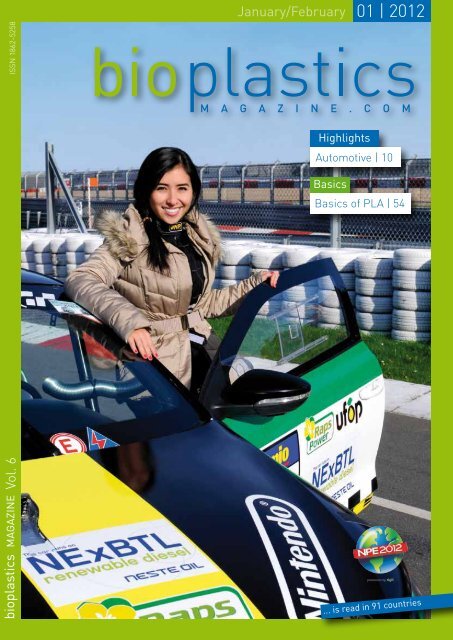
Cover: Michael Thielen<br />
4 bioplastics MAGAZINE [01/12] Vol. 7<br />
Follow us on twitter:<br />
http://twitter.com/bioplasticsmag<br />
Be our fan on Facebook:<br />
http://www.facebook.com/pages/bioplastics-MAGAZINE/103745406344904
News<br />
Telles JV is ending – Mirel shall go on …<br />
Metabolix announced on Jan. 12, 2012 that ADM has given<br />
notice of termination of the Telles, LLC joint venture for PHA<br />
bioplastics. Metabolix however, will remain committed to<br />
successfully commercializing PHA bioplastics, as Richard<br />
Eno, Chief Executive Officer of Metabolix points out.<br />
The effective date of the termination will be February<br />
8, 2012. Telles was established as a joint venture between<br />
Metabolix, Cambridge, Massachussetts, USA, and ADM,<br />
Decatur, Illinois, USA in July 2006. The joint venture sold<br />
PHA-based bioplastics, including Mirel and Mvera, in the<br />
USA, Europe and other countries.<br />
All Metabolix technology concerning PHA bioplastics that<br />
was used in the joint venture, including intellectual property<br />
rights, will revert solely to Metabolix.<br />
“Clearly, we are disappointed by ADM’s decision to withdraw<br />
from Telles. While this is a setback, we remain committed to<br />
successfully commercializing PHA bioplastics. Over the past<br />
few years, we now have proven the technology at industrial<br />
scale and believe that we now have the opportunity to launch<br />
this business with a different business model,” said Richard<br />
Eno. He continued, “We sincerely thank our customers,<br />
distributors, and partners for their interest in developing<br />
PHA-based solutions to address a growing market need<br />
for bioplastics. We will be evaluating alternate plans for<br />
commercialization and clearly wish to supply this growing<br />
market in the future.”<br />
Being asked by bioplastics MAGAZINE how such alternate<br />
plans could look like, Richard Eno responded:” Given<br />
Metabolix’s PHA intellectual property technology portfolio and<br />
longtime experience within the industry, we’re confident that<br />
we’ll be successful in finding a new option for manufacturing<br />
and commercialization. The Company has been in contact<br />
with potential partners who expressed interest – these<br />
include raw materials suppliers, manufacturers, industry<br />
players and customers. Metabolix will continue to engage in<br />
new partnering discussions and evaluate options to launch<br />
its PHA bioplastics business with a new model.”<br />
And he added: “The bioplastics market is growing at 20<br />
percent per year, and based on our experience, we can see<br />
where a PHA offering can participate in this growth – as is<br />
evidenced by the strong customer validation we’ve had for the<br />
product. Metabolix’s PHA technology platform is a valuable<br />
contribution to the industry, and as such, the Company plans<br />
to continue to focus on the development of PHA bioplastics.<br />
Metabolix is also developing biosourced industrial chemicals<br />
and a proprietary platform technology for co-producing<br />
plastics, chemicals and energy, from crops. We believe<br />
that Metabolix is positioned for growth, as the demand for<br />
biobased technologies<br />
continues to rise.”<br />
And finally, Eno is<br />
keen to: “... express<br />
my appreciation for<br />
the efforts put forth<br />
by the Telles and ADM<br />
Polymer teams, who<br />
have demonstrated<br />
the commercialization<br />
of PHA bioplastics at<br />
world scale. MT<br />
www.metabolix.com<br />
Richard Eno, CEO, Metabolix<br />
Rodenburg acquired Optimum<br />
Rodenburg Biopolymers BV, Oosterhout, the Netherlands, manufacturer of potato starch based Solanyl bioplastic compounds,<br />
has purchased Optimum BV, Rotterdam, the Netherlands, producer of FlourPlast biodegradable biopolymers. Details about<br />
the financial terms of the deal were not disclosed.<br />
Both products, Solanyl and FlourPlast, were developed with the German company Wacker Chemie from Munich.<br />
The acquisition enables Rodenburg to serve both the converter and the compounder markets with biopolymers. The raw<br />
materials for their Solanyl compound are based on reclaimed side stream starch from the potato processing industry. This<br />
is now complemented by Optimum’s proprietary FlourPlast biopolymer, based on grain-derived products, which can be<br />
directly compounded with existing biopolyesters. In addition, FlourPlast allows processors to fine-tune bioplastic or polyolefin<br />
formulations to achieve desired properties and reduce costs. Solanyl, available since 2004 can be used in injection moulding,<br />
sheet extrusion, thermoforming and blow moulding. It is sold as a compound, where as FlourPlast is sold as a pre-compound<br />
system. MT<br />
www.biopolymers.nl<br />
www.optimumbioplastics.com<br />
bioplastics MAGAZINE [01/12] Vol. 7 5
News<br />
bioplastics MAGAZINE presents:<br />
The 2nd PLA World Congress in Munich/Germany is the must-attend<br />
conference for everyone interested in PLA, its benefits, and challenges.<br />
The conference offers high class presentations from top individuals in the<br />
industry and also offers excellent networkung opportunities. Please find below the<br />
preliminary programme. Find more details and register at the conference website<br />
2 nd PLA World<br />
C o n g r e s s<br />
15 + 16 MAY 2012 * Munich * Germany<br />
www.pla-world-congress.com<br />
2nd PLA World Congress, Preliminary Program<br />
Tuesday, May 15, 2012<br />
08:00 - 09:00 Registration, Welcome-Coffee<br />
09:00 - 09:15 Michael Thielen, Polymedia Publisher Welcome<br />
09:15 - 09:45 Harald Kaeb, narocon Keynote Speech: Bioplastics - Future or Hype ?<br />
09:50 - 10:15 Udo Mühlbauer, Uhde Inventa-Fischer Latest developments in production of PLA<br />
10:15 - 10:40 Chae Hwan Hong, Hyundai-Kia Motors Development of Four Unit Process Technologies for PLA Manufacturing<br />
10:40 - 10:55 Q&A<br />
10:55 - 11:20 Coffeebreak<br />
11:20 - 11:45 Mark Vergauwen, NatureWorks The Latest in Ingeo Performance Developments<br />
11:45 - 12:10 Francois de Bie, Purac High Heat PLA for use in high performance fibers and other durable appl.<br />
12:10 - 12:35 Kevin Yang, Shenzhen Brightchina ESUN PLA<br />
12:35 - 12:50 Q&A<br />
12:50 - 14:00 Lunch<br />
14:00 - 14:35 Patrick Zimmermann, FkUR Modifying PLA to the next level<br />
14:35 - 14:50 Karin Molenveld, Wageningen (WUR) Strain induced crystallisation as a method to optimize PLA properties<br />
14:50 - 15:15 Daniel Ganz, Sukano PLA Masterbatch Technology – State of the art and latest trends<br />
15.15 - 15:40 Marcel Dartee, Polyone Additives / Masterbatches for PLA<br />
15:40 - 15:55 Q&A<br />
15:55 - 16:30 Coffeebreak<br />
16:35 - 17:00 Jan Noordegraaf, Synbra PLA particle foam<br />
17:00 - 17:25 N.N., Toray International Toray‘s modified PLA materials<br />
17:25 - 17:50 Mr. Shim, SK Chemicals title t.b.c.<br />
Wednesday, May 16, 2012<br />
09:00 - 09:25 Karl Zimmermann, Brückner Latest Technology in Film Stretching<br />
09:25 - 09:50 Frank Ernst, Taghleef NATIVIATM – The BoPLA film for packaging and labelling applications<br />
09:50 - 10:15 Larissa Zirkel, Huhtamaki Innovative Concepts of Functional PLA Films<br />
10:15 - 10:40 Shankara Prasad, SPC Biotech Bio conversion of agriwaste to polylactic acid<br />
10:40 - 10:55 Q&A<br />
10.55 - 11:20 Coffeebreak<br />
11:20 - 11:45 Johann Zimmermann, NaKu Processing PLA (title t.b.c.)<br />
11:45 - 12:10 N.N., Ireland, t.b.c. Processing PLA (title t.b.c.)<br />
12:10 - 12:35 Mathias Hahn, Fraunhofer IAP Modification of PLA with view to enhanced barrier and thermal properties<br />
12:35 - 12:50 Q&A<br />
12:50 - 14:00 Lunch<br />
14:00 - 14:35 Steve Dejonghe, Galactic Building the recycling scheme for PLA<br />
14:35 - 14:50 Gerold Breuer, Erema Closing the loop on bioplastics by mechanical recycling<br />
14:50 - 15:15 Sebastian Schippers, (IKV) Recycling of polylactic acid and utilization of recycled polylactic acid<br />
15.15 - 15:40 Ramani Narayan, Michigan State University Positioning and branding PLA products from carbon footprint and end-of-life<br />
15:40 - 15:55 Q&A<br />
16:00 - 16:30 Panel discussion: End of life options<br />
(subject to changes, visit www.pla-world-congress for updates)<br />
6 bioplastics MAGAZINE [01/12] Vol. 7
News<br />
New plants to produce succinic acid and BDO<br />
BioAmber Inc. from Minneapolis, Minnesota, USA, a next<br />
generation chemicals company, and Mitsui & Co., Chiyodaku,<br />
Tokyo, Japan, a leading global trading company, have<br />
partnered to build and operate the previously announced<br />
manufacturing facility in Sarnia, Ontario, Canada. The initial<br />
phase of the facility is expected to have production capacity of<br />
17,000 tonnes of biosuccinic acid and commence commercial<br />
production in 2013. The partners intend to subsequently<br />
expand capacity and produce 35,000 tonnes of succinic<br />
acid and 23,000 tonnes of 1,4 butanediol (BDO) on the site.<br />
Bioamber and Mitsui also intend to jointly build and operate<br />
two additional facilities that, together with Sarnia, will have<br />
a total cumulative capacity of 165,000 tonnes of succinic acid<br />
and 123,000 tonnes of BDO. BioAmber will be the majority<br />
shareholder in the plants.<br />
Succinic acid and 1,4-BDO are used to make polybutylene<br />
succinate biopolymer (PBS), a biodegradable polymer that<br />
until now is made from petroleum. “The use of BioAmber<br />
Biosuccinic Acid enables the PBS biopolymer to be not only<br />
biodegradable, but also partially renewable and — more cost<br />
effective”, as Babette Pettersen, Senior VP Marketing & Sales<br />
of BioAmber explained to bioplastics MAGAZINE, “in addition,<br />
BioAmber also has a low-cost route to Bio-1,4-BDO, based<br />
on technology licensed from DuPont, that enables us to<br />
tranform biosuccinic acid into Bio 1,4-BDO. This will enable a<br />
100% renewable biopolymer (Bio-Succinic Acid + Bio-BDO).”<br />
One of the key issues with biopolymers to date has been<br />
lack of performance. PBS takes this to another level, and<br />
BioAmber‘s mPBS (modified PBS) enhances these properties<br />
further. Designed and formulated using BioAmber’s<br />
proprietary technology, their mPBS meets end-user<br />
requirements for higher performing, biodegradable plastics.<br />
The uniformity, performance and processability of mPBS in<br />
existing equipment has been confirmed by a number of end<br />
users, with applications ranging from foodservice cutlery<br />
and coffee cup lids to plates, bowls, straws and stirrers,<br />
through to durable applications in Automotive, Building &<br />
Construction...<br />
BioAmber and Mitsui plan to build and operate a second<br />
plant in Thailand, which is projected to come on line in 2014.<br />
The partners are currently undertaking a feasibility study for<br />
the Thailand plant with PTT MCC Biochem Company Limited,<br />
a joint venture established between Mitsubishi Chemical<br />
Corporation and PTT Public Company Limited. BioAmber<br />
and Mitsui & Co. also plan to build and operate a third plant,<br />
located in either North America or Brazil, which will be<br />
similar in size to the Thailand project.<br />
“Our goal is to play a leading role in the growth of renewable<br />
chemicals, as evidenced by our recent joint ventures with<br />
BioAmber in North America for biosuccinic acid and The<br />
Dow Chemical Company in Brazil for biochemicals,” said<br />
Masanori Ikebe, General Manager of Mitsui’s Specialty<br />
Chemicals Division. “We believe that biosuccinic acid and<br />
bio‐BDO will experience rapid growth over the next decade,<br />
and BioAmber’s technology leadership is an excellent fit with<br />
Mitsui’s strength across the supply chain,” he added.<br />
“BioAmber’s partnership with Mitsui & Co. is a strong<br />
endorsement of our technology platform,” said Jean‐<br />
Francois Huc, CEO of BioAmber. “Mitsui is an ideal partner<br />
thanks to its long term commitment to renewable chemistry,<br />
its extensive reach into chemical markets and its strategic<br />
access to sustainable feedstocks. Mitsui also has the<br />
financial strength to support our expansion and help us<br />
compete internationally,” he added. MT<br />
www.bio-amber.com<br />
www.mitsui.com<br />
CHINAPLAS 2012 Grand Returns to Shanghai<br />
CHINAPLAS 2012 (The 26th International Exhibition on Plastics and Rubber Industries), which is dedicated to showcasing<br />
the world-class cutting-edge plastics and rubber technologies, will grandly return to Shanghai and held at Shanghai New<br />
International Expo Centre on April 18-21, 2012. One of 11 theme zones the organizer has set up in order to highlight the<br />
development of each specialized area comprehensively by displaying their cutting-edge technologies, techniques and<br />
applications for various industries is dedicated to bioplastics.<br />
The Bioplastics Zone will be the second year established in CHINAPLAS 2012, expecting more than 40% increase in the<br />
area. With the growing global concern on green manufacturing, bioplastics is inevitably the focus in the plastics industry, with<br />
enormous potential in the market. As the international platform for advanced technology in the plastics and rubber industries,<br />
CHINAPLAS 2012 will introduce the world’s leading bioplastics suppliers and their products like PLA, PHA, PBS, PPC, PCL,<br />
PVA, TPS, PA and PTT. The renowned exhibitors include Cardia, Danisco, Ecomann, Esun, Hisun, Kingfa, Mirel Plastics,<br />
NatureWorks, Nuvia, etc. Highlighting advanced technology and latest development on bioplastics, the 4th International<br />
Conference on Bioplastics and the Applications will be held concurrently with CHINAPLAS 2012. Like the last edition held in<br />
2011, speakers from the leading bioplastics suppliers will be invited. Overseas and Chinese plastics associations will continue<br />
to support the conference.<br />
www.chinapasOnline.com<br />
bioplastics MAGAZINE [01/12] Vol. 7 7
News<br />
Congress unveiled two-figure<br />
growth in WPC production<br />
With nearly 300 participants from 21 countries and 30<br />
exhibitors, the 4 th German WPC Congress, Cologne (13 th -14 th<br />
December 2011) organised by nova-Institute once more lived<br />
up to its reputation as the industry’s leading European event.<br />
The European market for Wood Plastic Composites (WPCs)<br />
has been growing at an average annual rate of 35% since<br />
2005. Given the current levels of investment in expanding<br />
production and growing interest from both trade and<br />
consumers, the industry is optimistic about the future and<br />
expects continued growth in every sector in the coming years<br />
over the next few years.<br />
WPCs are predominantly used in applications that<br />
emphasise product characteristics such as great rigidity<br />
and low shrinkage (compared to pure plastics) and better<br />
durability and mouldability (than pure wood products).<br />
However, as prices for plastics rise, it is only a matter of a<br />
few years before WPC pellets are cheaper than pure plastic<br />
pellets (they are presently 20-30% more expensive) and can<br />
then conquer mass markets.<br />
Winners of the WPC Innovation Prize –<br />
Evonik, Möller and Werzalit<br />
The presentation of the ‘WPC Innovation Prize’, which was<br />
sponsored this year by BASF Color Solution Germany was<br />
awarded to three companies. The audience of the congress<br />
voted for their favourites out of a short list of six innovations.<br />
1 st place: Evonik Industries, Essen, Germany<br />
- PLEXIGLAS ® Wood PMMA-wood composite<br />
Together with Reifenhäuser, Evonik developed a pure<br />
PMMA-wood composite that could be used to produce directly<br />
extruded profiles. Evonik says that the new material ‘takes<br />
WPCs to a whole new level in terms of weather resistance,<br />
colour stability, dimensional stability and technical strength’.<br />
The 2 nd place went to Möller, Meschede, Germany for a new<br />
WPC noise protection profile and the 3 rd place was awarded to<br />
Werzalit, Oberstenfeld, Germany for their process technology<br />
for in-mould coating of injection-moulded WPC parts. MT<br />
www.wpc-kongress.de<br />
Coca-Cola signed agreements<br />
to develop 100% plant based bottles<br />
In Mid December 2011 the Dutch company Avantium,<br />
Amsterdam, The Netherlands announced an agreement<br />
with The Coca-Cola Company to further co-develop their<br />
YXY technology for producing PEF bottles. First milestones<br />
include the start-up of an Avantium PEF pilot plant last<br />
December. Avantium plans to initiate commercial production<br />
of PEF in about three to four years.<br />
The Coca-Cola Company at the same time announced<br />
multi-million dollar partnership agreements with two other<br />
leading biotechnology companies to accelerate development<br />
of the first commercial solutions for next-generation<br />
PlantBottle packaging made 100% from plant based<br />
materials.<br />
The Coca-Cola Company‘s first generation PlantBottle<br />
packaging is the only fully recyclable PET bottle made with<br />
up to 30% plant-based material available today. PlantBottle<br />
packaging is made up of two components: MEG (monoethylene<br />
glycol), which makes up 30% of the PET, and<br />
is already made from plant materials, and PTA (purified<br />
terephthalic acid), which makes up the other 70%. In the<br />
next step, PTA will be replaced with plant-based materials,<br />
too.<br />
Therfore, Coca-Cola signed agreements with Virent<br />
and Gevo, also industry leaders in developing plant-based<br />
alternatives to materials traditionally made from fossil fuels<br />
and other non-renewable resources.<br />
Virent, Madison, Wisconsin, USA, has a patented<br />
technology that features catalytic chemistry to convert plantbased<br />
sugars into — among others — bio-based paraxylene,<br />
a key component needed to deliver plant-based terephthalic<br />
acid.<br />
Gevo, Englewood, Colorado, USA is going develop and<br />
commercialize technology to produce paraxylene from biobased<br />
isobutanol.<br />
Since introduced in 2009, the<br />
Coca-Cola Company has already<br />
distributed more than 10 billion partly<br />
biobased PlantBottle packages in 20<br />
countries worldwide. MT<br />
www.thecoca-colacompany.com<br />
www.yxy.com<br />
www.gevo.com<br />
www.virent.com<br />
8 bioplastics MAGAZINE [01/12] Vol. 7
News<br />
New crystal clear bioplastic<br />
for injection moulding<br />
End of last year FKuR from Willich, Germany presented its further<br />
developments of the cellulose acetate based Biograde® products. The<br />
highlight of this development is Biograde® V 2091 which is a completely<br />
transparent injection mouldable grade that has been developed for<br />
thin wall parts with long flow paths. Along with its high transparency,<br />
Biograde V 2091 stands out due to its smooth and shiny surface.<br />
Moreover, especially for thin walled parts, it outperforms standard<br />
polystyrene (PS) as to flexibility and heat distortion temperature.<br />
With these extended properties, the product line Biograde sets new<br />
standards and allows for the realization of diverse applications within<br />
the electronic and household appliances sector.<br />
Plate and cup made from transparent Biograde<br />
V 2091 (Photos FKuR Kunststoff GmbH)<br />
www.fkur.com<br />
FKuR will present more details on<br />
their PLA activities at the<br />
2 nd PLA World<br />
C o n g r e s s<br />
15 + 16 MAY 2012 * Munich * Germany<br />
Contact sales@fkur.com, to get a<br />
15% discount on the conference fee.<br />
organized by bM<br />
A truly globally diverse<br />
conference addressing the entire<br />
value chain.<br />
Experience networking and<br />
interactive events for real-time<br />
collaboration unlike any other.<br />
www.biopolymerworld.com<br />
Mestre-Venice, Italy, 23-24 April<br />
+1 858.592.6951<br />
Early Bird<br />
Discount Ends<br />
24 February<br />
Latest technology, future<br />
directions, & emergent trends<br />
that will leave you inspired.<br />
bioplastics MAGAZINE [01/12] Vol. 7 9
Automotive<br />
BioConcept-Car –<br />
New approaches into<br />
biomaterials<br />
By Michael Thielen<br />
The rear hatch made of<br />
flax and hemp<br />
The new ‘Bio-Rocco’ (Michael<br />
Thielen as passenger)<br />
The BioConcept-Car has become a true and faithful companion<br />
of bioplastics MAGAZINE. In our first ‚automotive issue‘<br />
in early 2007 we introduced the Ford Mustang racing car<br />
with bodywork made of flax fibre reinforced linseed acrylate. In<br />
2009, during the Composites Europe trade show the next generation<br />
BioConcept-Car, a green Renault Mégane Trophy was shown<br />
and bioplastics MAGAZINE reported in issue 01/2010. Last autumn<br />
the current BioConcept-Car, in this case a Volkswagen Scirocco,<br />
was introduced on the famous German race track, the Nürburgring,<br />
and during this event I was invited to experience a lap in<br />
the passenger seat of the car. I must admit: “What an experience<br />
!” Thomas (Tom) von Löwis of Menar, head of the Four Motors<br />
racing team, drove me around the legendary Nordschleife (‘The<br />
green hell’) at up to 240 km/h (150 mph) — up and down the ‘Eifel’<br />
hills and through one hairpin bend after another …. It was a great<br />
day. And after this experience I spoke with Tom von Löwis as well<br />
as with Prof. Hans-Josef Endres 1 , who consults for Four Motors<br />
with regard to the future use of bioplastics in the BioConcept-Car.<br />
On automanager.tv (an Internet platform) the editor and<br />
presenter Guido Marschall conducted an interview 2 with these two<br />
gentlemen. This article comprises parts of both these interviews.<br />
The Volkswagen Scirocco BioConcept-Car — in short the ‘Bio-<br />
Rocco’ — is a biodiesel driven racing car like its predecessors, but<br />
fuelled with a new generation of biodiesel, the so-called ‘NExBTL’.<br />
And it is becoming more and more sustainable. As a first step, the<br />
car was equipped with a rear hatch made of hemp and flax fibres.<br />
MT: What were the main reasons to convert the rear hatch to<br />
this special material?<br />
TvL: Besides the fact that we are trying to use as much biobased<br />
material as possible, lightweighting is an important issue.<br />
HJE: The topic of lightweighting is certainly important not only<br />
in order to win races, but also with a view to the fuel consumption<br />
and the exhaust emissions. But another very important fact here<br />
is the topic of resource conservation in terms of the materials<br />
used. We want to build highly efficient cars, however, not simply<br />
by using the resources that are available today. We also want<br />
to do this in 50 years from now. We want to apply plastics, with<br />
their fantastic properties, in the future, and also for demanding<br />
technical applications. Thus we need materials that do not<br />
depend on limited resources but are available even in the long<br />
term — and with the technical properties we need.<br />
10 bioplastics MAGAZINE [01/12] Vol. 7
Automotive<br />
The ‘Bio-Rocco‘ (Photo: Four-Motors)<br />
GM: Now, these new materials are not being developed in<br />
the first place with the aim of achieving new records in car<br />
racing, but motor sport offers the possibility of testing these<br />
new materials to the limit, and then to take advantage of<br />
these experiences for series production vehicles. Besides the<br />
fun that motor sport offers, this has been common practice<br />
for years, even in Formula 1. Which new insights are being<br />
collected with biomaterials used in motor sport today?<br />
TvL: One example is lightweighting, which we just<br />
mentioned. Let us compare this new version with a<br />
component in the first Mustang in 2006. The natural fibre<br />
reinforced material at that time was slightly heavier than a<br />
fibreglass material. Today, for example with the support of<br />
Professor Endres, the new hemp/flax version is almost as<br />
light as carbon fibre.<br />
HJE: We have learned a lot. Natural fibres in fact show<br />
similar, although different, properties from those of glass or<br />
carbon fibres. And subsequently the processing is similar but<br />
also different. Here questions had to be resolved, for example<br />
concerning the draping of a fabric. How does the weaving<br />
technology have to be adopted in order to optimise the<br />
draping behaviour? What is the optimum weight per area of<br />
a fabric so that the fabric can absorb enough resin and lead<br />
to an optimum final density? What about the compatibility<br />
(fibre/matrix adhesion) of the natural fibres and the resins?<br />
What are the resulting material properties of the composite?<br />
We are at the very beginning of an exciting learning process.<br />
GM: What kind of biomaterials are we talking about here?<br />
HJE: The natural fibres we are using are flax and hemp. For<br />
the time being we are combining these with petroleum based<br />
castable crosslinked resin systems because we wanted to<br />
concentrate first on the optimisation that we mentioned in<br />
terms of fibres and weaving. But in future steps we also want<br />
to look into resin systems based on vegetable oils, such as<br />
linseed or sunflower. For the thermoplastic materials we are<br />
looking at different technical bioplastics like bio-PA or new<br />
biopolyesters, and in future also at biobased polypropylene.<br />
GM: Which components in the racing car can be replaced<br />
by components made from biobased materials?<br />
TvL: I would not venture to say all, but most probably all<br />
those body parts that can be replaced in a racing car, such as<br />
the hood, left, and right doors, the rear hatch, the front and<br />
back bumpers, fenders etc. can all be made from these new<br />
natural fibre composites.<br />
MT: Are these natural fibre composites as stable as<br />
conventional ones?<br />
HJE: They can withstand the same loads as body parts<br />
made from fibreglass or carbon fibre, and one additional<br />
advantage is that they do not splinter in crashes.<br />
GM: And this is most especially desirable if we think about<br />
converting the material to series production vehicles.<br />
HJE: Yes, and they are lighter today than fibreglass parts,<br />
and only 30 percent of the weight of a steel version. In a small<br />
production series they can even be manufactured at a lower cost.<br />
Tom von Löwis, Hans-Josef Endres and Guido<br />
Marschall on automonager.tv (photo: automanager.tv)<br />
bioplastics MAGAZINE [01/12] Vol. 7 11
GM: For example in the field of electromobility consumers<br />
set great store on showing that they are doing good for the<br />
environment. Shouldn’t biomaterials offer the possibility of<br />
showing this particular property, i.e. of being ‘green’? Or is<br />
it still a ‘no-go’ to leave natural fibres openly visible in a car?<br />
TvL: For carbon fibre parts it is sexy to see the black fabric<br />
through the resin in an unpainted part. People want to see<br />
and show what high tech parts they have. We should take<br />
a similar approach. Make it visibly clear that we are using<br />
biobased materials — and be proud of it.<br />
Hans-Josef Endres and Tom von Löwis<br />
MT: And what comes next?<br />
HJE: In addition to the doors, fenders etc, we will look into<br />
three-dimensional parts such as mirror housings or parts of<br />
the dashboard. But here completely different thermoplastic<br />
processable bioplastics are needed. And even here we want<br />
to compete with petroleum-based materials in terms of<br />
quality, durability and cost.<br />
GM: Will all this also be suitable for mass production? We<br />
know from carbon fibre applications that it was not possible<br />
to convert the manufacturing processes easily to series<br />
production. Now we are getting there slowly, and step by step.<br />
HJE: Of course we see a chance here and this is a challenge.<br />
But we are only at the beginning of the development. In fact<br />
there are already quite a number of bioplastics in automotive<br />
applications today. These are parts in the interior such as<br />
hatracks, spare-wheel covers or parts of the instrument<br />
panel. All these can be manufactured with existing mass<br />
production techniques. However, most of these parts are<br />
invisible or covered. One of the next steps is to make exterior<br />
parts and visible parts.<br />
GM: Let’s talk about money. The OEMs and sub-suppliers<br />
are always interested in the cost factor. I assume these<br />
new materials are not cheaper than the conventional ones,<br />
otherwise the automotive industry would be applying them<br />
already.<br />
HJE: Well, you should not only look at the raw material cost<br />
but at the complete system. If we consider for example the<br />
‘end of life’, we know that in waste incineration glass fibres<br />
would create ash. Natural fibres, however, don’t leave behind<br />
so much ash but contribute to what we call ‘renewable<br />
energy’. If we look at the processing we see that glass fibres<br />
are more abrasive, whereas natural fibres are not abrasive.<br />
Thus the life-time of tools and dies is much longer.<br />
MT: In addition it can be observed that the cost of traditional<br />
plastics is rising with the increasing price of oil. So biobased<br />
plastics will become competitive in the mid to long term,<br />
and not only via economies of scale with larger production<br />
capacities.<br />
But after all this talking about materials and renewable<br />
resources, there is one more important target for Tom von<br />
Löwis and his team: They want to drive and win races with<br />
their BioConcept Car. Good luck for the coming season!<br />
www.fourmotors.com<br />
www.ifbb-hannover.de<br />
www.fnr.de<br />
1: Prof. Dr.-Ing. Hans Josef Endres, IfBB,<br />
Institute for Bioplastics and Biocomposites,<br />
University Hanover, Germany. Supported by the<br />
FNR (Agency for Renewable Resources within the<br />
German Federal Ministry of Food, Agriculture and<br />
Consumer Protection) the IfBB will assist Four<br />
Motors to develop more and more components<br />
made from biobased materials (natural fibres and<br />
bioplastics) for the BioConcept Car.<br />
2: We are grateful to Guido Marschall and<br />
autmomanager.tv for the permission to publish<br />
parts of their ‘auto-talk’ interview of Dec. 13th<br />
2011. www.automanager.tv<br />
Covergirl Christine also took a ride in the<br />
Bio-Rocco. She said: “Amazing, a ‘green car’<br />
in the’green hell’ and with more biobased<br />
plastic parts it becomes even greener.”<br />
12 bioplastics MAGAZINE [01/12] Vol. 7
Automotive<br />
Photo: DuPont<br />
Fuel line made of bio-PA 1010<br />
The fluid transfer system supplier Hutchinson SRL, of<br />
Rivoli, Italy, has specified a DuPont Zytel ® RS polyamide<br />
grade based on PA 1010 for the production of<br />
fuel lines used with both diesel and biodiesel. The renewably-sourced<br />
long-chain nylon was chosen in preference to<br />
competitive grades of PA12 on the basis of its superior temperature<br />
resistance and long-term aging performance in biodiesel.<br />
The extruded, monolayer fuel line from Hutchinson is<br />
already in use on commercial new turbo and multijet diesel<br />
engines used on several Fiat vehicles, including the Fiat 500,<br />
Panda, Punto, Lancia Delta, Alfa Romeo MiTo and Giulietta.<br />
As well as seeking to increase the use of renewablysourced<br />
polymers to reduce dependence on fossil fuels,<br />
automotive manufacturers, OEMs and materials suppliers<br />
are modifying engine and fuel systems to run efficiently<br />
on the latest generation of biofuels, including biodiesel.<br />
Components for such systems must resist the chemicallyaggressive<br />
biofuels, temperature extremes and mechanical<br />
stresses for the lifetime of the vehicle. This specific Zytel<br />
RS grade based on PA1010, which contains more than 60%<br />
renewably sourced ingredient by weight, offers properties<br />
typical of flexible polyamides with additional benefits such<br />
as superior high temperature resistance when compared<br />
to materials such as PA 12, high chemical resistance and<br />
low permeability to fuel and gases. It is suitable for a range<br />
of extrusion applications including fuel lines, hydraulic<br />
hoses, corrugated tubes, transmission oil cooler hoses and<br />
pneumatic tubes.<br />
“We were seeking a polymer for our fuel line application that<br />
was preferably renewably-sourced, for a more sustainable<br />
solution, and was able to provide the best aging stability in<br />
biodiesel,” explains Katia Rossi, development manager at<br />
Hutchinson. “We considered a number of flexible polyamides,<br />
including PA12 as they had previously been specified for similar<br />
fuel line systems, but material testing showed Zytel RS PA1010<br />
to meet our requirements. It combines, for example, superior<br />
temperature resistance to PA12 with the best resistance to<br />
biodiesel at high temperatures.” Data on aging performance in<br />
biodiesel was obtained by immersing the materials in the most<br />
common biodiesel – rapeseed methyl ester (RME) – at 125 °C<br />
(257 °F) for 1,000 hours and measuring retained mechanical<br />
properties. The B30 biodiesel used for testing is made up of<br />
30% biofuel from rapeseed and recycled vegetable oil and 70%<br />
standard diesel and is suitable for many diesel cars.<br />
By specifying the DuPont material for its fuel line for diesel<br />
engines, Hutchinson gains a longer-lasting solution that<br />
is also market leading in terms of its renewably-sourced<br />
content. “With more than 60% by weight, this Zytel RS grade<br />
based on PA1010 has one of the highest levels of renewablysourced<br />
content currently available for a high performance<br />
nylon,” confirms Mario Delbosco, development programs<br />
manager at DuPont Performance Polymers. The renewable<br />
carbon in PA1010 comes from sebacic acid, which in turn is<br />
derived from castor oil.<br />
The successful adoption of renewably-sourced Zytel nylon<br />
for the fuel line, which is already in commercial use on<br />
diesel-engined cars, has encouraged Hutchinson to extend<br />
the application to other automotive manufacturers in Europe<br />
and beyond as well as other fuel system applications.<br />
www.dupont.com<br />
bioplastics MAGAZINE [01/12] Vol. 7 13
Automotive<br />
Bioplastics in<br />
automotive applications<br />
By<br />
Daniela Rusu, Séverine A.E. Boyer<br />
Marie-France Lacrampe, Patricia Krawczak<br />
Ecole des Mines de Douai, Department of<br />
Polymers and Composites Technology &<br />
Mechanical Engineering, Douai, France<br />
Nowadays, polymeric materials represent approximately 20 % of the<br />
total weight of an automobile, in other words 100 to 150 kg/car.<br />
This substantial need in plastics, and recent economical and ecological<br />
issues such as the increasing crude oil price, accelerated depletion<br />
of fossil resources, together with the new regulations for controlling<br />
greenhouse gas emissions and management of the end-of-life of vehicles,<br />
has encouraged the automotive industry to develop, adapt or revive<br />
some long existing more eco-friendly plastic materials and biocomposites<br />
for their modern cars.<br />
Currently bioplastics cover a wide range of materials, from commodity<br />
thermoplastics up to engineering materials and thermosetting resins.<br />
Within these bio-based polymeric materials, some are already validated<br />
for different automotive applications: it is the case for some bio-based<br />
polyamides and bio-based polyurethane foams, but also for polylactic<br />
acid formulations and fabrics.<br />
Other bioplastics with potential/validated use in automotive industry<br />
are belonging to the class of bio-based polyesters and copolyesters,<br />
starch plastics, bio-based polyolefins and bio-based thermosetting<br />
polymers such as unsaturated polyester resins or bio-based epoxies (for<br />
more details see [1]). And even if some of their present features are not<br />
yet optimal for durable automotive applications, they could offer in future<br />
real alternatives for petrochemical plastics in modern cars.<br />
Taken from Handbook of Bioplastics and<br />
Biocomposites Engineering Applications<br />
edited by Srikanth Pilla – Wiley-Scrivener 2011<br />
(http://www.wiley.com/WileyCDA/WileyTitle/<br />
productCd-0470626070.html).<br />
14 bioplastics MAGAZINE [01/12] Vol. 7
Automotive<br />
The following shows three examples of bioplastics and vegetal fibre<br />
reinforced bioplastics to have an idea about the potential of these types of<br />
materials for automotive applications.<br />
Biopolyamides (Bio-PA)<br />
Polyamides (PA) are engineering thermoplastics that combine excellent<br />
mechanical properties, such as high mechanical strength and stiffness,<br />
wear properties, good heat resistance, together with chemical resistance<br />
to oils and solvents, dielectric properties, fire resistance, good appearance,<br />
and good processability. All these interesting features design them for<br />
high-end automotive applications, especially for under-the-hood car<br />
compartment. In fact, PA and PA composites represent about 10% of the<br />
plastics parts in modern cars.<br />
Until recently, the polyamides for car applications were petro-based,<br />
except the Rilsan ® PA 11 from Arkema, derived from castor oil, and already<br />
used for flexible tubing, mono-wall fuel lines and Rilperm ® multi-layer fuel<br />
lines, such as in ESD-Flex conductive fuel-pump module for General Motor<br />
car models, and for friction parts, quick connectors, pneumatic brake<br />
noses.<br />
Today, several other new bio-based polyamides appeared on the market,<br />
derived (at least partly) from renewable feedstocks such as castor beans<br />
and sugar cane. A recent example of an under-the-hood application of a<br />
biopolyamide, the DuPont Zytel ® RS, PA 6.10 (with 62.5% biobased carbon<br />
content), is the new automotive radiator end tank proposed by Toyota,<br />
Denso and DuPont Automotive consortium, and used in some 2009 Toyota<br />
Camrys vehicles.<br />
In appears that current and emerging bio-PA are promising new solutions<br />
for replacing the petrochemical polyamides, but also for extending the<br />
metal substitution in car applications, improving automotive comfort,<br />
design and insulation, and enriching the performances with fuel economy<br />
and reduced CO 2<br />
emissions.<br />
PLA and PLA-based composites<br />
While the biopolyamides already represent themselves as engineering<br />
polymers for high-end automotive applications, PLA is a rather new polymer<br />
in automotive applications and from some aspects, still in development.<br />
For long time, this aliphatic biodegradable polyester was intended only for<br />
biomedical and packaging uses, but in the last years, new PLA-improved<br />
materials were proposed for durable applications, such as transportation,<br />
electrical applications and electronics.<br />
Up to now, PLA fibers and fabrics were proposed for floor mats, in<br />
Toyota Raum and Prius cars (2003), and for canvas roof and carpet mats<br />
in Ford Model U (2003). The more recent Biofront stereocomplex PLA codeveloped<br />
Teijin & Mazda, is intended for automotive applications such as<br />
car seat fabric, as for Mazda Premacy Hydrogen RE Hybrid vehicle, but also<br />
floor mats, pillar cover, door trim, front panel and ceiling material.<br />
Vegetal fibre reinforced PLA is another class of green materials, with<br />
current and potential car applications. For instance, Toyota is already<br />
proposing automotive applications for PLA/kenaf biocomposites, such<br />
as the cover spare wheel on Toyota Prius and Toyota Raum (2003) or the<br />
translucent roof PLA/kenaf and ramie biocomposites on Toyota 1/X plug-in<br />
hybrid concept vehicle.<br />
Castor plant<br />
Accelerator pedal made from bio-PA 6.10 (prototype)<br />
bioplastics MAGAZINE [01/12] Vol. 7 15
However, the long-term properties of PLA-based materials intended<br />
for durable applications are to be validated over different time periods<br />
and aggressive environment conditions, before thinking to extend their<br />
automotive applications.<br />
Bio-based polypropylene (bio-PP)<br />
Petrochemical polypropylene (PP) is largely used in modern<br />
cars, and this is an important motivation for developing alternative<br />
greener materials with similar features, able to substitute it. Several<br />
attempts were made for obtaining bio-PP via bio-ethanol from<br />
different renewably feedstocks. For instance, Braskem and Novozymes<br />
announced a research partnership to develop large-scale production of<br />
green PP from sugarcane, a resin already obtained on laboratory scale<br />
(Braskem) and certified as 100% renewable. In the same time, Mazda<br />
is actively developing a bio-route for obtaining various PP and ethylenepropylene<br />
copolymers from cellulosic biomass. These new bio-based<br />
materials are intended in future to replace their petrochemical<br />
counterparts automotive applications such as (i) car bumpers and<br />
bumper spoilers, lateral siding, roof/boot spoilers, rocker panels,<br />
body panels; (ii) dashboards and dashboard carriers, door pockets<br />
and panels, consoles; (iii) heating ventilation air conditioning, battery<br />
covers, air ducts, pressure vessels, splash shields.<br />
In future, the new bio-based PP could also gradually shift the<br />
petrochemical PP from its biocomposites with natural fibers, in trim<br />
SusPack<br />
conference on sustainable packaging<br />
2012<br />
www.suspack.eu<br />
For the second time at the Anuga FoodTec, the conference<br />
„Sustainable Packaging - SusPack 2012“ is taking place from<br />
March 29th - 30th 2012.<br />
At the two-day conference (at Koelnmesse, Cologne) current issues<br />
and solutions for sustainability in the packaging industry will be<br />
presented and discussed. The focus is on bio-based packaging:<br />
Where and in what form have they been able to establish? What<br />
benefi ts do they bring? What has to be considered in the use? And<br />
fi nally, what innovations, trends and potentials are becoming evident?<br />
Topics<br />
new developments in bio-packaging<br />
End-of-life options<br />
overview over packaging market<br />
SusPack 2012:<br />
booking now on<br />
www.suspack.eu<br />
how to reduce food decay through new packaging solutions<br />
packaging from bio-based Polyethylen<br />
Call for papers & SusPack Award<br />
PLA based car seat fabric<br />
(photo: Mazda)<br />
parts applications in dashboards, door panels,<br />
parcel shelves, seat cushions, backrests and<br />
cabin linings, car disk brakes and even for exterior<br />
applications, such as the engine/transmission<br />
covers in Mercedes-Benz Travego Coach.<br />
General Conclusions<br />
Recent economical and ecological increasing<br />
concerns are offering strong motivations for<br />
substituting the well-known polymeric materials<br />
derived from fossil feedstocks and, in some<br />
cases, some metal materials with more ecofriendly<br />
materials from renewable resources, for<br />
a wide range of durable applications.<br />
More particularly, the green high-end polymeric<br />
materials are presenting a large potential for<br />
car applications and this trend is expected to<br />
grow over the next decades, knowing that the<br />
next-generation of vehicles will need to show<br />
enhanced efficiency in material use and increased<br />
technical and functional performances, while<br />
providing improved ecological footprint and less<br />
dependence on fossil feedstock costs.<br />
www.mines-douai.fr<br />
[1] Handbook of Bioplastics and Biocomposites<br />
Engineering Applications, chapter “Bioplastics<br />
and Bioplastics and Vegetal Fibre Reinforced<br />
Bioplastics in Automotive Applications”, edited by<br />
Srikanth Pilla<br />
Take part and send your application to Ms. Lena Scholz,<br />
phone: +49 (0)2233 48 1448, e-mail:<br />
lena.scholz@nova-institut.de, by January 27 th , 2012.<br />
Organiser<br />
www.nova-institut.eu<br />
Partner<br />
www.anugafoodtec.de<br />
Do you have any questions<br />
concerning SusPack 2012?<br />
We are happy to help you!<br />
Mr. Dominik Vogt<br />
Tel.: +49 (0) 22 33 – 48 14 49<br />
dominik.vogt@nova-institut.de<br />
16 bioplastics MAGAZINE [01/12] Vol. 7
BIOADIMIDE TM IN BIOPLASTICS.<br />
EXPANDING THE PERFORMANCE OF BIO-POLYESTER.<br />
NEW PRODUCT LINE AVAILABLE:<br />
BIOADIMIDE ADDITIVES EXPAND<br />
THE PERFOMANCE OF BIO-POLYESTER<br />
BioAdimide additives are specially suited to improve the hydrolysis resistance and the processing stability of bio-based<br />
polyester, specifically polylactide (PLA), and to expand its range of applications. Currently, there are two BioAdimide grades<br />
available. The BioAdimide 100 grade improves the hydrolytic stability up to seven times that of an unstabilized grade, thereby<br />
helping to increase the service life of the polymer. In addition to providing hydrolytic stability, BioAdimide 500 XT acts as a<br />
chain extender that can increase the melt viscosity of an extruded PLA 20 to 30 percent compared to an unstabilized grade,<br />
allowing for consistent and easier processing. The two grades can also be combined, offering both hydrolysis stabilization and<br />
improved processing, for an even broader range of applications.<br />
Focusing on performance for the plastics industries.<br />
Whatever requirements move your world:<br />
We will move them with you. www.rheinchemie.com
Automotive<br />
PLA and carbon nanotubes<br />
Nanotechnology for automotive applications<br />
Conductivity (S/cm)<br />
1,4<br />
1,2<br />
1<br />
0,8<br />
0,6<br />
0,4<br />
0,2<br />
0<br />
By<br />
A. Tielas, V. Ventosinos, M. de Dios<br />
Plastic Product / Process Area<br />
Engineering & Development Department<br />
Galician Automotive Technological Centre<br />
(CTAG)<br />
Porriño, Spain<br />
PLA/CNT (7%) PLA/CNT (7%)<br />
Talc (10%)<br />
PP/CNT (7%) PP/CNT (7%)<br />
Talc (10%)<br />
Fig. 1. Conductivity measured by the Van der Pauw method<br />
of 15x15x2 mm polylactic acid (PLA) and polypropylene (PP)<br />
pieces filled with the same content of CNT. PLA pieces<br />
exhibit more than five times the conductivity of PP samples.<br />
R impact<br />
Impact<br />
R t=∞<br />
Fig. 2. Resistance profile in a polymer/CNT sample<br />
during an impact.<br />
The continuous development of science is making possible<br />
the design of new materials with properties that were unthinkable<br />
a few years ago. The constant searching for lighter<br />
compounds, durable and compatible with the environment, has<br />
become one of the main goals of many researches today. In this<br />
sense, nanotechnology has quickly revolutionized the whole picture<br />
of current design of high added value materials due to the<br />
unique properties that those composites exhibit in fields as diverse<br />
as electronics, mechanics, optics or magnetism.<br />
Carbon nanotubes (CNTs) perfectly illustrate all the benefits<br />
that nanotechnology can bring, especially in the manufacture<br />
of polymer based nanocomposites. This is due to, among other<br />
reasons, their high electrical and thermal conductivity, which<br />
are transferred to the polymer, even using relatively small loads<br />
of CNTs. Many studies are being carried out to optimize the<br />
fabrication of polymer/CNT compounds, especially to improve the<br />
dispersion of CNTs within the polymer matrix.<br />
The Galician Automotive Technology Centre (CTAG), through its<br />
Engineering and Development department in the area of plastic<br />
products, seeks to explore and exploit all the inherent advantages<br />
of joining together polymer science and nanotechnology.<br />
Committed to the need to preserve respect for the environment<br />
by using, as far as possible, renewable sourced materials, CTAG<br />
currently develops compounds based on polylactic acid (PLA) and<br />
CNTs intended for diverse applications.<br />
Indeed, one of the most interesting properties of PLA/CNT<br />
composites from the standpoint of the practical applicability is<br />
their electrical conductivity. It is known that internal CNT networks<br />
are formed beyond a given threshold concentration of filler, the<br />
point at which a great increase of the electrical conductivity of the<br />
material appears. The electrical behaviour of the polymer also<br />
largely depends on the degree of alignment and dispersion of CNTs<br />
within the polymer matrix. PLA favours the dispersion of CNTs due<br />
to its polar character, and, in fact, PLA/CNT compounds exhibit<br />
in the order of five times the conductivity of PP/CNT composites<br />
(Figure 1).<br />
It has been shown that an external factor that can alter the<br />
disposition of CNTs, further produces conductivity changes in<br />
the sample. This behaviour allows, for example, the detection of<br />
impacts, by conductivity measurements, on pieces made of this<br />
material. The potential applications are vast, from the dynamic<br />
monitoring of structural damage of key parts of a car, to the<br />
localizing and counting of impacts on the surface of an airplane<br />
fuselage (Figure 2).<br />
Based on the same principle, we have developed prototypes<br />
of smart pedals that can detect emergency braking situations<br />
and activate adequate safety measures in case of an imminent<br />
18 bioplastics MAGAZINE [01/12] Vol. 7
Automotive<br />
collision. Drivers react instinctively by contracting their bodies<br />
under impact danger situations, and this fact can reduce the braking<br />
efficiency just at the very moment prior to a possible collision. The<br />
conductivity of a pedal made of polymer/CNT composite depends on<br />
the pressure exerted over its surface, thus it is possible to predict<br />
risky braking scenarios and enhance the security profile of the<br />
entire car (Figure 3).<br />
An added advantage of PLA/CNT composites relies on their<br />
ability to act as electromagnetic shields. As many parts of an<br />
automobile, and generally many everyday electronic devices, have<br />
electronic circuits susceptible to emitting radiation, it is necessary<br />
to make use of materials of capable EM shielding in order to<br />
avoid interferences between them, and also for the provision of a<br />
radiation free environment that meets the current electromagnetic<br />
emissions legislation for health (e.g. UNE-EN 50083-212007).<br />
First results show the suitability of this kind of material for<br />
electromagnetic shielding purposes, to a certain extent due to their<br />
high conductivity, in the order of 1 S/cm (S=Siemens), which is in the<br />
range of semiconductors.<br />
Fig. 3. Fully functional prototype of a brake pedal<br />
sensitive to the pressure exerted<br />
Although the use of PLA offers many advantages, this material<br />
still does not meet the requirements of durability and resistance<br />
needed in the automotive industry. It remains a challenge to<br />
clearly understand the biodegradation mechanisms of PLA/CNT<br />
composites. Although there are numerous studies on the influence<br />
of the incorporation of CNTs over the degradation kinetics of the<br />
material, the role of nano-fillers over the structural stability of the<br />
composite is still unclear. Several factors, such as concentration<br />
and functionalization of CNTs, or the surface to volume ratio of<br />
the sample, have to be taken into account in order to minimize<br />
the degradation and maintain the added value of the nano-filled<br />
materials; nevertheless, much more effort should be made with the<br />
aim of better understanding PLA/CNT interactions.<br />
Nanotechnology offers a great variety of compounds allowing not<br />
only the enhancement of electric properties of the polymer, but also<br />
the optical, magnetic and mechanical ones. In the near future, and<br />
even at present, two important challenges must be faced. First, to<br />
try to better comprehend the behaviour of nanometric composites<br />
in order to control a large range of amazing new properties, and the<br />
most important, to take advantage of those properties, keeping in<br />
mind the necessity of producing environmental and health friendly<br />
materials for a sustainable progress. Although there remains<br />
much hard work to find the best way to combine renewably sourced<br />
polymers such as PLA with nanoscale structures, is a foregone<br />
conclusion that the partnership between polymer science and<br />
nanotechnology opens a new era of intelligent materials with<br />
astounding properties.<br />
www.ctag.com<br />
bioplastics MAGAZINE [01/12] Vol. 7 19
Automotive<br />
Automotive parts<br />
must be predictable<br />
Material and flow models for natural fiber reinforced injection<br />
molding materials for practical use in the automotive industry<br />
By<br />
Erwin Baur<br />
M-Base Engineering + Software GmbH<br />
Aachen, Germany<br />
Fig. 1: Automotive part made from natural fiber<br />
reinforced PP with 30% Sisal (Source Ford)<br />
For many years natural fibers (NF) have been considered for reinforcement<br />
of plastics. They show good mechanical properties<br />
and the principle qualification has been demonstrated in many<br />
projects. However, natural fibers are a relatively new type of material,<br />
unknown to the classical plastics industry. The producers of natural<br />
fiber reinforced plastics and even more the producers of fibers have a<br />
hard time to match all expectations of potential users concerning product<br />
information, support in design and processing, and predictability of<br />
products. Very interesting high volume application fields, like in the automotive<br />
industry, can not be served due to this lack.<br />
Natural fibers can be processed in many different ways, but<br />
considering the actual use of plastics in the automotive industry, injection<br />
molding applications seem to be most promising. Polyproylene would be<br />
the most likely matrix material, because it is already broadly used in<br />
relevant applications and its thermal properties allow the compounding<br />
with natural fibers.<br />
Today the automotive producers are strongly interested in the use<br />
of materials from renewable sources and a reduction of the carbon<br />
footprint of their products. The willingness to use bio materials has<br />
increased, even against well established concerns towards unstable<br />
qualities, challenging processing and small processing windows. In one<br />
point, however, the automotive designers do not like to compromise:<br />
every part needs to be predictable, which means the material must allow<br />
simulation of performance during processing/manufacturing and in the<br />
final use. All components must show complete theoretical proof that<br />
they meet product safety requirements and are fit for purpose through<br />
using digital simulation. This is a fixed, established procedure in the<br />
automotive industry to meet today’s development times.<br />
So far injection moldable natural fiber reinforced thermoplastics<br />
could not offer the requested predictability. A new project, coordinated<br />
by M-Base Engineering + Software GmbH, Aachen, Germany has been<br />
started in order to bridge this gap. During a phase of three years relevant<br />
models for the simulation of natural fiber reinforced materials shall be<br />
developed, material parameters shall be measured and the validity of<br />
the new models shall be proofed with a realistic serial part. At the same<br />
time the basic simulation parameters shall be identified for as many<br />
different natural fibers as possible, so the results can be used for future<br />
projects.<br />
This project aims to open the way to enable natural fiber reinforced<br />
plastics to be designed theoretically and simulated in the automotive<br />
20 bioplastics MAGAZINE [01/12] Vol. 7
Automotive<br />
i<br />
k<br />
<br />
Ti-1,i<br />
<br />
FHi<br />
Fig. 3: First results of flow simulation using<br />
specific mechanical properties of a natural<br />
fiber in a fountain flow. These patterns allow<br />
prediction of the most important effects<br />
during injection molding (Source: Tim<br />
Osswald, University of Wisconsin, Madison).<br />
Fig. 2: Mechanistic model for a single<br />
fiber (Source: Tim Osswald, University<br />
of Wisconsin, Madison)<br />
<br />
Fi-1,i<br />
<br />
THi<br />
<br />
Fc k,i<br />
<br />
Fi+1,i<br />
<br />
Ti+1,i<br />
industry and subsequently in other industries. This will<br />
give natural fiber reinforced plastics the same status as<br />
established conventional plastics when selecting materials<br />
and in the long term their use in the industry will grow.<br />
The project will consider all aspects of simulation, the<br />
mechanical calculations will focus on simulating crash<br />
response (including in total vehicle simulation), which is vital<br />
for most automotive applications.<br />
Meeting these aims means considering the process as a<br />
whole, especially the anisotropic mechanical properties have<br />
to be considered, which follow completely different laws,<br />
compared to classical glass fibers. The following tasks are<br />
necessary, in order to find an integrative solution, covering<br />
the complete process:<br />
• Establishing the micro-mechanical characteristics of<br />
natural fibers before and after processing<br />
• Deriving a suitable fiber orientation model<br />
• Modeling typical side-effects when using NF plastics<br />
(fiber damage, separation etc.)<br />
• Produce NF compounds and test pieces<br />
• Describing the rheological and thermal characteristics of<br />
NF compounds completely<br />
• Determining quasi-static and dynamic mechanical<br />
properties<br />
• Integrating the fiber orientation model with commercial<br />
flow simulation software<br />
• Scaling up compound production for selected materials to<br />
near-series level<br />
• Integrating material models with commercial CAE<br />
software, especially for processing and crash simulation<br />
purposes<br />
• Simulating a serial component<br />
• Producing the serial component and conducting extensive<br />
mechanical testing, including crash response<br />
During the project numerous combinations of several<br />
different PP matrix materials with natural fibers (Flax,<br />
Hamp, Sisal, Wood, Straw, Cellulose Regenerate) will be<br />
compounded and analyzed. The elementary mechanical<br />
properties of the fibers will be measured and incorporated<br />
into the flow models. Using special mechanistic models<br />
the flow behavior of the fibers during processing will be<br />
evaluated, including orientation, fiber damage and fiber<br />
matrix separation. Based on these first steps, new flow and<br />
orientation models will be incorporated into commercial<br />
injection molding simulation software, allowing prediction<br />
of the orientation in real parts. The orientation information<br />
will be used to determine the anisotropic mechanical<br />
properties of the parts. In addition to the fiber properties,<br />
the characteristic rheological and thermal properties for<br />
process simulation will also be measured for all compounds.<br />
Especially the viscosities curves will be challenging, due to<br />
fiber jamming in conventional capillary rheometers.<br />
The project partners offer a unique combination of<br />
expertise and equipment that is needed to fulfill these tasks<br />
efficiently:<br />
• Ford Research & Advanced Engineering, Aachen<br />
• IAC (International Automotive Components), Krefeld<br />
• LyondellBasell, Frankfurt<br />
• Kunststoffwerk Voerde Hueck & Schade GmbH & Co. KG,<br />
Ennepetal<br />
• Simcon Kunststofftechnische Software GmbH, Würselen<br />
• M-Base Engineering + Software GmbH, Aachen<br />
• University of Wisconsin-Madison, Madison<br />
• Hannover Technical College, Institute of bioplastics and<br />
biocomposites, Hannover<br />
• Hochschule Bremen, Bremen<br />
• Technical University Clausthal, Institute of polymer<br />
materials and plastics, Clausthal<br />
• Deutsches Kunststoff Institut (DKI), Darmstadt<br />
The project is funded by the Federal Ministry of Food,<br />
Agriculture and Consumer Protection (BMELV) via the Agency<br />
for Renewable Resources (FNR).<br />
www.m-base.de<br />
bioplastics MAGAZINE [01/12] Vol. 7 21
Automotive<br />
Even the rubber industry has felt the impact of a shortage<br />
of raw material and so is seeking alternatives to the supply<br />
of natural rubber from the Hevea brasiliensis tree.<br />
This tree grows very slowly and needs about 20 years before<br />
it yields its harvest. “Natural rubber is gaining in interest<br />
because of the price of oil”, says Dirk Prüfer, professor and<br />
head of department at the Institute for Plant Biochemistry<br />
and Biotechnology at the Wilhelms University in Münster. The<br />
amount produced today will hardly be enough to cover demand.<br />
As an alternative dandelions are possibly a solution. During<br />
World War II the Americans, Soviets and Germans were looking<br />
at such alternatives. The idea of using dandelions as a natural<br />
source of raw materials was initiated by the Soviets in the<br />
early 1930s. When the Japanese occupied South-East Asia the<br />
Russians and Americans started to look seriously at producing<br />
a natural product from dandelions. On the occupation of the<br />
region by the Americans the Germans were using the technology<br />
Rubber from<br />
dandelions<br />
Could Taraxacum koksaghyz<br />
be a future source of rubber<br />
for the tyre industry?<br />
Taraxacum koksaghyz<br />
(photos: Christian Schulze Gronover)<br />
Dandelion produces in its root, amongst other things, natural<br />
rubber, and can be successfully grown in wide areas of Europe<br />
which in other respects are not particularly fertile. If this were to<br />
be done on a commercial scale then the numerous existing wild<br />
species would have to be grown under agricultural conditions.<br />
In particular it will be a case of increasing the yield.<br />
A German group of six research partners have been working<br />
since spring 2011 on the methodical basis of a cultivation<br />
programme for Caucasian or Russian dandelion (Taraxacum<br />
koksaghyz).<br />
The project is being promoted by the German Federal Ministry<br />
of Food, Agriculture and Consumer Protection (BMELV) via the<br />
Agency for Renewable Resources (FNR).<br />
The first step in the research programme is the adaptation<br />
of existing biotechnical cultivation methods to dandelion<br />
cultivation. Alongside this the researchers want to obtain<br />
seeds in kilogram quantities. The Continental Tyre Company<br />
(Continental Reifen AG), an industrial partner of the group, is<br />
planning tests of the first natural rubber samples.<br />
In terms of cultivation the researchers, unlike in other<br />
European R&D projects on the same topic, are focussing on<br />
two year old plants. They expect to obtain, among other things,<br />
a higher potential yield in the second year. The disadvantage of<br />
a 2-year cycle is that the cultivation takes longer because only<br />
in the second year do the plants produce seed. For this reason<br />
the scientists want to use methods such as special analysis<br />
techniques to accelerate the process as much as possible.<br />
In February of this year, a new project, supported by the<br />
German Federal Ministry of Education and Research (BMBF)<br />
will be launched. The project partners are: Continental Reifen<br />
Deutschland GmbH, Synthomer, Südzucker AG, Fraunhofer<br />
IME & ICB, Aeskulap GmbH, University Stuttgart, Max-Plack-<br />
Institute for Plant Breeding, Julius Kühn Institut, LipoFIT<br />
Analytic GmbH. The goal is the sustainable development of<br />
dandelion as an alternative source to replace natural rubber,<br />
latex and inulin. Stay tuned - bioplastics MAGAZINE will keep you<br />
updated on this project. MT<br />
22 bioplastics MAGAZINE [01/12] Vol. 7
Automotive<br />
80% Bioplastic<br />
‘Ecological Plastic’ covers<br />
80% of new Toyota ‘Sai’ interior<br />
Toyota Motor Corporation has successfully used ‘Ecological Plastic’ to<br />
cover approximately 80% of the total interior surface area in the partially<br />
redesigned Japan-market ‘Sai’ gasoline-electric hybrid sedan.<br />
‘Ecological Plastic’ is Toyota’s collective name of plastics developed by the<br />
company for automobiles and that use plant-derived material and are more<br />
heat- and shock-resistant, etc., than conventional bio-plastics.<br />
www.toyota.com<br />
Toyota announced that they achieved 80% coverage through the use of<br />
a new bio-PET-based Ecological Plastic in the seat trim, floor carpets,<br />
and other interior surfaces that require a higher abrasion-resistance than<br />
could be achieved with an earlier Ecological Plastic used in other parts<br />
of the interior. Bio-PET means that 30% by wt. (the monoethylenegykol<br />
component) is derived from renewable resources, here sugar cane. Toyota’s<br />
new material dramatically outperforms other general bioplastics in terms<br />
of heat-resistance, durability, and shrink-resistance, and performs on par<br />
with petroleum-derived plastics, with cost of parts included.<br />
Ecological Plastic is considered by TMC to be instrumental to cutting<br />
CO 2<br />
emissions and to using less petroleum resources over the lifecycle of a<br />
vehicle, from manufacturing through to disposal. This is because the plastic<br />
uses plants, which absorb CO 2<br />
from the atmosphere as they grow, as a raw<br />
material instead of petroleum-derived plastics. Furthermore, the benefits<br />
of an environmental technology like Ecological Plastic are increased when<br />
used in mass-produced products such as automobiles.<br />
Total Ecological Plastic coverage<br />
approx. 80% of interior surface<br />
Toyota has been working on applying Ecological Plastic to automobiles<br />
since 2000. In May 2003, TMC became the first in the world to use bioplastic<br />
made from polylactic acid in a mass-produced vehicle when it introduced<br />
the material in the spare-tire cover and floor mats of the Japan-market<br />
‘Raum’ compact car. They achieved another world-first when it used its bio-<br />
PET Ecological Plastic in the trunk lining of the Lexus CT 200h released in<br />
January 2011. bioplastics MAGAZINE reported about these developments.<br />
The Japanese car manufacturer continues its proactive push in the<br />
development of new technologies and practical applications to further<br />
expand the use of Ecological Plastic in vehicle parts. MT<br />
New Ecologial Plastic coverage<br />
bioplastics MAGAZINE [01/12] Vol. 7 23
Materials<br />
New biobased plastic for<br />
technical applications<br />
Ratio of Plant-based content<br />
High<br />
Moldability<br />
By<br />
Masaya Ikuno<br />
Design for Environment Group<br />
Fuji Xerox CO.<br />
Kanagawa; Japan<br />
Conventional ABS plastic<br />
The former plastic<br />
The new plastic<br />
The new plastic<br />
The former plastic<br />
ABS plastic<br />
HB V-2 V-1 V-0 5V<br />
Flame retardance level (UL94)<br />
Alloy PLA plastics in the market<br />
Fig. 1: The new bio-based plastic’s position<br />
in the Japanese market of flame-retardant<br />
polylactic-acid-based plastics.<br />
Ratio of<br />
plant-based content<br />
5<br />
4<br />
3<br />
2<br />
1<br />
0<br />
Impact<br />
resistance<br />
1. Introduction<br />
As the issue of climate change was discussed as one of the main agendas<br />
in the G8 summit and in the United Nations Framework Convention on<br />
Climate Change, the subject is now attracting attention around the world.<br />
Under these circumstances, the Japanese government promotes the use<br />
of the renewable resource ‘biomass’ through the ‘Biotechnology Strategic<br />
Scheme’ and the ‘Biomass Nippon Strategy’ policies. This is because<br />
the government focuses on the ‘carbon neutrality’ of biomass to prevent<br />
climate change and also aims to reduce the use of fossil resources by using<br />
biomass as a renewable resource. In response to the above two policies,<br />
the size of the Japanese market for biobased plastic is expanding gradually,<br />
although the speed is still far slower than expected by the government.<br />
In 2007, to be more environmentally friendly, Fuji Xerox developed a plantbased<br />
plastic (hereinafter referred to as former plastic) that represented<br />
an alternative to petroleum-based flame-retardant acrylonitrile butadiene<br />
styrene (ABS). This plastic was introduced for movable sections inside<br />
multifunctional machines and printers. Parts made of the former plastic<br />
were the first to acquire the Japanese BiomassPla logo (BP logo see Fig. 3)<br />
for multifunctional machines and printers. A BP logo is a certification<br />
provided to plastic products with a plant-based content of more than 25<br />
percent by weight by the Japan BioPlastics Association (JBPA) (see bM<br />
02/02008). After that, this plant-based plastic has been progressively<br />
introduced for parts in new Fuji Xerox products.<br />
The former plastic, however, was a material with a biomass ratio<br />
(by weight) that is comparatively low for biobased materials because it<br />
consisted of a polymer alloy of polylactic-acid (PLA) and a ‘petroleumbased<br />
resin blend’. In recent years, to have customers use multifunctional<br />
machines and printers more safely, high flame retardancy (according to<br />
UL 94) has been required for some plastic parts. Flame retardancy of the<br />
former plastic was not high enough (rated V-2) to be introduced for such<br />
parts.<br />
Therefore, with a strong design concept to develop a high plant-content<br />
plastic without using rapidly depleting resources but by fully utilizing the<br />
experiences in developing the former plastic, Fuji Xerox succeeded in<br />
establishing the new formulation of biobased plastic that has a high plantbased<br />
content and high flame retardancy, and succeeded in introducing the<br />
plastic for use in movable sections inside multifunctional machines and<br />
printers.<br />
Flame<br />
retardance<br />
Flexibility<br />
2. Characteristics of the new plastic<br />
Heat resistance<br />
Fig. 2: Comparison of characteristics between Fuji<br />
Xerox’s new biomass plastic, the former biomass<br />
plastic, and conventional ABS plastic<br />
Fig. 1 shows the position of the new plastic in the Japanese market. The<br />
main characteristics of this plastic are a biobased content of approximately<br />
60 % and flame retardancy rated V-1 (UL 94). Since the biobased content<br />
is comparably high, the new plastic was the first in the multifunctional<br />
machine and printer industry to acquire the BiomassPla 50 logo, which is<br />
provided to plastic products with a plant-based content of more than 50%<br />
by wt. by the JBPA.<br />
24 bioplastics MAGAZINE [01/12] Vol. 7
Materials<br />
Fig. 2 shows the comparison between the characteristics<br />
of the new plastic with those of the former plastic and<br />
those of Fuji Xerox’s conventional flame-retardant ABS<br />
plastic. Although the new plastic holds the advantage in<br />
terms of biobased content and flame retardancy, some of<br />
its properties are inferior to those of the former plastic<br />
and those of the conventional ABS plastic. Collaboration<br />
between the material development department and<br />
the engineering design department led to an improved<br />
material so that it can now be used for those movable<br />
sections in multifunctional machines and printers.<br />
Fig. 3 shows the Drum Cover, which is one of the parts for<br />
which the new plastic is being used. Since it is a movable<br />
section, the evaluation must reflect its actual usage. The<br />
static and dynamic loads applied to this movable section,<br />
which is opened and closed for cleaning or replacement<br />
of parts by customers or service engineers, were closely<br />
examined.<br />
For example, it was predicted how often the part will<br />
be opened and closed, and opening and closing tests for<br />
several hundreds of times were conducted. By repeating<br />
such tests reflecting the actual usage of each part, it could<br />
be confirmed that there are no issues in practical use and<br />
Fuji Xerox was confident to introduce the new biobased<br />
plastic to products.<br />
3. Technology Summary of the New Plastic<br />
As is shown in Fig. 1, many of the PLA based materials<br />
in the market consist of polymer alloys of PLA and<br />
petroleum-based resins. This is because it is difficult to<br />
ensure flame retardancy and strength for plastics which<br />
only use plant-based resins (PLA) as its base constituent,<br />
compared to polymer alloys.<br />
Fuji Xerox overcame this issue by selecting effective<br />
phosphorous flame retardants and combining the flame<br />
retardants to achieve higher retardancy (rated V-1, UL 94)<br />
in the new plastic based on polylactic acid resin compared<br />
to that in the former plastic. To achieve high flame<br />
retardancy, it is necessary to include higher amounts of<br />
flame retardants, which generally have a negative impact<br />
on some of the properties of the plastic. Therefore, it was<br />
essential to develop a material that delivers high flame<br />
retardancy and still maintains the characteristics required<br />
for the plastic parts.<br />
Actually, a material based on the combination of<br />
only PLA and flame retardants would result in a plastic<br />
material with insufficient properties and it would be<br />
impossible to be used in a multifunctional machine. To<br />
ensure the strength of the plastic, the additives to increase<br />
the adhesion between the base resin and additives (Fig.<br />
4) were optimized, as well as the molecular weight and<br />
cross-linkage of the base resin to create a material that is<br />
highly resistant to impact (Fig. 5 and Fig. 6). By introducing<br />
this technology, eventually a plastic of high biobased<br />
content and high flame-retardancy was introduced for<br />
movable sections.<br />
Additive<br />
Before adding the new additive<br />
Fig. 3: Drum cover of Fuji<br />
Xerox copy machine<br />
Additive<br />
After adding the new additive<br />
Fig. 4: Comparison of adhesion of additives and base resin in<br />
plastic before and after adding the new additives<br />
High<br />
Flexibility<br />
Elongation at break %<br />
Five Five times times higher<br />
Low<br />
Before adding the new additives<br />
After adding the new additives<br />
Fig. 5: Comparison of flexibility before and after<br />
adding the new additives<br />
bioplastics MAGAZINE [01/12] Vol. 7 25
Materials<br />
Crack<br />
Before adding the new additive<br />
After adding the new additive<br />
Fig. 6 Surface impact test<br />
The result after dropping a 500 g iron ball<br />
from a certain height<br />
4. Mouldability of new plastic<br />
As is shown in Fig. 2, since the viscosity and thus the<br />
flow behaviour of the new plastic is improved compared<br />
to the former plastic and the conventional ABS plastic,<br />
it is possible to create thin plastic parts and reduce the<br />
weight of the parts. On the other hand, since polylactic<br />
acid resin is a crystalline resin, there are remaining<br />
issues such as demoulding and post-shrinkage<br />
after demoulding when compared to conventional<br />
materials. First successes in solving these issues were<br />
reached through collaboration with the manufacturing<br />
technology department so that the new plastic could be<br />
introduced to manufacture products.<br />
5. Future efforts for new plastic<br />
The new plastic was introduced as the improved<br />
type of the former plastic to be used for parts inside<br />
machines. Research is on-going to further improve<br />
its flame retardancy and properties to introduce the<br />
plastic to outside parts where flame retardancy rating<br />
of 5V (UL 94) is required. Fuji Xerox is also aiming to<br />
increase the bio-based resin content in a product.<br />
Currently, work is on-going on the environmentallyfriendly<br />
design of plant-based plastic parts from<br />
the material design phase, the moulding phase, the<br />
engineering design phase, and to commercialization<br />
by communicating with the related departments. The<br />
target is to develop plant-based plastic that is equivalent<br />
to conventional plastic in terms of properties, cost, and<br />
mouldability through closer collaboration with related<br />
members inside and outside Fuji Xerox to expand the<br />
use of environmentally-friendly plastic.<br />
Fuji Xerox has evolved the new biobased plastic<br />
from the materials it developed in 2007 with technical<br />
assistance from FUJIFILM Corporation aiming to not<br />
use petroleum-based materials. UNITIKA LTD. has<br />
also been cooperating in developing the system for<br />
mass production.<br />
wwwfujixerox.co.jp<br />
26 bioplastics MAGAZINE [01/12] Vol. 7
Applications<br />
The biological<br />
bearing material<br />
Plain bearing made of iglidur N54<br />
Polymer researcher and bearings specialist igus GmbH,<br />
Cologne, has developed a plain bearing material that<br />
is based on 54% renewable raw materials. About 90%<br />
of the material for the new ‘iglidur N54’ plain bearing consists<br />
of a partly biobased PA 6.10 which is made from 62%<br />
vegetable oil rather than finite crude oil. The company’s mechanically<br />
and tribologically optimised biological plastic is<br />
suitable for universal use in the low-load range: “Not only at<br />
K’2010 we observed a distinctive trend towards biopolymers“<br />
said igus product manager René Achnitz, “so we asked ourselves<br />
how we could exploit the potential for the benefit of our<br />
customers?” igus thought that bioplastics could be an ideal<br />
solution to make environmentally friendly products such as<br />
the lubricant free plain bearings even ‘greener’. René Achnitz:<br />
“The new, lubricant-free ‘iglidur N54’” material joins<br />
our broad range of high-performance materials for general<br />
purpose, low-load applications and is a first serious step towards<br />
‘green bearings’.” As well as general mechanical engineering<br />
applications, igus mainly sees possibilities in consumer goods<br />
markets, for example furniture or other items of daily use.<br />
Ecological advantage of polymer bearings<br />
The new bio-bearing smoothly fits in with the company’s<br />
concept of developing environmentally friendly alternatives<br />
for more and more applications that currently work with<br />
lubricated metallic plain and roller bearings. On the one<br />
hand, ‘iglidur’ bearings help to protect resources and the<br />
environment due to the incorporated solid lubricants.<br />
Polymer bearings from igus do not require any oil and<br />
grease, are lubricant- and maintenance-free, which means<br />
no contaminants are released to the environment. In<br />
addition, they have a low weight in comparison with metallic<br />
options, leading to lower masses and thus reduced energy<br />
consumption. Furthermore, the energy balance for the<br />
production of plastics is significantly better than for metals.<br />
Whereas the energy from 15 litres of crude oil is necessary<br />
to produce 1 litre of aluminium, and 1 litre of steel requires<br />
11 litres of crude oil calculated on the same basis, the<br />
production of 1 litre of plastic only needs an average of 1.8<br />
litres of crude oil. According to igus, this value is expected to<br />
fall even further on account of the major progress currently<br />
being made in the field of vegetable oil based polymers. MT<br />
www.igus.de<br />
New ‘basics‘ book on bioplastics<br />
This new book, created and published by Polymedia Publisher, maker of bioplastics<br />
MAGAZINE will be available from early April 2012 in English and German language.<br />
The book is intended to offer a rapid and uncomplicated introduction into the subject<br />
of bioplastics, and is aimed at all interested readers, in particular those who have not<br />
yet had the opportunity to dig deeply into the subject, such as students, those just joining<br />
this industry, and lay readers. It gives an introduction to plastics and bioplastics, explains<br />
which renewable resources can be used to produce bioplastics, what types of bioplastic<br />
exist, and which ones are already on the market. Further aspects, such as market<br />
development, the agricultural land required, and waste disposal, are also examined.<br />
An extensive index allows the reader to find specific aspects quickly, and is<br />
complemented by a comprehensive literature list and a guide to sources of additional<br />
information on the Internet.<br />
The author Michael Thielen is editor and publisher bioplastics MAGAZINE. He is a<br />
qualified machinery design engineer with a degree in plastics technology from the<br />
RWTH University in Aachen. He has written several books on the subject of blowmoulding<br />
technology and disseminated his knowledge of plastics in numerous<br />
presentations, seminars, guest lectures and teaching assignments.<br />
110 pages full color, paperback<br />
ISBN 978-3-9814981-1-0: Bioplastics<br />
ISBN 978-3-9814981-0-3: Biokunststoffe<br />
Pre-order now for € 18.65 or US-$ 25.00 (+ VAT where applicable, plus shipping and handling, ask for details)<br />
order at www.bioplasticsmagazine.de/books, by phone +49 2161 6884463 or by e-mail books@bioplasticsmagazine.com<br />
bioplastics MAGAZINE [01/12] Vol. 7 27
Foam<br />
A<br />
B<br />
CO 2<br />
CO 2<br />
Photosynthesis/<br />
carbon fixation<br />
Photosynthesis/<br />
carbon fixation<br />
Figure 2:<br />
(a) Synthesis of PHBV by<br />
bacterial fermentation process;<br />
(b) Direct synthesis of PHBV in<br />
crop plants. Graphic according to<br />
Y. Poirier, Nature Biotechnology,<br />
Vol. 17, p. 960, 1999<br />
Propionic<br />
acid<br />
Starch<br />
Glucose<br />
PHBV<br />
Harvest &<br />
processing<br />
Fermentation<br />
Harvest &<br />
processing<br />
Threonine 2-ketobutyrate isoleucine<br />
Propionyl-CoA<br />
Acetyl-CoA Fatty acids<br />
PHBV<br />
PHBV<br />
Harvest &<br />
processing<br />
PHBV foams and its<br />
By<br />
Alireza Javadi 1,2 , Srikanth Pilla 2 ,<br />
Lih-Sheng Turng 2,3 , Shaoqin Gong 1,2<br />
1<br />
Department of Biomedical Engineering,<br />
University of Wisconsin–Madison, WI, USA<br />
2<br />
Wisconsin Institute for Discovery,<br />
Madison, WI, USA<br />
3<br />
Department of Mechanical Engineering,<br />
University of Wisconsin–Madison, WI, USA<br />
3HB<br />
PHBV<br />
3HV<br />
Figure 2: Schematic chemical structure of Poly<br />
(3-hydroxybutyrate-co-3-hydroxyvalerate) (PHBV).<br />
Introduction<br />
In the past few years, extensive research on biobased and<br />
biodegradable polymers has led to a better understanding<br />
of their properties and morphologies, as well as their<br />
structure–property relationship. Poly(hydroxyalkanoates)<br />
(PHAs), a family of linear polyesters produced in nature by<br />
bacterial fermentation of various renewable sources such<br />
as sugars, lipids, and alkanoic acids, are among the most<br />
promising biobased and biodegradable materials currently<br />
being investigated [1]. Among PHAs, poly(3-hydroxybutyrate)<br />
(PHB) and its copolymers Poly(3-hydroxybutyrate-co-3-<br />
hydroxyvalerate) (PHBV) have attracted a lot of attention in<br />
the past two decades due to their unique properties. PHBV<br />
is either produced directly from plants or synthesized by<br />
microorganisms by consuming sugars in the presence of<br />
propionic acid (Figure 1) [2]. PHBV (Figure 2) is available<br />
commercially under various names including Tianan<br />
Biologic’s ENMAT Y1000P, Biomer’s Biomer L, and<br />
Metabolix’s Mirel.<br />
In spite of improved mechanical (e.g., toughness) and<br />
thermal properties compared to PHB, PHBV still exhibits<br />
some disadvantages including low strain-at-break, narrow<br />
processing window, slow crystallization rate, and higher cost<br />
as compared to petroleum-based synthetic polymers [3].<br />
In order to tailor its properties and decrease its total cost,<br />
several approaches have been proposed such as forming<br />
blends or composites with biodegradable polymers, natural<br />
fillers, or inorganic fillers.<br />
PHBV-based polymer blends and composites have<br />
been extensively studied in order to reduce their material<br />
cost, improve their processability, and engineer their<br />
28 bioplastics MAGAZINE [01/12] Vol. 7
Foam<br />
Figure 3: Representative<br />
scanning electron microscopy<br />
(SEM) image of the tensile<br />
fractured surface of a<br />
component processed by<br />
microcellular injection<br />
molding.<br />
engineered composites<br />
mechanical (e.g., toughness) and thermal properties (e.g.,<br />
degree of crystallinity) [4]. In order to fully utilize PHBV in<br />
diverse applications, improving its thermal and mechanical<br />
properties (such as brittleness and low strain-at-break)<br />
and employing economic processing techniques (such as<br />
microcellular injection molding [5]) is important.<br />
Processing<br />
Similar to other thermoplastics, PHBV processing can also<br />
be done using conventional polymer processing equipment<br />
such as twin-screw extruder, injection-molding machine, etc.<br />
However, due to its sensitivity to thermal degradation, it is<br />
critical that lower processing temperatures are employed.<br />
Since this is practically difficult to implement with conventional<br />
processing equipment, a special fabrication technology has<br />
been implemented by the authors in all of their work on<br />
PHBV. This unique processing method, called microcellular<br />
processing technology, is an environmental-friendly polymer<br />
processing method capable of mass-producing components<br />
with minimally compromised material properties while<br />
consuming less energy and materials, as compared to<br />
components produced by the conventional processes [6]. The<br />
microcellular process uses a supercritical fluid (either CO 2<br />
or N 2<br />
) which acts as a plasticizing agent thereby reducing<br />
the processing temperature of PHBV. Some of the most<br />
common types of microcellular processes available today are<br />
microcellular extrusion, injection molding, and blow molding.<br />
The microcellular process encompasses three major steps:<br />
gas dissolution, cell nucleation, and cell growth. Due to their<br />
unique properties, microcellular components (Figure 3)<br />
are particularly attractive for applications such as food<br />
packaging, automotive industry, sporting equipments, roof<br />
sheet insulators, microelectronic circuit board insulators,<br />
electronic wire insulation, and molecular-grade filters [37].<br />
Properties<br />
One of the major drawbacks of PHBV is its poor thermal<br />
stability [7]. This co-polyester, similar to other types of<br />
polyesters, undergoes thermal degradation and hydrolysis<br />
which can lead to a reduction in molecular weight at<br />
temperatures above 170°C. Several methods such as<br />
incorporation of supercritical fluids (discussed above) [8],<br />
natural fibers (including kenaf fiber [9], pineapple fiber<br />
[10], and bamboo fiber [11]), and inorganic nanofillers [7]<br />
(e.g. organically modified nanoclay) into the PHBV matrix<br />
have been shown to improve the thermal stability of PHBV.<br />
Another significant drawback of PHBV is its brittleness<br />
which can be attributed to: (1) low nucleation density and<br />
a slow crystallization rate which leads to the formation<br />
of large spherulites [12]; (2) a logarithmic increase in the<br />
degree of PHBV crystallinity during storage time when more<br />
amorphous regions integrate into the crystalline regions,<br />
which will result in physical aging and a significant reduction<br />
in the impact strength [13]; and (3) circular and radial<br />
cracks inside the large spherulites which can act as stress<br />
concentration spots and promote the brittleness of PHBV<br />
[14]. To improve the mechanical properties of PHBV, several<br />
approaches such as blending with tough polymers (including<br />
poly(propylene carbonate) (PPC) [4] and poly(butylene<br />
adipate-co-terephthalate) (PBAT)) [5], and organic/inorganic<br />
nanofillers [7, 15] (including hyperbranched polymers and<br />
nanoclay) have been utilized to improve the PHBV’s strainat-break<br />
and toughness [15].<br />
bioplastics MAGAZINE [01/12] Vol. 7 29
Foam<br />
Applications<br />
Owing to the fact that it has similar mechanical and<br />
thermal properties to polyolefins, PHBV is considered a<br />
promising alternative for fossil resource based polymers in<br />
the automotive, construction, agricultural, and packaging<br />
industries [16]. PHBV exhibits excellent barrier properties;<br />
thus, can be used in packaging and agricultural industries<br />
[17,18]. In the agricultural industry, PHBV is also used as a<br />
carrier for pesticides in order to achieve the controlled release<br />
of pesticides via PHBV biodegradation [18]. Additionally, due<br />
to its natural origin and microbial polymerization process,<br />
PHBV does not contain any catalytic residues, which makes<br />
it suitable for biomedical applications such as bone tissue<br />
engineering, cartilage tissue engineering, nerve guidance<br />
channels, intestinal patches, wound dressings, surgical<br />
sutures, and drug carrier systems [19].<br />
Several research groups have blended PHBV with other<br />
biodegradable polymers such as PPC (polypropylene<br />
carbonate) [4] and PBAT (polybutylene adipate terephthalate)<br />
[5] to modify its mechanical, biodegradation, and<br />
morphological properties and to broaden its applicability in<br />
various industries. Also, natural fibers such as wood fiber<br />
[20], bamboo fiber [11], wheat straw [21], flax [22], abaca [22],<br />
jute [23], and coir fiber [24], which are cheap, lightweight, and<br />
abundantly available, have been incorporated into the PHBV<br />
matrix to tailor its mechanical properties and reduce its weight<br />
and production cost. Moreover, inorganic nanofillers such as<br />
nanoclays have been incorporated into the PHBV matrix to<br />
modify the mechanical and thermal properties of PHBV [25].<br />
With the continuous development of new PHBV-based blends<br />
and composites and new processing technologies, an even<br />
broader range of applications are anticipated for biobased<br />
and biodegradable PHBV.<br />
References<br />
1. K.G. Satyanarayana, G.G.C. Arizaga, F. Wypych,<br />
Progress in Polymer Science, Vol. 34, p. 982, 2009.<br />
2. A. K. Mohanty, M. Misra, G. Hinrichsen, Macromolecular<br />
Materials and Engineering, Vol. 276, p. 1, 2000.<br />
3. S. F. Wang, C. J. Song, G. X. Chen, T.Y. Guo, J. Liu,<br />
B.H. Zhang, S. Takeuchi, Polymer Degradation and Stability,<br />
Vol. 87, p. 69, 2005.<br />
4. J. Li, M.F. Lai, J.J. Liu, Journal of Applied Polymer Science,<br />
Vol. 98, p. 1427, 2005.<br />
5. A. Javadi, A. J. Kramschuster, S. Pilla, J. Lee, S. Gong, L.<br />
S.Turng, Polymer Engineering and Science,<br />
Vol. 50, p. 1440, 2010.<br />
6. S. Gong, L.S. Turng, C. Park, L. Liao, “Microcellular Polymer<br />
Nanocomposites for Packaging and other Applications,”<br />
in: A. Mohanty, M. Misra, H.S. Nalwa, eds., Packaging<br />
Nanotechnology, American Scientific Publishers, pp.144, 2008.<br />
7. M. Avella, E. Martuscelli, M. Raimo, Journal of Materials<br />
Science, Vol. 35, p. 523, 2000.<br />
8. M.J. Jenkins, Y. Cao, L. Howell, G.A. Leeke, Polymer,<br />
Vol. 48, p. 6304, 2007.<br />
9. M. Avella, G.B. Gaceva, A. Buzarovska, M.E. Errico, G. Gentile,<br />
Journal of Applied Polymer Science, Vol. 104, p. 3192, 2007.<br />
10. S. Luo, A.N. Netravali, Polymer Composites,<br />
Vol. 20, p. 367, 1999.<br />
11. S. Singh, A. K. Mohanty, T. Sugie, Y. Takai, H. Hamada,<br />
Composites: Part A, Vol. 39, p. 875, 2008.<br />
12. G. J. M. Koning, P. J. Lemstra, Polymer, Vol. 34, p. 4089, 1993.<br />
13. G. J. M. Koning, A. H. C. Scheeren, P. J. Lemstra, M. Peeters,<br />
H. Reynaers, Polymer Vol. 35, p. 4598, 1994.<br />
14. J. K. Hobbs, T. J. McMaaster, M. J. Miles, P. J. Barham,<br />
Polymer, Vol. 37, p. 3241, 1996.<br />
15. P. J. Barham, A. Keller, Journal of Polymer Science Part B:<br />
Polymer Physics, Vol. 24, p. 69, 1986.<br />
16. L. Jiang, E. Morelius, J. Zhang, M. Wolcott, J. Holbery,<br />
Journal of Composite Materials, Vol. 42, p. 2629, 2008.<br />
17. C.A. Lauzier, C.J. Monasterios, I. Saracovan, R.H.<br />
Marchessault, B.A. Ramsay, Tappi Journal, Vol. 76, p. 71, 1993.<br />
18. P. A. Holmes, UK Patent Application, Great Britain,<br />
2160208, 1985.<br />
19. C.W. Pouton, S. Akhtar, Advanced Drug Delivery Review,<br />
Vol. 18, p. 133, 1996.<br />
20. S. Singh, A.K. Mohanty, Composites Science and Technology,<br />
Vol. 67, p. 1753, 2007.<br />
21. M. 26, G. Rota, E. Martuscelli, M. Raimo, P. Sadocco, G. Elegir,<br />
Journal of Materials Science, Vol. 35, p. 829, 2000.<br />
22. N.M. Barkoula, S.K. Garkhail, T. Peijs,<br />
Industrial Crops and Products, Vol. 31, p. 34, 2010.<br />
23. A.K. Bledzki, A. Jaszkiewicz, Composites Science and<br />
Technology, Vol. 70, p. 1687, 2010.<br />
24. A. Javadi, Y. Srithep, S. Pilla, J. Lee, S. Gong, L. S. Turng,<br />
Materials Science and Engineering: C, Vol. 30, p. 749, 2010.<br />
25. G.X. Chen, G.J. Hao, T.Y. Guo, M.D. Song, B.H. Zhang, Journal<br />
of Applied Polymer Science, Vol. 93, p. 655, 2004.<br />
30 bioplastics MAGAZINE [01/12] Vol. 7
Materials<br />
VTT Technical Research Centre, Espoo, Finland and<br />
Aalto University, Espoo/Helsinki, Finlandm have<br />
developed a method which for the first time enables<br />
manufacturing of a wood-based and plastic-like material<br />
in large scale. The method enables industrial scale<br />
roll-to-roll production of nanofibrillated cellulose film,<br />
which is suitable for e.g. food packaging to protect products<br />
from spoilage.<br />
Nanofibrillated cellulose typically binds high amounts<br />
of water and forms gels with only a few per cent dry<br />
matter content. This characteristic has been a bottleneck<br />
for industrial-scale manufacture. In most cases, fibril<br />
cellulose films are manufactured through pressurised<br />
filtering but the gel-like nature of the material makes<br />
this route difficult. In addition, the wires and membranes<br />
used for filtering may leave a so-called ‘mark’ on the<br />
film which has a negative impact on the evenness of the<br />
surface.<br />
www.vtt.fi<br />
Transparent plastic-like packing<br />
material from birch fibril pulp<br />
magnetic_148,5x105.ai 175.00 lpi 15.00° 14.03.2009 10:13:31<br />
magnetic_148,5x105.ai 175.00 lpi 75.00° 0.00° 45.00° 14.03.2009 10:13:31<br />
Prozess CyanProzess MagentaProzess GelbProzess Schwarz<br />
According to the method developed by VTT and<br />
Aalto University nanofibrillated cellulose films are<br />
manufactured by evenly coating fibril cellulose on plastic<br />
films so that the spreading and adhesion on the surface<br />
of the plastic can be controlled. The films are dried in a<br />
controlled manner by using a range of existing techniques.<br />
Thanks to the management of spreading, adhesion and<br />
drying, the films do not shrink and are completely even.<br />
The more fibrillated cellulose material is used, the more<br />
transparent films can be manufactured.<br />
Several metres of fibril cellulose film have been<br />
manufactured with VTT’s pilot-scale device in Espoo. All<br />
the phases in the method can be transferred to industrial<br />
production processes. The films can be manufactured<br />
using devices that already exist in the industry, without<br />
the need for any major additional investment.<br />
VTT and Aalto University are applying for a patent for<br />
the production technology of NFC film. Trial runs and the<br />
related development work are performed at VTT.<br />
K<br />
The invention was implemented in the Naseva –<br />
Tailoring of Nanocellulose Structures for Industrial<br />
Applications project by the Finnish Funding Agency for<br />
Technology and Innovation (Tekes) that is included in the<br />
Finnish Centre for Nanocellulosic Technologies project<br />
entity formed by UPM, VTT and Aalto University.<br />
Nanofibrillated cellulose grade used was UPM<br />
Fibrilcellulose supplied by UPM.<br />
C<br />
M<br />
Y<br />
CM<br />
MY<br />
CY<br />
CMY<br />
Magnetic<br />
www.plasticker.com<br />
for Plastics<br />
• International Trade<br />
in Raw Materials,<br />
Machinery & Products<br />
Free of Charge<br />
• Daily News<br />
from the Industrial Sector<br />
and the Plastics Markets<br />
• Current Market Prices<br />
for Plastics.<br />
• Buyer’s Guide<br />
for Plastics & Additives,<br />
Machinery & Equipment,<br />
Subcontractors<br />
and Services.<br />
• Job Market<br />
for Specialists and<br />
Executive Staff in the<br />
Plastics Industry<br />
Up-to-date • Fast • Professional<br />
bioplastics MAGAZINE [01/12] Vol. 7 31
Show Preview<br />
NPE’2012 will take place April 1-5, 2012 at the Orange<br />
County Convention Center in Orlando, USA, after 40 years<br />
in Chicago. The improved economies and logistics of this<br />
new venue have encouraged many NPE’2012 exhibitors to bring<br />
more machinery to the show, much of it to be operated on-site,<br />
according to John Effmann of ENTEK Manufacturing Inc, who is<br />
chairman of NPE’2012. But not only machinery will be presented<br />
in Orlando. Besides conventional plastics NPE will again be<br />
a showcase and technology exchange for polymers derived from<br />
corn, castor beans, soybeans, potatoes, tapioca, and other natural<br />
resources. Again bioplastics will be one of the most interesting<br />
topics in this year‘s NPE‘2012, The International Plastics<br />
Showcase organized by SPI (The Society of the Plastics Industry).<br />
bioplastics MAGAZINE will not only be an exhibitor (please come<br />
and see us at booth 58047, South & North Halls) but will also offer<br />
a comprehensive show preview below (including a floor plan as a<br />
centerfold in this issue) and a show review in issue 03/2012. On<br />
our website you will find more bioplastics related info about NPE<br />
as we approach the show …<br />
Resirene<br />
The BIORENE ® family of Resirene are hybrid resins of<br />
PS or PP and thermoplastic starch, and they represent a<br />
biobased alternative to traditional plastics. The PS-Starch<br />
blend, Biorene HA-40 is ‘OK Biobased’ certified and be<br />
used to produce a wide range of everyday products, such<br />
as disposables, pen barrels, cutlery and the like.<br />
BIORENE resins deliver a competitive performance<br />
versus traditional plastics and can be processed in the<br />
same machinery as ordinary plastics. Another benefit<br />
is that Biorene uses lower processing temperatures, up<br />
to 50°F, thus enhancing productivity and saving energy<br />
costs.<br />
The benefits using Biorene:<br />
• Easy to process<br />
• Competitive performance<br />
• OK-Biobased certified<br />
(editor’s note:) However, Biorene products should<br />
not be marketed as biodegradable, as they content non<br />
biodegradable PS or PP<br />
www.resirene.com<br />
63027 South & North Halls<br />
Teknor Apex<br />
The Bioplastics Division of Teknor Apex will be<br />
highlighting the following new products:<br />
High-impact, high-heat PLA: Enhanced PLA<br />
compounds overcome the inverse relationship between<br />
heat distortion temperature (HDT) and Izod impact<br />
strength that is typical in standard PLA. Injection molding<br />
grades provide up to two times the HDT and up to six<br />
times the Izod impact strength of standard PLA resins.<br />
Extrusion/thermoforming grades exhibit up to two times<br />
the HDT and more than four times the Izod impact<br />
strength.<br />
Compostable compound for blown film: A blend of<br />
thermoplastic starch (TPS) and biodegradable copolyester<br />
(PBAT) degrades more rapidly than the copolyester alone,<br />
broadening application possibilities for film products<br />
intended for composting.<br />
Additives for PLA:<br />
A series of pellet<br />
masterbatches with PLA<br />
carrier resins enhance<br />
the processing and enduse<br />
performance of PLA.<br />
The additives include<br />
products for increasing<br />
impact strength,<br />
enhancing melt strength,<br />
and serving as a release<br />
agent in molding and<br />
extrusion.<br />
www.teknorapex.com<br />
58038 South & North Halls<br />
32 bioplastics MAGAZINE [01/12] Vol. 7
Show Preview<br />
IDES<br />
The IDES Prospector Plastics Search Engine includes<br />
84463 plastic material datasheets from 864 global resin<br />
manufacturers. At NPE 2012 IDES will be highlighting<br />
the bioplastics search functionality in their Prospector<br />
Plastics Database. The number of bioplastics listed in the<br />
system has grown tremendously and there are now nearly<br />
2500 grades that are biodegradable, include recycled<br />
content or are derived from renewable resources.<br />
Additionally, several bioplastics within the database are<br />
available for medical and healthcare applications.<br />
www.ides.com<br />
34020 South & North Halls<br />
RTP Company<br />
Global custom engineered thermoplastics compounder<br />
RTP Company has received ‘USDA Certified Biobased<br />
Product’ labels for two of its PLA-based bioplastic<br />
specialty compounds through the USDA‘s BioPreferred<br />
Voluntary Labeling Initiative. Following the program‘s<br />
requirements, RTP Company‘s compounds were thirdparty<br />
tested in accordance with ASTM D6866 procedures<br />
and renewable biobased carbon content is reported as a<br />
percent of total carbon content.<br />
RTP 2099 X 121249 C Natural, is a 30% glass fiber<br />
reinforced PLA grade. Because the glass fiber component<br />
of this compound does not contain any carbon, this<br />
product has been certified to have a biobased carbon<br />
content of 99%. With tensile strength and flexural<br />
modulus properties exceeding those of 30% glass fiber<br />
reinforced polypropylene (PP) and comparable to 30%<br />
glass fiber reinforced polybutylene terephthalate (PBT).<br />
RTP 2099 X 126213 Natural, is a polylactic acid/<br />
polycarbonate (PLA/PC) alloy with a biobased carbon<br />
content of 26%. With shrinkage, impact, and heat<br />
distortion temperature similar to many PC/ABS alloys<br />
www.rtpcompany.com<br />
39027 South & North Halls<br />
Photo courtesy of Brooks Sports Inc.<br />
Merquinsa<br />
Merquinsa presents several commercial applications<br />
from large global brands applying Bio TPU from renewable<br />
sources (bio content from 20% up to 90% according to<br />
ASTM D6866). One example is Ford Motor Company’s<br />
use of renewable-sourced materials which prompted<br />
the selection of Pearlthane ® ECO for the Lincoln MKZ<br />
tambour console door. Other sports, footwear, automotive<br />
& industrial companies have adopted and turned to Bio<br />
TPU since then: Bio TPU is now a commercial reality<br />
globally. Merquinsa’s Bio TPU is used for example by<br />
Brooks Sports in running goods.<br />
The Bio TPU product portfolio includes UV-stabilized<br />
grades in a wide range of hardnesses for molding and<br />
extrusion applications:<br />
In addition, Bio TPU allows part weight reduction up to<br />
7%. From 80 Shore A up to 95 Shore A hardness, Bio TPU<br />
offers lower density, and thus, is a lower cost solution.<br />
See data below on standard petroleum-based Pearlthane<br />
vs. Renewable-sourced Pearlthane ECO TPU grades:<br />
Merquinsa was recently acquired by The Lubrizol<br />
Corporation. The Merquinsa products will be integrated<br />
into Lubrizol’s Engineered Polymers business.<br />
Leistritz<br />
Wide ranging twin screw extrusion technologies will be<br />
displayed at the Leistritz NPE 2012 exhibit. A partial list of<br />
what will be exhibited includes:<br />
A ZSE-50 MAXX twin screw extruder configured for both<br />
reactive and direct extrusion. The model as exhibited is<br />
particularly suited for the processing of biopolymers<br />
The ZSE-40 MAXX on display will be equipped with a<br />
new swing-gate strand die assembly. The co-rotating<br />
twin screw extruder is ideal for masterbatch and<br />
custom compounding production. The swing gate frontend<br />
assembly is ideal for processing shear sensitive<br />
bioplastics.<br />
In a special Lab-scale twin screw extruder display<br />
area Leistritz will display a nano-16 twin screw extruder<br />
system (particularly beneficial for processing biopolymer<br />
compounds in the early stages of development when<br />
material availability is limited to 100 grams or less), a<br />
ZSE-18 twin screw extruder: and a Micro-27 modular,<br />
multi-mode twin screw extruder. The co-/counterrotating<br />
feature of the Micro 27 facilitates wide ranging<br />
development efforts for biopolymer compounds.<br />
www.leistritz –extrusion.com<br />
5975 West Hall<br />
www.merquinsa.com<br />
35004 South & North Halls<br />
bioplastics MAGAZINE [01/12] Vol. 7 33
Show<br />
Guide<br />
North & Shouth Halls<br />
Austin Novel Materials, North America 52059 27<br />
BASF 24000 8<br />
bioplastics MAGAZINE 58047 33<br />
Biopolymers & Biocomposites Research Team 62044 42<br />
Braskem 59042 38<br />
Braskem 22006 44<br />
Chase Plastic Services, Inc. 37027 19<br />
Chemtrusion, Inc. 30015 11<br />
DuPont 35013 16<br />
DuPont 57046 33<br />
Eastman Chemical Co. 39013 23<br />
Ecospan, LLC 58044 36<br />
EMS 35021 17<br />
Evonik Degussa Corporation 34023 15<br />
Evonik Degussa Corporation 55020 29<br />
Ex-Tech Plastics 33027 13<br />
Extrusa 59048 37<br />
FKuR Kunststoff GmbH 57042 32<br />
FKuR Plastics Corporation 57042 32<br />
Hallink RSB Inc. 19013 5<br />
Heritage Plastics Inc. 19004 3<br />
IDES 34020 14<br />
Jamplast, Inc. 26033 9<br />
Jarden Plastic Solutions 57009 31<br />
Kal-Trading 36009 18<br />
Kingfa Sci. & Tech. Co., Ltd 19008 4<br />
Kureha America Inc. 21013 7<br />
LTL Color Compounders, Inc. 50020 25<br />
Mathelin Bay Associates LLC 61000 40<br />
Merquinsa North America, Inc. 29022 10<br />
Minima Technology Co., Ltd. 53048 28<br />
Nanobiomatters Industries, S.L. 50046 26<br />
NatureWorks LLC 57048 33<br />
Nexeo Solutions 61002 41<br />
Phoenix Plastics L.P. 38008 20<br />
PolyOne Corporation 15030 2<br />
PolyOne Corporation 39006 22<br />
Polyvel, Inc. 31022 12<br />
Purac 54048 28<br />
Resirene, S.A. de. C.V. 63027 43<br />
Rhe Tech Inc 60044 39<br />
RTP Company 39027 24<br />
SPI Bioplastics Council 60047 37<br />
Teinnovations Inc. (PSM Bioplastic) 19027 6<br />
Teknor Apex Company 58038 35<br />
TP Composites, Inc. 38023 21<br />
Tradepro, Inc. 13013 1<br />
United Soybean Board 55039 30<br />
Zhejiang Hangzhou Xinfu Pharmaceutical Co., Ltd 60042 38<br />
South Hall<br />
South Hall<br />
North Hall<br />
Entrance<br />
bioplastics MAGAZINE<br />
Food Court<br />
Not in the North & South Halls, but still active in bioplastics:<br />
West Hall<br />
Gneuss, Inc. 6685<br />
IndiaMART.com 1386<br />
Leistritz 5975<br />
Recycling Solutions 3687<br />
NPE /SPI<br />
Recycling<br />
Center
On this floor plan you find the majority of companies<br />
offering bioplastics related products or services,<br />
such as resins, compounds, additives, semi-finished<br />
products and much more.<br />
For your convenience, you can take the centerfold<br />
out of the magazine and use it as your personal<br />
‘Show-Guide’ .<br />
Shaping the<br />
future of<br />
biobased<br />
plastics<br />
www.purac.com/bioplastics<br />
Entrance<br />
North Hall<br />
South Hall<br />
South Hall<br />
Register now! www.pla-world-congress.com<br />
(Source: www.npr.org)<br />
2 nd PLA World<br />
C o n g r e s s<br />
15 + 16 MAY 2012 * Munich * Germany
Show Preview<br />
Purac<br />
New applications, new<br />
markets and improved product<br />
performance have always been<br />
the focus of Purac’s continuous<br />
innovation efforts and<br />
partnerships. At the NPE 2012<br />
Purac will present solutions for<br />
the heat-resistant PLA. High<br />
purity PLLA and PDLA are now commercially available.<br />
The technology offers the unique possibility to increase<br />
the heat-stability of PLA to reach 80 - 150 °C. D-Lactide<br />
can be used to develop a range of heat-resistant PLA<br />
products for plastics, films, fibers and foam applications.<br />
To learn more about this technology meet Purac team at<br />
the booth in the “What’s hot in the Plastics Technology”<br />
zone.<br />
PSM Bioplastic (Teinnovations)<br />
PSM Bioplastic, gives manufactures the flexibility to<br />
achieve a wide variety of environmental goals.<br />
PSM biodegradable resins (HL-300 series) are specially<br />
designed to be run as a standalone material where endof-life<br />
disposal is the primary consideration. These resins<br />
can be used to produce parts that are 100% compostable<br />
by ASTM standards (e.g. D6400, D5338).<br />
PSM bio-based resins (HL-100 series) increase the<br />
bio content of products traditionally made entirely of<br />
petroleum based plastic, while still remaining extremely<br />
cost competitive. Blending a high percentage of PSM with<br />
a small amount of conventional plastic, yields excellent<br />
results. But using even just a small amount of PSM<br />
Biobased material will add an ecologically friendly aspect<br />
to just about any product, and has very little impact on<br />
part cost, performance, and production. (editor’s note:)<br />
However, the material will not be biodegradable.<br />
All PSM materials have a very high temperature<br />
tolerance for demanding injection molding,<br />
thermoforming, and flexible film applications.<br />
www.purac.com<br />
54048 South & North Halls<br />
SPI Bioplastics Council<br />
The SPI Bioplastics Council is the leading North<br />
American bioplastics group focused on the development<br />
of bioplastics as an integral part of the plastics industry.<br />
At NPE’2012 the SPI Bioplastics Council will be hosting<br />
the ‘Business of Bioplastics’ educational program on<br />
Tuesday, April 3 as part of SPI’s Business of Plastics<br />
Conference. The session, focused on the state of the<br />
industry, will include leaders from the bioplastics industry<br />
and U.S. government as well as a highly interactive panel<br />
discussion.<br />
In addition, representatives from the SPI Bioplastics<br />
Council will be in the booth to talk about the Council’s<br />
activities and its 2012 focus on education, awareness,<br />
communication and policy/government issues that are<br />
impacting the industry.<br />
www.psmna.com<br />
19027 South & North Halls<br />
www.bioplasticscouncil.org.<br />
60047 South & North Halls<br />
36 bioplastics MAGAZINE [01/12] Vol. 7
Show Preview<br />
Biopolymers and Biocomposites Research<br />
Team<br />
The Biopolymers and Biocomposites Research<br />
Team (BBRT) at Iowa State University will introduce<br />
new biorenewable plant containers developed for the<br />
specialty crop industry. The containers are a sustainable<br />
replacement for petroleum-based containers and degrade<br />
harmlessly when planted in a garden. This research<br />
was recently awarded a $1.9 million grant from USDA’s<br />
National Institute of Food and Agriculture.<br />
BBRT will also display other biobased materials<br />
including carbon fibers, self-healing biorenewable<br />
polymers, biobased coatings and plastics; and composites<br />
made from natural oils, fibers, and agricultural coproducts.<br />
BBRT promotes research and development of new<br />
formulations and processes for biorenewable polymers<br />
and composites. BBRT focuses on renewable oils<br />
polymerization, protein-based plastics processing,<br />
protein-based adhesives, and cellulosic-based<br />
composites. The team has a broad range of knowledge<br />
including polymer chemistry, characterization, and<br />
processing.<br />
www.biocom.iastate.edu<br />
62044 South & North Halls<br />
Gneuss<br />
Gneuss is a specialist for filtration, processing and<br />
measurement technology. The patented Gneuss Rotary<br />
Filtration Systems enable fully automatic, process and<br />
pressure constant filtration. Gneuss Melt Pressure<br />
and Temperature Sensors are characterized by their<br />
extremely high precision, combined with a high degree<br />
of robustness. Both, Gneuss filtration and measurement<br />
technology have been applied for bioplastics such as PLA<br />
since several years. The patented MRS Multi Rotation<br />
System offers completely new possibilities with regard<br />
to the efficient degassing and extrusion of polymer melts<br />
and has been tested with PLA as well.<br />
LTL Color Compounders<br />
LTL Color Compounders is a custom color compounder<br />
of engineered thermoplastic resins including biopolymers.<br />
Standard product lines include ColorFast ® , ColorRx ®<br />
medical and non-biocompatible grade resins, Surlyn<br />
Reflection Series ® thermoplastic alloy, and EcoFast<br />
recycled compounds. Some markets served are electronics,<br />
lawn & garden, medical, personal recreational<br />
vehicles, automotive, optical, sports, and agricultural.<br />
LTL offers live customer service, no minimum orders,<br />
short lead times, and toll compounding. Labs are staffed<br />
with experienced color matchers and lab technicians,<br />
and lab extrusion equipment is available for customer<br />
trials. The company is ISO9001:2008 and ISO13485:2003<br />
certified. Dongguan LTL Color Compounders in China is<br />
ISO9001:2008 certified and their operation mirrors LTL’s<br />
US operation. In 2010 LTL celebrated its 20th anniversary,<br />
and they have many years of experience manufacturing a<br />
multitude of resins and color matching to their customers’<br />
requirements. LTL‘s R&D department is continually<br />
developing new products, many of which are UL listed.<br />
www.ltlcolor-com<br />
50020 South & North Halls<br />
NatureWorks<br />
NatureWorks, the world’s leading supplier and<br />
innovator of biopolymers, plastics made from plants,<br />
not oil, is displaying a host of extruded, thermoformed,<br />
injection molded, and spun bond and melt blow films,<br />
fibers, durable, and semi-durable products. Finished<br />
goods include everything from baby wipes to iPhone<br />
covers and food-service cutlery to deli containers.<br />
Since 2003, NatureWorks has been producing world<br />
scale commercial quantities of Ingeo biopolymer and<br />
working with the supply chain to develop best practices<br />
for conversion of these new grades of resin into the<br />
broadest possible range of products. The NatureWorks<br />
technical sales team will be on hand to answer questions<br />
from engineers, designers, product managers, and<br />
plant personnel about the latest in resin grades and<br />
developments in converting. There will also be information<br />
about the second Ingeo production facility scheduled to<br />
come online in 2015, feedstock diversity, and production<br />
volume increases. Visitors can compare the price stability<br />
aspects of Ingeo with petroleum-based polymers.<br />
www.natureworksllc.com<br />
57048 South & North Halls<br />
www.gneuss.com<br />
6685, West Hall<br />
bioplastics MAGAZINE [01/12] Vol. 7 37
Show Preview<br />
FKuR<br />
Bioplastics specialist FKuR Plastics Corp. will be presenting a broad variety of biodegradable,<br />
biobased and natural fiber reinforced compounds.<br />
“During the last few months we have concentrated our development work on new<br />
formulations for injection molding and film applications“, says Patrick Zimmermann,<br />
Director Marketing & Sales at FKuR. ”These intelligent and tailor made compounds made<br />
from renewable resources enable our customers to capture new applications and markets“,<br />
explains Mr. Zimmermann.<br />
Besides the already well-established product lines Bio-Flex ® and Biograde ® FKuR will<br />
present new tailor-made green polyethylene compounds under the brand name Terralene,<br />
based on Braskems’ Green PE.<br />
www.fkur.com<br />
57042 South & North Halls<br />
Minima Technology<br />
Minima Technology has expertise in biodegradable and<br />
100% compostable polymer applications with innovative<br />
compounding techniques and International certifications.<br />
Minima Technology has built its research and<br />
development center to include a broad range of mechanical<br />
options which give prospective clients flexibility when<br />
discussing environmental options. A family of likeminded<br />
companies in different fields of processing expertise<br />
assist Minima Technology with manufacture is required.<br />
The options available include: Extrusion, Printing, Resin<br />
Compounding, Conversion, Physical/Chemical foaming,<br />
Thermoforming, Blow Molding, Injection Molding.<br />
The core philosophy of the company is to find a relatively<br />
simple way of ‘Love Earth Directly’ as ‘along nature by<br />
nature’ is the best way, by means of biodegradable plastic<br />
to replace and minimize conventional Petrol-plastic to be<br />
continually impacting onto earth environment.<br />
The registered readers of bioplastics MAGAZINE get this<br />
issue in an envelope sponsored by Minima Technology<br />
and made from one of their film blowing grades.<br />
United Soybean Board<br />
Kansas State University Installs Soy-Based Turf on<br />
Athletic Facilities. The University installed about five<br />
acres of AstroTurf ® GameDay Grass, which features<br />
BioCel ® technology, a soy-based polyurethane backing.<br />
From professional-level to high-school sports, hundreds<br />
of teams in 42 states across America compete on more<br />
than 365 hectares (900 acres) of soy-backed AstroTurf.<br />
Soy-Based Composites Used in Waterless Urinals. Soy<br />
represents a versatile feedstock for any company looking<br />
to replace petrochemicals with environmentally friendly<br />
alternatives. Waterless Company represents an example,<br />
using soy-based products in their urinal products.<br />
Waterless offers urinals with up to 35% Envirez ® , a soybased<br />
resin from Ashland Chemical.<br />
Soy-Based Polyols Offer Green Gasket Options to Auto<br />
Industry. Soy continues to grow in its role in the automotive<br />
industry, with soy-based gaskets, in addition to soy foam<br />
in seats, soy plastics in body parts and other uses. The<br />
auto industry continues to look to soy-based products<br />
to provide sustainable products that meet or exceed<br />
the requirements and performance of petrochemical<br />
products.<br />
www.minima-tech.com<br />
53048 South & North Halls<br />
www.soynewuses.org<br />
55039 South & North Halls<br />
30<br />
38 bioplastics MAGAZINE [01/12] Vol. 7
NPE2012, the world’s largest plastics conference, exposition and<br />
technology exchange, blasts into Orlando, Florida USA this April<br />
to reshape the future of our industry! Showcasing more than 2,000<br />
exhibitors, NPE is the only global event that allows you to:<br />
See large-scale, running machines in action<br />
Explore more than 2 million square feet<br />
of solutions for every segment of the<br />
plastics industry supply chain<br />
Discover new and emerging technologies<br />
among hundreds of on-site demos every day<br />
Meet 75,000 plastics professionals from more<br />
than 120 countries<br />
Access hundreds of timely programs, from business<br />
development to the latest technical advances<br />
Connect with the entire lifecycle of the plastics industry<br />
And much, much more!<br />
REGISTER NOW AT NPE.ORG<br />
Co-located at NPE2012:
Application News<br />
Biocomposite canoe<br />
An all natural composite canoe designed and manufactured<br />
in the UK using flax fibre and a linseed oil based resin was<br />
be showcased at the recent Composites Europe trade show.<br />
The canoe has been built by Flaxland and is made from a<br />
flax fabric (Biotex Flax 4x4 Hopsack) supplied by Composites<br />
Evolution, Bridge Way, UK, and a UV cured bioresin (EcoComp<br />
UV-L) supplied by Sustainable Composites, Redruth, UK. It<br />
is constructed using a marine plywood and European pine<br />
frame that is covered using the Biotex flax material and then<br />
impregnated with the linseed based resin.<br />
Simon Cooper, owner of Flaxland, is a traditional boat<br />
builder with a strong interest in using all natural materials.<br />
“I became interested in the use of Flax as a sustainable crop<br />
for the production of oil and fibre to make a boat. I wanted<br />
to find new, novel, but natural materials, and in my search<br />
found the Biotex website” he explained.<br />
Flaxland trialled many flax fabrics and found that Biotex<br />
suited the needs of the project best. Owner, Simon Cooper<br />
felt that Biotex had good impregnation, wet out and very good<br />
tear strength which was equal to the synthetic materials<br />
allowing for a flexible yet strong canoe which could be been<br />
made without the use of a mould tool.<br />
Flaxland have made a total of seven prototypes so far,<br />
using both the Biotex Flax 4x4 Hopsack and Biotex 3H Satin<br />
weaves. The Hopsack version offers a resilient and durable<br />
canoe which has a net weight of just less than 12 kg and the<br />
Satin version gives a lighter weight option, at just 8 kg, for<br />
racing.<br />
The canoe is currently undergoing long term durability and<br />
water resistance tests and, according to Simon, has shown<br />
good results for over one year already. He is now looking to<br />
roll out the design to larger rowing boats.<br />
www.compositesevolution.com<br />
www.flaxland.co.uk<br />
www.suscomp.com<br />
Designer headphones<br />
with PLA<br />
Advertised as the World’s first recyclable designer<br />
over-ear headphones the Noisezero 0+ Eco edition<br />
headphones were recently introduced. The headphones<br />
were developed by British-born and Hong Kong based<br />
Designer Michael Young, in collaboration with music<br />
technology brand EOps (New York and Hong Kong) and<br />
marketed through the Paris/France based online store<br />
Colette. The Noisezero 0+ Eco edition are made from<br />
stainless steel, aluminium and PLA, all of which are<br />
recyclable. The headphones feature 50mm titaniumcoated<br />
HD drivers with a neodymium iron-boron magnet<br />
for a great sound without unwanted vibration. The PLA<br />
ear chambers and sheep leather ear pads improve the<br />
sound quality and give a unique feeling of comfort. The<br />
headphones are compatible with iPhone, iPad and iPod<br />
and come with a microphone and a three-button remote<br />
module to control playback and volume.<br />
“The majority of all hard plastic parts including<br />
the earcup chamber, the mic housing, the cable plug<br />
are made of PLA,” as Michael Young told bioplastics<br />
MAGAZINE. And asked for his motivation to use this<br />
material he added that PLA is “eco friendly as it‘s<br />
made from renewable resources, it’s recyclable and its<br />
biodegradeable compared to traditional plastics like ABS<br />
that is not eco friendly.”<br />
Concerning his future plans, Michael Young said that<br />
he would like to try to use bio plastics as much as he can,<br />
but it is a little limited. Michael: “If we accept changes it<br />
is fine, for example, colors are harder to control, but that<br />
is ok — it‘s just a change. Production access can also be<br />
limited but more manufacturers are prepared to spend<br />
time with the process to make it work.” So Michael Young<br />
is absolutely willing to proceed onwards. MT<br />
www.michael-young.com<br />
www.eopstech.com<br />
www.colette.fr<br />
40 bioplastics MAGAZINE [01/12] Vol. 7
Application News<br />
New Cellulose<br />
Acetate for frames<br />
Mazzucchelli 1849, Castiglione Olona, Italy is a worldwide leader in the<br />
production and distribution of the plastic material traditionally used for<br />
the production of optical frames: Cellulose Acetate (CA). Mazzucchelli<br />
is the most important consumer of this polymer derived from Cellulose,<br />
derived from renewable sources widely present in nature. The process<br />
covers the treatment of two types of fibres: fibres from seeds (cotton)<br />
and fibres from wood (conifers and broadleaves). The company today is<br />
the most important manufacturer of Cellulose Acetate granules used in<br />
optical market and other industrial areas.<br />
Now Mazzucchelli introduced a new eco-friendly product: M49 ® , a<br />
new CA-material, for which an application of an International Patent has<br />
been filed. The new material is especially suited for the production of<br />
spectacle frames<br />
M49 is phthalate-free and is therefore compatible with other polymers,<br />
such as the polycarbonate or polymethylmetacrylate. Such plasticizers<br />
tend to migrate from CA into PC or PMMA resin of the glasses, making<br />
them hazy over time.<br />
Standard Acetate frame with<br />
Polycarbonate lenses, after the<br />
accelerated aging process<br />
M49 Acetate frame with<br />
Polycsrbonate lenses, after the<br />
accelerated aging process<br />
Biobiojoux<br />
Designer Lili Giacobino has launched her<br />
own business making jewellery out of kitchen<br />
cupboard staples such as flour, tapioca and<br />
chocolate. The 31year old entrepreneur<br />
turns the everyday items in our homes into<br />
individual, biodegradable and eco-friendly<br />
beauty accessories.<br />
From her tiny kitchen in Surbiton, UK, the<br />
Kingston University graduate creates eye<br />
catching earrings, bracelets and necklaces<br />
using food ingredients that are completely<br />
natural and skin friendly. Lili said: “I spent<br />
hours slaving over a hot stove – not to<br />
make tasty food but to create fantastic<br />
jewellery. People don’t believe me when<br />
I say I make earrings from potato flour –<br />
but I do. “I’m using ingredients that our<br />
mothers and grandmothers were familiar<br />
with. The jewellery is made from such<br />
simple ingredients that the end products are<br />
harmless to eat, good for your skin and look<br />
great when you wear them.”<br />
Lili’s creations are already proving popular<br />
among fashion conscious south Londoners<br />
thanks to her stall at the Greenwich Market<br />
on Fridays. One of Lili’s favourite ingredients<br />
is bio-glycerine which has been used for<br />
centuries in thousands of common items<br />
such as soap, desserts and cough mixture.<br />
Lili’s bio formula creates a bendy raw material<br />
which is also known under the expression<br />
‘bioplastic’ which takes a week to set before it<br />
can be crafted into a piece of jewellery.<br />
Exsocial worker Lili is originally from<br />
Switzerland and moved to the UK in 2008<br />
to study product and furniture design at<br />
Kingston University – MT<br />
www.lili-design.com<br />
The new material M49 has undergone exhaustive tests at specialized<br />
laboratories (OWS) and has been declared 100% biodegradable according<br />
to EN/ISO 14855. But M49 is also recyclable and can be re-worked with<br />
different technologies giving life to many other products.<br />
The natural derivation of M49 can also be ‘touched’ with a pleasant<br />
effect of ‘warm and silky’, which allows the user with a sense of luxury<br />
which can only come out from natural substances.<br />
The material can be manufactured with all Mazzucchelli technologies,<br />
and the working processes are the same as the traditional acetate sheet.<br />
It can be used in all the markets of fashion accessories, from frames to<br />
costume jewellery and design items. As far as the spectacle frames are<br />
concerned, M49 is compatible with all types of lenses. – MT<br />
www.m49.it<br />
bioplastics MAGAZINE [01/12] Vol. 7 41
Report<br />
biocore – a biorefinery<br />
Today, concerns linked to climate change and modern<br />
society’s excessive dependency on fossil resources are<br />
providing the necessary impetus for the transition towards<br />
a new economy that will use biomass as its primary<br />
source of carbon and energy. In this respect, biomass (plant<br />
and animal-derived resources alike) is completely unique,<br />
because it is the only naturally renewable energy source that<br />
can also supply carbon for the production of the chemicals<br />
and products that are vital for our daily life.<br />
The FP7 European project BIOCORE (BIOCOmmodity<br />
REfinery), managed by INRA (French National Institute for<br />
Agricultural Research), has been built to conceive and analyze<br />
the industrial feasibility of a biorefinery concept that will allow<br />
the conversion of cereal by-products (straws etc), forestry<br />
products and short rotation woody crops into 2nd generation<br />
energy, chemical intermediates, polymers and materials.<br />
The first challenge for Biocore is to demonstrate the<br />
feasibility of an advanced biorefinery operation that uses<br />
diverse biomass feedstocks. To achieve this, activities in<br />
Biocore are focusing on important areas, such as feedstock<br />
supply, using a case study approach, which accounts for<br />
variations in biomass type and annual availability, and<br />
transport logistics. Case studies are currently underway in<br />
several European regions and in India.<br />
From a technical point of view, Biocore is developing and<br />
optimizing a series of technologies to perform the different<br />
stages of lignocellulosic biomass refining and to extract<br />
maximum value and products from available resource.<br />
Regarding the initial extraction of the biomass components:<br />
cellulose hemicellulose and lignin, Biocore is using patented<br />
technology developed by CIMV S.A., Levallois Perret,<br />
France, a specialist in lignocellulosic biomass fractionation,<br />
which supplies the three components as separate, refined<br />
platform intermediates. To further transform these into<br />
useful products Biocore partners are focusing on a variety of<br />
chemical, thermochemical and biotechnological processes<br />
that will lead to the production of a wide range of products<br />
including 2nd generation fuels and other chemicals that<br />
can be used to make polymers (bio-PVC, bio-polyolefins,<br />
polyurethane, polyesters etc), detergents, food ingredients<br />
and wood panels.<br />
Beyond the development of individual processes and<br />
technologies, Biocore is also in the business of demonstrating<br />
the feasibility of value chains. Focusing on a certain number<br />
of mature technology that form part of the Biocore portfolio,<br />
pilot scale testing is being used to further establish industrial<br />
feasibility in conditions that are close to the market.<br />
Additionally, process engineering is being used to model the<br />
whole Biocore biorefinery process and to scope for process<br />
optimization, notably through unit operation integration, the<br />
reduction of energy consumption and the reduction and/or<br />
recycling of waste streams.<br />
Finally, beyond the performance of unit operations and<br />
manufacturing efficiency, tomorrow’s biorefineries will have<br />
to conform to all of the criteria of sustainability, which take<br />
into account environmental, economic and sociopolitical<br />
impacts.<br />
By<br />
Michael O’Donohue, Coordinator of Biocore<br />
and<br />
Aurelie Faure, European Project Manager,<br />
INRA Transfert, Paris, France<br />
Varied<br />
biomass<br />
Cereal byproducts<br />
Forestry waste<br />
Fractionation<br />
Hemicellulose<br />
Cellulose<br />
Intermediates<br />
Final products<br />
2 nd generation fuels<br />
Ethanol<br />
Thermoplastics<br />
PVC, polyolefins,<br />
polyurethanes, polyesters<br />
Chemistry<br />
Biotechnology<br />
Resins/Adhesives<br />
Food additives<br />
Detergents<br />
Application sectors<br />
Building Packaging Materials Energy<br />
SRC wood<br />
Lignin<br />
Wood panels<br />
Ethanol<br />
Adhesives<br />
and paints<br />
42 bioplastics MAGAZINE [01/12] Vol. 7
Report<br />
concept<br />
Residues of rice straw in the<br />
Punjab region (photo: courtesy<br />
Michael Carus)<br />
Therefore, Biocore researchers are analyzing the whole<br />
of the biorefinery process, from the production of the<br />
feedstock through to the ultimate use of the biorefinery<br />
products, using a variety of assessment methods in order to<br />
ensure that a comprehensive appraisal of the benefits of the<br />
Biocore concept will be available at the end of the project.<br />
Bioproducts and bioplastics<br />
In Biocore, white biotechnology and chemical technologies<br />
are major workhorses that form the basis of sophisticated<br />
integrated processes that will manufacture products for<br />
various market sectors.<br />
In particular, Biocore focuses on the production of<br />
key chemicals such as organic acids, aromatics and<br />
olefins. Those compounds are major building blocks for<br />
many commonly used thermoplastics (e.g. polyolefins,<br />
polyurethanes, PVC, etc.) which together represent 70% of<br />
the global plastic market. Additionally, Biocore will provide<br />
pipelines for 2nd generation biofuels, adhesives, resins and<br />
feed ingredients.<br />
70%<br />
PVC<br />
PET PE (HD<br />
and LD)<br />
PU<br />
Other<br />
PP<br />
PS<br />
PE: polyethylene (high<br />
and low density)<br />
PP: polypropylene<br />
PU: polyurethane<br />
PVC: polyvinylchloride<br />
PET: poly(ethylene<br />
terephthalate)<br />
PS: polystyrene<br />
The EU plastics resin market: Biocore activities focus on four<br />
of the ‘big five’ polymers (PVC, PET, PE and PP) that make up<br />
the EU plastics resins market. Together with polyurethane<br />
(PU) these represent 70% of this market.<br />
EREMA will present more details on<br />
their PLA activities at the<br />
2 nd PLA World Congress<br />
15 + 16 MAY 2012 * Munich * Germany<br />
Contact marketing@erema.at, to get<br />
a 15% discount on the conference fee.<br />
organized by bM<br />
Bio meets plastics.<br />
The specialists in plastic recycling systems.<br />
An outstanding technology for recycling both<br />
bioplastics and conventional polymers<br />
bioplastics MAGAZINE [01/12] Vol. 7 43
Report<br />
N° Organisation name Short name Country Organisation type<br />
1 Institut National de la Recherche Agronomique INRA France Res<br />
2 Valtion teknillinen tutkimuskeskus VTT Finland Res<br />
3 Energy research Centre of the Netherlands ECN The Netherlands Res<br />
4 Compagnie Industrielle de la Matière Végétale CIMV France SME<br />
5 Chimar Hellas AE Chimar Greece SME/end-user<br />
6 Arkema SA Arkema France MNI/end-user<br />
7 National Technical University of Athens NTUA Greece HE<br />
8 Institute for Energy and Environmental Research Heidelberg IFEU Germany Res<br />
9 Katholieke Universiteit Leuven KULeuven Belgium HE<br />
10 Syral SAS Syral France MNI/end-user<br />
11 SYNPO, akciová společnost Synpo Czech Republic Res<br />
12 Stichting Dienst Landbouwkundig Onderzoek DLO The Netherlands Res<br />
13 Chalmers Tekniska Hoegskola AB Chalmers Sweden HE<br />
14 Latvian State Institute of Wood Chemistry IWC Latvia Res<br />
15 INRA Transfert IT France Other<br />
16 The Energy and Resources Institute TERI India Res<br />
17 CAPAX environmental services CAPAX Belgium SME<br />
18 nova-Institut GmbH NOVA Germany SME<br />
19 Institut für Umweltstudien - Weibel & Ness GmbH IUS Germany SME<br />
20 Imperial College London Imperial United Kingdom HE<br />
21 Solagro Association SOLAGRO France NGO<br />
22 Szent Istvan University SZIE Hungary HE<br />
23 Tarkett SA Tarkett Luxemburg MNI/end-user<br />
24 DSM Bio-based Products & Services B.V. DBPS The Netherlands MNI/end-user<br />
The Team<br />
15 Research<br />
organizations,<br />
8 companies,<br />
1 NGO<br />
Regarding olefins, Biocore develops a portfolio of original<br />
processes and engineered microor-ganisms that produce<br />
ethylene, a polyethylene precursor and isopropanol, a<br />
precursor of propylene, which is the building block of<br />
polypropylene. Moreover, using pilot scale equipment and<br />
smart integration pathways for both biotechnological and<br />
chemical pro¬cesses, Biocore will demonstrate a cellulose<br />
to bio-PVC value chain.<br />
Development of Lignin-based Polymers<br />
When applied to wheat straw, the CIMV organosolv process<br />
provides a lignin fraction that is composed of linear polymers.<br />
Coherent with Biocore’s ambition to develop new ligninbased<br />
polymers, researchers from Synpo, Czech Republic,<br />
have developed a solvent-free method for the preparation<br />
of a polyurethane formulation. The integration of CIMV<br />
biolignin into a conventional PU formulation has provided<br />
elastomers with enhanced mechanical product properties,<br />
in particular increased tensile strength and toughness, with<br />
surface hardness being significantly increased. Synpo’s novel<br />
formulation, particularly appropriate for the manufacture of<br />
flooring materials and electrical appliances, constitutes one<br />
of Biocore’s first commercially-promising inventions.<br />
New bio-based PVC<br />
PVC is manufactured using ethylene, thus logically this<br />
well-known polymer can be produced partly from biomass. In<br />
Biocore, a combined research effort involving several partners<br />
is focused on the development of PVC from 2nd generation<br />
ethanol. In this process, ethanol is first dehydrated to afford<br />
ethylene, then the ethylene is converted into vinyl chloride<br />
monomers, which are finally polymerized to obtain PVC. The<br />
aim of work in Biocore is to first determine how the use of 2nd<br />
generation ethanol can influence the quality of the ethylene<br />
obtained, and also to establish the economic sustainability of<br />
the whole process, within the framework of a multiproduct<br />
refining scheme.<br />
In a further effort to make ‘greener’ PVC, Biocore<br />
researchers are also working on bio-based alternatives<br />
to DEHP, which is a widely-used additive that plasticizes<br />
PVC. Using biomass as raw material, chemists from DLO<br />
(Wageningen, The Netherlands) have synthesized a biobased<br />
phthalate, which is actually more efficient in making<br />
PVC flexible than DEHP. In tests, PVC containing 30% of the<br />
new plasticizer is about twice as flexible as PVC containing a<br />
similar amount of DEHP, without compromising the strength<br />
of the product.<br />
Biocore: Indian case studies<br />
Biocore aims to reveal how biorefineries can be<br />
implemented within defined local contexts. To achieve this,<br />
critical factors such as feedstock availability and logistics,<br />
but also social impacts and policy, will be examined and<br />
accounted for during the course of the Biocore project.<br />
Specific actions aim to critically analyze regional availability<br />
of lignocellulosic biomass feedstocks (straws, hardwood and<br />
SRC (short rotation coppice) wood) in different parts of Europe<br />
and India and optimize their supply for Biocore biorefineries in<br />
an economically-, socially- and environmentally-sustainable<br />
way.<br />
Bioenergy is an excellent opportunity for India and so the<br />
Biocore project aims to play a part in its development, by<br />
providing an analysis of how a biorefinery could work, and<br />
thus provide benefits, in India. To achieve this, the Indian<br />
case study will focus on rice straw, which is a major resource<br />
in India, and more widely in Asia. Currently rice straw is<br />
44 bioplastics MAGAZINE [01/12] Vol. 7
not exploited by Indian farmers, being burnt in the field,<br />
thus provoking significant environmental pollution and<br />
wasting precious biomass resources. The Energy and<br />
Resources Institute (TERI), the Indian partner of Biocore,<br />
will investigate feedstock provision potential at regional<br />
level and availability requirements, providing cost-supply<br />
curves for different scenarios in Punjab and Haryana.<br />
Evaluation of agronomical and environmental impacts and<br />
benefits related to the use of rice straw will be studied. As<br />
well as contributing to benchmarking studies and supply<br />
chain modeling, TERI will be active in the definition of the<br />
settings for a comprehensive sustainability assessment<br />
that will take into account social, legal and political<br />
factors, key points that will ultimately determine public<br />
acceptability and market diffusion of new technologies.<br />
To probe some of these aspects, a meeting was held in<br />
India in November 2011, at which Indian stakeholders<br />
(including policymakers, farmers and NGOs) and Biocore<br />
partners discussed biorefinery and exchanged views on<br />
the opportunities and hurdles that would characterize the<br />
implementation of a next generation biorefinery plan in<br />
India.<br />
bioplastics MAGAZINE will watch the development and<br />
keep the readers updated.<br />
Michael Carus of nova-Institute during the meeting in<br />
India, Nov. 2011 (photo: courtesy Michael Carus)<br />
O<br />
O<br />
O<br />
O<br />
www.biocore-europe.org/<br />
www.international.inra.fr/<br />
Di-2-ethylhexyl phthalate (DEHP)<br />
bioplastics MAGAZINE [01/12] Vol. 7 45
From Science & Research<br />
Figure 1: Principal steps in<br />
realization of PLA-gypsum<br />
AII-clay (nano)composites via<br />
melt-compounding technology in a<br />
co-rotating twin-screw extruder<br />
Drying all<br />
components<br />
(1) Gypsum AII<br />
+ clays<br />
(dry-mixing)<br />
(2) Gravimetric<br />
dosing<br />
PLA and AII - clay<br />
(3) Melt compounding in<br />
twin-screw extruder<br />
Leistritz type ZSE 18 HP-40D<br />
(ø=18 mm, L/D=40)<br />
(4) Granulating<br />
(granules for<br />
injection molding)<br />
PLA nanocomposites<br />
Tailored with specific end-use properties<br />
by<br />
Philippe Dubois, Marius Murariu<br />
Laboratory of Polymeric and<br />
Composite Materials<br />
Center of Innovation and Research<br />
in Materials and Polymers (CIRMAP)<br />
University of Mons (UMONS) &<br />
Materia Nova Research Center<br />
Mons, Belgium<br />
The ‘green’ challenge:<br />
polylactide (PLA)-based (nano)composites<br />
Polylactide or polylactic acid (PLA) is currently receiving considerable<br />
attention for rather conventional utilizations such as packaging materials<br />
as well as production of textile fibers, and more recently PLA has attracted<br />
increased interest for technical applications as well. [1-3] Actually, novel grades<br />
of PLA and related high performance PLA-based materials with higher added<br />
value are continuously searched for engineering applications such as electronic<br />
devices, electrical accessories, automotive parts, household appliances, etc.<br />
Consequently, the profile of PLA properties need to be tuned up for specifically<br />
reaching the end-user demands, and the combination of PLA with micro- and/or<br />
nano-fillers together with either flame retardants, impact modifiers, plasticizers<br />
or even other (bio)polymers represents a straightforward and readily scalable<br />
technical approach [2-8].<br />
It is worth noting that the University of Mons (UMONS), through both the<br />
Center of Innovation and Research in Materials and Polymers (CIRMAP) and<br />
Materia Nova center, has significantly contributed to the field of bio(nano)<br />
composites. This involvement is exemplified by the large panel of R&D activities<br />
and projects ranging from the fundamental/laboratory level to industrial scale<br />
production mostly performed by reactive processing (particularly reactive<br />
extrusion, so-called REx). Additionally, to allow the rapid implementation of novel<br />
products, UMONS and Materia Nova have recently created NANO4 S.A., a spinoff<br />
company specialized in production, functionalization, characterization and<br />
processing of nanofillers, incl. renewable biosourced nanoparticles, and their<br />
related masterbatches. Accordingly, NANO4 S.A. allows for the up-scaling of<br />
new bio(nano)composites characterized by specific end-use properties such as<br />
gas barrier, flame retardancy (FR), UV absorption, antibacterial action, tailored<br />
electrical behavior, etc.<br />
46 bioplastics MAGAZINE [01/12] Vol. 7
From Science & Research<br />
Two selected key-results, relying upon the original<br />
production of innovative bio(nano)composite materials<br />
using PLA as polyester matrix, with targeted applications<br />
in packaging, in textile fibers and in the field of engineering<br />
sector, are summarized hereinafter.<br />
350<br />
300<br />
250<br />
200<br />
RHR (kW/m 2 )<br />
PLA<br />
PLA- AII - clay (nano(composites:<br />
Decrease of pRHR,<br />
higher ignition time ...<br />
Case study 1:<br />
PLA-gypsum-clay (nano)composites with<br />
specific flame retardant properties<br />
The traditional technology for the production of lactic acid<br />
(LA) leads in the formation of large amounts of hydrated<br />
calcium sulphate, i.e., for each kilogram of LA, about one<br />
kilogram of gypsum is formed as a by-product [4, 5]. In<br />
response to the demand for extending the range of PLA<br />
applications, while reducing production cost, it has been<br />
demonstrated that commercially available PLA can be<br />
effectively melt-blended with previously dehydrated gypsum<br />
(so-called CaSO 4<br />
β-anhydrite II (hereafter noted AII), thus<br />
the by-product directly issued from LA fabrication process<br />
[4]. For achieving high performance PLA composites and<br />
for preventing polyester chain degradation by hydrolysis, it<br />
is important to specifically use AII microparticles, which is<br />
actually formed by dehydration of gypsum hemihydrate at<br />
500 °C.<br />
These two products (PLA and AII) from the same source<br />
as origin can lead by melt-mixing to polymer composites<br />
characterized by remarkable thermal stability, high<br />
rigidity, good tensile strength and barrier properties even<br />
at high AII content (up to 40 wt%). Such performances<br />
could be ascribed to the fine microfiller dispersion and<br />
good interfacial characteristics. Moreover, like for other<br />
mineral-filled polymers, addition of a third component into<br />
PLA–AII compositions, e.g., plasticizers, flame retardants,<br />
nanofillers, has been considered in order to generate new<br />
PLA grades with specific end-use performances. It was<br />
discovered (WO 2008/095874 A1 and US 2010/0184894 A1<br />
patents: ‘Polylactide-based compositions’) that co-addition<br />
of dehydrated CaSO 4<br />
(AII form) and adequately selected<br />
organo-modified layered silicates (OMLS) triggers synergistic<br />
effects on PLA fire-resistant properties. [5, 6] Interestingly<br />
enough, the production of these ternary PLA-AII-OMLS<br />
bio(nano)composites, has been successfully conducted by<br />
melt-compounding in a co-rotating twin-screw extruder as<br />
illustrated in Figure 1. The different starting materials that<br />
were investigated are:<br />
• PLA, was supplied by NatureWorks LLC as PLA 3051D<br />
(M n(PS)<br />
= 112 000; M w<br />
/M n<br />
= 1.95; D-isomer = 4.3 %).<br />
• Calcium sulphate hemihydrate, the by-product obtained<br />
from lactic acid production process (d 50<br />
of 9 μm) was<br />
provided by Galactic S.A. Starting from this filler,<br />
β-anhydrite II (AII) was obtained by drying at 500 °C for 1 h.<br />
A natural calcium sulphate anhydrite (USG CAS-20-4, d 50<br />
of<br />
4 μm) kindly supplied by USG Company was also studied.<br />
This product was used only as alternative for gypsum from<br />
150<br />
100<br />
50<br />
PLA-<br />
AII - clay<br />
0<br />
0 100 200 300 400 500 600 700<br />
— PLA<br />
— PLA- 40% AII (9) - 3% B104<br />
— PLA- 40% AII (4) - 3% C10A<br />
Figure 2: RHR plotted against time: neat PLA compared to<br />
PLA- gypsum AII- clay (nano)composites (by courtesy, tests<br />
performed by Dr. Antoine Gallos –ENSC Lille)<br />
lactic acid production process and as microfiller of lower<br />
dimensions.<br />
• Bentone 104 (Elementis Specialties) and Cloisite 10A<br />
(Southern Clay Products, Inc.), two montmorillonite-type<br />
clays organo-modified with benzyl dimethyl hydrogenated<br />
tallowalkyl ammonium, respectively coined as B104 and<br />
C10A, were investigated as OMLS.<br />
Highly filled (nano)composites, i.e., PLA with 40 wt% in AII<br />
and 3 wt% in clay, were thus produced at semi-pilot scale<br />
in a twin-screw extruder (Leistritz type ZSE 18 HP-40D,<br />
Ø = 18mm, L/D = 40) and the so-produced granules were<br />
characterized using various techniques. Firstly, it is worth<br />
mentioning that the good thermo-mechanical performances,<br />
comparable to those of conventional filled engineering<br />
polymers, are ascribed to the excellent filler (AII and OMLS)<br />
dispersion throughout the polyester matrix as evidenced by<br />
electronic microscopy [4, 5]. By considering the high content<br />
in inorganics (e.g., 40% and 3% in micro- and nano- fillers,<br />
respectively), these materials are characterized by good<br />
tensile strength (≈ 37 MPa), whereas the rigidity, i.e., Young’s<br />
modulus, is above 6300 MPa, that means an increase of 125%<br />
with respect to neat PLA (2800 MPa).<br />
Besides, as evidenced by thermogravimetry analysis (TGA)<br />
these (nano)composites are characterized by improved<br />
thermal stability (e.g., following as criterion the temperature<br />
for 5% weight loss- T 5%<br />
), whereas DSC analyses attest for<br />
the preservation of principal thermal parameters with even<br />
some increase of the PLA crystallization rate, property that<br />
can be considered as very promising in the perspective of<br />
further applications. Remarkably, the co-addition of gypsum<br />
AII and OMLS largely improves the fire-resistance of PLA as<br />
evidenced by cone calorimetry testing (Figure 2). The time<br />
to ignition (t ig<br />
) is increased and the peak of maximum rate of<br />
heat release (pRHR) is reduced by almost 50% with respect to<br />
neat PLA. In addition, the horizontal fire test UL94 HB reveals<br />
a low speed of burning (29-31 mm/min) - corresponding to<br />
(a)<br />
Time (s)<br />
bioplastics MAGAZINE [01/12] Vol. 7 47
From Science & Research<br />
PLA 3051D<br />
PLA - 40% AII- 3% B104<br />
Residual specimens<br />
Figure 3 (A-C): UL94 HB fire testing: specimens (~3.1 mm<br />
thickness) of (a) neat PLA burning with dripping and without<br />
char formation; (B) PLA- 40% CaSO4 AII (9 μm) - 3% B104<br />
(nano)composites burning without any dripping and with<br />
intensive charring (as shown on the residue remaining at the<br />
end of the test (C))<br />
HB classification (max. admissible value of 40 mm/min),<br />
together with the total absence of dripping and the formation<br />
of an intensive char (Figure 3). On one hand, the specimen<br />
samples based on either unfilled PLA or PLA filled only<br />
with AII (even at content as high as 40-50 wt%) burned with<br />
intensive dripping (continuous formation of burning droplets)<br />
and without charring. On the other hand, even if no flamed<br />
droplet was generated upon burning the binary PLA-OMLS<br />
nanocomposites, their burning rate increased preventing HB<br />
classification [5, 6]. Therefore, only the ternary PLA-AII-OMLS<br />
(nano)composites reached HB classification and displayed<br />
intensive charring attesting for the unique synergistic effect<br />
between the CaSO 4<br />
microfiller and organo-modified nanoclay.<br />
In relation to other key-properties, it is firmly believed that<br />
these novel PLA-based (nano)composites are perfectly suited<br />
for technical applications (e.g., electronic devices, electrical<br />
accessories, automotive parts, household appliances, etc.)<br />
due to their thermal stability and excellent processing ability<br />
evidenced using traditional techniques such as extrusion,<br />
injection and compression molding.<br />
A<br />
B<br />
C<br />
Case study<br />
2: PLA-ZnO nanocomposite films and fibers:<br />
anti-UV and antibacterial properties<br />
ZnO nanoparticles are well-known environmentally<br />
friendly and multifunctional inorganic additives that could<br />
be considered as nanofillers for PLA providing properties<br />
like antibacterial action or intensive ultraviolet absorption.<br />
However, ZnO as well as other Zn derivatives are known<br />
as very efficient catalysts in ring-opening polymerization<br />
of lactide but also in ‘unzipping’ depolymerization of PLA.<br />
Indeed, preliminary studies revealed that addition of<br />
untreated ZnO nanoparticles into PLA at melt-processing<br />
temperature led to severe degradation of the polyester<br />
matrix, i.e., drastic reduction of PLA molecular weight,<br />
resulting in a sharp reduction of their thermo-mechanical<br />
characteristics [7].<br />
Noteworthy, to make PLA matrix less susceptible to the<br />
catalytic action of ZnO during the melt blending process<br />
and any subsequent film/fiber processing, various filler<br />
surface treatments with selected additives (stearic acid,<br />
stearates, (fatty) amides, etc.) were tested with relatively<br />
low effectiveness. Remarkably, ZnO surface-treated by<br />
triethoxy caprylylsilane (i.e., commercial grade Zano 20 Plus<br />
supplied by Umicore Zinc Chemicals) leads to PLA-based<br />
nanocomposites characterized by very good preservation<br />
of the intrinsic molecular parameters of PLA and related<br />
physicochemical characteristic features. Furthermore,<br />
the surface-coated ZnO nanoparticles proved to finely and<br />
regularly disperse within the polyester matrix as highlighted<br />
by TEM (Figure 4).<br />
Additionally, whatever the nature of the PLA matrix,<br />
i.e., spinning or extrusion grade, the nanocomposites<br />
filled from 1 to 3 % surface-treated ZnO show mechanical<br />
properties, e.g., a tensile strength in the range 55 - 65 MPa,<br />
at least comparable and even somewhat higher than those<br />
obtained for the neat polyester matrix [7]. Noticeable, these<br />
nanocomposites show the onset of thermal degradation<br />
(T 5%<br />
) at significantly higher temperature (from 20 to 40 °C)<br />
with respect to the samples containing untreated ZnO. Such<br />
improvements represent a real interest in the perspective<br />
of their utilization in production of films or fibers, and are<br />
mainly attributed to the effect of the –Si-O-Si-O- layers<br />
that cover the nanofiller surface and behave as a protecting<br />
barrier limiting the catalytic effect of ZnO able to promote<br />
unzipping of the nearby PLA chains.<br />
Interestingly, the related PLA-ZnO nanocomposite<br />
films as produced by compression molding or extrusion,<br />
proved to be characterized by very effective anti-UV action<br />
(Figure 5), in fact a total anti-UV protection is obtained for<br />
an amount of nanofiller as low as 1%. On another hand,<br />
PLA-ZnO nanocomposites have been also melt-spun and<br />
a highly efficient antibacterial protection on knitted fabrics<br />
was evidenced to both gram positive and gram negative<br />
bacteria [7].<br />
48 bioplastics MAGAZINE [01/12] Vol. 7
From Science & Research<br />
Further prospects:<br />
PLA-based hybrid nanocomposites<br />
Other nano-reinforcements for PLA are under development,<br />
but the most extensively studied so far, remain natural clays<br />
(like montmorillonite, sepiolite and halloysite) or carbon-based<br />
nanoparticles, mostly carbon nanotubes (CNT) and expanded/<br />
exfoliated graphite. As illustration, exfoliated graphite as<br />
nanofillers combine the lower price and the layered structure<br />
of clay nanoplatelets with the superior thermal and electrical<br />
performances of CNT, whereas other specific end-use properties,<br />
e.g., mechanical rigidity, lower coefficient of friction, better abrasion<br />
resistance, have been highlighted. Also, PLA-expanded graphite<br />
(EG) nanocomposites proved to be characterized by increased<br />
kinetics of crystallization as well as thermo-mechanical properties<br />
allowing the application of these materials at higher temperature<br />
[8]. Furthermore, co-addition of EG and CNT into PLA paves the<br />
way to hybrid nanocomposites characterized by an interesting<br />
set of properties: higher tensile strength and rigidity, improved<br />
FR, conductive electrical characteristics even in presence of tiny<br />
amount of CNT. Again, the extent of the nanoparticle dispersion<br />
throughout the matrix remains a challenge where adequate<br />
surface treatment and/or addition of interfacial compatibilizers<br />
represent the best tools to get rid of filler aggregation.<br />
Conclusion<br />
Following the recent expansion of bioplastics and in response<br />
to the demand for enlarging PLA applications, it has been<br />
emphasized that PLA can be effectively melt-blended with<br />
selected micro- and nano-fillers to produce novel bio(nano)<br />
composites. Successful up-scaling of laboratory results via<br />
continuous twin-screw extrusion technology has been achieved<br />
paving the way to industrial applications. In this contribution,<br />
two case studies are discussed: i) PLA filled with CaSO 4<br />
(AII) and<br />
selected organo-modified clays yielding high performance (nano)<br />
composites, and ii) PLA-(surface-treated) ZnO nanocomposites<br />
leading to nanocomposite films and fibers with specific end-use<br />
properties : anti-UV protection and antibacterial action. Based on<br />
these illustrations, very promising developments in the synergy<br />
aspects are clearly expected from the combination of nanofillers<br />
and more efforts are to be consented in this direction.<br />
90<br />
80<br />
0% Zn0<br />
neat PLA<br />
70<br />
1% Zn0<br />
60<br />
3% Zn0<br />
50<br />
40<br />
30<br />
on PLA films<br />
(0.2 - 0.3 mm thickness)<br />
20<br />
10<br />
PLA - ZnO<br />
Wavelength (nm)<br />
0<br />
200 300 400 500 600 700 800<br />
Transmittance (%)<br />
Figure 5: UV-vis spectra of selected samples of PLA-ZnO<br />
(silane treated) films compared to neat PLA evidencing total<br />
anti-UV protection<br />
Figure 4: TEM picture of PLA (spinning grade) -1% ZnO (silane<br />
treated) attesting for good nanofiller dispersion into PLA matrix<br />
http://morris.umons.ac.be/CIRMAP<br />
www.materianova.be<br />
Authors thank the Wallonia Region, Nord-Pas de Calais<br />
Region and European Community for the financial<br />
support in the frame of the INTERREG – MABIOLAC and<br />
NANOLAC projects. They thank all partners, especially to<br />
ENSC Lille and ENSAIT- Roubaix (France), for technical/<br />
scientific support and helpful discussions, and all<br />
mentioned companies for supplying raw materials.<br />
CIRMAP acknowledges supports by the Région Wallonne<br />
in the frame of OPTI²MAT program of excellence, by the<br />
Interuniversity Attraction Pole program of the Belgian<br />
Federal Science Policy Office (PAI 6/27) and by FNRS-<br />
FRFC.<br />
References<br />
1. Platt D. Biodegradable Polymers - Market report.<br />
Smithers Rapra Limited UK, Shawbury, Shrewsbury,<br />
Shropshire, 2006.<br />
2. Madhavan Nampoothiri K, Nair NR, John RP. Biores.<br />
Tech. 2010;101:8493–501.<br />
3. Dubois Ph, Murariu M. JEC Composites Magazine<br />
2008;45:66-9.<br />
4. Murariu M, Da Silva Ferreira A, Degée Ph, Alexandre<br />
M, Dubois Ph. Polymer 2007;48(9):2613-8.<br />
5. Murariu M, Bonnaud L, Yoann P, Fontaine G, Bourbigot<br />
S, Dubois Ph. Polym. Degra.d Stabil. 2010;95:374-81.<br />
6. Dubois Ph, Murariu M, Alexandre M, Degée Ph,<br />
Bourbigot S, Delobel R, Fontaine G, Devaux E.<br />
Polylactide-based compositions. WO Patent 095874 Al,<br />
2008.<br />
7. Murariu M, Doumbia A, Bonnaud L, Dechief AL, Paint<br />
Y, Ferreira M, Campagne C, Devaux E, Dubois Ph.<br />
Biomacromolecules 2011;12:1762-71.<br />
8. Murariu M, Dechief AL, Bonnaud L, Paint Y, Gallos A,<br />
Fontaine G, Bourbigot S, Dubois Ph. Polym. Degrad.<br />
Stabil. 2010;95:889-900.<br />
bioplastics MAGAZINE [01/12] Vol. 7 49
Materials<br />
M<br />
Electrodialysis<br />
Feed Solution<br />
o<br />
E. Coli<br />
C<br />
o<br />
C C<br />
C C C<br />
o o o<br />
o<br />
H 2<br />
O<br />
Anode<br />
-<br />
-<br />
-<br />
-<br />
-<br />
-<br />
-<br />
-<br />
+<br />
+<br />
+<br />
+<br />
+<br />
+<br />
+<br />
+<br />
Dilute<br />
-<br />
-<br />
-<br />
-<br />
-<br />
-<br />
-<br />
-<br />
+ H 2<br />
O<br />
+ OH<br />
+<br />
+<br />
+<br />
+ Cathode<br />
+<br />
+<br />
Concentrate<br />
O<br />
O<br />
O<br />
O<br />
Biomass<br />
Fermentation<br />
A<br />
Separation / Purification<br />
B<br />
Conversion<br />
C<br />
Resin Manufacturing<br />
D<br />
Schematic diagram of (A) fermentation, (B) Separation and Purification, (C) Lactide Conversion and (D) PLA polymerisation.<br />
Four-unit process technology<br />
for PLA manufacturing<br />
www.hyundai.com<br />
By<br />
Hong, Chae Hwan<br />
Kim, Si Hwan<br />
Soe, Ji Yeon<br />
Han, Do Suck<br />
CAE & Materials<br />
Research Team<br />
Hyundai·Kia Motors<br />
Gyeonggi-do<br />
Uiwang Samdong,<br />
South Korea<br />
Polylactide (PLA) is one of the most important biodegradable and biocompatible<br />
polyesters derived from annually renewable resources. The most efficient method<br />
for preparation of PLA is ring-opening polymerisation of the dimeric cyclic<br />
ester of lactic acid, i.e. lactide.<br />
Fermentative production of the PLA precursor, lactic acid, offers the great advantage<br />
of producing optically pure L-or D-lactic acid depending upon the strains selected<br />
for fermentation. The optical purity of lactic acid is crucial for the physical properties<br />
of PLA. Though L-lactic acid can be polymerised to give a crystalline product (PLLA)<br />
suited to commercial uses, its application is limited by its low melting point. Complexing<br />
PLLA with poly-D-lactic acid (PDLA), however, raises the melting point thus presenting<br />
an attractive solution to the heat sensitivity of PLA. However, fermentation of sugars<br />
to D-lactic acid has been studied very little and its microbial productivity is not well<br />
known. Therefore, Hyundai·Kia Motors investigated D-lactic acid fermentation with a<br />
view to obtaining improved strains capable of producing D-lactic acid with enhanced<br />
productivity, and finally a maximum lactic acid production of 60 g/l was achieved.<br />
A fermentation-based process requires maintenance of a near neutral pH for high<br />
productivity and this necessitates the addition of alkali in most of the cases. Alkali<br />
addition produces a salt of lactic acid instead of lactic acid itself. To overcome this salt<br />
problem, the processes based on electrodialysis that do not require then addition of acid<br />
or alkali to convert lactate salts into lactic acid was tested. Electrodialysis technology<br />
(see picture) is based on electromigration of ions through a stack of cation and anion<br />
exchange membranes. Basically, it involves two steps. The first step called conventional<br />
electrodialysis (CED) separates and concentrates lactate salts. The second step called<br />
bipolar electrodialysis (BED) converts lactate salts into lactic acid. These two processes<br />
were adopted and D-lactic acid was produced.<br />
Lactide is prepared in a two-stage process: first, the lactic acid is converted into<br />
oligo(lactic acid) by a polycondensation reaction; second, the oligo(lactic acid) is<br />
thermally depolymerised to form the cyclic lactide via an unzipping mechanism.<br />
Through catalyst screening test for polycondensation and unzipping depolymerisation<br />
reaction a new method was developed to shorten the whole reaction time to 50% of the<br />
conventional method.<br />
Poly(L-)lactide was obtained from the ring-opening polymerisation of L-lactide.<br />
Various catalysts and polymerisation conditions were investigated resulting in the best<br />
catalyst system and the scale-up technology.<br />
50 bioplastics MAGAZINE [01/12] Vol. 7
Report<br />
75,000 tonnes/a Lactide<br />
plant (plant overview)<br />
Successful start<br />
New 75,000 tonnes<br />
lactic acid plant<br />
started operation<br />
By<br />
Lex Borghans<br />
Manager Corporate Marketing<br />
Purac, Gorinchem, the Netherlands<br />
Shirts with tie – supporting<br />
high heat fibers<br />
Purac, Gorinchem, the Netherlands, has successfully<br />
completed the construction of its new 75,000 tonnes/<br />
year Lactide plant in Thailand. The construction of this<br />
EUR 45 million state-of-the-art plant started in March 2010<br />
and has recently been finalized. At the moment the plant is<br />
being commissioned and the first test runs have already been<br />
finalized. Several batches of high quality PURALACT ® Lactides<br />
have been produced and actual deliveries of Puralact to<br />
customers are scheduled to start early 2012.<br />
This investment is driven by the commitment of Purac<br />
and its parent company CSM to play a leading role in the<br />
development of the market for lactic acid based bioplastics<br />
(Poly Lactic Acid or PLA). PLA contributes, with commercially<br />
viable and readily available products, to a significantly lower<br />
carbon footprint compared to traditional fossil-based plastics.<br />
The PLA market is highly attractive as many Brand Owners<br />
are increasingly developing and launching sustainable<br />
products. The new plant will produce Lactide monomers for<br />
biobased resins and plastics, which will be supplied to Purac<br />
business partners in the polymer and chemical industry.<br />
The PLA polymers made from the Puralact L and Puralact D<br />
monomers aim at gaining a significant share of today’s<br />
plastics market and enables Purac’s partners to produce<br />
PLA with application temperatures up to 180 °C (266 °F).<br />
François de Bie, Marketing Director Bioplastics comments:<br />
“This new Lactide plant will take us to the next step in<br />
developing the PLA market, together with our partners. In<br />
addition, we have made good progress in our application<br />
development program for bioplastics. Based on our<br />
proprietary technology we have demonstrated the benefits of<br />
Purac’s PLA building blocks in demanding applications in the<br />
packaging, foam, fiber and consumer products industries.”<br />
52 bioplastics MAGAZINE [01/12] Vol. 7
Report<br />
Food containers – supporting<br />
high heat food tray<br />
in Thailand<br />
PLA homopolymer resin produced from Purac’s stereo<br />
chemically pure L-Lactide has recently been tested and<br />
validated in a range of high end applications. In the segment<br />
of fiber spinning, a technical performance comparison was<br />
made between a regular, commercial PLA fiber grade and a<br />
comparable Puralact L based PLLA homo-polymer. With the<br />
PLLA homo-polymer, fully-drawn yarn with excellent mechanical<br />
and thermal properties was successfully made, due to the<br />
significantly higher melting point of PLLA homo-polymer. The<br />
fast crystallization and high levels of crystallinity of the PLLA<br />
provide important benefits to physical properties of fibers and<br />
fabrics.<br />
75,000 tonnes/a Lactide plant (detailed visual)<br />
In close co-operation with partners in the packaging arena,<br />
a product formulation was developed based on blends of PLA<br />
homo-polymer resins i.e. Puralact based PLLA and PDLA. This<br />
blend was extruded into a sheet material and subsequently<br />
thermoformed on an industrial production line for applications<br />
such as hot food trays. This demonstrates that when using<br />
Puralact based PLA resin, it is possible to meet the high heat<br />
requirements typical for these type of applications.<br />
“The successful start up of our 75,000 ton Lactide plant marks<br />
another milestone in Purac’s commitment to the development of<br />
the PLA market” says Jeroen Jonker, Vice President Bioplastics<br />
at Purac, “We are now able to supply monomers that can be<br />
transformed into high performance PLA, whilst providing the<br />
scale and security of supply as required by the end use markets.<br />
I am particularly excited that we are increasingly able to attract<br />
customers in the high end markets, a clear confirmation of our<br />
high performance PLA strategy”<br />
www.purac.com<br />
Purac will present more details on<br />
their PLA activities at the<br />
2 nd PLA World<br />
C o n g r e s s<br />
15 + 16 MAY 2012 * Munich * Germany<br />
Contact f.de.bie@purac.com at Purac,<br />
to get a 15% discount on the conference fee.<br />
organized by bM<br />
bioplastics MAGAZINE [01/12] Vol. 7 53
Basics<br />
PLA (polylactide or polylactic acid) belongs to the group<br />
of biopolymers chemically prepared from biobased, renewable<br />
raw materials. In this class of materials PLA<br />
is today’s most important thermoplastic biopolymer on the<br />
market. PLA is an aliphatic polyester based on lactic acid, a<br />
natural acid, that is mainly produced by fermentation of sugar<br />
or starch with the help of micro-organisms. Lactic acid exists<br />
in two optically active enantiomeric forms, i.e., as L-(+)- or (S)<br />
lactic acid and as D-(―)- or (R)-lactic acid.<br />
STARCH, SUGAR, BIO-<br />
GENIC WASTE MATERIALS<br />
CONDITIONING OF<br />
SUBSTRATES<br />
Fermentation<br />
IsolATION<br />
MiCroorganismS<br />
InoCulATION<br />
LACTIC ACID<br />
ProduCt<br />
PROCESSING<br />
PLA<br />
MATERIAL<br />
Blending/<br />
AdditivES<br />
PLA<br />
PolymeriZation<br />
SynthesIS<br />
LactidE<br />
(Source: [1])<br />
Basics of PLA<br />
O<br />
O<br />
O<br />
O<br />
(R,R)- lactide<br />
or D-lactide<br />
(Source: Purac)<br />
By Michael Thielen<br />
This article is based on a chapter in the new book<br />
“Engineering Biopolymers” [1] as well as personal<br />
information of Sicco de Vos (Purac) and Andreas<br />
Grundmann (Uhde-Inventa-Fischer)<br />
O<br />
O<br />
O<br />
O<br />
(S,S)- lactide<br />
or L-lactide<br />
O<br />
O<br />
O<br />
O<br />
(R,S)- lactide<br />
or meso-lactide<br />
Polymerisation<br />
Most of the lactic acid today is being produced by<br />
fermentation. Here biological material is being converted<br />
with the aid of bacteria, fungal or cell structures, or by<br />
adding enzymes. However, to manufacture lactic acid and —<br />
in the next step — polylactide a certain amount of process<br />
engineering is necessary (see graph). The biological feedstock,<br />
this engineering as well as the purity of the lactic acid play<br />
an important role on the quality, the properties and not least<br />
the cost of the final PLA. In the last 10-15 years, mainly by<br />
optimising the process technology and the ‘economy of scale’<br />
with larger manufacturing capacities, the price of PLA could<br />
be reduced significantly. Further significant reductions in the<br />
manufacturing cost seem possible in the future, especially<br />
when raw material costs are reduced, i. e., by the use of<br />
biogenic residues or wastes, such as whey, molasses, or<br />
wastes containing lignocellulose.<br />
In order to convert lactic acid into PLA, the lactic acid is in<br />
a first step prepolymerised to form small prepolymers by socalled<br />
oligopolycondensation and then depolymerised into<br />
cyclic lactides. This means two lactic acid molecules form<br />
a cyclic dimer, lactide, which, depending on the constituting<br />
isomers, can be a D-D-lactide, an L-L-lactide or a mesolactide<br />
(having one D and one L isomer).<br />
These lactides are then connected in a ringopening<br />
polymerization process, producing long, linear<br />
macromolecules: the PLA resin. This process can be<br />
performed using stirred tank cascades or horizontal reactors<br />
as they are known from polyester chemistry. The majority of<br />
the industrially relevant production processes for PLA have<br />
54 bioplastics MAGAZINE [01/12] Vol. 7
Basics<br />
in common that they are continuous melt processes, operated at high<br />
temperatures without the use of solvents. The capacity of such plants<br />
varies from 5,000 to 140,000 tonnes per annum.<br />
Apart from some exceptions, like clear film and fiber, virgin PLA resin as<br />
it exits the polymerization reactor, cannot be directly processed into final<br />
plastic products. Hence, as is usual with most plastics, virgin PLA resin is<br />
modified for specific applications by compounding with functional additives<br />
and/or by blending with other polymers (bioplastics or traditional, oil-based<br />
polymers). Such modifications have already resulted in PLA compounds<br />
with sufficient performance to replace PET, HIPS, PP and even ABS. In<br />
order to prevent the PLA pellets from sticking together during storage and<br />
transportation, virgin resin pellets are commonly crystallized. The resulting<br />
semi-crystalline, heat resistant granulate can be shipped around the globe<br />
without problems. In its crystalline state the chemical stability of PLA –<br />
and PLLA homopolymer in particular - is higher and its water absorption,<br />
swelling behavior, and rate of biological degradation are lower than those<br />
of amorphous PLA.<br />
PLA production<br />
For the production of PLA approximately 0.1 to 0.25 ha (in Europe rather<br />
0.2 to 0.5 ha) of agricultural area is needed for 1 tonne. For comparison,<br />
cotton requires almost 3x more land for the production of the same quantity.<br />
Hence, PLA exhibits very high land use efficiency and other comparisons<br />
can be found in [1, 2].<br />
The world’s first large PLA production unit with a capacity of 140,000<br />
tonnes per annum began production in the USA in 2002. Industrial PLA<br />
production facilities can now also be found in the Netherlands, Japan and<br />
China. For example one Dutch company is going to expand their 5,000<br />
t/a capacity to 35 – 70,000 t/a. A recent announcement from China was<br />
about an expansion of their PLA capacity to 50,000t/a in 2013 from 5,000<br />
t/a currently. In Germany a 500 t/a industrial pilot plant started operation<br />
in 2011 and in Switzerland a 1000 t/a industrial pilot plant will become<br />
operational in the first quarter of 2012.<br />
Gattinoni Obama Dress<br />
100% NatureWorks Ingeo PLA<br />
(Picture: Gattinoni)<br />
Properties<br />
Advantages of PLA are its high level of rigidity, transparency of the<br />
film, cups and pots, as well as its thermoplasticity and good processing<br />
performance on existing equipment in the plastics converting industry.<br />
Nevertheless PLA has some disadvantages at the moment: as its softening<br />
point is around 60°C, the unmodified material is not suitable for the<br />
manufacture of cups for hot drinks. Modified PLA types can be produced<br />
by the use of additives like nucleating agents or impact modifiers, or by<br />
a blending PLLA and PDLA, the homopolymers of of L- and D- lactides<br />
(stereocomplexing), which then have the required morphology for use at<br />
higher temperatures (see bM 02/2008). A second characteristic of PLA<br />
together with other bioplastics is its low water vapour barrier. Whilst this<br />
characteristic would make it unsuitable, for example, for the production of<br />
bottles, its ability to “breathe” is an advantage in the packaging of bread or<br />
vegetables.<br />
Applications<br />
Transparent PLA is very similar to conventional mass produced plastics,<br />
like PS, PP, PET and PMMA, not only in its properties but it can also be<br />
bioplastics MAGAZINE [01/12] Vol. 7 55
Basics<br />
processed on existing machinery without modification. PLA and PLAblends<br />
are available in granulate form, and in various grades, for use<br />
by plastics converters in the manufacture of film, moulded parts,<br />
drinks containers, cups, bottles and other everyday items. In addition<br />
to short life packaging film or deep drawn products (e.g. beverage or<br />
yoghurt pots, fruit, vegetable and meat trays) the material also has<br />
great potential for use in the manufacture of durable items.<br />
Examples here are casings for mobile phones, possibly reinforced<br />
with natural fibres, desktop accessories, lipstick tubes, and lots<br />
more. Even in the automotive industry we are seeing the first<br />
series application of plastics based on PLA. Some Japanese car<br />
manufacturers have developed their own blends which they use to<br />
produce dashboards, door tread plates, etc. (see bM 02/2008).<br />
Fibres spun from PLA are even used for textile applications,<br />
because PLA offers several interesting benefits over the traditional<br />
polyester fiber material, PET, and cotton. On the market we can<br />
already find all kinds of textiles from articles of clothing through<br />
children’s shoes to car seat covers.<br />
Furthermore there are lucrative special markets, for example<br />
in medical and pharmaceutical applications where PLA has been<br />
successfully used for decades. From screws etc. that are slowly<br />
resorbed into the body, to nails, implants and plates made from PLA<br />
or PLA copolymers, the parts are used to hold broken bones in place<br />
as they heal. The PLA is broken down within the body and assimilated<br />
by the human metabolism, so saving the patient the problem of a<br />
second surgery to remove the previously implanted parts.<br />
[1] Endres, H.-J., Siebert-Raths, A.:<br />
Engineering Biopolymers, Hanser<br />
Publsihers, 2011<br />
[2] Patel, M.: Ökobilanzierung von<br />
Biopolymeren und biogenen Rohstoffen;<br />
4. BioKunststoffe (conference), Hannover/<br />
Germany, 12-13 April 2011<br />
Uhde Inventa-Fischer will present more<br />
details on their PLA activities at the<br />
2 nd PLA World<br />
C o n g r e s s<br />
15 + 16 MAY 2012 * Munich * Germany<br />
Contact andreas.grundmann@thyssenkrupp.com at<br />
Uhde Inventa-Fischer to get a 15% discount on the<br />
conference fee.<br />
organized by bM<br />
End of life<br />
Basically PLA is recyclable, biodegradable and compostable,<br />
and can be incinerated for energy recovery and accelerated<br />
carbon recycling. However, copolymers or blends of polylactides<br />
are rapidly, slowly, or not at all biodegradable, depending on<br />
their composition, morphology, geometry, and not in the least the<br />
environmental conditions. Whilst PLA is actually quite stable under<br />
typical, dry, indoor conditions for years, it can be degraded under<br />
industrial composting conditions in a few weeks. Blends of PLA<br />
with non-biodegradable plastics, such as PLA/PC, are commonly<br />
not biodegradable let alone compostable, but that is also not the<br />
purpose of such a durable compound. This underlines the special<br />
diversity of this bio-based bioplastic that can be used in a form that<br />
rapidly degrades in industrial composting, or, if required, in a more<br />
durable composition that can be used for years and will most likely<br />
be recycled or incinerated in the end.<br />
As soon as significant amounts of PLA can be collected, recycling<br />
becomes feasible and worthwile. That is why for instance brand<br />
owners like Danone encourage their competitors to use PLA, in order<br />
to achieve a critical mass for recycling as soon as possible. Besides<br />
material recycling, where PLA is ground up and reprocessed into new<br />
products, also chemical (or feedstock) recycling is possible. Here the<br />
PLA is converted back into lactide monomers and lactic acid, and<br />
can be used for PLA again or for completely different purposes.<br />
www.ifbb-hannover.de<br />
www.purac.com<br />
www.uhde-inventa-fischer.com<br />
56 bioplastics MAGAZINE [01/12] Vol. 7
Did you know ?<br />
From the<br />
field to the<br />
wheel:<br />
Photovoltaic is 40 times<br />
more efficient than the<br />
best biofuel<br />
(source: shutterstock/alphaspirit)<br />
By Michael Carus<br />
Managing Director<br />
nova-Institute<br />
Hürth, Germany<br />
Solar radiation in Germany in gigajoules per hectare per year<br />
36,000 (+/- 10 to 12 % depending on region)<br />
Photosynthesis<br />
About 2% of 20,000 GJ per<br />
hectare and cultivation period:<br />
400 GJ per hectare per year<br />
Mechanical and chemical<br />
processes > Biofuels<br />
50 to 135 GJ per hectare<br />
per year (bioethanol,<br />
biodiesel, BTL)<br />
Degree of efficiency of<br />
distribution and combustion<br />
engine (fuel > wheel)<br />
About 35%<br />
18 – 47 GJ per<br />
hectare per year<br />
(bioethanol,<br />
biodiesel, BTL)<br />
Photovoltaic cell > national grid<br />
Total degree of<br />
efficiency about 10%:<br />
3,600 GJ per, hectare per year<br />
Inverter (DC > AC)<br />
Efficiency 90%<br />
Network losses: 6%<br />
Remainder for the car battery:<br />
3,050 GJ per hectare per year<br />
From battery to vehicle<br />
wheel<br />
Total efficiency about 60%<br />
1,800 GJ per<br />
hectare per year<br />
(solar<br />
electric car)<br />
The yield per hectare per year varies between a factor<br />
of 40 (BTL) and 100 (biodiesel)<br />
What will be the future of mobility? Which solution<br />
is both land-efficient and sustainable? On the one<br />
hand we have all different kinds of biofuels, like<br />
biodiesel, bioethanol and BTL (biomass to liquid), and on the<br />
other hand there is e-mobility sourced by renewable energy<br />
sources.<br />
Today we would like to compare the land efficiency, or the<br />
average energy yield per hectare for different biofuels, with<br />
that of a solar driven electric car - from the agricultural field<br />
to the car wheel. As a region we have chosen Germany just<br />
as an example. For most other regions the relationship of<br />
the results will not be so different - if there is more sun, the<br />
yield of the crops (as long they have enough water) and of<br />
the solar panels will increase almost in the same order. In<br />
regions with very long growing periods, or even two growing<br />
seasons per year, and sufficient water supply, the yield will be<br />
relative higher.<br />
In Germany the average solar radiation per hectare per<br />
year is about 10,000,000 kWh or 36,000 Gigajoules (GJ). This<br />
energy is used by the leaves of the crops as well as by the<br />
photovoltaic cell to transform and store energy.<br />
1) Biofuels<br />
The leaves of crops use the solar radiation by photosynthesis.<br />
The theoretical maximum conversion efficiency<br />
of solar energy to biomass is 4.6% for C3 crops and 6% for<br />
C4 crops (maize, sugar cane, miscanthus), the best yearround<br />
efficiencies realized are no more than 3% (Langeveld<br />
2010). So a realistic value of the photosynthesis in plant<br />
cells is about 2%, this is not very efficient. Because crops<br />
normally are only 100 – 150 days in the fields (spring and<br />
summer) the full yearly solar radiation cannot be taken into<br />
58 bioplastics MAGAZINE [01/12] Vol. 7
Did you know ?<br />
account – we have to reduce the 36,000 GJ to around 20,000<br />
GJ per hectare and growing period. That means that 400 GJ<br />
per hectare per year (2% of 20,000 GJ) are transferred to<br />
bioenergy in biomolecules. Further mechanical and chemical<br />
processing to biofuels will reduce the efficiencies and the<br />
yields significantly. In the range covering biodiesel from<br />
rapeseed/canola, bioethanol from wheat, and sugar beet to<br />
BTL (biomass to liquid) the energy yields are between 50 and<br />
135 GJ per hectare per year. That means that between 0.3<br />
and 0.7% of the solar energy is converted to biofuel. Finally<br />
the internal combustion engine has an efficiency of about<br />
35% (biofuel to wheel). 65% of the energy is lost as heat. This<br />
brings us a final yield of between 18 and 47 GJ per hectare per<br />
year or a total efficiency of between 0.1% and 0.2% related to<br />
the solar radiation of 20,000 GJ per hectare over the growing<br />
period. This does not look like the solution for the future!<br />
(biodiesel) more efficient compared to the system of energy<br />
crops plus a biofuel driven car!<br />
That is one reason why the nova-Institute thinks that<br />
biofuels are an intermediate technology that should be<br />
substituted by solar (and wind) energy in the next 20 – 30<br />
years. To switch from biomass to solar will set free huge<br />
amounts of land for other applications, such as bioplastics:<br />
we should rather use biomass for bio-based chemistry and<br />
materials which cannot be produced by sun and wind.<br />
Sources:<br />
Langeveld, J.W.A. 2010: Biomass availability. In: Langeveld et al.<br />
(editors): The Biobased Economy. Earthscan, London 2010.<br />
Remark: Where is the energy lost in the crop?<br />
Light-use efficiency of the average leaf of a crop is similar<br />
to that of the best photovoltaic (PV) solar cells<br />
transducing solar energy to charge separation<br />
(approx. 37%). In photosynthesis most of the<br />
energy is lost, being dissipated as heat during<br />
synthesis of biomass. (Langeveld 2010)<br />
2) Solar electricity<br />
Photovoltaic panels have a realistic efficiency<br />
of 10% as a yearly average today, and they work<br />
during the full year. The latest commercial<br />
systems have already efficiencies up to 15% and<br />
it is expected this will increase to 20 – 40% in<br />
the future. Today from the 36,000 GJ average<br />
solar radiation solar panels can earn 3,600 GJ<br />
of electricity (DC) and an inverter transforms<br />
this to AC electricity, suitable to feed into the<br />
national grid. Modern electrical inverters have<br />
efficiencies of ca. 90%. There are also losses<br />
in the grid, typically in Germany about 6%.<br />
Thus, of the original solar radiation about 3,050<br />
GJ reached the battery of the car. The system<br />
battery (ca. 65%) and electric motor (ca. 95%)<br />
have a total efficiency of ca. 60%. That means<br />
that finally 1,800 GJ are transmitted to the car<br />
wheel – or as a percentage of the solar radiation:<br />
5%. This is much better than with biofuels.<br />
Conclusion: Crops and solar panels are using<br />
the same source of energy to transform, via<br />
biofuels or electricity, into mobility, i.e. solar<br />
radiation. The photovoltaic panel and electric<br />
car system is 40 times (BTL) to 100 times<br />
iBIB 2012<br />
International Business Directory for Innovative<br />
Bio-based Plastics and Composites<br />
Pictures: nova-Institut, Sainsbury’s, Proganic<br />
For the 2 nd time worldwide:<br />
An entire overview of all suppliers of bio-based plastics and composites!<br />
In spring 2012 iBIB 2012 the second international directory of major suppliers of biobased<br />
plastics and composites will be published. Becoming an iBIB 2012 participant will<br />
enable you to reach about 50,000 potential industrial clients from all over the world.<br />
The print version will be distributed by the publishers and partners at trade fairs,<br />
exhibitions and conferences worldwide<br />
The PDF-version will be distributed widely by email and websides<br />
Online-database with detailed index to reach your supplier in a target oriented way<br />
iBIB 2012 : 250 pages – 100 companies, associations, R&D – 20 countries<br />
Book your page(s) now at: www.bio-based.eu/iBIB<br />
Deadline: 17 th February 2012<br />
In cooperation with<br />
www.bio-based.eu/iBIB<br />
Book now: www.bio-based.eu/iBIB<br />
Due to strong demand the new deadline<br />
for registration is: February 17 th<br />
Publisher<br />
nova-Institute GmbH | Chemiepark Knapsack | Industriestrasse 300 | D-50354 Hürth<br />
Dominik Vogt | Phone: +49 (0)2233 4814 – 49 | dominik.vogt@nova-institut.de<br />
bioplastics MAGAZINE [01/12] Vol. 7 59
Interview<br />
Pilar Echezarreta is a recognized Spanish architect. Recently<br />
she made some ‘inflatable architecture’ from<br />
film material made of Biolice, a bioplastic manufactured<br />
by Limagrain Céréales Ingrédients from maize flour<br />
using a unique process in the bioplastics sector.<br />
Pilar was born in Barcelona and lived in Mexico City for<br />
around 20 years. After graduating in Architecture, she studied,<br />
worked and lived between Paris, New York and Shanghai.<br />
Parallel to these activities she’s been working during the<br />
last 12 years in an on-going research project on inflatable<br />
structures with materials that are not usually considered<br />
for Architecture: air, paper, and plastics. Every unit is 100%<br />
handmade.<br />
How did you discover Biolice? What triggered the idea of<br />
using Biolice in your art ?<br />
During the month of December, you can buy in Paris<br />
decorative plastic bags that are used as decoration at the<br />
bottom of the Christmas tree. Once holidays are over, you can<br />
place the tree inside and throw the whole to the waste, all<br />
being biodegradable. During January you’ll find these trees<br />
dressed in gold [golden pearls] under the rain. When I had<br />
the opportunity to build an inflatable in Mexico, I decided to<br />
contact Biolice. To my surprise, Biolice was very supportive to<br />
my initiative and sent me the necessary amount of material.<br />
The use of biodegradable film gave a new scope to the<br />
design and construction: inflatable architecture can also be<br />
biodegradable!<br />
Pilar<br />
Echezarreta<br />
What makes Biolice unique for you?<br />
I guess it is very simple. Biolice is a noble material. If I can<br />
compare it to textiles, Biolice will be the silk of films. Biolice’s<br />
films have a great balance between weight, resistance,<br />
performance at warehouse, and color, and most important,<br />
it is biodegradable.<br />
Where did you show this kind of art?<br />
In Mexico City in 2009 the solo exhibition Golden Pearl and<br />
other prototypes proposed a colony of inflatable architectures<br />
built with polymer, one of them built real size with capacity<br />
for 8 people. The installation remained one month installed<br />
at the gallery.<br />
Later in 2010 I was invited by the Istituto Europeo di Design<br />
[Madrid] to teach the Air Workshop. The constraint I gave to<br />
the students was to build an inflatable structure out of 32<br />
golden bags. The final presentation was a performance in the<br />
Plaza de El Callao — one of the most crowded squares in<br />
Madrid<br />
The most recent construction was last November at the<br />
IV Festival Architecture and Performance, at Madrid. The<br />
project presented is a site specific unit called Assemblage<br />
with Air, an inflatable concert hall. The unit measures around<br />
20m long, by 5m high and 5m wide.<br />
If not confidential, can you tell us what is the next step with<br />
using bioplastics: working with ‘biosac by calcia’ bag, the<br />
innovative compostable cement bag, in order to find a link<br />
between architecture and raw materials for construction ?<br />
Being a rigid material, biosac makes me think in the use of<br />
paper in Architecture. Traditional Japanese architecture has<br />
impressive examples on this. We’re still on a study phase, and<br />
promise to keep you posted on the next biosac construction.<br />
<br />
<br />
<br />
<br />
<br />
<br />
<br />
<br />
PDF<br />
This is an abridged version of a longer<br />
interview with Pilar Echezarret.<br />
The complete interview as well as<br />
more pictures can befound at<br />
www.bioplasticsmagazine.com/20<strong>1201</strong>.pdf<br />
www.biolice.com<br />
60 bioplastics MAGAZINE [01/12] Vol. 7
Suppliers Guide<br />
10<br />
Simply contact:<br />
Tel.: +49 2161 6884467<br />
suppguide@bioplasticsmagazine.com<br />
1. Raw Materials<br />
1.4 starch-based bioplastics<br />
20<br />
30<br />
40<br />
Stay permanently listed in the<br />
Suppliers Guide with your company<br />
logo and contact information.<br />
For only 6,– EUR per mm, per issue you<br />
can be present among top suppliers in<br />
the field of bioplastics.<br />
For Example:<br />
Showa Denko Europe GmbH<br />
Konrad-Zuse-Platz 4<br />
81829 Munich, Germany<br />
Tel.: +49 89 93996226<br />
www.showa-denko.com<br />
support@sde.de<br />
FKuR Kunststoff GmbH<br />
Siemensring 79<br />
D - 47 877 Willich<br />
Tel. +49 2154 9251-0<br />
Tel.: +49 2154 9251-51<br />
sales@fkur.com<br />
www.fkur.com<br />
Limagrain Céréales Ingrédients<br />
ZAC „Les Portes de Riom“ - BP 173<br />
63204 Riom Cedex - France<br />
Tel. +33 (0)4 73 67 17 00<br />
Fax +33 (0)4 73 67 17 10<br />
www.biolice.com<br />
50<br />
10<br />
60<br />
20 70<br />
30 80<br />
39<br />
100<br />
110<br />
120<br />
130<br />
140<br />
150<br />
160<br />
170<br />
180<br />
190<br />
200<br />
210<br />
220<br />
230<br />
240<br />
250<br />
260<br />
270<br />
39 mm<br />
Polymedia Publisher GmbH<br />
Dammer Str. 112<br />
41066 Mönchengladbach<br />
Germany<br />
Tel. +49 2161 664864<br />
Fax +49 2161 631045<br />
info@bioplasticsmagazine.com<br />
www.bioplasticsmagazine.com<br />
Sample Charge:<br />
39mm x 6,00 €<br />
= 234,00 € per entry/per issue<br />
Sample Charge for one year:<br />
6 issues x 234,00 EUR = 1,404.00 €<br />
The entry in our Suppliers Guide is<br />
bookable for one year (6 issues) and<br />
extends automatically if it’s not canceled<br />
three month before expiry.<br />
www.facebook.com<br />
www.issuu.com<br />
www.twitter.com<br />
www.youtube.com<br />
DuPont de Nemours International S.A.<br />
2 chemin du Pavillon<br />
1218 - Le Grand Saconnex<br />
Switzerland<br />
Tel.: +41 22 171 51 11<br />
Fax: +41 22 580 22 45<br />
plastics@dupont.com<br />
www.renewable.dupont.com<br />
www.plastics.dupont.com<br />
Zhejiang Hangzhou Xinfu<br />
Pharmaceutical Co., Ltd<br />
No. 50 Qinshan Road, Jincheng<br />
Town, Lin‘an, 311300, China<br />
Tel.: +86 571 6106 2167<br />
Fax.: +86 571 6106 7360<br />
grace@xinfupharm.com<br />
www.xinfupharm.com<br />
1.1 bio based monomers<br />
PURAC division<br />
Arkelsedijk 46, P.O. Box 21<br />
4200 AA Gorinchem -<br />
The Netherlands<br />
Tel.: +31 (0)183 695 695<br />
Fax: +31 (0)183 695 604<br />
www.purac.com<br />
PLA@purac.com<br />
1.2 compounds<br />
API S.p.A.<br />
Via Dante Alighieri, 27<br />
36065 Mussolente (VI), Italy<br />
Telephone +39 0424 579711<br />
www.apiplastic.com<br />
www.apinatbio.com<br />
www.cereplast.com<br />
US:<br />
Tel: +1 310.615.1900<br />
Fax +1 310.615.9800<br />
Sales@cereplast.com<br />
Europe:<br />
Tel: +49 1763 2131899<br />
weckey@cereplast.com<br />
Kingfa Sci. & Tech. Co., Ltd.<br />
Gaotang Industrial Zone, Tianhe,<br />
Guangzhou, P.R.China.<br />
Tel: +86 (0)20 87215915<br />
Fax: +86 (0)20 87037111<br />
info@ecopond.com.cn<br />
www.ecopond.com.cn<br />
FLEX-262/162 Biodegradable<br />
Blown Film Resin!<br />
Natur-Tec ® - Northern Technologies<br />
4201 Woodland Road<br />
Circle Pines, MN 55014 USA<br />
Tel. +1 763.225.6600<br />
Fax +1 763.225.6645<br />
info@natur-tec.com<br />
www.natur-tec.com<br />
Transmare Compounding B.V.<br />
Ringweg 7, 6045 JL<br />
Roermond, The Netherlands<br />
Tel. +31 475 345 900<br />
Fax +31 475 345 910<br />
info@transmare.nl<br />
www.compounding.nl<br />
PolyOne<br />
Avenue Melville Wilson, 2<br />
Zoning de la Fagne<br />
5330 Assesse<br />
Belgium<br />
Tel.: + 32 83 660 211<br />
www.polyone.com<br />
1.3 PLA<br />
Shenzhen Brightchina Ind. Co;Ltd<br />
www.brightcn.net<br />
www.esun.en.alibaba.com<br />
bright@brightcn.net<br />
Tel: +86-755-2603 1978<br />
PSM Bioplastic NA<br />
Chicago, USA<br />
www.psmna.com<br />
+1-630-393-0012<br />
Jean-Pierre Le Flanchec<br />
3 rue Scheffer<br />
75116 Paris cedex, France<br />
Tel: +33 (0)1 53 65 23 00<br />
Fax: +33 (0)1 53 65 81 99<br />
biosphere@biosphere.eu<br />
www.biosphere.eu<br />
Grace Biotech Corporation<br />
Tel: +886-3-598-6496<br />
No. 91, Guangfu N. Rd., Hsinchu<br />
Industrial Park,Hukou Township,<br />
Hsinchu County 30351, Taiwan<br />
sales@grace-bio.com.tw<br />
www.grace-bio.com.tw<br />
1.5 PHA<br />
Division of A&O FilmPAC Ltd<br />
7 Osier Way, Warrington Road<br />
GB-Olney/Bucks.<br />
MK46 5FP<br />
Tel.: +44 1234 714 477<br />
Fax: +44 1234 713 221<br />
sales@aandofilmpac.com<br />
www.bioresins.eu<br />
Telles, Metabolix – ADM joint venture<br />
650 Suffolk Street, Suite 100<br />
Lowell, MA 01854 USA<br />
Tel. +1-97 85 13 18 00<br />
Fax +1-97 85 13 18 86<br />
www.mirelplastics.com<br />
62 bioplastics MAGAZINE [01/12] Vol. 7
Suppliers Guide<br />
3. Semi finished products<br />
3.1 films<br />
6. Equipment<br />
6.1 Machinery & Molds<br />
Tianan Biologic<br />
No. 68 Dagang 6th Rd,<br />
Beilun, Ningbo, China, 315800<br />
Tel. +86-57 48 68 62 50 2<br />
Fax +86-57 48 68 77 98 0<br />
enquiry@tianan-enmat.com<br />
www.tianan-enmat.com<br />
1.6 masterbatches<br />
Huhtamaki Forchheim<br />
Sonja Haug<br />
Zweibrückenstraße 15-25<br />
91301 Forchheim<br />
Tel. +49-9191 81203<br />
Fax +49-9191 811203<br />
www.huhtamaki-films.com<br />
Cortec® Corporation<br />
4119 White Bear Parkway<br />
St. Paul, MN 55110<br />
Tel. +1 800.426.7832<br />
Fax 651-429-1122<br />
info@cortecvci.com<br />
www.cortecvci.com<br />
FAS Converting Machinery AB<br />
O Zinkgatan 1/ Box 1503<br />
27100 Ystad, Sweden<br />
Tel.: +46 411 69260<br />
www.fasconverting.com<br />
PolyOne<br />
Avenue Melville Wilson, 2<br />
Zoning de la Fagne<br />
5330 Assesse<br />
Belgium<br />
Tel.: + 32 83 660 211<br />
www.polyone.com<br />
2. Additives/Secondary raw materials<br />
www.earthfirstpla.com<br />
www.sidaplax.com<br />
www.plasticsuppliers.com<br />
Sidaplax UK : +44 (1) 604 76 66 99<br />
Sidaplax Belgium: +32 9 210 80 10<br />
Plastic Suppliers: +1 866 378 4178<br />
Eco Cortec®<br />
31 300 Beli Manastir<br />
Bele Bartoka 29<br />
Croatia, MB: 1891782<br />
Tel. +385 31 705 011<br />
Fax +385 31 705 012<br />
info@ecocortec.hr<br />
www.ecocortec.hr<br />
Molds, Change Parts and Turnkey<br />
Solutions for the PET/Bioplastic<br />
Container Industry<br />
284 Pinebush Road<br />
Cambridge Ontario<br />
Canada N1T 1Z6<br />
Tel. +1 519 624 9720<br />
Fax +1 519 624 9721<br />
info@hallink.com<br />
www.hallink.com<br />
Arkema Inc.<br />
Functional Additives-Biostrength<br />
900 First Avenue<br />
King of Prussia, PA/USA 19406<br />
Contact: Connie Lo,<br />
Commercial Development Mgr.<br />
Tel: 610.878.6931<br />
connie.lo@arkema.com<br />
www.impactmodifiers.com<br />
Taghleef Industries SpA, Italy<br />
Via E. Fermi, 46<br />
33058 San Giorgio di Nogaro (UD)<br />
Contact Frank Ernst<br />
Tel. +49 2402 7096989<br />
Mobile +49 160 4756573<br />
frank.ernst@ti-films.com<br />
www.ti-films.com<br />
3.1.1 cellulose based films<br />
Minima Technology Co., Ltd.<br />
Esmy Huang, Marketing Manager<br />
No.33. Yichang E. Rd., Taipin City,<br />
Taichung County<br />
411, Taiwan (R.O.C.)<br />
Tel. +886(4)2277 6888<br />
Fax +883(4)2277 6989<br />
Mobil +886(0)982-829988<br />
esmy@minima-tech.com<br />
Skype esmy325<br />
www.minima-tech.com<br />
Roll-o-Matic A/S<br />
Petersmindevej 23<br />
5000 Odense C, Denmark<br />
Tel. + 45 66 11 16 18<br />
Fax + 45 66 14 32 78<br />
rom@roll-o-matic.com<br />
www.roll-o-matic.com<br />
The HallStar Company<br />
120 S. Riverside Plaza, Ste. 1620<br />
Chicago, IL 60606, USA<br />
+1 312 385 4494<br />
dmarshall@hallstar.com<br />
www.hallstar.com/hallgreen<br />
Rhein Chemie Rheinau GmbH<br />
Duesseldorfer Strasse 23-27<br />
68219 Mannheim, Germany<br />
Phone: +49 (0)621-8907-233<br />
Fax: +49 (0)621-8907-8233<br />
bioadimide.eu@rheinchemie.com<br />
www.bioadimide.com<br />
Sukano AG<br />
Chaltenbodenstrasse 23<br />
CH-8834 Schindellegi<br />
Tel. +41 44 787 57 77<br />
Fax +41 44 787 57 78<br />
www.sukano.com<br />
INNOVIA FILMS LTD<br />
Wigton<br />
Cumbria CA7 9BG<br />
England<br />
Contact: Andy Sweetman<br />
Tel. +44 16973 41549<br />
Fax +44 16973 41452<br />
andy.sweetman@innoviafilms.com<br />
www.innoviafilms.com<br />
4. Bioplastics products<br />
alesco GmbH & Co. KG<br />
Schönthaler Str. 55-59<br />
D-52379 Langerwehe<br />
Sales Germany: +49 2423 402 110<br />
Sales Belgium: +32 9 2260 165<br />
Sales Netherlands: +31 20 5037 710<br />
info@alesco.net | www.alesco.net<br />
NOVAMONT S.p.A.<br />
Via Fauser , 8<br />
28100 Novara - ITALIA<br />
Fax +39.0321.699.601<br />
Tel. +39.0321.699.611<br />
www.novamont.com<br />
WEI MON INDUSTRY CO., LTD.<br />
2F, No.57, Singjhong Rd.,<br />
Neihu District,<br />
Taipei City 114, Taiwan, R.O.C.<br />
Tel. + 886 - 2 - 27953131<br />
Fax + 886 - 2 - 27919966<br />
sales@weimon.com.tw<br />
www.plandpaper.com<br />
President Packaging Ind., Corp.<br />
PLA Paper Hot Cup manufacture<br />
In Taiwan, www.ppi.com.tw<br />
Tel.: +886-6-570-4066 ext.5531<br />
Fax: +886-6-570-4077<br />
sales@ppi.com.tw<br />
MANN+HUMMEL ProTec GmbH<br />
Stubenwald-Allee 9<br />
64625 Bensheim, Deutschland<br />
Tel. +49 6251 77061 0<br />
Fax +49 6251 77061 510<br />
info@mh-protec.com<br />
www.mh-protec.com<br />
6.2 Laboratory Equipment<br />
MODA : Biodegradability Analyzer<br />
Saida FDS Incorporated<br />
3-6-6 Sakae-cho, Yaizu,<br />
Shizuoka, Japan<br />
Tel : +81-90-6803-4041<br />
info@saidagroup.jp<br />
www.saidagroup.jp<br />
7. Plant engineering<br />
Uhde Inventa-Fischer GmbH<br />
Holzhauser Str. 157 - 159<br />
13509 Berlin, Germany<br />
Tel. +49 (0)30 43567 5<br />
Fax +49 (0)30 43567 699<br />
sales.de@thyssenkrupp.com<br />
www.uhde-inventa-fischer.com<br />
bioplastics MAGAZINE [01/12] Vol. 7 63
Suppliers Guide<br />
8. Ancillary equipment<br />
10. Institutions<br />
10.2 Universities<br />
9. Services<br />
Osterfelder Str. 3<br />
46047 Oberhausen<br />
Tel.: +49 (0)208 8598 1227<br />
Fax: +49 (0)208 8598 1424<br />
thomas.wodke@umsicht.fhg.de<br />
www.umsicht.fraunhofer.de<br />
Institut für Kunststofftechnik<br />
Universität Stuttgart<br />
Böblinger Straße 70<br />
70199 Stuttgart<br />
Tel +49 711/685-62814<br />
Linda.Goebel@ikt.uni-stuttgart.de<br />
www.ikt.uni-stuttgart.de<br />
narocon<br />
Dr. Harald Kaeb<br />
Tel.: +49 30-28096930<br />
kaeb@narocon.de<br />
www.narocon.de<br />
nova-Institut GmbH<br />
Chemiepark Knapsack<br />
Industriestrasse 300<br />
50354 Huerth, Germany<br />
Tel.: +49(0)2233-48-14 40<br />
Fax: +49(0)2233-48-14 5<br />
Bioplastics Consulting<br />
Tel. +49 2161 664864<br />
info@polymediaconsult.com<br />
10.1 Associations<br />
BPI - The Biodegradable<br />
Products Institute<br />
331 West 57th Street, Suite 415<br />
New York, NY 10019, USA<br />
Tel. +1-888-274-5646<br />
info@bpiworld.org<br />
European Bioplastics e.V.<br />
Marienstr. 19/20<br />
10117 Berlin, Germany<br />
Tel. +49 30 284 82 350<br />
Fax +49 30 284 84 359<br />
info@european-bioplastics.org<br />
www.european-bioplastics.org<br />
Michigan State University<br />
Department of Chemical<br />
Engineering & Materials Science<br />
Professor Ramani Narayan<br />
East Lansing MI 48824, USA<br />
Tel. +1 517 719 7163<br />
narayan@msu.edu<br />
University of Applied Sciences<br />
Faculty II, Department<br />
of Bioprocess Engineering<br />
Heisterbergallee 12<br />
30453 Hannover, Germany<br />
Tel. +49 (0)511-9296-2212<br />
Fax +49 (0)511-9296-2210<br />
hans-josef.endres@fh-hannover.de<br />
www.fakultaet2.fh-hannover.de<br />
Subscription<br />
Subscribe now and get a gift*<br />
and the next six issues for € 149,–**<br />
please fill in the form and fax to +49-2161-6884468<br />
or subscribe online at www.bioplasticsmagazine.com<br />
and mention the promotion code (see box below)<br />
Mrs.<br />
Name:<br />
Title:<br />
Company:<br />
Mr.<br />
First Name:<br />
Function:<br />
Department: R&D Marketing / PR Project Dept.<br />
Address<br />
Purchasing Sales other:<br />
Street/No.:<br />
Town:<br />
Country:<br />
Phone:<br />
Email:<br />
ZIP (Postal Code):<br />
State:<br />
Fax:<br />
http://www.<br />
Kind of business or interest in the field “bioplastics“<br />
VAT-number (EU only, except Germany):<br />
Promotion code<br />
201199<br />
An invoice will be mailed to you soon. **offer valid until March 31, 2012<br />
*If you return this form or subscribe online with promotion code before February 29, 2012,<br />
you‘ll get a nice daypack-rucksack. Every 10th new suscriber will get a watch.<br />
64 bioplastics MAGAZINE [01/12] Vol. 7
Events<br />
Event Calendar<br />
You<br />
can meet us!<br />
Please contact us in<br />
advance by e-mail.<br />
Feb. 20-22, 2012<br />
Innovation Takes Root 2012<br />
Omni ChampionsGate Resort in Orlando, Florida, USA.<br />
www.innovationtakesroot.com<br />
Feb. 28-29, 2012<br />
Solpack 1.0<br />
Munich, Germany<br />
www.solpack.de<br />
March 7-8, 2012<br />
Fachkongress „Future-Packaging I<br />
Verpackungstechnologien von morgen“<br />
TFZ Technologie- und Forschungszentrum Wiener<br />
Neustadt (Österreich)- Vienna (Wiener Neustadt)<br />
www.innovations-report.de/html/berichte/veranstaltungen/<br />
future_packaging_i_verpackungstechnologie_morgen_188831.<br />
html<br />
March 13-14, 2012<br />
World Biofuels Markets<br />
Rotterdam, The Netherlands<br />
www.worldbiofuelsmarkets.com<br />
March 14-15, 2012<br />
5th International Congress on Bio-based<br />
Plastics and Composites<br />
Cologne, Germany<br />
www.biowerkstoff-kongress.de<br />
March 20-22, 2012<br />
Green Polymer Chemistry<br />
Maritim Hotel, Cologne, Germany<br />
www.amiplastics.com<br />
March 21-22, 2012<br />
Plastics in Automotive Engineering<br />
Mannheim, Germany<br />
www.kunststoffe-im-auto.de<br />
March 27-30, 2012<br />
BioPlastek 2012<br />
An Interactive Forum on Bioplastics Today & Tomorrow<br />
Westin Arlington Gateway, Arlington, VA, USA<br />
http://bioplastek.com<br />
March 29-30, 2012<br />
Sus Pack 2012<br />
Conference on Sustainable Packaging<br />
Cologne, Germany<br />
www.suspack.eu<br />
April 1-5, 2012<br />
NPE 2012<br />
Orlando, USA<br />
www.npe.org<br />
April 18-21, 2012<br />
Chinaplas 2012<br />
Shanghai, China<br />
www.chinaplasonline.com<br />
visit bioplastics MAGAZINE<br />
at booth 58047<br />
April 19-20, 2012<br />
2 nd Congress on biodegradable polymer<br />
packaging<br />
Sala Aurea, Camera di Commercio, Parma (Italy)<br />
www.biopolpack.unipr.it.<br />
April 23-24, 2012<br />
Biopolymer World Congress<br />
NH Laguna Palace Hotel, Mestre-Venice (Italy)<br />
www.biopolymerworld.com<br />
April 25-26, 2012<br />
Durable Bioplastics<br />
Minneapolis, MN, USA<br />
http://infocastinc.com/index.php/Upcoming_Conferences<br />
May 8-9, 2012<br />
Bioplastics Compounding & Processing<br />
The Hilton Downtown Miami, Miami, Florida, USA<br />
www.amiplastics-na.com<br />
May 9-10, 2012<br />
5. BioKunststoffe<br />
Hannover, Germany<br />
www.hanser-tagungen.de/<br />
May 10-11, 2012<br />
2 nd Congress on Biodegradable Poplymers<br />
Packaging<br />
Centro Congressi Fiera di Milano – Rho, Milano, Italy<br />
www.biopolpack.unipr.it/preregistration.htm<br />
May 14-18, 2012<br />
SPE Bioplastic Materials Conference<br />
Renaissance Seattle Hotel - Seattle, Washington USA<br />
www.4spe.org<br />
May 15-16, 2012<br />
2 nd PLA World Congress<br />
presented by bioplastics MAGAZINE<br />
Holiday Inn City Center, Munich Germany<br />
www.pla-world-congress.com<br />
May 16-18, 2012<br />
SPE Bioplastic Materials Conference<br />
Renaissance Seattle Hotel, Seattle, Washington USA<br />
www.4spe.org<br />
June 13-15, 2012<br />
BioPlastics: The Re-Invention of Plastics<br />
Hilton - Downtown, San Francisco, USA<br />
www.BioPlastix.com<br />
June 19-20, 2012<br />
Biobased materials<br />
WPC, Natural Fibre and other innovative<br />
Composites Congress<br />
Fellbach, near Stuttgart, Germany<br />
www.nfc-congress.com<br />
Sep. 5-6, 2012<br />
naro.tech 9th International Symposium<br />
Erfurt, Germany<br />
www.narotech.eu<br />
Oct. 2-4, 2012<br />
BioPlastics – The Re-Invention of Plastics<br />
Caesars Palace Hotel, Las Vegas, USA<br />
www.InnoPlastSolutions.com<br />
bioplastics MAGAZINE [01/12] Vol. 7 65
Companies in this issue<br />
Company Editorial Advert Company Editorial Advert Company Editorial Advert<br />
A&O FilmPAC Ltd 62<br />
Aalto University 31<br />
ADM 3, 5<br />
Aeskulap 22<br />
alesco GmbH & Co. KG 63<br />
API S.p.A. 62<br />
Arkema 15, 43 45, 63<br />
Ashland Chemical 38<br />
AstroTurf 38<br />
Austin Novel Materials, North America 34<br />
Automanager.tv 10<br />
Avantium 8<br />
BASF 34<br />
BASF Color Solutions 8<br />
BioAmber 7<br />
BIOCORE 42<br />
Biomer 28<br />
Biopolymers & Biocomposites Research Team 34,37<br />
Biosphere 62<br />
BMBF 22<br />
BMELV 10, 21, 22<br />
BPI - The Biodegradable Products Institute 64<br />
Braskem 16, 34, 38<br />
Brooks Sports 33<br />
CAPAX environmental services 43<br />
Cereplast 62<br />
Chalmers Tekniska Hoegskola AB 43<br />
Chase Plastic Services, Inc. 34<br />
Chemtrusion, Inc. 34<br />
Chimar Hellas AE 43<br />
Chinaplas 7 61<br />
CIMV 42<br />
CIRMAP 46<br />
Coca-Cola 8<br />
Colette 40<br />
Composites Evolution 40<br />
Continental Tyres Germany 22<br />
Cortec® Corporation 63<br />
CTAG 18<br />
Denso 15<br />
Deutsches Kunststoff Institut 21<br />
DSM Bio-based Products & Services B.V. 43<br />
DuPont 13, 15, 34 62<br />
Eastman Chemical Co. 34<br />
Ecole des Mines de Douai 14<br />
Ecomann 51<br />
Ecospan, LLC 34<br />
EMS 34<br />
Energy research Centre of the Netherlands 43<br />
Eops 40<br />
Erema 6 43<br />
European Bioplastics e.V. 64<br />
Evonik 8, 34<br />
ExTech 34<br />
Extrusa 34<br />
FAS Converting Machinery AB 63<br />
FH Hannover 10, 54<br />
Fiat 13<br />
FkUR 6, 9, 34, 38 2, 62<br />
Flaxland 40<br />
FNR 10, 21, 22<br />
Ford 10, 20, 33<br />
Four Motors 10<br />
Fraunhofer ICB 22<br />
Fraunhofer IME 22<br />
Fraunhofer UMSICHT 64<br />
Fuji Xerox 24<br />
Galactic 6, 47<br />
Gattinoni 55<br />
Gevo 8<br />
Gneuss, Inc. 34,37<br />
Grace Biotech Corporation 62<br />
Hallink 63<br />
Hallink RSB Inc. 34<br />
Heritage Plastics 34<br />
Hochschule Bremen 21<br />
Huhtamaki Forchheim 63<br />
Hutchinson 13<br />
Hyundai-Kia Motors 6, 50<br />
IAC (International Automotive Components) 21<br />
IDES 33, 34<br />
igus 27<br />
Imperial College London 43<br />
IndiaMART.com 34<br />
Innovia Films 63<br />
INRA Transfert 43<br />
Institut for bioplastics & biocomposites 10, 21, 54<br />
Institut für Umweltstudien -<br />
Weibel & Ness GmbH<br />
Institut National de la Recherche Agronomique 43<br />
Institute for Energy and Environmental Research<br />
Heidelberg<br />
Iowa State University 34,37<br />
Jamplast, Inc. 34<br />
Jarden Plastic Solutions 34<br />
Julius Kühn Institut 22<br />
Kal 34<br />
Katholieke Universiteit Leuven 43<br />
Kingfa Sci. & Tech. Co., Ltd 34 62<br />
Kunststoffwerk Voerde Hueck & Schade 21<br />
Kureha America Inc. 34<br />
Latvian State Institute of Wood Chemistry 43<br />
Leistritz 33, 34<br />
Lili Giacobino 41<br />
Limagrain Céréales Ingrédient 60 62<br />
LipoFIT Analytic 22<br />
LTL Color Compounders, Inc. 34,37<br />
Lubrizol 33<br />
LyondellBasell 21<br />
M-Base Engineering + Software 20<br />
MANN+HUMMEL ProTec GmbH 63<br />
Materia Nova Research Center 46<br />
Mathelin Bay Associates LLC 34<br />
Max-Plack-Institute for Plant Breeding 22<br />
Mazzucchelli 41<br />
Mercedes-Benz 16<br />
Merquinsa North America, Inc. 33, 34<br />
Metabolix 5, 28 62<br />
Michael Young 40<br />
Michigan State University 6 64<br />
Minima Technology Co., Ltd. 4, 34, 38 63<br />
Mitsubishi Chemical 7<br />
Mitsui & Co. 7<br />
MODA 63<br />
Möller 8<br />
Nano4 46<br />
Nanobiomatters Industries, S.L. 34<br />
narocon 6 64<br />
National Technical University of Athens 43<br />
Natur-Tec ® - Northern Technologies 62<br />
NatureWorks 6, 34, 37,<br />
47, 55<br />
Nexeo Solutions 34<br />
nova-Institut 8, 16, 43,<br />
58<br />
43<br />
43<br />
16, 59,<br />
64<br />
Novamont 4 63, 68<br />
Novozymes 16<br />
Optimum 5<br />
OWS 41<br />
Phoenix Plastics L.P. 34<br />
Plastic Suppliers 63<br />
Plastic Technologies, Inc. 34<br />
plasticker 31<br />
Polyone 6, 34 62,63<br />
Polyvel, Inc. 34<br />
President Packaging Ind., Corp. 63<br />
PTT MCC Biochem 7<br />
PTT Public Company 7<br />
Purac 6, 34, 36, 62<br />
52, 54<br />
Recycling Solutions 34<br />
Reifenhäuser 8<br />
Renault 10<br />
Resirene, S.A. de. C.V. 32, 34<br />
Rhe Tech Inc 34<br />
Rhein Chemie Rheinau GmbH 63<br />
Rheinchemie 17<br />
Rodenburg 5<br />
Roll-o-Matic A/S 63<br />
RTP Company 33, 34<br />
Shenzhen Brightchina 6 62<br />
Showa Denko Europe GmbH 62<br />
Sidaplax 63<br />
Simcon Kunststofftechnische Software 21<br />
Solagro Association 43<br />
Southern Clay Products 47<br />
SPI (NPE) 32 39<br />
SPI Bioplastics Council 34, 36<br />
Stichting Dienst Landbouwkundig Onderzoek 43<br />
Südzucker 22<br />
Sukano AG 63<br />
Sustainable Composites 40<br />
SYNPO, akciová společnost 43<br />
Synthomer 22<br />
Syral 43<br />
Szent Istvan University 43<br />
Taghleef Industries SpA, Italy 63<br />
Tarkett SA 43<br />
Technical University Clausthal 21<br />
Teinnovations Inc. (PSM Bioplastic) 34, 36 63<br />
Tekes 31<br />
Teknor Apex Company 32, 34<br />
Telles 3, 5 62<br />
The Energy and Resources Institute 43<br />
The HallStar Company 63<br />
Tianan Biologic 28<br />
Tianan Biologic 63<br />
Toyota 15, 23<br />
TP Composites, Inc. 34<br />
Tradepro, Inc. 34<br />
Transmare Compounding B.V. 62<br />
Uhde Inventa-Fischer 6,54<br />
Uhde Inventa-Fischer GmbH 63<br />
United Soybean Board 34, 38<br />
Universität Stuttgart 64<br />
University of Mons 46<br />
University of Wisconsin-Madison 21, 28<br />
University Stuttgart 22<br />
UPM 31<br />
Valtion teknillinen tutkimuskeskus 43<br />
Virent 8<br />
Volkswagen 10<br />
VTT 31<br />
Wacker Chemie 5<br />
Waterless Company 38<br />
Wei Mon 57<br />
WEI MON INDUSTRY CO., LTD. 63<br />
Werzalit 8<br />
Wisconsin Institute for Discovery 28<br />
Wuhan Huali 26<br />
Zhejiang Hangzhou Xinfu<br />
Pharmaceutical Co., Ltd<br />
34 62<br />
66 bioplastics MAGAZINE [04/11] Vol. 6
2 nd PLA World<br />
C o n g r e s s<br />
15 + 16 MAY 2012 * Munich * Germany<br />
PLA is one of the bioplastics with the largtest market<br />
significance. The versatile bioplastics raw material is made almost<br />
completely from renewable resources. It is being used for packaging<br />
applications, for fibres in woven and non-woven applications. Even<br />
the automotive industry and consumer electronics are already<br />
applying PLA. Blending PLA with other bioplastics or other blendpartners<br />
as well as mixing it with natural fibres such as flax, hemp<br />
or kenaf broadens the range of applications even more.<br />
That‘s why bioplastics MAGAZINE is now organising the 2nd PLA<br />
World Congress.<br />
Experts from all involved fields will share their knowledge and<br />
contribute to a comprehensive overview of today‘s opportunities<br />
and challenges and discuss the possibilities, limitations and future<br />
prospects of PLA for all kind of applications.<br />
The 2 full-day-conference will be held on the 15th and 16th of May<br />
2012 in the Holiday Inn Munich City Centre Munich, Germany.<br />
The 2nd PLA World Congress is the must-attend conference<br />
for everyone interested in PLA, its benefits, and challenges. The<br />
conference offers high class presentations from top individuals in<br />
the industry and also offers excellent networkung opportunities.<br />
Register now:<br />
The conference will comprise<br />
high class presentations on<br />
• Latest developments<br />
• Market overview<br />
• High temperature behaviour<br />
• Barrier issues<br />
• Additives / Colorants<br />
• Applications<br />
• Reinforcements<br />
• End of life options<br />
Online registration is open at<br />
www.pla-world-congress.com<br />
www.pla-world-congress.com Tel.: +49 (2161) 6884469

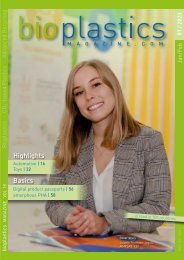







 Change language