


You also want an ePaper? Increase the reach of your titles
YUMPU automatically turns print PDFs into web optimized ePapers that Google loves.
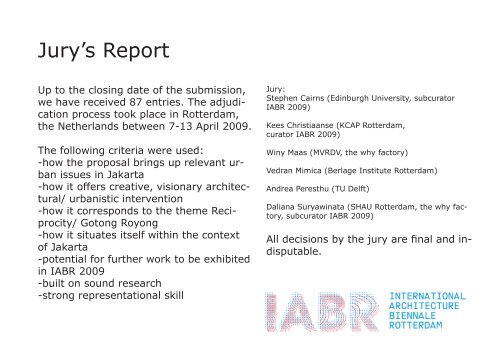
Jury’s <strong>Report</strong><br />
Up to the closing date of the submission,<br />
we have received 87 entries. The adjudication<br />
process took place in Rotterdam,<br />
the Netherlands between 7-13 April 2009.<br />
The following criteria were used:<br />
-how the proposal brings up relevant urban<br />
issues in Jakarta<br />
-how it offers creative, visionary architectural/<br />
urbanistic intervention<br />
-how it corresponds to the theme Reciprocity/<br />
Gotong Royong<br />
-how it situates itself within the context<br />
of Jakarta<br />
-potential for further work to be exhibited<br />
in IABR 2009<br />
-built on sound research<br />
-strong representational skill<br />
Jury:<br />
Stephen Cairns (Edinburgh University, subcurator<br />
IABR 2009)<br />
Kees Christiaanse (KCAP Rotterdam,<br />
curator IABR 2009)<br />
Winy Maas (MVRDV, the why factory)<br />
Vedran Mimica (Berlage Institute Rotterdam)<br />
Andrea Peresthu (TU Delft)<br />
Daliana Suryawinata (SHAU Rotterdam, the why factory,<br />
subcurator IABR 2009)<br />
All decisions by the jury are final and indisputable.
FIRST PRIZE<br />
Jakarta Bersih!<br />
402777<br />
NUNC architecten<br />
Steven Brunsmann<br />
Johan Krol<br />
João Bentes<br />
Floor Moormann<br />
Tanja Van der Laan
SECOND PRIZE<br />
Let’s Catch the Water!<br />
Jakarta Sponge City<br />
135677<br />
mamostudio + UPH University<br />
Adi Purnomo and David Hutama<br />
with Carolina Setiawan, Steven Rendi Willyvans, Irene<br />
Setiawati, Tifani Veronica, Cicilia Angelia, Arsheila Kinan,<br />
Ayudya Paramitha, Kelly, Conny Andriani Yosisca
THIRD PRIZE<br />
Field Estate: A Platform<br />
for Symbiotic Urbanism<br />
777881<br />
GABPA architects<br />
Gesa Buettner and Alejo Paillard<br />
with Alvar Mensana
FIELD_ESTATE: a platform for symbiotic urbanism<br />
Segitiga Emas Area<br />
Co 2<br />
777881<br />
KAMPONG<br />
TODAY<br />
TOMORROW<br />
SITE PLAN: 1:4000<br />
H O 2<br />
HIGH-RISE<br />
PLATFORMS<br />
WATER LILY ORGANISM<br />
Field Estate – a platform for symbiotic urbanism<br />
Field Estate is an urban development game. The<br />
aim is to achieve a city-scape of typological<br />
diversity and cooperative coexistence, combining<br />
segregated urban conditions into strategic<br />
partners: high-rise AND kampong; mall AND<br />
street market. The game is played with two<br />
pieces: towers and platforms. Tower and<br />
platforms move interdependently; their formation<br />
mimics a water lily: every vertical stem of a<br />
tower is surrounded by elevated platforms<br />
floating above the city. The purpose of the<br />
towers is to provide density; their employment<br />
follows the logics of the real estate market. The<br />
purpose of the platforms is adaptation of the<br />
existing; their employment follows the logic of<br />
community and preservation. The bio-textile<br />
semi-transparent roofs absorb and recycle<br />
water, and they dehumidify, cool and clean the<br />
air. By erecting the elevated platforms citizens<br />
across the social, religious and political divide<br />
join in a Gotong-Royong to diminish the danger<br />
of flooding and improving the city’s climate.<br />
1
FIELD_ESTATE: a platform for symbiotic urbanism<br />
Segitiga Emas Area<br />
777881<br />
WATER TANK<br />
Current trends<br />
PLATFORM 1:125<br />
IRRIGATION<br />
CLEAN TRANSPORTATION<br />
RENEWABLE ENERGY<br />
CO2 ABSORBANT<br />
H O 2<br />
SHADE<br />
FARMING<br />
LEISURE<br />
PARK<br />
DEHUMIDIFYING LAYER: BIOTEXTILE<br />
COOLING SPRINKLERS<br />
COMMUNAL WATER SOURCE<br />
H O<br />
2<br />
WATER MANAGEMENT<br />
Jakarta’s development follows the same<br />
scheme as other Asian mega cities where high<br />
land values and weak legal frameworks for<br />
preservation of low-income neighborhoods and<br />
open space facilitated mono-development of<br />
high-rise towers and mega-malls. Whole functioning<br />
neighborhoods are being displaced to<br />
make room for luxury towers, rural migrants<br />
have to squat in informal settlements and green<br />
space has reduced to a meager 9%. The informal<br />
sector of street vendors and urban farmers<br />
today accounts for 70% of the work-force and<br />
20% of the GDP. The unregulated densification<br />
leads to an increase in pollution, waste and<br />
energy-consumption. Indonesia is the 3rd<br />
largest greenhouse gas provider and most<br />
vulnerable to the increase in sea water levels<br />
and climate patterns due to global warming.<br />
Outside air pollution and the hot and humid<br />
tropical climate make walking the streets<br />
unbearable. Well-off citizens flock to the malls,<br />
their poorer counterparts migrants escape<br />
from the climate by setting up camp in areas<br />
with naturally cooler climate: under bridges and<br />
close to the rivers<br />
Field Estates learns from successful strategies.<br />
Instead of furthering the segregation between<br />
tower and low-rise dwellers Field Estates<br />
encourages the coexistence of the two housing<br />
typologies, allowing for different scenarios of<br />
cohabitation. It turns the city itno an indooroutdoor<br />
continuum, enticing all citizens back to<br />
the streets by providing for a semi-conditioned<br />
climate throughout the city.<br />
Rules of the game<br />
FOUR CONDITIONS THAT SEGREGATE JAKARTA<br />
1.DENSIFICATION<br />
HIGH RISE<br />
KAMPONG<br />
2.SHOPPING<br />
PRIVATE MALL<br />
3.FLOODING<br />
4.TROPICAL CLIMATE<br />
STREET MARKET PROTECTED UNPROTECTED CONDITIONED UNCONDITIONED<br />
+ + + +<br />
With every new high-rise a developer has to<br />
provide 20% of the gross floor area as elevated<br />
platforms. The platforms are placed as a<br />
climatic layer above the existing low rise, providing<br />
shade and air-conditioning, a full water cycle<br />
from water collection and absorption to drinking<br />
water and irrigation, and amenities to the neighborhood.<br />
75% of the platforms are for water<br />
collection and renewable energies, their waterabsorbing<br />
semi-transparent roof shading the<br />
houses and streets below. The remaining 25%<br />
range from urban farmland to sport fields.<br />
Platforms can also be installed per community<br />
initiative without entailing towers.<br />
ONE STRATEGY THAT UNITES JAKARTA<br />
$<br />
RULES OF THE GAME<br />
FARMING 15% ACCESS 10% ENERGY 65% ACCESS 10% FARMING 15%<br />
SPORTS 10% WATER 65% PARK 10% PLAYGROUND 10%<br />
SITE SECTION 1:750<br />
2
SPECIAL MENTION<br />
Ojek City: Permeable Mobility<br />
523477<br />
LABO Architecture+Design<br />
Deddy Wahjudi PhD, Nelly L. Daniel PhD,<br />
Hamal O. Pangestu, Mariska Pratimi, Angga Rosiawan
OJEK CITY : permeable mobility<br />
jl.Rasuna Said - jl. Jend Sudirman - jl. Gatot Subroto ( South Jakarta )<br />
Ojek city<br />
523477<br />
interchage transportation mode...<br />
( in traffic jam )<br />
no-car Jakarta<br />
(with a good public transportation)<br />
new transportation in disaster <br />
A place to interaction <br />
a new car lanes <br />
or a new strategy <br />
What have lost in Jakarta a man that lost themself in<br />
the middle of city named Jakarta. City development that<br />
dominated by physical consideration. It has conduced<br />
gap between human and environment and the net of<br />
human social. Design and strategy plays role in<br />
dismissing the humanity.<br />
Ojek city is an issue that focused, represented city face<br />
and city life in Jakarta, at present and the future. Ojek is<br />
a motorcycle taxi part of public transportation which<br />
have efficiency and ability to trough the traffic jam, so<br />
that it can be deliver people faster than other vehicle. It<br />
can be help people to access places which<br />
uncomfortable to walk, and can be maneuver in density<br />
area with its narrow alleys.<br />
Ojek is so humanist, very Jakarta, and very Indonesia.<br />
Ojek’s motor owned by the driver itself, and it's a<br />
unofficial and unlicenced public transportation. Thus,<br />
the transaction in the practice is very informal, there is<br />
no tax standard based distance, but its play with<br />
compromise between driver and passenger. A<br />
bargaining communication. Ojek has its zone or service<br />
area, but in the practice its very permissive and<br />
sometimes very accidental to access places where the<br />
passenger want.<br />
No standart price (bargaining) <br />
In the future, ojek with its network and relationship can<br />
provide range of services like ride children go to the<br />
school,delivery service with gentleman agreement, or a<br />
part of 24 hour shop’s delivery.<br />
an ojek stop...<br />
new cheap transportation for family <br />
a mobile shop <br />
Ojek corner (pangkalan ojek) is a place to park the<br />
motorcycle and a place for socialization its drivers and<br />
colleagues , a part of social space in the city. Its<br />
potential to become an interaction place can be happen<br />
if its near of kiosk or food court. It is a strategic place to<br />
ask an address if we lost, a node or security center of a<br />
dwelling zone.<br />
How we can live as a human in Jakarta Enjoy a<br />
conversation at ojek corner, and make a plan to trough<br />
the traffic jam with ojek.<br />
1<br />
Busway route - artery road<br />
Jl. Jenderal Sudirman<br />
Jl. Rasuna Sa id<br />
J l. Gat o t Subrot<br />
o<br />
There are 2 type of routes in Jakarta : a planned route and unplanned<br />
one, which grows organic and sprawling from the settlement area in<br />
the city. This organic route cannot be mapped and only can be<br />
understanding trough human-scale space experienced by the ojek<br />
driver and the community inside. These kind of routes are<br />
scattered all around jakarta, folded, wrapped, and growth<br />
between settlement area. Furthermore, these roads have a high<br />
permeability, crossing main roads, with unlimited route that can be<br />
provide by any kind of ojek : an unplanned road become an<br />
alterative road with human scale dimension. It can be developed to<br />
free-car road and walkable area, an escape route from the traffic.<br />
If these route traced ,the result is a pattern like fireworks spreading<br />
all around the city. An unlimited end with high permeability, that is<br />
ojek route.<br />
2<br />
Ojek corner points<br />
3<br />
Ojek routes
OJEK CITY : permeable mobility<br />
jl.Rasuna Said - jl. Jend Sudirman - jl. Gatot Subroto ( South Jakarta ) 523477<br />
CONCEPT<br />
a nest , organic shelter that can be build everywhere,a temporary and place for community.<br />
<br />
Placements of ojek’s shelter<br />
PLACEMENT<br />
Like a nest, ojek corner can be placed everywhere,<br />
from crossroad side to under highway.<br />
It will fill lost spaces which have potential to become<br />
a social space and easy to<br />
find,naturally,sporadic,organic,and unplanned.<br />
It maintained by community,belong to community,<br />
and a part of community space.<br />
APPLICATION.........
SPECIAL MENTION<br />
Stitching the Strip<br />
513557<br />
Dimitrij Zadorin
513557<br />
STITCHING THE STRIP<br />
GOTONG ROYONG CITY JAKARTA<br />
Jalan Sudirman in Jakarta is a blatant example of a modern corporate strip that expands depthward at the<br />
cost of the existing urban structure. This process is accompanied by rupture and isolation of existing<br />
villages – kampongs (dating from before WWII in this area) as well as visual contamination and physical<br />
fragmentation of the space acquired.<br />
The proposal, representing metaphorically ‘stitching the cut’, is based upon reconnecting kampongs by<br />
series of ‘bridges’ and reorganization of space around the skyscrapers. As form is dominant for these<br />
buildings, they will wallow in their symbolical verticality while all service and parking buildings are<br />
removed to the back. Conversely the everyday life is amorphous and horizontal (what allows to create an<br />
abstract slab of a fixed low height). It uses bridges to reconnect kampongs among the ribbons of public<br />
space for all, which is safeguarded against uncontrolled kampong‘s expansions by physical barriers –<br />
walls.<br />
DKI JAKARTA - SITE<br />
JAKARTA UTARA<br />
JAKARTA BARAT<br />
JAKARTA PUSAT<br />
JAKARTA TIMUR<br />
JAKARTA SELATAN<br />
INTEGRATION FIELD SLAB<br />
REORGANIZATION OF SPACE<br />
BRIDGE LAYOUT<br />
SEPARATING WALLS PREVENT FROM<br />
UNCONTROLLED EXPANSION OF<br />
KAMPONGS INTO PUBLIC SPACE<br />
KAMPONGS<br />
PUBLIC SPACE<br />
KAMPONGS<br />
LOW HEIGHT OF KAMPONG BUILDINGS<br />
ALLOWS FOR CONTAINING THEM IN<br />
A HORIZONTAL SLAB OF A FIXED HEIGHT<br />
FOR PRESERVING THE ABSTRACT<br />
CHARACTER OF CLEANED-UP SPACE<br />
CORPORATE ORATE<br />
SPACE<br />
FREED ED FROM VISUAL<br />
CONTAMINATION NAT<br />
ATI<br />
TION NAN<br />
AND<br />
RECONNECTING<br />
NEC<br />
ECT<br />
CTIN<br />
NG<br />
FRAGMENTED ED<br />
SPACE<br />
EXISTING KAMPONGS<br />
STITCHING BRIDGE<br />
CLEANED-UP ED-<br />
ABSTRACT ACT<br />
SPACE<br />
GREEN BELT<br />
SERVICE ZONE<br />
EXISTING KAMPONGS<br />
KAMPONGS AND THE STRIP<br />
STITCHINGS OF KAMPONGS<br />
CLEAN-UP OF THE STRIP<br />
PROJECT SITE 1:20000<br />
NEW KAMPONGS<br />
CORPORATE<br />
STRIP<br />
CONNECTION<br />
POINTS<br />
575 m<br />
520 m<br />
525 m<br />
445 m<br />
CORPORATE<br />
BUILDINGS<br />
SERVICE ZONE<br />
415 m<br />
GREEN BELT<br />
OLD<br />
KAMPONGS<br />
REQUIRED<br />
CONNECTIONS<br />
/STITCHINGS<br />
580 m<br />
500 m<br />
CLEANED-UP<br />
ABSTRACT<br />
SPACE<br />
JALAN<br />
SUDIRMAN<br />
CITY FABRIC
SITE PLAN 1:2000<br />
513557<br />
existing greenery<br />
Jalan Kh Mas Mansyur<br />
PARKING FACILITIES<br />
WITH BASKET AND TENNIS<br />
COURT ON THE ROOFS<br />
existing<br />
corporate building<br />
existing<br />
kampong building<br />
NEW<br />
PUBLIC BUILDING<br />
Jalan Karet Pasar<br />
Baru Barat VII<br />
STITCHING 5: LIGHT COVERED BAMBOO BRIDGE TO THE NEXT KAMPONG<br />
ESCALATORS<br />
NEW<br />
BUILDING/INFRASTRUCTURE<br />
STITCHING 4: INTEGRATION FIELD SLAB WITH ELABORATED PUBLIC FACILITIES<br />
SPORT CENTRE<br />
ELEVATORS<br />
PARK<br />
NEW<br />
KAMPONG BUILDING<br />
TREE<br />
CULTURAL CENTRE<br />
FOR LOCAL RESIDENTS<br />
NEW KAMPONG<br />
EXTENSION<br />
NEW KAMPONG<br />
EXTENSION<br />
ELEVATORS<br />
FOOD<br />
FACILITIES<br />
NEW KAMPONG<br />
EXTENSION<br />
STAIRCASE SHAFT<br />
NEW KAMPONG<br />
EXTENSION<br />
existing<br />
greenery<br />
CHILDREN PLAYGROUND<br />
kampong<br />
Karetpasarbaroe<br />
CROPS FIELD<br />
CONTINUOUS WALL AS VISUAL MANIFESTATION OF CONNECTIONS<br />
MOSQUE<br />
CENTRAL SQUARE<br />
ELEVATOR<br />
SMALL SHOPS<br />
NEW KAMPONG<br />
EXTENSION<br />
existing<br />
mosque<br />
SQUARE FOR<br />
INFORMAL MEETINGS<br />
Jalan Karet Gusuran III<br />
ESCALATORS<br />
Jalan Jend Sudirman<br />
AIR TUNNELS<br />
COCONUT PARK<br />
AS PART OF THE GREEN BELT<br />
SEPARATING CORPORATE BUILDINGS<br />
FROM PARKING AND SERVICE BUILDINGS<br />
PARKING<br />
FACILITIES<br />
kampong Karetblakang<br />
STITCHING 3: BRIDGE-ALLEY TO THE NEXT KAMPONG<br />
Jalan Komando Raya<br />
SITE VIEWS<br />
CENTRAL SQUARE IN THE INTEGRATION FIELD SLAB<br />
TO THE LEFT: NEW MOSQUE<br />
STITCHING 3: BRIDGE-ALLEY<br />
ENTRANCE TO THE SLAB FROM KAMPONG KARETBLAKANG<br />
IN THE CENTRE: TRANSFORMATION OF THE CONTINUOUS WALL<br />
STITCHING 5: LIGHT BAMBOO BRIDGE<br />
PARK OF LOW-HEIGHT TREES<br />
TO THE LEFT: NEW GARAGE BUILDINGS WITH SPORT COURTS ON TOP<br />
ENTRANCE TO THE SLAB FROM KAMPONG KARETPASARBAROE
SPECIAL MENTION<br />
Eco Gate as Border Device<br />
534558<br />
Budi Pradono Architects<br />
Budi Pradono, Anton Suryono, Yuli Sri Hartanto, Rina Nur<br />
Aisah, Adam Modigliani Prana, Adryan Fernando Hutagaol,<br />
Primaldi Perdana
ECO GATE<br />
BUMI SERPONG DAMAI<br />
AS BORDER DEVICE<br />
534558<br />
POTENTIAL ECO-GATE PROGRAM<br />
BIOETANOL<br />
PRODUCER<br />
ENERGY<br />
DEPOSIT<br />
SUNFLOWER<br />
FOREST<br />
FOOD<br />
COURT<br />
APPLE<br />
FOREST<br />
HANDICRAFT<br />
INDUSTRY<br />
ECO GATE - INDUSTRIAL<br />
HOME<br />
ACESSORIES<br />
ECO GATE - COW FARM<br />
LOW-COST<br />
HOUSING<br />
ECO GATE - AGRICULTURE<br />
Gotong Royong City<br />
Eco gate as border device<br />
The periphery of Jakarta has experienced a drastic<br />
increase in population. The population in the<br />
periphery of Jakarta has tripled from 4.4 million in<br />
1980 to 12.6 million in 2000, while Jakarta's<br />
population increased by only 30 percent.<br />
The growth of Jakarta is the cause of suburbanization<br />
in Jakarta's peripheral areas, and will correspond to<br />
suburbanization in Jakarta's neighboring areas such<br />
as Tangerang area of Bumi Serpong Damai (BSD) city<br />
development.<br />
Gated functional suburban housing estates / gated<br />
communities are the products of the market. The<br />
sprawl of private new towns that have been<br />
developed without regional planning coordination,<br />
and the resultant social and natural segregation,<br />
which we can see from the concrete wall as a rigid<br />
symbol of two areas desa /rural and inside the gate<br />
kota / urban<br />
In our research Tangerang area as one of suburban<br />
area lost its fast frontier forest and agricultural paddy<br />
field, everyday the equivalent of 5 football fields of<br />
agricultural land disappears.<br />
For many years The rural-kampung where traditional<br />
people depend on agricultural sector are neglected.<br />
Can we in the context and based on the uniqueness demographic<br />
circumstances, provide BSD rural area with series of contemporary ecogate<br />
Eco gate is a contemporary gate, which is replaced the conventional<br />
physical concrete fence. It is an open plan structure, which can be mutated<br />
in term of form or programming depend on the specificity of the place.<br />
Eco gate will function as the border to stop the<br />
development of the gated communities at the same<br />
time to provide a new opportunity for both<br />
communities to maximize the cohabitation<br />
relationship by providing several attractive<br />
programming such as energy producer, CO2<br />
producer by re-planting the forest, fish market, fishing<br />
garden, ethanol producer from the cow farm, social<br />
housing, bamboo producer, organic vegetable.<br />
ECO GATE - INDUSTRIAL<br />
Eco gate also act as job provider for several informal<br />
job, such as servant, housekeeper, car washer, baby<br />
sitter, florist, mobile tailor, food stall, café, and<br />
practical business education,<br />
Eco gate is a border device, between gated<br />
communities and rural kampung-settlement.
ECO GATE AS BORDER DEVICE<br />
BUMI SERPONG DAMAI<br />
534558<br />
TANGERANG<br />
CONVENTIONAL<br />
SECURITY GUARD<br />
GAS<br />
STATION<br />
SOCIAL<br />
INTERACTION<br />
WE DO NOT NEED ANYMORE CONVENTIONAL SECURITY GUARD IN THE FUTURE, TO BE REPLACED WITH ECO GATE<br />
INFORMAL<br />
WORKER<br />
DEVELOPMENT OF PRIVATE HOUSING<br />
IN JABOTABEK<br />
DIRECT CONTACT<br />
BETWEEN<br />
CONVENTIONAL<br />
FENCE AND<br />
RURAL-KAMPUNG<br />
HOUSING<br />
SERVICE<br />
AGRICULTURE<br />
CONVENTIONAL<br />
FENCE<br />
GATED COMMUNITY<br />
RURAL-KAMPUNG COMMUNITY<br />
MUTUALISM<br />
RELATIONSHIP<br />
TANGERANG POPULATION GROWTH<br />
HOMOGEN<br />
BASED ON<br />
TRADITION<br />
TANGERANG BUILT-UP GROWTH<br />
GATED COMMUNITY<br />
CLUSTER<br />
SOCIAL<br />
FORMAL WORKER INTERACTION SERVICE SIMILAR STRATA HETEROGEN BASED ON LIFESTYLE<br />
MONOTONE SPACE<br />
LESS NATURE/GREEN<br />
ORDER<br />
ORGANIZED PUBLIC SPACE<br />
RURAL-KAMPUNG COMMUNITY<br />
FRAGMENTED DYNAMIC SPACE MORE NATURE/GREEN UN-ORDER SPREAD PUBLIC SPACE<br />
ECO GATE INDUSTRIAL<br />
ECOGATE PROTOTYPE<br />
ECO GATE CATTLE BREEDING ECO GATE NURSERY ECO GATE FISHMARKET<br />
ECO GATE AGRICULTURE<br />
1. 2. 3. 4. 5.<br />
FISH MARKET<br />
SEA FOOD RESTAURANT<br />
MARKET<br />
GARDENER<br />
POOL<br />
CAR WASH/BENGKEL<br />
NURSERY<br />
CAFE+RESTO<br />
ATM CENTER<br />
PARKING CENTER<br />
GREENERY<br />
BOUTIQUE AND TAYLOR<br />
ECO GATE FISHMARKET<br />
ECO GATE FISHMARKET<br />
ECO GATE NURSERY

 Change language