

The romantic East: Burma, Assam, & Kashmir - Khamkoo
The romantic East: Burma, Assam, & Kashmir - Khamkoo
The romantic East: Burma, Assam, & Kashmir - Khamkoo

You also want an ePaper? Increase the reach of your titles
YUMPU automatically turns print PDFs into web optimized ePapers that Google loves.
UNIVERSITY OF CALIFORNIA LIBRARY
LIBRARY<br />
UNIVERSITY OF CALIFORNIA.<br />
Class
THE ROMANTIC EAST
BY THE SAME AUTHOR<br />
AROUND THE WORLD<br />
THROUGH JAPAN<br />
SECOND EDITION DEMY 8vO CLOTH<br />
WITH 50 FULL-PAGE ILLUSTRATIONS<br />
PRICE 12/6 NET<br />
" Altogether the work is one of the best impressionist<br />
records of travel we have read, and the<br />
account of modern Japan and the Japanese is by<br />
far the fullest and most truthful known to us."<br />
<strong>The</strong> Athetueum.<br />
INDIA OF TO-DAY<br />
"With this book in his hand the Western visitor<br />
should find no difficulty in mapping out his tour,<br />
or in seeing the cream of the sights of each place<br />
without wasting time or relying on guides." <strong>The</strong><br />
Times.<br />
PUBLISHED BY A. & C. BLACK LONDON<br />
AGENTS<br />
AMERICA . THE MACMILLAN COMPANY<br />
64 & 66 FIFTH AVENUE, NEW YORK<br />
CANADA . THE MACMILLAN COMPANY OF CANADA, LTD.<br />
27 RICHMOND STREET WEST, TORONTO.<br />
INDIA . . MACMILLAN & COMPANY, LTD.<br />
MACMILLAN BUILDING, BOMBAY<br />
309 Bow BAZAAR STREET, CALCUTTA
WALTER DEI, MAR.<br />
Photographed by Taber, London.
THE<br />
ROMANTIC EAST<br />
BURMA, ASSAM, & KASHMIR<br />
BY<br />
WALTER DEL MAR<br />
It<br />
AUTHOR OF<br />
'AROUND THE WORLD THROUGH JAPAN' AND ^I^DIA OF TO-DAY<br />
CONTAINING SIXTY- FOUR FULL -PAGE ILLUSTRATIONS<br />
FROM PHOTOGRAPHS<br />
LONDON<br />
ADAM AND CHARLES BLACK<br />
1906<br />
A II rights reserved
PREFACE<br />
<strong>The</strong> Romantic <strong>East</strong> is a narrative of a tour in<br />
<strong>Burma</strong>, <strong>Assam</strong>, and <strong>Kashmir</strong>, and it<br />
completes<br />
the series begun in Around the World through<br />
Japan and continued in India of To-day.<br />
<strong>The</strong> <strong>romantic</strong> side of <strong>Burma</strong> is to be found in<br />
its people,<br />
spoiled by<br />
who are of all Oriental races the least<br />
contact with the West. <strong>The</strong> romance<br />
of <strong>Kashmir</strong> lies in the country itself, while the<br />
romance of <strong>Assam</strong> is a purely commercial one,<br />
connected with the tea industry.<br />
<strong>The</strong> Romantic <strong>East</strong> offers some guidance as<br />
to what may be seen during a short tour ;<br />
and<br />
it will serve a useful purpose<br />
if it induces those<br />
who intend to travel at some future time to<br />
mature their plans in the present,<br />
for now is<br />
the time to visit <strong>Burma</strong> and <strong>Kashmir</strong> before the<br />
218658
vi<br />
THE ROMANTIC EAST<br />
character of the Burmese people<br />
is<br />
changed by the<br />
steady influx of alien immigrants,<br />
and before the<br />
amenities of the <strong>Kashmir</strong> Valley are endangered<br />
by the new railway.<br />
<strong>The</strong> majority of the illustrations are from my<br />
own cameras, but several are selected from the<br />
large collection of Burmese photographs taken<br />
by<br />
Mr. W. W. Schumacher in 1905. <strong>The</strong><br />
design<br />
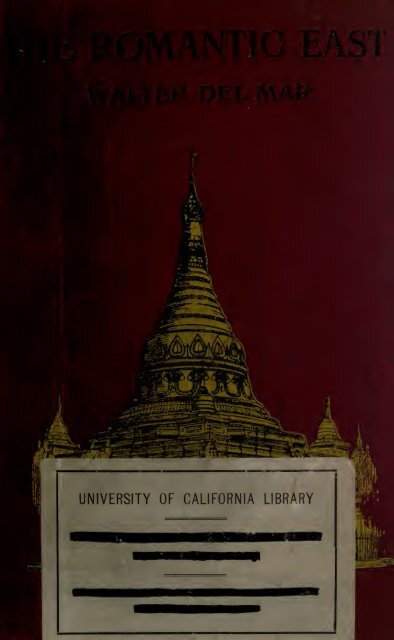
on the cover represents a corner of the Eindawya<br />
Pagoda, Mandalay.
CONTENTS<br />
CHAPTER I<br />
GOLDEN BURMA<br />
PAGE<br />
<strong>The</strong> ideal <strong>East</strong> Burmese characteristics <strong>The</strong> Yellow<br />
Peril Annexation Religion Marriage and divorce<br />
Burmese women Costumes A few figures<br />
. 1<br />
CHAPTER II<br />
THE FIRST VIEW<br />
Madras to Rangoon <strong>The</strong> Rangoon river Plague protection<br />
Pagodas and dagobas <strong>The</strong> fraternity of the<br />
Yellow Robe Monks and monasteries . . . 12<br />
CHAPTER III<br />
RANGOON<br />
<strong>The</strong> Shwe Dagon pagoda Gawdama the Buddha Tagondaings<br />
<strong>The</strong> great bell of Rangoon <strong>The</strong> story of<br />
the tiger<br />
.<br />
22<br />
CHAPTER IV<br />
RANGOON (continued)<br />
<strong>The</strong> Sule pagoda Nats <strong>The</strong> Central Jail Teak and<br />
elephants Silver-ware Rangoon hotels . . . 31<br />
vii
viii<br />
THE ROMANTIC EAST<br />
CHAPTER V<br />
RANGOON TO BHAMO<br />
PAGE<br />
Pegu <strong>The</strong> Shwe-hmaw-daw <strong>The</strong> great Buddha Karen<br />
women Toungoo Amarapura and Ava Sagaing<br />
Katha Shwegu ... ... 38<br />
CHAPTER VI<br />
BHAMO AND THE IRAWADI<br />
<strong>The</strong> road to China <strong>The</strong> races of Upper <strong>Burma</strong> Chins<br />
Shans Kachins Palaungs <strong>The</strong> river <strong>The</strong> defiles<br />
<strong>The</strong> road to the Ruby Mines <strong>The</strong> Mingon bell and<br />
pagoda Petroleum....... 50<br />
CHAPTER VII<br />
MANDALAY<br />
<strong>The</strong> Queen's Golden Monastery Fort Dufferin and the<br />
Royal Palace " <strong>The</strong> centre of the universe " King<br />
<strong>The</strong>baw and his Queens .... .63<br />
CHAPTER<br />
VIII<br />
MANDALAY (continued)<br />
Sermons in stones <strong>The</strong> Eindawya pagoda <strong>The</strong> game of<br />
chinlon A Burmese pwe <strong>The</strong> Great Temple and<br />
the Mahamani........ 70<br />
<strong>The</strong> railway to Lashio<br />
CHAPTER IX<br />
GOKTEIK<br />
<strong>The</strong> natural bridge Maymyo<br />
<strong>The</strong> Gokteik gorge and viaduct<br />
<strong>The</strong> excursion to<br />
Moulmein ........ 79
CONTENTS<br />
ix<br />
CHAPTER X<br />
MOULMEIN<br />
PAGE<br />
<strong>The</strong> Duke's Head <strong>The</strong> great Moulmein pagoda <strong>The</strong><br />
bells Ivory carvers Kado A modern shrine . 86<br />
CHAPTER XI<br />
CHRISTMAS IN<br />
Christmas Eve smoking concert<br />
BURMA<br />
Christmas at the Farm<br />
Caves Rangoon to Chittagong New Year's Day at<br />
Akyab<br />
.<br />
. 95<br />
CHAPTER XII<br />
ASSAM<br />
Chittagong <strong>The</strong> <strong>Assam</strong> -Bengal railway Big game<br />
<strong>The</strong> planters <strong>The</strong> romance of <strong>Assam</strong> <strong>The</strong> tea<br />
industry ... .106<br />
CHAPTER XIII<br />
ASSAM (continued)<br />
Climate <strong>The</strong> Brahmaputra from Nigri Ting to Dubri<br />
A mournful river Birds <strong>The</strong> new province of<br />
<strong>East</strong>ern Bengal and <strong>Assam</strong> .<br />
. . . .116<br />
CHAPTER XIV<br />
THE ROAD TO KASHMIR<br />
<strong>The</strong> Happy Valley <strong>The</strong> City of Sri Dhanjibhoy and<br />
Son A tramp in the snow Muree Kohala Bridge 124<br />
b
x<br />
THE ROMANTIC EAST<br />
CHAPTER XV<br />
KOHALA BRIDGE TO CHAKOTI<br />
<strong>The</strong> Jehlam and Kishanganga A dangerous road Domel<br />
<strong>The</strong> great gorge An accident to the tonga driver<br />
Chakoti ... .<br />
CHAPTER XVI<br />
CHAKOTI TO SRINAGAR<br />
PAGE<br />
.137<br />
<strong>The</strong> Jehlam gorge A breakdown Uri Oriental cunning<br />
Avalanches and landslides Rampur <strong>The</strong> Temple<br />
of Buniar Baramula Patan Srinagar . . .145<br />
CHAPTER XVII<br />
THE VENICE OF THE EAST<br />
Early birds Merchants and tourists Thieves and<br />
swindlers Curios and trophies Punts and houseboats<br />
156<br />
CHAPTER XVIII<br />
THE BRIDGES<br />
AND THE CITY<br />
Mayasum <strong>The</strong> bridges Sher Garhi palace Mosque of<br />
Shah Hamadan <strong>The</strong> great mosque Hari Parbat<br />
Tinpot temples .163<br />
CHAPTER XIX<br />
THE MOST BEAUTIFUL COUNTRY IN<br />
THE WORLD<br />
Different points of view From the steps of Solomon's<br />
Throne <strong>The</strong> valley and the mountain barriers<br />
<strong>Kashmir</strong> and the <strong>Kashmir</strong>is 170
CONTENTS<br />
xi<br />
CHAPTER XX<br />
THE GARDENS OF THE GREAT MOGULS<br />
PAGE<br />
Rotten Row <strong>The</strong> City Lake Nishat Bagh Shalimar<br />
Bagh Lalla Rookh Nasim Bagh . . . .181<br />
CHAPTER XXI<br />
SRINAGAR TO BARAMULA<br />
Manjhis and nautch -girls <strong>The</strong> "river of milk" <strong>The</strong><br />
Naru canal Winter birds Singharas Volur Lake . 187<br />
CHAPTER XXII<br />
AND SO HOME<br />
Baramula to Rawal Pindi <strong>The</strong> last dak .<br />
195
LIST<br />
OF ILLUSTRATIONS<br />
1. <strong>The</strong> Author ... .<br />
Frontispiece<br />
FACING PAGE<br />
2. " Alien Immigrants " . 2<br />
3. A Professional Beauty smoking a " Torch " . 6<br />
4. Taken by an Amateur . . 8<br />
5. "White Wings" 12<br />
6. Burmese Boats .... 14<br />
7. Burmese Monks ... . .20<br />
8. Carved Base of Tagon-Daing, Shwe . .<br />
Dagon 24<br />
9. Shrine on Shwe Dagon Platform . 26<br />
10. Women's Tresses offered at Shwe Dagon Shrine . 28<br />
11. <strong>The</strong> Sule Nat, Sule Pagoda, Rangoon 30<br />
12. Rangoon Jail, outside the Entrance .<br />
. . . 32<br />
13. Timber-Yard Elephants, Rangoon<br />
. 34<br />
14. Street Scene, Rangoon<br />
. . 36<br />
15. Shwe-hmaw-daw Pagoda, Pegu<br />
.<br />
16. <strong>The</strong> Great Reclining Buddha, Pegu<br />
.<br />
. . . . 38<br />
. 40<br />
17. <strong>The</strong> Pagoda of the Four Buddhas, Pegu<br />
. 42<br />
18. Shwegu<br />
on the Irawadi .... .48<br />
19. Chinese Shop, Bhamo . 52<br />
20. Angel Rock, Second Irawadi Defile . 56<br />
21. <strong>The</strong> Great Bell at Mingon<br />
. 60<br />
xiii
xiv<br />
THE ROMANTIC EAST<br />
FACING PAGE<br />
22. Watch Tower, Mandalay Fort . . 64<br />
23. <strong>The</strong> Summer-house where King <strong>The</strong>baw surrendered 66<br />
24. Mindon's Tomb, ^Mandalay Fort . .68<br />
25. <strong>The</strong> Game of Chinlon .... 72<br />
26. Musicians and Dancers, Burmese Pwe ... 74<br />
27. Arakan Pagoda and Turtle Tank . . 76<br />
28. Entrance to Arakan Pagoda, Mandalay<br />
. . . 78<br />
29. Gokteik Viaduct Train approaching ... 80<br />
30. Entrance of Cave, Gokteik Viaduct . 82<br />
31. <strong>The</strong> Bell, Moulmein Pagoda<br />
. 88<br />
32. Kado Landing .... ... 90<br />
33. Shrines on North Side of Kado Pagoda ... 92<br />
34. Moulmein Hackney Carriage .....<br />
96<br />
35. Christmas Lunch with the Buddhas, Farm Caves .<br />
98<br />
36. " <strong>The</strong> Only Lady of the Party<br />
"<br />
. .100<br />
37. Barge on Arakan Coast . . . . . 1 04<br />
38. Boats at Chandpur .108<br />
. .<br />
39. Entrance to Planter's Bungalow, <strong>Assam</strong> . . . 110<br />
40. Dooria Tea Estate, <strong>Assam</strong> . . . .112<br />
41. A Landing-place on the Brahmaputra<br />
. . . 116<br />
42. Gamirighat on the Brahmaputra<br />
. . . . 118<br />
43. View of the Brahmaputra . . . . . .120<br />
44. Our Tonga with Luggage tied Outside . . 1 26<br />
45. Coolies carrying our Luggage over the Snow . . 130<br />
46. "Solomon's Throne" 134<br />
47. <strong>The</strong> Museum and Solomon's Throne from the River . 138<br />
48. <strong>The</strong> Museum, Srinagar<br />
. . . . . .142<br />
49. View from the Bund, Srinagar . . . . .146<br />
50. Srinagar<br />
Bund from the Museum . . . 150
LIST OF ILLUSTRATIONS<br />
xv<br />
FACING PAGE<br />
51. Sher Garhi Palace, Srinagar<br />
. .154<br />
52. Fatten Kadal, one of the Bridges at Srinagar<br />
. . 158<br />
53. Mosque of Shah Hamadan, Srinagar.<br />
. 162<br />
54. Zaina Kadal, " <strong>The</strong> Fourth Bridge," Srinagar<br />
. . 164<br />
55. <strong>The</strong> Great Mosque, Srinagar<br />
. . . . .166<br />
56. Hari Parbat, Srinagar .... 168<br />
57. Temple Dome made from Biscuit Tins, Srinagar<br />
. 170<br />
58. On the River, Srinagar ... .174<br />
59- Riverside Scene, Srinagar... .178<br />
60. Our Party leaving Srinagar by House-boat . . 182<br />
61. <strong>Kashmir</strong>i Beauties .... .186<br />
62. A Village on the Naru Canal, <strong>Kashmir</strong> .<br />
.190<br />
63. Duck-Hunter near Sopur, <strong>Kashmir</strong> .<br />
.<br />
192<br />
64. Looking North-east over Volur Lake, <strong>Kashmir</strong> . .<br />
196
THE ROMANTIC EAST<br />
CHAPTER I<br />
GOLDEN BURMA<br />
<strong>The</strong> ideal <strong>East</strong> Burmese characteristics <strong>The</strong> Yellow Peril<br />
Annexation Religion Marriage and divorce Burmese<br />
women Costumes A few figures.<br />
IN Ptolemy's map of the world, dating<br />
from the<br />
second century of our era, <strong>Burma</strong> is marked Chryse<br />
Cherson, "<strong>The</strong> Golden Peninsula."<br />
<strong>The</strong>n, as now,<br />
its streams were worked for gold but so little is<br />
;<br />
now won from the alluvial deposits that its ancient<br />
name would no longer be appropriate<br />
if it were not<br />
for its pagodas. <strong>The</strong>se lift their gilded spires all<br />
over the country, and justify not only its Greek<br />
but its Indian title of Souverna Bhumi, "<strong>The</strong><br />
Golden Land."<br />
It is<br />
to-day, of all countries open to easy<br />
travelling, the nearest approach to the ideal <strong>East</strong>,
2 THE ROMANTIC EAST<br />
the least spoilt, in spite of its oil-mills, rice-mills,<br />
and timber-yards, by contact with the West, and<br />
the most pleasing in regard<br />
people.<br />
to the character<br />
<strong>The</strong>se conditions, however, are doomed to<br />
of its<br />
pass<br />
away. <strong>The</strong> Burmese, originally Indo-Chinese, are<br />
being hard pressed by their ancestral races. By<br />
the northern frontier and from over the seas the<br />
enterprising Chinamen pour into the country in a<br />
steady stream, absorbing<br />
the retail trade of the<br />
rural districts, and competing successfully in the<br />
towns ;<br />
while the famished hordes of Tamils come<br />
over in their thousands to cultivate the paddy-fields<br />
of the delta and press the idle <strong>Burma</strong>n from the<br />
land.<br />
Up to the present no great harm has been done,<br />
for in spite of the undesirable aliens the Burmese<br />
continue to increase.<br />
towns are doing<br />
<strong>The</strong> coolies employed<br />
in the<br />
work which the Burmese never<br />
attempted to do, and the Chinese are rather forcing<br />
the Burmese women out of business than competing<br />
with the men. <strong>The</strong> <strong>Burma</strong>n is by heredity<br />
and choice a cultivator of the soil, and as a field<br />
labourer is unexcelled. But now he is<br />
being
GOLDEN BURMA 3<br />
attacked in his last stronghold by the Tamil, and<br />
the struggle may prove disastrous to the <strong>Burma</strong>n,<br />
either on the material side, or by causing a change<br />
in his most pleasing characteristics.<br />
By nature the <strong>Burma</strong>n is an indolent, lazy<br />
fellow, who is quite willing to let his wife do all<br />
the work without any interference on his part<br />
as<br />
long as she provides him with plenty of food to<br />
eat and tobacco to smoke. But the idleness of the<br />
<strong>Burma</strong>n, fostered by a superstitious belief in lucky<br />
and unlucky days,<br />
is not the shiftless indifference<br />
of the ne'er-do-weel or the sullen apathy of the<br />
weak and hopeless. It is rather the careless<br />
optimism of the philosopher combined with the<br />
sportsman's contempt for productive labour inherited<br />
from a long line of freedom-loving ancestors.<br />
For the Burmese were a conquering race, their<br />
empire had been successfully defended by the<br />
sword from the assaults of the surrounding hostile<br />
races and tribes ;<br />
and when the British took <strong>Burma</strong><br />
they found a free race who had not, as in India,<br />
been previously subdued by foreign invaders.<br />
Watch the <strong>Burma</strong>n play at his favourite games,<br />
or put him in charge of a boat on a river in flood,
4 THE ROMANTIC EAST<br />
and you will find that he has a fund of energy to<br />
expend on those things<br />
in which he takes an<br />
interest. Moreover, he is a cheerful, merry fellow ;<br />
and, when not roused to sudden jealousy, a very<br />
pleasant companion. But John Chinaman is taking<br />
to wife the pick of the Burmese girls,<br />
and he has<br />
his privilege of selection, because he gives<br />
them a<br />
better home, less work, and finer clothes and jewels<br />
;<br />
and, as long as his sons' pigtails are left to his care,<br />
is quite<br />
content to conform to<br />
the observances of<br />
the Buddhist religion, and let his wife bring up the<br />
daughters as she likes. <strong>The</strong> mixed race springing<br />
up from these inter-marriages is a very good one<br />
indeed, inheriting the cheerful temper and quick<br />
wit of the mother together with the father's<br />
capacity for work. To the Chinaman <strong>Burma</strong> is<br />
China inasmuch as he is content to live, die, and be<br />
buried there,<br />
and you may meet Chinamen whose<br />
fathers and even grandfathers have been born in<br />
<strong>Burma</strong>. John is not far wrong either, for <strong>Burma</strong><br />
was, at any rate nominally, tributary to China as<br />
recently as 1881, or up to within five years of<br />
the time when England took the third bite and<br />
gobbled up what had been left of the Burmese
GOLDEN BURMA 5<br />
cherry from the two previous<br />
and 1852.<br />
bites taken in 1826<br />
By the treaty of February 24, 1826, the coasts<br />
of Tenasserim bordering on Siam, and of Arakan,<br />
the narrow strip between the mountains and the<br />
Bay of Bengal, were ceded with the outlying bits<br />
of <strong>Assam</strong> to the Honourable <strong>East</strong> India Company<br />
by His Majesty the King of Ava. By proclamation<br />
of December 20, 1852, Lower <strong>Burma</strong> was<br />
annexed, and the Irawadi valley up to Prome, as<br />
well as the valley of the Sittang up to a point about<br />
thirty-five miles north of Toungoo, came under<br />
British rule. On January 1, 1886, Upper <strong>Burma</strong><br />
was annexed, and the whole of <strong>Burma</strong> became a<br />
province<br />
Upper<br />
of British India.<br />
<strong>Burma</strong> was the real home of the Burmese<br />
race, Lower <strong>Burma</strong> being occupied by the Talaing<br />
or Mun race ;<br />
but the Burmese have settled in large<br />
numbers in the delta, and it is<br />
becoming more and<br />
more difficult to distinguish the various races which<br />
inhabit the country.<br />
Practically all of the Burmese are Buddhists ;<br />
but the missionaries have had considerable success<br />
with some of the minor races, and it is said that
6 THE ROMANTIC EAST<br />
a round hundred thousand of the Karens are<br />
Christians. In theory, Burmese Buddhism is the<br />
purest form of the religion, unchanged since it was<br />
brought to <strong>Burma</strong> by Asoka's missionaries, and it<br />
is possible<br />
that some of the more learned monks<br />
follow " the way " indicated by Gawdama ;<br />
a rule, the Buddhism of the <strong>Burma</strong>n is<br />
but, as<br />
so lost in a<br />
flood of superstition that it is rarely found on the<br />
surface.<br />
<strong>The</strong> Burmese have, however, learnt from<br />
their religion the virtues of tolerance, charitableness,<br />
kind-heartedness, and hospitality to a degree beyond<br />
most other races.<br />
Even the casual visitor to their<br />
country is impressed<br />
with their <strong>romantic</strong> character<br />
and envies their happy disposition.<br />
As in other Buddhist countries marriage in<br />
<strong>Burma</strong> is a purely secular affair. <strong>The</strong> parties agree<br />
to become man and wife and that is quite sufficient.<br />
If there is<br />
any ceremony at all, the most important<br />
observance is the eating out of the same dish, just<br />
as<br />
the Japanese drink out of the same sake cup.<br />
<strong>The</strong> wife retains her maiden name and her separate<br />
property. Divorce is equally simple and free. In<br />
the villages an application to the elders by either<br />
party procures a divorce attested in writing the<br />
:
A PROFESSIONAL BEAUTY SMOKING A " TORCH."<br />
Photographed by Watts & Skeer,
GOLDEN BURMA 7<br />
the common<br />
party claiming the divorce leaving<br />
home. Each retains the property he or she had<br />
before the marriage and half of what has been<br />
accumulated during the time they have been<br />
husband and wife. In some cases where the<br />
husband has paid "marriage-money" to get his<br />
bride the wife must repay this if she secures a<br />
divorce. In any event, the wife takes the female<br />
children and the husband the male children.<br />
<strong>The</strong>re seems to be no law against a plurality of<br />
wives nor any stigma attached to having two or<br />
three wives under the same roof. In these customs<br />
the <strong>Burma</strong>ns and Japanese agree, and in <strong>Burma</strong> as<br />
in Japan the family life of the peasants is open to<br />
the observation of any traveller.<br />
Burmese girls<br />
have little of the educational<br />
advantages of the boys, but their free life gives them<br />
an early worldly knowledge, and the Burmesewomen<br />
have many attractions. <strong>The</strong>y<br />
are affectionate and<br />
passionate, cheerful and bright, clever in their own<br />
affairs and in business, sharp in making a bargain,<br />
excellent housekeepers, and generally faithful wives.<br />
<strong>The</strong>y are seldom public prostitutes, but a girl may<br />
be bought from her parents.<br />
<strong>The</strong> negotiations are
8 THE ROMANTIC EAST<br />
usually conducted with the mother, who is<br />
at driving a good bargain ;<br />
keener<br />
and when the contract<br />
is made the girl<br />
is<br />
kept as a concubine, and does<br />
not lose caste by assenting to such an arrangement.<br />
During her concubinage she is treated as, and<br />
usually called, a " wife," and she frequently brings<br />
her mother and the children of previous "marriages"<br />
to live at the house of her new " husband."<br />
<strong>The</strong> <strong>Burma</strong>n drapes himself in a paso, or putsoe,<br />
which is a piece of cloth about fourteen feet long<br />
and forty inches wide, and twists a gaily-coloured<br />
handkerchief around his head.<br />
<strong>The</strong> costume of a Burmese woman ordinarily<br />
consists of two pieces<br />
;<br />
the engyi and lungyi, or<br />
tamein. <strong>The</strong> former is a loose double-breasted<br />
jacket<br />
with mandarin sleeves and falls over the<br />
lungyi, which, whenever the wearer can afford<br />
is of thin silk and is<br />
simply a square of about five<br />
feet with the ends usually sewn together so that it<br />
is<br />
put on like - a petticoat and folded in over the<br />
right hip.<br />
Women usually go barefooted, but sometimes<br />
wear clogs<br />
it,<br />
resembling the Japanese geta, or<br />
ornamental slippers with a pointed toe-cap which<br />
holds all but the little toe. Decorated with a
TAKEN BY AN AMATEUR.<br />
Photographed by W. IV. Schumacher.
GOLDEN BURMA 9<br />
certain<br />
amount of jewellery, with a scarf (ta-bet)<br />
around her neck, a wreath of flowers in her wellbrushed<br />
hair, and a bunch of " Christmas orchids "<br />
falling over her right ear,<br />
rather an effective picture<br />
;<br />
the Burmese girl makes<br />
but you<br />
must be careful<br />
not to annoy her by aiming your camera at her, as<br />
she has an idea that with it<br />
you may<br />
be able to see<br />
through her clothes, a liberty which as a modest<br />
and moral girl she can't allow. <strong>The</strong> older women<br />
generally wear one or two switches or tails of false<br />
hair, and rub the face and neck over with white<br />
their toilet.<br />
powder when making<br />
<strong>The</strong> Burmese year 1267 began<br />
on the 15th of<br />
April 1905, and the fact that their era is so far<br />
behind ours may account for their not being quite<br />
up<br />
to date in some other matters. For<br />
example, it<br />
took us the best part of two days to do eightythree<br />
miles by rail ;<br />
it took until Wednesday<br />
afternoon for a letter posted the previous Friday in<br />
Rangoon city to be delivered round the corner;<br />
and it took over a quarter of an hour and a personal<br />
application at the office to get a clean towel at the<br />
leading hotel in <strong>Burma</strong>. But there are compensations,<br />
as we discovered the morning we left<br />
Mandalay
10 THE ROMANTIC EAST<br />
for Gokteik. <strong>The</strong> train leaves Mandalay<br />
at six in<br />
the morning to make the connection at Myohaung,<br />
and we had engaged a ticca-gharry to call for us at<br />
the Club in time to catch this train. But it seems<br />
that the gates of Fort Dufferin are not opened<br />
until six o'clock, and, owing to this, our gharry<br />
arrived too late for the train. However, we drove<br />
to the station, caught a train at 6.30 A.M. to<br />
Myohaung, and found the train for Gokteik still<br />
where it continued to wait<br />
waiting at the junction,<br />
for another quarter of an hour.<br />
Including the Shan States, which are " more or<br />
less dependant," <strong>Burma</strong> has an area of 236,738<br />
square miles, or over four times that of England<br />
and Wales, and its population in 1901 was estimated<br />
at over 10,490,000, while the cities of Rangoon,<br />
Mandalay, and Moulmein had respectively 234,801,<br />
182,498, and 55,785 inhabitants. Rice is the<br />
principal food of the people as well as the principal<br />
article of export and<br />
;<br />
of the total cultivated area,<br />
which exceeds 11,000,000 acres, three out of every<br />
four acres are planted<br />
with rice. When we left<br />
Rangoon at the end of December, 1904, we were<br />
told that nearly 2,300,000 tons of cargo-rice would
GOLDEN BURMA 11<br />
be available for export during 1905, an amount that<br />
would be reduced by fifteen per cent in converting<br />
it into cleaned rice. Not only<br />
is the delta<br />
extremely well adapted to rice-growing but the<br />
heavy rainfall, averaging from a hundred to two<br />
hundred inches at various places near the coast, is<br />
another favourable factor.<br />
In <strong>Burma</strong> we found that we were "thakins"<br />
instead of "sahibs," and that we were honoured<br />
with a sheko in place of a salaam.
CHAPTER II<br />
THE FIRST VIEW<br />
Madras to Rangoon <strong>The</strong> Rangoon river Plague protection<br />
Pagodas and dagobas <strong>The</strong> fraternity of the Yellow Robe<br />
Monks and monasteries.<br />
UP to the time we visited<br />
<strong>Burma</strong> there had been<br />
no plague in that country and, as a protection<br />
against it, passengers leaving Indian ports for<br />
Rangoon had to be examined by the Health Officer<br />
at the time of embarkation, and their servants had<br />
to present themselves, four or five hours before the<br />
steamer sailed, for personal<br />
examination and fumigation<br />
of their clothes and luggage ; an indignity<br />
which our " bearer " strongly resented.<br />
We sailed from Madras for Rangoon, in a<br />
" British India<br />
"<br />
steamer, going out to the ship in a<br />
jolly-boat, and did the voyage of nine hundred<br />
miles in a few minutes over three days. Our<br />
12
WHITE WINGS.<br />
Photographed by the Author.
THE FIRST VIEW 13<br />
vessel, of about 4000 tons gross and under 2000<br />
tons net, is licensed to carry, if used for natives<br />
only, over 3500 passengers, on and 'tween decks,<br />
in fair weather, and nearly 2000 in foul weather.<br />
On this voyage<br />
we carried<br />
about 1800 Tamils for<br />
the rice-fields of the Irawadi delta, and in addition<br />
there were untold numbers of ants, cockroaches,<br />
and rats aboard.<br />
<strong>The</strong> voyage was without accident<br />
save that a Jesuit priest left open the bathroom tap,<br />
which flooded all<br />
the cabins on one side of the ship<br />
and damaged a lot of clothing and luggage.<br />
At eight o'clock in the morning of the third day<br />
we sighted<br />
the lightship on the Krishna Shoal, at<br />
three o'clock in the afternoon we slowed up at<br />
the<br />
pilot brig and took the pilot aboard, an hour later<br />
we had the obelisk on Elephant Point abeam and at<br />
six o'clock in the evening had landed on the pier at<br />
Rangoon.<br />
Entering the Rangoon river we overtook a fullrigged<br />
ship carrying every stitch of canvas, a<br />
glorious sight seldom seen in these days. Farther<br />
up we saw the rice-boats and house-boats with the<br />
high sterns peculiar to Burmese rivers but not<br />
unlike the Chinese boats seen on the Canton
14 THE ROMANTIC EAST<br />
river. <strong>The</strong> sampans<br />
in the Rangoon<br />
river also<br />
remind one of China, but the boatmen row Malay<br />
fashion standing and pushing their crossed oars.<br />
It is eleven miles from the pilot brig, or about<br />
seven miles from the first<br />
buoy<br />
which marks the<br />
channel of the Rangoon river, to Elephant Point<br />
at its entrance, and Rangoon is twenty-six miles<br />
farther up the river, or twenty-two<br />
miles as the<br />
crow flies. <strong>The</strong> obelisk on Elephant Point is 130<br />
feet high, and the <strong>East</strong>ern Grove lighthouse on<br />
Grove Point opposite<br />
is 93 feet high. On the way<br />
enters from<br />
up the Hmawwun (Mowoon) Chaung<br />
the east, and a little higher up Bassein Creek joins<br />
from the west. Liffey Island is passed, and just<br />
before the Pegu<br />
river comes in<br />
from the east the<br />
Syriam Pagoda is seen on the same side. Syriam,<br />
the old town where the Portuguese, Dutch, and<br />
English had in succession factories or trading-posts,<br />
lies some miles away up the Pegu river.<br />
<strong>The</strong> first<br />
distant view of Shwe Dagon pagoda,<br />
rising above Rangoon and dimly seen through its<br />
smoke and haze, is one of the most impressive<br />
sights that can well be imagined.<br />
It awakens the<br />
feelings of awe and veneration inspired by the view
THE FIRST VIEW 15<br />
of St. Paul's from the lower Thames, or the white<br />
dome of the Capitol at Washington<br />
seen miles<br />
away over the tops of the trees. You may, in very<br />
clear weather, first get sight of the pagoda from<br />
the bridge of a steamer while still out at sea ;<br />
but<br />
it is more likely to come into view, after entering<br />
the river, about three miles above Elephant Point,<br />
when it is still over twenty miles away by boat.<br />
of all<br />
<strong>The</strong> Shwe Dagon<br />
is the largest and most famous<br />
the Burmese pagodas, and the pagodas are<br />
the most characteristic feature of Burmese scenery.<br />
Every prominent cape on the coast of Lower<br />
<strong>Burma</strong>, and almost every<br />
hill in the Irawadi delta<br />
is crowned with one, and every village has one or<br />
more, while in<br />
Upper <strong>Burma</strong> they<br />
are found in<br />
great numbers in Mandalay, the modern capital,<br />
and in Ava and Amarapura, two of the previous<br />
seats of Government.<br />
<strong>The</strong>y<br />
are to be seen scattered<br />
up the river valleys to the very borders of China,<br />
and although they differ from the so-called pagoda<br />
of the latter country, they<br />
form an architectural<br />
link between them and the dagobas of India and<br />
Ceylon.<br />
<strong>The</strong> nine-storied pagodas<br />
on the Canton river
16 THE ROMANTIC EAST<br />
are in reality towers of victory, and each story has<br />
its projecting roof or cornice, closely resembling<br />
the projections on the Burmese pagoda spires.<br />
<strong>The</strong> Burmese name for pagoda is zedi, and pay a<br />
means a shrine or its image.<br />
Both the pagoda and the dagoba<br />
are lineal<br />
descendants of the tope at Sanchi, and to the great<br />
Asoka, the builder of the Indian monument, <strong>Burma</strong><br />
and Ceylon owe their architecture and their religion.<br />
<strong>The</strong> Buddhists say that Asoka sent the missionaries<br />
Sono and Uttaro to convert <strong>Burma</strong>, and that<br />
Buddhism became the Burmese state religion in the<br />
second century of our era ;<br />
but Western historians<br />
think that Buddhism was introduced into <strong>Burma</strong><br />
three centuries later from Ceylon. In both<br />
countries practically<br />
the whole of the indigenous<br />
population remains Buddhist to this day, those<br />
who profess other religions being immigrants or<br />
their progeny.<br />
<strong>The</strong> Burmese pagodas are similar in general<br />
form to the Thuparama Dagoba, at Anuradhapura,<br />
and others of the same type in Ceylon ; and, like<br />
the dagobas, are gigantic reliquaries built over<br />
some sacred object.<br />
<strong>The</strong>y are not only identical
THE FIRST VIEW 17<br />
in the main outlines of construction and in the use<br />
of solid brickwork throughout, but even the name<br />
pagoda is supposed to be only a corruption of<br />
dagoba, which in turn is supposed to be derived<br />
from the Sanskrit words dhatu, relic, and garbha,<br />
womb. In both cases a raised platform, almost<br />
invariably square in plan, is built, although<br />
in some<br />
cases, as in that of the pagoda on the Botataung<br />
jetty at Rangoon, the top of the platform is on the,<br />
present, level of the ground.<br />
the platform the pagoda proper springs,<br />
From the centre of<br />
conical or<br />
pyramidal in general form, but most frequently<br />
with a square sub-base changing to<br />
a diminishing<br />
or terraced octagonal base, and then into a circular<br />
form tapering to a point surmounted by an umbrellashaped<br />
metal top called<br />
a ti which sometimes has<br />
the shape of a miniature seven or nine -storied<br />
pagoda.<br />
<strong>The</strong> dagoba usually has a circular base on a square<br />
sub-base, but more nearly approaches a hemispheric<br />
form ;<br />
and is also surmounted with a ti differing,<br />
however, in minor details from the pagoda ti. <strong>The</strong><br />
processionals or space left on the platform between<br />
its<br />
outer edge and the base of the dagoba proper
18 THE ROMANTIC EAST<br />
is sometimes ornamented with statues, as at the<br />
Ruanweli Dagoba, Anuradhapura, and enclosed<br />
with an ornamental rail, while the pagoda platforms<br />
are more frequently embellished with smaller<br />
pagodas, shrines, or bells suspended<br />
on wooden<br />
frames.<br />
<strong>The</strong> relic, if a very holy one, would probably be<br />
encased in gold, then enclosed in a silver box,<br />
which would in turn be placed in a copper<br />
receptacle,<br />
and this would be embedded in the<br />
centre of the erection, sometimes at the level of<br />
the platform and sometimes higher up.<br />
After the<br />
solid brickwork had been finished, the fabric would<br />
be covered with stucco or some sort of plaster,<br />
which would be whitewashed and perhaps covered<br />
with gold-leaf. In some cases a small pagoda<br />
containing a precious relic is completely encased<br />
in a larger pagoda built over it at a later period, and<br />
this process may continue until the original platform<br />
becomes the base of the enlarged pagoda.<br />
<strong>The</strong>re are some further peculiarities of the<br />
Burmese pagodas to be noticed. <strong>The</strong> base is<br />
sometimes completely encircled with minor shrines,<br />
as is that of the Sule pagoda, Rangoon, or kept
THE FIRST VIEW 19<br />
entirely free, as is that of the Eindawya pagoda,<br />
Mandalay.<br />
Sometimes the embellishments of the<br />
platform follow some definite plan and are part of<br />
the original design, but more often these additions<br />
are made in an irregular and haphazard manner.<br />
Moreover, while the building of a pagoda or a<br />
shrine is a sure way of " getting merit," the same<br />
result is not attained by an equal expenditure in<br />
repairing an old one, so that you may see, on the<br />
same platform, shrines in all states of repair,<br />
from<br />
the freshly painted and gilded shrine with the<br />
carvings sharp<br />
with dismantled top,<br />
and intact to the tumbledown shed<br />
decayed boards, and defaced<br />
carvings. So with the pagodas themselves : some<br />
are overgrown with trees, and some show their<br />
brick bones through their torn stucco skin, some<br />
are<br />
black with age, while others are newly whitewashed<br />
or raise aloft glittering spires of gold.<br />
Shwe is the Burmese word for golden,<br />
but is also<br />
in general use to indicate anything superlative, and<br />
whether a pagoda is entirely covered with gold-leaf,<br />
or partly gilded, or has only a gilt ti, its name is<br />
pretty sure to begin with shwe.<br />
After the pagodas the greatest architectural
20 THE ROMANTIC EAST<br />
interest lies in the pongyi-kyoungs, the monasteries<br />
or residences<br />
of the pongyis or mendicant monks,<br />
who shave their heads, and, clothed in yellow garments,<br />
beg their daily food.<br />
<strong>The</strong>ir vows are taken<br />
for a short period only, but may from time to time<br />
be renewed indefinitely, or may be terminated at the<br />
end of any specified period. <strong>The</strong> monasteries or<br />
pongyi-kyoungs are not only the dwelling-places of<br />
the monks, but the schoolrooms of the country,<br />
so that every Burmese lad in former days followed<br />
the life of a monk for some years, and many<br />
<strong>Burma</strong>ns return to it in after life. Even to-day<br />
primary education is almost entirely<br />
of the monks.<br />
in the hands<br />
A layman may become a monk at<br />
any time, and a monk may become a layman<br />
at the<br />
termination of the period for which he has taken<br />
the vows. In this manner the life of the monks<br />
is<br />
known to the people from the inside, and there<br />
is no mystery about it.<br />
Every Burmese boy entered a monastery as<br />
probationer or sheng when he was eight<br />
a<br />
or nine<br />
years old, and assumed the yellow robe of a novitiate<br />
at about the age of twelve.<br />
<strong>The</strong> four grades are<br />
called sheng (or shinlaung), yahan, goyin, and
THE FIRST VIEW 21<br />
pongyi (or monk). <strong>The</strong> rank of pongyi<br />
is<br />
only<br />
properly applied<br />
service in the monastery.<br />
and therefore few Burmese girls<br />
schooling.<br />
to those who have had ten years'<br />
Nuns are not numerous,<br />
got any regular<br />
<strong>The</strong> monks are not priests,<br />
but simply<br />
men who are following the path of virtue<br />
leading<br />
ultimately to Nirvana (Nehban). <strong>The</strong>y take upon<br />
themselves no priestly functions, although they<br />
teach the spiritual law, expound the scriptures, and<br />
exhort others to keep from sin and follow the holy<br />
way.
CHAPTER III<br />
RANGOON<br />
<strong>The</strong> Shwe Dagon pagoda Gawdama the Buddha Tagon-daings<br />
<strong>The</strong> great bell of Rangoon <strong>The</strong> story of the tiger.<br />
As the Shwe Dagon was the first Burmese pagoda<br />
we had seen in the distance, so it was the first we<br />
visited after landing at Rangoon. We drove out<br />
by the Pagoda Road, which is a continuation of<br />
China Street, passing the cathedral, the level<br />
racecourse,<br />
and the cantonment gardens, and dismounted<br />
at the foot of the long flights of stone<br />
and brick stairs leading<br />
from the south side to<br />
the top. On the first terrace going up, two<br />
monster griffins guard the entrance, which is<br />
through a new seven-roofed pavilion decorated with<br />
teak carvings and gorgeous in fresh paint and gilding.<br />
<strong>The</strong>n the steps lead up through passages to<br />
the levelled top of <strong>The</strong>inguttara Hill, which forms<br />
22
RANGOON 23<br />
the great platform and measures 900 feet by 685<br />
feet. From the centre of the platform rises the<br />
pagoda on an octagonal base measuring<br />
around.<br />
1355 feet<br />
<strong>The</strong> height of the pagoda is<br />
given by different<br />
authorities at various figures from 320 to 370 feet,<br />
and the height of the ti above the sea at from 448<br />
to 574 feet. <strong>The</strong> City Survey and the Gazetteer<br />
agree<br />
that the latter elevation is 513 feet and the<br />
Survey gives the details as follows :<br />
Crown of road<br />
at south steps 103*98 feet above mean tide, platform<br />
83*77 feet above road, rim of the talapoin or<br />
umbrella 295*55 feet<br />
above platform, and tip of ti<br />
30*38 feet higher. <strong>The</strong> metal ti, which therefore<br />
rises about 326 feet above the platform, and is<br />
forty-seven feet high and weighs 2800 pounds,<br />
was presented in 1871 by Mindon Min, King of<br />
Independent <strong>Burma</strong>. It is heavily gilt<br />
and studded<br />
with jewels, and it is believed to have cost 62,000.<br />
<strong>The</strong> Buddhist legends claim that Dagon, the<br />
name of the city until changed to Rangun by<br />
Alompra, King of Ava, was founded in the sixth<br />
century B.C., and that the pagoda was built to<br />
contain relics of Gawdama and three previous
24 THE ROMANTIC EAST<br />
Buddhas. <strong>The</strong> sacred relics include the staff of<br />
Kakusanda, the water -filter of Konagamana, a<br />
portion of Kasyapa's robe, and eight hairs from the<br />
head of the Buddha, given with his own hand to<br />
the Burmese envoys.<br />
<strong>The</strong> base<br />
of the pagoda, from which the goldleaf<br />
put on in 1871 has mostly disappeared, is<br />
entirely surrounded by temples and shrines, most<br />
of them containing brass or marble images of the<br />
Buddha in the act of renouncing<br />
Shwe Dagon has been regilt several<br />
the world. <strong>The</strong><br />
times during<br />
the last century, and the gold required to do the<br />
work well is alone worth nearly 10,000, to say<br />
nothing of the labour involved.<br />
<strong>The</strong> Burmese name for the Buddha is<br />
Gawdama<br />
(or Godama) from the Sanskrit Gautama or Pali<br />
Gotama ;<br />
and from the other Indian name of Sakya<br />
Muni the Japanese get their name of Shaka and<br />
the Chinese get Sa-ka. <strong>The</strong> latter also call the<br />
Buddha Fo, Foe, Fo-hi in their different dialects,<br />
and the Japanese commonly use the word Butsu.<br />
In <strong>Burma</strong> the standing Gawdama is called Mat-tatkodaw<br />
;<br />
the seated one, with the right hand over<br />
the knee and the left<br />
held palm upward in the lap,
Photographed by W. W. Schumacher.<br />
CARVED BASE OF TAGOX-DAING, SHWE DAGOX, RAXGOON.
RANGOON 25<br />
Tin-myin-kwe and the ; reclining, dying Buddha,<br />
Shin-bin-tha-yaung.<br />
Many of the Gawdamas in the Shwe Dagon<br />
shrines have gold-embroidered robes thrown over<br />
their shoulders and covering them to their feet.<br />
<strong>The</strong> shrines themselves are covered with stucco,<br />
decorated with coloured glass,<br />
and have plate glass<br />
fronts, or are built entirely of teak.<br />
If of the latter,<br />
the wood may be in its natural colour, or varnished,<br />
or stained black, or gilded. At the side of these<br />
shrines are stone or stucco elephants, lions, and<br />
other beasts ;<br />
and dotted about are tagon-daigns,<br />
or flag-staffs, carrying the peculiar cylindrical or<br />
flat streamers made of netting held out by splints<br />
of bamboo.<br />
On the opposite side of the processional path<br />
surrounding the pagoda,<br />
margin of the platform, to<br />
or rather on the outer<br />
the right<br />
of the south<br />
entrance is a beautifully carved pavilion with<br />
thirteen pillars holding aloft double spires of seven<br />
stories. On the east side of the platform<br />
is a white<br />
temple, having in one bay a reclining figure of<br />
Yathodaya, the wife of Prince <strong>The</strong>iddatha, the<br />
Buddha, reposing on a handsomely decorated
26 THE ROMANTIC EAST<br />
charpai, over which are suspended three modern<br />
white silk parasols trimmed with lace ;<br />
and some<br />
of the best teak carvings are to be found on this<br />
side of the platform. On the north side is a carved<br />
and gilt pavilion with handsome pillars.<br />
In one<br />
of the corners near the Shan pagoda<br />
is the shrine of<br />
the great bell, or Maha Ganda, "the great sweet<br />
voice," 14 feet high, 15 inches thick,<br />
and 7 feet 7^<br />
inches in diameter at the mouth, which was presented<br />
by Mentara Gyi and thereby hangs a tale.<br />
;<br />
In 1853, after the second war with <strong>Burma</strong>, the<br />
British conquerors attempted to transport to Calcutta<br />
as a trophy this bell, which weighs over 42<br />
tons and is said to be the fourth largest in the<br />
world, but the boat overturned and the bell fell<br />
into the Rangoon river, and there remained despite<br />
all efforts to raise it. So the <strong>Burma</strong>ns asked if<br />
they might keep the bell if they could get it up,<br />
and the official reply was, " If (with heavy emphasis<br />
on the if) you can raise it, you can have it." Now<br />
the <strong>Burma</strong>ns had no heavy tackle, but they had a<br />
small idea whose application solved the problem.<br />
<strong>The</strong>y made a heavy disc of solid teak, the exact<br />
size of the bell's greatest diameter at the and<br />
lip,
Photographed by W. IV. Schumacher<br />
SHRINE ON SHWE DAGON PLATFORM.
RANGOON 27<br />
fastened it firmly to the other end, or ear, of the<br />
bell, and in that manner made a wheel of it.<br />
<strong>The</strong>y<br />
were then able by passing ropes around the centre<br />
to roll the bell out of the river and replace<br />
it on the<br />
temple platform. This is the accepted story, but the<br />
fact is that Maha Ganda was never moved at all.<br />
It was a smaller bell hanging near the north-west<br />
corner of the platform which was seized by the<br />
prize-agents during the war of 1826 and abandoned<br />
in the river. Sir James Edward Alexander, then<br />
a subaltern, in his Travels, published in 1827,<br />
relates that the natives raised the bell " by attaching<br />
two cables to it, which at low water were made<br />
fast to a brig moored over it ;<br />
when the tide rose so<br />
did the bell, and was hauled ashore."<br />
<strong>The</strong>re is another story of more recent date in<br />
relation to a tiger, which in some unexplained<br />
manner found its<br />
way into Rangoon, and sought<br />
refuge on one of the terraces of the base of the<br />
Shwe Dagon pagoda. Down rushed the monks<br />
and temple attendants in a panic to the fort below<br />
the pagoda and implored the soldiers to come up<br />
the ferocious beast and so save them from<br />
and kill<br />
a terrible death. After much difficulty and some
28 THE ROMANTIC EAST<br />
danger the tiger was traced to its hiding place, and<br />
in order to get at him a soldier had to climb to the<br />
roof of one of the smaller shrines from which he<br />
killed the animal. Next day there was a great<br />
commotion. <strong>The</strong> very pongyis who had begged<br />
the soldiers to kill the tiger denounced them as<br />
wicked slayers<br />
of the temple's not or good spirit,<br />
and not only hung the skin over the spot<br />
where it was shot, but ultimately placed on the<br />
pagoda platform a plaster image of the tiger<br />
to be worshipped by the faithful and shown to<br />
the curious.<br />
On the west side is a tazoung or memorial chapel,<br />
erected by Ko Oung Gyee (Gyi) in<br />
of Rs. 120,000 (say<br />
1900 at a cost<br />
8000), which will serve to show<br />
the quality of recent work as compared<br />
with the<br />
older examples here. On this side is the great<br />
recumbent Buddha, whose temple was being regilt<br />
at the time we visited it,<br />
corner is a big seated Buddha.<br />
and near the north-west<br />
To the right of the<br />
shrine at the top of the entrance steps<br />
is a finely<br />
carved tusk in a glass case.<br />
Even more interesting than the carvings on the<br />
shrines or the images within is<br />
the crowd of well-
Photographed by W. //'. Sc/tni<br />
WOMEN'S TRESSES OFFERED AT SHWE DAGOX SHRINE.
RANGOON 29<br />
behaved worshippers who throng the platform.<br />
<strong>The</strong> Burmese women stroll about smoking cheroots<br />
or " torches," the latter nine inches long and an inch<br />
in diameter,<br />
leaves rolled in a<br />
containing<br />
the inner bark of the betel-tree.<br />
a mixture of tobacco and<br />
teak-leaf wrapper or in a piece of<br />
<strong>The</strong> <strong>Burma</strong>ns lie on their back in the shade of<br />
the pagoda and smoke all day. Even children<br />
only four or five years old smoke, and you may see a<br />
Burmese woman offer a puff from her " torch " to her<br />
At one shrine you may see<br />
friends or acquaintances.<br />
a party of worshippers from the north-west frontier<br />
of India,<br />
Ceylon ; and you<br />
at another some pilgrims from Siam or<br />
will be almost certain to see a<br />
resident Chinaman with his Burmese wife and<br />
children, the boys wearing pigtails and the girls<br />
dressed in Burmese fashion. On the platform are<br />
fortune-tellers, and on the way down are the shops<br />
for flowers, sweets, candles, tobacco, and the triangular<br />
gongs with a wonderful tone which you<br />
may buy for a rupee, as well as quaint pith dolls,<br />
who stand on their elephantine legs,<br />
which are on<br />
sale from an anna up.<br />
<strong>The</strong>n there is the drive<br />
through Dalhousie Park, where you may see<br />
the
30 THE ROMANTIC EAST<br />
syces holding<br />
sunshades fashioned like the ancient<br />
chhatra or royal umbrella over the mem-sahibs ;<br />
and there is the view, so well known from sketches<br />
and pictures, of Shwe Dagon over the Great<br />
Royal Lake (Kandawgyi).
CHAPTER IV<br />
RANGOON (continued )<br />
<strong>The</strong> Sule pagoda Nats <strong>The</strong> Central Jail Teak and elephants<br />
Silver-ware Rangoon hotels.<br />
THERE is another famous pagoda in Rangoon,<br />
the Sule, at the junction of Dalhousie Street<br />
and Sule Pagoda Street. Under this pagoda a<br />
Talaing prince<br />
is said to have been buried alive<br />
by Alompra. <strong>The</strong> well-kept pagoda platform<br />
contains many brass Gawdamas, and at the southeast<br />
corner is a shed under which may be seen<br />
the image of the Sule Nat, the guardian angel of<br />
the Shwe Dagon. <strong>The</strong> Burmese firmly believe<br />
in nats and their great powers for good<br />
or evil.<br />
<strong>The</strong>re are nats with the attributes of good fairies<br />
or angels to be prayed to, and nats like evil genii<br />
or demons to be propitiated, but the existence of<br />
both kinds is<br />
very real to the Burmese, and the<br />
31
32 THE ROMANTIC EAST<br />
belief in them underlies their Buddhism and is<br />
of Gaw-<br />
not affected by the adverse teachings<br />
dama.<br />
One of the sights of Rangoon<br />
is the Central<br />
Jail, capable of accommodating three thousand<br />
prisoners and holding nearly two thousand at<br />
the time of our visit. <strong>The</strong>re were prisoners at<br />
work as carpenters, blacksmiths, printers, bookbinders,<br />
mat-makers, cabinet-makers, wood-carvers,<br />
and -<br />
rope makers<br />
;<br />
and at the jail showroom,<br />
opposite the entrance,<br />
can be bought<br />
the results<br />
of their labour. <strong>The</strong> carved teak furniture is<br />
worth buying, but you<br />
must estimate an amount<br />
equal to the original cost for shipping expenses<br />
to your home in London. If it goes farther, or<br />
to a country where there is an import duty on<br />
such goods, more must be allowed for expenses.<br />
<strong>The</strong> gallows in the jail-yard are built to remain in<br />
position<br />
permanently,<br />
and we saw some <strong>Burma</strong>ns<br />
in the cells under sentence of death. <strong>The</strong><br />
prisoners all have fetters rivetted to their ankles,<br />
and if refractory are punished by being put to<br />
work on a windlass working a grinding-mill, or<br />
by flogging. We heard the groans of one poor
RANGOON 33<br />
wretch being flogged while we were making some<br />
purchases of " "<br />
long-sleeve chairs and carved teak<br />
purchases in the showroom. <strong>The</strong> flogging<br />
is done<br />
with a rattan half an inch thick and about a<br />
yard long.<br />
Rangoon is on the left bank of the Hlaing or<br />
Rangoon river, just above the point<br />
where it<br />
receives the Pegu river and Pazundaung creek.<br />
On the banks of the latter most of the rice-mills<br />
are situated, while the oil business is concentrated<br />
on the Pegu. <strong>The</strong> unhusked rice, or paddy,<br />
is<br />
converted into cargo rice by grinding<br />
off the outer<br />
husk, or into milled, or white rice by denuding it<br />
of the inner pellicle as well. Higher up the<br />
Rangoon river, half-way<br />
to the suburb of<br />
Kemmendine, are some of the big timber-yards.<br />
Having procured a card to the manager of one<br />
of these yards, we went out early one morning<br />
to see the elephants at work. <strong>The</strong>y are unable<br />
to<br />
endure the heat during the middle of the day,<br />
even in winter, so that in the cold season they are<br />
only worked from daylight<br />
from three o'clock to dusk, while in<br />
working<br />
hours are shorter.<br />
to nine o'clock and<br />
summer their
34 THE ROMANTIC EAST<br />
<strong>The</strong> mahout sits not on the elephant's neck,<br />
but on a sort of cross-frame of wood placed on<br />
a padded<br />
cloth well in the<br />
centre of the elephant's<br />
back, and uses a long light goad (guzbuz) ;<br />
but<br />
well -trained animals learn to understand and<br />
obey, without being ridden, half-a-dozen words<br />
of command. We saw three at work, one old<br />
warrior whose brittle, chipped ears betrayed an<br />
age of eighty years or more, a young one,<br />
and one<br />
in his prime, about forty years old.<br />
<strong>The</strong>y dragged<br />
the logs out of the river and up to the saw-mill<br />
with chains ;<br />
lifted them off the ground<br />
with their<br />
trunks and tusks ;<br />
pushed them with their fore-feet,<br />
hind-feet, or trunk as directed, and finally<br />
stacked<br />
the squared timbers exactly as required.<br />
On the<br />
way back there are the fine carvings<br />
of the Chinese<br />
joss-house in the Strand Road to be seen, and at<br />
the other end of the Strand Road, which continues<br />
as Monkey Point Road, is the Botataung Jetty,<br />
where there is a gold pagoda whose platform<br />
contains monuments erected over the graves of<br />
British soldiers and sailors who fell in the second<br />
Burmese War more than fifty years ago.<br />
We spent most of one day in a ticca -gharry
driving about Rangoon<br />
RANGOON 35<br />
and its suburbs, but failed<br />
to find anything further of great interest. <strong>The</strong><br />
dilapidated pongyi-kyoungs at Kemmendine, one<br />
of whose shrines was in use as a stable, are hardly<br />
worth the journey. <strong>The</strong>re is<br />
nothing extraordinary<br />
about Government House ;<br />
or the private<br />
bungalows in Park Road and other fashionable<br />
avenues ;<br />
or the clubs, unless it be the sheds used<br />
as beggars' clubs ;<br />
or the bazaars, except that it is<br />
curious to see how the business there is monopolised<br />
by the sharp and clever Burmese women.<br />
A visit to the silversmiths in Godwin Road was<br />
interesting as showing how stationary the art has<br />
remained. Almost the only articles on sale are<br />
silver bowls cast in the rough and finished on the<br />
outside by hand chasing.<br />
It is a fact that we saw<br />
no repousse work being done, as all the artisans<br />
were at work chasing, but we were unable to<br />
verify the statement that none of the bowls are<br />
worked from the inside. However, the bowls are<br />
nearly all made with the same conventional designs,<br />
and their value largely depends upon the work and<br />
We were shown one<br />
art displayed in the chasing.<br />
or two specimens of pierced work in silver, but
36 THE ROMANTIC EAST<br />
could not find any niello work. In the latter the<br />
chasing<br />
is filled in with black niello, an alloy composed<br />
of lead, silver, copper, and sulphur.<br />
All,<br />
from the poorest workmen to Maung Yin<br />
Maung "Master Silversmith," ask double the<br />
weight of the article in rupees, a price which only<br />
the latter should get for his very finest work.<br />
Even supposing the silver in the bowl to be of<br />
standard fineness, 'it<br />
is only worth twelve annas per<br />
tola instead of sixteen ;<br />
so that buying silver<br />
articles, even at their simple weight in rupees,<br />
means giving a profit of thirty-three per cent on the<br />
cost of the silver. As this method of selling worked<br />
silver by weight<br />
is in use all over India from<br />
<strong>Burma</strong> to <strong>Kashmir</strong>, it<br />
may be well to explain the<br />
calculation in detail. <strong>The</strong> rupee<br />
is of British<br />
standard silver and weighs exactly one tola. <strong>The</strong><br />
tola weighs 180 grains or f of an ounce troy.<br />
<strong>The</strong>refore when bar silver of standard fineness<br />
is worth 26f pence per ounce the silver in the<br />
rupee is worth f of 26f or exactly 10 pence.<br />
For<br />
the silver in the rupee to be worth a shilling, bar<br />
silver must sell at 32 pence, to be worth the<br />
present par of 16 pence (or annas),<br />
bar silver would
RANGOON 37<br />
have to rise to 42f pence per ounce ;<br />
and to be<br />
worth the old par of 2 shillings, to 64 pence per<br />
ounce.<br />
Rangoon hotels afford interesting studies for<br />
the naturalist. In the course of one evening you<br />
may discover in your bedroom striped squirrels,<br />
chirping lizards, and muskrats, to say nothing of<br />
fleas, mosquitoes, ants, and cockroaches. From<br />
your windows you can see black crows, vultures,<br />
and, in the distance, cranes as well as other wading<br />
birds.<br />
NOTE TO CHAPTER IV<br />
THE AVA KINGS OF THE ALOMPRA DYNASTY<br />
1753. Alompra.<br />
1760. Naung-daw-gyi, Tsit-kaing-meng or Upa-yaza, eldest son<br />
of Alompra.<br />
1 763. Maung Lauk, or Sinbyushin, second son of Alompra.<br />
1776. Maung Ye Hla, or Singu Min, eldest son Maung Lauk.<br />
1781. Maung Maung, or Paongoza, reigned a few days, only son<br />
Naung-daw-gyi.<br />
1781. Bo-daw-paya, Mentara-gyi, or Maung Waing,<br />
fifth son<br />
Alompra.<br />
1819- Ba-gyi-daw, grandson Bo-daw-paya, went insane 1830,<br />
deposed 1837, died 1845.<br />
1837. Tharawadi Min, brother Ba-gyi-daw, went insane 1845.<br />
1846. Pagan Min, son Tharawadi.<br />
1853. Mindon Min, brother Pagan Min.<br />
1878. <strong>The</strong>baw Min, son Mindon Min.
CHAPTER V<br />
RANGOON TO BHAMO<br />
Pegu <strong>The</strong> Shwe-hmaw-daw <strong>The</strong> great Buddha Karen women<br />
Toungoo Amarapura and Ava Sagaing Katha<br />
Shwegu.<br />
TOURING in the interior of <strong>Burma</strong> is difficult unless<br />
you stick to the routes followed by<br />
the Irawadi<br />
Flotilla steamers or to the railways. <strong>The</strong> latter<br />
are metre gauge, with a total<br />
length<br />
of 1353 miles<br />
in May 1903, and the principal projected extensions,<br />
for which the Government is to provide 1,500,000,<br />
are from Pegu to Martaban, opposite Moulmein,<br />
122 miles, and from Henzada 68 miles to Kyangin,<br />
on the Irawadi.<br />
Burmese standard time employed<br />
on the railway<br />
is six hours and thirty minutes<br />
ahead of Greenwich, or one hour ahead of Indian<br />
standard time.<br />
On the way to<br />
Mandalay by the railway you<br />
can, between the trains, visit Pegu,<br />
the ancient
RANGOON TO BHAMO 39<br />
capital of the Talaing kingdom of Henthawadi.<br />
Pegu was once a port,<br />
and is still connected with<br />
the Sittang river by the Pegu-Sittang Canal which<br />
joins the river at Myit-kyo. <strong>The</strong> city was destroyed<br />
by Alompra nearly a hundred and fifty years ago,<br />
but of its -former greatness two wonderful monuments<br />
remain, the colossal Buddha to the west of<br />
the railway and the Shwe-hmaw-daw pagoda.<br />
Long after the dome of the Rangoon secretariat<br />
has sunk below the horizon, you can see from the<br />
train the Shwe Dagon, which is visible as far away<br />
as Dabein, over twenty-two miles from Rangoon<br />
by the railway, while at Tawa, nine miles from<br />
Pegu, the Shwe-hmaw-daw can be seen from the<br />
left hand side of the train. From Pegu station<br />
you are driven about a mile by way of Slaughter<br />
House Road, the Bridge, Canal Road, and<br />
Thanatpin Road, passing a great number of wheelwrights,<br />
whose houses have an open lower story,<br />
used as a store-room or stable, with the living<br />
apartments above. You pass the Leik-pya-gan<br />
tank on the right of the road on the way to the<br />
pagoda's south entrance, which latter was newly<br />
painted and lighted in 1901. <strong>The</strong> square platform
40 THE ROMANTIC EAST<br />
is<br />
only 10 feet above the fields, and measures 1390<br />
feet each way. <strong>The</strong> second platform<br />
is 20 feet<br />
higher, has a perimeter of 2736 feet, and can be<br />
entered by<br />
stairs in the centre of each face. <strong>The</strong><br />
octagonal base of the pagoda has sides measuring<br />
162 feet each, and the ti rises to a height of 324<br />
feet from the second platform.<br />
<strong>The</strong> Shwe-hmaw-daw is a graceful bell-shaped<br />
pagoda, surmounted by a pyramidal metal ti hung<br />
all around with tinkling bells, and it is covered<br />
with gold-leaf in various states<br />
of preservation, the<br />
most recent renewal being on the highest octagonal<br />
part,<br />
where bamboo screens had been erected to<br />
protect the gilders who were at work during our<br />
visit. <strong>The</strong> smooth circular part above was also<br />
bright and comparatively fresh. <strong>The</strong> carvings on<br />
the cornices<br />
of the seven-story wooden tower on<br />
the platform are excellent ;<br />
but on the whole there<br />
is not much to be seen at Shwe-hmaw-daw beyond<br />
the pagoda itself, which seems out of place in a<br />
town whose population<br />
is now only about 14,000,<br />
and the pagoda would be deserted but for the<br />
pilgrims who come from a distance to worship at<br />
its shrines.
RANGOON TO BHAMO 41<br />
On the way back we turned to the right at<br />
the canal to visit a pagoda with a large<br />
and wellexecuted<br />
brass Buddha, and then continued across<br />
the railway to the Shwe-nadaw pagoda, and the<br />
Shwe-guzale pagoda with its sixty-four Gawdamas,<br />
and afterwards by a shocking bad road to the Shwetachaung<br />
or great Buddha, which is also known as<br />
the Shin-bin-tha-hlayaung. This is a reclining<br />
figure over 180 feet long, and 50 feet high<br />
at the<br />
shoulder. At the head, which bears a peculiar<br />
head-dress or tiara called magiak, is a large box.<br />
<strong>The</strong> figure and its pedestal<br />
with plaster.<br />
overgrown with jungle<br />
are of brick covered<br />
It had been entirely lost sight of and<br />
looking for ballast for the railway.<br />
until it was discovered in<br />
Since then the<br />
plaster has been renewed and freshly painted over,<br />
the box at the head, and the finger-nails of the<br />
Buddha have been gilded, and the head-dress<br />
decorated with glass jewels. Near the head are<br />
erected two tagon-daing of bamboo, sustaining long<br />
cylindrical streamers of split<br />
bamboo covered with<br />
paper, which reach to the ground when there is no<br />
wind. <strong>The</strong> bare glimpses of this colossus, which<br />
could formerly be obtained from the railway
42 THE ROMANTIC EAST<br />
carriage just before reaching and just after passing<br />
Pegu station, are being shut off by a building, with<br />
steel lattice pillars,<br />
under construction to protect it<br />
from the elements.<br />
Its direction from Pegu station<br />
is between a conical pagoda near at hand, and<br />
the square Mahazedi farther off to the west.<br />
<strong>The</strong><br />
Kyaikpun pagoda with the great seated figures,<br />
90 feet high, of the Four Buddhas, lies to the south,<br />
and beyond<br />
it the Shwe-ku-gyi pagoda.<br />
In Pegu we saw many <strong>Burma</strong>ns wearing only a<br />
loin cloth, and had our first opportunity of studying<br />
at close quarters the designs with which their<br />
bodies were tattooed, some few from neck to instep,<br />
but most of them from the waist to the calf of the<br />
leg.<br />
<strong>The</strong>re is a curious story, told by Sangermano<br />
but denied by Symes, in relation to the origin of<br />
the universal Burmese custom of tattooing the<br />
body, which ascribes this custom to the wise king<br />
who commanded the young men to be tattooed, and<br />
the young women to wear their lungyis<br />
so as to<br />
expose one thigh, as they are still sometimes worn in<br />
Mandalay. <strong>The</strong> object was to encourage marriages<br />
and increase the declining birth-rate. <strong>The</strong> Karen<br />
women who live in the Pegu district, and come
Photographed by If. II'. Schnmachei<br />
THE PAGODA OF THE FOUR BUDDHAS.<br />
(Note the man standing by the right-hand Buddha )
RANGOON TO BHAMO 43<br />
originally from the Salwin valley,<br />
are said to be<br />
the least moral of the native races, and most of the<br />
prostitutes<br />
in <strong>Burma</strong> are said to be recruited from<br />
them.<br />
Going north from Pegu<br />
a stream is crossed<br />
before reaching Shwehle ;<br />
and between Pyuntaza<br />
and Nyaunglebin there is a gigantic seated Buddha,<br />
under a rough bamboo and matting shed, near the<br />
railway. <strong>The</strong> Kaboung river is crossed two miles<br />
before reaching Toungoo. This town, which is on<br />
the right bank of the Sittang river, was at one<br />
time the capital of an independent kingdom and<br />
remained the terminus of the railway until after<br />
Upper <strong>Burma</strong> was annexed. <strong>East</strong> of Toungoo the<br />
Myalat range of South Shan hills come into view<br />
and continue until Kume Road station, some of<br />
the peaks being nearly 5000 feet high.<br />
Pyinmana<br />
is the centre of one of the teak districts, and its<br />
big pagoda shows up well in the morning sun,<br />
while at the next station hills are to be seen to<br />
the west. At Nyaungyan, near the top of the<br />
watershed between the Sittang and Irawadi rivers,<br />
624 feet above the sea, there is a very effective<br />
group of pagodas to be seen from the station.
44 THE ROMANTIC EAST<br />
<strong>The</strong>re is a halt at Yamethin, and it is in the<br />
plains to the east of this town that the Sittang and<br />
Tsamon rivers rise, the former flowing southward<br />
between the Pegu and Paung-Laung hills, 350<br />
miles to the Gulf of Martaban, and the latter<br />
flowing northward 100 miles into the Myit-nge, just<br />
above its junction with the Irawadi. <strong>The</strong> Sittang<br />
river is famous for its<br />
" macareo " or bore, which is<br />
similar to the eagre of the Trent and the<br />
This phenomenon is caused by<br />
Severn.<br />
the action of the<br />
tides which rush up the river in the form of a wave,<br />
and in the case of the Sittang this wave at the<br />
river's mouth is<br />
ordinarily about three feet high<br />
and travels against the stream at<br />
a pace estimated<br />
at twelve miles an hour. This bore must have<br />
become greatly modified, unless the early writers<br />
on <strong>Burma</strong>, who state it to have been fifteen to<br />
twenty feet high, were given to some exaggeration.<br />
Thazi, 306 miles from Rangoon,<br />
is<br />
the junction<br />
for the branch line to Myingyan which passes<br />
through Meiktila, where there is a famous lake.<br />
At Myittha we saw a number of Shan women<br />
wearing wide trousers and great umbrella-shaped<br />
straw hats, and a few miles beyond we crossed the
RANGOON TO BHAMO 45<br />
Zawgyi river with its stone weir, from which the<br />
town of Kyaukse takes its name. Above the town<br />
is a hill covered with scores of white pagodas and<br />
crowned with the gilded Shwethayaung. At the<br />
station the pedlars were selling "sugar corn"<br />
(maize) and the native policemen were armed with<br />
swords. <strong>The</strong> Myit-nge<br />
is crossed before reaching<br />
the town of the same name with its cluster of<br />
pagodas. <strong>The</strong>re are a vast number of pagodas to<br />
the east of the line near Tagundaing,<br />
before Myohaung junction<br />
to Mandalay, to Lashio, and to<br />
the station<br />
where the three lines<br />
Amarapura Shore<br />
for Alon and Myitkyina centre. We followed<br />
the latter branch, changing at Amarapura<br />
for the<br />
ferry across the Irawadi to Sagaing.<br />
<strong>The</strong> river at Ava, four miles lower down where<br />
the Myit-nge<br />
enters and about 700 miles from the<br />
sea, is nearly five-eighths of a mile wide.<br />
Ava was<br />
formerly the capital of <strong>Burma</strong>, during the reign<br />
Bo-daw-paya, and it was from this ancient city that<br />
the first<br />
Marquis<br />
of<br />
of Dufferin and Ava took his<br />
title in 1888 after the annexation of Upper <strong>Burma</strong>,<br />
which took place during the time he was Viceroy<br />
of India. After Ava was deserted Amarapura
46 THE ROMANTIC EAST<br />
became the capital until 1860, when the seat of<br />
Government was removed to Mandalay.<br />
<strong>The</strong> view of Sagaing from Amarapura is<br />
extremely picturesque, and seen in the evening sun,<br />
its gleaming pagodas gave back the light from every<br />
eminence, including<br />
the hillocks close<br />
to the river,<br />
to the distant mountain tops, and ranging from<br />
Nga-dat-gyi near by on the west side to the great<br />
round dome of the Kaunghmudaw<br />
in the north.<br />
We clambered up the ghat at Sagaing, followed to<br />
the station by a crowd of girls and women carrying<br />
our luggage, and we amused ourselves<br />
by purchasing<br />
samples of the fruit on sale there. Pineapples,<br />
bananas, custard-apples, pomegranates, and kamrakh,<br />
or carambolas, were to be had, the latter a bitter<br />
fruit having a four -pointed star on the top and<br />
better suited for cooking than eating raw. Between<br />
Sagaing which was the capital of <strong>Burma</strong> in the<br />
fourteenth century and more recently during<br />
the reigns of Naung-daw-gyi<br />
and some of his<br />
successors and Ywataung, the modern railway<br />
town three miles away, there is a pagoda with a<br />
tree growing from the top.<br />
<strong>The</strong>re is also a large<br />
brick dome-shaped pagoda, surmounted with a ti,
RANGOON TO BHAMO 47<br />
called the Kyewa (" breast ") pagoda<br />
to be seen<br />
north-west of Ywataung station.<br />
<strong>The</strong> railway runs north up the Mu valley,<br />
and to<br />
the east can be seen the hills which separate this<br />
valley from the valley of the Irawadi. We passed<br />
and his<br />
Shwebo, the seat of Alompra's government<br />
burial place, during the night, arriving at Naba<br />
junction early in the morning, and changed there<br />
for Katha, where we caught one of the river<br />
steamers which wait till noon if the train is late<br />
and run daily to Bhamo. We had planned to go<br />
up to the terminus of the railway at Myitkyina,<br />
724 miles by rail from Rangoon and 138 miles<br />
from Bhamo by river, and come down by river to<br />
Mandalay, but we found that no steamers ran<br />
above Bhamo, and that travelling by native boats<br />
was uncomfortable and uncertain.<br />
<strong>The</strong> systems of transliteration from Burmese to<br />
English generally place the letter y after a<br />
consonant, to show that the latter is soft but it<br />
nevertheless comes as a shock to hear Myitkyina<br />
pronounced so as to rhyme with Kitchener, and gyi<br />
For reasons<br />
"great," pronounced the same as jee.<br />
known only to the learned, Amarapura<br />
has the
48 THE ROMANTIC EAST<br />
tonic accent on the first syllable, while Pegu,<br />
Katha, and Moulmein have it on the last syllable.<br />
<strong>The</strong> time-table of the Irawadi Flotilla is subject<br />
to daily change during the winter months, owing to<br />
the prevalence of fogs, especially<br />
in the mornings,<br />
so that you cannot be at all sure where you will<br />
cast anchor or tie up at night, or when you will<br />
start the next day. <strong>The</strong> steamers only run, as a<br />
rule, while there is daylight,<br />
and it takes on an<br />
average about fourteen hours' steaming up stream<br />
from Katha to Bhamo, and about nine hours down.<br />
Leaving Katha about 10 A.M. we passed the Government<br />
of <strong>Burma</strong>'s elephant kheddahs (kheda) on the<br />
west bank and reached Moda, thirty miles above<br />
Katha, in three hours. At 5.30 P.M. we stopped,<br />
half-way between Katha and Bhamo, at Shwegu, a<br />
pretty village with picturesque pagodas, flagstaff,<br />
and kyoungs perched up high above the river on a<br />
bluff from which long flights of wooden stairs,<br />
one<br />
with sixty -five steps,<br />
come down to the water's edge,<br />
and we lay up at<br />
Sinkan, below the second defile,<br />
for the night. <strong>The</strong> next morning we put<br />
half-past five, but a heavy fog<br />
off at<br />
came down at six<br />
o'clock, and we had to cast anchor for an hour and
RANGOON TO BHAMO 49<br />
a half, and even then could only move slowly ahead,<br />
while the " "<br />
Chittagonian leadsman took soundings<br />
with his bamboo pole, and sung his droning refrain<br />
of Ek bahm kam ek palm " one fathom less one<br />
However, we arrived at Bhamo fairly early<br />
palm."<br />
and had nearly the whole day to see the town.
CHAPTER VI<br />
BHAMO AND THE IRAWADI<br />
<strong>The</strong> road to China <strong>The</strong> races of Upper <strong>Burma</strong> Chins Shans<br />
Kachins Palaungs <strong>The</strong> river <strong>The</strong> defiles <strong>The</strong> road to<br />
the Ruby Mines <strong>The</strong> Mingon bell and pagoda Petroleum.<br />
BHAMO, the ancient capital of the Shan state of<br />
Manmaw stretches along the left, or east, bank of<br />
the Irawadi for four miles. It contains a mixed<br />
population of Kachins, <strong>Burma</strong>ns, Shans, and Chinese,<br />
numbering over 10,000 in 1901, and its population<br />
and trade are rapidly increasing owing to its favourable<br />
position as the nearest mart on the Irawadi to<br />
the Chinese frontier.<br />
Three miles above Bhamo the Taping river enters<br />
the Irawadi,<br />
Taping valley<br />
and the road into China goes up the<br />
about 125 miles to Momien<br />
(Tengyueh-ting),<br />
where the road from Myitkyina joins.<br />
From Bhamo, which the Chinese call Tsingai, by<br />
way of Momien and Ta Li Fu (the Carajan of<br />
50
BHAMO AND THE IRAWADI<br />
5i<br />
Marco Polo) to Yim-nan Fu is 450 miles, and there<br />
is a good road for 80 miles ;<br />
while from Yun-nan<br />
Fu are mule tracks connecting with the roads<br />
entering the Yang-tsze valley.<br />
From Bhamo to<br />
the Yang-tsze<br />
is about 800 miles by road,<br />
and on<br />
to Pekin 950 miles more. It takes nearly four<br />
weeks to go from Bhamo to Ta Li Fu, and from<br />
Ta Li Fu to Yun-nan Fu twelve days.<br />
Owing to low water the river channel was full of<br />
sand-banks, and the steamer had to tie up below<br />
the ghat, near the caravan station where the camps<br />
were pitched, and the pack-mules, ponies, and coolies<br />
driven in from China were relieved of their loads.<br />
<strong>The</strong>y bring in tea, raw silk, walnuts, hides, gold,<br />
straw hats, and orpiment or king's yellow, the lemon -<br />
coloured tri-sulphide of arsenic used in dyeing and<br />
making yellow "lacquer." Sometimes the hardy<br />
little ponies are sold in <strong>Burma</strong>, but more often they<br />
go back to China laden with dry fish, cotton yarns<br />
and fabrics, or woollens. <strong>The</strong> trans-frontier trade<br />
with China is valued at close on 2,500,000 per<br />
annum.<br />
<strong>The</strong> road from the caravan station along the<br />
river bank is<br />
called Irawadi Road up to the point
52 THE ROMANTIC EAST<br />
where it is intersected at right angles by Ghat<br />
Road, running east from the ghat, beyond which<br />
it is called Chinese Bazaar. Turning down Ghat<br />
Road you come to the police station, two miles<br />
from where we left the steamer, and in front of the<br />
police station is a gilt Buddha,<br />
<strong>The</strong> dak bungalow, the two forts, one to the<br />
east the other to the north,<br />
and the station where<br />
the caravan merchants from China must leave their<br />
arms on arrival at Bhamo, are all near this centre ;<br />
but more interesting than all of these is the crowd<br />
to be seen in the Chinese Bazaar. <strong>The</strong>re you may<br />
see warlike Chins from the western mountains,<br />
clothed only in a tiny loin-cloth, and wearing as<br />
ornaments curious necklaces and ear-rings, armed<br />
with bows and arrows, and carrying a small wicker<br />
basket slung by a basket-work strap across the<br />
shoulder, and perhaps a knife.<br />
Some of the men<br />
have their hair done up in a conical top-knot<br />
decorated with a long feather.<br />
<strong>The</strong> Shan-Talok women have a useful piece of<br />
finery in the shape of a large, soft, straw hat, which<br />
falls gracefully<br />
with bunches of straw ribbons.<br />
over the shoulders and is decorated<br />
<strong>The</strong> Kachin women
BHAMO AND THE IRAWADI 53<br />
from the north wear a jacket and a tamein, or simple<br />
cloth folded over in place of a skirt, and carry heavy<br />
loads on their backs in baskets supported by a<br />
wicker strap coming over the head. <strong>The</strong>y are very<br />
fond of decorating their clothes with cowries, and<br />
have cylinders of bamboo or amber an inch thick<br />
passing through the lobes of their ears. <strong>The</strong> Kachins<br />
from the hills bordering on China usually wear brown<br />
turbans, and the men are frequently seen, with a<br />
cheroot or roll of paper stuck over the left ear,<br />
carrying a huge knife (dha) in a rough sheath, and a<br />
big straw umbrella-hat slung over the back. <strong>The</strong>n<br />
there are the flat-nosed and fair-skinned Shan<br />
women, from the district to the east of Bhamo,<br />
dressed in black skirts with blue belts laced over<br />
them, white jackets, and on their heads black<br />
turbans folded in the shape of a high Parsi hat,<br />
sloping sharply<br />
backward from the forehead.<br />
Chinese in their characteristic garb are everywhere,<br />
and representatives of many<br />
other races and<br />
tribes may be seen in Bhamo, but the most unique<br />
costume we saw was that worn by the Palaung<br />
women from Nam Hsan, east of Mogok. <strong>The</strong>se<br />
women wore large cloth turbans, single-breasted
54 THE ROMANTIC EAST<br />
jackets trimmed with cowries and beads, ornamented<br />
tameins, and trousers or puttees. Most<br />
of them carried<br />
a decorated bag hanging from the<br />
shoulder, and some wore ear-cylinders like those<br />
of the Kachin women, but their peculiar Ornaments<br />
consist of a bone ring for a necklace and any<br />
number of wire rings around the body. Of the<br />
latter two or three are usually<br />
threaded with<br />
cowries. Similar rings are said to be worn by<br />
Kachin women. Many of these various tribes<br />
may be seen on the bazaar boats, which ply up and<br />
down the Irawadi carrying retail dealers and their<br />
wares from station to station.<br />
<strong>The</strong> journey down from Bhamo, pronounced by<br />
Europeans as it is written, but by some of the<br />
natives called "Baamboo," is a very interesting<br />
one, and you are made very comfortable on the<br />
Flotilla steamers. <strong>The</strong> distances from station to<br />
station as well as<br />
the time occupied vary with the<br />
amount of water in the river, for even as high up<br />
as Myitkyina there is a difference of forty feet<br />
between low water and flood.<br />
During<br />
the times<br />
of flood a straight course can be steered up or<br />
down, while in low water the windings<br />
of the
BHAMO AND THE IRAWADI 55<br />
tortuous and shifting channel must be followed.<br />
<strong>The</strong> Flotilla Company have men constantly at<br />
work observing the changes in the river, and marking<br />
the navigable channel with bamboo poles tied<br />
to sand bags. <strong>The</strong>se poles are painted white or<br />
red ;<br />
and going down stream the red poles are<br />
kept to port and the white to starboard.<br />
When you are stopping at a station the inhabitants<br />
will afford the greatest interest and amusement;<br />
but there are queer<br />
craft to be seen all<br />
along the river, birds of many kinds, dolphins of<br />
sorts which follow the boat and jump<br />
out of the<br />
river like porpoises, and queer fishing appliances.<br />
<strong>The</strong> latter take the form of big nets on bamboo<br />
frames hinged to<br />
the water by long<br />
a boat and moved in and out of<br />
bamboo levers.<br />
<strong>The</strong> native boats are mostly dug-outs (lounggoh)<br />
fashioned from a single log of teak. To this<br />
single log plank<br />
sides are sometimes added to<br />
increase the freeboard, and the boat is<br />
then called<br />
a loung-sat, and sometimes they are built high at<br />
the bow and stern like the proper Burmese riceboats<br />
(hnaw).<br />
<strong>The</strong> Shans take two dug-outs, build<br />
a platform over them, and so<br />
make a catamaran
56 THE ROMANTIC EAST<br />
which is propelled with a paddle or<br />
punted with a<br />
pole.<br />
<strong>The</strong>n there are big rafts of teak logs floating<br />
down the river, some with as many<br />
as four cabins<br />
built on them, and we were informed that the<br />
Bombay and <strong>Burma</strong> Trading Company had at the<br />
time nearly fifty<br />
thousand logs on the Irawadi,<br />
worth from 5 to 7 each. In the season of<br />
1902-3, the teak extracted from the Burmese<br />
forests was valued at 825,000.<br />
<strong>The</strong> most common bird on the river is the<br />
snake-bird, a diving bird with black plumage and<br />
a long snake-like neck and head. It usually swims<br />
with its body submerged, showing only the neck<br />
and head above the surface. <strong>The</strong>n we saw orioles,<br />
orange-breasted pigeons, cranes in the water, and<br />
big herons in the trees, white-breasted kingfishers,<br />
birds of a similar appearance with blue wingfeathers<br />
and back and a black breast,, black wading<br />
birds with white breasts and white tips to their<br />
wings, a bird having<br />
a red head with a black<br />
comb and a body with black and white stripes,<br />
and many species<br />
of the hawk tribe.<br />
If there are any<br />
steam launches at Bhamo it is<br />
possible to run up through the first defile and
BHAMO AND THE IRAWADI 57<br />
back during the day, and we were told that this<br />
defile is the finest of the three. <strong>The</strong> second<br />
defile is<br />
certainly<br />
not as fine as the Rhine or<br />
the Moselle, to say nothing of the Hudson ;<br />
and<br />
the third defile is<br />
very<br />
Cliveden.<br />
much like the Thames at<br />
Bhamo is 1028 miles from Rangoon by the river,<br />
according to the distances given by the Flotilla<br />
Company. Thirty miles down the river is Sawadi<br />
(Kaung Taung), and between this place and Sinkan,<br />
13 miles below, is the second defile. Approaching<br />
this the first view is similar to that seen coming<br />
down the Thames when the<br />
Quarry Woods are<br />
seen rising behind Bisham. <strong>The</strong>n a bold cliff,<br />
800 feet high, with almost perpendicular sides,<br />
appears to the right, its top covered with trees,<br />
and here the river narrows to little more than a<br />
hundred yards. Perched on a small hill at the foot<br />
of the cliff is a tiny pagoda, looking very fresh and<br />
bright in its framing of green trees. <strong>The</strong> majestic<br />
river flows swiftly between its rock-bound banks<br />
in the heart of a wilderness where modern progress<br />
is now represented by the steamer which hurries<br />
down the stream, and the telegraph wires spanning
58 THE ROMANTIC EAST<br />
the river below from cliff to cliff. In half an hour<br />
we had passed the defile, and in another half hour<br />
the river had widened and shoaled so as to be<br />
again full of sand-banks.<br />
We passed Sinkan, Shwegu, and Moda, and<br />
between the latter and Katha the Kaukkwe enters<br />
the Irawadi. We did the 110 miles from Bhamo<br />
to Katha in seven hours and a half. Lower down,<br />
near Kyetagaung, the Shweli enters from the east,<br />
and we tied up the first night at Tigyaing (Myadaung),<br />
20 miles below Katha, four sailors springing<br />
overboard and swimming with the rope to<br />
the bank. <strong>The</strong> next morning we cast off at nine<br />
o'clock, and in two hours had done the 30 miles<br />
to Tagaung, a very ancient capital<br />
of these parts.<br />
An hour later the twin peaks of Shwe-nyaung-bin<br />
came into view 30 miles away<br />
to the south-east.<br />
Twenty miles below Tagaung is Kyanhnyat,<br />
and it is another twenty miles to Male, near where<br />
the hills opposite come down to the river, and five<br />
miles more to Thabeikkyin,<br />
three o'clock.<br />
where we arrived at<br />
This is the landing for Mogok, the<br />
capital of the Ruby Mines district where the rubies<br />
and sapphires are found. Mogok lies up<br />
in the
BHAMO AND THE IRAWADI 59<br />
mountains thirty miles away<br />
as the crow flies.<br />
<strong>The</strong> metal cart-road is<br />
nearly sixty-two miles<br />
long, and there is a dak bungalow about every<br />
ten miles. But there are short cuts by bridlepaths,<br />
reducing the distance to about fifty miles, so<br />
that the journey can be easily done by pony<br />
in<br />
two days.<br />
Below Thabeikkyin the river narrows and the<br />
hills close in on both sides, and half way to Kabwet,<br />
twenty-five miles from Thabeikkyin, the third (or,<br />
as some call it, the first) defile is entered. Mau is<br />
only five miles below Kabwet, and Kyaukmyaung<br />
ten miles further down, and we cast anchor the<br />
second evening about seven o'clock at a village<br />
near the latter place. <strong>The</strong> steamer carried a<br />
search-light, and the boys at the landing took a<br />
huge delight in stripping themselves and dancing<br />
about naked in its rays. <strong>The</strong> Tamil boys in<br />
Southern India played similar pranks, with the<br />
addition of indecent gestures, as we passed them<br />
on the railway.<br />
<strong>The</strong> next morning we passed Ngasingu 250<br />
miles from Bhamo, Sheinmaga 25 miles below,<br />
and 35 miles more brought us opposite Mingon.
60 THE ROMANTIC EAST<br />
To the north is a white pagoda with trees growing<br />
on it, then comes the great bell, in size second only<br />
to the one in the Kremlin (which weighs about 200<br />
tons)<br />
hung on big timbers resting on brick piers,<br />
and supported on stones inserted below the lip<br />
which measures over 16 feet in diameter. <strong>The</strong><br />
bell is nearly 12 feet high, 6 to 12 inches thick, and<br />
weighs<br />
80 to 90 tons. South of the bell is the<br />
unfinished pagoda, a mass of solid brickwork 165<br />
feet high and 230 feet square, split from top to<br />
bottom by the earthquake of 1839 and torn by<br />
thunderbolts, one corner entirely gone and the<br />
rest fallen to ruins. It stands on a platform 450<br />
feet square, and there are over 8,000,000 cubic<br />
feet of bricks in this unfinished temple, which was<br />
begun by King Bo-daw-paya<br />
in the closing<br />
years<br />
of the eighteenth century. South of the temple<br />
on the river bank is<br />
the white Sibyo pagoda, with<br />
a porch in front and steps down to the water's edge.<br />
We left the steamer at Mandalay, but one can<br />
go all the way from there to Rangoon by the<br />
Flotilla, a distance of 708 miles, stopping 120 miles<br />
down at Nyaungu, noted for its fine basket-wares<br />
covered with so-called lacquer, which is really made
THE GRKAT BULL, AT MINGON.<br />
Photographed by Watts & Sfceei,
BHAMO AND THE IRAWADI 61<br />
of a sort of gum known as thitsi. Nyaungu is<br />
the landing-place for the celebrated ruins of Pagan,<br />
which was founded in the middle of the ninth<br />
century and was the capital seven hundred years<br />
ago, but was destroyed by the invading hordes of<br />
Kublai Khan in the year 1284.<br />
Lower down the<br />
river are the oil-wells at Yenangyat and at Yenangyaung.<br />
<strong>The</strong> former town is on the west bank 163<br />
miles below Mandalay, and the latter is on the east<br />
bank 250 miles from Mandalay.<br />
Crude petroleum has been known in <strong>Burma</strong> for<br />
over two thousand years, but it is only during the<br />
last ten years that its production has become of<br />
international importance. In 1796 Captain Cox<br />
estimated the output of the Yenangyaung wells at<br />
about 24,000,000 gallons. In 1902 the Burmese<br />
oil-fields yielded nearly 55,000,000 gallons, valued<br />
at the rate of 250 gallons for a sovereign, or less<br />
than a penny a gallon.<br />
<strong>The</strong> production in 1904<br />
was 116,000,000 gallons of crude oil, of which over<br />
73,000,000 gallons came from Yenangyaung. <strong>The</strong><br />
steamer may be left at Prome, one of the most<br />
ancient of the many Burmese capitals, famous for<br />
its great Shwe-tsan-daw pagoda, and from Prome the
62 THE ROMANTIC EAST<br />
railway may be taken to Rangoon<br />
161 miles southeast.<br />
NOTE TO CHAPTER V<br />
Distances<br />
from<br />
Rangoon.<br />
IRAWADI RIVER
CHAPTER VII<br />
MANDALAY<br />
<strong>The</strong> Queen's Golden Monastery Fort Dufferin and the Royal<br />
Palace<br />
" <strong>The</strong> centre of the universe " King <strong>The</strong>baw and<br />
his Queens.<br />
MANDALAY, founded in 1856, on the left bank of<br />
the Irawadi 315 feet above the sea, by Mindon<br />
Min, to-day spreads over an area measuring about<br />
six miles from north to south, and three miles<br />
from east to west. It is laid out on a grand scale,<br />
with "streets" running north and south, and<br />
"roads" running east and west, and boasts a<br />
double -track electric tramway six miles long.<br />
Near the middle of the city<br />
is Fort Dufferin,<br />
which was formerly called "the city," and in the<br />
centre of the fort stands the Royal Palace. <strong>The</strong><br />
most westerly thoroughfare<br />
is the Strand Road on<br />
the bank of the river, about two miles from the<br />
palace. After leaving the steamer we drove up<br />
63
64 THE ROMANTIC EAST<br />
this road to 35th, or A, Road ;<br />
crossed 84th, or<br />
Payagyi, Street ; 83rd, or Merchant, Street ;<br />
and<br />
turned up 80th, or West Moat, Street to the<br />
entrance of the fort.<br />
<strong>The</strong> east and west roads from 22nd Road to<br />
30th Road have the following alternative names :<br />
C Road, Sladen Road, Convent Road, Telegraph<br />
Road, B Road (which skirts the south moat of the<br />
fort), Browning Road, Cooke Road, Fire Station<br />
Road, and Court House Road.<br />
In 36th Road, on<br />
the way to the fort, we visited the Queen's Golden<br />
Monastery, remarkable for its carved teak railings<br />
and roofs, erected by <strong>The</strong>baw's Queen, Supayalat, in<br />
the early eighties in honour of her mother Queen<br />
Shinbome, queen during five successive reigns.<br />
<strong>The</strong>re is<br />
an instance in former times of a Burmese<br />
queen who was the consort of four of the royal<br />
line, and these facts may be adduced as convincing<br />
proof of the surpassing charm or exceeding cleverness<br />
of the women of <strong>Burma</strong>. Queen Shinbome,<br />
also called the Sin-byoo-me, the Sinpyumashin, or<br />
the Laungshe princess,<br />
was Mindon Min's chief<br />
queen and the mother of Supayagyi "the great<br />
princess," Supayalat "the middle princess," and
Photographed by Watts & Skeen.<br />
WATCH TOWER, MANDALAY FORT.
MANDALAY 65<br />
Supayagale "the little princess." When Mindon<br />
died Shinbome shaped the course of events which<br />
brought <strong>The</strong>baw to the throne, and it was intended<br />
that <strong>The</strong>baw should marry<br />
all three of his halfsisters,<br />
and that Supayagyi should be the chief<br />
But Supayalat captured <strong>The</strong>baw from the<br />
queen.<br />
first, although in accordance with custom he<br />
married Supayagyi two years later, and Supayalat<br />
remained his only real wife to the end.<br />
<strong>The</strong> crenelated brick walls of the fort, which<br />
enclose an area about 1^ miles square, are<br />
surrounded by a broad moat, and crossing this<br />
the bridge facing C Road, we entered the brick<br />
gateway and<br />
by<br />
drove through avenues of tamarind<br />
<strong>Burma</strong> Club located in the<br />
trees to the Upper<br />
Royal Palace. Facing the entrance to the Club<br />
which is at the top of a handsome flight of thirteen<br />
steps, is a cannon built up of bars encircled by<br />
bands and having originally ten rings by which it<br />
could be carried. Behind the club, whose diningroom,<br />
which was the audience-room of the Queen,<br />
contains the Lily Throne, is the Great Hall of<br />
Audience with its Lion Throne, now used as a<br />
church. Since the Viceroy's visit to Mandalay,
66 THE ROMANTIC EAST<br />
orders have been issued to move the club and<br />
the church to other quarters, and to restore the<br />
palace<br />
to its former condition.<br />
Lord Curzon has earned the gratitude of all<br />
travellers and students by his efforts to restore and<br />
preserve relics of bygone times in India, and they<br />
will most heartily agree with the address from the<br />
managing committee of the Bombay<br />
branch of the<br />
Royal Asiatic Society, tendering their "sincere<br />
thanks for all His Excellency has done for the<br />
cause of Indian archaeology, and more especially<br />
for the unremitting attention he has paid to the<br />
conservation of India's ancient monuments, culminating<br />
in the much desired Act for their effectual<br />
preservation."<br />
Mandalay society was agitated at the time of<br />
to the Burmese<br />
our visit<br />
by a circular relating<br />
" "<br />
wives of government officials, and by the tragedy<br />
in Fort Dufferin on the 13th of December, when a<br />
Punjabi havildar (or sergeant) shot and killed a<br />
British captain and two native officers. After<br />
these murders he succeeded in passing the fort<br />
gates with his rifle, and in getting out of Mandalay.<br />
He was run down a few miles outside
MANDALAY 67<br />
the city,<br />
but committed suicide before he was<br />
captured.<br />
<strong>The</strong> seven-roofed spire, or Shwepyathat, called<br />
by<br />
the natives "the<br />
centre of the universe," rises<br />
above the Lion Throne. Near this is the Nan-<br />
Myin, or watch-tower, ascended by an outside spiral<br />
staircase of seven cement and 153 wooden steps, to<br />
a platform, 78 feet above the ground, from which<br />
an excellent view over Mandalay and the surrounding<br />
country<br />
north is<br />
can be had. A little to the east of<br />
seen Mandalay Hill, rising to a height of<br />
954 feet above the sea. In the opposite direction,<br />
south-by-east, is the Arakan pagoda<br />
near Shanzu<br />
station. To the south-west is the railway station,<br />
farther away<br />
are the carved roofs of<br />
the Queen's<br />
Golden Monastery, and the pagodas of Sagaing<br />
appear on the horizon beyond. South-west- bysouth<br />
may be seen the steeple of a church which<br />
the guide said was the Roman Catholic Cathedral<br />
and in the distant south-west is a peak of the<br />
Shan hills.<br />
<strong>The</strong> various structures of the royal palace are all<br />
built of wood, as indeed were all Burmese buildings<br />
except the pagodas ;<br />
and owing to the perishable
68 THE ROMANTIC EAST<br />
nature of the materials used little remains of this<br />
ancient architecture, but the forms of it are here<br />
preserved, although the palace, or nandaw, itself is<br />
quite modern. <strong>The</strong> flame-shaped ornamentations<br />
of the eaves, the seven-roofed tower, and the teak<br />
carvings<br />
are the distinctive features of Burmese<br />
wooden architecture. <strong>The</strong> carving<br />
is in<br />
many<br />
cases beautifully done, and is almost always bold<br />
and full of spirit.<br />
But it is too frequently marred<br />
by coatings of gaudy colours, and even the gorgeousness<br />
of new gold-leaf<br />
is small compensation for the<br />
loss of sharpness. It is no doubt true that the<br />
<strong>Burma</strong>n can carve as well to-day as ever before,<br />
but the new carvings to be seen are generally only<br />
servile copies of the old designs without improvement<br />
or even refinement.<br />
Some of the teak pillars<br />
in the Royal Palace<br />
are fully sixty feet high, and the overhanging eaves<br />
of the Lion Throne room are supported by newly<br />
gilded round timbers, inclined from the base of the<br />
building to the outer end of the eaves in the<br />
manner of posts holding out an awning. Close to<br />
the watch-tower is the theatre, and south of the<br />
latter a swimming-tank. Near this is the summer-
house, on the veranda of which is<br />
the following legend<br />
:<br />
MANDALAY 69<br />
a brass plate with<br />
"<br />
King <strong>The</strong>ebaw sat at this<br />
opening with his two Queens and the Queen<br />
Mother when he gave himself up to General<br />
Prendergast on November 30, 1885." <strong>The</strong> " Queen<br />
Mother" was the masterful Shinbome, and "his<br />
two Queens" the neglected Supayagyi and the<br />
jealous Supayalat, who tyrannised<br />
to the end.<br />
the weak <strong>The</strong>baw<br />
Within the fort on the <strong>East</strong> Palace Road near<br />
the <strong>East</strong> Gate Road is<br />
the tomb of Maung Lwin,<br />
Mindon Min, the father and predecessor<br />
of <strong>The</strong>baw.<br />
<strong>The</strong> mausoleum is<br />
square<br />
with a seven -storied<br />
pyramidal roof in a perfect state of preservation,<br />
every detail<br />
being intact, and the gilding as bright<br />
as when first<br />
put on. It is on a white platform,<br />
having a rail with an opening in the centre of each<br />
face approached by a flight of six steps,<br />
and the<br />
whole has been enclosed with an iron railing to preserve<br />
it.<br />
Near it are other royal tombs, including<br />
the tomb of Mindon's favourite queen, and not far<br />
away is the monastery, with its elaborately carved<br />
roofs, where <strong>Burma</strong>'s last king was educated. <strong>The</strong>re<br />
is also a massive bell-tower ;<br />
but without a bell.
CHAPTER VIII<br />
MANDALAY<br />
(continued)<br />
Sermons in stones <strong>The</strong> Eindawya pagoda <strong>The</strong> game of<br />
chinlon A Burmese pwe <strong>The</strong> Great Temple and the<br />
Mahamani.<br />
OUTSIDE of Fort Dufferin near the east gate<br />
is the<br />
fine old Taikdaw monastery, whose carvings have<br />
gone<br />
to ruin and whose basements shelter litters of<br />
pigs and flocks of rabbit-eared goats. Near the<br />
base of Mandalay Hill, around which there is a<br />
drive, and to the top of which there is more than<br />
one ceremonial road, is the enclosure of the<br />
Kuthodaw, or " Charity " pagoda built by <strong>The</strong>baw's<br />
uncle. <strong>The</strong> southern entrance has well-carved teak<br />
gates, the central pagoda is 100 feet high, and<br />
on the platform was an old boat. Around the<br />
central pagoda are arranged 729 square pavilions,<br />
under each of which is an upright slab, like a<br />
tombstone, carved from top to bottom with black<br />
70
MANDALAY 71<br />
letters. On one side of each slab part of the<br />
Buddhist scriptures<br />
is carved in Burmese characters<br />
and on the other side in Pali.<br />
the pongyis repeat the lines spoken in<br />
of Arden :<br />
" And this our life, exempt from public haunt<br />
Here, indeed, might<br />
the Forest<br />
Finds tongues in trees, books in the running brooks,<br />
Sermons in stones and good in every thing."<br />
South of the Kuthodaw stood the Incomparable<br />
Monastery destroyed by fire in 1892, and east of<br />
the latter is the Glass Monastery. To the west<br />
of the Kuthodaw are the buildings of the Royal<br />
Monastery,<br />
and west of Fort Dufferin is the<br />
Thathanabaing Kyoung.<br />
<strong>The</strong> Eindawya pagoda<br />
is south of B Road and<br />
west of 85th Street not far from the Zegyo<br />
Bazaar, the solidly built new Municipal Markets<br />
replacing<br />
the old one burnt in 1897. <strong>The</strong><br />
Eindawya, built in 1847 by Pagan Min,<br />
is one of<br />
the most magnificent pagodas in <strong>Burma</strong>. It is<br />
entirely gilt from base to top, and so richly and<br />
heavily covered with gold-leaf as to appear<br />
to be<br />
solid gold. It has a square base, built in three<br />
terraces having<br />
a lion-like monster at each<br />
corner,
72 THE ROMANTIC EAST<br />
and a staircase to the third terrace up<br />
of each side.<br />
by<br />
an iron railing,<br />
the centre<br />
<strong>The</strong> base of the is<br />
pagoda surrounded<br />
and the shrines and monasteries<br />
are relegated to the outer side of the wide platform,<br />
so that there is an unobstructed view of the whole<br />
pagoda<br />
from base to ti. On the west side is the<br />
Mahuya Paya brought here from Gaya<br />
<strong>The</strong> pagoda platform<br />
is<br />
in 1839.<br />
a favourite place to hold<br />
a grand pwe, and it is also a great resort for the<br />
experts in Burmese football or chinlon, a sort of<br />
battledore and shuttlecock played with a hollow<br />
wicker sphere and the feet. <strong>The</strong> ball is thrown in<br />
the air and allowed to fall<br />
player,<br />
who catches it<br />
behind the back of the<br />
on the heel or the sole of the<br />
foot before it reaches the ground, and kicks it<br />
straight up into the air. <strong>The</strong> ball may be caught<br />
in<br />
front on the knee or toes, but the back strokes<br />
are more favoured. <strong>The</strong>re are no sides, but the<br />
players<br />
stand around near each other,<br />
who first fails to send the ball up<br />
As an exhibition of skill the game is<br />
and the one<br />
in the air falls out.<br />
very interesting,<br />
and as an exhibition of masculine grace there<br />
is nothing, except skating,<br />
compared.<br />
with which it can be
MANDALAY 73<br />
<strong>The</strong> pwe<br />
is the great national amusement of the<br />
Burmese, and the zat-pwe<br />
On moonlight nights, and particularly<br />
when there is<br />
its most common form.<br />
a full moon, you may hear the beating of the drums,<br />
and guided by the sound can make your way to the<br />
show.<br />
It may be held in any open space,<br />
such as a<br />
temple platform, or it may be in a specially constructed<br />
building, having a proper elevated stage<br />
lit<br />
by a row of oil lamps hanging in front at about<br />
the level of the performers' heads, a curtain displaying<br />
the Palace Gates,<br />
Mandalay, and steps<br />
at the<br />
sides. <strong>The</strong> auditorium is a lofty wooden shed,<br />
whose roof is<br />
supported by posts<br />
beaten earth.<br />
ground,<br />
and whose floor is<br />
In front of the stage, seated on the<br />
is the orchestra.<br />
<strong>The</strong> instruments are the<br />
big drum, suspended to an ornamental support ;<br />
the seing-weing, a series of small drums arranged<br />
around the interior of a low cylinder in the<br />
centre of which the musician sits ;<br />
the kyi-weing*<br />
a similar arrangement of bells or gongs ; splitbamboo<br />
clappers, or wah-lekhoht, worked by a<br />
number of performers<br />
;<br />
a wooden pipe or wind<br />
instrument called a nhae, which makes harsh sounds<br />
" slightly resembling an air," and seems to call the<br />
10
74 THE ROMANTIC EAST<br />
tune ;<br />
and flutes (puloay], one of which the leader<br />
blows.<br />
<strong>The</strong> <strong>Burma</strong>n comes with his whole family and<br />
their bedding ; and, if he is a connoisseur, before<br />
paying to see the show, he mounts the steps to the<br />
stage, goes behind the scenes, inspects the performers<br />
and their state of preparedness, and, if<br />
satisfied, pays the entrance money, spreads his mats<br />
on the ground, and perhaps goes to sleep until<br />
performance begins,<br />
the dull parts and intermissions.<br />
the<br />
and may do the same during<br />
<strong>The</strong> drums begin to play early in the evening,<br />
but the usual hours for the performances are from<br />
11 P.M. to sunrise, with the choice bits coming on<br />
about one o'clock.<br />
<strong>The</strong> curtain rises on the princess,<br />
who gives a dance which will be short if the audience<br />
is small, and longer<br />
if there are special visitors or<br />
the audience is large.<br />
She is dressed in a tightfitting,<br />
trailing lungyi,<br />
which is<br />
sewn on and allows<br />
of little movement of the legs, although<br />
it is<br />
open<br />
at one side almost to the knee. <strong>The</strong> bodice is a<br />
flesh-coloured tricot, with sleeves and fan-shaped<br />
pieces hanging<br />
at the back and at each side. She<br />
wears a number of necklaces, generally strings of
MANDALAY 75<br />
beads, which hang down to the waist in front, and<br />
carries a handkerchief. <strong>The</strong> dance consists of<br />
swayings of the body from the waist, expandings of<br />
the chest, stampings of the feet, and rapid changes<br />
of the arms and hands from one constrained angular<br />
position to another. After the curtain rings down<br />
on the dance, King<br />
slowly across the stage<br />
<strong>The</strong>baw and his ministers file<br />
before the curtain. <strong>The</strong><br />
higher the performer stands in the profession the<br />
more slowly he goes across ;<br />
the leading man<br />
advancing by almost imperceptible movements and<br />
taking some minutes to cross over. <strong>The</strong>n the<br />
curtain rises on the king and his ministers, and if<br />
you don't understand their conversation, which may<br />
last an hour or two, you go home, and if<br />
you do<br />
understand it, you blush.<br />
More interesting are the temple yein-pwes, given<br />
in the open air on the pagoda platforms where the<br />
crowd is greater, the dancers more numerous, and<br />
the moonlight effects more picturesque<br />
;<br />
interesting are the pwes given<br />
but most<br />
at the funeral of a<br />
monk (pongyi-byari),<br />
where gigantic wood and paper<br />
animals attend the funeral car. In the country,<br />
the neighbouring villages take turns in entertaining
76 THE ROMANTIC EAST<br />
each other at their pwes, and in the bigger places,<br />
like Mandalay, the various districts hold their<br />
temple pwes in well-regulated succession. Another<br />
form of pwe is the yoht-the or marionette<br />
show.<br />
<strong>The</strong> most venerated of the Mandalay pagodas is<br />
the square Arakan pagoda or Pay a Gyi, the<br />
" Great Temple," built in seven stories diminishing<br />
in size and surmounted by a fine ti. Its base is<br />
surrounded by corridors, and has a chamber in each<br />
face.<br />
<strong>The</strong> main chamber contains the famous brass<br />
Gawdama, Mahamani, brought over the mountains<br />
from Arakan through the Taungup Pass in 1787<br />
by King Bo-daw-paya (Mentara-gyi), successful campaign by the Crown Prince against<br />
after the<br />
that country in 1784, and first housed in a pagoda<br />
at Amarapura. It is a seated image 12 feet 7 inches<br />
high to the top of the magaik, or tiara, and although<br />
the Burmese are firmly convinced that the statue is<br />
contemporary with the Buddha himself, or at<br />
least<br />
not later than the sixth century B.C., there is no<br />
reason to doubt that it was cast in the second<br />
century of our era. It is heavily coated with goldleaf,<br />
and you can buy one for a rupee, follow the
MANDALAY 77<br />
pilgrims up the steps leading behind the image, and<br />
plaster the leaf on the Buddha's back.<br />
In the north-west court are colossal bronze<br />
images, which the true believers treat in the same<br />
manner as the wooden images of the god Binzuru<br />
are treated in Japan. If you have a bad eye, rub<br />
the eye of the god and then your own, and so<br />
on.<br />
<strong>The</strong> curious will be able to judge what are the complaints<br />
most common in Mandalay, by noting the<br />
parts<br />
of these bronze<br />
repeated rubbings.<br />
images most worn away by<br />
Leading away from the Buddha<br />
is a colonnade, on one side of which hang two bells<br />
and on the other is the turtle tank, where you buy<br />
food for the turtles, and find it<br />
snapped up by the<br />
crows before the turtles get a chance at it. At the<br />
entrance facing the street are two colossal griffins,<br />
one of which was stencilled with the advertisement<br />
of an American sewing-machine, and the other<br />
plastered with small bills asking you to " Vote for<br />
Mg. Kanbaw." Maung (Mg.) means male or Mr. ;<br />
Ma female or wife. <strong>The</strong>re are numerous small<br />
pagodas near the Arakan, and close to the Shanzu<br />
station is a great mass of brickwork like the base of<br />
one unfinished.
78 THE ROMANTIC EAST<br />
Mandalay<br />
is famous for its hand-woven silk<br />
lungyis, which European ladies buy to make into<br />
<strong>The</strong> silk is thin but does not crack, and<br />
petticoats.<br />
is said to be improved by washing. <strong>The</strong> Bazaar,<br />
which is most crowded between six and eight o'clock<br />
in the morning, contains other attractions, and many<br />
interesting hours may be spent there.
CHAPTER IX<br />
GOKTEIK<br />
<strong>The</strong> railway to Lashio <strong>The</strong> Gokteik gorge and viaduct <strong>The</strong><br />
natural bridge Maymyo <strong>The</strong> excursion to Moulmein.<br />
FROM Mandalay we went by way of Myohaung<br />
Junction, three miles south, to the famous Gokteik<br />
gorge<br />
and the viaduct over it.<br />
Immediately<br />
Sedaw, thirteen<br />
after<br />
miles from the junction, the line<br />
begins to ascend the precipitous mountain-side by<br />
a series of zig<br />
-<br />
zags. <strong>The</strong>re are four reversing<br />
stations<br />
between Sedaw and Maymyo, a distance<br />
of twenty-six miles, and on some of the gradients,<br />
which are as steep as 1 in 25, sand tracks are arranged<br />
so that a runaway train or carriage would be brought<br />
to a standstill in troughs of sand. <strong>The</strong> first station<br />
after Sedaw is Zibingyi, 1857 feet above the sea, and<br />
on the way up Mandalay<br />
hill can be seen on a clear<br />
day almost due west. After Zibingyi come<br />
79
80 THE ROMANTIC EAST<br />
Thondaung, 2700 feet above the sea, and Maymyo,<br />
3481 feet above the sea, the highest point on the<br />
railway.<br />
Double "Fairlie"-type engines are used to<br />
haul the trains, but we made very poor time to<br />
Maymyo,<br />
as the brake -blocks on some of the<br />
passenger carriages worked badly<br />
and forced the<br />
train to pull up more than once. From Maymyo<br />
(myo is<br />
Burmese for town)<br />
to Gokteik viaduct is<br />
forty miles, and the stations on the way with their<br />
elevations above the sea are Wetwun, 2775 feet;<br />
Hsum Hsai, 2437 feet ;<br />
and Nawnghkio, 2723 feet.<br />
Before you arrive at Gokteik you go through a<br />
rock cutting, and on coming out of the cutting<br />
there is a good view of the viaduct and of the line<br />
on the other side of the gorge going up the face of<br />
the cliff and through two tunnels to the table-land<br />
above.<br />
But perhaps the best view of the viaduct<br />
is from the railway dak bungalow on the hill straight<br />
above it.<br />
To get a view of the gorge itself you<br />
can walk out on the viaduct, or take the train farther<br />
up the line and see it from the north cliffs.<br />
<strong>The</strong> Gokteik gorge<br />
is in the North Shan States<br />
on a tributary of the Myit-nge, called the Nam Hpa
GOKTEIK VIADUCT<br />
TRAIX APPROACHING.<br />
Photographed by the Author.
GOKTEIK 81<br />
Se, which is interrupted here by a great dyke running<br />
across the valley. Through this dyke, which is<br />
500 feet high, and runs about north and south, the<br />
river has bored a tunnel or cave, 150 feet high at<br />
its opening up stream, but narrowing like a funnel,<br />
so converting the dyke into a natural bridge.<br />
<strong>The</strong><br />
piers of the viaduct rest on the natural bridge, one<br />
of them being above the opening of the cave, and<br />
the rails are 320 feet higher, or 820 feet above the<br />
river, at the elevation of 2133 feet above the sea ;<br />
while the cliffs on the side opposite the station rise<br />
several hundred feet higher.<br />
<strong>The</strong> chaukidar of the<br />
bungalow told us that it is 1360 feet from the top<br />
of the viaduct to the river, which he called the<br />
Chaungzon ;<br />
but, like most native information, his<br />
is not to be relied upon.<br />
<strong>The</strong> viaduct is<br />
1620 feet long, and was built by<br />
the Pennsylvania Steel Company. Work was<br />
begun on January 9, 1900, and the viaduct was<br />
completed and trains run over it on June 1, 1901.<br />
This was accomplished by transporting to the spot<br />
the most approved labour-saving machines, as well<br />
as expert artisans capable of working<br />
them to the<br />
best advantage. Although its rapid construction<br />
11
82 THE ROMANTIC EAST<br />
was a great engineering feat, the viaduct does not<br />
add to the natural beauties of the scene.<br />
To visit<br />
the river cave you should wear heavy boots, and if<br />
you penetrate into the cave you must not be afraid<br />
of a wetting. A long overcoat or a skirt is sure<br />
to come out with wet tails. <strong>The</strong>re is a waterfall<br />
like a shower-bath that you must pass through,<br />
after entering the cave from whose walls hang<br />
small stalactites ;<br />
the rock floor of the cavern<br />
is worn into curious swirls by the action of the<br />
river ;<br />
and there is a curve in its course underground,<br />
stream when<br />
so that you cannot see the entrance up<br />
you get to the point where daylight shows through<br />
the smaller opening at the farther end.<br />
You can go down from the dak bungalow to<br />
the far end of the cave and back in an hour and a<br />
half, and in another half hour walk across the top<br />
of the natural bridge by the rough path<br />
at the side<br />
of the viaduct piers.<br />
<strong>The</strong>re is fine scenery on the way to Lashio, the<br />
present terminus of the line, ninety-seven miles<br />
beyond Gokteik and 3100 feet above the sea. <strong>The</strong><br />
road was completed in 1903 to Lashio, from which<br />
it is ninety-five miles by a fair road to Kunlong
ENTRANCE OF CAVE<br />
GOKTEIK VIADUCT.<br />
Photographed by Watts & Skeen.
Ferry<br />
district<br />
GOKTEIK 83<br />
over the Salwin into China. From the<br />
to the west of the railway comes hlapet or<br />
"<br />
pickled tea," the anti-soporific so largely used by<br />
the pwe- going Burmese. Between Se-En and<br />
Manpwe stations are fine waterfalls, close under<br />
which the railway runs before it mounts the hill<br />
by<br />
their side. At Baudwen, about forty -five miles<br />
from Hsipaw station, are some old mines, formerly<br />
worked by the Chinese for silver. <strong>The</strong> large<br />
percentage of lead in the ore was disregarded as<br />
being too heavy to transport at a profit.<br />
Since the<br />
railway has been built it has become possible to<br />
work the old tailings<br />
for the lead, and the <strong>Burma</strong><br />
Mines, Railway, and Smelting Company was formed<br />
in March, 1906, to take over the mines.<br />
When we were at Gokteik there was only one<br />
train a day to return by,<br />
and this train only<br />
ran as<br />
far as Maymyo, so that we could only travel fortyone<br />
miles by rail during the whole day ; and this<br />
made it necessary to expend three days<br />
and two<br />
nights over the round trip from Mandalay, when<br />
it could have been comfortably done in two days<br />
and a night, or possibly in twenty -four hours.<br />
An accelerated express service would be much
84 THE ROMANTIC EAST<br />
appreciated by many tourists, who would then be<br />
less likely to miss a chance of seeing the finest bit<br />
of scenery on the <strong>Burma</strong> railways. <strong>The</strong> railway<br />
has shown an enlightened liberality in erecting a<br />
comfortable dak bungalow at Gokteik, which can<br />
be occupied free of charge<br />
;<br />
but there is no food to<br />
be had there unless<br />
you give a day's notice to the<br />
manager of the refreshment room at Maymyo, who<br />
will then make arrangements to provide meals.<br />
Maymyo has a very fine new dak bungalow on<br />
Lodge Road, about a quarter of a mile from the<br />
station. <strong>The</strong> town is still only a straggling village,<br />
but it is rapidly growing, and is highly thought of<br />
as a sanatorium and hot-weather resort.<br />
On Tuesdays, Thursdays, and Saturdays, steamers<br />
sail each way between Rangoon and Moulmein,<br />
and at six o'clock in the morning we cast<br />
the Mogul Street jetty for<br />
arrived at half-past four.<br />
off from<br />
Moulmein, where we<br />
<strong>The</strong> distance is 140 miles,<br />
and crossing the Gulf of Martaban you sight,<br />
the Tenasserim coast, Double Island light<br />
and the<br />
Water pagoda off Amherst, the latter named after<br />
the Lord Amherst who was Governor- General of<br />
India when this coast, which extends south to<br />
on
GOKTEIK 85<br />
Victoria Point within ten degrees<br />
of the equator,<br />
was annexed. Entering the mouth of the Sal win,<br />
locally known as the Moulmein, river by the New<br />
Channel, the Kwang-la pagoda, 183 feet high, is<br />
seen four miles to the north of Amherst. Moulmein<br />
is nearly twenty-five miles from the first buoy in<br />
the entrance to<br />
the New Channel, and on the way<br />
up Long Island, Mupun Island (both in mid stream),<br />
and New Island, to the west of the channel, are<br />
passed. Just above Moulmein three rivers meet :<br />
the Salwin coming from the north, the Gyaing<br />
from the east, and the Attaran from the southeast.<br />
From Martaban, the old Talaing capital<br />
opposite Moulmein, the Darebank or Martaban<br />
river, really one of the mouths of the Salwin, runs<br />
west to the gulf,<br />
and forms with the Moulmein<br />
river the island of Balugyun.<br />
Between Moulmein<br />
and Martaban lies the small island of Goungzaygyoun<br />
with its little pagoda.
CHAPTER X<br />
MOULMEIN<br />
<strong>The</strong> Duke's Head <strong>The</strong> great Moulmein pagoda <strong>The</strong> bells-<br />
Ivory carvers Kado A modern shrine.<br />
THE Toung-ngyo hills, which form the backbone<br />
of Moulmein, are covered with green, crowned with<br />
pagodas, and fringed with shops and warehouses.<br />
<strong>The</strong> town itself looks very pretty from a distance,<br />
although in reality it is very dirty and shabby and<br />
;<br />
the pagodas are more picturesque as seen from<br />
the river than they are upon a closer inspection.<br />
Of the Moulmein pagodas the most northerly<br />
is<br />
the Great Pagoda, south of this are Old Pagoda,<br />
Signal Pagoda with a flagstaff, and Uzina or South<br />
Pagoda, while to the south-west of these is Mupun<br />
Pagoda. <strong>The</strong> two largest pagodas show up well<br />
against the sky-line, and in the distant north, forty<br />
miles up the river, a mountain peak called the<br />
86
MOULMEIN 87<br />
" Duke of York's (some say Wellington's) Head,"<br />
points to the heavens a profile<br />
showing with great<br />
distinctness the forehead, eyebrows, nose, mouth,<br />
double chin, and neck- cloth, all<br />
complete. On<br />
landing you find that the street running alongside<br />
the river is, as usual, called the Strand Road.<br />
<strong>The</strong><br />
next street running parallel is<br />
Lower Main Street,<br />
the principal thoroughfare, and the next beyond it<br />
Main Street.<br />
Upper<br />
<strong>The</strong> principal sights of Moulmein can be done<br />
in three hours. A gharry will take you up the<br />
road at the back of the Uzina pagoda, so that you<br />
reach the platform by the steps on the east side.<br />
Turning to the right to the north-east corner, there<br />
is<br />
a great Buddha's foot (Shwe-zet-daw) carved in<br />
stone, with a sculptured border of bulls and hans<br />
around it. <strong>The</strong> toes are all of equal length, and<br />
each is decorated with a spirally twisted conical<br />
shell, while the hollow of the foot bears the wheel<br />
of the law. <strong>The</strong> corners of the pagoda platform<br />
have figures with two bodies and only one head,<br />
and at the top of the north steps are images in the<br />
attitude of prayer. <strong>The</strong> shrine of the seated<br />
Buddha by the north base of the pagoda was being
88 THE ROMANTIC EAST<br />
repainted, the shrine at the north-west base contains<br />
a gilded and glass -jewelled Buddha with a silk<br />
drapery,<br />
while the shrine at the south-west base<br />
covers a similar Buddha and four<br />
others standing<br />
in various attitudes, each with a chhatra over his<br />
head, as well as eight seated Buddhas and two<br />
kneeling elephants. On the southern edge of the<br />
platform is a pavilion covering<br />
a number of carved<br />
and painted wooden figures, some of them, such as<br />
the four beggars, being very fine indeed.<br />
<strong>The</strong> Signal pagoda and the Old pagoda are<br />
uninteresting; but the Kyaikthanlan, or Great,<br />
pagoda,<br />
has more to offer to<br />
the gilt<br />
on the pagoda<br />
pagodas and shrines surrounding<br />
the curious, although<br />
itself and on the small<br />
its base is much<br />
tarnished and worn away. Mounting to the platform<br />
by the southern stairway and turning<br />
right, you<br />
to the<br />
come at the south-east corner to the<br />
famous bell hanging from a beam supported by<br />
" This<br />
four pillars.<br />
Around the bell is inscribed :<br />
Bell is<br />
made by Koo Na Lin Gah Yah the priest<br />
and weight 600 viss. No one body design to<br />
destroy this Bell. Maulmain, March 30, 1855.<br />
He who destroyed to this Bell, they must be in
MOULMEIN 89<br />
the great Heell, and unable to coming<br />
out." In<br />
front of an adjoining shrine containing a brass<br />
Buddha is another bell bearing the following<br />
inscription<br />
on one side: "Maulmain 6th March<br />
1887 at 2 P.M. ... cast a bell by<br />
the name of<br />
Madoothara made in the quiet reign of Queen<br />
Victoria. <strong>The</strong> dimensions 3 ft. 6 inches in diameter<br />
4 ft. in height 10 ft. 6 inches in circumference 4<br />
inches in thickness weight 1028 viss ... do not<br />
destroy to this tremendous bell." You may, without<br />
danger of giving offence, ring the bell by<br />
striking it three times with a deer's horn<br />
it the usual way of ringing<br />
lying by<br />
bells at Burmese<br />
temples.<br />
At the top of the north stairs are seated human<br />
figures with elephant<br />
heads similar in<br />
form to the<br />
Hindu Ganesa, and the shrine close by contains a<br />
gilt seated Buddha with a standing image on each<br />
side. <strong>The</strong> shrine with a Chinese inscription on the<br />
doorway on the west side of the base of the pagoda<br />
shelters the largest Buddha, the shrine south of<br />
this has only a small brass Buddha, and the next<br />
one has a Buddha seated on a throne with a screen<br />
at the back, both the throne and screen inlaid with<br />
12
90 THE ROMANTIC EAST<br />
mirrors and coloured glass-work. A similar glasswork<br />
pedestal supports one reclining and six seated<br />
Buddhas in the shrine at the south end of the<br />
platform.<br />
Perhaps the most satisfactory thing about<br />
Kyaikthanlan<br />
is the view from the sides of its<br />
platform. <strong>The</strong> ridge of hills runs due north and<br />
south, and the is<br />
pagoda built on the most northern<br />
eminence. To the east can be seen the Attaran<br />
river, and farther away to the north-east the Farm<br />
Cave hills. Part of Moulmein lies to the north<br />
and east of the pagoda, but most of the population<br />
live on the west slope of the ridge.<br />
<strong>The</strong> view on<br />
the north is bounded on the east side of the Salwin<br />
by the Zwekabin range, of which the Duke's Head<br />
is the most westerly peak, while to the west of the<br />
Salwin, north of Moulmein, are the Zingyaik hills.<br />
At the base of the pagoda to the north-west lies<br />
the jail,<br />
which contains nothing of interest, and<br />
across the river is Martaban. To the south is the<br />
line of pagodas and pongyi-kyoungs on the ridge,<br />
and to the south-west of them the Myangoon<br />
pagoda with curious images of tattooed nats guarding<br />
its entrance.
KADO LANDING.<br />
Photographed by the Aitth
MOULMEIN 91<br />
<strong>The</strong> ivory carvers in the Padeintan Quarter,<br />
Daingwunkwin, had little to show except mediocre<br />
paper-cutters and backs for hand-glasses.<br />
One of<br />
them, however, exhibited a pavilion about six<br />
inches high with a Buddha inside all<br />
a solid piece,<br />
for which he asked<br />
carved out of<br />
one hundred and<br />
fifty rupees ; and a dancing girl or princess, wearing<br />
a seven-tiered skirt inlaid with precious stones,<br />
made to the order of a Rangoon official, which<br />
could be duplicated for two hundred and fifty<br />
<strong>The</strong> prices asked by the carvers for inferior<br />
rupees.<br />
work were ridiculously high, and the silversmiths<br />
showed nothing but coarse or damaged pieces.<br />
Yet we found on visiting Kado that as good work<br />
can be done by the Burmese artisans of to-day as<br />
has been done by their predecessors.<br />
Leaving Kulladan Jetty near the north end of<br />
Lower Main Road, Moulmein, the Irawadi Flotilla<br />
Company's launch lands you at Kado in about an<br />
hour and a half. <strong>The</strong>re is a picturesque but somewhat<br />
dilapidated landing-place, and following the<br />
street leading away from the river you take the<br />
first turning to the left and continue for less than<br />
a mile to the pagoda compound.<br />
On the way is
92 THE ROMANTIC EAST<br />
passed the house of Maung Shwe Hla, the present<br />
head of the family to whom Kado owes its religous<br />
buildings and its consequent fame. <strong>The</strong> buildings<br />
were erected at the end of the last century, and<br />
the workmanship displayed, in reproducing the<br />
old forms as well as the elaboration of the<br />
details, is as good as can be seen anywhere in<br />
<strong>Burma</strong>.<br />
To the right on entering the enclosure is a large<br />
building containing a hall<br />
with a ceiling of twelve<br />
coffers decorated with coloured glass and supported<br />
by eight pillars with capitals of glass mosaic.<br />
shrine has before it<br />
<strong>The</strong><br />
a pair of curtains embroidered<br />
with peacocks in shwechido work of gold and silver<br />
thread and spangles. All this is in good (Burmese)<br />
taste, but the jarring modern note is simultaneously<br />
struck by<br />
over a dozen American "office clocks,"<br />
all of the same pattern and make, which ornament<br />
the pillars<br />
and walls. To the north-east of this<br />
building is an octagonal pagoda with a gilded top.<br />
In front of the pagoda is the usual bell, and to the<br />
south of it is a building with an octagonal foreporch<br />
and a connecting gallery<br />
paintings.<br />
decorated with<br />
Instead of a shrine is a large glass case
SHRINES ON NORTH SIDE<br />
Photographed by the Author.<br />
OF KADO PAGODA.
MOULMEIN. 93<br />
containing eight<br />
carved tusks and a number of<br />
small ivory figures.<br />
On the north of the pagoda is a group<br />
of three<br />
shrines in line east and west. <strong>The</strong> most westerly<br />
one has a gilt seven -roofed shrine, and a porch<br />
whose roof is supported by nineteen pillars arranged<br />
in three groups of three, and five of two each.<br />
<strong>The</strong><br />
pillars are all inlaid with mirrors and coloured glass<br />
patterns, and around the inside of the porch there<br />
is a frieze of carved wooden figures in panels, while<br />
the ceiling<br />
is divided into four coffers. <strong>The</strong> shrine<br />
itself contains Buddhas in brass, wood, and marble,<br />
and before them on the floor stand some good<br />
wood carvings, including a couple of tattooed<br />
beggars, one seated and one standing,<br />
pairs of gong-<br />
and three<br />
or bell -holders. <strong>The</strong> roof of the<br />
shrine rests on six pillars,<br />
and light<br />
is admitted<br />
from above just at their tops under the eaves.<br />
When we visited Kado a pongyi had recently died,<br />
and his body, preserved in honey,<br />
had been encased<br />
in a coffin (pyoung-bong) shaped like a dragon with<br />
shining glass scales, and was lying in state in the<br />
centre of the porch.<br />
<strong>The</strong> central building, which is<br />
oblong in plan, has
94 THE ROMANTIC EAST<br />
a floor of marble and encaustic tiles laid in squares,<br />
and a ceiling with nine coffers, also supported<br />
so as<br />
to admit light from under the eaves. <strong>The</strong> shrine<br />
has six pillars encrusted with glass,<br />
and contains<br />
two standing images of heroic size robed in gilt<br />
and<br />
jewelled gowns, while at their feet kneel three<br />
worshippers, also in gilt and jewelled robes. This<br />
Shwe Hla<br />
group is supposed to represent Maung<br />
and his father and uncle, the builders of the shrines,<br />
and their tutelary deities.<br />
<strong>The</strong> easternmost shrine contains a brass Buddha<br />
seated on a pedestal of coloured glass mosaic before<br />
a background of glass and gold. To the north of<br />
these three shrines is a pongyi-kyoung, and scattered<br />
about the grounds are dwelling-places and<br />
other conveniences for the priests<br />
and caretakers<br />
of the temple.
CHAPTER XI<br />
CHRISTMAS IN BURMA<br />
Christmas Eve smoking concert Christmas at the Farm Caves<br />
Rangoon to Chittagong New Year's Day at Akyab.<br />
THE sights<br />
of Moulmein and Kado were seen on<br />
Boxing Day. On Christmas Eve we were invited<br />
to the Amateur Smoking Concert at Moulmein<br />
Gymkhana Hall, where the microcosm of Moulmein<br />
society could be seen in its entirety, for the audience<br />
and the singers represented every branch of the<br />
business and social life of Moulmein. Social lines<br />
are less rigidly<br />
drawn here than in India<br />
"<br />
proper,"<br />
and Europeans, Eurasians, and Asiatics mix pretty<br />
freely in these functions. <strong>The</strong> government, the<br />
great trading companies, the shipping interests,<br />
finance, the law, the medical profession, the army,<br />
and the visitors<br />
had all at least one representative<br />
on the programme.<br />
It was only near the end that<br />
95
96 THE ROMANTIC EAST<br />
the audience warmed up and entered heart and<br />
lungs into the choruses, but enthusiastic applause<br />
and shouts of " En-caw, caw, caw," greeted the end<br />
of " <strong>The</strong>re were Three Crows," after which we rose<br />
to sing "God Save the King," before adjourning to<br />
the bar for a stirrup-cup and the exchange of<br />
hearty wishes for "A Merry Christmas." <strong>The</strong>n<br />
we arranged a picnic for the following day to<br />
the Farm Caves, and went back to<br />
our bunks on<br />
board ship.<br />
We were awakened from sweet dreams by the<br />
flash of a lantern and a sharp command from a<br />
strange voice to " Get up, mister, and come out !<br />
In answer to our dazed " Who are "<br />
you ? the reply<br />
came, "Father Christmas, don't delay." So we<br />
crawled out from under the mosquito-nets, and<br />
"<br />
went on deck in pyjamas<br />
to find "all hands forward<br />
to splice the main brace." <strong>The</strong> captain's health<br />
was duly drunk in champagne with musical honours,<br />
some other pleasant compliments of the season<br />
passed, and when we again<br />
retired to our cabins it<br />
was " Some wee short hour ayont the twal."<br />
Christmas morning opened in brilliant sunshine,<br />
and after breakfast we started for the Farm or
CHRISTMAS IN BURMA 97<br />
Ka-yon Caves. <strong>The</strong> English name is supposed to<br />
have been derived from the<br />
Shan word Pharum.<br />
Ka-yon<br />
is the Burmese name. <strong>The</strong>re were eight of<br />
us, three-fourths being undoubted Scots from whom<br />
we gathered that India had been mainly colonised<br />
from Scotland, and was now chiefly managed by<br />
the abilities and for the benefit of North Britain.<br />
We spent a full eight-hour day on our picnic away<br />
from the ship,<br />
but as an excursion it could be done<br />
in a couple of hours less. First we drove about<br />
four miles to Nioungbenziak,<br />
where there is a<br />
ferry over the Attaran river in gharries, and the<br />
Moulmein gharries are perhaps the cheapest<br />
hackney carriages in the world. <strong>The</strong> legal fare by<br />
is<br />
day three annas the first<br />
each mile after the first,<br />
mile and two annas for<br />
or eight annas for the first<br />
hour and six for each succeeding hour. By the<br />
half day of five hours the fare is twenty -four annas,<br />
and by the day of ten hours, forty annas.<br />
Think<br />
of a legal fare of three shillings and fourpence<br />
without tips<br />
for a ten-hour !<br />
day <strong>The</strong>re are even<br />
cheaper cabs for poor folk and better ones, they say,<br />
but we saw none of the latter ; and we were quite<br />
prepared to believe that living is cheap in Moulmein.<br />
13
98 THE ROMANTIC EAST<br />
At the village on the farther bank of the<br />
Attaran we found the ox-carts, which we had<br />
engaged by messenger the previous evening, and<br />
started on a jolting drive of an hour and a half,<br />
along a road lined for the most part with palm<br />
trees, to the entrance of the first cave. <strong>The</strong> road<br />
runs eastward as a dyke, across flat fields, from a<br />
hill with three pagodas to the range of knife-edge<br />
rocks, rising precipitously from the plains, in which<br />
the caves are found, and there was a bad break<br />
in this dyke between the 6J and 6^ milestones.<br />
Except for this short distance the road was quite<br />
good enough for bicycling, and the four miles or<br />
so from the ferry could be easily done in thirtyfive<br />
minutes.<br />
<strong>The</strong> Attaran river is in sight to the south, and<br />
just beyond the 8J milestone from Moulmein a road<br />
branches off to the south from the main road,<br />
crosses a little nullah by a bridge and leads to the<br />
caves.<br />
<strong>The</strong> knife-edge range runs north-west to<br />
south-east, and on the most northern point<br />
is a<br />
small pagoda reached from the east side by a series<br />
of ladders up<br />
the face of the cliffs. <strong>The</strong> entrance<br />
to the first cave is<br />
approached by a flight of steps
leading to a platform<br />
CHRISTMAS IN BURMA<br />
% 99<br />
pagoda, and at the right-hand side<br />
on which stands a small<br />
of the pagoda<br />
is a gallery, running along the side of the cliff,<br />
containing many gigantic Gawdamas, as well as<br />
another pagoda. <strong>The</strong> cave itself runs almost due<br />
north into the cliffs, and its mouth has a small<br />
dome carved out of the rock above, lined with<br />
concentric circles of tiny Gawdamas, while throughout<br />
the entire<br />
length<br />
of the cave are two rows of<br />
sitting and recumbent Buddhas. An opening in<br />
the left-hand row leads into a lofty cave, lit from<br />
above by an opening in the cliff, and at the far end<br />
of this cave is a ladder about ten feet long up to a<br />
sort of cave or tunnel into the rock.<br />
After having discussed the contents of our<br />
tiffin baskets, presided over by the only lady of<br />
the party, and made great inroads, notwithstanding<br />
her protests, into the store of liquid<br />
refreshments,<br />
we sang "Auld Lang Syne," and then it was<br />
discovered that none of the Scots knew that the<br />
last line of the first verse reads " And days o'<br />
syne ? "<br />
lang<br />
whereas the first line of the refrain is<br />
"For auld lang syne, my dear."<br />
party composed the following parody :<br />
<strong>The</strong> poet<br />
of the
100 THE ROMANTIC EAST<br />
By the old Moulmein pagoda,<br />
Looking westward to the sea,<br />
<strong>The</strong>re are Burmese girls a plenty,<br />
But they have no charm for me.<br />
Though the temple bells keep ringing,<br />
Yet they only seem to say<br />
:<br />
Your own kind are for all time,<br />
And these but for a day.<br />
On the road to Mandalay,<br />
Which is quite another way,<br />
You'll get very hot and dusty<br />
From Rangoon by train all day.<br />
Ship me somewhere west of Suez,<br />
Where my mother-tongue is spoke ;<br />
And they raise an awful rumpus<br />
At each commandment broke ;<br />
Where the food is clean and tasty,<br />
Where the bedding is all right,<br />
Where the water's pure and wholesome,<br />
And your sweetheart's skin is white,<br />
Which it ain't in Mandalay,<br />
Where you buy a wife and pay<br />
By agreement with her mother<br />
In the usual Burmese way.<br />
After making a careful examination of the cave,<br />
we walked about half a mile by a rough cart-road<br />
to the Sad-dan cave. <strong>The</strong> entrance to this cave, or<br />
rather series of caves, is much higher up the face of<br />
the cliff. In addition to the entrance, which is<br />
approached by steep steps and which faces nearly<br />
east, there is another opening facing north-east,
*.-<br />
3<br />
i'^HLi<br />
IBi<br />
THE ONLY LADY OF THE PARTY."<br />
Photographed by the Author.<br />
OF<br />
THE<br />
UNIVERSITY<br />
OF
CHRISTMAS IN BURMA 101<br />
which is screened by a tattered curtain of rock,<br />
and serves as a window to light the large cave. <strong>The</strong><br />
main trend of the underground galleries is here<br />
north and south. We thoroughly explored these<br />
galleries, following each ramification until it got too<br />
small to proceed farther, and lighting up the vaults<br />
far above with magnesium lights and rockets, to<br />
the infinite disgust of the birds and the wild terror<br />
of the bats who flew overhead in thousands.<br />
<strong>The</strong><br />
caves were quite dry and free from damp in almost<br />
every part, and are decorated throughout with<br />
stalactites, stalagmites, "rock-falls," and in places<br />
with huge roots of trees, which have pierced the<br />
roofs of the caves and come straight down through<br />
the air to strike into the floors.<br />
As we came from the ferry in the morning, we<br />
noticed by<br />
the side of the road the carcase of a cow<br />
just dead, and saw the vultures gathering for the<br />
feast ;<br />
on our return four hours later only the big<br />
rib bones, picked clean, were left. A solitary grey<br />
adjutant stork with white legs and fawn-coloured<br />
feet, and a neck almost as bare as those of the<br />
vultures, seemed to have been assisting them.<br />
<strong>The</strong><br />
adjutant<br />
is a bird as tall as a man, and the under-
102 THE ROMANTIC EAST<br />
feathers of the wings<br />
feathers of commerce.<br />
and tail are the marabou<br />
While waiting for the ferry, we watched a party<br />
of small boys playing marbles for pice,<br />
and found<br />
they were well provided with these copper<br />
coins.<br />
<strong>The</strong> marble is held between the tips of the thumb<br />
and the forefinger of the right hand, and shot out<br />
with the middle finger of the left hand. We<br />
returned to the boat for a Christmas dinner of roast<br />
turkey, plum-pudding, and mince pies,<br />
and finished<br />
up with a water-melon, which only faintly recalled<br />
the flavour of the American variety. <strong>The</strong> thermometer<br />
in the. cabin registered 90 during the day,<br />
and this was the highest point<br />
it reached during our<br />
tour in India.<br />
From Moulmein we returned to Rangoon, and<br />
at Rangoon took the coasting steamer for Chittagong.<br />
Most tourists would be well advised to go<br />
direct from Rangoon to Calcutta, even if they<br />
intend to visit friends in<br />
<strong>Assam</strong>, as some days are<br />
lost in making the voyage up the Arakan coast, and<br />
the railway into the country from Chittagong<br />
is<br />
inconvenient and slow.<br />
However, we left<br />
Rangoon on December 28,
CHRISTMAS IN BURMA 103<br />
1904, at 6 A.M., passed Elephant Point at 8.30, and<br />
at 9.45 were between the China Bakir light<br />
and the<br />
pilot brig Kyauktan. At 4.15 P.M. the cherub log<br />
registered 71 miles from the brig,<br />
and we were<br />
opposite the Baragua lightship, and five hours later,<br />
128 miles from the brig,<br />
we had the Alguada light<br />
abeam.<br />
Alguada light is off Cape Negrais, which is north<br />
of Pagoda Point, the south-west point of Lower<br />
<strong>Burma</strong> and of the Arakan coast, which latter<br />
extends north to the Naf estuary at Chittagong.<br />
<strong>The</strong> next day at<br />
noon we had steamed 190 miles<br />
from Alguada light, and had just passed the volcanic<br />
Foul Island, recently surveyed for a lighthouse.<br />
At<br />
2.15 P.M. we cast anchor in the open roadstead<br />
of Sandoway, the Burmese Thandwe, where we<br />
remained less than an hour and a half. About 8<br />
P.M. we were off the south-western point of Cheduba<br />
Island, and the next morning anchored in Kyaukpyu<br />
harbour at the northern end of Ramri Island, where<br />
we remained less than two hours.<br />
<strong>The</strong> same day,<br />
at 4 P.M., two hours after passing a gold-tipped<br />
pagoda on the coast, we made fast to the wharf at<br />
Akyab.
104 THE ROMANTIC EAST<br />
Akyab, situated on an island, is the third port<br />
in <strong>Burma</strong>, ranking after Rangoon and Moulmein.<br />
<strong>The</strong> distances logged between Sandoway and<br />
Kyaukpyu vary, according to whether the " inside "<br />
or "outside" course is<br />
But from Rangoon to Sandoway is<br />
taken, from 88 to 143 miles.<br />
364 miles, and<br />
from Kyaukpyu to Akyab 88 miles ;<br />
while from<br />
Akyab to Chittagong is<br />
194 miles, and from Chittagong<br />
to Calcutta 378 miles.<br />
<strong>The</strong> harbour of Akyab is protected by a line of<br />
reefs, on which is placed the Savage Island lighthouse,<br />
and is entered by<br />
a narrow channel. <strong>The</strong><br />
scenery is very pretty, the fishing-boats with matting<br />
sails very quaint, and the natives have the Chinese<br />
custom of painting eyes on their sampans. <strong>The</strong><br />
ancient capital of Arakan, Myohaung, lies fifty<br />
miles to the north-east on the Kaladan river.<br />
Akyab boasts a club, a<br />
and since 1877 a municipal bazaar.<br />
spend hours watching the people<br />
occupations<br />
and affairs.<br />
clock -tower, a racecourse,<br />
<strong>The</strong>re you can<br />
in their various<br />
We left Akyab harbour about noon on Monday,<br />
January 2, 1905, and after steaming twenty-nine<br />
miles had Oyster Rock light abeam. <strong>The</strong> next
CHRISTMAS IN BURMA 105<br />
morning, about nine, we anchored at the mouth of<br />
the Chittagong (or Karnaphuli)<br />
river. <strong>The</strong> buildings<br />
on the hills in Chittagong, the ancient Islamabad,<br />
can be seen from the anchorage, but it is difficult to<br />
make out the river's mouth, even when it is only a<br />
couple of miles away. This coast was visited by a<br />
cyclone, October 24, 1897, which caused the loss of<br />
14,000 lives. We waited at the anchorage until<br />
noon, when we started and picked up our moorings,<br />
about 12 or 14 miles up the river, opposite the<br />
town, an hour and a half later.<br />
14
CHAPTER XII<br />
ASSAM<br />
Chittagong <strong>The</strong> <strong>Assam</strong>-Bengal railway Big game <strong>The</strong><br />
planters <strong>The</strong> romance of <strong>Assam</strong> <strong>The</strong> tea industry<br />
THE most prominent buildings in Chittagong are<br />
the offices<br />
of the <strong>Assam</strong> -Bengal Railway, on the<br />
top of one hill ; and, on the top of another, the<br />
post-office, circuit -court, and dak bungalow,<br />
all<br />
under one roof.<br />
Chittagong presents no special<br />
feature of interest ;<br />
but it is the headquarters of<br />
the race of lying, quarrelsome, Moslem boatmen<br />
and longshoremen employed<br />
in the Bay of Bengal,<br />
along its coasts, and up the rivers emptying into<br />
it, as the Lascars are similarly employed<br />
in the<br />
Arabian Sea. <strong>The</strong>re are no European books on<br />
sale in Chittagong, nor any newspapers and it<br />
;<br />
appears that the ticket-seller at the railway station<br />
does not even read his company's time-tables, as he<br />
106
ASSAM 107<br />
said he had never heard of, or sold a ticket to,<br />
Kamarbandha Ali, a station 460 miles from Chittagong<br />
up the main line.<br />
<strong>The</strong> <strong>Assam</strong> -Bengal railway<br />
is a metre -gauge<br />
line open from Chittagong<br />
Brahmaputra valley,<br />
to Tinsukia in the<br />
a distance of 574 miles, with<br />
branches aggregating about 165 miles in length.<br />
In addition to the very exceptional damage, amounting<br />
to over 90,000, it received in the earthquake<br />
of June 12, 1897, when over 1500 people were<br />
killed in <strong>Assam</strong>, the railway is subject<br />
to annual<br />
damage during the rains in the difficult hill section,<br />
and elsewhere on the line. For it must be remembered<br />
that one place in the Khasi Hills north-west<br />
of the railway holds the world's record for rainfall,<br />
and after the rains trains are liable to interruptions,<br />
even if the line is not in places entirely carried<br />
away,<br />
and constant labour is<br />
required<br />
line in working condition.<br />
to keep the<br />
<strong>The</strong> closest connection we could make involved<br />
a wait of eight hours at Laksam Junction, so we<br />
took the train down to Chandpur<br />
on the east bank<br />
of the Meghna, one of the great rivers<br />
formed by<br />
the junction of the Ganges and the Brahmaputra.
108 THE ROMANTIC EAST<br />
<strong>The</strong>re we waited for the Calcutta mail, which comes<br />
down by steamer from Goalundo, and had our<br />
dinner in the restaurant -car on the way back to<br />
Laksam. During the night we skirted the western<br />
and northern borders of Hill Tippera, and the next<br />
day was spent in traversing the hill section between<br />
Badarpur, the junction for the Silchar branch, and<br />
Lumding, the junction for Gauhati. After crossing<br />
the Surma river the line goes up the Jatinga river<br />
valley amid hills to Damchara. <strong>The</strong> section<br />
between this station and Lumding was open for<br />
traffic on the 1st of December 1903. <strong>The</strong> railway<br />
first follows the right bank of the Jatinga, which<br />
runs between heavily-wooded hills,<br />
and the scenery<br />
begins to be very pretty.<br />
All along the railway are posts showing the<br />
miles and quarter-miles from Chittagong, and the<br />
tunnels are also numbered ;<br />
No. 2 being at the<br />
272nd mile-post, and No. 3 goes through a landslip.<br />
Farther on, near another landslip, was the<br />
wreck of a recently derailed train. <strong>The</strong>re was a<br />
hot controversy as to the cause of the accident,<br />
some ascribing<br />
it to excessive speed, others to faults<br />
in the permanent way.<br />
However that may be, the
ASSAM 109<br />
railway cuttings are certainly too steep,<br />
and work<br />
is<br />
going on all along this section reducing their<br />
pitch.<br />
<strong>The</strong> natives work with a sort of hoe called<br />
a khodali, and are usually armed with a big knife<br />
similar to the Burmese dha, which they<br />
call a dao.<br />
<strong>The</strong> valley broadens between the 278th post and<br />
Harangajao, which is between the 282nd and 283rd<br />
post, where the rail level is 489 feet above the sea.<br />
<strong>The</strong>re is plenty of big game<br />
to be found in<br />
<strong>Assam</strong>, including rhinoceros, elephant, leopards,<br />
the wild buffalo, and tigers. Shortly before we<br />
came through, a man had been found dead on<br />
the railway, mauled by a tiger,<br />
and we saw at<br />
Harangajao the body of a leopard which was killed<br />
on the line only a few hours before we arrived<br />
there. At this station two engines are attached to<br />
the train, one in front and one in back, and the real<br />
ascent begins. <strong>The</strong> gradient most of the way is<br />
1 in 37, and there is a succession of tunnels and<br />
viaducts up to the summit, which is<br />
15, just before Jatinga<br />
in tunnel No.<br />
station in the Cachar hills<br />
(294th mile), where the rail level is 1855 feet above<br />
the sea. <strong>The</strong> hills are less thickly wooded on the<br />
other side of the watershed, but there is more
110 THE ROMANTIC EAST<br />
timber after Mahur. <strong>The</strong>re are other streams to<br />
cross and further tunnels until, after threading<br />
No. 32, the line runs through a level jungle of<br />
bamboos and pampas-grass to Langting (343 miles).<br />
Three miles farther on there is a grave covered<br />
with a white marble cross by<br />
the side of the line.<br />
After Lumding, where we changed<br />
into the<br />
dining-car, the railway goes across country to<br />
Dhansiri station, and then down the Dhansiri<br />
valley.<br />
After Manipur Road, from where there is<br />
a cart-road to Manipur going south-west to Kohima<br />
and then south, the railway runs in the Sibsagar<br />
district with the Naga hills lying to the east.<br />
It was<br />
about three o'clock in the morning when we pulled<br />
up at Kamarbandha Ali station, where we found<br />
kind friends whose tea-gardens are in this district.<br />
Life in<br />
a bungalow on an <strong>Assam</strong> tea-garden is<br />
very much the same as it is in other remote districts<br />
in India. <strong>The</strong>re are the same heavy risks to life<br />
and health taken lightly,<br />
and the same social<br />
trivialities taken seriously. <strong>The</strong>re is the close<br />
clinging to the customs and habits of "home,"<br />
together with a quickened ingenuity in adapting<br />
the local conditions to one's wants, or in adapting
ENTRANCE TO PLANTER'S BUNGALOW, ASSAM.<br />
Photographed by the Atithor.
ASSAM 111<br />
oneself to the local conditions. Of far deeper<br />
interest is the growth of the industry which has<br />
made possible these homes in the wilderness.<br />
<strong>The</strong> romance of <strong>Assam</strong> is a romance of commerce,<br />
the history of a savage country brought under<br />
civilised rule through the cultivation, by alien<br />
labour, of a single product. It is true that<br />
Chittagong and part of the western districts of<br />
<strong>Assam</strong> were under a settled government long before<br />
tea was grown in the Brahmaputra valley,<br />
and it is<br />
true that oil and coal are found beneath the surface<br />
of the land upon which the <strong>Assam</strong>ese grows for<br />
his own needs abundant crops of rice.<br />
But in spite<br />
of its other resources, the upper Brahmaputra<br />
would probably have been left in the undisturbed<br />
possession of the native tribes if it were not<br />
for the discovery of the native tea-plant, and the<br />
ultimate establishment of the tea-gardens. <strong>The</strong><br />
tea-gardens are to <strong>Assam</strong> what the sugar-plantations<br />
are to the Hawaiian Islands, the source of its<br />
exports, its commercial prosperity,<br />
and its wealth.<br />
In 1823 Mr. Robert Bruce heard that a teaplant<br />
fifteen<br />
to twenty feet high, with a leaf nine<br />
inches long, was to be found growing wild in the
THE ROMANTIC EAST<br />
jungles of <strong>Assam</strong>, and in 1824 his brother, Mr.<br />
C. A. Bruce, sent specimens to the government<br />
botanist at Calcutta. <strong>The</strong> botanist said the plant<br />
was a species of camellia, which was quite true,<br />
but he failed to recognise in it the tea camellia.<br />
Six years after <strong>Burma</strong> had ceded its <strong>Assam</strong>ese<br />
territory an officer was sent to report<br />
possibilities, and Bruce again brought<br />
on its<br />
forward his<br />
camellia and insisted that it was tea. Two years<br />
later the government botanist admitted that Bruce's<br />
plant was the tea camellia, a committee was formed,<br />
and the first tea-garden was opened by the Indian<br />
Government in 1835 in Lakhimpur. One pound<br />
of tea made from the indigenous leaf was sent<br />
from this garden in the following year.<br />
In<br />
1840 the <strong>Assam</strong> Company was formed, and<br />
the Government turned over its<br />
experimental<br />
garden at Jaipur to the Company. <strong>The</strong> introduction<br />
of the Chinese tea -plant into India by<br />
Robert Fortune, another Scot, who imported 2000<br />
tea -plants and 17,000 sprouting<br />
seeds into the<br />
North -West Provinces in 1851, and the employment<br />
of Chinese experience, and above all the<br />
experiments in the cultivation of hybrids, placed
the cultivation upon<br />
ASSAM 113<br />
a solid basis. <strong>The</strong><br />
tea industry<br />
is also indebted to Sir Joseph Banks, to Colonel<br />
Kyd of the Calcutta Botanical Gardens, and to Dr.<br />
William Jameson of the Sararunpur Gardens for<br />
earlier experiments, as well as to Lord William<br />
Bentinck for official encouragement. In 1853 the<br />
weight of crop was about 300,000 pounds,<br />
in 1860<br />
the tea grown<br />
in <strong>Assam</strong> and the rest of India had<br />
risen to about a million pounds, and in 1902 out of<br />
525,000 acres of tea cultivated in the whole of<br />
India <strong>Assam</strong> accounted for<br />
and out of a total production<br />
million pounds weight of leaf in that<br />
about 340,000 acres;<br />
of less than 190<br />
year, <strong>Assam</strong><br />
grew over 132 million pounds.<br />
While the seed trees in the nurseries grow to<br />
the height of 15 or 20 feet, the plant from<br />
which the leaf is<br />
plucked<br />
is seldom allowed to<br />
exceed 5 or 6 feet, and in the winter is<br />
pruned<br />
down to a couple of feet from the ground, or in<br />
extreme cases cut off close to the roots.<br />
times the bushes were grown as<br />
In former<br />
close together as<br />
3 feet, in parallel lines crossing at right angles,<br />
so that four plants would form the corners of a<br />
3 -foot square : now they are planted 6 feet<br />
15
114 THE ROMANTIC EAST<br />
apart in diagonal lines, so that three plants occupy<br />
the angles of an equilateral triangle of 6 feet.<br />
Like the common English and Japanese camellias,<br />
the flower of the tea-plant has no scent.<br />
is<br />
All through the <strong>East</strong>, from India to Japan, tea<br />
known as cha (or chha), the pronunciation of the<br />
Chinese ideograph in the Mandarin dialect, and<br />
the European name comes from the same ideograph,<br />
which is<br />
pronounced in the Amoy or Fuh-Kien<br />
dialect te (tat/).<br />
<strong>The</strong> tea industry in <strong>Assam</strong> has had to face<br />
many problems. <strong>The</strong> labour problem<br />
which early became a vital<br />
question,<br />
was one<br />
as the natives<br />
of <strong>Assam</strong> were quite content to cultivate the<br />
easily-grown<br />
rice and mustard which sufficed for<br />
their limited wants ;<br />
and coolie labour, imported<br />
from Chhota Nagpur and other over -populated<br />
districts in India, became a necessity which caused<br />
many We difficulties. were told that 700,000<br />
people imported from India are engaged in<br />
the <strong>Assam</strong> tea industry, and the total number<br />
employed in and around the gardens was, according<br />
to the census of 1901, 657,331, of whom 318,406,<br />
or nearly half, were females. <strong>The</strong>n the fixing of
ASSAM 115<br />
the rate of exchange between the rupee<br />
sovereign operated<br />
and the<br />
to increase the difficulties of<br />
competing with the Chinese growers, who get<br />
more silver money for a sovereign's worth of tea<br />
sold in London than can the <strong>Assam</strong> planters.<br />
Finally, there was the English tea-tax to be faced ;<br />
and if<br />
any political economist remains in the belief<br />
that the consumer pays the import-tax, he had<br />
better stay away from <strong>Assam</strong> unless he is<br />
to be converted from the error of his ways.<br />
prepared<br />
NOTE TO CHAPTER XII<br />
DISTRICTS IN NEW PROVINCE OF EASTERN BENGAL AND ASSAM<br />
Bakarganj.
CHAPTER XIII<br />
ASSAM<br />
continued<br />
Climate <strong>The</strong> Brahmaputra from Nigri Ting to Dubri A<br />
mournful river Birds <strong>The</strong> new province of <strong>East</strong>ern Bengal<br />
and <strong>Assam</strong>.<br />
THERE seems to<br />
be no question that the climate<br />
of the Brahmaputra Valley is very trying to<br />
Europeans in the rains ;<br />
but in the cold weather,<br />
except for the morning fogs, nothing<br />
pleasanter. It may or may not be foggy<br />
could be<br />
in the<br />
early morning, but after chhota hazri, which in<br />
<strong>Assam</strong> means not the cup taken on rising but<br />
the big English breakfast, the sun is sure to<br />
come out and the temperature<br />
rise to between<br />
60 and 70 in the shade, to fall again<br />
to 40 at<br />
night.<br />
Not only<br />
is the temperature pleasant, but the air<br />
is bracing and surprisingly<br />
clear. And the clearness<br />
of this air is<br />
very deceptive.<br />
<strong>The</strong> snow-clad<br />
116
**'<br />
** *<br />
-^^fciJi^ESJ
ASSAM 117<br />
peaks of the Himalayas seen on a clear day N.N.E.<br />
from Nigri Ting ("Slave-girl Hill") are over a<br />
hundred miles away, but they appear to be only a<br />
quarter of that distance. <strong>The</strong> Brahmaputra is<br />
several miles broad after<br />
the rains, but in the cold<br />
weather one bank is<br />
frequently steep<br />
while the<br />
other consists of chars of pure sand left by the<br />
receding flood. <strong>The</strong> steep banks are over-grown<br />
with reeds and grasses, while the borders of the<br />
sand-banks are strewn with black chips guarded by<br />
a tiny wading-bird. <strong>The</strong> banks seem in the clear<br />
air<br />
to be about 10 feet high, and the reeds about<br />
3 feet, when suddenly through an opening at the<br />
base of the reeds walks a full-grown man, and you<br />
find by the comparative height that the banks are<br />
50 to 60 feet high and the reeds from 15 to 18 feet.<br />
Examined with your glasses<br />
the black chips turn<br />
into snub-nosed and sharp-nosed crocodiles (usually<br />
called alligators here), while the wader may be a<br />
bird as tall as a man.<br />
As the Dutch reckoned the run of the canalboats<br />
by the number of pipes smoked, so the<br />
<strong>Assam</strong>ese are said to estimate distances by the<br />
number of "chews." This may<br />
account for the
118 THE ROMANTIC EAST<br />
round numbers used in giving<br />
the distance from<br />
station to station on the river.<br />
From Nigri Ting, where we embarked for our<br />
journey down the Brahmaputra,<br />
to Dhubri is<br />
about 325 miles, and we were made comfortable on<br />
the Minhla, the best boat of the Indian General<br />
Navigation and Railway Company's<br />
river fleet.<br />
In spite of the great variety of bird life the<br />
Brahmaputra seems, as compared with the Irawadi,<br />
to be rather a mournful river.<br />
Wading birds, from<br />
the big herons, cranes, and storks to the little white<br />
herons and egrets whose feathers, assumed only at<br />
the nesting season, make the fashionable " "<br />
ospreys<br />
or aigrettes are seen everywhere. <strong>The</strong> brilliant<br />
Indian oriole or mango - bird and the maina, a<br />
member of the starling family, flash through the<br />
air, snake-birds cover the water, and the housecrows<br />
and jungle-crows haunt the landing-places<br />
;<br />
but for the first<br />
day hardly<br />
a boat is seen on the<br />
river,<br />
nor, except the temporary<br />
huts of the watermen,<br />
a single human habitation on the banks.<br />
<strong>The</strong> landing-places have sometimes a moored<br />
flat alongside which the steamer makes fast, and<br />
at other places the steamer's nose is<br />
merely pushed
ASSAM 119<br />
into the bank and held there. <strong>The</strong> mournful<br />
character of the river is accentuated at the landings,<br />
where you witness pitiful scenes caused by the<br />
break-up of family<br />
ties when the coolies have<br />
finished their contract term and return home.<br />
Below Nigri Ting the Dhansiri enters the<br />
Brahmaputra on the left bank, and the Lohit river,<br />
a continuation of the Subansiri, comes in on the<br />
opposite or north bank ;<br />
but it is difficult to<br />
distinguish the tributaries from the re-entering<br />
branches of the river itself, which make many<br />
large islands on the way<br />
down. <strong>The</strong>se branches<br />
sometimes change their course from year to year,<br />
but the Brahmaputra never in this respect rivals<br />
the Mississippi, whose main channel sometimes<br />
changes so as to transfer whole sections from one<br />
American state to another. All the forenoon<br />
the Himalayas<br />
are seen in the<br />
distant north, and<br />
in the afternoon the Naga Hills appear<br />
south.<br />
to the<br />
At Bishnath, where we lay up for the night,<br />
we took on hundreds of cases of Pekoe, Broken<br />
Orange Pekoe, and Pekoe Souchong from the tea<br />
plantations. <strong>The</strong>se extend on the north bank
120 THE ROMANTIC EAST<br />
below Rangamati, and on the south bank to a<br />
point<br />
about 25 miles below Gauhati.<br />
At Sil Ghat<br />
the hills come down to the river, in which some<br />
rocks are seen for the first time. Tezpur, 75 miles<br />
below Nigri Ting,<br />
is built on a rocky bank, and<br />
from the steamer you can see permanent buildings<br />
and a railway. <strong>The</strong> second night we arrived at<br />
Gauhati, about 75 miles below Tezpur, Peacock<br />
Island and the wooded hills<br />
on both banks being<br />
dimly seen in the dusk. Tezpur has been identified<br />
with<br />
"<br />
Sonitpur, the city of blood," of the ancient<br />
legendary period.<br />
Gauhati is a busy place,<br />
the terminus of the<br />
branch railway and the station for Shillong, the<br />
administrative headquarters<br />
of the <strong>Assam</strong> Government,<br />
situated 63 miles by<br />
road south in the<br />
Khasi Hills, on a plateau nearly 5000 feet above<br />
the sea.<br />
Here, on the 16th of October 1905, was<br />
published a Gazette extraordinary announcing the<br />
creation of the new province of <strong>East</strong>ern Bengal<br />
and <strong>Assam</strong> under a Lieutenant -Governor and a<br />
Legislative Council. <strong>The</strong> new province, which<br />
was formed in spite of the organised opposition of<br />
the Bengali Babus, combines <strong>Assam</strong>'s 56,000 square
ASSAM<br />
miles, containing a population<br />
six millions, with about 50,000 square<br />
miles containing<br />
over twenty-five<br />
of a little over<br />
million inhabitants taken<br />
from Bengal. <strong>The</strong> western border of the new<br />
province begins at the frontier of Bhutan, east of<br />
Darjiling, and runs south-west to Sahibganj<br />
on the<br />
Ganges. It then follows the course of the Ganges<br />
down to the deltaic branch called the Madhumati,<br />
which leaves the main stream above Goalundo, and<br />
the course of the latter<br />
Bay of Bengal.<br />
which runs south to the<br />
<strong>The</strong> proportion of Mohammedans<br />
to Hindus in the new province<br />
is as three to two,<br />
and the capital is fixed at the old Moslem town of<br />
Dacca in the delta of the Ganges and Brahmaputra.<br />
<strong>The</strong> third morning we were caught in a fog, and<br />
had to anchor in the stream until about 10 o'clock.<br />
For another couple of hours a range of hills could<br />
be seen on the right bank, and detached hills on the<br />
left, while the river became more animated. We<br />
passed many boats, all of them being<br />
" tracked<br />
" or<br />
towed up against the stream. During the day we<br />
saw dolphins playing about in the river, and<br />
ghariyal or fish-eating crocodiles on the banks. In<br />
the afternoon the Garo Hills were in sight to the<br />
16
122 THE ROMANTIC EAST<br />
south, and the Bhutan Hills to the north, and at<br />
4 o'clock we arrived at Dhubri. <strong>The</strong>re we saw<br />
evidence of the great<br />
Bengal jute industry, and of<br />
the minor one of brickmaking. Having sent a<br />
request, in advance, to the station-master, we found<br />
attached to the train a through carriage for Silliguri,<br />
where we arrived early the next<br />
morning on the<br />
way to Darjiling.<br />
Ten weeks later, after having<br />
been as far north as the Khaibar Pass, we left<br />
Rawal Pindi for <strong>Kashmir</strong>.<br />
NOTE TO CHAPTER XIII<br />
TIME-TABLE OF BRAHMAPUTRA RIVER STEAMERS, WINTER, 1904-5<br />
Down River<br />
D.B. Dak Bungalow.<br />
R.H. Rest House.<br />
T.O. Telegraph Office.<br />
Madras Time<br />
Leave<br />
1st Day. Dibrughur (Dibrugarh), D.B. . . 13<br />
Dehingmukh (Dihingmukh) . . . 14.30<br />
Desangmukh (Disangmukh)., R.H. . 16.30<br />
Dekumukh (Dikhumukh)<br />
. . . 17.30<br />
Jhansimukh (Janjimukh)<br />
. . 18.30<br />
Kolomabari (Kamlabari)<br />
. . . 19-30<br />
2nd Day. Kokeelamukh (Kokilamukh), D.B. . 6<br />
Nigriting (Nigri Ting), R.H. ... 8<br />
Dhansirimukh, R.H 11<br />
. .<br />
Gamirighat (Goniiri Ghat)<br />
. 13<br />
Behalimukh, R.H. . . . . 14<br />
Bishnath (Biswanath), T.O. . . . 16
Down River<br />
ASSAM 123<br />
Madras Time<br />
Leave<br />
3rd Day. Silghat,<br />
D.B 8<br />
Tezpur,<br />
.10<br />
D.B. . .<br />
"<br />
Singrighat (Singari Ghat)<br />
. .<br />
. 12.30<br />
Rangamatighat, R.H. . . 16<br />
Gauhati 18<br />
Sualkuchi (Saulkusi)<br />
. . . . 21<br />
Polashbari (Palasbari), T.O. . . 21.20<br />
Kholabandha 0.30<br />
4th Day. Dalgoma ... . 2<br />
Goalpara, T.O. ... . 3.15<br />
. . . .<br />
Bilashipari<br />
5.15<br />
(Bilasipara)<br />
Dhubri Ghat, D.B 9<br />
5th Day. Jagannathgunge, T.O. ... 5<br />
Seraj gunge (Sirajganj), D.B. 6<br />
. . .<br />
Goalundo, T.O. . . . . . 1 1<br />
Up River<br />
Leave<br />
1st Day. Goalundo .... . 5.30<br />
2nd Dhubri Ghat . . . 9.30<br />
3rd Polashbari 4.10<br />
4th Tezpur ...... 9<br />
5th Dhansirimukh ..... 7<br />
6th Desangmukh<br />
.<br />
. . . . 5.10<br />
Arrive<br />
Dibrughur<br />
. . . . . .<br />
19
CHAPTER XIV<br />
THE ROAD TO KASHMIR<br />
<strong>The</strong> Happy Valley <strong>The</strong> city of Sri Dhanjibhoy and Son A<br />
tramp in the snow Murree Kohala Bridge<br />
THERE are three <strong>Kashmir</strong>s the state, the valley,<br />
and the city.<br />
<strong>The</strong> state of <strong>Kashmir</strong> had a population<br />
in 1901 of over 1,157,000, of whom all but<br />
150,000 speak Kashur, as the <strong>Kashmir</strong>i language<br />
is called, while the territories of the Maharaja of<br />
Jammu and <strong>Kashmir</strong>, including Malakand, Chitral,<br />
and adjoining districts, cover an area of 80,900<br />
square miles, and contain 2,906,000 inhabitants, of<br />
whom over ninety per cent are Mohammedans,<br />
nearly<br />
all of the Sunni sect.<br />
"<strong>The</strong> Happy Valley of <strong>Kashmir</strong>" lies at a<br />
mean elevation of about 6000 feet above the sea,<br />
the lowest point being about 5200 feet. <strong>The</strong><br />
floor of the valley<br />
is about 85 miles long and<br />
124
THE ROAD TO KASHMIR 125<br />
22 miles wide ;<br />
but from peak to peak of the<br />
surrounding mountains, which rise thousands of<br />
feet on all sides, the valley measures about 120<br />
miles from south-east to north-west, is 75 miles<br />
wide in its broadest part, and has an area of<br />
4500 square miles. In speaking of <strong>Kashmir</strong>,<br />
it is<br />
this valley which is usually meant.<br />
In the middle of the length of the valley near<br />
its eastern border of mountains, at an elevation of<br />
5276 feet above the sea, is<br />
Srinagar, founded by<br />
King<br />
Pravarasena II. in<br />
the sixth century,<br />
and at<br />
first named after him Pravarapura. <strong>The</strong> present<br />
name means "<strong>The</strong> City of Sri" (Lakshmi), the<br />
Goddess of Wealth and Beauty, although commonly<br />
supposed to be derived from Surjyanagar, which<br />
would be translated " <strong>The</strong> City of the Sun."<br />
Although<br />
sometimes called <strong>Kashmir</strong><br />
City,<br />
it is<br />
generally known as Srinagar, and the name as pronounced<br />
by the natives falls upon the stranger's ear<br />
as " Seroon-nug-ger." <strong>The</strong> city has been the<br />
capital since its foundation, and it is to-day the<br />
summer capital of H.H. the Maharaja, Jammu<br />
being his winter capital.<br />
In 1901 the population<br />
of Srinagar was 122,000.
126 THE ROMANTIC EAST<br />
<strong>The</strong> road into <strong>Kashmir</strong> by the Jehlam river is<br />
Messrs. Dhanjibhoy and Son, the Imperial Carrying<br />
Company, Limited, writ large. Dhanjibhoy,<br />
the mail agent and proprietor of the tonga service,<br />
has the manners of a diplomat,<br />
the powers<br />
of an<br />
autocrat, and the inherited shrewdness of the Parsi.<br />
"Son " is still in leading-strings. At first we were<br />
told that we must give up the road by way of<br />
Murree owing to the heavy snowfall, and make<br />
special arrangements for conveyances by way of<br />
Hasan Abdal and Abbottabad. <strong>The</strong> time-table<br />
by the latter route would have been first day, 42<br />
miles from Hasan Abdal to Abbottabad ;<br />
second<br />
day, 16 miles to Mansira ;<br />
third day, 18 miles to<br />
Garhi Habibulla ;<br />
fourth day, 22 miles, or 98<br />
miles in all, to Domel, where the road joins the one<br />
from Murree ;<br />
and three more days to do the 110<br />
miles to Srinagar.<br />
Dhanjibhoy flattered our vanity by observing<br />
that three such fine young men would probably<br />
not mind the hardships of the Murree route to<br />
Srinagar, which he, on second thoughts, was of<br />
the opinion we might reach in four days. <strong>The</strong><br />
usual time is sixty hours, including stoppages for
OUR TONGA WITH LUGGAGE TIED OUTSIDE.<br />
Photographed by the Autt,
THE ROAD TO KASHMIR 127<br />
meals, that is, six hours from Rawal Pindi to<br />
Murree, two days from Murree to Baramula, and<br />
six hours more to Srinagar. <strong>The</strong> mail tongas<br />
which travel all<br />
day and night can go through in<br />
half the time. In the end we decided to take our<br />
chances by the Murree route, and left the hotel at<br />
Rawal Pindi at half- past<br />
three in<br />
the afternoon of<br />
the 25th of February.<br />
Our servants had refused to go with us, as they<br />
were afraid<br />
of the cold and of the dangers of the<br />
road, so we three started off with our luggage in a<br />
special tonga. A special tonga for three from<br />
Rawal Pindi costs 130 rupees, or just two-thirds of<br />
a rupee per mile for the 195 miles. For such parts<br />
of the road as were impracticable for tongas, we<br />
were to be refunded a proportionate amount.<br />
Once on board the tonga we were free<br />
to start as<br />
early as we liked, stop for the night at any dak<br />
bungalow on the road, drive on as long as the light<br />
lasted, and halt for meals where we pleased.<br />
Dhanjibhoy was careful to point<br />
out that all he<br />
agreed to do was to supply the vehicle, give us<br />
relays of quiet, well-broken-in ponies, and a competent<br />
driver. He " did not insure our lives," and
128 THE ROMANTIC EAST<br />
we must take all risks. It is only fair to say that<br />
he carried out his part<br />
of the contract as well as<br />
could be expected. It is true that one of his<br />
tongas broke<br />
down, that the drivers were of unequal<br />
ability, that most of the ponies were jibbers,<br />
and one pair of them proved unmanageable and<br />
detained us in the road for a couple of hours ;<br />
but<br />
such experiences are common to all travellers by<br />
road.<br />
In order to visit <strong>Kashmir</strong> it is<br />
provided that a<br />
pass shall be procured<br />
from the Assistant Resident<br />
in <strong>Kashmir</strong>, who lives in Srinagar, and when applying<br />
by letter for such a pass you are required to<br />
state your rank or profession and the object of<br />
your visit (sport, health, pleasure, or business).<br />
<strong>The</strong> real object of the pass<br />
is to bring you under<br />
the control of the Resident, by obtaining your<br />
agreement to observe the conditions and rules,<br />
which have not otherwise the force of laws, considered<br />
necessary for the preservation of game, the<br />
maintenance of order, and the fostering of good<br />
relations with the natives. Owing to delay of<br />
mails on the road our passes had not arrived before<br />
we started, so we left without having any, and
THE ROAD TO KASHMIR 129<br />
when we reported ourselves at Srinagar were<br />
informed it would hardly be necessary for us to<br />
have a pass for the short period of our stay.<br />
Murree lies<br />
to the north-east of Rawal Pindi,<br />
and is about 7300 feet above the sea. <strong>The</strong> distance<br />
is usually given as 37 miles, but Murree extends<br />
over nearly 6 miles from the brewery to the south<br />
end of the Kuldanna cantonment, so that the<br />
distance is sometimes given at 35, and sometimes<br />
at 40 miles.<br />
Every 5 or 6 miles there is a relay of<br />
horses, and the is<br />
change made in from two to six<br />
minutes ;<br />
anything over three minutes being considered<br />
slow. A relay<br />
is called a dak, and the<br />
word is<br />
commonly<br />
used in India to denote the<br />
distance between relays or the length of a journey.<br />
<strong>The</strong> first dak out of Rawal Pindi is just over 6<br />
miles, and the road seems to go slightly downhill.<br />
Half-way<br />
between the first and second daks the<br />
road is<br />
fairly level, and at a bridge across the<br />
stream we saw a large caravan of camels. After<br />
the second dak there is a short ascent over a<br />
range of hills,<br />
and a descent of about a mile to the<br />
bridge at the stone marking the distance from<br />
Rawal Pindi as 13-3, or 13 miles and 3 furlongs.<br />
17
130 THE ROMANTIC EAST<br />
From this bridge<br />
to the third dak at the 17th<br />
milestone, where toll has to be paid, the road is<br />
mostly uphill, with views to the right over the<br />
hills ;<br />
but 6 furlongs beyond this dak the road<br />
descends to a stream, and then comes 2 miles<br />
ascent and a mile downhill to the bridge over<br />
the stream at 20*4.<br />
<strong>The</strong> bridges crossed from time to time are over<br />
the tributaries and main stream of the Karung<br />
river, whose valley the road follows up to Tret.<br />
Ascending through tree-covered slopes for about a<br />
mile, we arrived at the fourth dak ;<br />
and at the<br />
22nd milestone, where the road is<br />
high above<br />
the river, there are views behind us over the<br />
distant hills, and below us of the road by which<br />
we had come. <strong>The</strong>n we descend to another bridge<br />
and go up the left<br />
bank of the stream, ascending<br />
zigzags at the 24th milepost, and arriving at<br />
the <strong>The</strong>t dak bungalow at twenty minutes past<br />
six. <strong>The</strong> actual time from the hotel was two<br />
hours and fifty minutes, and the distance nearly<br />
26 miles, so that the rate was about 9 miles an<br />
hour, including stops, and we had reached an elevation<br />
of nearly 4000 feet above the sea.<br />
<strong>The</strong>re was
THE ROAD TO KASHMIR 131<br />
some snow to be seen on the saddle of the hill in<br />
front of the dak bungalow<br />
at Tret, but the sun had<br />
been uncomfortably hot during the day, and there<br />
was no sign of snow on the road.<br />
<strong>The</strong> next morning we left Tret at half -past<br />
seven, and got to Gohragully<br />
in little over an<br />
hour. From milestones 27 to 29, where the road<br />
zigzags up, there are fine views over the plains<br />
to Rawal Pindi, south of south-west, and to the<br />
isolated mountains west of south-west. Above<br />
milestone 30 there was snow and ice<br />
on the road,<br />
and two miles beyond the tonga stopped close<br />
by the round, stone watch-tower, at Gohragully,<br />
built at time of the Mutiny, about a mile below<br />
Murree brewery. <strong>The</strong>re we engaged coolies<br />
to carry our luggage, and riding ponies for ourselves.<br />
<strong>The</strong> established charge for riding ponies with<br />
" European saddles " is one rupee per stage<br />
;<br />
for<br />
baggage ponies or mules, eight annas ;<br />
and for<br />
coolies carrying twenty-five sirs, say fifty pounds<br />
weight, of luggage, four annas. An extra payment<br />
of an anna to a good coolie is considered a<br />
satisfactory tip.<br />
<strong>The</strong> tonga drivers look for a tip,
132 THE ROMANTIC EAST<br />
but the ostlers or syces expect nothing.<br />
Owing to<br />
the bad state of the road we promised our coolies<br />
double pay if they made good time. We paid two<br />
rupees each for the hire of the ponies to Bagla, and<br />
had already mounted when the owner refused to<br />
let us start, unless we each paid another rupee.<br />
As we knew it would not do to go<br />
faster than our<br />
luggage, and as the ponies were poor brutes, we<br />
concluded not to insist on our right to them, but<br />
demanded our money back and started off on foot<br />
about nine o'clock.<br />
It was just so much saved, as<br />
the road above the brewery was quite impracticable<br />
for ponies, and we must have abandoned them.<br />
<strong>The</strong> snow on the road had a narrow track through<br />
it which had been trodden by the coolies, who<br />
carried the mail-bags, walking in single<br />
file.<br />
<strong>The</strong>se<br />
footsteps were two or three feet above the surface<br />
of the road, and if we placed one foot before<br />
the other carefully we found a solid, if slippery,<br />
foothold, but any deviation landed us in the<br />
soft, deep snow. <strong>The</strong> ponies would simply have<br />
floundered about, so we were better off without<br />
them.<br />
<strong>The</strong> mountains on our side of the valley are
THE ROAD TO KASHMIR 133<br />
here covered with trees, but those across the valley<br />
to the north-west are bare. We reached milestone<br />
34 at ten o'clock, and about a quarter<br />
hour later passed<br />
of an<br />
round a shoulder of the mountain<br />
at Basur Gali, and turned to the right out of the<br />
tonga road, then up through<br />
the trees to<br />
Trinity<br />
Church, Murree, which we reached at twenty<br />
minutes past eleven, the snow becoming deeper as<br />
we proceeded. We retraced our steps from the<br />
church to<br />
Chamber's Hotel, where we found some<br />
food, and passed the church again on our way to<br />
Bagla. It took us nearly an hour to get to milestone<br />
39 at the cross-roads on the ridge, and half<br />
an hour later we took a path to the right through<br />
the woods, and down by a short cut with some<br />
breakneck bits at the finish, where the next traveller<br />
was lowered with a rope from tree to tree, to the<br />
tonga road close to milestone 43 which we reached<br />
at half-past two. Half an hour later we found a<br />
tonga at Bagla between milestones 44 and 45,<br />
and after changing our wet shoes and putting on<br />
some warm wraps we started<br />
on the way<br />
Kohala. We had had a hot sun all<br />
day up<br />
down to<br />
to this<br />
time, and we suffered more from the heat than the
134 THE ROMANTIC EAST<br />
cold in plodding through the snow ; but now it<br />
became overclouded, and we had at first some<br />
difficulty in keeping<br />
warm. Four miles lower<br />
down, after the first dak, the road was clear of<br />
snow, and at milestone 51 the Jehlam could be seen<br />
thousands of feet below.<br />
<strong>The</strong> general<br />
direction of the road from Murree<br />
to Kohala is<br />
north-north-east, descending<br />
the Hank<br />
of the mountains on the west or right bank of the<br />
Jehlam, which flows, a little<br />
to the east of south,<br />
between Domel and<br />
the town of Jehlam on the<br />
North -Western Railway, and forms the western<br />
boundary of <strong>Kashmir</strong>. Across the valley to<br />
the eastward we could see the peaks of the Pir<br />
Panjal range<br />
of <strong>Kashmir</strong>.<br />
of mountains in the Punch district<br />
Through<br />
these mountains is the old<br />
Imperial Road, starting from Gujrat and running<br />
about 160 miles to<br />
Srinagar, by which the Moguls<br />
visited <strong>Kashmir</strong> from the Punjab.<br />
From Murree the road runs downhill all the<br />
way to Kohala, which is about 2000 feet above the<br />
level of the sea, with nearly level stretches between<br />
milestones 54 and 55, and also between the small<br />
bridge at milestone 63 and Kohala Bridge. <strong>The</strong>
Photographed by the Author<br />
SOLOMON'S THRONE" SRINAGAR MERCHANTS IN FOREGROUND.
culverts<br />
THE ROAD TO KASHMIR 135<br />
and bridges are of stone, and the road is<br />
kept in very good<br />
heaps of<br />
condition. At the sides were<br />
road-metal ready to be spread<br />
over the<br />
surface before the rush of visitors annually expected<br />
in the latter half of March. At milestone 52 the<br />
flank of the mountain above us was free from snow,<br />
and we passed through a grove<br />
of trees.<br />
<strong>The</strong>re is<br />
a dak at 55*7, and a beautiful view down to the<br />
river with the vivid green of young paddy-fields<br />
in the valley, and snow on the mountains in the<br />
distant background. A couple of miles farther on<br />
the road itself forms the bed of a small stream,<br />
which is conducted over on a surface of large<br />
stones ;<br />
at milestone 63 '4 Kohala Bridge comes in<br />
sight,<br />
and a short distance from it down the stream<br />
are the remains of the piers of the old bridge built<br />
in 1871.<br />
Before arriving at the bridge there was a<br />
bad subsidence on the river side of the road where<br />
the embankment had given way.<br />
Kohala is a quaint little village plastered against<br />
the hillside, the<br />
houses rising one above the other,<br />
and the goats were feeding on the flat, mud roofs,<br />
characteristic of the Jehlam valley. <strong>The</strong> dak<br />
bungalow is on the hillside above the road, as
136 THE ROMANTIC EAST<br />
is also the post office.<br />
Srinagar<br />
lies over the<br />
mountains almost due east from Kohala, but the<br />
road first runs north up the Jehlam Valley for<br />
over twenty miles before finding a break in the<br />
mountain barrier.
CHAPTER XV<br />
KOHALA BRIDGE TO CHAKOTI<br />
<strong>The</strong> Jehlam and Kishanganga A dangerous road Domel<br />
<strong>The</strong> great gorge An accident to the tonga driver<br />
Chakoti.<br />
THE iron bridge across the Jehlam at Koliala,<br />
built in 1895, toll one rupee,<br />
is 64 miles 348 feet<br />
from Rawal Pindi, and in calculating the distances<br />
from point to point, these odd feet and the length<br />
of the bridge are disregarded. On the <strong>Kashmir</strong><br />
side a new series of milestones from the bridge<br />
to Baramula begins, and between these milestones<br />
the road is divided into sections of about 100<br />
feet numbered 1 to 52. <strong>The</strong> road up<br />
the left<br />
bank of the Jehlam from Kohala to Baramula,<br />
which took ten years to build and cost about<br />
185,000, was opened in 1889, but cart traffic only<br />
began in September 1890, and before the latter<br />
date no wheeled vehicles had ever run into or out<br />
137 18
138 THE ROMANTIC EAST<br />
of <strong>Kashmir</strong>. Nor, in fact, were there any roads<br />
for wheeled traffic in <strong>Kashmir</strong> itself. <strong>The</strong> waterways<br />
formed the principal means of transportation<br />
within the valley, and goods imported and exported<br />
were carried on men's backs. <strong>The</strong>re was an old<br />
road, available for coolie traffic, down the right<br />
bank of the Jehlam from Baramula. Beyond<br />
Kohala the road runs north at first, and is cut for<br />
the most part in the face of the cliffs, sometimes<br />
high above the river and sometimes approaching<br />
its level.<br />
<strong>The</strong> scenery after crossing the bridge<br />
is<br />
very<br />
fine, the turbulent river rushing through<br />
its narrow<br />
bed below, the hills rising steeply from it on either<br />
side, and in the distant background across the<br />
river to the north-west are higher snow-capped<br />
mountains. After the 1st milestone is the<br />
Maharaja's rest-house at Barasalla, and near it<br />
the<br />
road was nearly blocked by two great<br />
rocks that<br />
had fallen from the cliffs above. <strong>The</strong>n the road<br />
crosses a bridge and threads a tunnel, and after<br />
passing other rock -falls we arrived at the 3rd<br />
Jj<br />
milestone, where a bad landslip above and below<br />
the road left barely room for the tonga to pass in
KOHALA BRIDGE TO CHAKOTI 139<br />
the narrow space between the fallen rocks and the<br />
crumbling edge<br />
of the road.<br />
Just before the 5th<br />
milestone is another tunnel, and then a good<br />
stretch of road for two or three miles when we<br />
crossed a small plateau, passing through a grove of<br />
trees, and drove by the village<br />
of Chattar down a<br />
zigzag road, on which is the 8th milestone, to a<br />
couple of bridges over a tributary<br />
9th milestone is<br />
stream. <strong>The</strong><br />
between these bridges, and there<br />
was a fall of rocks on the road before reaching<br />
the 10th milestone, and several falls between the<br />
10th and llth. Less than a mile beyond the<br />
latter is Dulai, where we stopped for the night at<br />
the very nice dak bungalow prettily situated on<br />
the river-bank, and after a fairly good<br />
dinner we<br />
turned in, satisfied with having done a good day's<br />
work.<br />
It began to rain during the night,<br />
the wind<br />
rising to half a gale, and when we left at eight<br />
o'clock the next morning it was still raining.<br />
<strong>The</strong>re* was a bridge to cross before the 12th<br />
milestone and at the 14th milestone there were<br />
bad falls of rocks on the road. A mile and a<br />
half farther on is the village of Kara, near which
140 THE ROMANTIC EAST<br />
a stream enters the Jehlam on the opposite bank.<br />
<strong>The</strong> road then ascends high above the river and is<br />
cut in the face of the cliffs. Between milestones<br />
16 and 17 were more rock-falls, and after the latter<br />
came a dak, then a long tunnel followed by a<br />
shorter<br />
tunnel at milestone 18, and more rock-falls<br />
before and after the next milestone. After milestone<br />
20 the road runs through a short cutting<br />
and enters the more open valley at the junction of<br />
the Jehlam and Kishanganga rivers. <strong>The</strong> latter<br />
comes down from the north ;<br />
and the former from<br />
the east or rather south-east, so that its left bank<br />
here forms an acute angle. Milestone 21 is at the<br />
bridge, across the Jehlam, by<br />
which the road<br />
from the north through Garhi Habibulla and by<br />
the left bank of the Kishanganga joins the Murree<br />
road. <strong>The</strong> Domel dak bungalow<br />
is near the<br />
bridge, and farther along<br />
the <strong>Kashmir</strong> road is a<br />
toll-gate and custom-house, where we had to pay<br />
three rupees<br />
toll. <strong>The</strong> distant mountains up both<br />
river valleys were capped with snow, and from all<br />
we could hear, the road was no better by way of<br />
Abbottadad than by the way we had come.<br />
<strong>The</strong> Jehlam, which is<br />
also known as the Behat,
KOHALA BRIDGE TO CHAKOTI 141<br />
or by its Sanskrit name Vitasta, has a local name<br />
between Domel and Baramula, where it is called<br />
Kashur Darya. From Domel to Uri the road<br />
runs south-east, and for the first six miles to<br />
Tindali the mountains alternately recede from and<br />
approach the river, forming small valleys. <strong>The</strong><br />
high mountain tops north of milestone 24 were<br />
covered with snow, and in the river opposite the<br />
next milestone is an island which is<br />
submerged<br />
when the river is in flood, and there is a similar<br />
island opposite the next dak, at 28^ miles.<br />
<strong>The</strong>re<br />
was a rock-fall<br />
near Tindali, after which we passed<br />
lines of new trees planted along the roadside,<br />
and then two bad falls of rock on the road, one<br />
before and one after the 30th milestone. Three<br />
miles farther on the road gets<br />
down nearly to the<br />
level of the river, and at milestone 34 is Garhi.<br />
Garhi means a small fort and is frequently<br />
used in<br />
<strong>Kashmir</strong>i names of places. Here we were delayed<br />
twenty minutes, while the tonga wheels were<br />
greased and a new driver taken on, and we had<br />
a chance to walk to the suspension bridge for<br />
foot-passengers across the Jehlam, and enjoy the<br />
view down -stream closed by<br />
the distant snow-
THE ROMANTIC EAST<br />
covered mountain tops.<br />
It had stopped raining<br />
by the time we left Domel, but came down again<br />
before we left Garhi.<br />
Half a mile beyond<br />
Garhi the road ascends<br />
a detached hill<br />
by zigzags, and goes through the<br />
shoulder of it<br />
by an open cutting<br />
on to one of<br />
the small plateaus or river terraces called by the<br />
natives karewas or udars. <strong>The</strong>se are seen sometimes<br />
on one side of the river and sometimes on<br />
both sides up to Baramula, and appear to be the<br />
old bed of the river, high up above the present<br />
stream which flows in the deep gorge below.<br />
<strong>The</strong>re is a grove of trees on this plateau before<br />
milestone 36, and at 38 miles the road serves as<br />
the bed of a small stream which crosses it. <strong>The</strong><br />
road zigzags down before the next milestone and<br />
up again after it, and there is another grove of<br />
trees before the dak at Saran, 39|- miles. Beyond<br />
the 40th milestone the road turns sharply to<br />
the<br />
right and is cut in the sheer face of .the cliffs,<br />
which form a side gorge entering<br />
the main defile<br />
at right angles<br />
;<br />
and at milestone 42 there is<br />
a magnificent view looking backward down the<br />
Jehlam. In fact the scenery is exceptionally wild
KOHALA BRIDGE TO CHAKOTI 143<br />
and grand throughout the whole of this dak to<br />
Hattian, 45 miles. Just before Hattian is an iron<br />
girder bridge, and above Hattian, but on the other<br />
side of the Jehlam, is a fine waterfall in a cleft<br />
of the mountains.<br />
After Zeli, 47 miles, are the recently finished<br />
towers of a new suspension bridge across the<br />
Jehlam, and opposite milestone 48 a tributary<br />
torrent enters the other bank. <strong>The</strong>n came a very<br />
bad mile. A big rock had fallen on the road and<br />
blocked half of it, while farther on the road itself<br />
had partly fallen into the river. At the 50th<br />
milestone is the highest waterfall on the route,<br />
coming into the river close to the road, and at the<br />
next milestone is another waterfall. Just before<br />
the latter is the dak at Chinari, and there our<br />
driver, the best whip and finest post-horn performer<br />
we found on the road, came to grief.<br />
He<br />
was holding up the tonga pole during the change<br />
of horses, and one was about to be secured when<br />
the brute plunged and broke away, allowing the<br />
heavy pole to fall to the ground, and as it fell, one<br />
of the driver's fingers was caught between the<br />
metal bands by which the cross-piece or yoke is
144 THE ROMANTIC EAST<br />
fastened to the pole,<br />
and the fleshy top of it<br />
including the nail torn off.<br />
completely He stood<br />
dazed for an instant, looking at the protuding bone<br />
it was the middle finger of the left hand then<br />
calmly stooped<br />
down and fished out the torn flesh<br />
from between the metals, and stuck it<br />
back again.<br />
After washing the finger we dressed it in lint and<br />
salve, tied it<br />
up with adhesive tape, and wrapped<br />
it in a handkerchief. <strong>The</strong>re was no other driver<br />
to be had and the nearest doctor was at Uri, so<br />
with this rough dressing<br />
he started to drive us<br />
eighteen miles over a dangerous road, strewn with<br />
fallen rocks and broken away in places,<br />
in a storm<br />
of rain which turned to heavy wet snow during the<br />
afternoon.<br />
<strong>The</strong>re was a big rock on the road in the first<br />
mile out of Chinari, and four cascades close to the<br />
road in the mile following. Up to milestone 54,<br />
where there were fresh falls of rock, the condition<br />
of the road was very bad,<br />
and then came another<br />
cascade followed by an inprovement<br />
in the road<br />
to Chakoti, 55f miles, where we had tiffin at the<br />
dak bungalow prettily situated where a mountain<br />
stream enters the river.
CHAPTER XVI<br />
CHAKOTI TO SRINAGAR<br />
<strong>The</strong> Jehlam gorge A breakdown Uri Oriental cunning<br />
Avalanches and landslides Rampur <strong>The</strong> Temple of Buniar<br />
Baramula Patan Srinagar.<br />
THE rain had changed to snow by the time we<br />
finished tiffin at Chakoti, and it continued snowing<br />
all the evening. But in spite of all difficulties our<br />
wounded driver cheerily sounded his horn and<br />
drove us out of Chakoti,<br />
over the bridge by the<br />
waterfall, and along the treacherous road which<br />
runs for miles under the conglomerate<br />
cliffs.<br />
After crossing the old wooden bridge near Uppi,<br />
57^- miles, the cliffs above the road increase in<br />
height, the road got rapidly worse, and just before<br />
milestone 59 there was another bad cave in the<br />
road. <strong>The</strong> next five miles were dangerous to a<br />
degree, and it is a wonder that we got through<br />
with whole skins.<br />
145 19
146 THE ROMANTIC EAST<br />
<strong>The</strong> road gets nearer to the river level at the<br />
60th milestone, where there are grand<br />
cliffs on<br />
the opposite side of the river which here runs,<br />
nearly straight, through a magnificent gorge<br />
extremely wild and impressive. After crossing a<br />
bridge and changing horses, we began what proved<br />
to be the worst dak. At milestone 61 the road<br />
was very bad, and the next mile, all under the<br />
crumbling cliffs after passing Dardkob and another<br />
bridge, was the most dangerous mile of the day.<br />
At milestone 62 a boulder, half a ton in weight,<br />
lay in<br />
the middle of the road, and we bumped on<br />
for another two miles over smaller fallen rocks,<br />
which somewhat distracted our attention from the<br />
grand views down the straight reach of river flowing<br />
at the bottom of the gorge far below.<br />
<strong>The</strong> biggest fallen rock, bigger than the tonga<br />
itself, lay<br />
and 65.<br />
in the road between the milestones 64<br />
At the end of another mile we seemed to<br />
have got over the difficult part,<br />
and our driver had<br />
just whipped his horses up, for a dash to the last<br />
dak before Uri, when off flew the tire of the near<br />
wheel, and before the driver could pull up the<br />
wheel had been broken to pieces, and we came to
Photographed by the A lithe<br />
VIEW FROM THE BUND, SRINAGAR.
CHAKOTI TO SRINAGAR 147<br />
a standstill. <strong>The</strong>re was no other damage done,<br />
and our resourceful driver sent the syce the<br />
groom who travels from dak to dak with each pair<br />
of horses and hangs on to the tonga as best he<br />
can on with the horses to the dak, which was<br />
fortunately near at hand. But there was no tonga<br />
to be had there, and an hour passed before we were<br />
on our way again<br />
in a covered bullock-cart with our<br />
wet luggage, most of which had been exposed all day,<br />
on the outside of the tonga, to the rain and snow.<br />
After the next dak the road runs over the<br />
plateau upon which the village<br />
of Islamabad is<br />
situated, on a causeway built across paddy-fields ;<br />
then comes the bridge where the Jehlam makes a<br />
right-angled turn at milestone 68 ;<br />
and after the<br />
next milestone is the Uri dak bungalow, where we<br />
put up for the night. Sending<br />
the driver off to<br />
the doctor with a good round tip for his plucky<br />
behaviour, we unpacked our luggage and spread<br />
the wet things out to dry.<br />
Fortunately, some of<br />
our packages were water-tight, or we should have<br />
had a bad night of it.<br />
Uri occupies a commanding position at the<br />
junction of the Jehlam and Haji Pir valleys. <strong>The</strong>
148 THE ROMANTIC EAST<br />
road, which runs south-east from Domel to Uri,<br />
changes its general<br />
Uri and Baramula.<br />
direction to north-east between<br />
<strong>The</strong> Haji Pir river flows into<br />
the Jehlam from the south, corning down from the<br />
pass of the same name.<br />
<strong>The</strong> next morning we had an experience of<br />
Oriental cunning. We had asked the tahsildar the<br />
night before to provide us with coolies to carry our<br />
luggage as the road was blocked for wheeled traffic<br />
between Uri and Baramula, and we knew we<br />
should have close on thirty miles to walk through<br />
the snow. We had some hopes of doing<br />
it in one<br />
day, if we could make an early start ;<br />
but when the<br />
coolies arrived in the morning, the native in charge<br />
of the dak bungalow shepherded them into an outhouse,<br />
and kept us kicking our heels until after ten<br />
o'clock waiting for the coolies to turn up.<br />
Finally,<br />
suspecting the trick, we offered him a reward if<br />
he procured<br />
us the number of coolies we wanted<br />
within five minutes, and, sure enough, out they<br />
came from their hiding-place and picked up their<br />
loads. We paid the promised reward, but on our<br />
return journey gave him good<br />
tip, so that in the end he gained nothing.<br />
advice instead of a
CHAKOTI TO SRINAGAR 149<br />
From the Uri dak bungalow, which we left at a<br />
quarter-past ten, we took a short cut down to<br />
the<br />
Haji Pir river, crossing it on the coolies' shoulders<br />
and nearly getting a ducking, and then up again to<br />
the road, which we found in a very bad condition.<br />
Not only were we obliged to walk in a narrow<br />
track through snow and slush continually up to<br />
our ankles and sometimes up to our knees, but<br />
the road was blocked in many places by avalanches<br />
and landslides, and in other places had caved in<br />
and fallen away. And the cliffs above us were still<br />
crumbling as we walked along, so that in many<br />
and run<br />
places we had to watch our opportunity<br />
past the falling earth and snow. As it turned out,<br />
we had no really narrow escapes, although there<br />
were many<br />
fresh falls of rock on the road since<br />
yesterday's snow, and from milestone 76, which we<br />
reached at half-past twelve, we could see on the<br />
precipitous flank<br />
path<br />
of the mountain ahead the fresh<br />
of an enormous avalanche. Landslips<br />
occurred near here in September<br />
again<br />
1905. <strong>The</strong> best<br />
pace we could get out of our coolies was two miles<br />
an hour, and when one of us forged ahead to get<br />
some food prepared at Rampur,<br />
three miles in an
150 THE ROMANTIC EAST<br />
hour was the utmost that could be done. Just<br />
after milestone 76 are the ruins of a square stone<br />
temple with an arched entrance the top of which<br />
is formed by a single large stone. <strong>The</strong> mountains<br />
on our side of the valley are more heavily clothed<br />
with trees, and after passing<br />
Uri deodars are<br />
seen on the hills above, but on all sides they<br />
were covered with snow from their summits to the<br />
river's edge.<br />
From milestone 79 the road was less<br />
dangerous,<br />
although the snow was much deeper. In places<br />
there was at least six feet of it in the drifts on the<br />
road, and at one place, between milestones<br />
81 and<br />
82, where an avalanche had formed an inclined<br />
plane<br />
from the cliffs<br />
above the road to the river<br />
below, the snow was fully twenty feet deep where<br />
we had to climb over it. Just beyond the 80th<br />
milestone is the hamlet of Uruboha, and between<br />
it and Rampur there are grand<br />
rock cliffs<br />
standing<br />
back from the road and rising up in sheer precipices.<br />
It was a quarter to four by the time the last coolie<br />
reached Rampur, so we had to be satisfied with<br />
a short day's work, and resigned ourselves to the<br />
comforts of dry foot-gear before a roaring wood-fire
CHAKOTI TO SRINAGAR 151<br />
in the old dak bungalow, with a hearty meal to<br />
follow and a good night's rest.<br />
March came in "like a lamb," and at nine<br />
o'clock on the morning of the first of the month we<br />
started to walk from Rampur to<br />
and a half miles by the road.<br />
Baramula, fifteen<br />
But we took a short<br />
cut just after leaving the dak bungalow, turning to<br />
the left out of the road and going down a ravine<br />
to a small bridge and up again, by a narrow path<br />
through a jumble of big rocks, to the road at milestone<br />
85 near the Temple of Buniar built, according<br />
to tradition, by the Pandava brethren. <strong>The</strong> temple<br />
as it stands to-day<br />
is a central shrine in the middle<br />
of a square courtyard surrounded by<br />
central shrine, which is<br />
cells. <strong>The</strong><br />
square and has no spire, is<br />
built on a plinth, and the interior, which contains<br />
a linga,<br />
is<br />
approached by a flight of steps. <strong>The</strong><br />
temple<br />
and cells are built of blue limestone. In<br />
the enclosure behind the shrine are thirteen cells ;<br />
each side are fifteen, and the entrance to the courtyard<br />
in front of the central shrine is flanked by<br />
five cells on either hand, making fifty-three in all ;<br />
and, as far as we could see, the cells were all empty.<br />
<strong>The</strong> doorways are finished with a trefoil arch,<br />
on
152 THE ROMANTIC EAST<br />
formed by large stones laid in horizontal courses,<br />
and embellished with a pyramidal hood-moulding or<br />
pediment. Such doorways and fluted columns, with<br />
wide intervals between them, form the characteristic<br />
features of the ancient stone architecture of<br />
<strong>Kashmir</strong>.<br />
Beyond Buniar the valley opens, then comes<br />
the village of Nowshera, and two miles farther<br />
on (88f) the village of Chantamula. <strong>The</strong>n "the<br />
March lamb " began to shed its fleece, and at noon it<br />
was snowing hard. Between milestones 91 and 92<br />
the valley opens out on our side, while across the<br />
river is a wide plateau which ends in cliffs opposite<br />
Hichama (92 miles), where our side becomes still<br />
more open. We found at Hichama the mail tonga,<br />
which had forced its<br />
way down through the snow<br />
from Baramula, and also a sahib who was going<br />
towards Rampur on a pony.<br />
<strong>The</strong> road has a heavy gradient after Hichama,<br />
and the valley closes in again near Sheri but afterwards<br />
opens out, and the road was fairly easy up to<br />
the cross-road to Baramula Bridge. We reached<br />
Dhanjibhoy's office at a quarter-past three ; but it<br />
was nearly half-past four before we had had some
CHAKOTI TO SRINAGAR 153<br />
tea, changed our clothes, settled with our coolies,<br />
and left Baramula for the drive of thirty-four miles<br />
south-east to the hotel at Srinagar. Meanwhile<br />
it had stopped snowing, but there was snow on the<br />
road up<br />
to the milestone which marks the distance<br />
from Kohala as<br />
Srinagar,<br />
100 miles, and from Sher Garhi,<br />
as 31 miles. After that the road was<br />
free from snow, although the ground<br />
on both sides.<br />
was covered<br />
All the way along, with few breaks, the nearly<br />
straight road, nine miles of which was under water<br />
during the flood of September 1905, is lined with<br />
a row of poplars on each side. Wild ducks,<br />
jackals, and large wading -birds were seen from<br />
time to time between the dirty villages ; but by<br />
the time we had left the hills and passed through<br />
Sangrama it began to snow again,<br />
and we could<br />
not see far from the road. We were still a long<br />
way from Srinagar when night fell ; the dak<br />
bungalow and the ruins of the temples at Patan,<br />
built over a thousand years ago by Samkaravarman<br />
and his queen, Sugandha, were indistinctly<br />
seen, and by the time we reached Haritrat it was<br />
quite dark. We arrived at Mirgund, the last dak,<br />
20
154 THE ROMANTIC EAST<br />
at a quarter-past eight,<br />
and there the horses were<br />
changed by the light of straw and pinewood torches,<br />
but we got a good pair at last, and arrived at<br />
Nedou's Hotel, Srinagar,<br />
within an hour. Having<br />
telegraphed from Baramula that we were coming<br />
on, we found refreshments and beds awaiting us,<br />
and did justice to both.<br />
We were informed that the mails which left<br />
Rawal Pindi on Sunday, February 26, arrived at<br />
Srinagar in the first hour of Thursday morning,<br />
taking over seventy-four hours to come through<br />
instead of the usual thirty, or at most thirty-six,<br />
hours.<br />
NOTE TO CHAPTER XVI<br />
STAGES ON<br />
KASHMIR ROAD<br />
T^ , T. ,. Above sea.<br />
Distances from Rawal Pmdi. .
CHAKOTI TO SRINAGAR 155<br />
From<br />
Distances from Rawal Pindi. Above sea. Kohala Bridge.<br />
Tindali (Tinali)<br />
...... 27<br />
98 Garhi(Gurhi)<br />
. . 2750<br />
34<br />
103J Saran ........ 39J<br />
109 Haitian (Hatian) ..... 45<br />
111<br />
Zeli(Neli) .... 3080 47<br />
115 Chinari ....... 51<br />
119| Chakoti (Chakuti)<br />
. . 3780<br />
55|<br />
121 J Uppi(Opi) ....... 57J<br />
125J Dardkob ....... 6lJ<br />
4425 69<br />
130J Islamabad ....... 66 J<br />
133" Uri (Urie) ....<br />
144 Uruboha (Urambu) ..... 80<br />
146J Rampur .... 4825 82^<br />
147} Buniar (Bhaniar) ...... 83}<br />
150} Nowshera (Naoshera) ..... 86f<br />
152f Chantamula (Ghaut Malla) .... 88}<br />
156 Hichama (Kechama) ..... 92<br />
158} Sheri(Shir) ...... 94}<br />
161} Baramula .5150 97}<br />
. . .<br />
168 . . . .<br />
Sangrama<br />
... 104<br />
173 Bulgaon ....... 109<br />
175} Palhalan . . .....<br />
111}<br />
177} Patan ..... 5300 113}<br />
183J Haritrat (Harprat) ..... 119J<br />
187J Mirgund (Merigond) ..... 123J<br />
195 Srinagar, Sher Garhi . . 5235 131<br />
to<br />
196 Srinagar Hotel . . . 5276<br />
132
CHAPTER XVII<br />
THE VENICE OF THE EAST<br />
Early birds Merchants and tourists Thieves and swindlers<br />
Curios and trophies Punts and house-boats.<br />
THE sun rose in a cloudless sky the following<br />
morning. <strong>The</strong> news of our arrival had spread in<br />
the curious rapid way such things get about in the<br />
<strong>East</strong>, and every merchant in Srinagar knew that<br />
the first<br />
guests of the season had made an<br />
appearance at the hotel. Other visitors were<br />
already on the way, but we were the first tourists.<br />
<strong>The</strong> first sportsman to arrive at the hotel for<br />
the summer shooting season of 1905 was a German<br />
officer, a lieutenant in the Uhlans, who left Rawal<br />
Pindi, Saturday morning, February 25, and arrived<br />
by way of Abbottabad at Srinagar, Friday night,<br />
March 3. <strong>The</strong> next day two American gentlemen<br />
turned up. <strong>The</strong> shooting licence for the summer<br />
156
THE VENICE OF THE EAST 157<br />
season covers the eight months from March 15<br />
to November 15. <strong>The</strong> first comer has the choice<br />
of ground, and when he has selected his nullah and<br />
paid sixty rupees for his licence, he may<br />
kill as<br />
many as six each of the goral, thar, ibex, and<br />
burhel, four red bear, two heads each of sharpu,<br />
markhor, and barasingh,<br />
one Ovis Ammon.<br />
but only one serow and<br />
In the early morning the merchants invaded<br />
the hotel, swarmed in the passages, and besieged<br />
us in our rooms. Every face showed a pair of<br />
hawk's eyes, keen and alert ;<br />
but there was a<br />
gleam of cheerful exultation which seemed to<br />
say "Now is the winter of our discontent made<br />
glorious summer." When we left the hotel they<br />
followed us to the boat, and when we started<br />
down the canal to the river they pursued<br />
us in<br />
other boats. Relays watched for us from lofty<br />
windows above the river and joined in the chase,<br />
dodging through the narrow streets behind the<br />
houses facing the river and reappearing at each<br />
landing-place, while one enterprising dealer pursued<br />
us along the bank mounted on a horse.<br />
At last<br />
we landed at the Zaina Kadal and were brought
158 THE ROMANTIC EAST<br />
to bay. A score of dirty hands thrust greasy<br />
cards in our faces, double that number of voices<br />
invited us to visit as many shops,<br />
each "the best<br />
in <strong>Kashmir</strong>," and those who stood nearest whispered<br />
in our ear that the rest were all thieves and<br />
swindlers.<br />
That the <strong>Kashmir</strong>is are<br />
persistent, voluble, and<br />
quick-witted is easy to discover ; that they are a<br />
dirty, cringing, spiritless lot is easy to see ;<br />
and<br />
that they are untruthful and dishonest is easy to<br />
believe. If the <strong>Kashmir</strong>i merchants enjoy the<br />
reputation of being the most unconscionable rogues,<br />
it is<br />
mainly their own fault, and every merchant in<br />
Srinagar is ready to admit that, with one exception,<br />
they are all even worse than reputed.<br />
As a matter of fact, the <strong>Kashmir</strong>is do carry<br />
their swindling a point beyond our experience of<br />
any other land, for in all our travels we never<br />
found another country where the post office is<br />
used for the issue of false coin. At the Baramula<br />
post office on the way up two bad rupees were<br />
given in the change for a sovereign, and at Srinagar<br />
one bad rupee. <strong>The</strong> one received at the latter<br />
place is kept as a souvenir, the two received at
THE VENICE OF THE EAST 159<br />
Baramula were afterwards taken back and good<br />
ones given us in exchange.<br />
We visited many shops in Srinagar, going<br />
through filthy alleys, courtyards, and passages,<br />
always followed by the merchants of the city,<br />
and<br />
it would almost appear that the only firm unrepresented<br />
in the crowd was the one whose notice,<br />
posted in the hotel, read as follows " : For the<br />
convenience of the European<br />
residents and visitors<br />
I am requesting that I will left Srinagar valley<br />
on the 15th instant for Sialkot."<br />
We were fortunate enough to meet at the hotel<br />
a sportsman who had been driven in by stress of<br />
weather from his camp in the nullah, where he had<br />
been " sleeping with the game " during the winter,<br />
and who gave us the advantage<br />
of his experience.<br />
Under his guidance we saw the sights of Srinagar,<br />
and were enabled to make a few purchases of<br />
native work at reasonable prices<br />
;<br />
and when we<br />
left in a house-boat for Baramula he came part of<br />
the way with us.<br />
In the metal-work shops we saw samovars of<br />
Russian pattern, and a " fire-devil " in the shape of<br />
a metal bird filled with water and placed on a
160 THE ROMANTIC EAST<br />
charcoal fire, which it automatically<br />
blows in a<br />
similar manner to a pair of bellows.<br />
We purchased finely-chased silver on the basis<br />
of twelve annas per tola, embroideries on our<br />
estimate of the number of days' work at four annas<br />
a day, as well as enamels, lacquer work (nakasli),<br />
papier-mache (kar4-kalamdani), and carved wood<br />
at moderate prices.<br />
We also bought some skins,<br />
including one of a fine snow leopard (safed chetah<br />
or ramahun) from Ladakh, of Mohammed Baba,<br />
the taxidermist, at whose shop we saw a fairly<br />
complete collection of the larger<br />
mammalia of<br />
<strong>Kashmir</strong>. Among others were the markhor, whose<br />
broad spiral horns form a wide V<br />
;<br />
the barasingh,<br />
or <strong>Kashmir</strong> stag; the Ovis Ammon (or nyan), a<br />
wild sheep with enormous horns curving down<br />
until the points face towards the front ;<br />
the burhel<br />
(or narpu), whose horns curve boldly outward ;<br />
and the other variety of wild sheep called the<br />
sharpu (or urin), whose horns curve back in a semicircle.<br />
<strong>The</strong>re were also heads of the Tibetan<br />
antelope or goa, whose ringed horns go straight up<br />
making a tall V with the tops<br />
curved towards each<br />
other, and the ibex (kale mayar) from Baltistan
THE VENICE OF THE EAST 161<br />
whose broad horns curve backwards like those<br />
of the sharpu. Specimens of the goral, serow,<br />
chakor, manaul, musk deer or kusturah, thar, wolf,<br />
fox, bear, and loh or <strong>Kashmir</strong>i fox could also be<br />
inspected.<br />
Srinagar is indeed a filthy town, and it is no<br />
wonder that it is considered unhealthy, or that<br />
thousands perish of cholera and small-pox. But<br />
we saw it<br />
at a very bad time, when the heavy fall<br />
of snow was melting and<br />
had been trodden into<br />
slush. Even so, it is not as bad as some Chinese<br />
cities, while the river running through<br />
one to avoid long walks in<br />
a Venetian picturesqueness.<br />
it enables<br />
the streets and gives<br />
it<br />
<strong>The</strong> curious tumbledown<br />
wooden buildings propped up with long<br />
timbers, the balconies projecting from unexpected<br />
places, the peculiar bridges or kadals (pronounced<br />
"cuddles"), the stone landing-places and steps,<br />
the floating latrines, and the shikaras and dungas<br />
all combine to form a picture of exceptional<br />
quaintness.<br />
In this veritable "Venice of the <strong>East</strong>" the<br />
place of the gondola is taken by the shikara, which<br />
is<br />
nothing more or less than a Thames punt,<br />
21
162 THE ROMANTIC EAST<br />
propelled by paddles (/cur). <strong>The</strong>se paddles have<br />
heart-shaped blades fashioned in the form of the<br />
leaf of the water-lily and fastened to the handle<br />
with a band. <strong>The</strong> coolies sit on their haunches<br />
fore and aft and use three different strokes the<br />
plain backward dig followed by<br />
a clean lift from<br />
the water ;<br />
the dig and lift followed by feathering<br />
in a semi-circle ;<br />
and the dig and lift followed by a<br />
peculiar twiddle. <strong>The</strong> manjhi or boatman is paid<br />
a small sum for the use of his boat, and you employ<br />
as ,many coolies as you want for paddling<br />
at four<br />
annas a day the usual wage<br />
of an able-bodied<br />
<strong>Kashmir</strong>i.
CHAPTER XVIII<br />
THE BRIDGES AND THE CITY<br />
Mayasum <strong>The</strong> bridges Sher Garhi palace Mosque of Shah<br />
Ramadan <strong>The</strong> great mosque Hari Parbat Tinpot<br />
temples.<br />
To the east of Srinagar the hill called Takht-i-<br />
Sulaiman, or " Solomon's Throne," raises its trap<br />
summit a thousand feet above the Jehlam at its<br />
base. On the top of the ridge<br />
is the Sankar<br />
Acharya, a<br />
Hindu temple of great, but uncertain,<br />
age.<br />
<strong>The</strong> river here flows to the west,<br />
and from its<br />
right or north bank runs, first to the north and then<br />
to the west, the Tsont-i-kul, a canal which re-enters<br />
the Jehlam lower down opposite Sher Garhi, and<br />
so forms an island called Mayasum. On this<br />
island, which is the European quarter,<br />
is the<br />
Residency, the dak bungalow, the post office, the<br />
telegraph office, the hotel, Dhanjibhoy's agent, the<br />
163
164 THE ROMANTIC EAST<br />
banks, and the shops for European goods. <strong>The</strong><br />
island<br />
is<br />
protected from ordinary floods by a lofty<br />
embankment or bund, but it<br />
was all under water in<br />
September 1905, and in previous exceptional floods.<br />
the dining-room of the hotel,<br />
<strong>The</strong>y show you, in<br />
where the water nearly reached the ceiling during<br />
these times. On the river bank opposite the island<br />
is the museum, a substantial square building of<br />
pyramidal elevation.<br />
In this reach of the river the house-boats,<br />
upon which most of the resident sahibs live during<br />
the summer, are moored.<br />
From the 13th of December<br />
1904, when the snow began to fall, up<br />
to the 1st of March 1905, there had been continual<br />
bad weather in<br />
the <strong>Kashmir</strong> valley,<br />
and the snowfall<br />
had been so heavy that many of the house-boats<br />
had been sunk at their<br />
the snow piled up on them.<br />
moorings by the weight of<br />
Many sahibs, instead<br />
of spending the summer on a house-boat, prefer to<br />
escape the mosquitoes and go to Gulmarg, " <strong>The</strong><br />
Meadow of Roses," a hill station to the west of<br />
Srinagar<br />
on the northern slopes of the Pir Panjal<br />
8500 feet above the sea.<br />
<strong>The</strong>re are three bridges across the Jehlam above
THE BRIDGES AND THE CITY 165<br />
Srinagar. <strong>The</strong> first coming down the river is at<br />
Kanbal, not far from Islamabad which lies two<br />
miles back from the river, the second on Bij-Behara,<br />
and the third at Pampur. But the bridge below<br />
the museum in Srinagar, where the river turns to<br />
the north, is called " the first bridge<br />
" or Amiran<br />
Kadal, and close to this bridge on the left bank is the<br />
solidly-constructed Maharaja's Sher Garhi palace,<br />
and next to it the palace of General Raja<br />
Sir Amar<br />
Singh, brother of the Maharaja. <strong>The</strong> General's<br />
palace has an electric light installation, and the<br />
exterior is illuminated by arc -lights.<br />
A canal<br />
called the Kut-i-kul is cut from the left bank of<br />
the river below Sher Garhi to the Naya Kadal,<br />
and the canal is crossed a few yards from the<br />
river by the Tainki Kadal.<br />
<strong>The</strong> next bridge over the Jehlam below Sher<br />
Garhi is called Haba Kadal, and then comes Fatteh<br />
Kadal towards the end of the reach to the north.<br />
Below the latter bridge on the right bank is the<br />
mosque of Shah Hamadan, built on the foundations<br />
of a Hindu temple in the reign of Kutab-ud-din<br />
in honour of the Saint Mir Sayyad Ali of Hamadan.<br />
<strong>The</strong> mosque<br />
is a square wooden building, with
166 THE ROMANTIC EAST<br />
a balcony facing the river, covered by a shingle<br />
roof rising pyramid fashion to a square open<br />
pavilion with five arches on each side, and above<br />
this<br />
a pyramidal spire surmounted by<br />
an umbrellashaped<br />
metal finial or ti. In the base of the spire<br />
above the pavilion are curious dormer windows<br />
with projecting tops, one in each face. <strong>The</strong><br />
interior of the mosque is hung<br />
with embroidered<br />
cloths, and from the rafters are suspended ostrich<br />
eggs and crystal lustres.<br />
to enter.<br />
Shoes must be taken off<br />
Connected with the mosque are quaint<br />
wooden buildings, intended, we were told, for the<br />
priests.<br />
From the Zaina Kadal we walked through<br />
filthy streets to the Jama Masjid, crossing a branch<br />
of the Mar Nullah, the canal which connects the<br />
Anchar Dal with the Astavol Dal and Boad Dal.<br />
<strong>The</strong> Jama Masjid<br />
is said to have been built by<br />
Sadr-ud-din in the year 1323.<br />
It was burnt twice<br />
and re-built the second time by Shah Jahan, burnt<br />
for the third time in 1671, and thoroughly repaired<br />
in 1816, only to be closed during the Sikh occupation<br />
between 1819 and 1845.<br />
entirely of wood and are locally<br />
<strong>The</strong> buildings,<br />
which are<br />
known as the
THE GREAT MOSQUE, SRINAGAR.<br />
Photographed by the Author.
THE BRIDGES AND THE CITY 167<br />
Ziarat (ziarat being the name for any Mohammedan<br />
shrine), are in a very bad state of repair and rapidly<br />
falling to pieces. <strong>The</strong>y are no longer<br />
used for<br />
public worship, and we had difficulty in finding<br />
the caretaker ;<br />
but after some delay the southern<br />
door,<br />
kept fastened with a padlock of the peculiar<br />
<strong>Kashmir</strong>i pattern, unlocked by a key which engages<br />
an interior screw, was opened<br />
for us. Within is a<br />
square enclosure like a sarai, surrounded by cloisters<br />
with a square building in the middle of each side.<br />
Three of these buildings have roofs and spires<br />
similar to the mosque of Shah Hamadan ;<br />
and<br />
all of them have fine deodar pillars<br />
and rafters,<br />
the former at least 30 feet high, and said to<br />
be five hundred years old in spite of the fires !<br />
In the centre of the enclosure is another wooden<br />
building.<br />
A short distance to the north of the Jama Masjid<br />
is Hari Parbat, a hill about 250 feet high and 3<br />
miles in circumference, surrounded by a wall 28<br />
feet high, and having a fort on its summit. <strong>The</strong><br />
wall was built by Akbar about the year 1590, and<br />
the enclosed hill was called the Nagar Nagar or<br />
Sangin Darwaza,<br />
<strong>The</strong> fort or citadel on the top is
168 THE ROMANTIC EAST<br />
more modern, having been built by<br />
Khan, the Pathan governor.<br />
Atta Mohammed<br />
<strong>The</strong>re are several temples in Srinagar with<br />
domes and sikras covered over with pieces of biscuit<br />
tins. <strong>The</strong> most imposing of them all is the<br />
Srisanatan Dharm Sabha, in an enclosure on the<br />
left bank of the river, whose tinned sikras have<br />
small gilded spires.<br />
A short distance away on the<br />
same bank is the stone mosque built by Nur<br />
Jahan. On the right bank below the Zaina Kadal<br />
is the tomb of Zainu-1-abidin, the great king of<br />
<strong>Kashmir</strong> who came to the throne in the year 1417,<br />
and who died at the age of sixty-nine after a reign<br />
of fifty-two years. <strong>The</strong> bridge<br />
is named after the<br />
king, who built here the first permanent bridge,<br />
the bridges before his time being of boats.<br />
At the Zaina Kadal the river takes a turn to<br />
the west, and below it are the Ali Kadal, the Naya<br />
Kadal, and last of all the Safa Kadal. <strong>The</strong> latter<br />
is a simple wooden arch ;<br />
but the others have piers,<br />
built of timbers, in the form of an inverted pyramid,<br />
each tier projecting beyond the one below, until<br />
the space between the piers is narrowed sufficiently<br />
to be spanned with long timbers. <strong>The</strong>se bridges
HARI PARBA-r, SRINAGAR.<br />
Photographed by the Author.
THE BRIDGES AND THE CITY 169<br />
ordinarily last from thirty to forty years, but in the<br />
flood of July 1893 six of the seven bridges were<br />
swept away, and only the Amiran Kadal was left<br />
standing. Except for these accidents, the number<br />
of bridges has remained unchanged for nearly five<br />
hundred years.<br />
22
CHAPTER XIX<br />
THE MOST BEAUTIFUL COUNTRY IN THE WORLD<br />
Different points of view From the steps of Solomon's Throne<br />
<strong>The</strong> valley and the mountain barriers <strong>Kashmir</strong> and the<br />
<strong>Kashmir</strong>is.<br />
KASHMIR is considered to be "one of the most<br />
beautiful and fertile valleys in the world," the<br />
" land of enchantment, the only land which never<br />
disappoints expectations";<br />
"the most beautiful<br />
country in the <strong>East</strong> " and "the most lovely country<br />
under the sun."<br />
Of course we saw very<br />
little of it<br />
in our short stay but<br />
;<br />
what we did see was enough<br />
to make us desire to come again, and we saw<br />
nothing to cause us to disparage the reputation of<br />
the Happy Valley. <strong>The</strong> mountains enclosing the<br />
valley rival those of Switzerland, the lakes compare<br />
favourably with those of Westmoreland, and the<br />
poplar avenues recall the valley<br />
of the Loire.<br />
<strong>The</strong>re are reminiscences of the Thames in the river,<br />
170
TEMPLE DOME MADE FROM BISCUIT TINS, SRINAGAR.<br />
Photographed by the Author.
THE MOST BEAUTIFUL COUNTRY 171<br />
suggestions of Venice in the town, and something<br />
of the quaint scenery<br />
country.<br />
of Holland in the flat<br />
Opinions vary as to the best time to see <strong>Kashmir</strong>.<br />
Some say the summer, in spite of the heat<br />
and mosquitoes<br />
;<br />
some say the spring<br />
;<br />
but more<br />
favour the time when the ground is<br />
snow.<br />
covered with<br />
Resident sahibs, who had seen the valley at<br />
all seasons, gave us their opinions in<br />
the following<br />
words :<br />
" Unless you've come to select your nullah and<br />
get ready for a shooting expedition, you are much<br />
too early to see <strong>Kashmir</strong> to advantage. A fortnight<br />
hence the blossoms will be out and the whole<br />
scenery beautified. Or, better still, you should be<br />
here when the hills are covered with roses, when<br />
the fields are ablaze with the orange-coloured<br />
colchicum and the deep yellow saffron flowers, and<br />
when the gardens on the<br />
lake are gay with picnic<br />
parties and mem-sahibs in summer flocks flit<br />
through the groves." So said one sahib, and he<br />
recalled to mind Moore's lines :<br />
" If woman can make the worst wilderness dear,<br />
Think, think what a heaven she must make of Cashmere."
172 THE ROMANTIC EAST<br />
But we heard a different story from an older<br />
sahib, who explained that the surveying parties we<br />
had seen on the right<br />
bank of the Jehlam, from the<br />
road up to Baramula, were engaged<br />
in the final<br />
surveys for the railway which would come up from<br />
Domel on that side, and which may be worked by<br />
electricity supplied by an installation utilising the<br />
water-power of the river. It was not yet known<br />
whether the connection<br />
with the North Western<br />
Railway would be made at Rawal Pindi or at<br />
Hasan Abdal, and through trains are not expected<br />
to run into the valley for at least five years.<br />
" <strong>The</strong>n,'* said he, " <strong>Kashmir</strong> will be utterly ruined.<br />
It has been spoilt by petticoats already. Before<br />
the tonga road was built, and the mem-sahibs<br />
began to come, we sahibs indeed lived a happy life.<br />
We had the finest sport,<br />
and the best the country<br />
afforded in the way of shelter, clothing, food, and<br />
women, and we found all of them good enough<br />
without importing any of these necessities. <strong>The</strong>n<br />
the mem-sahibs came, and now we must live in big<br />
houses, dress in fine linen, eat tinned food, and give<br />
up our bachelor ways Why couldn't they leave<br />
!<br />
well enough alone "<br />
?
THE MOST BEAUTIFUL COUNTRY 173<br />
Another sahib thought we were seeing the<br />
valley at its best when every<br />
hill was covered with<br />
snow and the flat floor of the valley, supposed to<br />
have been the bed of a lake in prehistoric times,<br />
was concealed under its white " layers. You can<br />
imagine the smaller beauties of blossoms and<br />
flowers, of green trees and yellow fields," he contended<br />
"<br />
;<br />
but you can't imagine the grander beauties<br />
of snow-clad mountains under a brilliant sun.<br />
<strong>The</strong><br />
latter must be seen to understand and appreciate<br />
them." So we selected a brilliant afternoon to<br />
climb up the flank of " Solomon's Throne," far<br />
enough to<br />
get a good view of the valley<br />
and the<br />
ring of mountains surrounding it.<br />
South from Sher Garhi on the left<br />
Jehlam a road runs to Shapiyon,<br />
bank of the<br />
where it turns<br />
to the south-west and crosses the Pir Panjal Pass,<br />
11,400 feet above the sea, and the Ratan Pir.<br />
This is the old Imperial Road constructed in the<br />
early Mogul<br />
times on the left bank of the Pir<br />
Panjal stream, the more ancient road used by<br />
Akbar following the right bank, and it was between<br />
the two passes that Jahangir died in camp on<br />
Sunday October 28, 1627, on his way back from
174 THE ROMANTIC EAST<br />
<strong>Kashmir</strong>.<br />
<strong>The</strong> road continues by way of Nowshera<br />
on the Tawi River and through Bhimber to Gujrat,<br />
a station<br />
on the railway a few miles north of the<br />
Chenab River. Naba Pir, 14,066 feet, and Tatakuti,<br />
15,524 feet, are seen to the west of Shapiyon ;<br />
and other peaks of the Pir Panjal range<br />
are seen<br />
south-west of Srinagar, while to the west lies<br />
Gulmarg on the northern flank of the same range.<br />
North-west lies Baramula, and farther away the<br />
peak of Kazi Nag rises to the height of 12,125 feet.<br />
Coming around to the north is the range over<br />
which sportsmen after markhor travel through the<br />
Tragbal Pass, 11,770 feet above the sea, to the<br />
valley of the Kishanganga, and then by<br />
the Sarisangar<br />
Pass (13,900 feet) to the Astor Valley at<br />
the base of Nanga Parbat, or Dayarmar, which<br />
rises 26,629 feet above the sea, and can be seen<br />
due north of Gulmarg.<br />
Astor is about 150 miles<br />
from Srinagar and is reached in fourteen marches,<br />
Gilgit is 230 miles or twenty-two marches.<br />
North of Srinagar are the Drawar mountains<br />
among whose peaks is Haramukh, which rises to<br />
the height of 16,903 feet. Nearly twenty-five<br />
miles away to the north-north-west is Safapur
THE MOST BEAUTIFUL COUNTRY 175<br />
(10,296 feet). Nearer at hand towards the east<br />
follow Sayaha (11,318 feet), Mahadeo (13,073 feet),<br />
and Batgul (14,409 feet).<br />
the other side of the last<br />
valley is the road, 237 miles long<br />
<strong>The</strong> Sind vaUey<br />
lies on<br />
three peaks, and up this<br />
by the Zoji La<br />
11,300 feet above the sea in the Bara Lacha range<br />
and the passes of Namika La (13,000 feet), and<br />
Futu La (13,400 feet) to Leh, which lies at an<br />
elevation of 11,500 feet in Ladakh five<br />
the Indus.<br />
miles from<br />
This is the road which starts north from<br />
Srinagar and is taken by<br />
those who desire to add<br />
the Ovis Ammon to their trophies. Gwash Brari<br />
(17,830 feet) lies behind the ridge to the east of<br />
Srinagar, and south of this ridge are the peaks of<br />
Ganderpater (14,500 feet) and Churu (11,332 feet),<br />
behind a nearer range which terminates to the south<br />
in<br />
the Wastarwan mountain (9707 feet), at whose<br />
foot, fifteen miles to<br />
up the right<br />
the south-east, runs the road<br />
bank of the Jehlam to Islamabad and<br />
on by the Banihal Pass (9200 feet) to Jammu, 177<br />
miles by road from Srinagar.<br />
By<br />
the Sidau route<br />
the distance between the capitals is under 130<br />
miles. Even in midsummer the highest peaks<br />
would show a crest of snow, but when we saw
176 THE ROMANTIC EAST<br />
them they were covered down to their bases, and<br />
in the whole valley the only places not covered<br />
with snow were the waterways<br />
and the mountain<br />
precipices, too steep to give the snow a resting<br />
place.<br />
<strong>The</strong> distant views were certainly grand and<br />
impressive, and the glimpses nearer at hand brilliant<br />
and beautiful, so that we were entirely satisfied<br />
with our hasty survey of the valley.<br />
<strong>The</strong> people did not impress us so favourably.<br />
From the time of Hiuen Tsiang, the Chinese<br />
traveller, who resided in the valley of " Kia-shimi-lo<br />
" for two years in the early half of the<br />
seventh century and described the people as<br />
"handsome in appearance," the beauty<br />
of the<br />
women of <strong>Kashmir</strong> has been the theme of <strong>East</strong>ern<br />
poets and prose writers ;<br />
and six centuries ago<br />
Marco Polo, the first European to write of them,<br />
said<br />
"the women of <strong>Kashmir</strong> are very beautiful."<br />
From his time to that of Fredric Drew, who thirty<br />
years ago found "the general run of women decidedly<br />
good-looking," there is no discordant note in the<br />
chorus of admiration.<br />
Perhaps all the good-looking<br />
women now keep parda, or perhaps the people have
THE MOST BEAUTIFUL COUNTRY 177<br />
degenerated, but for some reason or other we saw<br />
nothing of feminine beauty. Some of the children<br />
we saw were nice-looking, but that was all.<br />
<strong>The</strong> <strong>Kashmir</strong>is are of a race similar to the<br />
Pathans, and their features are strikingly Jewish.<br />
<strong>The</strong> girls are married as early as the age of seven,<br />
and cohabitation is general<br />
at twelve and sometimes<br />
as early as nine. <strong>The</strong>y are usually mothers<br />
by the time they are fourteen, and as they are<br />
very .prolific,<br />
bearing from ten to fourteen children,<br />
they age quickly. Moreover, great numbers of<br />
them are pitted with small-pox, and as it is not<br />
thought quite respectable<br />
for a woman to be clean<br />
they are almost invariably filthy-looking,<br />
so that<br />
there is not much that is attractive about the<br />
<strong>Kashmir</strong>i beauties.<br />
<strong>The</strong> <strong>Kashmir</strong>i women of to-day use, as they<br />
did centuries ago, a black powder<br />
called kohol to darken their eyelids,<br />
babies may be seen in Srinagar,<br />
of lead ore<br />
and even<br />
as in some of the<br />
cities of the plains, with eyes heavily blackened<br />
with it.<br />
Men and women wear the pheran, a tunic<br />
or gown with hanging sleeves fastened<br />
at the neck<br />
and falling to the ankles. Under this<br />
gown is<br />
23
178 THE ROMANTIC EAST<br />
carried in winter a kangar, or fire-basket. This<br />
is really a portable stove, being a fireproof usually<br />
clay basin, containing burning charcoal, enclosed<br />
in a basket with a handle.<br />
Held under the gown<br />
in the neighbourhood of the stomach, the kangar<br />
does not improve the appearance<br />
of the natives.<br />
<strong>The</strong> coolies wear palahru, which are<br />
straw sandals<br />
almost exactly like the Japanese waraji, and these<br />
sandals are the very best footgear for mountain<br />
work, particularly in wet weather.<br />
<strong>The</strong> <strong>Kashmir</strong>is have a very ancient and continuous<br />
literary history contained in four chronicles<br />
called the Rajatarangini, after the title of the first<br />
of them which was begun by the poet Kalhana<br />
in 1148 A.D. <strong>The</strong> others date from 1459, 1486,<br />
and 1586, respectively. When Akbar conquered<br />
the valley in 1586-8, a copy<br />
of these chronicles<br />
in Sanskrit was handed to him, and he had them<br />
translated,<br />
and they have been done into French<br />
by Troyer, and into English by Jogesh Chunder<br />
Dutt, M. A. Stein, and others.<br />
<strong>The</strong> <strong>Kashmir</strong>is remained subject to the Moguls<br />
from Akbar 's time until the Afghans under Ahmed<br />
Shah Durani captured <strong>Kashmir</strong> in 1752 ;<br />
and the
THE MOST BEAUTIFUL COUNTRY 179<br />
Afghans or Pathans ruled in the valley until 1819,<br />
when the Sikhs under Ranjit Singh conquered<br />
it. Gulab Singh, a Dogra Rajput, was given<br />
the rajaship of Jammu, but the <strong>Kashmir</strong> valley<br />
itself was ruled by Sikh governors. In 1846,<br />
after the British had defeated the Sikhs, <strong>Kashmir</strong><br />
was sold to the Maharaja<br />
of Jammu for<br />
750,000. Gulab Singh died in 1857 and was<br />
succeeded by his third son Ranbir Singh.<br />
died in September 1885, and his eldest son,<br />
Ranbir<br />
Partab<br />
Singh, the present Maharaja, began his reign.<br />
Partab Singh failed to rule in a manner satisfactory<br />
to the<br />
Indian Government, and he was obliged in<br />
1889 to resign all his powers to a Council ; but<br />
in 1891 the Maharaja was given a greater share<br />
in the direction of affairs, and in 1905 his full<br />
powers were restored.<br />
And so it is that for over three centuries the<br />
<strong>Kashmir</strong>is have been subject to an alien rule and<br />
slaves to the tender mercies of a succession of<br />
governors, nominally representing the conquerors<br />
for the time being, but in reality free from all<br />
responsibility and at liberty to practice any injustice<br />
or cruelty upon the defenceless people.
180 THE ROMANTIC EAST<br />
That the <strong>Kashmir</strong>is should have developed in<br />
a marked degree the traits common to all ill-used<br />
slaves is not surprising<br />
;<br />
but their best friends<br />
hope that the new era inaugurated by<br />
the land<br />
settlement of 1887-93 may witness a gradual<br />
in their character.<br />
amelioration in their social condition and a corresponding<br />
improvement<br />
Besides<br />
" man's inhumanity to man " the <strong>Kashmir</strong>is<br />
have suffered from small - pox<br />
and cholera<br />
epidemics ; from famines, such as the one in 1877-9<br />
when there was no road for wheeled conveyances<br />
into the <strong>Kashmir</strong> valley; and from earthquakes,<br />
of which the most severe recorded was in 1885,<br />
when there was a series of shocks lasting from<br />
the 13th of May to the 16th of August, during<br />
which period over 3500 people perished.<br />
And now<br />
the plague<br />
is<br />
reported to be again raging in<br />
Jammu.
CHAPTER XX<br />
THE GARDENS OF THE GREAT MOGULS<br />
Rotten Row <strong>The</strong> City Lake Nishat Bagh Shalimar Bagh<br />
Lalla Rookh Nasim Bagh.<br />
AT eight o'clock in the morning of the day we<br />
visited the pleasure-gardens of the Moguls<br />
on the<br />
lakes to the north-east of Srinagar, the thermometer<br />
outside of our window stood at 28 R, and<br />
it had been two degrees lower during the night.<br />
We took shikaras at the bridge close to the east<br />
end of the poplar avenue, known as Rotten Row,<br />
and paddled through the<br />
Tsont-i-kul, or " Appletree<br />
Canal," to the Boad Dal.<br />
Rotten Row is comparatively new, and takes<br />
the place<br />
of the old poplar avenue, planted by the<br />
Sikhs, which was a mile and a furlong in length<br />
and fifty-six feet wide. <strong>The</strong> .Boad Dal, or City<br />
Lake, is under four miles long and only a little<br />
181
182 THE ROMANTIC EAST<br />
over two and a half miles wide. <strong>The</strong> bottom is<br />
covered with a dense growth of aquatic plants, and<br />
the famous "floating gardens" have been made<br />
by cutting these plants off below the surface,<br />
sprinkling earth<br />
over the matted top and planting<br />
vegetables. At the time we saw them, these<br />
floating gardens simply<br />
looked like the flat surface<br />
of a marsh slightly elevated above the level of the<br />
lake. Around the lake are orchards, vineyards,<br />
and hop-fields, and at the northern end of the<br />
eastern shore is the Nishat Bagh. This garden,<br />
1800 feet long and containing about forty-four<br />
acres, is laid out in terraces, rising<br />
back from the<br />
lake nearly to the high road on the flank<br />
of the<br />
hills above, through<br />
the centre of which a stream<br />
of water is led in cascades and fountains to the<br />
pavilion near the entrance. In the pavilion are<br />
carved window screens, some glass windows, and<br />
a lacquered papier-mache ceiling,<br />
and there are<br />
fountains in the square, open courtyard. <strong>The</strong><br />
garden is planted with cherry-trees and chenars ;<br />
and roses, lilacs, and syringas grow there in profusion.<br />
Across the lake in front of the Nishat<br />
Bagh is a curious little humpbacked bridge over
THE GARDENS OF THE GREAT MOGULS 183<br />
which runs the road from Srinagar to the Hindu<br />
temple at Ishibori, half a mile to the north of the<br />
Nishat Bagh. At Ishibori the Hindus have a<br />
great bathing festival,<br />
where "mixed bathing" in<br />
puris 7iaturalibus 9<br />
or netnun as the <strong>Kashmir</strong>is<br />
would say, may be seen.<br />
From Nishat Bagh we passed through an archway<br />
in the Sutoo, as the causeway between the<br />
two lakes is called, and paddled up the Astavol Dal<br />
to the canal leading to the Shalimar Bagh. <strong>The</strong><br />
upper part of the canal was dry,<br />
so we left the<br />
boat and walked. <strong>The</strong> banks of the canal are<br />
planted with chenars, or plane-trees, mulberry<br />
-<br />
trees, and "tooth-cleaning-trees," as our manjhi<br />
called<br />
the elm-trees from whose wood the " toothsticks<br />
" are made, and beyond the trees are paddyfields.<br />
Perhaps there is no garden in the world so<br />
famous as the Shalimar Bagh, built on the bank<br />
of the Astavol Dal by Jahangir and further<br />
embellished by<br />
Shah Jahan.<br />
It was the favourite<br />
retreat of the former Emperor and his Empress,<br />
Nur Jahan the Nur Mahal or "Light of the<br />
Harem," of Thomas Moore's Lalla Rookh.
184 THE ROMANTIC EAST<br />
Lalla Rookh herself was a daughter of Aurangzeb,<br />
grandson of Jahangir. Shalimar is not a botanical<br />
garden, but a park of fine chenar, walnut, willow,<br />
poplar, and elm-trees through which is diverted a<br />
stream upon whose artificial banks are built a<br />
number of summer-houses or pavilions.<br />
In the lake face of the rectangular enclosure<br />
are two gateways which lead through lodges<br />
placed on either side of the central line of the<br />
garden, which is a third of a mile in length. Inside<br />
the gates and facing them are two pavilions joined<br />
by an arcade of twelve pillars,<br />
and behind the<br />
arcade a group of fifteen fountains. <strong>The</strong>n a pair<br />
of small pavilions, one on each side of the central<br />
canal, another pair of similar pavilions, and then<br />
the main pavilion or principal baradari with a<br />
triple roof. This is surrounded by basins from<br />
which rise fountains, twenty-one in front, sixtythree<br />
on each side, and twenty-seven in back, or<br />
one hundred and seventy-four fountains in all.<br />
<strong>The</strong> sides of the basins in<br />
back and in front of the<br />
baradari have niches for holding lights.<br />
<strong>The</strong> plinth<br />
of the baradari is of polished black limestone<br />
resembling<br />
black marble.<br />
Within there are three
THE GARDENS OF THE GREAT MOGULS 185<br />
chambers in a line from side to side, the central<br />
oblong chamber has a ceiling painted in panels,<br />
and the side chambers have coloured glass windows.<br />
<strong>The</strong>re are porticoes or verandas in front and back,<br />
supported by black marble pillars<br />
with carved<br />
bases and bracket capitals, four simple ones in<br />
centre and double pillars at the corners.<br />
<strong>The</strong> ceilings<br />
of the verandas are painted<br />
in panels,<br />
upper half of the wall is also painted.<br />
the<br />
and the<br />
Among the<br />
decorations are barasingh heads holding a lamp on<br />
each tine.<br />
Behind the baradari is<br />
a small pavilion which is<br />
said<br />
to have been the zenana, and there is a larger<br />
one on either side ;<br />
while there are buildings at the<br />
sides of the garden in a line with each of the pair<br />
of detached pavilions, so that, not counting the<br />
gate lodges, there are thirteen buildings in the<br />
grounds. It was snowing when we left Shalimar<br />
Bagh, and we paddled across the lake in a snowstorm<br />
to the Nasim Bagh or " Garden of Zephyrs,"<br />
begun<br />
in Akbar's time and now famous for its<br />
grove of chenars. <strong>The</strong><br />
chenar, or boin, specimens<br />
of which measure over sixty feet around the<br />
trunk, is the plane-tree, which is said to have been<br />
24
186 THE ROMANTIC EAST<br />
introduced into <strong>Kashmir</strong> by AH Mardan Khan,<br />
who was subahdar or governor under Shah Jahan,<br />
and who laid out the terraces of the other Shalimar<br />
Bagh in the suburbs of Lahore. His tomb may<br />
be seen on the way from Lahore to the* gardens.<br />
From the Garden of Zephyrs we went to see the<br />
painted wooden mosque at Hazrat Bal, the most<br />
sacred Mohammedan shrine in <strong>Kashmir</strong>, where<br />
they were repeating the afternoon prayers, and<br />
back by the Miphal and Tsont-i-kul through the<br />
sluice-gate to the landing-place behind the golfcourse<br />
and hotel.<br />
a walk out by<br />
It cleared up later, and we took<br />
the road which runs to<br />
of Takht-i-Sulaiman, then turns to<br />
the south<br />
the north-east<br />
across the shoulder of the hill and runs north to<br />
Nishat and Shalimar. We left this road, struck<br />
across the fields to the Anatnag road, which runs<br />
south-east up the Jehlam valley to Islamabad<br />
which the natives call<br />
Anatnag or Anantbag and<br />
returned by the Ram Munshi Bagh and the Bund.
KASHMIRI BEAUTIES.<br />
Photographed by the Author.
CHAPTER XXI<br />
SRINAGAR TO BARAMULA<br />
Manjhis and nautch-girls <strong>The</strong> " river of milk" <strong>The</strong> Naru<br />
canal Winter birds Singharas Volur Lake.<br />
WHEN we left<br />
Srinagar we engaged a house-boat<br />
to take us as far as Baramula, and took on board<br />
stores for a three days' picnic. <strong>The</strong> boatman<br />
arranged the whole " bandobast," and provided an<br />
English house-boat for ourselves and a dunga, or<br />
native house-boat, to be used as kitchen and to<br />
accommodate the crew. <strong>The</strong> charge for the boats<br />
was one rupee eight annas per day, the use of<br />
cooking utensils<br />
eight annas, and the hire of eight<br />
coolies at four annas each came to two rupees,<br />
making a total charge of four rupees per day.<br />
This seemed very reasonable, although a dunga can<br />
be hired for twenty to thirty rupees a month,<br />
but we found that the " eight<br />
coolies " meant the<br />
187
188 THE ROMANTIC EAST<br />
boatman's family, and included his wife, a young<br />
man with a frock-coat who was above any work,<br />
and an old man who was incapable of any. <strong>The</strong><br />
boatman is usually called by the Hindustani name<br />
manjhi, but the Kashur name is hanji or hanz. <strong>The</strong><br />
Srinagar manjhi combines in himself the professions<br />
of water-man, interpreter, guide, and procurer,<br />
so we were not surprised when we boarded the<br />
house-boat to find<br />
three nautch-girls engaged for<br />
our entertainment on the way down. We declined<br />
their services, however, and dismissed them with an<br />
honorarium, after<br />
in the doorway<br />
It took over six<br />
taking their photographs seated<br />
of the house-boat.<br />
hours to do the ten miles from<br />
the Tsont-i-kul to Shadipur. After passing the<br />
Safa Kadal the Dudganga or " river of milk " joins<br />
the Jehlam on the left (khowar] bank ;<br />
and opposite<br />
Shadipur, where there is a suspension bridge with<br />
brick towers, the Sind river, which flows down<br />
from the Zoji La, enters the Jehlam from the<br />
east or right (dachari) bank.<br />
Shadipur was founded<br />
in the latter half of the fourteenth century by<br />
Sultan Shahabu-d-din, after whom it was called<br />
Shahabuddinpur. <strong>The</strong> six miles from Shadipur
SRINAGAR TO BARAMULA 189<br />
to Sumbal Bridge was done in about two hours,<br />
and we seemed to get quite close to Aha Tyung,<br />
an isolated hill rising 1000 feet above the plain, at<br />
whose northern base is the famous Manusbal Lake.<br />
By going through the Naru Canal below Shadipur<br />
we cut off about sixteen miles and reduced our<br />
voyage to two days or about twenty hours drifting.<br />
<strong>The</strong> first<br />
day we walked many miles along the<br />
bank, and from time to time as we came in sight<br />
of native women drawing water from the river, we<br />
noticed that they dropped their lotas and chattis<br />
which they had filled with water and fled precipitately<br />
towards their villages.<br />
<strong>The</strong>se strange<br />
proceedings in a country<br />
where the sahib is a<br />
frequent visitor, led us to think that perhaps the<br />
foreign nimrods had not exclusively<br />
beasts and the birds.<br />
hunted the<br />
Of the latter we saw a great<br />
variety and large numbers. <strong>The</strong>re were golden<br />
eagles, vultures, falcons, hawks, and kites (chil)<br />
:<br />
cranes, egrets, and blue-crested herons, the latter<br />
preserved for the use of the Maharaja. <strong>The</strong><br />
<strong>Kashmir</strong>i call it the breg, and the plume of heron<br />
feathers worn as a mark of distinction is called<br />
gund.<br />
<strong>The</strong> Indian kingfisher flashed his turquoise-
190 THE ROMANTIC EAST<br />
blue and orange-brown plumage before the bow of<br />
our boat, and the pied kingfisher flew along the<br />
banks of the stream. Finches with black and<br />
yellow feathers, hoopoes, and a solitary golden<br />
oriole or "mango -bird" darted through the air;<br />
and floating over the water were flocks of the<br />
white-headed krind or laughing gulls.<br />
At noon the second day we saw a large jhil<br />
the south-west alive with wild ducks. <strong>The</strong> natives<br />
called<br />
them keus, nilig,<br />
and honk, which would be<br />
teal, mallard, and shoveller ducks, and they shoot<br />
them with long match-lock muskets firmly lashed<br />
to boats and aimed by steering the latter. Two and<br />
a half hours later, when we were in the south-west<br />
corner of Volur Lake, we saw to the north large<br />
to<br />
flocks of grey geese,<br />
which the boatmen called ans.<br />
Volur Lake is the largest in India, and is in reality<br />
an expansion of the Jehlam, which enters it at<br />
the south-east end and flows out from the southwest.<br />
In times of low water the lake measures<br />
about 13 miles by<br />
6 and covers an area of 78<br />
square miles, but at times of flood it covers over<br />
100 square miles.<br />
On the lake we found a number of boats con-
SRINAGAR TO BARAMULA 191<br />
taining fishermen who were using<br />
a sort of hoe on<br />
a long pole (kamkhuru) to gather great quantities<br />
of singharas which (caltrops) grow on the bottom<br />
of the lake. <strong>The</strong>se are heart-shaped water-nuts<br />
with four curved horns measuring 3 to 4 inches<br />
between their extremities. <strong>The</strong> nuts are dried,<br />
pounded, ground into flour, and made into a sort of<br />
bread which is eaten by the poorer people. <strong>The</strong><br />
called kanga.<br />
From other fishermen we bought mahsir, which<br />
shells are utilised as a fuel which is<br />
they called pairim gad (" Punjab fish ").<br />
<strong>The</strong> mahsir<br />
is a carp with a greenish-brown back and bronze<br />
sides, which is,<br />
however, more like a salmon in shape.<br />
It is the great sporting fish of India, and has been<br />
known to attain the weight of 150 pounds<br />
;<br />
but<br />
40 pounds<br />
is a good ordinary size, and those we<br />
saw in the <strong>Kashmir</strong> only ran to about 4 pounds.<br />
Cooked when freshly caught the mahsir is an<br />
excellent fish for the table.<br />
Our manjhi prepared for us very palatable meals,<br />
and we found that the <strong>Kashmir</strong>i names for<br />
breakfast,<br />
lunch, and dinner are nipari, mimuz, and<br />
battakheu. We had bought such tinned things<br />
as we thought we should require, and sufficient
192 THE ROMANTIC EAST<br />
whisky<br />
to last to Rawal Pindi. We knew that<br />
the lexicographers traced the word whisky to the<br />
Gaelic word uisge, meaning water ;<br />
and we had<br />
heard that Scotch whisky was prepared in a pot<br />
still from malted barley. We had never seen the<br />
process, and were unable to say whether the whisky<br />
with a Scotch name we bought at Srinagar was<br />
derived from water or barley<br />
;<br />
but it is curious<br />
that the <strong>Kashmir</strong>i name for barley<br />
is wiska.<br />
Our manjhi's little bill for the supplies he considered<br />
it necessary to lay in for a trip of fortyeight<br />
hours was, in English weights and prices, as<br />
follows :<br />
720 pounds of wood .<br />
.
I<br />
s &<br />
5<br />
g 3
SRINAGAR TO BARAMULA 193<br />
<strong>The</strong> quantities were in most cases more<br />
than twice as much as we consumed, and the<br />
prices,<br />
which certainly looked cheap enough,<br />
were, according to the lists posted in the dak<br />
bungalow,<br />
two to three times what should have<br />
been paid.<br />
For example, the current price for<br />
ducks is<br />
twopence each, for eggs, twopence<br />
a dozen, and for twopence you can buy about<br />
a pound and a half of meat, two pounds of<br />
rice, four pounds of potatoes, or forty pounds of<br />
firewood.<br />
After traversing the south-western corner of<br />
Volur Lake we got into the Jehlam again, and<br />
three-quarters of an hour later arrived at Sopur<br />
Bridge. Four miles below Sopur the Pohur<br />
enters the Jehlam, and from Sopur there is a<br />
road to Gulmarg, which is eighteen<br />
miles from<br />
Sopur and seventeen miles from Baramula.<br />
We stopped long enough at Sopur to visit the<br />
old mosque on the left bank of the river, and<br />
the bazaars on the right bank, and left at halfpast<br />
five, tying up for the night<br />
later. It took three hours to get<br />
two hours<br />
to Baramula<br />
Bridge the next morning. <strong>The</strong> natives we<br />
25
194 THE ROMANTIC EAST<br />
saw coming down from Srinagar seemed more<br />
sullen and more apathetic than the city folk.<br />
<strong>The</strong> huts of the villagers<br />
were miserable to a<br />
degree, and the villagers<br />
themselves equally miserable<br />
and filthy.
CHAPTER XXII<br />
AND SO<br />
HOME<br />
Baramula to Rawal Pindi<br />
<strong>The</strong> last dak<br />
AT Baramula we left<br />
the boat and transferred our<br />
belongings, mostly packed in yakdans<br />
or muletrunks,<br />
which we bought for about ten shillings<br />
each at Srinagar, to the pack-animals which had<br />
been provided for<br />
us by the tahsildar, to whom we<br />
had previously telegraphed. <strong>The</strong> pack-ponies are<br />
called<br />
markhban and the pack-donkeys kharwala.<br />
<strong>The</strong> khar or kharwar, a donkey's load,<br />
is the ancient<br />
standard weight of <strong>Kashmir</strong>, and is<br />
nearly one<br />
hundred and eighty pounds. We arranged with<br />
Dhanjibhoy's agent to have a special tonga to<br />
meet us at Uruboha, and about eleven o'clock our<br />
cavalcade left Baramula, the boat people coming<br />
to see us off and say hawalat khuda (adieu).<br />
Six months later, in September 1905, almost<br />
195
196 THE ROMANTIC EAST<br />
the whole town of Baramula was destroyed by a<br />
fire which raged for twelve hours.<br />
Eight hundred<br />
houses are said to have been burnt, and the damage<br />
was estimated at over 50,000.<br />
As our pace was limited by that of our packanimals,<br />
it took us over five hours to ride from<br />
Baramula down to Rampur, so that we only<br />
averaged three miles an hour. A large number of<br />
coolies were at work on the road, and it had been<br />
greatly improved in<br />
the few days since we passed<br />
over it<br />
coming up. For long distances a pathway<br />
had been cut in the snow and ice ;<br />
much of the<br />
fallen rock had been removed ;<br />
and the larger<br />
boulders, too big to be hauled off the road,<br />
were<br />
being drilled preparatory to blasting. Men were<br />
stationed at some of the more dangerous places<br />
to warn travellers that the landslides were still<br />
moving.<br />
On the <strong>Kashmir</strong> road, as well as in many parts<br />
of India, the custom prevails of two men working<br />
a spade or shovel. One of them pushes the spade<br />
in,<br />
and the other helps the removal of the earth or<br />
rock by hauling on a rope<br />
end of the handle.<br />
attached to the lower
AND SO HOME 197<br />
After some food at Rampur we pushed on ;<br />
but at one place where there had been a big<br />
avalanche of snow, between milestones 82 and 81,<br />
our pack-mules had to be unloaded and led a.cross.<br />
This proved to be the last obstruction to the working<br />
of the tongas,<br />
and at<br />
Uruboha we transferred<br />
overselves and luggage to the tonga waiting for<br />
us, and leaving at six o'clock did the eleven miles<br />
to Uri in an hour and a half.<br />
How we rejoiced to<br />
hear again the steady clank of the yoke<br />
tonga pole,<br />
and the sibilant call<br />
on the<br />
of the driver, like<br />
whistling the letter S, as he urged his horses over<br />
the broken road the latter half of the journey in<br />
the deepening twilight. <strong>The</strong> day had been fine ;<br />
but we had hardly settled down to our dinner<br />
before it<br />
began to rain, and the downpour continued<br />
all<br />
night<br />
and until we left Garhi after<br />
tiffin the next day.<br />
<strong>The</strong> purple and yellow five-petalled wild-flowers<br />
were in bloom from Uri down, and trees were in<br />
blossom farther along<br />
the road. Near<br />
Uppi there<br />
had been a heavy rock-fall since we had passed up,<br />
and there were fresh falls in other places.<br />
When<br />
we reached Domel the sun had come out, and we
198 THE ROMANTIC EAST<br />
met a procession of men armed with swords marching<br />
behind a drummer. All the way down the<br />
hillsides are<br />
cultivated wherever the slopes are not<br />
too steep, and every karewa has its paddy-fields.<br />
Goats and jungle-crows were both plentiful, but<br />
there was otherwise little animal life seen after<br />
leaving Baramula. We drove steadily on to<br />
Kohala, and found we had accomplished nearly<br />
seventy miles in about ten hours, or, deducting the<br />
hour for tiffin, in nine hours including<br />
all other stops.<br />
<strong>The</strong> next morning we started early from Kohala<br />
for the long grind up to Bagla, which, including<br />
stops, we only did at the rate of five miles an hour<br />
As we got near Bagla the snow reappeared<br />
first on<br />
the hillside<br />
next to the road, and then in places on<br />
the road itself, and finally all over the road and the<br />
trees near it. At Bagla we found a lot of good<br />
coolies, and, employing<br />
two extra ones to take<br />
turn about, we made excellent time up, arriving<br />
at Trinity Church in two hours and eighteen<br />
minutes.<br />
For this walk, however, we had provided<br />
ourselves with alpenstocks and with nail-studded<br />
leather sandals or chaplies (tsapli] strapped over<br />
our boots, so that we got on very comfortably.
AND SO HOME 199<br />
Nothing had been done to improve<br />
the road<br />
over Murree since we came up from Rawal Pindi,<br />
and a great block of stone effectually<br />
tonga road, half a mile beyond Bagla.<br />
blocked the<br />
Just after<br />
milestone 43 we left the tonga road, zigzagged up<br />
the mountain for half an hour, and got into the level<br />
road around the north flank. After milestone 39<br />
at the cross-roads we continued uphill, passing<br />
the monument to Captain G. A. de Visme, 8th<br />
Hussars, who was killed here on June 20, 1880.<br />
At<br />
Murree we wasted a lot of time over tiffin, but<br />
got down to the Brewery in thirty-five minutes,<br />
found a tonga waiting for us, and left the Brewery<br />
for Rawal Pindi about half-past four. A couple<br />
of ox-carts in<br />
the road above Gohragully delayed<br />
us while their loads were removed and the carts<br />
hauled to one side in the snow, but below<br />
Gohragully<br />
the road was free<br />
from snow and we<br />
did the next fifteen miles down in an hour and<br />
three-quarters. We left the last dak at 7.40 P.M.,<br />
the lights of Rawal Pindi were already in sight,<br />
and we were figuring on the exact minute we<br />
would arrive at the hotel and what we should<br />
have for dinner, when our off-pony took it into<br />
his
200 THE ROMANTIC EAST<br />
head to turn nasty. For nearly two hours he<br />
kept wheeling around from one ditch to the other,<br />
despite the united efforts of the driver, the syce,<br />
and the three passengers, and in the end had to<br />
be unharnessed and sent<br />
back while we waited in<br />
the dark for another relay, and it was after ten<br />
o'clock when we finally arrived at the hotel.<br />
Over the evening meal we congratulated<br />
ourselves<br />
upon having succeeded in obtaining a peep<br />
at the <strong>romantic</strong> country in the bosom of the<br />
Himalayas, and the pleasantest recollections will<br />
always be associated with our excursion from<br />
Rawal Pindi to Srinagar and the Happy Valley<br />
of <strong>Kashmir</strong>.
INDEX<br />
Geographical names in small capitals. Names of gods, persons, monuments, scenes and<br />
subjects in Roman characters. Other foreign words in italics. Anc. = ancient. B. =<br />
<strong>Burma</strong> or Burmese. K. = <strong>Kashmir</strong>, <strong>Kashmir</strong>i, or Kashur.<br />
ABBOTTABAD (ABOTTABAD), 126, 140,<br />
156.<br />
Afghans, 178-179.<br />
AHA TYUNG, 189.<br />
Ahmed Shah Durani, 178.<br />
Aindaw Yah Pagoda. See Eindawya.<br />
Akbar, 167, 173, 178, 185.<br />
AKYAB (or TSIT-HTWE), 104.<br />
Alaungpaya. See Alompra.<br />
Alenandaw. See Shinbome.<br />
ALGUADA REEF, 103.<br />
Ali (Alii) Kadal, 5th Bridge, 168.<br />
All Mardan Khan, 186.<br />
Alompra (Alam-praw, Alaungpaya,<br />
Alaungphaya, Aloung Phoura,<br />
Aloung Payah, Aloung - bhoora,<br />
Alaunghpra, Aong-zaya), 23, 31, 37,<br />
39. 47-<br />
ALON, 45.<br />
Aloung Paya. See Alompra.<br />
AMARAPURA (AMARAPOORA, AMARA-<br />
POORAH, UMMERAPURA, AMAYA-<br />
POYA) or TAUNG-MYO, 15, 45-46,<br />
47. 76.<br />
Amar Singh, Gen. Raja Sir, 165.<br />
AMHERST, 84-85.<br />
Amiran (Ameeri) Kadal, ist Bridge,<br />
165, 169.<br />
ANATNAG (ANANTANAGA, ANANT-<br />
BAG)0r ISLAMABAD, KASHMIR, 186.<br />
Anaundopra. See Naung-daw-gyi.<br />
ANCHAR (ANCHIAR) LAKE, 166.<br />
Ans or Grey Goose, 190.<br />
Antelope, Tibetan, 160.<br />
ANURADAPURA, 16, 18.<br />
ARAKAN (ARACAN, ARRAKAN, ARRA-<br />
CAN), 5, 76, 102-105.<br />
Arakan Pagoda, 67, 76-77.<br />
Architecture, Burmese, 67-68.<br />
Architecture, <strong>Kashmir</strong>i, 151-152.<br />
Asoka, 6, 16.<br />
ASSAM, 5, 104-123.<br />
<strong>Assam</strong>-Bengal Railway, 106-110.<br />
<strong>Assam</strong> Company, 112.<br />
ASTAVOL (ASTAWHOL, ASTAWOHL)<br />
DAL, anc. HASTAVALIKA, 166, 183.<br />
ASTOR, 174.<br />
ASTOR VALLEY, 174.<br />
Atta Mohammed Khan, 168.<br />
ATTARAN (ATARAN) RIVER, 85, 90,<br />
97- 98-<br />
Aurangzeb, 184.<br />
AVA, 5, 15, 45.<br />
AVA RIVER. See IRAWADI.<br />
BADARPUR, 108.<br />
BAGLA, 132-133, 154, 198-199.<br />
Ba-gyi-daw (Badyidaw, Hpagyidoa,<br />
Hpagyee-daw, Phagyidoa, Phagyidau)<br />
or Sagaing Min, 37.<br />
BAKARGANJ, 115.<br />
BALTISTAN, 160.<br />
BALUGYUN (BHEE-LOO-GYWON, BHILU-<br />
GYWON.BlLU-GYUN, PELEW GEWEN,<br />
BEELOO-GYOON), 85.<br />
Bandobast (bundabust), 187.<br />
BANIHAL PASS (BANAHAL), 175.<br />
Banks, Sir Joseph, 113.<br />
Baradari, 184-185.<br />
Baragua (Baragu) Lightship, 103.<br />
201 26
202 THE ROMANTIC EAST<br />
BARA LACHA MTS., 175.<br />
BARAMULA (-MULLA, -MOULA,<br />
-MOOLA) or WARAMULA, anc.<br />
VARAHAMULA, 127, 137, 138, 141,<br />
148, 152-154, 155, 193-196.<br />
BARASALA (BARSALA), 138, 154.<br />
Barasingh (bara sinha] Stag, Hangal<br />
(J?.), 157, 160, 185.<br />
BASSEIN (BASSIM) CREEK, 14.<br />
BASUR GALI, 133.<br />
BATGUL, 175.<br />
Battakheu, 191.<br />
BAUDWEN, 83.<br />
BEHALIMUKH, 122.<br />
BEHAT. See JEHLAM, 140.<br />
Bells, 26-27, 29, 60, 88-89.<br />
Bentinck, LordWm., 113.<br />
BHAMO, 49-54.<br />
BHIMBER, 174.<br />
Bhodaw Phaya. See Bodaw Paya.<br />
BHUTAN HILLS, 121.<br />
BlJ-BEHARA, anc. VlJAYESVARA, 165.<br />
BlLASHIPARI (BlLASIPARA), 123.<br />
Binzuru, Japanese god, 77.<br />
Birds, 56, 118, 189.<br />
BISHNATH (BISWANATH), 119, 122.<br />
BOAD DAL, 166, 181.<br />
Bo-daw-paya (Badon Min, Badonsachen,<br />
Badun Meng, Bhadon-<br />
<strong>The</strong>keng, Bhodauphra, Bho-dawbhoora,<br />
Bhodaw Bhura, Bhodaw<br />
Phaya, Bodaw Paya, Bodoahpra,<br />
Bodoapra, Bodo Piyah) or Mentaragyi.<br />
37. 45. 60, 76.<br />
BOGRA, 115.<br />
Boin (<br />
K. )<br />
= plane-tree, 185-186.<br />
Botataung (BOTATOUNG, BOTAH-<br />
TOUNG), 17, 34.<br />
BRAHMAPUTRA RIVER (BRAHMPUTR),<br />
107, 117-123.<br />
Breg or blue heron, 189.<br />
Bruce, C. A., 112.<br />
Bruce, Robert, in.<br />
Buddha, the, 24.<br />
Buddhas, the Four, 23-24, 42.<br />
Buddhism, 5-6.<br />
BULGAON, 155.<br />
BUNIAR (BANIAR, BANYAR, BHANIAR,<br />
BHANIER, BHANIYAR, BHAWANI-<br />
GOR), 151-152, 155.<br />
Burhel, or Narpu (Ovis nahura], 157,<br />
1 60.<br />
BURMA (BIRMAH, BURMAH), 1-103.<br />
<strong>Burma</strong> Mines, Railway and Smelting<br />
Co., 83.<br />
<strong>Burma</strong>ns, 2-4.<br />
Burmese (Birmese) women, 8-9, 35.<br />
Burmese era, 9.<br />
Butsu, 24.<br />
CACHAR (KACHAR) HILLS, 109, 115.<br />
CARAJAN. See TA-LI-FU, 46.<br />
Carambolas, 46.<br />
Carving, 68, 88, 93.<br />
Catamarans, 55.<br />
Cha (Chha), 114.<br />
Chakor, 161.<br />
CHAKOTI (CHAKUTI), 137, 144, 145,<br />
I 55-<br />
CHANDPUR (CHANDPAR), 107-108.<br />
CHANTAMULA (GHAUT MALLA), 152,<br />
I 55-<br />
ChapUs (Chap lees, Tsaplis, Chaplies),<br />
198.<br />
Chars, 117.<br />
CHATTAR, 139, 154.<br />
Chatti (Chatty], 189.<br />
Chaukidar, 81.<br />
CHAUNGZON (CHUNGZOUN), 81.<br />
CHEDUBA ISLAND, 103.<br />
Chenab River, 174.<br />
Chenars (Chenaars, Cheenars, Cinar,<br />
Chinars], 183, 185-186.<br />
Chenguza. See Singu Min.<br />
Chhatra, 30, 88.<br />
Chhota hazri (Chhoti haziri), 116.<br />
CHHOTA NAGPUR, 114.<br />
Chil, 189.<br />
China Bakir (Buckeer, Buckir) light,<br />
103.<br />
CHINAJU, 143-144, 155.<br />
Chinese, 2-4.<br />
Chinese tea plants, 112.<br />
Chin race, 50, 52.<br />
Ching Houza. See Sinbyushin.<br />
Chinlon (chinlone, khyee-loon, chin<br />
lohn), 70, 72.<br />
CHITRAL, 124.<br />
CHITTAGONG (ISLAMABAD), 102, 104-<br />
107, in, 115.<br />
CHITTAGONG RIVER (KARNAPHULI),<br />
105.<br />
Chittagonians, 49, 106.<br />
Chryse Cherson (Chersonesus Aurea), i.
INDEX 203<br />
CHURU, 175.<br />
COAL, in.<br />
Cowries, 53, 54.<br />
Crocodiles, 117, 121.<br />
Cyclones, 105.<br />
DABEIN, 39.<br />
DACCA, 115, 121.<br />
Dachan (K.), 188,<br />
Dagobas, 15-18.<br />
DAGON. See RANGOON, 23.<br />
Dak or Dha. See Dao, 109.<br />
DAINGWUNKWIN, MOULMEIN, 91.<br />
Dak, 129.<br />
DAL (DALA, DHAL), 166, 181.<br />
DALGOMA, 123.<br />
Dalhousie Park, Rangoon, 29.<br />
DAMCHARA, 108.<br />
Dancing, 75.<br />
Dao (da, dak, dha, dhama, dhad], 109.<br />
DARDKOB, 146, 155.<br />
DAREBANK, or MARTABAN RIVER,<br />
85-<br />
DARRANG, 115.<br />
DAYARMAR (DIYAMIR, DAYAMUR),<br />
174.<br />
DEHINGMUKH (DIKING-), 122.<br />
DEKUMUKH (DIKHU-), 122.<br />
DESANGMUKH (DISANG-), 122, 123.<br />
Dha (Burmese), 53, 109.<br />
Dhal, 192.<br />
Dhamma Raza. See Naung-daw-gyi.<br />
DHANSIRI, no.<br />
DHANSIRI MUKH, 122, 123.<br />
DHANSIRI RIVER, no, 119.<br />
DHUBRI GHAT, 118, 121-123.<br />
DIBRUGHUR (-GHAR), 122, 123.<br />
DlNAJPUR, 115.<br />
Divorce in <strong>Burma</strong>, 6-7.<br />
Dogras, 179.<br />
DOMEL (DOMAYL), 126, 134, 137,<br />
140-141, 148, 154, 197.<br />
DOUBLE ISLAND LIGHT, 84.<br />
DRAWAR MTS., 174.<br />
DUDGANGA (DUGDHGANGA), l88.<br />
DUKE'S HEAD MT., 87, 90.<br />
DULAI, 139, 154.<br />
Dunga (Doonga), 161, 187.<br />
Earthquakes, 107, 180.<br />
EASTERN BENGAL AND ASSAM, 115,<br />
I20-I2I.<br />
EASTERN GROVE LIGHTHOUSE, 14.<br />
Education, 18-19.<br />
Eindawya (Aindaw Ya, Ein gdawya,<br />
Endawya, Endoya) Pagoda, Mandalay,<br />
19, 70, 71-72.<br />
ELEPHANT POINT, 13, 14, 103.<br />
Elephants, 33-34.<br />
Engyi (Enggee), 8.<br />
Eras :<br />
Religious Era or Buddhist,<br />
2443 = 1900 A.D. ; Pohppasaw Era<br />
or Burmese, 1262=1900 A.D. ;<br />
Bhodaw Eensahna or Grand Epoch,<br />
2591 = 1900 A.D., 9.<br />
" Fairlie "-type locomotives, 80.<br />
FARIDPUR, 115.<br />
FARM or KA-YON CAVES, 90, 96-<br />
101.<br />
Fatteh (Futteh) Kadal = 3rd Bridge,<br />
165.<br />
Floating gardens, 182.<br />
Fo (Foe, Fo-hi), 22.<br />
Fort Dufferin, 10, 63, 65-70.<br />
Fortune, Robert, 112.<br />
FOUL ISLAND, 103.<br />
Fruit, 46.<br />
FUTU LA, 175.<br />
Gad(=fish], 191.<br />
Game, 109, 160-161.<br />
GAMIRIGHAT (GOMIRI-), 122.<br />
GANDERPATER, 175.<br />
GANGES RIVER, 107.<br />
GARHI (GHARI, GURRY, GURHI, 141-<br />
142, 155, 197.<br />
GARHI HABIBULLA (HABIBULLAH),<br />
126, 140.<br />
GARO HILLS, 115, 121.<br />
GAUHATI (GOWHATI), 120, 123.<br />
Gawdama (Gaudama, Gautama (Sanskrit),<br />
Ghaudma, Godama, Gotama<br />
(Pali), the Buddha, 6, 24.<br />
Gazelle or Goa, 160.<br />
Ghariyal, 121.<br />
Gharry (Garry, Gari, Palki-gari),<br />
87. 97-<br />
GHAUT MALLA (CHANTAMULA), 152,<br />
155-<br />
GlLGIT, 174.<br />
Glass Monastery, 71.<br />
God or Tibetan, antelope, 160.<br />
GOALPARA, 115, 123.
204 THE ROMANTIC EAST<br />
GOALUNDO, 108, 121, 123.<br />
GOHRAGULLY (GHORA GULLY), 131,<br />
154. 199-<br />
GOKTEIK (GOEKTEIK), 79-84.<br />
Gokteik Viaduct, 81-82.<br />
Gongs, 29.<br />
Goral (goural), 157, 161.<br />
Gotama (Pali], 24.<br />
GOUNGZAYGYOUN (GAUNGTAYGYAUN,<br />
85-<br />
Goyin, 20.<br />
Great Pagoda, Moulmein, 86.<br />
Griffins (Gryphons, Leogryphs), 77.<br />
GROVE POINT, 14.<br />
GUJRAT (GUJERAT), 134, 174.<br />
Gulab Singh, Maharaja (Ghulab,<br />
Golab), 179.<br />
GULMARG (GULMURG), 164, 174, 193.<br />
Gund, 189.<br />
Guzbux or elephant goad, 34.<br />
GWASH BRARI (KOLAHOI), 175,<br />
GYAING RIVER, 85.<br />
Gyi, 47.<br />
Haba (Habba, Huba) Kadal, 165.<br />
HAJI PIR RIVER, 147-148, 149.<br />
HAMADAN (HAMDAN), 165.<br />
Hangal (K. or } Barasingh, 160.<br />
Hanjis (Ham), 188.<br />
Hans (Hansa, hentha, hantha), the<br />
Brahminy goose, 87.<br />
HARAMUKH (HARAMOUK), 174.<br />
HARANGAJAO, 109.<br />
HARI PARBAT (KARA PARVAT), anc.<br />
SARIKAPARVATA, 163, 167.<br />
HARITRAT (HARPRAT), 153, 155.<br />
HASAN ABDAL, 126, 172.<br />
HATTIAN (HATIAN), 143, 155.<br />
Havildar= sergeant, 66.<br />
Hawalat Khuda, 195.<br />
HAZRAT BAL, 186.<br />
Heng-tha (Henza) or ruddy shieldrake,<br />
87.<br />
HENTHAWADI, 39.<br />
HENZADA, 38.<br />
HICHAMA (KECHAMA), 152, 155.<br />
HILL TIPPERAH (TIPPERA), 108, 115.<br />
HIMALAYAS, 117, 119.<br />
Hiuen Tsiang (Hieun Tsang), 176.<br />
HLAING or RANGOON RIVER, 33.<br />
Hlapet (le'hpet, l&pack), 83.<br />
Hman-Nandaw or Glass Palace, 65.<br />
HMAWWUN (MOWOON), CHAUNG, 14.<br />
Honk or Shoveller Duck, 190.<br />
HON-KIANG. See IRAWADI.<br />
Hsenghpyusheng. See Sinbyushin.<br />
Hsi PAW (HSIPAW, THIBAW), 83.<br />
HSUM HSAI, 80.<br />
Hti (Burmese}. See ti (tee).<br />
HYDASPES (BIDASPES). See JEHLAM.<br />
Ibex (Capra Sibirica), 157, 160-161.<br />
Imperial Road, 173.<br />
Incomparable Monastery, 71.<br />
INDUS RIVER, 175.<br />
IRAWADI (ERAWUDDY, IRABATBY,<br />
IRRAWADI, IRRAWADDY, IRRA-<br />
WUDY), AVA, or HON-KIANG, 5,<br />
41-62.<br />
Iravvadi (Irrawaddy) Flotilla, 38, 48,<br />
54-62, 91.<br />
ISABAR (ISHIBORI, ISSIBUR), 183.<br />
ISLAMABAD (ANATNAG), 165, 175,<br />
186.<br />
ISLAMABAD (CHITTAGONG), 105.<br />
ISLAMABAD (KASHMIR), 147, 155.<br />
Ivory carving, 91, 93.<br />
Jahangir, 173, 183, 184.<br />
JAINTIA (JYNTEAH) HILLS, 115.<br />
JAIPUR, ASSAM, 112.<br />
JALPAIGURI, 115.<br />
Jama Masjid (Jami), 166-167.<br />
Jameson, Dr. Wm.<br />
, 113.<br />
JAMMU (JAMU, JUMMOO), 125, 175,<br />
179.<br />
JATINGA, 109.<br />
JATINGA RIVER, 108.<br />
JEHLAM (BEDASTA, BEHAT, BEHUT,<br />
BIDASPES, GHELUM, HYDASPES,<br />
JAILAM, JELUM, JHELAM, JHELUM,<br />
JHILUM, JHYLUM, VEDASTA.VEHAT,<br />
VETASTHA, VETH, VIDASTA, VIT-<br />
ASTA, VYATH) RIVER, 126, 134-155,<br />
163.<br />
JEHLAM STATION, 134.<br />
JHANSIMUKH (JANJI-), 122.<br />
Jhil(Jheel), 190.<br />
KABOUNG RIVER, 43.<br />
KABWET (KABUET), 59, 62.<br />
KACHAR. See CACHAR.<br />
Kachin (Ching-paw) race, 50, 53.<br />
Kadals, 161.
INDEX 205<br />
KADO (KADOE), 86, 91-95.<br />
Khyee-loon. See Chinloon.<br />
KAJNAG PEAK, 174.<br />
KlSHANGANGA (KlSAN-, KlSHEN-),<br />
Kakusanda (Kathapah), 24.<br />
137, 140, 174.<br />
KALADAN (KOLADYN, KOOLADAN, KOHALA, 133-138, 154-155, 198.<br />
KHOLABANDHA, 123.<br />
Lacquer, 51, 60-61, 160.<br />
Khowar(K.}, 188. LADAKH, 160, 175.<br />
KU-LA-DAN) RIVER, 104.<br />
KOHIMA, 110.<br />
Kale Mayar or Ibex, 160.<br />
Kohol, 177.<br />
Kalhana, 178.<br />
KOKILAMUKH (KOKEE-), 122.<br />
KAMARBANDHA ALI, 107, no. KOLAHOI (GASABRAR), 175.<br />
Kamkhuru, 191.<br />
KOLOMABARI (KAMLA-), 122.<br />
Kamrakh or Carambola, 46.<br />
Konagamana (Konagamma, Kaukkathan),<br />
24.<br />
KAMRUP, 115.<br />
KANBAL (KANABAL), 165.<br />
Koonboung-men (Kohn-Boung Min).<br />
KANDAWGYI, 30.<br />
See Tharawadi.<br />
Kanga, 191.<br />
Koyin-galay or Koyin. See Goyin.<br />
Kangar (Kangri, Kongre), 178. KRISHNA SHOAL AND LIGHTSHIP, 13.<br />
Karen (Carian, Karenn, Carayner, Kublai Khan, 61.<br />
Carrian, Karian, Karyen, Kayen), KULLIAN, 154.<br />
6, 42.<br />
KUME ROAD, 43.<br />
Kare-wa (Kareewati) or Wudar (udar), KUNLONG FERRY, 82-83.<br />
142, 198.<br />
Kur or paddle (K. 162.<br />
),<br />
Kar-i-kalamdani, 160.<br />
Kusturah or musk deer, 161.<br />
KARNAPHULI (KARNAFULI) or CHIT- Kutab-ud-din, 165.<br />
TAGONG RIVER, 105.<br />
Kuthodaw Pagoda (Koo-thoo-daw,<br />
KARUN. See KA-YON, 97.<br />
Kuthodau), 70-71.<br />
KARUNG RIVER, 130.<br />
KUT-I-KUL (KUTAKUL), anc. KSIP-<br />
KASHMIR (CASHMERE, CASHMEER, TIKA-KULYA, 165.<br />
CASHMIR), 124-200.<br />
Kwang-la (Konla) Pagoda, 85.<br />
KASHMIR CITY, 125.<br />
Kyaikpun (Kyaik Ka-lun-pun, Kyaikpaw)<br />
<strong>Kashmir</strong>is, 157-159, 176-180, 193-194.<br />
Pagoda, 42.<br />
Kashur or <strong>Kashmir</strong>i language', 124. Kyaikthanlan Pagoda, Moulmein, 88-<br />
KASHUR DARYA or JEHLAM, 141.<br />
90.<br />
Kasyapa (Gawnagohng), 24.<br />
KYANGIN, 38.<br />
KATHA (HATHA), 47, 48, 58, 62. KYANHNYAT (KYANHUYAT, KYAN<br />
KAUKKWE (KOUKKWE) RIVER, 58. NHYAT), 58, 62.<br />
Kaunghmudaw (Koongmoodaw) KYAUKMYAUNG, 59, 62.<br />
Pagoda, 46.<br />
KYAUKPYU (KYOUK PHOO, KYOUK<br />
KAUNG TAUNG. See SAWADI.<br />
PHYOO, KYOUKPYU), 103, 104.<br />
KA-YON (KARUN, KAYUN) CAVES, 97. KYAUKSE (KYOUKSE), 45.<br />
KAZI NAG (KAJNAG), 174.<br />
Kyauktan, pilot brig, 103.<br />
KECHAMA. See HICHAMA.<br />
Kyd, Col., 113.<br />
KEMMENDINE (KEMANDINE, KEMEN- KYETAGAUNG, 58.<br />
DINE, KEMINDINE, KYEEMYENG- Kyet-sha-teing or prayerflags, 25.<br />
DAING, KEMMINDINE), 33, 35.<br />
Keus, 190.<br />
Kharwala, 195.<br />
Kharwar(Khar), 195.<br />
Kyewa Pagoda, 47.<br />
Kyi-weing, 73.<br />
Kyoung-daw-gyi or Royal Monastery,<br />
7i-<br />
KHASI (COSSYAH, KHASIA) HILLS, Kyoungs (Kioums, Kyaungs], See<br />
107, 115, 120.<br />
Pongyi-kyoungs.<br />
Kheddahs Kheda\ 48.<br />
(Keddah,<br />
Khodali, 109.<br />
Labour, 114, 131, 162, 187.
206 THE ROMANTIC EAST<br />
' '<br />
,<br />
Manaul, 161.<br />
MIPHAL, 186.<br />
MANDALAY, 9, 45, 46, 60, 61, 63-78. MIRGUND (MERIGOND), 153-155.<br />
LAKHIMPUR, 112, 115.<br />
MANDALAY HILL, 70.<br />
LAKSAM, 107-108.<br />
MANIPUR, no.<br />
LANGTING, no.<br />
MANIPUR ROAD, no.<br />
Lascars, 106.<br />
Manjhi (Mangi), 162, 187, 191.<br />
LASHIO, 45, 79, 82.<br />
MANMAW, 50.<br />
Laungshe Princess. See Shinbome. MANPWE (MANPUR), 83.<br />
LEH, 175.<br />
MANSIRA (MANSERAH), 126.<br />
Leik-pya-gan Tank, Pegu, 39.<br />
MANUSBAL LAKE, 189.<br />
Le'pet, Letpet, or Le'hpct= '<br />
'pickled tea" Marabou feathers, 102.<br />
LIFFEY ISLAND, 14.<br />
Markhban, 195.<br />
Lily Throne, 65.<br />
Markhor (Capra Falconeri], 157, 160.<br />
Linga or Lingam, 151.<br />
MAR NULLAH or NALLI MAR, 166.<br />
Lion Throne, 65, 67, 68.<br />
Marriage in <strong>Burma</strong>, 6, 7.<br />
Loh or <strong>Kashmir</strong>i fox, 161.<br />
MARTABAN, 38, 85, 90.<br />
LOHIT (LUHIT) RIVER, 119.<br />
LONG ISLAND, 85.<br />
MARTABAN, Gulf of, 44, 84-85.<br />
MARTABAN RIVER or DAREBANK, 85.<br />
Lotas, 189.<br />
Mat-tat-kodaw (Mat-yat-daw), 24.<br />
Loung-goh, 55.<br />
MAU, 59, 62.<br />
Loung-sat, 55.<br />
Maung(moung)<br />
LOWER BURMA, 5, 103.<br />
77-<br />
brother" or ' ' '<br />
'Mr.<br />
LU-KIANG. See SALWIN.<br />
Maung Lauk or Sinbyushin, 37.<br />
LUMDING, 108, no.<br />
Maung Lwin (Lohn) or Mindon Min, 69.<br />
Lungyi (lohn-gyee, longyi, lungee), 8, Maung Maung (Meng Chang, Meng<br />
74. 78.<br />
Lu, Momien, Moung Men, Moung-<br />
LUSHAI HILLS, 115.<br />
Meng) or Paongoza, 37.<br />
Maung Po-gyi. See <strong>The</strong>baw Min.<br />
Ma (Mah] femak, Mrs. , Miss, 77. Maung Shwe Hla, 92, 94.<br />
Macareo, 44.<br />
Maung Taung. See Pagan Min.<br />
MADHUMATI RIVER, 121.<br />
Maung Waing or Bo-daw-paya, 37.<br />
Magaik, 41, 76.<br />
Maung Ye Hla or Singu Min, 37.<br />
MAHADEO, 175.<br />
Maung Yin Maung, 36.<br />
Maha (Mahah} Ganda, 26-27.<br />
MAYASUM, anc. MAKSIKASVAMIN,<br />
Mahamani (Mahamuni, Mahah Myat 163.<br />
Munee), 70, 76-77.<br />
MAYMYO (MAIMO, MAY-MU) or PYIN-<br />
Maharaja (Maharajah), 179.<br />
Mahazedi (-zaydi), 42.<br />
Mahout, 34.<br />
ULWIN, 79, 80, 83-84.<br />
MEGHNA (MEGNA) RIVER, 107.<br />
MEIKTILA, 44.<br />
Mahsir (Mahseer, Mahseir) or Pairim Mem-sahib(Mem-Sahib,Madam-Sahib},<br />
Gad, 191, 192.<br />
30, 171, 172.<br />
MAHUR, no.<br />
Mentara-gyi (Mantaya-dyi, Minder -<br />
Mahuya Paya, 72.<br />
awyi, Mintara gyi). See Bo-dawpaya.<br />
MAIMANSINGH, 115.<br />
Mainas (Mina, Minah, Myna], 118. Mimuz (K.], 191.<br />
Maize, 45.<br />
Mindon (Mendoon, Mengdun, Mindohn,<br />
Makur. See Markhor.<br />
Mindoon) Min (Men, Meng) or<br />
MALAKAND, 124.<br />
Maung Lwin, 23, 37, 63, 64, 69.<br />
MALDAH, 115.<br />
MlNGON (MlNGUN, MENGOHN, MEN-<br />
MALE, 58, 62.<br />
GOON), 48, 59-60, 62.<br />
MANASBAL (MANAS BALL) LAKE. Minhla, 118.<br />
See MANUSBAL.<br />
Mintaya Gyi. See Mentara-gyi.
INDEX 207<br />
Mir Sayyad Ali, 165.<br />
MODA, 48, 58, 62.<br />
MOGOK, 58-59.<br />
Moguls, 134.<br />
MOMEIN (MOMIEN) PANTHES or<br />
TENG-YUEH-TING, 50.<br />
Monks. See Pongyi.<br />
Mosquitoes, 171.<br />
MOULMEIN (MAULMAIN, MAULME'N,<br />
MAULMEIN), 10, 48, 79, 84-95,<br />
97-<br />
MOULMEIN RIVER, 85.<br />
Moung Lohn. See Mindon Min.<br />
MOWOON (HMAWWUN), 14.<br />
Mu VALLEY, 47.<br />
Mun or Talaing race, 5.<br />
MUPUN (MOPUN) ISLAND, 85.<br />
Mupun Pagoda, Moulmein, 86.<br />
MURREE (MARI, MARRI), 126, 127,<br />
129, 133, 154, 199.<br />
MYADAUNG, 58,<br />
MYALAT MTS. , 43.<br />
Myedu Meng (Mye-htoo-meng). See<br />
Sinbyushin.<br />
MYINGYAN (MYINGAN), 44.<br />
MYITKYINA (MYITKINA, MYIT KYINA),<br />
45- 47, 5. 54-<br />
MYIT-KYO, 39.<br />
MYITNGE (MYET NGYE, MYIT NGYE),<br />
44, 45 80.<br />
MYITTHA, 44.<br />
Myo (Mew}, 80.<br />
MYOHAUNG, 10, 45, 79.<br />
MYOHAUNG, ARAKAN, 104.<br />
NABA JUNCTION, 47.<br />
NABA PIR, 174.<br />
NAF (NAAF) RIVER, 103.<br />
NAGA HILLS, no, 115, 119.<br />
Nagar Nagar Fort, 167.<br />
Nakash, 160.<br />
Nala (nullah], 98, 157, 171.<br />
NALLI MAR or MAR NULLAH, 166.<br />
NAM HPA SE RIVER, 80-8 1.<br />
NAM HSAN, 53.<br />
NAMIKA LA, 175.<br />
Nandaw or palace, 62.<br />
NANGA PARBAT (DAYAMAR, DAYAR-<br />
MAR, DEO MIR, DIYAMIR), 174.<br />
Nan-Myin, 67.<br />
Nan-tagohn or prayerflags, 41.<br />
NAOSHERA. See NOWSHERA.<br />
Narpu (Napoo, Neroo) or Burhel (Ovis<br />
nahura],<br />
NARU 160.<br />
CANAL, 187, 189.<br />
NASIM BAGH, 181, 185-186.<br />
Nats, 28, 31-32, 90.<br />
Naung - daw - gyi (Noungdau-gyi,<br />
Naungdoagyi, Naungdawdyi, Namigdoagyi,<br />
Noung-daw-gyee), 37, 46.<br />
NAWNGHKIO, 80.<br />
Naya (Nava) Kadal or 6th Bridge, 165,<br />
168.<br />
NEGRAIS, CAPE, 103.<br />
Nehban (NeKban, Neibban] or Nirvana,<br />
21.<br />
NELI. See ZELI, 155.<br />
Netnun (<br />
K. )<br />
= naked, 183.<br />
NEW CHANNEL, 85.<br />
NEW ISLAND, 85.<br />
Nga-dat-gyi, 46.<br />
NGASINGU, 59, 62.<br />
Nhae (ne, hne), 73.<br />
Niello-work, 36.<br />
NIGRI TING, 117, 118, 119, 120, 122.<br />
Nilig or mallard, 190.<br />
NlOUNGBENZAIK (NYAUNGBINZEIK,<br />
-2EK, NAUNG-BIN-SAIK), 97.<br />
Nipari (K.} or breakfast, 191.<br />
NISHAT BAGH, 181-183.<br />
NOAKHALI, 115.<br />
NOWGONG, 115.<br />
NOWSHERA (NAOSHERA, NAU-<br />
SHAHRA), 152, 155, 174.<br />
Nullah (Nala}, 98, 157, 171.<br />
Nur Jahan, 168, 183.<br />
Nur Mahal, 183.<br />
Nyan or Ovis Amman, 160.<br />
NYAUNGLEBIN, 43.<br />
NYAUNGU (NEOUN DOH, NYAUNGGA,<br />
NYOUNG-OO), 60, 62.<br />
NYAUNGYAN, 43.<br />
Old Pagoda, Moulmein, 86, 88.<br />
OPI. See UPPI.<br />
Orpiment, 51.<br />
Ovis Ammon or Nyan, 157, 160, 175.<br />
.OYSTER ROCK LIGHT, 104.<br />
PABNA, 115.<br />
PADDY (MALAY PADI), 135.<br />
PADEINTAN, MOULMEIN, 91.<br />
Padoung-Men. See Ba-gyi-daw.<br />
PAGAN (PAGHAM), 61.
208 THE ROMANTIC EAST<br />
Pravarasena, Pagan (Pugan) Min (Meng, Men) or<br />
PRAVARAPURA. See SRINAGAR, 125. 188.<br />
Raja, 125.<br />
Maung Taung, 37, 71.<br />
PROME, 5, 61.<br />
PAGODA POINT or THAY GIN, 103. Prostitution, 7, 43, 188.<br />
Pagodas, 16-19.<br />
Ptolemy (Claudius Ptolemaeus),<br />
Pairim Gad or Mahsir, 191.<br />
Pulahra or straw sandals. See Palahru.<br />
Palahru, 178.<br />
Palaung (Palaw) race, 50, 53.<br />
Puloay (pyuay), 74.<br />
PALHALAN, 155.<br />
PUNCH (POONCH, PRUNTS), 134.<br />
Pali language, 71.<br />
Putsoe (paso, poot-tsho), 8.<br />
PAMPUR, 165.<br />
Pwe (pooee, poo-ay, puay, pwai, 73-76.<br />
Pandava, 151.<br />
PANJAL (PANTSAL). See Pm Pwe-weing or stage, 73.<br />
PANJAL. PYINMANA, 43.<br />
Paongoza. See Maung Maung, 37. Pyoung-bong, 93.<br />
Papier-mache' (Kar-i-kalamdani), 160, PYUNTAZA, 43.<br />
182.<br />
Partab Singh, 179.<br />
Queen's Golden Monastery, 63, 64, 67.<br />
Paso. See Putsoe, 8.<br />
Passport for <strong>Kashmir</strong>, 128-129.<br />
Railways, 38, 83-84, 172.<br />
PATAN, anc.ePATTANA, 153, 155.<br />
Rainfall, u, 107.<br />
Pathans, 168, 177, 179.<br />
Rajatarangini, 178.<br />
PAUNG-LAUNG HILLS, 44.<br />
RAJDIANGAN PASS or TRAGBAL, 174.<br />
Pawas or ta-bet, 9.<br />
RAJSHAHI, 115.<br />
Paya (Payah), 16.<br />
Ramahun (K.) or<br />
Payagyi (Payah gyee) or Maha snow leopard, 160.<br />
Myatmani,<br />
76-77.<br />
RAMPUR (RAMPORE), 149-151, 155,<br />
RAM MUNSHI BAGH, 186.<br />
Payoung-bohng. See Pyoung-bong.<br />
196-197.<br />
PAZUNDAUNG (POOZOONDOUNG, RAMRI (Ramree) ISLAND, 103.<br />
PUZUN DAUNG, PUZWON-DOUNG) Ranbir Singh, Maharaja, 179.<br />
CREEK, 33.<br />
RANGAMATI, 120, 123.<br />
PEACOCK ISLAND, 120.<br />
RANGOON (RANGUN, DAGON, TA-<br />
PEGU, 38-43, 48.<br />
KOON, YAN-KOON), 10, 22-37, 62,<br />
PEGU RIVER, 14, 33.<br />
84, 102.<br />
PEGU-SlTTANG CANAL, 39.<br />
RANGPUR, 115.<br />
PELEW GEWEN. See BALUGYUN. Ranjit Singh, 179.<br />
Petroleum, 61, in.<br />
RARA, 139, 154.<br />
PHARUM. See FARM CAVES, 97. RATAN (RUTTEN) PIR, 173.<br />
Pheran, 177-178.<br />
RAWAL PINDI (RAWALPINDEE,<br />
PIR PANJAL (PANTSAL) PASS, 134, RAWAL PINDEE, 122, 127, 129,<br />
164, 173, 174.<br />
131, 137, 154-155. 172, 199-200.<br />
Plague, 12, 180.<br />
Rice, 10-11, 33, in, 114.<br />
POHUR (POHRU) RIVER, 193.<br />
Royal Lake (Kandawgyi), Rangoon, 30.<br />
POLASHBARI (PALAS-), 123.<br />
Royal Monastery, Mandalay (Kyoungdaw-gyi),<br />
Pongyi (hpongyi, hpoon-gyee, hpungyi,<br />
71.<br />
phonghi, phongyee, phongyi, phoongie,<br />
phun-gyi, pohngyee, pondyi, poongee)<br />
or telapoin, 20-21.<br />
Royal Palace, Mandalay, 65-69.<br />
Dagoba, 18.<br />
Rubies, 58.<br />
Pongyi-byan or monk's funeral, 75. RUTTEN (RATAN) PIR, 173.<br />
Pongyi - kyoungs (Kaungs, Kioums,<br />
Koungs), 20.<br />
SAD-DAN CAVE, 100-101.<br />
Pratab (Pertab, Portab) Singh, Maharaja.<br />
Sadr-ud-din, 166.<br />
See Partab.<br />
Safa (Saffa) Kadal or 7th Bridge,<br />
168,
INDEX 209<br />
SAFAPUR, 174.<br />
Safed chetah, ounce or snow leopard,<br />
160.<br />
SAGAING (CHAGAING, CHEGAIN, SA-<br />
GAIN, SAYYIN, TSAGAIN), 46, 67.<br />
Sagaing Min. See Ba-gyi-daw.<br />
Sa-ka, 24.<br />
Sakya Muni, 24.<br />
SALWIN (SALWEEN, SALWEN, SAL-<br />
VVEIN, SALUOEN, THANLWEN (B. )<br />
or LU-KIANG, 83, 85, 90.<br />
SAMBAL. See SUMBAL.<br />
Samkaravarman (883-902), King, 153.<br />
Samovars, 159.<br />
Sampans, 14, 104.<br />
SANCHI TOPE, 16.<br />
SANDOWAY, 103, 104.<br />
Sangin Darwaza, 167.<br />
SANGRAMA, 153, 155.<br />
Sankar Acharya, 163.<br />
SARAN, 142, 155.<br />
SARARUNPUR GARDENS, 113.<br />
SARISANGAR PASS, 174.<br />
SAVAGE ISLAND LIGHT, 104.<br />
SAWADI (SAWNADDY) or KAUNG<br />
TAUNG, 57, 62.<br />
SAYAHA, 175.<br />
Saydee. See Zedi.<br />
SEDAW, 79.<br />
SE-EN, 83.<br />
BUDDINPUR, 188-189.<br />
Shahabu-d-din, 188.<br />
Shah Ramadan (Shah-i-Hamadan,<br />
Shah Hamdan) mosque, 163, 165-<br />
166, 167.<br />
Shah Jahan, 166, 183, 186.<br />
SHALIMAR (-AMAR, SHALAHMAR)<br />
BAGH, 181, 183-185, 186.<br />
SHAN HILLS, 43.<br />
Shan (Tai) race, 44, 50, 53.<br />
SHAN STATES, 10, 80.<br />
Shan-Talok (Tiloks, Tolake), 52.<br />
SHANZU, 67, 77.<br />
SHAPIYON (SHAPEYAN), 173, 174.<br />
Sharpu (Sharpoo, Ovis vignei], 157,<br />
160, 161.<br />
SHEINMAGA, 59, 62.<br />
Sheko, ii.<br />
Shembuan. See Sinbyushin.<br />
Seing-weing, 73.<br />
Serow (Hind. Sarao], 157, 161.<br />
SHADIPUR (-POR, -PORE), anc. SHAHA-<br />
Sfteng. See Shin, 20.<br />
SHER GARHI, 153, 155, 163, 165, 166,<br />
i73-<br />
SHERI (SHIR), 152, 155.<br />
Shikara (Shikada, -arda, -arah, arra]<br />
or Shikar (Shikari], 161-162, 181.<br />
SHILLONG, 120.<br />
Shin (Sheng, Shinlaung], 20.<br />
Shin-bin-tha-hlayaung (Shin-bin-thayaung<br />
-young], 25, 41.<br />
Shinbome, Queen (Sin-byoo-me), or<br />
Alenandavv, 64, 69.<br />
Shwe (Shoay, Shoe, Shooay, Shway]<br />
(B.]=golden, 19.<br />
SHWEBO, 47.<br />
Shwechido work, 92.<br />
Shwe Dagon (Dagohn, Dagun from<br />
Talaing Takoon) Pagoda, 14, 15,<br />
22-29, 39.<br />
SHWEGU (SHWEGOO), 48, 58, 62.<br />
Shwe-guzale or Shwe-ku-gale, 41.<br />
SHWEHLE, 43.<br />
Shwe-hmaw-daw (-mada, -maw-daw,<br />
-moda) Pagoda, 39, 40.<br />
Shwe-ku-gyi Pagoda, 42.<br />
SHWELI (NAMMAW, LUNGKIANG,<br />
SHUELI, SHWELEY) RIVER, 58.<br />
Shwe-na-daw, 41.<br />
SHWE-NYAUNG-BIN, 58.<br />
Shwe-pyathat, 67.<br />
Shwe-tachaung, 41.<br />
Shwe-thayaung, 45.<br />
Shwe-tsan-daw (-San Daw), 61.<br />
Shwe-zet-daw or Buddha's foot, 87.<br />
SIBSAGAR DISTRICT, ASSAM, no, 115.<br />
Sibyo (Seebyo) Pagoda, 60.<br />
Sidau, 175.<br />
Signal Pagoda, Moulmein, 86, 88.<br />
Sikhs, 166, 179, 181.<br />
SILCHAR, 108.<br />
SIL GHAT, 120, 122.<br />
Silk, 78.<br />
Silver Mines, 83.<br />
Silver ware, 35-37, 160.<br />
Sinbyushin (Hsenghbyusheng, Hsenghpyusheng,<br />
Shembuan, Tsen-byo-yen,<br />
Tseng - upyoo - sheng, Zempiuscien ) ,<br />
37-<br />
SIND (SCINDE, SINDH) RIVER, 175,<br />
188.<br />
Singhara nuts, 187, 191.<br />
SlNGRIGHAT (SlNGARIGHAT), 123.<br />
27
210 THE ROMANTIC EAST<br />
Singu Min (Chenguza, Singgu Meng,<br />
Singu-zu, Tseng-goo-meng, Tsengoomen),<br />
37.<br />
SINKAN, 48, 57, 62.<br />
Sinpyumashin. See Shinbome.<br />
Sir (Seer, Ser), 131.<br />
SIRAJGANJ (SERAJGUNGE), 123.<br />
SlTTANG (SlTOUNG, TSITTANG, TSIT-<br />
TOUNG) RIVER, 5, 39, 43, 44.<br />
Snake-bird, 56.<br />
Snow Leopard (Felis undo) or Safed<br />
Chetah (cheetah), 160.<br />
Sono, 16.<br />
SOPUR (SOPOR), anc. SUYYAPURA, 193.<br />
SOUVERNA BHUMI, i.<br />
SRINAGAR (SRINAGUR, SERINAGUR,<br />
SURJYANAGAR, SRINAGARA, SHRI<br />
NAGARA, SEROONNUGGER) or PRA-<br />
VARAPURA, 125, 126-127, 134, 136,<br />
155-187.<br />
Srisanatan Dharm Sabha, 168.<br />
Standard Times, 39.<br />
SUALKUCHI (SAULKUSI), 123.<br />
Subahdar, 186.<br />
SUBANSIRI RIVER, 119.<br />
Sugandha, Queen, 153.<br />
Sule (Soolay, Sulay, Tsoo-lai, Tsulai)<br />
Pagoda,<br />
1 8, 31.<br />
SUMBAL (SAMBAL) RIVER, 189.<br />
Sunni sect, 124.<br />
Supayagale, 65.<br />
Supayagyi, 64, 65, 69.<br />
Supaya-lat (Soo-payah-Lat), Queen, 64.<br />
65, 69.<br />
SURMA RIVER, 108.<br />
Sutoo, 183.<br />
Syce, 132.<br />
SYLHET, 115.<br />
SYRIAM (SIRIAM, SYRIAN), 14.<br />
Syriain Pagoda, 14.<br />
Tabet = scarf, 9.<br />
TAGAUNG (TAGOUNG), 58, 62.<br />
Tagon-daings (Tagun-, Ta-khwoon-,<br />
Tagohn-deing] 41.<br />
,<br />
TAGUNDAING, 45.<br />
Tahsildar (Tehsilder), 195.<br />
Taikdaw Monastery, 70.<br />
Tainki Kadal, 165.<br />
TAKHT-I-SULAIMAN (SULIMAN, SULEI-<br />
MAN) or GOPADRI, 163, 186.<br />
TAKOON. See RANGOON.<br />
Talaing or Mun race, 5, 31, 39, 85.<br />
Talapoin or umbrella over pagoda<br />
name given by Portuguese to Burmese<br />
monks, 23.<br />
TA Li Fu (TAIHO-HSIEN, TA-LE Foo,<br />
TALI Fu, TA-LI-O, TA-Li-Fu) or<br />
CARAJAN, 50-51.<br />
Tamein (tamehn, hta-mien) or a-chit<br />
paso, 8, 53.<br />
Tamils, 2-3, 13.<br />
TAPING (TAI PING, TAPENGA) RIVER,<br />
5-<br />
TATAKUTI, 174.<br />
Tattooing, 42.<br />
TAUNG-MYO. See AMARAPURA.<br />
TAUNG-NGYO (TAUNG-GNYO) HILLS.<br />
TAUNGUP PASS, 76.<br />
TAWA, 39.<br />
TAWI RIVER, 174.<br />
Tazoung (Tazaung), 28.<br />
Tea (Tay, Te), 111-115, 119-120.<br />
Teak, 25, 32, 33, 34, 43, 56, 68.<br />
Temperature, .102, 116, 181.<br />
TENASSERIM, 5, 84.<br />
TENG-YUEH-TING (TANGYUE CHOW,<br />
TENGYECHOW, TENG-YUCH-CHOW,<br />
TENGYUEH, TUNG-YUEH-HING,TUN-<br />
YEO, TENGYECHEW) or MOMEIN, 50.<br />
TEZPUR (TEZPORE) or SONITPUR, 120,<br />
122.<br />
THABEIKKYIN(THABEITKIN,THABEIT-<br />
KYUN, THABEITKYIN), 59, 62.<br />
Thakin (B.}<br />
= Sahib, 1 1 .<br />
Thakinma = Mem-Sahib, 1 1 .<br />
THANDWE (SANDOWAY), 103.<br />
Thar, 157, 161.<br />
Tharawadi (Tharawaddy, Tharrawaddy,<br />
Thayawadi) Min (Meng),<br />
37-<br />
Thathanabaing Kyoung, 71.<br />
THAYGIN (PAGODA POINT), 103.<br />
THAZI, 44.<br />
<strong>The</strong>baw (<strong>The</strong>bau, <strong>The</strong>ebaw, Thibaw)<br />
Min or Maung Po-gyi, 37, 64, 65,<br />
69. 70, 75-<br />
<strong>The</strong>iddatha (<strong>The</strong>idat), the Buddha, 25.<br />
THEINGUTTARA (THEHNGOOTTARA)<br />
HILL, 22.<br />
Thitsi (thit-see,<br />
thi' see), 61.<br />
THONDAUNG, 80.<br />
Thuparama Dagoba, 16.<br />
Ti (htee, hti, tee], 17, 166.
INDEX<br />
Ticca -gharry (Thika, Thikah-gari,<br />
Tikka, Ticker], 34.<br />
TIGYAING (THIGYAIX, TIGAING,<br />
TIGYAUNG), 58, 62.<br />
TlNDALI (TlNALl), 141, 155.<br />
Tin-myin-kwe (-k\vay), 25.<br />
TINSUKIA, 107.<br />
TlPPERAH, 108, 115.<br />
Tola 1 80 grains, 36.<br />
Tongas, 127-128, 197.<br />
Torch, 29.<br />
TOUNG-NGYO HILLS, MOULMEIN, 86.<br />
TOUNGOO (TOUNG-NGU, TAUNU,<br />
TOUNG Ho, TAUNGOO, TONGHO,<br />
TUNGU, TOUNGU), 5, 43.<br />
TRAGBAL (TRAGABAL) or<br />
ANGAN PASS, 174.<br />
RAJDI-<br />
TRET, 130-131, 154.<br />
TSAGAIN. See SAGAING.<br />
TSAMON RIVER, 44.<br />
Tsapli or leather sandals, 198.<br />
Tsengoo-men. See Singu Min.<br />
Tseng-upyoo-sheng. See Sinbyushin.<br />
TSINGAI or BHAMO, 50.<br />
TSIT-HTWE or AKYAB, 104.<br />
Tsit- Kaing- Meng. See Naung-dawgyi.<br />
37-<br />
TSONT-I-KUL (SUNT-I-KUL,<br />
TSUNTH<br />
KUL) or MAHASARIT, 163, 181,<br />
186, 188.<br />
Udar (nddara, wudar] or Kare-wa,<br />
142.<br />
Upa-yaza. See Naung-daw-gyi, 37.<br />
UPPER BURMA, 5.<br />
UPPI (Opi), 145, 155, 197.<br />
URI (URIE), 141, 144, 146, 147-149,<br />
iSS. *97-<br />
Urin or Sharpu, 160.<br />
URUBOHA (URAMBU), 150, 155, 195,<br />
197.<br />
Uttaro, 16.<br />
Uzinaor South pagoda, Moulmein, 86,<br />
87-88.<br />
VICTORIA POINT, 85.<br />
Viss (peissa, piktha]<br />
= 'j<br />
><br />
.6c ><br />
"i6 Ibs, av.,<br />
88-89.<br />
VlTASTA. -&M? JEHLAM, 141.<br />
VOLUR (WULAR, WULUR) LAKE, anc.<br />
MAHAPADMA, 187, 190, 193.<br />
Wah-lekhoht (wah-le kkoht], 73.<br />
WASTARWAN MT. ,<br />
175.<br />
Water Pagoda, 84.<br />
WETWUN (WETWIN), 80.<br />
Wiska (K.]<br />
= barley, 192.<br />
Women, Burmese, 8-9.<br />
Women, <strong>Kashmir</strong>i, 177-178.<br />
Wudar (udar, uddara] or Karewa,<br />
142.<br />
WULAR (WOOLAR,<br />
See VOLUR.<br />
WULUR) LAKE.<br />
Yahan, 20.<br />
Yakdans or mule trunks, 195.<br />
YAMETHIN (YAMITHIN), 44.<br />
YANDOON (YAN-KOON), "THE CITY<br />
OF VICTORY." See RANGOON.<br />
YANG-TSZE-KlANG (YANG-TSE-, YANG-<br />
Tzu), 51.<br />
Yathodaya (Yasodhara, Vasodhara),<br />
wife of the Buddha, 25.<br />
Vein (Yehn] pwe, 75.<br />
YENANGYAT (YENAN-GYAT), 61, 62.<br />
YENANGYAUNG (YANANGHOONG,<br />
YENAN-GYAUNG, YAYNAN GHEOUM,<br />
YAYNAN-GYOUNG, YENAN-CHOUNG,<br />
YAY-NAN-CHOUNG), 61, 62.<br />
Yoht-the (-thay, -thwe], 76.<br />
YUN-NAN FU (YUN-NAN FOO, YUNAN<br />
FU) or MUANGTSHI, 51.<br />
YWATAUNG, 46-47.<br />
Zaina (Zeina, Zina) Kadal, 4th Bridge,<br />
157, 166, 168.<br />
Zainu-1-abidin (Zein-ul-Abadin), 168.<br />
Zat (zaht] pwe, 67, 73.<br />
ZAWGYI RIVER, 45.<br />
Zedi (Saydee, Zaydee, Zaydi], 16.<br />
Zegyo Bazaar (Dwa), Mandalay, 71,<br />
78.<br />
ZELI (NELI), 143, 155.<br />
Zempiuscien. See Sinbyushin.<br />
Ziarat, 167.<br />
ZlBINGYI, 79.<br />
Zina Kadal. See Zaina.<br />
Zinguza. See Singu Min.<br />
ZINGYAIK (ZIGAT) HILLS, 90.<br />
Zoji (ZoGi) LA, 175, 188.<br />
ZWEKABIN (ZOE KABIEN, ZWAY-<br />
KABYIN) HILLS, 90.
Printed by R. & R. CLARK, LIMITED, Edinburgh.
'<br />
' '<br />
We<br />
'<br />
OTHER BOOKS BY WALTER DEL MAR<br />
AROUND-<br />
<strong>The</strong>WORLD<br />
THROUGH<br />
JAPAN<br />
In One Volume<br />
Demy 8vo<br />
Cloth With 50 Full-Page<br />
Illustrations<br />
SECOND EDITION<br />
I2S. 6d. net.<br />
PRESS NOTICES<br />
<strong>The</strong> Athenaeum<br />
"<strong>The</strong>re are globe-trotters enough who<br />
record their experiences, but very few whose<br />
experiences are so well worth recording as<br />
those contained in this goodly volume. Mr.<br />
Del Mar, however, is much more than a<br />
globe-trotter, though he ran round the world<br />
in some eight months ;<br />
he is a well-equipped<br />
traveller, knowing well what and how to see<br />
and hear. He writes with ease and power,<br />
setting forth a narrative always vivid, interpolated<br />
with acute and just observations,<br />
indicating insight and even a sort of rapid<br />
research, and absolutely free from the silly<br />
sentiment and crude egoism that characterise<br />
so many books of this kind.<br />
" In his treatment of Japan Mr. Del Mar<br />
is refreshingly free from the mawkish gush<br />
and conceited asstheticism which, with plenty<br />
of hardy ignorance and unblushing egoism,<br />
make up the stock of many English and<br />
American writers on Japanese subjects.<br />
have never met elsewhere with such<br />
vivid and true pictures of the curiously<br />
jumbled-up life of modern Japan.<br />
'<br />
Mr. Del Mar adds a chapter of suggestions<br />
which every intending globe-trotter<br />
should read.<br />
'<br />
Altogether the work is one of the best<br />
impressionist records of travel we have read,<br />
and the account of modern Japan and the<br />
Japanese is by far the fullest and most<br />
truthful known to us."<br />
Academy and Literature<br />
"<strong>The</strong> book is largely of Japan, not the<br />
Japan of the enthusiast, but Japan Westernised<br />
and top-hatted as seen by the observant<br />
globe-trotter who can enjoy the beauty and<br />
novelty of the land, and at the same time<br />
take note of <strong>East</strong>ern odours and imported<br />
decadence. <strong>The</strong> author has not the<br />
licensed flight of the poet nor the biassed<br />
vision of the missionary on the other<br />
;<br />
hand,<br />
he does not wander wildly into discursive<br />
politics, and the result is a matter-of-fact<br />
book, a trifle judicial perhaps, but always<br />
acceptable. <strong>The</strong> material is<br />
arranged on a<br />
broad plan divided into convenient headings.<br />
<strong>The</strong> problems of the Far <strong>East</strong>, the navy, the<br />
credit of Japan, and missionary work are<br />
dealt with briefly, but the general reader will<br />
grapple rather with the author's reflections<br />
on the eternal feminine. He describes the<br />
whole social system in detail, and enlarges<br />
upon the point of view of the Japanese, and<br />
of the traveller of inquiring mind. All of<br />
which makes good reading, and a useful<br />
PUBLISHED BY A. & C. BLACK, SOHO SQUARE, LONDON, W.<br />
AND OBTAINABLE FROM ALL BOOKSELLERS
'<br />
'<br />
'<br />
AROUND THE WORLD THROUGH JAPAN<br />
PRESS NOTICES<br />
continued<br />
commentary<br />
is found in the statistics of the<br />
divorce court, the registrar, and the coroner.<br />
For instance, 124,000 divorces, 107,000<br />
illegitimate children, and nearly 9000 suicides<br />
might give the thoughtful Japanese food for<br />
reflection ;<br />
but the Japanese has not a<br />
mathematical mind, and no appreciation of<br />
statistics. Moreover, he sees no reason for<br />
adopting the elastic moral code of the West.<br />
<strong>The</strong> concluding pages give hints to travellers,<br />
but the volume as a whole, provided with<br />
excellent photographs, affords ample compensation<br />
to the stay-at-home."<br />
London Globe<br />
"To China he assigns four chapters, to<br />
Japan as many as nineteen. To Japan, indeed,<br />
he accords 240 of his 425 pages, and it is on<br />
that country that he is at once most readable<br />
and most instructive. In this respect his<br />
book may be recommended as a gentle but<br />
effective corrective to those numerous volumes<br />
in which Japan and the Japanese have been<br />
painted in couleur de ' rose. '<br />
Mr. Del Mar,<br />
if he nothing extenuates, sets down naught<br />
in malice. We see no sign of prejudice in<br />
his account of the Frenchman of the '<br />
<strong>East</strong>.'<br />
<strong>The</strong> only regard in which he differs from so<br />
many of his predecessors is in his desire to<br />
be accurate and just. It is easy to cast a<br />
glamour over life in Japan, but it is much<br />
more to the purpose that we should know<br />
the exact truth about it, and especially about<br />
its everyday, social, and domestic side."<br />
'<br />
<strong>The</strong> Field<br />
Mr. Del Mar made the usual trips to<br />
Canton, Macao, and Shanghai, and describes<br />
all that came under his notice. Japan was<br />
the next country visited, and here a stay of<br />
more than three months was made. This<br />
portion of the book is by tar the most interesting,<br />
as the author remained long enough in<br />
the country to form an accurate opinion of<br />
the real state of affairs, and had evidently<br />
made himselt acquainted with the best<br />
authorities on the subject."<br />
Liverpool Post<br />
"Apart from political and international<br />
considerations, there has always been an<br />
interest taken in our new allies in Dai Nippon,<br />
and Mr. Walter Del Mar furnishes in Around<br />
the World through Japan a vast store of<br />
information regarding the features of the<br />
country and the manners of its people. <strong>The</strong>re<br />
is<br />
nothing political in the handsome volume,<br />
nor does the author profess to give anything<br />
beyond a fully annotated itinerary of his long<br />
journey but he has made the diary deeply<br />
;<br />
interesting, and his hope that it may be of<br />
service to other travellers is not without<br />
foundation. Throughout the little history<br />
there is<br />
conspicuous a vein of what is transatlantically<br />
known as good horse sense."<br />
Birmingham Post<br />
Mr. Del Mar has the rare knack of<br />
noting and inquiring into actualities : he<br />
takes cognisance of living issues, and is freer<br />
from gush than most chroniclers of travel ;<br />
he has also the courage to touch upon<br />
phases of life usually suppressed by other<br />
writers. Taken altogether, this book, which<br />
is embellished with some effective illustrations,<br />
may be recommended for its frank, interesting,<br />
and absorbing quality. It furnishes<br />
delightful, amusing, and instructive reading."<br />
Yorkshire Herald<br />
"Mr. Walter Del Mar's book, Around the<br />
World through Japan, is full of interest.<br />
That he has used his eyes and understanding<br />
is<br />
abundantly demonstrated in the volume<br />
before us. <strong>The</strong>re is much that is<br />
amusing<br />
in Mr. Del Mar's book. Mr. Del Mar<br />
leaves little or nothing to be inferred he<br />
;<br />
speaks plainly of the social customs of the<br />
Japanese, and herein the chief merit of his<br />
interesting work lies. <strong>The</strong> book is lavishly<br />
illustrated. <strong>The</strong> author contrives to impart<br />
useful information on every page, and we<br />
have no hesitation in commending his work<br />
to students and lovers of travel and adventure<br />
whom necessity or lack of suitable<br />
opportunity keeps at home."<br />
Glasgow Herald<br />
"Of extreme interest and never dull.<br />
Altogether we have here a most charming<br />
book of travels, written in a bright and<br />
pleasant style."<br />
Scotsman<br />
"Unusually<br />
full of solid information,<br />
acute observation, and frank impressions of<br />
the lands and countries visited."<br />
Westminster Gazette<br />
' '<br />
Thoroughly modern and not a little<br />
popular. ' '<br />
St. James' Gazette<br />
'<br />
'<br />
Contains a great deal of careful information."<br />
Yorkshire Post<br />
"It is bright and readable and full of<br />
information."<br />
PUBLISHED BY ADAM & CHARLES BLACK SOHO SQUARE, LONDON, W.<br />
AND OBTAINABLE FROM ALL BOOKSELLERS
'<br />
'<br />
By Walter Del Mar<br />
INDIA<br />
OF TO-DAY<br />
In One Volume Large<br />
Crown 8vo Bound in<br />
Cloth Containing 32<br />
Full x Page Illustrations<br />
Price 6s. net.<br />
PRESS NOTICES<br />
Army and Navy Gazette<br />
'<br />
India of To-day will be found of great<br />
interest to all who are about to visit our<br />
Indian Empire, for it is an admirable monograph<br />
on the historical and architectural interests<br />
of the country, accompanied by a<br />
number of very beautiful illustrations of<br />
buildings and places which are historically<br />
important."<br />
London Times<br />
' '<br />
With this book in his hand the winter<br />
visitor should find no difficulty in mapping<br />
out his tour, or in seeing the cream of the<br />
sights of each place without wasting time or<br />
relying on guides. <strong>The</strong> excellent practical<br />
hints, in the last chapter, on travelling,<br />
clothes, servants, and such matters, would<br />
be commended by the most experienced of<br />
those for whom Mr. Del Mar has coined the<br />
term ' resident sahibs.' "<br />
London Standard<br />
"Mr. Del Mar's historical and archaeological<br />
notes on the places he visited imply<br />
extensive reading."<br />
Athenaeum<br />
' '<br />
Mr. Del Mar again shows his powers of<br />
observation."<br />
Birmingham Post<br />
"Mr. Walter Del Mar is an inveterate<br />
but one of the best specimens<br />
globe-trotter,<br />
of that class.<br />
" Mr. Del Mar, it must be admitted, does<br />
his work surprisingly well ; and he sees a<br />
great deal more than those whose acquaintance<br />
with the country<br />
is more intimate. "<br />
L_^-_r2r<br />
Manchester Courier<br />
1 '<br />
Mr. Del Mar's account of a ten weeks'<br />
tour in India is<br />
interesting and instructive.<br />
Very lucid are the descriptions of the<br />
famous places Mr. Del Mar saw, while his<br />
work is dotted and enlivened with pages<br />
which show the keen observing power of the<br />
true traveller. It is made still more interesting<br />
by a few dips into history and Hindu<br />
lore. '<br />
PUBLISHED BY ADAM & CHARLES BLACK, SOHO SQUARE, LONDON, W.<br />
AND OBTAINABLE FROM ALL BOOKSELLERS
'<br />
'<br />
'<br />
'<br />
'<br />
1 '<br />
<strong>The</strong><br />
'<br />
INDIA OF TO-DAY. By Walter Del Mar<br />
Scotsman<br />
PRESS NOTICES<br />
' '<br />
Mr. Del Mar may go over a lot of ground<br />
in a few weeks, but he is<br />
always on the alert<br />
as to what is to be seen or heard during his<br />
travels, and can give an astonishingly vivid<br />
account of what passes " before him.<br />
He is<br />
always enjoyable, and conveys in<br />
light and breezy fashion a great amount of<br />
interesting information as to what may be<br />
seen and experienced in India during a few<br />
months' tour, from the middle of November<br />
to the middle of March.<br />
'<br />
Stay-at-home people could not very well<br />
see the country, its people, and its historic<br />
sights through a better kaleidoscope than<br />
that provided by Mr. Del Mar. Picturesque<br />
and vivid are his descriptions of the tours he<br />
has mapped out. <strong>The</strong> letterpress is enriched<br />
by a magnificent series of full-page illustrations<br />
selected from over a thousand photographs."<br />
Nottingham Express<br />
' '<br />
Mr. Walter Del Mar is a traveller not<br />
unknown to the reading public with a seeing<br />
eye and an understanding mind, not a rushing<br />
tourist bent on covering ground,' but a<br />
'<br />
well-equipped traveller.<br />
"Mr. Del Mar leads the reader to the<br />
gorgeous panorama 01 India its temples,<br />
its gorgeous scenery, its heat not so great<br />
as most of us imagine and its snows. <strong>The</strong><br />
result is a charming, staid, instructive book<br />
of travel in a country of which far too little<br />
is known in England. <strong>The</strong> book concludes<br />
with a few practical hints regarding travel in<br />
India, and the globe-trotter who intends to<br />
visit the jewel of the British Crown could<br />
not do better than follow in Mr. Del Mar's<br />
footsteps."<br />
Nottingham Daily Guardian<br />
' '<br />
Mr. Del Mar describes with much minuteness<br />
all there is to be seen at every place of<br />
importance he visited, and gives by the way<br />
a good deal of information for the intending<br />
tourist in India.<br />
"His notes on men and things as he saw<br />
them are in some cases of special interest."<br />
Aberdeen Free Press<br />
' '<br />
All come within the range of the comprehensive<br />
tour, and all are subjects of<br />
interesting description, reminiscence, and<br />
remark."<br />
continued<br />
' '<br />
Glasgow News<br />
<strong>The</strong> result of Mr. Del Mar's travels and<br />
researches has been a book which should be<br />
of great use to intending travellers in our<br />
great dependency."<br />
Glasgow Herald<br />
'<br />
Mr. Del Mar not only tells what the<br />
country is, and describes the interests and<br />
activities of its people, but also arrests and<br />
enchains the attention with apposite historical<br />
summaries and serviceable passages of pictorial<br />
delineation.<br />
'<br />
Always strong and luminous in his manner<br />
of presentment, the author occasionally<br />
rises to a strain of simple but captivating<br />
eloquence as, for example, when he finds<br />
himself by the cradle of the gods,' or receives<br />
inspiration from the scenes of the Mutiny or<br />
the captivating grace of the Taj Mahal and<br />
in all cases, whatever may be his mood, he<br />
conveys the impression of one who speaks at<br />
first hand, and reveals the trained methods<br />
of a penetrating and sure observation."<br />
<strong>The</strong> Field<br />
Mr. Del Mar strikes out rather a new<br />
line, and in this volume shows very clearly<br />
and concisely how most of the great monuments<br />
and famous sights of India, from<br />
Madura in the south to the Khaibar Pass on<br />
the north-west frontier, may be seen in a ten<br />
weeks' tour.<br />
concluding chapter of the book<br />
gives a great many useful and practical<br />
details about such things as railway travelling,<br />
the cost, the best time of year to go, etc. ,<br />
which it would be well for the intending<br />
visitor to study carefully. Space forbids us<br />
to dwell at greater length on the many items<br />
of interest contained in this work ;<br />
suffice it<br />
to say that it is written in a very clear and<br />
businesslike manner ;<br />
and at this time, when<br />
the visit of T. R. H. the Prince and Princess<br />
of Wales has attracted fresh attention to<br />
our great dependency,<br />
it will prove most<br />
useful to the tourists who are likely to follow<br />
in their wake, many of whom have only a<br />
and will be<br />
short time at their disposal,<br />
anxious to see as much as possible in that<br />
time.<br />
' '<br />
<strong>The</strong> numerous illustrations reproduced<br />
from photographs are good. <strong>The</strong> book<br />
contains a very complete index, which much<br />
enhances its value as a work of reference. "<br />
PUBLISHED BY ADAM & CHARLES BLACK, SOHO SQUARE, LONDON, W.<br />
AND OBTAINABLE FROM ALL BOOKSELLERS
THIS BOOK IS DUE ON THE LAST DATE<br />
STAMPED BELOW<br />
AN INITIAL FINE OF 25 CENTS<br />
WILL BE ASSESSED FOR FAILURE TO RETURN<br />
THIS BOOK ON THE DATE DUE. THE PENALTY<br />
WILL INCREASE TO SO CENTS ON THE<br />
DAY<br />
FOURTH<br />
AND TO $I.OO ON THE SEVENTH DAY<br />
SEP<br />
OCT<br />
e<br />
19U<br />
MAR 23 1942U<br />
APR 26 1948<br />
Dec29'49RF|-<br />
21 1941<br />
LD 21-50m-l,'3J
yC 41<br />
S<br />
218658




 Change language