

Caribbean Examinations Council
Caribbean Examinations Council
Caribbean Examinations Council

You also want an ePaper? Increase the reach of your titles
YUMPU automatically turns print PDFs into web optimized ePapers that Google loves.
The <strong>Caribbean</strong> Examiner<br />
IN THIS ISSUE<br />
P20<br />
REGISTRAR’S NOTES<br />
05 Celebrating Thirty Solid Years of Csec<br />
CLASS OF ‘79<br />
06 Honouring the Members of the ‘CXC Class of ‘79’<br />
10 30 Years of CSEC – The Pro Registrar’s Perspective<br />
20 Why do we return year after year?<br />
22 Reply on behalf of the “CXC Class of ‘79”<br />
24 Do You Remember?<br />
26 The Early CSEC Days<br />
27 Reflections<br />
28 CSEC – Our Examination<br />
INTERVIEW<br />
P06<br />
16 Baldwin Hercules<br />
CSEC CLASS OF 1979<br />
30 In Their Own Words<br />
CXC NEWS<br />
32 Intellectual Property is Serious Business for CXC<br />
42 CXC wants to nip Plagiarism in the bud<br />
44 CXC opens digital printery<br />
STRATEGIC ALLIANCES<br />
34 CXC and UWI Institutions Sign MOUs<br />
35 CXC and Ian Randle Publishers Sign Contract<br />
EXAMINATIONS<br />
36 USF Offers CXC Associate Degree Holders Junior Status<br />
38 Improved Performance at CSEC Continues in 09<br />
39 Performance at CAPE Remains Steady<br />
41 Barbados Parliament Approves Lands for CXC HQ<br />
TNT Government removes fees for private candidates<br />
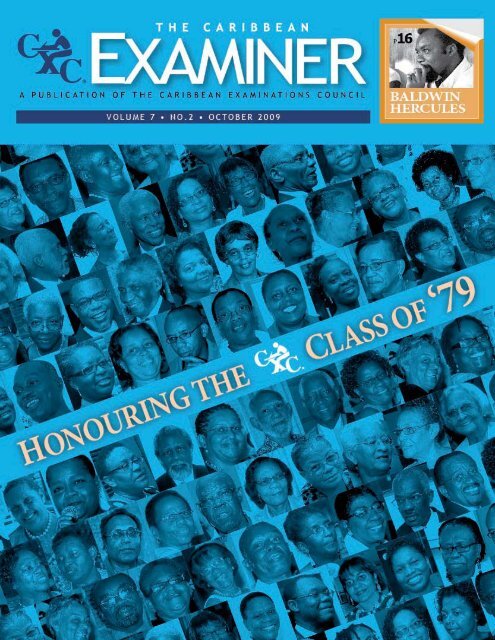
Cover Photograph<br />
Faces of CXC Class of ‘79<br />
THE CARIBBEAN EXAMINER is a publication of the CARIBBEAN EXAMINATIONS COUNCIL (CXC)<br />
Editor-in-Chief: Dr Didacus Jules • EDITOR: CLEVELAND SAM • LINE EDITOR: MAUREEN GRAZETTE & MIRANDA SEALY<br />
Please send your comments to: THE CARIBBEAN EXAMINER, CXC, THE GARRISON, ST MICHAEL, BARBADOS<br />
Website http://www.cxc.org • E-mail: cxcezo@cxc.org • YouTube: http://www.youtube.com/watch?v=oFDDmH7oHzg<br />
Check out <strong>Caribbean</strong> <strong>Examinations</strong> <strong>Council</strong> (CXC) page on Facebook<br />
ISSN 2071-9019<br />
www.cxc.org OCTOBER 2009 3
The <strong>Caribbean</strong> Examiner<br />
REGISTRAR’S NOTES<br />
Celebrating Thirty Solid Years of Csec<br />
2009 marked the 30th Anniversary of our<br />
flagship examination, the <strong>Caribbean</strong> Secondary<br />
Education Certificate (CSEC) and we at CXC<br />
felt that it ought to be a moment of celebration<br />
for what we have achieved and for reflection on<br />
where we now need to go.<br />
The attainment of this milestone is truly<br />
a tribute to the stalwarts who, over these<br />
many years, have worked hard to make our<br />
examinations internationally accepted and<br />
regionally credible. So it provided us with an<br />
opportunity to recognize and highlight this<br />
contribution. In Barbados, Guyana, Jamaica<br />
and Trinidad and Tobago we hosted award<br />
ceremonies for the honorees who were part of<br />
that seminal experiment in 1979 of <strong>Caribbean</strong><br />
educational sovereignty. The distinguished<br />
persons recognized included the indomitable Sir<br />
Roy Augier, a founding father and past Chairman<br />
of CXC; Sir Howard Fergus, a distinguished<br />
citizen of Montserrat who has acted as Governor<br />
of Montserrat in the past and who was a member<br />
of the first CSEC <strong>Caribbean</strong> History Panel; Sir<br />
Colville Young, the current Governor General of<br />
Professor Anselm Hennis<br />
Belize and a member of the first English A Panel;<br />
Mr Wilfred Beckles, the former Registrar who<br />
presided over that historical moment and Mrs<br />
Irene Walter, Pro Registrar in 1979 and a former<br />
Registrar. We dug as extensively as we could into<br />
our archives, into the memories of those who<br />
served then and into the records of ministries<br />
of education across the region to identify those<br />
who had played seminal roles at every level in<br />
that process.<br />
The reconstruction of that moment has<br />
helped us to fill an important lacuna in the<br />
history of CXC. Because of these celebrations,<br />
so many people have come forward with<br />
their recollections that we felt it important to<br />
continue the story from the previous issue of<br />
The <strong>Caribbean</strong> Examiner. The recollections of<br />
the students who sat these early examinations<br />
add real texture to the accounting for this history<br />
and we have been honestly amazed at where that<br />
CSEC Class of ’79 has gone since. Professor<br />
Anselm Hennis, our feature speaker for the<br />
awards ceremony in Barbados, was part of that<br />
cohort from Harrison College. His journey since<br />
then has been an inspiring trajectory towards<br />
professional excellence and personal integrity<br />
and it exemplifies the story of the CSEC Class<br />
of ’79.<br />
In this issue we continue to report on<br />
progress. There is the progress made on<br />
articulation agreements – this time with the<br />
prestigious University of South Florida.<br />
There is the progressive improvement in<br />
CSEC and <strong>Caribbean</strong> Advanced Proficiency<br />
Examination (CAPE) performance in this year’s<br />
examinations, as well as the phenomenal growth<br />
of the <strong>Caribbean</strong> Certificate of Secondary<br />
Level Competence (CCSLC). There is progress<br />
reported on strategic partnerships with key<br />
business and academic partners: the University<br />
of the West Indies’ School of Education and<br />
DR DIDACUS JULES<br />
the Institute for Critical Thinking and with<br />
Ian Randle Publishers, undoubtedly the leading<br />
<strong>Caribbean</strong> publishing house.<br />
We have a lot more progress to report and we<br />
will do so in subsequent issues of The <strong>Caribbean</strong><br />
Examiner, which will now be published twice<br />
annually. We hope that this publication will<br />
become increasingly useful to educators in<br />
the region and that you will be motivated to<br />
occasionally contribute to its content.<br />
DR DIDACUS JULES<br />
Registrar, <strong>Caribbean</strong> <strong>Examinations</strong> <strong>Council</strong><br />
PHOTO BY CARLEEN JULES<br />
www.cxc.org OCTOBER 2009 5
The <strong>Caribbean</strong> Examiner<br />
CLASS OF ‘79<br />
Susan Giles presents gift to Laloo Hart<br />
Professor Neville Ying (right) receives<br />
a gift from Professor Nigel Harris,<br />
Chairman of CXC<br />
Jasper Lawrence presents gift to Dr Heloise Lewis<br />
Honouring the Members of the<br />
‘CXC Class of ‘79’<br />
By Cleveland Sam<br />
“We, the CXC Class of ‘79, are indeed<br />
honoured to have played our part in helping<br />
to build this great <strong>Caribbean</strong> institution, which<br />
together with the University of the West Indies<br />
and the West Indies Cricket team are the most<br />
evident signs of <strong>Caribbean</strong> integration at work.<br />
As history makers, it was gratifying to be part<br />
of a truly <strong>Caribbean</strong> team embarking on a most<br />
exciting endeavour...”<br />
These are the words of Annette Smith, a<br />
staff member with CXC in 1979 based at the<br />
Western Zone Office in Jamaica as she spoke<br />
on behalf of the “CXC Class of ‘79” at the<br />
“Honouring the CXC Class of ’79” function in<br />
Jamaica on 15 th July.<br />
Smith is among over 130 persons from<br />
across the region who make up the distinguished<br />
group dubbed the “CXC Class of ‘79.” This ‘Class’<br />
is made up of the people who laid the foundation<br />
on which CXC’s <strong>Caribbean</strong> Secondary Education<br />
Certificate (CSEC) examination now stands. The<br />
members of the CXC Class of ’79 contributed in<br />
various ways to the successful administration of<br />
the first CSEC examinations offered by CXC in<br />
1979 in <strong>Caribbean</strong> History, English A, Geography,<br />
Integrated Science and Mathematics. They were<br />
members of the five Subject Panels; members of<br />
Professor Neville Ying, a CXC resource person from 1975 and Cliff Hughes, a member of the CSEC<br />
Class of ‘79, are pinned with buttonholes by Judith Taylor as they arrive for the function in Jamaica Dr Jules presents gift to Patrica Douglas, a CXC employee in 1979<br />
6 OCTOBER 2009 www.cxc.org
The <strong>Caribbean</strong> Examiner<br />
Class of ‘79<br />
1979 by Bernadine Parris<br />
The period leading up to the first examinations in 1979 was a time of despondency and uncertainty. The public was<br />
concerned about acceptance of the certification and the survival of this relatively new <strong>Caribbean</strong> organization. Most persons<br />
felt that CXC would collapse like the West Indies Federation. It was also difficult to find persons who were willing to work<br />
here. The staff at that time was constantly faced with these challenges.<br />
Despite all this, a few brave souls stuck to it and made it possible for the first examinations to take place in 1979. I<br />
remember the excitement and anticipation on the first day of marking at the Windsor Hotel in Christ Church. We all wanted<br />
to see the dream of having our own <strong>Caribbean</strong> examinations come true, and we did with the help of the international bodies CIDA and ETS.<br />
the five Examining Committees; markers who<br />
marked in 1979 and are still marking in 2009;<br />
and members of CXC staff in 1979.<br />
To recognize the contribution of the<br />
members of the Class, CXC hosted awards<br />
functions in Barbados, Jamaica and Guyana, and<br />
a presentation ceremony in Trinidad and Tobago<br />
during the July marking exercise.<br />
The event in Barbados was hosted on<br />
Friday 10 th July at the Christ Church Parish<br />
Church Centre. At this event, 75 members of the<br />
CXC Class of ’79 received their gifts including<br />
Wilfred Beckles, the Registrar of CXC in 1979,<br />
several members of staff and former and current<br />
resource persons.<br />
Professor Anselm Hennis, a member of the<br />
first cohort of students from Harrison College<br />
in Barbados to write the CSEC examinations<br />
in 1979, was the feature speaker. Honourable<br />
Ronald Jones, Minister of Education and<br />
Human Resource Development, also spoke at<br />
the ceremony.<br />
The second event was hosted at the Hilton<br />
Hotel in Kingston, Jamaica on 15 th July. Professor<br />
Nigel Harris, Chairman of CXC, addressed the<br />
function, while the feature speaker was Cliff<br />
Hughes, a former student at the Excelsior High<br />
School, Jamaica, who wrote the first CSEC<br />
examinations in 1979. Jasper Lawrence, Chief<br />
Education Officer in Jamaica, also addressed<br />
the function.<br />
More than 30 persons were honoured at<br />
this function including the <strong>Council</strong>’s first Pro<br />
Registrar and first female Registrar Irene Walter,<br />
and Sir Roy Augier, former Chairman and<br />
member of the first <strong>Caribbean</strong> History Panel.<br />
The following day, 16 th July, was the turn of<br />
the Guyana and Trinidad and Tobago marking<br />
centres to host their events. The awards function<br />
in Guyana was hosted at the Georgetown Club and<br />
saw awards being presented to six members of the<br />
CXC Class of ’79. Pulandar Kandhi, Permanent<br />
Secretary in the Ministry of Education in Guyana<br />
and also the Deputy Chairman of CXC, spoke at<br />
the event, along with Juliette Persico, the longest<br />
serving Local Registrar in the region. Among the<br />
awardees at this event were Clement Derrell,<br />
who has been marking CSEC for the 30 years of<br />
its existence, and Belle Tyndall, a member of the<br />
first English A Panel.<br />
Significant Role<br />
“All of you have one thing in common,”<br />
Honourable Ronald Jones, Minister of Education<br />
and Human Resource in Barbados told the<br />
honourees. “You have played a significant role<br />
in creating a brand, that in the relatively short<br />
span of thirty years, is distinctively <strong>Caribbean</strong> and<br />
is highly respected across the world as a brand<br />
associated with exceptional quality.”<br />
In reflecting on the first students who wrote<br />
the CSEC examinations in 1979, Minister Jones<br />
noted that there was uncertainty about the new<br />
examinations.<br />
“Since you were the ‘guinea pigs,’ you were<br />
unsure of how institutions of higher education<br />
would view your new qualifications. You could<br />
not be sure either that employers would equate<br />
these qualifications with the established and<br />
respected certification of the institutions in the<br />
former ‘Mother Country’. You were therefore<br />
expected to engage in what was essentially an act<br />
of faith,” Jones explained.<br />
A former teacher, Minister Jones also<br />
acknowledged that the new examination in<br />
1979 presented a significant opportunity for the<br />
region’s educators. “While it might have been a<br />
time of great uncertainty for our students, it was<br />
also a time of great excitement for the teachers<br />
and academics across the region,” he stated.<br />
He explained that while in the past educators<br />
Honourable Ronald Jones, Minister of Education and Human Resource Development in<br />
Barbados, presents gift to Elma Licorish, a CXC employee in 1979<br />
Pulandar Kandhi, Permanent Secretary in the Ministry of Education in Guyana<br />
and Deputy Chairman of CXC, presents gift to Anna Benjamin<br />
www.cxc.org OCTOBER 2009 7
The <strong>Caribbean</strong> Examiner<br />
Honourable Ronald Jones presents gift to Marion Coppin,<br />
a CXC employee in 1979<br />
Professor Nigel Harris, CXC Chairman, presents<br />
award to Sir Roy Augier, former CXC Chairman and<br />
a member of the first CSEC <strong>Caribbean</strong> History Panel<br />
Henderson Eastmond, CXC Assistant Registrar presents gift to<br />
Clement Radcliff at event in Trinidad and Tobago<br />
taught the syllabuses and prepared students to<br />
write the examinations of foreign bodies, with<br />
the advent of CSEC, “we were being given the<br />
opportunity to participate in the determination<br />
of what our children should learn and be assessed<br />
on. Across the <strong>Caribbean</strong>, we were going to be,<br />
to quote so appropriately from the words of<br />
the Barbados National Anthem, ‘craftsmen of<br />
our fate’.”<br />
Pulandar Kandhi, Permanent Secretary in<br />
the Ministry of Education in Guyana and Deputy<br />
Chairman of CXC, said honouring the Class of<br />
’79 was a most appropriate gesture. “When we<br />
look at where CXC was, where we are, and where<br />
we want to be, we can only acknowledge that<br />
honouring our pioneers is fitting.”<br />
Appreciation for duty<br />
And the awardees agreed. Speaking on<br />
behalf of the honourees in Barbados, Sheilah<br />
Garcia-Bisnott, a member of the CSEC English<br />
Examining Team from the inception of the<br />
examination, spoke gracefully. “The fact that<br />
we are being awarded for doing our duty is the<br />
supreme reward,” she quipped.<br />
A Jamaican, Mrs Garcia-Bisnott urged her<br />
fellow honorees to “see this as nothing more<br />
than your duty, our duty to the children of the<br />
<strong>Caribbean</strong> and to the <strong>Caribbean</strong>.”<br />
The long-time examiner said she felt “an<br />
extra-ordinary sense of pride of being a part of<br />
this, which is beyond us, better than we are and<br />
bigger than we are.”<br />
If Garcia-Bisnott was graceful, Dr Merle<br />
Baker was equally as eloquent in her response<br />
on behalf of the honourees in Jamaica. Dr Baker<br />
in answering the rhetorical question ‘what about<br />
CXC that made us return year after year’, offered<br />
the following reason. “…We have just always<br />
returned because we have become loyal soldiers<br />
to a great cause – CXC.”<br />
One who has served as an examiner in<br />
different countries for CXC over the last 30 years,<br />
Dr Baker said they understood that the very<br />
future of the <strong>Caribbean</strong> was at stake.<br />
“We, like a dedicated army, knew that our<br />
future and survival as a <strong>Caribbean</strong> people and<br />
a <strong>Caribbean</strong> academic certifying institution on<br />
the world stage was under serious attack by those<br />
1979 by Rose Brathwaite<br />
I started working with CXC in May 1979 as an Aide (Clerical Assistant) in the <strong>Examinations</strong> Administration<br />
Division. My duties then included the checking of SBA scores which were submitted by the schools, gridding of mark<br />
sheets, preparing folders for marking and script batching. All of this was done in a small area in the <strong>Examinations</strong> Section.<br />
Checking the SBA scores was tedious but it had to be done before marking began. I also assisted in the marking exercise.<br />
I was assigned to the Mathematics Basic group at the Windsor Hotel. We went there not knowing what to expect since<br />
this was our first exercise. The rooms we used were small and we utilized every available space. At times the floors were<br />
also used for sorting of folders. We had a very committed team of workers.<br />
Bernadine Parris was our supervisor and even though there was much work to be done, she made the process enjoyable. There was never<br />
a dull moment when she was around. She gave everyone a name other than their real name. There was “daddy long legs”, there was “cubba”,<br />
Sandra was called Veronica, Chris was changed to Christophene and so on, but no one felt offended. At one point whenever Bernadine entered<br />
the room everyone would start laughing because we knew that she would do or say something funny.<br />
It was hard work but we accepted the challenge and in the end it was satisfying to know that the exercise was completed successfully despite<br />
the various setbacks. All in all that first marking exercise was a learning experience for me and I enjoyed it. I am happy to have been a part of<br />
that first marking session and I believe that I have been able to build on that experience over the years.<br />
8 OCTOBER 2009 www.cxc.org
The <strong>Caribbean</strong> Examiner<br />
Class of ‘79<br />
1979 by Edwina Griffith<br />
The year 1979 at the <strong>Caribbean</strong> <strong>Examinations</strong> <strong>Council</strong> was filled with mixed emotions as this was the first<br />
examinations/marking session for most of us except the expatriates like Dr Elliot from Canada. The expatriates organized<br />
the entire process while the staff followed and made adjustments as they went along.<br />
The first marking was held at the Windsor Hotel in Christ Church and although I was not fully involved in the marking,<br />
I went to visit the centre and I was appalled at what I saw. CXC had taken this once prestigious luxury hotel and transformed<br />
the rooms into a “war zone”. There were loose scripts everywhere as ISD wanted data by a specific date and had requested<br />
Exams to pull out the completely marked scripts from the folders. Rest assured that EAD refrained from using that system ever again.<br />
Also, the temporary members of staff were chosen from places like Codrington College and retired government employees. Coming out of<br />
this group is the now famous Rev. Errington Massiah who was at the time a student of the College. As you would imagine, emotions ran high but<br />
we were successful at delivering the first examinations.<br />
who would have waved their flags and wagged<br />
their tongues negatively and said ‘aha aha - I<br />
told you so’.”<br />
Dr Baker stated that contrary to the Mighty<br />
Sparrow’s song ‘No money, No Love,’ their love<br />
for CXC was never about money, rather, “our<br />
earnings provided us with the opportunities<br />
to explore fully the various islands, Jamaica,<br />
Barbados, Trinidad and Tobago and Guyana<br />
which became marking centres. We can now<br />
speak with authority about the beauty and<br />
natural wonders of those <strong>Caribbean</strong> destinations:<br />
the majestic elegance of the Kaiteur, Orinduke<br />
and Dunn’s River waterfalls, and the serenity of<br />
Harrison’s Cave, at CXC’s expense.”<br />
Annette Smith, who worked at the Western<br />
Zone Office in 1979, spoke on behalf of the staff<br />
at the Jamaica event. “We are indeed privileged<br />
to have played our part in this significant and<br />
historical development in the <strong>Caribbean</strong>,” she<br />
stated. “We look on like proud parents, 30 years<br />
later, as CXC has come of age.”<br />
<strong>Caribbean</strong> Pride<br />
Speaking at the function in Jamaica,<br />
Jasper Lawrence, Chief Education Officer in<br />
the Ministry of Education, said the <strong>Caribbean</strong><br />
<strong>Examinations</strong> <strong>Council</strong> (CXC) is an institution of<br />
which the entire <strong>Caribbean</strong> can feel proud.<br />
“The CXC has helped to leapfrog<br />
the <strong>Caribbean</strong> Community from external<br />
examination bodies, setting the standards for<br />
secondary education and measuring the outcomes<br />
of secondary education,” said Lawrence, who was<br />
deputizing for Honourable Andrew Holness,<br />
Minister of Education in Jamaica.<br />
His views were echoed by Cliff Hughes,<br />
the feature speaker and himself a member of the<br />
CSEC Class of ’79 at Excelsior High School in<br />
Jamaica. He said CXC was a successful regional<br />
project that represented “the best of us as a people<br />
called the <strong>Caribbean</strong>.”<br />
Wilfred Beckles, CXC Registrar in 1979, receives his award from Honourable Ronald Jones<br />
(L–R) Coleridge Barnett, Dr Jean Small, Dr Pauline Christie, Faye Saunders and Irene Walter<br />
www.cxc.org OCTOBER 2009 9
The <strong>Caribbean</strong> Examiner<br />
CLASS OF ‘79<br />
30 Years of CSEC<br />
The Pro Registrar’s Perspective<br />
By Irene Walter<br />
Employees at the Western Zone Office in earlier times<br />
The signing of the Agreement in Barbados<br />
in 1972 by the governments of 15 Englishspeaking<br />
<strong>Caribbean</strong> territories brought the<br />
<strong>Caribbean</strong> <strong>Examinations</strong> <strong>Council</strong> into being<br />
after a gestation period which commenced as<br />
far back as 1946.<br />
My recollections thirty-five years on, of<br />
details of the events which took place in the early<br />
years of the <strong>Council</strong>’s life have understandably<br />
dimmed. However, there still remain in sharp<br />
relief some of the more striking aspects of those<br />
early years. In particular, the events of the first<br />
five years leading to the first examinations in<br />
June 1979 are seen through the lenses of activities<br />
which I directed and managed from the Western<br />
Zone Office.<br />
The birth of the regional institution caused<br />
hardly a stir in Jamaica, passing almost unnoticed<br />
Irene Walter<br />
by the general population. However, it was an<br />
occasion for celebration by the leadership of the<br />
teaching fraternity in Jamaica, who, with their<br />
regional colleagues in the Eastern <strong>Caribbean</strong>,<br />
had vigorously supported the idea of the<br />
establishment of a <strong>Caribbean</strong> examining body<br />
to replace the English-exported School and<br />
Higher School Certificate examinations and their<br />
successors the General Certificate of Education<br />
(GCE) at O- and A-levels. For a time, prior<br />
to the signing, there was some doubt whether<br />
Jamaica (which had seceded in 1962 from the<br />
1958 Federation of the West Indies) would join<br />
with its regional partners in this new <strong>Caribbean</strong><br />
initiative. It was therefore a well-satisfied<br />
Fay Saunders, then President of the Jamaica<br />
Teachers Association and a representative of the<br />
teaching profession at the CARICOM meetings<br />
10 OCTOBER 2009 www.cxc.org
The <strong>Caribbean</strong> Examiner<br />
Heads of Division meeting in earlier times (L–R): John Campbell, Irene Walter, Wilfred Beckles, Astrid Waterman,<br />
Colin Kirton and Dr Bertram Drakes (partly hidden)<br />
which agreed to establish the <strong>Council</strong>, who<br />
accompanied the then Minister of Education,<br />
the Honourable Florizel Glasspole, to the signing<br />
ceremony. Even after the signing, however, the<br />
matter of participation of Jamaica was still not<br />
considered a done deal in some quarters.<br />
Only after the signing of the Supplementary<br />
Agreement in 1973 by the newly elected<br />
government, which created an Administrative<br />
and Operational Centre (AOC) in Jamaica to<br />
complement the Headquarters, which would be<br />
located in Barbados, was the matter of Jamaica’s<br />
participation sealed, as it provided the <strong>Council</strong><br />
with a high-level presence in Jamaica. The AOC,<br />
called the Western Zone Office, was given the<br />
responsibility to direct the work of the western<br />
region –Jamaica, Belize, the Turks and Caicos<br />
Islands, the Cayman Islands and the Bahamas,<br />
which the <strong>Council</strong> hoped would join. In 1974<br />
when the WZO became operational, the <strong>Council</strong><br />
decided to add to the responsibilities of the office<br />
the work of syllabus formulation and oversight of<br />
the Measurement and Evaluation Division.<br />
The <strong>Council</strong> held its first meeting under<br />
the Chairmanship of Dr (later Sir) Roy Marshall,<br />
Vice Chancellor of the University of the West<br />
Indies in 1973, and appointed the first Registrar,<br />
Major Daniel, who took up the appointment in<br />
November of that year. The Pro Registrar’s post<br />
was filled when I was appointed to the post in<br />
August 1974. But almost immediately there was<br />
to be a change in the leadership as Dr Marshall<br />
resigned his position as Vice Chancellor and<br />
therefore had to demit the position of Chairman<br />
of CXC.<br />
The first working meeting of the <strong>Council</strong><br />
was held in 1974, under the Chairmanship of<br />
the late Dr Dennis Irvine, then Vice Chancellor<br />
of the University of Guyana. It was his task<br />
to provide the leadership to respond to an<br />
The Pro Registrar’s Perspective<br />
ambitious agenda set by the Heads of regional<br />
participating governments for the conduct of the<br />
first examination in 1979. There was much work<br />
to be done to meet that deadline. There were<br />
policy decisions which would be taken on the<br />
basis of discussions with University of Cambridge<br />
Local <strong>Examinations</strong> Syndicate (UCLES) about its<br />
role in the transition of the examining functions;<br />
there were ‘study visits’ to overseas Boards,<br />
notably the West African <strong>Examinations</strong> <strong>Council</strong><br />
(WAEC) by the Pro Registrar and the Senior<br />
Assistant Registrar.<br />
The work programme set by the <strong>Council</strong><br />
identified five subjects for the first examinations<br />
in 1979 - English, Mathematics, Geography,<br />
<strong>Caribbean</strong> History and Integrated Science.<br />
This meant that the syllabuses needed to be<br />
developed and circulated regionally by the<br />
beginning of the school year, in September<br />
1977. The model adopted by CXC of providing<br />
detailed syllabuses outlining general and specific<br />
objectives together with the content of the subject<br />
was a new approach which had not been available<br />
to <strong>Caribbean</strong> schools when UCLES examined<br />
the school population. The responsibility for<br />
managing the process of syllabus formulation<br />
was delegated to the Western Zone Office which<br />
in 1974 comprised a two-person office manned<br />
by the Pro Registrar and a Secretary, Delores<br />
Pyne. The syllabus panels each had six members<br />
selected from the most proficient teachers<br />
nominated by the ministries of education.<br />
The panels began work in 1975 and were given<br />
less than 24 months to design the syllabuses,<br />
respond to teachers’ comments, and obtain<br />
SUBSEC’s (a Sub-Committee of the School<br />
<strong>Examinations</strong> Committee which was charged<br />
with approving syllabuses) approval prior to<br />
dispatching them to schools by the beginning<br />
of September 1977. Every effort was made by all<br />
panels to visit individual territories during the<br />
“Those long hours spent by the panels hammering out<br />
the syllabuses were filled with a remarkable fraternal<br />
spirit, a spirit which would continue to be the hallmark<br />
of the collaborative effort of all involved.”<br />
www.cxc.org OCTOBER 2009 11
The <strong>Caribbean</strong> Examiner<br />
CLASS OF ‘79<br />
Irene Walter making a point to Wilfred Beckles, former Registrar,<br />
Dr Dennis Irvine, former Chairman, is at right<br />
formulation exercise to meet with teachers and<br />
discuss the panels’ proposals. It was during these<br />
visits to territories that the panels found that<br />
the excitement and euphoria exhibited by the<br />
teaching profession was often countered with a<br />
real fear of whether the task could be successfully<br />
accomplished. Images of the failure of the East<br />
African Examination Body which had embarked<br />
earlier in undertaking to examine their school<br />
population were always present in the minds of<br />
all involved in this new undertaking.<br />
Those long hours spent by the panels<br />
hammering out the syllabuses were filled with<br />
a remarkable fraternal spirit, a spirit which<br />
would continue to be the hallmark of the<br />
collaborative effort of all involved. The panel<br />
members, all teachers or curriculum specialists,<br />
whether on the staff of the regional universities,<br />
community colleges, ministries of education or<br />
from the classroom, soon formed friendships<br />
which have lasted over the 33 years since they<br />
first served as members. Many members went<br />
on to collaborate in writing the new text books<br />
which were required to support the syllabus. As<br />
the Secretary to the first five panels, I was in the<br />
thick of the fray, travelling around the region,<br />
joining the panellists in explaining to the teachers<br />
and the general public the aim of the <strong>Council</strong>,<br />
its structure and work. It was an exciting and<br />
professionally fulfilling time, but there were<br />
hiccups along the way to the completion of the<br />
syllabuses. I remember how daunting the task<br />
of designing a new Integrated Science syllabus<br />
appeared to the highly qualified panel, working<br />
under the leadership of the late Flo Commissiong<br />
of the University of the West Indies. Flo, as she<br />
was fondly known, came to the task from a<br />
successful career as a Biology teacher at a leading<br />
boys’ school in Jamaica and as a Teacher Educator<br />
attached to the Faculty of Education at UWI.<br />
The panel worked assiduously, often late into the<br />
night, and produced a comprehensive syllabus<br />
in which the subject matter of Biology, Physics<br />
and Chemistry were skilfully incorporated. The<br />
panel presented the document to the July 1975<br />
meeting of SUBSEC held in St Lucia. The panel<br />
had just barely met the deadline for submission<br />
and was confident that it had done a good job<br />
worthy of the approval of SUBSEC. To the great<br />
distress of the Convenor who presented the<br />
syllabus, it was rejected and returned to the panel<br />
for further work on the grounds that it was far<br />
too heavy for a single subject award. The panel<br />
reconvened and within days reviewed and revised<br />
the syllabus, returning it to SUBSEC with the<br />
recommendation that it should be given a Double<br />
Award. This recommendation was accepted, but<br />
there was much doubt whether teachers were able<br />
to manage the programme so that the syllabus<br />
was initially offered as a pilot examination for<br />
the first years of the examination.<br />
What was remarkable about the work of<br />
the panels was that the syllabuses formed a<br />
substantial part of the material sent to the UCLES<br />
and London University to support a request for<br />
the acceptance of the new CXC examinations as<br />
equivalent to the O-levels offered by the British<br />
Boards. The work of the <strong>Council</strong> in developing<br />
the new syllabuses cannot be recorded without<br />
mentioning the strong professional support given<br />
to the fledgling Syllabus Unit and the panels<br />
by Dr Thomas (Tom) Christie of Manchester<br />
University who served as a Consultant funded<br />
by the Commonwealth Secretariat.<br />
A major policy decision taken by the<br />
<strong>Council</strong> was that the new examinations should<br />
be structured to test a wider range of abilities in<br />
the school population than the GCE tested. This<br />
decision was in part to respond to <strong>Caribbean</strong><br />
governments’ policy to provide secondary<br />
education for a larger part of the 11 to 16 age<br />
cohort. The decision to expand the tests to<br />
include other techniques led to the inclusion<br />
of a multiple choice paper, as well as a schoolbased<br />
assessed component of the examination,<br />
which would be marked by classroom teachers<br />
during the penultimate year of the two-year<br />
programme and moderated by CXC. This latter<br />
component, an innovation not up to then offered<br />
in examinations by British Boards, would be<br />
awarded up to 40 percent of the marks for the<br />
subject.<br />
The decision to include the multiple choice<br />
component in every subject examined resulted in<br />
the development of a close working relationship<br />
with the Educational Testing Service (ETS) of<br />
Princeton University. Two of the staff members<br />
of that institution who gave invaluable service<br />
to the <strong>Council</strong> in those early years were the late<br />
Dr Matt Sherman and Mrs Fran Ottobre. Our<br />
relations with ETS also lent credibility to our first<br />
examinations and played an important role in<br />
12 OCTOBER 2009 www.cxc.org
The <strong>Caribbean</strong> Examiner<br />
The Pro Registrar’s Perspective<br />
securing for the <strong>Council</strong> a favourable assessment<br />
by Stephen Fisher of the CXC General and<br />
Basic examinations as an entry qualification to<br />
American universities. The <strong>Council</strong>’s membership<br />
in the American Association of College Registrars<br />
and Admission Officers (AACRAO), a clearing<br />
house for information on qualifications outside<br />
the USA, helped as well in securing the acceptance<br />
of the new CXC qualification. As the <strong>Council</strong>’s<br />
representative to the Association, I was privileged<br />
to attend many meetings held in the USA. One<br />
meeting which I particularly enjoyed was held<br />
in Las Vegas, Nevada. On entering the hotel that<br />
first evening, I was startled by the line of ‘one arm<br />
bandits’ stretching from the entry door to the<br />
elevators leading up to the bedroom! Even more<br />
memorable on that occasion was my visit to the<br />
Grand Canyon and the Hoover Dam.<br />
In 1978, there was again a significant change<br />
in the management of the organization as Major<br />
Daniel demitted the office of Registrar and was<br />
replaced by Mr Wilfred Beckles. An important<br />
item on the <strong>Council</strong>’s agenda in 1978 which<br />
the new Registrar had to manage was securing<br />
acceptance of the CXC certification for entry to<br />
universities in the UK, USA, and Canada as well<br />
as to our regional universities, the University of<br />
the West Indies and the University of Guyana.<br />
Although documentation on the examinations<br />
presented to the relevant institutions in 1978 led<br />
to the acceptance of General Proficiency Grades<br />
I and II generally, the <strong>Council</strong> was aware that the<br />
successful conduct of the first examinations in<br />
June 1979 would be critical in ensuring a more<br />
widespread acceptance, particularly among the<br />
still sceptical parents, teachers and students in the<br />
<strong>Caribbean</strong>. The <strong>Council</strong>, however, had prepared<br />
itself well to satisfy these sectors. Besides the<br />
careful designing of syllabuses and examinations<br />
and conducting workshops for teachers, the<br />
<strong>Council</strong> held training sessions for potential<br />
markers. To complete the activity of marker<br />
training and prepare a cadre of markers for the<br />
CXC marking exercise, the <strong>Council</strong> negotiated<br />
with Cambridge Syndicate to train markers and<br />
to use them to mark live GCE scripts in 1978.<br />
In Jamaica, this activity took place at the now<br />
defunct Forum Hotel located in Edgewater,<br />
Portmore, in St Catherine.<br />
By June 1979, the <strong>Council</strong> was well prepared<br />
to successfully administer the first examinations.<br />
The essay scripts for English and Integrated<br />
Science assigned to the Jamaica Centre were<br />
marked at the Pegasus Hotel, selected to<br />
ensure maximum security. <strong>Caribbean</strong> History,<br />
Geography and Mathematics scripts were marked<br />
in Barbados and the multiple choice papers<br />
by ETS in New Jersey. When the Final Awards<br />
Committee met in Barbados in August 1979 and<br />
approved the recommended grade boundaries, it<br />
was with a sense of satisfaction that all the many<br />
players returned to their home territories to await<br />
the issue of the results.<br />
By 1979, the staff had grown in numbers<br />
both at Headquarters and the Western Zone<br />
Office. In Jamaica, the <strong>Council</strong> recruited two<br />
young, energetic and committed staff members:<br />
Mrs Annette Smith and Miss Hazel Campbell. But<br />
it was generally admitted that the strength of the<br />
organization lay in the large numbers of persons<br />
from the region and beyond who were involved in<br />
the work of the <strong>Council</strong>. The CXC family included<br />
the Panellists and the Examining Committees,<br />
whose work and expertise were critical to the<br />
success of the <strong>Council</strong>, the members of the<br />
<strong>Council</strong>, Moderators, both external and regional,<br />
(unknown to all except top management), who<br />
carried out the important work of quality control,<br />
members of the <strong>Council</strong>’s major committees<br />
– the School <strong>Examinations</strong> Committee, the<br />
Administrative and Finance Committee and<br />
National Committees in participating countries.<br />
In Jamaica, Sir Roy Augier, Professor Reginald<br />
(Reg) Murray and Dr Laurie Reid, <strong>Council</strong><br />
members from the University of the West Indies,<br />
played leading roles in publicizing the work of<br />
the <strong>Council</strong> and assuring the population of the<br />
worth and integrity of the new examinations.<br />
Also playing a critical role in the <strong>Council</strong>’s<br />
Irene Walter and Wilfred Beckles in conversation with the Honourable Clive Pantin,<br />
former Minister of Education in Trinidad and Tobago<br />
development were funding agencies including<br />
the Commonwealth Secretariat, United States<br />
Agency for International Development (USAID),<br />
the Canadian International Development Agency<br />
(CIDA), CARICOM and the Association of<br />
Canadian Community Colleges (ACCC), whose<br />
director Kathy Whalen took a personal interest in<br />
ensuring that the work and worth of the <strong>Council</strong><br />
were recognized.<br />
In Jamaica, the first small entry was mainly<br />
in the subjects, English and Mathematics. The<br />
<strong>Council</strong> owes a debt of gratitude to the Principals<br />
and classroom teachers of that first cohort of<br />
students. The late Mr Wesley Powell, founder<br />
and Headmaster of Excelsior High School, and<br />
the late Mrs Ellorine Walker of Merle Grove<br />
High School never wavered in their belief in the<br />
<strong>Council</strong> and demonstrated their confidence by<br />
ensuring that their students were included in<br />
the first cohort sitting the <strong>Caribbean</strong> Secondary<br />
Education Certificate (CSEC) examinations.<br />
Now thirty years later, the CSEC certification<br />
is the preferred choice of the secondary school<br />
candidate in Jamaica and the rest of the <strong>Caribbean</strong>.<br />
It is most gratifying to those of the small band<br />
of persons still alive today who were involved in<br />
the work of the <strong>Council</strong> in those early years, to<br />
join in the celebrations of a first-class examining<br />
body, thirty years on.<br />
Irene Walter, C.D was the Pro Registrar<br />
of CXC in 1979 when the first CSEC<br />
examinations were offered.<br />
She later became the Registrar.<br />
www.cxc.org OCTOBER 2009 15
The <strong>Caribbean</strong> Examiner<br />
INTERVIEW<br />
Baldwin Hercules (centre), Paul King, Genoise Bowen (back) and Rita Voeth in earlier times<br />
INTERVIEW WITH<br />
BALDWIN HERCULES<br />
Baldwin Hercules, former Senior Assistant Registrar, <strong>Examinations</strong> Administration Division,<br />
recently sat down and spoke with Cleveland Sam and Andrea Gooding about<br />
some of his experiences at CXC in his 32 years with the <strong>Council</strong><br />
What preparations went into<br />
getting the 1979 examinations<br />
ready prior to 1979?<br />
The work would have begun in Jamaica with<br />
the development of the syllabuses for the subjects<br />
for the first examinations. Those five subjects<br />
were English, Mathematics, Geography, History<br />
and Integrated Science DA. The WZO office<br />
was responsible for developing these syllabuses.<br />
The policy was to have the four major territories<br />
represented on these subject panels and then<br />
they sought assistance also from the universities<br />
and ministries of education. Typically, a subject<br />
panel had six representatives but always the four<br />
major territories were represented along with the<br />
university representative and some curriculum<br />
experts from other territories.<br />
The syllabuses were put in schools two<br />
years before the examinations were to be sat,<br />
that would be in 1977. In terms of developing the<br />
examinations, the <strong>Council</strong> had assistance from<br />
international bodies, for example the Educational<br />
Testing Service (ETS) and they were instrumental<br />
in helping with the development of the Multiple<br />
Choice component of the examinations. They<br />
had assistance also from the British examining<br />
bodies who assisted in the area of training of<br />
examiners. When I joined in 1976 one of the<br />
first activities I was involved in was the marking<br />
of Cambridge scripts by <strong>Caribbean</strong> Examiners<br />
under the guidance of the Chief Examiners<br />
from the UK, they set a presidential marking. I<br />
remember here in Barbados there was a session<br />
at Sam Lord’s Castle where the Cambridge<br />
Chief Examiners for English Language came to<br />
supervise a group of <strong>Caribbean</strong> people marking<br />
<strong>Caribbean</strong> scripts. We were training a core of<br />
examiners in preparation for our examinations<br />
in 1979. These were live examinations scripts<br />
that were written by <strong>Caribbean</strong> students and<br />
were assessed by <strong>Caribbean</strong> teachers under the<br />
supervision of the Cambridge Chief Examiners.<br />
Item Writers were trained with assistance from<br />
the Educational Testing Service of the USA.<br />
16 OCTOBER 2009 www.cxc.org
The <strong>Caribbean</strong> Examiner<br />
Interview with Baldwin Hercules<br />
What about the mechanism for<br />
the actual marking of the CXC<br />
examinations?<br />
Very early we decided to have a residential<br />
system of marking, a system which is still in<br />
place today. The scripts would be brought to<br />
two locations, namely Barbados and Jamaica,<br />
and we would bring the Examiners from all over<br />
the region into the hotel situation, and in fact<br />
we actually marked in hotels in that first year. I<br />
should add that our Chief Examiners in those<br />
days were supervised by British Moderators.<br />
We had in the system what we called British<br />
Moderators who assisted the Chief Examiners<br />
not only in marking but prior to the setting of<br />
the papers and in the end at Grading. That was<br />
to ensure that we were pitching the examinations<br />
at the same level as the GCE O’ Levels.<br />
As part of the preparation<br />
representatives from the <strong>Council</strong><br />
went on study tours abroad…<br />
tell us about those.<br />
The Registrar and Pro Registrar visited a<br />
number of examining bodies in the UK and<br />
Africa. My visits to overseas examining bodies<br />
happened after 1979. My first trip was in 1980<br />
when I went to Cambridge.<br />
Can you tell us about the support<br />
given to CXC by the Governments<br />
of the region?<br />
I think some governments during that<br />
period were more committed than others, I<br />
think that is fair to say. But some of the major<br />
territories did make early statements indicating<br />
that they would have their candidates write the<br />
examinations as soon as they were brought on. I<br />
remember Guyana making a statement very early<br />
in the game saying that all of their students would<br />
write the examinations. Trinidad and Tobago also<br />
made a statement that they would commit their<br />
students. As 1979 due near we had seen that some<br />
of them weren’t quite prepared for that launch,<br />
I think we were helped by a decision taken by<br />
Trinidad and Tobago that they make the CXC<br />
examinations optional in the first two years but<br />
mandatory by the third. Trinidad and Tobago<br />
for example, paid for their students to write both<br />
CSEC and Cambridge in the subjects they were<br />
being offered. Most of the territories followed<br />
that lead and by the mid eighties I think most of<br />
the territories were fully committed to the whole<br />
range of examinations.<br />
Baldwin Hercules speaking at his last Heads of Division<br />
meeting at CXC<br />
What were the major concerns in<br />
pioneering this new examination?<br />
Those of us on the inside were confident that<br />
we could deliver examinations of international<br />
repute, we didn’t doubt ourselves on that, but<br />
they were people on the outside who didn’t<br />
think that we could deliver examinations of that<br />
standard. We had to work diligently to ensure<br />
that we did deliver and ensure that the critics<br />
were silenced.<br />
How much did the failure of the<br />
East Africa Board contribute to this<br />
doubt?<br />
East and West Africa had major problems<br />
launching local examinations, especially with<br />
security. Those were some of the concerns that<br />
people had and of course people were concerned<br />
about recognition, whether these examinations<br />
would be accepted by the universities overseas.<br />
We had no concerns internally that we couldn’t<br />
do it, we figured that the <strong>Caribbean</strong> was in the<br />
business of assessing children for entry into<br />
secondary school, we are assessing students at<br />
university level, there is expertise in the region to<br />
do that so then why couldn’t we assess students<br />
at secondary school leaving level.<br />
When you reflect 30 years back<br />
and see what has happened since<br />
1979, how do you feel?<br />
For me 1979 was a very proud moment. We<br />
had some major challenges getting the results out<br />
but for me it was an exciting time, being part of<br />
a major regional effort. We had some challenges<br />
with processing because we were reliant on the<br />
services of ETS and it was a question of getting<br />
the marking done here, getting the scores up to<br />
ETS, getting feedback from ETS on the quality<br />
of the scores and the completeness of the data.<br />
So in effect the major problem we had in the<br />
first year was a late release of the results because<br />
of the long distance arrangement we had for the<br />
processing. However, the examinations were<br />
delivered without major incident other than the<br />
lateness; and it was for me very exciting to see<br />
thereafter every year the numbers kept growing.<br />
In that first year there were about 30 000 students<br />
and now in 2009 we have 143 000 students taking<br />
the examinations.<br />
What was your role in<br />
the 1979 examinations?<br />
I joined in 1976 as a Junior Assistant<br />
Registrar and I worked in General Administration<br />
and I did everything. It was like the Registrar’s<br />
Administrative Assistant as it were. In 1978 just<br />
before we became operational I was promoted to<br />
Assistant Registrar, <strong>Examinations</strong>, we had a Senior<br />
Assistant Registrar in place for <strong>Examinations</strong> and<br />
then I was made assistant. In 1978 and 1979 I<br />
worked closely with the Senior Assistant Registrar<br />
to organize the examinations, distribution<br />
of the papers, registration of candidates,<br />
monitoring of SBA, arrangement for the marking<br />
exercise, processing of the results and working<br />
in collaboration with the IS Department. It<br />
was operations, making sure that we got the<br />
job done.<br />
What is your most vivid<br />
recollection of 1979?<br />
The most pleasing and exciting thing for me<br />
in 1979 was the day we issued those examination<br />
results to the region. That we had completed the<br />
exercise and we were able to deliver the results.<br />
I don’t recall any major criticism about it. At<br />
<strong>Council</strong> they were comments about the lateness<br />
of the release, but then I think people understood<br />
that these were teething problems and that we<br />
were working towards improving the scheduling<br />
in subsequent years. By 1980 when we brought<br />
home the processing we were able to produce the<br />
results by the end of August, which was at that<br />
time acceptable, but in later years people wanted<br />
them by the middle of August. That was it for me,<br />
delivering the examination results. There were<br />
people who were sitting back waiting for us to<br />
fail and I think we delivered and for most of us<br />
who worked here it was rewarding.<br />
How much did the commitment<br />
of staff play in ensuring the results<br />
were released?<br />
The 1979 operation entailed longggg hours.<br />
We had to be on call to receive information from<br />
www.cxc.org OCTOBER 2009 17
The <strong>Caribbean</strong> Examiner<br />
INTERVIEW<br />
ETS because they were doing the processing up<br />
there (New Jersey). When there were gaps we had<br />
to be able to provide the information, people<br />
had to be here. The average staff member in<br />
the <strong>Examinations</strong> Administration Division and<br />
Measurement and Evaluation Division probably<br />
worked 12 to 14 hours a day over a month to<br />
ensure the success of the operation. This lasted<br />
from early July into September.<br />
How did CSEC differ from the<br />
Cambridge examinations?<br />
Our major difference was that we had gone<br />
ahead into School Based Assessment. It was an<br />
area that a lot of the overseas boards had talked<br />
about but they never really embraced it for public<br />
examinations. I think that we were daring and<br />
innovative in terms of the introduction of the<br />
SBA. Teachers didn’t particularly like it at the<br />
outset, because they saw it as additional work,<br />
and you still hear complaints from teachers from<br />
time to time. The <strong>Council</strong> felt that the business<br />
of offering a one-shot examination was not in<br />
the best interest of the students. People should<br />
be given opportunity over time to demonstrate<br />
their knowledge and abilities because as you<br />
know some people are not good at the final<br />
one-shot written examinations, they need to be<br />
less stressed out.<br />
After 32 years with CXC what<br />
significant changes have you seen?<br />
We have managed to overcome the early<br />
resistance to SBA. I think the region and the<br />
teaching fraternity came to accept that SBA<br />
was generally a good thing. There was early<br />
criticism that we were over-testing, doing too<br />
much testing. However, over the years we<br />
have been able to review the structure of the<br />
examinations and reduce the amount of testing<br />
that was being done across the range of subjects.<br />
One of the good things about CXC was that<br />
teachers were always involved in the process. The<br />
examinations were set and conducted, and the<br />
teachers were always invited to provide feedback<br />
on the questions. The feedback was always taken<br />
into account in refinements that were done<br />
subsequently. Over the years, in my view, it has<br />
been a partnership between the <strong>Council</strong> and the<br />
education fraternity.<br />
the marking and the grading. When you told<br />
the universities or the British boards that your<br />
people said that our Grades I and II are equivalent<br />
to your Grades A,B and C what can they say?<br />
Your principal spokespersons are telling you<br />
that CXC was equivalent in standard to your<br />
examinations and the students who took the<br />
examinations performed well at universities at<br />
home and abroad.<br />
The recognition came officially in the early<br />
1980s. London (University) was the first to make<br />
a statement saying that they were satisfied that<br />
CXC have met the standards at O’ Level.<br />
What are your best memories after<br />
32 years at CXC?<br />
The launch in 1979 when we delivered, that<br />
to me was a high; that was the highlight of my<br />
stint at CXC. I was pleased as well when we moved<br />
to administer local examinations. We were able<br />
to take on the common entrance services for<br />
Trinidad and Tobago and later on Barbados. We<br />
were doing other things for St Lucia and Grenada.<br />
It told me that we were a maturing organization.<br />
Then of course we moved to CAPE and CCSLC,<br />
every step of the way all those developments for<br />
me were exciting times. I really felt that I have<br />
been part of an organization that has grown<br />
rapidly. Those gains for me were very exciting.<br />
What were some of the not-so-good<br />
memories?<br />
I tell people that I cried perhaps two or<br />
three times in my adult life and in 1995 I cried<br />
when we introduced some new technology that<br />
failed us badly. We processed the results about<br />
three times. It was perhaps late September when<br />
we eventually got the results out and they were<br />
not clean. We attempted to expedite the process<br />
by introducing a technology called, Optical<br />
Character Recognition (OCR). I don’t think<br />
we were ready for that and I don’t think the<br />
service we bought was the best so we had a lot of<br />
errors in the scoring and we just had to process<br />
and re-process until we got it nearly right and<br />
eventually we issued the results, but it certainly<br />
wasn’t clean. It was the longest query period we<br />
had in the history of CXC. We responded to over<br />
5000 queries on the examinations that year. That<br />
for me was the most painful part of the process.<br />
We got over that and I think that is testimony to<br />
CXC’s strength and like a phoenix we rose from<br />
the ashes and we came stronger the next year<br />
and stronger the following year. I think we are<br />
fully established.<br />
One of the things I must talk about is the<br />
advance in technology. In the good old days<br />
after the first year with ETS, we moved the<br />
operation home, to the Barbados Data Processing<br />
Services and we were standing in line with the<br />
government’s operations so we had to find<br />
convenient slots and that too involved some very<br />
late nights. Some of us slept on the floors while<br />
we waited down there for the old mainframe<br />
computers to churn out these results overnight.<br />
When the stuff came off the computer we had to<br />
check to make sure that things were ok. Those<br />
were long hard nights. Some of us ate like birds<br />
– biscuits and what have you to survive.<br />
What is your view on the use of<br />
technology at CXC?<br />
With regards to issuing results online, I<br />
think we would have to eventually, because most<br />
educational institutions are making the results<br />
available online to students. I am sure in due<br />
course the technology would allow you to do it<br />
quite easily. I’m not too sure that we are quite<br />
ready for that but I think we have no choice if<br />
that is the way things are going in the world<br />
these days.<br />
Going forward?<br />
Going forward I would like for us to do<br />
more of the national examinations services,<br />
I think that is still wide open. I don’t know<br />
that all the ministries in the region should be<br />
small examination units. You have a regional<br />
examining body that is working with all the<br />
expertise on board and I think those territories<br />
should be looking to put the business in CXC’s<br />
hands. I think perhaps there may be some<br />
opportunity for us to handle professional<br />
examinations. I know the nurses at one point<br />
were interested in us offering examinations.<br />
That is one group but they are probably other<br />
professional groups that could approach us for<br />
certification. The possibilities are endless. There<br />
is nothing else like CXC in the region. It is the<br />
testing body.<br />
What do you think was responsible<br />
for the almost instant acceptance of<br />
CSEC abroad?<br />
From the very outset we brought into the<br />
mix Moderators to assist in setting the papers,<br />
Baldwin Hercules, former Senior Assistant Registrar,<br />
<strong>Examinations</strong> Administration Division, retired at the end of 2008.<br />
See an excerpt from his interview on CXC’s YouTube site here:<br />
http://www.youtube.com/watch?v=kGUx-rV4Tys<br />
18 OCTOBER 2009 www.cxc.org
The <strong>Caribbean</strong> Examiner<br />
CLASS OF ‘79<br />
Why do we return<br />
year after year?<br />
By Dr Merle Baker<br />
Every year for the past 30 years I<br />
packed my suitcase, left my five children, my<br />
schoolwork, the dogs, the comfort of my home<br />
and the arms of my husband who would ask<br />
me, “Merle, why do you go back each year?”<br />
Mr Chairman, Chief Education Officer of<br />
Jamaica, Mr Jasper Lawrence, CXC Pro Registrar,<br />
Mr Glenroy Cumberbatch, invited guests, fellow<br />
Honourees.<br />
Firstly, I thank my God and Heavenly Father<br />
for giving us the strength and ability to serve<br />
CXC for 30 years. Then I thank CXC for the opportunity<br />
to speak on behalf of this illustrious<br />
cohort of educational pioneers who steered and<br />
steadied the course of an examination marking<br />
exercise over the past 30 years.<br />
BUT, WHAT ABOUT CXC MADE<br />
US RETURN YEAR AFTER YEAR?<br />
In 1978, after the discussions, the norming<br />
and storming, the pilot testing and sensitising of<br />
all the stakeholders, and the Ministries of Education,<br />
it became abundantly clear that the defining<br />
moment had arrived to change the course of the<br />
academic assessment of <strong>Caribbean</strong> students;<br />
from British to the <strong>Caribbean</strong>. Then, the framers<br />
of the exercise wisely put in place two factors –1)<br />
clear-cut definite systems of operations and 2<br />
handpicked educators, that is us, who undertook<br />
the daunting but enviable challenge, which has<br />
withstood the changes, the expansion and the<br />
scrutiny.<br />
STILL, WHAT ABOUT<br />
CXC MADE US RETURN<br />
YEAR AFTER YEAR?<br />
I posit the training<br />
Then in 1978, we, the first ‘selected volunteers’<br />
were rigorously trained and skillfully drilled<br />
in the aim and content of the various curricula<br />
and especially in the examination procedure.<br />
The operative word is training, which produced<br />
two cornerstones - discipline and commitment<br />
to the examination process to which we felt that<br />
we had made a serious input.<br />
Therefore, that first marking exercise in<br />
1979 held in the then lavish comfort of the<br />
rooms of the Jamaica Pegasus Hotel, became<br />
birthplace, home and working environment.<br />
Under ‘Commander’ Irene Walter of Jamaica,<br />
we eager Examiners understood ‘that the task was<br />
not for jokers or shirkers but for persons who are<br />
prepared to mark and mark and mark and still<br />
do it CXC WAY.’<br />
Dr Merle Baker<br />
20 OCTOBER 2009 www.cxc.org
The <strong>Caribbean</strong> Examiner<br />
Why do we return year after year?<br />
Thank you CXC for continuing to keep the youth focused on things local<br />
and things <strong>Caribbean</strong>. If not for your input some of the local stories and the<br />
young people’s documentation of their experiences would have been lost.<br />
YET, WHAT ABOUT CXC MADE<br />
US RETURN YEAR AFTER YEAR?<br />
I suggest our expanded roles in<br />
our territories<br />
We perceived ourselves as the vehicle and<br />
representatives through which the different CXC<br />
subject curricula would be disseminated. As a<br />
result, very early we too became trainers and item<br />
writers. We formed local and <strong>Caribbean</strong> subject<br />
associations which became the pivot for several<br />
early meetings and post CXC Marking Exercise<br />
gatherings.<br />
Whenever CXC is mentioned we become<br />
involved, even in areas where we are not necessarily<br />
skilled, such as mounting massive CXC<br />
Visual Arts displays, or in the production of<br />
materials and in other interests that heightened<br />
the continued success of the <strong>Council</strong>.<br />
SO, WHAT ABOUT CXC MADE<br />
US RETURN YEAR AFTER YEAR?<br />
Contrary to the world’s greatest calypsonian,<br />
the Mighty Sparrow, who sang ‘No money,<br />
No Love”. Our love for CXC has never been for<br />
the MONEY. Instead our earnings provided us<br />
with the opportunities to explore fully the various<br />
islands – Jamaica, Barbados, Trinidad and Tobago<br />
and Guyana, which became marking centres. We<br />
can now speak with authority about the beauty<br />
and natural wonders of those <strong>Caribbean</strong> destinations;<br />
the majestic elegance of the Kaiteur,<br />
Orinduke and Dunn’s River waterfalls, and the<br />
serenity of Harrison’s cave, at CXC’s expense.<br />
Added to that, we did not only learn about<br />
our countries but we learned about each other,<br />
our similarities and differences. At the first tables<br />
there were examiners from Trinidad and Tobago,<br />
Barbados, Jamaica, Dominica, Grenada, Bahamas,<br />
Guyana and Belize…an original CARICOM<br />
setting, which made intimate connections as<br />
friends and comrades, as the Guyanese then<br />
called themselves. We were united for two concentrated<br />
weeks on a consuming pressurized<br />
task and whilst thus engaged we were able to<br />
discuss politics, family, social and cultural issues,<br />
educational needs and sports.<br />
THEN, WHAT ABOUT CXC<br />
MADE US RETURN YEAR<br />
AFTER YEAR?<br />
It’s for the <strong>Caribbean</strong> youth<br />
CXC we truly enjoyed the rich cultural mix.<br />
There is so much that we have learnt about our<br />
similarities and differences. As an island chain<br />
we have learnt that our issues academic and<br />
non-academic are similar. We are educators of<br />
an ever-growing, Internet and Face-book using;<br />
young population that is daily bombarded by<br />
alternative cultures and values which minimise<br />
the eloquence of our language and the knowledge<br />
of our history. Thank you CXC for continuing to<br />
keep the youth focused on things local and things<br />
<strong>Caribbean</strong>. If not for your input some of the local<br />
stories and the young people’s documentation of<br />
their experiences would have been lost. Perhaps<br />
we as your honourees can become gainfully engaged<br />
in assisting you to capture some of these<br />
life-story gems for posterity, or assist in the correction<br />
of the phonetical spelling of words. One<br />
of my special examples is the spelling of the word<br />
chaos…k-us.<br />
WHAT ELSE ABOUT CXC MADE<br />
US RETURN YEAR AFTER YEAR?<br />
Obviously the cultural events<br />
We truly appreciate the social and cultural<br />
events held at the end of each marking exercise.<br />
We the honourees implore you ‘not to destroy<br />
that opportunity for the cultural performers<br />
in our midst to display their talents’. Creative<br />
ways have to be made to ensure that non-hotel<br />
residents and local examiners are provided with<br />
an opportunity to attend and enjoy these events.<br />
How else could we have heard Icil’s creative interpretation<br />
of Michael Jackson’s life as the African<br />
god, Shango, or heard the recital of local poems<br />
and folklore or listen to the songs and acts from<br />
the different groups and territories or just sing<br />
our yearly anthem/tribute to CXC to the tune of<br />
Frank Sinatra’s ‘My Way’<br />
For what is CXC, what has it got?<br />
Pens, purple, red, green and scripts a lot<br />
The record shows we took the blows<br />
And did it THEIR WAY<br />
NOW, WHAT ABOUT CXC<br />
MADE US RETURN YEAR<br />
AFTER YEAR?<br />
It’s our loyalty<br />
Perhaps we have just always returned because<br />
we have become loyal soldiers to a great<br />
cause - CXC. We understand the Vision and<br />
Mission of the Commanders in Chief. We, like<br />
a dedicated army, know that our future and<br />
survival as a <strong>Caribbean</strong> people and a <strong>Caribbean</strong><br />
academic certifying institution on the world stage<br />
was under serious attack by those who would<br />
have waved their flags and wagged their tongues<br />
negatively and say “aha aha - I told you so.” But, as<br />
positive strategists, with or without recognition<br />
or promotion to higher ranks, we have worked<br />
to maintain the standards of this noble <strong>Caribbean</strong><br />
<strong>Examinations</strong> <strong>Council</strong>. Through sheer will<br />
power and sacrifice, we have ensured that those<br />
who were not competent to the task were quickly<br />
annihilated and we have supported our leaders<br />
and watched with admiration as the institution<br />
grew from strength to strength, CSEC, CAPE,<br />
CVQ and perhaps even beyond.<br />
CXC we have and do publicly acknowledge<br />
the time and effort you have devoted to highlight<br />
milestones at 10, 25 and now 30 years in order to<br />
signify your continued progress and to appreciate<br />
the efforts of the pioneers. For that we the<br />
honourees sincerely thank you. Long may you<br />
enjoy continued success!<br />
Dr Merle Baker has been associated with<br />
CXC since 1978 and was speaking on behalf<br />
of the honourees at the function in Jamaica<br />
to honour the CXC Class of ’79.<br />
www.cxc.org OCTOBER 2009 21
The <strong>Caribbean</strong> Examiner<br />
CLASS OF ‘79<br />
Annette Smith<br />
Reply on behalf of the<br />
“CXC Class of ‘79”<br />
By Annette Smith<br />
Greetings!<br />
It is a great pleasure and honour to be<br />
asked to respond on behalf of the “CXC Class<br />
of ’79”. We wish to express our gratitude to the<br />
<strong>Council</strong> for its recognition of the tremendous<br />
contribution made by the various individuals<br />
who included the officers of the ministries of<br />
education who served on the <strong>Council</strong> and the<br />
Schools Examination Committee (SEC), members<br />
of Subject Panels, Examining Committees,<br />
pilot schools, script markers, clerical assistants,<br />
Local Registrars and the staff of the Western Zone<br />
Office and Headquarters.<br />
I am sure that I speak on behalf of my colleagues<br />
when I say that we are indeed privileged<br />
to have played our part in this significant and<br />
historical development in the <strong>Caribbean</strong>. We<br />
look on like proud parents, 30 years later, as CXC<br />
has come of age.<br />
I now ask that you accompany me in a<br />
brief walk down memory lane. In May 1979<br />
the first regional examinations in five subjects,<br />
namely, English, Geography, <strong>Caribbean</strong> History,<br />
Integrated Science (Double Award) and Mathematics<br />
were written by students in pilot schools<br />
throughout the region. These first examinations<br />
were not timetabled to coincide with those offered<br />
by Cambridge as there was still an element<br />
of skepticism concerning the equivalence of the<br />
standards. Happily, the confidence displayed by<br />
the <strong>Council</strong> has been vindicated. Thirty years<br />
later all doubts have been erased.<br />
The first marking exercise in Jamaica was<br />
conducted over two weeks in July 1979 at the Jamaica<br />
Pegasus Hotel. Script markers were drawn<br />
from Jamaica and other <strong>Caribbean</strong> territories.<br />
The results were made available to schools in<br />
August 1979. The teething pains experienced at<br />
the first marking exercise led the staff of WZO<br />
to infer that CXC was an abbreviation for Chaos<br />
X Confusion.<br />
The production run-up to the first examinations<br />
was not without its challenges.<br />
Many doubted that the examinations would have<br />
become acceptable, especially for matriculation<br />
into universities abroad. It meant that the syllabus<br />
content and evaluation techniques had<br />
to be on par with, and even exceed that of our<br />
major competitor. Understandably, there were<br />
many naysayers who frequently questioned the<br />
longevity of CXC as an examining body. Today,<br />
I say, history has absolved us.<br />
CXC also set about ensuring international<br />
benchmarking by co-opting international consultants<br />
such as Dr Thomas Christie of the<br />
University of Manchester who joined us as a<br />
CFTC Consultant and Dr H Andrew Elliott, a<br />
Consultant from the Canadian International<br />
Development Agency (CIDA), who both pro-<br />
22 OCTOBER 2009 www.cxc.org
The <strong>Caribbean</strong> Examiner<br />
Reply on behalf of the “CXC Class of ‘79”<br />
“We who presided over an examination where many students were unwilling<br />
‘guinea pigs’ are now proud that our children and grandchildren are recipients<br />
of a certification of the highest quality, which prepares them for a range<br />
of opportunities in this modern world.”<br />
vided professional support to Syllabus Panels<br />
and Examining Committees.<br />
Permit me to share with you a synopsis of<br />
what life was like at WZO in those early years.<br />
The Western Zone Office was responsible for the<br />
development of syllabuses and this task was zealously<br />
undertaken by a small staff, which though<br />
young and inexperienced was very innovative and<br />
enthusiastic. Ours was a closely knit team capably<br />
guided by Irene Walter. At WZO, multi-tasking<br />
was second nature to us. Much was expected of<br />
the staff and so the mantra of the office became<br />
“work quickly but get it right.” In that spirit we<br />
undertook tasks ranging from the servicing of<br />
syllabus panels and other <strong>Council</strong> committee<br />
meetings to duplicating and collating documents.<br />
As staff members we were oblivious to the labour<br />
laws which suggested that there was a 40-hour<br />
work week. Invariably, we worked seven-day<br />
weeks and 12-hour days. We arrived at the office<br />
at 6:30 a.m., aroused by the aroma from the<br />
kitchenette beckoning that breakfast was already<br />
prepared by Vena. At 7:30 a.m. without fail, Irene<br />
would be calling by telephone to ensure that the<br />
office staff was in place. A typical workday invariably<br />
ended at 9:00 p.m. I am sorry, that adds up<br />
to about 14.5 hours per day.<br />
Did anyone murmur? Of course we did,<br />
but we were back at the office at the dawning of<br />
the new day re-energized. Who could question<br />
our commitment and loyalty? We had bought<br />
into a dream and the team was convinced that it<br />
could be realized.<br />
Today, Total Quality Management (TQM)<br />
is spoken of as if it were a new phenomenon, at<br />
WZO that was our constant watchword. Irene<br />
Walter would have it no other way. How dare you<br />
forget that all documents produced by that office<br />
needed to have the author and date of production?<br />
We learnt that lesson the hard way. After<br />
preparing 2,500 copies of a draft history syllabus<br />
of almost 100 pages we created the cardinal sin;<br />
no author or date of production. Irene asked to<br />
be shown a copy of the final document; nothing<br />
left her office without her stamp of approval. She<br />
then asked in that all too familiar tone – “who is<br />
the author?” Did I explain that these syllabuses<br />
were prepared on a selective typewriter using<br />
individual stencils that needed to be duplicated,<br />
sorted and stapled manually? We now needed<br />
to prepare another stencil and undo the stapled<br />
documents – all in time to make the flights<br />
taking panel members back to their respective<br />
territories.<br />
Our written presentations to all meetings<br />
necessitated the preparation of several drafts,<br />
which Irene would vet and amend using a red ink<br />
pen. Frequently, you had to redo several drafts.<br />
The servicing of meetings conducted by WZO<br />
was so structured that there was a check list to be<br />
followed which outlined the various steps.<br />
For Irene, mediocrity was intolerable. Our<br />
lives have been enriched for having sojourned<br />
with WZO and being guided by Irene.<br />
Absenteeism and not placing the <strong>Council</strong>’s<br />
work first were frowned upon. Who could forget<br />
the gas riots when Irene having called into<br />
the office as she usually does by 7:30 a.m. and<br />
having had no response, decided that she would<br />
set out to fetch us from our homes? We were<br />
spared by the burning tyres in the streets – the<br />
situation must have been beyond her control as<br />
she conceded defeat.<br />
CXC has now progressed well beyond those<br />
early years. There are no longer questions about<br />
standards or acceptance for matriculation purposes<br />
to tertiary institutions in the region or internationally.<br />
From the first year’s offering of five<br />
subjects the <strong>Council</strong> now offers examination and<br />
certification of 33 subjects at the CSEC and 46<br />
units at CAPE. At the CSEC level there are now<br />
two sittings for both in-school and private candidates.<br />
In recent years, CXC expanded its remit<br />
to include the <strong>Caribbean</strong> Certificate of Secondary<br />
Level Competence (CCSLC) examination, jointly<br />
awarded by the Ministry of Education and the<br />
CXC and intended to provide awardees with<br />
the skills necessary for the world of work. We<br />
who presided over an examination where many<br />
students were unwilling ‘guinea pigs’ are now<br />
proud that our children and grandchildren are<br />
recipients of a certification of the highest quality,<br />
which prepares them for a range of opportunities<br />
in this modern world.<br />
Before closing I wish to make an observation.<br />
Having paid several visits to the WZO over<br />
the years, I must comment on what remains a<br />
serious concern. One of the major challenges<br />
which affected the WZO from the inception was<br />
that of identifying suitable locations, whether<br />
as office accommodation or for use as a marking<br />
centre. During the period 1976 to 1979 the<br />
team was constantly backpacking. We had five<br />
addresses over the three-year period: 30 Tobago<br />
Avenue; 60 Knutsford Boulevard; JTA Building<br />
at 97A Church Street; 34 Old Hope Road and<br />
eventually the present location at 37 Arnold<br />
Road. As we reflect on our contribution in<br />
changing the regional educational landscape, it<br />
would be equally fitting if a new, state-of-the-art,<br />
permanent home could be found for WZO.<br />
We, the CXC Class of ‘79 are indeed honoured<br />
to have played our part in helping to build<br />
this great <strong>Caribbean</strong> institution, which together<br />
with the UWI and the WI Cricket team are the<br />
most evident signs of <strong>Caribbean</strong> integration at<br />
work. As history makers, it was gratifying to<br />
be part of a truly <strong>Caribbean</strong> team embarking<br />
on a most exciting endeavour and even more<br />
delighted that eventually the competitors had to<br />
concede grudgingly that we had an examination<br />
that was in advance of what they were doing –<br />
SBA and multiple choice, aspects which they have<br />
since replicated. For us it was a labour of love<br />
founded on a dream of <strong>Caribbean</strong> unity, hard<br />
work, loyalty and commitment.<br />
Annette Smith was a Junior Assistant<br />
Registrar at the Western Zone Office in<br />
Jamaica during the administration of the<br />
first CSEC examinations in 1979.<br />
www.cxc.org OCTOBER 2009 23
The <strong>Caribbean</strong> Examiner<br />
CLASS OF ‘79<br />
Do You<br />
Remember<br />
By Jeanette France<br />
Do you remember those early years when we<br />
felt and were treated like royalty? – ‘red carpet’<br />
welcome at the airport, single occupant accommodation<br />
at the best hotels, formal dinners and<br />
entertainment?<br />
Do you remember when we were provided<br />
with daily feedback during the marking exercises<br />
– praises if we were doing well, counseling<br />
if we could improve and, well, let’s not say it, if<br />
we were doing badly?<br />
Do you remember when we received our<br />
honorarium promptly and were even given time<br />
to spend it?<br />
Do you remember when we were so proud<br />
of CXC that our only criticism came in the form<br />
of a parody of Frank Sinatra’s “I Did it My Way”?<br />
They (CXC)certainly did it Their Way!<br />
(That was some talent!)<br />
When did all this begin to change?<br />
Do you remember when we had to race the<br />
traffic across a busy highway from our hilltop<br />
hotel to our marking centre?<br />
(If you are in your 60s or older and you are suffering<br />
from hypertension, this is where it started!)<br />
Do you remember when we became students<br />
again and had to line up for our meals?<br />
Do you remember the ‘itchy’ problem at one<br />
of the marking centres? (Pretty uncomfortable!)<br />
Do you remember when our criticism of CXC<br />
became less veiled?<br />
Jeanette France<br />
Well I can!<br />
Do you remember when CXC celebrated<br />
its 10th birthday and rewarded us with silver<br />
brooches and a certificate?<br />
(I wonder how many of us can still find these?)<br />
Do you remember when our representative at<br />
that function suggested that we learn to “extract<br />
the pleasures and eliminate the pain”?<br />
(A prophetic piece of advice!)<br />
Do you remember thinking that only CXC<br />
could make us work six days a week from 8 to 5?<br />
(And for what?)<br />
Do you remember when Table Leaders were<br />
asked to mark on Sundays to accommodate<br />
markers who could not mark on Saturdays?<br />
(That was foul, and of course we refused!)<br />
Do you remember drinking cups upon cups<br />
of coffee to stay alert until 5p.m.?<br />
(Now you know where those stomach problems<br />
originated)<br />
English B markers, do you remember when we<br />
were considered the elite group because we were<br />
the smallest and were always the first to complete<br />
our marking?<br />
And do you remember how we argued about<br />
Macbeth and Lady Macbeth? The men always<br />
lost. (Forgive me, I had to get that one in!)<br />
I have many more memories – good ones and<br />
not so good ones. But when the tally is taken,<br />
the good memories come out on top. We worked<br />
hard for “peanuts”, but we valued the training<br />
and the experience we received from the marking<br />
exercise. I like to believe that we became better<br />
teachers because of these experiences.<br />
Jeanette France is a retired English Teacher<br />
from St Vincent and The Grenadines<br />
THANK YOU CXC!<br />
24 OCTOBER 2009 www.cxc.org
The <strong>Caribbean</strong> Examiner<br />
CSEC CLASS OF 1979<br />
The Early<br />
CSEC<br />
Days<br />
By Laloo Hart<br />
In 1979 at the urging of Mr Stephen Quan<br />
Soon, I applied to CXC about a month before<br />
the start of marking and received an invitation<br />
via telegram for the marking of Mathematics.<br />
The first contingent of Trinidadian Mathematics<br />
markers consisted of about 13 markers and<br />
included Stephen Quan Soon (Chief Examiner),<br />
Shereen Khan, Gwendolyn Pope, Silochan<br />
Roopnarine, Sylvan Sandy, Lazarus<br />
Benjamin, Chandrika Singh, Simon<br />
Rostant, Shaffie Ali, June Hezekiah,<br />
Urico Jardim, Chung Kit and yours<br />
truly, Laloo Hart.<br />
On our arrival at the airport in<br />
Barbados we were met by the Registrar,<br />
Mr Wilfred Beckles. Initially accommodation<br />
was at the Holiday Inn and after<br />
three days we were relocated to the Rockley<br />
Resort. For the first few years Mathematics<br />
(Basic and General Proficiency) was marked<br />
at one centre. Everyone had to be transported<br />
by bus for lunch which was served at Rockley<br />
each day.<br />
The first Mathematics marking was done<br />
at the Windsor Hotel at Hastings on Barbados’<br />
South Coast. In those days, marking began with<br />
either the even or odd folders and markers were<br />
not allowed to search for their question in the<br />
scripts. Your question was tagged by clerical<br />
assistants who used yellow strips to flag with<br />
the appropriate question number. The markers<br />
simply opened the script on the tagged page and<br />
marked the question. The mark was then gridded<br />
on the candidate’s score sheet by the marker. A<br />
folder consisted of ten scripts on the right and<br />
ten grid sheets on the left. By the end of the first<br />
week, the tagging had to be abandoned as the tags<br />
sometimes fell out or in most cases the questions<br />
were continued in other pages, resulting in many<br />
missed ends. The gridding was eventually taken<br />
over by the clerical assistants (then called ‘aides’).<br />
To complete the marking by the<br />
second week we marked<br />
until eight or<br />
A copy of the cable Laloo Hart<br />
received from CXC in 1979<br />
nine o’ clock at nights; dinner was served during<br />
a short break at the marking centre.<br />
The second marking took place at the Christ<br />
Church Foundation School in Barbados and<br />
was even more eventful. Too many markers were<br />
recruited and marking finished by Tuesday of the<br />
second week. There was a talk of being sent home<br />
early, but that did not materialize and everyone<br />
had three full free days.<br />
The third and fourth marking took place at<br />
Shortwood Teachers’ College in Jamaica, with<br />
markers staying at the New Kingston Hotel. At<br />
that time, there were frequent power interruptions<br />
in the Kingston area; these were accompanied<br />
by a quick loss in the water supply, especially<br />
in the upper floors. There were many stories of<br />
markers having the water supply suddenly interrupted<br />
while showering. In fact, many hotel room<br />
dustbins became containers for water. There<br />
were also surreptitious means of getting a bath<br />
from the tank that supplied the hotel’s kitchen.<br />
CXC by that time had their figures right as we<br />
completed the last few folders in the dining<br />
room of the hotel.<br />
Personally, my association with the<br />
CXC marking has afforded me the opportunity<br />
to vastly improve my classroom<br />
teaching skills and professional<br />
development. It has also paved the<br />
way for meeting and exchanging ideas<br />
with other teachers in the <strong>Caribbean</strong>.<br />
My experiences with CXC were so rewarding<br />
that I eventually participated in every<br />
marking exercise each year since 1979. CXC has<br />
weathered the storm of the early years and has<br />
now become a premier examinations body of<br />
which we can all be proud. We are now in exciting<br />
times and I am happy to be involved with CXC as<br />
it seeks to chart a new course for the future.<br />
Laloo Hart is Vice Principal (Acting)<br />
at El Dorado East Secondary School in<br />
Trinidad and Tobago.<br />
26 OCTOBER 2009 www.cxc.org
The <strong>Caribbean</strong> Examiner<br />
CSEC CLASS OF 1979<br />
Reflections<br />
By Doreen Ellis<br />
It was the year 1979. I was expecting my<br />
third and last child who was born in early 1980.<br />
I had heard about this new regional examination<br />
which would be replacing the G.C.E. and I<br />
was quite excited by the prospect of a “local”<br />
examination. As a teacher, I was well aware of<br />
some of the cultural biases which sometimes<br />
crept into overseas examinations, and though<br />
students of Accounting did not suffer as much<br />
from these cultural biases as students of other<br />
subjects, I still identified positively with the<br />
move.<br />
Somebody at my College, I can’t remember<br />
who, advised me that CXC would be conducting<br />
a pilot examination in Accounting and Book<br />
Keeping (I think that’s what it was called then),<br />
and was recruiting teachers of the subject to<br />
train them in marking the examination. I was<br />
encouraged to offer myself. I did not need much<br />
encouragement. The prospect of being involved<br />
with a new examination in my subject at the very<br />
inception was quite exciting. The further<br />
incentive was that the training was<br />
going to be in Barbados – an<br />
island to which I had never<br />
travelled to before.<br />
For anyone finding<br />
this strange, you have to<br />
remember that Jamaica is<br />
far north of all the other<br />
islands and it is actually<br />
much cheaper to travel<br />
to North America from<br />
Jamaica, than it is to travel<br />
to Barbados or Trinidad,<br />
so most Jamaicans travel<br />
north for vacation.<br />
Little did I know that<br />
over the next thirty years,<br />
Barbados would become my<br />
“summer home,” for at least<br />
two weeks.<br />
I was recruited<br />
for training and<br />
I t r a v e l l e d t o<br />
B a r b a d o s –<br />
pregnant and<br />
all – where<br />
I met other teachers from the region involved in<br />
the same activity. It was here, and subsequent<br />
marking exercises, that we heard for the first<br />
time terms like ‘Chief’ (Chief Examiner), ‘Table<br />
Leader’, ‘Marker’. I do not recall the terms<br />
“Examiner” and “Assistant Examiner” being used<br />
back then, though those terms may have existed<br />
from the beginning, but just not used by us.<br />
I remember marvelling at how hierarchical<br />
the structure seemed to be. There seemed not<br />
to be much interaction between the chiefs,<br />
assistant chiefs and the markers. Chiefs and<br />
assistant chiefs were ensconced in a little room<br />
by themselves, away from the markers, and only<br />
surfaced at the beginning and end of the day.<br />
I always wondered what they did in that little<br />
room all day!<br />
I remember table leaders being called<br />
occasionally to chiefs’ room. They were required<br />
to take with them folders which they had checked.<br />
We markers could sense the anxiety<br />
and nervousness felt by a table<br />
leader when he/she was<br />
called to chief’s room.<br />
We learned that<br />
table leaders were<br />
being checked<br />
to see if they<br />
were checking<br />
the markers<br />
accurately.<br />
C h i e f s<br />
and assistant<br />
chiefs would<br />
always speak in<br />
hushed tones<br />
in that little<br />
r o o m , a n d<br />
when any of us<br />
markers passed<br />
by, they would<br />
s t o p t a l k i n g<br />
altogether until<br />
we had passed. We<br />
assumed this strange<br />
behaviour had to do<br />
with the security of the<br />
examination.<br />
Then there were the various colour pens in<br />
use. Over the thirty years, that has not changed.<br />
Chiefs still use purple, table leaders green and<br />
markers red. I have come to appreciate the<br />
wisdom of that when it becomes necessary to<br />
trace who is responsible for certain markings on<br />
a candidate’s script.<br />
I subsequently moved up in ranks to using<br />
the green pen. I was a table leader for about ten<br />
years, but discovered that I actually preferred<br />
being a marker than a table leader. Checking<br />
folders made me very tense for two reasons.<br />
The activity seemed relentless – like there was<br />
always a stack of folders in front of me which<br />
never diminished no matter how quickly I<br />
worked. Then there was the awesome feeling of<br />
responsibility – what if I missed checking just<br />
the folder that had several errors and caused a<br />
candidate to fail? Over the years, I came to realize<br />
that this could rarely ever happen since I was<br />
responsible for checking only one question, and<br />
there were other table leaders who were carefully<br />
checking other questions. I also quickly learned<br />
that if markers were properly and thoroughly<br />
standardized on a question, they were less likely<br />
to make errors when marking. Yet for all that, I<br />
think I still prefer marking to table leading.<br />
I still do not know what chiefs and assistant<br />
chiefs were whispering about in those early days.<br />
CXC has become more open and willing to share<br />
relevant information with everyone concerned in<br />
the examination process. Though a high level of<br />
security is still important, persons feel more like<br />
part of a team if information is shared.<br />
I have thoroughly enjoyed my years with<br />
CXC. My involvement has enhanced my<br />
teaching, not just in the subject area, but I have<br />
learned the difference in being a teacher and an<br />
examiner. I have made several regional friends<br />
and have visited Barbados, Trinidad and Guyana<br />
several times, all at CXC’s expense. What a great<br />
experience!<br />
Doreen Ellis is a retired Vice Dean,<br />
Faculty of Business and Management,<br />
University of Technology, Jamaica.<br />
Doreen Ellis<br />
www.cxc.org OCTOBER 2009 27
The <strong>Caribbean</strong> Examiner<br />
CSEC CLASS OF 1979<br />
CSEC<br />
Our Examination<br />
By Annelle Thomas<br />
The period 1977/78 was an exciting period<br />
for many teachers of English in the <strong>Caribbean</strong>,<br />
and especially for those of us who were engaged<br />
in the initial training in Item Writing for the<br />
Multiple Choice Paper which was going to be<br />
introduced in the <strong>Caribbean</strong> <strong>Examinations</strong><br />
<strong>Council</strong>’s <strong>Caribbean</strong> Secondary Education<br />
Certificate (CSEC) English A (Language)<br />
examination. This was seen as “our examination”<br />
since we as classroom teachers were involved in<br />
the process of building a bank of items which<br />
at some point in time would be used in the<br />
examination.<br />
I was privileged to be involved in this initial<br />
training in Barbados as well as the marking of<br />
the mock examination held in Jamaica in 1978.<br />
There we scrutinized marking schemes to be<br />
used in guiding us for assessing short stories<br />
and essays and other areas of the continuous<br />
writing examination, and most importantly,<br />
the marking of the first official examination<br />
in 1979. I remember well the days we worked<br />
assiduously at writing and reviewing items and<br />
extending these tasks well into the nights and<br />
with additional homework to be prepared for<br />
the next day.<br />
Of course, the members of the CXC<br />
English Panel and CXC staff were the key<br />
persons in this exercise. I recall vividly the<br />
vibrant team of Angela Andrews and Paul<br />
King who coordinated these sessions and the<br />
team leaders in the persons of Clive Borelli,<br />
Hollis Hunt and Hazel Simmons, Professor<br />
Hazel Simmons-McDonald with support from<br />
Baldwin Hercules and other members of the<br />
CXC staff.<br />
We were all bursting with enthusiasm<br />
and excitement at that first marking exercise in<br />
Jamaica in 1979 followed by the one in 1980.<br />
Then came the introduction of the English B<br />
(Literature) in 1981. Some of us opted to switch<br />
to the marking of English B including me and<br />
this was indeed an exhilarating experience.<br />
It was refreshing to read the different views<br />
students expressed in their response to the same<br />
question and to make comparison to your own<br />
students at school.<br />
Annelle Thomas<br />
At the marking centres we were able to<br />
share ideas and experiences and the knowledge<br />
gained through this process. We were<br />
encouraged to use the skills acquired to train<br />
and develop our teachers in respective countries.<br />
I took up this challenge and spearheaded the<br />
formation of a National Association of Teachers<br />
of English in St Vincent and the Grenadines.<br />
Training sessions and workshops were held and<br />
teachers were expected to hold similar training<br />
sessions in their schools. I was so motivated and<br />
encouraged by the enthusiasm of teachers that<br />
a request was made to CXC to send resource<br />
persons to assist in conducting a workshop in<br />
St Vincent. The outcome was that this would<br />
be done but it must be organized as a regional<br />
workshop. This workshop in collaboration<br />
with CXC, the Ministry of Education and the<br />
SVG National Association was a success and led<br />
the way for other regional workshops in other<br />
countries.<br />
Marking Centres were always buzzing with<br />
excitement and activity whether at a session in<br />
orientation of marking schemes or discussion<br />
at table on review during the end of marking.<br />
These were enjoyable and pleasant interactions<br />
among Assistant Examiners, Examiners/Table<br />
Leaders and Chief Examiners. There were also<br />
sad occasions when someone took ill and could<br />
not resume marking, or as in 1983 after the end<br />
of the English B marking in Trinidad, the sudden<br />
collapse and death of one of our colleagues, as<br />
he was about to leave the Trinidad Hilton for his<br />
home in Belize.<br />
After my transfer to the Ministry of<br />
Education in 1989, I was able to continue my<br />
association with CXC as Local Registrar. Prior<br />
to this, I served as a member of the CXC English<br />
Panel from 1985 to 1995 with Hollis Hunt, Clive<br />
Borelli, Gordon Rohler, Dr Colville Young<br />
and Hazel Simmons, among others. I had the<br />
privilege of serving on the Schools <strong>Examinations</strong><br />
Committee and as proxy on <strong>Council</strong> and later as<br />
a member of the Final Awards Committee until<br />
my retirement in 1996.<br />
There were also pleasant memories and<br />
interactions with members of <strong>Council</strong> during<br />
this period, Dr Roy Augier (now Sir Roy),<br />
Chairman, Irene Walter, Pro Registrar and<br />
Baldwin Hercules, Senior Assistant Registrar<br />
in particular with whom I had most contact<br />
and other members of the dedicated staff at<br />
Headquarters in Barbados.<br />
The invaluable experiences gained helped<br />
in motivating me to ensure that classroom<br />
teachers were trained in the new techniques<br />
required for teaching the CXC syllabus and<br />
becoming familiar with marking schemes for<br />
assessment of students’ work. Regular meetings<br />
and training sessions/workshops were held<br />
nationally as well as in-service training within<br />
schools.<br />
I am proud to have been associated with<br />
this August body and continue to take an interest<br />
in the development of the examination system,<br />
which is indeed our <strong>Caribbean</strong> examination,<br />
and extend congratulations on its success and<br />
achievements over the years.<br />
Annelle Thomas is a retired<br />
English Teacher and former CXC Local<br />
Registrar, St. Vincent and The Grenadines.<br />
28 OCTOBER 2009 www.cxc.org
The <strong>Caribbean</strong> Examiner<br />
CSEC CLASS OF 1979<br />
In their own words<br />
CSEC Class of ‘79<br />
Trevor E<br />
Blake<br />
St Kitts/Nevis<br />
The memories have<br />
faded. The details are<br />
unclear. After all, it was 30<br />
years ago! I vaguely recall<br />
throughout the lower forms there had been some<br />
talk of a new <strong>Caribbean</strong> examination to replace the<br />
Cambridge GCE’s. This was, of course, the 1970’s,<br />
in the midst of that surge of nationalism that swept<br />
through the <strong>Caribbean</strong>, rendering everything that<br />
emanated from Britain, colonial and, by definition,<br />
inimical to the development of a <strong>Caribbean</strong> ethos.<br />
So the Class of ’79 was destined to be the pioneers<br />
(or, perhaps, the guinea pigs) for this new <strong>Caribbean</strong><br />
examination - CSEC!<br />
In the beginning, there was some degree of<br />
trepidation as this new examination approached.<br />
It was billed to be more difficult than the GCE. It<br />
was designed to test a comprehensive understanding<br />
of the subject area, and not just the ability to<br />
memorise and regurgitate. We were not sure how<br />
the questions would be structured; there were no<br />
past papers with which to prepare. Nonetheless I<br />
accepted the inevitable, and resolved in my mind<br />
that we would be ready for whatever comes.<br />
And so I wrote those initial four CXC subjects<br />
offered at my school; English, Geography, <strong>Caribbean</strong><br />
History and Mathematics, and went off to summer<br />
vacation with little thought of the results. As the<br />
end of the summer neared, I began to think about<br />
my results. If I recalled correctly, the results of the<br />
science and foreign language Cambridge GCE exams<br />
came before the CXC subjects results, which caused<br />
some anxiety amongst many students. However,<br />
so confident was I of my own results that I started<br />
preparations for the 6th Form, opting to take two<br />
of my CXC subjects at A’ level, even before receiving<br />
my CXC results!<br />
Preparing this brief note has led me to<br />
reminisce not only on the experience, but its impact<br />
on my personal development. What I can say,<br />
definitively, is that the CXC pioneering Class of ’79<br />
was no less well educated than any other! Reflecting<br />
on the experience in 6 th form with students from<br />
schools that did not take part in the inaugural<br />
CXC examinations, this much was certain, as it<br />
was in my later experiences in university sitting<br />
alongside British students and students of other<br />
nationalities.<br />
Keith<br />
‘Stone’<br />
Greaves<br />
Montserrat<br />
Secondary School<br />
Keith ‘Stone’<br />
Greaves completed<br />
his course of studies<br />
at the Montserrat<br />
Secondary School in 1979. He started out as a<br />
Junior Broadcaster at Radio Antilles. Keith ‘Stone’<br />
spent almost two decades at Radio Antilles serving<br />
as its last General Manager before it went off the<br />
air in 1997.<br />
Keith ‘Stone’ has worked for several regional<br />
media houses including the <strong>Caribbean</strong> News<br />
Agency in Barbados now called the <strong>Caribbean</strong><br />
Media Corporation (CMC). He also served as<br />
the Montserrat correspondent for the BBC, the<br />
Associated Press and the Spanish International<br />
News Agency (EFE). He has done special reports<br />
about Montserrat for the Voice of America (VOA)<br />
Washington, Radio Canada International (RCI) and<br />
Deutsche Welle in Germany. He moved to the UK to<br />
work for the BBC World Service <strong>Caribbean</strong> Division<br />
as a full-time Producer - researching, writing,<br />
editing and presenting programmes from London<br />
for listeners in the <strong>Caribbean</strong>. He helped to establish<br />
and operate a commercial FM broadcast station on<br />
Dutch St Maarten in the early 1990’s.<br />
Keith ‘Stone’ is the recipient of several<br />
<strong>Caribbean</strong> media awards including top presenter<br />
of the year from the <strong>Caribbean</strong> Publishing and<br />
Broadcasting Association. He also received a special<br />
award from the <strong>Caribbean</strong> Disaster Emergency<br />
Response Agency (CDERA) for pro-active reporting<br />
in the area of disaster mitigation.<br />
He currently works for the Government of<br />
Anguilla as Programme Manager at Radio Anguilla<br />
(Department of Information and Broadcasting).<br />
He is involved in several community groups<br />
on Anguilla including the Anguilla Diabetes<br />
Association as Public Relations Officer and Vice<br />
President of the Parent Teachers’ Association at the<br />
Orealia Kelly Primary School (Stoney Ground).<br />
Kelvin<br />
‘Tabu’<br />
Duberry<br />
Montserrat<br />
Secondary School<br />
From an early<br />
age Kelvin was actively<br />
involved in music and<br />
while in secondary<br />
school he made his<br />
first calypso record which was featured on the 1979<br />
calypso album “From Montserrat with love”. ‘Tabu’<br />
was one of the first artists to record at the prestigious<br />
Air Studios, Montserrat WI. Since 1979 ‘Tabu’ has<br />
been a part of the calypso scene in Montserrat and<br />
he has won all three major crowns in the annual<br />
Montserrat Festival Calypso competitions. To date<br />
Tabu has composed more than 200 calypsos and is<br />
still performing in the annual year-end festival.<br />
‘Tabu’ migrated to the United Kingdom in<br />
1993 and spent ten years. While in the UK his love<br />
for music took him to many European countries<br />
playing with a reggae band called Nomadic Roots.<br />
He played in Switzerland, France, Denmark,<br />
Holland, Belgium and many arenas throughout<br />
England and Wales. Tabu also performed at The<br />
Royal Festival Hall in Central London at the “Soul<br />
for Montserrat” concert which was staged in 1997<br />
to raise funds for Montserrat during the height of<br />
the volcanic crisis. He has performed also in North<br />
America and the <strong>Caribbean</strong> and his dream is to<br />
perform in Brazil’s Rio Carnival.<br />
‘Tabu’ has been an artist for most of his life.<br />
He began painting in the late 70’s and since leaving<br />
school has been teaching art, currently at the<br />
Montserrat Secondary School.<br />
He obtained a CIDA scholarship to study<br />
Art at the Edna Manley School for the Visual and<br />
Performing Arts, Jamaica.<br />
During his years in the UK, ‘Tabu’ furthered his<br />
education in Graphic Design at the Newham College<br />
for further Education. He also taught art at King’s<br />
Wood School, Harold Hill in Essex for five years.<br />
Also a talented sportsman, ‘Tabu’ represented<br />
Montserrat for more than 10 years as a national<br />
cricketer and also played professional cricket in<br />
the Central Lancashire League in England for two<br />
years.<br />
30 OCTOBER 2009 www.cxc.org
The <strong>Caribbean</strong> Examiner<br />
Marie-<br />
Louise<br />
Felix<br />
St Joseph’s Convent<br />
St Lucia<br />
In 1979, Marie-<br />
Louise, at 15 years old,<br />
(turning 16 in about 2<br />
months) graduated from the St Joseph’s Convent,<br />
Castries, St Lucia. Marie-Louise graduated with<br />
eight (8) “O” Level subjects, achieving 3 As, 4 Bs and<br />
a C in French. Marie-Louise also sat CXC English<br />
obtaining a Grade I in the subject.<br />
In September of 1979, Marie-Louise moved to<br />
the “A” Level College and took Physics, Economics<br />
and Biology. Many persons did not understand the<br />
combination, which in fact was based on what she<br />
liked rather than its capacity to achieve any specific<br />
career goals. In 1981, after two interesting years at<br />
College, Marie-Louise graduated with A in English,<br />
B in Biology and Economics and C in Physics.<br />
Prior to final exams, Marie-Louise applied<br />
to enter the Faculty of Natural Sciences at The<br />
University of the West Indies. In August she<br />
received notification that she was successful in her<br />
application, and thus entered Cave Hill Campus of<br />
the UWI in October 1981. In 1984, after graduating<br />
from Cave Hill, Marie-Louise commenced a teaching<br />
job at St Mary’s College where she remained for one<br />
year before transferring to the newly built Leon<br />
Hess Secondary School as a Biology and Integrated<br />
Science Teacher. Marie-Louise also taught English<br />
Language and Religious Education.<br />
In October of 1986, Marie-Louise returned to<br />
Cave Hill Campus to pursue a Masters in Biology.<br />
In 1989 she completed her MPhil research on the<br />
Biology, Ecology and Culture of Freshwater Shrimps<br />
in Barbados and proceeded on a career in Fisheries<br />
Management at the Department of Fisheries in the<br />
Ministry of Agriculture, Forestry and Fisheries in<br />
St Lucia.<br />
In 1991, Marie-Louise was awarded a PhD<br />
in Biology for her research on the aquaculture of<br />
<strong>Caribbean</strong> freshwater shrimp.<br />
On return to St Lucia in November 1989, Marie-<br />
Louise returned to the Leon Hess Secondary School<br />
until July 1990 as a Physics teacher until a position<br />
of Aquaculture Biologist could be created in the<br />
Department of Fisheries. During the period of 1990<br />
– 2001, she worked at the Department of Fisheries<br />
in St Lucia as the Aquaculture Coordinator.<br />
In 2000, due to her increased involvement<br />
in turtle conservation and CITES, Marie-Louise<br />
pursued a Masters Degree in CITES at the University<br />
of Andalusia in Spain. It was whilst she was in Spain<br />
that she applied to the World Wildlife Fund (WWF)<br />
for the position of Wildlife Trade Management<br />
Officer at the WWF Guianas Regional Project Office,<br />
headquartered in Paramaribo, Suriname. In May<br />
2001 Marie-Louise joined WWF and is currently the<br />
Regional Species Conservation Officer, responsible<br />
for Wildlife Management (including international<br />
trade), and Marine Turtle Conservation in Suriname,<br />
Guyana and French Guiana.<br />
Charles Morton<br />
Basseterre High School<br />
St Kitts/Nevis<br />
Herman<br />
Francis, MBE<br />
Montserrat<br />
Secondary School<br />
Herman Francis<br />
was one of the students<br />
who sat the first CXC<br />
CSEC examinations in<br />
1979.<br />
He recalled 30<br />
years ago that there was much discussion and<br />
anticipation about the new CXC examinations.<br />
Although students were assured that the move away<br />
from the GCE was a positive one for the region,<br />
there was the skepticism that is usually associated<br />
with persons moving out of their comfort zones<br />
into unchartered waters and words like “guinea pigs”<br />
surfaced frequently.<br />
On reflection Herman is happy to be a small<br />
part of history.<br />
After graduating from the island’s lone<br />
secondary school, Herman taught for 21 years in<br />
several primary schools around the island.<br />
Herman is currently the Coordinator of<br />
Culture in the Ministry of Youth Affairs, Culture,<br />
Tourism and Sports.<br />
Although no longer in full-time teaching, he<br />
still teaches music. In January 2007, Herman was<br />
recognized by Her Majesty Queen Elizabeth II for<br />
his services to music and culture and was awarded<br />
Member of the British Empire (MBE).<br />
He is a regular in the annual calypso<br />
competition in Montserrat performing under the<br />
stage name “Cupid” and is currently the reigning<br />
Calypso Monarch.<br />
In 1979, like many of the other high schools<br />
in the Federation, Basseterre High School started<br />
the <strong>Caribbean</strong> <strong>Examinations</strong> <strong>Council</strong> (CXC) CSEC<br />
examinations. I wrote four of the subjects, English,<br />
Math, History and Geography and was successful.<br />
“in their own words”<br />
Prior to the examination date, many of my<br />
friends and I sat and discussed the fact that we<br />
were going to be the first batch of students to write<br />
the examinations. Of course, there were mixed<br />
emotions throughout the entire school; anxiety, fear,<br />
excitement, eagerness, and the list continues.<br />
Thirty years have elapsed since we wrote these<br />
examinations and kudos are due to this august body<br />
which has been able to maintain extremely high<br />
standards, and add significantly to the number of<br />
subjects offered to students throughout the Englishspeaking<br />
<strong>Caribbean</strong>.<br />
Today it gives tremendous pride to be one of<br />
many students who wrote the first exams.<br />
At present, I am the Branch Manager of the<br />
Bank of Nova Scotia, Nevis. I hasten to add that<br />
the preparations for the CXC exams of 1979 have<br />
contributed to my overall professional growth and<br />
development.<br />
Congratulations!! Happy 30 th Anniversary<br />
CSEC.<br />
Joseph Grantley<br />
Cassell<br />
Montserrat Secondary School<br />
Joseph Grantley Cassell attended secondary<br />
school from 1974 to 1982. He graduated with CXC<br />
O’ Levels in English, Mathematics, Geography and<br />
History and GCE O’level and A’ Levels in Spanish,<br />
Chemistry, Physics, Biology and General Paper.<br />
In 1986, he obtained a BTEC diploma in<br />
Electronics and Communications Engineering<br />
from Cable and Wireless College in Porthcurno,<br />
UK. He also obtained a Certificate in Business<br />
Administration from the UWI St Augustine Campus<br />
in 1998. Between 1986 and 2005, Joseph obtained<br />
certificates from training in telecommunication and<br />
business management from several institutions of<br />
different countries including United Kingdom, St<br />
Kitts, Canada, Barbados, Montserrat and St. Lucia.<br />
Joseph has been an employee of Cable and<br />
Wireless Limited, currently known as LIME, from<br />
March 7, 1983. In his career at LIME, he has held<br />
several supervisory and managerial positions in<br />
various departments and is currently the Chief<br />
Operating Officer/Country Manager at LIME.<br />
Apart from his career in telecommunications,<br />
he is also an entrepreneur, owning several businesses<br />
in Montserrat.<br />
Joseph has also made an invaluable contribution<br />
to the development of Montserrat in a civic capacity,<br />
serving on a number of boards and committees at<br />
the community and national levels.<br />
www.cxc.org OCTOBER 2009 31
The <strong>Caribbean</strong> Examiner<br />
CXC NEWS<br />
Intellectual<br />
Property<br />
is Serious<br />
Business<br />
for CXC<br />
www.dailygalaxy.com<br />
For years, third parties have been unwittingly infringing the <strong>Council</strong>’s<br />
intellectual property (IP) rights, by either using its trade marks on textbooks<br />
and other material, or by reproducing its copyrighted works.<br />
Are you accustomed to seeing textbooks<br />
entitled, for example, “Mathematics for CAPE”<br />
or browsing a website with the name www.<br />
cxcpastpapers.com with no attribution or<br />
suggesting the <strong>Council</strong>’s affiliation with, or<br />
endorsement of, these products?<br />
For years, third parties have been<br />
unwittingly infringing the <strong>Council</strong>’s intellectual<br />
property (IP) rights, by either using its trade<br />
marks on textbooks and other material, or by<br />
reproducing its copyrighted works.<br />
This is all about to change as the <strong>Council</strong><br />
implements its recently-approved Intellectual<br />
Property Policy.<br />
Recognizing that once properly leveraged<br />
IP could be one of its more valuable assets, after<br />
consultations with stakeholders, the <strong>Council</strong><br />
prepared an IP Policy document. This, in an<br />
effort to systematically implement the steps<br />
required to protect, manage and enforce its IP<br />
to distinguish its assets in the market, ensure<br />
quality, and realize commercial results. As<br />
highlighted in the Policy’s Introduction, “In<br />
today’s fiercely competitive, knowledge-based<br />
economy, IP is a central component of adding<br />
value to business”.<br />
The Policy takes a holistic approach when<br />
it comes to the <strong>Council</strong>’s IP, incorporating<br />
publishing, copyright and trade marks, with<br />
special emphasis on copyright works and trade<br />
marks. Further, the Policy provides guidelines<br />
governing the creation, use and ownership of<br />
IP, whether owned and/or generated at, for, or<br />
by the <strong>Council</strong>, its staff, resource persons and<br />
students.<br />
As it relates to publishing, the Policy<br />
highlights the <strong>Council</strong>’s intention to establish<br />
partnerships for the production, marketing and<br />
distribution of resource materials to increase<br />
access to examinations and certification within<br />
the <strong>Caribbean</strong> region.<br />
With respect to copyright, the procedures<br />
for seeking copyright permission are provided as<br />
well as information on restricted acts, copyright<br />
restrictions and exceptions. Additionally, the<br />
Policy lists the <strong>Council</strong>’s trade marks, and<br />
details the proper trade mark usage guidelines<br />
to which third parties are expected to adhere as<br />
well as general exemptions.<br />
StrategIC Goals of the Policy<br />
The over-arching goal of the Policy<br />
reflects the <strong>Council</strong>’s desire to create a working<br />
environment that encourages the generation of<br />
new knowledge and knowledge-based products<br />
by staff, resource persons and students.<br />
Further, the Policy aims to: motivate<br />
the development and dissemination of IP by<br />
providing appropriate financial rewards to<br />
creators and to the <strong>Council</strong>; and ensure financial<br />
returns from the development of IP in a manner<br />
consistent with the vision and mission of the<br />
<strong>Council</strong>.<br />
StrategIC Objectives<br />
The strategic objectives of the Policy<br />
include: consolidating the <strong>Council</strong>’s market<br />
position; providing quality assurance; securing<br />
business profitability; aligning business, research<br />
and development, and IP strategies.<br />
To ensure that it creates IP opportunities,<br />
some of the strategies which the <strong>Council</strong> will<br />
employ include: business strategy planning, strategic<br />
alliances and promotion to raise awareness<br />
among its key stakeholders.<br />
The IP Policy may be accessed on the <strong>Council</strong>’s website @ www.cxc.org<br />
32 OCTOBER 2009 www.cxc.org
The <strong>Caribbean</strong> Examiner<br />
STRATEGIC ALLIANCES<br />
CXC and UWI Institutions Sign MOUs<br />
DThe <strong>Caribbean</strong> <strong>Examinations</strong> <strong>Council</strong> and<br />
two departments of the University of the West<br />
Indies signed Memoranda of Understanding<br />
(MOUs) in July this year.<br />
The MOUs were signed with the School of<br />
Education at the UWI Mona Campus on 8 th July<br />
and the Institute of Critical Thinking at UWI’s St<br />
Augustine Campus one week later on 13 th July.<br />
Benefits to Graduate Students<br />
The MOU with the School of Education will<br />
benefit graduate students at the school and CXC<br />
staff. It enables UWI students conducting postgraduate<br />
research to access CXC’s examinations<br />
data base and receive other forms of support<br />
from CXC.<br />
In particular, students enrolled in the<br />
recently-launched Master of Education in Educational<br />
Measurement will be able to access the<br />
CXC database in undertaking their research. Under<br />
the agreement, graduate students will benefit<br />
from the supervision or joint supervision of their<br />
research work by CXC staff approved by UWI.<br />
Benefits to CXC Staff<br />
The agreement also makes provision for the<br />
UWI School of Education to provide opportunities<br />
for CXC staff who satisfy matriculation<br />
requirements, to pursue courses and accumulate<br />
credits towards graduate degrees offered by the<br />
School. In addition, CXC staff will also benefit<br />
from attachments to the School of Education,<br />
where they will be able to use the School’s facilities<br />
to undertake research from which both the<br />
School and CXC will benefit.<br />
In signing the Agreement, Professor Zellyne<br />
Jennings-Craig, Director of the UWI School<br />
of Education said “the agreement with CXC will<br />
strengthen the programme by providing students<br />
with opportunities to undertake research of a<br />
new type aimed at improving practice in the field<br />
of Psychometrics.”<br />
Professor Jennings-Craig noted that the idea<br />
was the brainchild of Professor Stafford Griffith<br />
who worked assiduously in the development of<br />
the Master of Education in Educational Measurement<br />
for delivery both on-line and face- to-face.<br />
Professor Jennings-Craig added that the first<br />
batch of on-line students started the programme<br />
last September while the first batch of face-to-face<br />
students will begin the programme in the new<br />
academic year.<br />
Dr Didacus Jules, CXC Registrar, who<br />
signed on behalf of CXC, said “CXC has 30 years<br />
of <strong>Caribbean</strong> student’s performance data which<br />
Signing the agreement are Professor Zellyne Jennings-Craig (second from left), Dr Didacus Jules,<br />
and Glenroy Cumberbatch. Professor Stafford Griffith (left) looks on<br />
if interrogated appropriately could better inform<br />
teaching and learning practices in <strong>Caribbean</strong><br />
schools”.<br />
Dr Jules expressed the view that the MOU<br />
will strengthen the ties between the <strong>Council</strong><br />
and the UWI. The Vice Chancellor of the UWI,<br />
Professor Nigel Harris, is the current Chairman<br />
of the <strong>Caribbean</strong> <strong>Examinations</strong> <strong>Council</strong>.<br />
A joint CXC-UWI monitoring team and<br />
other mechanisms that will help to give expression<br />
to the many clauses of the MOU have been<br />
put in place. In discussing the way forward after<br />
the signing, Professor Griffith said that he hoped<br />
that long before the five-year period of the MOU<br />
expires, the progress made in its implementation<br />
and the mutual benefits derived by UWI and<br />
CXC will lead to an amendment to the agreement<br />
to strengthen and expand the nature of the<br />
collaboration between the School of Education<br />
and CXC.<br />
Critical Syllabus Review<br />
The MOU between CXC and the Institute of<br />
Critical Thinking will see the Institute conducting<br />
a comprehensive review of 10 syllabuses for<br />
the <strong>Caribbean</strong> Secondary Education Certificate<br />
(CSEC) and one syllabus for the <strong>Caribbean</strong> Advanced<br />
Proficiency Examination (CAPE).<br />
Dr Jules, signed for CXC while Dr Bhoendradatt<br />
Tewarie, Pro Vice-Chancellor Planning<br />
and Development and Director of the Institute,<br />
signed on behalf of the UWI.<br />
Dr Tewarie indicated that the mandate of<br />
the project was “to conduct a comprehensive<br />
review of all syllabuses examined by CXC and<br />
to make recommendations for the redesign<br />
and reconfiguration of the examinations and<br />
evaluation system for each subject with a view<br />
to ensuring that pedagogical approaches to<br />
preparation for examinations are infused with<br />
critical thinking”.<br />
11 Subjects<br />
The pilot project would be conducted<br />
focusing on 11 subjects: CSEC Mathematics,<br />
Physics, Biology, Integrated Science, Economics,<br />
<strong>Caribbean</strong> History, Geography, Social Studies,<br />
Principles of Business and English Language,<br />
and CAPE Literatures in English.<br />
Dr Tewarie stated that the Institute will<br />
seek to draw on subject experts and education<br />
specialists from the University with a view to<br />
engaging teachers from the secondary system<br />
over the next year, following which they would<br />
“work with Dr Jules and his CXC team as they<br />
review the recommendations, proposals and<br />
specific measures to implement the actions and<br />
initiatives agreed upon.”<br />
Dr Jules said that he welcomed the partnership<br />
with the Institute of Critical Thinking<br />
and saw this partnership as long term in nature,<br />
beginning with the pilot of these 11 exams, to<br />
take CXC and education in general to a higher<br />
level in the region.<br />
The Pro Vice Chancellor welcomed the<br />
confidence shown by CXC in the University of<br />
the West Indies in general and in the Institute of<br />
Critical Thinking in particular.<br />
Additionally, he said that “upon implementation,<br />
the entire process will be reviewed for each<br />
of the 11 subjects and adjustments, modifications<br />
etc, as may be required, will be made in the context<br />
of stakeholder consultations to strengthen<br />
approaches and processes for each subject as a<br />
follow up to the initial pilot.”<br />
Dr Tewarie stated that because the education<br />
system in the region was so examination<br />
centered it was important to begin to change<br />
education with a review of examinations.<br />
Dr Jules indicated that he and Dr Tewarie<br />
had worked on projects before and after about a<br />
year of discussion had come to an understanding<br />
about how the infusion of critical thinking into<br />
examinations, pedagogy, syllabus and curriculum<br />
could be achieved.<br />
A joint monitoring team would be established<br />
to ensure that the pilot meets its stated objectives<br />
and would provide written semi-annual<br />
reports on progress.<br />
34 OCTOBER 2009 www.cxc.org
STRATEGIC ALLIANCES<br />
CXC and Ian Randle Publishers Sign Contract<br />
The <strong>Caribbean</strong> <strong>Examinations</strong> <strong>Council</strong><br />
(CXC) and Ian Randle Publishers signed a<br />
publishing agreement on Monday 7 September<br />
2009 giving Ian Randle Publishers the rights to<br />
publish and market certain CXC materials.<br />
The agreement was signed at the Courtleigh<br />
Hotel in Kingston, Jamaica by Ms Christine<br />
Randle, Managing Director, Ian Randle<br />
Publishers and Mr Glenroy Cumberbatch,<br />
Pro Registrar of the <strong>Caribbean</strong> <strong>Examinations</strong><br />
<strong>Council</strong>.<br />
The contract gives Ian Randle Publishers<br />
exclusive publishing rights for syllabuses<br />
and past examination question papers with<br />
syllabus abstracts for all <strong>Caribbean</strong> Advanced<br />
Proficiency Examination (CAPE) and the<br />
<strong>Caribbean</strong> Secondary Education Certificate<br />
(CSEC) subjects.<br />
The agreement also gives the Jamaicabased<br />
publishers non-exclusive publishing<br />
rights for the subjects’ reports, related Specimen<br />
Papers and Mark Schemes for all CAPE and<br />
CSEC subjects.<br />
“A decision was taken that we would<br />
go with regional publishers whereever the<br />
opportunity provides, providing they have the<br />
capacity and technology to meet the needs,”<br />
Glenroy Cumberbatch, CXC Pro Registrar<br />
stated during the signing.<br />
“We are delighted to enter this partnership<br />
with the CXC. From its base in Kingston, Ian<br />
Randle Publishers operates full editorial, design,<br />
production, marketing and order fulfillment<br />
departments, ensuring quality control at all<br />
points of the publishing process,” Christine<br />
Randle, Managing Director of Ian Randle<br />
Publishers said.<br />
Under the agreement CXC has retained<br />
the responsibility of distributing syllabuses<br />
to ministries of education in its Participating<br />
Territories.<br />
“Strategic partnership is a critical<br />
objective of the <strong>Council</strong>’s new vision and the<br />
agreement with Ian Randle fits neatly into that<br />
objective,” commented Dr Didacus Jules, CXC<br />
Registrar. “In the coming months the <strong>Council</strong><br />
will announce other partnerships which will<br />
benefit the region’s students in terms of their<br />
preparation for examinations.”<br />
Last year CXC met with publishers from<br />
the <strong>Caribbean</strong> and the United Kingdom to<br />
discuss the need for collaboration between<br />
the publishers and CXC as well as the need for<br />
adequate resources to support the examinations<br />
the <strong>Council</strong> offers.
The <strong>Caribbean</strong> Examiner<br />
STRATEGIC ALLIANCES<br />
USF Offers CXC Associate Degree Holders Junior Status<br />
University of South Florida<br />
As the <strong>Caribbean</strong> <strong>Examinations</strong> <strong>Council</strong><br />
(CXC) continues to negotiate articulation<br />
agreements with US universities for students<br />
presenting CAPE and the CXC Associate Degree,<br />
the University of South Florida and CXC have<br />
reached an agreement which brings substantial<br />
benefits to students with the Associate Degree.<br />
“USF will accept CXC Associate Degree<br />
holders to USF with junior standing to pursue the<br />
Bachelor of Science in Applied Science (BSAS)<br />
degree program,” states one of the clauses in the<br />
contract pertaining to the obligations of USF in<br />
the agreement.<br />
Junior status in the US university system<br />
refers to the third year of university. This means<br />
that students presenting the CXC Associate<br />
Degree will only be required to do two years<br />
at USF to complete the Bachelor of Science<br />
in Applied Science degree (BSAS). USF offers<br />
13 concentrations in the BSAS programme,<br />
including Urban Studies, Public Administration,<br />
Information Technology, Public Health and<br />
Environmental Policy, among others.<br />
Students will receive four credits for each<br />
Unit of Pure Mathematics and each Unit of<br />
Physics. USF is also offering exemptions from<br />
two courses for students who have Grades I to<br />
IV in Physics Units 1 and 2, Biology Unit 1,<br />
Chemistry Units 1 and 2, French Units 1 and<br />
2 and Spanish Unit 1. Students who have these<br />
subjects at the required grade will also receive<br />
four credits in total, three for the university<br />
course and one for the course lab. In the case of<br />
Spanish Unit 2, students will receive six credits.<br />
“This is a significant achievement for<br />
CXC to reach this agreement with USF as the<br />
university recruits heavily in the <strong>Caribbean</strong>,”<br />
stated Cleveland Sam, who is responsible for<br />
Articulation Agreements at CXC. “Our students<br />
will also now realize the full potential of the<br />
CXC Associate Degree qualification.”<br />
“CXC will work with USF to promote the<br />
agreement throughout the region and bring<br />
attention to the benefits of the Associate Degree<br />
to sixth form schools and community colleges<br />
“The University of South Florida (USF) is pleased to accept the CXC Associate Degree as<br />
fulfilling 60 semester credits toward the Bachelor of Science in Applied Science (BSAS)”<br />
Bryan Anderson, Assistant Director, Office of Undergraduate Admissions, USF<br />
36 OCTOBER 2009 www.cxc.org
The <strong>Caribbean</strong> Examiner<br />
University of South Florida<br />
<strong>Caribbean</strong> Advanced Proficiency Examination (CAPE)<br />
Equivalency Table<br />
CAPE EXAM USF Equivalency (credits hours) GE<br />
Applied Mathematics (Unit 1) STA 2122 (3) √<br />
Biology (Unit 1) BSC 1010 (3)/ BSC 1010L (1) √<br />
Communication Studies (Unit 1) ENC 1101 (3) √<br />
Chemistry (Unit 1) CHM 1045 (3) / CHM 1045L (1) √<br />
Chemistry (Unit 2) CHM 1046 (3) / CHM 1046L (1) √<br />
Computer Science (Unit 1/Unit2)<br />
Economics (Unit 1) ECO 2023 (3)<br />
To Be Determined by Dept. Advisor<br />
Economics (Unit 2) ECO 2013 (3) √<br />
French (Unit 1) FRE 1120 (3) / FRE 1120L (1)<br />
French (Unit 2) FRE 1121 (3) / FRE 1121L (1)<br />
Geography (Unit 1) GEA 2000 (3) √<br />
Information Technology (Unit 1) CGS 2034 (3) √<br />
Literatures in English (Unit 1/Unit 2) ENC 1102 (3) √<br />
Physics (Unit 1) PHY 2053 (4) / PHY 2053L (1) √<br />
Physics (Unit 2) PHY 2054 (4) / PHY 2054L (1) √<br />
Pure Mathematics (Unit 1) MAC 2311 (4) √<br />
Pure Mathematics (Unit 2) MAC 2312 (4) √<br />
Sociology (Unit 1/Unit 2) SYG 2000 (3) √<br />
Spanish (Unit 1) SPN 1120 (3) / SPN 1120L (1)<br />
Spanish (Unit 2) SPN 1121 (3) / SPN 1121L (3)<br />
offering the degrees,” Mr Sam added.<br />
In addition to students with the CXC<br />
Associate Degree, USF will award transfer credits<br />
to students who have successfully completed<br />
CAPE units and who may not have attained<br />
the Associate Degree. The university will award<br />
credits to students with Grades I to IV.<br />
“The University of South Florida (USF)<br />
is pleased to accept the CXC Associate Degree<br />
as fulfilling 60 semester credits toward the<br />
Bachelor of Science in Applied Science (BSAS),”<br />
stated Bryan Anderson, Assistant Director,<br />
Office of Undergraduate Admissions at USF.<br />
“As one of the most diverse universities in the<br />
United States, it is our hope that through this<br />
agreement, an even larger population of students<br />
from the <strong>Caribbean</strong> will enroll at USF.”<br />
According to the agreement, the Fort<br />
Lauderdale-based institution will also “ensure<br />
that the Office of Admissions, Office of the<br />
Registrar, academic advisors and other relevant<br />
internal entities of USF are aware of this MOU<br />
and its provisions.” In addition USF will provide<br />
a central point of contact to address transfer<br />
issues and concerns of students with CXC/<br />
CAPE credentials/credits.<br />
CXC will provide a central point of contact<br />
at its office to advise USF of any substantive<br />
changes in the content of CAPE syllabuses,<br />
objectives or assessment measures.<br />
CXC has undertaken to maintain the level<br />
of academic rigor and content coverage as<br />
outlined in the CAPE syllabuses reviewed and<br />
in effect on the date of the agreement.<br />
CXC will also provide timely and accurate<br />
certification of CAPE Units completed for each<br />
student who applies to USF.<br />
Visit USF International Admissions<br />
office online at http://usfweb2.usf.edu/<br />
Admissions/International/<br />
www.cxc.org OCTOBER 2009 37
The <strong>Caribbean</strong> Examiner<br />
EXAMINATIONS<br />
Improved Performance<br />
at CSEC Continues in 09<br />
For the third consecutive year, performance<br />
in the May/June sitting of the <strong>Caribbean</strong><br />
Secondary Education Certificate (CSEC)<br />
examinations has shown an upward trend. This<br />
year 66 percent of the subject entries achieved<br />
Grades I to III, the acceptable Grades at CSEC.<br />
This compares favourably with 62 percent<br />
in 2008 and 60 percent in 2007. The overall<br />
improved performance was helped by improved<br />
performances in 20 subjects this year compared<br />
with a decline in 14 subjects and two subjects<br />
remaining steady. The subject with the largest<br />
percentage improvement was Typewriting,<br />
which saw a 28 percentage point improvement<br />
in performance. This year 59 percent of the<br />
candidates achieved Grades I to III compared<br />
with 31 percent last year. This is the final year<br />
Typewriting is being offered as it has now been<br />
replaced by Electronic Document Preparation<br />
and Management.The best overall performance<br />
was in Physical Education and Sport with 96<br />
percent of the entries achieving Grades I to<br />
III. This was followed by Electronic Document<br />
Preparation and Management with 89 percent;<br />
Theatre Arts and Integrated Science, both with<br />
88 percent; and Food and Nutrition, Home<br />
Economics Management and Information<br />
Technology (General) all with 87 percent of the<br />
entries achieving acceptable grades.<br />
Improved English Performance<br />
Performance on English A passed the 50<br />
percent mark for the first time in three years.<br />
Fifty-six percent of entries achieved Grades I to<br />
III this year compared with 46 percent last year.<br />
Notwithstanding the improved performance in<br />
English A, the Examining Committee pointed<br />
out that when questions require candidates to<br />
make “assessments and judgments, there is a<br />
sharp decline in performance.” Performance<br />
in English B also improved, with 53 percent of<br />
candidates achieving acceptable grades this year<br />
compared with 48 percent in 2008.<br />
Mathematics<br />
Performance in Mathematics declined this<br />
year with 40 percent of the candidates achieving<br />
Grades I to III, this compared with 47 percent<br />
achieving similar grades in 2008. There was<br />
however, an improvement in the quality of the<br />
results, with more candidates achieving Grade<br />
Is than in 2008.<br />
Agricultural Science students<br />
Sciences<br />
Of the three Natural Science subjects,<br />
performance improved in Chemistry with 78<br />
percent of the entries achieving acceptable<br />
grades compared with 68 percent last year;<br />
performance remained the same on Biology<br />
(74 percent) and Physics (77 percent) of entries<br />
achieving acceptable grades. With reference<br />
to Chemistry, the Examiners said that while<br />
candidates perform fairly well, “performance<br />
on the aspects of the syllabus testing knowledge<br />
of Organic Chemistry continues to be very<br />
poor.” CXC will be undertaking research<br />
this coming year on the teaching of Organic<br />
Chemistry to better advise on the instructional<br />
improvements that could result in greater<br />
performance. In making observations about<br />
the performance in the Biology examination,<br />
the Examining Committee said candidates “lack<br />
specific knowledge of important biological<br />
concepts, principles and structures and their<br />
functions.” Both Agricultural Science offerings<br />
saw improved performance this year. Eightyseven<br />
percent of entries for Agricultural Science<br />
(Double Award) achieved Grades I to III this<br />
year compared with 85 percent last year and<br />
for Agricultural Science (Single Award), 86<br />
percent achieved acceptable Grades, compared<br />
with 84 percent last year. There was a 10 percent<br />
improvement in performance in Human and<br />
Social Biology. This year 78 percent of the entries<br />
achieved acceptable grades compared with 68<br />
percent last year. The Examining Committee<br />
noted improved performance on the section<br />
of the paper dealing with Genetics this year. In<br />
previous examinations, Genetics was pointed<br />
out as one of the weaknesses of candidates.<br />
Business<br />
Performance in most of the business<br />
subjects declined this year with the exception<br />
of Principles of Business which saw 80 percent<br />
of the candidates achieving acceptable grades,<br />
compared with 75 percent last year. Performance<br />
in Principles of Accounts dropped from 64<br />
percent in 2008 to 61 percent this year. In<br />
Economics, 63 percent of candidates achieved<br />
acceptable grades compared with 68 percent<br />
last year; performance declined marginally in<br />
Office Administration, from 82 percent last year<br />
to 81 percent this year and while performance<br />
in Electronic Document Preparation and<br />
Management was among the best overall, it<br />
declined when compared with that of 2008.<br />
This year 89 percent of candidates achieved<br />
acceptable grades compared with 95 percent<br />
last year. Candidate entries and subject entries<br />
both increased marginally this year. Candidate<br />
entries increased from 143 017 in 2008 to 143<br />
489 this year, while subject entries climbed to<br />
566 886 from 557 425 in 2008.<br />
38 OCTOBER 2009 www.cxc.org
The <strong>Caribbean</strong> Examiner<br />
Performance at<br />
CAPE Remains Steady<br />
The performance of candidates in the May/<br />
June 2009 <strong>Caribbean</strong> Advanced Proficiency<br />
Examination (CAPE) remained on par with<br />
that of 2008 and 2007. Eighty-nine percent of<br />
the Unit entries submitted achieved Grades I to<br />
V, which are acceptable Grades at CAPE. Of the<br />
46 Units examined, performance improved on<br />
17 Units; declined on 20 Units, remained the<br />
same on eight Units and one Unit, Information<br />
Technology Unit 2, was examined for the first<br />
time.<br />
Higher Order Skills<br />
In several of the Units, the Examining<br />
Committees reported that candidates<br />
demonstrated very weak higher order cognitive<br />
skills. “Candidates were severely challenged<br />
by questions which require higher order level<br />
competencies…few of them were able to earn<br />
many marks for application, analysis, synthesis<br />
and evaluation,” one Examining Committee<br />
commented. Another Examining Committee<br />
recommended that “greater emphasis is needed<br />
in preparing candidates for items that access<br />
higher order cognitive skills.” Similarly, another<br />
Examining Committee noted that students<br />
encountered difficulties in transferring and<br />
applying knowledge to solve problems.<br />
Improved Performance<br />
Accounting Unit 1, Electronic and<br />
Electrical Technology Unit 2 and Geography<br />
Unit 2 were among the subjects with the most<br />
improved performance in 2009. Ninety-five<br />
percent of entries achieved Grades I to V on<br />
Accounting Unit 1, compared with 74 percent<br />
in 2008; 84 percent of the entries for Electronic<br />
and Electrical Technology Unit 2 achieved<br />
acceptable grades compared with 64 percent last<br />
year; and for Geography Unit 2, 94 percent of the<br />
entries achieved Grades I to V compared with<br />
71 percent in 2008. Both Units of Management<br />
of Business saw improved performance.<br />
Performance on Unit 1 improved by 12 percent,<br />
with 90 percent of entries achieving Grades I to<br />
V compared with 78 percent in 2008 and a twopercent<br />
improvement on Unit 2. This year, 97<br />
percent of the entries achieved acceptable grades<br />
compared with 95 percent last year. In spite of<br />
the improved performance in Management<br />
of Business, the Examining Committee is of<br />
the view that if certain strategies are adopted<br />
candidates could achieve even better grades.One<br />
such measure the Committee recommended is<br />
for schools to “use teachers who are specialists<br />
in accounting to teach the accounting aspects of<br />
the syllabus or to allow guest lecturers to make<br />
presentations on different accounting core<br />
areas.” Performance in both Computer Science<br />
and Information Technology declined this year,<br />
compared with their excellent performances<br />
last year. The Examining Committee attributed<br />
part of the decline in performance to weak<br />
Programming skills. While Law Unit 1 saw a<br />
minor improvement in performance, there was<br />
a decline in performance on Law Unit 2, which<br />
dropped from 70 percent of entries achieving<br />
acceptable grades in 2008 to 52 percent this year.<br />
“Candidates seem to find unstructured essaytype<br />
questions challenging,” stated the Law<br />
Examining Committee. “...Too many candidates<br />
are unfamiliar with basic legal concepts<br />
and principles. This results in their drawing<br />
conclusions which are neither based on nor<br />
supported by the wide body of cases and other<br />
sources which are available from recommended<br />
resource material.”<br />
Growth<br />
Both candidate entries and Unit entries for<br />
CAPE continue to grow. This year there was a<br />
six percent increase in the number of candidates<br />
registering for the CAPE. Some 24 183 candidates<br />
registered for the examination compared<br />
with 22 782 candidates last year. There was also<br />
an eight percent increase in the number of Unit<br />
entries submitted. Ninety-three thousand, six<br />
hundred and forty-eight Unit entries were received<br />
this year compared with 86 360 Unit entries<br />
last year. The two subjects with the highest<br />
entries continue to be Communication Studies<br />
with 11 407 and <strong>Caribbean</strong> Studies with 9 546.<br />
Pure Mathematics Unit 1 passed the 5000 entries<br />
mark this year with 5 630 entries compared<br />
with 4 996 last year, while Management of Business<br />
Unit 1 is fast approaching that landmark<br />
with 4 773 entries this year.<br />
CAPE Top Awards<br />
Candidates who satisfactorily complete<br />
seven CAPE Units in specified combinations are<br />
eligible for the award of one of the available nine<br />
CXC Associate Degrees. The seven Units include<br />
<strong>Caribbean</strong> Studies and Communication Studies<br />
and candidates must have achieved Grades I to<br />
V in each Unit. The Most Outstanding CAPE<br />
Performer will receive the Dennis Irvine Award,<br />
which Jordanna Deane of St Joseph’s Convent,<br />
Port of Spain, Trinidad and Tobago won in<br />
2008. In addition, CXC also offers awards for<br />
outstanding performance in Business Studies,<br />
Computer Science, Environmental Science,<br />
Humanities, Mathematics, Modern Languages,<br />
Natural Sciences and Technical Studies. The<br />
Eric Williams Memorial Collection offers the<br />
Eric Williams CAPE Prize in History for the<br />
Most Outstanding CAPE History candidate.<br />
www.cxc.org OCTOBER 2009 39
The <strong>Caribbean</strong> Examiner<br />
EXAMINATIONS<br />
Significant Increase in CCSLC Population<br />
Subject entries for the <strong>Caribbean</strong> Certificate<br />
of Secondary Level Competence (CCSLC)<br />
have passed the 60-thousand mark in this the<br />
third sitting of the examination. In fact, subject<br />
entries for 2009 tripled when compared<br />
with entries for 2008. This year 60 393 subject<br />
entries were received, compared with 19 048<br />
entries last year. Candidate entries have also<br />
grown at almost 300 percent this year. This year<br />
21 563 candidates wrote the examination compared<br />
with 7 839 candidates in 2008 and 2 669<br />
in 2007, the first year the examination was offered.<br />
Mathematics has overtaken English as the<br />
subject attracting the most entries. This year,<br />
17 847 entries were submitted for Mathematics<br />
compared with 5 903 entries last year. Some<br />
17 215 entries were submitted for English this<br />
year compared with 5 922 last year. There was<br />
an almost four-fold growth in entries for Social<br />
Studies and Integrated Science. For Social Studies<br />
there were 12 353 entries this year, compared<br />
with 3 367 entries last year, while for Integrated<br />
Science 10 455 entries were received this year<br />
compared with 2 807 entries last year. Entries<br />
for Spanish, though relatively small, doubled<br />
this year with 2 143 compared with 831 entries<br />
in 2008. The entries for French improved slightly<br />
from 226 last year to 380 this year.<br />
Performance<br />
The overall performance of students<br />
declined this year. This year 54 percent of the<br />
entries received acceptable grades which are<br />
Mastery and Competent, with 6.21 percent<br />
achieving Mastery and 47.87 achieving<br />
Competent. This compared with an overall<br />
performance of 61 percent of the entries<br />
achieving acceptable grades last year. Last year,<br />
10.58 percent of entries achieved Mastery, while<br />
50.60 percent achieved Competent.<br />
Performance improved in French,<br />
Integrated Science and Spanish and declined<br />
in English, Mathematics and Social Studies. For<br />
French overall performance jumped from 45<br />
percent in 2008 to 80 percent this year, with 13.9<br />
percent of entries achieving Mastery and 66.2<br />
percent achieving Competent. Performance in<br />
Integrated Science improved from 50 percent<br />
last year to 51 percent this year, while for Spanish<br />
there was a 10 percentage improvement in<br />
performance. Forty-eight percent of the entries<br />
achieved acceptable grades this year compared<br />
with 38 percent last year. Performance in<br />
English dropped from 70 percent in 2008 to 59<br />
percent this year. Also significant was the drop<br />
in the percentage of students achieving Mastery,<br />
from 15 percent last year to seven percent this<br />
year. For Mathematics, performance fell from<br />
54 percent in 2008 to 46 percent this year and<br />
for Social Studies there was an eight percent<br />
decline; from 70 percent in 2008 to 62 percent<br />
this year.<br />
More Territories on Board<br />
Eleven Participating Territories submitted<br />
candidates for the CCSLC this year, five more<br />
than in 2008. The new territories offering candidates<br />
this year are British Virgin Islands, Cayman<br />
Islands, Dominica, Montserrat and Saba.<br />
Jamaica continues to be the largest subscriber<br />
to the examination with 16 247 candidates, followed<br />
by St Vincent and the Grenadines with 1<br />
651, Dominica 1 463, St Kitts/Nevis 1 002 and<br />
Antigua and Barbuda 453 candidates.<br />
40 OCTOBER 2009 www.cxc.org
The <strong>Caribbean</strong> Examiner<br />
CXC’s current headquarters<br />
CXC’s future home<br />
RESOLVED that Parliament in accordance<br />
with section 5 of the Crown Lands (Vesting and<br />
Disposal) Act, Cap. 225 approve the lease to the<br />
National Insurance Board, a corporate body<br />
established by section 3 of the National Insurance<br />
and Social Security Act, Cap. 47, of the parcel of<br />
land, the property of the Crown, situate at Prince<br />
Road, Pine Plantation Road in the parish of Saint<br />
Michael in this Island and more particularly<br />
described in the First Schedule to this Resolution,<br />
on the terms and conditions set out in the Second<br />
Schedule hereto to facilitate the construction of<br />
the headquarters of the <strong>Caribbean</strong> <strong>Examinations</strong><br />
<strong>Council</strong> (CXC).<br />
First Schedule<br />
ALL THAT land the property of the Crown situate<br />
at Prince Road, Pine Plantation Road in the<br />
parish of Saint Michael in this Island containing<br />
by admeasurement 8,893.9 square metres or<br />
thereabouts and abutting and bounding on three<br />
sides on lands of the Government of Barbados<br />
and on a public road known as Prince Road or<br />
however else the same may abut and bound as<br />
shown and delineated on a plan certified on the<br />
22 nd day of November, 2005 by N. St. C. Hunte,<br />
Land Surveyor and recorded in the Lands and<br />
Surveys Department on the 23 rd day of November,<br />
2005 as Plan No.1477.<br />
Barbados<br />
Parliament<br />
Approves Lands<br />
for CXC HQ<br />
The Barbados Parliament debated and passed a resolution to vest a portion<br />
of land to the National Insurance Board of Barbados for the construction<br />
of a Headquarters for CXC. The resolution was unanimously passed by<br />
both Houses of Parliament in May this year before Parliament went on it’s<br />
summer break. Below is the resolution which was debated and passed.<br />
Second Schedule<br />
Terms and Conditions<br />
1. The lease shall be for a period of 99 years<br />
2. The rent shall be $1.00 per annum payable<br />
yearly in advance.<br />
3. The purpose of the lease is to facilitate the<br />
construction of the headquarters building<br />
for the <strong>Caribbean</strong> <strong>Examinations</strong> <strong>Council</strong><br />
(CXC).<br />
4. The lessee shall not assign, demise, underlet<br />
or otherwise part with possession of any<br />
part thereof without the consent of the<br />
landlord.<br />
5. The lessee shall have the right to mortgage<br />
and encumber its leasehold interest.<br />
On the 7 th day of May, 2009 Cabinet agreed, inter<br />
alia, to lease to the National Insurance Board the<br />
parcel of land described in the First Schedule<br />
hereto for a period of 99 years to facilitate the<br />
construction of the headquarters building for<br />
the <strong>Caribbean</strong> <strong>Examinations</strong> <strong>Council</strong> (CXC).<br />
The approval of Parliament is now sought for<br />
the lease to the National Insurance Board of the<br />
parcel of land more particularly described in the<br />
First Schedule hereto on the terms and conditions<br />
set out in the Second Schedule in accordance with<br />
the provisions of section 5 of the Crown Lands<br />
(Vesting and Disposal) Act, Cap. 225.<br />
TNT Government<br />
removes fees for<br />
private candidates<br />
As of 2010, residents of Trinidad and<br />
Tobago wishing to write CXC examinations as<br />
private candidates will no longer have to pay fees.<br />
The Ministry of Education in a recently issued<br />
press release announced that with effect from<br />
January 2010 “all fees, in respect to registration<br />
for <strong>Caribbean</strong> <strong>Examinations</strong> <strong>Council</strong> (CXC)<br />
examinations will be removed for nationals and<br />
others who register as private candidates.”<br />
The release further stated, “the Ministry of<br />
Education will meet all the examination related<br />
costs, except late entry fee associated with the<br />
<strong>Caribbean</strong> <strong>Examinations</strong> <strong>Council</strong> examinations<br />
for private candidates.”<br />
According to the Ministry’s release, private<br />
candidates will pay the full fee for late<br />
registration, charged by CXC, which is BDS$50<br />
or TT$162.<br />
The new policy will allow candidates a<br />
maximum of two free registrations per subject.<br />
Based on last year’s private registration<br />
figures the Ministry is expected to spend approximately<br />
TT$6.6 million as a result of this initiative.<br />
“It is the Ministry’s stated intention to further<br />
encourage the citizens of Trinidad and Tobago<br />
to develop themselves, through education, and<br />
the removal of fees for private candidates in<br />
2010 will serve to bolster this resolve,” the press<br />
release stated.<br />
In 2009, 53 percent of the CSEC candidates<br />
from Trinidad and Tobago were over the age of<br />
18 years. This suggests that more than half of the<br />
candidate population is private candidates. Some<br />
5 226 candidates were over 18 years and 11 285<br />
candidates were over 19 years.<br />
The decision to remove the fees for private<br />
candidates was taken in September 2009 and is in<br />
alignment with the Government’s Vision 2020.<br />
“In this vision, the Government wants to<br />
provide free, available seamless education from<br />
preschool to tertiary years,” explained Khadine<br />
Brathwaite, CXC Local Registrar in Trinidad and<br />
Tobago. “Everyone who is willing to improve<br />
himself educationally and who is a national<br />
of Trinidad and Tobago is eligible to benefit<br />
from this.”<br />
Brathwaite told The <strong>Caribbean</strong> Examiner<br />
that reaction to the announcement has been<br />
overwhelming.<br />
“Our offices were cramped with people<br />
on the last week of registration. The estimated<br />
number of persons registered to write the examinations<br />
privately is 30,000 people, the largest in<br />
our history,” she concluded.<br />
www.cxc.org OCTOBER 2009 41
The <strong>Caribbean</strong> Examiner<br />
CXC NEWS<br />
CXC wants to nip<br />
Plagiarism<br />
in the bud<br />
“The <strong>Council</strong> would like to encourage<br />
parents to provide guidance to their children<br />
in the preparation of the SBAs and IAs, but<br />
not to do the work for their children as it robs<br />
them of an excellent learning opportunity,”<br />
Plagiarism: The use or close<br />
imitation of the language and<br />
thoughts of another author<br />
and the representation of them<br />
as one’s own original work.<br />
In recent times there has been concerns<br />
expressed about the authenticity of some<br />
School Based Assessment (CSEC) and Internal<br />
Assessment (CAPE) submitted by candidates.<br />
At the heart of the concerns is the issue of<br />
plagiarism; the illegal use of other people’s<br />
work, be it from the Internet, texts or previous<br />
SBA projects submitted.<br />
The <strong>Council</strong>’s position is stated clearly in<br />
the Handbook for Principals under the section,<br />
Notice to Candidates. It states: “Principals are<br />
advised to hold briefing sessions for candidates<br />
immediately prior to the start of the examination<br />
period to reinforce their knowledge of the<br />
provisions of the <strong>Council</strong>’s regulations which<br />
govern their conduct. Candidates should be<br />
made aware of the following examples of<br />
misconduct and the penalties for involvement<br />
in such activities.”<br />
The document goes on to state as one of<br />
the examples, “Plagiarism, for example, in SBA<br />
assignments and artwork.”<br />
Another example cited by the regulation<br />
is: “Copying from or collusion with another<br />
candidate(s) in the examination room in one<br />
examination paper.”<br />
The penalty for any such act is “cancellation<br />
of the results in the subject(s). If the evidence<br />
in the script(s) indicates that the candidate(s)<br />
copied from was/were party to the copying/<br />
collusion, the same penalty is imposed.”<br />
© Allan Sanders 2009<br />
Registrar’s Comments<br />
“The <strong>Council</strong> has seen some signs that<br />
some students may not have carried out some<br />
of their IA/SBA assignments themselves,” Dr<br />
Didacus Jules, CXC Registrar, stated. “While<br />
this is not a widespread practice, the <strong>Council</strong><br />
would like to nip it in the bud as we know the<br />
majority of students work hard and prepare<br />
excellent SBA and IA projects for CSEC and<br />
CAPE respectively.” Dr Jules has appealed to<br />
teachers and parents to be vigilant in ensuring<br />
their students are actually doing the work they<br />
submit to them. “The <strong>Council</strong> would like to<br />
encourage parents to provide guidance to their<br />
children in the preparation of the SBAs and IAs,<br />
but not to do the work for their children as it<br />
robs them of an excellent learning opportunity,”<br />
the Registrar said.<br />
42 OCTOBER 2009 www.cxc.org
The <strong>Caribbean</strong> Examiner<br />
CXC NEWS<br />
CXC opens<br />
digital printery<br />
Myra Mazara-Stradford, Xerox Business Development Manager is assisted by Dr Jules as she cuts<br />
the ribbon to officially open the new printery. BBM’s George Connolly looks on<br />
Monday 27 th September 2009 will be<br />
remembered as a red-letter day in the history<br />
of the <strong>Caribbean</strong> <strong>Examinations</strong> <strong>Council</strong> (CXC).<br />
This was the day the CXC’s printing operations<br />
moved from the Stone Age to the digital age;<br />
from a Heidelberg to a HLC 128.<br />
On that September morning, Dr Didacus<br />
Jules, Registrar of CXC and Myra Mazara-<br />
Stradford, Business Development Manager at<br />
Xerox, cut the ribbon to officially open the new<br />
state-of-the art printery in front of the flashing<br />
bulbs of the media and to the applause of CXC<br />
staff and members of staff of Barbados Business<br />
Machines, agents in Barbados for Xerox.<br />
The new CXC digital printery consists of a<br />
suite of new generation equipment from Xerox.<br />
These include Docutech 128 HLC which prints<br />
128 pages per minute in colour; the DocuColour<br />
5000 which prints 50 pages per minute in colour<br />
in all sizes; the 8254E wide-format printer, which<br />
prints large banners and posters on canvas or<br />
paper up to 54 inches wide. The new facilities<br />
also include a CP Bourg perfect binder.<br />
“Welcome to the future…and it is now!”<br />
Dr Jules quipped to those gathered to witness<br />
the event. “The vision for the new CXC is one<br />
that works smarter and uses technology to drive<br />
efficiency.”<br />
The Registrar explained that the new<br />
printers will save the <strong>Council</strong> over BDS$700,000<br />
annually in printing costs. He said last year<br />
CXC printed almost three million impressions,<br />
excluding examination papers. A large<br />
percentage of that printing was outsourced, he<br />
added.<br />
“It would take one full day (8 hrs) to do prepress,<br />
print, collate, staple and trim 1,000 sets of<br />
12 pages of A3 folded to A4 on the Heidelberg<br />
printer,” Dr Jules noted, however, “on the Xerox<br />
HLC 128 it takes four to five hours.”<br />
He also explained that in the past, it took<br />
the staff of the Information Systems Division<br />
almost two days to print the result slips for the<br />
<strong>Caribbean</strong> Secondary Education Certificate<br />
(CSEC) examinations, but with the new<br />
printery the results were printed this year in half<br />
that time. “The savings in both staff time and<br />
financial cost which will accrue are significant,”<br />
the CXC Registrar stated.<br />
The printery will enable CXC to print<br />
several of the manuals and booklets at a fraction<br />
of the cost it paid in the past.<br />
CXC/BBM alliance<br />
The new digital printery is one aspect of<br />
a strategic alliance between CXC and Barbados<br />
Business Machines (BBM). A Memorandum<br />
of Understanding between CXC and BBM was<br />
signed in April. The MOU, which runs for<br />
seven years, will see BBM supplying CXC with a<br />
44 OCTOBER 2009 www.cxc.org
The <strong>Caribbean</strong> Examiner<br />
Noel Stephens, one of the CXC staff members who were trained at Xerox University, explaining the workings<br />
of one of the printers to the media and staff of CXC and BBM<br />
The Past: The Heidelberg Press used by CXC<br />
number of multifunctional digital devices able<br />
to print, copy, scan and fax.<br />
“Our partnership with BBM-Xerox<br />
involves a comprehensive provision of related<br />
services and digital Technologies,” explained<br />
Dr Jules. “What has been particularly attractive<br />
to us is that we have agreed a leasing regime that<br />
is affordable to us, that embeds a philanthropic<br />
rebate in the costing. This arrangement also<br />
means that our technology is kept current<br />
without the onerous upfront capital investment<br />
that purchasing would have involved. BBM has<br />
also committed to the supply of all consumables<br />
(including paper).”<br />
CXC staff members working with the<br />
equipment are also to benefit from training<br />
provided by BBM and Xerox Corporation. In<br />
preparation for the new printery, three members<br />
of the Production Division team, Noel Stephens,<br />
Franky Worrell and Christopher Bannister<br />
attended the Xerox University in Washington<br />
for one week. There, they received customized<br />
training in all aspects of the machines installed<br />
in the printery and are now Xerox-certified<br />
operators of the equipment.<br />
One critical aspect of the MOU is the<br />
installation of Docushare CPX software. This<br />
allows CXC to securely share documents with its<br />
resource persons across the region and reduces<br />
the need for some resource persons to travel for<br />
face-to-face meetings.<br />
The partnership also includes the creation<br />
of a CXC-branded schools’ yearbook for all<br />
secondary schools in the region. The yearbook<br />
is to be produced by BBM in conjunction<br />
with CXC for the various secondary schools<br />
and marketed to graduates of the high school.<br />
George Connolly, General Manager of BBM<br />
displayed a draft of the first copy of the yearbook<br />
at the opening of the printery. The first issue<br />
of the yearbook features the Christ Church<br />
Foundation School which is celebrating its<br />
bicentenary this year. “This partnership models<br />
the kind of strategic relationships that we are<br />
seeking to develop with private sector and other<br />
organizations,” the CXC Registrar noted. “It<br />
is based on mutual synergies, identifying and<br />
growing new opportunities that bring economic<br />
benefit, add education value and enable CXC to<br />
create new vistas of opportunity consistent with<br />
our mission and vision.”<br />
Sandra Thompson, Assistant Registrar, EAD, Dr Gordon Harewood, Senior Assistant Registrar, Production<br />
and Susan Giles, Senior Assistant Registrar, EAD review one of the first CAPE pre-slips printed in the new printery<br />
BBM’s General Manager, George Connolly<br />
displays the first draft of the yearbook<br />
www.cxc.org OCTOBER 2009 45

 Change language