

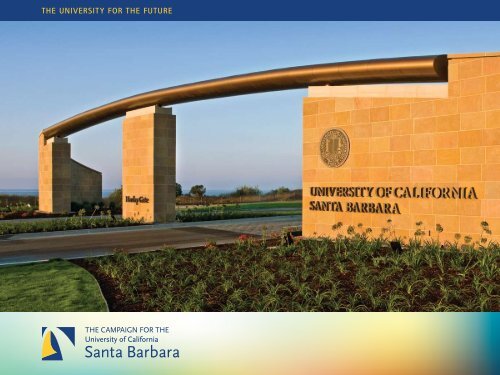
Campaign brochure - Institutional Advancement - University of ...
Campaign brochure - Institutional Advancement - University of ...
Campaign brochure - Institutional Advancement - University of ...

You also want an ePaper? Increase the reach of your titles
YUMPU automatically turns print PDFs into web optimized ePapers that Google loves.
THE university for the future
UC Santa Barbara<br />
THE university for the future<br />
from the chancellor<br />
Interdisciplinary. Collaborative. Entrepreneurial.<br />
Educating citizens for California and a global society.<br />
Inventing the future by fueling new discoveries.<br />
Developing solutions for a sustainable world.<br />
Enhancing culture and community.<br />
Cultivating leaders and champions.<br />
Henry T. Yang<br />
Chancellor<br />
Thanks to the exceptional support and extraordinary generosity <strong>of</strong> the UC Santa Barbara family, our campus raised almost<br />
two-thirds <strong>of</strong> a billion dollars in the initial phase <strong>of</strong> the first comprehensive fund-raising campaign in UC Santa Barbara’s history.<br />
We are sincerely grateful to all who have participated in this remarkable philanthropic achievement: our volunteer leaders,<br />
foundation trustees, alumni, parents, faculty, staff, community members, friends — and our students, who personify UC Santa<br />
Barbara and help make the case for supporting our campus. We also acknowledge the private foundations, corporations, and<br />
government agencies that have invested in the promise <strong>of</strong> our campus and the teaching and research that will transform our<br />
society. We are honored by the commitment that each gift and grant represents, and we thank everyone who has chosen to<br />
partner with us in ensuring UC Santa Barbara’s excellence for future generations.<br />
The visionary gifts <strong>of</strong> our donors have helped us recruit and retain brilliant faculty, highly motivated students, and dedicated<br />
staff; enhance our research and education programs; support outstanding students with scholarships and graduate fellowships;<br />
build world-class facilities to meet the needs <strong>of</strong> our campus community; strengthen our endowment; and so much more.<br />
UC Santa Barbara is today widely recognized as one <strong>of</strong> the premier research universities in the world. Looking forward, we are now embracing a new<br />
range <strong>of</strong> challenges in ways that promise not only to expand knowledge and find new solutions, but also to improve the quality <strong>of</strong> life for the people<br />
<strong>of</strong> California, our nation, and the world.<br />
We celebrate what we have achieved together. And we are confident that the future holds even greater promise for our university. Together we<br />
will continue to build on UC Santa Barbara’s strengths while developing new opportunities for creativity and innovation. We thank you for your<br />
continued partnership in this great endeavor.<br />
Henry T. Yang<br />
CHANCELLOR<br />
Storke Tower<br />
1
Invest in a LEADER<br />
A Top-Ranked <strong>University</strong><br />
#9 AMONG ALL PUBLIC UNIVERSITIES IN THE U.S.A. [US News & World Report]<br />
#29 AMONG THE WORLD’S TOP 200 UNIVERSITIES [Times Higher Education]<br />
#1 AMONG ALL PUBLIC UNIVERSITIES IN THE WORLD FOR<br />
RESEARCH IMPACT IN ENGINEERING [Times Higher Education]<br />
ONE OF ONLY 63 UNIVERSITIES ELECTED TO THE PRESTIGIOUS<br />
ASSOCIATION OF AMERICAN UNIVERSITIES (AAU)<br />
An Award-Winning Faculty<br />
5 WINNERS OF NOBEL PRIZES SINCE 1998<br />
25 MEMBERS OF AMERICAN ACADEMY OF ARTS AND SCIENCES<br />
32 MEMBERS OF NATIONAL ACADEMY OF SCIENCES<br />
23 MEMBERS OF NATIONAL ACADEMY OF ENGINEERING<br />
UC Santa Barbara faculty have won the Millennium Technology Prize,<br />
the Fields Medal in Mathematics, and major book prizes in the<br />
humanities and social sciences, and have been awarded fellowships<br />
by the Guggenheim Foundation, the National Endowment for the<br />
Humanities, and the National Endowment for the Arts.<br />
2010 national research council rankings<br />
Top-ranked programs in Chemical Engineering; Computer Science;<br />
Electrical and Computer Engineering; Materials; Mechanical<br />
Engineering; Chemistry and Biochemistry; Ecology, Evolution, and<br />
Marine Biology; Geography; Marine Science; Physics; Psychology;<br />
Anthropology; Communication; Art History; Comparative Literature;<br />
Theater; English; Spanish; History; Religious Studies.<br />
The <strong>University</strong> Of Choice<br />
#2 IN UC FOR APPLICATIONS FROM CALIFORNIA HIGH SCHOOL SENIORS<br />
#1 IN UC FOR SATISFACTION AMONG ALL GRADUATING SENIORS<br />
#1 AMONG ALL AAU INSTITUTIONS FOR CHICANO/LATINO ENROLLMENT<br />
An Economic Engine<br />
THE LARGEST EMPLOYER IN SANTA BARBARA COUNTY<br />
APPROXIMATELY 80 PERCENT OF THE UNIVERSITY’S ANNUAL OPERATING<br />
EXPENDITURES ARE SPENT IN SANTA BARBARA COUNTY<br />
SUCCESS STORY<br />
2010 National Research Council Rankings<br />
The 2010 assessment by the National Research Council, evaluating<br />
over 5,000 doctoral programs in 62 fields at 212 universities in the<br />
United States, serves as another strong indicator <strong>of</strong> the excellence<br />
<strong>of</strong> UC Santa Barbara’s doctoral programs across the disciplines.<br />
Among the 31 campus programs assessed, 10 programs, or nearly<br />
a third, have a range <strong>of</strong> rankings reaching into the top five in the<br />
country; 14, or 45 percent, are in the range <strong>of</strong> the top 10; and 20,<br />
or nearly two-thirds, are in the range <strong>of</strong> the top 20.<br />
“ These new rankings reflect UC Santa Barbara’s rapid<br />
rise over the decades, and serve as a resounding<br />
affirmation <strong>of</strong> the quality and diversity <strong>of</strong> our<br />
doctoral programs, which form the fundamental<br />
basis <strong>of</strong> a strong research university.”<br />
Manzanita Village, the student residential complex overlooking the UC Santa Barbara lagoon and ocean.<br />
2<br />
Nobel Prize winners:<br />
David Gross, Alan Heeger, Walter Kohn, Herbert Kroemer, Finn Kydland.<br />
— Chancellor Henry T. Yang<br />
Photos on this page by Werner Huthmacher<br />
Students at the Carrillo Dining Commons located within Manzanita Village.<br />
3
Educating Citizens FOR CALIFORNIA<br />
AND A GLOBAL SOCIETY<br />
Elementary school students from the Harding <strong>University</strong> Partnership School visit UC Santa Barbara.<br />
Through teaching and research about culture and society, we help to shape<br />
public policy. We prepare students to be enlightened, engaged, and ethical<br />
citizens — leaders who are ready for 21st-century challenges.<br />
Learning about diverse cultures, traditions, and religions expands students’<br />
knowledge and their understanding <strong>of</strong> how the past informs the present and<br />
shapes the future. Intensive language courses, unique area studies programs,<br />
and the Education Abroad Program help students develop the cultural literacy<br />
that they need to actively engage in California’s global society.<br />
An Extraordinary Service Ethos<br />
• UC Santa Barbara ranks among the top universities sending alumni<br />
to the Peace Corps, Teach for America, and other highly competitive,<br />
public service programs.<br />
• In 2008, UC Santa Barbara students won the Ultimate College Bowl by<br />
registering the largest number <strong>of</strong> voters <strong>of</strong> any campus in the country.<br />
• Under the auspices <strong>of</strong> the Center for Black Studies Research, UC faculty and<br />
students are helping a Haitian community to rebuild after the earthquake.<br />
• Through groups like Habitat for Humanity and Engineers Without<br />
Borders, student volunteers have helped rebuild houses in New Orleans<br />
after Hurricane Katrina and are supporting development projects in<br />
Kenya, Mali, and Peru.<br />
• The Gevirtz Graduate School <strong>of</strong> Education has joined with Santa Barbara’s<br />
Harding Elementary School to establish a public elementary “laboratory”<br />
school. Teachers at the new Harding <strong>University</strong> Partnership School work<br />
with UC Santa Barbara faculty to develop instructional programs that<br />
maximize student learning, train aspiring teachers, and <strong>of</strong>fer ongoing<br />
pr<strong>of</strong>essional development to practicing educators.<br />
UC Santa Barbara student volunteers rebuilding homes with Habitat for Humanity.<br />
4<br />
5
“<br />
Chemical Engineering student and Burnham Scholar Ricardo Alamillo.<br />
Inventing the Future by fueling new discoveries<br />
Collaboration, Innovation, and Discovery<br />
Kavli Institute for Theoretical Physics (KITP)<br />
SUCCESS STORY<br />
Carol Greider, Nobel Laureate,<br />
Alumna, Class <strong>of</strong> 1983<br />
UC Santa Barbara alumna Carol W.<br />
Greider was a co-winner <strong>of</strong> the 2009<br />
Nobel Prize in Physiology or Medicine.<br />
Greider and her colleagues were<br />
honored for the discovery <strong>of</strong> a<br />
fundamental mechanism in the cell<br />
that has stimulated the development<br />
<strong>of</strong> new therapeutic strategies. Greider<br />
graduated in 1983 with a bachelor’s<br />
degree in biology from the College <strong>of</strong> Creative Studies, after<br />
conducting original research in the Department <strong>of</strong> Molecular,<br />
Cellular, and Developmental Biology in the College <strong>of</strong> Letters<br />
and Science.<br />
“It was at UC Santa Barbara that I first<br />
became interested in biochemistry. I was<br />
able to structure my own curriculum,<br />
explore Different subjects, and find out<br />
what I really liked.”<br />
— carol greider, ‘83<br />
nobel laureate<br />
Photo by Brian Peoples<br />
Our superb faculty thrives within a campus culture that is interdisciplinary,<br />
collaborative, and entrepreneurial. Paradigm-changing initiatives in such<br />
areas as solid-state energy efficiency, medicine and the health sciences,<br />
ethnic studies, and digital humanities and media arts deliver<br />
transformative research.<br />
Biological Sciences, Bioengineering, and Nanotechnology<br />
We are a national leader in scientific initiatives in bioengineering, new<br />
materials, device control, and nanotechnology, as well as the study <strong>of</strong> the<br />
historical and social contexts <strong>of</strong> nanotechnology. Working with partners<br />
outside the university, we are revolutionizing the way we diagnose, treat,<br />
and prevent diseases such as cancer, Alzheimer’s disease, macular<br />
degeneration, and diabetes.<br />
Information Technology for the Future<br />
Our leading Photonic Integrated Circuit technology is enabling a new<br />
generation <strong>of</strong> data and telecommunication networks, as well as<br />
ultrasensitive sensors. Techniques developed at UC Santa Barbara to<br />
improve the security <strong>of</strong> data communications and storage are having a<br />
huge impact for both private and commercial users <strong>of</strong> the Internet. Research<br />
on the social effects <strong>of</strong> communication and online reading communities<br />
helps us understand the social effects <strong>of</strong> technology in and on society.<br />
Our renowned institute brings together the world’s leading theoretical<br />
physicists and scientists to collaborate on the most challenging questions<br />
at the frontiers <strong>of</strong> science. Questions are addressed in intensely focused<br />
programs lasting several months to facilitate significant contributions.<br />
Recent topics include: dark matter and black holes, systems biology,<br />
computational neuroscience, quantum technologies, galaxy clusters,<br />
extra dimensions, the nature <strong>of</strong> turbulence, and high-Tc superconductivity<br />
in new materials. Over a thousand scientists participate annually at<br />
the KITP, and the institute’s unique on-line archive <strong>of</strong> talks extends the<br />
collaborative impact <strong>of</strong> the programs, speeding discovery.<br />
The Brain and the Mind<br />
We are accelerating research in neuroscience through the application<br />
and development <strong>of</strong> new technologies aimed at discovering how the brain<br />
and mind work, how to decelerate cognitive aging, and how to find both<br />
the cause <strong>of</strong> and treatments for autism. Interdisciplinary work in such areas<br />
as psychology, philosophy, linguistics, and literature is helping to shape<br />
cognitive science and the study <strong>of</strong> the mind.<br />
21st-Century California<br />
Pioneering scholars in the humanities and social sciences inform our<br />
understanding <strong>of</strong> the changing demographics <strong>of</strong> global California:<br />
the histories, languages, religions, ethnicities, and cultures that create<br />
unparalleled diversity in our multicultural and multilingual state.<br />
6<br />
7
8<br />
developing Solutions<br />
for a Sustainable World<br />
Employing solution-centered, interdisciplinary teaching and research,<br />
we are developing a deeper understanding <strong>of</strong> the natural and human forces<br />
shaping the environment. We are creating new and effective approaches to<br />
environmental stewardship and the search for renewable and sustainable<br />
energy sources.<br />
Global Sustainability<br />
The challenge <strong>of</strong> the future is the wise management <strong>of</strong> the complex biological<br />
and social systems on which our lives depend. Through interdisciplinary<br />
research taking place throughout the university—not only in science and<br />
engineering and our pioneering environmental studies programs but<br />
also in history, literature, architecture, art, sociology, economics, and<br />
communication— faculty and students are addressing the environmental<br />
challenges facing the planet.<br />
Energy Independence<br />
Through the Institute for Energy Efficiency and other campus research centers,<br />
we are pioneering the development <strong>of</strong> new technologies in the fields <strong>of</strong> solidstate<br />
lighting, computing, renewable energy, and building design.<br />
Eco-Entrepreneurship<br />
Our environmental scientists and economists are developing a new generation<br />
<strong>of</strong> eco-entrepreneurs in order to develop innovative strategies that will attract<br />
investment and help the environment.<br />
John E. Bowers, the Fred Kavli Pr<strong>of</strong>essor <strong>of</strong> Nanotechnology and Director <strong>of</strong> the Institute for Energy Efficiency,<br />
holds a prototype <strong>of</strong> an electrically powered hybrid silicon laser.<br />
Environmental Media<br />
The Carsey-Wolf Center partners with the Bren School <strong>of</strong> Environmental<br />
Science and Management, as well as with environmental scientists and<br />
media scholars throughout campus, to train scientists, media practitioners,<br />
and policy makers how to create a new awareness <strong>of</strong> environmental issues<br />
in order to translate science into solutions.<br />
Understanding the Environment in History and Culture<br />
Tomorrow’s solutions depend on an understanding <strong>of</strong> the history <strong>of</strong> the<br />
environment and our place in it. Interdisciplinary research and teaching<br />
in environmental history, environmental ethics, architecture and the built<br />
environment, and environmental policy and economics point the way<br />
forward by explaining the past.<br />
SUCCESS STORY<br />
Engaged Students on an Engaged Campus<br />
UC Santa Barbara was named to the 2011 “Green College Honor Roll”<br />
by the Princeton Review, and was named a Bicycle-Friendly Business<br />
Gold Award winner by the League <strong>of</strong> American Bicyclists. The campus<br />
is home to the most LEED-certified buildings in the UC system, all<br />
new construction aims to meet LEED Silver standards, and Bren Hall<br />
is the first building in the nation to receive two LEED Platinum<br />
certifications. The Associated Students Environmental Affairs Board<br />
led a successful campaign for “trayless dining” in the campus dining<br />
halls, reducing food waste by 54 percent overall, and instituted<br />
a pilot food-composting project. Students attended the 2009<br />
United Nations Climate Change Conference in Copenhagen and<br />
in 2010 hosted the biannual conference <strong>of</strong> the California Student<br />
Sustainability Coalition.<br />
“ Our campus has become a ‘living laboratory’<br />
for the research, teaching, and practice<br />
<strong>of</strong> environmental sustainability.”<br />
— Chancellor Henry T. Yang<br />
The campus has more than seven miles <strong>of</strong> paved bike paths<br />
and more than 10,000 bicycle parking spaces.<br />
9
Students in the revitalized Isla Vista shopping district and<br />
a banner designed by art students for Pardall Road.<br />
Photos on this page by David Bazemore<br />
Enhancing culture and community<br />
As part <strong>of</strong> the Arts & Lectures program, Suzanne Farrell (above)<br />
and Yo-Yo Ma (below) teach master classes for UC Santa Barbara<br />
students as a complement to their public performances.<br />
A great public university serves both its students and the community and sustains civic culture.<br />
The UC Santa Barbara Arts & Lectures Program, the <strong>University</strong> Art Museum, the Pollock Theater<br />
<strong>of</strong> the Carsey-Wolf Center, the Walter H. Capps Center for the Study <strong>of</strong> Ethics, Religion, and<br />
Public Life, the Interdisciplinary Humanities Center, the Multicultural Center, the <strong>University</strong><br />
Libraries, and the performance spaces <strong>of</strong> theater, dance, and music programs all provide<br />
venues for educational programming, exhibitions, and performances that open the university<br />
to the community.<br />
Arts & Lectures and Public Humanities and Arts Programs<br />
With over 200 events per year, the Arts & Lectures program is considered one <strong>of</strong> the best<br />
university performing arts programs in the country, bringing to Santa Barbara Yo-Yo Ma,<br />
Malcolm Gladwell, Phillip Glass, Wynton Marsalis, and many others. Arts & Lectures’ outreach<br />
program provides free educational activities to approximately 20,000 people each year with<br />
partnerships on campus, in schools, and in the community. Internationally acclaimed artists<br />
<strong>of</strong>fer master classes for our theater, dance, and music programs, which <strong>of</strong>fer conservatory<br />
training in a liberal arts context.<br />
Through Arts & Lectures and programs such as the Arthur N. Rupe Great Debate Series and the<br />
College <strong>of</strong> Letters and Science Critical Issues in America series, UC Santa Barbara creates a public<br />
sphere in which writers, public figures, policy makers, and academic experts can inspire<br />
discussion and debate about the most compelling issues <strong>of</strong> our time.<br />
SUCCESS STORY<br />
The Isla Vista Experience<br />
Adjacent to campus, this unique small town is known for its student and<br />
beach culture. The majority <strong>of</strong> our students, and many faculty as well, call<br />
Isla Vista home. UC Santa Barbara faculty, staff, and students have taken<br />
the lead in transforming IV into a vibrant community <strong>of</strong> engagement through<br />
support for the Isla Vista Master Plan, innovative creative projects like the<br />
banners for Pardall Road designed by art students, and tutoring <strong>of</strong> local<br />
elementary school students by undergraduate volunteers. Isla Vista Arts,<br />
part <strong>of</strong> the Interdisciplinary Humanities Center, organizes cultural events in<br />
Isla Vista that include Magic Lantern Films, Improvability (an improv comedy<br />
troupe), and Shakespeare in Anisq’Oyo’ Park. UC Santa Barbara provided the<br />
land for the Isla Vista Foot Patrol’s new and expanded station house, which<br />
was built by the County <strong>of</strong> Santa Barbara.<br />
10<br />
11
Cultivating leaders and champions<br />
Much <strong>of</strong> our students’ education takes place outside <strong>of</strong> the classroom, on the playing field and in the gym,<br />
on stage and in the concert hall. Students are engaged in independent research, community service,<br />
internships, study abroad, and a wide variety <strong>of</strong> student government and student organizations.<br />
92% STUDENT-ATHLETE<br />
GRADUATION RATE<br />
Exceptional Programs Offer Exceptional Opportunities to Our Students<br />
• The College <strong>of</strong> Engineering’s Technology Management Program <strong>of</strong>fers students <strong>of</strong> all majors<br />
the chance to develop leadership skills in technology management and entrepreneurship.<br />
• The innovative M.A. program in Global and International Studies prepares students for<br />
careers in international NGOs, business, or government.<br />
• Through the Sara Miller McCune Internship and Public Service program, the Walter H. Capps<br />
Center for the Study <strong>of</strong> Ethics, Religion, and Public Life <strong>of</strong>fers students internships with local<br />
non-pr<strong>of</strong>its in Santa Barbara and government agencies in Washington, D.C., and Sacramento.<br />
2006 Men’s Soccer NCAA National Champions.<br />
• The UC Centers in Washington, D.C., and Sacramento <strong>of</strong>fer students hands-on experience<br />
through a variety <strong>of</strong> internships, including in national and state government.<br />
• Intercollegiate and intramural athletics enhance community outreach and develop<br />
leaders and champions.<br />
“ My life has been immeasurably enriched by the education and life<br />
experience I received at UC Santa Barbara. The Bachelor <strong>of</strong> Arts degree<br />
I earned in English Literature provided me with a superior foundation<br />
for my chosen career path. The spirit and community <strong>of</strong> UC Santa<br />
Barbara provided me with the basis to go forward in life with<br />
confidence and strength.”<br />
“<br />
Being a student athlete at UC Santa<br />
Barbara was an amazing experience.<br />
I was encouraged to prepare for<br />
my studies just like I trained for<br />
my sport. Today, out in the financial<br />
world, working at Deloitte, I find<br />
myself exceptionally prepared<br />
for my career.”<br />
12<br />
UC Santa Barbara alumni: Jeff Henley, Chairman <strong>of</strong> Oracle, B.A. in Economics ‘66;<br />
Elizabeth Gabler, President <strong>of</strong> Fox 2000 Pictures, B.A. in English ‘77;<br />
Dr. Leroy Chiao, former NASA astronaut and Commander <strong>of</strong> Expedition 10 mission<br />
to the International Space Station, M.S. ‘85 and Ph.D. in Chemical Engineering ‘87.<br />
— Elizabeth Gabler, President <strong>of</strong> Fox 2000 Pictures, B.A. in English ‘77<br />
— Katie Voigtlander, ‘10<br />
B.A. in Business Economics/Accounting<br />
Track and cross-country, winner <strong>of</strong><br />
the Golden Eagle Ring<br />
2009 Women’s Basketball Big West Conference Champions.<br />
13
invest in<br />
transformative research<br />
invest in<br />
a transformative education<br />
Together with teaching, research is fundamental to UC Santa Barbara’s mission. Our campus<br />
is home to 12 national institutes and centers and more than 100 other research institutes,<br />
where scholars from across the disciplines are working together to expand the frontiers <strong>of</strong><br />
knowledge and contribute to society. UC Santa Barbara also manages seven natural reserves<br />
throughout the state, ranging from the nearby Coal Oil Point Reserve, now a nesting site<br />
for the endangered snowy plover, to the Sierra Nevada Aquatic Research Laboratory, a field<br />
research station located in the eastern Sierra Nevada near Mammoth Lakes. Each <strong>of</strong> these<br />
sites provides unique opportunities for research, teaching, and public outreach while serving<br />
to preserve California’s rich ecological diversity for future generations.<br />
A strong undergraduate education is essential in today’s world. Undergraduates in the College <strong>of</strong><br />
Letters and Science receive a broad liberal arts education. Students in the College <strong>of</strong> Engineering<br />
follow rigorous, specialized programs. The College <strong>of</strong> Creative Studies, known as “a graduate<br />
school for undergraduates,” focuses on independent research.<br />
Nanotechnology research thrives at UC Santa Barbara, both at the California NanoSystems<br />
Institute, which focuses on developing information, biomedical, and manufacturing<br />
technologies, and the NSF-funded Center for Nanotechnology in Society, which studies<br />
social and cultural issues concerning nanotechnologies.<br />
Photolithography bays in UC Santa Barbara’s Nan<strong>of</strong>abrication Facility are used<br />
by researchers, students, and industries from around the world to create novel<br />
structures and devices at the nanoscale.<br />
Photo by Brenda Hartshorn<br />
The Gevirtz Graduate School <strong>of</strong> Education is directing a campus- and UC-wide effort to promote<br />
Pre-K through Grade 12 students’ access to the highest quality science, technology, engineering,<br />
and mathematics (STEM) teaching. Central to this initiative is our CalTeach program, which<br />
recruits and trains undergraduate STEM majors to become the next generation <strong>of</strong> mathematics<br />
and science teachers.<br />
For graduate students, UC Santa Barbara <strong>of</strong>fers 57 master’s and doctoral programs that are<br />
preparing the next generation <strong>of</strong> university pr<strong>of</strong>essors and researchers. Graduate students,<br />
the lifeblood <strong>of</strong> a research university, are key collaborators for faculty, and they enhance the<br />
education <strong>of</strong> undergraduate students in laboratory, discussion, and tutoring settings. We also<br />
prepare graduate students for careers in K-12 education, environmental science and management,<br />
public service, the arts, the non-pr<strong>of</strong>it sector, and many other fields.<br />
The Orfalea Center for Global and International Studies, the Chicano Studies Institute,<br />
the Center for Black Studies Research, and the Center for New Racial Studies exemplify<br />
UC Santa Barbara’s strength in interdisciplinary research with a national and global impact.<br />
The Interdisciplinary Humanities Center, along with the Carsey-Wolf Center and the<br />
Walter H. Capps Center for the Study <strong>of</strong> Ethics, Religion, and Public Life, combines scholarly<br />
research with public humanities programming for the university and larger community,<br />
educating the public and informing public policy debates.<br />
Admission to UC Santa Barbara has become increasingly competitive, with the number <strong>of</strong><br />
freshman applicants doubling in the last dozen years. UC Santa Barbara’s student body is more<br />
diverse and accomplished than ever. The average high school GPA <strong>of</strong> the 2010 entering freshman<br />
class was 3.92, up from 3.8 ten years ago. Chicano, Latino, African American, and American<br />
Indian students make up 25% <strong>of</strong> total campus enrollment, up from 16% a decade ago.<br />
Students have access to academic resources and social and cultural networks designed to enrich<br />
their educational experience. Resources include support for undergraduate research, advising,<br />
tutoring, and campus cultural organizations and student groups. The UC Santa Barbara MultiCultural<br />
Center presents over 90 events each year that increase cultural awareness and understanding.<br />
Students in a computer lab at the Student Resource Building.<br />
Student on a research expedition.<br />
14<br />
15
invest in uc santa barbara<br />
Ensuring the excellence and accessibility <strong>of</strong> UC Santa Barbara for future<br />
generations takes more than state funds and student fees. It also takes you.<br />
Private giving plays an enormous — and critical — role in enhancing the<br />
campus and its programs. Indeed, philanthropic support — from individuals,<br />
corporations, and foundations — has helped make it possible for UC Santa<br />
Barbara to stand today among the leading teaching and research institutions<br />
in this country and the world. In the future, such support will be crucial.<br />
From faculty recruitment and facilities upgrades to fellowships and<br />
scholarships, nearly every important initiative and program on this campus<br />
now benefits from the generosity <strong>of</strong> those who know it best, including you.<br />
Over the past decade, through The <strong>Campaign</strong> for UC Santa Barbara, generous<br />
individuals, including alumni and parents, and other funders have<br />
contributed $600 million to support exciting programs and campus priorities.<br />
During this time, UC Santa Barbara has developed in ways that reflect both<br />
your support and your pride.<br />
“ This is a time <strong>of</strong> unprecedented change and<br />
opportunity for UC Santa Barbara. It’s also<br />
a time <strong>of</strong> great excitement and anticipation,<br />
as the campus marshals resources to<br />
capitalize on the vibrant intellectual assets<br />
and extraordinary potential that distinguish it.<br />
Building on the tremendous momentum created<br />
under Chancellor Henry Yang’s leadership, it is<br />
private support that will provide the critical<br />
margin <strong>of</strong> excellence to achieve our potential<br />
as a world-class university.”<br />
— MICHAEL DOUGLAS, B.A. in Dramatic Art ‘68<br />
Today, the campus is at another critical moment in its history. The programs,<br />
priorities, initiatives, and values outlined in this <strong>brochure</strong> are the foundation<br />
<strong>of</strong> the next phase <strong>of</strong> The <strong>Campaign</strong> for UC Santa Barbara. We need your help<br />
to advance an ambitious agenda that includes transformational research,<br />
dedicated teaching, and a commitment — as a great public university — to<br />
enhancing the lives <strong>of</strong> the citizens <strong>of</strong> California, the United States, and the<br />
world. We are extremely grateful for the generosity you have shown to UC<br />
Santa Barbara in the past, and we sincerely thank you. Now, we welcome<br />
your engagement and participation in this important new phase <strong>of</strong> our<br />
common enterprise.<br />
16
UC Santa Barbara Colleges and Schools<br />
College <strong>of</strong> Creative Studies<br />
College <strong>of</strong> Engineering<br />
College <strong>of</strong> Letters and Science<br />
Bren School <strong>of</strong> Environmental Science and Management<br />
Gevirtz Graduate School <strong>of</strong> Education<br />
Design by:<br />
Printed with soy based inks on Endurance paper certified by the Forestry Stewardship Council (FSC).<br />
<strong>University</strong> <strong>of</strong> California, Santa Barbara • Santa Barbara, CA 93106 • Phone: (805) 893-8000 • www.ucsb.edu

 Change language