

Introduction to Planetary Science
Introduction to Planetary Science
Introduction to Planetary Science

You also want an ePaper? Increase the reach of your titles
YUMPU automatically turns print PDFs into web optimized ePapers that Google loves.
<strong>Introduction</strong> <strong>to</strong> <strong>Planetary</strong> <strong>Science</strong>
<strong>Introduction</strong> <strong>to</strong> <strong>Planetary</strong> <strong>Science</strong><br />
The Geological Perspective<br />
GUNTER FAURE<br />
The Ohio State University,<br />
Columbus, Ohio, USA<br />
TERESA M. MENSING<br />
The Ohio State University,<br />
Marion, Ohio, USA
A C.I.P. Catalogue record for this book is available from the Library of Congress.<br />
ISBN-13 978-1-4020-5233-0 (HB)<br />
ISBN-13 978-1-4020-5544-7 (e-book)<br />
Published by Springer,<br />
P.O. Box 17, 3300 AA Dordrecht, The Netherlands.<br />
www.springer.com<br />
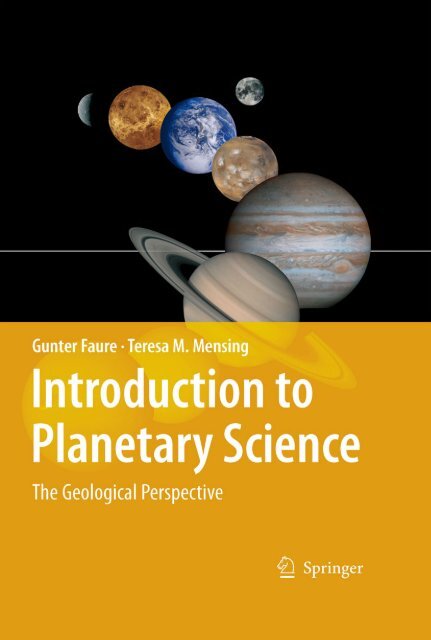
Cover art: The planets of the solar system.<br />
Courtesy of NASA.<br />
A Manual of Solutions for the end-of-chapter problems can be found at the book’s homepage at<br />
www.springer.com<br />
Printed on acid-free paper<br />
All Rights Reserved<br />
© 2007 Springer<br />
No part of this work may be reproduced, s<strong>to</strong>red in a retrieval system, or transmitted in any form or by any means, electronic, mechanical,<br />
pho<strong>to</strong>copying, microfilming, recording or otherwise, without written permission from the Publisher, with the exception of any material<br />
supplied specifically for the purpose of being entered and executed on a computer system, for exclusive use by the purchaser of the work.
In memory of Dr. Erich Langenberg,<br />
David H. Carr, and Dr. Robert J. Uffen<br />
who showed me the way.<br />
Gunter Faure<br />
For Professor Tom Wells and<br />
Dr. Phil Boger who taught me <strong>to</strong><br />
reach for the stars.<br />
Teresa M. Mensing
Table of Contents<br />
Preface xvii<br />
1. The Urge <strong>to</strong> Explore 1<br />
1.1. The Exploration of Planet Earth 2<br />
1.2. Visionaries and Rocket Scientists 4<br />
1.3. Principles of Rocketry and Space Navigation 7<br />
1.4. Summary 9<br />
1.5. <strong>Science</strong> Briefs 10<br />
1.6. Problems 11<br />
1.7. Further Reading 11<br />
2. From Speculation <strong>to</strong> Understanding 13<br />
2.1. The Geocentric Cosmology of Ancient Greece 13<br />
2.2. The Scientific Method 14<br />
2.3. Units of Measurement 16<br />
2.3.1. Distance 16<br />
2.3.2. Time 17<br />
2.3.3. Velocity and Speed 17<br />
2.3.4. Mass 18<br />
2.3.5. Temperature 18<br />
2.3.6. Pressure 19<br />
2.4. Summary 19<br />
2.5. <strong>Science</strong> Briefs 20<br />
2.6. Problems 21<br />
2.7. Further Reading 21<br />
3. The Planets of the Solar System 23<br />
3.1. The Sun and the Planets of the Solar System 23<br />
3.2. The Titius-Bode Rule 25<br />
3.3. Average Orbital Velocities 27<br />
3.4. Surface Temperatures 28<br />
3.5. Bulk Densities 28<br />
3.6. Summary 32<br />
3.7. <strong>Science</strong> Briefs 32<br />
3.8. Problems 34<br />
3.9. Further Reading 34<br />
4. Life and Death of Stars 35<br />
4.1. The Big Bang 35<br />
4.2. Stellar Evolution 39<br />
4.3. Nucleosynthesis<br />
vii<br />
41
viii table of contents<br />
4.4. The Milky Way Galaxy 44<br />
4.5. Summary 45<br />
4.6. <strong>Science</strong> Briefs 46<br />
4.7. Problems 47<br />
4.8. Further Reading 48<br />
5. Origin of the Solar System 49<br />
5.1. The Solar Nebula 49<br />
5.2. Origin of the Sun and Planets 50<br />
5.3. The Sun 53<br />
5.3.1. Internal Structure 53<br />
5.3.2. Energy Production 56<br />
5.3.3. Magnetism and Sunspots 57<br />
5.3.4. Effect on Space 59<br />
5.3.5. Life and Death of the Sun 59<br />
5.4. Summary 61<br />
5.5. <strong>Science</strong> Briefs 62<br />
5.6. Problems 62<br />
5.7. Further Reading 63<br />
6. Earth: Model of <strong>Planetary</strong> Evolution 65<br />
6.1. Growth from Planetesimals 65<br />
6.2. Internal Differentiation 67<br />
6.3. Atmosphere 69<br />
6.4. Interior of the Earth 72<br />
6.4.1. Temperature 72<br />
6.4.2. Melting of Peridotite 72<br />
6.4.3. Mantle Plumes 73<br />
6.4.4. Plate Tec<strong>to</strong>nics 74<br />
6.4.5. Magnetic Field 76<br />
6.5. Interactions with the Solar Wind 79<br />
6.6. Summary 81<br />
6.7. <strong>Science</strong> Briefs 82<br />
6.8. Problems 85<br />
6.9. Further Reading 85<br />
7. The Clockwork of the Solar System 87<br />
7.1. The Pioneers of Astronomy 87<br />
7.2. Elliptical Orbits of Planets 89<br />
7.2.1. Eccentricity 89<br />
7.2.2. Average Distance 90<br />
7.2.3. Revolution and Rotation 90<br />
7.2.4. Plane of the Ecliptic 91<br />
7.2.5. Axial Obliquity 91<br />
7.2.6. Conjunctions and Oppositions 92<br />
7.2.7. Sidereal and Synodic Periods of Revolution 95<br />
7.2.8. Solar and Lunar Eclipses 96<br />
7.2.9. Orbital Velocities 96<br />
7.2.10. Launching Satellites in<strong>to</strong> Orbit 98<br />
7.2.11. Lagrange Points 99<br />
7.3. Celestial Mechanics of the Earth 100<br />
7.3.1. Rising and Setting of the Sun 100<br />
7.3.2. Change in the Period of Rotation 101<br />
7.3.3. Seasons of the Northern Hemisphere 101
table of contents ix<br />
7.3.4. The Earth at Summer Solstice 101<br />
7.3.5. Autumnal and Vernal Equinoxes 102<br />
7.3.6. Milankovitch Cycles 103<br />
7.4. The Gregorian Calendar 104<br />
7.5. Summary 105<br />
7.6. <strong>Science</strong> Briefs 105<br />
7.7. Problems 107<br />
7.8. Further Reading 107<br />
8. Meteorites and Impact Craters 109<br />
8.1. Classification and Mineralogy of Meteorites 110<br />
8.2. Carbonaceous Chondrites 112<br />
8.3. Tektites 114<br />
8.4. Meteorite Parent Bodies 115<br />
8.5. Celestial Mechanics 116<br />
8.6. Falls and Finds 118<br />
8.7. Age Determinations 120<br />
8.8. Meteorite Impacts 122<br />
8.8.1. Formation of Craters 122<br />
8.8.2. Classification of Craters 123<br />
8.8.3. Modification of Craters 124<br />
8.8.4. Frequency of Impacts 125<br />
8.8.5. Environmental Consequences (Tunguska,<br />
1908) 126<br />
8.9. Meteor Crater: Memorial <strong>to</strong> E.M. Shoemaker 127<br />
8.10. Summary 131<br />
8.11. <strong>Science</strong> Briefs 131<br />
8.12. Problems 135<br />
8.13. Further Reading 135<br />
9. The Earth-Moon System 139<br />
9.1. Landforms of the Lunar Surface 141<br />
9.1.1. Highlands 141<br />
9.1.2. Maria 142<br />
9.1.3. Impact Craters 143<br />
9.1.4. Regolith 143<br />
9.1.5. Water 143<br />
9.2. Iso<strong>to</strong>pic Dating 145<br />
9.3. Geology of the Near Side 145<br />
9.4. Lunar Meteorites 149<br />
9.5. Internal Structure 150<br />
9.6. Origin of the Moon 152<br />
9.7. Celestial Mechanics 154<br />
9.7.1. Spin-Orbit Coupling 154<br />
9.7.2. Lunar Orbit 155<br />
9.8. Tides 156<br />
9.8.1. Ocean Tides 156<br />
9.8.2. Body Tides 157<br />
9.9. Research Stations on the Moon 158<br />
9.9.1. Weighing the Risks and Benefits 158<br />
9.9.2. Utilization of Lunar Resources 159<br />
9.10. Space Law 160<br />
9.10.1. United Nations: Laws for States 160
x table of contents<br />
9.10.2. NASA: Code of Conduct for Astronauts 161<br />
9.11. Summary 162<br />
9.12. <strong>Science</strong> Briefs 163<br />
9.13. Problems 166<br />
9.14. Further Reading 166<br />
10. Mercury: Too Hot for Comfort 167<br />
10.1. Surface Features 167<br />
10.1.1. Impact Craters and Cliffs 167<br />
10.1.2. Regolith 169<br />
10.1.3. Atmosphere 169<br />
10.1.4. Water 170<br />
10.1.5. Surface Temperatures 170<br />
10.2. Internal Structure 171<br />
10.2.1. Iron Core 171<br />
10.2.2. Magnetic Field 172<br />
10.2.3. Geological Activity 173<br />
10.3. Origin of Mercury 174<br />
10.4. Celestial Mechanics 175<br />
10.4.1. Spin-Orbit Coupling 176<br />
10.4.2. The Solar Transit 177<br />
10.4.3. Rotation of the Long Axis of the Orbit 177<br />
10.5. Summary 178<br />
10.6. <strong>Science</strong> Briefs 178<br />
10.7. Problems 179<br />
10.8. Further Reading 181<br />
11. Venus; <strong>Planetary</strong> Evolution Gone Bad 183<br />
11.1. Surface Features 184<br />
11.2. Geological Processes 187<br />
11.2.1. Volcanic Activity 187<br />
11.2.2. Tec<strong>to</strong>nic Activity 192<br />
11.2.3. Impact Craters 194<br />
11.3. Atmosphere and Climate 195<br />
11.3.1. Chemical Composition and Structure 195<br />
11.3.2. Circulation 197<br />
11.3.3. Greenhouse Warming 197<br />
11.3.4. Evolution of the Surface Environment 198<br />
11.3.5. Carbon Cycles of Venus and the Earth 199<br />
11.4. Internal Structure 201<br />
11.4.1. The Core and Magnetism 201<br />
11.4.2. Episodic Resurfacing 202<br />
11.5. Celestial Mechanics 203<br />
11.5.1. Retrograde Rotation 203<br />
11.5.2. Phases, Conjunctions, and Transits 204<br />
11.6. Summary 205<br />
11.7. <strong>Science</strong> Briefs 206<br />
11.8. Problems 209<br />
11.9. Further Reading 209<br />
12. Mars: The Little Planet that Could 211<br />
12.1. Origin and Properties 213<br />
12.1.1. Origin by Accretion of Planetesimals 213
table of contents xi<br />
12.1.2. Physical and Chemical Properties 214<br />
12.1.3. Evolution of the Atmosphere 215<br />
12.1.4. Orbit of Mars 215<br />
12.2. Surface Features: Northern Hemisphere 216<br />
12.2.1. Tharsis Plateau 216<br />
12.2.2. Olympus Mons 218<br />
12.2.3. Young Lava Flows 219<br />
12.2.4. Valles Marineris 220<br />
12.2.5. U<strong>to</strong>pia Planitia 220<br />
12.2.6. Soil of U<strong>to</strong>pia and Chryse 222<br />
12.3. Surface Features: Southern Hemisphere 223<br />
12.3.1. Hellas Impact Basin 224<br />
12.3.2. Argyre Impact Basin 225<br />
12.3.3. Isidis Impact Basin 225<br />
12.3.4. Timescale for Mars 225<br />
12.4. Volcanoes of the Southern Hemisphere 227<br />
12.4.1. Syrtis Major Volcano 227<br />
12.4.2. Hespera Planum 227<br />
12.4.3. Hadriaca Patera 228<br />
12.5. Stream Valleys 228<br />
12.5.1. Nanedi Vallis 228<br />
12.5.2. Nirgal Vallis 230<br />
12.5.3. Vedra Valles 231<br />
12.6. Impact Craters 231<br />
12.7. Martian Meteorites 234<br />
12.8. Water on Mars 235<br />
12.8.1. Hydrologic Cycle 236<br />
12.8.2. Phase Diagrams of Water and Carbon<br />
Dioxide 238<br />
12.8.3. Polar Ice Caps 239<br />
12.8.4. Mountain Glaciers and Continental Ice<br />
Sheets 241<br />
12.9. Life on Mars 241<br />
12.9.1. Origin and Preservation 241<br />
12.9.2. Search for Life (Vikings) 243<br />
12.9.3. Search for Life (ALH 84001) 243<br />
12.9.4. Search for Life (Rovers) 244<br />
12.10. Colonization of Mars 249<br />
12.10.1. Travel <strong>to</strong> Mars 250<br />
12.10.2. First Steps 251<br />
12.10.3. Terraforming 252<br />
12.11. Satellites 252<br />
12.12. Summary 253<br />
12.13. <strong>Science</strong> Briefs 254<br />
12.14. Problems 258<br />
12.15. Further Reading 258<br />
13. Asteroids: Shattered Worlds 261<br />
13.1. Classification 261<br />
13.1.1. Spectral Types 261<br />
13.1.2. Orbits of the Asteroids 262<br />
13.2. Physical Properties and Celestial Mechanics 266
xii table of contents<br />
13.3. First Landings 270<br />
13.3.1. Eros 270<br />
13.3.2. Braille 270<br />
13.3.3. I<strong>to</strong>kawa 271<br />
13.4. Near-Earth Objects (NEOs) 273<br />
13.5. Torino Scale 275<br />
13.6. Summary 276<br />
13.7. <strong>Science</strong> Briefs 277<br />
13.8. Problems 279<br />
13.9. Further Reading 279<br />
14. Jupiter: Heavy-Weight Champion 281<br />
14.1. Physical and Orbital Properties 281<br />
14.1.1. Physical Properties 281<br />
14.1.2. Orbital Properties 284<br />
14.2. Atmosphere 284<br />
14.3. Satellites and Rings 286<br />
14.3.1. Regular Satellites 287<br />
14.3.2. Rings of Jupiter 289<br />
14.4. The Spacecraft Galileo 290<br />
14.5. Impact of Comet Shoemaker – Levy 9 291<br />
14.6. Summary 292<br />
14.7. <strong>Science</strong> Briefs 293<br />
14.8. Problems 295<br />
14.9. Further Reading 295<br />
15. Galilean Satellites: Jewels of the Solar System 297<br />
15.1. Physical Properties and Celestial Mechanics 297<br />
15.1.1. Physical Properties 297<br />
15.1.2. Celestial Mechanics 300<br />
15.1.3. Origin: Alternative Hypotheses 303<br />
15.2. Io, the Hyperactive Princess 304<br />
15.2.1. Volcanoes 304<br />
15.2.2. Plumes 306<br />
15.2.3. Surface Features 307<br />
15.2.4. Interactions with Jupiter 310<br />
15.2.5. Summary 311<br />
15.3. Europa, the Ice Princess 312<br />
15.3.1. Ice Crust and Ocean 314<br />
15.3.2. Impact Craters 316<br />
15.3.3. Chaotic Terrains 318<br />
15.3.4. Life in the Ocean 321<br />
15.3.5. Summary 322<br />
15.4. Ganymede in the Middle 323<br />
15.4.1. Ice Crust 323<br />
15.4.2. Rejuvenation 323<br />
15.4.3. A Conjecture 325<br />
15.4.4. Summary 325<br />
15.5. Callis<strong>to</strong>, Left Out in the Cold 326<br />
15.5.1. Physical Properties 327<br />
15.5.2. Impact Craters 328<br />
15.5.3. Differential Sublimation 328<br />
15.5.4. Summary 329
table of contents xiii<br />
15.6. <strong>Science</strong> Briefs 331<br />
15.7. Problems 332<br />
15.8. Further Reading 333<br />
16. Saturn: The Beauty of Rings 335<br />
16.1. Physical Properties 335<br />
16.1.1. Atmosphere 335<br />
16.1.2. Internal Structure 337<br />
16.1.3. Celestial Mechanics 338<br />
16.2. The Rings 339<br />
16.3. The Satellites 341<br />
16.3.1. Ring Satellites 341<br />
16.3.2. Main Group 342<br />
16.3.3. Trans-Titanian Satellites 343<br />
16.3.4. Bulk Densities and Diameters 343<br />
16.4. Surface Features of the Regular Satellites 344<br />
16.4.1. Mimas 344<br />
16.4.2. Enceladus 344<br />
16.4.3. Tethys and Dione 346<br />
16.4.4. Ammonia-Water Lava 347<br />
16.4.5. Rhea and Hyperion 349<br />
16.4.6. Iapetus and Phoebe 351<br />
16.5. The Cassini-Huygens Mission 352<br />
16.6. Summary 353<br />
16.7. <strong>Science</strong> Briefs 354<br />
16.8. Problems 356<br />
16.9. Further Reading 356<br />
17. Titan: An Ancient World in Deep Freeze 359<br />
17.1. Physical and Orbital Properties 359<br />
17.2. Atmosphere 360<br />
17.2.1. Chemical Composition 360<br />
17.2.2. Structure 362<br />
17.3. Huygens Lands on Titan 362<br />
17.4. Summary 366<br />
17.5. <strong>Science</strong> Briefs 366<br />
17.6. Problems 367<br />
17.7. Further Reading 367<br />
18. Uranus: What Happened Here? 369<br />
18.1. Physical and Orbital Properties 369<br />
18.1.1. Physical Properties 369<br />
18.1.2. Orbital Properties 370<br />
18.2. Atmosphere 372<br />
18.3. Internal Structure 373<br />
18.4. Rings 373<br />
18.5. Satellites 375<br />
18.5.1. Small Satellites 375<br />
18.5.2. Classical Satellites 375<br />
18.6. What Happened <strong>to</strong> Uranus? 380<br />
18.7. Summary 381<br />
18.8. <strong>Science</strong> Briefs 382<br />
18.9. Problems 383<br />
18.10. Further Reading 383
xiv table of contents<br />
19. Neptune: More Surprises 385<br />
19.1. Surprises Revealed by Voyager 2 385<br />
19.2. Physical and Orbital Properties 387<br />
19.3. Atmosphere 387<br />
19.4. Internal Structure 388<br />
19.5. Rings 390<br />
19.6. Satellites 391<br />
19.6.1. Small Satellites 391<br />
19.6.2. Tri<strong>to</strong>n 391<br />
19.6.3. Nereid 395<br />
19.7. Summary 396<br />
19.8. <strong>Science</strong> Briefs 397<br />
19.9. Problems 398<br />
19.10. Further Reading 398<br />
20. Plu<strong>to</strong> and Charon: The Odd Couple 401<br />
20.1. Physical Properties 402<br />
20.2. Orbital Properties 403<br />
20.3. Summary 405<br />
20.4. <strong>Science</strong> Briefs 405<br />
20.5. Problems 407<br />
20.6. Further Reading 407<br />
21. Ice Worlds at the Outer Limit 409<br />
21.1. Principals of the Ice Worlds 410<br />
21.1.1. Eris (2003 UB 313) 410<br />
21.1.2. Sedna (2003 VB 12) 412<br />
21.1.3. Quaoar (2002 LM 60) 412<br />
21.1.4. Ixion (2001 KX76) 413<br />
21.1.5. Varuna (2000 WR106) 413<br />
21.2. Structure of the E-K Belt 413<br />
21.3. The Oort Cloud 415<br />
21.4. Summary 416<br />
21.5. <strong>Science</strong> Briefs 417<br />
21.6. Problems 418<br />
21.7. Further Reading 418<br />
22. Comets: Coming Inside from the Cold 421<br />
22.1. Ana<strong>to</strong>my of Comets 421<br />
22.2. Sources of Comets 423<br />
22.3. Short-Period Comets 424<br />
22.4. Long-Period Comets 425<br />
22.4.1. Hyakutake 425<br />
22.4.2. Hale-Bopp 426<br />
22.5. Meteor Showers and IDPs 428<br />
22.6. Close Encounters 430<br />
22.6.1. Giacobini-Zinner in 1985 430<br />
22.6.2. Halley in 1986 430<br />
22.6.3. Borelly in 1999 431<br />
22.6.4. Wild 2 in 2004 432<br />
22.6.5. Tempel 1 in 2005 432<br />
22.6.6. Churyumov-Gerasimenko in 2014 434<br />
22.7. Chemical Composition 434
table of contents xv<br />
22.8. Summary 435<br />
22.9. <strong>Science</strong> Briefs 436<br />
22.10. Problems 438<br />
22.11. Further Reading 439<br />
23. Earth: The Cradle of Humans 441<br />
23.1. Origin of Life 441<br />
23.1.1. Panspermia 442<br />
23.1.2. Miller-Urey Experiment 442<br />
23.1.3. Mineral Catalysts 443<br />
23.1.4. Cradle of Life 444<br />
23.2. Importance of the Biosphere 444<br />
23.2.1. Atmosphere 445<br />
23.2.2. Sedimentary Rocks 445<br />
23.2.3. Fossil Fuels 446<br />
23.2.4. Humans 446<br />
23.3. Tales of Doom 448<br />
23.3.1. Evolution of the Sun 448<br />
23.3.2. Impacts 449<br />
23.3.3. Suicide 450<br />
23.4. Summary 451<br />
23.5. Further Reading 451<br />
24. Brown-Dwarf Stars and Extrasolar Planets 455<br />
24.1. Methods of Discovery 455<br />
24.1.1. Doppler Spectroscopy 455<br />
24.1.2. Occultation 456<br />
24.2. Brown-Dwarf Stars 456<br />
24.3. Extrasolar Planets 458<br />
24.4. Voyage <strong>to</strong> the Stars 460<br />
24.4.1. Nearby Stars 460<br />
24.4.2. Habitable Planets 461<br />
24.4.3. Voyage <strong>to</strong> Proxima Centauri 462<br />
24.5. SETI and the Drake Equation 463<br />
24.5.1. SETI 464<br />
24.5.2. The Drake Equation 464<br />
24.6. Summary 466<br />
24.7. Further Reading 467<br />
Appendix 1. Mathematical Equations Used in Astronomy 469<br />
Appendix 2. Summaries of Physical and Orbital<br />
Parameters 475<br />
A2.1. The Planets and Satellites of the Solar System 475<br />
A2.2. Orbital Properties of Asteroids 477<br />
A2.3. Orbital Properties of Selected Comets 478<br />
Glossary 481<br />
Author Index 503<br />
Subject Index 509
The Earth and the Moon. Montage of separate images recorded in 1992 by the spacecraft Galileo on its way <strong>to</strong><br />
the Jupiter system (Image PIA 00342, courtesy of NASA/JPL-Caltech)
Preface<br />
This textbook is intended <strong>to</strong> be used in a lecture course for college<br />
students majoring in the Earth <strong>Science</strong>s. <strong>Planetary</strong> science provides<br />
an opportunity for these students <strong>to</strong> apply a wide range of subject<br />
matter pertaining <strong>to</strong> the Earth <strong>to</strong> the study of other planets of the solar<br />
system and their principal satellites. As a result, students gain a wider<br />
perspective of the different worlds that are accessible <strong>to</strong> us and they<br />
are led <strong>to</strong> recognize the Earth as the only oasis in space where we can<br />
live without life-support systems. In addition, planetary science tends<br />
<strong>to</strong> unify subjects in the Earth <strong>Science</strong>s that are cus<strong>to</strong>marily taught<br />
separately: geophysics, volcanology, igneous petrology, mineralogy,<br />
geomorphology, geochemistry, hydrogeology, glacialogy, tec<strong>to</strong>nics,<br />
economic geology, his<strong>to</strong>rical geology, as well as meteoritics, microbiology,<br />
physics, astronomy, atmospheric science, and even geopolitics<br />
and international relations. Clearly, planetary science is well suited<br />
<strong>to</strong> be taught as a caps<strong>to</strong>ne course for senior undergraduates and<br />
beginning graduate students at universities everywhere. The exploration<br />
of space is by necessity a cooperative enterprise in which<br />
national borders, cultural differences, and even language barriers fade.<br />
Therefore, we propose that planetary science should be incorporated in<strong>to</strong><br />
theEarth<strong>Science</strong>curriculumevenatinstitutionsthatdonothaveanactive<br />
research program in planetary science. Students will benefit from such a<br />
course because it will expand their intellectual horizons and will prepare<br />
them <strong>to</strong> contribute <strong>to</strong> the on-going exploration of the solar system.<br />
This book evolved from a popular course we taught from 1988 until<br />
2005 in the Department of Geological <strong>Science</strong>s of The Ohio State<br />
University. The course combined lectures with class discussions and<br />
fieldtrips <strong>to</strong> the planets via videotapes. In addition, students solved<br />
numerical homework problems and wrote short essays on assigned<br />
<strong>to</strong>pics which required them <strong>to</strong> use their own resources and <strong>to</strong> form<br />
their own opinions based on factual information. As a result of the<br />
progress in the exploration of the solar system that has already been<br />
made, the planets of the solar system and their satellites are no longer<br />
faint points of light in the night sky. Instead, they have become real<br />
worlds with surfaces that contain records of their his<strong>to</strong>ries and of<br />
their present environmental conditions. The data that are pouring in<br />
from robotic spacecraft that are exploring different parts of the solar<br />
system need <strong>to</strong> be interpreted by Earth scientists who are accus<strong>to</strong>med<br />
<strong>to</strong> constructing realistic hypotheses from large sets of numerical data<br />
and visual information.<br />
xvii
xviii preface<br />
Our current knowledge about the Earth and the solar system is<br />
expressed in the form of theories that explain the interactions of matter<br />
and energy in a way that is consistent with all relevant observations<br />
available <strong>to</strong> us at the present time. Accordingly, we emphasize the<br />
importance of the scientific method in the exploration of the solar<br />
system. In addition, we demonstrate the consistency of the physical and<br />
chemical properties of the planets and their satellites with the current<br />
theory of the origin and evolution of the solar system. In this way, the<br />
differences in the properties of planets and satellites can be viewed as<br />
a consequence of the processes that produced the solar system and that<br />
continue <strong>to</strong> cause the evolution of its many components. Instead of<br />
treating each body in the solar system as a unique entity, we emphasize<br />
the patterns of variation among them. In this way, we demonstrate that<br />
the solar system is a unit that has many parts with properties that vary<br />
in predictable ways based primarily on their distances from the Sun.<br />
For this reason, we begin this presentation with the Sun which<br />
dominates the solar system and exemplifies the processes that cause<br />
stars in the Milky Way galaxy <strong>to</strong> continue <strong>to</strong> form and evolve. In<br />
addition, we relate the evolution of stars <strong>to</strong> the synthesis of chemical<br />
elements by the nuclear reactions which release the energy that stars<br />
radiate in<strong>to</strong> interstellar space. We simplify this complex subject by<br />
emphasizing the main events in the evolution of stars and stress that<br />
the origin of the Earth and of the other planets of the solar system is<br />
part of an ongoing process that started with the creation of the Universe<br />
and that will continue until the end of time.<br />
Next, we present Kepler’s Laws and demonstrate how they govern<br />
the motions of all objects that orbit the Sun or any other massive body<br />
in space. The motions of the Earth around the Sun are the basis for the<br />
way we measure time and for the seasonal changes in the climate of the<br />
Earth. The discussion of celestial mechanics also introduces students<br />
<strong>to</strong> basic information about the geometries of ellipses and circles. In<br />
addition, we demonstrate that the bulk densities of the terrestrial planets<br />
decrease with increasing distance from the Sun in agreement with the<br />
prevailing theory of the formation of the solar system.<br />
The next six chapters deal with the terrestrial planets starting with<br />
meteorites, followed by the Earth-Moon system, Mercury, Venus,<br />
Mars, and the asteroids. Meteorites and the Earth-Moon system are<br />
discussed first because they are familiar <strong>to</strong> us and because they<br />
contain information about the early his<strong>to</strong>ry of the solar system. For<br />
example, the cratered surface of the Moon records a period of intense<br />
bombardment by solid objects like those that still reside in the asteroidal<br />
belt. In addition, the gravitational interaction between the Moon<br />
and Earth gives rise <strong>to</strong> the tides in the oceans, generates heat, and<br />
causes the period of rotation of the Moon <strong>to</strong> be locked <strong>to</strong> the period of<br />
its revolution around the Earth. Such gravitational interactions occur<br />
also between Mercury and the Sun and between all of the planets and<br />
their principal satellites including Jupiter and its Galilean satellites.<br />
The descriptions of the terrestrial planets provide information on<br />
their orbital parameters, their masses and volumes, the presence or<br />
absence of magnetic fields and atmospheres, and their bulk chemical<br />
compositions. These properties can be used <strong>to</strong> deduce their internal
preface xix<br />
structure, their geologic his<strong>to</strong>ry and present activity, and the presence<br />
or absence of water or other volatile compounds in solid, liquid, or<br />
gaseous form. We emphasize that the present surfaces of the terrestrial<br />
planets are shaped by the geological processes that have occurred in<br />
the past or are still occurring at the present time.<br />
The so-called gaseous planets and their satellites are alien worlds<br />
with properties that are radically different from those of the Earth and<br />
the other terrestrial planets. We pay particular attention <strong>to</strong> Jupiter and<br />
its Galilean satellites because they exemplify the bizarre properties<br />
of Saturn, Uranus, and Neptune and their major satellites. Each one<br />
of these giant planets is unique and yet all of these planets and their<br />
satellites fit the mold provided by the theory of the solar system.<br />
Until quite recently, very little information was available about<br />
the Plu<strong>to</strong>-Charon system on the outer fringes of the solar system.<br />
Plu<strong>to</strong> is now known <strong>to</strong> be a member of a newly-defined group of<br />
objects composed primarily of ices of several volatile compounds. The<br />
largest members of this group, including Plu<strong>to</strong>, are now classified as<br />
dwarf planets. In addition, the entire solar system is surrounded by<br />
a “cloud” of icy bodies whose highly eccentric orbits take them far<br />
in<strong>to</strong> interstellar space. When these small solar-system bodies return <strong>to</strong><br />
the inner solar system, they may either collide with the gaseous and<br />
terrestrial planets or they may swing around the Sun as comets.<br />
The discussion of comets returns our attention <strong>to</strong> the inner solar<br />
system and thus <strong>to</strong> the Earth, which is the only planet we know well.<br />
Therefore, the next <strong>to</strong> last chapter contains a review of the dominant<br />
planetary processes and of the way these processes are manifested<br />
on Earth. The principal point of these comparisons is <strong>to</strong> recognize<br />
the uniqueness of the Earth as “an abode fitted for life”. In the final<br />
chapter we take note of the existence of planets in orbit around other<br />
stars in our galactic neighborhood. Most of the planets that have been<br />
discovered so far are more massive than Jupiter and some of them orbit<br />
close <strong>to</strong> their central star. Although none of the 160 extrasolar planets<br />
known at the present time are likely <strong>to</strong> harbor life, we are beginning<br />
<strong>to</strong> consider the possibility that alien organisms may occur on other<br />
planets in the galaxy. We are at a critical juncture in the his<strong>to</strong>ry of<br />
humankind because our scouts are about <strong>to</strong> leave the “cradle of life”<br />
<strong>to</strong> venture forth <strong>to</strong> other planets of the solar system and beyond.<br />
The teaching aids used in this textbook include black-and-white<br />
diagrams that illustrate and clarify the text. We also provide numerous<br />
and carefully chosen color pictures of planetary surfaces and extraterrestrial<br />
objects. All of the diagrams and color pictures have extensive<br />
explana<strong>to</strong>ry captions that complement the information provided in the<br />
text. This textbook also includes end-of-chapter problems by means<br />
of which students can test their understanding of the principles of<br />
planetary science and can verify statements made in the text. In<br />
addition, we provide subject and author indexes, and appendices<br />
containing relevant formulae and lists of the properties of the planets<br />
and their satellites. In conclusion, we reiterate our basic premise that<br />
the Earth scientists in training <strong>to</strong>day will benefit from a caps<strong>to</strong>ne course<br />
that unifies what they have learned about the Earth and that broadens<br />
their intellectual horizon <strong>to</strong> include the solar system in which we live.
xx preface<br />
Our interest in and knowledge of <strong>Planetary</strong> <strong>Science</strong> has been<br />
stimulated by the positive feedback we have received from many<br />
former students, including especially Rene Eastin, Edson Howard,<br />
Nancy Small, Tim Leftwich, Jeffrey Kargel, Stuart Wells, Chris<strong>to</strong>pher<br />
Conaway, Brad Cramer, Kate Tierney, Allison Heinrichs, Benjamin<br />
Flaata, Andy Karam, and many others. In addition, we have enjoyed<br />
the friendship of Gerald Newsom, Professor of Astronomy, and of<br />
Ralph von Frese, Professor of Geology, at The Ohio State University.<br />
We have also benefitted from our association with colleagues of the<br />
ANSMET program (Antarctic Search for Meteorites) including W.A.<br />
Cassidy, Ralph Harvey, John Schutt, Christian Koeberl, Kunihiko<br />
Nishiizumi, Ghislaine Crozaz, Robert Walker, Peter Wasilewski, and<br />
David Buchanan. However, we alone are responsible for any errors of<br />
omission or comission.<br />
We are pleased <strong>to</strong> acknowledge the excellent working relationship<br />
we have enjoyed with Petra D. van Steenbergen, Senior Publishing<br />
Edi<strong>to</strong>r (Geosciences) of Springer and with Ria Balk, Publishing<br />
Assistant. We thank the individuals who gave us permission <strong>to</strong> use<br />
copyrighted images and text: Ron Miller, Peter Brown, Bevan French,<br />
Paolo Candy, Kris Asla, John Gleason, Chinella<strong>to</strong> Matteo, Robert<br />
Postma, Joe Orman, and Rick Scott. We also thank Scot Kaplan for the<br />
pho<strong>to</strong>graph of the Ahnighi<strong>to</strong> meteorite and we gratefully acknowledge<br />
the support of The Ohio State University of Marion. Betty Heath typed<br />
the manuscript including all of its numerous revisions and corrections.<br />
Her skill and dedication helped us <strong>to</strong> complete this project for which<br />
we are most grateful.<br />
Gunter Faure and Teresa M. Mensing
On May 25, 1961, President John F. Kennedy<br />
of the USA (Figure 1.1) made a speech before<br />
a joint session of Congress concerning urgent<br />
national needs. In this speech, he proposed <strong>to</strong><br />
send an American astronaut <strong>to</strong> the Moon before<br />
the end of the decade and <strong>to</strong> bring him back<br />
alive:<br />
“…I believe that this nation should commit itself <strong>to</strong><br />
achieving the goal, before this decade is out, of landing<br />
a man on the moon and returning him safely <strong>to</strong><br />
the earth. No single space project in this period will<br />
be more impressive <strong>to</strong> mankind, or more important<br />
for the long-range exploration of space; and none<br />
will be so difficult or expensive <strong>to</strong> accomplish…”<br />
<br />
This bold proposal immediately captured the<br />
support of the American people who were<br />
concerned at the time because the USA had fallen<br />
behind the Soviet Union in launching spacecraft<br />
in<strong>to</strong> Earth orbit (Sorensen, 1965).<br />
The accomplishments of the Soviet Union in<br />
the exploration of space at that time included<br />
the launching of Sputnik 1 in<strong>to</strong> Earth orbit<br />
on Oc<strong>to</strong>ber 4, 1957, followed by Sputnik 2<br />
on November 2 of the same year. During this<br />
period, several American rockets exploded on<br />
the launch pad until the Explorer 1 satellite<br />
was launched on January 31, 1958, by a<br />
rocket built by Wernher von Braun and his<br />
team of engineers at the Reds<strong>to</strong>ne Arsenal<br />
near Huntsville, Alabama (Ward, 2005). Subsequently,<br />
the USA launched seven Pioneer spacecraft<br />
between Oc<strong>to</strong>ber 11, 1958 and December<br />
15, 1960 from Cape Canaveral, Florida, for<br />
planned flybys of the Moon, but all of them either<br />
missed the Moon or malfunctioned after launch<br />
(Weissman et al., 1999).<br />
The Soviet Union also had its share of failures<br />
with the Luna program designed <strong>to</strong> explore the<br />
1<br />
1<br />
The Urge <strong>to</strong> Explore<br />
Moon. However, Luna 3, launched on Oc<strong>to</strong>ber<br />
4, 1959, did reach the Moon and pho<strong>to</strong>graphed<br />
the farside, which had never before been seen<br />
by human eyes. The Soviet Union achieved<br />
another important success when Yuri Gagarin<br />
orbited the Earth on April 12, 1961, and returned<br />
safely.<br />
In the meantime, the National Aeronautics and<br />
Space Administration (NASA) had designed and<br />
built a spacecraft for Project Mercury whose goal<br />
it was <strong>to</strong> put humans in<strong>to</strong> space. On April 1,<br />
1959, seven military test pilots were selected <strong>to</strong><br />
be the first Mercury astronauts, including Alan<br />
Shepard who carried out a 15 minute suborbital<br />
flight on May 5, 1961, followed by a second<br />
suborbital flight on July 21, 1961, by Virgil<br />
“Guss” Grissom. Finally, on February 20, 1962,<br />
John Glenn orbited the Earth three times in a<br />
Mercury capsule (Glenn, 1999).<br />
When viewed in this perspective, President<br />
Kennedy’s dramatic proposal of May 25, 1961, <strong>to</strong><br />
put a man on the Moon was a giant leap forward.<br />
It was intended <strong>to</strong> rouse the American people<br />
from their depression and <strong>to</strong> demonstrate <strong>to</strong> the<br />
world that the USA possessed the technology <strong>to</strong><br />
achieve this goal and that it had the collective will<br />
<strong>to</strong> carry it out. Therefore, President Kennedy’s<br />
proposal was primarily motivated by political<br />
considerations related <strong>to</strong> the Cold War with the<br />
USSR. He did not say that the astronauts should<br />
explore the Moon by taking pho<strong>to</strong>graphs and by<br />
collecting rocks, nor did he mention how many<br />
flights should take place. These matters were<br />
advocated later by geologists at academic institutions<br />
and by members of the United States<br />
Geological Survey and were adopted by NASA<br />
with some reluctance (Wilhelms, 1993).<br />
The American effort <strong>to</strong> put a man on the Moon<br />
succeeded brilliantly when Neil Armstrong and
2 chapter 1<br />
Figure 1.1. John F. Kennedy, 35th President of the USA<br />
from 1961 <strong>to</strong> 1963. (John F. Kennedy Presidential Library<br />
and Museum, Bos<strong>to</strong>n, MA)<br />
Edwin Aldrin landed in the Sea of Tranquillity<br />
on July 20, 1969, in accordance with President<br />
Kennedy’s challenge (Collins, 1974; Aldrin and<br />
McConnell, 1991; Hansen, 2006). The lunar<br />
landing of Apollo 11 was followed by six<br />
additional flights, the last of which (Apollo 17)<br />
returned <strong>to</strong> Earth on December 19, 1972 (Cernan<br />
and Davis, 1999). The Soviet space program also<br />
succeeded by landing robotic spacecraft on the<br />
Moon starting with Luna 9 (launched on January<br />
31, 1966) followed later by several additional<br />
flights, some of which returned samples of lunar<br />
soil (e.g., Luna 20, 1972; Luna 24, 1976).<br />
These landings on the surface of the Moon<br />
achieved a long-standing desire of humans <strong>to</strong><br />
explore the Moon and the planets whose motions<br />
in the night sky they had observed for many<br />
thousands of years. Some people considered the<br />
exploration of the Moon by American astronauts<br />
and by Soviet robotic landers <strong>to</strong> be a violation of<br />
the sanctity of a heavenly body, but most viewed<br />
it as an important miles<strong>to</strong>ne in the his<strong>to</strong>ry of<br />
mankind.<br />
1.1 The Exploration of Planet Earth<br />
The exploration of the Earth began more than<br />
one million years ago as groups of human huntergatherers<br />
(Homo erectus) roamed across the<br />
plains of Africa and Asia in search of food.<br />
More recently, at the end of the last ice age<br />
between about 20,000 and 10,000 years ago,<br />
when sealevel was about 120 meters lower than<br />
it is <strong>to</strong>day, hunting parties from Siberia crossed<br />
the Bering Strait on foot <strong>to</strong> Alaska. These people<br />
subsequently explored the new terri<strong>to</strong>ry they had<br />
discovered and eventually populated all of North<br />
and South America. When the continental ice<br />
sheet started <strong>to</strong> recede about 20,000 years ago,<br />
sealevel increased and eventually flooded the<br />
Bering Strait about 10,000 years ago (Emiliani,<br />
1992, Figure 24.9).<br />
In a much more recent period of time,<br />
starting in 1415 AD, Portuguese mariners began<br />
a sustained and state-supported effort <strong>to</strong> sail<br />
south along the coast of West Africa (Bellec,<br />
2002). Their goal was <strong>to</strong> find a direct route<br />
<strong>to</strong> the Far East, which was the source of<br />
silk, spices, and other high-priced goods that<br />
reached the Mediterranean region primarily by<br />
land via slow-moving caravans. In the process,<br />
the Portuguese naviga<strong>to</strong>rs disproved much misinformation<br />
about the perils of crossing the equa<strong>to</strong>r<br />
of the Earth, they constructed accurate maps,<br />
improved navigational techniques, and designed<br />
more seaworthy sailing ships. After 83 years<br />
of effort by many successive expeditions, the<br />
Portuguese explorer Vasco da Gama in 1498 AD<br />
reached the city of Calicut (Kozhikode) in India.<br />
Fourteen years later, in 1512 AD, the Portuguese<br />
arrived in the Spice Islands (Moluccas) and, in<br />
1515 AD, they “discovered” China. Actually, the<br />
Portuguese were by no means the only explorers<br />
at that time because Chinese naviga<strong>to</strong>rs had<br />
already reached the east coast of Africa, Marco<br />
Polo had lived in China from 1276 <strong>to</strong> 1292 AD,<br />
and Alexander the Great crossed the Himalayas<br />
in<strong>to</strong> India in 326 BC, or 1824 years before Vasco<br />
da Gama sighted the Malabar coast of India.<br />
While the Portuguese were seeking a direct<br />
route <strong>to</strong> China by sailing east, Chris<strong>to</strong>pher<br />
Columbus proposed <strong>to</strong> Queen Isabella of Spain<br />
that China could be reached more directly by<br />
sailing west. In 1486 the Queen appointed a<br />
Commission <strong>to</strong> evaluate this proposal. After
the urge <strong>to</strong> explore 3<br />
deliberating for four years, the Commission<br />
declared that Columbus’ proposal was nonsense.<br />
However, the defeat of the Moors by the Spanish<br />
armies in the battle of Granada in 1492 caused the<br />
Queen <strong>to</strong> reconsider. Columbus was recalled <strong>to</strong><br />
the Spanish court and his proposal was approved<br />
on April 17 of 1492. Six months later, on Oc<strong>to</strong>ber<br />
12, Columbus sighted land after sailing west<br />
across the Atlantic Ocean six years before Vasco<br />
da Gama reached India.<br />
Chris<strong>to</strong>pher Columbus had, in effect, rediscovered<br />
North America which had been<br />
populated thousands of years earlier by people<br />
from Siberia and which had also been visited<br />
by Vikings led by Leif Eriksson, son of Erik<br />
the Red, who had established a settlement in<br />
Greenland in 986 AD. In fact, all of the continents<br />
(except Antarctica) and most of the large<br />
islands contained human populations in the 15th<br />
century when the Portuguese began their quest<br />
<strong>to</strong> find a way <strong>to</strong> India, China, and the islands in<br />
the Molucca Sea of Indonesia.<br />
In spite of the discoveries Chris<strong>to</strong>pher<br />
Columbus had made, he had not actually reached<br />
China or the Moluccas. Therefore, Emperor<br />
Charles V of Spain authorized the Portuguese<br />
nobleman Ferdinand Magellan <strong>to</strong> reach the<br />
Moluccas by sailing around the southern end<br />
of the landmass that Columbus had discovered.<br />
A small fleet of five ships sailed on September<br />
20, 1519, with 200 people on board. One year<br />
later, on November 28, 1520, the three remaining<br />
ships sailed through a narrow passage (now<br />
known as the Straits of Magellan) and entered<br />
a new ocean on a calm and sunny day. Accordingly,<br />
Magellan and his surviving associates<br />
named it the Pacific Ocean. However, the<br />
voyage across the Pacific Ocean was a nightmare<br />
because of the lack of fresh food and water. Many<br />
crew members died of scurvy and Magellan<br />
himself was killed in a battle with natives in the<br />
Philippines. The 18 survivors completed the first<br />
circumnavigation of the Earth and returned <strong>to</strong><br />
Seville in 1522 AD after three years at sea.<br />
All of the expeditions of the fifteenth <strong>to</strong> the<br />
seventeenth centuries were motivated primarily<br />
by the desire for wealth and power. The exploration<br />
of the Earth that resulted from these<br />
voyages was an unintended byproduct. Not until<br />
the eighteenth century did scientific exploration<br />
become a fac<strong>to</strong>r in motivating the expeditions<br />
organized by England and France. Noteworthy<br />
among the leaders of these extended voyages<br />
of discovery were Captain Louis An<strong>to</strong>ine de<br />
Bougainville of France (1729–1811) and Captain<br />
James Cook of Britain (1728–1779).<br />
Captain de Bougainville had an illustrious<br />
career in the service of France. He first served as<br />
aide-de-camp <strong>to</strong> General Louis-Joseph Montcalm<br />
in Canada during the French and Indian War<br />
(1756–1763) described by Anderson (2005). In<br />
1763, he led an expedition <strong>to</strong> the South Atlantic<br />
Ocean and set up a French colony on the<br />
Falkland Islands. Next, he sailed around the<br />
world between 1766 and 1769 accompanied by<br />
a group of scientists. In 1772, de Bougainville<br />
became the secretary <strong>to</strong> King Louis XV of France<br />
and served as the Commodore of the French<br />
fleet which supported the American Revolution<br />
(1779–1782). After the French Revolution in<br />
1792, he settled on his estate in Normandy. Later,<br />
Napoleon I appointed him <strong>to</strong> be a Sena<strong>to</strong>r, made<br />
him a Count, and a Member of the Legion of<br />
Honor. He died on August 31, 1811, in Paris at<br />
the age of 82.<br />
James Cook learned his craft as a seaman on<br />
wooden sailing ships that hauled cargo along<br />
the North-Sea coast of England. In 1752 he<br />
enlisted in the Royal Navy and participated in<br />
the siege of Louisburg in Nova Scotia during the<br />
Seven-Years War (1756–1763) between Great<br />
Britain and France (Anderson, 2000). He also<br />
helped General Wolfe <strong>to</strong> cross the St. Lawrence<br />
River for an attack on the city of Quebec.<br />
The British army commanded by General Wolfe<br />
scaled the rocky cliff along the northern bank of<br />
the river under cover of darkness and defeated<br />
the French army of General Montcalm on the<br />
Plain of Abraham on September 13, 1759.<br />
In 1768 the Royal Society of England selected<br />
James Cook <strong>to</strong> command the first scientific<br />
expedition <strong>to</strong> the Pacific Ocean. His orders were<br />
<strong>to</strong> transport a group of British scientists led by<br />
Joseph Banks <strong>to</strong> the island of Tahiti in order<br />
<strong>to</strong> observe the transit of Venus across the face<br />
of the Sun on June 3, 1769. Subsequently, he<br />
was ordered <strong>to</strong> sail south <strong>to</strong> explore the socalled<br />
Terra Australis. During this leg of the<br />
expedition Cook discovered and circumnavigated<br />
New Zealand. He then crossed the Tasman Sea<br />
and, on April 19,1770, discovered the east coast<br />
of Australia. On this voyage he mapped not only
4 chapter 1<br />
the coast of New Zealand but also the Great<br />
Barrier Reef which is still considered <strong>to</strong> be a<br />
serious navigational hazard. On his way back<br />
<strong>to</strong> England, Cook passed through the Torres<br />
Strait between Timor and the York peninsula<br />
of Australia, s<strong>to</strong>pped briefly in Batavia (i.e.,<br />
Jakarta) and arrived in England in 1771 without<br />
losing a single member of his crew <strong>to</strong> scurvy,<br />
although 30 men died of fever and dysentery<br />
contracted in Batavia.<br />
James Cook led two additional scientific<br />
expeditions <strong>to</strong> the Pacific Ocean. During the<br />
second voyage (1772–1775) he entered the<br />
Pacific Ocean from the west and approached<br />
the coast of East Antarctica before turning<br />
north. He mapped Easter Island and Tonga and<br />
discovered New Caledonia before continuing <strong>to</strong><br />
cross the Pacific Ocean. By sailing east around<br />
the tip of South America he entered the Atlantic<br />
Ocean where he discovered the South Sandwich<br />
Islands and South Georgia Island. During this<br />
voyage Cook concluded that the hypothetical<br />
Terra Australis existed only in the form of<br />
New Zealand and Australia and that Antarctica<br />
was not the hoped-for oasis of the southern<br />
hemisphere.<br />
During his third and last cruise (1776–1779)<br />
Cook again entered the Pacific Ocean from the<br />
west, passed New Zealand and Tahiti before<br />
turning north <strong>to</strong> the Hawaiian Islands. From there<br />
he sailed north along the west coast of North<br />
America in<strong>to</strong> the Bering Strait and entered the<br />
Chukchi Sea. On his return <strong>to</strong> Hawaii Captain<br />
Cook was killed on February 14, 1779, during a<br />
skirmish with native Hawaiians on the beach at<br />
Kealakekua Bay on the Big Island.<br />
During his three expeditions between 1768 and<br />
1779 Cook mapped large areas of the Pacific<br />
Ocean from the coast of Antarctica <strong>to</strong> the Bering<br />
Strait. In addition, the scientists on his ships<br />
contributed greatly <strong>to</strong> the advancement of botany,<br />
zoology, anthropology, and astronomy. Cook’s<br />
expeditions were motivated primarily by the<br />
desire <strong>to</strong> explore the Earth and thereby set a<br />
precedent for the current exploration of the solar<br />
system.<br />
We may have inherited the urge <strong>to</strong> explore<br />
from our distant ances<strong>to</strong>rs (i.e., Homo erectus)<br />
who had <strong>to</strong> keep moving <strong>to</strong> survive. Those<br />
who were bold and <strong>to</strong>ok risks were occasionally<br />
rewarded by finding new places <strong>to</strong> hunt and<br />
<strong>to</strong> gather food. The more recent voyages of<br />
discovery by Vasco da Gama, Chris<strong>to</strong>pher<br />
Columbus, and Ferdinand Magellan, and many<br />
others were motivated primarily by the hope<br />
of becoming rich and famous. These explorers<br />
endured great hardships and many lives were<br />
lost. Nevertheless, the voyages did stimulate<br />
world trade and increased the wealth and power<br />
of certain European nations. The voyages also<br />
led <strong>to</strong> advances in science and <strong>to</strong> improvements<br />
in the technology of the time as exemplified by<br />
the expeditions of Louis An<strong>to</strong>ine de Bougainville<br />
of France and of Captain James Cook of Great<br />
Britain.<br />
When the 20th century ended a few years ago,<br />
the exploration of the Earth had been successfully<br />
concluded. In the meantime, advances in<br />
science and technology had prepared the way for<br />
the exploration of the space around the Earth and<br />
of the Moon, our nearest celestial neighbor. In<br />
addition, robotic spacecraft are now providing<br />
increasingly detailed views of the planets of the<br />
solar system and their satellites. As a result,<br />
we are contemplating a future when humans<br />
may live in space stations orbiting the Earth<br />
and in settlements on the Moon, on Mars, and<br />
perhaps elsewhere. This giant leap for mankind<br />
has become possible because of the development<br />
of powerful rocket engines and of sophisticated<br />
electronic computers.<br />
1.2 Visionaries and Rocket Scientists<br />
One of the technological prerequisites for<br />
the exploration of the solar system was the<br />
development of the rocket engine. In addition,<br />
the people of the world had <strong>to</strong> be made aware<br />
of the possibility that space travel by humans is<br />
feasible. Therefore, the exploration of the solar<br />
system was first popularized by visionaries and<br />
then realized by rocket scientists.<br />
The first proposal for space travel was written<br />
in the seventeenth century by Johannes Kepler<br />
(1571–1630 AD) who was both a scientists and a<br />
visionary. He published a s<strong>to</strong>ry called Somnium<br />
(The Dream) in which he described a trip <strong>to</strong><br />
the Moon by means of his mother’s spells. The<br />
authorities were not amused and accused his<br />
mother of being a witch. She was imprisoned<br />
for six years before Kepler was able <strong>to</strong> secure<br />
her release. Although Kepler’s science fiction did
the urge <strong>to</strong> explore 5<br />
not catch on, he did explain the motions of the<br />
planets in their orbits around the Sun and thereby<br />
provided the foundation for modern astronomy.<br />
However, two centuries passed before the people<br />
of the world were ready <strong>to</strong> think about space<br />
travel again.<br />
The science fiction novels of Jules Verne<br />
(1828–1905) and later those of H. G. Wells<br />
(1866–1946) generated interest in space travel and<br />
inspired some of the pioneers whose scientific<br />
contributions have made the exploration of the<br />
solar system a reality. In addition, the paintings of<br />
Chesley Bonestell, Ron Miller, W. K. Hartmann,<br />
Pamela Lee, and other space artists have let us see<br />
places in the solar system and in the Milky Way<br />
galaxy we have not yet been able <strong>to</strong> reach. Chesley<br />
Bonestell’s images, which appeared in numerous<br />
books, magazine articles and movies starting in the<br />
early 1940s, inspired an entire generation of future<br />
explorers of the solar system including Wernher<br />
von Braun, Arthur C. Clarke, Carl Sagan, Fred<br />
Whipple, and Neil Armstrong (Miller and Durant,<br />
2001; Hartmann et al., 1984; Miller and Hartmann,<br />
2005). The individuals <strong>to</strong> be considered here<br />
include Konstantin E. Tsiolkovsky (1857–1935),<br />
Robert H. Goddard (1882–1945), and Wernher<br />
von Braun (1912–1977).<br />
Konstantin Eduardovitch Tsiolkovsky<br />
(Figure 1.2) became interested in space travel<br />
as a young man after reading novels by Jules<br />
Verne (e.g., De la Terre à la Lune; From the<br />
Earth <strong>to</strong> the Moon, published in 1865). In<br />
1880 Tsiolkovsky <strong>to</strong>ok a job as a mathematics<br />
teacher in Borovsk, Kaluga Province of Russia,<br />
where he began <strong>to</strong> think seriously about how<br />
humans could live in space. In 1892 he moved<br />
<strong>to</strong> the <strong>to</strong>wn of Kaluga where he designed<br />
liquid-fueled, steerable rockets, and spacecraft<br />
that included gyroscopes for attitude control and<br />
airlocks through which astronauts could exit for<br />
extra-vehicular activity (EVA) in free space. He<br />
also designed an orbiting space station which<br />
contained a greenhouse <strong>to</strong> provide food and<br />
oxygen for the occupants. These plans were<br />
included in a scientific paper which Tsiolkovsky<br />
wrote in 1903: “Investigations of space by<br />
means of rockets”.<br />
Tsiolkovsky was convinced that humans<br />
would eventually colonize the solar system and<br />
then move on <strong>to</strong> planets orbiting other stars in<br />
the Milky Way galaxy:<br />
Figure 1.2. Konstantin Eduardovitch Tsiolkovsky (1857–<br />
1935) was a Russian rocket scientist and pioneer of<br />
cosmonautics<br />
“Men are weak now, and yet they transform the Earth’s<br />
surface. In millions of years their might will increase <strong>to</strong> the<br />
extent that they will change the surface of the Earth, its<br />
oceans, the atmosphere, and themselves. They will control<br />
the climate and the Solar System just as they control the<br />
Earth. They will travel beyond the limits of our planetary<br />
system; they will reach other Suns and use their fresh<br />
energy instead of the energy of their dying luminary.” (i.e.,<br />
our Sun).<br />
Although Tsiolkovsky did not actually build<br />
rockets or spacecraft, he influenced many young<br />
Russian engineers including Sergey Korolev who<br />
later became the “Chief Designer” of the Soviet<br />
space program. Korolev led the team of engineers<br />
that designed and built the rockets that launched<br />
Sputniks 1 and 2 in 1957 and which put Yuri<br />
Gagarin in orbit around the Earth in 1961.<br />
.<br />
Robert Hutchings Goddard (Figure 1.3), like<br />
Tsiolkovsky, became interested in space flight<br />
as a young man after reading the science fiction<br />
novel: “War of the Worlds” by H.G. Wells. He<br />
studied physics at Clark University in Worcester,<br />
Massachusetts, and received his doc<strong>to</strong>rate in<br />
1908. Subsequently, he joined the faculty of<br />
Clark University and started <strong>to</strong> experiment with
6 chapter 1<br />
Figure 1.3. Robert H. Goddard (1882–1945). (Courtesy of<br />
NASA)<br />
rockets in a small basement labora<strong>to</strong>ry. His<br />
results demonstrated that rockets can generate<br />
forward thrust in a vacuum and he invented<br />
a rocket engine that burned liquid oxygen<br />
and gasoline. Finally, on March 16, 1926, he<br />
successfully tested such a rocket in Auburn,<br />
Massachusetts.<br />
Goddard’s research was funded by the Smithsonian<br />
Institution of Washing<strong>to</strong>n, D.C., which<br />
published a report he had submitted in 1919 in<br />
which he mentioned the possibility that rockets<br />
could be used <strong>to</strong> reach the Moon. Much <strong>to</strong><br />
Goddard’s dismay, this idea was ridiculed by<br />
newspaper reporters, which caused him <strong>to</strong> avoid<br />
publicity of any kind in the future. However,<br />
copies of Goddard’s report were read with great<br />
interest in Europe and may have encouraged the<br />
founding of the German Rocket Society in 1927.<br />
In spite of the unfavorable publicity in the<br />
USA, Goddard continued <strong>to</strong> improve the rockets<br />
he was building with new funding arranged<br />
for him by Charles Lindbergh. He moved his<br />
operation <strong>to</strong> Roswell, New Mexico, where he<br />
could launch his rockets in secret. In the 1930s<br />
his rockets first broke the sound barrier and<br />
reached an altitude of 1.6 km (i.e., one mile)<br />
above the surface of the Earth. Goddard’s inventions<br />
were used after his death in 1945 <strong>to</strong> build<br />
intercontinental ballistic missiles (ICBMs) as<br />
well as the multi-stage rockets that put a man on<br />
the Moon in 1969.<br />
The contributions Goddard made <strong>to</strong> rocketry<br />
were officially recognized in 1959 when<br />
the Congress of the USA authorized the<br />
issuance of a gold medal in his honor<br />
and established the Goddard Space Flight<br />
Center in Greenbelt, Maryland. In addition,<br />
the Federal Government agreed <strong>to</strong> pay<br />
$1,000,000 for the use of Goddard’s patents.<br />
()<br />
Wernher von Braun (Figure 1.4) grew up in<br />
Germany and, like Tsiolkovsky and Goddard,<br />
became an enthusiastic advocate of space travel<br />
after reading the science fiction novels of Jules<br />
Verne and H.G. Wells (Ward, 2005). He also<br />
studied a seminal scientific report by Hermann<br />
Oberth published in 1923: “Die Rakete zu den<br />
Planetenräumen” (The rocket in<strong>to</strong> interplanetary<br />
space). The desire <strong>to</strong> understand the technical<br />
details of Oberth’s report motivated von Braun<br />
<strong>to</strong> learn physics and mathematics when he<br />
was still in highschool. In 1930, he joined the<br />
German Society for Space Travel and assisted<br />
Oberth in testing liquid-fueled rocket engines.<br />
After receiving a B.S. degree in mechanical<br />
engineering in 1932 from the Technical Institute<br />
of Berlin, von Braun enrolled in the University of<br />
Berlin and received his Ph.D. degree in physics<br />
in 1934. His dissertation was a theoretical and<br />
experimental study of the thrust developed by<br />
rocket engines.<br />
When the Society for Space Travel experienced<br />
financial difficulties during the worldwide<br />
economic depression in the early 1930s, von<br />
Braun went <strong>to</strong> work for Captain Walter<br />
R. Dornberger who was in charge of solidfuel<br />
rockets in the Ordnance Department of<br />
the German Army (Reichswehr). Within two<br />
years, von Braun’s team successfully launched<br />
two liquid-fueled rockets that achieved an<br />
altitude of more than 2.4 kilometers (1.4 miles).<br />
Because the original test site was <strong>to</strong>o close<br />
<strong>to</strong> Berlin, the Army built a new facility near
the urge <strong>to</strong> explore 7<br />
Figure 1.4. Wernher von Braun (1912–1977), Direc<strong>to</strong>r of<br />
the NASA Marshall Space Flight Center. (Courtesy of<br />
NASA)<br />
the village of Peenemünde on the coast of the<br />
Baltic Sea in northeastern Germany. Dornberger<br />
was the military commander and von Braun<br />
was the civilian technical direc<strong>to</strong>r of the new<br />
rocket-research center. One of the rockets that<br />
was developed there was the A-4, which became<br />
known as the V-2 when it was used by the<br />
German Army <strong>to</strong> strike targets in Great Britain<br />
during World War II (1939–1945). At that time,<br />
the German rockets developed in Peenemünde<br />
were superior <strong>to</strong> those of any other country,<br />
although von Braun acknowledged the importance<br />
of Robert Goddard’s work in the development<br />
of rocket technology.<br />
When the Russian Army approached<br />
Peenemünde during the winter of 1944/45, von<br />
Braun moved his entire staff and a large number<br />
of rockets <strong>to</strong> western Germany and surrendered<br />
<strong>to</strong> the advancing American forces. Within a few<br />
months, he and about 100 of his engineers were<br />
taken <strong>to</strong> Fort Bliss in Texas. From there they<br />
traveled <strong>to</strong> White Sands, New Mexico, where<br />
they launched V-2 rockets for high-altitude<br />
research. In 1952, von Braun and his team<br />
moved <strong>to</strong> Huntsville, Alabama, where von<br />
Braun was the technical direc<strong>to</strong>r and later chief<br />
of the U.S. Army ballistic-weapons program.<br />
Even though he was designing and testing<br />
rockets for the US Army, von Braun published<br />
several popular books between 1952 and 1956 in<br />
which he advocated space travel and developed<br />
plans for landing astronauts on the Moon and<br />
Mars (See Section 1.7, Further Reading). After<br />
the Soviet Union launched the Sputniks in<br />
Oc<strong>to</strong>ber and November of 1957, von Braun<br />
was asked <strong>to</strong> use one of his rockets <strong>to</strong> launch<br />
an American satellite in<strong>to</strong> orbit. The launch of<br />
Explorer 1 by a Reds<strong>to</strong>ne rocket <strong>to</strong>ok place on<br />
January 31, 1958, and thereby initiated the exploration<br />
of space by the USA. As a result, von<br />
Braun who had become a naturalized citizen of<br />
the USA in 1955, became a national hero and<br />
leading advocate of the exploration of the solar<br />
system.<br />
The organization that von Braun had built up<br />
in Huntsville was later transferred <strong>to</strong> NASA and<br />
was renamed the C. Marshall Space Flight Center<br />
with von Braun as its first direc<strong>to</strong>r. The Center<br />
developed the Saturn rockets, which were used<br />
between 1969 and 1971 <strong>to</strong> launch spacecraft <strong>to</strong><br />
the Moon in response <strong>to</strong> President Kennedy’s<br />
directive. These rockets performed flawlessly<br />
and enabled astronauts <strong>to</strong> set foot upon the Moon.<br />
As a result, we now have the technological<br />
capability <strong>to</strong> explore the solar system and, in<br />
time, <strong>to</strong> establish human settlements in space<br />
and on other planets, as Konstantin Tsiolkovsky<br />
envisioned more than 100 years ago.<br />
1.3 Principles of Rocketry and Space<br />
Navigation<br />
Before a spacecraft built on Earth can travel<br />
anywhere in the solar system it must have a<br />
powerful engine that can lift it far enough above<br />
the surface so that it can escape from the gravitational<br />
force the Earth exerts on all objects on<br />
its surface. The engine that is required for this<br />
purpose must also be able <strong>to</strong> function in the upper<br />
atmosphere of the Earth where the air gets very<br />
“thin” and where the amount of oxygen is insufficient<br />
<strong>to</strong> operate internal combustion engines<br />
powered by gasoline. The only propulsion system<br />
that can provide the necessary power and that<br />
can operate in the vacuum of space is the rocket
8 chapter 1<br />
engine. Therefore, space travel and the exploration<br />
of the solar system were not possible<br />
until after Robert Goddard, Wernher von Braun,<br />
and Sergey Korolev designed and tested rocket<br />
engines that could lift a spacecraft, the rocket<br />
engine itself, and the necessary fuel in<strong>to</strong> orbit<br />
around the Earth.<br />
The principle of operation of the rocket engine<br />
is derived from a law of nature discovered by<br />
Isaac New<strong>to</strong>n (1642–1727), which states that<br />
<strong>to</strong> every action there is an equal and opposite<br />
reaction. In the rockets in Figure 1.5 a jet of hot<br />
gas is expelled through a nozzle at the rear which<br />
causes the rocket itself <strong>to</strong> move forward. The hot<br />
gas is generated by combustion of either a solid<br />
or a liquid fuel. The solid fuel burns even in the<br />
vacuum of space because the fuel contains the<br />
oxygen that is needed for its combustion. Liquidfueled<br />
rockets carry oxygen and fuel in liquid<br />
form. Both are pumped in<strong>to</strong> the combustion<br />
Figure 1.5. Schematic diagrams of rockets powered by solid<br />
and liquid fuel. Both derive forward thrust from the jets of<br />
hot gas expelled through the nozzles in the rear. The nose<br />
cone contains the payload, which is small compared <strong>to</strong> the<br />
weight of the body of the rocket and the fuel it contains.<br />
The arrows extending from the nose cones represent the<br />
magnitude and direction of the force exerted by the rocket<br />
engines. (Adapted from Figure 5.2 of Wagner, 1991)<br />
chamber where they burn <strong>to</strong> form the hot gas that<br />
is expelled through the nozzle of the engine.<br />
The force of gravity exerted by the Earth on<br />
all objects decreases with increasing distance<br />
from its center in accordance with New<strong>to</strong>n’s law<br />
of gravity (<strong>Science</strong> Brief 1.5.1). According <strong>to</strong><br />
this law, the force exerted by the Earth on an<br />
object on its surface decreases when that object is<br />
moved farther away from the Earth (i.e., in<strong>to</strong> the<br />
space between the planets). Figure 1.6 demonstrates<br />
that the force of gravity exerted by the<br />
Earth decreases from “one” when the object is<br />
located on the surface of the Earth <strong>to</strong> only 0.01<br />
when the object is moved <strong>to</strong> a point located ten<br />
Earth radii from its center. At that distance, the<br />
object is nearly weightless and therefore could<br />
remain in free space without falling back <strong>to</strong> the<br />
surface of the Earth.<br />
Figure 1.6 also demonstrates that a spacecraft<br />
launched from the surface of the Earth has <strong>to</strong><br />
climb out of the gravitational hole in<strong>to</strong> free space<br />
before it can start its journey <strong>to</strong> the Moon, or<br />
Mars, or <strong>to</strong> other more distant locations. At the<br />
present time, rocket engines burning solid or<br />
liquid fuel are the only way a spacecraft can<br />
escape from the gravitational force of the Earth.<br />
Figure 1.6. This diagram illustrates that the force of gravity<br />
acting on an object of constant mass decreases from 1.0 on<br />
the surface of the Earth <strong>to</strong> near zero when that object is<br />
transported in<strong>to</strong> interplanetary space. The distance between<br />
the center of the Earth and the object is expressed in<br />
multiples of the radius of the Earth, which has a value of<br />
6378 kilometers. The scale of the vertical axis was inverted<br />
in order <strong>to</strong> make the point that a rocket must “climb” out<br />
of a gravitational hole in order <strong>to</strong> reach free space where it<br />
becomes weightless because the force of gravity exerted on<br />
it by the Earth approaches zero (See <strong>Science</strong> Brief 1.5.1)
the urge <strong>to</strong> explore 9<br />
After a spacecraft has arrived in free space, a<br />
comparatively small push from a rocket mo<strong>to</strong>r<br />
can move it in the direction of its desired destination.<br />
When a spacecraft approaches its destination,<br />
it is acted upon by the force of gravity exerted<br />
by the target planet which pulls it in<strong>to</strong> a gravitational<br />
hole like that which surrounds the Earth.<br />
To avoid a crash landing, the spacecraft must<br />
go in<strong>to</strong> orbit around the planet and then descend<br />
gradually for a controlled landing.<br />
A spacecraft in a stable circular orbit around<br />
a planet is acted upon by two forces identified in<br />
Figure 1.7. The gravitational force F 1 exerted<br />
by the planet is pulling the spacecraft <strong>to</strong>ward<br />
itself. This is opposed by the centrifugal force<br />
F 2 that is generated by the velocity (v) of the<br />
spacecraft in its circular orbit around the planet.<br />
Figure 1.7. Forces acting on a spacecraft or satellite that is<br />
“in orbit” around a planet. The velocity (v) of the spacecraft<br />
generates a centrifugal force F 2 which must be equal in<br />
magnitude but opposite in direction <strong>to</strong> the gravitational force<br />
F 1. When F 1 = F 2, the spacecraft is in a stable circular<br />
orbit above the surface of the planet. When the velocity<br />
(v) decreases, F 2 decreases, whereas F 1 remains constant.<br />
Consequently, the radius of the orbit decreases which causes<br />
F 1 <strong>to</strong> increase as the spacecraft approaches the surface of<br />
the planet in accord with Figure 1.6. When a spacecraft<br />
descends <strong>to</strong> a lower circular orbit, its velocity must increase<br />
in order <strong>to</strong> raise the centrifugal force sufficiently <strong>to</strong> balance<br />
the increase in the gravitational force. (See <strong>Science</strong> Brief<br />
1.5.2 and 1.5.3)<br />
When the two opposing forces are equal, the<br />
spacecraft is weightless and can remain in orbit<br />
unless its velocity is decreased by an external<br />
process (i.e., the firing of a “retrorocket”). When<br />
that happens, the centrifugal force F 2 decreases<br />
while the force of gravity that acts on the spacecraft<br />
remains constant. As a result, the altitude<br />
of the spacecraft begins <strong>to</strong> decrease. Therefore, a<br />
spacecraft in orbit around a planet can be made<br />
<strong>to</strong> land by gradually reducing its orbital velocity<br />
(See also <strong>Science</strong> Brief 1.5.2).<br />
1.4 Summary<br />
The modern era of space exploration can be<br />
traced <strong>to</strong> the work of four individuals: Konstantin<br />
E. Tsiolkovsky and Sergey Korolev of Russia,<br />
Robert H. Goddard of the USA, and Wernher von<br />
Braun of Germany and the USA. These rocket<br />
scientists were inspired by the science-fiction<br />
novels of Jules Verne and H.G. Wells <strong>to</strong> design<br />
the rocket engines that are required <strong>to</strong> place<br />
artificial satellites in orbit around the Earth and<br />
<strong>to</strong> propel robotic or manned spacecraft from the<br />
Earth <strong>to</strong> the Moon and <strong>to</strong> the planets of the solar<br />
system.<br />
The exploration of the solar system actually<br />
began thousands of years ago with the exploration<br />
of the Earth. Early humans (Homo erectus)<br />
in Africa and Asia were hunter/gatherers who<br />
needed <strong>to</strong> keep moving in order <strong>to</strong> survive. Some<br />
groups of hunters from Siberia walked across<br />
the Bering Strait during the last ice age more<br />
than about 10,000 years ago and discovered new<br />
land on the other side which was uninhabited by<br />
humans.<br />
Still more recently, in 1415 AD, the rulers<br />
of Portugal on the Iberian peninsula of Europe<br />
attempted <strong>to</strong> find a sea-route <strong>to</strong> India, China,<br />
and the so-called spice islands in order <strong>to</strong> gain<br />
wealth and political power. Many hundreds of<br />
sailors died on the expeditions that attempted<br />
<strong>to</strong> sail around the southern tip of Africa and<br />
across the Indian Ocean. In spite of the losses,<br />
the Portuguese mariners ultimately established a<br />
highly profitable trade in silk, spices, and other<br />
valuable commodities.<br />
The success of the Portuguese merchants<br />
motivated other countries <strong>to</strong> participate in the<br />
search for wealth: Spain, The Netherlands,<br />
Britain, and France. Expeditions sent by Britain
10 chapter 1<br />
and France included scientists who wrote reports<br />
about their discoveries, which substantially<br />
increased knowledge of the Earth. During the<br />
20th century, the exploration of the Earth<br />
progressed rapidly with the result that all continents<br />
were mapped and thoroughly investigated<br />
from the air and on the ground.<br />
The exploration of the Earth has now evolved<br />
<strong>to</strong> the exploration of the other planets and their<br />
satellites in the solar system made possible by<br />
the development of the rocket engine. Seven of<br />
the eight planets of the solar system have been<br />
examined by remote sensing from robotic spacecraft.<br />
Only Plu<strong>to</strong> has not yet been visited by<br />
a spacecraft from Earth, but a robotic spacecraft<br />
called New Horizons will arrive in its<br />
vicinity in 2015. In addition, several spaceships<br />
from Earth have landed on Mars and Venus and<br />
twelve humans have walked on the Moon. The<br />
modern era of exploration of the solar system<br />
has begun and will continue with the active<br />
participation of many nations including the USA,<br />
Russia, the European Union, Japan, and China.<br />
In addition, India, Pakistan, Iran and North Korea<br />
have rocket-powered ballistic missiles that could<br />
be used for space exploration.<br />
1.5 <strong>Science</strong> Briefs<br />
1.5.1 Force of Gravity<br />
The force of gravity exerted by a planet of mass<br />
(M) on another body of mass (m) is expressed<br />
by New<strong>to</strong>n’s Law of gravitation:<br />
M × m<br />
F = G<br />
r2 (1.1)<br />
where F = force of gravity in new<strong>to</strong>ns (N)<br />
M = mass of the planet in kilograms (kg)<br />
m = mass of the other object in kilograms<br />
r = distance between the object and the<br />
center of the planet in meters (m)<br />
G = gravitational constant<br />
= 667 × 10−11 N × m2 /kg 2<br />
Let M = 598 × 1024 kg (mass of the Earth)<br />
r = 6378 × 106 m (one Earth radius)<br />
m = 1.0 kg<br />
F = 667 × 10−11 × 598 × 10 24 × 10<br />
6378 × 10 6 2<br />
= 9805 N<br />
Let r = 10 × 6378 × 10 6 m 10 Earth radii<br />
F = 667 × 10−11 × 598 × 1024 × 10<br />
6378 × 1062 F = 009805 N<br />
The results indicate that, if the force of gravity<br />
acting on the object on the surface of the Earth is<br />
equal <strong>to</strong> 1.0, the force acting on the same object<br />
10 radii from the center of the Earth is equal <strong>to</strong><br />
009805/9805 = 001 and the units cancel.<br />
1.5.2 Stable Circular Orbit<br />
A spacecraft of mass (m) in orbit about a planet<br />
of mass (M) is acted upon by the gravitational<br />
force F 1 expressed by equation 1.1<br />
F 1 = G Mm<br />
r 2<br />
A spacecraft in circular orbit around a planet<br />
is also acted upon by the centrifugal force F 2<br />
depending on its velocity (v):<br />
F2 = mv2<br />
(1.2)<br />
r<br />
If the spacecraft is in a stable circular orbit:<br />
F 1 = F 2<br />
(1.3)<br />
In case the velocity of a spacecraft in a<br />
stable circular orbit is decreased by external<br />
means (e.g., by firing an on-board rocket),<br />
the centrifugal force F 2 in equation 1.2<br />
decreases, whereas the gravitational force F 1 in<br />
equation 1.1 is unaffected. Therefore, the gravitational<br />
force F 1 becomes stronger than the<br />
centrifugal force F 2 and the spacecraft begins<br />
<strong>to</strong> spiral <strong>to</strong>ward the surface of the planet.<br />
In case the velocity of a spacecraft in a stable<br />
orbit is increased (e.g., by firing an on-board<br />
rocket), the centrifugal force F 2 becomes<br />
stronger than the gravitational force F 1. Asa<br />
result, the orbit of the spacecraft changes from<br />
a circle <strong>to</strong> an ellipse. If the spacecraft is accelerated<br />
sufficiently, its orbit ultimately changes<br />
from an ellipse in<strong>to</strong> a parabola, which causes the<br />
spacecraft <strong>to</strong> move away from the planet without<br />
returning.
the urge <strong>to</strong> explore 11<br />
1.5.3 Average Velocity of an Object<br />
in Circular Orbit<br />
The condition for a circular orbit expressed by<br />
equation 1.3 is: F 1 = F 2:<br />
Substituting equations 1.1 and 1.2:<br />
GMm<br />
r 2<br />
mv2<br />
=<br />
r<br />
<br />
GM<br />
v =<br />
r<br />
1/2<br />
(1.4)<br />
This result indicates that the velocity of a spacecraft<br />
in a circular orbit is inversely proportional<br />
<strong>to</strong> the square root of the radius of the orbit. Alternatively,<br />
equation 1.4 can be solved for r:<br />
r = GM<br />
v2 (1.5)<br />
Note that equations 1.4 and 1.5 apply only <strong>to</strong><br />
spacecraft in stable circular orbits as required by<br />
equation 1.3.<br />
1.6 Problems<br />
1. Exploration has always been a risky business<br />
that has caused great hardship and death.<br />
The polar regions of the Earth, in some<br />
respects, resemble the surface environment of<br />
the planet Mars. Select one of the several polar<br />
explorers and write a short report about him<br />
(2 pages double-spaced). Identify what aspect<br />
of the planning and execution led <strong>to</strong> success<br />
or failure of the expedition:<br />
1. Roald Amundsen 4. Fridtjof Nansen<br />
2. Robert F. Scott 5. Lauge Koch<br />
3. Ernest Shackle<strong>to</strong>n 6. Peter Freuchen<br />
2. <strong>Science</strong> Brief 1.5.3 contains the equation:<br />
GMm<br />
r 2<br />
mv2<br />
=<br />
r<br />
Solve this equation first for the velocity (v)<br />
and then for the orbital radius (r).<br />
3. Calculate the velocity of the Earth in its orbit<br />
around the Sun given that:<br />
M = 199 × 1030 kg (mass of the Sun)<br />
r = 1496×109 m (radius of the orbit of the<br />
Earth)<br />
G = 667 × 10 −11 Nm 2 /kg 2<br />
(gravitational<br />
constant)<br />
Express the orbital velocity in km/s. (Answer:<br />
v = 2978 km/s).<br />
4. What important assumption underlies the<br />
calculation in problem 3 above?<br />
5. Calculate the average orbital velocity of the<br />
Earth given that:<br />
r = 1496 × 10 6 km (radius of the orbit of<br />
the Earth)<br />
p = 36525days (time required for the Earth<br />
<strong>to</strong> complete one orbit around the Sun)<br />
C = 2r (circumference of a circle).<br />
= 314<br />
Express the velocity in km/s. (Answer:<br />
v = 2977 km/s).<br />
6. Does the good agreement of the orbital velocities<br />
obtained in problems 3 and 5 prove that<br />
the orbit of the Earth is a circle?<br />
1.7 Further Reading<br />
Aldrin B, McConnell M (1991) Men from Earth. Bantam<br />
Falcon Books, New York<br />
Anderson F (2000) Crucible of war: The Seven-Years’<br />
War and the fate of empire in British North America<br />
(1754–1766). Knopf, New York<br />
Anderson F (2005) The war that made America: A short<br />
his<strong>to</strong>ry of the French and Indian War. Viking, New York<br />
Bellec F (2002) Unknown lands: The log books of the<br />
great explorers (Translated by Davidson L, Ayre E). The<br />
Overlook Press, Woods<strong>to</strong>ck and New York<br />
Bergaust E (1960) Reaching for the stars (An authoritative<br />
biography of Wernher von Braun). Doubleday,<br />
New York<br />
Cernan E, Davis D (1999) The last man on the Moon.<br />
St Martin’s Griffin, New York<br />
Collins M (1974) Carrying the fire: An astronaut’s journeys.<br />
Ballantine Books, New York<br />
Emiliani C (1992) Planet Earth: Cosmology, geology<br />
and the evolution of life and environment. Cambridge<br />
University Press, Cambridge, UK<br />
Ferris T (1988) Coming of age in the Milky Way. Anchor<br />
Books, Doubleday, New York<br />
Glenn J (1999) John Glenn: A memoir. Bantam Books,<br />
New York<br />
Hansen JR (2006) First man: The life of Neil Armstrong.<br />
Simon and Schuster, New York<br />
Hartmann WK, Miller R, Lee P (1984) Out of the<br />
cradle: Exploring the frontiers beyond Earth. Workman,<br />
New York
12 chapter 1<br />
Kosmodemyansky AA (1956) Konstantin Tsiolkovsky: His<br />
life and works. Foreign Languages Publishing House,<br />
Moscow, Russia<br />
Lehman M (1963) This high man: The life of Robert H.<br />
Goddard. Farrar-Straus, New York<br />
Miller R, Durant III, FC (2001) The art of Chesley<br />
Bonestell. Paper Tiger, Collins and Brown, London, UK<br />
Miller R, Hartmann WK (2005) The grand <strong>to</strong>ur: A traveler’s<br />
guide <strong>to</strong> the solar system. Workman, New York<br />
Seeds MA (1997) Foundations of astronomy, 4th edn.<br />
Wadsworth Pub. Co<br />
Sorensen TC (1965) Kennedy. Harper and Row, New York<br />
Tsiolkovsky KE (1960) Beyond planet Earth (Translated by<br />
Kenneth Sayers). Press, New York<br />
Von Braun W (1953a) Man on the Moon. Sidgwick and<br />
Jackson, London, England<br />
Von Braun W (1953b) The Mars project. University of<br />
Illinois Press, Urbana, IL<br />
Von Braun W, et al. (1953c) Conquest of the Moon. Viking,<br />
New York<br />
Von Braun W (1971) Space frontier, Revised edition. Holt,<br />
Rinehart, and Wins<strong>to</strong>n, New York<br />
Wagner JK (1991) <strong>Introduction</strong> <strong>to</strong> the solar system.<br />
Saunders College Pub., Philadelphia, PA<br />
Ward B (2005) Dr. Space: The life of Wernher von Braun.<br />
Naval Institute Press, Annapolis, MD<br />
Weissman PR, McFadden L-A, Johnson TV (eds) (1999)<br />
Encyclopedia of the solar system. Academic Press, San<br />
Diego, CA<br />
Wilhelms DE (1993) To a rocky Moon: A geologists his<strong>to</strong>ry<br />
of lunar exploration. The University of Arizona Press,<br />
Tucson, AZ
Since time beyond reckoning, humans have<br />
observed the daily motions of the Sun and<br />
the Moon and wondered about this important<br />
spectacle. They were also vitally concerned about<br />
the weather, the growth of plants and the ripening<br />
of fruits and seeds, the migration of animals, and<br />
about many other environmental phenomena that<br />
affected their survival. The early humans lived in<br />
constant fear because they did not understand and<br />
therefore could not predict natural phenomena<br />
in their environment. For this reason, humans<br />
everywhere invented s<strong>to</strong>ries that explained where<br />
the Sun went at night, what caused the face of<br />
the Moon <strong>to</strong> change in a regular pattern, and<br />
why it rained at certain times and not at others.<br />
These s<strong>to</strong>ries were passed by the parents <strong>to</strong> their<br />
children and gradually evolved in<strong>to</strong> a coherent<br />
body of mythology that gave these people a<br />
sense of security because it explained the natural<br />
phenomena that governed their lives. Mythology<br />
explained not only the movement of the Sun and<br />
the Moon, but also provided answers about life<br />
and death and established rules of conduct which<br />
allowed the people <strong>to</strong> live in harmony with their<br />
environment.<br />
2.1 The Geocentric Cosmology<br />
of Ancient Greece<br />
<strong>Science</strong> began during the early S<strong>to</strong>ne Age<br />
(Paleolithic Period: 2,500,000 <strong>to</strong> 200,000 years<br />
ago) when humans picked up s<strong>to</strong>nes and<br />
considered whether they could be used <strong>to</strong> make<br />
a hand ax, or blades for scraping and cutting.<br />
Good s<strong>to</strong>nes were valuable and therefore were<br />
collected and traded. Individuals who knew<br />
where good s<strong>to</strong>nes could be found and who could<br />
make <strong>to</strong>ols of good quality gained the respect of<br />
their less knowledgeable companions and thus<br />
From Speculation <strong>to</strong> Understanding<br />
13<br />
2<br />
rose in the hierarchy of their S<strong>to</strong>ne-Age clans<br />
(Faul and Faul, 1983).<br />
From these ancient roots evolved a new way<br />
of explaining natural phenomena that was based<br />
on observations and deductive reasoning. In<br />
time, the accumulated information was interpreted<br />
by gifted individuals who passed their<br />
insights <strong>to</strong> their students. The scholars among<br />
the Sumerians, the Chinese, the Babylonians, the<br />
Egyptians, and the Greeks studied the stars and<br />
planets as a basis for tracking the progress of the<br />
seasons and as an aid <strong>to</strong> navigation. For example,<br />
Homer (9th or 8th century BC) stated that the<br />
Bear never bathes, meaning that the constellation<br />
Ursa Major (Big Dipper) in Figure 2.1 never<br />
sinks in<strong>to</strong> the water of the Mediterranean Sea,<br />
which means that it does not set and therefore can<br />
be relied upon <strong>to</strong> identify the North star Polaris.<br />
Later, Greek philosophers developed rational<br />
explanations about the apparent motions of<br />
heavenly bodies based on their knowledge that<br />
the Earth is a sphere and on Pla<strong>to</strong>’s requirement<br />
that the explanations be geometrically pleasing.<br />
For example, the Greek geometer Eudoxus<br />
(440-350 BC) proposed in 385 BC that the<br />
Universe consists of 27 concentric translucent<br />
spheres that surround the Earth. This model<br />
provided rational explanations for the observable<br />
motions of the planets. However, the model of<br />
Eudoxus failed <strong>to</strong> explain the more extensive<br />
astronomical observations of the Babylonians,<br />
who were defeated by Alexander the Great in<br />
330 BC.<br />
Nevertheless, Aris<strong>to</strong>tle (384 <strong>to</strong> 322 BC)<br />
adopted Eudoxus’ model and elaborated it by<br />
increasing the number of transparent spheres<br />
<strong>to</strong> 55 with the Earth positioned at the center.<br />
This geocentric model of the Universe was later<br />
refined by the astronomer Claudius P<strong>to</strong>lemy who
14 chapter 2<br />
Figure 2.1. The constellation Ursa Major (Big Dipper) is a well known feature of the northern sky at night. The stars that form<br />
this constellation are located at different distances from the Earth within the Milky Way galaxy. (Reproduced by permission<br />
of Paolo Candy)<br />
incorporated it in<strong>to</strong> his book entitled: Almagest<br />
published about 150 AD (<strong>Science</strong> Brief 2.5.1).<br />
The final version of this theory included<br />
epicycles and eccentrics as well as off-center<br />
motions of the spheres with the result that the<br />
entire contraption reproduced all of the available<br />
data concerning stars and planets, not perfectly,<br />
but pretty well. A rival theory, which placed<br />
the Sun at the center of the Universe, advocated<br />
by Aristarchus (310 <strong>to</strong> 230 BC) and a few<br />
other Greek astronomers, failed <strong>to</strong> convince the<br />
geocentrists and was forgotten.<br />
This episode in the his<strong>to</strong>ry of astronomy illustrates<br />
how science was done at the time of<br />
the Greeks between 2000 and 2500 years ago.<br />
Eudoxus had gone <strong>to</strong> Egypt <strong>to</strong> study geometry<br />
and applied his knowledge <strong>to</strong> the study of the<br />
stars. He set up an astronomical observa<strong>to</strong>ry<br />
where he mapped the night sky. His observations<br />
were crude by present-day standards,<br />
but they were state-of-the art about 2500 years<br />
ago. He then used these observations and those<br />
of his predecessors <strong>to</strong> construct a hypothesis<br />
about the way the Universe is organized. The<br />
hypothesis was subsequently tested and was<br />
found <strong>to</strong> be inadequate, especially when the<br />
astronomical observations of the Babylonians<br />
became available. Nevertheless, Aris<strong>to</strong>tle and<br />
others improved the hypothesis of Eudoxus,<br />
which caused Claudius P<strong>to</strong>lemy <strong>to</strong> adopt it<br />
(<strong>Science</strong> Brief 2.5.1). In this way, the geocentric<br />
model of the Universe became the leading<br />
cosmological theory until the 16th century AD<br />
when Nicolaus Copernicus (1473 <strong>to</strong> 1543)<br />
reinstated the heliocentric (Sun-centered) model<br />
of the Universe. Although the geocentric theory<br />
of Eudoxus, Aris<strong>to</strong>tle, and P<strong>to</strong>lemy turned out<br />
<strong>to</strong> be wrong, it was originally based on a set<br />
of factual observations and measurements that<br />
were available in their lifetimes. Similarly, the<br />
cosmological theories we accept <strong>to</strong>day may be<br />
replaced by better theories in the future if new<br />
observations about the Universe indicate that<br />
the present theories are inadequate (Gale, 1979;<br />
Ferris, 1988).<br />
2.2 The Scientific Method<br />
The process by means of which Eudoxus<br />
devised his hypothesis is an early example of<br />
the scientific method, which was later demonstrated<br />
even more clearly by Johannes Kepler<br />
(1571–1630 AD) who is widely regarded as the<br />
first true scientist. The scientific method is based
from speculation <strong>to</strong> understanding 15<br />
on the accumulation of precise and accurate<br />
measurements concerning the phenomenon under<br />
investigation. These measurements must be<br />
reproducible and their reliability must be beyond<br />
question. The measurements are then used <strong>to</strong><br />
invent an explanation (called a hypothesis) that<br />
must take in<strong>to</strong> account all of the available information,<br />
but it may differ from the scientific<br />
knowledge existing at the time. A given set<br />
of data may be explainable by two or more<br />
hypotheses, all of which satisfy the existing data.<br />
For example, light can be treated as an electromagnetic<br />
wave or as a stream of particles called<br />
pho<strong>to</strong>ns (<strong>Science</strong> Brief 2.5.2, 3).<br />
A hypothesis concerning a particular phenomenon<br />
must be tested <strong>to</strong> determine whether it is<br />
an acceptable explanation of the relevant facts.<br />
These tests generally arise from predictions made<br />
by extrapolating the hypothesis. The predictions<br />
are tested either by experiments in the labora<strong>to</strong>ry<br />
or by additional measurements, or both. The<br />
testing of a hypothesis is carried out in an adversarial<br />
manner in order <strong>to</strong> demonstrate that the<br />
hypothesis is incorrect. This phase of the investigation<br />
may last several years or even decades and<br />
ends only when a general consensus is reached<br />
that the hypothesis is, in fact, a valid explanation<br />
of the available information. At this point in<br />
the process, a hypothesis becomes a theory that<br />
is added <strong>to</strong> the fabric of scientific knowledge<br />
(Carey, 1998, Cleland, 2001).<br />
The theories that constitute scientific<br />
knowledge are judged <strong>to</strong> be acceptable because<br />
they are successful in explaining all known<br />
facts concerning natural phenomena even if<br />
previously accepted theories pertaining <strong>to</strong> related<br />
phenomena have <strong>to</strong> be discarded. The beauty of<br />
scientific theories is their internal consistency<br />
and their success in explaining the world around<br />
us, including the nuclei of a<strong>to</strong>ms, the Earth, the<br />
solar system, the galaxy in which we live, and<br />
the Universe at large. In spite of their success, all<br />
scientific theories are subject <strong>to</strong> change as new<br />
observations become available. Therefore, they<br />
represent our present understanding concerning<br />
natural phenomena rather than the ultimate truth<br />
about them (Sagan, 1996; Wong, 2003).<br />
Theories that appear <strong>to</strong> explain fundamental<br />
properties of matter are elevated <strong>to</strong> the stature<br />
of natural laws. For example, Isaac New<strong>to</strong>n<br />
expressed the movement of bodies under the<br />
influence of gravitational forces by means of<br />
three statements that are universally applicable<br />
and are therefore known as New<strong>to</strong>n’s laws of<br />
motion. Similarly, Johannes Kepler described<br />
the movement of the planets orbiting the Sun<br />
by three laws that govern such motions everywhere<br />
in the entire Universe. However, even<br />
New<strong>to</strong>n’s and Kepler’s laws need <strong>to</strong> be modified<br />
by the theory of relativity of Albert Einstein<br />
(1879–1955) in cases where the velocities<br />
approach the speed of light or where very large<br />
masses are present.<br />
The scientific method demands a high degree<br />
of honesty from scientists engaged in research.<br />
Observations may not be altered <strong>to</strong> fit a preconceived<br />
hypothesis and all relevant facts must be<br />
disclosed (Powell, 1998). Similarly, the hypothesis<br />
that is derived from a body of data must<br />
follow logically from these data even when<br />
it contradicts some strongly held convictions<br />
of the investiga<strong>to</strong>r, or of the sponsor, or of<br />
contemporary society. In some cases, scientists<br />
have suffered the consequences of expressing<br />
unpopular ideas arising from the results of their<br />
research.<br />
An example of the conflict between the<br />
formal teachings of the Catholic Church of the<br />
16th century and astronomy is the execution of<br />
Giordano Bruno (1548–1600 AD) by burning at<br />
the stake on February 17 of 1600 in Rome. Bruno<br />
had openly advocated the heliocentric model of<br />
the Universe proposed by Copernicus and had<br />
stated that the Earth moves around the Sun. In<br />
addition, he claimed that the Universe is infinite.<br />
During his trial, which lasted seven years, he<br />
refused <strong>to</strong> retract these and other heretical ideas<br />
he had published in his turbulent life. Finally,<br />
Pope Clement VIII declared him <strong>to</strong> be an “impenitent<br />
and pertinacious heretic”. When he was<br />
sentenced <strong>to</strong> death on February 8 of 1600, he<br />
is reported <strong>to</strong> have <strong>to</strong>ld the judges of the inquisition:<br />
“Perhaps your fear in passing judgement<br />
on me is greater than mine in receiving it.”<br />
Even the great Galileo Galilei (1564–1642<br />
AD) was not spared (Figure 2.2). He invented<br />
the astronomical telescope and used it <strong>to</strong> make<br />
observations in 1610 that proved that the<br />
Earth moves around the Sun as Copernicus<br />
had stated. Subsequently, he wrote a book in<br />
which he presented persuasive arguments in<br />
favor of Copernican cosmology. Although he
16 chapter 2<br />
Figure 2.2. Galileo Galilei (1564–1642) was prosecuted<br />
for having taught the Copernican doctrine<br />
that the Earth and the planets of the solar system<br />
revolve around the Sun. (http://www-gap.dcs.stand.ac.uk/∼his<strong>to</strong>ryPictDisplay/Galileo.html)<br />
also discussed P<strong>to</strong>lemy’s geocentric cosmology<br />
and although his final conclusions favored<br />
P<strong>to</strong>lemy (as the Pope had ordered), Galileo’s<br />
arguments in favor of Copernicus were clearly<br />
more persuasive than his <strong>to</strong>ken consideration of<br />
P<strong>to</strong>lemy. Consequently, Galileo was prosecuted<br />
in 1633 on suspicion of heresy. He was convicted<br />
of having taught the Copernican doctrine and<br />
sentenced <strong>to</strong> serve time in jail, even though<br />
he had recanted his teachings, and even though<br />
he was 69 years old at the time. Fortunately,<br />
Pope Urban VIII commuted his sentence <strong>to</strong><br />
house arrest at his small estate at Arcetri near<br />
Florence. Galileo continued his work on physics<br />
and astronomy while under house arrest for eight<br />
more years until his final illness and death on<br />
January 8, 1642 (Hester et al., 2002; O’Connor<br />
and Robertson, 2003). Galileo’s heretical views<br />
on the solar system were partially vindicated on<br />
Oc<strong>to</strong>ber 31 of 1992 when Pope John Paul II<br />
officially stated that errors had been made in his<br />
trial. The Vatican now has an active astronomical<br />
observa<strong>to</strong>ry staffed by scientists who are free <strong>to</strong><br />
publish the results of their research.<br />
2.3 Units of Measurement<br />
Before we can properly describe the Sun and the<br />
planets of the solar system, we need <strong>to</strong> define<br />
the units of distance, mass, time, and temperature<br />
we will use. These units are in use in<br />
most countries in order <strong>to</strong> facilitate international<br />
commerce, standardize manufacturing, simplify<br />
global communication, and permit scientific<br />
research. The USA is one of the few remaining<br />
countries that still uses the traditional measures<br />
of distance, mass, volume, and temperature.<br />
A summary of units and equations used in<br />
astronomy is provided in Appendix Appendix 1.<br />
2.3.1 Distance<br />
The standard international (SI) unit of distance is<br />
the meter (m). The meter was originally defined<br />
in 1791 by the French Academy of <strong>Science</strong>s as<br />
one ten millionth of the length of the meridian<br />
(line of longitude) which extends from the North<br />
Pole <strong>to</strong> the South Pole of the Earth and passes<br />
through the city of Paris. Subsequently, the International<br />
Bureau of Weights and Measures in<br />
1889 redefined the meter as the distance between<br />
two lines on a bar composed of an alloy of<br />
platinum (90%) and iridium (10%). In the SI<br />
system of units the meter is defined as the<br />
distance traveled by light in a vacuum in a time<br />
interval of one 299 792 458 th of one second. In<br />
spite of the different ways in which the meter has<br />
been defined, its length has not changed significantly.<br />
The meter is subdivided or expanded in<br />
multiples of ten defined by standard prefixes:<br />
kilo k = 10 3<br />
deci = 10 −1<br />
centi c = 10 −2<br />
milli m = 10 −3<br />
micro = 10 −6<br />
nano n = 10 −9<br />
Accordingly, the hierarchy of units of length<br />
based on the meter (m) consists of the following<br />
derived units:<br />
1 kilometer km = 10 3 m 1 millimeter mm = 10 −3 m<br />
1 decimeter = 10 −1 m 1 micrometer m = 10 −6 m<br />
1 centimeter cm = 10 −2 m 1 nanometer nm = 10 −9 m
from speculation <strong>to</strong> understanding 17<br />
The conversion of statute miles, feet, and inches<br />
used in the USA in<strong>to</strong> SI units of length is based<br />
on the relation between inches and centimeters:<br />
1 inch = 254 cm, 1 foot 12 inches = 254 ×<br />
12 = 3048 cm, and<br />
1 mile5280 feet = 3048 × 5280 = 160 934 cm<br />
= 160934 m = 160934 km<br />
The basic unit of distance in studies of the solar<br />
system is the Astronomical Unit (AU), which<br />
is defined as the average distance between the<br />
center of the Earth and the center of the Sun.<br />
The astronomical unit is equal <strong>to</strong> 149.6 million<br />
kilometers (i.e., 1 AU = 1496 × 10 6 km). (See<br />
also Glossary). Distances from the Earth <strong>to</strong> the<br />
stars of the Milky Way galaxy and <strong>to</strong> the other<br />
galaxies of the Universe are expressed in units of<br />
lightyears (ly). One light year is the distance that<br />
light travels through the vacuum of interstellar<br />
and intergalactic space in one sidereal year at a<br />
speed (c) of 29979 × 10 8 m/s.<br />
1ly= 29979 × 10 8 × 36525 × 24 × 60 × 60<br />
= 9460 × 10 12 m<br />
1ly= 946 × 10 12 km See Glossary<br />
When distances are expressed in units of<br />
lightyears, they indicate how long the light we<br />
see has traveled through space <strong>to</strong> reach the Earth.<br />
Therefore, we see stars and galaxies how they<br />
were in the past. In other words, when we look<br />
at stars and galaxies in the sky at night, we are<br />
looking in<strong>to</strong> the past. For example, the distance <strong>to</strong><br />
the Andromeda galaxy is 23 × 10 6 ly. Therefore<br />
we see it <strong>to</strong>day the way it was 23 × 10 6 years<br />
ago.<br />
2.3.2 Time<br />
The basic unit of time in the SI system (as well as<br />
in the cgs and mks systems) is the second defined<br />
as the duration of 9,192,631,770 periods of the<br />
radiation corresponding <strong>to</strong> the transition between<br />
the two hyperfine levels of the ground state of the<br />
a<strong>to</strong>m of cesium -133. This definition was adopted<br />
by the 13th Conference on Weights and Measures<br />
in order <strong>to</strong> ensure that the second defined in<br />
this way is indistinguishable from the so-called<br />
ephemeris second which is based on the motions<br />
of the Earth in its orbit around the Sun (<strong>Science</strong><br />
Brief 2.5.4). The ephemeris second is defined as<br />
1/31,556,925.9747 of the tropical year January 0,<br />
1900 AD, 12h ET. Therefore, 1 tropical year =<br />
31 556 9259747 s. The tropical year is the time<br />
that elapses between two passes of the vernal<br />
equinox by the Earth in its orbit. The precession<br />
of the vernal equinox causes the tropical year <strong>to</strong><br />
be slightly less than the time it takes the Earth <strong>to</strong><br />
complete one orbit about the Sun.<br />
In everyday life, time is measured in years,<br />
days, hours, and minutes which are defined as<br />
follows (<strong>Science</strong> Brief 2.5.4):<br />
1 minute (min) = 60 s<br />
1 hour (h) = 60 min = 3600 s<br />
1 day (d) = 24 h = 86 400 s<br />
Therefore, if 1 d = 86 400 s, one tropical year<br />
has:<br />
31 556 9259947<br />
= 365242199 days<br />
86 400<br />
By adding one extra day every four years and by<br />
other manipulations the calender (Section 7.4),<br />
the year is held <strong>to</strong> 365 days.<br />
The length of the sidereal year, during which<br />
the Earth completes one orbit around the Sun and<br />
returns <strong>to</strong> the same place in its orbit as determined<br />
with reference <strong>to</strong> fixed background stars,<br />
is:<br />
1sidereal year = 365256366 days<br />
The periods of revolution of planets around the<br />
Sun and of satellites around their planets are<br />
expressed in sidereal years.<br />
2.3.3 Velocity and Speed<br />
The rate of motion of a body can be described<br />
by the distance traversed in one second, which<br />
is a statement of its velocity or speed. The two<br />
words do not have the same meaning because<br />
“velocity” has both magnitude and direction,<br />
whereas “speed” has magnitude but not direction.<br />
For example, a bullet fired out of a gun has<br />
velocity because it has direction, while light<br />
emitted by a lightbulb travels in all directions at<br />
the same speed (<strong>Science</strong> Brief 2.5.2).
18 chapter 2<br />
The units of velocity or speed are distance<br />
divided by time (e.g., miles per hour, centimeters<br />
per second, or meters per second). The rates of<br />
motion of bodies in space are expressed in terms<br />
of kilometers per second (km/s).<br />
Albert Einstein determined that the speed<br />
of light (c) in a vacuum cannot be exceeded<br />
by any body traveling in space because the<br />
mass of the body increases and becomes infinite<br />
when its velocity approaches the speed of light<br />
(Section 24.4.3). Therefore, the speed of light is<br />
an important fundamental constant of nature. It<br />
has been measured carefully and is known <strong>to</strong> be:<br />
Speed of light (c) = 299792458 × 10 8 m/s<br />
In other words, light travels 299.79 million<br />
meters in one second and nothing can move<br />
faster than this. We begin <strong>to</strong> appreciate the<br />
vast distances between stars in the Milky Way<br />
Galaxy from the fact that the distance <strong>to</strong> the star<br />
Proxima Centauri, the Sun’s nearest neighbor, is<br />
4.2 lightyears (Section 24.4.3).<br />
2.3.4 Mass<br />
All objects composed of matter posses a property<br />
called mass. The mass of an object on the surface<br />
of the Earth is expressed by its weight, which<br />
depends on the magnitude of the gravitational<br />
force the Earth exerts on it. Figure 1.6 demonstrates<br />
that the weight of an object decreases<br />
when it is moved away from the Earth, whereas<br />
its mass remains constant regardless of where the<br />
object is located.<br />
The basic unit of mass in the cgs system<br />
is the gram (g), which is the weight of one<br />
cubic centimeter of pure water at the temperature<br />
of 4 C at a place where the acceleration<br />
due <strong>to</strong> gravity is 980.655 cm/sec/sec. In<br />
the SI system of units, mass is expressed in<br />
kilograms (kg). The Bureau of Weights and<br />
Measures in Paris actually maintains an object<br />
composed of platinum whose weight is one<br />
kilogram. The gram and kilogram are related<br />
by the statement: 1 kg = 10 3 g. In addition, the<br />
metric <strong>to</strong>nne is defined as : 10 <strong>to</strong>nne = 10 3 kg.<br />
The gram is subdivided in<strong>to</strong>:<br />
milligrams mg = 10 −3 g nanograms ng = 10 −9 g<br />
micrograms g = 10 −6 g picograms pg = 10 −12 g<br />
These weights are used in geochemistry <strong>to</strong><br />
express the concentrations of trace elements in<br />
solids such as meteorites (e.g., 5 g/g). By the<br />
way, one pound (lb) avoirdupois is equal <strong>to</strong><br />
453.59 g, whereas one metric pound is defined<br />
as 500.00 g.<br />
2.3.5 Temperature<br />
Under normal circumstances, such as on the<br />
surface of the Earth, the temperature is a measure<br />
oftheamoun<strong>to</strong>fheatanobjectcontains.Inthermodynamics<br />
heat is defined as a form of energy that<br />
is convertible in<strong>to</strong> work. Heat behaves like an<br />
invisible fluid that always flows from a point of<br />
higher <strong>to</strong> a point of lower temperature. Temperature<br />
is expressed on the Celsius scale C,<br />
which has been adopted in virtually all countries<br />
except in the USA where the Fahrenheit scale F<br />
is still in use.<br />
On the Celsius scale, the temperature of<br />
pure water in contact with ice is set equal <strong>to</strong><br />
0 C (i.e., the freezing temperature of water)<br />
and the temperature of pure boiling water at<br />
sealevel is 100 C. The boiling temperature of<br />
pure water increases with increasing pressure<br />
and it decreases with decreasing pressure<br />
(Section 12.8.2). This relationship is the reason<br />
why food cooks faster in a pressure cooker<br />
than in an open pot (i.e., boiling water reaches<br />
temperatures above 100 C when the pressure is<br />
greater than one atmosphere). Similarly, on the<br />
summits of high mountains, water boils at less<br />
than 100 C because the pressure exerted on it by<br />
the atmosphere is lower than it is at sealevel.<br />
The conversion of temperatures measured in<br />
Fahrenheit <strong>to</strong> the Celsius scale is expressed by<br />
the equation:<br />
F − 325<br />
C = (2.1)<br />
9<br />
For example, the temperature on the Celsius scale<br />
of 95 F is: 95–32 = 63; 63/9 = 7; 7×5 = 35 C. A third temperature scale called the Kelvin<br />
scale (K) is used in physical chemistry. The<br />
conversion of kelvins <strong>to</strong> C is based on the<br />
equation:<br />
C = K − 27315 (2.2)<br />
This equation indicates that if K = 0,<br />
C =−27315 . In other words, “absolute zero”
from speculation <strong>to</strong> understanding 19<br />
K = 0 occurs at −27315 C. The equation also<br />
indicates that C = 0 is equivalent <strong>to</strong> 273.15 K.<br />
A very different situation occurs in the<br />
measurement of temperatures in dilute gases that<br />
exist in the space around the Sun and other stars.<br />
In such environments the temperature is related<br />
<strong>to</strong> the velocities of the molecules that make up the<br />
gas. When the density of the gas is very low, the<br />
molecules reach high velocities before colliding<br />
with another molecule. The high average velocities<br />
of the molecules cause the dilute gas <strong>to</strong><br />
have a high temperature even though the <strong>to</strong>tal<br />
amount of heat energy of the gas is low. The<br />
so-called kinetic theory of gases also implies that<br />
the molecules of a gas (or of any other form of<br />
matter) at absolute zero s<strong>to</strong>p moving (i.e., their<br />
velocities are equal <strong>to</strong> 0 m/s).<br />
2.3.6 Pressure<br />
The pressure that is exerted by the atmosphere<br />
on the surface of the Earth is measured<br />
in atmospheres (atm), where 1 atm is the<br />
atmospheric pressure at sealevel at the equa<strong>to</strong>r.<br />
Actually, pressure is expressed more precisely in<br />
bars where:<br />
1 bar = 0987 atm (2.3)<br />
One atmosphere is also equal <strong>to</strong> 759.968 mm of<br />
mercury (Hg) or 29.92 inches of Hg, which is the<br />
unit of pressure used in barometers in the USA.<br />
The unit of pressure in the SI system of units is<br />
the pascal (Pa) which is defined by the relation:<br />
1Pa= 10 −5 bar (2.4)<br />
The pascal is the preferred unit of pressure<br />
in science, but pressure is still expressed in<br />
atmospheres in planetary science because it is<br />
easy <strong>to</strong> visualize what it means. The nature of<br />
light and its wavelength spectrum are presented<br />
in <strong>Science</strong> Briefs 2.5.2 and 2.5.3.<br />
2.4 Summary<br />
<strong>Science</strong> has evolved from the efforts of some<br />
of the oldest human civilizations <strong>to</strong> explain<br />
the world by developing natural philosophies<br />
about important aspects of their environment.<br />
Geometry and astronomy were among the first<br />
subjects <strong>to</strong> be investigated because they were<br />
useful <strong>to</strong> the people at the time. For example, the<br />
philosophers of ancient Greece, more than 2000<br />
years ago, developed the geocentric model of the<br />
Universe. This model was later adopted by the<br />
Catholic Church, which thereby stifled research<br />
in astronomy for nearly 1500 years.<br />
The scientific method, by means of which<br />
knowledge is generated, evolved in the 16th<br />
century AD from the work of Nicolaus<br />
Copernicus, Tycho Brahe, Johannes Kepler, and<br />
Galileo Galilei who derived conclusions by the<br />
rational interpretation of their own measurements,<br />
or of those of their contemporaries,<br />
instead of relying on the teachings of Aris<strong>to</strong>tle<br />
and P<strong>to</strong>lemy, as was cus<strong>to</strong>mary at that time. The<br />
reinterpretation of the movement of the planets<br />
of the solar system by the heliocentric model of<br />
Copernicus caused a revolution that led <strong>to</strong> the<br />
rebirth of science and of the arts (i.e., the Renaissance).<br />
The scientific method is based on factual observations<br />
and accurate measurements of natural<br />
phenomena. These observations and measurements<br />
concerning a particular phenomenon must<br />
be reproducible and therefore are not in dispute.<br />
The explanations that are proposed <strong>to</strong> explain the<br />
observations (hypotheses) are tested by means<br />
of experiments, or by additional measurements,<br />
or both. The goal of testing hypotheses is <strong>to</strong><br />
falsify them by demonstrating that they are<br />
wrong. This process continues until a consensus<br />
develops in the community of scientists that one<br />
of the original hypotheses cannot be falsified<br />
and therefore is acceptable as a theory. Such<br />
theories may be revised later when new observations<br />
or measurements become available.<br />
Therefore, scientific knowledge consist of a<br />
body of theories each of which is an acceptable<br />
explanation of a set of factual observations<br />
and measurements at any given time.<br />
The observations from which new hypotheses<br />
and theories are derived are expressed in terms of<br />
units of measurements. Scientists in all countries<br />
use a set of carefully defined standard international<br />
(SI) units which enable scientists from all<br />
countries <strong>to</strong> communicate their results unambiguously.<br />
The journals in which reports about the<br />
solar system are published include: Meteoritics<br />
and <strong>Planetary</strong> <strong>Science</strong>, Journal of Geophysical
20 chapter 2<br />
Research, Reviews of Geophysics and Space<br />
Physics, Nature, Geochimica et Cosmochimica<br />
Acta, Earth and <strong>Planetary</strong> <strong>Science</strong> Letters, Space<br />
<strong>Science</strong> Reviews, Icarus, <strong>Science</strong>, as well as<br />
Astronomy and Sky and Telescope.<br />
2.5 <strong>Science</strong> Briefs<br />
2.5.1 The Cosmology of P<strong>to</strong>lemy<br />
P<strong>to</strong>lemy was born during the second century<br />
AD in P<strong>to</strong>lemais on the river Nile. He became<br />
an astronomer and mathematician at the astronomical<br />
observa<strong>to</strong>ry in Canopus located about<br />
24 km east of the city of Alexandria in Egypt.<br />
P<strong>to</strong>lemy published a book in which he presented<br />
an elaborate model of the motions of the<br />
Sun, the Moon, and the planets based on the<br />
geocentric cosmology of the Greek astronomers.<br />
In the 9th century AD the Arab astronomers<br />
who used P<strong>to</strong>lemy’s book referred <strong>to</strong> it by the<br />
Greek word “megiste”, which means “greatest”.<br />
Therefore, the book became known as “al<br />
megiste” which was eventually corrupted <strong>to</strong><br />
“Almagest”, meaning “The Greatest.” P<strong>to</strong>lemy’s<br />
statement that the Earth is fixed at the center<br />
of the Universe was adopted as dogma by the<br />
Catholic Church.<br />
2.5.2 The Nature of Light<br />
Electromagnetic waves have certain properties<br />
such as wavelength, period, and speed, where<br />
the wavelength is the distance between two<br />
successive peaks in the wave, the period is the<br />
time required for two successive peaks <strong>to</strong> pass a<br />
fixed point, and the velocity of the wave is the<br />
ratio of the wavelength divided by the period. All<br />
kinds of waves transport energy as they travel<br />
away from their source. The energy of a ray of<br />
light is equivalent <strong>to</strong> a certain quantity of mass<br />
in accordance with Einstein’s famous equation:<br />
E = mc 2<br />
where (E) is the energy, (m) is the mass, and<br />
(c) is the speed of light. Therefore, a quantum<br />
of energy of an electromagnetic wave can be<br />
expressed as the equivalent mass of a pho<strong>to</strong>n.<br />
2.5.3 Electromagnetic Wavelength<br />
Spectrum<br />
The wavelengths of electromagnetic waves<br />
range continuously from hundreds of meters <strong>to</strong><br />
fractions of one nanometer (nm). Light that is<br />
visible <strong>to</strong> human eyes has a narrow range of<br />
wavelengths between 400 (blue) and 750 (red)<br />
nanometers. The characteristics of electromagnetic<br />
waves whose wavelengths are longer and<br />
shorter than those of visible light are indicated<br />
in Table 2.1 The energy of electromagnetic<br />
radiation increases in proportion <strong>to</strong> the reciprocal<br />
of the wavelength. In other words, the shorter the<br />
wavelength the higher is the energy. Therefore,<br />
gamma rays are much more energetic than<br />
x-rays, and ultraviolet light is more energetic<br />
than visible light.<br />
2.5.4 Origin of the Divisions of Time<br />
About 4400 years ago, the Sumerians who lived<br />
in Mesopotamia (presently southern Iraq) determined<br />
that a year had approximately 360 days.<br />
Consequently, they divided the year in<strong>to</strong> 12<br />
months of 30 days each for a <strong>to</strong>tal of 360 days.<br />
About 900 years later, the Egyptians divided the<br />
day in<strong>to</strong> 24 hours. Still later, between 300 and<br />
100 BC, the Babylonians divided hours in<strong>to</strong> 60<br />
minutes and minutes in<strong>to</strong> 60 seconds.<br />
The sexagesimal system of numbers used<br />
by the Babylonians has the advantage that the<br />
number 60 is divisible by 12 different numbers:<br />
1, 2, 3, 4, 5, 6, 10, 12, 15, 20, 30, and 60.<br />
Therefore, when 60 is divided by any of these<br />
numbers, the result is a whole number: 60/2 = 30<br />
60/3 = 20 60/4 = 15 60/5 = 12, etc.<br />
Table 2.1. The wavelength spectrum of electromagnetic<br />
waves<br />
Wavelength Character<br />
> 10 3 – 1 m radio<br />
1 – 0.1 m television<br />
10 – 0.1 cm microwave<br />
100–075 m infrared<br />
750 – 400 nm visible<br />
400 – 10 nm ultraviolet<br />
10 – 0.1 nm x-rays<br />
0.1 – 0.001 nm gamma rays<br />
One nanometer is equal <strong>to</strong> one billionth of a meter<br />
1nm= 10 −9 m.
from speculation <strong>to</strong> understanding 21<br />
Accordingly, the roots of the units of time in<br />
use <strong>to</strong>day extend about 4400 years in<strong>to</strong> the past<br />
(i.e., 2400 BC) <strong>to</strong> the culture of the Sumerians<br />
and <strong>to</strong> later civilizations of the Egyptians,<br />
Babylonians, and Greeks who introduced these<br />
units <strong>to</strong> the peoples living in the Mediterranean<br />
region. Subsequently, the Romans continued <strong>to</strong><br />
use the ancient units of time throughout their<br />
empire.<br />
2.6 Problems<br />
1. Express 1 kilometer in terms of millimeters.<br />
2. Convert 1 light year in<strong>to</strong> the corresponding<br />
number of astronomical units. (Answer:<br />
63,235 AU).<br />
3. How long would it take a spacecraft <strong>to</strong> reach<br />
the star Proxima Centauri assuming that the<br />
speed of the spacecraft is 1000 km/s and that<br />
the distance <strong>to</strong> Proxima Centauri is 4.2 ly?<br />
Express the result in sidereal years. (Answer:<br />
1259 years).<br />
4. Derive an equation for the conversion of<br />
temperatures on the Fahrenheit <strong>to</strong> the Kelvin<br />
scale.<br />
5. Write a brief essay about the life and scientific<br />
contributions of one of the following pioneers<br />
of astronomy.<br />
a. Galileo Galilei d. Albert Einstein<br />
b. Johannes Kepler e. Edwin Hubble<br />
c. Isaac New<strong>to</strong>n f. Carl Sagan<br />
2.7 Further Reading<br />
Carey SS (1998) A beginner’s guide <strong>to</strong> the scientific<br />
method, 2nd edn. Wadsworth Pub. Co.,<br />
Belmont, CA<br />
Cleland CE (2001) His<strong>to</strong>rical science, experimental science,<br />
and the scientific method. Geology 29(11):987–990<br />
Faul H, Faul C (1983) It began with a s<strong>to</strong>ne: A his<strong>to</strong>ry of<br />
geology from the S<strong>to</strong>ne Age <strong>to</strong> the age of plate tec<strong>to</strong>nics.<br />
Wiley, New York<br />
Ferris T (1988) Coming of age in the Milky Way. Anchor<br />
Books, Doubleday, New York<br />
Gale G (1979) Theory of science: An introduction of the<br />
his<strong>to</strong>ry, logic, and philosophy of science. McGraw-Hill,<br />
New York<br />
Hester J, Burstein D, Blumenthal G, Greeley R, Smith B,<br />
Voss H, Wegner G (2002) 21st century astronomy.<br />
Nor<strong>to</strong>n, New York<br />
O’Connor JJ, Robertson EF (2003) Galileo Galilei. http://<br />
www-gap.dcs.stand.ac.uk/∼his<strong>to</strong>ry/Mathematicians/<br />
Galileo.html<br />
Powell JL, (1998) Night comes <strong>to</strong> the Cretaceous. Harcourt<br />
Brace and Co., San Diego, CA<br />
Sagan C (1996) The demon-haunted world: <strong>Science</strong> as a<br />
candle in the dark. Random House, New York<br />
Wong K (2003) Stranger in a new land. Sci Am<br />
289(5):74–83
The solar system is dominated in all respects by<br />
the Sun, which actually is a fairly ordinary star<br />
among the hundreds of billions of stars that make<br />
up the Milky Way galaxy. Our galaxy is one of<br />
un<strong>to</strong>ld billions of galaxies and star clusters that<br />
populate the Universe. These statements make<br />
clear that our Sun and the planets of the solar<br />
system comprise only a very small part of the<br />
Milky Way galaxy and that our galaxy itself is<br />
like a grain of sand on a beach that stretches as far<br />
as we can see, and beyond. These statements also<br />
tell us that the Earth and all of us who live here<br />
are a part of the Universe. In other words, the<br />
Universe is not just an immense entity composed<br />
of space and galaxies of stars, but it also includes<br />
our living rooms and backyards were we live.<br />
In fact, the Universe includes us and all living<br />
organisms on the Earth.<br />
When viewed from the Earth, the Sun is a<br />
radiant disk that rises every morning across the<br />
eastern horizon, moves in an arc across the sky,<br />
and sets in the evening by appearing <strong>to</strong> sink<br />
below the western horizon. These motions give<br />
the mistaken impression that the Sun orbits the<br />
Earth. In reality, the Earth and all of the other<br />
planets of the solar system orbit the Sun. The<br />
familiar daily motions of the Sun across the sky<br />
are caused by the rotation of the Earth about a<br />
virtual axis that is located at the North and South<br />
geographic poles. Many other aspects of the solar<br />
system that are apparent <strong>to</strong> a casual observer are<br />
also not the way they appear <strong>to</strong> be.<br />
Our experiences on the Earth have given<br />
us a sense of scale regarding size, distance,<br />
and time that is completely misleading in the<br />
context of the solar system, not <strong>to</strong> mention<br />
the Milky Way galaxy, and the Universe as<br />
a whole. For example, we consider the Earth<br />
<strong>to</strong> be a large planet, but its volume is more<br />
3<br />
The Planets of the Solar System<br />
23<br />
than one million times smaller than the volume<br />
of the Sun. The average distance between the<br />
Sun and the Earth is 149.6 million kilometers,<br />
which sounds like a long distance, but it actually<br />
places the Earth very close <strong>to</strong> the Sun within the<br />
solar system which extends <strong>to</strong> more than 50 AU<br />
from the Sun, not <strong>to</strong> mention the Oort cloud<br />
which extends <strong>to</strong> 100,000 AU. We also think<br />
that 100 years is a long time and celebrate the<br />
fact that we now live in the twenty-first century.<br />
Even if we consider that recorded his<strong>to</strong>ry began<br />
about 10,000 years ago, only 100 centuries have<br />
passed. Actually, one century is an insignificant<br />
length of time compared <strong>to</strong> the age of the solar<br />
system, which is 46 million centuries old (i.e., 4.6<br />
billion years). Even our distant ances<strong>to</strong>rs (Homo<br />
erectus), mentioned in Section 1.1, lived 18,000<br />
centuries ago.<br />
Although the 20 centuries of the most recent<br />
human his<strong>to</strong>ry represent only a tiny fraction<br />
of time in the his<strong>to</strong>ry of the solar system, the<br />
population of the Earth has increased <strong>to</strong> more<br />
than six billion during this period of time. In<br />
addition, we have explored the Earth and are<br />
now exploring the solar system. Humans have<br />
certainly accomplished a lot in the past 2000<br />
years! Visionaries like Konstantin Tsiolkovsky<br />
of Russia predicted that in the fullness of time<br />
humans will not only explore and occupy the<br />
solar system, but will colonize other planets that<br />
orbit “nearby” stars located several lightyears<br />
from the Sun. (See Chapter 24).<br />
3.1 The Sun and the Planets<br />
of the Solar System<br />
The celestial bodies that populate the solar<br />
system have been classified in<strong>to</strong> three categories<br />
that were defined on August 24, 2006, by the
24 chapter 3<br />
International Astronomical Union (IAU) at an<br />
assembly in Prague:<br />
Planets are celestial bodies that orbit the Sun,<br />
have sufficient mass for their self-gravity<br />
<strong>to</strong> overcome rigid-body forces so that they<br />
assume a spherical shape, and they have<br />
“cleared the neighborhood around their<br />
orbits.”<br />
Dwarf planets are less massive than planets<br />
although they do have spherical shapes, they<br />
have not “cleared the neighborhood around<br />
their orbits,” and they are not satellites.<br />
Small Solar-System Bodies orbit the Sun<br />
but do not have sufficient mass <strong>to</strong> achieve<br />
spherical shapes and they have not “cleared<br />
the neighborhood around their orbits.”<br />
The practical consequences of these new definitions<br />
are that the solar system has only eight<br />
planets: Mercury, Venus, Earth, Mars, Jupiter,<br />
Saturn, Uranus, and Neptune.<br />
Plu<strong>to</strong> and the asteroid Ceres are now classified<br />
as dwarf planets, which is a new category that<br />
will eventually include the largest of the spherical<br />
ice bodies that occur in the Edgeworth-Kuiper<br />
belt in the space beyond the orbit of Neptune<br />
(e.g., 2003 UB 313 described in Chapter 21).<br />
All of the asteroids (except Ceres), centaurs,<br />
comets, and the small ice objects that occur in<br />
the Edgeworth-Kuiper belt and in the Oort cloud<br />
are now classified as small solar-system objects.<br />
The new definitions adopted by the IAU do<br />
not specifically address objects that orbit the<br />
planets of the solar system except <strong>to</strong> exclude<br />
them from the category of dwarf plants because<br />
they do not orbit the Sun. However, several satellites<br />
of Jupiter and Saturn have larger diameters<br />
than the planet Mercury. Therefore, we will<br />
continue <strong>to</strong> use the term “satellite” <strong>to</strong> describe<br />
celestial bodies of any size and shape that orbit<br />
any of the eight regular planets of the solar<br />
system and we reserve the name “Moon” for the<br />
satellite of the Earth. The orbits of the planets<br />
and asteroids are confined <strong>to</strong> a narrow region of<br />
space aligned approximately with the equa<strong>to</strong>r of<br />
the Sun and with the plane of the orbit of the<br />
Earth. The orientations of the orbits of the comets<br />
range more widely than those of the planets such<br />
that comets may enter the solar system both<br />
from above and from below the planetary disk.<br />
Mercury and Venus are the only planets that<br />
do not have at least one satellite. The number<br />
of known satellites in the solar system has<br />
increased from 59 in 1991 (Wagner, 1991) <strong>to</strong><br />
more than 120 because many additional satellites<br />
of Jupiter, Saturn, Uranus, and Neptune have<br />
been discovered recently with modern astronomical<br />
telescopes and by robotic spacecraft<br />
(e.g, the Voyagers, Galileo, and Cassini). The<br />
newly discovered satellites have small diameters,<br />
are far removed from their home planets, and<br />
have irregular orbits.<br />
The best way <strong>to</strong> describe the solar system is by<br />
examining certain physical properties (Table 3.1)<br />
that characterize each of the planets. The physical<br />
properties <strong>to</strong> be considered here are the distances<br />
of the planets from the Sun, the bulk densities<br />
Table 3.1. Physical properties of the planets (Beatty et al., 1999; Hartmann, 2005; Hester et al., 2002)<br />
Planet Distance<br />
from Sun,<br />
AU<br />
Radius, km Mass,<br />
10 24 kg<br />
Density,<br />
g/cm 3<br />
Average surface<br />
temperature, C<br />
Sun − 695,510 1,989,000 1410 +5507<br />
Mercury 03871 2440 0.3302 543 +167 (−173 <strong>to</strong> +452)<br />
Venus 07233 6052 4.865 520 +464<br />
Earth 10000 6378 5.974 552 +15 (−90 <strong>to</strong> +58)<br />
Mars 15237 3396 0.6419 391 −33 (−140 <strong>to</strong> +20)<br />
Ceres 2768 457 0.0012 23<br />
Jupiter 52026 71,492 1898 133 −123 <strong>to</strong> −153<br />
Saturn 95549 60,268 568.5 069 −113 <strong>to</strong> −153<br />
Uranus 192184 25,559 86.83 1318 −195 ∗<br />
Neptune 301100 24,766 102.4 1638 −204 ∗<br />
Plu<strong>to</strong> 395447 1150 0.0132 20 −236<br />
∗ Temperature where the atmospheric pressure is 1.0 bar. Plu<strong>to</strong> and Ceres are included in this table even though they are dwarf planets.
the planets of the solar system 25<br />
Figure 3.1. Comparison between the diameter of the Sun and those of the planets of the solar system (including Plu<strong>to</strong>) drawn<br />
<strong>to</strong> scale. The planets and their diameters expressed in kilometers are : Me = Mercury (4880); V = Venus (12,104); E = Earth<br />
(12,756); Ma = Mars (6792); J = Jupiter (142,984); S = Saturn (120,536); U = Uranus (51,118); N = Neptune (49,532);<br />
P = Plu<strong>to</strong> (2,300). The diameter of the Sun is 1,391,020 km<br />
of the planets, their average orbital velocities,<br />
and their surface temperatures. The existence of<br />
patterns in these properties implies the operation<br />
of a process that has affected all of the planets<br />
in the solar system. In addition, these patterns<br />
provide a basis for recognizing deviations from<br />
the norm, which are clues <strong>to</strong> the occurrence<br />
of events that may have locally disturbed the<br />
patterns.<br />
The data in Table 3.1 indicate that the<br />
radius of the Sun is 695,510 km, that its mass<br />
is 1 989 000 × 10 24 kg, its bulk density is<br />
1410 g/cm 3 , and its surface temperature (pho<strong>to</strong>sphere)<br />
is 5507 C. Although the Earth is the<br />
most massive terrestrial planet 5974×10 24 kg,<br />
its mass is only a tiny fraction of the mass of the<br />
Sun (i.e., 0.00030 %). Even Jupiter, the largest of<br />
all the planets in the solar system with a mass of<br />
1898×10 24 kg, pales by comparison with the Sun<br />
(i.e., 0.0954%). The sum of the masses of all of<br />
the planets of the solar system 26675×10 24 kg<br />
comprises only 0.134 % of the mass of the Sun.<br />
Evidently, the planets of the solar system are<br />
mere crumbs left over during the formation of<br />
the Sun. This point is illustrated in Figure 3.1<br />
which shows the planets in relation of the Sun<br />
drawn <strong>to</strong> the same scale.<br />
3.2 The Titius-Bode Rule<br />
The Titius-Bode rule generates a series of<br />
numbers that appear <strong>to</strong> match the average<br />
distances of the planets from the Sun expressed<br />
in astronomical units. The rule was published<br />
in 1772 by two German astronomers named<br />
Johann Titius and Johann Bode. The procedure<br />
for generating this series of numbers is:<br />
1. Write a string of numbers starting with zero:<br />
0, 3, 6, 12, 24, 48, 96, 192, 384, 768…<br />
2. Add 4 <strong>to</strong> each number and divide by 10.<br />
3. The result is: 0.4, 0.7, 1.0, 1.6, 2.8, 5.2, 10.0,<br />
19.6, 38.8, and 77.2.<br />
The actual distances of the planets (i.e. the<br />
average radii of their orbits) are compared <strong>to</strong><br />
the Titius-Bode predictions in Table 3.2 and<br />
Figure 3.2.
26 chapter 3<br />
Table 3.2. Average radii of planetary orbits compared<br />
<strong>to</strong> values predicted by the Titius-Bode rule published in<br />
1772<br />
Planet Avg. radius<br />
of orbit, AU<br />
Titius-Bode<br />
radius, AU<br />
Year of<br />
discovery<br />
Mercury 039 04 antiquity<br />
Venus 072 07 antiquity<br />
Earth 100 10 antiquity<br />
Mars 152 16 antiquity<br />
Ceres 277 28 1801<br />
Jupiter 520 52 antiquity<br />
Saturn 956 100 antiquity<br />
Uranus 1922 196 1781<br />
Neptune 3011 388 1846<br />
Plu<strong>to</strong> ∗ 3954 772 1930<br />
∗ Plu<strong>to</strong> was reclassified as a dwarf planet in August of 2006.<br />
The Titius-Bode rule predicted the existence<br />
of a planet at a distance of 2.8 AU from the<br />
Sun between the orbits of Mars and Jupiter.<br />
At the time the rule was published, no such<br />
planet was known <strong>to</strong> exist in this region of the<br />
solar system. However, when the asteroid Ceres<br />
was discovered on January 1,1801, by Giuseppe<br />
Piazza at the predicted distance from the Sun,<br />
the Titius-Bode rule appeared <strong>to</strong> be confirmed.<br />
However, the solar distances of Uranus, Neptune,<br />
and Plu<strong>to</strong>, which were discovered later (e.g.,<br />
Uranus in 1781) deviate significantly from their<br />
predicted values.<br />
The good agreement between the predicted<br />
and observed solar distances of the inner planets<br />
in Figure 3.2 suggests that they formed by a<br />
process that caused the spacing of their orbits<br />
<strong>to</strong> follow a pattern that is duplicated by the<br />
Titius-Bode rule. However, the rule does not<br />
identify this process. The discrepancies between<br />
the actual radii of the orbits of Uranus, Neptune,<br />
and Plu<strong>to</strong> and their radii predicted by the<br />
Titius-Bode rule may indicate that the orbits of<br />
these planets were altered after their formation.<br />
Figure 3.2. The observed radii of the orbits of the terrestrial planets (Mercury, Venus, Earth, Mars, and Ceres) as well as<br />
those of Jupiter and Saturn agree with the distances predicted by the Titius-Bode rule. However, the observed average radii<br />
of the orbits of Uranus, Neptune, and of the dwarf planet Plu<strong>to</strong> are progressively shorter than the radii predicted by the<br />
Titius-Bode rule
the planets of the solar system 27<br />
However, it is probably best not <strong>to</strong> read <strong>to</strong>o much<br />
in<strong>to</strong> the deviations from the Titius-Bode rule<br />
because the rule is not considered <strong>to</strong> be a valid<br />
description of the spacing of planets in the solar<br />
system.<br />
3.3 Average Orbital Velocities<br />
A planet in a stable circular orbit around the<br />
Sun must move with a velocity which is sufficiently<br />
large <strong>to</strong> generate a centrifugal force that<br />
is equal <strong>to</strong> the force of gravity exerted by the<br />
Sun (Section 1.3). Since the gravitational force<br />
acting on a planet located close <strong>to</strong> the Sun is<br />
greater than the force acting on a more distant<br />
planet, the average orbital velocity of planets<br />
close <strong>to</strong> the Sun must be higher than the orbital<br />
velocity of more distant planets. An equation<br />
based on this principle was derived in <strong>Science</strong><br />
Brief 1.5.3.<br />
The average orbital velocities of the planets of<br />
the solar system in Figure 3.3 vary as expected<br />
because Mercury (0.3871 AU) has the highest<br />
average orbital velocity of 47.87 km/s, whereas<br />
the dwarf planet Plu<strong>to</strong> (39.5447 AU) moves<br />
at the lowest velocity of only 4.75 km/s. The<br />
average orbital velocity of the Earth (1.0 AU) is<br />
29.79 km/s, which is equivalent <strong>to</strong> 107,244 km/h<br />
or 67,027.5 miles per hour. That is more than<br />
one thousand times faster than the speed limit<br />
for cars on the Interstate Highways of the USA<br />
(65 miles/h).<br />
The observed pattern of variation of the<br />
average orbital velocities of the planets in the<br />
solar system in Figure 3.3 applies <strong>to</strong> all objects<br />
in stable circular orbits around the Sun. The<br />
velocity of any object orbiting the Sun depends<br />
only on the average radius of the orbit and on the<br />
mass of the Sun but not on the mass of the orbiter.<br />
For example, the average velocity of Ceres,<br />
which has a much smaller mass than Jupiter, is<br />
17.87 km/s as expected for an object orbiting the<br />
Sun at an average distance of 2.768 AU. (<strong>Science</strong><br />
Brief 3.7.1).<br />
Figure 3.3. The average orbital velocities of the planets decrease with increasing distance from the Sun. All objects in stable<br />
circular orbits around the Sun obey this relationship demonstrated in Section 1.3
28 chapter 3<br />
3.4 Surface Temperatures<br />
The surface temperature of a planet depends<br />
primarily on its distance from the Sun and on the<br />
presence of an atmosphere containing so-called<br />
greenhouse gases such as carbon dioxide CO 2,<br />
water vapor H 2O, and methane CH 4. In<br />
addition, minor amounts of heat originate in the<br />
interiors of some of the planets and are brought <strong>to</strong><br />
the surface by volcanic activity (e.g., Earth) and<br />
by convection of the atmosphere (e.g., Jupiter).<br />
The average surface temperatures of the terrestrial<br />
planets in Table 3.1 and in Figure 3.4A<br />
decrease with distance from the Sun as expected<br />
and range from +167 C on Mercury <strong>to</strong> −33 C<br />
on Mars. The average surface temperature of<br />
Venus +464 C is anomalously high because<br />
this planet has a dense atmosphere composed<br />
primarily of carbon dioxide which absorbs<br />
infrared radiation. The pattern of temperature<br />
variations suggests that, without greenhouse<br />
warming, the temperature of Venus should only<br />
Figure 3.4. A. The average surface temperatures of the<br />
terrestrial planets decrease with increasing distance from<br />
the Sun. The surface temperature of Venus +464 C<br />
deviates from the pattern because the carbon dioxide of its<br />
atmosphere absorbs infrared radiation (i.e., extreme greenhouse<br />
warming). B. The temperatures at a pressure of 1.0<br />
bar in the atmospheres of the gas planets likewise decrease<br />
with distance from the Sun and reach very low values. The<br />
surface temperature of the dwarf planet is −236 C which<br />
is only 37 degrees above absolute zero<br />
be about +75 C. The surface temperature of<br />
Mercury has an extreme range of 625 degrees<br />
(from +452 <strong>to</strong> −173 C) because Mercury<br />
lacks an atmosphere and rotates slowly on its<br />
axis allowing extreme heating and cooling. The<br />
observed range of surface temperatures on Earth<br />
is 148 degrees between extremes of +58 and<br />
−90 C. The range of temperatures on Mars is<br />
160 degrees ranging from +20 <strong>to</strong> −140 C. The<br />
average temperature of Ceres can be inferred<br />
from the average radius of its orbit (2.768 AU)<br />
in Figure 3.4B <strong>to</strong> be about −75 C.<br />
The surface temperatures of the gas planets in<br />
Table 3.1 and in Figure 3.4B refer <strong>to</strong> the level<br />
in their atmospheres where the pressure is 1.0<br />
bar. These temperatures decrease with increasing<br />
distance from the Sun starting with −138 Con<br />
Jupiter, −139 C on Saturn, −195 C on Uranus,<br />
and −204 C on Neptune. The temperature on<br />
the surface of the dwarf planet Plu<strong>to</strong> is −236 .<br />
3.5 Bulk Densities<br />
The density of a solid object is defined by the<br />
relation:<br />
Density = Mass<br />
Volume kg/m3 or g/cm 3 (3.1)<br />
The density of an object is the weight in grams of<br />
one cubic centimeter of the material of which the<br />
object is composed. Consequently, the density<br />
of celestial object depends on its chemical<br />
composition and on the minerals of which it<br />
is composed. The specific gravity is defined in<br />
<strong>Science</strong> Brief 3.7.4 and in the Glossary.<br />
For example, igneous, sedimentary, and metamorphic<br />
rocks on the Earth are composed<br />
of certain minerals having a wide range of<br />
densities depending on their chemical compositions.<br />
The minerals listed in Table 3.3 have<br />
densities that range from 0917 g/cm 3 for water<br />
ice <strong>to</strong> 526 g/cm 3 for hematite Fe 2 O 3. The<br />
densities of metals range even more widely<br />
from 269 g/cm 3 for aluminum (Al) <strong>to</strong> 19.3<br />
for gold (Au). Accordingly, a planet having a<br />
bulk density of 391 g/cm 3 could be composed<br />
of a core of metallic iron (Fe) surrounded by<br />
a rocky mantle of peridotite rocks (augite +<br />
olivine + magnetite). The significant aspect of<br />
this deduction is that the planet in question has a
the planets of the solar system 29<br />
Table 3.3. Densities of common terrestrial minerals and<br />
selected metals<br />
Mineral Composition Density,<br />
g/cm 3<br />
Minerals<br />
Ice H 2O 0.917<br />
Quartz SiO 2 2.65<br />
Orthoclase KAlSi 3O 8 2.57<br />
Albite NaAlSi 3O 8 2.62<br />
Anorthite CaAlSi 2O 8 2.76<br />
Olivine Mg Fe 2SiO 4 3.27–3.37<br />
Augite Ca,Mg,Fe,Al silicate 3.2–3.4<br />
Pyrite FeS 2 5.02<br />
Magnetite Fe 3O 4 5.18<br />
Hematite Fe 2O 3 5.26<br />
Metals<br />
Aluminum Al 2.69<br />
Iron Fe 7.87<br />
Nickel Ni 8.90<br />
Copper Cu 8.96<br />
Lead Pb 11.35<br />
Gold Au 19.3<br />
core of metallic iron (or of iron sulfide) because<br />
its density exceeds that of peridotite. This line of<br />
reasoning indicates that the Moon in Table 3.4<br />
can only have a small iron core because its<br />
bulk density of 334 g/cm 3 is within the range<br />
of the minerals that form peridotite (i.e., augite<br />
+ olivine + minor amounts of magnetite). The<br />
volume and radius of the rocky core of Plu<strong>to</strong> are<br />
estimated in <strong>Science</strong> Briefs 3.7.2 and 3 based on<br />
the planetary bulk density of 20g/cm 3 and on<br />
some plausible assumptions.<br />
Table 3.4. Comparison between observed bulk densities<br />
and uncompressed densities of the terrestrial planets<br />
(Seeds, 1997, p. 418; Freedman and Kaufmann, 2002)<br />
Planet Density, g/cm 3<br />
Bulk Uncompressed<br />
Mercury 544 54<br />
Venus 524 42<br />
Earth 552 42<br />
Moon 334 335<br />
Mars 393 375<br />
The density of matter depends not only on its<br />
chemical composition but also on the temperature<br />
and pressure <strong>to</strong> which it is subjected.<br />
An increase in temperature causes the volume<br />
of most materials <strong>to</strong> increase, whereas pressure<br />
reduces the volume of even seemingly incompressible<br />
materials such as rocks and metallic<br />
iron. Therefore, an increase in pressure causes<br />
the density of matter <strong>to</strong> rise while an increase<br />
in temperature causes it <strong>to</strong> decrease. The net<br />
increase of the density of the interior of the<br />
Earth in Figure 3.5 reflects the increases of both<br />
pressure and temperature as well as changes in<br />
the chemical composition of the material. In<br />
addition, the minerals that make up the rocks of<br />
the mantle of the Earth recrystallize under the<br />
influence of pressure <strong>to</strong> form new minerals that<br />
have smaller volumes and greater densities than<br />
the minerals that are stable at the surface of the<br />
Earth.<br />
Figure 3.5 also demonstrates the abrupt change<br />
in density at the boundary between the rocks of<br />
the mantle and the liquid iron of the outer core of<br />
the Earth. The pressure exerted by the weight of<br />
the overlying mantle and crust causes the density<br />
of iron in the core of the Earth <strong>to</strong> rise <strong>to</strong> more<br />
than 12 g/cm 3 compared <strong>to</strong> only 787 g/cm 3 at<br />
20 C at the surface of the Earth. Consequently,<br />
the bulk density of the Earth 552 g/cm 3 calculated<br />
from its mass and its volume is higher than<br />
its so-called uncompressed density 42g/cm 3 ,<br />
which has been corrected for the compression of<br />
the mantle and core. For the same reason, the<br />
uncompressed densities of the terrestrial planets<br />
and the Moon in Table 3.4 are all lower than<br />
their bulk densities. Although the uncompressed<br />
densities are more representative of the internal<br />
structure and chemical composition of planets,<br />
the bulk densities of the planets are based on<br />
direct observations of their masses and volumes.<br />
The bulk densities of the terrestrial planets<br />
(Mercury, Venus, Earth, Mars, and Ceres) in<br />
Figure 3.6A decrease in a regular pattern with<br />
increasing distance from the Sun expressed<br />
in astronomical units (AU). The differences<br />
in the bulk densities of these planets are<br />
caused by corresponding differences in the<br />
chemical compositions of the terrestrial planets.<br />
In addition, the pattern of density variation<br />
suggests that the terrestrial planets originally<br />
formed in orbit around the Sun (i.e., they were
30 chapter 3<br />
Figure 3.5. The density of the mantle and outer core of the Earth are caused by the increasing pressure as well as by changes<br />
in the chemical composition (e.g., rocky mantle and metallic iron core) and by pressure-induced recrystallization of minerals<br />
in the mantle <strong>to</strong> form new minerals having lower volumes and higher densities than the common rock-forming minerals at<br />
the surface of the Earth (e.g., plagioclase feldspar, olivine, and pyroxene). Adapted from Bullen (1963)<br />
not captured by the Sun after having originated<br />
elsewhere in the solar system).<br />
The pattern of density variations of the terrestrial<br />
planets in Figure 3.6A also reveals the<br />
existence of three anomalies:<br />
1. The bulk density of the Earth 552 g/cm 3 is<br />
greater than expected for a planet located at a<br />
distance of 1.0 AU from the Sun.<br />
2. The density of the Moon 334 g/cm 3 is less<br />
than that of the Earth and lower than expected<br />
for a body that formed in orbit around the<br />
Earth.<br />
3. The densities of the satellites of Mars (Phobos,<br />
19g/cm 3 and Deimos, 18g/cm 3 are less<br />
than those of Mars 391 g/cm 3 and deviate<br />
from the pattern of planetary densities in<br />
Figure 3.6A, but their densities are consistent<br />
with those of s<strong>to</strong>ny asteroids.<br />
The anomalously high bulk density of the Earth<br />
and the comparatively low density of the Moon<br />
imply a significant difference in their chemical<br />
compositions. A reasonable hypothesis for the<br />
low density of the Moon would be that it formed<br />
in the space between the orbits of Mars and<br />
Jupiter (as suggested in Figure 3.6A) and was later<br />
captured by the Earth. This hypothesis has been<br />
rejected because the Earth and the Moon would<br />
have broken up by gravitational interaction (i.e.,<br />
tides). Although the resulting fragments could<br />
have reassembled <strong>to</strong> reform the Earth, it is by no<br />
means certain that the reassembly of the Earth<br />
would have allowed a satellite <strong>to</strong> form, or that<br />
such a satellite, if it formed, would have had the<br />
chemical composition and internal structure of the<br />
Moon as we know it. The question concerning<br />
the origin of the Moon and the reason for the<br />
anomalously high density of the Earth will be<br />
considered in Chapter 9.<br />
The satellites of Mars consist of rocks<br />
composed of silicate minerals, they have small
the planets of the solar system 31<br />
Figure 3.6. A. The bulk densities of the terrestrial planets decrease with increasing distance from the Sun. The bulk density<br />
of Earth is anomalously high, whereas that of the Moon is anomalously low as are the densities of the satellites of Mars<br />
(Phobos and Deimos). The bulk density of the gas planet Jupiter is noticeably lower than that of the terrestrial planets. B. The<br />
bulk densities of the gas planets are similar <strong>to</strong> that of Jupiter and vary only within narrow limits. Plu<strong>to</strong> is a solid object with<br />
a bulk density of about 2 g/cm 3 and has been reclassified as a dwarf planet<br />
masses compared <strong>to</strong> Mars (Phobos: 108 ×<br />
10 16 kg; Deimos: 180 × 10 15 kg; Mars: 6419 ×<br />
10 23 kg), and they have irregular shapes. Their<br />
low masses and irregular shapes combined with<br />
their low densities can be explained by the<br />
hypothesis that they are asteroids that were<br />
captured by Mars.<br />
The bulk densities of Jupiter, Saturn, Uranus<br />
and Neptune in Figure 3.6B are all less than<br />
164 g/cm 3 and vary only from 069 g/cm 3<br />
(Saturn) <strong>to</strong> 1638 g/cm 3 (Neptune). The low<br />
bulk densities arise from the thick atmospheres<br />
composed of hydrogen (H) and helium (He) that<br />
surround the comparatively small cores of rocky<br />
material of these planets. The low densities and<br />
thick atmospheres of the gas planets distinguish<br />
them from the terrestrial planets which have high<br />
bulk densities characteristic of the presence of<br />
iron cores.<br />
Plu<strong>to</strong>, located at an average distance of<br />
39.54 AU from the Sun, differs from the planets<br />
of the solar system because it is a solid body<br />
composed primarily of water ice H 2O. Its<br />
density of about 20g/cm 3 indicates that it has a
32 chapter 3<br />
core, which is presumed <strong>to</strong> be composed of rocky<br />
material having a density of about 30g/cm 3<br />
(Table 3.1). The radius of the rocky core of<br />
Plu<strong>to</strong> can be estimated from the densities of ice<br />
0917 g/cm 3 and rocks 30g/cm 3 and from<br />
the known bulk density of Plu<strong>to</strong>. (<strong>Science</strong> Brief,<br />
3.7.2 and 3).<br />
3.6 Summary<br />
The masses and volumes of the planets of the<br />
solar system are very small compared <strong>to</strong> the<br />
mass and volume of the Sun. All of the planets<br />
are under the gravitational influence of the Sun<br />
even though some of the planets are very far<br />
from it. The spacing of the orbits of the planets<br />
is represented by a series of numbers generated<br />
by the Titius-Bode rule. The match between the<br />
predicted and observed radii for the terrestrial<br />
planets is remarkably good, but discrepancies of<br />
increasing magnitude occur for Uranus, Neptune,<br />
and Plu<strong>to</strong> because the observed orbital radii are<br />
shorter than the predicted values. Therefore, the<br />
Titius-Bode rule is probably not valid although it<br />
suggests that the spacing of the planets in the solar<br />
system reflects the process by which they formed.<br />
The average orbital velocities of the planets<br />
likewise decrease with increasing average radii<br />
of their orbits as required by dynamical considerations<br />
in Section 1.3. This relationship results<br />
from the requirement that an object in a stable<br />
circular orbit must move with a velocity that<br />
generates a centrifugal force large enough <strong>to</strong><br />
balance the gravitational force of attraction<br />
exerted by the Sun.<br />
The surface temperatures of the planets in<br />
the solar system also decrease with increasing<br />
distance from the Sun. This relationship is<br />
modified in the case of the terrestrial planets<br />
(except Mercury) by the presence of atmospheres<br />
and by greenhouse warming. The temperatures<br />
of the gas planets refer <strong>to</strong> the surface where the<br />
atmospheric pressure is equal <strong>to</strong> 1.0 bar. These<br />
temperatures decline <strong>to</strong> low values and reach<br />
−204 C in the atmosphere of Neptune.<br />
The bulk densities of the planets decrease<br />
with increasing distance from the Sun. This<br />
pattern of variation indicates that the chemical<br />
compositions of the planets differ because of<br />
the chemical differentiation of the solar system<br />
during its formation. The terrestrial planets as a<br />
group are enriched in heavy metals (e.g., iron),<br />
whereas the gas planets have thick atmospheres<br />
composed primarily of hydrogen and helium. The<br />
bulk density of the dwarf planet Plu<strong>to</strong> 2g/cm 3 <br />
indicates that it contains a core of rocky material<br />
(about 3 g/cm 3 ) surrounded by a thick mantle of<br />
water ice 0917 g/cm 3 .<br />
The patterns of variations of the parameters<br />
considered in this chapter relate the planets of<br />
the solar system <strong>to</strong> each other and <strong>to</strong> the Sun<br />
and thereby promote the thesis that the solar<br />
system is a coherent unit rather than a collection<br />
of individual objects.<br />
3.7 <strong>Science</strong> Briefs<br />
3.7.1 Average Orbital Velocity of Ceres<br />
Before we demonstrate how the average orbital<br />
velocity of Ceres (or of any other planet in the<br />
solar system) is calculated, we briefly review<br />
the geometry of circles: A circle is a geometric<br />
figure consisting of a line (the circumference)<br />
that maintains a constant distance (r) from a point<br />
located at its center. The length of the circumference<br />
of a circle divided by its diameter (2r)<br />
is a constant known as (pi) whose value is<br />
3.14159…. ( = circumference/diameter).<br />
Consequently, the circumference of a circle is<br />
2r and the area (A) of a circle is A = r2. In order <strong>to</strong> calculate the orbital velocity of<br />
Ceres, we make the simplifying assumption that<br />
the orbit of Ceres is a circle. Therefore, the<br />
average orbital velocity (v) is:<br />
v = 2r<br />
(3.2)<br />
t<br />
where r = radius of the orbit in kilometers<br />
t = period of revolution in seconds<br />
The radius (r) of the orbit of Ceres is 2.768 AU or<br />
41409 × 106 km and its period of revolution (t)<br />
is 4.61 years or 461×365256×24×60 ×60 =<br />
14548 × 108 s.<br />
Therefore, the average velocity (v) of Ceres in<br />
its orbit around the Sun is:<br />
v = 2 × 41409 × 106 × 314<br />
14548 × 108 = 1787 km/s<br />
The average orbital velocity of Ceres is<br />
consistent with the pattern of variation of the
the planets of the solar system 33<br />
average orbital velocities of the planets in the<br />
solar system in Figure 3.3.<br />
3.7.2 The Volume of the Rocky Core<br />
of Plu<strong>to</strong><br />
A sphere is a three-dimensional body whose<br />
surface maintains a constant distance (r) from<br />
its center. The volume (V) of a sphere is<br />
V = 4/3 r 3 and its surface (S) is S = 4 r 2 .<br />
(Appendix Appendix 1).<br />
The mass of Plu<strong>to</strong> M p is the sum of the<br />
masses of the core M c and the mantle M m:<br />
M p = M c + M m<br />
(3.3)<br />
The mass of an object is related <strong>to</strong> its density (d)<br />
and volume (V) by equation 3.1.<br />
Therefore, the mass of an object is equal <strong>to</strong> its<br />
volume multiplied by its density:<br />
Mass = Volume × Density<br />
Let V p = volume of Plu<strong>to</strong><br />
V c = volume of the core of Plu<strong>to</strong>,<br />
d p = bulk density of Plu<strong>to</strong> 20g/cm 3 ,<br />
d c = density of the core 30g/cm 3 ,<br />
d m = density of the ice mantle<br />
0917 g/cm 3 ,<br />
and M p = V pd p,M c = V c d c, and M m = V m d m.<br />
Substituting in<strong>to</strong> equation 33 <br />
Vp dp = Vc dc + Vm dm (3.4)<br />
Note that V m = V p − V c, which allows us <strong>to</strong><br />
eliminate V m from equation 3.4:<br />
V p d p = V c d c + V p − V c d m<br />
Solving for V c yields:<br />
V c = V p d p − d m<br />
d c − d m<br />
(3.5)<br />
The volume of Plu<strong>to</strong> V p can be calculated from<br />
its radius r = 1150 km, Table 3.1):<br />
Vp = 4<br />
3 r3 4 × 314 × 11503<br />
=<br />
3<br />
= 6367 × 10 9 km 3<br />
Substituting this value in<strong>to</strong> equation 3.5 yields:<br />
V c = 6367 × 109 20 − 0917<br />
30 − 0917<br />
= 331×10 9 km 3<br />
Therefore, the volume of the rocky core of Plu<strong>to</strong><br />
is V C = 331 × 10 9 km 3<br />
3.7.3 The Radius of the Rocky Core<br />
of Plu<strong>to</strong><br />
The volume of Plu<strong>to</strong>’s core V c = 331 ×<br />
10 9 km 3 can be set equal <strong>to</strong> the volume of a<br />
sphere:<br />
Vc = 4<br />
r3<br />
c<br />
3<br />
from which it follows that:<br />
r c =<br />
log r c =<br />
1/3 3Vc<br />
=<br />
4<br />
= 0790 × 10 9 1/3<br />
log 0790 × 109<br />
3<br />
3 × 3310 × 10 9<br />
4 × 314<br />
1/3<br />
(3.6)<br />
= 29658 r c = 924 km<br />
Therefore, the radius of the core of Plu<strong>to</strong> is<br />
924 km and the radius of its ice mantle r m is:<br />
r m = r p − r c = 1150 − 924 = 226 km<br />
The numerical results of these calculations<br />
depend primarily on the densities of the core<br />
and mantle of Plu<strong>to</strong> and hence on their assumed<br />
chemical compositions. Stern and Yelle (1999)<br />
considered a three-component model of Plu<strong>to</strong> in<br />
which the mantle is assumed <strong>to</strong> be composed of<br />
a mixture of water and methane ices.<br />
3.7.4 Definition of Specific Gravity<br />
The specific gravity of a body is its density in<br />
g/cm 3 divided by the density of pure water at<br />
4 C which is 100 g/cm 3 . Therefore, the specific<br />
gravity is the ratio of two densities and it is<br />
dimensionless because the units cancel. (See<br />
Glossary).
34 chapter 3<br />
3.8 Problems<br />
1. Calculate the volumes of the Earth VE and<br />
the Sun VS and compare them <strong>to</strong> each other<br />
by dividing the volume of the Sun by the<br />
volume of the Earth. Express the result in<br />
words.<br />
Radius of the Sun: 695,700 km<br />
Radius of the Earth: 6378 km<br />
Volume of a sphere: 4<br />
r3<br />
3<br />
(Answer: V S/V E = 13 × 10 6 )<br />
2. Express the average distance between the Sun<br />
and the Earth as a percent of the average<br />
distance between the Sun and Plu<strong>to</strong>. State the<br />
result in words. Orbital radii: Earth: 1496 ×<br />
10 6 km; Plu<strong>to</strong>: 39.53 AU. (Answer: 2.5 %).<br />
3. Calculate the travel time for light emitted by<br />
the Sun <strong>to</strong> reach the Earth. Express the result<br />
in seconds, minutes, hours, and days. The<br />
speed of light (c) is 299×10 10 cm/s. Look up<br />
the length of one AU in Appendix Appendix<br />
1. (Answer: t = 5003s= 833 min, etc).<br />
4. Halley’s comet was first observed in 240 BC<br />
by Chinese astronomers and was also in the sky<br />
in the year 1066 AD at the Battle of Hastings.<br />
Calculate the number of years that elapsed<br />
between these dates and determine how many<br />
times this comet reappeared in this interval of<br />
time, given that its period of revolution is 76<br />
years but excluding the appearances at 240 BC.<br />
(Answer: 1306 y, 16 times).<br />
5. Calculate the density of a rock composed of<br />
the four minerals listed below <strong>to</strong>gether with<br />
their abundances and densities.<br />
Mineral Abundance, %<br />
by volume<br />
Density,<br />
g/cm 3<br />
Olivine 15 3.30<br />
Augite 50 3.20<br />
Plagioclase 25 2.68<br />
Magnetite 10 5.18<br />
Hint: The <strong>to</strong>tal mass of the rock is the sum<br />
of the masses of its minerals. (Answer: d r =<br />
328 g/cm 3 ).<br />
3.9 Further Reading<br />
Beatty JK, Petersen CC, Chaikin A (eds) (1999) The<br />
new solar system, 4th edn. Sky Publishing Corp.,<br />
Cambridge, MA<br />
Bullen KE (1963) An introduction <strong>to</strong> the theory of<br />
seismology, 3rd edn. Cambridge University Press,<br />
Cambridge, UK<br />
Freedman RA, Kaufmann III WJ (2002) Universe: The solar<br />
system. Freeman, New York<br />
Hartmann WK (2005) Moons and planets, 5th ed.<br />
Brooks/Cole, Belmont, CA<br />
Hester J, Burstein D, Blumenthall G, Greeley R, Smith<br />
B, Voss H, Wegner G (2002) 21st century astronomy.<br />
Nor<strong>to</strong>n, New York<br />
Seeds MA (1997) Foundations of astronomy, 4th edn.<br />
Wadsworth, Belmont, CA<br />
Stern SA, Yelle RV (1999) Plu<strong>to</strong> and Charon. In: Weissman<br />
P.R., McFadden L.-A., Johnson T.V. (eds) Encyclopedia<br />
of the Solar System. Academic Press, San Diego, CA,<br />
pp 499–518<br />
Wagner JK (1991) <strong>Introduction</strong> <strong>to</strong> the solar system.<br />
Saunders, Philadelphia
An acceptable theory of the origin of the Earth<br />
must also explain the origin of the other planets<br />
of the solar system and of the Sun. Moreover,<br />
such a theory must account for the origin of<br />
the different kinds of stars that exist in the<br />
Milky Way galaxy. When we attempt <strong>to</strong> explain<br />
the origin of galaxies, we enter the realm of<br />
cosmology, which is the study of the Universe<br />
including its his<strong>to</strong>ry, its present state, and its<br />
evolution in the future. In modern cosmology<br />
the origin of the Earth is intimately related <strong>to</strong><br />
the origin of the Sun and hence <strong>to</strong> the origin of<br />
the Milky Way galaxy and <strong>to</strong> the origin of the<br />
Universe itself.<br />
We are naturally preoccupied with objects<br />
in the Universe that consist of the same kind<br />
of matter of which stars, planets, and humans<br />
are composed. Actually, the Universe contains<br />
far more space than galaxies and stars and<br />
the kind of matter that forms the stars and<br />
planets of the galaxies makes up only a small<br />
fraction of the <strong>to</strong>tal amount of matter and energy<br />
in the Universe. Modern cosmology indicates<br />
that galaxies are embedded within dark matter<br />
that is invisible and the Universe also contains<br />
dark energy which opposes the force of gravity.<br />
The most recent estimates in Table 4.1 indicate<br />
that ordinary matter contributes only 5% of the<br />
<strong>to</strong>tal amount of matter and energy contained<br />
in the Universe, dark matter makes up 25%,<br />
and dark energy 70%. The properties of dark<br />
matter and dark energy can only be determined<br />
indirectly from the effects they have on the<br />
objects in the Universe that are visible <strong>to</strong> us.<br />
Even though we are just beginning <strong>to</strong> appreciate<br />
the complexity of the Universe as a whole, the<br />
origin and evolution of stars like the Sun are well<br />
unders<strong>to</strong>od.<br />
35<br />
4<br />
Life and Death of Stars<br />
4.1 The Big Bang<br />
During the first two decades of the 20th<br />
century the Universe was assumed <strong>to</strong> be<br />
static. For example, when the equations of<br />
Einstein’s general theory of relativity indicated<br />
that the Universe could expand, he modified<br />
them by adding a “cosmological constant” in<br />
order <strong>to</strong> maintain the Universe in a steady<br />
state. The theory of the steady-state Universe<br />
was challenged when the American astronomer<br />
Edwin P. Hubble (1889–1953) concluded<br />
from his observations of distant galaxies that<br />
the Universe is actually expanding. Hubble<br />
discovered the existence of galaxies located far<br />
beyond the limits of the Milky Way galaxy and<br />
demonstrated by use of the Doppler effect that<br />
these galaxies are receding from the Earth at<br />
high velocities. (<strong>Science</strong> Brief 11.7.3). Moreover,<br />
in 1929 he showed that the recessional velocities<br />
of these distant galaxies are proportional <strong>to</strong><br />
their distances from the Earth. In other words,<br />
the higher the recessional velocity of a distant<br />
galaxy, the greater the distance between it and<br />
the Earth.<br />
This proportionality is expressed by the<br />
so-called Hubble equation:<br />
velocity = H × distance (4.1)<br />
where H = Hubble constant. The Hubble<br />
equation implies that the distances between the<br />
Milky Way galaxy and other galaxies in the<br />
Universe have increased with time in such a<br />
way that galaxies with high recessional velocities<br />
have moved farther away than galaxies that<br />
have low velocities. This means that five billion
36 chapter 4<br />
Table 4.1. Types of matter and energy contained within the<br />
Universe (Cline, 2003)<br />
Type of matter Abundance,<br />
% (mass)<br />
Ordinary matter:<br />
(stars, planets, etc.)<br />
5<br />
Cold dark matter: 25<br />
Hot dark matter: 0.3<br />
Dark energy: 70<br />
Radiation (pho<strong>to</strong>ns) 0.005<br />
years ago, these distant galaxies were closer <strong>to</strong><br />
the Milky Way galaxy than they are at the present<br />
time. Ten billion years ago the distances between<br />
galaxies were still smaller. The farther back in<br />
time we go, the smaller the Universe becomes<br />
until ultimately, at a certain time in the past, all<br />
of the galaxies come <strong>to</strong>gether in a point.<br />
The consequence of the Hubble equation is<br />
that the Universe originated at a certain time in<br />
the past when all of its mass and space were<br />
contained in a small particle. The expansion<br />
of the Universe presumably started when this<br />
particle exploded, thereby creating a fireball that<br />
subsequently cooled as it expanded <strong>to</strong> form the<br />
Universe we know <strong>to</strong>day. The British cosmologist<br />
Sir Fred Hoyle, who supported the rival<br />
steady-state hypothesis of the Universe, referred<br />
<strong>to</strong> the explosion that started the expansion of the<br />
Universe as the “Big Bang.” He actually meant<br />
<strong>to</strong> ridicule the new hypothesis, but the name<br />
was quickly adopted by cosmologists. The Big<br />
Bang hypothesis has been confirmed by several<br />
independent lines of evidence and has become<br />
the accepted theory of cosmology (Riordan and<br />
Zajc, 2006).<br />
The age of the Universe, which is the time that<br />
has elapsed since the Big Bang, can be calculated<br />
from the Hubble equation:<br />
velocity = H × distance<br />
The velocity (v) is related <strong>to</strong> the distance (d) by<br />
the equation that defines velocity:<br />
v = d<br />
t<br />
Substituting in<strong>to</strong> the Hubble equation yields:<br />
v = d<br />
= H × d<br />
t<br />
By dividing both sides of this equation by d we<br />
obtain:<br />
t = 1<br />
(4.2)<br />
H<br />
Evidently the expansion age (t) of the Universe<br />
is equal <strong>to</strong> the reciprocal at the Hubble constant.<br />
The numerical value of this constant is the<br />
slope of the straight line that is defined by the<br />
recessional velocities of galaxies (y-coordinate)<br />
and the corresponding distances from the earth<br />
(x-coordinate).<br />
The recessional velocities of more than 50<br />
galaxies and their distances from the Earth define<br />
the straight line in Figure 4.1. The slope of<br />
this line yields a value of 22 km/s/10 6 ly for<br />
the Hubble constant ly = lightyear. The calculation<br />
of the corresponding expansion age of the<br />
Universe is illustrated in <strong>Science</strong> Brief 4.6.1. The<br />
best presently available estimate of the expansion<br />
age of the Universe is:<br />
t = 136 × 10 9 years<br />
with an uncertainty of about ±14 × 10 9 y.<br />
Therefore, the Universe came in<strong>to</strong> existence<br />
136 ± 14 × 10 9 years ago by the explosion of<br />
an unimaginably small particle and it has evolved<br />
from this beginning <strong>to</strong> its present state.<br />
The Big Bang hypothesis was confirmed in<br />
1964 when Arno A. Penzias and Robert W.<br />
Wilson discovered a microwave radiation that<br />
originates from space surrounding the Earth and<br />
which was identified by Robert H. Dicke as<br />
the remnant of the fireball of the Big Bang.<br />
The wavelength of this background radiation<br />
is equivalent <strong>to</strong> a temperature of about 2.73<br />
kelvins, which is the present temperature of the<br />
Universe.<br />
The third piece of evidence that supports the<br />
Big Bang theory is the abundance of hydrogen<br />
and helium in the Universe. The expansion of the<br />
Universe proceeded so rapidly that only a<strong>to</strong>ms<br />
of hydrogen and helium (with minor amounts of<br />
lithium, beryllium, and boron) could form. The<br />
observed abundances of hydrogen and helium<br />
in stars agree with the predicted abundances of<br />
these elements (Anders and Grevesse, 1989):<br />
Hydrogen = 76% by weight<br />
Helium = 24% by weight
life and death of stars 37<br />
Figure 4.1. The measurements of the recessional velocities (v) and the distances (d) between the Earth and distant galaxies<br />
define a straight line whose slope is the Hubble constant (H) defined by the relation: H = v/d orv= H × d as stated<br />
in equation 4.1. A statistical interpretation of these data yields a value of 22 ± 22km/s/10 6 ly for the Hubble constant.<br />
The asterisk identifies the most distant galaxy included in this survey, which is located at almost 1300 ± 10 6 ly from<br />
Earth 122 × 10 22 km and which has a recessional velocity close <strong>to</strong> 26,500 km/s (8.8% of the speed of light). These<br />
modern measurements extend and confirm the results Edwin Hubble published in 1929. Adapted from Hester et al. (2002,<br />
Figure 19.6)<br />
The agreement between the predicted and<br />
observed abundances of hydrogen and helium<br />
supports the hypothesis that the Universe did start<br />
with a Big Bang (<strong>Science</strong> Brief 4.6.2).<br />
ThephysicalpropertiesoftheUniverseimmediately<br />
following the Big Bang have been investigated<br />
by the application of certain theories<br />
of nuclear physics. All matter in the Universe<br />
immediately following the Big Bang was in its<br />
most primitive state consisting of a mixture of<br />
free quarks and lep<strong>to</strong>ns, which are identified by<br />
name in Table 4.2. When the Universe cooled<br />
because of the expansion following the Big<br />
Bang, the quarks combined with each other <strong>to</strong><br />
becomepro<strong>to</strong>nsandneutrons,whichsubsequently<br />
formed the nuclei of hydrogen and helium. The<br />
timing of these events was controlled by the<br />
temperature, which has been calculated based on<br />
the expansion of the fireball (Weinberg, 1977).<br />
The resulting evolution of the Universe is<br />
depicted in Figure 4.2 by a line which traces the<br />
decrease of the temperature of the Universe as<br />
a function of its age expressed in seconds. The<br />
values of both temperature and age in Figure 4.2<br />
were plotted in powers of 10 in order <strong>to</strong> encompass<br />
the enormous ranges of these parameters. As a<br />
result of this choice of scales, the first second<br />
of time in the his<strong>to</strong>ry of the Universe is greatly<br />
expanded in Figure 4.2 compared <strong>to</strong> all of the<br />
time that followed. Nevertheless, the diagram<br />
illustrates the conclusion of cosmologists that<br />
a<strong>to</strong>mic nuclei of hydrogen and helium (with minor<br />
amounts of lithium, beryllium, and boron) formed<br />
about three minutes after the Big Bang. Subsequently,<br />
these nuclei became electrically neutral<br />
a<strong>to</strong>ms by attracting electrons <strong>to</strong> themselves when<br />
the temperature had decreased <strong>to</strong> about 4000 K<br />
and the Universe was about 100,000 years old.<br />
Another miles<strong>to</strong>ne in the evolution of the Universe<br />
occurred several hundred million years later when<br />
stars began <strong>to</strong> form from large clouds of hydrogen<br />
and helium gas, which eventually evolved in<strong>to</strong>
38 chapter 4<br />
Table 4.2. The basic constituents of ordinary matter. (Liss and Tip<strong>to</strong>n, 1997)<br />
Types of<br />
particles<br />
Names<br />
of<br />
particles<br />
Quarks Lep<strong>to</strong>ns<br />
Up Charm Top Electron Muon Tau<br />
Down Strange Bot<strong>to</strong>m Electron<br />
neutrino<br />
galaxies. For example, some of the stars of the<br />
Milky Way galaxy are about 13 billion years old<br />
and presumably formed about 600 million years<br />
after the Big Bang.<br />
The data in Table 4.3 indicate that the<br />
density of the Universe also decreased from an<br />
estimated value of 10 96 g/cm 3 at 10 −43 seconds <strong>to</strong><br />
10 −30 g/cm 3 at the present time. The decrease of<br />
Muon<br />
neutrino<br />
Tau<br />
neutrino<br />
the density of the Universe is primarily caused by<br />
the increase in the volume of space between the<br />
galaxies. Space and time increase <strong>to</strong>gether and are<br />
referred <strong>to</strong> as the “space-time continuum.” In other<br />
words, the Universe is not expanding in<strong>to</strong> existing<br />
space, but it is actually creating space and time as<br />
it expands. Evidence obtained recently indicates<br />
that the expansion of the Universe is accelerating.<br />
Figure 4.2. The temperature of the Universe decreased from greater than 10 32 kelvins only a tiny fraction of a second after<br />
the Big Bang <strong>to</strong> 2.73 kelvins at the present time about at 136 × 10 9 years later. The age of the Universe and its temperature<br />
are both expressed in powers of 10 meaning that the age “−20” is equal <strong>to</strong> 10 −20 seconds and that a temperature of “20”<br />
represents 10 20 kelvins. Several miles<strong>to</strong>nes in the evolution of the Universe are identified for reference. Data from Hester<br />
et al. (2002, Figure 20.14)
life and death of stars 39<br />
Table 4.3. Decrease of temperature and density of the<br />
Universe as a result of expansion (Hester et al., 2002,<br />
Figure 20.14)<br />
Time, as<br />
indicated<br />
Temperature, K Density, g/cm 3<br />
10 −43 s 10 32 10 96<br />
10 −35 s 10 28 10 80<br />
10 −13 s 10 16 10 32<br />
15 s 3 × 10 9 10 4<br />
3 min 1<br />
10 9 10 2<br />
10 5 y 2 4000 10 −20<br />
10 9 y 3 18 10 −27<br />
136 × 10 9 2.73 10 −30<br />
1 Nuclei of hydrogen, deuterium, helium, lithium, beryllium, and<br />
boron a<strong>to</strong>ms formed in about 2 minutes between 3 and 5 minutes<br />
after the Big Bang.<br />
2 A<strong>to</strong>mic nuclei combined with electrons <strong>to</strong> form neutral a<strong>to</strong>ms of<br />
hydrogen and of the other elements listed above.<br />
3 Several hundred million years after the Big Bang, clouds of<br />
hydrogen and helium a<strong>to</strong>ms began <strong>to</strong> form stars within galaxies.<br />
As a result, the Universe will become colder,<br />
darker, and emptier in the course of billions of<br />
years in the future (Ferris, 1997; Christianson,<br />
1999).<br />
4.2 Stellar Evolution<br />
The Big Bang and its immediate aftermath<br />
caused clouds of hydrogen and helium <strong>to</strong> be<br />
scattered in<strong>to</strong> the space that was unfolding with<br />
the expansion of the Universe. A few hundred<br />
million years after the Big Bang, stars began <strong>to</strong><br />
form within these clouds, which later evolved<br />
in<strong>to</strong> clusters of galaxies each of which contained<br />
hundreds of billions of stars. The early-formed<br />
first-generation stars were composed only of<br />
hydrogen and helium (and small amounts of<br />
lithium, beryllium, and boron) because, at that<br />
time, the Universe did not yet contain any of the<br />
other elements of which the planets of our solar<br />
system are composed. Typical stars in the Milky<br />
Way galaxy <strong>to</strong>day are still composed primarily of<br />
hydrogen and helium but also contain elements<br />
having higher a<strong>to</strong>mic numbers (numbers of<br />
pro<strong>to</strong>ns) such as carbon Z = 6, nitrogen<br />
Z = 7, oxygen Z = 8, fluorine Z = 9, and<br />
neon Z = 10, where (Z) is the a<strong>to</strong>mic number.<br />
The properties of the light that stars radiate<br />
in<strong>to</strong> space are used <strong>to</strong> determine certain important<br />
properties of these stars, such as their chemical<br />
composition, their surface temperature, and the<br />
“color” of the light they emit, as well as their<br />
luminosity, which is defined as the <strong>to</strong>tal amount<br />
of energy a star radiates in<strong>to</strong> space in one<br />
second (Glossary). These measurable properties<br />
are used <strong>to</strong> construct the Hertzsprung-Russell<br />
(H-R) diagram that is used <strong>to</strong> categorize stars<br />
on the basis of their masses and <strong>to</strong> track their<br />
evolution. The stars in a relatively young galaxy<br />
are represented by points within a band called<br />
the main sequence. The luminosity of these stars<br />
relative <strong>to</strong> the luminosity of the Sun ranges over<br />
seven orders of magnitude from 10 3 <strong>to</strong> 10 −4 .<br />
The most luminous stars emit blue light, which<br />
implies that they have a high surface temperature<br />
∼ 40 000 K, whereas the least luminous<br />
stars emit red light because they have low surface<br />
temperatures ∼ 2000 K. Stars having a high<br />
luminosity and a high surface temperature are<br />
more massive than stars with low luminosity and<br />
low surface temperature. Therefore, the highluminosity<br />
stars are called blue giants and the<br />
low-luminosity stars on the main sequence are<br />
the red dwarfs. The very smallest stars called<br />
brown dwarfs are described in Section 24.2.<br />
The light radiated by stars on the main<br />
sequence is generated by nuclear fusion reactions<br />
by means of which two pro<strong>to</strong>ns (nuclei of<br />
hydrogen) and two neutrons are combined <strong>to</strong><br />
form the nucleus of helium. This process releases<br />
large amounts of energy in the form of heat<br />
that is transported by radiation and convection<br />
from the core of the star <strong>to</strong> its surface where<br />
some of it is converted in<strong>to</strong> electromagnetic<br />
radiation (light) that is radiated in<strong>to</strong> the space.<br />
Stars can also lose energy by ejecting hot<br />
ionized gas in the form of flares. Such flares<br />
are primarily composed of pro<strong>to</strong>ns (hydrogen<br />
nuclei), alpha particles (helium nuclei), and<br />
electrons.<br />
The very first stars of the Milky Way galaxy<br />
formed by the contraction of clouds of hydrogen<br />
and helium under the influence of gravity and<br />
other forces. When the core temperature of such<br />
a H-He star reached about 12 million kelvins, the<br />
hydrogen-fusion reaction started and a star was<br />
born. The luminosity and surface temperature of<br />
the new star placed it on the main sequence at<br />
a point depending on the mass of the star. For<br />
example, the Sun is located roughly in the middle
40 chapter 4<br />
Figure 4.3. The Hertzsprung-Russell diagram is constructed<br />
by plotting the luminosity of stars (divided by the luminosity<br />
of the Sun) in powers of 10 versus their surface temperature<br />
(or color). Most of the stars of an active galaxy plot in the<br />
area labeled main sequence. The blue giants are the largest<br />
stars with about 60 solar masses, whereas red dwarfs have<br />
less mass than the Sun. Stars on the main sequence generate<br />
energy in their cores by a nuclear reaction that fuses two<br />
pro<strong>to</strong>ns (nuclei of hydrogen a<strong>to</strong>ms) with two neutrons <strong>to</strong><br />
form a nucleus of helium. After the hydrogen in the core is<br />
exhausted, stars leave the main sequence and become red<br />
giants which ultimately eject their gas envelopes leaving<br />
their cores, which take the form of white dwarfs, neutron<br />
stars, or a black holes depending on the original mass of<br />
the star. Adapted from Hester et al. (2002, Figure 12.15)<br />
of the main sequence in Figure 4.3 at a relative<br />
luminosity of 1.<br />
The masses of stars on the main sequence<br />
range widely from about 0.2 <strong>to</strong> 60 solar masses.<br />
Consequently, the massive stars (blue giants)<br />
contain more hydrogen fuel for the H-He fusion<br />
reaction than the less massive stars (red dwarfs).<br />
We might expect therefore, that blue giants can<br />
sustain the H-fusion reaction much longer than<br />
red dwarfs because they contain so much more<br />
fuel. However, the opposite is true because blue<br />
giants “burn” the hydrogen in their cores far<br />
more rapidly than red dwarfs do and therefore<br />
they spend much less time on the main sequence<br />
than red dwarfs. The longevity of red dwarfs<br />
arises from the fact that convection in their<br />
interiors is continually replenishing the hydrogen<br />
in their cores. Blue giants are short-lived because<br />
convection in their interiors does not allow the<br />
hydrogen in their cores <strong>to</strong> be replaced.<br />
The relationship between the masses of stars<br />
and their life expectancies on the main sequence<br />
in Figure 4.4 indicates that the most massive stars<br />
(60 solar masses) spend only about 360,000 years<br />
on the main sequence, whereas the Sun (1 solar<br />
mass) and other stars of similar mass stay on the<br />
main sequence for about 10 billion years. Stars<br />
with masses less than that of the Sun remain on<br />
the main sequence longer than the age of the<br />
Universe. Therefore, red dwarfs that formed in<br />
the Milky Way galaxy during the initial burst<br />
of star formation are still residing on the main<br />
sequence, whereas stars more massive than the<br />
Sun died earlier and completed their evolution<br />
long before the present. The Sun, being a star of<br />
modest size, will remain on the main sequence<br />
Figure 4.4. The life expectancies of stars on the main<br />
sequence depend strongly on their masses. The most<br />
massive stars (60 solar masses) “burn” the hydrogen in their<br />
cores in less than one million years and complete their life<br />
cycle soon thereafter. The least massive stars (less than one<br />
solar mass) spend up <strong>to</strong> one thousand billion years on the<br />
main sequence. As a result, the red dwarfs are the oldest and<br />
most abundant stars in the Milky Way and other galaxies,<br />
whereas blue giants are the youngest and least abundant<br />
stars. The life expectancy of the Sun on the main sequence<br />
is ten billion years. We also know that the Sun is 4.6 billion<br />
years old which means that it will continue <strong>to</strong> shine for<br />
about another 5.4 billion years before it becomes a red giant.<br />
Data from Hester et al. (2002, Table 12.3)
life and death of stars 41<br />
for an additional 5.4 billion years, based on its<br />
present age of the 4.6 billion years.<br />
4.3 Nucleosynthesis<br />
Stars on the main sequence can only convert<br />
hydrogen in their cores in<strong>to</strong> helium. All of<br />
the other chemical elements are formed by<br />
nuclear reactions that occur after a star has<br />
left the main sequence and has evolved in<strong>to</strong><br />
a red giant on the H-R diagram in Figure 4.3.<br />
When most of the hydrogen in the core of a<br />
star on the main sequence has been converted<br />
<strong>to</strong> helium, the rate of energy production initially<br />
decreases, which causes the star <strong>to</strong> contract. The<br />
resulting compression of the interior of the star<br />
raises the temperature of the core and of the<br />
shell around the core. Therefore, the site of the<br />
hydrogen-fusion reaction shifts from the core<br />
<strong>to</strong> a shell outside of the core, thereby causing<br />
the luminosity of the star <strong>to</strong> increase. As a result,<br />
the star moves off the main sequence and in<strong>to</strong> the<br />
region in Figure 4.3 occupied by red giant stars.<br />
The heat generated by hydrogen-fusion in the<br />
shell also increases the temperature of the core.<br />
When the core temperature reaches about 100<br />
million K, the helium in the core begins <strong>to</strong> form<br />
nuclei of carbon a<strong>to</strong>ms by the so-called triplealpha<br />
process, which occurs in two steps. First,<br />
two helium nuclei collide with each other <strong>to</strong> form<br />
a nucleus of beryllium 8 4 Be :<br />
4<br />
2<br />
He + 4<br />
2<br />
8<br />
He → 4Be + energy (4.3)<br />
This beryllium nucleus is unstable and must<br />
assimilate a third alpha particle almost immediately<br />
<strong>to</strong> produce a nucleus of carbon:<br />
8<br />
4<br />
Be + 4<br />
2<br />
12<br />
He → 6C + energy (4.4)<br />
The additional energy generated by the helium<br />
fusion reaction causes the star <strong>to</strong> expand in<strong>to</strong> a<br />
red giant. The surface temperature of red giant<br />
stars actually decreases because the energy is<br />
spread over a larger surface area than before.<br />
The transformation of a main-sequence star<br />
in<strong>to</strong> a red giant is an important event in the<br />
evolution of stars because, at this stage, stars<br />
can generate energy by synthesizing nuclei of<br />
carbon and many other elements. As a result,<br />
the chemical composition of red giants changes<br />
as they synthesize elements containing up <strong>to</strong><br />
92 pro<strong>to</strong>ns in their nuclei. The elements that<br />
contain more than two pro<strong>to</strong>ns in their nuclei<br />
are called “metals” by cosmologists even though<br />
some of these elements are actually non-metals<br />
such as carbon, nitrogen, oxygen, fluorine, sulfur,<br />
and many others. Nevertheless, the synthesis<br />
of nuclei of chemical elements by red giants<br />
is said <strong>to</strong> increase their “metallicity.” The<br />
synthesis of chemical elements in red giant<br />
stars takes place by several different kinds of<br />
nuclear reactions that occur at different stages in<br />
their evolution. These reactions were originally<br />
described by Burbidge et al. (1957) and have<br />
since become an integral part of the theory of<br />
stellar evolution and energy generation in stars<br />
(Bethe, 1968).<br />
The nucleosynthesis reactions occurring in<br />
red giant stars are caused by the bombardment<br />
of nuclei by alpha particles (alpha process)<br />
and by the capture of neutrons (neutron-capture<br />
process). For example, if the nucleus of carbon-<br />
12 12 6 C collides with an alpha particle 4 2 He ,it<br />
forms the stable nucleus of oxygen-16:<br />
12<br />
6<br />
C + 4<br />
2<br />
16<br />
He → 8O + energy (4.5)<br />
This process continues until the positive<br />
electrical charges of the product nuclei repel<br />
the positively charged alpha particles, because<br />
particles having electrical charges of the same<br />
polarity repel each other. The alpha process<br />
becomes ineffective when the target nuclei<br />
contain 26 or more pro<strong>to</strong>ns, which characterizes<br />
the nuclei of the a<strong>to</strong>ms of iron and elements of<br />
higher a<strong>to</strong>mic number.<br />
In addition <strong>to</strong> the alpha process described<br />
above, nucleosynthesis in red giant stars occurs<br />
by the capture of neutrons. This process is<br />
not limited by electrostatic repulsion because<br />
neutrons do not have an electrical charge.<br />
Consider for example, the neutron capture by the<br />
stable nucleus of iron-56 56<br />
26Fe :<br />
59<br />
26<br />
56<br />
26<br />
57<br />
26<br />
58<br />
26<br />
1 57<br />
Fe + n → Festable (4.6)<br />
o<br />
Fe + 1<br />
0<br />
Fe + 1<br />
0<br />
26<br />
58<br />
n → 26Festable (4.7)<br />
59<br />
n → 26Feunstable (4.8)<br />
59<br />
Fe → 27Co + beta particle + neutrino + energy<br />
(4.9)
42 chapter 4<br />
The unstable nucleus of 59<br />
26Fe decays by the<br />
spontaneous emission of a beta particle (an<br />
electron emitted from the nucleus) <strong>to</strong> form<br />
stable cobalt-59, which has 27 pro<strong>to</strong>ns and<br />
59 − 27 = 32 neutrons. The neutrino is a lep<strong>to</strong>n<br />
listed in Table 4.2 which interacts sparingly<br />
with matter but carries kinetic energy (Faure and<br />
Mensing, 2005).<br />
The decay of the nucleus of 59<br />
26Fe is an example<br />
of radioactivity which occurs by the spontaneous<br />
emission of nuclear particles from an<br />
unstable nucleus and of electromagnetic radiation<br />
from the resulting product nucleus. The nuclei<br />
of a<strong>to</strong>ms in the cores of red giants and mainsequence<br />
stars have positive electrical charges<br />
(arising from the presence of pro<strong>to</strong>ns) because the<br />
nuclei are unable <strong>to</strong> interact with electrons at the<br />
high temperatures (i.e., > 100 million K in red<br />
giants and > 12 million K in main-sequence stars).<br />
The hypothesis explaining the origin of the<br />
chemical elements by nucleosynthesis in stars,<br />
proposed by Burbidge et al. (1957), was finetuned<br />
by comparing the predicted abundances<br />
of the elements <strong>to</strong> the chemical composition of<br />
the solar system revealed by optical spectroscopy<br />
of sunlight and by chemical analyses of<br />
meteorites which originated from the asteroids.<br />
The abundances of the chemical elements<br />
derived from these sources are displayed in<br />
Figure 4.5.<br />
The abundances of the chemical elements<br />
in the solar system are expressed in terms of<br />
numbers of a<strong>to</strong>ms of an element divided by 106 a<strong>to</strong>ms of the element silicon (Si). For example,<br />
the abundance of hydrogen is 279 × 10 10 a<strong>to</strong>ms<br />
of H per 106 a<strong>to</strong>ms of Si, which can be restated<br />
in terms of powers of 10:<br />
279 × 10 10 = 10 1044<br />
Therefore, the abundance of hydrogen in<br />
Figure 4.5 is expressed by a point whose coordinates<br />
are: 10.44 and 1 (i.e., the nucleus of H<br />
contains only one pro<strong>to</strong>n).<br />
The abundances of the elements included in<br />
Figure 4.5 illustrate several important observations:<br />
1. Hydrogen and helium, which formed during<br />
the Big Bang, are more abundant than all other<br />
elements.<br />
2. Lithium, beryllium, and boron have low<br />
abundances because only small amounts of<br />
these elements formed during the initial<br />
expansion of the Universe.<br />
3. Elements with even a<strong>to</strong>mic numbers are more<br />
abundant than elements with odd a<strong>to</strong>mic<br />
numbers. (Oddo-Harkins rule).<br />
4. The abundances of the elements generally<br />
decline as their a<strong>to</strong>mic numbers increase.<br />
5. Iron stands out by being more abundant than<br />
expected from the pattern of abundances.<br />
The chasm in Figure 4.5 caused by the low<br />
abundances of Li, Be, and B is bridged by<br />
the triple-alpha process, which permits all of<br />
the other elements <strong>to</strong> form by nucleosynthesis<br />
reactions starting with carbon-12. Iron is the<br />
end product of the alpha process, which may<br />
explain the anomalously high abundance of this<br />
element. Elements having higher a<strong>to</strong>mic numbers<br />
than iron formed by neutron capture and other<br />
nuclear reactions during the red-giant stage and<br />
its aftermath. The present theory of nucleosynthesis<br />
successfully explains the abundances of<br />
most of the elements in the solar system. The<br />
good agreement between the theoretical predictions<br />
and the measured abundances of chemical<br />
elements in the solar system provides confidence<br />
in the reliability of the theory of stellar nucleosynthesis.<br />
The nuclear reactions that continue <strong>to</strong><br />
synthesize chemical elements enable red giant<br />
stars <strong>to</strong> maintain their large size until eventually<br />
all nuclear fuel is used up. Therefore, red giants<br />
stars become increasingly unstable with age and<br />
are ultimately destroyed in gigantic explosions<br />
that occur after the central core collapses. The<br />
resulting shockwave blows away the outer layers<br />
of gas that contains not only residual hydrogen<br />
and helium, but also the new elements whose<br />
nuclei were synthesized by nuclear reactions<br />
during the red giant stage. When a star more<br />
massive than the Sun reaches the end of the red<br />
giant stage it explodes as a supernova. The<br />
gas ejected by a supernova in<strong>to</strong> interstellar<br />
space forms a planetary nebula, which in some<br />
cases has the shape of a balloon with the<br />
remnant of the stellar core at its center. The<br />
fate of the stellar core depends on its mass.<br />
Stars whose mass is similar <strong>to</strong> that of the<br />
Sun become white dwarfs which are characterized<br />
by low luminosities but high surface<br />
temperatures (Figure 4.3). These stellar corpses<br />
gradually cool and ultimately fade from view
life and death of stars 43<br />
Figure 4.5. The abundances of the chemical elements in the solar system are expressed in terms of numbers of a<strong>to</strong>ms per<br />
million a<strong>to</strong>ms of silicon and were plotted in this diagram in powers of 10. The abundances of hydrogen and helium are<br />
up <strong>to</strong> 1000 times higher than those of carbon and other elements of higher a<strong>to</strong>mic number (i.e., number of pro<strong>to</strong>ns). The<br />
chemical symbols used <strong>to</strong> identify the elements are: H = hydrogen, He = helium, Li = lithium, Be = beryllium, B = boron,<br />
C = carbon, N = nitrogen, O = oxygen, F = fluorine, Ne = neon, Na = sodium, Mg = magnesium, Al = aluminum,<br />
Si = silicon, P = phosphorus, S = sulfur, Cl = chlorine, Ar = argon, K = potassium, Ca = calcium, Sc = scandium,<br />
Ti = titanium, V = vanadium, Cr = chromium, Mn = manganese, Fe = iron, Co = cobalt, and Ni = nickel. Only the first<br />
28 of the 92 naturally occurring chemical elements are included in this diagram. Data from Anders and Grevesse (1989)<br />
when their surface temperature drops below<br />
about 750 K.<br />
The cores of stars that are significantly more<br />
massive than the Sun collapse until all a<strong>to</strong>mic<br />
nuclei disintegrate and the pro<strong>to</strong>ns are converted<br />
in<strong>to</strong> neutrons by interacting with electrons.<br />
The resulting neutron stars are as dense as<br />
a<strong>to</strong>mic nuclei and hence are relatively small.<br />
The contraction also increases their rate of<br />
rotation up <strong>to</strong> about 60 rotations per second<br />
although a few rotate much faster than this.<br />
As a result, the rapidly spinning neutron stars<br />
emit electromagnetic radiation in pulses, which<br />
is why neutron stars are also called “pulsars”<br />
(Irion, 1999).<br />
The cores of the most massive stars collapse<br />
until their gravitational force prevents even<br />
pho<strong>to</strong>ns of electromagnetic radiation <strong>to</strong> escape.<br />
Therefore, they have the appearance of black holes<br />
in the galaxy in which they occur. Black holes can<br />
grow in mass by pulling matter from passing stars.<br />
Before falling in<strong>to</strong> the black hole, the material<br />
forms a disk that orbits the hole and emits an<br />
intense beam of x-rays as it disappears in<strong>to</strong> the<br />
black hole forever. The Milky Way and other<br />
galaxies each contain a supermassive black hole
44 chapter 4<br />
in their central bulge. The mass of a superheavy<br />
black hole can reach millions of solar masses.<br />
4.4 The Milky Way Galaxy<br />
Our galaxy in Figure 4.6 has the shape of a flat<br />
disk formed by spiral arms and is surrounded<br />
by a halo containing numerous globular clusters<br />
of stars and small satellite galaxies. The central<br />
region of the Milky Way galaxy is occupied<br />
by a spherical bulge containing a large number<br />
of bright stars. These features identify the<br />
Milky Way galaxy as a barred spiral. Other<br />
types of galaxies include ellipticals, spirals, and<br />
irregulars.<br />
The diameter of the disk of the Milky Way<br />
galaxy is about 100 thousand light years and that<br />
of the halo is 300 thousand light years. The Sun<br />
is located within the galactic disk at a distance of<br />
Figure 4.6. Schematic diagram of the Milky Way galaxy. The galactic disk consists of spiral arms which are composed of<br />
stars and clouds of gas and dust. The galactic bulge contains a large number of luminous stars as well as a supermassive<br />
black hole. The galactic halo includes small satellite galaxies such as the Magellanic “clouds” and numerous globular clusters<br />
of stars. The galactic halo also contains dark matter, which makes up most of the mass of the galaxy. Adapted from Hester<br />
et al. (2002, Figure 18.6)
life and death of stars 45<br />
27 thousand light years from the central bulge.<br />
The entire Milky Way galaxy is rotating about its<br />
central bulge with a radial velocity of 250 km/s<br />
at a distance of 27 thousand lightyears from the<br />
galactic center, which corresponds <strong>to</strong> a period<br />
of revolution of 200 million years (<strong>Science</strong><br />
Brief 4.6c).<br />
The rotation of the Milky Way galaxy causes<br />
it <strong>to</strong> have the structure of a two-armed spiral<br />
and triggers star formation by compressing the<br />
clouds of gas in the spiral arms. Therefore, the<br />
spiral arms are illuminated by the light emitted<br />
by massive young stars whose life expectancy<br />
on the main sequence is so short that they do<br />
not have time <strong>to</strong> drift far from the spiral arm in<br />
which they formed.<br />
The rotation of the Milky Way and other spiral<br />
galaxies causes stars like the Sun <strong>to</strong> revolve<br />
around the galactic center. If most of the mass of<br />
the galaxy is concentrated in the central bulge,<br />
as suggested by the amount of light that is<br />
generated there, then the orbital velocities of stars<br />
should decrease with increasing distance from<br />
the galactic center like those of the planets of the<br />
solar system in Figure 3.5. In actual fact, recent<br />
measurements of the orbital velocities of stars in<br />
spiral galaxies in Figure 4.7 indicate that their<br />
orbital velocities are close <strong>to</strong> being constant and<br />
independent of their distance from the galactic<br />
center. Therefore, the mass of a spiral galaxy is<br />
not concentrated in the central bulge as initially<br />
assumed. The radial distribution of orbital velocities<br />
(called the rotation curve) of spiral galaxies<br />
indicates that a large fraction of the <strong>to</strong>tal mass<br />
of a galaxy resides in its halo in the form of<br />
dark matter. The matter that is responsible for<br />
the mass of the halo does not emit electromagnetic<br />
radiation and therefore is not detectable<br />
by optical telescopes or other kinds of radiation<br />
detec<strong>to</strong>rs.<br />
The halo of the Milky Way galaxy in<br />
Figure 4.6 contains several small galaxies that<br />
are being cannibalized by the host galaxy (e.g.,<br />
the Magellanic “clouds”) or will collide with it<br />
in the future (e.g., the Andromeda galaxy). As<br />
a result, the Milky Way galaxy is gaining large<br />
amounts of gas and dust from which new stars<br />
will continue <strong>to</strong> form in the future (Wakker and<br />
Richter, 2004).<br />
Evidently, the Milky Way and other galaxies<br />
in the Universe are growing in mass by assim-<br />
Figure 4.7. The rotation curve of the spiral galaxy NGC<br />
3198 is flat indicating that the orbital velocities of stars<br />
do not decrease with increasing distance from the galactic<br />
center. The explanation is that the mass of this and other<br />
spiral galaxies is not concentrated in its central bulge, but<br />
resides primarily in the halo surrounding the disk of spiral<br />
arms. The curves demonstrate that normal luminous matter<br />
dominates only in the inner part of the galaxy within a radius<br />
of about 32 × 10 3 ly (point A) and that dark nonluminous<br />
matter becomes increasingly abundant at greater distances<br />
from the galactic center. The presence and distribution of<br />
dark matter explains why the orbital velocities of stars in<br />
this spiral galaxy remain constant at distances greater than<br />
about 20×10 3 ly (point B) from the galactic center. Adapted<br />
from Hester et al. (2002, Figure 17.14)<br />
ilating smaller galaxies and clouds of gas from<br />
intergalactic space. Although the oldest known<br />
stars in our galaxy formed about 13 billion years<br />
ago and although billions of stars have formed<br />
and died since then, the Milky Way galaxy<br />
continues <strong>to</strong> grow and <strong>to</strong> form new stars with no<br />
end in sight.<br />
4.5 Summary<br />
The observation that the Universe is expanding<br />
implies that the distances between galaxies were<br />
shorter in the past than they are at present and<br />
that at some time in the past all of the matter<br />
and energy of the Universe was concentrated in<br />
a small particle. This particle exploded spontaneously<br />
thereby starting the Universe with a Big<br />
Bang.
46 chapter 4<br />
About 10 −43 seconds later, the Universe was<br />
composed of a mixture of elementary nuclear<br />
particles which were interacting with each other<br />
in accordance with theories of nuclear physics<br />
and depending on the rapidly decreasing pressure<br />
and temperature. About three minutes after the<br />
Big Bang at a temperature of one billion kelvins,<br />
nuclei of hydrogen and helium formed, as well<br />
as much smaller amounts of lithium, beryllium,<br />
and boron.<br />
The first stars which began <strong>to</strong> form several<br />
hundred million years later were initially<br />
composed only of the elements that were synthesized<br />
during a brief interval of time following<br />
the Big Bang (i.e., hydrogen and helium). These<br />
stars generated energy by the nuclear fusion<br />
of hydrogen <strong>to</strong> helium while they resided on<br />
the main sequence of the H-R diagram. The<br />
largest stars consumed most of the hydrogen<br />
in their cores in less than one million years<br />
and subsequently sustained themselves for even<br />
shorter periods of time by the energy derived<br />
from the synthesis of a<strong>to</strong>mic nuclei containing<br />
more than two pro<strong>to</strong>ns. These newly synthesized<br />
nuclei were ejected when the aging stars<br />
died by the collapse of their cores and the<br />
explosive loss of the surrounding shells of gas<br />
(i.e., supernova).<br />
The resulting planetary nebulae allowed new<br />
stars <strong>to</strong> form that were composed not only<br />
of hydrogen and helium, but also contained<br />
elements whose nuclei contained more than two<br />
pro<strong>to</strong>ns. Consequently, the Milky Way and all<br />
other galaxies in the Universe have evolved by<br />
the birth and death of stars and by the production<br />
of chemical elements within these stars. The<br />
theory of stellar evolution and nucleosynthesis<br />
also leads <strong>to</strong> the insight that the stars of the Milky<br />
Way galaxy have a range of ages and chemical<br />
compositions. However, all stars are composed<br />
of the same chemical elements that exist in the<br />
Sun and in the planets of our solar system.<br />
Another important insight is that the Sun,<br />
which formed only 4.6 billion years ago, is a<br />
relatively young star in the Milky Way galaxy.<br />
We know this not only from the age of the solar<br />
system, but also because of the presence in the<br />
Sun of elements that did not form during the<br />
Big Bang. In other words, the Sun is a secondgeneration<br />
star that formed from the gas and<br />
dust that had accumulated in our galactic neigh-<br />
borhood by the explosion of ancestral red giant<br />
stars.<br />
The presence of these “metallic” elements<br />
in the cloud of gas and dust from which the<br />
Sun formed, made possible the accumulation of<br />
planets composed of solid compounds. These<br />
planets include the Earth on which we live.<br />
We see now that the Earth is composed of<br />
chemical elements that were synthesized by<br />
nuclear reactions in red giant stars that have since<br />
exploded. Human beings and all other forms of<br />
life on the Earth are likewise composed of the<br />
“ashes” of the nuclear “fires” like those that are<br />
still burning in all of the hundreds of billions of<br />
stars in the Milky Way and all other galaxies of<br />
the Universe.<br />
The Milky Way galaxy is classified as a barred<br />
spiral because it contains a bar-shaped central<br />
bulge connected <strong>to</strong> two arms composed of stars<br />
and clouds of gas and dust. The arms are being<br />
wound in<strong>to</strong> a trailing spiral by the rotation of the<br />
central bulge. The rotation curve of the Milky<br />
Way galaxy indicates that the orbital velocities<br />
of stars are constant and do not decrease<br />
with increasing distance from the galactic center.<br />
This anomalous property of spiral galaxies is<br />
attributable <strong>to</strong> the presence of large amounts of<br />
dark matter in the halo surrounding the galactic<br />
disk. The halo also contains numerous dwarf<br />
galaxies and globular clusters which are being<br />
assimilated by the Milky Way galaxy. The clouds<br />
of gas and dust entering the Milky Way galaxy<br />
are causing new stars <strong>to</strong> form and are thereby<br />
rejuvenating the galaxy.<br />
4.6 <strong>Science</strong> Briefs<br />
4.6.1 The Hubble Constant and the Age<br />
of the Universe<br />
The data points in Figure 4.1 define a straight line<br />
in coordinates of the distance <strong>to</strong> other galaxies<br />
and their recessional velocities. The distance<br />
is expressed in units of millions of lightyears<br />
while the velocity is expressed in kilometers per<br />
second. According <strong>to</strong> equation 4.1, the Hubble<br />
constant is equal <strong>to</strong> the slope of this line (Hester<br />
et al., 2002).<br />
H = velocity km/s<br />
= 22<br />
distance 106 ly
life and death of stars 47<br />
The expansion age (t) of the Universe expressed<br />
by equation 4.2 is the reciprocal of the Hubble<br />
constant:<br />
t = 1<br />
H = 106 ly<br />
22 km/s<br />
We calculated in Section 2.3.1 that one lightyear<br />
is equal <strong>to</strong> 9460 × 1012 km.<br />
Therefore:<br />
t = 9460 × 1012 × 106 km<br />
22 km/s<br />
Note that the distance in kilometers cancels,<br />
leaving:<br />
9460 × 1018<br />
t =<br />
22<br />
Converting <strong>to</strong> years:<br />
9460 × 10<br />
t =<br />
18<br />
22 × 60 × 60 × 24 × 36526<br />
= 001362 × 10 12 y<br />
t = 1362 × 10 9 y<br />
This result is the best available estimate of the<br />
age of the Universe. The scatter of data points<br />
above and below the straight line in Figure 4.1<br />
allows the value of the Hubble constant <strong>to</strong> vary<br />
from 20 <strong>to</strong> 25 km/s/10 6 ly. The corresponding<br />
values of the age of the Universe range from<br />
15 billion H = 20 km/s/10 6 ly <strong>to</strong> 12 billion<br />
years H = 25 km/s/10 6 ly. Astronomers are<br />
still working <strong>to</strong> reduce the uncertainty of the best<br />
estimate of the age of the Universe.<br />
4.6.2 The A<strong>to</strong>mic Nuclei of Hydrogen<br />
and Helium<br />
The a<strong>to</strong>ms of hydrogen consist of only<br />
one pro<strong>to</strong>n, which forms the nucleus, and<br />
one electron. The nuclei of a small fraction<br />
of the hydrogen a<strong>to</strong>ms (0.015 % by number)<br />
contain both a pro<strong>to</strong>n and a neutron giving them<br />
a mass number of two. Therefore, this a<strong>to</strong>mic<br />
variety of hydrogen is known as deuterium after<br />
the Greek word for “two.” In contrast <strong>to</strong> the<br />
nucleus of hydrogen a<strong>to</strong>ms, all nuclei of helium<br />
a<strong>to</strong>ms contain two pro<strong>to</strong>ns and most of them<br />
s<br />
also contain two neutrons, although a few helium<br />
a<strong>to</strong>ms (0.000138 % by number) contain only one<br />
neutron. The make-up of the a<strong>to</strong>mic nuclei of<br />
hydrogen and helium is indicated by the way<br />
these a<strong>to</strong>ms are identified in a<strong>to</strong>mic physics:<br />
Hydrogen 1 2<br />
1 H and 1 H<br />
Helium 4<br />
3<br />
2 He and 2 He<br />
where the subscript identifies the number of<br />
pro<strong>to</strong>ns (a<strong>to</strong>mic number) and the superscript<br />
indicates the number of pro<strong>to</strong>ns and neutrons<br />
(mass number).<br />
4.6.3 The Period of Revolution of the Sun<br />
Information provided by Hester et al. (2002)<br />
indicates that the Sun is located at a distance<br />
of 27 × 10 3 ly from the central bulge of the<br />
Milky Way galaxy and that the radial velocity at<br />
that distance is 250 km/s. Therefore, the circumference<br />
(d) of the orbit of the Sun around the<br />
center of the galaxy is:<br />
d = 2r = 2 × 27 × 10 3 × 9460 × 10 12 × 314<br />
= 1604 × 10 15 km<br />
where 1 ly = 9460×10 12 km (Section 2.3.1). The<br />
period (t) of revolution of the Sun is:<br />
t = d 1604 × 1015<br />
= = 6416 × 10<br />
v 250<br />
15 s<br />
Converting from seconds <strong>to</strong> years:<br />
6416 × 10<br />
t =<br />
15<br />
60 × 60 × 24 × 36526 = 203 × 106 y<br />
The period of revolution of the Sun around the<br />
center of the Milky Way galaxy is about 200<br />
million years.<br />
4.7 Problems<br />
1. Calculate the diameter of the Milky Way<br />
galaxy in kilometers assuming that its radius<br />
is 50 ly. (Answer: 946 × 10 14 km).<br />
2. Calculate the period of revolution of a star that<br />
is located 35 ly from the center of the galaxy<br />
assuming that its radial velocity is 150 km/s.<br />
(Answer: 439 × 10 5 y).
48 chapter 4<br />
3. Calculate the age of an expanding universe<br />
characterized by a Hubble constant<br />
H=15km/s/10 6 ly. (Answer: 1998×10 9 y).<br />
4. According <strong>to</strong> the Oddo-Harkins rule, chemical<br />
elements with even a<strong>to</strong>mic numbers are<br />
more abundant than elements that have odd<br />
a<strong>to</strong>mic numbers. Examine Figure 4.5 and<br />
note the elements Al, Si, and P. Determine<br />
whether these elements obey the Oddo-<br />
Harkins rule and suggest an explanation for<br />
this phenomenon. (See Faure, 1998).<br />
5. Write an essay about one of the following<br />
scientists who contributed significantly <strong>to</strong> the<br />
theory of cosmology and stellar evolution.<br />
a. George Gamow c. Hans Bethe<br />
b. Fred Hoyle d. Edwin Hubble<br />
4.8 Further Reading<br />
Anders E, Grevesse N (1989) Abundances of the<br />
elements: Meteoritic and solar. Geochim Cosmochim<br />
Acta 53:197–214<br />
Bethe H, (1968) Energy production in stars. <strong>Science</strong><br />
161:541–547<br />
Burbidge EM, Burbidge GR, Fowler WA, Hoyle F (1957)<br />
Synthesis of the elements in stars. Rev Modern Phys<br />
29:547–650<br />
Christianson G (1999) Mastering the Universe. Astronomy<br />
27(2):60–65<br />
Cline DB (2003) The search for dark matter. Sci Am<br />
288(3):50–59<br />
Faure G (1998) Principles and applications of geochemistry,<br />
2nd edn. Prentice Hall, Upper Saddle<br />
River, NJ<br />
Faure G, Mensing TM (2005) Iso<strong>to</strong>pes: Principles and<br />
applications, 3rd edn. Wiley, Hoboken, NJ<br />
Ferris T (1997) The whole shebang: a state-of-the-<br />
Universe report. Touchs<strong>to</strong>ne Books, Simon and Schuster,<br />
New York<br />
Hester J, Burstein D, Blumenthal G, Greeley R, Smith B,<br />
Voss H, Wegner G (2002) 21st century astronomy.<br />
Nor<strong>to</strong>n, New York<br />
Irion R (1999) Pursuing the most extreme stars. Astronomy<br />
27(1):48–53<br />
Liss TM, Tip<strong>to</strong>n PL (1997) The discovery of the Top Quark.<br />
Sci Am 276(9):54–59<br />
Riordan M, Zajc WA (2006) The first few microseconds.<br />
Sci Am 294(5):34–41<br />
Wakker BP, Richter P (2004) Our growing and breathing<br />
galaxy. Sci Am 290(1):38–47<br />
Weinberg S (1977) The first three minutes. Bantam Books,<br />
Basic Books, New York, 177 p
The Milky Way galaxy contains clouds of gas<br />
and dust that occupy large regions of interstellar<br />
space. These clouds are composed primarily of<br />
hydrogen and helium, but they also contain all<br />
of the other chemical elements that were synthesized<br />
by red giant stars prior <strong>to</strong> and during<br />
their final explosions as novae or supernovae.<br />
Therefore, the clouds of gas and dust in the<br />
galaxy are the remnants of planetary nebulae<br />
that formed when the envelopes of hot gas of<br />
red giant stars were blown in<strong>to</strong> interstellar space<br />
following the collapse of their cores.<br />
The gases of planetary nebulae are initially<br />
hot enough <strong>to</strong> cause the a<strong>to</strong>ms <strong>to</strong> lose some or<br />
all of their extranuclear electrons. Consequently,<br />
the planetary nebulae are initially composed of<br />
electrically charged a<strong>to</strong>ms called ions (<strong>Science</strong><br />
Brief 5.5.1). Gases composed of ions and electrons<br />
represent a state of aggregation called plasma.<br />
Matter in the form of plasma in interstellar<br />
space responds <strong>to</strong> differences in the electrical<br />
potential and can contain magnetic fields<br />
inherited from the ancestral red giant stars in..<br />
The hot and ionized gas of a planetary<br />
nebula produced by a supernova expands at high<br />
velocities approaching the speed of light until<br />
it collides and mixes with interstellar gas of<br />
previous supernovae. The Sun and the planets of<br />
the solar system originated by contraction of such<br />
a cloud of gas and dust called the solar nebula<br />
which contained not only hydrogen and helium<br />
but also chemical elements that were ejected by<br />
ancestral red giant stars in our neighborhood of<br />
the Milky Way galaxy.<br />
5.1 The Solar Nebula<br />
The gases of planetary nebulae cooled as a result<br />
of expansion and by emitting electromagnetic<br />
49<br />
5<br />
Origin of the Solar System<br />
radiation. Consequently, the ions that were<br />
present when the gas was still hot attracted<br />
electrons <strong>to</strong> themselves and thus became neutral<br />
a<strong>to</strong>ms of the chemical elements. These a<strong>to</strong>ms<br />
continued <strong>to</strong> move along random paths at high<br />
velocities depending on the temperature. Consequently,<br />
the a<strong>to</strong>ms of different chemical elements<br />
collided with each other, which permitted<br />
covalent bonds <strong>to</strong> form by “sharing” of electrons.<br />
Chemical bonds that result from the electrostatic<br />
attraction between positively and negatively<br />
charged ions are called “ionic” bonds. In reality,<br />
covalent bonds between a<strong>to</strong>ms in a molecule<br />
in most cases have a certain amount of ionic<br />
character because the electrons are not shared<br />
equally by the a<strong>to</strong>ms that form a particular<br />
molecule.<br />
The collisions among a<strong>to</strong>ms in a cloud<br />
of gas composed of neutral a<strong>to</strong>ms produced<br />
a large number of different molecules. The<br />
most abundant molecule in the solar nebula<br />
was dia<strong>to</strong>mic hydrogen H 2, which formed by<br />
covalent bonding of two hydrogen a<strong>to</strong>ms. The<br />
solar nebula also contained individual a<strong>to</strong>ms of<br />
helium, which is a noble gas and therefore does<br />
not form bonds with other a<strong>to</strong>ms. The other noble<br />
gases (neon, argon, kryp<strong>to</strong>n, xenon, and radon)<br />
in the solar nebula also did not form bonds for<br />
the same reason as helium.<br />
The a<strong>to</strong>ms of the other elements, some of<br />
which are listed in Table 5.1, formed covalently<br />
bonded molecules when their a<strong>to</strong>ms in the solar<br />
nebula collided with each other. For example, an<br />
a<strong>to</strong>m of carbon (C) that collided with an a<strong>to</strong>m<br />
of oxygen (O) produced the molecule CO, which<br />
we know as carbon monoxide:<br />
C + O → CO + energy (5.1)
50 chapter 5<br />
Table 5.1. The periodic table of the chemical elements having a<strong>to</strong>mic numbers from 1 <strong>to</strong> 18<br />
Groups<br />
1 2 3 4 5 6 7 8<br />
Period 1 H(1) He(2)<br />
Period 2 Li(3) Be(4) B(5) C(6) N(7) O(8) F(9) Ne(10)<br />
Period 3 Na(11) Mg(12) Al(13) Si(14) P(15) S(16) Cl(17) Ar(18)<br />
Notes: The elements are arranged in order of increasing a<strong>to</strong>mic number (number of pro<strong>to</strong>ns in the nuclei of<br />
their a<strong>to</strong>ms). Elements in the same group have similar chemical properties. The horizontal sequences (periods)<br />
reflect the progressive filling of the available electron orbitals with increasing a<strong>to</strong>mic numbers. The elements<br />
are identified by their chemical symbols: H = hydrogen, He = helium, Li = lithium, Be = beryllium,<br />
B = boron, C = carbon, N = nitrogen, O = oxygen, F = fluorine, Ne = neon, Na = sodium,<br />
Mg = magnesium, Al = aluminum, Si = silicon, P = phosphorus, S = sulfur, Cl = chlorine, Ar = argon.<br />
The complete periodic table contains 92 chemical elements.<br />
The energy released by this process is called the<br />
“heat of the reaction” which caused the temperature<br />
of the solar nebula <strong>to</strong> rise. However, the<br />
heats of chemical reactions are much lower than<br />
those of nuclear reactions.<br />
Molecules of CO may have collided with<br />
another a<strong>to</strong>m of oxygen <strong>to</strong> form CO 2, which is<br />
carbon dioxide CO 2:<br />
CO + O → CO 2 + energy (5.2)<br />
Carbon monoxide (CO) and carbon dioxide<br />
CO 2 are gases at the temperature and pressure<br />
that prevail on the surface of the Earth. However,<br />
at the low temperature of interstellar space, CO<br />
and CO 2 form solids we call ice.<br />
Another example of compound formation<br />
involved a<strong>to</strong>ms of hydrogen (H) and oxygen (O):<br />
H + O → HO + energy (5.3)<br />
H + HO → H2O + energy (5.4)<br />
H 2O is the chemical formula for water ice which<br />
melts at 0 C on the surface of the Earth. Liquid<br />
water can be converted in<strong>to</strong> a gas by raising<br />
its temperature <strong>to</strong> 100 C at a pressure of 1 atm.<br />
The important point here is that water molecules<br />
formed spontaneously in the solar nebula as a<br />
result of collisions of a<strong>to</strong>ms of H and O and that<br />
the water molecules existed in the form of small<br />
particles of ice.<br />
Reactions between a<strong>to</strong>ms of carbon (C) and<br />
hydrogen (H) in solar nebula formed so-called<br />
organic molecules, such as methane CH 4 and<br />
other hydrocarbons. In addition, the solar nebula,<br />
like other clouds in interstellar space, contained<br />
a large number of different complex organic<br />
compounds such as methanol CH 3OH, ace<strong>to</strong>ne<br />
CH 3 2CO, formaldehyde H 2CO, and about<br />
one hundred others. Some of these compounds<br />
have been detected in comets where they have<br />
been preserved at low temperature for 4.6 billion<br />
years (Hartmann, 2005).<br />
The a<strong>to</strong>ms of metallic elements such as<br />
calcium (Ca), magnesium (Mg), and iron (Fe)<br />
interacted with a<strong>to</strong>ms of oxygen in the solar<br />
nebula <strong>to</strong> form the oxides CaO, MgO, and FeO.<br />
These compounds formed small solid particles<br />
at the low pressure and temperature of the solar<br />
nebula. In this way, the hot plasma ejected<br />
by the ancestral supernovae evolved in<strong>to</strong> the<br />
solar nebula which was composed of molecular<br />
hydrogen, helium a<strong>to</strong>ms, organic molecules, as<br />
well as solid particles of ice, oxides of metals,<br />
and other kinds of solids (e.g., graphite).<br />
5.2 Origin of the Sun and Planets<br />
The Sun and the planets of the solar system<br />
formed as a result of the contraction of gas<br />
and dust of the solar nebula which <strong>to</strong>ok place<br />
in accordance with the laws of physics and<br />
chemistry. However, the sequence of events<br />
and the present make-up of the solar system<br />
are, in general, unpredictable because the<br />
process is strongly affected by feedback loops<br />
which magnify minor perturbations in<strong>to</strong> major<br />
differences in the final outcome. For example,<br />
attempts <strong>to</strong> reproduce the formation of the<br />
solar system by computational methods do not<br />
necessarily yield the solar system we know. In<br />
some cases, two stars can form instead of one
origin of the solar system 51<br />
and the number of planets and their satellites<br />
may vary unpredictably.<br />
The solar nebula was part of a much larger cloud<br />
of gas and dust which had accumulated in our<br />
galactic neighborhood during a long period of time<br />
that preceded the comparatively rapid formation<br />
of our solar system. The Elephant’s Trunk nebula<br />
in Figure 5.1 is an example of such a cloud of<br />
gas and dust in which stars are forming at the<br />
present time. Another example is the Orion nebula<br />
described by O’Dell (2003). Therefore, other stars<br />
may have originated from the same cloud of gas<br />
and dust in which the Sun formed and these sister<br />
stars may still reside in our galactic neighborhood.<br />
Figure 5.1. The Elephant’s Trunk nebula in the Milky Way galaxy, seen here in false-color infrared light by the Spitzer<br />
Space-Telescope. The nebula is a stellar nursery in which several young stars glowed brightly when the light was emitted<br />
about 2450 years ago. This nebula also contained dust particles and molecules of hydrogen and of complex polycyclic aromatic<br />
hydrocarbons (PAHs). (Courtesy of NASA/JPL-Caltech/W. Reach (SSC/Caltech). (http://ipac.jpl.nasa.gov/media_images/<br />
ssc2003-06b1.jpg)
52 chapter 5<br />
The contraction of the solar nebula under the<br />
influence of gravity may have been initiated<br />
by the passage of a shockwave caused by the<br />
explosion of a nearby red giant star, or by<br />
the pressure of pho<strong>to</strong>ns emitted by stars in the<br />
galaxy, or by random motions of a<strong>to</strong>ms and<br />
dust particles, or by other causes. The resulting<br />
contraction of the solar nebula caused most of<br />
its mass <strong>to</strong> be concentrated in the form of the<br />
pro<strong>to</strong>sun. The subsequent compression of the gas<br />
and dust caused the temperature of the interior of<br />
the pro<strong>to</strong>sun <strong>to</strong> increase. As a result, all solid dust<br />
particles and molecules that were incorporated<br />
in<strong>to</strong> the pro<strong>to</strong>sun disintegrated in<strong>to</strong> a<strong>to</strong>ms and<br />
ultimately in<strong>to</strong> ions. When the core temperature<br />
of the pro<strong>to</strong>sun reached about 12 million kelvins,<br />
the hydrogen-fusion reaction started <strong>to</strong> produce<br />
energy, thereby causing the newly-formed Sun<br />
<strong>to</strong> radiate light. The contraction of the pro<strong>to</strong>sun<br />
until ignition of the hydrogen-fusion reaction<br />
lasted only about 30 million years. Pro<strong>to</strong>stars<br />
that are more massive than the Sun contract<br />
faster, whereas less massive pro<strong>to</strong>stars contract<br />
more slowly than the Sun (e.g., 0.16 million<br />
years for 15 solar masses and 100 million years<br />
for 0.5 solar masses). The resulting star then<br />
takes its place on the main sequence on the H-<br />
R diagram depending on its mass and hence on<br />
its luminosity and surface temperature or color<br />
(Section 4.2).<br />
The contraction of the solar nebula also<br />
increased its rate of rotation and caused the<br />
left-over gas and dust <strong>to</strong> be spun out in<strong>to</strong> the<br />
pro<strong>to</strong>planetary disk surrounding the pro<strong>to</strong>sun.<br />
This disk extended 50 AU or more from the<br />
center of the pro<strong>to</strong>sun. The temperature of<br />
the pro<strong>to</strong>planetary disk nearest the young Sun<br />
increased substantially primarily because of the<br />
transfer of heat by infrared radiation from the<br />
Sun. As a result, the ice particles in the pro<strong>to</strong>planetary<br />
disk closest <strong>to</strong> the Sun sublimated and<br />
only particles composed of refrac<strong>to</strong>ry compounds<br />
survived, such as the oxides of metals. At a<br />
distance of greater than about 5 AU from the Sun,<br />
the pro<strong>to</strong>planetary disk remained cold enough for<br />
ice particles <strong>to</strong> survive. In this way, the temperature<br />
gradient altered the chemical composition<br />
of the pro<strong>to</strong>planetary disk because only particles<br />
of refrac<strong>to</strong>ry compounds (i.e., those having high<br />
melting temperatures) survived near the Sun,<br />
whereas all kinds of particles and molecules of<br />
the solar nebula survived in the disk at distances<br />
greater than about 5 AU (i.e., the radius of the<br />
orbit of Jupiter).<br />
During the final stages of contraction of<br />
the Sun, the solar wind (<strong>to</strong> be discussed in<br />
Section 5.3.2 and 5.3.4) blew away most of the<br />
gas of the pro<strong>to</strong>planetary disk close <strong>to</strong> the Sun.<br />
As a result, the refrac<strong>to</strong>ry dust particles in the<br />
inner part of the solar system could stick <strong>to</strong>gether<br />
and thereby formed larger particles which had a<br />
wide range of diameters from one millimeter or<br />
less <strong>to</strong> several hundred kilometers or more. The<br />
resulting objects called planetesimals continued<br />
<strong>to</strong> grow in mass by colliding with each other <strong>to</strong><br />
form the terrestrial planets in the inner part of<br />
the solar system and the rocky cores of the large<br />
gas planets.<br />
The planetesimals near the outer edge of<br />
the pro<strong>to</strong>planetary disk were composed of<br />
mixtures of refrac<strong>to</strong>ry dust particles and ices<br />
(e.g., water, carbon dioxide, methane, ammonia,<br />
etc.), whereas the planetesimals in the inner<br />
(hot) part of the pro<strong>to</strong>planetary disk contained<br />
only small amounts of ice. A large number of<br />
ice planetesimals have survived in the outer<br />
fringe of the present solar system in the form<br />
of Kuiper-belt objects (Chapter 21) whose orbits<br />
occasionally take them in<strong>to</strong> the inner part of the<br />
solar system as comets (Chapter 22).<br />
The scenario outlined above explains the<br />
existence of the terrestrial planets in the inner<br />
part of the solar system. In addition, the<br />
systematic decrease of the bulk densities of<br />
these planets (Figure 3.6A) is a consequence<br />
of the chemical fractionation of the pro<strong>to</strong>planetary<br />
disk by the temperature gradient that was<br />
imposed on it. The high temperature nearest the<br />
Sun not only caused ice particles <strong>to</strong> sublimate<br />
but also enriched the remaining solid particles<br />
in iron and other refrac<strong>to</strong>ry metal oxides such<br />
that the planetesimals that ultimately formed the<br />
planet Mercury contained more iron than the<br />
planetesimals that formed Mars. However, the<br />
theory of the origin of the solar system does not<br />
explain the anomalously high density of the Earth<br />
and the low density of the Moon discussed in<br />
Section 3.5 and documented in Table 3.4. These<br />
anomalies will be considered in Chapter 9 on the<br />
Earth-Moon system.<br />
The bulk densities of the gas planets in<br />
Figure 3.6B, considered in the context of the
origin of the solar system 53<br />
theory of the origin of the solar system, indicate<br />
that these planets have rocky cores surrounded<br />
by thick atmospheres of hydrogen, helium, and<br />
molecular compounds like CO, CO 2,CH 4,H 2O,<br />
NH 3, and others. The chemical compositions of<br />
the atmospheres of the gas planets are similar<br />
<strong>to</strong> the chemical composition of the Sun because<br />
these gases originally existed in the solar nebula.<br />
However, the Sun does not contain molecular<br />
compounds because they have disintegrated at<br />
the high temperatures that prevail in the Sun.<br />
On the other hand, the atmospheres of the<br />
terrestrial planets: Venus, Earth, and Mars<br />
contain only trace amounts of hydrogen and<br />
helium because these gases were expelled from<br />
the inner part of the pro<strong>to</strong>planetary disk by the<br />
solar wind. In addition, the masses of these<br />
planets are not large enough <strong>to</strong> hold hydrogen<br />
and helium (Appendix 1). Consequently, the<br />
atmospheres of the terrestrial planets had a<br />
different origin than the atmospheres of the gas<br />
planets. Another point <strong>to</strong> be made here is that<br />
Jupiter may have captured a lion’s share of the<br />
gas expelled from the inner part of the solar<br />
system, which may explain why it is the most<br />
massive planet in the solar system (Freedman<br />
and Kaufmann, 2002; Beatty et al., 1999; Taylor,<br />
1992).<br />
5.3 The Sun<br />
An obvious property of the Milky Way and other<br />
galaxies is that the stars are separated from each<br />
other by large distances. Consequently, the stars<br />
in our galactic neighborhood appear as mere<br />
points of light in the sky at night. The resulting<br />
isolation of the solar system from neighboring<br />
stars protects life on the Earth from the dangerous<br />
explosions that can occur during the evolution<br />
of stars and from the ultraviolet light and x-rays<br />
they emit.<br />
The remoteness of the solar system from the<br />
nearest stars in the Milky Way galaxy also<br />
increases the difficulties astronomers experience<br />
who try <strong>to</strong> study stars at different stages in their<br />
evolution in order <strong>to</strong> determine their internal<br />
structure and <strong>to</strong> understand the processes that<br />
occur in their interiors. Much of what is known<br />
about stars on the main sequence of the H-R<br />
diagram is based on observations of the Sun,<br />
which rules the solar system. The very existence<br />
of the Earth and all other objects in the solar<br />
system resulted from the origin of the Sun,<br />
which also holds the planets in their orbits and<br />
warms their surfaces by irradiating them with<br />
light (Section 6.1). If the Sun were <strong>to</strong> be replaced<br />
by a black hole of equal mass, the planets would<br />
revolve around it in <strong>to</strong>tal darkness and their<br />
surface temperatures would be far <strong>to</strong>o low for<br />
life <strong>to</strong> exist anywhere in the solar system. The<br />
Sun has sustained life on Earth for close <strong>to</strong> four<br />
billion years and has enabled sentient beings on<br />
the Earth <strong>to</strong> ask questions about how it all works.<br />
(See also Chapter 23).<br />
5.3.1 Internal Structure<br />
The data in Table 3.1 indicate that the Sun has a<br />
radius of 695,510 km, a mass of 1989 × 10 30 kg,<br />
a bulk density of 1410 g/cm 3 , and a surface<br />
temperature of 5507 C. We also know that the<br />
average distance between the Earth and the Sun<br />
is 1496×10 6 km, which allows us <strong>to</strong> observe the<br />
Sun with a delay of only 8.3 minutes caused by<br />
the time it takes light emitted by the Sun <strong>to</strong> reach<br />
the Earth. However, observers must be careful<br />
never <strong>to</strong> look directly at the Sun in order <strong>to</strong> avoid<br />
permanent damage <strong>to</strong> the eyes.<br />
The interior of the Sun in Figure 5.2 consists<br />
of a core from which prodigious amounts of<br />
energy are released by the hydrogen-fusion<br />
reaction. The temperature at the center of the core<br />
exceeds 15 × 10 6 K, the pressure is greater than<br />
225 × 10 9 atmospheres, and the density is about<br />
150 g/cm 3 even though the core of the Sun is<br />
composed primarily of hydrogen and helium. The<br />
graphs in Figure 5.3 demonstrate that temperature,<br />
pressure, and density of the interior of the<br />
Sun decrease <strong>to</strong>ward the surface.<br />
The energy released by hydrogen fusion in<br />
the core is transported <strong>to</strong>ward the surface in<br />
the form of radiation rather than by conduction<br />
because gas is an inefficient conduc<strong>to</strong>r of heat.<br />
However, when the temperature decreases <strong>to</strong><br />
about 2.2 million K at 0.71R from the center of<br />
the Sun, the gas becomes opaque which reduces<br />
the efficiency of heatflow by radiation. For this<br />
reason, the heat is transported the rest of the way<br />
<strong>to</strong> the surface by convection, which occurs when<br />
hot gas rises <strong>to</strong> the surface, cools, and then sinks<br />
back in<strong>to</strong> the interior of the Sun.
54 chapter 5<br />
Figure 5.2. The interior of the Sun contains the core (0 <strong>to</strong> 0.2R) where energy is released by the hydrogen-fusion reaction.<br />
The energy is transported <strong>to</strong>wards the surface in the form of radiation (0.2R <strong>to</strong> 0.8R) and by convection (0.8R <strong>to</strong> 1.0R), where<br />
R is the radius of the Sun (695,510 km). The energy is then radiated in<strong>to</strong> space through the corona, which extends irregularly<br />
for millions of kilometers in<strong>to</strong> space. Adapted from Hester et al. (2002, Figure 13.6) and from Wagner (1991, Figure 6.12)<br />
The hot gas at the <strong>to</strong>p of the convective zone<br />
radiates light in<strong>to</strong> the atmosphere of the Sun<br />
which consists of the basal pho<strong>to</strong>sphere, the<br />
overlying chromosphere, and the corona. The<br />
density and temperature of matter in these layers<br />
of the solar atmosphere vary systematically with<br />
height above the base of the pho<strong>to</strong>sphere. The<br />
graphs in Figure 5.4 indicate that the density<br />
decreases from less than 10 −6 g/cm 3 at the base<br />
of the pho<strong>to</strong>sphere <strong>to</strong> less than 10 −14 g/cm 3 at<br />
the base of the corona about 2250 km above<br />
the <strong>to</strong>p of the convective zone. The temperature<br />
of the Sun’s atmosphere rises from about<br />
5780 K in the pho<strong>to</strong>sphere <strong>to</strong> about 10,000 K in
origin of the solar system 55<br />
Figure 5.3. Variation of temperature, pressure, and density<br />
in the interior of the Sun, which is subdivided in<strong>to</strong><br />
the core (0 <strong>to</strong> 0.2R), the radiation zone (0.2R <strong>to</strong><br />
0.8R) , and the convection zone (0.8R <strong>to</strong> 1.0R)<br />
where R is the radius of the Sun (695,510 km) and<br />
02R = 139 102 km. All three parameters have maximum<br />
values in the center of the core R = 0 and decline<br />
<strong>to</strong>ward the surface. Adapted from Hester et al. (2002,<br />
Figure 13.2)<br />
Figure 5.4. Profiles of density and temperature of the solar<br />
atmosphere expressed in powers of 10. For example, “−10”<br />
on the scale of densities is 10 −10 g/cm 3 and “5” on the scale<br />
of temperatures is 10 5 K. The light emitted by the surface<br />
of the Sun originates from the pho<strong>to</strong>sphere. Adapted from<br />
Hester et al. (2002, Figure 13.11)<br />
the chromosphere. It then rises abruptly <strong>to</strong> values<br />
between 2 and 3 million kelvins in the overlying<br />
corona. The temperature increase of the corona<br />
which coincides with the decrease of its density,<br />
has been attributed <strong>to</strong> heating by the magnetic<br />
field of the Sun (Lang, 1999). The high temperature<br />
of the corona causes a<strong>to</strong>ms <strong>to</strong> lose electrons<br />
and <strong>to</strong> acquire positive electrical charges. The<br />
resulting ions emit ultraviolet light and x-rays<br />
when electrons enter vacant orbitals in ions such<br />
as Fe 13+ and Ca 14+ (Hester et al., 2002). The<br />
corona becomes visible when the Sun is eclipsed<br />
by the Moon or when the direct light of the Sun<br />
is blocked by a coronagraph. The solar wind,<br />
which consists of pro<strong>to</strong>ns, electrons, and ionized<br />
a<strong>to</strong>ms, originates deep within the corona and<br />
blows continually at 350 <strong>to</strong> 700 km/s throughout<br />
the solar system <strong>to</strong> the outermost boundary of<br />
the heliosphere (Schrijver, 2006; Human, 2000).
56 chapter 5<br />
5.3.2 Energy Production<br />
The luminosity and surface temperature place the<br />
Sun on the main sequence in the H-R diagram<br />
as shown in Figure 4.3. Like all other stars on<br />
the main sequence, the Sun generates energy by<br />
the nuclear fusion of hydrogen <strong>to</strong> helium called<br />
the pro<strong>to</strong>n-pro<strong>to</strong>n chain and represented by the<br />
equations:<br />
1<br />
1<br />
1 2<br />
H + 1H → 1H + positrone+ + neutrino<br />
(5.5)<br />
e + + e − → 2 gamma rays (5.6)<br />
3<br />
2<br />
2<br />
1<br />
He + 3<br />
2<br />
H + 1<br />
1<br />
3<br />
H → He + (5.7)<br />
He → 4<br />
2<br />
2<br />
He + 1<br />
1<br />
1<br />
H + H (5.8)<br />
The first step in the process (equation 5.5)<br />
requires the collision of two hydrogen nuclei<br />
(pro<strong>to</strong>ns) with sufficient energy <strong>to</strong> overcome the<br />
electrostatic repulsion of the two pro<strong>to</strong>ns and thus<br />
<strong>to</strong> form the nucleus of deuterium composed of<br />
one pro<strong>to</strong>n and one neutron as well as a positron<br />
(positively charged electron) and a neutrino<br />
which are released from the product nucleus<br />
(<strong>Science</strong> Brief 5.5.2). The positron is annihilated<br />
by interacting with a negatively charged electron<br />
as shown in equation 5.6. This antimattermatter<br />
reaction converts the positron and the<br />
electron in<strong>to</strong> two gamma rays, which have equal<br />
energy but travel in opposite directions. The<br />
deuterium nucleus collides with another pro<strong>to</strong>n<br />
(equation 5.7) <strong>to</strong> form the nucleus of stable<br />
helium-3 3<br />
2He , which de-excites by emitting<br />
a gamma ray. The final step in the process<br />
(equation 5.8) occurs when two helium-3 nuclei<br />
collide with sufficient energy <strong>to</strong> form the nucleus<br />
of stable helium-4 4<br />
2He thereby releasing two<br />
pro<strong>to</strong>ns, which return <strong>to</strong> the hydrogen reservoir<br />
in the core of the Sun. The fusion of four<br />
pro<strong>to</strong>ns in<strong>to</strong> one nucleus of 4 2He releases energy<br />
because the four pro<strong>to</strong>ns have more mass than<br />
the product nucleus of 4 2He and the excess mass<br />
is converted in<strong>to</strong> energy in accordance with<br />
Einstein’s equation:<br />
E = mc 2<br />
1<br />
(5.9)<br />
where E = energy, m = mass, and c = speed<br />
of light. The <strong>to</strong>tal amount of energy released<br />
by this process is 19.794 million electron volts<br />
(MeV) per a<strong>to</strong>m of helium produced. (Note<br />
that 1 MeV = 160207 × 10 −6 erg). The rate of<br />
conversion of hydrogen in<strong>to</strong> helium is approximately<br />
equal <strong>to</strong> 600 million metric <strong>to</strong>ns per<br />
second (Hester et al., 2002). These facts justify<br />
the statement that the Sun generates prodigious<br />
amounts of energy by the nuclear reactions in its<br />
core.<br />
The energy released by the pro<strong>to</strong>n-pro<strong>to</strong>n<br />
chain explains why stars on the main sequence<br />
are able <strong>to</strong> radiate energy in the form of<br />
light. However, when hydrogen fusion was first<br />
proposed in 1920 by Sir Arthur Edding<strong>to</strong>n, some<br />
of his colleagues complained that the temperature<br />
inside stars is not high enough <strong>to</strong> overcome the<br />
electrostatic repulsion between two pro<strong>to</strong>ns. Sir<br />
Arthur refuted this argument with the statement:<br />
“We do not argue with the critic who urges that the stars<br />
are not hot enough for this process; we tell him <strong>to</strong> go and<br />
find a hotter place.”<br />
The pro<strong>to</strong>n-pro<strong>to</strong>n chain actually contributes<br />
only about 85% of the <strong>to</strong>tal amount of energy<br />
released by hydrogen fusion in the Sun. The<br />
remaining 15% arises from the production<br />
of helium by the CNO cycle discovered by<br />
Hans Bethe. The CNO cycle depends on the<br />
presence of nuclei of carbon-12 in the Sun and<br />
other second-generation stars. The sequence of<br />
reactions that constitute the CNO cycle starts<br />
with the addition of a pro<strong>to</strong>n 1<br />
1H <strong>to</strong> the nucleus<br />
of carbon-12 12<br />
6 C :<br />
12<br />
6<br />
14<br />
7<br />
15<br />
7<br />
C + 1<br />
1<br />
13<br />
H → N + unstable (5.10)<br />
7<br />
13 13<br />
7N → 6C + e+ + stable (5.11)<br />
13<br />
6<br />
1 14<br />
C + H → N + stable (5.12)<br />
N + 1<br />
1<br />
N + 1<br />
1<br />
7<br />
15<br />
H → O + unstable (5.13)<br />
8<br />
15 15<br />
8O → 7N + e+ + (5.14)<br />
12 4<br />
1H → 6C + 2He stable (5.15)<br />
where N = nitrogen, O = oxygen, = gamma<br />
ray, e + = positron, and = neutrino.<br />
13 The nucleus of 7N produced in reaction<br />
5.10 is unstable and decays <strong>to</strong> stable 13 6C by<br />
emitting a positron (equation 5.11). Carbon-13 is<br />
stable and absorbs an additional pro<strong>to</strong>n <strong>to</strong> form<br />
stable 14 7N (equation 5.12). The process continues<br />
when 14 7N absorbs a pro<strong>to</strong>n <strong>to</strong> form unstable<br />
15<br />
8O (equation 5.13), which decays by positron
origin of the solar system 57<br />
emission <strong>to</strong> stable 15 7N (equation 5.14). The last<br />
reaction in the CNO cycle (equation 5.15) occurs<br />
when 15 7<br />
N absorbs a pro<strong>to</strong>n and then disintegrates<br />
in<strong>to</strong> 12 6C and 4 2He. In this way, the CNO cycle converts four<br />
hydrogen nuclei 1<br />
1H in<strong>to</strong> one nucleus of helium<br />
42 He and releases the same amount of energy as<br />
the pro<strong>to</strong>n-pro<strong>to</strong>n chain (i.e., 19.794 MeV). The<br />
positrons e + are annihilated by interacting with<br />
extranuclear electrons e− and the neutrinos<br />
escape from the Sun without interacting with it<br />
in any way. (<strong>Science</strong> Briefs, 5.5.2). The nucleus<br />
of 12 6<br />
C acts as the catalyst that facilitates the<br />
fusion of four pro<strong>to</strong>ns in<strong>to</strong> a helium nucleus. It is<br />
released at the end of the process and is available<br />
for another passage through the CNO cycle.<br />
5.3.3 Magnetism and Sunspots<br />
All stars act like giant magnets because they<br />
extend lines of magnetic force in<strong>to</strong> the space<br />
around them (<strong>Science</strong> Brief 5.5.3). The lines of<br />
magnetic force that surround a star constitute<br />
its magnetic field. The magnetism of stars is<br />
induced by electrical currents that are activated<br />
when hot plasma in their interiors is made <strong>to</strong><br />
flow in closed loops. The flow of hot plasma is<br />
probably related <strong>to</strong> the fact that all stars rotate<br />
about a virtual axis. For example the period of<br />
rotation of the pho<strong>to</strong>sphere of the Sun ranges<br />
from 25.7 days at the equa<strong>to</strong>r <strong>to</strong> 33.4 days at<br />
a solar latitude of 75 . In addition, the rates of<br />
rotation of the Sun change with depth below<br />
the surface but converge <strong>to</strong> about 28 days at<br />
the boundary between the <strong>to</strong>p of the core and<br />
the bot<strong>to</strong>m of the radiative zone. The magnetic<br />
field of the Sun is probably generated in a layer<br />
about 20,000 km thick that is located between the<br />
radiative and convective zones (Lang, 1999).<br />
The lines of magnetic force extend from the<br />
surface of the Sun in<strong>to</strong> space in the form of closed<br />
loops. The geometry of the solar magnetic field<br />
in Figure 5.5 reflects the fact that the Sun has<br />
magnetic poles of opposite polarity located close<br />
Figure 5.5. The Sun acts like a bar magnet by extending lines of magnetic force in<strong>to</strong> the space around it. These lines of<br />
force form closed loops that are anchored within the Sun. Recent data obtained by the spacecraft Ulysses indicate that the<br />
lines of magnetic force are spaced fairly evenly over the surface of the Sun. The fast solar wind (700 km/s) follows the field<br />
lines emanating from the poles, whereas the low-velocity particles (350 km/s) escape from the equa<strong>to</strong>rial region of the Sun.<br />
Adapted from Lang (1999, Figure 21)
58 chapter 5<br />
<strong>to</strong> the axis of rotation. The pattern of lines of<br />
magnetic force is disturbed by the rotation of the<br />
Sun which causes the loops of the magnetic field<br />
<strong>to</strong> be twisted. In addition, the magnetic field of<br />
the Sun interacts with the solar wind and forces<br />
the ions <strong>to</strong> flow along lines of magnetic force.<br />
When large amounts of hot plasma called solar<br />
flares erupt from the surface of the Sun as in<br />
Figure 5.6, the magnetic field shapes the flares<br />
in<strong>to</strong> arches and loops.<br />
In the seventeenth century AD, astronomers<br />
studying the Sun observed the occurrence of<br />
dark spots in the pho<strong>to</strong>sphere. These sunspots are<br />
cooler than the surrounding pho<strong>to</strong>sphere by about<br />
1500 K and are caused by localized increases<br />
of the strength of the magnetic field caused by<br />
the convective currents of plasma in the Sun<br />
(Byrne, 2005). Individual sunspots have a dark<br />
center called the umbra, which is surrounded by<br />
a region that is less dark called the penumbra.<br />
Sunspots occur in pairs connected by arches of<br />
magnetic lines of force. The existence of these<br />
arches indicates that the sunspots that form a<br />
pair have opposite magnetic polarity. Although<br />
individual sunspots fade in a few days, the<br />
intensity of sunspot activity and its location on<br />
the surface of the Sun in Figure 5.7 vary in<br />
cycles of about 11 years. At the start of a new<br />
cycle, sunspots first appear at about 30 north<br />
and south latitude on the surface of the Sun. In<br />
the following years, the sites of sunspot activity<br />
move <strong>to</strong>wards the equa<strong>to</strong>r where the activity ends<br />
11 years after it started.<br />
The sunspot cycle has been observed for about<br />
400 years. The records indicate that the period<br />
of the sunspot cycles has actually varied from<br />
9.7 <strong>to</strong> 10.8 years and that their intensity has also<br />
fluctuated. For example, during the Little Ice<br />
Figure 5.6. Image of the Sun taken on September 14, 1999, with the Extreme Ultraviolet Imaging Telescope (EIT). This<br />
view shows the upper chromosphere/lower corona of the Sun at a temperature of about 60,000 K. The large prominence is<br />
composed of pro<strong>to</strong>ns and electrons that are being ejected by the Sun in<strong>to</strong> the corona where the temperature typically exceeds<br />
one million kelvins. When a solar flare like this is directed <strong>to</strong>ward the Earth, it can disturb its magnetic field and cause a<br />
spectacular aurora in the polar regions. Courtesy of the SOHO/EIT consortium. SOHO is a project of international cooperation<br />
between ESA (European Space Agency) and NASA. (http://soho.nasc om.nasa.gov/)
origin of the solar system 59<br />
Figure 5.7. A large group of sunspots was observed by SOHO on March 30, 2001. The area encompassed by these sunspots<br />
is equivalent <strong>to</strong> 13 times the surface of the Earth. Several large flares and coronal mass ejections occurred in this area of the<br />
Sun, including one on April 2, 2001, which was the largest flare recorded in 25 years. The number of sunspots varies with a<br />
period of about 11 years. The sunspots in this image consist of dark centers (umbra) surrounded by lighter rims (penumbra).<br />
Time-dependent variations in the number of sunspots correlate with variations in the frequency and magnitude of solar flares<br />
which disrupt the reception of radio and television broadcasts on the Earth and affect global weather. The images of the Sun<br />
in Figures 5.6 and 5.7 reinforce the point that the surface environment of the Earth is affected by the activity of the Sun.<br />
Courtesy of SOHO (ESA & NASA)<br />
Age (Maunder Minimum) from 1645 <strong>to</strong> 1715 AD<br />
almost no sunspots were observed. In addition,<br />
the polarity of the magnetic field associated with<br />
sunspots changes from cycle <strong>to</strong> cycle with a<br />
periodicity of 22 years.<br />
5.3.4 Effect on Space<br />
The Sun affects the surrounding interstellar space<br />
by its gravitational and magnetic fields, as well<br />
as by the solar wind. The strength of the two<br />
force fields and of the solar wind decreases with<br />
increasing distance from the Sun by the reciprocal<br />
of the distance squared. Therefore, at a<br />
distance of about 150 AU from the Sun the solar<br />
wind is no longer able <strong>to</strong> displace the gas and<br />
dust in the space between the stars and therefore<br />
it piles up against the interstellar medium. This<br />
phenomenon defines the boundary of a bubble of<br />
space in Figure 5.8 within which the solar wind<br />
blows unhindered. This boundary is called the<br />
termination shock. The bubble of space, defined<br />
by the termination shock, forces the gas and<br />
dust of the interstellar medium <strong>to</strong> flow around<br />
it and thereby defines the heliopause which is<br />
the surface of the heliosphere. The heliosphere<br />
is not a perfect sphere because the front is<br />
compressed by the resistance of the interstellar<br />
medium against the forward motion of the Sun<br />
in its orbit around the center of the Milky Way<br />
galaxy and the backside of the heliosphere trails<br />
behind the Sun as shown in Figure 5.8. The<br />
heliopause is not the outer limit of the solar<br />
system because the gravitational field of the Sun<br />
extends <strong>to</strong> about 150,000 AU, which includes the<br />
ice bodies of the Oort cloud <strong>to</strong> be discussed in<br />
Section 21.3 (Weissman, 1999, 25–26).<br />
The Voyager 1 spacecraft, which was launched<br />
from Earth in 1977, approached the termination<br />
shock boundary in August of 2002. It will<br />
eventually cross the boundary of the heliopause<br />
and will then become the first man-made object<br />
<strong>to</strong> leave the heliosphere and thus <strong>to</strong> enter interstellar<br />
space. Present estimates place the distance<br />
between the Sun and the heliopause at between<br />
153 and 158 AU. Voyager 1 may reach this<br />
final frontier at about 2020 AD <strong>to</strong> be followed<br />
by Voyager 2, its sister spacecraft, which is 29<br />
million kilometers behind Voyager 1.<br />
5.3.5 Life and Death of the Sun<br />
The theory of stellar evolution can be used <strong>to</strong><br />
explain the past his<strong>to</strong>ry of the Sun and <strong>to</strong> predict<br />
its future. For example, the luminosity of the<br />
Sun soon after its formation 4.6 billion years ago<br />
was only about 70% of its present value and has<br />
been increasing gradually. The luminosity will<br />
continue <strong>to</strong> increase until about 1.4 billion years<br />
from now, when the Sun will be hot enough <strong>to</strong><br />
cause the oceans <strong>to</strong> boil thus turning the Earth<br />
in<strong>to</strong> a lifeless desert (Hayden, 2000). Four billion<br />
years later, when the age of the Sun approaches<br />
11 billion years, the Sun will leave the main
60 chapter 5<br />
Figure 5.8. The solar wind forms an asymmetric bubble around the Sun. The boundary surface of this bubble is defined by<br />
the termination shock which occurs about 150 AU from the Sun when the nuclear particles of the solar wind pile up against<br />
the gas and dust of the interstellar medium through which the Sun is moving (large arrow). The bubble of solar wind forces<br />
the interstellar medium <strong>to</strong> flow around it, thereby defining the heliosphere which is bounded by the heliopause. Adapted from<br />
Hester et al. (2002, Figure 13.17)<br />
sequence and will evolve in<strong>to</strong> a red giant. At an<br />
age of 12.25 billion years (about 7.7 billion years<br />
from now), the Sun’s luminosity will be about<br />
2000 times its present value and its diameter<br />
will increase until it reaches the orbit of Venus.<br />
At this time, the planet Mercury will have been<br />
assimilated in<strong>to</strong> the body of the red giant Sun.<br />
The mass of the Sun will actually decline at this<br />
stage, which will cause the radii of the orbits of<br />
Venus, Earth, and Mars <strong>to</strong> increase and thereby<br />
prevent their assimilation by the red giant Sun.<br />
After the Sun’s age reaches 12.33 billion years,<br />
it will become increasingly unstable because of<br />
repeated explosive helium-fusion events in shells<br />
around the core. Finally, 12.3655 billion years<br />
after its arrival on the main sequence, the Sun’s<br />
core will collapse in<strong>to</strong> a white dwarf and the<br />
remaining envelope of gas will be blown in<strong>to</strong><br />
interstellar space as a planetary nebula (Lang,<br />
1999). The evolution of the Sun follows the same<br />
pattern as that of other stars of similar mass<br />
and chemical composition which start on the<br />
main sequence and eventually become red giants<br />
that last less than one billion years before they<br />
explode as supernovae or die as white dwarfs,<br />
depending on their masses.<br />
In this way, the fate of the planets of the solar<br />
system is directly linked <strong>to</strong> the evolution of the<br />
Sun. The planets originated during the formation<br />
of the Sun, the conditions of their existence is<br />
governed by the Sun, and they will be destroyed<br />
when the Sun dies in a gigantic explosion. This
origin of the solar system 61<br />
drama has occurred billions of times in the Milky<br />
Way and other galaxies since the Universe came<br />
in<strong>to</strong> existence.<br />
5.4 Summary<br />
The Milky Way galaxy contains large clouds<br />
of gas and dust which formed from mixtures<br />
of primordial hydrogen and helium with other<br />
chemical elements that were ejected in<strong>to</strong> interstellar<br />
space during the violent explosions of<br />
red giant stars. Parts of these interstellar clouds<br />
contract <strong>to</strong> form new generations of stars, some<br />
of which may have planets in orbit around them.<br />
The Sun is such a second-generation star that<br />
formed from a cloud of interstellar gas and dust<br />
by a process that has caused stars <strong>to</strong> form in the<br />
Milky Way galaxy throughout its his<strong>to</strong>ry.<br />
The gas of a planetary nebula ejected by a<br />
supernova is initially composed of positivelycharged<br />
ions and electrons because the a<strong>to</strong>ms<br />
of the chemical elements do not retain all<br />
of their electrons at the high temperature the<br />
gas inherits from the supernova. As the gas<br />
cools, the ions attract electrons <strong>to</strong> themselves<br />
until their positive charges are neutralized. The<br />
resulting a<strong>to</strong>ms of different elements then form<br />
covalently bonded molecules of a large number<br />
of compounds, including: water, carbon dioxide,<br />
methane, hydrocarbons, oxides of metals, and<br />
many others. Some of these compounds form<br />
small crystals of ice (e.g., water, carbon dioxide,<br />
methane, and others) or solid dust particles (e.g.,<br />
FeO, MgO, CaO, graphite, and others). As a<br />
result, the cloud of hot gas ejected by a supernova<br />
cools and becomes a mixture of gas (H 2, He) and<br />
dust.<br />
The solar nebula, which contracted <strong>to</strong> form the<br />
Sun and the planets of the solar system, was part<br />
of a much larger cloud from which several stars<br />
in our galactic neighborhood may have formed.<br />
The compression of the solar nebula increased<br />
the temperature of the resulting pro<strong>to</strong>sun. When<br />
the core temperature of the pro<strong>to</strong>sun reached 12<br />
million kelvins, the nuclear fusion reaction by<br />
the pro<strong>to</strong>n-pro<strong>to</strong>n chain and by the CNO cycle<br />
started. The luminosity and surface temperature<br />
of the newly-formed star placed it on the main<br />
sequence of the Hertzsprung-Russell diagram.<br />
The Sun has resided on the main sequence for the<br />
past 4.6 billion years and is expected <strong>to</strong> remain<br />
there for a <strong>to</strong>tal of about 10 billion years.<br />
The contraction of the solar nebula resulted<br />
in an enormous decrease of its volume and<br />
caused a corresponding increase in the rate of<br />
rotation of the pro<strong>to</strong>sun. As a result, small<br />
amounts of gas and dust that were left behind<br />
were spun in<strong>to</strong> the pro<strong>to</strong>planetary disk which<br />
surrounded the pro<strong>to</strong>sun. The temperature of the<br />
disk closest <strong>to</strong> the pro<strong>to</strong>sun increased primarily<br />
by heat radiated by the pro<strong>to</strong>sun and caused<br />
ice particles <strong>to</strong> evaporate. More distant parts of<br />
the pro<strong>to</strong>planetary disk remained cold enough<br />
<strong>to</strong> allow ice particles <strong>to</strong> survive. The refrac<strong>to</strong>ry<br />
dust particles that remained in the inner part of<br />
the disk agglomerated in<strong>to</strong> solid planetesimals<br />
composed primarily of refrac<strong>to</strong>ry compounds of<br />
iron, magnesium, and calcium. The planetesimals<br />
in the inner part of the pro<strong>to</strong>planetary disk were<br />
composed of refrac<strong>to</strong>ry particles and formed the<br />
terrestrial planets. The planetesimals in the outer<br />
part of the pro<strong>to</strong>planetary disk were composed<br />
of both ices and refrac<strong>to</strong>ry particles and formed<br />
the rocky cores of the gas planets.<br />
When the pro<strong>to</strong>sun began <strong>to</strong> generate heat<br />
by nuclear reactions in its core, the resulting<br />
Sun began <strong>to</strong> emit a strong wind, which pushed<br />
the hydrogen and helium gas in the pro<strong>to</strong>planetary<br />
disk <strong>to</strong> the outer part of the disk where<br />
it was captured by the gravitational fields of<br />
the large rocky cores of Jupiter, Saturn, Uranus,<br />
and Neptune. The terrestrial planets (Mercury,<br />
Venus, Earth, Mars, and Ceres) inherited very<br />
little of the primordial hydrogen and helium<br />
because their gravitational fields are not strong<br />
enough <strong>to</strong> hold the a<strong>to</strong>ms of these elements. The<br />
evolution of the pro<strong>to</strong>planetary disk in<strong>to</strong> a set of<br />
planets and their satellites occurred in less than<br />
one hundred million years.<br />
The ultimate fate of the Earth is closely tied <strong>to</strong><br />
the future evolution of the Sun whose luminosity<br />
will continue <strong>to</strong> increase even while it continues<br />
<strong>to</strong> reside on the main sequence. About 1.4 billion<br />
years from now, the surface temperature of the<br />
Earth will have increased sufficiently <strong>to</strong> cause the<br />
water in the oceans <strong>to</strong> boil. Still later, about 5.4<br />
billion years from now, the luminosity and the<br />
diameter of the Sun will increase dramatically as<br />
it evolves in<strong>to</strong> a red giant. The planet Mercury<br />
will be assimilated by the Sun at this time, but<br />
Venus, Earth, and Mars may be spared because
62 chapter 5<br />
the radii of their orbits will increase as the Sun<br />
loses mass by a series of explosions. Finally,<br />
the red giant Sun will explode and its core will<br />
collapse in<strong>to</strong> a white dwarf star. The origin of<br />
the Sun and of the Earth, their evolution through<br />
time, and their ultimate destruction are all part of<br />
the ongoing evolution of stars in the Milky Way<br />
galaxy.<br />
The Sun is the only star that is accessible <strong>to</strong><br />
close observation and therefore has been studied<br />
intensively. The internal structure of the Sun<br />
arises from the way in which heat is transported<br />
from the core <strong>to</strong>wards the surface. The major<br />
units are: the core (0.20 R), the radiative zone<br />
(0.20–0.71)R, and the convective zone (0.71–1.0)<br />
R, where R is the radius of the Sun. The heat<br />
is then radiated from the pho<strong>to</strong>sphere through<br />
the chromosphere and the corona in<strong>to</strong> interstellar<br />
space in the form of electromagnetic radiation<br />
(i.e., visible, ultraviolet, and infrared light). In<br />
addition, the Sun emits a flux of ions and<br />
electrons called the solar wind which follows<br />
lines of magnetic force emanating from the Sun.<br />
The magnetic field of the Sun arises by<br />
induction resulting from electrical currents<br />
caused by currents of plasma that flow in<br />
its interior. The plasma currents may locally<br />
compress the magnetic field of the Sun and cause<br />
the appearance of sunspots. The number and<br />
location of sunspots varies in cycles with a period<br />
of about 11 years.<br />
The so-called solar wind forms a bubble<br />
around the solar system whose boundary surface<br />
(termination shock) is located about 150 AU<br />
from the Sun. As the Sun moves through interstellar<br />
space, the gas and dust of the interstellar<br />
medium are forced <strong>to</strong> flow around it, thereby<br />
defining a volume of space called the heliosphere.<br />
The two Voyager spacecraft, which were<br />
launched from Earth in 1977, approached the<br />
termination shock boundary in 2002 and will<br />
leave the heliosphere around 2020 when they<br />
pass through the heliopause.<br />
5.5 <strong>Science</strong> Briefs<br />
5.5.1 A<strong>to</strong>ms and Ions<br />
A<strong>to</strong>ms consist of positively charged nuclei<br />
surrounded by a sufficient number of negatively<br />
charged electrons <strong>to</strong> make the a<strong>to</strong>ms electrically<br />
neutral. We know from the study of electrical<br />
charges that opposite charges (positive and<br />
negative) attract each other, whereas identical<br />
charges repel each other. When neutral a<strong>to</strong>ms are<br />
exposed <strong>to</strong> heat energy (as in the Sun), some of<br />
the electrons may break away from their a<strong>to</strong>ms.<br />
As a result, a<strong>to</strong>ms that have lost electrons have<br />
a positive charge. The magnitude of the charge<br />
depends on the number of electrons that were<br />
lost. If two electrons are lost by a neutral a<strong>to</strong>m,<br />
the resulting ion has a charge of +2.<br />
5.5.2 Neutrinos<br />
Neutrinos are low-mass nuclear particles that<br />
are released by unstable nuclei undergoing beta<br />
decay. They carry varying amounts of kinetic<br />
energy but interact sparingly with matter. Recent<br />
research indicates that neutrinos can assume<br />
three different forms identified in Table 4.2.<br />
In spite of their elusive properties, neutrinos<br />
can be detected and are being used <strong>to</strong> moni<strong>to</strong>r<br />
the nuclear reactions in the Sun. In addition,<br />
neutrinos were released by the supernova 1987A<br />
which occurred in the Large Magellanic Cloud<br />
(Figure 4.6).<br />
5.5.3 Magnetic Fields<br />
Magnetism is a force that is exerted by certain<br />
types of materials such as the mineral magnetite<br />
or objects composed of metallic iron or certain<br />
ceramic materials that were magnetized during<br />
manufacture. Magnetism has polarity similar<br />
<strong>to</strong> electrical charges. Therefore, the ends of<br />
a magnetized iron bar (i.e., a bar magnet)<br />
have opposite magnetic polarity, which causes<br />
a magnetic force field <strong>to</strong> form between them as<br />
shown in Figure 5.5 (See also <strong>Science</strong> Briefs<br />
6.7.3, 6.7.4, and 6.7.5).<br />
5.6 Problems<br />
1. The average speed of the solar wind<br />
is 850,000 miles per hour. Convert that<br />
speed <strong>to</strong> kilometers per second (Answer:<br />
v = 380 km/s).<br />
2. Interstellar space contains about one a<strong>to</strong>m (or<br />
ion) per cubic centimeter of space. Calculate<br />
the number of a<strong>to</strong>ms (or ions) in one cubic<br />
kilometer of space. (Answer: 10 15 a<strong>to</strong>ms).
origin of the solar system 63<br />
3. The fusion of four pro<strong>to</strong>ns in<strong>to</strong> one nucleus<br />
of 4 2He releases energy in the amount of<br />
19.794 MeV. Convert this amount of energy<br />
in<strong>to</strong> the equivalent energy expressed in joules<br />
1eV= 16020×10−19 J. (Answer: 31709×<br />
10−13 J).<br />
4. Calculate the number of 4 2He a<strong>to</strong>ms that must<br />
be produced in the Sun each second <strong>to</strong> provide<br />
enough energy <strong>to</strong> equal the solar luminosity<br />
of 39×1026 J/s. (Answer: 1229×1038 a<strong>to</strong>ms<br />
of 4 2He per second).<br />
5. Calculate the number of hydrogen nuclei that<br />
exist in the Sun based on the following information:<br />
Mass of the Sun = 199 × 10 30 kg<br />
Concentration of hydrogen = 74% by mass<br />
A<strong>to</strong>mic weight of hydrogen = 100797<br />
Number of a<strong>to</strong>ms per mole = 6022 × 10 23<br />
(Answer: 879 × 10 56 a<strong>to</strong>ms)<br />
6. Given that the rate of helium production is<br />
1229 × 10 38 a<strong>to</strong>m/s and that the number of<br />
hydrogen nuclei in the Sun is 879 × 10 56<br />
a<strong>to</strong>ms, estimate how much time in years<br />
is required <strong>to</strong> convert all of the hydrogen<br />
in the Sun in<strong>to</strong> helium. Remember that<br />
four hydrogen a<strong>to</strong>ms form one helium a<strong>to</strong>m.<br />
(Answer: 57 × 10 9 y).<br />
7. Refine the calculations of the life expectancy<br />
of the Sun by considering that hydrogen<br />
fusion in the Sun occurs only in its core and<br />
that the density of the core is greater than the<br />
bulk density of the Sun as a whole.<br />
a. Calculate the mass of the core of the<br />
Sun given that its radius is 140,00 km and<br />
that its density is 150 g/cm 3 . (Answer:<br />
172 × 10 33 g)<br />
b. Calculate the number of a<strong>to</strong>ms of hydrogen<br />
in the core of the Sun assuming that<br />
its concentration is 74 % (mass). (See<br />
problem 5) (Answer: 762 × 10 56 a<strong>to</strong>ms).<br />
c. Estimate how much time in years is<br />
required <strong>to</strong> convert all of the hydrogen in<br />
the core of the Sun in<strong>to</strong> helium. (Answer:<br />
49 × 10 9 y).<br />
d. How does this result compare <strong>to</strong> the<br />
accepted life expectance of the Sun<br />
and consider possible reasons for the<br />
discrepancy.<br />
5.7 Further Reading<br />
Beatty JK, Petersen CC, Chaikin A (1999) The new solar<br />
system, 4th edn. Sky Publishing, Cambridge, MA<br />
Byrne G (2005) Cycle of the Sun. Astronomy 33(6):40–45<br />
Cowen R (2003) Cool cosmos: Orbiting telescope views<br />
infrared universe. <strong>Science</strong> News 164 Dec 20 and 27:164<br />
Freedman RA, Kaufmann III WJ (2002) Universe: The solar<br />
system. Freeman and Co., New York<br />
Hartmann WK (2005) Moons and planets, 5th edn.<br />
Brooks/Cole, Belmont, CA<br />
Hayden T (2000) The evolving Sun. Astronomy,<br />
28(1):43–49<br />
Hester J, Bursten D, Blumenthal G, Greeley R, Smith B,<br />
Voss H, Wegner G (2002) 21st century astronomy.<br />
W.W. Nor<strong>to</strong>n, New York<br />
Human K (2000) When the solar wind blows. Astronomy<br />
28(1):56–59<br />
Lang KR (1999) The Sun. In: Beatty J.K., Petersen C.C.,<br />
Chaikin A (eds), The new solar system. 4th edn. Sky<br />
Publishing, Cambridge, MA, pp. 23–38<br />
O’Dell CR (2003) The Orion nebula: Where stars are born.<br />
Belknap, New York<br />
Schrijver CJ (2006) The science behind the solar corona.<br />
Sky and Telescope 111(4):28–33<br />
Taylor SR (1992) Solar system evolution: A new<br />
perspective. Cambridge University Press, New York<br />
Wagner JK (1991) <strong>Introduction</strong> <strong>to</strong> the solar system.<br />
Saunders College Publishing, Philadelphia, PA<br />
Weissman PR (1999) The solar system and its place in the<br />
galaxy. In: Weissman P.R., McFadden L.-A., Johnson<br />
T.V. (eds), Encyclopedia of the solar system. Academic<br />
Press, San Diego, CA, pp 1–33
The Earth in Figure 6.1 is the most massive<br />
of the four terrestrial planets that formed in the<br />
inner part of the solar system from planetesimals<br />
composed primarily of refrac<strong>to</strong>ry compounds<br />
of oxygen, silicon, aluminum, iron, calcium,<br />
magnesium, sodium, potassium, and titanium.<br />
Theseplanetesimalscontainedonlysmallamounts<br />
of ice composed of volatile compounds such as<br />
water, carbon dioxide, methane, and ammonia<br />
because the ice particles in the inner part of<br />
the pro<strong>to</strong>planetary disk sublimated when heat<br />
emanating from the pro<strong>to</strong>sun caused the temperature<br />
in its vicinity <strong>to</strong> rise. In spite of the loss<br />
of these volatile compounds from the inner part<br />
of the solar system, the Earth has a large volume<br />
of water on its surface. Water is also present<br />
on Mars in the form of ice in the polar regions.<br />
Therefore, questions arise about the sources of<br />
water on Earth and Mars and about whether<br />
Mercury, Venus, and the Moon may also have<br />
contained water at the time of their formation.<br />
Other significant properties that characterize<br />
the Earth include the presence of an atmosphere<br />
containing molecular oxygen, the presence of a<br />
magnetic field, and a narrow range of surface<br />
temperatures within which water can exist in<br />
liquid form. Even more important is the fact that<br />
some of the surface features of the Earth are<br />
still controlled by dynamic processes that are<br />
energized by heat that continues <strong>to</strong> be generated<br />
in its interior by the radioactivity of the a<strong>to</strong>ms of<br />
uranium, thorium, and potassium.<br />
6.1 Growth from Planetesimals<br />
The solid dust particles in the inner region of the<br />
pro<strong>to</strong>planetary disk (i.e., less than 5 AU from<br />
the Sun) were composed primarily of refrac<strong>to</strong>ry<br />
compounds because the elevated temperature in<br />
6<br />
Earth: Model of <strong>Planetary</strong> Evolution<br />
65<br />
this region caused ice particles <strong>to</strong> sublimate.<br />
These refrac<strong>to</strong>ry dust particles accreted <strong>to</strong> form<br />
the terrestrial planets of the solar system. The<br />
details of this process remain obscure because<br />
it was dominated by random events that are not<br />
reproducible. Initially, a large number of small<br />
bodies may have formed which continued <strong>to</strong><br />
grow by attracting dust particles from the disk.<br />
The rate of growth at this stage depended on<br />
the masses of the growing bodies, such that<br />
the most massive bodies grew faster than less<br />
massive objects. The resulting gravitational interactions<br />
eventually caused the smaller objects <strong>to</strong><br />
impact on the largest bodies, thereby accelerating<br />
the growth and raising the internal temperatures<br />
of the large bodies that were destined <strong>to</strong><br />
become the earthlike planets of the solar system<br />
(Kenyon, 2004).<br />
The rate of accretion of the terrestrial planets<br />
was slow at first but accelerated and became<br />
violent at the end when the pro<strong>to</strong>planetary bodies<br />
were bombarded by the impacts of solid objects<br />
that had not grown as rapidly as the pro<strong>to</strong>planets.<br />
At this stage, the pro<strong>to</strong>planets were heated by the<br />
impacts, by the continuing decay of radioactive<br />
a<strong>to</strong>ms that had been produced in the ancestral<br />
stars, and by the compression of the increasing<br />
amount of matter of which they were composed.<br />
Theaccretionofdustparticlesintheouterregion<br />
of the pro<strong>to</strong>planetary disk proceeded similarly,<br />
except that both refrac<strong>to</strong>ry and ice particles were<br />
present. The largest bodies that formed became<br />
the rocky cores of the giant planets: Jupiter,<br />
Saturn, Uranus, and Neptune. The strong force of<br />
gravity exerted by the rocky cores of these planets<br />
attracted hydrogen, helium, and other volatile<br />
compounds from the pro<strong>to</strong>planetary disk <strong>to</strong> form<br />
the atmospheres that characterize these giant gas<br />
planets. The extent of the “outer region” of the
66 chapter 6<br />
Figure 6.1. This picture of the “Visible Earth” is one of the most important images ever recorded in human his<strong>to</strong>ry because it<br />
confirms that the Earth is a spherical body suspended in space by the force of gravity exerted by the Sun (<strong>Science</strong> Brief 1.5.2,3;<br />
Appendix Appendix 1). The water vapor of the atmosphere condenses <strong>to</strong> form clouds which reveal the movement of air masses<br />
that determine the local weather. Most of the surface of the Earth is covered by an ocean of liquid water that surrounds the<br />
continents and islands where we live. This view of the Earth shows the continent of North America, including the peninsulas<br />
of Florida, Yucatán, and Baja, as well as most of the southwestern region of the USA and Canada. The unique feature of this<br />
view is that the Earth is revealed <strong>to</strong> be an oasis in the vastness of space. Although the Earth is affected by extraterrestrial<br />
forces and processes (e.g., the amount of solar energy), its surface environment is largely controlled by the dynamics of its<br />
own mantle, crust, hydrosphere, and atmosphere. Courtesy of NASA/visible Earth. (http://visibleearth.nasa.gov/)<br />
solar system is far greater than that of the “inner<br />
region” both in terms of the volume of space<br />
and in terms of the mass it contains (Problem 1,<br />
Section 6.8). The smaller objects that formed in<br />
this vast region of space either impacted on the<br />
pro<strong>to</strong>planets that were forming, or were captured<br />
by them in<strong>to</strong> orbit, or were deflected in<strong>to</strong> the inner<br />
region of the solar system, or were ejected <strong>to</strong><br />
the outermost reaches of the pro<strong>to</strong>planetary disk.<br />
All of these bodies were initially composed<br />
of random mixtures of refrac<strong>to</strong>ry particles and<br />
ice consisting of volatile compounds (e.g., water,
earth: model of planetary evolution 67<br />
oxides of carbon, methane, and ammonia).<br />
The largest of these bodies generated enough<br />
internal heat <strong>to</strong> differentiate in<strong>to</strong> a rocky core<br />
surrounded by an ice mantle and crust. The heat<br />
required for this internal differentiation originated<br />
from the decay of radioactive a<strong>to</strong>ms, from<br />
the compression of the material of which they<br />
were composed, and as a result of tidal interactions<br />
with the large planets in this region and<br />
with each other.<br />
The ice-bearing bodies that were deflected in<strong>to</strong><br />
the inner region of the solar system eventually<br />
collided with the terrestrial pro<strong>to</strong>planets and<br />
released water and other volatile compounds<br />
they contained. As a result, all of the terrestrial<br />
planets initially developed atmosphere composed<br />
of the volatile compounds that were delivered<br />
by ice-bearing impac<strong>to</strong>rs from the outer region<br />
of the solar system. In addition, ices of volatile<br />
compounds were occluded in the impac<strong>to</strong>rs that<br />
had formed in the inner region and had survived<br />
within these bodies.<br />
The pro<strong>to</strong>planetary disk and all of the objects<br />
of whatever size and composition continued <strong>to</strong><br />
orbit the Sun. The contraction of the solar nebula<br />
in<strong>to</strong> the Sun and the pro<strong>to</strong>planetary disk and the<br />
subsequent evolution of that disk in<strong>to</strong> the planets<br />
and their satellites occurred in less than about<br />
100 million years, which is rapid on the timescale<br />
of the Universe (i.e., 136×10 9 y). The accretion<br />
of the Earth <strong>to</strong>ok only about 10 million years or<br />
less which is also rapid compared <strong>to</strong> its age of<br />
456 × 10 9 y.<br />
The processes that caused the formation of<br />
the planets of the solar system described above<br />
are an extension of the theory of star formation<br />
supplemented by information derived from the<br />
study of meteorites and the Moon. In addition,<br />
the sequence of events is consistent with the<br />
applicable laws of physics and chemistry with<br />
due allowance for the chaotic nature of this<br />
process. By adopting this hypothesis of the<br />
origin of the planets, we can recognize the<br />
unique set of circumstances that affected not only<br />
the origin of each planet but also shaped its<br />
subsequent evolution. For example, the chemical<br />
differentiation of the pro<strong>to</strong>planetary disk is a<br />
plausible explanation for the differences between<br />
the masses and compositions of the planets in the<br />
inner and outer solar system. Even the regular<br />
decrease of the bulk densities of the terrestrial<br />
planets with increasing distance from the Sun<br />
fits in<strong>to</strong> this framework. However, it does not<br />
account for the anomalously high density of<br />
the Earth and for the equally anomalous low<br />
density of the Moon. Therefore, we conclude<br />
from this example that the properties of the<br />
planets are not necessarily attributable <strong>to</strong> the<br />
process by which they formed and that special<br />
circumstances in their subsequent his<strong>to</strong>ry have<br />
intervened <strong>to</strong> produce the planets in their present<br />
form. This subject was discussed in complete<br />
detail and with excellent clarity by Taylor (1992)<br />
and in an issue of the journal “Elements” (vol. 2,<br />
No. 4, 2006).<br />
6.2 Internal Differentiation<br />
The impact of planetesimals upon the Earth<br />
released large amounts of energy primarily in<br />
the form of heat. The planetesimals impacted at<br />
a rapid rate such that the heat generated in this<br />
way was sufficient <strong>to</strong> melt the Earth. Therefore,<br />
the Earth was initially composed of a mixture of<br />
molten silicates, molten sulfide, and molten iron.<br />
In geology a body of molten silicate that may<br />
form in the crust and upper mantle of the Earth is<br />
called a magma. Therefore, when the Earth was<br />
completely or even partially molten, it is said <strong>to</strong><br />
have had a magma ocean shown in Figure 6.2<br />
(Miller et al., 2001). Metallurgists who smelt ores<br />
in order <strong>to</strong> recover the metals they contain have<br />
known for many centuries that silicate melts,<br />
sulfide melts, and liquid iron are immiscible in<br />
each other and separate from each other based on<br />
their densities. Accordingly, globules of molten<br />
iron coalesced in<strong>to</strong> larger masses which sank<br />
through the magma ocean <strong>to</strong>wards the center of<br />
the Earth where they collected <strong>to</strong> form its iron<br />
core. The globules of molten sulfide likewise<br />
sank through the magma ocean but moved more<br />
slowly than the molten iron because iron sulfide<br />
has a lower density than metallic iron (Table 3.3).<br />
At the end of the period of accretion, the<br />
Earth began <strong>to</strong> cool which caused silicate<br />
minerals <strong>to</strong> crystallize from the silicate magma.<br />
The sequence of minerals that crystallize from<br />
magma at decreasing temperatures depends<br />
on environmental fac<strong>to</strong>rs (e.g., temperature<br />
and pressure) as well as on the chemical<br />
composition of the magma. In general, minerals<br />
can crystallize from a melt of the appropriate
68 chapter 6<br />
Figure 6.2. This painting by Chesley Bonestell shows the Earth at an early stage of its evolution about 4.6 <strong>to</strong> 4.5 billion<br />
years ago. At that time, minerals were crystallizing in a global ocean of molten silicate as the Earth differentiated in<strong>to</strong> a core<br />
composed of liquid iron and nickel, a mantle consisting of olivine and pyroxene crystals, and a primordial crust of anorthite<br />
crystals that floated in the magma ocean. At that time, the Earth already had a primordial atmosphere containing clouds that<br />
formed when water vapor condensed as the temperature of the atmosphere was decreasing even though the surface of the<br />
Earth was still being bombarded by impacts of solid objects. The Moon appears large on the horizon because it was closer <strong>to</strong><br />
the Earth when it first formed than it is <strong>to</strong>day (Section 9.6). This view of the early Earth is a realistic visualization of a stage<br />
in the evolution of the Earth. This and other images by Bonestell popularized the exploration of the solar system many years<br />
before the technology became available that has enabled the current exploration of the planets and their satellites (Miller<br />
et al., 2001). (Reproduced by permission of Ron Miller)<br />
chemical composition when the temperature of<br />
the melt has decreased <strong>to</strong> the melting temperature<br />
of the minerals under consideration. This<br />
simple rule must be modified in case the magma<br />
contains water and other compounds that can<br />
lower the melting temperatures of minerals.<br />
Nevertheless, in the simplest case, the minerals<br />
crystallize in the order of their decreasing<br />
melting temperatures as expressed by Bowen’s<br />
reaction series in Figure 6.3. According <strong>to</strong> this<br />
scheme, olivine Mg Fe 2SiO 4 and the Caplagioclase<br />
anorthite CaAl 2Si 2O 8 crystallize<br />
at temperatures between 1880 and 1535 C. The<br />
early-formed olivine crystals may react with the<br />
residual magma <strong>to</strong> form pyroxenes which are<br />
silicates of magnesium, iron, and calcium with<br />
varying amounts of aluminum. The important<br />
point is that olivine and pyroxene have high<br />
densities of about 34g/cm 3 that exceed the<br />
density of basalt magma (i.e., 30g/cm 3 ).<br />
Consequently, the early-formed crystals of<br />
olivine and pyroxene sank in the magma ocean<br />
of the early Earth and were deposited around the<br />
iron core thereby forming the peridotite rocks<br />
of the mantle of the Earth.<br />
The anorthite that crystallized from the magma<br />
at about the same high temperature as olivine and<br />
pyroxene has a low density of only 276 g/cm 3<br />
and therefore floated <strong>to</strong>ward the <strong>to</strong>p of the<br />
magma ocean where it accumulated as a solid<br />
crust composed of the rock anorthosite. This<br />
crust continued <strong>to</strong> be broken up by violent explosions<br />
caused by the impact of planetesimals that<br />
collided with the Earth for about 600 <strong>to</strong> 800<br />
million years after its formation. In addition, the<br />
surface of the Earth was disrupted by volcanic<br />
activity which occurred more frequently and<br />
was more violent than at present because the<br />
Earth contained more heat, because the crust was<br />
thinner than it is <strong>to</strong>day, and because the impacts<br />
of planetesimals triggered large-scale melting in<br />
the mantle. The evolution of the Earth at this<br />
time in the past was discussed by Stevenson<br />
(1983), Ernst (1983), Lunine (1999), Wilde et al.<br />
(2001), Moorbath (2005), and Valley (2005).<br />
During this time, conditions on the surface of
earth: model of planetary evolution 69<br />
Figure 6.3. Bowen’s reaction series indicates the sequence<br />
of silicate minerals that crystalize from a cooling magma<br />
of basaltic composition. Olivine Mg Fe 2SiO 4 and the<br />
calcium-rich plagioclase anorthite CaAl 2Si 2O 8 crystallize<br />
first at the highest temperature of 1553 C. Olivine has a<br />
high density between 3.27 and 337 g/cm 3 depending on<br />
its iron content, whereas anorthite has a low density of<br />
276 g/cm 3 . Therefore, olivine crystals forming from basalt<br />
magma density = 30g/cm 3 sink, while anorthite crystals<br />
float. The removal of early-formed crystals of olivine,<br />
pyroxene, and Ca-rich plagioclase depletes the remaining<br />
magma in magnesium, iron, and calcium and enriches it<br />
in sodium, potassium, and silica SiO 2. Adapted from<br />
Press and Siever (1986, Figure 15.8) and Emiliani (1992,<br />
Tables 10.4 and 10.5)<br />
the Earth and of the other terrestrial planets<br />
were quite different than the tranquillity of<br />
the present solar system. Therefore, geologists<br />
refer <strong>to</strong> the time interval between 4.6 and 3.8<br />
billion years in the past as the Hadean Eon (i.e.,<br />
hades = hell).<br />
The separation of immiscible iron and sulfide<br />
liquids and the crystallization of the silicate<br />
liquid can account for the large-scale features of<br />
the internal structure of the Earth in Figure 6.4.<br />
The iron core at the center of the Earth consists<br />
of an inner solid core radius = 1329 km and<br />
an outer liquid core giving the combined core<br />
a radius of 3471 km. The core is overlain by<br />
the mantle which is composed of peridotite and<br />
its high-pressure equivalent called pyrolite for a<br />
combined thickness of 2883 km.<br />
The mantle of the Earth is subdivided in<strong>to</strong><br />
the asthenosphere and the lithosphere. The two<br />
subdivisions of the mantle differ primarily in<br />
their mechanical properties which depend largely<br />
on the temperature. The rocks of the asthenosphere<br />
can deform plastically when they are<br />
subjected <strong>to</strong> stress because the minerals are so<br />
close <strong>to</strong> their melting temperatures that a small<br />
amount of melt may be present. The lithosphere<br />
is rigid and forms a hard shell about 120 km thick<br />
around the underlying asthenosphere. In addition,<br />
the Earth has continents which are about 40 km<br />
thick and are composed primarily of silicate<br />
minerals that have low densities, such as: orthoclase,<br />
the mica minerals biotite and muscovite,<br />
and quartz. The average density of the rocks of<br />
the continental crust is about 27g/cm 3 , which<br />
means that the continents are actually floating in<br />
the underlying lithospheric mantle whose density<br />
is 32g/cm 3 in accordance with Archimedes’<br />
Principle (<strong>Science</strong> Brief 6.7.1).<br />
The differentiation of the Earth as a result of<br />
the segregation of immiscible liquids caused the<br />
chemical elements <strong>to</strong> be partitioned in<strong>to</strong> those<br />
with an affinity for metallic iron (siderophile),<br />
those which associate with sulfur (chalcophile),<br />
and the elements that enter the silicate melt<br />
(lithophile). The preferential association of the<br />
chemical elements with the three immiscible<br />
liquids is the basis for the geochemical classification<br />
of the elements developed by the<br />
geochemist V.M. Goldschmidt (1888–1947). (See<br />
Faure, 1998)<br />
6.3 Atmosphere<br />
Goldschmidt’s geochemical classification also<br />
includes the atmophile elements: hydrogen,<br />
nitrogen, helium, neon, argon, kryp<strong>to</strong>n, xenon,<br />
and radon. These elements as well as certain<br />
volatile compounds (e.g., water, oxides of<br />
carbon, methane, ammonia, and hydrogen<br />
sulfide) were present in the planetesimals that<br />
formed the Earth. When the planetesimals<br />
exploded on impact or fell in<strong>to</strong> the magma<br />
ocean, the gases were released and formed<br />
an atmosphere that enveloped the Earth. Any<br />
residual hydrogen and helium leaked away
70 chapter 6<br />
Figure 6.4. The interior of the Earth consists of an iron core, the outer part of which is liquid, a solid mantle composed of<br />
silicate rocks, and a thin oceanic and continental crust (not shown). The upper part of the mantle and the overlying crust form<br />
a rigid shell called the lithosphere which is about 120 km thick. The rest of the mantle called the asthenosphere is solid but<br />
can deform plastically when subjected <strong>to</strong> stress acting over long periods of time. The variation of the density of the mantle<br />
and core at increasing depth is illustrated in Figure 3.5. Adapted from Faure (1998, Figure 4.1)<br />
because the force of gravity of the Earth is<br />
not strong enough <strong>to</strong> retain these elements in<br />
the atmosphere. The violent explosions caused<br />
by the impacts of large planetesimals disrupted<br />
the primordial atmosphere, but the resulting<br />
losses were offset by the impact of late-arriving<br />
ice planetesimals from the outer fringes of<br />
the solar system which released water and the<br />
other volatile compounds in<strong>to</strong> the primordial<br />
atmosphere of Earth. In addition, the vigorous<br />
volcanic activity that occurred during the period<br />
of intense bombardment allowed gases <strong>to</strong> escape<br />
from the interior of the Earth.<br />
As the main phase of the accretionary period<br />
of the Earth ended, the atmosphere contained<br />
most of the water and other volatile compounds<br />
listed above as well as dia<strong>to</strong>mic nitrogen<br />
molecules N 2 and the noble gases because<br />
the Earth was still <strong>to</strong>o hot <strong>to</strong> contain them.<br />
However, molecular oxygen O 2 was present<br />
only in trace amounts because most of the<br />
oxygen in the planetesimals was bonded <strong>to</strong> other<br />
chemical elements. Small amounts of oxygen and<br />
hydrogen were released by the decomposition of<br />
water molecules by ultraviolet light emitted by<br />
the Sun. The hydrogen molecules escaped in<strong>to</strong><br />
interplanetary space, but the oxygen reacted with<br />
methane CH 4 <strong>to</strong> form carbon dioxide CO 2:<br />
CH 4 + O 2 → CO 2 + 2H 2<br />
(6.1)<br />
Carbon dioxide, water vapor, and methane are<br />
so-called greenhouse gases because they absorb<br />
infrared radiation and thereby cause the temperature<br />
of the atmosphere <strong>to</strong> rise. Therefore, the<br />
presence of these gases in the atmosphere may<br />
have prevented the Earth from lapsing in<strong>to</strong> a<br />
deep freeze at a time when the luminosity of<br />
the Sun was only 70% of its present value.<br />
However, after the anorthosite crust insulated the
earth: model of planetary evolution 71<br />
atmosphere from the hot interior of the Earth, the<br />
temperature of the atmosphere decreased, which<br />
caused water vapor <strong>to</strong> condense and rain started<br />
falling all over the Earth (<strong>Science</strong> Brief 6.7.2).<br />
As the atmosphere continued <strong>to</strong> cool, most of the<br />
water it contained was transferred <strong>to</strong> the surface<br />
of the Earth in the form of rain and became<br />
a global ocean. The raindrops that formed in<br />
the atmosphere dissolved carbon dioxide and<br />
other volatile compounds and thus removed these<br />
greenhouse gases from the atmosphere, which<br />
moderated the global climate of the Earth and<br />
prevented the water in the global ocean from<br />
boiling, as it may have done on Venus.<br />
Although the details of the evolution of<br />
the atmosphere are still uncertain, geological<br />
evidence proves that liquid water existed on<br />
the surface of the Earth more than 3.8 billion<br />
years ago and may have been present much<br />
earlier (Moorbath, 2005). In addition, evidence<br />
derived from the study of the Moon indicates<br />
that the terrestrial planets, including the Earth,<br />
continued <strong>to</strong> be bombarded by objects from space<br />
until about 3.8 billion years ago. Nevertheless,<br />
geological processes began <strong>to</strong> shape the surface<br />
of the Earth as soon as liquid water could exist<br />
on its surface.<br />
The geological activity during the Hadean<br />
Eon (4.6 <strong>to</strong> 3.8 billion years) included volcanic<br />
eruptions and the formation of volcanic islands<br />
in the global ocean. The lava flows that were<br />
extruded were composed of pyroxene, olivine,<br />
calcium-rich plagioclase, and magnetite Fe 3O 4<br />
which identifies them as varieties of basalt<br />
known as komatiite and tholeiite (Faure, 2001).<br />
The water in the ocean, which was not yet<br />
salty at this time, dissolved these minerals in a<br />
process known as chemical weathering. The ions<br />
of magnesium, iron, and calcium that entered<br />
the ocean reacted with the dissolved carbon<br />
dioxide <strong>to</strong> form solid precipitates of sedimentary<br />
carbonate minerals:<br />
Fe 2+ + CO2 + H2O → FeCO3 + 2H<br />
siderite<br />
+<br />
(6.2)<br />
Mg 2+ + CO2 + H2O+→MgCO3 + 2H<br />
magnesite<br />
+<br />
(6.3)<br />
Ca 2+ + CO2 + H2O → CaCO3 + 2H<br />
calcite<br />
+<br />
(6.4)<br />
The deposition of carbonate minerals removed<br />
carbon dioxide dissolved in the water and transferred<br />
it in<strong>to</strong> the rock reservoir, from which<br />
it could only escape when the rocks were<br />
later exposed <strong>to</strong> chemical weathering at the<br />
surface of the Earth. This was the start of<br />
geological activity and the beginning of the<br />
continuing modulation of the global climate by<br />
the s<strong>to</strong>rage of carbon dioxide in rock reservoirs,<br />
including not only carbonate rocks but<br />
also fossil fuel (coal, petroleum, and natural gas),<br />
amorphous carbon particles, and solid hydrocarbon<br />
molecules (kerogen) in shale (Holland,<br />
1984; Lewis and Prinn, 1984).<br />
The chemical composition of the present<br />
atmosphere in Table 6.1 indicates that dry<br />
air consists primarily of dia<strong>to</strong>mic molecular<br />
nitrogen (78.084 %) and oxygen (20.946 %),<br />
and that the concentration of carbon dioxide<br />
CO 2 is only 0.033 %. These data demonstrate<br />
that geological and biological processes have<br />
profoundly changed the chemical composition of<br />
the primordial atmosphere by removing carbon<br />
dioxide and by releasing oxygen. The removal<br />
of carbon dioxide by chemical weathering of<br />
silicate minerals followed by the precipitation of<br />
solid carbonates in the oceans is augmented by<br />
pho<strong>to</strong>synthesis of green plants which combine<br />
carbon dioxide and water molecules <strong>to</strong> form<br />
glucose C 6H 12O 6 and molecular oxygen:<br />
6CO2 + 6H2O → C6H12O6 + 6O2 (6.5)<br />
The reaction is energized by sunlight which is<br />
absorbed by chlorophyll (i.e., the molecule that<br />
Table 6.1. Chemical composition of dry air (Faure, 1998)<br />
Constituent Concentration by volume<br />
% L/L<br />
Nitrogen N 2 78.084 —<br />
Oxygen O 2 20.946 —<br />
Carbon dioxide 0.033 —<br />
Argon (Ar) 0.934 —<br />
Neon (Ne) — 18.18<br />
Helium (He) — 5.24<br />
Kryp<strong>to</strong>n (Kr) — 1.14<br />
Xenon (Xe) — 0.087<br />
Hydrogen H 2 — 0.5<br />
Methane CH 4 — 2<br />
Nitrogen oxide — 0.5
72 chapter 6<br />
colors green plants). Accordingly, some of the<br />
carbon dioxide of the primordial atmosphere<br />
was later converted in<strong>to</strong> molecular oxygen after<br />
pho<strong>to</strong>synthetic lifeforms had evolved in the<br />
ocean prior <strong>to</strong> about 3.5 billion years ago.<br />
6.4 Interior of the Earth<br />
The continuing tec<strong>to</strong>nic activity of the Earth is<br />
driven by the convection of the asthenospheric<br />
part of the mantle in response <strong>to</strong> differences in the<br />
temperature. In other words, the basic cause for<br />
the tec<strong>to</strong>nic activity of the Earth is the unequal<br />
distribution of heat in the mantle. At the time of<br />
its formation, the Earth received increments of<br />
heat from several sources:<br />
1. Conversion of the kinetic energy of planetesimals<br />
in<strong>to</strong> heat at the time of impact upon the<br />
Earth.<br />
2. Decay of naturally occurring radioactive<br />
elements which were more abundant 4.6<br />
billion years ago, but which still generate heat<br />
in the Earth at the present time.<br />
3. Compression of the Earth as its mass<br />
continued <strong>to</strong> rise.<br />
4. Release of gravitational potential energy by<br />
molten iron sinking <strong>to</strong>ward the center of the<br />
Earth.<br />
5. Heat generated by the gravitational interactions<br />
between the Earth and the Moon.<br />
The last-mentioned source of heat (lunar tides)<br />
has contributed <strong>to</strong> the heat budget of the Earth<br />
only after the Moon formed following the initial<br />
accretion of the Earth. The heat sources listed<br />
above apply <strong>to</strong> all of the terrestrial and gaseous<br />
planets of the solar system.<br />
The variation of density in the interior of the<br />
Earth was discussed in Section 3.5 and is illustrated<br />
in Figure 3.5 which shows that the density<br />
of rocks and minerals increases when they are<br />
compressed by rising pressure with increasing<br />
depth in the Earth. The information we have<br />
about the variation of density of the interior of<br />
the Earth is derived largely from the interpretation<br />
of earthquake records because the velocity<br />
of seismic waves depends on the mechanical<br />
properties of the rocks, which in turn are affected<br />
by the density and the temperature of the rocks<br />
in the interior of the Earth.<br />
6.4.1 Temperature<br />
The present temperature distribution in the<br />
mantle of the Earth is not known with certainty,<br />
although seismic data do indicate that the<br />
rocks that compose the mantle are solid, which<br />
constrains the temperature <strong>to</strong> be less than the<br />
melting temperatures of peridotite and pyrolite.<br />
Limited experimental data indicate that the<br />
melting temperature of dry peridotite rises with<br />
increasing pressure from about 1090 Catthe<br />
surface of the Earth (pressure = 0001 kilobars)<br />
<strong>to</strong> 1340 C at a depth of 100 km (pressure = 34<br />
kilobars). Extrapolation of these data <strong>to</strong> a depth<br />
of 400 km (pressure = 132 kilobars) in Figure 6.5<br />
yields an estimated melting temperature for dry<br />
peridotite of about 1700 C (Press and Siever,<br />
1986). Additional estimates referred <strong>to</strong> by Wyllie<br />
(1971) suggest a temperature of 1770 C at a<br />
depth of 700 km. This means that the rocks of the<br />
mantle of the Earth are “white hot” but remain<br />
solid as indicated by the fact that they transmit<br />
seismic waves (i.e., S-waves).<br />
The iron of the outer part of the core is liquid<br />
because the temperature at that depth exceeds<br />
the melting temperature of iron in spite of the<br />
high pressure. However, the pressure close <strong>to</strong> the<br />
center of the Earth causes the melting point of<br />
iron <strong>to</strong> rise above the prevailing temperature of<br />
about 5000 <strong>to</strong> 6000 C. Therefore, the inner core<br />
of the Earth is solid.<br />
6.4.2 Melting of Peridotite<br />
The melting curve of dry peridotite in Figure 6.5<br />
is significant because it illustrates how hot<br />
peridotite in the mantle of the Earth can melt <strong>to</strong><br />
form basalt magma. Consider a volume of hot<br />
peridotite at point P where the temperature is<br />
1500 C and the pressure is 140 kilobars. In this<br />
environment, dry peridotite does not melt, which<br />
is indicated by the location of point P in the<br />
field labeled “solid.” In order <strong>to</strong> cause the rock<br />
<strong>to</strong> melt, either the temperature must increase <strong>to</strong><br />
1720 C at point R or the pressure must decrease<br />
<strong>to</strong> 70 kilobars at point Q. The peridotite at point<br />
P in Figure 6.5 can also melt in case water or<br />
other volatile compounds are present, because<br />
such compounds act as a flux that lowers the<br />
melting temperature of solid rocks. However,<br />
for the purpose of the present discussion, the
earth: model of planetary evolution 73<br />
Figure 6.5. The melting curve of dry peridotite constrains<br />
the temperature of the mantle of the Earth, which remains<br />
solid even though its temperature rises <strong>to</strong> 1700 C at a depth<br />
of 400 km where the pressure is 132 kilobars. In addition,<br />
the melting curve illustrates how peridotite at point P can<br />
melt either by increasing the temperature <strong>to</strong> 1740 C at point<br />
R or by lowering the pressure from 140 <strong>to</strong> 70 kilobars at<br />
point Q. Melting of rocks in the mantle by decompression is<br />
an important process that leads <strong>to</strong> the formation of magma,<br />
which can either cause volcanic eruptions on the surface<br />
of the Earth or can result in the formation of plu<strong>to</strong>nic<br />
igneous rocks in the continental crust. Adapted from Press<br />
and Siever (1986, Figure 15.12)<br />
peridotite at point P is considered <strong>to</strong> be “dry”<br />
which means that it can only melt in response<br />
<strong>to</strong> an increase in temperature or a decrease in<br />
pressure.<br />
The rocks of the mantle of the Earth do<br />
contain radioactive elements (uranium, thorium,<br />
and potassium) that generate heat when the nuclei<br />
of their a<strong>to</strong>ms decay spontaneously. However,<br />
the data in Table 6.2 demonstrate that peridotite<br />
generates only small amounts of heat 0021 ×<br />
10 −6 cal/g/y by this process compared <strong>to</strong><br />
Table 6.2. Production rates of heat by the decay of<br />
radioactive a<strong>to</strong>ms of uranium (U), thorium (Th), and<br />
potassium (K) in different kinds of plu<strong>to</strong>nic igneous rocks<br />
(Emiliani, 1992, Table 11.8)<br />
Rock type Heat production, 10 −6 cal/g/y<br />
U Th K Total<br />
Granite 34 4 108 848<br />
Diorite 19 18 067 437<br />
Gabbro 066 05 012 128<br />
Peridotite 0011 0002 0008 0021<br />
granite 848×10 −6 cal/g/y because peridotites<br />
have much lower concentrations of radioactive<br />
elements than granite. Consequently, peridotite<br />
in the mantle of the Earth is more likely <strong>to</strong> melt<br />
as a result of a decrease in pressure than because<br />
of an increase in temperature.<br />
Rocks composed of silicate minerals do not<br />
melt completely at a unique temperature the<br />
way ice does. In contrast <strong>to</strong> ice which melts<br />
congruently, silicate minerals such as olivine,<br />
plagioclase, and pyroxene melt incongruently<br />
over a range of temperature <strong>to</strong> form a melt<br />
and residual solids. The chemical composition<br />
of the melt depends on the extent of melting<br />
and differs from the chemical composition of<br />
the rock before any melting occurred. Therefore,<br />
the partial melting of peridotite in the mantle<br />
can produce a wide range of melt compositions<br />
depending on the extent of melting. Small<br />
degrees of melting (e.g., 1% or less) yield melts<br />
that are enriched in alkali metals such as sodium,<br />
potassium, and rubidium, whereas large degrees<br />
of partial melting (e.g., 20 <strong>to</strong> 30%) produce melts<br />
of basaltic composition with elevated concentrations<br />
of iron, magnesium, and calcium,<br />
6.4.3 Mantle Plumes<br />
The volcanic activity on oceanic islands, along<br />
mid-ocean ridges, and along continental rift<br />
zones is caused by decompression melting that<br />
occurs when plumes or diapirs of hot rock rise<br />
through the asthenospheric mantle until they<br />
encounter the underside of the rigid lithosphere<br />
(Faure, 2001). Plumes arise at depth in the<br />
asthenosphere where the irregular distribution of<br />
radioactive elements (explained in Section 6.4.4)<br />
causes localized increases of the temperature.<br />
As a result, the density of the affected rocks
74 chapter 6<br />
decreases which causes them <strong>to</strong> become buoyant<br />
relative <strong>to</strong> the surrounding rocks. Therefore,<br />
these rocks start <strong>to</strong> move upward through the<br />
asthenospheric mantle. Such mantle plumes can<br />
develop a head and a tail having diameters of<br />
several tens <strong>to</strong> hundreds of kilometers as they<br />
slowly rise <strong>to</strong> the <strong>to</strong>p of the asthenosphere.<br />
When plumes encounter the rigid lithospheric<br />
layer at the <strong>to</strong>p of the asthenospheric mantle, their<br />
heads spread radially and can reach diameters of<br />
up <strong>to</strong> 1000 km. Such large plumes exist under<br />
Iceland, under the island of Tristan da Cuñha in<br />
the South Atlantic Ocean, and under the Afar<br />
depression at the entrance <strong>to</strong> the Red Sea and<br />
at many other places on the Earth. The impact<br />
of an asthenospheric plume on the underside of<br />
the lithosphere has significant geological consequences<br />
especially in case the plume is located<br />
beneath continental crust:<br />
1. The outward flow of the head of the plume<br />
causes fractures <strong>to</strong> form in the overlying lithosphere.<br />
These fractures can propagate <strong>to</strong> the<br />
surface and cause rifts in the oceanic or continental<br />
crust.<br />
2. The development of fractures reduces the<br />
pressure in the head of the plume and in the<br />
lithospheric mantle directly above it.<br />
3. The resulting decompression causes largescale<br />
partial melting of the rocks in the head<br />
of the plume and in the overlying lithospheric<br />
mantle.<br />
4. The basalt magma produced by decompression<br />
melting follows the fractures upward<br />
and may cause volcanic eruptions on the<br />
surface of the Earth.<br />
5. Magma that crystallizes before reaching the<br />
surface forms sills and dikes or large-scale<br />
bodies of plu<strong>to</strong>nic igneous rocks in the<br />
oceanic and continental crust.<br />
6. The upward flow of hot magma transports<br />
heat from the lower asthenosphere in<strong>to</strong> the<br />
oceanic and continental crust and thereby<br />
makes the crustal rocks more susceptible <strong>to</strong><br />
partial melting <strong>to</strong> form magmas ranging in<br />
composition from andesite <strong>to</strong> rhyolite.<br />
7. The increase of the temperature of the lithospheric<br />
mantle adjacent <strong>to</strong> a plume and of the<br />
overlying crust causes expansion of the rocks,<br />
which manifests itself by uplift at the surface.<br />
8. The rifts that form in the continental crust<br />
may widen in the course of geologic time <strong>to</strong><br />
form ocean basins exemplified by the Atlantic<br />
Ocean and the Red Sea.<br />
The theory of mantle convection presented<br />
above explains how heat generated by radioactivity<br />
causes the upward movement of plumes<br />
of hot peridotite and how the interaction of<br />
these plumes with the rigid lithospheric layer<br />
at the <strong>to</strong>p of the mantle causes many of the<br />
geologic phenomena we observe at the surface<br />
of the Earth. In order <strong>to</strong> complete the presentation<br />
of this theory we next explain why the<br />
radioactive elements are irregularly distributed in<br />
the asthenospheric mantle.<br />
6.4.4 Plate Tec<strong>to</strong>nics<br />
The lithosphere of the Earth consists of about<br />
20 plates, some of which are quite small (e.g.,<br />
the Gorda/Juan de Fuca, Caroline, Bismarck, and<br />
Solomon plates in the Pacific Ocean). The plates<br />
are bounded by spreading ridges, rift valleys,<br />
strike-slip faults, and subduction zones. Some<br />
plates consist entirely of suboceanic lithosphere<br />
with the corresponding overlying oceanic crust<br />
(e.g., the Pacific, Scotia, Philippine, Cocos, and<br />
Nazca plates), while others contain both continental<br />
and oceanic crust underlain by the corresponding<br />
lithosphere (e.g., the Antarctic, African,<br />
Somali/Eurasian, North American, Caribbean,<br />
South American, and Indian/Australian plates).<br />
A few of the smaller plates include only continental<br />
crust and lithosphere (e.g., Arabian and<br />
Ana<strong>to</strong>lian plates).<br />
Plates form by volcanic activity at oceanic<br />
spreading ridges (e.g., the Mid-Atlantic Ridge<br />
and East-Pacific Rise) and are transported away<br />
from these ridges by convection currents in the<br />
underlying asthenosphere caused by the motions<br />
of plumes. For example, the Pacific plate in<br />
Figure 6.6 moves in a northwesterly direction at<br />
a rate of up <strong>to</strong> 11 cm/y and carries along with<br />
it all of the chains of volcanic islands that have<br />
formed on it (e.g., the Hawaiian islands). The<br />
Pacific plate is consumed in subduction zones<br />
that extend from the west coast of North America<br />
across the North Pacific Ocean and along the<br />
eastern margin of Asia all the way south <strong>to</strong> the<br />
South-East Indian Ridge.<br />
The down-going Pacific plate consists of a<br />
thin layer of terrigenous sediment, basaltic rocks
earth: model of planetary evolution 75<br />
Figure 6.6. The Pacific plate originates by volcanic activity on the seafloor along the East Pacific rise and the Pacific-Antarctic<br />
ridge. The plate moves in a northwesterly direction at up <strong>to</strong> 11 cm/y and is subducted along the system of deep-sea trenches<br />
along the northern and western margin of the Pacific basin. The subducted marine sediment and underlying basalt of the<br />
oceanic crust are dehydrated, chemically altered, and recrystallized. Several hundred million years after subduction, these<br />
rocks form plumes that manifest their presence by volcanic activity within the Pacific basin. The Hawaiian Islands are an<br />
examples of this phenomenon. Adapted from Press and Siever (1986)
76 chapter 6<br />
of the oceanic crust, and the underlying lithospheric<br />
mantle. The sediment and the basaltic<br />
rocks contain uranium, thorium, and potassium<br />
derived by weathering of crustal rocks and<br />
by the alteration of sediment and basalt by<br />
seawater. When the sediment and basaltic rocks<br />
are subducted in<strong>to</strong> the mantle along deep-sea<br />
trenches, most of the water escapes in<strong>to</strong> the<br />
wedge of mantle rocks above the down-going<br />
plate. The addition of water <strong>to</strong> the peridotite<br />
of the mantle wedge decreases its melting<br />
temperature and therefore causes partial melting.<br />
The resulting magmas of basaltic and andesitic<br />
composition rise <strong>to</strong> the surface and are erupted by<br />
volcanoes located behind the deep-sea trenches<br />
that mark the subduction zone. The resulting<br />
island arcs along the northern and western margin<br />
of the Pacific Ocean include the Aleutian Islands<br />
of North America and the Kuril, Japanese,<br />
Ryukyu, and the Philippine islands. The feature<br />
continues as the Bismarck Archipelago and the<br />
Solomon, Vanuatu, and the Tonga-Kermadec<br />
islands, as well as the North and South Islands of<br />
New Zealand. This system of deep-sea trenches<br />
(subduction zones) in Figure 6.6 and volcanic<br />
island arcs is one of the largest <strong>to</strong>pographic<br />
features on the surface of the Earth. The theory<br />
of plate tec<strong>to</strong>nics, which was developed between<br />
about 1950 and 1970, explains this and many<br />
other aspects of global geology. Examples of<br />
volcanic activity caused by rising plumes and<br />
descending plates are illsturated in Figure 6.7<br />
and 6.8.<br />
The theory of plate tec<strong>to</strong>nics also explains the<br />
origin of plumes in the asthenospheric mantle<br />
because the subducted sediment and basalt<br />
recycle the heat-producing elements back in<strong>to</strong> the<br />
mantle. The rocks that pass through the process<br />
of subduction are dehydrated, their chemical<br />
composition is altered, and the minerals recrystallize<br />
at the elevated pressure and temperature of<br />
the asthenosphere. These changes also increase<br />
the density of the subducted rocks allowing them<br />
<strong>to</strong> sink <strong>to</strong> a level where they are in buoyant<br />
equilibrium.<br />
The radioactive elements in the subducted<br />
rocks produce heat as they continue <strong>to</strong> decay<br />
for hundreds of millions of years. The heat so<br />
generated accumulates and causes the temperature<br />
of the subducted rocks <strong>to</strong> rise above that of<br />
the surrounding rocks of the asthenosphere. The<br />
increase in temperature causes expansion, which<br />
lowers the density, and thereby creates a buoyant<br />
force that is directed upward. As a result, a body<br />
of subducted rocks that has been incubated for a<br />
sufficient period of time begins <strong>to</strong> move upward<br />
through the surrounding asthenosphere.<br />
The rising body of hot rock becomes a plume<br />
that slowly forces its way upward through the<br />
solid rocks of the asthenosphere, which yield<br />
by plastic deformation. Similarly, the rocks of<br />
the plume itself also remain solid because the<br />
temperature of the plume initially is only one<br />
or two hundred degrees higher than that of<br />
the asthenosphere. When the plumehead reaches<br />
the underside of the overlying lithospheric shell<br />
of the Earth, it spreads laterally and thereby<br />
causes fractures <strong>to</strong> form which may propagate<br />
upward in<strong>to</strong> the continental or oceanic crust. The<br />
resulting decompression causes partial melting<br />
of the rocks in the head of the plume and in the<br />
overlying lithosphere as indicated previously in<br />
Section 6.4.3.<br />
The arrival of a large plume under a continent<br />
can cause uplift, rifting, volcanic activity, earthquakes,<br />
and may eventually lead <strong>to</strong> the formation<br />
of a new ocean. The width of the ocean<br />
increases as the crustal fragments move apart.<br />
In this way, plumes explain continental drift<br />
(e.g., the increasing separation between Africa<br />
and South America). Continental drift may move<br />
land masses in<strong>to</strong> different climatic zone, which<br />
affects the flora and fauna they carry. In addition,<br />
the break-up of large continents may lead <strong>to</strong><br />
the dispersal of the resulting fragments. Subsequent<br />
changes in the movement of asthenospheric<br />
convection currents may reassemble previously<br />
dispersed continental fragments in<strong>to</strong> larger continents.<br />
For example, the granitic crust of the<br />
present continents is a mosaic of microcontinents<br />
of differing ages, compositions, and geologic<br />
his<strong>to</strong>ries that were swept <strong>to</strong>gether by the<br />
convection currents of the asthenospheric mantle.<br />
6.4.5 Magnetic Field<br />
The Earth, like the Sun, acts like a bar magnet<br />
in Figure 6.9 and extends a magnetic field in<strong>to</strong><br />
the space around it. However, the Earth cannot<br />
actually be a permanent bar magnet because<br />
all materials lose their magnetic properties at
earth: model of planetary evolution 77<br />
Figure 6.7. The shield volcano Kilauea on the island of Hawaii has been erupting basalt lava from vents on its flank. The<br />
braided lava flows in this image originated from the fountains on the slope of the Pu’u O’o cone. The lava erupted at this<br />
site has a low viscosity and moves at an average speed of about 0.5 km/h as it flows <strong>to</strong> the coast where it is quenched by<br />
the water of the Pacific Ocean. The magma originates by decompression melting of rocks in the head of a plume that is<br />
currently located beneath Kilauea volcano. The volcanic eruptions will end in the future when the movement of the Pacific<br />
plate (Figure 6.6) displaces Kilauea from its magma source and a new island called Loihi will emerge from the ocean south<br />
of the present island of Hawaii. The entire chain of the Hawaiian islands and the related Emperor seamounts consists of<br />
extinct volcanoes that originally formed above the “hot spot” beneath the present island of Hawaii starting about 65 million<br />
years ago (Carr and Greeley, 1980; Rhodes and Lockwood, 1995; Faure, 2001). Courtesy of the U.S. Geological Survey,<br />
Department of the Interior. (http://hvo.wr.usgs.gov/hazards/dds24167_pho<strong>to</strong>caption.html)<br />
temperatures greater than about 500 C, which is<br />
their Curie temperature, named after Pierre Curie.<br />
The existence of the magnetic field of the<br />
Earth was discovered during the 12th century<br />
AD and led <strong>to</strong> the construction of the magnetic<br />
compass, which has been an important aid <strong>to</strong><br />
navigation ever since (<strong>Science</strong> Brief 6.7.3). The<br />
magnetic compass points in the direction of<br />
the magnetic pole located near the geographic<br />
north pole. The magnetic poles of the Earth<br />
wander randomly in the polar region and do<br />
not coincide with the geographic north and<br />
south poles (<strong>Science</strong> Brief 6.7.4). In addition,<br />
the magnetic field of the Earth has varied in<br />
terms of its strength and has actually changed<br />
its polarity on a timescale of millions of years.<br />
The his<strong>to</strong>ry of polarity reversals during the past<br />
five million years has been used <strong>to</strong> construct a<br />
chronology presented in Table 6.3. The polarity<br />
of the magnetic field of the Earth throughout its<br />
his<strong>to</strong>ry has been and continues <strong>to</strong> be recorded by<br />
volcanic rocks during their crystallization from<br />
cooling lava flows.<br />
The magnetic field of the Earth is attributed <strong>to</strong><br />
induction caused by electrical currents flowing<br />
in the liquid part of its iron core. However,<br />
the details of the process that generates and<br />
sustains the magnetic field of the Earth are not yet<br />
completely unders<strong>to</strong>od. The simplest explanation<br />
we can offer is that the magnetic field of the<br />
Earth is generated by electrical currents that flow<br />
around the circumference of the core, in which<br />
case the Earth could be regarded as an electromagnet<br />
(<strong>Science</strong> Brief 6.7.5). Unfortunately, this
78 chapter 6<br />
Figure 6.8. Mt. Fuji-san (also called Fujiyama) is a typical stra<strong>to</strong>volcano near the Pacific coast of the island of Honshu, Japan.<br />
Its summit rises <strong>to</strong> an elevation of 3,776 m, making it the highest mountain in Japan. Mt. Fuji is composed of interbedded<br />
flows of andesite lava and layers of volcanic ash that were erupted explosively through the crater at the summit. Andesite<br />
lava has higher concentrations of SiO 2 and is more viscous than basalt. Note that “SiO 2” is a chemical component of lava and<br />
does not represent the mineral quartz whose chemical formula is also SiO 2. The andesite magma forms by partial melting of<br />
ultramafic rocks of the lithospheric mantle above subduction zones that surround the Pacific basin in Figure 6.6. Melting is<br />
initiated when water is released by the rocks of the Pacific plate that is being subducted in<strong>to</strong> the Japan deep-sea trench. The<br />
addition of water (and other volatile compounds) <strong>to</strong> the rocks of the mantle wedge above the subduction zone lowers their<br />
melting temperature and causes magma <strong>to</strong> form of basaltic <strong>to</strong> andesitic composition (Wilson, 1989; Faure, 2001). The image<br />
of Mt. Fuji was taken at sunrise from Kawaguchiko, Yamanashi Prefecture, Japan. (http://commons.wikimedia.org)<br />
hypothesis fails <strong>to</strong> explain the origin of the postulated<br />
electrical current.<br />
An alternative hypothesis is <strong>to</strong> compare the<br />
Earth <strong>to</strong> a dynamo, which is a device for<br />
generating an electrical current by rotating<br />
magnets within coils of insulated copper wire<br />
(<strong>Science</strong> Brief 6.7.6). The problem with this<br />
hypothesis is that dynamos are designed <strong>to</strong><br />
generate electrical current rather than magnetism.<br />
Therefore, the Earth cannot be a conventional<br />
dynamo. Instead, Walter Elsasser and Edward<br />
Bullard proposed that the magnetic field of the<br />
Earth is generated by a self-exciting dynamo<br />
operating in the liquid part of the iron core.<br />
The hypothesis of Elsasser and Bullard<br />
proposes that liquid iron, which is a good<br />
electrical conduc<strong>to</strong>r, is stirred by thermal<br />
convection, or by the rotation of the Earth, or<br />
both. As a result, electrical currents are induced<br />
in the streams of liquid iron by the presence of<br />
a stray magnetic field. The electrical currents<br />
in the liquid part of the iron core then induce<br />
the magnetic field of the Earth. A small fraction<br />
of the magnetic field of the Earth continues
earth: model of planetary evolution 79<br />
Figure 6.9. The polarity of a bar magnet is expressed in<br />
terms of plus + and minus −, where plus means “north”<br />
and minus means “south” (See also <strong>Science</strong> Brief 6.7.7).<br />
The lines of magnetic force outside of the bar magnet<br />
extend from the positive pole <strong>to</strong> the negative pole but from<br />
minus <strong>to</strong> plus inside the magnet. The magnetic field of the<br />
Earth closely resembles that of a bar magnet. Adapted from<br />
Emiliani (1992, Figure 11.28)<br />
<strong>to</strong> induce the electrical currents in the streams<br />
of liquid iron, thereby creating a self-exciting<br />
dynamo in the core of the Earth.<br />
The proposed process is highly unstable<br />
which explains why the strength and polarity<br />
of the magnetic field of the Earth vary spontaneously.<br />
In other words, the magnetic field of<br />
the Earth is generated by a chaotic process in<br />
Table 6.3. Chronology of the reversals of the polarity of<br />
the magnetic field of the Earth (Faure and Mensing, 2005;<br />
Mankinen and Dalrymple, 1979)<br />
Epoch Polarity Age, Million<br />
years<br />
Brunhes Normal 0 <strong>to</strong> 0.72<br />
Matuyama Reversed 0.72 <strong>to</strong> 2.47<br />
Gauss Normal 2.47 <strong>to</strong> 3.40<br />
Gilbert Reversed 3.17 <strong>to</strong> 5.41<br />
which cause and effect are not closely related.<br />
However, the process is feasible and does explain<br />
why the magnetic poles are located in the<br />
vicinity of the geographic poles of the Earth<br />
(Press and Siever, 1986).<br />
Accordingly, the necessary conditions for the<br />
existence of planetary magnetic fields include but<br />
may not be limited <strong>to</strong>:<br />
1. The presence of an electrically conducting<br />
fluid, which, in the case of the Earth, is the<br />
molten iron in the outer core of the Earth.<br />
2. The flow of the electrical conduc<strong>to</strong>r must be<br />
activated either by a rapid rate of rotation of<br />
the planet, or by thermally driven convection<br />
currents, or both.<br />
3. A magnetic field of unspecified origin must<br />
exist in order <strong>to</strong> induce the electrical current<br />
in the liquid part of the core.<br />
Accordingly, planets that do not rotate as rapidly<br />
as the Earth, or whose core has solidified, are<br />
not expected <strong>to</strong> have a magnetic field. These<br />
statements provide a frame of reference that will<br />
enable us <strong>to</strong> explain why some planets in the<br />
solar system have magnetic fields and why some<br />
do not. As we progress in the exploration of<br />
the planets and their satellites, we will discover<br />
that magnetic fields can be generated by quite<br />
different processes, which we cannot anticipate<br />
from a consideration of the Earth alone.<br />
6.5 Interactions with the Solar Wind<br />
The magnetic field of the Earth resembles that of<br />
a bar magnet depicted in Figure 6.9 and described<br />
in <strong>Science</strong> Brief 6.7.7. However, the resemblance<br />
is only superficial because the interior of the<br />
Earth is <strong>to</strong>o hot <strong>to</strong> be permanently magnetized<br />
and because a bar magnet cannot spontaneously<br />
reverse its polarity as the magnetic field of the<br />
Earth has done many times throughout geologic<br />
time. In addition, the magnetic field of the Earth<br />
in Figure 6.10 is not symmetrical like that of the<br />
bar magnet in Figure 6.9. Instead, the magnetic<br />
field is dis<strong>to</strong>rted by interacting with the solar<br />
wind which blows with a speed of about 450 km/s<br />
as it approaches the Earth. The speed of the solar<br />
wind decreases abruptly at the boundary called<br />
the shock wave where the motion of the particles<br />
becomes turbulent as they are deflected by the<br />
magnetic field of the Earth. The magne<strong>to</strong>pause<br />
in Figure 6.10 is a second boundary where the
80 chapter 6<br />
Figure 6.10. The magnetic field of the Earth is dis<strong>to</strong>rted by<br />
the solar wind composed of pro<strong>to</strong>ns and electrons. As the<br />
Earth revolves around the Sun, the magnetic field facing<br />
the Sun is compressed by the solar wind while the magnetic<br />
tail trails away from the Sun. Adapted from Freedman and<br />
Kaufmann (2002, Figure 8.20)<br />
pressure exerted by the solar wind is exactly<br />
balanced by the strength of the magnetic field.<br />
In this way, the magnetic field shields the Earth<br />
from the pro<strong>to</strong>ns and electrons of the solar wind<br />
by forcing them <strong>to</strong> flow around the magne<strong>to</strong>sphere,<br />
which is the volume of space within the<br />
magne<strong>to</strong>pause.<br />
Some of the charged particles of the solar wind<br />
leak across the magne<strong>to</strong>pause and are then trapped<br />
by the magnetic field within the magne<strong>to</strong>sphere<br />
in the form of two donut-shaped equa<strong>to</strong>rial rings<br />
known as the Van Allen belts in Figure 6.11.<br />
The inner belt is located between about 2000<br />
and 5000 km above the equa<strong>to</strong>r of the Earth and<br />
is composed primarily of pro<strong>to</strong>ns. The second<br />
belt consists mostly of electrons and extends<br />
farther north and south above the equa<strong>to</strong>r than<br />
the first (lower) belt. The second belt lies about<br />
16,000 km above the surface of the Earth and is<br />
about 6,000 km thick. These so-called radiation<br />
belts are hazardous <strong>to</strong> astronauts and <strong>to</strong> electronic<br />
equipment in spacecraft that are outward bound<br />
Figure 6.11. The Van Allen radiation belts were discovered<br />
in 1958 during the flight of Explorer I, which was the first<br />
American satellite launched in<strong>to</strong> space by Wernher von<br />
Braun (Section 1.2). James Van Allen, a physics professor at<br />
the University of Iowa, insisted that the satellite should carry<br />
a detec<strong>to</strong>r of energetic charged particles (Geiger counter)<br />
and subsequently discovered the radiation belts that bear his<br />
name. Adapted from Wagner (1991, Figure 9.6) and from<br />
Freedman and Kaufmann (2002, Figure 8.20)<br />
<strong>to</strong> the Moon or <strong>to</strong> other destinations in the solar<br />
system (Van Allen and Bagenal 1999).<br />
When the Sun ejects unusually large amounts<br />
of pro<strong>to</strong>ns and electrons in the form of solar<br />
flares, the magne<strong>to</strong>sphere of the Earth is<br />
overloaded with nuclear particles that follow the<br />
lines of the magnetic field <strong>to</strong> the region above<br />
the magnetic poles of the Earth where they<br />
descend <strong>to</strong>wards the surface. As they enter the<br />
atmosphere, the particles collide with molecules<br />
of nitrogen and oxygen and thereby transfer<br />
their energy <strong>to</strong> them. These energized a<strong>to</strong>ms lose<br />
the excess energy by emitting electromagnetic<br />
radiation with wavelengths in the visible part of<br />
the spectrum (<strong>Science</strong> Brief 2.5.3, Table 2.1).<br />
The resulting displays of light in Figure 6.12<br />
seen at night in the polar regions are known as<br />
the northern lights (aurora borealis) or southern<br />
lights (aurora australis) and originate about<br />
80 <strong>to</strong> 160 km above the surface of the Earth.<br />
Auroral displays in the northern hemisphere are<br />
accompanied by simultaneous displays in the<br />
southern hemisphere. The most common colors
earth: model of planetary evolution 81<br />
Figure 6.12. Spectacular view of the aurora borealis over<br />
the frozen Mackenzie River at Fort Simpson in the<br />
Northwest Terri<strong>to</strong>ries of Canada. The red dot on the distant<br />
horizon is a microwave <strong>to</strong>wer. The view is <strong>to</strong> the north with<br />
the Mackenzie River in the foreground. Image courtesy of<br />
Robert Postma. < http://www.distanthorizons.ca ><br />
are red and green. Auroral displays are visual<br />
evidence that the atmosphere of the Earth is<br />
affected by energetic electrons (and pro<strong>to</strong>ns) of<br />
the solar wind that are trapped by the magnetic<br />
field of the Earth. (Jago, 2001).<br />
6.6 Summary<br />
The dust particles in the pro<strong>to</strong>planetary disk<br />
accreted <strong>to</strong> form planetesimals having diameters<br />
that ranged from a few centimeters or less <strong>to</strong><br />
hundreds of kilometers or more. The largest<br />
planetesimals in the inner part of the disk grew<br />
in<strong>to</strong> the terrestrial planets by impacts of smaller<br />
bodies. Computer models of this process indicate<br />
that the time required <strong>to</strong> form the Earth was<br />
between one and ten million years.<br />
The rate of accretion of the Earth by impacts<br />
of planetesimals was sufficiently rapid <strong>to</strong> cause<br />
the Earth <strong>to</strong> melt. The resulting magma ocean<br />
contained three immiscible components: liquid<br />
iron, liquid sulfides of iron, and molten silicates<br />
of iron, magnesium, and calcium. Consequently,<br />
the metallic iron sank <strong>to</strong> the center of the Earth<br />
<strong>to</strong> form the core, the liquid sulfide also sank but<br />
did not form a continuous layer around the iron<br />
core, and the silicate melt began <strong>to</strong> crystallize in<br />
accordance with Bowen’s reaction series.<br />
Early-formed crystals of olivine and pyroxene<br />
sank in the magma ocean, whereas crystals of<br />
Ca-rich plagioclase floated <strong>to</strong>ward the <strong>to</strong>p of the<br />
magma ocean. The olivine and pyroxene crystals<br />
formed the peridotite of which the mantle of<br />
the Earth is composed. The crystals of anorthite<br />
accumulated in a layer at the surface of the<br />
magma ocean <strong>to</strong> form a crust consisting of<br />
anorthosite. The gases and volatile compounds<br />
that were released by the impacting planetesimals<br />
formed a dense atmosphere.<br />
Most of the water and other volatile<br />
compounds that had been delivered <strong>to</strong> the Earth<br />
by the planetesimals formed the primordial<br />
atmosphere. As time passed, the atmosphere<br />
cooled sufficiently <strong>to</strong> become saturated with<br />
water vapor which caused the water <strong>to</strong> rain out<br />
<strong>to</strong> form a global ocean. The transfer of water<br />
from the atmosphere <strong>to</strong> the ocean also caused<br />
a major fraction of the carbon dioxide in the<br />
atmosphere <strong>to</strong> dissolve in the water. The removal<br />
of greenhouse gases such as water vapor and<br />
carbon dioxide allowed the atmosphere <strong>to</strong> cool<br />
further and prevented the water in the ocean<br />
from boiling as it may have done on Venus. The<br />
presence of liquid water on the surface of the<br />
Earth initiated chemical weathering of volcanic<br />
rocks in the ocean and resulted in the deposition<br />
of marine carbonate rocks which sequestered<br />
carbon dioxide and thereby stabilized the global<br />
temperature on the surface of the Earth.<br />
The interior of the Earth at the present<br />
time includes an iron core, the outer part of<br />
which is liquid, whereas the inner core is<br />
solid. The mantle, composed of peridotite and<br />
pyrolite, is solid even though it is very hot<br />
because the high pressure prevents the rocks from<br />
melting. The outer layer of the mantle forms a<br />
brittle shell about 120 km thick called the lithosphere,<br />
whereas the underlying mantle, called the
82 chapter 6<br />
asthenosphere, responds <strong>to</strong> stress by deforming<br />
plastically.<br />
The subduction of lithospheric plates with the<br />
associated oceanic crust and marine sediment<br />
recycles the radioactive elements back in<strong>to</strong> the<br />
asthenospheric mantle where these elements<br />
release heat as their a<strong>to</strong>mic nuclei decay. After a<br />
period of incubation lasting hundreds of millions<br />
of years, the subducted rocks become buoyant<br />
and form a plume that slowly rises <strong>to</strong>ward the<br />
<strong>to</strong>p of the mantle. When a large plume reaches<br />
the underside of the lithosphere, the diameter of<br />
the head increases. As a result, fractures form<br />
in the overlying lithospheric plate which leads<br />
<strong>to</strong> a decrease of the lithostatic pressure and<br />
thereby causes basalt magma <strong>to</strong> form by partial<br />
melting of the rocks in the head of the plume<br />
and in the adjacent lithospheric mantle. The<br />
geological phenomena that result from the interaction<br />
of mantle plumes with the lithospheric<br />
plate include: uplift, volcanic activity, earthquakes,<br />
rifting, seafloor spreading, continental<br />
drift, and climate change.<br />
The magnetic field of the Earth resembles that<br />
of a bar magnet but actually originates by electromagnetic<br />
induction associated with convection<br />
of liquid iron in the outer core. This process<br />
is unstable, which explains why the strength of<br />
the magnetic field and its polarity have changed<br />
unpredictably throughout geologic time. The<br />
magnetic field deflects the pro<strong>to</strong>ns and electrons<br />
of the solar wind except during episodes of<br />
intense solar flares. At these times, some of the<br />
charged particles leak in<strong>to</strong> the magne<strong>to</strong>sphere<br />
and descend <strong>to</strong>ward the surface of the Earth in<br />
the polar regions. The energy of the pro<strong>to</strong>ns and<br />
electrons is transferred <strong>to</strong> molecules of oxygen<br />
and nitrogen which re-radiate the excess energy<br />
in the form of visible light. The resulting display<br />
gives rise <strong>to</strong> the northern and southern lights.<br />
The theories of the origin of the solar system<br />
(Chapter 5) and of the Earth (Chapter 6) are<br />
direct extensions of the Big Bang cosmology<br />
and of stellar evolution. Therefore, planets and<br />
their satellites, like those of our solar system,<br />
can form every time a star arises by contraction<br />
of a large volume of diffuse gas and dust. The<br />
only constraints on the development of solar<br />
systems are that elements able <strong>to</strong> form refrac<strong>to</strong>ry<br />
compounds were present and that the process was<br />
allowed <strong>to</strong> run its course without disruption by<br />
the violent activities of nearby stars.<br />
6.7 <strong>Science</strong> Briefs<br />
6.7.1 Archimedes’ Principle<br />
According <strong>to</strong> the Law of Buoyancy, discovered<br />
by the Greek mathematician Archimedes (290-<br />
212 BC), a body that is completely or partially<br />
submerged in a fluid at rest is acted upon<br />
by an upward-directed or buoyant force. The<br />
magnitude of this force is equal <strong>to</strong> the weight of<br />
the fluid displaced by the body. Another way of<br />
expressing this principle is <strong>to</strong> say that a body will<br />
float in a liquid if the weight of the body is less<br />
than the weight of the liquid the body displaces.<br />
For example, a ship constructed of steel sinks<br />
in<strong>to</strong> the water until the weight of the water the<br />
ship displaces is equal <strong>to</strong> the weight of the ship.<br />
If the ship weighs less than the water it displaces,<br />
then the ship will have freeboard (i.e., it will<br />
stick out of the water). If the weight of the ship<br />
is greater than the weight of an equal volume<br />
of water, the ship will have no freeboard and<br />
therefore will sink.<br />
Archimedes’ Principle applies <strong>to</strong> blocks of<br />
continental crust floating in the mantle of the<br />
Earth. Even though the rocks of the mantle are<br />
solid, they are able <strong>to</strong> yield <strong>to</strong> long-term stress by<br />
deforming plastically. A volume of continental<br />
crust weighs less than the same volume of the<br />
mantle because the density of the continental<br />
crust d = 29g/cm 3 is less than the density of<br />
the mantle d = 32g/cm 3 . Therefore, blocks of<br />
continental crust have freeboard (i.e., they stick<br />
out of the mantle) as illustrated in Figure 6.13.<br />
If the crust is floating in the mantle (i.e., is in<br />
isostatic equilibrium), the weight of the crustal<br />
block is equal <strong>to</strong> the weight of the mantle<br />
it displaces. If f = freeboard and the average<br />
thickness of the crust is 40 km, the ratio of the<br />
weight of the crustal block W c divided by<br />
the weight of the mantle displaced by the crustal<br />
block W m is equal <strong>to</strong> one:<br />
Wc =<br />
Wm 40 × 29<br />
= 10<br />
40 − f32<br />
Solving for the freeboard (f):<br />
f = 375 km
earth: model of planetary evolution 83<br />
Figure 6.13. Blocks of continental crust float in the upper<br />
mantle because crustal rocks are less dense than the rocks<br />
of the mantle. In this illustration, the crust is assumed <strong>to</strong> be<br />
40 km thick, and (f) is the “freeboard” in kilometers. The<br />
result of the calculation in the text f = 375 km agrees<br />
with the average depth of the oceans<br />
According <strong>to</strong> this calculation, the average depth<br />
of the ocean basins is 3.75 km which is in<br />
good agreement with the actual average depth of<br />
3.73 km (Emiliani, 1992, Table 14.1).<br />
6.7.2 Relative Humidity<br />
Liquid water and ice form vapor composed of<br />
water molecules. When the rate of evaporation of<br />
water molecules from the surface of liquid water<br />
or ice is equal <strong>to</strong> its rate of condensation, the<br />
vapor is said <strong>to</strong> be saturated, which means that<br />
a state of equilibrium exists between the vapor<br />
and the liquid water or ice.<br />
The concentration of water vapor in air is<br />
expressed in units of grams of water per cubic<br />
meter g/m 3 . Alternatively, the concentration of<br />
water vapor can also be expressed in terms of<br />
the pressure it exerts measured in mm of Hg.<br />
The concentration of water vapor or its pressure<br />
in Figure 6.14 increases with rising temperature<br />
regardless of whether the vapor exists in a<br />
vacuum or in a mixture of other gases such as<br />
air in accordance with Dal<strong>to</strong>n’s Law.<br />
The relative humidity of air is the ratio of<br />
the measured concentration or pressure of water<br />
vapor at a specified temperature divided by the<br />
concentration or pressure of saturated vapor at<br />
Figure 6.14. The curve represents the increase of the vapor<br />
pressure of water with increasing temperature. This curve is<br />
used <strong>to</strong> illustrate the effect of cooling an air mass at point P<br />
whose coordinates are a vapor pressure of 200 mm of Hg and<br />
a temperature of 90 C. As shown in the text, this air mass<br />
is undersaturated with respect <strong>to</strong> water and has a relative<br />
humidity of 39.2%. As the temperature decreases <strong>to</strong> about<br />
66 C, the relative humidity rises <strong>to</strong> 100% and therefore<br />
raindrops start forming by condensation. The air remains<br />
at 100% relative humidity as the temperature continues <strong>to</strong><br />
decline <strong>to</strong> 15 C at point S. Data from Emiliani (1992,<br />
Table 13.6)<br />
the same temperature. For example, point P in<br />
Figure 6.14 represents air at 90 C having a<br />
vapor pressure of 200 mm of Hg. The air represented<br />
by point P is undersaturated with respect<br />
<strong>to</strong> water vapor because saturated vapor at 90 C<br />
(point Q) has a pressure of about 510 mm of Hg.<br />
Therefore, the relative humidity (RH) of the air at<br />
point P is:<br />
RH = 200<br />
× 100 = 392%<br />
510<br />
If the air is cooled from 90 C at point P <strong>to</strong><br />
66 C at point R, the air becomes saturated even<br />
though the vapor pressure of water has not<br />
changed. Therefore, water vapor condenses at<br />
point R <strong>to</strong> form rain drops that fall out of the
84 chapter 6<br />
air mass. If the temperature continues <strong>to</strong> decline,<br />
the vapor pressure of water remaining in the<br />
air must decrease along the curve by continued<br />
condensation of water. When the temperature<br />
reaches 15 C at point S, the vapor pressure of<br />
the water remaining is only about 10 mm of Hg.<br />
As the air mass cooled from 66 C (point R)<br />
<strong>to</strong> 15 C (point S), the relative humidity of the<br />
air remained at 100%, provided that equilibrium<br />
between the vapor and drops of liquid water was<br />
maintained.<br />
The example in Figure 6.14 illustrates how<br />
the primordial atmosphere reached saturation by<br />
cooling and how most of the water it contained<br />
rained out as the temperature decreased <strong>to</strong> the<br />
present average global temperature of 15 C.<br />
The graph in Figure 6.14 also demonstrates<br />
that the vapor pressure of water at 100 C is<br />
760 mm of Hg, which is equal <strong>to</strong> one atmosphere.<br />
Consequently, water boils at 100 C because its<br />
vapor pressure is equal <strong>to</strong> the <strong>to</strong>tal atmospheric<br />
pressure of one atmosphere. On the summit of<br />
Mt. Everest, where the pressure is only 236 mm<br />
of Hg, water boils at 70 C and pota<strong>to</strong>es take<br />
a lot longer <strong>to</strong> cook than they do at sealevel<br />
where water has a higher boiling temperature.<br />
(Emiliani, 1992, p. 274.)<br />
6.7.3 Magnetic Compass<br />
The magnetic compass consists of a magnetized<br />
iron or steel needle which is suspended<br />
<strong>to</strong> allow it <strong>to</strong> move freely in a horizontal<br />
plane. The needle therefore aligns itself with the<br />
magnetic lines of force such that one end points<br />
<strong>to</strong>ward the magnetic pole located close <strong>to</strong> the<br />
geographic north pole of the Earth, whereas the<br />
other end points <strong>to</strong> the magnetic pole near the<br />
geographic south pole. The magnetic poles do not<br />
coincide exactly with the geographic poles whose<br />
positions are fixed by the axis of rotation of<br />
the Earth. Therefore, magnetic compasses must<br />
be adjusted <strong>to</strong> compensate for the declination,<br />
which is the angle between a line pointing <strong>to</strong><br />
“true” north and the direction indicated by the<br />
magnetic compass. The magnitude of the declination<br />
depends on the locations of the observer<br />
and also varies with time on a scale of centuries<br />
because the magnetic poles wander randomly in<br />
the polar regions.<br />
6.7.4 Magnetic Poles<br />
Magnetism is associated with polarity similar<br />
<strong>to</strong> the polarity of electrical charges. Objects<br />
with opposite magnetic polarity attract each<br />
other, whereas objects having the same magnetic<br />
polarity repel each other. The polarity of the<br />
magnetic poles of the Earth is determined by<br />
the needle of a magnetic compass. The end<br />
of the needle that points <strong>to</strong> geographic north<br />
is identified as the north magnetic pole of the<br />
needle. Therefore, the magnetic pole, which is<br />
associated with geographic north pole of the<br />
Earth, must actually be the south magnetic pole<br />
because it attracts the north magnetic pole of<br />
the compass needle. Similarly, the magnetic pole<br />
in Antarctica is actually the north magnetic<br />
pole because it attracts the south magnetic pole<br />
of the compass needle. Accordingly, the south<br />
magnetic pole of the Earth is located close <strong>to</strong><br />
the geographic north pole in the Canadian Arctic<br />
at 77 18 ′ N and 101 48 ′ W. The north magnetic<br />
pole is located in East Antarctica at 65 48 ′ S and<br />
139 0 ′ E (Emiliani, 1992).<br />
6.7.5 Electromagnet<br />
An electromagnet consists of an iron core around<br />
which insulated copper wire has been wound.<br />
When a direct electrical current (i.e., DC rather<br />
than AC) flows through the windings of the<br />
copper wire, a magnetic field is induced in the<br />
iron core which thereby becomes an electromagnet.<br />
The strength of the magnetism of an<br />
electromagnet can be adjusted by selecting the<br />
number of copper windings and by controlling<br />
the magnitude of the electric current that passes<br />
through them.<br />
6.7.6 Dynamo<br />
A dynamo is a device that generates electric<br />
power by induction, which occurs when a magnet<br />
is rotated within windings of insulated copper<br />
wire. The energy required <strong>to</strong> rotate the magnet<br />
is provided by turbines that are driven either<br />
by steam, or by the flow of water, or by diesel<br />
engines. The steam is made by heating water<br />
either by burning fossil fuel (e.g., coal) or by<br />
fissioning nuclei of a<strong>to</strong>ms of 235 U. Regardless<br />
of the design of the dynamo and the power
earth: model of planetary evolution 85<br />
source, dynamos generate electricity rather than<br />
magnetism.<br />
6.7.7 Bar Magnets<br />
The polarity of bar magnets is subject <strong>to</strong> the<br />
convention that north is “plus” and south is<br />
“minus”. The positive (north) pole of a bar<br />
magnet repels the north magnetic pole of a<br />
compass needle, whereas the negative (south)<br />
pole of a bar magnet attracts the north magnetic<br />
pole of a compass needle. The lines of magnetic<br />
force that emerge from the poles of a bar magnet<br />
in Figure 6.9 extend from the positive (north)<br />
pole <strong>to</strong> the negative (south) pole.<br />
6.8 Problems<br />
1. Calculate the surface area A 1 of a disk<br />
having a radius of 50 AU and compare it <strong>to</strong> the<br />
area A 2 of a disk whose radius is only 5 AU.<br />
Express the areas in units of square kilometers<br />
and state the results in words with reference <strong>to</strong><br />
Section 6.1. (Answer: A 1 = 175 × 10 20 km 2 ;<br />
A 2 = 17568 × 10 18 km 2 .<br />
2. Compare the volume V 1 of the solid part of<br />
the core of the Earth <strong>to</strong> the volume V 2 of<br />
the whole core both by means of the percent<br />
difference and by a fac<strong>to</strong>r (e.g., the volume of<br />
the inner core is “x” % of the volume of the<br />
whole core and is “x” times larger than the<br />
inner core).<br />
Radius of the inner<br />
(solid) core:<br />
Radius of the whole<br />
core:<br />
Volume of a sphere:<br />
1329 km Answer:<br />
3471 km<br />
V1 = 00561 V2 or:<br />
V1 = 5612 % of V2 V = 4/3r 3<br />
3. Calculate the mass of the core of the Earth and<br />
of its mantle (without the core) and interpret<br />
the results by expressing their masses as a<br />
percent of the <strong>to</strong>tal mass of the Earth.<br />
4. Estimate the depth of the hypothetical global<br />
ocean in kilometers before any continents or<br />
oceanic islands had formed. Assume that the<br />
<strong>to</strong>tal volume of water on the surface of the<br />
Earth was 165×10 9 km 3 . (Answer: 3.23 km).<br />
Radius of the 3471 km Answer:<br />
whole core:<br />
Core = 322%<br />
Radius of the 6378 km<br />
Earth:<br />
Mantle = 678%<br />
Density of iron: 787 g/cm3 of the mass of the<br />
Earth.<br />
Density of<br />
peridotite:<br />
32g/cm3 6.9 Further Reading<br />
Carr MH, Greeley R (1980) Volcanic features of Hawaii: A<br />
basis for comparison <strong>to</strong> Mars. NASA, Sci Tech Inform<br />
Branch, Washing<strong>to</strong>n, DC<br />
Emiliani C (1992) Planet Earth; Cosmology, geology,<br />
and the evolution of life and environment. Cambridge<br />
University Press, New York<br />
Ernst WG (1983) The early Earth and the Archean rock<br />
record. In: Schopf J.W. (ed) Earth’s Earliest Biosphere;<br />
Its Origin and Evolution. Prince<strong>to</strong>n University Press,<br />
Prince<strong>to</strong>n, NJ, pp 41–52<br />
Faure G (1998) Principles and applications of geochemistry,<br />
2nd edn. Prentice Hall, Upper Saddle River, NJ<br />
Faure G (2001) Origin of igneous rocks: The iso<strong>to</strong>pic<br />
evidence. Springer-Verlag, Heidelberg<br />
Faure G, Mensing TM (2005) Iso<strong>to</strong>pes; Principles and<br />
applications. Wiley, Hoboken, NJ<br />
Freedman RA, Kaufmann III WJ (2002) Universe: The solar<br />
system. Freeman, New York<br />
Holland HD (1984) The chemical evolution of the<br />
atmosphere and oceans. Prince<strong>to</strong>n University Press,<br />
Prince<strong>to</strong>n, NJ<br />
Jago L (2001) The northern lights. Knopf, Random<br />
House, NY<br />
Kenyon S (2004) Cosmic snows<strong>to</strong>rm. Astronomy<br />
32(3):43–53<br />
Lewis JS, Prinn RG (1984) Planets and their atmospheres:<br />
Origin and evolution. Academic Press, Orlando, FL<br />
Lunine JL (1999) Earth: Evolution of a habitable world.<br />
Cambridge University Press, Cambridge, UK<br />
Mankinen EA, Dalrymple GB (1979) Revised geomagnetic<br />
polarity time scale for the interval 0–5 m.y. BP. J<br />
Geophys Res 84(B2):615–626<br />
Miller R, Durant III FC, Schuetz MH (2001) The art<br />
of Chesley Bonestell. Paper Tiger, Collins and Brown,<br />
London, UK<br />
Moorbath S (2005) Oldest rocks, earliest life, heaviest<br />
impacts, and the Hadean-Archaean transition. Applied<br />
Geochem 20:819–824<br />
Press F, Siever R (1986) Earth, 4th edn. Freeman and Co.,<br />
New York<br />
Rhodes JM, Lockwood JP, (eds) (1995) Mauna Loa<br />
revealed: Structure, composition, his<strong>to</strong>ry, and hazards.<br />
Geophys. Monograph 92, Amer Geophys Union,<br />
Washing<strong>to</strong>n, DC<br />
Schopf JW (1983) Earth’s earliest biosphere: Its origin and<br />
evolution. Prince<strong>to</strong>n University Press, Prince<strong>to</strong>n, NJ<br />
Stevenson DJ (1983) The nature of the Earth prior <strong>to</strong><br />
the oldest known rock record: The Hadean Earth. In:
86 chapter 6<br />
Schopf JW (ed) Earth’s Earliest Biosphere: Its Origin<br />
and Evolution. Prince<strong>to</strong>n University Press, Prince<strong>to</strong>n, NJ,<br />
pp. 32–40<br />
Taylor SR (1992) Solar system evolution: A new<br />
perspective. Cambridge University Press, New York<br />
Van Allen JA, Bagenal F (1999) <strong>Planetary</strong> magne<strong>to</strong>spheres<br />
and the interplanetary medium. In: Beatty JK, Petersen<br />
CC, Chaikin A. (eds) The New Solar System, 39–58, 4th<br />
edn. Sky Publishing Corp., Cambridge, MA<br />
Valley JW (2005) A cool early Earth? Sci Am 293:57–65<br />
Wagner JK (1991) <strong>Introduction</strong> <strong>to</strong> the solar system.<br />
Saunders College Pub., Orlando, Florida<br />
Wilde SA, Valley JW, Peck YH, Graham CM (2001)<br />
Evidence from detrital zircons for the existence of continental<br />
crust and oceans on the Earth 4.4 billion years<br />
ago. Nature 409:175–178<br />
Wilson M (1989) Igneous petrogenesis: A global tec<strong>to</strong>nic<br />
approach. Unwin Hyman, London, UK<br />
Wyllie PJ (1971) The dynamic Earth: Textbook in<br />
geosciences. Wiley, New York
The motion of the Earth in its orbit around<br />
the Sun is profoundly important <strong>to</strong> all forms of<br />
life including humans. Even the most primitive<br />
people on Earth observed the daily rising and<br />
setting of the Sun, the changing phases of the<br />
Moon, and the motions of the planets in the sky<br />
at night. In addition, most plants and animals<br />
respond <strong>to</strong> the daily sequence of light and<br />
dark periods and <strong>to</strong> the passage of the seasons<br />
by au<strong>to</strong>matic adjustments of their metabolic<br />
functions. Throughout his<strong>to</strong>ry, humans have<br />
made careful measurements in order <strong>to</strong> understand<br />
these matters and <strong>to</strong> predict celestial events<br />
before they occurred. The contributions of the<br />
ancient civilizations <strong>to</strong> astronomy have already<br />
been mentioned in Section 2.1 in connection with<br />
cosmology. Section 2.3.2 and <strong>Science</strong> Brief 2.5.4<br />
relate the units of time <strong>to</strong> the period of rotation<br />
of the Earth and <strong>to</strong> the period of its orbit around<br />
the Sun.<br />
The people of the Middle Ages also had<br />
problems with the calendar they inherited from<br />
the Romans. The problems with the calendar<br />
became so serious that in 1514 AD the<br />
astronomer Nicholaus Copernicus was asked by<br />
the Lateran Council of the Catholic Church <strong>to</strong><br />
advise it on the reform of the calendar. Copernicus<br />
declined <strong>to</strong> get involved at that time<br />
because he thought that the motions of the Sun<br />
and Moon were not unders<strong>to</strong>od well enough.<br />
However, even at that time Copernicus had<br />
become dissatisfied with P<strong>to</strong>lemy’s cosmology.<br />
7.1 The Pioneers of Astronomy<br />
Nicolaus Copernicus (1473–1543) was a<br />
nineteen-year-old student at the University of<br />
Krakov in 1492 when Chris<strong>to</strong>pher Columbus<br />
embarked on his first voyage west across<br />
7<br />
The Clockwork of the Solar System<br />
87<br />
the Atlantic Ocean. Copernicus was also a<br />
contemporary of Ferdinand Magellan whose<br />
crew successfully circumnavigated the Earth and<br />
returned <strong>to</strong> Spain in 1522 (Section 1.1).<br />
Copernicus devoted much of his professional<br />
life <strong>to</strong> the improvement of the cosmological<br />
model of P<strong>to</strong>lemy and eventually came <strong>to</strong> the<br />
conclusion that all of the planets of the solar<br />
system revolve around the Sun rather than around<br />
the Earth. He presented a detailed description<br />
of the heliocentric model of the solar system<br />
in his book entitled: De revolutionibus orbium<br />
coelestium (On the revolutions of the celestial<br />
spheres) but did not allow his work <strong>to</strong> be<br />
published until 1543 when he was on his<br />
deathbed because he did not want <strong>to</strong> incur the<br />
sanctions of the Catholic Church (Gingerich,<br />
2004). Copernicus proposed that the Sun is<br />
located at the center of the solar system and<br />
that the orbits of the six planets known at that<br />
time are perfect circles. Unfortunately, the heliocentric<br />
model of Copernicus did not predict the<br />
motions of the planets any better than P<strong>to</strong>lemy’s<br />
model did because the orbits of the planets<br />
are not circular and the Sun is not located at<br />
the exact center of the solar system. Copernicus<br />
tried <strong>to</strong> make adjustments similar <strong>to</strong> those<br />
P<strong>to</strong>lemy had used, but in the end he could<br />
not reconcile the differences between his model<br />
and astronomical observations of the motions<br />
of the planets. Nevertheless, the resurrection of<br />
the heliocentric concept by Copernicus initiated<br />
a revolution in astronomy that contributed <strong>to</strong><br />
the liberation of the human spirit known as the<br />
Renaissance (Ferris, 1988).<br />
After Copernicus died in 1543, his model<br />
was refined by the work of Tycho Brahe<br />
(1546–1601) even though Brahe initially adhered<br />
<strong>to</strong> the cosmology of P<strong>to</strong>lemy. However, when
88 chapter 7<br />
his own work demonstrated the deficiencies of<br />
P<strong>to</strong>lemy’s cosmology, Brahe adopted a hybrid<br />
model in which the Sun orbits the Earth (as<br />
proposed by P<strong>to</strong>lemy), but all other planets<br />
orbit the Sun (as postulated by Copernicus).<br />
More important for the future of astronomy<br />
was Brahe’s resolve <strong>to</strong> map the stars and <strong>to</strong><br />
track the planets with the highest precision<br />
possible. Fortunately, Tycho Brahe was a very<br />
wealthy man thanks <strong>to</strong> grants he received from<br />
King Frederick II of Denmark. He used these<br />
funds <strong>to</strong> build two astronomical observa<strong>to</strong>ries<br />
(Uraniborg and Stjerneborg) on the island of Ven<br />
in Oresund between Denmark and Sweden. The<br />
data that Brahe and his assistants accumulated<br />
at these observa<strong>to</strong>ries between 1576 and 1597<br />
were ultimately analyzed by Johannes Kepler<br />
after Brahe had been forced <strong>to</strong> leave Denmark<br />
upon the death of his royal patron.<br />
Johannes Kepler (1571–1630) was educated<br />
at a Lutheran seminary in Germany but failed <strong>to</strong><br />
be ordained. Instead, he became a mathematics<br />
teacher at a highschool in Graz, Austria. Kepler<br />
was an ardent Copernican and fervently believed<br />
that the orbits of the planets are related <strong>to</strong> each<br />
other in a simple and beautiful way. However,<br />
his idealism was constrained by his rational mind<br />
and by his intellectual honesty. Kepler knew that<br />
Tycho Brahe possessed the data he needed <strong>to</strong><br />
test his ideas about the relationships among the<br />
planetary orbits. Therefore, he contacted Brahe<br />
at Benatek Castle near Prague where he lived<br />
following his expulsion from Denmark. After<br />
Kepler joined Brahe at Benatek Castle, they<br />
repeatedly quarreled because Brahe hesitated <strong>to</strong><br />
give Kepler his data and because Kepler disapproved<br />
of Brahe’s excessive lifestyle. But when<br />
Brahe died unexpectedly on Oc<strong>to</strong>ber 24 in 1601,<br />
Kepler <strong>to</strong>ok possession of his data and began a<br />
lengthy series of calculations <strong>to</strong> determine the<br />
shapes of planetary orbits. After many trials and<br />
errors he eventually arrived at three conclusions<br />
known <strong>to</strong> us as Kepler’s laws:<br />
1. The orbit of a planet about the Sun is an ellipse<br />
with the Sun at one focus (Figure 7.1).<br />
2. A line joining a planet in its orbit and the Sun<br />
sweeps out equal areas in equal intervals of<br />
time (Figure 7.2).<br />
3. The square of the period of an object orbiting<br />
the Sun is equal <strong>to</strong> the cube of the average<br />
radius of its orbit.<br />
Kepler was not pleased <strong>to</strong> acknowledge that<br />
planetary orbits are ellipses rather than circles as<br />
he and most astronomers of his time assumed.<br />
However, his laws solved the problems that<br />
afflicted the model of Copernicus. In addition, we<br />
now know that Kepler’s laws apply <strong>to</strong> orbiting<br />
bodies throughout the Universe including spacecraft<br />
orbiting a planet, <strong>to</strong> binary star systems<br />
revolving around their common center of gravity,<br />
and even <strong>to</strong> pairs of galaxies that orbit each other<br />
(Freedman and Kaufmann, 2002).<br />
When Kepler published his first two laws in<br />
1609, Galileo Galilei (1564–1642) was 45 years<br />
old. Although the two pioneers of astronomy<br />
did not meet, Galileo supported the heliocentric<br />
model of the solar system by his telescopic observations<br />
starting in 1610. For example, Galileo<br />
noticed that the apparent size of Venus is related<br />
<strong>to</strong> the phases of Venus as seen from Earth (<strong>to</strong> be<br />
discussed in Chapter 11). He also discovered that<br />
Jupiter has four satellites that revolve around it<br />
like a miniature solar system (Chapter 15).<br />
The final chapter in the quest <strong>to</strong> understand<br />
the motions of the planets in the solar system<br />
was written by Sir Isaac New<strong>to</strong>n (1642–1727)<br />
who was born in the year Galileo Galilei passed<br />
away. New<strong>to</strong>n experimented with the motions of<br />
bodies when acted upon by a force and expressed<br />
his conclusions in the form of the three laws of<br />
motion that bear his name (<strong>Science</strong> Brief 7.6a).<br />
New<strong>to</strong>n also recognized that the motions of the<br />
planets around the Sun are caused by the force of<br />
gravity described by the equation (Section 1.3):<br />
F = G m1 × m2 r2 (7.1)<br />
where F = gravitational force between two<br />
objects expressed in new<strong>to</strong>ns (N),<br />
m1 = mass of the first object (e.g., the Sun)<br />
expressed in kilograms,<br />
m2 = mass of the second object (e.g., a planet)<br />
expressed in kilograms,<br />
r = distance between the centers of the two<br />
objects expressed in meters,<br />
G = universal constant of gravitation.<br />
The value of the constant of gravity in the mks<br />
system of units is:<br />
G = 667 × 10 −11 new<strong>to</strong>n m 2 /kg 2<br />
New<strong>to</strong>n demonstrated that Kepler’s laws follow<br />
directly from his three laws of motion and from
the clockwork of the solar system 89<br />
Figure 7.1. The orbits of the planets are ellipses with the Sun at one of the focal points: a = semi-major axis; b =<br />
semi-minor axis; f = focal length; F 1 and F 2 = focal points; perihelion is the point on the orbit that is closest <strong>to</strong> the Sun;<br />
aphelion is the farthest point on the orbit from the Sun. The planets revolve around the Sun in the prograde (counterclockwise)<br />
direction when viewed from a point in space located above the plane of the orbit of the Earth. The planets also rotate about<br />
imaginary axes and most do so in the prograde direction. Only Venus, Uranus, and Plu<strong>to</strong> have retrograde (clockwise) rotation<br />
the equation describing the force of gravity. In<br />
fact, he extended Kepler’s third law:<br />
p 2 = a 3<br />
(7.2)<br />
where p = period of revolution of the planet<br />
expressed in years and<br />
a = average distance between the planet and<br />
the Sun measured in astronomical units, <strong>to</strong> make<br />
it applicable <strong>to</strong> any two bodies that orbit each<br />
other:<br />
p 2 =<br />
4 2<br />
Gm 1 + m 2 a3<br />
(7.3)<br />
When this equation is used, time must be<br />
expressed in seconds (s), the distance between<br />
the objects must be in meters (m), and the masses<br />
must be in kilograms (kg).<br />
7.2 Elliptical Orbits of Planets<br />
The geometry of an ellipse is defined by<br />
certain parameters identified in Figure 7.1. These<br />
include the two focal points (F 1 and F 2, the<br />
focal length (f), the semi-major axis (a), the semiminor<br />
axis (b), as well as the perihelion and<br />
aphelion (<strong>Science</strong> Brief 7.6.2).<br />
7.2.1 Eccentricity<br />
Ellipses differ from circles by their eccentricity<br />
(e), which is defined by the equation:<br />
e = f<br />
(7.4)<br />
a<br />
The eccentricity of circles is equal <strong>to</strong> zero<br />
because circles have one center rather than two<br />
focal points. Therefore, the focal length (f) of<br />
circles is zero, which causes the eccentricity (e)<br />
in equation 7.4 <strong>to</strong> be zero. With the exception of
90 chapter 7<br />
Figure 7.2. According <strong>to</strong> Kepler’s second law, the areas of the triangles swept out in equal intervals of time by a planet in<br />
its orbit are equal. The diagram illustrates the fact that a planet at perihelion moves faster in its orbit than it does at aphelion.<br />
This law applies <strong>to</strong> all bodies that revolve around a second body because of the ellipticity of such orbits<br />
Mercury and Plu<strong>to</strong>, the eccentricities of the orbits<br />
of the planets in Table 7.1 are generally low and<br />
range only from 0.0068 (Venus) <strong>to</strong> 0.093 (Mars).<br />
The orbit of Mercury has an eccentricity of 0.206<br />
whereas that of Plu<strong>to</strong> is 0.250. The eccentricity<br />
of the orbit of the Earth is 0.017. Consequently,<br />
the orbits of most planets are very nearly circular.<br />
7.2.2 Average Distance<br />
The distance between a planet moving in an<br />
elliptical orbit and the Sun changes continuously<br />
depending on the location of the planet.<br />
Reference <strong>to</strong> Figure 7.1 demonstrates that at<br />
perihelion the distance d 1 between the Sun and<br />
a planet is:<br />
d 1 = a − f<br />
whereas at aphelion the distance d 2 is:<br />
d 2 = a + f<br />
Therefore, the average distance between the Sun<br />
and a planet in its orbit is:<br />
d 1 + d 2<br />
2<br />
= a − f + a + f<br />
2<br />
= 2a<br />
2<br />
= a (7.5)<br />
In other words, the semi-major axis (a) of the<br />
orbit of a planet is equal <strong>to</strong> the average distance<br />
between the planet and the Sun.<br />
7.2.3 Revolution and Rotation<br />
As the planets revolve around the Sun in their<br />
elliptical orbits in Figure 7.1, they also rotate<br />
about imaginary axes. The direction of the<br />
revolution and rotation of the planets is determined<br />
from a vantage point in space above<br />
the plane of the orbit of Earth (plane of the<br />
ecliptic defined in Section 7.2.4). The direction<br />
of revolution and rotation of a planet is prograde<br />
if it is counterclockwise when viewed from<br />
above. Similarly, if the direction is clockwise, it<br />
is called retrograde. All of the planets of the solar
the clockwork of the solar system 91<br />
system in Table 7.1 revolve around the Sun in<br />
the prograde (counterclockwise) direction. Most<br />
also rotate in the prograde direction. The only<br />
exceptions <strong>to</strong> this generalization are the planets<br />
Venus, Uranus, and Plu<strong>to</strong> whose rotation is retrograde.<br />
The prevalence of prograde revolution<br />
and rotation of the planets is consistent with the<br />
prograde rotation of the Sun (Section 5.3.3) and<br />
implies that the pro<strong>to</strong>planetary disk also rotated<br />
in the prograde direction. We will find out later<br />
that some satellites of Jupiter, Saturn, Uranus,<br />
and Neptune revolve in the retrograde direction.<br />
7.2.4 Plane of the Ecliptic<br />
The plane of the orbit of the Earth, called the<br />
plane of the ecliptic, serves as a reference for the<br />
orbits of the other planets in the solar system.<br />
This relationship is expressed in Figure 7.3 by the<br />
angle of inclination (i) between the plane of the<br />
planetary orbit and the ecliptic. The inclinations<br />
of the planetary orbits <strong>to</strong> the ecliptic in Table 7.1<br />
range from zero (Earth) <strong>to</strong> 339 (Venus) but rise<br />
<strong>to</strong> 700 for the orbits of Mercury and 1712 <br />
for Plu<strong>to</strong>. The evident alignment of the orbits<br />
of the planets with the plane of the ecliptic is<br />
consistent with the theory that the planets of the<br />
solar system formed within the pro<strong>to</strong>planetary<br />
disk that surrounded the pro<strong>to</strong>sun following the<br />
contraction of the solar nebula (Section 5.2).<br />
7.2.5 Axial Obliquity<br />
Table 7.1. Physical properties of planetary orbits (Freedman and Kaufmann, 2002)<br />
Planet Semi-major<br />
axis(AU)<br />
Sidereal period<br />
of revolution<br />
(d,y)<br />
Period of<br />
rotation (d,h)<br />
The theory of the origin of the planets within<br />
the pro<strong>to</strong>planetary disk leads us <strong>to</strong> expect that<br />
their axes of rotation should be oriented at right<br />
angles <strong>to</strong> the planes of their orbits. However,<br />
this expectation is not fulfilled as illustrated in<br />
Figure 7.4 because the inclinations of the axes of<br />
rotation (axial obliquity) relative <strong>to</strong> the vertical<br />
vary widely from 0 (Mercury) <strong>to</strong> 178 (Venus).<br />
Uranus and Plu<strong>to</strong> also have highly inclined axes<br />
of rotation of 9796 and 1225 , respectively<br />
(Hartmann, 2005).<br />
The deviations of the axes of rotation of the<br />
planets from the vertical direction may have<br />
been caused by impacts of large bodies during<br />
the early his<strong>to</strong>ry of the solar system. Even the<br />
axes of rotation of the gaseous planets may<br />
have been affected by impacts on their rocky<br />
cores before these planets accumulated their<br />
large atmospheres of hydrogen and helium. The<br />
present inclination of the axis of Uranus 979 <br />
indicates that this planet was actually “tipped<br />
over” and that its north pole is now pointing in a<br />
southerly direction. In that case, the direction of<br />
rotation of Uranus, viewed from above, changed<br />
from prograde <strong>to</strong> retrograde. Similar explanations<br />
apply <strong>to</strong> Venus and Plu<strong>to</strong> whose present<br />
retrograde rotation may be due <strong>to</strong> “tipping” of<br />
their axes of rotation, thus causing their former<br />
geographic north poles <strong>to</strong> point south.<br />
Eccentricity Inclination of<br />
orbit <strong>to</strong> the<br />
ecliptic <br />
Mercury 03871 87969 d 58.646 d 0206 700 479<br />
Venus 07233 22470 d 243.01 R d 00068 339 350<br />
Earth 10000 365256 d 1.000 d 0017 000 2977<br />
Mars 15236 68698 d 1.026 d 0093 185 241<br />
Jupiter 52026 11856 y 9.936 h 0048 130 131<br />
Saturn 95719 29369 y 10.656 h 0053 248 964<br />
Uranus 19194 84099 y 17.232 R h 0043 077 683<br />
Neptune 30066 16486 y 16.104 h 0010 177 55<br />
Plu<strong>to</strong> ∗ 39537 24860 y 6.387 R d 0250 1712 47<br />
R = retrograde<br />
∗ Plu<strong>to</strong> has been reclassified as a dwarf planet (Section 3.1).<br />
Average orbital<br />
speed (km/s)
92 chapter 7<br />
Figure 7.3. The orbital inclination (i) of a planet (or satellite) is the angle between the plane of the planetary orbit and the<br />
plane of the ecliptic, which is the plane of the orbit of the Earth. In cases where the orbital inclination is greater than 90 , the<br />
direction of revolution of the planet (or satellite) changes from prograde (anti-clockwise) <strong>to</strong> retrograde (clockwise)<br />
7.2.6 Conjunctions and Oppositions<br />
The systematic decrease of the average orbital<br />
velocities of the planets with increasing distance<br />
from the Sun (Figure 3.5) causes them <strong>to</strong><br />
constantly change position relative <strong>to</strong> each other.<br />
For example, the Earth moves faster in its orbit<br />
than Mars and therefore regularly passes Mars.<br />
Similarly, Venus catches up <strong>to</strong> the Earth and<br />
passes it regularly because the average orbital<br />
velocity of Venus is greater than that of the Earth.<br />
The resulting alignments of the planets with the<br />
Earth and the Sun in Figure 7.5 are referred <strong>to</strong><br />
as conjunctions or oppositions. A conjunction<br />
occurs when a planet is positioned on a straight<br />
line between the Earth and Sun or its extension on<br />
the other side of the Sun. If one of the so-called<br />
inferior planets (Mercury and Venus) is located<br />
between the Earth and the Sun, the resulting<br />
alignment is called an inferior conjunction. If one<br />
of the above-mentioned planets is positioned on<br />
the other side of the Sun, a superior conjunction<br />
results.<br />
Conjunctions of the superior planets (i.e.,<br />
Mars, Jupiter, Saturn, Uranus, Neptune, and<br />
Plu<strong>to</strong>) occur when one of these planets is located<br />
behind the Sun relative <strong>to</strong> the Earth. However,<br />
when the alignment of a superior planet occurs<br />
on the same side of the Sun as the Earth, that kind<br />
of a conjunction is referred <strong>to</strong> as an opposition.<br />
Note that only the “inferior”planets have what we<br />
call “inferior” and “superior” conjunctions and<br />
that “superior” planets have either conjunctions<br />
or oppositions depending on whether they occur
the clockwork of the solar system 93<br />
Figure 7.4. The axial obliquity of a planet (or satellite) is the inclination of its axis of rotation relative <strong>to</strong> the pole of the orbit,<br />
which is the imaginary line drawn from the center of the planet at 90 <strong>to</strong> the plane of its orbit. The obliquity determines the<br />
amount of sunlight received by the northern and southern hemispheres of a planet and thus causes seasonal changes of the<br />
weather. In cases were the axial obliquity is greater than 90 , the sense of rotation changes from prograde (anti-clockwise)<br />
<strong>to</strong> retrograde (clockwise). For example, Venus 178 , Uranus 979 , and Plu<strong>to</strong> 1225 rotate in the retrograde direction<br />
because their obliquities are greater than 90 <br />
behind the Sun as seen from the Earth or on the<br />
same side of the Sun as the Earth. The reader can<br />
verify by reference <strong>to</strong> Figure 7.5 that the inferior<br />
planets cannot have oppositions.<br />
When Mercury or Venus pass between the Earth<br />
and the Sun, their images may be visible from<br />
the Earth as dark disks that move across the face<br />
of the Sun. Such an event, called a transit, is<br />
not visible from the Earth in all cases because<br />
of the inclinations of their orbits relative <strong>to</strong> the<br />
plane of the ecliptic (i.e., the orbit of the Earth).<br />
Similarly, superior planets that are in conjunction<br />
are also not visible from the Earth because<br />
the conjunctions take place behind the Sun.<br />
However, when a superior planet is in opposition<br />
in Figure 7.5, it is visible from the Earth at night.<br />
The movement of the planets relative <strong>to</strong> the<br />
Sun can also be expressed by the magnitude of
94 chapter 7<br />
Figure 7.5. The inferior planets (Mercury and Venus) have inferior and superior conjunctions when the Earth and the Sun<br />
are aligned with either Mercury or Venus. The superior planets (Mars, Jupiter, Saturn, etc.) are in opposition when they are<br />
aligned on the same side of the Sun as the Earth and they are in conjunction when they are located behind the Sun. The<br />
elongation is the angle formed by a planet with the Sun. For example, the elongation of a planet at inferior conjunction or<br />
opposition is equal <strong>to</strong> zero. When Mercury or Venus are at their greatest eastern elongation, they are visible in the evening in<br />
the western sky. When either of these planets is at its greatest western elongation, it is visible in the morning in the eastern<br />
sky. Adapted from Figure 4.6 of Freedman and Kaufmann (2002)
the clockwork of the solar system 95<br />
the angle between the lines joining a planet <strong>to</strong><br />
the Sun and the Earth <strong>to</strong> the Sun. Astronomers<br />
call this angle the elongation of the planet. The<br />
elongation of an inferior planet (Mercury or<br />
Venus) increase as it moves in its orbit from 0 at<br />
inferior conjunction <strong>to</strong> the position of its greatest<br />
elongation. When Mercury or Venus are in the<br />
position of greatest western elongation, they<br />
are visible from Earth in the morning. Hence,<br />
Venus is called the “morning star.” However,<br />
when Mercury or Venus are in the position of<br />
greatest eastern elongation, they are visible in the<br />
evening, which explains why Venus is also called<br />
the “evening star”. The same could be said about<br />
Mercury, but it is much closer <strong>to</strong> the Sun than<br />
Venus and is therefore more difficult <strong>to</strong> see. In<br />
addition, Mercury and Venus are planets rather<br />
than stars, but a casual observer on Earth may<br />
have difficulty distinguishing planets from stars.<br />
7.2.7 Sidereal and Synodic Periods<br />
of Revolution<br />
The position of a planet in its orbit can also<br />
be fixed with reference <strong>to</strong> background stars in<br />
the Milky Way galaxy. The resulting reference<br />
point is used <strong>to</strong> determine the sidereal period of<br />
revolution of a planet, which is defined by the<br />
statement: The sidereal period of revolution of<br />
a planet (or any celestial object) is the time that<br />
elapses during one revolution about the Sun with<br />
respect <strong>to</strong> the stars.<br />
An alternative method of describing the<br />
revolution of planets is by means of their synodic<br />
period, which is the time that elapses between<br />
successive conjunctions with the Earth. The<br />
synodic periods of revolution of Mercury, Venus,<br />
and Mars in Table 7.2 are longer than their<br />
sidereal periods whereas the synodic periods<br />
of Jupiter, Saturn, Uranus, Neptune, and Plu<strong>to</strong><br />
are shorter. The reason for the shortness of the<br />
synodic periods of these planets is that they<br />
move more slowly in their orbits than the Earth<br />
(Table 7.1), which causes the Earth <strong>to</strong> overtake<br />
them before they have moved very far in their<br />
own orbits.<br />
The relation between the sidereal and synodic<br />
periods of planets is expressed by equations that<br />
are derived in <strong>Science</strong> Brief 7.6.3. For inferior<br />
Table 7.2. Sidereal and synodic periods of<br />
revolution of the planets (Freedman and<br />
Kaufmann, 2002)<br />
Planet Sidereal<br />
period<br />
Synodic<br />
period<br />
Mercury 88 d 116 d<br />
Venus 225 d 584 d<br />
Earth 365.256 d –<br />
Mars 686.98d 780 d<br />
Jupiter 11.9 y 399 d<br />
Saturn 29.5 y 378 d<br />
Uranus 84.0 y 370 d<br />
Neptune 164.8 y 368 d<br />
Plu<strong>to</strong> ∗ 248.5 y 367 d<br />
∗ Plu<strong>to</strong> has been reclassified as a dwarf planet.<br />
planets (Venus and Mercury):<br />
1 1 1<br />
= +<br />
P E S<br />
For superior planets (Mars, Jupiter, etc.):<br />
(7.6)<br />
1 1 1<br />
= − (7.7)<br />
P E S<br />
Where P = sidereal period of a planet<br />
E = sidereal period of the Earth<br />
S = synodic period of the planet<br />
and the periods must be expressed in the same<br />
units of time.<br />
For example, the synodic period of revolution<br />
of Jupiter in Figure 7.6 can be calculated from<br />
equation 7.7 given that the sidereal period of<br />
Jupiter (P) is 11.856 y:<br />
1 1 1<br />
= −<br />
11856 10 S<br />
−09156 =− 1<br />
S<br />
S = 1<br />
= 1092 y = 3989d<br />
09156<br />
Rounding <strong>to</strong> three significant digits yields a value<br />
of 399 days for the synodic period of Jupiter as<br />
in Table 7.2.<br />
The synodic period of revolution of inferior<br />
and superior planets indicates the length of<br />
time between successive alignments with the<br />
Earth when the distance between them is at a
96 chapter 7<br />
Figure 7.6. The synodic period of Jupiter is 398.9 days<br />
which is the time that elapses between successive alignments<br />
of Jupiter, the Earth, and the Sun. While Jupiter<br />
moves from opposition 1 <strong>to</strong> 2, the Earth has completed<br />
one complete revolution of 360 and is starting on the<br />
second revolution. Adapted from Box 4.1 of Freedman and<br />
Kaufmann (2002). Not drawn <strong>to</strong> scale<br />
minimum. For example, the Earth and Mars are<br />
in conjunction every 780 days (2.13 years) which<br />
defines the window of opportunity for travel from<br />
the Earth <strong>to</strong> Mars and for the return <strong>to</strong> Earth.<br />
7.2.8 Solar and Lunar Eclipses<br />
The motion of the Moon around the Earth<br />
occasionally places it between the Earth and the<br />
Sun. During these occurrences, observers on the<br />
day-side of the Earth see that a dark object (i.e.,<br />
the Moon) passes across the face of the Sun and<br />
causes temporary darkness. Such solar eclipses<br />
greatly disturbed humans who lived thousands of<br />
years ago. The fear caused by the darkening of<br />
the Sun may have motivated them <strong>to</strong> build solar<br />
observa<strong>to</strong>ries (e.g., S<strong>to</strong>nehenge in England) in<br />
order <strong>to</strong> predict such solar eclipses and thereby<br />
<strong>to</strong> lessen the fear that these events aroused.<br />
The alignment of the Earth, Moon, and Sun<br />
in Figure 7.7 demonstrates that a <strong>to</strong>tal solar<br />
eclipse occurs only in those parts of the Earth that<br />
pass through the dark shadow (umbra) which the<br />
Moon casts upon the Earth. The diameter of the<br />
Moon’s shadow is 269 km when the Earth-Moon<br />
distance is at a minium and even less when it is<br />
at a maximum caused by the eccentricity of the<br />
Moon’s orbit. The shadow of the Moon sweeps<br />
across the surface of the Earth at a rapid rate<br />
because of the orbital velocity of the Moon and<br />
the rotational velocity of the Earth. As a result,<br />
a <strong>to</strong>tal solar eclipse cannot last more than 7.5<br />
minutes and, in many cases, takes even less time<br />
than that (Hester et al., 2002).<br />
The eclipse starts when only a part of the<br />
Sun is obscured by the Moon (position 1 in<br />
Figure 7.7), <strong>to</strong>tality occurs at position 2, and<br />
the phenomenon ends when the Sun re-emerges<br />
from behind the Moon (position 3). When the<br />
distance between the Earth and the Moon is at<br />
its maximum, the area of the Moon as seen from<br />
the Earth is less than the area of the Sun. On<br />
these occasions, we see a bright ring of sunlight<br />
around the shadow of the Moon in what is called<br />
an annular eclipse (not shown).<br />
The revolution of the Moon around the Earth<br />
can also place it in the shadow of the Earth,<br />
which results in a lunar eclipse visible at night<br />
(not shown). The shadow of the Earth (umbra)<br />
at the distance of the Moon is nearly 9200 km<br />
wide or more than 2.5 times the diameter of the<br />
Moon. Therefore, a <strong>to</strong>tal lunar eclipse can last up<br />
<strong>to</strong> 100 minutes as the Moon slowly moves across<br />
the shadow of the Earth before it re-merges in<strong>to</strong><br />
sunlight.<br />
7.2.9 Orbital Velocities<br />
The velocity of a planet in a circular orbit around<br />
the Sun was derived from basic principles in<br />
<strong>Science</strong> Brief 1.5.2 and is expressed by the<br />
equation:<br />
1/2 GM<br />
vo =<br />
(7.8)<br />
r<br />
where M = mass of the Sun in kilograms<br />
r = distance between the center of the planet<br />
and the center of the Sun in meters.<br />
G = gravitational constant 667 × 10 −11<br />
Nm 2 /kg 2 <br />
v o = orbital velocity of the planet in m/s.<br />
Equation 7.8 applies <strong>to</strong> any body in the solar<br />
system in orbit around another body provided<br />
that the shape of its orbit is a circle.<br />
In reality, Kepler’s first law states that the<br />
orbits of the planets are ellipses rather than<br />
circles, which means that equation 7.8 does<br />
not strictly apply <strong>to</strong> the planets of the solar
the clockwork of the solar system 97<br />
Figure 7.7. When the Moon passes between the Earth and the Sun, it causes a solar eclipse, as a result of which the light<br />
of the Sun is partially or completely blocked from reaching the Earth. A <strong>to</strong>tal eclipse occurs only in that part of the Earth<br />
that actually passes through the umbra whose width decreases with increasing distance between the Moon and the Earth. The<br />
diagram is not <strong>to</strong> scale and was adapted from Figure 2.24 of Hester et al. (2002)<br />
system. Nevertheless, the orbital velocity of Mars<br />
(24.19 km/s), calculated by means of equation 7.8<br />
in <strong>Science</strong> Brief 7.6.4, is in good agreement<br />
with the observed period of its orbit (Table 7.1)<br />
because the eccentricity of its orbit (0.093) is<br />
low, which means that the orbit of Mars is very<br />
nearly circular.<br />
According <strong>to</strong> Kepler’s second law, a planet<br />
in Figure 7.2 sweeps out triangular areas of<br />
equal area in equal intervals of time. This<br />
statement implies that the velocity of a planet<br />
at perihelion is greater than it is at aphelion.<br />
Therefore, the velocity of a planet in its orbit<br />
varies continuously depending on its position<br />
between perihelion and aphelion. However, if the<br />
orbit is nearly circular (i.e., it has a low eccentricity),<br />
the average orbital velocity can be calcu-<br />
lated by dividing the circumference of its orbit<br />
by the period of its revolution.<br />
For example, the length of the semi-major axis<br />
(a) of the orbit of the Earth (i.e., its average<br />
distance from the center of the Sun) is a =<br />
1496 × 10 6 km (Section 2.3.1) and its period<br />
of revolution is p = 365256 days (Table 7.1).<br />
The circumference of a circle is equal <strong>to</strong> 2r<br />
where r is the radius of the circle and = 314.<br />
Therefore, the average orbital velocity v o of the<br />
Earth is:<br />
vo = 2a<br />
p = 2 × 1496 × 106 × 314<br />
365256 × 24 × 60 × 60 km/s<br />
vo = 2977 km/s
98 chapter 7<br />
Nothing in our every-day experience approaches<br />
velocities of this magnitude. For example, the<br />
velocity of a rifle bullet is only about one<br />
kilometer per second. Nevertheless, we are<br />
unaware of the high orbital velocity of the<br />
Earth because we experience velocities only with<br />
respect <strong>to</strong> fixed points in our frame of reference.<br />
The average orbital velocities of the planets in<br />
the solar system are listed in Table 7.1 and are<br />
illustrated in Figure 3.3.<br />
The decrease of the average orbital velocities<br />
with increasing distance of the planets from the<br />
center of the Sun is explained in <strong>Science</strong> Brief<br />
1.5.3 by the equation:<br />
r = GM<br />
v2 (7.9)<br />
o<br />
where all symbols have the same meaning as<br />
before. The equation indicates that the radii of<br />
planetary orbits depend on the reciprocal of the<br />
square of their orbital velocities, provided that<br />
the orbits are circular. In other words, a planet<br />
having a small circular orbit (small value of r)<br />
must have a high velocity. Conversely, a planet<br />
with a large circular orbit must have a low orbital<br />
velocity, as shown in Figure 3.3.<br />
7.2.10 Launching Satellites in<strong>to</strong> Orbit<br />
The laws that determine the average velocities<br />
of the planets in their orbits around the Sun also<br />
apply <strong>to</strong> artificial satellites launched from the<br />
Earth or from any other body in the solar system.<br />
The critical parameter that determines whether a<br />
satellite launched from the Earth will achieve a<br />
stable orbit is the so-called escape velocity which<br />
is defined by the equation:<br />
1/2 2GM<br />
ve =<br />
(7.10)<br />
r<br />
and is derived in <strong>Science</strong> Brief 7.6e. In this<br />
equation:<br />
M = mass of the Earth in kilograms,<br />
G = universal gravitational constant 667 ×<br />
10 −11 Nm 2 /kg 2 <br />
r = distance <strong>to</strong> the center of the Earth in meters<br />
v e = escape velocity in units of meters per<br />
second.<br />
The equation tells us that the escape velocity<br />
depends on the mass of the Earth (M) and on the<br />
distance (r) of the object being launched from the<br />
center of the Earth. Given that the mass of the<br />
Earth is M = 5974 × 10 24 kg, that its radius is<br />
r = 6 378 km, and that the gravitational constant<br />
is G = 667×10 −11 Nm 2 /kg 2 , the escape velocity<br />
of an object on the surface of the Earth is:<br />
−11 24<br />
2 × 667 × 10 × 5974 × 10<br />
ve =<br />
6 378 × 103 v e = 1249 × 10 8 1/2 = 1117 × 10 4 m/s<br />
v e =<br />
1117 × 104<br />
10 3<br />
= 112km/s<br />
1/2<br />
Evidently, the velocity of a rifle bullet (about<br />
1.0 km/s) is much less than the escape velocity,<br />
which explains why rifle bullets fired in<strong>to</strong> the air<br />
always fall back <strong>to</strong> the surface of the Earth.<br />
In order <strong>to</strong> increase the velocity of the<br />
projectile, we decide <strong>to</strong> fire an iron ball out of an<br />
old-fashioned cannon as shown in Figure 7.8A.<br />
The cannon ball flies a certain distance, but falls<br />
back <strong>to</strong> the surface of the Earth because it does<br />
not achieve the necessary escape velocity. If we<br />
want the same cannon ball <strong>to</strong> fly farther, we<br />
must increase its velocity by using more black<br />
powder. If the force generated by the charge of<br />
black powder is large enough, the cannon ball<br />
will reach escape velocity and will fly so far that<br />
it literally falls off the Earth (i.e., it goes in<strong>to</strong><br />
orbit) as suggested in Figure 7.8B.<br />
Of course, we do not launch satellites in<strong>to</strong><br />
orbit by shooting them out of cannons. Instead,<br />
we attach the satellite <strong>to</strong> a rocket engine which<br />
lifts it off the launch pad and carries it <strong>to</strong> such<br />
a height (say 250 km above the surface of the<br />
Earth) that its velocity is equal <strong>to</strong> or exceeds the<br />
escape velocity at that distance from the center<br />
of the Earth.<br />
We now discover a peculiar property of<br />
equation 7.8 because it tells us that the escape<br />
velocity decreases the farther the object is located<br />
from the center of the Earth. If we increase<br />
the value of r in equation 7.8 by 250 km and<br />
calculate the escape velocity at that height, we get<br />
a value of v e = 109km/s which is less than the<br />
escape velocity at the surface of the Earth. These
the clockwork of the solar system 99<br />
Figure 7.8. A. Trajec<strong>to</strong>ry of an iron sphere fired from<br />
a muzzle-loading cannon charged with black powder. B.<br />
When the cannon ball reaches escape velocity (11.2 km/s)<br />
it falls around the curvature of the Earth and goes in<strong>to</strong> orbit<br />
around it<br />
concepts were first mentioned in Section 1.3 and<br />
will come up again in later chapters.<br />
When a satellite reaches its destination in<br />
space with a velocity that is greater than the<br />
velocity required for a circular orbit, it enters<br />
an elliptical orbit which is characterized by its<br />
apogee (point farthest from the planet) and its<br />
perigee (point closest <strong>to</strong> the planet). When a<br />
satellite in an elliptical orbit is accelerated <strong>to</strong><br />
a still higher velocity, its orbit may become<br />
parabolic in shape, which means that the satellite<br />
flies off in<strong>to</strong> interplanetary space and does not<br />
return <strong>to</strong> the Earth. At still higher velocities, the<br />
orbit becomes hyperbolic which likewise carries<br />
the satellite away from the Earth without return<br />
(Hartmann, 2005, Figure 3.4).<br />
7.2.11 Lagrange Points<br />
The gravitational and centrifugal forces acting on<br />
a planet in orbit around the Sun (or a satellite<br />
orbiting a planet) combine <strong>to</strong> define five points<br />
in space at which another body can maintain its<br />
position relative <strong>to</strong> the other two. The existence<br />
of such points was predicted in 1772 by the<br />
French mathematician Joseph Louise Lagrange<br />
(1736–1813) and was confirmed in 1906 by the<br />
discovery of asteroids that occupy two Lagrange<br />
points in the orbit of Jupiter. The Lagrange<br />
points identified by number in Figure 7.9 revolve<br />
around the Sun with the same period as the planet<br />
with which they are associated.<br />
Lagrange points 4 and 5 are especially<br />
important because objects at these locations tend<br />
<strong>to</strong> remain there indefinitely because the gravitational<br />
field at these sites is bowl-shaped. Objects<br />
that enter these regions may move around<br />
within them like marbles in a bowl, but they<br />
cannot leave (Hester et al., 2002). For example,<br />
the Lagrange points 4 and 5 associated with<br />
Jupiter contain collections of asteroids called the<br />
Trojans, which is an allusion <strong>to</strong> the wooden horse<br />
in which soldiers of the Greek armies were hiding<br />
during the siege of the city of Troy in the 13th<br />
century BC. The Trojan asteroids revolve around<br />
the Sun in the same orbit as Jupiter and maintain<br />
a constant distance ahead and behind that planet.<br />
In addition, Lagrange points 4 and 5 in Figure 7.9<br />
define two equilateral triangles with the Sun and<br />
a planet. The other Lagrange points (1,2, and 3)<br />
are less effective because solid objects at these<br />
locations can drift away or be displaced when<br />
another object enters these regions. The reason<br />
for this behavior is that the gravitational field at<br />
these sites is like an inverted bowl or the summit<br />
of a hill. An object can stay there only until it is<br />
acted upon by a force that causes it <strong>to</strong> move away.<br />
Lagrange points are associated with each of<br />
the nine planets of the solar system and with the<br />
principal satellites that revolve around them. For<br />
example, the Lagrange points 4 and 5 of Tethys<br />
and Dione (satellites of Saturn) contain several<br />
small bodies and the orbit of Mars harbors a<br />
Trojan asteroid called 5261 Eureka (Hartmann,<br />
2005, p 56).<br />
The Lagrange points 4 and 5 of the Earth-<br />
Moon system are sites where large structures<br />
may be constructed in the future with building<br />
materials derived from the Moon. The transport<br />
of cargo from the Moon <strong>to</strong> Lagrange points 4<br />
and 5 is facilitated by the fact that these sites<br />
maintain a constant position relative <strong>to</strong> a support<br />
base on the lunar surface (O’Neill 1974, 1975,<br />
1977; Johnson and Holbrow, 1977; Heppenheimer,<br />
1977).
100 chapter 7<br />
Figure 7.9. The gravitational and centrifugal forces of two bodies in orbit about their center of gravity cause the existence<br />
of five Lagrange points identified by number. Objects that enter regions 1,2, and 3 may drift away when acted upon by a<br />
force. Objects at sites 4 and 5 behave like marbles in a bowl. They can move within the bowl but they cannot leave it. For<br />
example, the Lagrange points 4 and 5 of Jupiter contain collections of solid objects known as the Trojan asteroids which<br />
revolve around the Sun in the same orbit as Jupiter and maintain a constant distance in front of and behind Jupiter. Adapted<br />
from Hartmann (2005), Freedman and Kaufmann (2002), and Hester et al. (2002)<br />
7.3 Celestial Mechanics of the Earth<br />
The environmental conditions on the surface of<br />
the Earth are strongly affected by the inclination<br />
of the axis of rotation of the Earth (i.e., its<br />
axial obliquity) and much less by the eccentricity<br />
of its orbit. These two parameters determine<br />
the apparent motions of the Sun as seen from<br />
the surface of the Earth and hence the seasonality<br />
of the climate in the northern and southern<br />
hemispheres.<br />
7.3.1 Rising and Setting of the Sun<br />
The rotation of the Earth causes the Sun <strong>to</strong> rise<br />
in the east and <strong>to</strong> move in an arc across the<br />
southern sky (when viewed from the northern<br />
hemisphere) until it sets in the west. The highest<br />
position of the Sun in the sky (i.e., noon) depends<br />
on the season of the year and on the location<br />
of the observer. The time that elapses between<br />
successive high-stands of the Sun is defined <strong>to</strong><br />
be one solar day as discussed in Section 2.3.4<br />
and <strong>Science</strong> Brief 2.5.4.<br />
The relation between the apparent motions of<br />
the Sun and the rotation of the Earth is illustrated<br />
in Figure 7.10. Consider that you are standing<br />
somewhere on the northern hemisphere of the<br />
Earth facing north. Note that east is <strong>to</strong> the right<br />
and west is <strong>to</strong> the left of you. Now consider<br />
that you are standing at point A in Figure 7.10<br />
facing north as before. It is still dark at point<br />
A because the first ray of sunlight has not yet<br />
reached you. However, as the Earth continues<br />
<strong>to</strong> rotate in a prograde direction, the first ray<br />
of sunlight will become visible on the horizon<br />
<strong>to</strong> your right (i.e., in the east). Eventually, your<br />
location will be in full daylight at point A’ and<br />
the Sun will continue <strong>to</strong> rise in the sky until it<br />
reaches its highest position at noon.<br />
Consider next that you are standing at point<br />
B in Figure 7.10 facing north. The Sun is still<br />
visible in the sky but it is now sinking <strong>to</strong>ward the<br />
horizon. As the Earth turns, the Sun sinks below<br />
the horizon <strong>to</strong> your left (i.e., west). By the time<br />
the Earth has rotated you <strong>to</strong> position B’, the Sun<br />
has set and the night has started.
the clockwork of the solar system 101<br />
Figure 7.10. The rotation of the Earth between points A<br />
and A’ explains why the Sun rises in the eastern sky in the<br />
morning. Similarly, its rotation from point B and B’ causes<br />
the Sun <strong>to</strong> set in the western sky in the evening. The view<br />
of the Earth is from above. The North geographic pole is<br />
displaced from the center because of the inclination of axis<br />
of rotation<br />
7.3.2 Change in the Period of Rotation<br />
The period of rotation of the Earth has changed<br />
during its his<strong>to</strong>ry as a result of two opposing<br />
processes. It decreased as a result of the growth<br />
of the core and increased because of gravitational<br />
interactions (tides) with the Moon and neighboring<br />
planets. The net result has been that the<br />
period of rotation of the Earth has increased from<br />
about 15.7 hours at 2.5 billion years ago <strong>to</strong> 24.0<br />
hours at the present time. In other words, the<br />
length of a day has increased because the period<br />
of rotation of the Earth increased. The periods of<br />
rotation of the other planets and their satellites<br />
have also increased for the same reasons. More<br />
information on this phenomenon is provided in<br />
<strong>Science</strong> Briefs 7.6.6 and 9.12.2 and in the book<br />
by Munk and MacDonald (1960).<br />
7.3.3 Seasons of the Northern<br />
Hemisphere<br />
The climate on the surface of the Earth is partly<br />
determined by the amount of sunlight it receives,<br />
which depends not only on the inclination of its<br />
axis of rotation 235 but also on the luminosity<br />
of the Sun, the average distance between the<br />
Earth and the Sun, the concentration of greenhouse<br />
gases in the atmosphere of the Earth (e.g.,<br />
carbon dioxide, methane, and water vapor), and<br />
the fraction of sunlight that is reflected by the<br />
surface of the Earth back in<strong>to</strong> interplanetary<br />
space called the albedo (Graedel and Crutzen,<br />
1993). The ellipticity of the orbit of the Earth<br />
and the resulting variation of its distance <strong>to</strong> the<br />
Sun has only a minor effect on the seasonality<br />
of the climate because of the low eccentricity of<br />
the Earth’s orbit (i.e., 0.017).<br />
The key <strong>to</strong> understanding the seasonality of<br />
the climate of the Earth is that the attitude<br />
of its axis of rotation in Figure 7.11 remains<br />
fixed in space as the Earth revolves around the<br />
Sun (except as discussed in Section 7.3.6). The<br />
seasons of the northern hemisphere are defined<br />
by the summer and winter solstices and by the<br />
vernal and autumnal equinoxes, during which<br />
the Earth occupies the specific sites in its orbit<br />
identified in Figure 7.11. The corresponding<br />
seasons of the southern hemisphere are opposite<br />
<strong>to</strong> those of the northern hemisphere:<br />
Northern hemisphere Southern hemisphere<br />
Summer solstice Winter solstice<br />
Autumal equinox Vernal equinox<br />
Winter solstice Summer solstice<br />
Vernal equinox Autumnal equinox<br />
7.3.4 The Earth at Summer Solstice<br />
On the day of the summer solstice in the northern<br />
hemisphere (June 21) the axis of rotation of<br />
the Earth in Figure 7.11 points <strong>to</strong>ward the Sun.<br />
Therefore, on this day the northern hemisphere<br />
receives a maximum amount of sunlight, whereas<br />
the southern hemisphere receives a minimum<br />
amount. The vertical cross-section of the Earth<br />
in Figure 7.12 demonstrates that during the<br />
summer solstice all locations within the arctic<br />
circle (including the north pole) have 24 hours of
102 chapter 7<br />
Figure 7.11. The seasons of the northern hemisphere of the Earth are caused by the variation of the amount of sunlight this<br />
hemisphere receives because of the 235 tilt of the axis of rotation (i.e., the axial obliquity). The difference in the distances<br />
<strong>to</strong> the Sun when the Earth is at perihelion and aphelion is small and does not significantly affect the insolation of the Earth.<br />
The amount of sunlight received by the northern hemisphere is a maximum at the summer solstice and a minimum at the<br />
winter solstice. During the vernal and autumnal equinoxes both hemispheres get the same amount of sunlight and the length<br />
of the day is equal <strong>to</strong> the length of the night. Adapted from Freedman and Kaufmann (2002)<br />
daylight. At the same time, the area encompassed<br />
by the Antarctic circle is in complete darkness<br />
for 24 hours on this day. The latitude of the arctic<br />
and antarctic circles is at latitude 665 N and S<br />
(i.e., 90.0–23.5), respectively.<br />
Another significant phenomenon associated<br />
with the summer solstice of the northern<br />
hemisphere occurs along the Tropic of Cancer<br />
located at 235 N latitude. On this day, the Sun<br />
is directly overhead at noon along this circle.<br />
In addition, the Tropic of Cancer is the location<br />
of the most northerly position on the Earth<br />
where the Sun is directly overhead at noon.<br />
Similarly, the Tropic of Capricorn at 235 S<br />
latitude is the circle along which the Sun is<br />
directly overhead on the day of the summer<br />
solstice of the southern hemisphere. As the Earth<br />
continues in its orbit past the summer solstice<br />
of the northern hemisphere, the location of the<br />
circle above which the Sun is directly overhead<br />
at noon gradually moves south. On the day of<br />
the autumnal equinox (Figure 7.11) the Sun is<br />
directly overhead at noon above the equa<strong>to</strong>r of<br />
the Earth.<br />
7.3.5 Autumnal and Vernal Equinoxes<br />
On the days of the autumnal and vernal equinox<br />
(Figure 7.11) the axis of rotation of the Earth<br />
points in the direction in which the Earth is<br />
moving in its orbit and therefore is not at all<br />
inclined <strong>to</strong>ward the Sun. Therefore, on these<br />
two days both hemispheres of the Earth receive<br />
the same amount of sunlight, meaning that day<br />
and night are equal in length (“equinox” means<br />
“equal night”). In addition, on the day of the<br />
equinox the Sun is directly overhead along the<br />
equa<strong>to</strong>r as noted above. As the Earth continues<br />
in its orbit <strong>to</strong>ward the winter solstice of the<br />
northern hemisphere, the circle along which the<br />
Sun is directly overhead at noon moves south<br />
and reaches the Tropic of Capricorn at latitude<br />
2350 S on the day of the winter solstice in the<br />
northern hemisphere which coincides with the<br />
summer solstice of the southern hemisphere.
the clockwork of the solar system 103<br />
Figure 7.12. The Earth seen in vertical profile <strong>to</strong> illustrate the sunlight that reaches different parts of the northern hemisphere<br />
during the summer solstice. For example, note that all parts of the Earth inside the Arctic Circle have 24 hours of daylight<br />
on this day. In addition, the Sun is directly overhead at noon above all points that lie on the great circle of the Tropic of<br />
Cancer. The inclination of the axis of rotation of the Earth (i.e., its axial obliquity) determines the positions of the Arctic and<br />
Antarctric circles as well as the positions of the Tropic of Cancer and the Tropic of Capricorn<br />
7.3.6 Milankovitch Cycles<br />
The tilt of the axis of the Earth (i.e., its axial<br />
obliquity) is not constant over long periods of<br />
time but varies from 21.5 <strong>to</strong> 245 with a period<br />
of 41,000 years. In addition, the axis of rotation<br />
wobbles (precesses) such that it traces out a<br />
complete circle in 23,000 years. The effects<br />
of the changing inclination and orientation of<br />
the axis of rotation of the Earth on the global<br />
climate are amplified by the changing elongation<br />
(i.e., eccentricity) of its orbit on a timescale<br />
of 100,000 years. The result of these variations<br />
is that the amount of sunlight received by<br />
the northen and southern hemispheres changes<br />
systematically on timescales of tens of thousands<br />
of years. The Yugoslav astronomer Milutin<br />
Milankovitch calculated so-called insolation<br />
curves for locations at 45 latitude in the northen<br />
hemisphere of the Earth based on the celestial<br />
mechanics of its orbit. The results in Figure 7.13<br />
indicate that the insolation (amount of sunlight<br />
received) of the northen hemisphere of the<br />
Earth has increased and decreased systematically<br />
during the past 140,000 years. The work of<br />
Milankovitch, which was published in the 1920s<br />
and 1930s, was later used by Broecker et al.<br />
(1968), Imbrie and Imbrie (1986), and others <strong>to</strong>
104 chapter 7<br />
Figure 7.13. Variation of the amount of solar radiation<br />
received by the northern hemisphere of the Earth at 45 N<br />
as a result of the celestial mechanics of its orbit. Based on<br />
calculations by Milankovitch as adapted by Broecker et al.<br />
(1968)<br />
explain the cause for the large-scale continental<br />
glaciations and the related variations of sealevel<br />
during the Pleis<strong>to</strong>cene Epoch that started at 1.81<br />
million years in the past and ended only about<br />
10,000 years ago.<br />
7.4 The Gregorian Calendar<br />
The celestial mechanics of the Earth as<br />
manifested by the apparent motions of the Sun<br />
and the Moon and by the seasonal appearance of<br />
familiar constellations of stars all contribute <strong>to</strong><br />
the way in which we measure the passage of time<br />
(Section 2.3.2). The calendar we use <strong>to</strong>day has<br />
evolved from the calendar used by the Romans<br />
who adopted it from the Greeks and from<br />
preceding civilizations of the eastern Mediterranean<br />
region (i.e., the Egyptians, Babylonians,<br />
and Sumerians).<br />
The Roman calendar was originally based<br />
on the synodic period of the Moon (29.53059<br />
days) and consisted of 12 months and 355 days.<br />
Because the length of the Roman year was inconsistent<br />
with the sidereal period of revolution of<br />
the Earth (365.256366 days), the Romans had<br />
<strong>to</strong> add ten days <strong>to</strong> each year in order <strong>to</strong> keep<br />
in step with the seasons, which depend on the<br />
sidereal period of the Earth rather than on the<br />
synodic period of the Moon. These annual adjustments<br />
<strong>to</strong> the calendar were not always made,<br />
which created enough of a problem <strong>to</strong> prompt<br />
the Roman Emperor Julius Caesar in the year<br />
46 BC <strong>to</strong> invite the Greek astronomer Sosigenes<br />
of Alexandria <strong>to</strong> reform the calendar. Sosigenes<br />
started by adding 90 days <strong>to</strong> the year 46 BC <strong>to</strong><br />
make up for lost time. In addition, he increased<br />
the length of the year <strong>to</strong> 365.25 days and stipulated<br />
that one extra day must be added once every<br />
four years (i.e., leap year).<br />
The so-called Julian calendar was in use for<br />
almost 1630 years. However, by 1454 AD the<br />
calendar had surpassed the movement of the<br />
Earth by about 10 days because the Julian year<br />
(365.25 days) was longer than the tropical year<br />
(365.242199 days) defined as the time between<br />
successive vernal equinoxes. After considerable<br />
delay, Pope Gregory III proclaimed in 1582<br />
that 10 days would be eliminated from Oc<strong>to</strong>ber<br />
of that year and that henceforth the length of<br />
the year would be 365.2422 days. As a result,<br />
the Gregorian calendar differs from the Julian<br />
calendar by an amount of time equal <strong>to</strong> 3.12 days<br />
every 400 years.<br />
This discrepancy requires that the calendar<br />
must be reduced by three days every 400<br />
years, which is accomplished by specifying that<br />
centennial years (i.e, 1900, 1800, etc.) cannot be<br />
leap years except when they are divisible by 400.<br />
For this reason, the year 2000 was a leap year<br />
but 1900 was not. In this way, we have given<br />
back the extra three days that had accumulated<br />
between 1600 and 2000 AD. A further correction<br />
is made by the provision that years divisible<br />
by 4000 have only 365 days. As a result, the
the clockwork of the solar system 105<br />
Gregorian calendar only deviates by about one<br />
day in 20,000 years (Hester et al., 2002).<br />
The Gregorian calendar was adopted by most<br />
Roman Catholic states by 1587 AD, whereas<br />
Protestant states delayed their acceptance until<br />
the 18 th century. For example, England and her<br />
colonies did not adopt the “new style” calendar<br />
until 1752 and Russia complied only in 1917<br />
after the Bolshevik Revolution.<br />
7.5 Summary<br />
One of the most difficult intellectual problems<br />
humans have had <strong>to</strong> solve is <strong>to</strong> recognize that<br />
we live on a planet that simultaneously revolves<br />
around the Sun as it rotates on its axis. These<br />
motions regulate our lives by causing the Sun <strong>to</strong><br />
rise in the morning and <strong>to</strong> set in the evening. In<br />
addition, the inclination of the axis of rotation<br />
affects the amount of sunlight the northern and<br />
southern hemispheres receive at different times<br />
of year, thereby determining the global climate<br />
and its seasonal variations.<br />
Celestial mechanics is not an easy subject <strong>to</strong><br />
master because all parts of the solar system are in<br />
continuous motion. Nevertheless, all of us need<br />
<strong>to</strong> understand how we measure time, what causes<br />
the Sun <strong>to</strong> rise and set every day, and why the<br />
weather changes in an annual cycle. We also need<br />
<strong>to</strong> grasp how satellites and manned spacecraft<br />
are launched from the surface of the Earth in<strong>to</strong><br />
orbits around it.<br />
This knowledge combined with rocket<br />
technology and electronic computers has<br />
permitted us <strong>to</strong> land on the Moon, <strong>to</strong> view the<br />
Universe in exquisite detail, and <strong>to</strong> explore the<br />
surfaces of Mars and most of the other planets<br />
and their principal satellites. We have also built<br />
an orbiting space station where astronauts are<br />
learning how <strong>to</strong> live in space in preparation<br />
for the establishment of manned outposts on<br />
the Moon and on Mars. In order <strong>to</strong> achieve<br />
such goals, many difficult problems must be<br />
investigated and solved. We could not attempt<br />
such feats if the pioneers of astronomy had not<br />
mastered celestial mechanics.<br />
Therefore, we pay our respects <strong>to</strong> the pioneers<br />
of astronomy who figured out how the solar<br />
system works and thereby made possible the<br />
exploration of the planets and their satellites. As<br />
a result of what we have already achieved, our<br />
self-image has changed because, in the words of<br />
Archibald McLeish, “We are all of us riders on<br />
the Earth <strong>to</strong>gether.”<br />
7.6 <strong>Science</strong> Briefs<br />
7.6.1 New<strong>to</strong>n’s Laws of Motion<br />
1. A body at rest remains at rest and a body in<br />
motion at a constant speed remains in motion<br />
along a straight line unless acted upon by a<br />
force.<br />
2. The rate of change of velocity of a body (a)<br />
is directly proportional <strong>to</strong> the force (F) and<br />
inversely proportional <strong>to</strong> the mass (m) of the<br />
body (i.e., a = F/m).<br />
3. The actions of two bodies are always<br />
equal in magnitude and opposite in direction<br />
(Section 1.3).<br />
7.6.2 Equation of an Ellipse<br />
An ellipse is the locus of all points along a closed<br />
curve such that the sum of their distances from<br />
the two foci remains constant. It is also defined<br />
as being the intersection of a right circular cone<br />
with a plane that is oriented in such a way that<br />
it is not parallel <strong>to</strong> the base or <strong>to</strong> the axis of a<br />
cone. This definition illustrates the relationship<br />
between an ellipse and a circle because a circle<br />
is the intersection of a right circular cone<br />
with a plane oriented parallel <strong>to</strong> the base of<br />
the cone.<br />
The equation of an ellipse, oriented such that<br />
the semi-major axis is parallel <strong>to</strong> the x-axis<br />
in Cartesian coordinates with the center of the<br />
ellipse at (h, k) is:<br />
x − h 2<br />
a 2<br />
y − k2<br />
+<br />
b 2<br />
= 1 (7.11)<br />
where h = x-coordinate of the center,<br />
k = y-coordinate of the center,<br />
a = semi-major axis,<br />
b = semi-minor axis.<br />
The focal distance (f) of an ellipse is:<br />
f = a 2 − b 2 1/2<br />
and the eccentricity (e) is:<br />
e = a2 − b21/2 a<br />
(7.12)<br />
(7.13)
106 chapter 7<br />
7.6.3 Synodic Periods of Revolution<br />
The synodic period of revolution of a planet<br />
(Section 7.2.7) is related <strong>to</strong> its sidereal period by<br />
equations 7.6 and 7.7. If the planet in question is<br />
inferior (i.e., has a smaller orbit than the Earth),<br />
the rate of revolution of the Earth is 360 /E,<br />
where E is its sidereal period (365.25 days).<br />
Similarly, the rate of revolution of the inferior<br />
planet is 360 /P where P is the sidereal period<br />
of revolution of the inferior planet. The angle<br />
of rotation of the Earth AE during an interval<br />
of time equal <strong>to</strong> the synodic period (S) of the<br />
inferior planet is:<br />
360<br />
AE = S<br />
E<br />
The angle of rotation of the inferior planet Ap during one synodic period is:<br />
360<br />
Ap = S<br />
P<br />
Actually, the inferior planet has a higher average<br />
orbital velocity than the Earth and therefore has<br />
gained a lap on the Earth. Consequently, the <strong>to</strong>tal<br />
angle of rotation of the inferior planet is equal <strong>to</strong><br />
the angle of rotation of the Earth plus 360 :<br />
<br />
<br />
<br />
360 360<br />
S = S + 360<br />
P<br />
E<br />
<br />
Dividing each term by 360 S yields:<br />
1 1 1<br />
= +<br />
P E S<br />
which is identical <strong>to</strong> equation 7.6 in Section 7.2.7.<br />
If the planet in question has a larger orbit<br />
than the Earth (i.e., a superior planet), the Earth<br />
overtakes the planet. Therefore, the angle of<br />
rotation of the Earth during one synodic period<br />
of a superior planet is:<br />
<br />
<br />
<br />
360 360<br />
S = S + 360<br />
E<br />
P<br />
<br />
Dividing each term by 360 S yields:<br />
1 1 1<br />
= +<br />
E P S<br />
which is rearranged in<strong>to</strong> the form of equation 7.7:<br />
1 1 1<br />
= −<br />
P E S<br />
7.6.4 Average Orbital Velocity of Mars<br />
Given that the length of the semi-major axis<br />
of the orbit of Mars is 1.5236 AU, that the<br />
mass of the Sun (M) is 2 × 10 30 kg, and that the<br />
gravitational constant (G) is 667×10 −11 new<strong>to</strong>n<br />
m 2 /kg 2 , the average orbital velocity of Mars is:<br />
1/2<br />
<br />
GM<br />
vo =<br />
r<br />
−11 30<br />
667 × 10 × 2 × 10<br />
vo =<br />
15236 × 1496 × 106 1/2<br />
× 1000<br />
19 1334 × 10<br />
vo =<br />
227930 × 109 1/2<br />
= 005852 × 10 101/2 = 02419 × 10 5 = 2419 km/s<br />
The velocity calculated above is in good<br />
agreement with the velocity given in Table 7.1<br />
(24.1 km/s).<br />
7.6.5 Escape Velocity<br />
When a small object on the surface of the Earth<br />
(or any other planet or satellite) is acted upon<br />
by a force, it is accelerated and thus acquires a<br />
certain amount of kinetic energy (KE) depending<br />
on its mass (m) and its velocity (v):<br />
KE = 1<br />
2 mv2<br />
As the object rises off the surface of the planet<br />
or satellite, it also acquires gravitational potential<br />
energy (PE):<br />
PE = GMm<br />
r<br />
where G = universal gravitational constant,<br />
M = mass of the planet or satellite, and<br />
r = distance between the object and the center<br />
the planet or satellite.<br />
In case the kinetic energy of the object is greater<br />
than its potential energy, the object will escape<br />
from the planet or satellite. The velocity that is<br />
required <strong>to</strong> allow an object <strong>to</strong> escape from the<br />
surface of a planet or satellite is obtained by
the clockwork of the solar system 107<br />
setting the kinetic energy of the object equal <strong>to</strong><br />
its potential energy:<br />
KE = PE<br />
1<br />
2 mv2 = GMm<br />
r<br />
Solving for the escape velocity ve yields:<br />
1/2 2GM<br />
ve =<br />
(7.14)<br />
r<br />
Since the gravitational constant is expressed in<br />
mks units, the mass (M) must be in kilograms,<br />
the distance (r) must be in meters, and time is<br />
in seconds. Note that the equation for the escape<br />
velocity ve is similar in form <strong>to</strong> the equation for<br />
the velocity vo of an object in a stable circular<br />
orbit:<br />
1/2 GM<br />
vo =<br />
r<br />
Therefore, we can express the escape velocity by<br />
the equation:<br />
v e = 2 1/2 v o = 141 v o<br />
In summary, the escape velocity is 1.41 times<br />
the velocity of an object in a stable circular orbit<br />
(Hartmann, 2005).<br />
7.6.6 Increase of the Period of Rotation<br />
of the Earth<br />
The period of rotation of the Earth and hence<br />
the length of one day has increased in the<br />
course of geologic time because of gravitational<br />
interactions of the Earth with the Moon and<br />
with neighboring planets in the solar system<br />
(Munk and MacDonald, 1960). This tendency<br />
was counteracted initially by the growth of the<br />
iron core which caused the period of rotation of<br />
the Earth <strong>to</strong> decrease (i.e., the rotation speeded<br />
up). However, the period of revolution of the<br />
Earth (i.e., the length of one year) was not<br />
affected by these processes. Munk and Davies<br />
(1964) later combined both effects and demonstrated<br />
how the period of rotation of the Earth<br />
has increased with time.<br />
For example, the calculations of Munk and<br />
Davies (1964) indicate that 2.5 billion years ago<br />
one day had only 15.7 hours. Therefore, one<br />
year contained a larger number of shorter days<br />
compared <strong>to</strong> the present. The number of days (N)<br />
in one year 2.5 billion years ago was:<br />
36525 × 24<br />
N = = 55835 days<br />
157<br />
The geophysical evidence for the increase of the<br />
period of rotation was supported by the paleon<strong>to</strong>logist<br />
Wells (1963) who reported that some<br />
Devonian corals had about 400 daily growth lines<br />
per annual layer. This result fits the calculated<br />
result of Munk and Davies (1964) and was later<br />
corroborated by Clark (1968).<br />
7.7 Problems<br />
1. Calculate the distance from the center of the<br />
Sun <strong>to</strong> the center of the Earth when the Earth<br />
is at perihelion (q) and aphelion (Q) of its<br />
orbit, given that the eccentricity is 0.017.<br />
Express the results in kilometers. (Answer:<br />
q = 14706 × 10 6 km Q = 15214 × 10 6 km).<br />
2. Calculate the number of jovian days in one<br />
jovian year using the data in Table 7.1.<br />
(Answer: 1046 jovian days.)<br />
3. Calculate the escape velocity of an object<br />
located on the surface of Mercury using data<br />
in Appendices I and II and express the results<br />
in km/s. (Answer: v e = 425 km/s).<br />
4. Verify by calculation the magnitude of<br />
the synodic period of Plu<strong>to</strong> using data in<br />
Table 7.1. (Answer: S = 3667d).<br />
5. Use equation 7.3 <strong>to</strong> calculate the average<br />
distance from the surface of the Earth at<br />
the equa<strong>to</strong>r of a satellite in a “geostationary<br />
orbit”(i.e., whose period of revolution is equal<br />
<strong>to</strong> the period of rotation if the Earth). Express<br />
the result in kilometers. (Answer: 35,879 km<br />
above the surface of the Earth).<br />
7.8 Further Reading<br />
Broecker WS, Thurber DL, Goddard J, Ku TL, Matthews<br />
RK, Mesolella KJ (1968) Milankovitch hypothesis<br />
supported by precise dating of coral reefs and deep-sea<br />
sediment. <strong>Science</strong> 159:297–300
108 chapter 7<br />
Clark GR II (1968) Mollusk shell: Daily growth lines.<br />
<strong>Science</strong> 161:800–802<br />
Ferris T (1988) Coming of age in the Milky Way.<br />
Doubleday, New York<br />
Freedman RA, Kaufmann III WJ (2002) Universe: The solar<br />
system. Freeman, New York<br />
Gingerich O (2004) The book nobody read: Chasing the<br />
revolutions of Nicolaus Copernicus. Walker, New York<br />
Graedel TE, Crutzen PJ (1993) Atmospheric change: An<br />
Earth-system perspective. Freeman, New York<br />
Hartmann WK (2005) Moons and planets, 5th edn.<br />
Brooks/Cole, Belmont, CA<br />
Hester J, Burstein D, Blumenthal G, Greeley R, Smith B,<br />
Voss H, Wegner G (2002) 21st century astronomy.<br />
Nor<strong>to</strong>n, New York<br />
Heppenheimer TA (1977) Colonies in space. Stackpole<br />
Books, Harrisburg, PA<br />
Imbrie JD, Imbrie KO (1986) Ice ages: Solving the mystery.<br />
Harvard University Press, Cambridge, MA<br />
Johnson RD, Holbrow C (1977) Space settlements – a<br />
design study. NASA SP-413, Washing<strong>to</strong>n, DC<br />
Munk WH, MacDonald GLF (1960) The rotation of the<br />
Earth. Cambridge University Press, Cambridge, UK<br />
Munk WH, Davies D (1964) The relationship between core<br />
accretion and the rotation rate of the Earth. In: Craig H,<br />
Miller SL, Wasserburg GJ (eds.) Iso<strong>to</strong>pic and Cosmic<br />
Chemistry. North-Holland, Amsterdam, pp 342–346<br />
O’Neill GK (1974) The colonization of space. Phys Today<br />
Sept.: 32<br />
O’Neill GK (1975) Space colonies and energy supply <strong>to</strong> the<br />
Earth. <strong>Science</strong>, 10:943<br />
O’Neill GK (1977) The high frontier. Morrow, New York<br />
Wells JW (1963) Coral growth and geochronometry. Nature<br />
197:948–950
Meteorites are solid objects that fall <strong>to</strong> the<br />
surface of the Earth from the interplanetary<br />
space of the solar system. They are named after<br />
the county, village, or <strong>to</strong>pographic feature near<br />
which they were found or from where their fall<br />
was observed. In cases where many specimens<br />
are recovered from the same site, all of the<br />
specimens are given the same name. The size of<br />
meteorite specimens ranges widely from particles<br />
smaller than grains of sand <strong>to</strong> large masses<br />
measuring tens of meters in diameter. Even larger<br />
meteorites are known <strong>to</strong> have impacted on the<br />
Earth. Most meteorites are composed of silicate<br />
and oxide minerals, like those that form igneous<br />
rocks of basaltic composition on the Earth, and<br />
are therefore classified as “s<strong>to</strong>ny” meteorites.<br />
In addition, some meteorites consist largely of<br />
metallic alloys of iron and nickel, whereas others<br />
contain a mixture of silicate minerals in a matrix<br />
of metallic iron. The fall of meteorites is accompanied<br />
by thunderous explosions of fireballs<br />
that streak across the sky trailing dark smoke.<br />
Because of their unusual appearance and the<br />
terrifying spectacle that accompanies their fall,<br />
meteorites have been collected for thousands of<br />
years and were considered <strong>to</strong> be messengers<br />
from the gods who resided in the sky. Some<br />
meteorite specimens are extremely massive such<br />
as the Cape York iron meteorite in Figure 8.1<br />
which weighed about 200 <strong>to</strong>ns before it broke<br />
in<strong>to</strong> several fragments as it passed through the<br />
atmosphere. Metallic iron from some of these<br />
fragments was used by the Inuits <strong>to</strong> make knife<br />
blades and spearpoints. Even a dagger found in<br />
King Tutankhamen’s burial chamber is suspected<br />
of having been forged from meteoritic iron.<br />
The scientific importance of meteorites arises<br />
from the fact that they are fragments of larger<br />
bodies that formed at the same time as the planets<br />
8<br />
Meteorites and Impact Craters<br />
109<br />
and their satellites very early in the his<strong>to</strong>ry<br />
of the solar system. Accordingly, the study of<br />
meteorites has provided a wealth of information<br />
about the origin and age of the solar system<br />
including the Earth.<br />
When a large meteorite having a diameter of<br />
10 m or more impacts on the Earth, it excavates a<br />
crater the diameter of which is roughly ten times<br />
larger than the diameter of the impac<strong>to</strong>r. More<br />
than 150 such impact craters have been identified<br />
on the Earth and tens of thousands occur on the<br />
Moon. The impact of large meteorites has serious<br />
environmental consequences exemplified in 1908<br />
by the explosion of a meteorite in the atmosphere<br />
above the Tunguska River in Siberia.<br />
Before we continue this discourse about<br />
meteorites, we need <strong>to</strong> clarify the terminology<br />
that is used <strong>to</strong> describe them:<br />
Meteors are streaks of light in the sky at night<br />
caused by small grains that are heated by<br />
friction as they pass through the atmosphere<br />
of the Earth.<br />
Meteoroids are solid objects in interplanetary<br />
space with diameters ranging from a few<br />
centimeters <strong>to</strong> several meters or even tens<br />
of meters. They originated from collisions<br />
of asteroids, but the difference between<br />
large meteoroids and small asteroids is not<br />
defined.<br />
Meteorites are meteoroids that have fallen <strong>to</strong><br />
the surface of the Earth. In other words,<br />
when a meteoroid has passed through the<br />
atmosphere and has impacted on the surface<br />
of the Earth it is called a meteorite.<br />
The origin of s<strong>to</strong>ny meteorites and of the<br />
chondrules they contain has been the subject of<br />
a growing number of review papers and books<br />
including: McCall (1973), Taylor et al. (1983),<br />
Grossman (1988), Wasson (1993), Scott et al.
110 chapter 8<br />
Figure 8.1. Ahnighi<strong>to</strong> (i.e., “tent”) is a 34-<strong>to</strong>n fragment of an iron meteorite (III AB, octahedrite) that fell on the Cape York<br />
peninsula of north West Greenland thousands of years before the area was inhabited by Inuits. Ahnighi<strong>to</strong> and two smaller<br />
fragments of the so-called Cape York meteorite are on display in the American Museum of Natural His<strong>to</strong>ry in New York<br />
City. Additional specimens can be viewed in the Geological Museum of Copenhagen. The <strong>to</strong>tal weight of the Cape York<br />
meteorite is approximately 200 <strong>to</strong>ns. The recovery of the fragments of this meteorite was described by Buchwald (1975). The<br />
chemical composition and mineralogy of a 20-<strong>to</strong>n fragment known as Agpalilik in Copenhagen was investigated by Koeberl<br />
et al. (1986). Ahnighi<strong>to</strong> and two smaller specimens of the Cape York (i.e., “Woman” and “Dog”) were brought <strong>to</strong> New York<br />
City in 1897 by Robert E. Peary, polar explorer and Rear Admiral of the U.S. Navy (Weems, 1967). (Pho<strong>to</strong>: Scot Kaplan)<br />
(1994), Hewins et al. (1996), Hewins (1997),<br />
Lipschutz and Schultz (1999), Rubin (2000),<br />
Hutchison (2004), Scott and Krot (2004), Davis<br />
(2004), Zanda (2004), and Sears (2005).<br />
8.1 Classification and Mineralogy<br />
of Meteorites<br />
Meteorites are subdivided on the basis of their<br />
composition in<strong>to</strong> s<strong>to</strong>ny meteorites, s<strong>to</strong>ny –<br />
irons, and iron meteorites. Most (but not<br />
all) s<strong>to</strong>ny meteorites contain small spherical<br />
pellets called chondrules. Therefore, s<strong>to</strong>ny<br />
meteorites are further classified in<strong>to</strong> chondrites<br />
(containing chondrules) and achondrites (lacking<br />
chondrules). Both types of s<strong>to</strong>ny meteorites are<br />
subdivided in<strong>to</strong> different classes based primarily<br />
on their chemical compositions, mineral compositions,<br />
and textures. Many chondrites as well<br />
as achondrites are breccias that formed by<br />
crushing presumable during collisions in the<br />
asteroidal belt. The s<strong>to</strong>ny irons and irons also<br />
encompass several different classes defined on<br />
the basis of chemical, mineralogical, and textural<br />
criteria.
meteorites and impact craters 111<br />
The classification of meteorites in Table 8.1<br />
reveals several interesting facts about them:<br />
1. Ordinary chondrites and achondrites contain<br />
minerals that form only at high temperatures<br />
and that do not contain hydroxyl ions OH − <br />
or water molecules in their crystal structure.<br />
2. In contrast, carbonaceous chondrites contain<br />
minerals that form at comparatively low<br />
temperature (e.g., serpentine, sulfates) and<br />
they also contain water molecules and solid<br />
hydrocarbon compounds.<br />
3. Iron meteorites like Sikhote-Alin in Figure 8.2<br />
contain minerals composed of metallic iron<br />
and nickel (e.g., kamacite and taenite).<br />
Table 8.1. Classification of meteorites (Hartmann, 2005; Koeberl, 1998)<br />
4. Some s<strong>to</strong>ny meteorites are known <strong>to</strong> have<br />
originated from the Moon (Chapter 9)<br />
and from Mars (Chapter 12). The martian<br />
meteorite Nakhla is pictured in Figure 8.3.<br />
5. A few rare minerals in meteorites do not occur<br />
naturally on the Earth.<br />
Mason (1962, 1972) listed 80 minerals that occur<br />
in s<strong>to</strong>ny meteorites, most of which also occur<br />
in terrestrial rocks although some are rare (e.g.,<br />
diamond). Nevertheless, we are reassured that<br />
meteorites contain the same chemical elements as<br />
terrestrial rocks and that, with a few exceptions,<br />
they are also composed of the same minerals as<br />
terrestrial rocks.<br />
Type Class Subdivision Minerals<br />
S<strong>to</strong>ny meteorites<br />
Ordinary E Enstatite<br />
H Bronzite<br />
Chondrites L Hypersthene<br />
LL Olivine, pyroxene,<br />
plagioclase<br />
Others<br />
Carbonaceous C1 – C2 Serpentine,<br />
sulfate, organic<br />
compounds<br />
C3 – C5 Olivine, pyroxene,<br />
organic<br />
compounds<br />
Ureilites Olivine-pigeonite<br />
Aubrites Enstatite<br />
Achondrites Diogenites Hypersthene<br />
Howardites Pyroxene – plag.<br />
Eucrites Pigeonite – plag.<br />
Others<br />
S<strong>to</strong>ny – irons<br />
Mesosiderites Pyroxene, plag.,<br />
Fe – Ni alloy<br />
Pallasites Olivine, Fe – Ni<br />
alloy<br />
Iron meteorites<br />
Octahedrites IA Kamacite, taenite<br />
IIIA graphite, troilite<br />
Irons IVA schreibersite<br />
Hexahedrites IIA daubreelite,<br />
phosphate<br />
Ataxites<br />
Others<br />
Martian meteorites<br />
Lunar meteorites
112 chapter 8<br />
Figure 8.2. The Sikhote-Alin iron meteorite fell on<br />
February 12 of 1947 in the mountains north of Vladivos<strong>to</strong>k,<br />
Russia. The original meteoroid weighed between<br />
70 and 100 <strong>to</strong>ns before it exploded about 5.8 km above<br />
the surface of the Earth. At that time, the meteorite was<br />
no longer moving fast enough <strong>to</strong> be heated by friction,<br />
which explains why some of the recovered fragments<br />
have the jagged shapes of shrapnel, whereas others have<br />
scalloped surfaces or thumb prints called regmaglypts<br />
displayed by the specimen in this image. (Reproduced by<br />
permission of GNU Free Documentation License, version<br />
1.2 and retrieved from: “http://en.wikipedia.org/wiki/Image:<br />
SikhoteAlinMeteorite.jpg.”)<br />
The densities of s<strong>to</strong>ny meteorites (except<br />
carbonaceous chondrites) are higher than those of<br />
olivine 332 g/cm 3 and pyroxene 33g/cm 3 <br />
because they contain small grains of metallic<br />
iron-nickel alloys. Ordinary chondrites have<br />
densities between 3.3 and 38g/cm 3 , whereas<br />
the densities of most carbonaceous chondrites<br />
range from about 2.2 <strong>to</strong> 35g/cm 3 depending<br />
on their chemical composition (Mason, 1962),<br />
although a few have densities less than 22g/cm 3<br />
(e.g., the Tagish Lake carbonaceous chondrite).<br />
The densities of iron meteorites depend on<br />
the concentrations of metallic iron and nickel<br />
whose densities in pure form are: iron Fe =<br />
786 g/cm 3 , nickel Ni = 890 g/cm 3 . Therefore,<br />
the density (d) of the metal phase of an iron<br />
meteorite containing 8.0 % Ni and 92 % Fe is:<br />
d = 008 × 890 + 092 × 786 = 794 g/cm 3<br />
We show in <strong>Science</strong> Brief 8.11.1 that a spherical<br />
specimen of an iron meteorite with a diameter<br />
of 30.48 cm has a mass (m) of 117,664 g and<br />
therefore is about three times heavier than a<br />
granite boulder of the same volume.<br />
8.2 Carbonaceous Chondrites<br />
Nearly 5% of the observed falls of meteorites<br />
consist of the so-called carbonaceous chondrites<br />
which are characterized by the presence of<br />
organic compounds composed of carbon,<br />
hydrogen, nitrogen, and sulfur. These<br />
compounds formed by chemical reactions in the<br />
solar nebula and are not of biogenic origin. They<br />
were initially incorporated in<strong>to</strong> the planetesimals<br />
and were subsequently transferred in<strong>to</strong> the<br />
parent bodies of meteorites and in<strong>to</strong> the planets<br />
and their satellites. The organic compounds<br />
in carbonaceous chondrites are heat-sensitive<br />
and have survived only where the ambient<br />
temperature did not exceed 125 C, as for<br />
example in the surface layers of the meteorite<br />
parent bodies. In addition, the primordial organic<br />
compounds have survived in the ice-rich bodies<br />
of the solar system, such as the satellites of<br />
the gaseous planets, Kuiper-belt objects, and<br />
comets. Organic compounds have also been<br />
identified in pro<strong>to</strong>planetary disks that surround<br />
certain young stars and in clouds of gas and dust<br />
in interstellar space of the Milky Way galaxy.<br />
The origin and subsequent evolution of<br />
chondrules that occur in chondrites was<br />
discussed in a book by Hewins et al. (1996)<br />
with contributions from nearly 100 meteoriticists<br />
who participated in a conference held<br />
in 1994 at the University of New Mexico in<br />
Albuquerque. Most of the participants supported<br />
the hypothesis that chondrules formed in the solar<br />
nebula when small clumps of refrac<strong>to</strong>ry particles<br />
were melted by shock waves and/or by electrical<br />
discharge (i.e., lightning). An alternative view<br />
is that chondrules are crystallized impact-melt<br />
spherules that formed as a result of impact in<strong>to</strong><br />
the regolith that covers the surfaces of asteroids<br />
(Sears, 2005).<br />
In accordance with the majority view,<br />
chondrules and other kinds of particles in<br />
chondrites are older than the meteorites in which<br />
they occur and, in some cases, formed inside the<br />
ancestral stars prior <strong>to</strong> or during their terminal<br />
explosions (Sections 4.2 and 4.3). These ancient<br />
grains include:<br />
Chondrules: Spherical particles, less than<br />
5 mm in diameter, composed primarily of<br />
olivine and pyroxene that crystallized from<br />
droplets of silicate melt that formed within
meteorites and impact craters 113<br />
Figure 8.3. The s<strong>to</strong>ny meteorite Nakhla fell on June 28 of 1911 in Abu Hommos near Alexandria, Egypt. More than 40<br />
specimens of Nakhla weighing about 40 kg were recovered, most of which are still held by the Museum of Cairo. Nakhla<br />
is known <strong>to</strong> be a specimen of basalt that was ejected from the surface of Mars by the impact of a meteorite from the<br />
asteroidal belt. The Sm-Nd crystallization age of Nakhla is 126 ± 007 billion years in contrast <strong>to</strong> all s<strong>to</strong>ny meteorites<br />
from the asteroidal belt, which crystallized between 4.50 and 4.60 billion years ago (Nakamura et al., 1982). The s<strong>to</strong>ny<br />
meteorites, that fell at Shergotty (India), Nakhla (Egypt), and Chassigny (France) are the type examples of the SNC group<br />
of meteorites all of which originated from Mars. (Pho<strong>to</strong> No. S98-04014, courtesy of NASA, C. Meyer, 2004: http://wwwcura<strong>to</strong>r.jsc.nasa.gov.cura<strong>to</strong>r/antmet/mmc/mmc.htm)<br />
the solar nebula when small clumps of dust<br />
particles were melted by the passage of a<br />
shock wave or by lightning (Hewins et al.<br />
1996).<br />
CAIs: Solid particles up <strong>to</strong> 10 mm in diameter<br />
composed of refrac<strong>to</strong>ry Ca-Al minerals.<br />
Diamonds: Microscopic grains ∼ 10 −9 m<br />
that formed in stars during supernova explosions<br />
and which now occur in interstellar<br />
space of the Milky Way galaxy and in<br />
carbonaceous chondrites such as Allende<br />
which is depicted in Figure 8.4.<br />
Silicon carbide: Microscopic grains (0.5 <strong>to</strong><br />
26 × 10 −6 m) produced by supernovas<br />
which ejected them in<strong>to</strong> interstellar space<br />
of the Milky Way galaxy. These kinds<br />
of grains as well as diamonds have been<br />
recovered from the carbonaceous chondrite<br />
Murchison (Berna<strong>to</strong>wicz et al., 2003).<br />
Some of the most widely known carbonaceous<br />
chondrites and the dates and locations of their<br />
fall are: Allende, 1969, Mexico; Murchison,<br />
1969, Australia; Orgueil, 1864, France; Murray,<br />
1950, Kentucky; Ivuna, 1938, Tanzania; Mighei,<br />
1889, Russia. The fall of Allende was described<br />
by Clarke et al. (1971) whose report contains<br />
excellent pho<strong>to</strong>graphs.<br />
An unusually friable carbonaceous chondrite<br />
in Figure 8.5 disintegrated over British Columbia<br />
on January 18, 2000. The fireball was tracked<br />
instrumentally, which established the orbit of this<br />
meteorite and indicated that it had a low density,<br />
high porosity, and low strength. Fragments of<br />
the main mass fell on<strong>to</strong> the ice of Tagish Lake
114 chapter 8<br />
Figure 8.4. A. Allende is a carbonaceous meteorite that fell at 1:05 AM on February 8, 1969, near the village of Puebli<strong>to</strong><br />
de Allende, Chihuahua, Mexico. The meteorite broke up in<strong>to</strong> a large number of small pieces whose <strong>to</strong>tal mass was about<br />
two <strong>to</strong>ns. The specimen in part A is covered by a black fusion crust that has flaked off in a few places. The volume of<br />
the cube is 10cm 3 . B. The sawed interior surface of Allende reveals the presence of numerous mineral inclusions in a<br />
fine-grained, dark grey matrix. The list of mineral that have been identified includes andradite (garnet), anorthite (feldspar),<br />
augite (pyroxene), fayalite and forsterite (olivine), melilite, nepheline and sodalite (feldspathoids), perovskite, rhönite, spinel,<br />
wollas<strong>to</strong>nite, and other minor constituents. In addition, Allende contains a variety of carbon compounds including fullerene,<br />
fullerane, polycyclic aromatic hydrocarboous, benzofluoranthene, and corennulene (Becker and Bunch, 1997). Reproduced<br />
by permission of Chinella<strong>to</strong> Matteo<br />
in British Columbia. Several specimens of the<br />
meteorite weighing about 870 g were recovered<br />
one week later by Mr. James Brook (a local<br />
resident) who wrapped them in plastic bags<br />
without <strong>to</strong>uching them and kept them frozen.<br />
Additional specimens, found later during spring<br />
melt, were saturated with water and had been<br />
contaminated. The chemical and mineralogical<br />
compositions of the Tagish Lake meteorite were<br />
described in a series of reports edited by Brown<br />
et al. (2002) including a summary report by<br />
Mittlefehldt (2002).<br />
8.3 Tektites<br />
Tektites are small objects composed of black<br />
<strong>to</strong> greenish glass that occur in strewn fields<br />
in certain regions of the Earth, including:<br />
Australia, Malaysia, Indonesia, Indochina,<br />
southern China, Philippines, Africa (Ivory<br />
Coast), Czechoslovakia, and North America<br />
(Texas and Georgia). The names of tektites<br />
are derived from the region in which they<br />
were collected (e.g., australites, indochinites, and<br />
philippinites). Tektites from Czechoslovakia are<br />
known as moldavites (after the Moldau River),<br />
those from southern China including the island<br />
of Hainan are called Muong Nong tektites, and<br />
the Texas tektites are known as bediasites after<br />
the Bedias tribe of native Americans.<br />
The diameters of tektites range from a few<br />
millimeters (microtektites) up <strong>to</strong> 20 cm although<br />
most are less than 5 cm across. Their shapes<br />
resemble spheres, teardrops, dumbbells, and<br />
but<strong>to</strong>ns. The australite tektite in Figure 8.6 is<br />
a flanged but<strong>to</strong>n. Most tektites appear <strong>to</strong> have<br />
been shaped by aerodynamic processes with<br />
concurrent melting and ablation during their<br />
passagethroughtheatmosphere.TheMuongNong<br />
tektites are layered and weigh up <strong>to</strong> 12.8 kg.<br />
More than 650,000 individual tektite specimens<br />
have been collected worldwide weighing between<br />
3 and 4 metric <strong>to</strong>nnes (Glass, 1982, p. 146–147).<br />
All tektites contain grains of pure silica glass<br />
called lechatelierite which implies that they<br />
reached high temperatures up <strong>to</strong> 2000 C. In<br />
general, moldavites as well as other tektites<br />
have high concentrations of SiO 2 (up <strong>to</strong><br />
84.48 %), low concentrations of sodium and<br />
potassium Na 2O = 020% K 2O = 240%, and<br />
are virtually devoid of water H 2O and other<br />
volatile compounds (CO 2 CH 4 N 2, etc). In<br />
addition, they do not contain crystals of minerals<br />
in contrast <strong>to</strong> volcanic glass (e.g., obsidian)<br />
which always contains crystals.<br />
The origin of tektites used <strong>to</strong> be a controversial<br />
subject with several competing hypotheses,
meteorites and impact craters 115<br />
Figure 8.5. The fall of the Tagish Lake carbonaceous<br />
chondrite on January 18 of 2000 produced a brilliant fireball<br />
and caused thunderous de<strong>to</strong>nations that were observed by<br />
many people in northern British Columbia and the Yukon<br />
Terri<strong>to</strong>ry of Canada. Several dozen specimens weighing<br />
about 1 kg were collected on January 25 and 26 by<br />
Mr. James Brook on the ice of the Taku arm of Tagish<br />
Lake located in British Columbia at 59 42 ′ 157 ′′ N and<br />
134 12 ′ 49 ′′ W. About 200 additional specimens weighing<br />
between 5 and 10 kg were recovered later between April<br />
20 and May 8 after they had melted in<strong>to</strong> the ice. The<br />
strewn field has an area of about 48 square kilometers<br />
3 × 16 km aligned about S30 E. The Tagish Lake<br />
meteorite is a primitive matrix-dominated carbonaceous<br />
chondrite containing small chondrules, CAIs, and other<br />
grains. The matrix is composed of phyllosilicates, Fe-Ni<br />
sulfides, magnetite, abundant Ca-Mg-Fe carbonates, olivine,<br />
pyroxene, and about 5.4 % by weight of carbon. Instrumental<br />
observations indicate that the meteoroid entered the<br />
atmosphere with a velocity of about 16 km/s, that its mass<br />
was about 56 <strong>to</strong>nnes (metric) and that its diameter was 4<br />
meters (Brown et al., 2002). The orbital characteristics of<br />
the Tagish Lake meteoroid are: a = 21±02AU,e= 057±<br />
005, q = 0891 ± 0009 AU, Q = 33 ± 04AU, i = 14 ±<br />
09 , and p = 30 ± 04 y. The parameters are identified in<br />
Chapter 7. (Reproduced by permission of Dr. Peter Brown,<br />
Department of Astronomy, University of Western Ontario,<br />
London, Ontario)<br />
which claimed that they are either obsidian,<br />
glassy meteorites, or of lunar origin. Finally, Faul<br />
(1966) concluded that tektites formed by melting<br />
of terrestrial rocks and soil during impacts of<br />
large meteorites upon the Earth. Therefore, each<br />
of the major strewn fields is assumed <strong>to</strong> be<br />
genetically associated with a meteorite impact<br />
crater. Such a relationship was firmly established<br />
between the moldavites and an impact<br />
crater at Nördlingen in south-central Germany<br />
called Rieskessel diameter = 24 km because<br />
both formed at the same time about 14.3 million<br />
years ago. In addition, the Ivory Coast tektites<br />
of Africa originated from the Bosumtwi Crater<br />
Figure 8.6. This tektite from Australia is called an<br />
australite. It has a diameter of 20 millimeters and weighs<br />
3.5g. Its shape identifies it as a flanged but<strong>to</strong>n. Tektites<br />
form as a consequence of meteorite impacts in<strong>to</strong> silica-rich<br />
soil and rocks on the surface of the Earth. The resulting<br />
blobs of molten silicate are thrown high in<strong>to</strong> the atmosphere<br />
where they are shaped by aerodynamic forces as they<br />
solidify in<strong>to</strong> silica-rich glass. (Courtesy of H. Raab at<br />
http://commons.wikimedia.org)<br />
in Ghana. However, the impact craters that gave<br />
rise <strong>to</strong> the remaining tektite fields have not yet<br />
been identified.<br />
According <strong>to</strong> the current theory, tektites<br />
formed by melting of the target rocks during<br />
the impacts of large meteorites. The blobs of<br />
liquid silicate were propelling in<strong>to</strong> the stra<strong>to</strong>sphere<br />
where they solidified before falling back<br />
<strong>to</strong> the surface of the Earth. As a result of their<br />
short flight in<strong>to</strong> space, tektites were not irradiated<br />
by cosmic rays and therefore do not contain the<br />
so-called cosmogenic radionuclides that characterize<br />
s<strong>to</strong>ny meteorites. Hence, tektites have a<br />
terrestrial origin even though they did fall <strong>to</strong><br />
Earth from the sky (Koeberl, 1986).<br />
8.4 Meteorite Parent Bodies<br />
Most meteorites are fragments of asteroids that<br />
occur in large numbers in the space between the<br />
orbits of Mars and Jupiter (Chapter 13). Images<br />
of individual asteroids recorded by spacecraft<br />
indicate that most of the asteroids are themselves
116 chapter 8<br />
fragments of still larger bodies that apparently<br />
formed by accretion of planetesimals at the<br />
time the solar system formed within the pro<strong>to</strong>planetary<br />
disk. Most of these planetary bodies<br />
were subsequently broken up by the gravitational<br />
forces of Mars and Jupiter. Therefore, meteoroids<br />
in space are fragments of their parent bodies<br />
that resembled the Earth and the other terrestrial<br />
planets of the solar system. For these reasons, the<br />
study of meteorites provides information about<br />
the way the planets formed and differentiated<br />
in<strong>to</strong> a metallic core, a silicate mantle, and a thin<br />
crust (Section 6.1).<br />
Virtually all meteorites contain small amounts<br />
of the mineral troilite which is a sulfide of iron<br />
with the formula FeS. The shape of the troilite<br />
grains indicates that they crystallized from an<br />
iron – sulfide liquid that did not mix with the<br />
silicate and the iron liquids from which the<br />
silicate minerals and the iron – nickel alloys of<br />
meteorites crystalized, respectively. The existence<br />
of silicate, sulfide, and iron-nickel minerals and<br />
their textures indicates that the parent bodies of<br />
the meteorites differentiated by the segregation of<br />
silicate, sulfide, and iron-nickel liquids which are<br />
known<strong>to</strong>beimmiscibleineachother(Section6.2).<br />
In addition, this evidence implies that the parent<br />
bodies of the meteorites were initially hot enough<br />
<strong>to</strong> melt and then differentiated by the segregation<br />
of the immiscible liquids based on their densities<br />
and in response <strong>to</strong> the force of gravity. The<br />
segregation of the immiscible liquids <strong>to</strong>ok place<br />
when large masses of the dense iron liquid sank<br />
through the ocean of silicate magma <strong>to</strong> form the<br />
cores of the parent bodies. Some of the sulfide<br />
liquid was trapped in the iron liquid and sank<br />
with it, whereas the rest formed globules in the<br />
silicate liquid. Both eventually crystallized as the<br />
parent bodies cooled <strong>to</strong> form a mantle composed<br />
of iron- and magnesium silicate minerals (e.g.,<br />
pyroxene and olivine), oxide minerals (magnetite,<br />
ilmenite, and chromite), and iron sulfide (troilite).<br />
After the parent bodies had solidified, at least<br />
some of them were broken up by collisions with<br />
other solid bodies that formed within the pro<strong>to</strong>planetary<br />
disk. According <strong>to</strong> this series of deductions,<br />
the different types of meteorites (i.e., s<strong>to</strong>ny,<br />
iron, and s<strong>to</strong>ny iron) originated from different<br />
parts of their parent bodies. Chondrites and<br />
achondrites represent the material from different<br />
levels in the silicate mantle of their parent<br />
bodies, whereas the carbonaceous chondrites<br />
formed from the regolith and shallow crust that<br />
was subjected <strong>to</strong> shock waves but maintained<br />
a temperature of less than about 125 C. Some<br />
iron meteorites represent the cores of their parent<br />
bodies while others may have originated from<br />
large masses of metallic iron that were trapped<br />
within the mantle of their parent bodies.<br />
8.5 Celestial Mechanics<br />
The origin of meteoroids by collisions of asteroids<br />
is supported by the fact that the wave-length<br />
spectra of sunlight reflected by asteroids resemble<br />
those of different classes of meteorites (e.g.,<br />
carbonaceous chondrites, ordinary chondrites,<br />
iron meteorites, etc.) We therefore have sufficient<br />
evidence <strong>to</strong> propose that meteorites originate<br />
from the main asteroidal belt between the orbits<br />
of Mars and Jupiter and that their orbits were<br />
perturbed by collisions among the large fragments<br />
of their former parent bodies which presently<br />
populate this region of space in the solar system.<br />
The hypothesis that meteoroids are fragments<br />
of asteroids is also supported by the observed<br />
orbits of several s<strong>to</strong>ny meteorites (e.g., Pribram,<br />
Farming<strong>to</strong>n, Lost City, and Dhajala). The orbits<br />
of these meteorites were determined from<br />
pho<strong>to</strong>graphs of the fireballs that preceded their<br />
fall <strong>to</strong> Earth. The results indicate that the orbits<br />
of these meteoroids were highly eccentric and<br />
extended from the asteroidal belt at aphelion<br />
<strong>to</strong> the vicinity of the Sun at perihelion. In<br />
addition, the orbits of these meteoroids were<br />
closely aligned with the plane of the ecliptic<br />
as are the orbits of the asteroids. Consequently,<br />
these meteoroids crossed the orbits of Mars,<br />
Earth, and Venus and could have impacted on<br />
any one of these planets or their satellites (e.g.,<br />
the Moon).<br />
The orbit of Pribram (H chondrite) was one<br />
of the first <strong>to</strong> be established from pho<strong>to</strong>graphs<br />
of its fall in Czechoslovakia during the night of<br />
April 7, 1959. Figure 8.7 demonstrates that its<br />
orbit was eccentric with an aphelion within the<br />
asteroidal belt at about 3.9 AU from the Sun and<br />
its perihelion was at a distance of about 0.75 AU<br />
outside the orbit of Venus. Therefore, the orbit<br />
of Pribram crossed the orbits of Mars and of the<br />
Earth-Moon system but not the orbit of Venus.<br />
Figure 8.1 illustrates two hypothetical collisions
meteorites and impact craters 117<br />
Figure 8.7. The orbit of the Pribram meteorite which fell in Czechoslovakia at night on April 7, 1959, crosses the orbits of<br />
Earth and Mars (but not Venus and Mercury) and extends <strong>to</strong> the outskirts of the asteroidal belt. Therefore, Pribram appears<br />
<strong>to</strong> have originated within the asteroidal belt and was perturbed in<strong>to</strong> an Earth-crossing orbit. During every revolution in its<br />
orbit, Pribram had four chances <strong>to</strong> collide with the Earth and with Mars. The circumstances of its fall indicate that Pribram<br />
was approaching the perihelion of its orbit when it caught up <strong>to</strong> the Earth. (Adapted from Hartmann, 2005, Figure 6.13)<br />
of Pribram with Earth. One of these occurred<br />
at night before sunrise as Pribram approached<br />
perihelion. The second hypothetical collision<br />
occurred in the late afternoon after Pribram had<br />
passed the perihelion of its orbit. Since Pribram<br />
was reported <strong>to</strong> have fallen at night, it was on<br />
its way <strong>to</strong> perihelion when it collided with the<br />
Earth. The diagram can also be used <strong>to</strong> illustrate<br />
two hypothetical collisions of Pribram with<br />
Mars, one at night and the other in the afternoon.<br />
The fall of Pribram makes the point that<br />
the time of fall of meteoroids is influenced by<br />
celestial mechanics and therefore is not a random<br />
event. In fact, Figure 8.8 demonstrates that the<br />
frequency of meteorite falls between the years<br />
1790 and 1940 AD reached a peak at 3:00 PM<br />
and then declined <strong>to</strong> a minimum at 3:00 AM of<br />
the next day. However, the low frequency of falls<br />
at 3 AM is presumably due <strong>to</strong> the fact that most<br />
people are asleep at this time.
118 chapter 8<br />
Figure 8.8. The number of observed meteorite falls between 1790 and 1940 AD at different times of day is not constant<br />
but rises in the morning <strong>to</strong> a peak at 3:00 PM and then declines in the late afternoon and evening. The number of recorded<br />
meteorite falls between midnight and 4:00 AM may be small because few people are awake at that time. Nevertheless, the<br />
large number of falls between noon and midnight suggest that most meteoroids revolve around the Sun in the prograde<br />
direction as suggested also by the fall of Pribram in Figure 8.7 (Adapted from Mason, 1962, Figure 8.10)<br />
8.6 Falls and Finds<br />
All meteorites must pass through the atmosphere<br />
before they impact on the surface of the Earth.<br />
Solid objects that pass through the atmosphere<br />
at high velocities (10 <strong>to</strong> 70 km/s) are heated<br />
by friction and are acted upon by mechanical<br />
forces that may cause them <strong>to</strong> break up. Small<br />
bodies ranging in diameter from less than 1.0 mm<br />
<strong>to</strong> a few centimeters may be destroyed by<br />
the frictional heating and burn up as meteors<br />
(shooting stars) in the atmosphere. The same<br />
process causes the surface of larger bodies<br />
<strong>to</strong> melt. The molten layer ablates causing the<br />
surfaces of meteorites (after they have reached<br />
the Earth) <strong>to</strong> have shallow concave pits (scallops)<br />
and a thin fusion crust. The silicate and metallic<br />
iron liquids that are stripped from the surface<br />
of an incoming meteoroid coalesce in<strong>to</strong> small<br />
glass or metallic spherules that form the “smoke”<br />
that trails behind the fire ball. The resulting<br />
meteorite ablation-spherules have been recovered<br />
from glacial ice in Antarctica and Greenland,<br />
from deep-sea sediment in the oceans, and from<br />
soil on the continents.<br />
When a meteoroid breaks up in the<br />
atmosphere, its fall is accompanied by loud<br />
thunder and the fragments are scattered in<br />
an oval-shaped area called a “strewn field.”<br />
Consequently, the original meteoroid in space<br />
is represented by several smaller meteorite<br />
specimens in the strewn field. The fall of such<br />
meteorite specimens has only rarely caused<br />
significant damage <strong>to</strong> buildings or injured
meteorites and impact craters 119<br />
humans and domestic animals. Freshly fallen<br />
meteorite specimens are not hot in most cases<br />
because only their outer surface melts while their<br />
interiors remain cold. Meteoroids in orbit around<br />
the Sun absorb solar radiation depending on the<br />
radius and eccentricity of their orbits and on<br />
their albedo. (See Glossary). Consequently, the<br />
temperature of meteoroids in interplanetary space<br />
is well above “absolute zero”.<br />
Meteorite specimens that were collected at<br />
the time of their fall are especially valuable<br />
for research purposes and are designated as<br />
“falls”, whereas meteorite specimens that were<br />
found accidentally long after their fall are called<br />
“finds”. The abundances of the different types<br />
of meteorites whose fall was observed and<br />
which were collected a short time later have<br />
been recorded in Table 8.2 because this information<br />
helps <strong>to</strong> reconstruct their parent bodies.<br />
The results demonstrate that ordinary chondrites<br />
are most abundant and constitute 80.6 % of<br />
all “falls.” Carbonaceous chondrites (4.7%) and<br />
achondrite (8.9%) are comparatively rare as are<br />
the s<strong>to</strong>ny irons (1.2%) and the irons (4.5%).<br />
Meteorites whose fall was not observed and<br />
which were later recovered accidentally are<br />
rapidly altered by exposure <strong>to</strong> liquid water<br />
and <strong>to</strong> molecular oxygen O 2 of the terrestrial<br />
atmosphere. As a result, the minerals of<br />
meteorites react <strong>to</strong> form weathering products that<br />
are stable in the terrestrial environment (e.g, clay<br />
minerals, oxyhydroxides, and carbonates). All<br />
meteorite specimens that were found accidentally<br />
are suspected of being altered and contaminated<br />
by ions and molecules of terrestrial origin<br />
and therefore are not suitable for research that<br />
depends on the integrity of their chemical and<br />
mineralogical compositions.<br />
The abundances of different types of meteorite<br />
“finds” are quite different from their abundances<br />
among the “falls” in Table 8.2. For example,<br />
King (1976, Table I) reported that 54% of the<br />
meteorite finds are irons, whereas only 4.5 % of<br />
the falls are irons. Conversely, only 40% of the<br />
finds are s<strong>to</strong>ny meteorites (chondrites and achondrites)<br />
compared <strong>to</strong> 94.2% among the observed<br />
falls (Hartmann, 2005, Table 6.2). The reason<br />
for the discrepancy is that iron meteorites are<br />
found more often because their high density<br />
easily distinguishes them from boulders of terrestrial<br />
rocks and from s<strong>to</strong>ny meteorites which, in<br />
Table 8.2. Abundances of different types of meteorites<br />
among “falls” (Hartmann, 2005)<br />
Meteorite<br />
classification<br />
Abundance,<br />
%by<br />
number<br />
Ordinary chondrites<br />
Enstatite<br />
chondrites (E)<br />
15<br />
Bronzite<br />
chondrites (H)<br />
323<br />
Hypersthene<br />
chondrites (L)<br />
393<br />
Amphoterite<br />
chondrites (LL)<br />
72<br />
Others 03<br />
Sum:<br />
Carbonaceous chondrites<br />
806<br />
C1 07<br />
C2 20<br />
C3 20<br />
Sum:<br />
Achondrites<br />
47<br />
Ureilites 04<br />
Aubrites 11<br />
Diogenites 11<br />
Howardites and<br />
eucrites<br />
53<br />
Others 10<br />
Sum:<br />
S<strong>to</strong>ny irons<br />
89<br />
Mesosiderites 09<br />
Pallasites 03<br />
Sum:<br />
Irons<br />
12<br />
Octahedrites (IA) 08<br />
Octahedrites<br />
(IIIA)<br />
15<br />
Octahedrites<br />
(IVA)<br />
04<br />
Hexahedrites<br />
(IIA)<br />
05<br />
Ataxites, etc. 13<br />
Sum: 45<br />
Total for all types: 999<br />
addition, are more susceptible <strong>to</strong> weathering than<br />
the irons (<strong>Science</strong> Brief 8.11.1).<br />
Most of the meteorites (about 70 %) that<br />
land on the Earth fall in<strong>to</strong> the ocean and<br />
are rarely recovered. The remaining 30% are<br />
uniformly distributed over the surfaces of the
120 chapter 8<br />
continents without a detectable bias for the<br />
polar regions. Nevertheless, more than 10,000<br />
meteorite specimens have been collected on the<br />
ice of the East Antarctic ice sheet (Cassidy,<br />
2003). These meteorite specimens originally fell<br />
in the accumulation area of the ice sheet, were<br />
buried within the ice, and were then transported<br />
<strong>to</strong> the coast by the flow of the ice<br />
sheet (Whillans and Cassidy, 1983). In places<br />
where the movement of the ice is blocked by<br />
the Transantarctic Mountains, the ice sublimates<br />
leaving the meteorite specimens stranded on<br />
the bare ice. Significant numbers of meteorite<br />
specimens have also been collected in the<br />
deserts of central Australia, North Africa, and in<br />
western South America where meteorites tend <strong>to</strong><br />
accumulate in the lag gravels of deflation areas.<br />
The state of preservation of meteorites collected<br />
in Antarctica and in the deserts of the world is<br />
generally good and much important research has<br />
been done based on these collections (e.g., age<br />
determinations).<br />
8.7 Age Determinations<br />
All s<strong>to</strong>ny meteorites contain the chemical<br />
elements uranium (U) and thorium (Th) whose<br />
a<strong>to</strong>ms can decompose spontaneously by emitting<br />
suba<strong>to</strong>mic particles from their nuclei. When<br />
this happens <strong>to</strong> a particular a<strong>to</strong>m of U, it<br />
is transformed in<strong>to</strong> the a<strong>to</strong>m of a different<br />
element. The resulting daughter a<strong>to</strong>m is also<br />
unstable and transforms itself in<strong>to</strong> the a<strong>to</strong>m<br />
of still another element. This process causes<br />
what we call radioactivity which manifests itself<br />
by the emission of suba<strong>to</strong>mic particles and of<br />
penetrating electromagnetic radiation known as<br />
gamma rays. The decay of U a<strong>to</strong>ms continues<br />
sequentially until at last a stable a<strong>to</strong>m is formed.<br />
In the case of the decay of U and Th a<strong>to</strong>ms,<br />
the end products are stable a<strong>to</strong>ms of lead (Pb).<br />
The result is that the unstable a<strong>to</strong>ms of U and<br />
Th are slowly converted <strong>to</strong> stable a<strong>to</strong>ms of<br />
Pb. The unstable a<strong>to</strong>ms of U and Th are the<br />
radioactive parents and the stable a<strong>to</strong>ms of Pb<br />
produced by the decay of U and Th are their<br />
radiogenic daughters (also called progeny). The<br />
rate of decay of radioactive parent a<strong>to</strong>ms <strong>to</strong><br />
stable daughters is governed by the halflife of<br />
the parent, which is defined as the time required<br />
for one half of the parent a<strong>to</strong>ms <strong>to</strong> decay. This<br />
simple statement is the basis for measuring the<br />
ages not only of meteorites but also of terrestrial<br />
rocks (Faure and Mensing, 2005).<br />
For example, consider a one-gram sample of<br />
a meteorite that contained 128 radioactive parent<br />
a<strong>to</strong>ms of an unspecified element when it formed<br />
by crystallization of minerals some time in the<br />
past. During a time interval equal <strong>to</strong> one halflife,<br />
half of the initial parent a<strong>to</strong>ms decayed <strong>to</strong> 64<br />
stable daughter a<strong>to</strong>ms, leaving only 64 parent<br />
a<strong>to</strong>ms. During the next halflife more parent<br />
a<strong>to</strong>ms decayed <strong>to</strong> stable daughter a<strong>to</strong>ms leaving<br />
only 32 parent a<strong>to</strong>ms at the end of the second<br />
halflife. As time continued, the number of parent<br />
a<strong>to</strong>ms remaining after three halflives decreased<br />
<strong>to</strong> 16, and then <strong>to</strong> 8 after four halflives, and so on.<br />
The decay of radioactive parent a<strong>to</strong>ms and<br />
the accumulation of stable daughter a<strong>to</strong>ms in<br />
the meteorite with time in Figure 8.9A occurs<br />
exactly as explained above. As the number of<br />
parent a<strong>to</strong>ms decreases, the number of radiogenic<br />
daughter a<strong>to</strong>ms increases until in the end<br />
all of the parent a<strong>to</strong>ms decay <strong>to</strong> daughter a<strong>to</strong>ms.<br />
Therefore, the number of daughter a<strong>to</strong>ms that<br />
have accumulated divided by the number of<br />
remaining parent a<strong>to</strong>ms in Figure 8.9B increases<br />
from zero (no daughter present) at the beginning<br />
<strong>to</strong> 1.0 after one halflife, 3.0 after two halflives,<br />
and so on <strong>to</strong> 63 after six halflives.<br />
The age of a s<strong>to</strong>ny meteorite is determined<br />
by measuring the ratio of the number of radiogenic<br />
daughter a<strong>to</strong>ms divided by the number<br />
of unstable parent a<strong>to</strong>ms remaining (D/P). This<br />
measurement is made by skilled analysts working<br />
in scrupulously clean chemical labora<strong>to</strong>ries using<br />
equipment that can cost $500,000. Nevertheless,<br />
hundreds of meteorites have been dated in this<br />
way. For example, if D/P = 150, the graph in<br />
Figure 8.9B indicates that 4.0 halflives of the<br />
parent have elapsed. If the halflife is 115 × 10 9<br />
years, then the age (t) of the meteorite is:<br />
t = 40 × 115 × 10 9 = 460 × 10 9 y<br />
Dates in the past are expressed in terms of mega<br />
anna (Ma) or giga anna (Ga) where Ma = 10 6<br />
years ago and Ga = 10 9 years ago, and the word<br />
“anna” is the plural form of “annum” which is<br />
the Latin word for “year.”<br />
Uranium and thorium are not the only elements<br />
whose a<strong>to</strong>ms are radioactive. Most of the other
meteorites and impact craters 121<br />
Figure 8.9. A. The radioactive parent a<strong>to</strong>ms decay <strong>to</strong> stable daughters in accordance with their halflives such that after<br />
each halflife only half of the parent a<strong>to</strong>ms remain. Therefore, in this example the number of parent a<strong>to</strong>ms deceases from<br />
128 <strong>to</strong> 64, 32, 16, 8, 4, 2, etc. At the same time, the number of stable radiogenic daughters increases after each halflife<br />
from 0 <strong>to</strong> 64, 96, 112, 120, 124, 126, etc. For example, after two halflives have elapsed the number of daughters is<br />
64 + 32 = 96. B. The decay of radioactive parent a<strong>to</strong>ms and the consequent accumulation of stable daughters causes the ratio<br />
D/P <strong>to</strong> increase with time, where D is the number of radiogenic daughters that have accumulated and P is the number of<br />
radioactive parents that remain. The time elapsed since crystallization of the minerals of a s<strong>to</strong>ny meteorite is determined by<br />
measuring the D/P ratio which can be converted in<strong>to</strong> the age of the meteorite by multiplying it by the halflife expressed<br />
in terms of billions of years as demonstrated in the text. A more complete explanation of dating is given in <strong>Science</strong><br />
Brief 8.11.2<br />
elements that have radioactive a<strong>to</strong>ms are listed in<br />
Table 8.3 <strong>to</strong>gether with their halflives. This table<br />
contains nine different parent – daughter pairs<br />
each of which has been used <strong>to</strong> date meteorites.<br />
When several of these methods are used <strong>to</strong><br />
date the same meteorite, the resulting dates are<br />
not necessarily identical because each parent –<br />
daughter pair responds differently <strong>to</strong> the events<br />
that have affected meteorites during their long<br />
his<strong>to</strong>ries.<br />
Most s<strong>to</strong>ny meteorites that have been dated<br />
crystallized within about 100 million years of<br />
each other between 4.65 and 4.55 Ga. This<br />
result means that the parent bodies of meteorites<br />
formed in this interval of time, became hot<br />
enough <strong>to</strong> melt, differentiated by segregation of<br />
immiscible liquids, and then cooled and crystallized.<br />
According <strong>to</strong> the theory of the origin of<br />
the solar system, the Earth and the other planets<br />
of the solar system also formed at this time by
122 chapter 8<br />
Table 8.3. Elements that have radioactive a<strong>to</strong>ms, their<br />
halflives, and the elements of their stable radiogenic<br />
daughters. (Faure and Mensing, 2005)<br />
Element of thet Halflife Element of<br />
radioactive 10 9 y the stable<br />
paren daughter<br />
uranium 238 U 4468 lead 206 Pb<br />
uranium 235 U 07038 lead 207 Pb<br />
thorium 232 Th 1401 lead 208 Pb<br />
potassium 40 K 1193 argon 40 K<br />
potassium 40 K 139 calcium 40 Ca<br />
rubidium 87 Rb 488 strontium 87 Sr<br />
samarium 147 Sm 106 neodymium 143 Nd<br />
lutetium 176 Lu 357 hafnium 176 Hf<br />
rhenium 187 Re 416 osmium 187 Os<br />
the same process as the parent bodies of the<br />
meteorites (Sections 5.2, 6.1, and 6.2).<br />
The only exceptions <strong>to</strong> this generalization<br />
are certain meteorites known <strong>to</strong> have originated<br />
from the surfaces of the Moon and Mars. The<br />
martian meteorites originally attracted attention<br />
because they yielded anomalously low crystallization<br />
ages of about 1.3 Ga. Therefore, these<br />
meteorites must have originated from a planet<br />
on which magmatic activity was still occurring<br />
1.3 billion years ago. Consequently, their home<br />
planet must be more massive than the Moon<br />
and Mercury both of which have been inactive<br />
for more than three billion years. After some<br />
hesitation, Mars was identified as the home<br />
planet, partly because the abundances of noble<br />
gases (neon, argon, kryp<strong>to</strong>n, and xenon) in these<br />
anomalous meteorites matched the concentrations<br />
of these gases in the atmosphere of Mars<br />
as reported by the Viking spacecraft that landed<br />
on the surface of Mars in 1975.<br />
We return <strong>to</strong> the lunar and martian meteorites<br />
in chapters 9 and 12, respectively. Additional<br />
information about the use of radiogenic daughter<br />
a<strong>to</strong>ms for dating of meteorites is available in<br />
a book by Faure and Mensing (2005). The<br />
universal geochronometry equation is derived in<br />
<strong>Science</strong> Brief 8.11.2 and is used <strong>to</strong> date the<br />
achondrite Moama by the slope of the Sm-Nd<br />
isochron based on the analytical data of Hamet<br />
et al. (1978). The Sm-Nd date of Moama is<br />
458 ± 005 × 10 9 years.<br />
8.8 Meteorite Impacts<br />
Large meteorites measuring several hundred<br />
meters in diameter contain a very large amount<br />
of kinetic energy expressed conventionally in<br />
terms of the energy released by the explosion<br />
of millions of metric <strong>to</strong>nnes of TNT (dynamite)<br />
(<strong>Science</strong> Brief 8.11.3). As a result, such large<br />
meteorites can pass through the atmosphere<br />
unscathed and explode on impact with the Earth,<br />
thereby forming craters whose diameters are<br />
more than ten times larger than the diameters of<br />
the impac<strong>to</strong>rs. The release of the vast amount<br />
of energy and the injection of dust and smoke<br />
in<strong>to</strong> the atmosphere both cause environmental<br />
damage and sudden climate change on a global<br />
scale. Therefore, the impacts of large meteorites<br />
in the geologic past have caused global extinction<br />
events affecting both animals and plants on the<br />
continents and in the oceans (Silver and Schultz,<br />
1982; Melosh, 1989; Koeberl, 1998; Shoemaker<br />
and Shoemaker, 1999; Koeberl and MacLeod,<br />
2002; Kenkmann et al. 2005).<br />
8.8.1 Formation of Craters<br />
The physical process by means of which impact<br />
craters form has been investigated by the study<br />
of:<br />
1. Known impact craters such as Meteor Crater,<br />
Arizona (Shoemaker, 1963).<br />
2. Nuclear and chemical explosion craters.<br />
3. Craters formed by hypervelocity projectiles in<br />
the labora<strong>to</strong>ry (Gault et al., 1968).<br />
The results of these studies indicate that<br />
meteorite impact-craters form in three stages;<br />
1. Compression stage.<br />
2. Excavation stage.<br />
3. Post-formation modification stage<br />
(Section 8.8.3).<br />
The compression stage occurs when the kinetic<br />
energy of the meteorite is transferred in<strong>to</strong> the<br />
target rocks by means of two compressional<br />
waves. One of these travels through the meteorite<br />
from the front <strong>to</strong> the back, whereas the second<br />
wave moves downward through the target rocks.<br />
If the incoming meteorite had a velocity of<br />
10 km/s, the pressure generated in the target<br />
rocks by the compressional wave is of the<br />
order of several million bars (1 bar = 0987<br />
atmospheres). These pressures not only crush
meteorites and impact craters 123<br />
rocks <strong>to</strong> a powder but they also cause them <strong>to</strong><br />
melt and even <strong>to</strong> vaporize. For example, granite<br />
is crushed at about 250,000 bars (250 kilobars)<br />
and begins <strong>to</strong> melt between pressures of 450<br />
and 500 kilobars. When pressures in excess of<br />
600 kilobars are applied <strong>to</strong> granite, or any other<br />
kind of rock, it is vaporized. Therefore, the<br />
enormous pressure generated by the impact of<br />
a high-velocity meteorite causes the target rocks<br />
<strong>to</strong> form a high-temperature fluid that is expelled<br />
at velocities that greatly exceed the velocity<br />
of the impac<strong>to</strong>r. The shockwave that passes<br />
through the target rocks also causes textural<br />
changes in the rocks and crystallographic alteration<br />
of minerals. The evidence for this kind<br />
of shock metamorphism has been described by<br />
French and Short (1968), French (1998), and<br />
most recently by Becker (2002). The interested<br />
reader may also wish <strong>to</strong> consult a seminal paper<br />
by Dietz (1961) about the his<strong>to</strong>ry of this branch<br />
of planetary science. The compression stage just<br />
described lasts only from one thousandth <strong>to</strong> one<br />
tenth of one second depending on the diameter<br />
of the impac<strong>to</strong>r between 10 m and 1000 m,<br />
respectively.<br />
The excavation of the impact crater takes place<br />
when a relaxation wave is generated by the<br />
decompression of the rocks after the compression<br />
wave has passed. At this stage, the fragments of<br />
crushed rocks are thrown out of the impact site at<br />
comparatively low velocity and form the ejecta<br />
blanket that surrounds the crater. The excavation<br />
process causes the ejected material <strong>to</strong> land upside<br />
down such that the oldest rocks from the deepest<br />
part of the crater fall on <strong>to</strong>p of the youngest<br />
rocks derived from shallow depth. Initially, the<br />
ejected material forms a cone-shaped curtain<br />
which subsequently tears as the cone expands<br />
thereby causing the ejected blanket <strong>to</strong> form rays<br />
on the ground. Some of the larger blocks of rocks<br />
that may be ejected form small secondary craters<br />
in the ejecta blanket. In addition, some of the<br />
ejected rock fragments fall back in<strong>to</strong> the crater <strong>to</strong><br />
form a deposit of fallback breccia. The residual<br />
heat within the crater may cause melting of the<br />
fallback breccia. When the melt crystallizes, it<br />
forms a rock called impactite which may be finegrained<br />
and crystalline or glassy depending on<br />
the rate of cooling.<br />
The size of the crater that is produced depends<br />
on the mass and velocity of the meteorite and<br />
Figure 8.10. The diameters of impact craters increase<br />
exponentially with increasing kinetic energy of the<br />
impacting meteoroid. The calculations necessary <strong>to</strong><br />
construct this graph are explained in <strong>Science</strong> Brief 8.11.4.<br />
The results indicate that a crater having a diameter of about<br />
30 km was formed by a meteoroid whose kinetic energy<br />
was close <strong>to</strong> 1 × 10 28 ergs<br />
on the mechanical properties of the target rocks.<br />
The relation between the diameter of the crater<br />
(D) and the kinetic energy (E) of the impac<strong>to</strong>r<br />
is expressed graphically in Figure 8.10 based on<br />
equation 8.12 stated in <strong>Science</strong> Brief 8.11.4.<br />
8.8.2 Classification of Craters<br />
The impact craters are classified on the basis of<br />
their increasing diameters in<strong>to</strong> several different<br />
types:<br />
1. Bowl-shaped craters<br />
2. Central-uplift craters<br />
3. Peak-ring basins<br />
4. Multi-ring basins<br />
The bowl-shaped (or simple) craters on Earth<br />
in Figure 8.11A have diameters less than about<br />
5 km (Glass 1982, p. 128). Consequently, they<br />
are formed by comparatively small impac<strong>to</strong>rs<br />
whose kinetic energy is less than 1 × 10 24 ergs<br />
(based on equation 8.13 in <strong>Science</strong> Brief 8.11.4).
124 chapter 8<br />
Figure 8.11. The structure of meteorite impact craters depends on the kinetic energy of the impac<strong>to</strong>r. Bowl-shaped craters<br />
(A) form by the release of less than 1 × 10 24 ergs, whereas central-uplift craters (B) result from the explosive release of more<br />
than 1 × 10 25 ergs. Adapted from Glass (1982, p. 128)<br />
Larger craters (e.g., 10 km) have a central uplift<br />
that forms by a complex readjustment of stresses<br />
suggested in Figure 8.11B. Peak-ring basins and<br />
even multi-ring basins probably formed on the<br />
Earth during a period of intense bombardment<br />
of all terrestrial planets from 4.5 and 3.8 billion<br />
year ago. The remnants of such impact basins<br />
have been recognized on the Earth, but much<br />
of their original structure has been removed by<br />
erosion.<br />
8.8.3 Modification of Craters<br />
After impact craters have formed on one of<br />
the continents of the Earth, or on another solid<br />
planet or satellite elsewhere in the solar system,<br />
their shapes are modified by geological processes<br />
under the influence of gravity. These processes<br />
cause the formation of terraces by sliding of<br />
rock masses and the accumulation of talus cones<br />
and aprons along the crater walls. In addition,
meteorites and impact craters 125<br />
impact craters on the Earth may fill with water<br />
which deposits clastic sediment composed of<br />
wind-blown dust and locally derived weathering<br />
products. If the water eventually evaporates as<br />
a result of progressive desertification of the<br />
climate, lacustrine evaporite minerals may also<br />
be deposited, including calcite CaCO 3, gypsum<br />
CaSO 4 · 2H 2O, halite (NaCl), and hematite<br />
Fe 2O 3. In some cases, meteorite impact craters<br />
on the near side of the Moon have filled with<br />
basalt lava flows until only the raised rims remain<br />
visible.<br />
The ultimate fate of impact craters on the<br />
continents of the Earth is either <strong>to</strong> be filled<br />
up and buried by sedimentary cover rocks or<br />
<strong>to</strong> be eroded until only the circular outline of<br />
the crushed and brecciated rocks that underlie<br />
the former craters remain. Consequently, buried<br />
or eroded impact craters can only be identified<br />
by careful geophysical, mineralogical, and<br />
geochemical studies in the field and in the<br />
labora<strong>to</strong>ry. The criteria that have been used <strong>to</strong><br />
detect and <strong>to</strong> identify impact craters on the Earth<br />
include localized geophysical anomalies (e.g.,<br />
gravity and magnetism), the presence of shatter<br />
cones, breccia dikes, breccia bodies containing<br />
glass (suevite), and melt rocks (impactites),<br />
as well as the occurrence of high-pressure<br />
polymorphys of quartz (coesite and stishovite)<br />
and of sets of planar partings that identify<br />
shocked quartz and feldspar. Remnants of the<br />
impac<strong>to</strong>rs are found much more rarely (e.g.,<br />
at Meteor Crater, Arizona), although the dust<br />
ejected from meteorite impact craters may<br />
have an anomalously high concentration of the<br />
element iridium that is much more abundant<br />
in meteorites than in terrestrial rocks such as<br />
granite.<br />
8.8.4 Frequency of Impacts<br />
Powerful impacts occurred much more<br />
frequently during the early his<strong>to</strong>ry of the Earth<br />
when the solar system still contained a large<br />
number of solid bodies of various sizes left<br />
over from the main phase of planet formation<br />
(Section 6.1). For example, Figure 8.12 illustrates<br />
the fact that about 4.6 billion years ago<br />
the Earth and Moon were hit by meteorites<br />
about one million times more often than they<br />
are at the present time. The resulting devastation<br />
Figure 8.12. Frequency of meteoroid impacts on the Earth<br />
and Moon as a function of time in the past. During the<br />
time the planets of the solar system formed by impacts of<br />
planetesimals (Section 5.2 and 6.1), the impact rate was<br />
more than one million times higher than it is at present. By<br />
the time the initial period of intense bombardment ended at<br />
about 3.8 Ga, the rate had declined <strong>to</strong> only about 30 times<br />
the present rate. Nevertheless, even at the present time the<br />
meteorite flux <strong>to</strong> the Earth is between 10 7 and 10 9 kg/y.<br />
(Adapted from Hartmann 2005, Figure 6.6)<br />
of the terrestrial surface may have retarded the<br />
development of life on the Earth. Therefore,<br />
the time between 4.6 and 3.8 billion years ago<br />
is called the Hadean Eon after “hades” the<br />
underworld (hell) of Greek mythology. The<br />
impact craters, that formed during this time<br />
on all planets and their satellites, have been<br />
obliterated on the Earth by geological processes,<br />
but they have been preserved on the Moon.<br />
Nevertheless, more than 150 meteorite impact<br />
craters of Precambrian and Phanerozoic age<br />
have been identified on the Earth and tens of<br />
thousands of craters still exist on the Moon.<br />
Figure 8.12 also demonstrates that the rate of<br />
impacts on the Earth and Moon decreased rapidly<br />
with time and, at 3.8 Ga, was only about 30 times
126 chapter 8<br />
the present rate. Nevertheless, the Earth and<br />
Moon continue <strong>to</strong> be bombarded by meteorites<br />
on a daily basis although most of the particles<br />
are small and are therefore classified as micrometeorites.<br />
Estimates by Hartmann (2005) based<br />
on studies reported in the literature indicate<br />
that the Earth receives between 10 7 and 10 9 kg<br />
of meteoritic material each year. If the annual<br />
amount is taken <strong>to</strong> be 10 8 kg, the daily meteorite<br />
flux (MF) over the whole Earth is:<br />
MF =<br />
1 × 10⁸ 103 = 274 <strong>to</strong>nnes/day<br />
× 365256<br />
The daily deposition of hundreds of <strong>to</strong>nnes of<br />
meteoritic dust over the entire surface of the<br />
Earth goes virtually unnoticed primarily because<br />
of the small grain size of this material. Larger<br />
meteoroids with diameters of 10 m or less (before<br />
they enter the atmosphere) impact at hourly<br />
intervals, but their fall is observed only when<br />
it occurs over densely populated areas and even<br />
then is not always reported in the daily news.<br />
Fortunately, meteoroids having diameters of<br />
100 m <strong>to</strong> 10 km impact on the Earth only<br />
very rarely under present circumstances. For<br />
example, Figure 8.13 indicates that impacts of<br />
meteoroids with diameters of about 100 m occur<br />
only about once in 1000 years. However, the<br />
impact of such meteoroids produces a crater<br />
with a diameter of more than one kilometer.<br />
The curve in Figure 8.13 suggests also that still<br />
larger meteoroids impact even less frequently<br />
and therefore do not pose an imminent threat<br />
<strong>to</strong> the survival of humans on the Earth. For<br />
example, meteoroids with diameters of 10 km are<br />
expected <strong>to</strong> strike the Earth only once in several<br />
hundred million years.<br />
These predictions apply only <strong>to</strong> the present<br />
time because the large number of impact basins<br />
on the Moon having diameters greater than<br />
100 km indicates that impacts of large meteoroids<br />
were much more frequent during the early his<strong>to</strong>ry<br />
of the solar system than they are at present.<br />
8.8.5 Environmental Consequences<br />
(Tunguska, 1908)<br />
The kinetic energy (KE) of a meteorite<br />
approaching the Earth depends on its mass (m)<br />
Figure 8.13. The frequency (or probability) of impacts<br />
decreases with increasing diameter of meteoroids. For<br />
example, meteoroids having a diameter of 100 m impact<br />
on the Earth once every 1000 years and make a crater<br />
whose diameter is greater than 1.0 km. Large meteoroids<br />
(10 km diameter) impact only once in 100 millions 10 8 <br />
years, but produce an impact basin with a diameter of more<br />
than 100 km. The graph can also be used <strong>to</strong> estimate the<br />
size of the impac<strong>to</strong>r based on the diameter of the crater.<br />
For example, a 10 km-crater requires a meteoroid with a<br />
diameter of about 1.0 km. Adapted from Hartmann (2005,<br />
Figure 6.5, p. 134)<br />
and its velocity (v) in accordance with the formula:<br />
KE = 1<br />
2 mv2<br />
where m = mass of the object in grams, v =<br />
velocity in centimeters per second, and KE =<br />
kinetic energy in ergs. The kinetic energy of a<br />
meteoroid having a diameter of 100 m, a density<br />
of 35g/cm 3 , and a velocity of 15 km/s is equal <strong>to</strong><br />
206×10 24 ergs, which is equivalent <strong>to</strong> the energy<br />
released by the explosion of 49 million <strong>to</strong>nnes of<br />
TNT (<strong>Science</strong> Brief 8.11.3). The amount of energy<br />
released by the impact of s<strong>to</strong>ny meteoroids with<br />
diameters between 10 m and 10 km in Figure 8.14<br />
ranges from less than 10 4 <strong>to</strong>nnes of TNT (10 m) <strong>to</strong><br />
more than 10 12 <strong>to</strong>nnes of TNT (10 km). The latter<br />
exceedstheenergyofthemostpowerfulhydrogenfusion<br />
bomb by a fac<strong>to</strong>r of about one thousand.<br />
The impact and explosion of large meteoroids<br />
in the geologic his<strong>to</strong>ry of the Earth is recorded by<br />
craters some of which have diameters in excess<br />
of 100 km (e.g., Vredefort, South Africa, 300 km,<br />
2.02 Ga; Sudbury, Ontario, 250 km, 1.85 Ga;<br />
and Chicxulub, Mexico, 180 km, 65.0 Ma). The<br />
formation of such craters has been described by<br />
Melosh (1989), Koeberl and MacLeod (2002),
meteorites and impact craters 127<br />
Figure 8.14. Amount of energy released by the impact of<br />
meteoroids traveling at 15 km/s. The energy is expressed<br />
in terms of the equivalent amount of energy released by<br />
the explosion of a certain weight of TNT. Accordingly, the<br />
impact of a meteoroid having a diameter of 100 m releases<br />
an amount of energy equivalent <strong>to</strong> about 50 million metric<br />
<strong>to</strong>nnes of TNT or <strong>to</strong> the explosion of a large nuclearfission<br />
bomb. The instantaneous release of this amount of<br />
energy could devastate the surface of a larger continent<br />
and exterminate most animals and plants in the affected<br />
area. Meteoroids of larger diameter release proportionately<br />
more energy and cause damage on a global scale. (Based<br />
on 10 3 kg of TNT = 42 × 10 16 erg)<br />
Grieve and Therriault (2004), and French (2004)<br />
among others.<br />
The horrific aftermath of the impact of large<br />
meteoroids on the Earth has been extensively<br />
studied in order <strong>to</strong> test the hypothesis that the<br />
sudden extinction of the dinosaurs at the end<br />
of the Cretaceous Period was caused by the<br />
impact of a large meteoroid that excavated the<br />
crater at Chicxulub on the northern coast of the<br />
Yucatán peninsula of Mexico (Powell, 1998).<br />
In addition, the environmental consequences of<br />
the impact on the Earth of a large meteoroid<br />
resemble the aftermath of the explosion of<br />
nuclear weapons in the atmosphere. These<br />
matters will be mentioned again in Chapter 13 in<br />
connection with the possible impacts of certain<br />
asteroids that regularly cross the orbit of the<br />
Earth.<br />
A meteoroid with a diameter of 30 <strong>to</strong> 60 m<br />
actually did explode in the atmosphere about<br />
6 km above the Tunguska River, Siberia, in the<br />
morning of June 30, 1908 and released energy<br />
equivalent <strong>to</strong> 10 <strong>to</strong> 15 million <strong>to</strong>nnes of TNT<br />
(Hartmann, 2005). Observers in the area reported<br />
seeing a ball of fire crossing the sky followed by<br />
very loud thunderous noises. A man who lived<br />
60 km from the explosion site reported that part<br />
of the sky was suddenly on fire and that he felt a<br />
blast of heat as though his shirt was burning. The<br />
heat pulse was followed by a very loud crashing<br />
sound and a blast of hot air that threw him off his<br />
porch and blew out glass windows in his house.<br />
In the area directly beneath the blast point the<br />
trees were stripped of their branches but were left<br />
standing. Farther away, about 5 <strong>to</strong> 15 km from<br />
the center, the trees were blown down in a radial<br />
pattern pointing away from the blast site as illustrated<br />
in Figure 8.15. Reindeer herders camping<br />
about 30 km away reported that the forest started<br />
<strong>to</strong> burn and that many reindeer were killed.<br />
This spectacular event in a remote and sparsely<br />
populated region of the Earth left no crater<br />
and caused little damage <strong>to</strong> the local communities<br />
(Krinov, 1966; Chyba et al., 1993).<br />
Impacts of large meteoroids (about 50 ± 20 m in<br />
diameter) occur approximately once in 100 years<br />
(Figure 8.7). The consequences of such an impact<br />
would be catastrophic if it occurred in a more<br />
populous region than Siberia.<br />
8.9 Meteor Crater: Memorial<br />
<strong>to</strong> E.M. Shoemaker<br />
A spectacular bowl-shaped crater in Figure 8.16<br />
near the <strong>to</strong>wn of Winslow in northern Arizona<br />
was originally identified as a volcanic crater<br />
by G.K. Gilbert of the U.S. Geological Survey<br />
(Gilbert, 1896). However, the mining engineer<br />
D.M. Barringer considered it <strong>to</strong> be a meteorite<br />
impact-crater because of the fragments of<br />
metallic iron-nickel alloy that had been found in<br />
the surrounding area (Barringer, 1905). Consequently,<br />
he purchased the crater and attempted<br />
<strong>to</strong> recover the main body of the iron meteorite<br />
he expected <strong>to</strong> find below the floor of the<br />
crater. After several years of effort, the project<br />
was abandoned without finding the hoped-for<br />
bonanza of metal. The crater is presently owned<br />
by the Barringer Crater Company and is open<br />
<strong>to</strong> the public. We encourage our readers <strong>to</strong>
128 chapter 8<br />
Figure 8.15. Devastation of a spruce forest caused by the explosion on June 30, 1908, of a meteoroid in the atmosphere<br />
about 6 km above the ground near the village of Vanavara, Tunguska river of Siberia, Russia. The blastwave knocked down<br />
trees in an area of 2150 km 2 but did not form a crater (Shoemaker and Shoemaker, 1999). Considering the large amount<br />
of energy released by this event, the damage <strong>to</strong> humans in this sparsely populated area was minor. A fictional but realistic<br />
description of such an event in the atmosphere over the city of Vienna by Koeberl (1998, pages 11–16) concluded with the<br />
words: “Das gesamte Gebiet ist verbrannt und zerstört.” (The entire area was burned and destroyed). (Pho<strong>to</strong> by Kulik, May,<br />
1929, reproduced by courtesy of the Tunguska Page of Bologna University at http://www-th.bo.infn.it/tunguska/)<br />
visit Meteor Crater because it is the bestpreserved<br />
and most accessible bowl-shaped<br />
meteorite impact-crater on the Earth although its<br />
name does not conform with the definition of a<br />
“meteor”.<br />
The failure of D.M. Barringer <strong>to</strong> find the iron<br />
meteorite below the floor of Meteor Crater raised<br />
doubts about its origin because geologists had<br />
never witnessed the formation of such a crater by<br />
the impact of a large chunk of metallic iron that
meteorites and impact craters 129<br />
Figure 8.16. Meteor Crater near Winslow in northern Arizona is 1.1 km wide and 200 m deep. It formed about 50,000 years<br />
ago by the explosive impact of an iron meteorite that had a diameter of 30 m, weighed about 100,000 <strong>to</strong>ns, and was traveling<br />
at about 20 km/s. The resulting crater was excavated in about 10 seconds. Fragments of the iron meteorite were named<br />
Canyon Diablo after a dry streambed (arroyo) in the vicinity of the crater. Meteor Crater is a bowl-shaped crater that was<br />
excavated in flat-lying sedimentary rocks of Paleozoic age. The regional pattern of joints of these rocks is reflected by the<br />
somewhat rectangular shape of the crater. The rocks that form the ejecta blanket that surrounds the crater are overturned (i.e.,<br />
the youngest rocks are at the bot<strong>to</strong>m and the oldest rocks are on <strong>to</strong>p). (Courtesy of D. Roddy (U.S. Geological Survey) and<br />
Lunar and <strong>Planetary</strong> Institute in Hous<strong>to</strong>n, Texas; http://solarsystem.nasa.gov)<br />
fell out of the sky. Therefore, during the first 50<br />
years of the 20th century most geologists did not<br />
accept the idea that meteoroid impacts constitute<br />
an important geological process because <strong>to</strong> do so<br />
seemed <strong>to</strong> violate the Principle of Uniformitarianism<br />
(i.e., the present is the key <strong>to</strong> the past).<br />
A notable exception was Robert Dietz who<br />
identified the remnants of numerous meteoroid<br />
impact craters he called astroblemes on four<br />
different continents and referred <strong>to</strong> them as<br />
“geological structures <strong>to</strong> be recognized as<br />
the scars of an agelong and still continuing<br />
bombardment of the Earth by rubble from<br />
elsewhere in the solar system” (Dietz, 1961).<br />
However, the existence of meteoroid impact<br />
craters on the Earth was not widely accepted<br />
until shatter cones (Dietz, 1947), shocked quartz,<br />
and its high-pressure polymorphs coesite and<br />
stishovite were demonstrated <strong>to</strong> be diagnostic<br />
criteria for the impact of large fast-moving<br />
meteoroids from interplanetary space. (Chao<br />
et al., 1960, 1962).<br />
Meteor Crater has a diameter of 1.2 km and<br />
a depth of 180 m. It was formed by the impact<br />
of the Canyon Diablo iron meteorite about<br />
40,000 years ago. The crater is located on the<br />
southern part of the Colorado Plateau and is<br />
underlain by flat-lying sedimentary rocks of<br />
Permian <strong>to</strong> Triassic age. The principal formations<br />
are the Coconino Sands<strong>to</strong>ne (Permian), the<br />
Kaibab Limes<strong>to</strong>ne (Permian), and the Moenkopi<br />
Formation (Triassic). The Moenkopi Formation<br />
is distinctive because it consists of reddish brown<br />
sands<strong>to</strong>nes and silts<strong>to</strong>nes.<br />
When Meteor Crater in Figure 8.16 formed<br />
during the time of the Wisconsin glaciation of<br />
the Pleis<strong>to</strong>cene Epoch, northern Arizona received<br />
considerably more rain than it does at the present
130 chapter 8<br />
time. As a result, a lake formed within the crater<br />
causing up <strong>to</strong> 30 meters of Pleis<strong>to</strong>cene lake beds<br />
and debris from the older rock formations <strong>to</strong><br />
accumulate within it. When the Laurentide ice<br />
sheet retreated from North America about 10,000<br />
years ago, the annual amount of precipitation<br />
in northern Arizona decreased and the lake in<br />
Meteor Crater dried up.<br />
The controversy concerning the origin of<br />
Meteor Crater was settled in the late 1950s when<br />
Eugene M. Shoemaker mapped it in great detail<br />
for his Ph.D. dissertation which he submitted<br />
<strong>to</strong> Prince<strong>to</strong>n University (Shoemaker 1960, 1963;<br />
Shoemaker and Kieffer, 1974). His results and<br />
their interpretation left no room for doubt that<br />
Meteor Crater had in fact been formed by the<br />
explosive impact of an iron meteorite whose<br />
diameter was about 30 m traveling at 20 km/s.<br />
In addition, Shoemaker became convinced that<br />
this impact was not an isolated incident but<br />
was merely one example of a general geological<br />
phenomenon, the evidence for which was most<br />
clearly preserved on the Moon. He concluded<br />
that the Earth resembled a target in a shooting<br />
gallery that had been hit many times before and<br />
would be hit again in the future. The projectiles<br />
that left their mark on the surface of the Earth<br />
and Moon are large meteoroids and asteroids on<br />
Earth-crossing orbits.<br />
In the years that followed his investigation<br />
of Meteor Crater, Gene Shoemaker became an<br />
ardent advocate in favor of the geological exploration<br />
of the Moon. He helped <strong>to</strong> persuade NASA<br />
<strong>to</strong> incorporate the study of the geology of the<br />
Moon in<strong>to</strong> the Apollo Program and he trained<br />
the astronauts in field geology. Above all, he<br />
wanted <strong>to</strong> be the first geologist <strong>to</strong> travel <strong>to</strong><br />
the Moon. Unfortunately, Gene Shoemaker had<br />
a medical condition that prevented him from<br />
becoming an astronaut. Instead, he became interested<br />
in identifying meteoroids and asteroids in<br />
Earth-crossing orbits that could someday impact<br />
on the Earth. Although he and his wife Carolyn<br />
were spectacularly successful in finding near-<br />
Earth asteroids, their most famous achievement<br />
was the discovery of comet Shoemaker-Levy 9<br />
in 1993. Comets (Chapter 22) are solid objects<br />
composed of ice and dust that revolve around<br />
the Sun in highly eccentric orbits. The comet<br />
Shoemaker-Levy 9 had been broken in<strong>to</strong> a<br />
string of 21 fragments in 1992 by the gravi-<br />
tational force of Jupiter. Two years later, in<br />
1994, these fragments sequentially impacted<br />
upon Jupiter causing gigantic explosions in full<br />
view of astronomers and geologists on Earth.<br />
Gene Shoemaker had the good fortune <strong>to</strong> witness<br />
these explosions which confirmed what he and a<br />
small group of visionaries had concluded some<br />
30 years before:<br />
1. The Earth has been and continues <strong>to</strong> be<br />
a target of large solid objects (meteoroids,<br />
asteroids, and comets) that have been<br />
bombarding it since its formation 4.6 billion<br />
years ago.<br />
2. The resulting explosions release very large<br />
amounts of energy that can cause catastrophic<br />
damage <strong>to</strong> the Earth including the extinction<br />
of most forms of life on its surface.<br />
3. Thousands of these projectiles populate the<br />
interplanetary space of the solar system and<br />
many of them cross the orbit of the Earth.<br />
Gene Shoemaker died in a traffic accident on<br />
July 18, 1997, in central Australia where he<br />
had been studying a large impact crater. He<br />
was 69 years old. His sudden death stunned his<br />
many friends and colleagues in the fraternity<br />
of planetary scientists. Many people considered<br />
what they could do <strong>to</strong> give meaning <strong>to</strong> this<br />
tragic event. Within a few days, a proposal was<br />
developed by Carolyn C. Porco (2000) <strong>to</strong> place<br />
a vial of Gene Shoemaker’s ashes on the Lunar<br />
Prospec<strong>to</strong>r spacecraft which was scheduled <strong>to</strong><br />
depart for the Moon in the near future. The<br />
proposal was approved by NASA and by his<br />
wife Carolyn. Accordingly, the Lunar Prospec<strong>to</strong>r<br />
spacecraft that was launched on January 6, 1998,<br />
contained a vial of Gene Shoemaker’s ashes and<br />
an engraved epitaph. When the spacecraft had<br />
completed its mission on July 31, 1999, it was<br />
directed <strong>to</strong> crash in<strong>to</strong> the south-polar region of<br />
the Moon. Eugene Shoemaker’s wish <strong>to</strong> go <strong>to</strong><br />
the Moon was thereby fulfilled.<br />
Gene Shoemaker was widely admired because<br />
he was a visionary scientist and a leading<br />
explorer of the solar system. His study of Meteor<br />
Crater changed forever how we think about the<br />
Earth. <strong>Science</strong> Brief 8.11.5 contains a poem<br />
written by Bevan M. French who knew Gene<br />
Shoemaker well and who is himself a leader<br />
among planetary scientists.
meteorites and impact craters 131<br />
8.10 Summary<br />
Meteorites are an important source of information<br />
about the origin and early his<strong>to</strong>ry of the<br />
solar system. They have been used <strong>to</strong> determine<br />
the age of the Sun and the planets of the solar<br />
system and have helped us <strong>to</strong> understand the<br />
origin and evolution of the solar nebula. The<br />
modern theory of the origin of the solar system<br />
and of the internal differentiation of the terrestrial<br />
planets is largely based on the study of<br />
meteorites.<br />
As a result of the continuing study of<br />
meteorites, we now know that they are fragments<br />
of parent bodies that formed from planetesimals<br />
between the orbits of Mars and Jupiter<br />
at about the same time as the other planets of<br />
the solar system. Subsequently, the orbits of the<br />
parent bodies were perturbed by the gravitational<br />
forces of Jupiter and Mars, which caused<br />
most of the parent bodies <strong>to</strong> be broken up<br />
by collisions. The resulting fragments are the<br />
asteroids that continue <strong>to</strong> reside in this region<br />
of the solar system. When two asteroids collide,<br />
the resulting fragments (called meteoroids) may<br />
be deflected in<strong>to</strong> eccentric Earth-crossing orbits<br />
as they continue <strong>to</strong> orbit the Sun. Eventually,<br />
meteoroids may strike the Earth, the Moon, or<br />
one of the other terrestrial planets.<br />
Small grains of meteoritic or cometary dust<br />
that hit the Earth glow brightly as meteors<br />
because they are heated by friction as they streak<br />
through the atmosphere. Larger meteoroids,<br />
ranging in diameter up <strong>to</strong> about 100 m, may break<br />
up in<strong>to</strong> a shower of smaller fragments depending<br />
on their mechanical properties. Such meteoroid<br />
fragments that fall out of the sky are called<br />
meteorites. Still larger masses, plough through<br />
the atmosphere and explode on impact leaving<br />
large impact craters whose radii are more than<br />
ten times the diameter of the impac<strong>to</strong>r.<br />
The probability that the Earth will be hit<br />
by a meteoroid decreases exponentially with<br />
the increasing size of the object because large<br />
meteoroids are less numerous in interplanetary<br />
space than small ones. Impacts of small objects<br />
(less than about one meter) occur daily, whereas<br />
impacts of large meteoroids (10 km) occur only<br />
once in about 100 million years. However, the<br />
impact of a large meteoroid can devastate the<br />
surface of the Earth on a global scale by causing<br />
short-term changes in the global climate resulting<br />
in the extinction of most life forms.<br />
Meteorites have been collected for thousands<br />
of years and have been classified on the basis<br />
of their mineralogical and chemical composition<br />
in<strong>to</strong> s<strong>to</strong>nes, irons, and s<strong>to</strong>ny irons.<br />
They are characterized by their density (e.g.,<br />
iron meteorites), by the dark brown <strong>to</strong> black<br />
fusion crust, and by their scalloped surface,<br />
both of which are the result of heating<br />
and ablation during their passage through the<br />
atmosphere.<br />
8.11 <strong>Science</strong> Briefs<br />
8.11.1 The Mass of a Small Iron<br />
Meteorite<br />
Calculate the mass of an iron-meteorite specimen<br />
having a radius (r) of 15.24 cm (6 inches) and a<br />
density (d) equal <strong>to</strong> 794 g/cm3 .<br />
The volume (V) of a sphere of radius (r) is:<br />
V = 4<br />
3 r3 where = 314 is the circumference<br />
of a circle divided by its diameter. Therefore,<br />
V =<br />
4 × 314 × 15243<br />
3<br />
The mass (m) of the sphere is:<br />
= 14 8191cm 3<br />
m =V × d = 14 8191 × 794 = 117 664 g<br />
117 664<br />
m =<br />
103 = 117664 kg<br />
Remember that mass is a property of matter<br />
which is expressed by its weight when the mass<br />
is acted upon by the force of gravity of the Earth<br />
or of any other body in the solar system.<br />
8.11.2 Dating S<strong>to</strong>ny Meteorites<br />
by the Sm-Nd Method<br />
The Law of Radioactivity states that the rate<br />
of decay of a radioactive a<strong>to</strong>m of a chemical<br />
element is proportional <strong>to</strong> the number of a<strong>to</strong>ms<br />
remaining. This statement is expressed mathematically<br />
by the equation:<br />
P = P 0e −t<br />
(8.1)<br />
where P = number of radioactive parent a<strong>to</strong>ms<br />
remaining,
132 chapter 8<br />
P 0 = number of parent a<strong>to</strong>ms present at the<br />
time of crystallization of the minerals in the<br />
specimen <strong>to</strong> be dated,<br />
= decay constant which is related <strong>to</strong> the<br />
halflife T 1/2 by = 0693/T 1/2<br />
e = mathematical constant equal <strong>to</strong> 2.718,<br />
t = time elapsed since crystallization measured<br />
backwards from the present.<br />
The number of radiogenic daughter a<strong>to</strong>ms (D)<br />
that have accumulated in a sample of a s<strong>to</strong>ny<br />
meteorite can be expressed by the equation:<br />
D = P 0 − P (8.2)<br />
The number of parent a<strong>to</strong>ms at the time of<br />
crystallization P 0 is obtained by rearranging<br />
equation 8.1:<br />
P 0 = Pe t<br />
(8.3)<br />
Substituting equation 8.3 in<strong>to</strong> equation 8.2<br />
yields:<br />
D = Pe t − P (8.4)<br />
from which we obtain the basic geochronometry<br />
equation (Faure and Mensing, 2005):<br />
D = Pe t − 1 (8.5)<br />
A geochronometer that is especially well suited<br />
<strong>to</strong> dating s<strong>to</strong>ny meteorites is based on the decay<br />
of an a<strong>to</strong>m of samarium identified as 147 Sm. The<br />
a<strong>to</strong>m ejects an alpha particle (identical <strong>to</strong> the<br />
nucleus of helium a<strong>to</strong>ms) from its nucleus as it<br />
decays <strong>to</strong> a stable a<strong>to</strong>m of neodymium 143 Nd<br />
with a halflife of 106 × 10 9 years. Therefore,<br />
147 Sm is the radioactive parent (P) and 143 Nd is<br />
the stable radiogenic daughter (D). Substituting<br />
these a<strong>to</strong>mic labels in<strong>to</strong> equation 8.5 yields:<br />
143 Nd = 147 Sme t − 1 (8.6)<br />
For practical reasons we divide both sides of<br />
equation 8.6 by the number of stable a<strong>to</strong>ms of<br />
Nd identified as 144 Nd and thereby obtain the<br />
equation:<br />
143 147 Nd Sm<br />
= e<br />
144Nd 144Nd t − 1 (8.7)<br />
Note that we have not accounted for the presence<br />
of a<strong>to</strong>ms of 143 Nd that are not produced by<br />
decay of 147 Sm within the meteorite, but which<br />
existed in the solar nebula and were incorporated<br />
in<strong>to</strong> the meteorite parent bodies at the time<br />
of their formation. Therefore, we now restate<br />
equation 8.7 by adding the non-radiogenic 143 Nd<br />
a<strong>to</strong>ms represented by the ratio 143 Nd/ 144 Nd 0<br />
143 Nd<br />
144 Nd =<br />
243Nd<br />
144 Nd<br />
<br />
+<br />
0<br />
147Sm t<br />
e − 1<br />
144Nd (8.8)<br />
This equation is used <strong>to</strong> calculate the age (t)<br />
of meteorites from the measured values of the<br />
143 144 147 144 Nd/ Nd and Sm/ Nd ratios.<br />
Mineral concentrates prepared from a sample<br />
of a s<strong>to</strong>ny meteorite all have the same age<br />
(t). Therefore, the measured 143Nd/ 144Nd and<br />
147 144 Sm/ Nd ratios of minerals separated from<br />
the same meteorite define a straight line<br />
143 144 in coordinates of Nd/ Nd (y-axis) and<br />
147 144 Sm/ Nd (x-axis). The slope of this line is<br />
equal <strong>to</strong> the D/P ratio which is used <strong>to</strong> calculate<br />
the crystallization age of the meteorite.<br />
For example, Hamet et al. (1978) reported<br />
measurements of the a<strong>to</strong>mic ratios 143Nd/ 144Nd and 147Sm/ 144Nd for the minerals of the achondrite<br />
(eucrite) Moama. The data points in<br />
Figure 8.17 define a straight line called an<br />
isochron because all minerals that define it have<br />
the same age t. The slope of the isochron (m) is<br />
derivable from the a<strong>to</strong>mic ratios.<br />
<br />
143 144 Nd/ Nd − 143Nd/<br />
<br />
144Nd 143 ∗<br />
0 Nd<br />
m =<br />
=<br />
147Sm/ 144Nd 147Sm = D<br />
(8.9)<br />
P<br />
where 143 Nd ∗ is the number of radiogenic 143 Nd<br />
a<strong>to</strong>ms.<br />
According <strong>to</strong> equation 8.8, the slope (m) is<br />
related <strong>to</strong> the age (t) of the meteorite by:<br />
m = e t − 1 (8.10)<br />
Solving equation 8.10 for t yields:<br />
t = 1<br />
lnm + 1 (8.11)<br />
<br />
where ln is the logarithm <strong>to</strong> the base e and <br />
is the decay constant of 147 Sm equal <strong>to</strong> 654 ×<br />
10 −12 y −1 . The slope (m) of the Sm-Nd isochron
meteorites and impact craters 133<br />
Figure 8.17. Samarium – neodymium isochron of the minerals and of a whole-rock sample of the achondrite Moama. The<br />
slope of the straight-line isochron is equal <strong>to</strong> the D/P ratio which is the number of radiogenic daughters 143 Nd present<br />
divided by the number of parent a<strong>to</strong>ms remaining 147 Sm as shown in equation 8.9. The results of this age determination<br />
indicate that the minerals of the meteorite Moama crystallized 458 ± 005 billion years ago. Px = pyroxene, WR = whole<br />
rock, H = heavy fraction, density > 32g/cm 3 ,Pl= plagioclase. Data from Hamet et al. (1978)<br />
of Moama is m = 0030406. Substituting in<strong>to</strong><br />
equation 8.10 yields:<br />
t =<br />
1<br />
ln0030406 + 1<br />
654 × 10−12 t = 00299528<br />
654 × 10−12 = 00045799 × 1012 y<br />
t = 458 × 10 9 years<br />
Almost all of the s<strong>to</strong>ny meteorites that have<br />
been analyzed for dating have yielded dates<br />
between 4.65 and 4.55 Ga thereby defining a<br />
time period of about 100 million years when the<br />
planets of the solar system formed by impact<br />
of planetesimals, differentiated by segregation<br />
of immiscible liquids, cooled, and solidified by<br />
crystallization of minerals.<br />
8.11.3 Kinetic Energy of a Meteoroid<br />
Assume that a spherical meteoroid with a radius<br />
(r) of 50 m, a density (d) of 35g/cm 3 , and a<br />
velocity (v) of 15 km/s is about <strong>to</strong> impact on the<br />
Earth. The volume (V) of this meteoroid is:<br />
V = 4<br />
3 r3
134 chapter 8<br />
where the radius r = 50 m = 50 × 100 =<br />
5 000 cm<br />
V =<br />
4 × 314 × 5 0003<br />
3<br />
The mass (m) of the meteoroid is:<br />
= 523 × 10 11 cm 3<br />
m = d × V<br />
m = 35 × 523 × 10 11 = 183 × 10 12 g<br />
The kinetic energy (KE) of the meteoroid is:<br />
KE = 1<br />
2 mv2<br />
where the velocity v = 15 × 1000 × 100 = 15 ×<br />
10 6 cm/s<br />
KE = 183 × 1012 15 × 1062 2<br />
KE = 206 × 10 24 ergs<br />
The explosion of one <strong>to</strong>nne of TNT releases<br />
an amount of energy equal <strong>to</strong> 42 × 10 16 ergs<br />
(Koeberl, 1998, p. 89). Therefore, the kinetic<br />
energy of this meteoroid is equivalent <strong>to</strong>:<br />
206 × 1024<br />
KE = = 0490 × 108<br />
42 × 1016 = 490 × 10 6 <strong>to</strong>nnes of TNT<br />
or 49 mega<strong>to</strong>nnes of TNT. Therefore, the impact<br />
of this meteoroid has the same explosive energy<br />
as a good-sized hydrogen bomb (Figure 8.8).<br />
If this meteoroid were <strong>to</strong> hit a large city like<br />
New York, millions of people would die almost<br />
instantly. If the meteoroid were <strong>to</strong> fall in<strong>to</strong><br />
the ocean, the resulting tsunami could flood<br />
the adjacent continents, thus killing even more<br />
people.<br />
8.11.4 Diameters of Impact Craters<br />
The kinetic energy of a meteoroid that impacts on<br />
the Earth determines the diameter of the resulting<br />
explosion crater. The relation between the two<br />
parameters was expressed by Dence et al. (1977)<br />
in the form of an equation:<br />
D = 196 × 10 −5 E 0294<br />
(8.12)<br />
Table 8.4. Diameters of impact craters calculated<br />
from equation 8.13 for increasing kinetic energies<br />
of the impac<strong>to</strong>r<br />
Diameter of<br />
crater, km<br />
Kinetic energy<br />
of impac<strong>to</strong>r, ergs<br />
1.95 10 24<br />
7.57 10 26<br />
2.93 10 28<br />
114 10 30<br />
444 10 32<br />
1700 10 34<br />
where D = diameter of the crater in kilometers<br />
and<br />
E = energy in joules<br />
Taking logarithms <strong>to</strong> the base 10 of both sides<br />
of the equation yields:<br />
log D = log196 × 10 −5 + 0294 log E<br />
(8.13)<br />
log D =−4707 + 0294 log E<br />
The unit of energy in the cgs system is the erg<br />
which is related <strong>to</strong> the joule (J) by the relations:<br />
1J= 10 7 erg<br />
10 3 <strong>to</strong>nnes of TNT = 42 × 10 19 erg<br />
The diameters of impact craters in Figure 8.10<br />
were plotted from the results of calculations in<br />
Table 8.4 derived from equation 8.13.<br />
8.11.5 The Man Passing by on his Way<br />
<strong>to</strong> the Moon<br />
A tribute <strong>to</strong> Eugene M. Shoemaker<br />
by Bevan M. French<br />
He was born in a Basin<br />
that’s now called L.A.<br />
He decided quite early<br />
that he wouldn’t stay.<br />
The Moon shone down on him,<br />
there were rocks all around.<br />
And in that combination,<br />
his life’s work was found.<br />
He’d lie in his cradle<br />
and smile at his mother,
meteorites and impact craters 135<br />
with a hammer in one hand<br />
and a rock in the other.<br />
And late in the evening,<br />
you might hear him croon,<br />
“I’m just passing by<br />
on my way <strong>to</strong> the Moon.”<br />
He started with field work<br />
like all Survey hands,<br />
but salt and uranium<br />
were not in his plans.<br />
It was Meteor Crater<br />
and all of its kin<br />
that changed our whole view<br />
of the world that we’re in.<br />
Then he hooked up with NASA<br />
and worked with Apollo,<br />
‘cause where astronauts went,<br />
geologists could follow.<br />
And in conference or meeting,<br />
he’d sing the same tune,<br />
“I’m just passing by<br />
on my way <strong>to</strong> the Moon.”<br />
So all young geologists<br />
who are new on the scene,<br />
if you want <strong>to</strong> do well,<br />
take your lessons from Gene.<br />
Stay close <strong>to</strong> your field work,<br />
but leave your mind free,<br />
and don’t sit at home when<br />
there’s new worlds <strong>to</strong> see.<br />
For the young are not finished<br />
with the worlds that we know.<br />
They’ve heard all our s<strong>to</strong>ries,<br />
and they are eager <strong>to</strong> go.<br />
It won’t be next August,<br />
or the following June,<br />
but one day they’ll pass by<br />
on their way <strong>to</strong> the Moon.<br />
8.12 Problems<br />
1. Calculate the density (d) of a spherical<br />
meteoroid having a diameter of 15 m and<br />
a mass of 6 × 10 9 kg. Express the result in<br />
g/cm 3 . (Answer: d = 339 g/cm 3 ).<br />
2. Use equation 8.5 <strong>to</strong> calculate a Rb-Sr date (t)<br />
of a lunar meteorite given that its measured<br />
daughter/parent (D/P) ratio is 0.04649 and<br />
that the decay constant of 87 Rb is 142 ×<br />
10 −11 y −1 . (Answer: t = 32 × 10 9 y).<br />
3. The diameter of the meteorite impact crater at<br />
Sudbury, Ontario, is approximately 250 km.<br />
Calculate the amount of energy (E) released<br />
by this impact. (Consult <strong>Science</strong> Brief 8.11d).<br />
Express the energy in terms of <strong>to</strong>nnes of TNT,<br />
where 1 kilo<strong>to</strong>nne of TNT = 42 × 10 19 erg.<br />
(Answer: 35 × 10 14 <strong>to</strong>nnes of TNT).<br />
4. Calculate the diameter (D) of the crater<br />
formed by the explosive impact of a meteoroid<br />
having a mass (m) of 6×10 9 kg and traveling<br />
with a velocity (v) of 20 km/s. (Answer: D =<br />
405 km).<br />
8.13 Further Reading<br />
Barringer DM (1905) Coon Mountain and its crater. Proceed<br />
Acad Nat Sci Philadelphia 57:861–886. Phil Acad Sci,<br />
Philadelphia<br />
Becker LA (2002) Repeated blows: Did extraterrestrial<br />
collisions capable of causing widespread extinctions<br />
pound the Earth? Sci Am Mar.: 77–83<br />
Becker LA Bunch TE (1997) Fullerenes, fulleranes,<br />
and polycyclic aromatic hydrocarbons in the Allende<br />
meteorite. Meteoritics Planet Sci 32(4):479–487<br />
Berna<strong>to</strong>wicz TJ, Messenger S, Pravdivtseva O, Swan R,<br />
Walker RM (2003) Pristine presolar silicon carbide.<br />
Geochim Cosmochim Acta 67(24):4679–4691<br />
Brown PG, ReVelle DO, Tagliaferri E, Hildebrand AR<br />
(2002) An entry model for the Tagish Lake fireball using<br />
seismic, satellite, and infrasound records. Meteoritics and<br />
Planet Sci 37(5):661–675<br />
Buchwald VF (1975) Handbook of iron meteorites. vol. 1–3.<br />
University California Press, Berkeley, CA<br />
Cassidy WA (2003) Meteorites, ice, and Antarctica.<br />
Cambridge University Press, Cambridge, UK<br />
Chao ECT, Shoemaker EM, Madsen BM (1960)<br />
First natural occurrence of coesite. <strong>Science</strong>,<br />
132:220–222<br />
Chao ECT, Fahey JJ, Littler J, Mil<strong>to</strong>n DJ (1962) Stishovite,<br />
SiO 2, a very high-pressure new mineral from Meteor<br />
Crater, Arizona. J Geophys Res 67:419–421<br />
Chyba CF, Thomas PJ, Zahnle KJ (1993) The 1908<br />
Tunguska explosion: Atmospheric disruption of a s<strong>to</strong>ny<br />
asteroid. Nature, 361: 40–44<br />
Clarke Jr RS, Jarosewich E, Mason B, Nelen J, Gomez M,<br />
Hyde JR (1971) The Allende, Mexico, meteorite shower.<br />
Smithsonian Contrib Earth Sci 5:1–53<br />
Davis AM, ed. (2004) Meteorites, comets, and<br />
planets. Treatise on Geochemistry, Vol. 1, Elsevier,<br />
Amsterdam<br />
Dence MR, Grieve RAF, Robertson PB (1977) Terrestrial<br />
impact structures: Principal characteristics and energy<br />
consideration. In: Roddy D.J., Pepin R.O., Merril R.B.<br />
(eds), Impact and Explosion Cratering. Pergamon Press,<br />
Oxford, UK, pp 247–275
136 chapter 8<br />
Dietz RS (1947) Meteorite impact suggested by the orientation<br />
of shatter-cones at the Kentland, Indiana, disturbance.<br />
<strong>Science</strong>, 105:42–43<br />
Dietz RS (1961) Astroblemes. Sci Am Aug.: 1–10<br />
Faul H (1966) Tektites are terrestrial. <strong>Science</strong><br />
152:1341–1345<br />
Faure G, Mensing TM (2005) Iso<strong>to</strong>pes: Principles and applications.<br />
Wiley, Hoboken, NJ<br />
French BM, Short NM (ed) (1968) Shock metamorphism<br />
of natural materials. Mono Book Corp., Baltimore, MD<br />
French BM (1998) Traces of catastrophe: A handbook<br />
of shock metamorphic effects in terrestrial meteorite<br />
impact structures. Contribution 952. Lunar Planet Sci<br />
Inst Hous<strong>to</strong>n, TX<br />
French BM (1997) The man passing by on his way <strong>to</strong> the<br />
Moon. The <strong>Planetary</strong> Report 17(6):14–15<br />
French BM (2004) The importance of being cratered: The<br />
new role of meteorite impact as a normal geological<br />
process. Meteoritics and Planet Sci, 39(2):169–197<br />
Gault DE, Quide WL, Overbeck VR (1968) Impact cratering<br />
mechanics and structures. In: French B.M., Short N.M.<br />
(eds), Shock Metamorphism of Natural Materials. Mono<br />
Book Corp., Baltimore, MD, pp 87–99<br />
Gilbert GK (1896) The origin of hypotheses, illustrated<br />
by the discussion of a <strong>to</strong>pographic problem. <strong>Science</strong><br />
3:1–13<br />
Glass BP (1982) <strong>Introduction</strong> <strong>to</strong> planetary geology.<br />
Cambridge University Press, Cambridge, MA<br />
Grieve RAF, Therriault AM (2004) Observations of terrestrial<br />
impact structures: Their utility in constraining crater<br />
formation. Meteoritics and Planet Sci 39(2): 199–216<br />
Grossman JN (1988) Formation of chondrules. In: J.K.<br />
Kerridge, M.S. Matthews (eds), Meteorites and the Early<br />
Solar System. University of Arizona Press, Tucson, AZ,<br />
pp 680–696<br />
Hamet J, Nakamura N, Unruh DM, Tatsumo<strong>to</strong> M (1978)<br />
Origin and his<strong>to</strong>ry of the adcumulate eucrite Moama<br />
as inferred from REE abundances, Sm-Nd, and U-Pb<br />
systematics. Proceedings of the 9th Lunar and <strong>Planetary</strong><br />
Conference. Geochim Cosmochim Acta Supplement<br />
1115–1136<br />
Hartmann WK (2005) Moons and planets, 5th edn.<br />
Brooks/Cole-Thomson, Belmont, CA<br />
Hewins RH, Jones RH, Scott ERD (1996) Chondrules and<br />
the pro<strong>to</strong>planetary disk. Cambridge University Press,<br />
Cambridge, UK<br />
Hewins RH (1997) Chondrules. Annual Rev Earth Planet<br />
Sci 25:61–83<br />
Hutchison R (2004) Meteorites: A petrologic, chemical,<br />
and iso<strong>to</strong>pic synthesis. Cambridge University Press,<br />
Cambridge, UK<br />
Kenkmann T, Hörz F, Deutsch A (eds) (2005) Large<br />
meteorite impacts III. Geol Soc Amer SPE 384, Boulder,<br />
CO<br />
King EA (1976) Space geology: An introduction. Wiley,<br />
New York<br />
Koeberl C (1986) Geochemistry of tektites and impact<br />
glasses. Ann Rev Earth Planet Sci 14:323–350<br />
Koeberl C, Weinke HH, Kluger F, Kiesl W (1986) Cape<br />
York III AB iron meteorite: Trace element distribution in<br />
mineral and metallic phases. In: Proceedings of the Tenth<br />
Symposium on Antarctic Meteorites, 297–313. Mem Nat<br />
Inst Polar Res, Special Issue No. 41<br />
Koeberl C (1998) Impakt; Gefahr aus dem All. VA Bene,<br />
Vienna<br />
Koeberl C, MacLeod KG (eds) (2002) Catastrophic events<br />
and mass extinctions: Impacts and beyond. SPE 356,<br />
Geol Soc Amer, Boulder, CO<br />
Krinov EL (1966) Giant meteorites. Pergamon Press,<br />
London<br />
Lipschutz ME, Schultz L (1999) Meteorites. In: P.R.<br />
Weissman, L.-A. McFadden, T.V. Johnson (eds),<br />
Encyclopedia of the Solar System. Academic Press, San<br />
Diego, CA, pp 629–671<br />
Mason B (1962) Meteorites. Wiley, New York<br />
Mason B (1972) The mineralogy of meteorites. Meteoritics<br />
7(3): 309–326<br />
McCall GJH (1973) Meteorites and their orgins. David &<br />
Charles, Devon, UK<br />
Melosh HJ (1989) Impact cratering: A geological process.<br />
Oxford University Press, New York, 245p<br />
Mittlefehldt DW (2002) Tagish Lake: A meteorite from the<br />
far reaches of the asteroid belt. Meteoritics and Planet<br />
Sci, 37:703–712<br />
Powell JL (1998) Night comes <strong>to</strong> the Cretaceous. Harcourt<br />
Brace, San Diego, CA<br />
Porco CC (2000) Destination Moon. Astronomy, February,<br />
53–55<br />
Rubin AE (2000) Petrologic, geochemical, and experimental<br />
constraints on models of chondrule formation. Earth-Sci<br />
Rev, 50:3–27<br />
Scott ERD, Jones RH, Rubin AE (1994) Classification,<br />
metamorphic his<strong>to</strong>ry, and premetamorphic composition<br />
of chondrules. Geochim Cosmochim Acta, 58(3):<br />
1203–1209<br />
Scott ERD, Krot AN (2004) Chondrites and their components.<br />
In: Davis A.M. (ed.), Meteorites, comets, and<br />
planets. Treatise on Geochemistry, vol. 1, Elsevier,<br />
Amsterdam, pp 144–200<br />
Sears DWG (2005) The origin of chondrules and chondrites.<br />
Cambridge University Press, Cambridge, UK<br />
Shoemaker EM (1960) Penetration mechanics of high<br />
velocity meteorites, illustrated by Meteor Crater,<br />
Arizona. In: Structure of the Earth’s Crust and Deformation<br />
of Rocks, 418–434. Internat Geol Congress, XXI<br />
Session, Part 18, Copenhagen<br />
Shoemaker EM (1963) Impact mechanics at Meteor Crater,<br />
Arizona. In: Middlehurst B.M., Kuiper G.P. (eds), The<br />
Moon, Meteorites, and Comets. University of Chicago<br />
Press, pp 301–336<br />
Shoemaker EM, Kieffer SW (1974) Guidebook <strong>to</strong> the<br />
geology of Meteor Crater, Arizona. Pub. 17, Center for<br />
Meteorite Studies, Arizona State University, Tempe, AZ,<br />
66p<br />
Shoemaker EM, Shoemaker CS (1999) The role of collisions.<br />
In: Beatty J.K. Petersen C.C., and Chaikin A.,<br />
(eds), The New Solar System. Sky Publishing Corp,<br />
Cambridge, MA, pp 69–86
meteorites and impact craters 137<br />
Silver LT, Schultz PH (eds) (1982) Geological implications<br />
of impacts of large asteroids and comets on the Earth.<br />
Geol Soc Amer, SPE 190, Boulder, CO<br />
Taylor GJ, Scott ERD, Keil K (1983) Cosmic setting for<br />
chondrule formation. In: E.A. King (eds), Chondrules<br />
and their Origins. Lunar Planet Inst, Hous<strong>to</strong>n, TX,<br />
pp 262–278<br />
Wasson JT (1993) Constraints on chondrule origins.<br />
Meteoritics, 28:13–28<br />
Weems JE (1967) Peary: The explorer and the man.<br />
St Martin’s Press, New York<br />
Whillans IM, Cassidy WA (1983) Catch a falling star:<br />
Meteorites and old ice. <strong>Science</strong> 222:55–27<br />
Zanda B (2004) Chondrules. Earth Planet Sci 224:1–17
The Moon in Figure 9.1 is the only satellite<br />
of the Earth and is usually referred <strong>to</strong> as “the<br />
Moon” even though the ancient Greeks personified<br />
the Moon as the goddess Selene and the<br />
Romans later knew the Moon as Luna. However,<br />
nowadays these names are used only in words<br />
like “selenology” and “lunar”. Therefore, we will<br />
reserve the name “Moon” for the satellite of the<br />
Earth and will refer <strong>to</strong> the satellites of other<br />
planets by their proper names (e.g., Io, Europa,<br />
Ganymede, and Callis<strong>to</strong> are the Galilean satellites<br />
of the planet Jupiter).<br />
The Moon is a familiar sight in the sky at<br />
night. We all know that the face of the Moon<br />
has markings that resemble a human face. The<br />
markings are approximately circular and a little<br />
darker than the surrounding areas. We also know<br />
that the Moon “shines” only because it reflects<br />
sunlight and that it is a solid body like the<br />
Earth. The face of the Moon seems <strong>to</strong> stay the<br />
same, which gives the erroneous impression that<br />
the Moon does not rotate on its axis. Actually,<br />
the Moon and the Earth carry out a complicated<br />
dance of revolutions and rotations that<br />
cause the Moon <strong>to</strong> rise and set, that increase<br />
and decrease the area of the Moon’s illuminated<br />
face, and that cause the rising and falling of the<br />
water in the oceans of the Earth. In addition,<br />
the periodicity of certain biorythms appears <strong>to</strong><br />
be synchronized with the period of revolution of<br />
the Moon.<br />
Another property of the Moon that is<br />
observable from the Earth is that its face is<br />
never obscured by lunar clouds, which indicates<br />
that the Moon does not have an atmosphere<br />
because the Moon lacks water and other volatile<br />
compounds such as carbon dioxide and methane.<br />
In addition, the mass of the Moon is <strong>to</strong>o small <strong>to</strong><br />
generate a sufficient gravitational force <strong>to</strong> retain<br />
139<br />
9<br />
The Earth-Moon System<br />
gases such as helium, nitrogen, oxygen, neon,<br />
and argon.<br />
Figures 9.2 and 9.3 record the fact that the<br />
Moon is the first body in the solar system <strong>to</strong> be<br />
visited by humans and is scheduled <strong>to</strong> become<br />
the site of the first off-Earth outpost in 2018. The<br />
landing of an American spacecraft in the Sea of<br />
Tranquillity on July 20, 1969, was a miles<strong>to</strong>ne<br />
in human his<strong>to</strong>ry and signaled the start of the era<br />
of space exploration (Section 1.1). The names<br />
of the astronauts who under<strong>to</strong>ok this daring<br />
feat of exploration are: Neil Armstrong, Edwin<br />
(Buzz) Aldrin, and Michael Collins. Armstrong<br />
and Aldrin descended <strong>to</strong> the surface of the<br />
Moon in the lunar lander (Eagle) while Michael<br />
Collins remained in the mothership (Columbia)<br />
that returned all three astronauts safely <strong>to</strong> the<br />
Earth, thereby fulfilling the task assigned by<br />
President J.F. Kennedy.<br />
The significance of this event was succinctly<br />
expressed by Neil Armstrong as he stepped on<strong>to</strong><br />
the lunar surface:<br />
“That’s one small step for a man, one giant leap for<br />
mankind.”<br />
In the excitement of the moment, Armstrong<br />
omitted the letter “a” before the word “man”.<br />
(Wilhelms, 1993, p. 201). The principle <strong>to</strong> be<br />
observed in the exploration of the Moon and<br />
other bodies of the solar system is articulated in a<br />
plaque mounted on the descent stage of the lunar<br />
lander that still stands at the landing site on the<br />
surface of the Moon:<br />
“Here men from the planet Earth first set foot upon the<br />
Moon, July 1969 AD.<br />
We came in peace for all mankind.”<br />
Armstrong and Aldrin also planted an American<br />
flag on the Moon, but they did not claim possession<br />
of the Moon for the United States of America.
140 chapter 9<br />
Figure 9.1. Full view of the near side of the Moon recorded by the Galileo spacecraft on December 7, 1992. The dark,<br />
roughly circular maria are impact basins that later filled with layers of basalt lava. The light-colored highlands are composed<br />
of anorthositic gabbro. The maria, are only lightly cratered, whereas the areal density of impact craters on the highlands<br />
approaches saturation. This evidence indicates that the highlands are older than the maria. The craters Copernicus and Tycho<br />
are surrounded by rays of ejecta that overlie the adjacent mare basins, indicating that they formed after the basins had filled<br />
with basalt. The surfaces of the mare basins and the highlands are both covered by a regolith composed of powdered lunar<br />
rocks and meteorites including angular boulders ejected from nearby meteorite impact craters (Courtesy of NASA/JPL)<br />
A new spirit of cooperation in the exploration of<br />
the solar system was demonstrated on that day.<br />
In subsequent landings, the astronauts of the<br />
Apollo program explored five other sites on the<br />
surface of the Moon using battery – powered<br />
lunar rovers shown in Figure 9.3. The results<br />
of these expeditions <strong>to</strong> the Moon have been<br />
described in books and scientific reports starting<br />
with a special issue of the journal “<strong>Science</strong>”<br />
(vol. 167, No. 3918, 1970) containing the first<br />
results derived from the study of the rock samples<br />
collected by Armstrong and Aldrin. Descriptions
the earth-moon system 141<br />
Figure 9.2. On July 20, 1969, the spacecraft Eagle carrying<br />
Neil Armstrong and Edwin (Buzz) Aldrin landed safely in<br />
the southwestern area of Mare Tranquillitatis (Figure 9.1).<br />
The astronauts disembarked from their spacecraft and both<br />
stepped on the surface of the Moon where they spent a<br />
<strong>to</strong>tal of 21.36 hours and collected 21.7 kg of rock and soil<br />
samples. The Lunar Lander can be seen as a reflection<br />
in the visor of Aldrin’s space helmet. In the meantime,<br />
Michael Collins remained in the spaceship Columbia which<br />
continued <strong>to</strong> orbit the Moon. On that day, the dream of<br />
visionaries on the Earth was fulfilled by competent and<br />
bold rocket scientists who reached the Moon. The flight<br />
of Apollo 11 was followed by five additional trips <strong>to</strong> the<br />
Moon. Only one of the seven attempted flights (i.e., Apollo<br />
13) suffered a malfunction on the way <strong>to</strong> the Moon; but<br />
the astronauts were able <strong>to</strong> swing around the Moon and<br />
returned safely <strong>to</strong> the Earth. After a long hiatus devoted <strong>to</strong><br />
the exploration of Venus, Mars, and of the outer reaches<br />
of the solar system, a new epoch of lunar exploration will<br />
commence in 2018 <strong>to</strong> prepare the way for a manned flight<br />
<strong>to</strong> Mars. (Courtesy NASA, image # AS 11-40-5903, GRIN<br />
Data Base: GPN-2001-000013)<br />
of the Moon landings include books by Collins<br />
(1974), Aldrin and McConnell (1991), Wilhelms<br />
(1993), Cernan and Davis (1999), Kluger (1999),<br />
Harland (2000), Lindsay (2001), Light (2002),<br />
Turnill (2003), and Hansen (2005).<br />
9.1 Landforms of the Lunar Surface<br />
The major <strong>to</strong>pographic features of the lunar<br />
surface in Figure 9.1 can be seen even with<br />
a modest telescope or binoculars and were<br />
described hundreds of years ago. Johannes<br />
Kepler recognized and named the circular plains<br />
Figure 9.3. Astronaut Charles M. Duke Jr, Lunar Module<br />
pilot of the Apollo 16 mission, at station 1 during the first<br />
extravehicular activity (EVA) at the Descarte landing site<br />
in the lunar highlands at 899 S and 1551 E. Duke is<br />
standing at the rim of Plum crater which is 40 m wide and<br />
10 m deep. The Lunar Rover can be seen in the background<br />
on the far side of Plum crater. This pho<strong>to</strong>graph was taken<br />
by astronaut John W. Young. (Courtesy of NASA , image<br />
# AS16-114-18423, GRIN Data Base: GPN-2000-001132)<br />
and the mountainous highlands. He referred<br />
<strong>to</strong> the plains as the “maria” (plural form of<br />
mare) which is the Latin word for “sea” and<br />
he named the mountainous highlands “terrae”<br />
(plural form of terra, which is the Latin word<br />
for land). We now know that the maria are<br />
composed of basalt and make up about 30%<br />
of the near side of the Moon, whereas the<br />
highlands consist of anorthositic gabbro illustrated<br />
in Figure 9.4A & B.<br />
9.1.1 Highlands<br />
The mountainous highlands of the Moon are<br />
composed of plu<strong>to</strong>nic rocks that range in<br />
composition from feldspathic gabbro <strong>to</strong> lightcolored<br />
anorthosite both of which consist<br />
predominantly of plagioclase feldspar, which<br />
causes the lunar highlands <strong>to</strong> have a higher<br />
albedo than the basalts of the lunar maria.<br />
Anorthosite also occurs on the Earth in layered<br />
gabbro intrusions (e.g., Stillwater complex<br />
of Montana) and as large massifs primarily<br />
of Precambrian age. For example, Whiteface
142 chapter 9<br />
Figure 9.4. A. Basalt (sample 15016) collected by the astronauts of Apollo 15 who landed in the Mare Imbrium at the base<br />
of the Apennine Mountains (Figure 9.9). The sample is dark grey in color, weighs 923 g, and is highly vesicular. The vesicles<br />
are gas bubbles that formed when the basalt lava was extruded at the surface of the Moon. The gas, composed of carbon<br />
dioxide and carbon monoxide, escaped from the cooling lava and drifted away in<strong>to</strong> interplanetary space. Basalts are composed<br />
primarily of plagioclase and pyroxene with varying amounts of ilmenite FeTiO 3, olivine Fe Mg 2SiO 4, and magnetite<br />
Fe 3O 4. (Courtesy of NASA/Johnson Space Center, pho<strong>to</strong>graph S71-45477). B. Anorthosite (sample 60025) collected by the<br />
astronauts of Apollo 16 in the Cayley Plains near the crater Descartes of the lunar highlands. The specimen weighs 1.8 kg<br />
and is composed primarily of calcium-rich plagioclase. The anorthosites of the lunar highlands formed during the cooling<br />
of the magma ocean when plagioclase crystals floated <strong>to</strong> the surface and formed a thin primordial crust (Section 6.2). The<br />
specimen shown here crystallized between 4.44 and 4.51 billion years ago when the Moon was still young. (Courtesy of<br />
NASA/ Johnson Space Center, pho<strong>to</strong>graph S72-42187)<br />
Mountain in the Adirondacks of upstate New<br />
York is composed of light-colored anorthosite.<br />
The dominance of anorthosite in the lunar<br />
highlands is significant because, according <strong>to</strong> the<br />
theory of planetary differentiation discussed in<br />
Section 6.2, plagioclase-rich rocks formed the<br />
original lunar crust as a result of crystallization<br />
of a magma ocean like the one we mentioned<br />
in connection with the internal differentiation<br />
of the Earth. The anorthosite crust of the Earth<br />
was destroyed or deeply buried by subsequent<br />
geological activity, but it seems <strong>to</strong> have survived<br />
on the Moon where such geological activity did<br />
not occur. In fact, the far side of the Moon<br />
consists largely of heavily cratered highlands<br />
composed of anorthositic gabbro.<br />
9.1.2 Maria<br />
The large circular maria consist of basalt lava<br />
that filled giant basins that were carved by<br />
the impacts of large meteorites (or asteroids)<br />
having diameters that ranged up <strong>to</strong> hundreds of<br />
kilometers. The resulting impact basins subse-<br />
quently filled with basalt lava that welled up<br />
through deep fractures in the floors of these<br />
basins. The maria also contain several kinds of<br />
minor <strong>to</strong>pographic features that formed during<br />
the initial filling of the basins (e.g., lava drain<br />
channels called rilles) and during the subsequent<br />
solidification of the lava lakes (e.g., ridges,<br />
domes, cones, pits, and chain craters).<br />
The crater density, defined as the number of<br />
impact craters per unit area, of the highlands is<br />
much higher than in the basalt plains. This observation<br />
indicates that the lunar highlands have<br />
been exposed <strong>to</strong> meteorite impacts for a longer<br />
period of time than the basalt plains. Therefore,<br />
the <strong>to</strong>pography of the lunar surface indicates the<br />
occurrence of three stages in the early his<strong>to</strong>ry of<br />
the Moon:<br />
1. Fractional crystallization of a magma ocean<br />
of basaltic composition in accordance with<br />
Bowen’s reaction series <strong>to</strong> form an anorthosite<br />
crust and a peridotite mantle (Section 6.2).<br />
2. Heavy bombardment of the Moon by large<br />
impac<strong>to</strong>rs that formed basins some of which<br />
have diameters in excess of 1000 km.
the earth-moon system 143<br />
3. Eruption of basalt lava through fissures<br />
thereby filling the basins and causing some of<br />
them <strong>to</strong> overflow in<strong>to</strong> adjacent impact craters.<br />
For reasons that are still not unders<strong>to</strong>od, the<br />
surface of the far side of the Moon is composed<br />
primarily of heavily cratered highland terrain.<br />
Lava plains that are so prominent on the near<br />
side are almost completely absent on the far side<br />
except for the Orientale basin, part of which<br />
extends <strong>to</strong> the near side.<br />
9.1.3 Impact Craters<br />
The basalt plains such as the Mare Imbrium<br />
in Figure 9.1 as well as the highlands contain<br />
innumerable craters first described by Galileo<br />
Galilei. The diameters of the craters range<br />
from less than one meter <strong>to</strong> several hundred<br />
kilometers. Most of the impact craters are<br />
circular in shape, have a raised rim, and a<br />
flat floor situated below the elevation of the<br />
surrounding terrain. Large craters have a central<br />
uplift and the largest craters may contain one<br />
or more rings of peaks that rise from their<br />
floors (Section 8.8.1,2). Large craters on the<br />
Moon are named after famous deceased scientists,<br />
scholars, and artists (e.g., P<strong>to</strong>lemaeus,<br />
Copernicus, Eudoxus, Era<strong>to</strong>sthenes, Archimedes,<br />
etc.). Small craters are given first names (e.g.,<br />
Shorty and Lara, landing site of Apollo 17,<br />
Taurus-Littrow valley).<br />
The rim of the crater Pytheas in Figure 9.5 is<br />
elevated because the rocks along the crater rim<br />
were tilted so that they dip away from the crater.<br />
In addition, craters are surrounded by aprons of<br />
rock debris called ejecta blankets. The ejecta<br />
blankets on the Moon have rays that can be<br />
traced for hundreds of kilometers in some cases<br />
(e.g., the crater Tycho in Figure 9.1). Most of<br />
the craters are the result of meteorite impacts and<br />
only a few are of volcanic origin.<br />
The crater Euler in Figure 9.6 is 27 km wide<br />
and has a central uplift. The walls of the crater<br />
have been modified by slumping and expose the<br />
stratification of the rocks that underlie the surface<br />
of the Mare Imbrium. The floor of the crater and<br />
the surrounding ejecta are sprinkled with small<br />
secondary craters formed by the ejecta of the<br />
crater Copernicus.<br />
The craters Archimedes, Aristillus, and<br />
Au<strong>to</strong>lycus in the Mare Imbrium are visible<br />
in Figure 9.1. Archimedes in Figure 9.7<br />
(80 km wide) was flooded by basalt lava flows<br />
which also covered the ejecta deposits along<br />
the right side of the crater. The smaller craters<br />
Aristillus and Au<strong>to</strong>lycus in the upper right<br />
of Figure 9.7 are younger than Archimedes<br />
because the lava flow that covers the ejecta<br />
of Archimedes did not overflow their ejecta<br />
blankets.<br />
9.1.4 Regolith<br />
The ejecta that originated from the explosions<br />
that formed the basins on the near side of the<br />
Moon originally covered large parts of the lunar<br />
surface. This material was subsequently buried<br />
under the ejecta blankets associated with smaller<br />
impact craters that formed more recently. Consequently,<br />
the entire surface of the Moon is now<br />
covered by a blanket of regolith that is composed<br />
of fine-grained crushed basalt from the maria<br />
and of fragments of feldspar-rich gabbro from<br />
the highlands. In addition, the lunar regolith<br />
contains small beads of glass derived by melting<br />
of lunar rocks during meteorite impacts as well<br />
as glass of meteoritic origin. The regolith also<br />
contains angular boulders of basalt and gabbro<br />
that were excavated from the underlying bedrock<br />
by the impacts (See Figure 9.4A and 9.4B).<br />
The thickness of the regolith layer varies locally<br />
from one <strong>to</strong> several meters. The basalt flows that<br />
underlie the maria are exposed in the walls of<br />
deep craters (e.g., Figure 9.6) and lava flowchannels<br />
such as Hadley Rille at the edge of<br />
Mare Imbrium.<br />
The regolith on the lunar surface is sometimes<br />
referred <strong>to</strong> as “lunar soil,” even though it does not<br />
meet the geological definition of “soil” because<br />
it lacks the stratification of terrestrial soil that<br />
results from the interaction with rooted plants<br />
and from the downward transport of weathering<br />
products. The color of the lunar regolith is dark<br />
grey <strong>to</strong> black consistent with its composition.<br />
9.1.5 Water<br />
The absence of an atmosphere mentioned in the<br />
introduction also implies that the Moon does<br />
not contain water. Petrographic studies of the<br />
lunar rocks returned by the astronauts of the<br />
Apollo program revealed that crystals containing
144 chapter 9<br />
Figure 9.5. Oblique view south across the Mare Imbrium <strong>to</strong>ward the crater Copernicus which is clearly visible in Figure 9.1.<br />
The Montes Carpatus are located along the south rim of the Mare Imbrium. The bowl-shaped impact crater Pytheas is located<br />
near the center of the image. It has a diameter of almost 19 km and a sharply defined raised rim. The ejecta blanket that<br />
surrounds Pytheas is rayed and has a hummocky surface. The small craters in this view of the southern area of the Mare<br />
Imbrium are aligend along rays of Copernican ejecta that extend north across the plain of Imbrian basalt in Figure 9.1. Both<br />
Copernicus and Pytheas formed less than 1.8 billion years ago. (Wilhelms and McCauley, 1971). (Courtesy of NASA, image<br />
# AS17-2444-M)<br />
hydroxyl ions OH - do not occur on the Moon.<br />
Therefore, lunar rocks do not contain mica<br />
minerals (biotite, phlogopite, and muscovite),<br />
amphiboles (hornblende), serpentine, and clay<br />
minerals (kaolinite, smectite). Evidently, the<br />
basalt magmas that formed the volcanic and<br />
plu<strong>to</strong>nic rocks of the lunar crust did not contain<br />
water. This insight raises an important question:<br />
Why does the Moon lack water when the Earth<br />
and the other terrestrial planets apparently did<br />
acquire water during their formation? The answer<br />
<strong>to</strong> this question will emerge later in this chapter<br />
as part of the theory of the origin of the Moon<br />
(Section 9.6).
the earth-moon system 145<br />
Figure 9.6. Close-up view of the impact crater Euler taken<br />
by the astronauts of Apollo 17. This crater is located<br />
in the southwestern quadrant of the Mare Imbrium about<br />
400 km northwest of Copernicus. The floor of Euler is lower<br />
than the surface of the Mare Imbrium which indicates that<br />
the crater has not been appreciably filled with weathering<br />
products and ejecta derived from impacts in the neighborhood.<br />
Although Euler is a relatively young crater, it is<br />
older than Pytheas because Euler was formed before the<br />
volcanic activity of the mare Imbrium had ended, whereas<br />
Pytheas was formed after the cessation of volcanic activity.<br />
In addition, we can see that Euler formed before Copernicus<br />
because Copernican ejecta appear <strong>to</strong> have cratered Eulerian<br />
ejecta. (Courtesy of NASA, image # AS 15-0274, P)<br />
Water in the form of ice may have accumulated<br />
in deep craters in the polar regions of the<br />
Moon (e.g., the Aitken basin at the South Pole)<br />
as a result of impacts of comets that are partly<br />
composed of water ice. If confirmed, the availability<br />
of water will greatly facilitate the establishment<br />
of human outposts on the Moon.<br />
The absence of an atmosphere means that<br />
the Moon exists in the vacuum of interplanetary<br />
space. As a result, there is no wind<br />
and hence there are no dust s<strong>to</strong>rms on the<br />
surface of the Moon. An entire set of geological<br />
processes and their products are eliminated by the<br />
combined absence of air and water. For example,<br />
it never rains or snows and there are no streams,<br />
lakes, and oceans. Consequently, sedimentary<br />
rocks that are deposited by wind or water<br />
are absent from the Moon such as sands<strong>to</strong>ne,<br />
shale, limes<strong>to</strong>ne, and evaporites. The only quasisedimentary<br />
rocks on the Moon are breccias that<br />
form when the regolith is compressed by shock<br />
waves emanating from meteorite impact sites.<br />
Most important of all is the absence of living<br />
organisms of any kind due <strong>to</strong> the absence of<br />
water. Not even bacteria have been found in<br />
the lunar regolith because all life forms that we<br />
know of require the presence of water and hydrocarbon<br />
compounds. Such compounds have not<br />
been found because the Moon not only lacks<br />
water but is also depleted in hydrogen, carbon,<br />
nitrogen, and other volatile elements. Evidently,<br />
the chemical composition of the Moon differs<br />
from that of the Earth in several important ways<br />
even though the Moon is quite close <strong>to</strong> the<br />
Earth 3844 × 10 3 km and presumably formed<br />
at the same time and by the same process as the<br />
Earth. Here we have another mystery that will be<br />
explained later in this chapter.<br />
9.2 Iso<strong>to</strong>pic Dating<br />
The rock samples collected by American astronauts<br />
in the course of the Apollo Program between<br />
1969 and 1972 and the soil samples returned by<br />
the robotic spacecraft of the USSR (Luna, 1970<br />
<strong>to</strong> 1976) were dated by means of the radiogenic<br />
iso<strong>to</strong>pe chronometers described in Section 8.7.<br />
The resulting dates based on the Rb-Sr and Sm-<br />
Nd methods in Figure 9.8 range from about 4.5<br />
<strong>to</strong> 3.1 Ga. In addition, the spectrum of iso<strong>to</strong>pic<br />
dates of lunar basalts, gabbros, and anorthosites<br />
is polymodal which means that the volcanic<br />
activity that filled the impact basins with basalt<br />
lava was episodic with major events between 4.1<br />
<strong>to</strong> 3.6 Ga and from 3.5 <strong>to</strong> 3.1 Ga. The dates<br />
also indicate that only a few early-formed rocks<br />
that crystallized between 4.6 and 4.2 Ga have<br />
survived <strong>to</strong> the present. The episodic nature of<br />
the basin-filling volcanic activity characterizes<br />
not only the entire near side of the Moon, but<br />
was also recognized by Snyder et al. (1994) in<br />
the sequential eruptions of high-titanium basalt in<br />
the Sea of Tranquillity at 3.85, 3.71, 3.67, and<br />
3.59 Ga. In all cases, the basalts are younger<br />
than the meteorite impacts that formed the basins<br />
that later filled with basalt lava.<br />
9.3 Geology of the Near Side<br />
In contrast <strong>to</strong> the Earth, the rocks on the Moon<br />
were not folded and faulted by tec<strong>to</strong>nic forces.<br />
The absence of sedimentary rocks deposited by<br />
water or wind (Section 9.1.5) and the absence of<br />
tec<strong>to</strong>nic activity have prevented the formation of
146 chapter 9<br />
Figure 9.7. The impact crater Archimedes in the Mare Imbrium (Figure 9.1) has a diameter of 80 km and has been filled by<br />
lava flows of the Mare Imbrium. Even the ejecta, visible on the side facing the viewer (south), have been obliterated by lava<br />
flows elsewhere around the rim of the crater. For example, east of Archimedes lava flows partially drowned a small crater.<br />
These lava flows are only lightly cratered in contrast <strong>to</strong> the more heavily cratered ejecta blanket south of Archimedes. The<br />
craters Aristillus and Au<strong>to</strong>lycus (Figure 9.1) are younger than Archimedes because their ejecta blankets were not covered by<br />
Imbrian lava flows. In fact, Aristillus (the northern crater) is younger than Au<strong>to</strong>lycus because the ejecta blanket of Artistillus<br />
partly overlaps the ejecta of Au<strong>to</strong>lycus. Wilhelms and McCauley (1971) used these kinds of criteria and the principle of<br />
superposition <strong>to</strong> construct a sequentially correct geologic map of the near side of the Moon. (Courtesy of NASA, image #<br />
AS-1541, M)
the earth-moon system 147<br />
Figure 9.8. The his<strong>to</strong>gram of Rb-Sr and Sm-Nd isochron<br />
dates (<strong>Science</strong> Brief 8.11.3) of lunar rocks is polymodal<br />
which suggests that the his<strong>to</strong>ry of magmatic/volcanic<br />
activity on the Moon was episodic. The majority of the dates<br />
range from 3.16 <strong>to</strong> 4.60 Ga. The absence of dates younger<br />
than about 3.0 Ga indicates that no magmatic activity has<br />
occurred on the Moon during the last three billion years.<br />
Data from Turcotte and Kellog (1986)<br />
complex mountains chains on the Moon. Given<br />
these limitations, our present understanding of<br />
the geology of the Moon is based on the<br />
interpretation of surface <strong>to</strong>pography and of the<br />
areal distribution of mappable stratigraphic units<br />
contained in the geologic map prepared by<br />
Wilhelms and McCauley (1971). The sequence<br />
of deposition of these units was determined<br />
by means of the principles of superposition<br />
and of cross-cutting relationships. The sequence<br />
of meteorite impacts and episodes of volcanic<br />
activity was related <strong>to</strong> a timeframe provided by<br />
the iso<strong>to</strong>pic dates of rock samples collected at<br />
the landing sites of Apollo astronauts and by<br />
the robotic landers of the Luna program of the<br />
former USSR (e.g., Luna 16; Mare Fecunditatis;<br />
September 1970). The resulting subdivisions of<br />
the lunar his<strong>to</strong>ry in Table 9.1 carry the names of<br />
large impact craters whose ejecta are <strong>to</strong>pographic<br />
landmarks in the landscape of lunar his<strong>to</strong>ry and<br />
also provide reference points in the timescale of<br />
the geologic his<strong>to</strong>ry of the Moon.<br />
The sequence of meteorite impacts and<br />
volcanic activity recorded in the Mare Imbrium<br />
in Figures 9.5, 9.6 and 9.7 is representative of the<br />
his<strong>to</strong>ry of the entire near side of the Moon. The<br />
pivotal event in the lunar timescale of Table 9.1<br />
Table 9.1. Lunar timescale (Adapted from Hartmann,<br />
2005)<br />
Era Age, Ga Events<br />
Copernican < 18 Occasional meteoroid<br />
impacts.<br />
Era<strong>to</strong>sthenian 1.8-3.2 End of flooding of mare<br />
basins by basalt lava.<br />
Imbrian 3.2-4.0 Mare basins flooded by<br />
basalt lava.<br />
Nectarian 4.0-4.6 Intense bombardment,<br />
mare basins formed.<br />
is the volcanic activity that resulted in the filling<br />
of the Imbrian multi-ring basin which had a<br />
diameter of about 1100 km. The mare basalts<br />
that filled the Imbrian basin are designated Im<br />
(Imbrian mare) in Figure 9.9. Parts of the ejecta<br />
deposits outside of the original rim of the basin<br />
now form the lunar Carpathian, Apennine, and<br />
Caucasus mountains.<br />
In addition, parts of the original ring<br />
mountains (shown in black in Figure 9.9) project<br />
through the Imbrian basalts (e.g., the Alps in<br />
the northern part of Mare Imbrium). While<br />
the volcanic activity was still in progress, a<br />
meteorite impact formed the crater Archimedes<br />
(Figures 9.7 and 9.9) which subsequently filled<br />
with Imbrian mare basalt.<br />
Several additional impact basins listed in<br />
Table 9.2, that were formed during pre-Imbrian<br />
(Nectarian) time, were also filled with basalt lava<br />
during the Imbrian Era (3.2 <strong>to</strong> 4.0 Ga). In other<br />
words, the eruption of floods of basalt lava during<br />
the Imbrian Era was not restricted <strong>to</strong> the Imbrian<br />
basin but occurred in most, but perhaps not all,<br />
of the large impact basins that existed on the near<br />
side of the Moon at about 4.0 Ga.<br />
The eruption of mare basalts ended during the<br />
Era<strong>to</strong>sthenian Era (3.2 <strong>to</strong> 1.8 Ma) named after the<br />
impact crater Era<strong>to</strong>sthenes whose ejecta blanket<br />
partly overlaps the Imbrian ejecta that form<br />
the lunar Apennine Mountains in Figure 9.9.<br />
During this period in the his<strong>to</strong>ry of the Moon,<br />
the frequency of meteorite impacts continued <strong>to</strong><br />
decline. Nevertheless, the eruption of flood basalt<br />
in Mare Imbrium and in other maria listed in<br />
Table 9.2 continued. As a result, most of the<br />
maria on the near side of the Moon contain<br />
basalt flows of Era<strong>to</strong>sthenian age that overlie<br />
the more voluminous Imbrian basalt. The only
148 chapter 9<br />
Figure 9.9. Surface deposits of the southern part of the Mare Imbrium. The Imbrian basin formed in pre-Imbrian (Nectarian)<br />
time by the impact of a large asteroid. During the subsequent Imbrian Era the resulting multiring basin filled with floods of<br />
basalt symbolized by “Im.” The ejecta deposits (black) along the original rim of the Imbrian basin now form the Carpathian<br />
and Apennine mountain ranges. Meteorites continued <strong>to</strong> impact on the Moon during the Imbrian Era as indicated by the<br />
presence of the crater Archimedes, which filled up with basalt lava from the Imbrian basin. The eruption of flood basalt<br />
continued in<strong>to</strong> the Era<strong>to</strong>sthenian Era that takes its name from the crater Era<strong>to</strong>sthenes (Ec). Basalt flows of Era<strong>to</strong>sthenian age<br />
(Em) overlie the Imbrian basalts within the Mare Imbrium and in most of the other maria on the near side of the Moon. The<br />
most recent era in the his<strong>to</strong>ry of the Moon is named after the crater Copernicus (Cc). The ejecta blankets of the Copernican<br />
craters overlie those the Imbrian and Era<strong>to</strong>sthenian craters and consist of mixtures of different kinds of rock fragments that<br />
originated from both the maria and the highlands. Adapted from the geologic map of the near side of the Moon prepared by<br />
Wilhelms and McCauley (1971)<br />
impact basin that is completely filled by Era<strong>to</strong>sthenian<br />
basalt is the Mare Crisium (Figure 9.1).<br />
The most recent his<strong>to</strong>ry of the Moon is encompassed<br />
by the Copernican Era < 18Ga, named<br />
after the crater Copernicus located south of<br />
the rim of the Imbrian basin in Figure 9.9.<br />
Copernican craters are less numerous and are<br />
smaller than the impact basins of pre-Imbrian<br />
age. This tendency implies that the frequency<br />
of meteorite impacts during the Copernican Era<br />
continued <strong>to</strong> decline and that the impac<strong>to</strong>rs were<br />
smaller on average than those that carved the<br />
mare basins in pre-Imbrian (Nectarian) time.<br />
The Copernican craters Aristillus and<br />
Au<strong>to</strong>lycus in Figure 9.9 illustrate the use of the<br />
Principle of Superposition in the reconstruction<br />
of the his<strong>to</strong>ry of the Moon. The ejecta of<br />
Aristillus overlie those of Au<strong>to</strong>lycus and the<br />
ejecta of both overlie those of Archimedes.<br />
Consequently, both of these Copernican craters<br />
post-date the formation and subsequent filling<br />
of Archimedes. The ejecta of these and other<br />
Copernican craters overlie those of all previously<br />
formed craters. In general, the regolith at the<br />
Apollo and Luna landing sites contains rock<br />
fragments ejected by several different craters,
the earth-moon system 149<br />
Table 9.2. Episodes of basin-filling volcanic activity<br />
on the near side of the Moon (Wilhelms and McCauley,<br />
1971)<br />
Mare Time of Filling<br />
Imbrian Era<strong>to</strong>sthenian<br />
√ √<br />
Imbrium<br />
Oceanus<br />
Procellarum<br />
Tranquillitatis<br />
Serenitatis<br />
Fecunditatis<br />
Crisium<br />
Nectaris<br />
Nubium<br />
Humorum<br />
Vaporum<br />
Frigoris<br />
√ √<br />
√<br />
√ √<br />
√<br />
√<br />
√<br />
√ √<br />
√<br />
√<br />
√ √<br />
some of which may be located in the highlands.<br />
This is the reason why samples of lunar regolith<br />
collected at a particular site on the Moon contain<br />
rock fragments of several different varieties of<br />
mare basalt as well as gabbro and anorthosite<br />
clasts from the highlands.<br />
9.4 Lunar Meteorites<br />
The impacts of meteorites on the surface of the<br />
Moon dislodged boulders of the bedrock, most<br />
of which fell back <strong>to</strong> the surface of the Moon and<br />
formed small secondary craters. Occasionally,<br />
boulders of the target rocks were launched in<strong>to</strong><br />
orbit around the Moon or escaped from the Moon<br />
and went in<strong>to</strong> orbit around the Sun. Some of<br />
these lunar boulders were captured by the Earth<br />
or by other terrestrial planets. Such boulders are<br />
classified as lunar meteorites after they were<br />
captured by the Earth.<br />
The first lunar meteorite pictured in<br />
Figure 9.10 was collected on January 18, 1992,<br />
by Ian Whillans (glaciologist) and John Schutt<br />
(geologist and mountaineer) on the Near Western<br />
ice field of the polar plateau adjacent <strong>to</strong> the Allan<br />
Hills, southern Vic<strong>to</strong>ria Land, Antarctica. On this<br />
day, they collected eleven meteorite specimens<br />
including a small breccia fragment about 3 cm<br />
in diameter and weighing 31.4 g. The presence<br />
of a greenish tan-colored fusion crust on this<br />
specimen indicated that its surface had melted<br />
Figure 9.10. The lunar meteorite ALHA 81005 was<br />
collected on January 18, 1982, by Ian Whillans and John<br />
Schutt on the so-called Middle Western icefield of the East<br />
Antarctic icesheet near the Allan Hills of the Transantarctic<br />
Mountains. The specimen is about 3 cm wide and has a<br />
thin greenish-tan fusion crust. It was considered <strong>to</strong> be a<br />
“strange” meteorite when it was collected. However, the<br />
lunar origin of this specimen was immediately recognized<br />
by scientists at the Johnson Space Center in Hous<strong>to</strong>n, Texas,<br />
who had been working with the lunar rock samples collected<br />
by the Apollo astronauts. The rock contains fragments of<br />
light-colored plagioclase crystals imbedded in a black finegrained<br />
matrix composed of the powdery fraction of the<br />
lunar regolith. Therefore, the rock has been classified as<br />
an anorthosite breccia from the lunar highlands (Cassidy,<br />
2003). Fragments of this specimen were analyzed in a<br />
variety of labora<strong>to</strong>ries around the world and the results were<br />
presented at the Fourteenth Lunar and <strong>Planetary</strong> <strong>Science</strong><br />
Conference on March 17, 1983 (Keil and Papike, 1983).<br />
(Courtesy of NASA/LPI; wikimedia commons)<br />
like those of meteorites that pass through the<br />
atmosphere. Therefore, the specimen was very<br />
probably a meteorite; but it did not resemble any<br />
of the many meteorite specimens John Schutt<br />
had previously collected in Antarctica. The lunar<br />
origin of this specimen was established only after<br />
it had been taken <strong>to</strong> the Johnson Space Center<br />
in Hous<strong>to</strong>n, Texas, where it received the designation<br />
ALHA 81005 (Cassidy, 2003). This lunar<br />
meteorite became the center of attention during<br />
the 14th Lunar and <strong>Planetary</strong> <strong>Science</strong> Conference<br />
on March 17, 1983, in Hous<strong>to</strong>n, Texas. The<br />
unanimous verdict of the assembled geochemists<br />
and meteoriticists was that ALHA 81005 is an<br />
anorthositic regolith breccia from the highlands
150 chapter 9<br />
of the Moon and that it was compacted by a<br />
shock wave caused by the impact of a meteorite.<br />
Although all geochemical and mineralogical<br />
criteria that were considered confirmed the lunar<br />
origin of ALHA 81005, the geochemical and<br />
mineralogical evidence did not indicate how this<br />
specimen had been launched in<strong>to</strong> interplanetary<br />
space from the surface of the Moon without being<br />
crushed or melted. Some investiga<strong>to</strong>rs expressed<br />
doubt that even a low-angle meteorite impact<br />
could cause rock samples <strong>to</strong> be lifted off the<br />
surface of the Moon with enough velocity <strong>to</strong><br />
escape from its gravitational field. Fortunately,<br />
a controversy was averted when H.J. Melosh of<br />
the University of Arizona suggested that boulders<br />
lying on the surface of the Moon can survive the<br />
initial passage of the shock wave and be ejected<br />
in<strong>to</strong> space by the subsequent relaxation wave.<br />
The effectiveness of this process is indicated<br />
by the fact that lunar meteorites have been found<br />
not only in Antarctica, but also in the deserts<br />
of Australia, Libya, Oman, and Morocco. The<br />
lunar meteorites collected at these sites include<br />
anorthositic regolith breccias like ALHA 81005,<br />
gabbro and basalt from mare regions, and melt<br />
rocks derived from highland anorthosites. In<br />
2004 about 30 specimens of lunar meteorites<br />
had been identified, several of which are paired<br />
(i.e., they are fragments of the same meteoroid<br />
in space). The <strong>to</strong>tal weight of lunar meteorites<br />
exceeds 5.6 kg and is likely <strong>to</strong> increase as<br />
additional specimens are identified (Eugster,<br />
1989).<br />
Age determinations of the lunar meteorites<br />
indicate that they crystallized early in the his<strong>to</strong>ry<br />
of the Moon much like the lunar rocks returned<br />
by the Apollo astronauts. After ejection from<br />
the Moon by impacts of asteroidal meteorites<br />
or comets, individual specimens spent varying<br />
intervals of time in space ranging from about ten<br />
million <strong>to</strong> 300 thousand years until they were<br />
captured by the Earth. The terrestrial ages of<br />
several lunar meteorites collected in Antarctica<br />
(i.e., the time elapsed since their arrival on the<br />
Earth) range from 170 thousand <strong>to</strong> 70 thousand<br />
years (Eugster, 1989).<br />
Boulders can be ejected by meteorite impacts<br />
not only from the surface of the Moon but also<br />
from other planets including Mars, the Earth,<br />
Venus, and even Mercury. In fact, several s<strong>to</strong>ny<br />
meteorites collected on the polar plateau of<br />
Antarctica and at other sites on the Earth originated<br />
on the surface of Mars. Conversely, rocks<br />
from Earth could have landed on the Moon,<br />
but none were found by the Apollo astronauts.<br />
Nevertheless, the transfer of boulders from a<br />
terrestrial planet of the solar system <strong>to</strong> any of its<br />
neighbors appears <strong>to</strong> be feasible and may be an<br />
ongoing phenomenon.<br />
9.5 Internal Structure<br />
The composition and structure of the interior<br />
of the Moon has been investigated by several<br />
indirect methods described by Glass (1982):<br />
1. Changes in the velocities of spacecraft<br />
orbiting the Moon.<br />
2. Measurement of the flow of heat from the<br />
interior <strong>to</strong> the surface of the Moon at the<br />
landing sites of Apollo 15 and 17.<br />
3. Determination of the strength and orientation<br />
of the lunar magnetic field by orbiting spacecraft<br />
and by instruments on the surface of the<br />
Moon.<br />
4. Recordings of moonquakes by seismometers<br />
placed on the surface of the Moon by the<br />
Apollo astronauts.<br />
The tracking of spacecraft in lunar orbits<br />
indicated that their orbital velocities increased<br />
over the maria on the near side and over large<br />
craters (greater than about 200 km) that are filled<br />
with basalt. The increase in the orbital velocities<br />
is attributable <strong>to</strong> an increase in the force of<br />
lunar gravity caused by a local increase of mass.<br />
Therefore, the positive gravity anomalies over<br />
the maria indicate the presence of mass concentrations<br />
referred <strong>to</strong> as mascons. The data also<br />
show a decrease of orbital velocities above large<br />
unfilled impact basins presumably because of a<br />
local deficiency of mass.<br />
The heatflow measurements on the surface of<br />
the Moon yielded a value that is only about<br />
20% of the heatflow of the Earth indicating<br />
that the interior of the Moon is cooler than the<br />
interior of the Earth. This result sets limits on the<br />
average concentrations of uranium, thorium, and<br />
potassium in the crust of the Moon because the<br />
decay of the unstable a<strong>to</strong>ms of these elements is<br />
the principal source of heat in the Moon as well<br />
as in the Earth (Section 8.7).<br />
The strength of the magnetic field, which<br />
extends in<strong>to</strong> the space around the Moon, is only
the earth-moon system 151<br />
one trillionth 10 -12 the strength of the magnetic<br />
field of the Earth. However, the rocks of the lunar<br />
crust are magnetized, which indicates that the<br />
Moon did have a magnetic field at the time the<br />
mare basins were flooded by basalt lava between<br />
4.0 and 3.0 billion years ago. The magnetic<br />
field of the Moon at that time may have been<br />
induced by electrical currents in a liquid core<br />
composed of iron and nickel in accordance with<br />
the theory of the self-exciting dynamo described<br />
in Section 6.4.5. However, several alternative<br />
hypotheses have been proposed <strong>to</strong> explain the<br />
magnetization of the rocks in the lunar crust.<br />
The moonquakes recorded by seismometers on<br />
the surface of the Moon originate primarily from<br />
sources 800 <strong>to</strong> 1000 km below the lunar surface<br />
and less frequently from shallow depths less than<br />
100 km. In addition, the seismometers recorded<br />
1800 impacts of meteorites between 1969 and<br />
1977 when the seismometers were turned off<br />
for budgetary reasons. The results indicate that<br />
the Moon has far fewer quakes than the Earth,<br />
presumably because the Moon is tec<strong>to</strong>nically<br />
inactive. The principal cause for the occurrence<br />
of deep lunar moonquakes is the stress imposed<br />
by tidal forces as the Moon revolves around the<br />
Earth.<br />
The seismic data are the best source of information<br />
about the structure and composition of<br />
the lunar interior. The profile of velocities of<br />
compressional (P) waves in Figure 9.11 demonstrates<br />
the presence of compositional layers in<br />
the lunar crust separated by boundary surfaces at<br />
depths of about 20 and 60 kilometers. The profile<br />
was taken in the eastern part of the Oceanus<br />
Procellarum (Ocean of S<strong>to</strong>rms) where the astronauts<br />
of Apollo 12 landed on November 14,<br />
1969. The basalt layer is only present in the<br />
maria, whereas the anorthositic gabbro forms the<br />
crust in the highlands and extends beneath the<br />
Oceanus Procellarum. The underlying mantle of<br />
the Moon consists of ultramafic rocks (peridotite)<br />
composed primarily <strong>to</strong> the minerals olivine and<br />
pyroxene.<br />
The mantle of the Moon in Figure 9.12 is<br />
subdivided in<strong>to</strong> three layers based on the<br />
available seismic data (Glass, 1982, Figure 7.34):<br />
Upper mantle: 60 <strong>to</strong> 300 km<br />
Middle mantle: 300 <strong>to</strong> 1000 km<br />
Lower mantle: 1000 <strong>to</strong> 1475 km<br />
Core (liquid?): 1475 <strong>to</strong> 1738 km<br />
Figure 9.11. Profile of the velocity of seismic P-waves <strong>to</strong> a<br />
depth of about 100 km below the lunar surface in the eastern<br />
Oceanus Procellarum (Ocean of S<strong>to</strong>rms). The increases of<br />
the velocity at about 20 and 60 km are attributed <strong>to</strong> transitions<br />
from mare basalt <strong>to</strong> anorthositic gabbro at 20 km and<br />
from the gabbro <strong>to</strong> peridotite (olivine and pyroxene) at<br />
60 km. The basalt layer occurs only in the mare regions<br />
and is absent in the highlands. Adapted from Glass (1982,<br />
Figure 7.33) and based on data by Toksöz et al. (1973)<br />
The basal part of the middle mantle (800 <strong>to</strong><br />
1000 km) is the source of most of the deep earthquakes<br />
on the Moon. The lower mantle attenuates<br />
S – waves (shear) suggesting that the rocks in<br />
the lower mantle are less rigid because they are<br />
partially molten. Consequently, the rigid shell<br />
of the lunar crust and mantle extends from the<br />
surface <strong>to</strong> a depth of about 1000 km, thus giving<br />
the lunar lithosphere (rigid part) a thickness of<br />
1000 km. The underlying lower mantle (1000 <strong>to</strong><br />
1475 km) and core (1475 <strong>to</strong> 1738 km) form the<br />
lunar asthenosphere, the thickness of which is<br />
about 738 km.<br />
According <strong>to</strong> these interpretations of the<br />
available seismic data, the Moon has a much<br />
thicker lithosphere than the Earth whose lithosphere<br />
is only about 120 km thick. This
152 chapter 9<br />
Figure 9.12. The mantle of the Moon is subdivided in<strong>to</strong><br />
three layers on the basis of seismic data. Deep moonquakes<br />
originate from the lower part of the middle mantle between<br />
800 and 1000 km. The core-mantle boundary has been<br />
placed here at a depth of about 1470 km. The state and<br />
composition of the core are uncertain. The lithosphere<br />
(rigid) of the Moon extends from the surface <strong>to</strong> a depth<br />
of about 1000 km. The lower mantle attenuates S-waves<br />
presumably because the rocks are partially molten. Accordingly,<br />
the asthenophere (not rigid) extends from about<br />
1000 km <strong>to</strong> the center of the Moon at a depth of 1738 km.<br />
Adapted from Figure 7.34 of Glass (1982)<br />
conclusion is consistent with the evidence that<br />
the Moon is no longer geologically active<br />
because its larger surface-<strong>to</strong>-volume ratio has<br />
allowed it <strong>to</strong> cool faster than the Earth. However,<br />
even though the Moon is tec<strong>to</strong>nically inactive,<br />
its interior is still hot. The temperature at a<br />
depth of 1000 km is estimated <strong>to</strong> be 1500 C,<br />
but the thickness of the lunar lithosphere no<br />
longer permits magmas <strong>to</strong> form by decompression<br />
melting (Section 6.4.2). The relationship<br />
between the cooling rate of a solid body and its<br />
surface-<strong>to</strong>-volume ratio mentioned above means<br />
that small bodies cool faster than large bodies<br />
because small bodies (e.g., the Moon and Ceres)<br />
have larger surface-<strong>to</strong>-volume ratios than large<br />
bodies like Venus and the Earth..<br />
The composition and state of the core of the<br />
Moon are known only from the seismic signal<br />
recorded after the impact of a single meteorite<br />
on the far side. The available evidence indicates<br />
that S-waves were not transmitted through the<br />
center of the Moon presumably because the<br />
seismic waves passed through a molten zone.<br />
The hypothetical core implied by the seismic data<br />
may have a radius between 170 and 360 km and<br />
it may be composed either of iron sulfide or of<br />
an alloy of iron and nickel.<br />
9.6 Origin of the Moon<br />
Prior <strong>to</strong> the landings of the Apollo astronauts<br />
in 1969, the experts predicted that the samples<br />
of lunar rocks <strong>to</strong> be collected by the astronauts<br />
would reveal the origin of the Moon. However,<br />
the information that was subsequently generated<br />
by the study of the Moon from orbit and by<br />
analysis of lunar rocks did not at first yield<br />
a convincing explanation for the origin of the<br />
Moon.<br />
The hypotheses that had been proposed prior<br />
<strong>to</strong> the lunar landings included three alternatives:<br />
1. The Moon formed elsewhere in the solar<br />
system and was later captured by the Earth.<br />
2. The Moon formed in orbit around the Earth<br />
by the accumulation of planetesimals.<br />
3. The Moon formed from material that was <strong>to</strong>rn<br />
out of the Earth by one of several alternative<br />
processes.<br />
These and other related hypothesis were<br />
evaluated by Wood (1986) in relation <strong>to</strong> certain<br />
facts that constrain the origin of the Moon. The<br />
facts he considered included:<br />
1. Depletion of the Moon in volatile elements<br />
(e.g., potassium, sodium, fluorine, zinc, and<br />
19 others) relative <strong>to</strong> carbonaceous chondrites.<br />
2. Depletion of the Moon in iron as indicated by<br />
its low bulk density 3344 g/cm 3 compared<br />
<strong>to</strong> the bulk density of the Earth 5520 g/cm 3 .<br />
3. The absence of water and other volatile<br />
compounds in the igneous rocks of the Moon.<br />
The hypothesis that the Moon formed elsewhere<br />
in the solar system and was later captured by<br />
the Earth could account for its lower density. In<br />
fact, the decrease of the bulk densities of the<br />
terrestrial planets with increasing distance from<br />
the Sun in Figure 3.6 (Section 3.5) could be used<br />
<strong>to</strong> conclude that the Moon originally formed in<br />
the asteroidal belt between the orbits of Mars<br />
and Ceres at a distance of 1.8 AU from the<br />
Sun. However, in that case we would expect <strong>to</strong><br />
find hydroxyl ions in some of the minerals that
the earth-moon system 153<br />
crystallized from lunar magma because water and<br />
other volatile compounds become more abundant<br />
with increasing distance from the Sun. For the<br />
same reason, we would not expect the Moon <strong>to</strong><br />
be depleted in certain volatile elements. In other<br />
words, the absence of water and the depletion of<br />
volatile elements of the Moon are both inconsistent<br />
with the chemical differentiation of the<br />
pro<strong>to</strong>planetary disk (Section 5.2).<br />
In addition, if the Moon originated from the<br />
asteroidal belt or from an even more distant<br />
region of the solar system, its velocity relative<br />
<strong>to</strong> the Earth would be <strong>to</strong>o high for capture.<br />
Instead, the Moon would pass the Earth and<br />
would continue in its eccentric orbit. It would<br />
swing around the Sun and then return <strong>to</strong> the<br />
distant region of space from where it originated.<br />
If the Moon’s orbit prior <strong>to</strong> capture by the Earth<br />
was either parabolic or hyperbolic, the Moon<br />
would have made only one pass around the<br />
Sun followed by ejection from the solar system<br />
(Section 7.2.9).<br />
The hypothesis that the Moon formed in<br />
orbit around the Earth by the accretion of<br />
planetesimals also seems plausible at first sight.<br />
However, it <strong>to</strong>o fails <strong>to</strong> explain why the Moon<br />
lacks water and why its bulk density is much<br />
lower than that of the Earth. The special circumstances<br />
that are required <strong>to</strong> reconcile the compositional<br />
differences between the Earth and the<br />
Moon invalidate this hypothesis.<br />
The third group of hypotheses is based on<br />
the idea that the Moon was somehow <strong>to</strong>rn out<br />
of the Earth. Wood (1986) described several<br />
proposed mechanisms for causing the Earth <strong>to</strong><br />
fission (e.g., by a rapid rate of rotation). If such<br />
fission occurred after the core of the Earth had<br />
formed, the deficiency of iron in the Moon might<br />
be explained. However, the mechanical problems<br />
of fissioning the Earth <strong>to</strong> form the Earth-Moon<br />
system also discredit this hypothesis.<br />
A better case can be made for the hypothesis<br />
that the Moon formed from a disk of material<br />
that was ejected from the Earth as a result of<br />
the impact of a large object having a mass<br />
of about 0.1 Earth masses (e.g., approximately<br />
the size of Mars). Mathematical modeling has<br />
indicated that objects of that magnitude existed<br />
within the solar system after the main phase of<br />
planetary accretion had ended. Therefore, collisions<br />
of such large objects with the Earth were<br />
not only possible but probable. The explosion<br />
that resulted from such an impact could have<br />
ejected sufficient material from the mantle of the<br />
Earth <strong>to</strong> form the Moon.<br />
According <strong>to</strong> the impact hypothesis, the<br />
material ejected from the Earth achieved escape<br />
velocity and therefore went in<strong>to</strong> orbit around<br />
the Earth. The material initially consisted of<br />
vaporized silicates which cooled and condensed<br />
rapidly. Elements having low vapor pressures<br />
condensed first followed sequentially by other<br />
elements and compounds in order of their<br />
increasing vapor pressure. The most volatile<br />
elements (e.g. potassium, sodium, fluorine, etc.)<br />
condensed last and certain fractions of these<br />
elements escaped in<strong>to</strong> interplanetary space.<br />
Similarly, all of the water and atmospheric gases<br />
(e.g., nitrogen, carbon dioxide, etc.) that were<br />
initially present also escaped.<br />
This version of the fission hypothesis can<br />
explain both the low density of the Moon<br />
and the anomalously high density of the Earth<br />
(Section 3.5, Figure 3.6A) by the following<br />
scenario: The impact occurred after the Earth<br />
as well as the impac<strong>to</strong>r had differentiated in<strong>to</strong><br />
an iron-nickel core and a solid silicate mantle<br />
composed primarily of pyroxene and olivine<br />
or their high-pressure derivatives. The impac<strong>to</strong>r<br />
struck the Earth at a low angle of incidence,<br />
which expelled a large mass of terrestrial mantle,<br />
but left the core of the Earth intact. The impac<strong>to</strong>r<br />
itself disintegrated in such a way that its mantle<br />
was stripped away allowing its core <strong>to</strong> be assimilated<br />
by the core of the Earth.<br />
Consequently, the Moon formed primarily<br />
from mantle rocks derived from the Earth and<br />
from the impac<strong>to</strong>r, which explains its low<br />
density consistent with the density of peridotite<br />
composed of pyroxene and olivine (Table 3.3).<br />
On the other hand, the core of the Earth was<br />
enlarged by assimilating the iron core of the<br />
impac<strong>to</strong>r, which increased the bulk density of<br />
the Earth <strong>to</strong> 552 g/cm 3 (Section 3.5). The bulk<br />
density of the Earth also increased because the<br />
loss of part of the mantle increased its core<strong>to</strong>-mantle<br />
mass ratio. In this way, the impact<br />
hypothesis that was designed <strong>to</strong> explain the origin<br />
of the Moon also explains the anomalously high<br />
bulk density of the Earth.
154 chapter 9<br />
The impac<strong>to</strong>r hypothesis is a compromise that<br />
incorporates some aspects of each of the three<br />
competing hypotheses because:<br />
1. The impac<strong>to</strong>r did form elsewhere in the solar<br />
system.<br />
2. The Moon did form in orbit around the Earth.<br />
3. The Moon did form in large part from material<br />
that was ejected by the Earth.<br />
This compromise was reached at a conference<br />
in Oc<strong>to</strong>ber of 1984 in Kona on the island of<br />
Hawaii (i.e., twelve years after the return of the<br />
last Apollo mission). The oral presentations were<br />
subsequently published in 1986 in the form of<br />
a book edited by W.K. Hartmann, R.J. Phillips,<br />
and G.J. Taylor. The giant impac<strong>to</strong>r hypothesis<br />
continues <strong>to</strong> be tested and has been modified<br />
in minor ways <strong>to</strong> accommodate geochemical<br />
data pertaining <strong>to</strong> specific elements. None of<br />
these modifications have yet invalidated the<br />
basic premise of the impac<strong>to</strong>r hypothesis. Consequently,<br />
this hypothesis has been accepted in<br />
principle by a growing number of planetary<br />
scientists and, therefore, it has acquired the<br />
stature of a theory.<br />
The current theory concerning the origin of the<br />
Moon postulates that it formed in orbit around<br />
the Earth by the accretion of solid particles that<br />
condensed from the mantle material ejected from<br />
the Earth. The impacts of these particles released<br />
sufficient heat <strong>to</strong> cause the newly-formed Moon<br />
<strong>to</strong> melt. As a result, the Moon differentiated<br />
by the segregation of immiscible liquids that<br />
formed a small core composed of metallic iron<br />
and nickel or of iron sulfide surrounded by a<br />
solid mantle of silicate minerals (pyroxene and<br />
olivine).<br />
9.7 Celestial Mechanics<br />
The physical dimensions of the Moon in<br />
Table 9.3 confirm that it is considerably smaller<br />
than the Earth with respect <strong>to</strong> its radius<br />
(1738 km), mass 7349 × 10 22 kg, and volume<br />
220 × 10 19 m 3 . In addition, the density of<br />
the Moon 3344 g/cm 3 and its surface gravity<br />
(0.17 compared <strong>to</strong> Earth) are both lower than<br />
those of the Earth. The albedo of the Moon<br />
(11%) is also less than that of Earth (39%)<br />
because the surface of the Moon is covered with<br />
regolith composed of fragments of basalt and<br />
Table 9.3. Physical properties of the Moon and the Earth<br />
(Hartmann, 2005; Freedman and Kaufman, 2002)<br />
Moon Earth<br />
Radius, km 1738 6378<br />
Mass, kg 7349×1022 598 × 1024 Bulk density, 3.344 5.520<br />
g/cm 3<br />
Volume, m3 220 × 1019 1086 × 1021 Visual<br />
geometric<br />
albedo, %<br />
11 39<br />
Atmosphere none nitrogen +<br />
oxygen<br />
Surface<br />
gravity<br />
(Earth =<br />
1.0)<br />
0.17 1.0<br />
Average<br />
surface<br />
temperature,<br />
+130 (day) +60 <strong>to</strong> −90<br />
−180<br />
mean: +9<br />
C<br />
(night)<br />
Surface<br />
material<br />
regolith<br />
composed of<br />
fine grained<br />
rock<br />
fragments<br />
and glass<br />
spherules.<br />
water, ice,<br />
granitic<br />
rocks<br />
anorthositic gabbro which do not reflect sunlight<br />
as well as the surface of the oceans, ice sheets,<br />
and clouds do on the Earth. The low albedo<br />
means that, in proportion <strong>to</strong> its size, the Moon<br />
absorbs more sunlight than the Earth. However,<br />
the surface temperature of the Moon fluctuates<br />
widely (+130 <strong>to</strong> −180 C) because the absence<br />
of an atmosphere does not allow heat <strong>to</strong> be transported<br />
from the illuminated side of the Moon<br />
<strong>to</strong> its dark side. The surface temperature of the<br />
Earth ranges only from +60 <strong>to</strong> −90 C with a<br />
mean of 15 C. The high and low temperatures of<br />
the surface of the Earth are determined primarily<br />
by the seasons and by the latitude of the observer<br />
rather than by the day/night cycle as on the<br />
Moon.<br />
9.7.1 Spin-Orbit Coupling<br />
Contrary <strong>to</strong> popular belief, the far side of the<br />
Moon is not in perpetual darkness because the
the earth-moon system 155<br />
Moon does rotate on its axis. The data in<br />
Table 9.4 indicate that the period of rotation of<br />
the Moon is equal <strong>to</strong> its period of revolution<br />
in its orbit (i.e., both are 27.32 days). This<br />
phenomenon occurs between most planets and<br />
their closest satellites as a result of gravitational<br />
interactions by means of tides. Figure 9.13 illustrates<br />
the well-known fact that the Moon keeps<br />
the same face pointed <strong>to</strong>ward the Earth as it<br />
revolves around it. The insert in the lower right<br />
corner of Figure 9.13 demonstrates that the Moon<br />
completes one rotation during each revolution.<br />
Therefore, this phenomenon is described as one<strong>to</strong>-one<br />
spin-orbit coupling. The cause of this<br />
phenomenon is explained in more detail in<br />
<strong>Science</strong> Brief 9.12a.<br />
Figure 9.13 also demonstrates which parts of<br />
the Moon are illuminated by the Sun as the Moon<br />
revolves around the Earth. For example, if the<br />
Moon is in position 1 in Figure 9.13, the entire<br />
face of the Moon seen from the Earth receives<br />
sunlight in the phase called “full Moon”. As the<br />
Moon continues in its orbit, the area of the illuminated<br />
part decreases (wanes) until, at position 5,<br />
the face we first saw in position 1 is completely<br />
dark. As the Moon continues, the illuminated part<br />
of its face increases (waxes). When the Moon<br />
returns <strong>to</strong> point 1 in its orbit 27.32 days later, we<br />
again see a full Moon (weather permitting).<br />
Table 9.4. Orbital parameters of the Moon and the Earth<br />
(Hartmann, 2005; Freedman and Kaufman, 2002)<br />
Moon Earth<br />
Average distance from the<br />
Earth <strong>to</strong> the Moon,<br />
103 km<br />
384.4 –<br />
Average orbital velocity,<br />
km/s<br />
1.022 29.79<br />
Eccentricity of the orbit 0.0549 0.017<br />
Sidereal period of<br />
27.322 365.256<br />
revolution, days<br />
Synodic period of<br />
revolution (new Moon<br />
<strong>to</strong> new Moon) days<br />
Period of rotation,<br />
days/hours<br />
Inclination of the orbit <strong>to</strong><br />
the ecliptic<br />
29.531<br />
27.32 d 23.9345 h<br />
515 –<br />
Axial obliquity 668 2345 <br />
Escape velocity km/s 2.38 11.2<br />
Figure 9.13. As the Moon revolves around the Earth from<br />
position 1 <strong>to</strong> 8 and back <strong>to</strong> 1, the hatch marks identify<br />
the part of the Moon that faces the Earth in position 1.<br />
Therefore, the Moon does in fact complete one rotation as it<br />
revolves once around the Earth (See inset in lower right). At<br />
the same time as the Moon revolves/rotates once, the Earth<br />
rotates on its axis 27.32 times, because we measure time<br />
by counting the number of rotations (days) of the Earth.<br />
The synchronous rotation and revolution of the Moon is<br />
described as 1:1 spin-orbit coupling (i.e., one rotation per<br />
revolution). The diagram also shows the changing illumination<br />
of the Moon by the Sun, which defines the phases of<br />
the Moon as seen from the Earth:1. Full Moon, 2. Waning<br />
gibbous, 3. Third quarter, 4. Waning crescent, 5. New Moon,<br />
6. Waxing crescent, 7. First quarter, 8. Waxing gibbous<br />
9.7.2 Lunar Orbit<br />
The orbit of the Moon is an ellipse in accordance<br />
with Kepler’s first law. The semimajor axis (a)<br />
of its orbit (i.e., the average distance from the<br />
center of the Earth <strong>to</strong> the center of the Moon) in<br />
Table 9.4 is 3844 × 10 3 km. The eccentricity (e)<br />
of the orbit is 0.0549. Since e = f/a, where f is<br />
the distance between the center of the ellipse and<br />
one of the focal points and “a” is the length of<br />
the semimajor axis,<br />
f =e×a=00549×3844×10 3 =2110×10 3 km<br />
Therefore, the distance between the center of<br />
the Earth and the center of the Moon in<br />
Figure 9.14 increases <strong>to</strong> 3844+2110×10 3 =<br />
4055 × 10 3 km when the Moon is at apogee<br />
and decreases <strong>to</strong> 3844−2110×10 3 = 3633×<br />
10 3 km at perigee. This difference in the distance
156 chapter 9<br />
Figure 9.14. Partial view of the orbit of the Moon around<br />
the Earth in order <strong>to</strong> illustrate the average distance (a)<br />
between the Earth and the Moon a = 3844 × 10 3 km and<br />
the distances <strong>to</strong> the Moon at apogee (A) and perigee (P):<br />
A = 4055 × 10 3 km; P = 3633 × 10 3 km. The distance (f)<br />
between either one of the foci and the center of the ellipse is<br />
f = 2110 × 10 3 km. This distance may appear <strong>to</strong> be small,<br />
but it causes the distance between the Earth and the Moon<br />
<strong>to</strong> vary by 10.9 %<br />
between the Earth and the Moon from apogee<br />
<strong>to</strong> perigee amounts <strong>to</strong> 10.9 % during each<br />
revolution of the Moon.<br />
9.8 Tides<br />
Seafaring peoples along the oceans have known<br />
for thousands of years that the water level along<br />
the coast rises and falls in daily cycles consisting<br />
of two high tides and two low tides. Boat owners<br />
know that the safest time <strong>to</strong> get their sailboats<br />
in<strong>to</strong> a harbor is when the tide is rising and the<br />
safest time <strong>to</strong> leave a harbor is after the high tide<br />
has peaked and the water is flowing back in<strong>to</strong> the<br />
ocean. The height of tides depends not only on<br />
astronomical fac<strong>to</strong>rs, but is also influenced by the<br />
shape of the coast and by the local <strong>to</strong>pography of<br />
the seafloor. In general, bays and the mouths of<br />
estuaries, where harbors are located, have higher<br />
tides than places where the coast is straight.<br />
The mathematical analysis of the ocean<br />
tides raised by the Moon on the Earth was<br />
originally worked out in 1884 by George<br />
Darwin (1845–1912), the Plumian Professor<br />
of Astronomy and Experimental Philosophy<br />
at Cambridge University and second son of<br />
Charles Darwin. George Darwin advocated the<br />
hypothesis that the Moon formed from matter<br />
pulled out of the still-molten Earth by solar tides.<br />
Although this hypothesis has been discarded,<br />
Darwin’s mathematical analysis of the gravitational<br />
interactions between the Earth, the Moon,<br />
and the Sun is still the definitive solution of this<br />
mathematical problem.<br />
9.8.1 Ocean Tides<br />
In order <strong>to</strong> illustrate the explanation of tides in the<br />
oceans, we imagine that we place three identical<br />
billiard balls along a line that extends from the<br />
center of the Moon <strong>to</strong> the center of the Earth<br />
and extrapolate that line <strong>to</strong> the far side of the<br />
Earth as shown in Figure 9.15. For the sake of<br />
this discussion we say that the gravitational force<br />
exerted by the Moon on ball 1, located on the<br />
surface of the Earth facing the Moon, is equal <strong>to</strong><br />
6 arbitrary units. The force exerted by the Moon<br />
on ball 2 at the center of the Earth is only 4<br />
arbitrary units because the distance from ball 2<br />
<strong>to</strong> the center of the Moon is greater than that of<br />
ball 1. Ball 3 on the opposite side of the Earth<br />
is acted upon by a still weaker force of only 2<br />
arbitrary units.<br />
The net force F 1 exerted by the Moon on<br />
ball 1 in Figure 9.15 relative <strong>to</strong> the force it exerts<br />
on ball 2 at the center of the Earth is:<br />
F 1 = 6 − 4 =+2 arbitrary units<br />
The plus sign indicates that the force F 1 is<br />
directed <strong>to</strong>ward the Moon. Similarly, the net<br />
force F 3 acting on ball 3 relative <strong>to</strong> the force<br />
acting on ball 2 at the center of the Earth is:<br />
F 3 = 2 − 4 =−2 arbitrary units<br />
and the minus sign indicates that the force is<br />
directed away from the Moon.<br />
Although this argument is contrived, it<br />
provides a plausible explanation for the observed<br />
fact that the Moon raises two high tides in<br />
the oceans of the Earth: one on the side<br />
facing the Moon F 1 =+2 arbitrary units<br />
and one on the opposite side of the Earth<br />
F 3 =−2 arbitrary units. Now comes the punch<br />
line: The two bulges of water in the ocean remain<br />
fixed in their position along the line connecting<br />
the center of the Earth <strong>to</strong> the center of the<br />
Moon. Therefore, the daily tidal cycle results<br />
from the rotation of the Earth such that a selected<br />
spot on the coast in Figure 9.16 experiences
the earth-moon system 157<br />
Figure 9.15. View of the Earth and the Moon from above the plane of the ecliptic. The length of the straight arrows suggest<br />
the magnitudes of gravitational force (in arbitrary units) exerted by the Moon on three identical billiard balls placed as shown.<br />
The diagram provides a plausible explanation for why the net force acting on ball 1 is directed <strong>to</strong>ward the Moon and why the<br />
net force acting on ball 3 is directed away from the Moon. As a result, two bulges of water form in the oceans on opposite<br />
sides of the Earth. Not drawn <strong>to</strong> scale<br />
different tidal stages every 6 hours in a 24 hour<br />
day. Starting with high tide at t = 0 h, low tide<br />
at t = 6 h, high tide at t = 12 h, low tide at<br />
t = 18 h, and back <strong>to</strong> high tide at t = 24 h.<br />
To repeat the punch line: The bulges of water<br />
in the oceans remain stationary and the tidal<br />
cycle is caused by the rotation of the Earth<br />
through these bulges. However, the bulge facing<br />
the Moon is actually displaced in the direction<br />
of the rotation of the Earth. As a result, gravitational<br />
forces have slowed the rate of rotation<br />
of the Earth and have caused the Moon <strong>to</strong><br />
recede from the Earth (Section 7.3.2 and <strong>Science</strong><br />
Brief 9.12.1).<br />
9.8.2 Body Tides<br />
The tidal forces that affect the water in the oceans<br />
also cause bulges <strong>to</strong> form in the rocks of the<br />
crust of the Earth. These bulges maintain their<br />
positions on opposite sides of the Earth which<br />
means that the rocks of the crust are continually<br />
flexed as the Earth rotates. As a result,<br />
heat is generated in the rocks of the crust by<br />
internal friction. This process is an important<br />
source of heat not only for the Earth-Moon<br />
system but also for the satellites of other planets<br />
in the solar system (e.g., the Galilean satellites of<br />
Jupiter).<br />
The tidal forces the Moon exerts on the Earth<br />
act <strong>to</strong> elongate the body of the Earth along the<br />
line that connects the center of the Moon <strong>to</strong> the<br />
center of the Earth. Similarly, the tidal forces<br />
exerted by the Earth cause the body of the Moon<br />
<strong>to</strong> deform. The resulting strain on the Moon<br />
increases as it approaches the perigee of its orbit<br />
and decreases as it recedes <strong>to</strong>ward the apogee<br />
because of progressive changes in the distance<br />
between the Earth and the Moon. In summary,<br />
the body tide caused by the Moon generates heat<br />
in the crust of the Earth as it rotates on its axis.<br />
The body tide exerted by the Earth on the Moon<br />
generates heat because the shape of the Moon is<br />
deformed as it approaches the Earth at perigee<br />
and relaxes as it recedes <strong>to</strong> the apogee of its orbit.<br />
Consideration of the ocean and body tides<br />
raised by the Moon on the Earth leads <strong>to</strong> the<br />
conclusion stated in Section 9.8.1 that these<br />
tides are slowing the rotation of the Earth and<br />
are causing the Moon <strong>to</strong> recede from the Earth<br />
(Hartmann, 2005, p. 58). Extrapolating these<br />
trends backward in time indicates that the Earth<br />
originally rotated faster than it does at present<br />
(Section 7.3.2) and that the Moon was originally
158 chapter 9<br />
Figure 9.16. Sequence of high and low tides experienced<br />
by an observer at a selected point (hatch mark) along the<br />
coast during one 24-hour rotation of the Earth. Not drawn<br />
<strong>to</strong> scale<br />
closer <strong>to</strong> the Earth than it is at the present time<br />
(Eriksson and Simpson, 2000). This is the reason<br />
why in Figure 6.2 Chesley Bonestell painted an<br />
oversized Moon over the magma ocean of the<br />
young Earth. The stress imposed on the crust of<br />
the Earth by the body tides may, in some cases,<br />
trigger earthquakes and volcanic eruptions. In<br />
fact, the intense volcanic activity of Io, the first<br />
Galilean satellite of Jupiter, is the result of tidal<br />
heating caused by the gravity of Jupiter and the<br />
eccentricity of the orbit of Io.<br />
9.9 Research Stations on the Moon<br />
The rapid evolution of our capability <strong>to</strong> explore<br />
the planets and their satellites inevitably raises<br />
the questions: Why are we doing it and what<br />
benefits do we expect <strong>to</strong> receive from the efforts<br />
we make? Space exploration is an expensive<br />
and often dangerous business that should not<br />
be undertaken lightly without weighing the<br />
risks against the potential benefits (See also<br />
Section 7.2.11).<br />
9.9.1 Weighing the Risks and Benefits<br />
The surface of the Moon is not an easy place for<br />
humans <strong>to</strong> live and work. The many hazards that<br />
must be controlled include:<br />
1. The absence of an atmosphere which creates<br />
the threat of instantaneous and fatal decompression.<br />
2. High intensity of cosmic-ray flux which<br />
damages cells.<br />
3. Extreme range of temperatures during the 27.3<br />
lunar day and night which exceeds human<br />
<strong>to</strong>lerance.<br />
4. The low gravity of the Moon can cause bone<br />
loss and atrophication of muscles of lunar<br />
astronauts.<br />
5. Frequent impacts of small meteorites because<br />
of the absence of a protective atmosphere on<br />
the Moon.<br />
6. The dust in the lunar soil can damage<br />
mechanical and electronic devices.<br />
7. Rescue missions from the Earth will take days<br />
<strong>to</strong> reach the Moon in case of an emergency at<br />
a lunar station.<br />
These and other hazards that have not yet been<br />
specified must be balanced by the benefits that<br />
could be realized by establishing a base on<br />
the surface of the Moon. The potential benefits<br />
include:<br />
1. Research <strong>to</strong> prepare for space journeys <strong>to</strong><br />
distant parts of the solar system:<br />
a. The development of construction<br />
techniques using ceramics manufactured<br />
from lunar soil using solar or nuclear<br />
energy.<br />
b. Growth of food crops in lunar soil<br />
protected by transparent shelters.<br />
c. Development of pressurized all-terrainvehicles<br />
for travel and exploration of the<br />
lunar surface.<br />
d. Construction of shelters placed underground<br />
for protection against meteorite<br />
impacts and cosmic rays.
the earth-moon system 159<br />
e. Exploration <strong>to</strong> detect and recover natural<br />
resources on the Moon, including: water,<br />
metals, building s<strong>to</strong>ne, and fuel (helium-3).<br />
2. The low gravity of the Moon, and hence its<br />
lower escape velocity compared <strong>to</strong> the Earth,<br />
requires less energy <strong>to</strong> launch spacecraft <strong>to</strong><br />
other planets.<br />
3. Optimal conditions for astronomical research<br />
using optical, infrared, and microwave<br />
telescopes or receivers placed on the lunar<br />
far side for shielding from electronic noise<br />
emanating from the Earth and because the<br />
absence of an atmosphere improves the clarity<br />
of optical images.<br />
4. Reposi<strong>to</strong>ry of important cultural and scientific<br />
records <strong>to</strong> preserve them for posterity.<br />
5. Training of astronauts and citizen volunteers<br />
(<strong>to</strong>urists) whose reports will prepare others<br />
<strong>to</strong> consider moving <strong>to</strong> space colonies in the<br />
future.<br />
6. The most important long-range objective for<br />
establishing self-sufficient and viable colonies<br />
on the Moon, on Mars, and on any other<br />
habitable body in the solar system is <strong>to</strong> assure<br />
the preservation of human life in the solar<br />
system in case the Earth becomes uninhabitable<br />
as a result of full-scale nuclear war,<br />
extreme greenhouse warming, impact of a<br />
near-Earth asteroid, or by the uncontrolled<br />
spread of an incurable disease.<br />
Therefore, the Moon is not only a challenge<br />
<strong>to</strong> human ingenuity, but it is also our lifeboat<br />
that may help humans <strong>to</strong> survive in case the<br />
Earth becomes uninhabitable. For these and other<br />
ethical reasons, the Moon should never be used<br />
<strong>to</strong> s<strong>to</strong>re nuclear and industrial waste or <strong>to</strong> launch<br />
military missiles at targets on Earth or at spacecraft<br />
or satellites of adversaries.<br />
The visionary Russian explorer of<br />
space Konstantin Eduardovitch Tsiolkovsky<br />
(Section 1.2) saw the future of humans in an<br />
even larger perspective. He anticipated that the<br />
Earth would become uninhabitable when the<br />
Sun begins <strong>to</strong> expand and eventually becomes a<br />
white dwarf star. Therefore, he advocated that<br />
humans ultimately must find another habitable<br />
planet orbiting a suitable star in our galactic<br />
neighborhood. We know that the Sun will, in<br />
fact, expand in<strong>to</strong> a red giant in about 5 billion<br />
years (Section 23.3.1). We also know that<br />
the Sun’s surface temperature will start rising<br />
long before it enters the red-giant phase of its<br />
evolution. The resulting increase in the surface<br />
temperature of the Earth may cause the oceans<br />
<strong>to</strong> boil away thus turning the Earth in<strong>to</strong> a hot<br />
and dry desert planet like Venus is <strong>to</strong>day.<br />
Tsiolkovsky did not know, as we do, that<br />
the death of our Sun is not imminent. Nevertheless,<br />
NASA has given high priority <strong>to</strong> the<br />
discovery of potentially habitable planets that<br />
may orbit nearby stars and a serious effort is<br />
underway <strong>to</strong> Search for Extra-Terrestrial Intelligence<br />
(SETI) because some extrasolar planets in<br />
the Milky Way galaxy may already be inhabited<br />
by intelligent life forms (Section 24.4 and 24.5).<br />
Although the search for extraterrestrial intelligence<br />
has been going on for more than 40 years,<br />
no life forms of any kind have been discovered<br />
anywhere in our solar system and in the Milky<br />
Way galaxy. However, we have a saying in<br />
science that applies <strong>to</strong> the search for extraterrestrial<br />
intelligence: Absence of evidence is<br />
not evidence of absence. Therefore, the search<br />
continues.<br />
9.9.2 Utilization of Lunar Resources<br />
The Moon and other solid bodies in the solar<br />
system contain certain natural resources that have<br />
potential value <strong>to</strong> colonists or <strong>to</strong> the crews of<br />
spacecraft en route <strong>to</strong> other destinations (Schrunk<br />
et al., 1999). For example, the regolith that<br />
covers the surface of the Moon contains a<strong>to</strong>ms<br />
of helium-3 that has been embedded in rocks and<br />
minerals by the solar wind. These kinds of a<strong>to</strong>ms<br />
of helium are rare on the Earth but could be<br />
used <strong>to</strong> fuel commercial fusion reac<strong>to</strong>rs, which<br />
would reduce our reliance on the combustion of<br />
fossil fuel. In addition, fusion reac<strong>to</strong>rs could also<br />
provide heat and electricity <strong>to</strong> research stations<br />
on the Moon or propel rocket-powered spacecraft<br />
that s<strong>to</strong>p <strong>to</strong> refuel on their way from Earth <strong>to</strong><br />
Mars and beyond (For more details see <strong>Science</strong><br />
Briefs 9.12.2 and 3).<br />
The Moon may also contain surface deposits<br />
of water ice in deep craters in the polar regions<br />
that never receive direct sunlight. Whether such<br />
deposits actually exist is not known at the present<br />
time (i.e., 2005/2006). Another valuable resource<br />
on the surface of the Moon is sunlight because<br />
it can be converted directly in<strong>to</strong> electricity<br />
and/or heat for industrial processes such as the
160 chapter 9<br />
manufacture of glass by melting of lunar soil<br />
and for the extraction of oxygen from silicate<br />
or oxide minerals. However, the rotation of the<br />
Moon limits the availability of sunlight except<br />
for high plateaus and peaks in the polar regions<br />
which receive nearly continuous sunlight in spite<br />
of the rotation of the Moon.<br />
Therefore, the most desirable sites for a lunar<br />
base in Figure 9.17 are in the polar regions of the<br />
Moon because of the potential presence of water<br />
ice combined with nearly continuous sunlight. In<br />
the best-case scenario, a lunar base on a high<br />
peak in the Aitken basin at the south pole of the<br />
Moon may have access <strong>to</strong> water needed <strong>to</strong> sustain<br />
human life. In addition, water molecules can be<br />
split by electrolysis in<strong>to</strong> oxygen and hydrogen<br />
gas, which can be liquefied for use as rocket fuel.<br />
The foregoing examples illustrate the kinds of<br />
natural resources that are, or may be, available<br />
on the Moon. Guidelines provided by treaties<br />
and resolutions of the United Nations encourage<br />
international cooperation in the establishment of<br />
a lunar base at the most advantageous site and<br />
in the recovery and utilization of the natural<br />
resources of the Moon. Current plans by NASA<br />
call for the establishment of a lunar base in<br />
2018 using a newly designed Crew Exploration<br />
Vehicle, a Lunar Surface Access Module, and a<br />
Heavy-Lift Vehicle (Reddy, 2006).<br />
9.10 Space Law<br />
The discovery, evaluation, and exploitation of<br />
the natural resources of the Moon are the subject<br />
of multilateral treaties and resolutions adopted<br />
by the United Nations. These international agreements<br />
are intended <strong>to</strong> assure that the people of<br />
all countries on Earth share in the benefits <strong>to</strong><br />
be derived from these resources. The treaties<br />
also forbid the s<strong>to</strong>rage of nuclear weapons and<br />
military exercises on the Moon, and they require<br />
that the Moon and all other bodies in the solar<br />
system be used only for peaceful purposes such<br />
as research and exploration.<br />
9.10.1 United Nations: Laws for States<br />
On December 13 of 1963 the General<br />
Assembly of the United Nations adopted<br />
a resolution (No. 18) entitled: “Declaration<br />
of Legal Principles Governing the Activities<br />
of States in the Exploration and Use of<br />
Outer Space.” The principles identified in this<br />
document were subsequently elaborated in five<br />
multilateral treaties:<br />
1. The Treaty on Principles Governing the Activities<br />
of States in the Exploration and Use of<br />
Outer Space, Including the Moon and Other<br />
Celestial Bodies. (Effective date: Oc<strong>to</strong>ber<br />
10, 1967). Excerpts of this treaty appear in<br />
<strong>Science</strong> Brief 9.12d.<br />
2. The Agreement on the Rescue of Astronauts<br />
and the Return of Objects Launched in<strong>to</strong><br />
Outer Space (Effective date: December 3,<br />
1968)<br />
3. The Convention on International Liability for<br />
Damage Caused by Space Objects (Effective<br />
date: September 1, 1972).<br />
4. The Convention on Registration of Objects<br />
Launched in<strong>to</strong> Outer Space. (Effective date:<br />
September 15, 1976).<br />
5. The Agreement Governing the Activities of<br />
States on the Moon and Other Celestial<br />
Bodies. (Effective date: July 11, 1984).<br />
In addition <strong>to</strong> resolution 18 mentioned above,<br />
the United Nations adopted four resolutions<br />
concerning matters arising from the use of space<br />
and <strong>to</strong> encourage international cooperation in<br />
space exploration:<br />
The Principles Governing the Use by States<br />
of Artificial Earth Satellites for International<br />
Direct Television Broadcasting. (Resolution<br />
37/92, adopted December 10,1982)<br />
The Principles Relating <strong>to</strong> Remote Sensing<br />
of the Earth from Outer Space (Resolution<br />
41/65, adopted December 3, 1986).<br />
The Principles Relevant <strong>to</strong> the Use of Nuclear<br />
Power Sources in Outer Space (Resolution<br />
47/68, adopted December 14, 1992).<br />
The Declaration on International Cooperation<br />
in the Exploration and Use of Outer Space<br />
for the Benefit and in the Interest of All<br />
States, Taking in<strong>to</strong> Particular Account the<br />
Needs of Developing Countries (Resolution<br />
51/122, adopted December 13, 1996).<br />
These treaties and resolutions of the United<br />
Nations are the foundation for future agreements<br />
dealing more specifically with human activities<br />
on the Moon and on Mars. These agreements are<br />
modeled after the Antarctic Treaty that prohibits<br />
exploitation of natural resources and does not<br />
recognize past claims of ownership advanced
the earth-moon system 161<br />
Figure 9.17. A temporary base on the Moon inhabited by two lunar astronauts who are returning <strong>to</strong> their shelter after an<br />
excursion on their lunar rover. The spacecraft which brought them <strong>to</strong> the Moon and which will return them <strong>to</strong> the Earth stands<br />
ready for take-off in the background. The base shown in this artist’s view is located in an impact crater or mare close <strong>to</strong> the<br />
lunar highlands. The regolith at this site consists of ground-up lunar rocks and meteorites containing angular boulders of basalt<br />
and anorthositic gabbro that were ejected from nearby meteorite-impact craters. Additional views of a future research station<br />
on the Moon appear in an article by Spudis (2003). Courtesy of the Johnson Space Center in Hous<strong>to</strong>n (JSC 2004-E-18833,<br />
April 2004)<br />
by certain nations based either on active exploration<br />
of the continent (e.g., UK, Russia, and<br />
Norway) or on terri<strong>to</strong>rial proximity, or both (e.g.,<br />
Australia, New Zealand, Chile, and Argentina).<br />
This treaty has been scrupulously observed by<br />
all treaty nations in large part because economic<br />
considerations have been ruled out. How the<br />
issue of economic exploitation of the natural<br />
resources of the Moon will be dealt with remains<br />
<strong>to</strong> be seen.<br />
9.10.2 NASA: Code of Conduct<br />
for Astronauts<br />
The treaties and resolutions of the United Nations<br />
do not provide enough specific guidance for the<br />
adjudication of conflicts that may arise when<br />
space traffic increases, or when fights occur<br />
among the astronauts of a spacecraft on a long<br />
mission. In order <strong>to</strong> regulate the activities of<br />
astronauts on the International Space Station<br />
(ISS), NASA established a Code of Conduct<br />
for the crew in December of 2000 (Tenenbaum,<br />
2002). According <strong>to</strong> this code, the conduct:<br />
“…shall be such as <strong>to</strong> maintain a harmonious and cohesive<br />
relationship among ISS crewmembers and an appropriate<br />
level of mutual confidence and respect through an interactive,<br />
participative, and relationship – oriented approach<br />
which duly takes in<strong>to</strong> account the international and multicultural<br />
nature of the crew and mission.”<br />
In addition, the code specifies that crewmembers<br />
must not: “act in a manner which results in or<br />
creates the appearance of :<br />
1. Giving undue preferential treatment <strong>to</strong> any<br />
person or entity…and/or<br />
2. adversely affecting the confidence of the<br />
public in the integrity of, or reflecting<br />
unfavorably in a public forum on, any ISS<br />
partner, partner state or cooperating agency.”<br />
These statements do not specifically prohibit any<br />
actions by crewmembers of the ISS except that<br />
they are not permitted <strong>to</strong> speak badly of NASA<br />
or of an ISS partner at a public forum. However,
162 chapter 9<br />
the Intergovernmental Agreement concerning the<br />
ISS does give jurisdiction for alleged misdeeds<br />
<strong>to</strong> the country of the accused crew member.<br />
This provision is similar <strong>to</strong> the Antarctic Treaty<br />
which specifies that violations of its provisions<br />
are punished by the country of the alleged perpetra<strong>to</strong>r.<br />
9.11 Summary<br />
The Moon is familiar <strong>to</strong> all of us and has been<br />
closely observed for thousands of years. It is the<br />
only body in the solar system on which astronauts<br />
have landed. The samples of rocks and soil the<br />
astronauts collected have helped <strong>to</strong> determine the<br />
age and geologic his<strong>to</strong>ry of the Moon. According<br />
<strong>to</strong> the dominant theory, the Moon formed by<br />
accretion of solid particles derived from a flat<br />
disk (or ring) that originated after the Earth was<br />
hit by a large solid body only a few tens of<br />
millions of years after the Earth had itself formed<br />
by accretion of planetesimals and had differentiated<br />
in<strong>to</strong> a core, mantle, and crust.<br />
During the early part of its his<strong>to</strong>ry, the Moon<br />
was bombarded by large bodies that excavated<br />
large basins on its near side. These basins were<br />
subsequently filled with basalt lava during an<br />
episode of volcanic activity that lasted more<br />
than 800 million years (4.0 <strong>to</strong> 3.2 Ga) and<br />
affected almost the entire near side of the Moon.<br />
Consequently, the present surface of the Moon<br />
consists of heavily cratered highlands composed<br />
of anorthositic gabbro and sparsely cratered<br />
basalt plains (maria). In addition, the entire<br />
surface of the Moon is covered by a thin layer of<br />
regolith consisting of rock fragments and glass<br />
beads derived from meteorite impacts.<br />
Seismic evidence indicates that the lithosphere<br />
of the Moon is about 1000 km thick and that the<br />
underlying asthenosphere and core are at least<br />
partially molten. Even though the interior of the<br />
Moon is still hot, the Moon has been geologically<br />
and tec<strong>to</strong>nically inactive for about three<br />
billion years, presumably because the rigid lithosphere<br />
has not allowed magma <strong>to</strong> form by local<br />
decompression of the mantle.<br />
The rate of rotation of the Moon has been<br />
slowed by tidal interactions in the Earth-Moon<br />
system such that the Moon now has one-<strong>to</strong>-one<br />
spin-orbit coupling, which means that the Moon<br />
rotates on its axis only once for each time it orbits<br />
the Earth. Gravitational interactions between the<br />
Earth and the Moon cause the water in the oceans<br />
<strong>to</strong> form two bulges on opposite sides of the Earth.<br />
Consequently, an observer on the coast experiences<br />
two high tides and two low tides during<br />
a 24-hour day/night rotation of the Earth. Tidal<br />
bulges also occur in the rocks of the crust of the<br />
Earth, which generate heat by internal friction as<br />
the Earth rotates. These gravitational interactions<br />
are also slowing the rate of rotation of the Earth<br />
and are increasing the radius of the orbit of the<br />
Moon.<br />
The exploration of the Moon by astronauts is<br />
scheduled <strong>to</strong> resume in 2018 in preparation for<br />
the construction of a research station on the lunar<br />
surface. The purpose of such a station will be<br />
<strong>to</strong> prepare for landings of astronauts on Mars.<br />
The exploitation of lunar resources in support<br />
of a research station on the Moon will require<br />
significant advances in technology and will raise<br />
legal issues for which there is no precedent.<br />
The natural resources that may be exploited on<br />
the Moon include water, helium-3, and sunlight.<br />
The existence of water is problematic because<br />
the Moon is inherently dry and any ice on its<br />
surface would have been deposited by comets.<br />
Helium-3, which is implanted by the solar wind<br />
in the rock fragments and glass particles of the<br />
lunar regolith, could be used in nuclear fusion<br />
reac<strong>to</strong>rs that could generate large amounts of<br />
energy. Sunlight can also be used both as a source<br />
of heat and <strong>to</strong> generate electricity. A few sites<br />
in the polar regions receive almost continuous<br />
sunshine during the 27.3-day cycle of lunar day<br />
and night.<br />
The landing of astronauts on the surface of<br />
the Moon during the Apollo Program between<br />
1969 and 1972 was a brilliant achievement of<br />
technology, management, and personal courage<br />
that initiated the ongoing exploration of the entire<br />
solar system. As a result, we recognize now more<br />
clearly than ever before that the planet on which<br />
we live is the only place where we can live in<br />
safety and in comfort.<br />
The poet Archibald McLeish expressed this insight with<br />
these eloquent words:<br />
“To see the Earth as it truly is, small and blue and<br />
beautiful in that eternal silence where it floats, is <strong>to</strong> see<br />
ourselves as riders on the Earth <strong>to</strong>gether, brothers who know<br />
now they are truly brothers.”<br />
(The Apollo Moon Landings, VHS, Finlay-Holiday,<br />
Whitier, CA)
the earth-moon system 163<br />
9.12 <strong>Science</strong> Briefs<br />
9.12.1 Tidal Interactions<br />
in the Earth-Moon System<br />
The force of gravity exerted by the Moon on<br />
the oceans causes two bulges <strong>to</strong> form on the<br />
side of the Earth facing the Moon and on the<br />
opposite side. The resulting elongation of the<br />
ocean along the line connecting the center of the<br />
Earth <strong>to</strong> the center of the Moon was discussed<br />
in Section 9.8.1 and is illustrated in Figures 9.15<br />
and 9.16.<br />
We now refine the explanation of ocean tides<br />
by including the effect of the rotation of the<br />
Earth, which causes the bulges in the oceans <strong>to</strong><br />
be displaced from the line connecting the Earth<br />
and the Moon (Hartmann, 2005). This effect in<br />
Figure 9.18 causes bulge A on the Earth <strong>to</strong> pull<br />
the Moon forward in its orbit around the Earth.<br />
As the Moon speeds up, the radius of its orbit<br />
increases. At the same time, the gravitational<br />
force exerted by the Moon on bulge A slows<br />
the rate of rotation of the Earth. Another way<br />
<strong>to</strong> describe this process is <strong>to</strong> say that angular<br />
momentum is transferred from the Earth <strong>to</strong> the<br />
Moon. As the rate of rotation of the Earth<br />
decreases, the radius of the orbit of the Moon<br />
increases and angular momentum in the Earth-<br />
Moon system is thereby conserved.<br />
The gravitational force exerted by the Earth<br />
on the Moon causes the shape of the Moon <strong>to</strong> be<br />
elongated in such a way that the long axis points<br />
<strong>to</strong>ward the Earth. The gravitational interaction<br />
between the Earth and the tidal bulge on the part<br />
of the Moon that faces the Earth has acted as<br />
a brake on the rotation of the Moon. There is<br />
good reason <strong>to</strong> assume that the Moon rotated<br />
more rapidly after it had formed in orbit around<br />
the Earth (Section 9.7.1). The tidal interaction<br />
between the Earth and the bulge on the near side<br />
of the Moon slowed the rotation of the Moon<br />
and forced it in<strong>to</strong> a state of synchronous rotation<br />
or one-<strong>to</strong>-one spin-orbit coupling (Eriksson and<br />
Simpson, 2000).<br />
To summarize, tidal interactions in the Earth-<br />
Moon system continue <strong>to</strong> slow the rotation<br />
of the Earth and are causing the Moon <strong>to</strong><br />
recede. Tidal interactions have also reduced the<br />
rate of rotation of the Moon and forced it<br />
in<strong>to</strong> the present state of one-<strong>to</strong>-one spin-orbit<br />
coupling. The continuing decrease of the rate of<br />
rotation of the Earth implies that in the past it<br />
rotated more rapidly than it does at the present<br />
time. The consequences of a high rotation rate<br />
were discussed in Section 7.3.2 and <strong>Science</strong><br />
Brief 7.6.6.<br />
9.12.2 Energy Released by Hydrogen<br />
Fusion<br />
At the very high temperatures and pressures<br />
that occur in the cores of stars on the Main<br />
Sequence, nuclei of hydrogen a<strong>to</strong>ms (pro<strong>to</strong>ns)<br />
collide with each other with sufficient force<br />
<strong>to</strong> cause them <strong>to</strong> fuse <strong>to</strong>gether <strong>to</strong> form an<br />
a<strong>to</strong>mic version (i.e., an iso<strong>to</strong>pe) of hydrogen<br />
called deuterium whose nucleus is composed of<br />
one pro<strong>to</strong>n and one neutron (Section 4.2). The<br />
nucleus of deuterium can collide with another<br />
pro<strong>to</strong>n <strong>to</strong> form the nucleus of helium-3 which<br />
consists of two pro<strong>to</strong>ns and one neutron. Finally,<br />
when two nuclei of helium-3 collide, they form<br />
the nucleus of helium-4 (two pro<strong>to</strong>ns and two<br />
neutrons) and release two pro<strong>to</strong>ns, which return<br />
<strong>to</strong> the hot pro<strong>to</strong>n gas in the core of the star.<br />
Every time a nucleus of helium-4 is produced by<br />
these reactions, a large amount of energy equal <strong>to</strong><br />
19.794 million electron volts (MeV) is released.<br />
The energy expressed in units of million<br />
electron volts can be converted in<strong>to</strong> ergs by the<br />
relation:<br />
1 MeV = 160207 × 10 −6 erg<br />
19794 MeV = 31711 × 10 −6 ergs<br />
The production of one gram-a<strong>to</strong>mic weight<br />
(mole) of helium-4 releases an amount of energy<br />
(E) equal <strong>to</strong>:<br />
E = 31711 × 10 −6 × A ergs<br />
where A = 6022 × 1023 a<strong>to</strong>ms/mole (Avogadro’s<br />
Number).<br />
Therefore, E = 19096 × 1017 ergs/mole of<br />
helium-4.<br />
Given that one mole of helium-4 weighs<br />
4.0026g, the amount of energy released by the<br />
production of one gram of helium-4 is:<br />
19096 × 1017<br />
E =<br />
40026<br />
= 47710 × 10 17 ergs/gram of helium-4
164 chapter 9<br />
Figure 9.18. Illustration of the effects of the tidal interactions between tidal bulge A on the Earth and the Moon. The<br />
gravitational force exerted by tidal bulge A increase the orbital velocity of the Moon. The gravitational force exerted by tidal<br />
bulge B counteracts this effect but does not cancel it because tidal bulge A is closer <strong>to</strong> the Moon than tidal bulge B. The<br />
Moon exerts an opposite gravitational force on tidal bulge A that decreases the rate of rotation of the Earth. The result of<br />
these tidal interactions is that the Moon recedes from the Earth and the number of days in one year is decreasing (i.e., the<br />
period of rotation of the Earth is increasing) Adapted from Figure 3.11 of Hartmann (2005)<br />
This is a very large amount of energy whose<br />
magnitude can be comprehended by converting<br />
it <strong>to</strong> the weight of TNT that releases the same<br />
amount of energy as the production of only one<br />
gram of helium-4 in the core of a Main-Sequence<br />
star. Given that 1 <strong>to</strong>nne of TNT = 42×10 16 ergs,<br />
E =<br />
4710 × 1017<br />
= 11359 <strong>to</strong>nnes of TNT<br />
42 × 1016 The result is that the production of one gram<br />
of helium-4 by nuclear fusion reactions in stars<br />
releases the same amount of energy as the<br />
explosion of about 114 <strong>to</strong>nnes of TNT. This<br />
calculation helps <strong>to</strong> make the point that nuclear<br />
fusion reac<strong>to</strong>rs could provide very large amounts<br />
of energy.<br />
9.12.3 Fusion Reac<strong>to</strong>rs Based on Lunar<br />
Helium-3<br />
The solar wind consists of a mixture of the<br />
nuclei of hydrogen, deuterium, helium-3, and<br />
helium-4. When these particles impact on the<br />
surface the Moon, they are trapped in the<br />
crystals of the minerals that occur in the lunar<br />
soil. This process has been occurring for a<br />
very long time (about 4.5 billion years) and<br />
substantial quantities of these solar gases have<br />
accumulated.<br />
Space engineers have proposed that the<br />
helium-3 and other gases can be recovered by<br />
heating samples of the lunar soil almost <strong>to</strong> the<br />
melting temperature. Two nuclei of helium-3<br />
recovered from the lunar soil can be fused <strong>to</strong><br />
produce a nucleus of helium-4 plus two nuclei<br />
of hydrogen and a large amount of energy. The
the earth-moon system 165<br />
desired nuclear fusion reaction can be stated in<br />
the form of an equation:<br />
3<br />
2He+3 2<br />
where 3 2<br />
4<br />
2<br />
1<br />
1<br />
He → 4<br />
2He+21 1<br />
H+12859 MeV (9.1)<br />
He = nucleus of helium-3<br />
He = nucleus of helium-4<br />
H = nucleus of hydrogen (pro<strong>to</strong>n)<br />
The energy originates from the conversion of<br />
mass in<strong>to</strong> energy in accordance with Einstein’s<br />
equation: E = mc2 where E = energy in Joules<br />
m = mass in kilograms<br />
c = speed of light 3 × 10⁸ m/s.<br />
The energy released by this reaction is equivalent<br />
<strong>to</strong> about 74 <strong>to</strong>nnes of TNT per gram of helium-4<br />
produced.<br />
These kinds of reactions release very large<br />
amounts of energy in all Main-Sequence stars<br />
like the Sun. Unfortunately, they require an<br />
extremely high temperature of about ten million<br />
degrees Celsius. Such temperatures can be<br />
generated on Earth only for very short periods<br />
of time (e.g., in the thermonuclear hydrogen<br />
bomb). In spite of continuing efforts, we have<br />
not yet succeeded in building a fusion reac<strong>to</strong>r<br />
that can produce energy by converting hydrogen<br />
in<strong>to</strong> helium. The availability of helium-3 on the<br />
Moon may offer a shortcut <strong>to</strong> the production<br />
of thermonuclear energy on the Earth as well<br />
as on the Moon. Such fusion reac<strong>to</strong>rs would<br />
have a distinct advantage over U-fission reac<strong>to</strong>rs<br />
because they produce only stable a<strong>to</strong>ms of<br />
hydrogen and helium, that will not contaminate<br />
the terrestrial or lunar environment. Nuclear<br />
reac<strong>to</strong>rs based on U-fission produce radioactive<br />
waste products that emit energetic radiation for<br />
tens of thousands of years.<br />
9.12.4 Treaty on Principles Governing<br />
the Activities of States in the Exploration<br />
and Use of Outer Space, Including<br />
the Moon and Other Celestial Bodies<br />
(Articles 1 <strong>to</strong> 4 out of a <strong>to</strong>tal of 17).<br />
Article 1<br />
The exploration and use of outer space, including<br />
the Moon and other celestial bodies, shall be<br />
carried out for the benefit and in the interest<br />
of all countries, irrespective of their degree of<br />
economic or scientific development, and shall be<br />
the province of all mankind.<br />
Outer space, including the Moon and other<br />
celestial bodies, shall be free for exploration and<br />
use by all States without discrimination of any<br />
kind, on a basis of equality and in accordance<br />
with international law, and there shall be free<br />
access <strong>to</strong> all areas of celestial bodies.<br />
There shall be freedom of scientific investigation<br />
in outer space, including the Moon and<br />
other celestial bodies, and States shall facilitate<br />
and encourage international cooperation in such<br />
investigation.<br />
Article 2<br />
Outer space, including the Moon and other<br />
celestial bodies, is not subject <strong>to</strong> national appropriation<br />
by claim of sovereignty, by means of<br />
use or occupation, or by any other means.<br />
Article 3<br />
States Parties <strong>to</strong> the Treaty shall carry on activities<br />
in the exploration and use of outer space,<br />
including the Moon and other celestial bodies, in<br />
accordance with international law, including the<br />
Charter of the United Nations, in the interest of<br />
maintaining international peace and security and<br />
promoting international cooperation and understanding.<br />
Article 4<br />
States Parties <strong>to</strong> the Treaty undertake not <strong>to</strong> place<br />
in orbit around the Earth any objects carrying<br />
nuclear weapons or any other kinds of weapons<br />
of mass destruction, install such weapons on<br />
celestial bodies, or station such weapons in outer<br />
space in any other manner.<br />
The Moon and other celestial bodies shall be<br />
used by all States Parties <strong>to</strong> the Treaty exclusively<br />
for peaceful purposes. The establishment<br />
of military bases, installations and fortifications,<br />
the testing of any type of weapons and the<br />
conduct of military maneuvers on celestial bodies<br />
shall be forbidden. The use of military personnel<br />
for scientific research or for any other peaceful<br />
purposes shall not be prohibited. The use of<br />
any equipment or facility necessary for peaceful<br />
exploration of the Moon and other celestial<br />
bodies shall also not be prohibited.
166 chapter 9<br />
9.13 Problems<br />
1. Write an essay <strong>to</strong> explain why the polar<br />
regions of the Moon are the most favorable<br />
sites for the establishment of a lunar base.<br />
2. Calculate the escape velocity of the Moon in<br />
units of km/s (Appendix 1 and Table 9.3).<br />
(Answer: 2.38 km/s).<br />
3. Calculate the distance between the apogee and<br />
the perigee of the orbit of the Moon measured<br />
along a straight line through the center of the<br />
ellipse (Answer: 7288 × 10 3 km).<br />
4. Several subsamples of a lunar meteorite<br />
collected in Antarctica were analyzed for<br />
dating by the Rb-Sr method. The analytical<br />
results for two subsamples are:<br />
87 86 87 86 Subsample Sr/ Sr Rb/ Sr<br />
PX1, R 0.703415 0.07779<br />
PL2, R 0.699193 0.001330<br />
The values define two points in the x-y plane<br />
where 87Rb/ 86Sr ≡ x and 87Sr/ 86Sr ≡ y.<br />
a. Calculate the slope (m) of a straight line<br />
connecting the two points. (Answer: m =<br />
0055218).<br />
b. Calculate a Rb-Sr date from the slope m<br />
using equation 8.11 in <strong>Science</strong> Brief 8.11b:<br />
t =<br />
lnm + 1<br />
<br />
where = 142×10 −11 y −1 (decay constant of<br />
87 Rb) and ln is the natural logarithm. (Answer:<br />
t = 3785 × 10 9 y).<br />
9.14 Further Reading<br />
Aldrin B, McConnell M (1991) Men from Earth. Bantam<br />
Falcon Books, New York<br />
Cassidy WA (2003) Meteorites, ice, and Antarctica.<br />
Cambridge University Press, New York<br />
Cernan E, Davis D (1999) The last man on the Moon.<br />
St Martin’s Press, New York<br />
Collins M (1974) Carrying the fire: An astronaut’s journeys.<br />
Ballantine Books, New York<br />
Eriksson KA, Simpson EL (2000) Quantifying the<br />
oldest tidal record: The 3.2 Ga Moodies Group,<br />
Barber<strong>to</strong>n Greens<strong>to</strong>ne belt, South Afirca. Geol<br />
28:831–834<br />
Eugster O (1989) His<strong>to</strong>ry of meteorites from the Moon<br />
collected in Antarctica. <strong>Science</strong> 245:1197–1202<br />
Freedman RA, Kaufmann III WJ (2002) Universe: The solar<br />
system. Freeman, New York<br />
Glass BP (1982) <strong>Introduction</strong> <strong>to</strong> planetary geology.<br />
Cambridge University Press, Cambridge, UK<br />
Hansen JR (2005) First man: The life of Neil Armstrong.<br />
Simon and Schuster, New York<br />
Harland DM (2000) Exploring the Moon; The Apollo<br />
expeditions. Springer-Praxis, New York<br />
Hartmann WK, Phillips RJ, Taylor GJ (eds) (1986) Origin<br />
of the Moon. Lunar Planet. Institute, Hous<strong>to</strong>n, TX<br />
Hartmann WK (2005) Moons and planets. 5th edn.<br />
Brooks/Cole, Belmont CA<br />
Keil K, Papike JJ (1983) Meteorites from the Earth’s Moon.<br />
Special Session, 14th Lunar and <strong>Planetary</strong> <strong>Science</strong><br />
Conference, 17 Mar 1983. Lunar and <strong>Planetary</strong> Institute<br />
Contrib. 501, Hous<strong>to</strong>n, TX<br />
Kluger J (1999) Moon hunters: NASA’s remarkable expeditions<br />
<strong>to</strong> the ends of the solar system. Simon and Schuster,<br />
New York<br />
Light M (2002) Full Moon. Knopf, New York<br />
Lindsay H (2001) Tracking Apollo <strong>to</strong> the Moon; The s<strong>to</strong>ry<br />
behind the Apollo Program. Springer-Verlag, New York<br />
Reddy F (2006) NASA’s next giant leap. Astronomy<br />
Feb:62–67<br />
Schrunk D, Sharpe B, Cooper B, Madhu Thangavelu<br />
(1999) The Moon: Resources, future development and<br />
colonization. Wiley and Praxis Pub., Ltd., Chichester, UK<br />
Snyder GA, Lee D-C, Taylor LA, Halliday AN, Jerde EA<br />
(1994) Evolution of the upper mantle of the Earth’s<br />
Moon: Neodymium and strontium iso<strong>to</strong>pic constraints<br />
from high-Ti mare basalt. Geochim Cosmochim Acta<br />
58(21):4795–4808<br />
Spudis PD (2003) Harvest the Moon. Astronomy,<br />
June, 42–47<br />
Tenenbaum D (2002) Outer space laws. Astronomy,<br />
February, 40–44<br />
Toksöz MN, Dainty AM, Solomon SC, Anderson KR,<br />
(1973) Velocity structure and evolution of the Moon.<br />
Proceed. Fourth Lunar Sci Conf, Geochim Cosmochim<br />
Acta, Supplement 4, vol 3, 2529–2547<br />
Turcotte DL, Kellog LH (1986) Implications of iso<strong>to</strong>pic data<br />
for the origin of the Moon. In: Hartmann W.K., Phillips<br />
R.J., Taylor G.J. (eds) Origin of the Moon, 311–329.<br />
Lunar Planet Sci Inst, Hous<strong>to</strong>n, TX, pp 311–329<br />
Turnill R (2003) The Moon landings: An eyewitness<br />
account. Cambridge University Press, New York<br />
Wilhelms DE, McCauley JF (1971) Geologic map of the<br />
near side of the Moon. Geologic Atlas of the Moon,<br />
I-703. U.S. Geological Survey, Washing<strong>to</strong>n, DC<br />
Wilhelms DE (1993) To a rocky Moon; A geologist’s<br />
his<strong>to</strong>ry of lunar exploration. University Arizona Press,<br />
Tucson, AZ<br />
Wood JA (1986) Moon over Mauna Loa: A review of<br />
hypotheses of formation of Earth’s Moon. In: Hartmann<br />
W.K., Phillips R.J., Taylor G.J. (eds) Origin of the Moon.<br />
Lunar Planet. Sci. Institute, TX, pp 17–55
Mercury is the smallest of the terrestrial planets,<br />
but it is larger than the Moon. Its surface is<br />
covered with impact craters and, like the Moon,<br />
it does not have an atmosphere. In spite of these<br />
and other similarities, Mercury has many unique<br />
properties that distinguish it from the Moon and<br />
from all other terrestrial planets.<br />
Although its proximity <strong>to</strong> the Sun (0.387 AU)<br />
makes Mercury difficult <strong>to</strong> observe from the<br />
Earth, it was known <strong>to</strong> the Sumerians about 5000<br />
years ago. The Greeks called it Apollo when<br />
it was visible at sunrise and Hermes when it<br />
appeared at sunset. Hermes was the messenger<br />
of Zeus (his father) and lived with him on Mount<br />
Olympus. The Romans later referred <strong>to</strong> Hermes<br />
as Mercurius because of its rapid motion. We<br />
recall that the planet Mercury has the highest<br />
average orbital speed (47.9 km/s) of any planet in<br />
the solar system (Figure 3.3) in accordance with<br />
Kepler’s third law (Section 7.1 and Table 7.1).<br />
Very little was known about the surface of<br />
Mercury until 1974/75 when the robotic spacecraft<br />
Mariner 10 imaged part of its surface during<br />
three flybys on March 29 and September 21,<br />
1974, and on March 16, 1975. The resulting<br />
mosaic in Figure 10.1 shows that the surface of<br />
Mercury is heavily cratered but lacks the large<br />
circular mare basins of the Moon. Instead, the<br />
surface of Mercury is characterized by sparselycratered<br />
plains that occur locally. However, only<br />
half of the surface of Mercury is visible in the<br />
images recorded by Mariner 10.<br />
A new spacecraft called Messenger was<br />
launched by NASA on May 11, 2004, and is<br />
expected <strong>to</strong> go in<strong>to</strong> orbit around Mercury in 2009.<br />
It will continue mapping the surface of Mercury<br />
and attempt <strong>to</strong> determine whether deposits of<br />
water ice are present in deep impact craters<br />
in the polar regions of Mercury. The European<br />
10<br />
Mercury: Too Hot for Comfort<br />
167<br />
Space Agency (ESA) is also building a spacecraft<br />
called Bepi Colombo for launch <strong>to</strong> Mercury in<br />
2009. This spacecraft was named after the Italian<br />
mathematician Giuseppe (Bepi) Colombo who<br />
calculated the trajec<strong>to</strong>ry that allowed Mariner 10<br />
<strong>to</strong> reach Mercury in 1974.<br />
Books and articles about Mercury include<br />
those by Murray and Burgess (1977), Greeley<br />
(1985), Strom (1987, 1999), Vilas et al. (1988,<br />
1999), Harmon (1997), Nelson (1997), and<br />
Robinson and Lucey (1997). An atlas of the<br />
surface of Mercury was published by Davies<br />
et al. (1978).<br />
10.1 Surface Features<br />
The data concerning Mercury sent back by<br />
Mariner 10 in 1974 provided information about<br />
the abundance of impact craters, the mercurial<br />
regolith, the absence of atmospheric gases<br />
including water, the extreme temperatures that<br />
occur on the surface of this planet, and about the<br />
existence of a weak magnetic field.<br />
10.1.1 Impact Craters and Cliffs<br />
The images returned by Mariner 10 indicate that<br />
the surface of Mercury is covered with impact<br />
craters that resemble those on the surface of<br />
the Moon. The craters on Mercury are named<br />
after famous composers, painters, poets, etc.<br />
For example, Rodin (23 N, 17 W) is a large<br />
single-ring impact basin with a diameters of<br />
about 240 km. The crater Ibsen (23 S, 37 W;<br />
diameter: 160 km) has a smooth uncratered floor<br />
suggesting that it was flooded by lava flows.<br />
Several other large craters also appear <strong>to</strong> have<br />
been flooded by lava flows (e.g., Homer at 0 ,
168 chapter 10<br />
Figure 10.1. This mosaic of the surface of Mercury was assembled from images recorded in 1974/75 during flybys of Mariner<br />
10. The north pole is at the <strong>to</strong>p and about half of the multi-ring Caloris basin is visible at the left edge of the image. The surface<br />
of Mercury is heavily cratered but also includes more sparsely cratered plains formed by local eruptions of basalt lava flows.<br />
Strindberg and Van Eyck are old impact craters that were flooded by lava presumably of basaltic composition. Brontë and<br />
Degas are comparatively young overlapping craters surrounded by rays of ejecta. The Budh and Tir planitiae are examples of<br />
lava plains that are sparsely cratered and are therefore younger than the heavily cratered regions of Mercury located south of<br />
the Tir planitia and north of the crater Strindberg. (Courtesy of NASA and JPL/Caltech, Mariner 10, PIA03104: Pho<strong>to</strong>mosaic<br />
of Mercury)<br />
38 W; Giot<strong>to</strong> at 13 N, 58 W, Chaikovskij at<br />
8 N, 50 W, and so on). Craters with well<br />
preserved central peaks and bowl-shaped craters<br />
also occur in abundance on Mercury and are<br />
illustrated on the shaded relief maps prepared by<br />
the U.S. Geological Survey. These observations<br />
indicate that Mercury suffered the same intense<br />
bombardment in its early his<strong>to</strong>ry as the Moon.
mercury: <strong>to</strong>o hot for comfort 169<br />
The largest impact crater on the surface of<br />
Mercury is the Caloris multiring basin parts of<br />
which are visible in Figure 10.1. It has a diameter<br />
of about 1300 km and the outermost ring forms<br />
the Caloris Mountains that are up <strong>to</strong> 2 km high.<br />
The Caloris basin of Mercury resembles the Mare<br />
Orientale located partly on the far side of the<br />
Moon. The area opposite Caloris basin on the<br />
other side of Mercury contains closely spaced<br />
hills that may have formed by seismic waves<br />
released by the violent impact of the meteoroid<br />
that carved out the Caloris basin.<br />
The impact craters on the surface of Mercury<br />
are not uniformly distributed because some<br />
regions have been resurfaced by the eruption<br />
of lava flows. The resulting lava plains are<br />
only sparsely cratered, which indicates that the<br />
volcanic activity occurred after the period of<br />
intense bombardment had ended at about 3.8 Ga.<br />
Two of these lava plains (Budh and Tir planitiae)<br />
are identified in Figure 10.1. In addition, many<br />
of the large early-formed impact craters have<br />
smooth and lightly cratered floors because they<br />
were partially filled by lava flows. Many such<br />
craters are evident in Figure 10.1 including<br />
Strindberg and Van Eyck.<br />
The pho<strong>to</strong>mosaics of the surface of Mercury<br />
also reveal the presence of impact craters that<br />
are surrounded by rayed ejecta blankets resembling<br />
the crater Tycho on the Moon. This<br />
phenomenon is exemplified by the overlapping<br />
craters Brontë and Degas in Figure 10.1. Both<br />
have central peaks and their floors are lower than<br />
the surrounding terrain. Degas is located south<br />
of Brontë and overlaps its rim. Both craters are<br />
younger than the episode of volcanic activity<br />
that caused the formation of the Sobkou planitia<br />
visible west of the twin crates in Figure 10.1 (but<br />
not labeled).<br />
The most recent episode in the geologic his<strong>to</strong>ry<br />
of Mercury was the formation of scarps called<br />
rupes that cut across craters as well as the<br />
inter-crater lava plains. The Discovery scarp in<br />
Figure 10.2 extends for about 350 km and is<br />
up <strong>to</strong> 3 km high. This and other scarps (e.g.,<br />
the Santa Maria rupes) formed by compression<br />
of the crust that may have resulted from the<br />
shrinking of the iron core as it cooled and<br />
or/by large impacts on the surface of Mercury.<br />
Geologically speaking, the scarps or rupes of<br />
Mercury are crustal fractures along which there is<br />
vertical displacement. Therefore, the scarps can<br />
be classified as a special type of fault that has<br />
not been observed on the Moon or on the Earth.<br />
The scarps have been preserved on Mercury<br />
because of the absence of an atmosphere, which<br />
has prevented erosion and redeposition of weathering<br />
products. Consequently, the fault scarps of<br />
Mercury have remained standing for up <strong>to</strong> about<br />
three billion years.<br />
10.1.2 Regolith<br />
The surface of Mercury is covered by a<br />
layer of regolith composed of rock fragments<br />
and impact glass of the overlapping ejecta<br />
blankets associated with impact craters. The rock<br />
fragments are probably composed of basalt and<br />
anorthositic gabbro by analogy with the Moon.<br />
However, no rock samples from the surface of<br />
Mercury have been found on the Earth. In other<br />
words, we do not have any mercurial meteorites.<br />
The Messenger spacecraft is equipped <strong>to</strong> measure<br />
the chemical composition of the regolith from<br />
orbit and the European spacecraft Bepi Colombo<br />
will have a lander that may transmit pictures from<br />
the surface of Mercury.<br />
10.1.3 Atmosphere<br />
Mercury does not have an atmosphere because<br />
the Mariner 10 data indicate that the atmospheric<br />
surface pressure is only 2 × 10 −12 atmospheres.<br />
Therefore, the pressure exerted by the mercurial<br />
atmosphere is approximately equal <strong>to</strong> two<br />
trillionths 10 −12 of the terrestrial atmosphere.<br />
The instruments on Mariner 10 detected the<br />
presence of hydrogen and helium in the space<br />
around Mercury. These elements originate from<br />
the solar wind but cannot accumulate in the space<br />
around Mercury because its gravitational force<br />
is not strong enough <strong>to</strong> hold them. Mariner 10<br />
also detected a<strong>to</strong>ms of sodium and potassium that<br />
presumably emanate from the regolith because<br />
the surface temperature rises <strong>to</strong> +350 Casa<br />
result of solar heating.<br />
Mariner 10 did not detect the presence of<br />
molecular nitrogen, water, and carbon dioxide,<br />
all of which may have been present at the time<br />
Mercury accreted from planetesimals, but which<br />
probably escaped in<strong>to</strong> interplanetary space. The<br />
absence of water and carbon dioxide has limited
170 chapter 10<br />
Figure 10.2. The Discovery scarp (or rupes) is one of several deep fractures in the crust of Mercury with large vertical<br />
displacement of up <strong>to</strong> three kilometers. The trace of this and other scarps on the surface of Mercury is not straight or curved<br />
in a consistent direction, but is typically “wavy” or “meandering.” The Discovery scarp intersects two impact craters as well<br />
as the surrounding lava plain and therefore appears <strong>to</strong> be the most recent geological feature of this area. Most of the craters in<br />
this image have flat and lightly-cratered floors indicating that they were partially filled with lava flows. (Courtesy of NASA<br />
and JPL/Caltech, Mariner 10, PIA02446:Discovery Scarp)<br />
the scope of geological activity on the surface<br />
of Mercury in the same way as on the Moon.<br />
Therefore, sedimentary rocks are not likely <strong>to</strong> be<br />
present on the surface of Mercury, although the<br />
igneous rocks of the mercurial crust may contain<br />
hydroxyl-bearing minerals such as amphiboles<br />
and micas if Mercury acquired water from the<br />
impacts of comets and planetesimals at the time<br />
of its formation.<br />
10.1.4 Water<br />
Recently-obtained radar images of the north and<br />
south poles of Mercury indicate that several<br />
craters in these areas contain deposits that<br />
strongly reflect radar waves. The bot<strong>to</strong>ms of<br />
these craters do not receive sunlight and therefore<br />
maintain a uniformly low temperature of about<br />
−150 C. Therefore, the radar reflections may<br />
be caused by water ice that was released by<br />
the impacts of comets in the polar regions of<br />
Mercury. Another possible explanation is that<br />
the radar reflections are caused by deposits of<br />
native sulfur which also reflects radar waves. The<br />
Messenger spacecraft may solve this mystery<br />
after it goes in<strong>to</strong> orbit around Mercury in 2009.<br />
10.1.5 Surface Temperatures<br />
The average surface temperatures of Mercury<br />
vary between wide limits from +350 Conthe<br />
day side <strong>to</strong> −170 C degrees on the night side.<br />
The high day-time temperature arises because<br />
Mercury is close <strong>to</strong> the Sun causing sunlight<br />
<strong>to</strong> be about seven times more intense than on<br />
the Earth, because one mercurial day lasts 88
mercury: <strong>to</strong>o hot for comfort 171<br />
terrestrial days, and because the absence of an<br />
atmosphere does not permit heat <strong>to</strong> be transported<br />
from the day side <strong>to</strong> the night side. Consequently,<br />
the daytime temperature along the equa<strong>to</strong>r of<br />
Mercury rises <strong>to</strong> +430 C, which means that the<br />
temperature range on Mercury amounts <strong>to</strong> about<br />
600 degrees. Evidently, the day-time temperatures<br />
on the surface of Mercury really are <strong>to</strong>o hot<br />
for comfort. In fact, it gets so hot that several<br />
industrial metals that occur in solid form on<br />
the Earth would melt in the heat of the day on<br />
Mercury. These metals and their melting temperatures<br />
include: bismuth 2713 C, cadmium<br />
3209 C, lead 327502 C, tin 2319681 C,<br />
and zinc 41958 C. The only metal that is<br />
liquid at Earth-surface temperatures is mercury<br />
which has a melting temperature of −38842 C.<br />
10.2 Internal Structure<br />
The physical dimension of Mercury in Table 10.1<br />
confirm that its radius (2439 km), mass 3302 ×<br />
10 23 kg, and volume 608 × 10 19 m 3 are all<br />
larger than those of the Moon. In addition,<br />
Mercury is a solid body that shines only by<br />
reflecting sunlight and it does not have any satellites.<br />
10.2.1 Iron Core<br />
The most noteworthy property of Mercury is its<br />
high bulk density of 5420 g/cm 3 , which is much<br />
higher than that of the Moon 3344 g/cm 3 and<br />
is exceeded only by the bulk density of the Earth<br />
5515 g/cm 3 . Therefore, the smallest terrestrial<br />
planet has a disproportionately large iron core.<br />
According <strong>to</strong> calculations in <strong>Science</strong> Brief<br />
10.6.1, the iron core of Mercury occupies 42%<br />
of its volume whereas the iron core of the Earth<br />
makes up only 17% of the terrestrial volume.<br />
The radius of the iron core of Mercury can be<br />
calculated from the volume of the planet listed<br />
in Table 10.1 as demonstrated in <strong>Science</strong> Brief<br />
10.6.2. The result indicates that the radius of the<br />
core of Mercury is 1830 km and that the thickness<br />
of the overlying mantle is only 610 km. The<br />
cross-section of Mercury in Figure 10.3 illustrates<br />
the point that its core is disproportionately<br />
large compared <strong>to</strong> the other terrestrial planets<br />
and that its mantle is correspondingly thin.<br />
Table 10.1. Physical properties of Mercury and the Moon<br />
(Hartmann, 2005; Freedman and Kaufmann, 2002)<br />
Property Mercury Moon<br />
Radius, km 2439 1738<br />
Mass, kg 3302 × 1023 7349 × 1022 Bulk<br />
density,<br />
5.420 3.344<br />
g/cm 3<br />
Volume,<br />
km 3<br />
608 × 10 10 220 × 10 10<br />
Albedo, % 12 11<br />
Atmosphere none none<br />
Surface<br />
gravity<br />
Earth =<br />
10<br />
0.38 0.17<br />
Average +350 (day) +130 (day)<br />
surface<br />
temperature,<br />
C −170 (night) −180 (night)<br />
Surface igneous rocks anorthositic gabbro,<br />
material of basaltic basalt, and regolith<br />
composition composition<br />
composed of fine<br />
grained rock<br />
fragments and glass<br />
spherules<br />
Consequently, Mercury is more iron-rich than<br />
the other terrestrial planets of the solar system.<br />
The large size of the iron core of Mercury can<br />
be explained by several alternative hypotheses:<br />
1. The apparent enrichment of Mercury in iron<br />
is the result of the chemical differentiation of<br />
the pro<strong>to</strong>planetary disk (Section 5.2).<br />
2. The silicate mantle of Mercury was eroded<br />
by the solar wind shortly after the Sun had<br />
formed.<br />
3. Soon after Mercury had formed by accretion<br />
of planetesimals and had differentiated in<strong>to</strong> an<br />
iron core and silicate mantle, it collided with a<br />
large body (e.g., a planetesimal). The impact<br />
caused part of the silicate mantle of Mercury<br />
<strong>to</strong> be ejected leaving a remnant containing<br />
a disproportionate amount of metallic iron.<br />
However, the ejected mantle material did not<br />
coalesce <strong>to</strong> form a satellite as in the Earth-<br />
Moon system.
172 chapter 10<br />
Figure 10.3. The iron core of Mercury occupies about 42%<br />
of the volume of this planet (<strong>Science</strong> Brief, 10.6b). The<br />
radius of the core is 1830 km which amounts <strong>to</strong> 75% of<br />
the radius of Mercury. The silicate mantle of Mercury<br />
has a thickness of only 610 km. Data from Freedman and<br />
Kaufmann (2002, p. 235)<br />
10.2.2 Magnetic Field<br />
The Mariner 10 spacecraft detected that Mercury<br />
has a magnetic field that is only about 1% of<br />
the strength of the magnetic field of the Earth<br />
(Section 6.4.5). The magnetic field of Mercury<br />
has two poles like the terrestrial magnetic field<br />
(Figures 6.5, 6.6 and <strong>Science</strong> Brief 6.7.4, 5, 6,<br />
7) and the lines of magnetic force in the space<br />
around Mercury are deformed by streams of<br />
electrically charged particles (primarily pro<strong>to</strong>ns<br />
and electrons) of the solar wind as shown in<br />
Figure 10.4.<br />
The existence of even a weak magnetic field<br />
in the space surrounding Mercury is surprising<br />
because, according <strong>to</strong> the theory of the selfexciting<br />
dynamo, planetary magnetic fields are<br />
generated by electrical currents flowing in<br />
the liquid iron-nickel cores of rotating planets<br />
(Section 6.4.5). This theory does not appear <strong>to</strong> be<br />
applicable <strong>to</strong> Mercury because its core is thought<br />
<strong>to</strong> be solid and because Mercury rotates very<br />
slowly with a period of 58.646 days.<br />
Figure 10.4. The magnetic field of Mercury is deformed<br />
by the solar wind causing it <strong>to</strong> trail in the down-wind<br />
direction. The electrically charged particles of the solar<br />
wind (primarily pro<strong>to</strong>ns and electrons) are deflected by the<br />
magnetic field and flow around it between the magne<strong>to</strong>pause<br />
and the shock wave, both of which are three-dimensional<br />
surfaces in space. Adapted from Figure 10.18 of Freedman<br />
and Kaufmann (2002)<br />
The core of Mercury is assumed <strong>to</strong> be solid<br />
because its surface-<strong>to</strong>-volume ratio (S/V) in<br />
Figure 10.5 and <strong>Science</strong> Brief 10.6.3 is intermediate<br />
between those of the Moon and Mars, both<br />
of which do not have magnetic fields presumably<br />
because their cores have solidified. In addition,<br />
the self-exciting dynamo seems <strong>to</strong> require stimulation<br />
by the rotation of the planet in order <strong>to</strong><br />
activate the convection currents in the core that<br />
cause the induction of the planetary magnetic<br />
field. Therefore, Mercury seems <strong>to</strong> fail both<br />
requirements leading <strong>to</strong> the prediction that it does<br />
not have a magnetic field.<br />
The observation that Mercury actually does<br />
have a magnetic field, in spite of predictions<br />
<strong>to</strong> the contrary, suggests that some part of the<br />
metallic core of Mercury may be liquid because<br />
its observed magnetic field cannot be generated<br />
by the permanent magnetization of a solid core.<br />
The reason is that solid iron that is magnetized<br />
at low temperature loses its magnetism when it<br />
is heated <strong>to</strong> 770 C (i.e., the Curie temperature<br />
of iron). Even though the iron core of Mercury<br />
is solid, its temperature is higher than 770 C
mercury: <strong>to</strong>o hot for comfort 173<br />
Figure 10.5. The surface-<strong>to</strong>-volume ratios (S/V) (expressed<br />
as logarithms <strong>to</strong> the base 10) of the asteroid Ceres and<br />
the terrestrial planets decrease with increasing values of the<br />
planetary radii. These ratios are qualitatively related <strong>to</strong> the<br />
cooling rate because the amount of heat lost by radiation<br />
from a planet depends on its surface area per unit volume.<br />
Therefore, the comparatively high S/V ratio of Mercury<br />
implies a comparatively high cooling rate which has caused<br />
the iron core <strong>to</strong> solidify and has lowered the internal temperature<br />
sufficiently <strong>to</strong> prevent volcanic active at the surface<br />
and therefore the core cannot act as a permanent<br />
magnet.<br />
A refinement of the dynamo theory is based<br />
on the idea that the convection currents in the<br />
liquid part of a planetary core arise because<br />
of differences in its temperature. For example,<br />
heat is released by the crystallization of liquid<br />
iron at the boundary between the solid and<br />
liquid parts of the core. The heat increases the<br />
temperature of the liquid iron, which expands<br />
and thereby reduces its density. Consequently,<br />
the iron liquid at the solid-liquid boundary in<br />
the core becomes buoyant and rises <strong>to</strong>ward the<br />
core-mantle boundary. This mechanism does not<br />
depend on the rate of rotation of the planet<br />
in question and therefore could explain why<br />
Mercury has a weak magnetic field even though<br />
it rotates much more slowly than the Earth.<br />
The refinement of the dynamo theory<br />
described above, assumes that the iron core of<br />
Mercury is partly liquid. Strom (1999) listed<br />
three alternative hypotheses <strong>to</strong> explain why<br />
liquid iron may be present in the core:<br />
1. The iron core of Mercury may be heated by<br />
the decay of radioactive a<strong>to</strong>ms of uranium<br />
and thorium and their unstable radiogenic<br />
daughters (unlikely).<br />
2. The core cooled more slowly than expected<br />
because it is unusually well insulated by the<br />
mantle of Mercury (questionable).<br />
3. The melting temperature of the iron in the core<br />
was lowered by the presence of other elements<br />
that melt at lower temperatures than iron<br />
(e.g., copper, lead, zinc, sulfur). For example,<br />
iron sulfide melts between 800 and 1050 C<br />
compared <strong>to</strong> 1535 C for pure iron (unlikely).<br />
Another possible reason why the core of Mercury<br />
may be partly molten is that its interior is being<br />
heated by tidal friction. The eccentricity of the<br />
orbit of Mercury e = 0206 around the Sun<br />
is much greater than the eccentricities of the<br />
other terrestrial planets. Therefore, the shape of<br />
Mercury changes as it travels in its orbit from<br />
perihelion <strong>to</strong> aphelion. The constantly changing<br />
tidal force exerted by the Sun on Mercury<br />
during each revolution and its slow rotation<br />
both generate heat by tidal friction. The heat<br />
may be concentrated in the region of the coremantle<br />
boundary because of the abrupt change in<br />
the physical properties in this transition region.<br />
However, none of the alternative hypotheses<br />
mentioned above has received sufficient support<br />
from direct observations or mathematical models<br />
<strong>to</strong> be accepted as a theory that can explain why<br />
Mercury has a magnetic field.<br />
10.2.3 Geological Activity<br />
The surface features of Mercury make clear<br />
that this planet is not geologically active. In<br />
this regard, Mercury resembles the Moon but<br />
differs from the Earth where geological activity is<br />
manifested by frequent volcanic eruptions, earthquakes,<br />
and the movement of lithospheric plates.<br />
The symp<strong>to</strong>ms of geological activity arise partly<br />
as a result of melting of solids in the interior<br />
of a planet, which depends on several environmental<br />
fac<strong>to</strong>rs including temperature, pressure,<br />
and the chemical composition of the solids in<br />
the interior of the planet. The absence of an<br />
atmosphere on Mercury also excludes chemical
174 chapter 10<br />
weathering, transport of weathering products,<br />
and their deposition in layers.<br />
The important point is that the temperature in<br />
the interior of a planet is not the only parameter<br />
that determines whether melting can take place<br />
and hence whether a planet is geologically active.<br />
For example, if the pressure in the mantle of<br />
the Mercury were <strong>to</strong> be lowered locally by the<br />
impact of a large meteoroid or by some other<br />
mechanism, magma could still form as a result of<br />
decompression rather than because of an increase<br />
in temperature. Nevertheless, the high S/V ratio<br />
of Mercury implies that it has cooled more<br />
rapidly than the larger terrestrial planets which<br />
have lower S/V ratios. Therefore, we return <strong>to</strong><br />
Figure 10.5 in which the logarithms of the S/V<br />
ratios of the terrestrial planets decrease smoothly<br />
with increasing numerical values of their radii.<br />
The results demonstrate that the S/V ratios of the<br />
Moon, Mercury, and Mars, are larger than those<br />
of Venus and the Earth. As a result, the Moon,<br />
Mercury, and Mars are geologically inactive,<br />
whereas Venus and the Earth are geologically<br />
active, although Venus appears <strong>to</strong> be dormant<br />
at the present time. Therefore, the absence of<br />
internal geological activity of Mercury is at least<br />
partly caused by the loss of internal heat implied<br />
by its high S/V ratio, which is similar <strong>to</strong> the<br />
values of this ratio of the Moon and Mars, both<br />
of which are also geologically inactive.<br />
10.3 Origin of Mercury<br />
Our understanding of the formation of Mercury<br />
is based on its physical and chemical characteristics<br />
as interpreted in the context of the theory<br />
of the formation of the solar system (Sections 5.1<br />
and 5.2). Accordingly, Mercury formed in the<br />
part of the pro<strong>to</strong>planetary disk that was only<br />
0.387 AU from the center of the Sun. At this<br />
close range, all particles that were composed<br />
of the ices of water, carbon dioxide, methane,<br />
and ammonia sublimated and the resulting gases<br />
as well as nitrogen and the noble gases were<br />
swept away by the solar wind. Only particles<br />
composed of refrac<strong>to</strong>ry compounds (i.e., not<br />
affected by high temperature), such as the<br />
oxides of iron, manganese, chromium, titanium,<br />
calcium, silicon, and aluminum, survived in<br />
close proximity <strong>to</strong> the Sun. Therefore, we<br />
expect that Mercury is enriched in iron and<br />
the other elements listed above. In other words,<br />
the predicted enrichment of Mercury in these<br />
elements may be the result of the removal of the<br />
volatile elements and their compounds that were<br />
converted in<strong>to</strong> gases by the heat that emanated<br />
from the young Sun.<br />
The planet Mercury subsequently originated<br />
by the accretion of the refrac<strong>to</strong>ry dust grains and<br />
of the planetesimals that formed in the innermost<br />
region of the pro<strong>to</strong>planetary disk. As the mass<br />
of the planet continued <strong>to</strong> grow, occasional icebearing<br />
planetesimals from the outer regions<br />
of the pro<strong>to</strong>planetary disk could have impacted<br />
on Mercury and released water and other<br />
volatile compounds. The energy liberated by<br />
the impacts of planetesimals of all kinds was<br />
sufficient <strong>to</strong> cause the entire planet <strong>to</strong> melt.<br />
Therefore, when the main accretionary phase<br />
ended, Mercury consisted of a magma ocean<br />
composed of three kinds of immiscible liquids:<br />
molten silicates, metallic iron, and sulfides of<br />
iron and other metals. Mercury may also have<br />
had an atmosphere at this stage composed of<br />
a mixture of gases including water vapor and<br />
carbon dioxide.<br />
In the next stage of its evolution, the molten<br />
iron and sulfides sank <strong>to</strong>wards the center of<br />
Mercury and thereby formed its metallic iron<br />
core that may still contain sulfides of iron, zinc,<br />
copper, nickel, and cobalt. The growth of the<br />
core probably accelerated the rate of rotation of<br />
Mercury. In addition, Mercury may have initially<br />
had a magnetic field as a result of convection in<br />
its molten core.<br />
While the interior of Mercury was differentiating<br />
in<strong>to</strong> a core and mantle, gases trapped in its<br />
interior escaped in<strong>to</strong> the atmosphere. However,<br />
the atmosphere of Mercury was later eroded for<br />
three principal reasons:<br />
1. The energy of electrons and pro<strong>to</strong>ns of the<br />
solar wind of the young Sun was sufficient<br />
<strong>to</strong> break up molecules in the atmosphere of<br />
Mercury, which allowed the resulting a<strong>to</strong>ms<br />
<strong>to</strong> escape in<strong>to</strong> interplanetary space.<br />
2. The mass of Mercury is <strong>to</strong>o small and its<br />
gravitational force is <strong>to</strong>o weak <strong>to</strong> hold a<strong>to</strong>ms<br />
of elements of low a<strong>to</strong>mic number (i.e., the<br />
escape velocity of Mercury is only 4.3 km/s).<br />
3. The impact of large planetesimals caused parts<br />
of the atmosphere <strong>to</strong> be ejected.
mercury: <strong>to</strong>o hot for comfort 175<br />
These three fac<strong>to</strong>rs combined <strong>to</strong> allow the early<br />
atmosphere of Mercury <strong>to</strong> disperse and also<br />
caused the planet <strong>to</strong> lose water and other volatile<br />
compounds and elements.<br />
After the end of the main accretionary phase,<br />
the silicate melt of the magma ocean crystallized<br />
in accordance with Bowen’s reaction series <strong>to</strong><br />
form a feldspar-rich crust and a mantle composed<br />
of olivine and pyroxene. The iron core cooled<br />
more slowly than the magma ocean because it<br />
was insulated by the mantle. The early-formed<br />
crust continued <strong>to</strong> be disrupted by frequent<br />
impacts of large planetesimals and other kinds of<br />
objects from interplanetary space. These impacts<br />
formed the craters and impact basins that still<br />
characterize the surface of Mercury at the present<br />
time.<br />
During and after the period of heavy<br />
bombardment, lava of mafic composition flooded<br />
pre-existing impact basins and locally covered<br />
the surface of Mercury. Although the volcanic<br />
rocks on the surface of Mercury have not yet<br />
been dated, their ages presumably range from<br />
about 4.0 <strong>to</strong> 3.0 Ga by analogy with the volcanic<br />
rocks on the Moon (Section 9.2). When the core<br />
of Mercury solidified some time after the period of<br />
intense bombardment, the resulting shrinkage of<br />
the core compressed the mantle and crust, which<br />
caused the formation of scarps by thrust faulting.<br />
In summary, Mercury was initially hot enough<br />
<strong>to</strong> melt, allowing it <strong>to</strong> differentiate in<strong>to</strong> an iron<br />
core and a silicate mantle and primordial crust<br />
similar <strong>to</strong> the Earth. The intense bombardment<br />
of Mercury by planetesimals and other objects<br />
from the solar system continued after the mantle<br />
and crust had solidified as recorded by the<br />
abundant impact craters on its surface <strong>to</strong>day.<br />
The atmosphere that Mercury may have had<br />
at the time of its formation was later lost,<br />
which depleted this planet in water, carbon<br />
dioxide, methane, and other volatile compounds<br />
and elements. Planet-wide volcanic activity<br />
occurred <strong>to</strong>ward the end of the period of heavy<br />
bombardment and is assumed <strong>to</strong> have ended at<br />
about 3.0 Ga.<br />
These conjectures about the origin of Mercury<br />
and its subsequent evolution are extrapolations<br />
of the theory of the origin of the solar<br />
system. However, they disregard the effects of a<br />
possible collision between Mercury and a large<br />
planetesimal. Such a collision apparently did<br />
occur on the Earth and resulted in the formation<br />
of the Moon by accretion of solid particles<br />
that formed from matter ejected by the impact<br />
(Section 9.6). We mentioned in Section 10.2.1<br />
that a similar collision may have ejected part<br />
of the mantle of Mercury except that, in this<br />
case, the resulting particles drifted away and<br />
did not coalesce <strong>to</strong> form a satellite of Mercury.<br />
Of course, the absence of a satellite may also<br />
mean that Mercury did not collide with a large<br />
impac<strong>to</strong>r.<br />
10.4 Celestial Mechanics<br />
The planet Mercury orbits the Sun and rotates<br />
on its axis in the prograde direction. The average<br />
distance of Mercury from the Sun is 0.387 AU<br />
and the eccentricity of its orbit is 0.206, which<br />
is more than 12 times greater than the eccentricity<br />
of the orbit of the Earth (0.017). Therefore,<br />
the distance between the center of Mercury and<br />
the center of the Sun varies from 0.307 AU at<br />
perihelion <strong>to</strong> 0.466 AU at aphelion or 41% of the<br />
average distance. The eccentricity of the orbit of<br />
Mercury is exceeded only by the eccentricity of<br />
the orbit of Plu<strong>to</strong> (0.250). In addition, the orbits<br />
of both planets are more steeply inclined <strong>to</strong> the<br />
plane of the ecliptic than the orbits of all other<br />
planets in the solar system, namely: 700 for<br />
Mercury and 1712 for Plu<strong>to</strong>.<br />
Other noteworthy facts about the celestial<br />
mechanics of Mercury listed in Table 10.2<br />
include its high average orbital speed of<br />
47.9 km/s compared <strong>to</strong> 29.79 km/s for the Earth.<br />
The orbital speed of Mercury varies widely from<br />
59 km/s at perihelion <strong>to</strong> 39 km/s at aphelion<br />
because of the comparatively large eccentricity<br />
of its orbit. Mercury also has an unusually long<br />
period of rotation of 58.646 days compared <strong>to</strong><br />
one day for the Earth. In addition, the axial<br />
obliquity of Mercury is only 05 , whereas that<br />
of the Earth is 2345 . The significance of the<br />
low axial obliquity (inclination of the axis of<br />
rotation) of Mercury is that its polar regions<br />
receive hardly any sunshine and therefore could<br />
contain deposits of ice that have been preserved<br />
by the constant low temperatures that prevail in<br />
the polar regions (Section 10.1.4). The variation<br />
of the orbital speed of Mercury and its slow<br />
rate of rotation affect the apparent motions of<br />
the Sun across the mercurial sky. Freedman and
176 chapter 10<br />
Table 10.2. Orbital parameters of Mercury and the Earth<br />
(Hartmann, 2005; Freedman and Kaufmann, 2002)<br />
Property Mercury Earth<br />
Average distance<br />
from the Sun, AU<br />
Average orbital<br />
speed, km/s<br />
Eccentricity of the<br />
orbit<br />
Sidereal period of<br />
revolution, days<br />
Synodic period of<br />
revolution, days<br />
Period of rotation,<br />
days<br />
Inclination of the<br />
orbit <strong>to</strong> the<br />
ecliptic<br />
0.387 1.00<br />
47.9 29.79<br />
0.206 0.017<br />
87.969 365.256<br />
116 —<br />
58.646 1.0<br />
700 —<br />
Axial obliquity 05 2345 <br />
Escape velocity,<br />
km/s<br />
4.3 11.2<br />
Kaufmann (2002, p. 231) reported that the east<strong>to</strong>-west<br />
motion of the Sun, as seen from the<br />
surface of Mercury, actually s<strong>to</strong>ps and reverses<br />
direction for several Earth days. In addition,<br />
when Mercury is at the perihelion of its orbit,<br />
the Sun sets in the west and then reappears<br />
for several Earth days before setting once<br />
again.<br />
10.4.1 Spin-Orbit Coupling<br />
Although Mercury rotates and revolves in the<br />
normal prograde direction as noted above,<br />
its rotation has been slowed significantly by<br />
tidal interactions with the Sun (Section 9.7.1).<br />
However, in contrast <strong>to</strong> the Moon, the period<br />
of rotation of Mercury (58.646d) is not equal <strong>to</strong><br />
its period of revolution (87.969d). Instead, the<br />
spin/orbit ratio (S/O) is:<br />
It follows that:<br />
S 58646<br />
2<br />
= = 06666 =<br />
O 87969 3<br />
58646 × 3d= 87969 × 2d<br />
175938 d = 175938 d<br />
In other words, Mercury rotates on its axis<br />
three times during two revolutions around the<br />
Sun. This unusual relationship, called 3-<strong>to</strong>-2<br />
spin-orbit coupling, has developed only in the<br />
orbit of Mercury and arises because of the gravitational<br />
interaction between the tidal bulges that<br />
form on Mercury and the significant eccentricity<br />
of its orbit (Freedman and Kaufmann, 2002,<br />
Figure 10.7).<br />
The 3-<strong>to</strong>-2 spin-orbit coupling has the practical<br />
effect that the Sun does not shine constantly on<br />
the same side of Mercury. Instead, Figure 10.6<br />
demonstrates that Mercury rotates once on its<br />
axis while traversing 240 (or 2/3) of its orbit.<br />
The revolution starts when Mercury is at high<br />
noon in position 1. When it reaches position<br />
2, it has rotated 90 in the prograde direction<br />
while traversing 60 in its orbit around the<br />
Sun. Positions 3, 4, and 5 likewise represent<br />
60 increments of the orbit and 90 increments<br />
Figure 10.6. Mercury has 3-<strong>to</strong>-2 spin-orbit coupling which<br />
means that it rotates three times during two revolutions.<br />
It also means that Mercury rotates once as it revolves<br />
through 240 of arc of its orbit. The rotation starts at<br />
position 1. At position 2 the planet has traversed 60 of its<br />
orbit while rotating 90 in the prograde (counter clockwise)<br />
direction. As Mercury continues in its orbit in 60 increments,<br />
it rotates through 90 as indicated by the hatch mark.<br />
When Mercury reaches position 5, it has completed the first<br />
rotation. It continues <strong>to</strong> rotate as it revolves through position<br />
6 <strong>to</strong> positions 7. At this point the side of Mercury that was<br />
originally in the Sun (point 1) is now in the dark
mercury: <strong>to</strong>o hot for comfort 177<br />
of the rotation of Mercury. When the planet<br />
reaches position 5, it has completed one rotation<br />
but has moved only 240 along its orbit. As<br />
Mercury completes its first orbit by traveling<br />
from position 5 <strong>to</strong> position 6 and ultimately<br />
<strong>to</strong> position 7, it begins its second rotation.<br />
Figure 10.6 demonstrates that the face that was<br />
at high noon in position 1 is at midnight when<br />
Mercury returns <strong>to</strong> the same position in its orbit<br />
(i.e., position 7).<br />
By tracking the rotation of Mercury around<br />
one revolution, we have demonstrated that the<br />
time elapsed between high noon (position 1) and<br />
midnight (position 7) is equal <strong>to</strong> 87.969 days<br />
(i.e., one period of revolution). When Mercury<br />
returns <strong>to</strong> its starting point after completing one<br />
revolution, the side that was dark at the start is<br />
now “in the Sun.”<br />
The length of time from high noon <strong>to</strong> midnight<br />
on Mercury is virtually identical <strong>to</strong> the time from<br />
sunrise <strong>to</strong> sunset. Therefore, the part of Mercury<br />
that is “in the Sun” is exposed for nearly three<br />
months (i.e., 88 days), which causes the temperature<br />
of the regolith at the equa<strong>to</strong>r <strong>to</strong> rise <strong>to</strong><br />
+430 C. The heat acquired by the regolith is<br />
radiated in<strong>to</strong> interplanetary space after the dayside<br />
of Mercury has rotated <strong>to</strong> the night-side. As<br />
a result, the temperature of the regolith decreases<br />
<strong>to</strong> −170 C during the long night that follows.<br />
10.4.2 The Solar Transit<br />
The inferior planets Mercury and Venus pass<br />
regularly between the Earth and the Sun as they<br />
approach their respective inferior conjunctions<br />
(Section 7.2.6 and Figure 7.5). Their passage in<br />
front of the Sun, called a transit, is not always<br />
visible from the Earth because of the inclination<br />
of the orbits of Mercury and Venus relative <strong>to</strong><br />
the plane of the ecliptic.<br />
Mercury passes in front of the Sun at least<br />
three times each year; but transits, when the<br />
planet actually moves across the face of the Sun<br />
as seen from the Earth, are comparatively rare<br />
(i.e., 13 or 14 per century). The most recent<br />
transits of Mercury occurred November 13, 1986;<br />
November 6, 1993; November 15, 1999; and on<br />
May 7, 2003. The next transit will take place on<br />
November 8, 2006. A transit of Mercury is only<br />
observable during the daytime (i.e., the Sun must<br />
be in the sky above the observer) and requires the<br />
use of a telescope. Note that observers must never<br />
point a telescope directly at the Sun without<br />
using an appropriate solar filter. The duration<br />
of transits depends on the path the planet takes<br />
across the face of the Sun and can last from<br />
less than one up <strong>to</strong> nine hours. For example, the<br />
transit of Mercury on November 15, 1999, lasted<br />
about 52 minutes (Gordon, 1999; Freedman and<br />
Kaufmann, 2002).<br />
10.4.3 Rotation of the Long Axis<br />
of the Orbit<br />
Astronomers have known for several centuries<br />
that the long axis of the orbit of Mercury<br />
rotates in space at the rate of 5600 seconds<br />
of arc per century. By the time of the 19th<br />
century, calculations had demonstrated that most<br />
of this phenomenon is caused by the gravitational<br />
effects of the Sun and neighboring planets on the<br />
orbit of Mercury. However, a small part of the<br />
rotation amounting <strong>to</strong> only 43 seconds of arc per<br />
century could not be attributed <strong>to</strong> gravitational<br />
interactions. Therefore, astronomers proposed<br />
that the residual effect is caused by a small<br />
undiscovered planet in the space between the<br />
Sun and the orbit of Mercury. This hypothetical<br />
planet was named Vulcan because its surface<br />
temperature was thought <strong>to</strong> be even higher than<br />
that of Mercury. Vulcan was the Roman god<br />
of fire, which therefore was an appropriate<br />
name for a hypothetical planet that was even<br />
closer <strong>to</strong> the Sun than Mercury (Schultz, 1993;<br />
Wagner, 1991).<br />
The problem concerning the rotation of the<br />
long axis of the orbit of Mercury was solved in<br />
the 20th century after Albert Einstein published<br />
his theory of general relativity. One of the predictions<br />
of this theory is that the large mass of the<br />
Sun actually warps the space around it, which<br />
means that the orbit of Mercury around the Sun is<br />
not completely describable by New<strong>to</strong>n’s laws of<br />
motions. When relativistic effects were included<br />
in the calculation, the results agreed exactly with<br />
the observed rate of rotation of the long axis of<br />
the orbit of Mercury. This result was one of the<br />
first tests of Einstein’s theory of relativity and it<br />
eliminated the need <strong>to</strong> postulate the existence of<br />
planet Vulcan.
178 chapter 10<br />
10.5 Summary<br />
Mercury is the smallest of the four terrestrial<br />
planets, but it is larger and more massive than<br />
the Moon. The surface of Mercury is heavily<br />
cratered, which implies that it formed at about<br />
the same time as the Moon (or perhaps slightly<br />
earlier) and was bombarded by large planetesimals<br />
and other objects early in the his<strong>to</strong>ry of<br />
the solar system. Following its accretion from<br />
planetesimals, Mercury was hot enough <strong>to</strong> melt<br />
and subsequently differentiated by the segregation<br />
of iron and sulfide liquids from the silicate<br />
melt that formed a magma ocean early in its<br />
his<strong>to</strong>ry. Mercury may have had an atmosphere<br />
composed of water vapor, carbon dioxide, and<br />
other gases early in its his<strong>to</strong>ry. This primordial<br />
atmosphere was later lost primarily because<br />
Mercury does not have enough mass <strong>to</strong> retain<br />
these gases. Consequently, Mercury no longer<br />
contains water except perhaps deposits of ice<br />
in its polar regions that receive little, if any,<br />
sunlight.<br />
One of the most noteworthy characteristics of<br />
Mercury is that its iron core is unusually large<br />
compared <strong>to</strong> the volume of the planet (42% of<br />
its <strong>to</strong>tal volume) and that it has a weak magnetic<br />
field. The presence of the magnetic field is<br />
unexpected because heat-flow models predict<br />
that the core of Mercury is solid and therefore<br />
cannot support a magnetic field by means of the<br />
planetary dynamo theory.<br />
The orbit of Mercury is more eccentric and its<br />
inclination <strong>to</strong> the plane of the ecliptic is exceeded<br />
only by the orbit of the planet Plu<strong>to</strong>. In addition,<br />
Mercury has 3-<strong>to</strong>-2 spin-orbit coupling which<br />
was imposed on it by tidal forces exerted by the<br />
Sun. As a result, Mercury rotates very slowly<br />
with a period of about 59 days as it revolves in<br />
the prograde direction with a period of 88 days.<br />
The long exposure <strong>to</strong> the Sun, caused by the slow<br />
rotation and the proximity <strong>to</strong> the Sun (0.387 AU),<br />
allow the “daytime” temperatures of the surface<br />
at the equa<strong>to</strong>r of Mercury <strong>to</strong> rise up <strong>to</strong> 430 C.<br />
The heat received during the mercurial day is<br />
radiated in<strong>to</strong> interplanetary space during the long<br />
night that follows when the surface temperature<br />
drops <strong>to</strong> −170 C.<br />
Although Mercury was observed by the<br />
Sumerians about 5,000 years ago, very little was<br />
known about its surface and interior until the<br />
spacecraft Mariner 10 carried out three flybys<br />
in 1974/75. A new spacecraft, called Messenger,<br />
was launched on May 11, 2004, and is scheduled<br />
<strong>to</strong> go in<strong>to</strong> orbit around Mercury in 2009. It<br />
will obtain images of the entire surface of the<br />
planet, investigate the possible presence of ice<br />
(water and carbon dioxide) in the polar regions,<br />
and carry out tests <strong>to</strong> determine whether part<br />
of the core of Mercury is still liquid. However,<br />
Messenger is not designed <strong>to</strong> land on Mercury<br />
and will not recover rock samples from its<br />
surface.<br />
10.6 <strong>Science</strong> Briefs<br />
10.6.1 The Core of Mercury<br />
The high bulk density of Mercury is caused by<br />
the presence of a large iron core in its interior.<br />
The size of this core can be estimated from the<br />
densities of metallic iron and of ultramafic rocks<br />
that form the mantle of Mercury.<br />
The density (D) of an object is defined in<br />
Section 3.5 as the ratio of its mass (M) divided<br />
by its volume (V):<br />
D = M<br />
V<br />
Therefore, the mass of the object is:<br />
(10.1)<br />
M = D × V (10.2)<br />
The mass of any differentiated planetary body<br />
M p is the sum of the masses of its core M c<br />
and its mantle M m:<br />
M = M c + M m (10.3)<br />
Expressing the masses by use of equation 10.2<br />
yields:<br />
D pV p = D cV c + D mV m<br />
(10.4)<br />
Dividing by the <strong>to</strong>tal volume of the planet V p:<br />
Vc Vm Dp = Dc + Dm Vp Vp (10.5)<br />
where V c/V p and V m/V p are the volume<br />
fractions of the core and mantle, respectively.
mercury: <strong>to</strong>o hot for comfort 179<br />
The volume fractions must satisfy the relation:<br />
Therefore,<br />
Vc<br />
V p<br />
Vm<br />
V p<br />
<br />
+<br />
Vm<br />
V p<br />
<br />
= 1 −<br />
<br />
= 10 (10.6)<br />
Vc<br />
V p<br />
<br />
(10.7)<br />
Substituting equation 10.7 in<strong>to</strong> equation 10.5<br />
yields:<br />
<br />
Vc<br />
Dp = Dc + Dm 1 −<br />
Vp V <br />
c<br />
(10.8)<br />
Vp This equation can be solved for Vc/Vp) which is<br />
the volume fraction of the core of the planet:<br />
<br />
Vc<br />
=<br />
Vp Dp − Dm (10.9)<br />
Dc − Dm In order <strong>to</strong> calculate the volume fraction of the<br />
Mercury, we use its uncompressed density and<br />
estimates of the densities of the core and mantle:<br />
Dp = 530 g/cm3 (uncompressed density of<br />
Mercury)<br />
Dm = 334 g/cm3 (olivine and pyroxene,<br />
Table 3.3)<br />
Dc = 797 g/cm3 (90% iron + 10% nickel as<br />
in iron meteorites)<br />
Substituting these values in<strong>to</strong> equation 10.9:<br />
Vc Vp Vm Vp = 530 − 334 196<br />
= = 0423<br />
797 − 334 463<br />
=1 − 0428 = 0577<br />
The result of this calculation is that the ironnickel<br />
core occupies about 42% of the volume<br />
of Mercury and that the mantle makes up the<br />
remaining 58% of the planetary volume.<br />
10.6.2 Radius of the Core of Mercury<br />
The volume (V) of a sphere is (Appendix 1):<br />
V = 4<br />
3 r3<br />
(10.10)<br />
where r is its radius and = 314. The volume<br />
of the core of Mercury is 42% of the volume of<br />
the planet which is 608×10 10 km 3 (Table 10.1).<br />
Therefore, the volume of the core of Mercury<br />
V c is:<br />
V c = 608 × 10 10 × 042 = 255 × 10 10 km 3<br />
Substituting this value in<strong>to</strong> equation 10.10 yields:<br />
255 × 10 10 = 4 × 314 × r3 c<br />
3<br />
r 3<br />
c =0609 × 1010 = 609 × 10 9 km 3<br />
r c =1825 × 10 3 km<br />
Therefore, the radius of the core of Mercury is:<br />
r c = 1830 km. The thickness d m of the overlying<br />
mantle is: d m = 2440−1830 = 610 km where the<br />
radius of Mercury is 2440 km.<br />
10.6.3 Surface-<strong>to</strong>-Volume Ratio<br />
of Mercury<br />
The surface area (S) of a sphere is (Appendix 1):<br />
S = 4r 2<br />
where r is the radius of the sphere. Given that<br />
the radius of Mercury is 2440 km, the area of its<br />
surface is:<br />
S = 4 × 314 × 2440 2 km 2<br />
S = 7477 × 10 7 km 2<br />
The volume (V) of Mercury is:<br />
V = 608 × 10 10 km 3<br />
Therefore, the surface <strong>to</strong> volume ratio (S/V) of<br />
Mercury is:<br />
S 7477 × 107<br />
=<br />
V 608 × 10 10 = 123 × 10−3 km −1<br />
The logarithm of the S/V ratio of Mercury in<br />
Figure 10.5 is −2910.<br />
10.7 Problems<br />
1. The map of a small area on Mercury in<br />
Figure 10.7 contains numerous impact craters<br />
having a range of diameters.
180 chapter 10<br />
Figure 10.7. Small area of the surface of Mercury from 57 S<strong>to</strong>30 S and from 140 W <strong>to</strong> 190 W. The map is based on<br />
images recorded by the spacecraft Mariner 10 and was prepared by the U.S. Geological Survey for NASA (Atlas of Mercury,<br />
1:15 000 000 Topographic Series, H 15M 1RM, 1979, I-1171)<br />
a. Measure the diameter of each crater in this<br />
map in millimeters until close <strong>to</strong> 100 separate<br />
craters have been measured.<br />
b. Record these measurements in a table under<br />
the headings:<br />
Range Count Total Percentage<br />
0–2<br />
2–4<br />
4–6<br />
6–8<br />
8–10<br />
10–12<br />
12–14<br />
c. Sum the number of craters in each size range<br />
and record these <strong>to</strong>tals in the appropriate<br />
column. Add up all of the <strong>to</strong>tals and express<br />
the number of craters in each category as a<br />
percentage of the <strong>to</strong>tal number of craters you<br />
measured.<br />
d. Plot the size ranges along the x-axis and the<br />
percentage of each category along the y-axis.<br />
Fit a smooth curve by eye <strong>to</strong> the resulting<br />
array of points. Make it neat.<br />
e. Interpret the graph you have constructed and<br />
explain your conclusions in a short technical<br />
report under the subheadings: Objective,<br />
Procedure, Presentation of Data, Interpretation,<br />
and Conclusions. Compose a cover<br />
sheet with the title of your project, your name,<br />
and the date. The text must be neatly typed on
mercury: <strong>to</strong>o hot for comfort 181<br />
a high-quality white paper, the his<strong>to</strong>gram must<br />
be neatly drafted, and all of the pages must be<br />
numbered consecutively and stapled or bound<br />
attractively.<br />
10.8 Further Reading<br />
Davies M, Gault D, Dwornik S, Strom R (1978) Atlas<br />
of Mercury. NASA SP-423. US Government Printing<br />
Office, Washing<strong>to</strong>n, DC<br />
Freedman RA, Kaufmann III WJ (2002) The solar system.<br />
Freeman, New York<br />
Gordon BB (1999) Adrift on the Sun. Astronomy, Nov,<br />
76–78<br />
Greeley R (1985) <strong>Planetary</strong> landscapes. Allen and Unwin,<br />
London, UK<br />
Harmon JK (1997) Mercury radar studies and lunar comparisons.<br />
Adv Space Res 19:1487–1496<br />
Hartman WK (2005) Moons and planets. 5th edn.<br />
Brooks/Cole, Belmont, CA<br />
Murray B, Burgess E (1977) Flight <strong>to</strong> Mercury. Columbia<br />
University Press, New York<br />
Murray B, Malin MC, Greeley R (1981) Earthlike planets;<br />
Surfaces of Mercury, Venus, Earth, Moon, and Mars.<br />
Freeman, San Francisco<br />
Nelson RM (1997) Mercury: The forgotten planet. Sci Am<br />
277(11):56–63<br />
Robinson MS, Lucey PG (1997) Recalibrated Mariner 10<br />
color mosaics: Implications for mercurian volcanism.<br />
<strong>Science</strong> 275:197–200<br />
Schultz L (1993) Plane<strong>to</strong>logie: Eine Einführung. Birkhäuser<br />
Verlag, Basel<br />
Strom R (1987) Mercury, The elusive planet. Smithsonian<br />
Inst Press, Washing<strong>to</strong>n, DC<br />
Strom R (1999) Mercury. In: Weissman P.R., McFadden<br />
L.A., Johnson T.V. (eds) Encyclopedia of the<br />
Solar System, 123–145. Academic Press, San Diego,<br />
CA<br />
Vilas F, Chapman C, Matthews MS (eds) (1988) Mercury.<br />
University of Arizona Press, Tucson<br />
Vilas F (1999) Mercury. In: J.K. Beatty, C.C. Petersen, and<br />
A. Chaikin, (eds) The new Solar System. 4th edn. Sky<br />
Pub. Cambridge, MA, pp 87–96<br />
Wagner JK (1991) <strong>Introduction</strong> <strong>to</strong> the solar system.<br />
Saunders College Publishing, Philadelphia
We know Venus as the “star” that shines prominently<br />
in the evening and, at other times, in<br />
the morning. Of course, Venus is one of the<br />
four terrestrial planets of the solar system in<br />
Figure 11.1 and is not a star. However, it<br />
is the brightest object in the sky at night<br />
surpassed only by the Moon. The planet Venus<br />
has been associated with the goddess of love<br />
since about 3100 BC. It was called Hesper by<br />
the Greeks when it appeared in the evening<br />
sky and Phosphor (Lucifer) when it was visible<br />
in the morning. The Romans named the planet<br />
Venus after the goddess of love and beauty.<br />
The first telescopic observations of Venus by<br />
Galileo Galilei around 1610 indicated that Venus<br />
has phase changes like the Moon and that its<br />
apparent size varies with time. These observations<br />
supported the heliocentric model of the<br />
solar system and caused Galileo <strong>to</strong> issue a<br />
cautiously worded message: “The mother of<br />
Love (i.e., Venus) imitates the form of Cynthia<br />
(i.e., the phases the Moon).” However, very<br />
little was known about the surface of Venus<br />
because it is hidden under a thick and continuous<br />
layer of clouds. The presence of an atmosphere<br />
was discovered by Mikhail V. Lomonosov<br />
(1711–1765) who observed a luminous halo<br />
around Venus during its solar transit in 1761. The<br />
halo results from the scattering of sunlight by the<br />
venusian atmosphere when the Sun is directly<br />
behind the planet.<br />
Transits of Venus were used in the 18th<br />
and 19th century <strong>to</strong> define the astronomical<br />
unit, which established the size of the solar<br />
system. A transit of Venus on June 3, 1769,<br />
was observed by members of the Royal Society<br />
of England who were transported <strong>to</strong> the island<br />
of Tahiti on a sailing ship commanded by<br />
James Cook (Section 1.1). Subsequent transits<br />
11<br />
Venus; <strong>Planetary</strong> Evolution Gone Bad<br />
183<br />
of Venus occurred in 1874 and 1882 and, more<br />
recently, in 2004 (Section 11.5.2). The next<br />
such event will occur in 2012. In general, the<br />
transits of Venus occur in pairs separated by eight<br />
years.<br />
The modern era of the exploration of Venus by<br />
means of robotic spacecraft started on December<br />
14,1962, when Mariner 2 approached Venus<br />
during a flyby and reported that Venus does not<br />
have a magnetic field and that its surface temperature<br />
is in excess of 430 C. Present knowledge<br />
indicates that the average surface temperature<br />
of Venus is 460 C. Several spacecraft in the<br />
Venera series of the USSR subsequently determined<br />
that the atmosphere of Venus is largely<br />
composed of carbon dioxide. Finally, Venera 7<br />
landed on the surface of Venus on December 15,<br />
1970, and reported that the atmospheric pressure<br />
is 90 bars. Two years later on July 22, 1972,<br />
Venera 8 carried out a chemical analysis of the<br />
rocks on the surface of Venus, and two years<br />
after that Mariner 10 recorded closeup images<br />
of the clouds of Venus in Figure 11.2 as it flew<br />
by on its way <strong>to</strong> Mercury (Chapter 10). The<br />
Venera series continued in 1982 with successful<br />
landings of Venera 13 and 14 which sent back the<br />
first color pictures of the surface of Venus and<br />
obtained improved chemical analyses of samples<br />
taken in<strong>to</strong> the spacecraft. The initiatives by the<br />
USA included two Pioneer spacecraft that paved<br />
the way <strong>to</strong> the highly successful mission of<br />
the Magellan spacecraft, which was launched<br />
on May 4, 1989, and subsequently mapped the<br />
entire surface of Venus with radar (Young, 1990,<br />
Wagner, 1991; Saunders et al., 1992; Ford et al.,<br />
1993; Roth and Wall, 1995). The most recent<br />
encounter with Venus occurred in 1990 during<br />
the flyby of the spacecraft Galileo on its way <strong>to</strong><br />
the Jupiter system (Johnson et al., 1991) followed
184 chapter 11<br />
Figure 11.1. The four terrestrial planets: Mercury, Venus, Earth, and Mars reside in the inner region of the solar system.<br />
All are solid objects and have high densities because they contain iron cores surrounded by mantles and crusts composed of<br />
silicate and oxide minerals. The Earth and Venus are similar in size and chemical composition but their surface environments<br />
differ greatly even though both have atmospheres. Mars has only a “thin” atmosphere, whereas Mercury lacks a permanent<br />
atmosphere. The Earth has a substantial planetary magnetic field in contrast <strong>to</strong> Venus and Mars which have none, whereas<br />
Mercury has only a weak magnetic field. The distances between the planets are not <strong>to</strong> scale. (Courtesy of NASA/Lunar and<br />
<strong>Planetary</strong> Institute, Hous<strong>to</strong>n, TX)<br />
in 1998 and 1999 by the spacecraft Cassini en<br />
route <strong>to</strong> Saturn. However, we still do not have<br />
rock samples from the surface of Venus for<br />
iso<strong>to</strong>pic dating and detailed chemical analysis in<br />
a terrestrial labora<strong>to</strong>ry.<br />
11.1 Surface Features<br />
The radar images of Magellan revealed that the<br />
surface of Venus contains <strong>to</strong>pographic features<br />
that are the result of internal geological activity.<br />
In this sense, Venus differs from the Moon and<br />
Mercury and resembles the Earth. The surface<br />
of Venus also contains large impact craters,<br />
but they are much less numerous than those of<br />
the Moon and Mercury, and they are randomly<br />
distributed over the entire surface of the planet.<br />
The comparatively low crater density implies<br />
that the surface of Venus is younger than the<br />
surfaces of the Moon and Mercury, whereas<br />
the uniform distribution of the craters tells us<br />
that the entire surface of Venus has the same<br />
age. In other words, Venus does not have continents<br />
composed of ancient rocks similar <strong>to</strong> the<br />
continents of the Earth and the highlands of the<br />
Moon. These and other properties of Venus, <strong>to</strong><br />
be discussed in this chapter, indicate that the<br />
geological evolution of Venus <strong>to</strong>ok a different<br />
path than the evolution of all other terrestrial<br />
planets. Summaries of the available information<br />
about Venus have been published by Hunten<br />
et al. (1984), Barsukov et al. (1992), Cattermole<br />
(1994), Grinspoon (1997), Bougher et al. (1997),<br />
Head and Basilevsky (1999), and Saunders<br />
(1999).<br />
The principal <strong>to</strong>pographic features of Venus<br />
in Figure 11.3 are the highlands (terrae), low<br />
plains (planitiae), mountains (montes), and areas<br />
of moderate relief (regiones). Most (but not all)<br />
of the montes of Venus are volcanoes. The<br />
chasmata are deep trenches formed by tec<strong>to</strong>nic<br />
processes in the mantle of Venus rather than<br />
by erosion. Similarly, coronae are the surface<br />
expressions of convection currents in the mantle<br />
and appear <strong>to</strong> be the sources of basalt lava.<br />
The International Astronomical Union (IAU) has<br />
adopted a system of naming these <strong>to</strong>pographic<br />
features on Venus after women, who have been<br />
deceased for at least three years and who must<br />
be, in some way, notable or worthy of having a<br />
planetary feature named after them.
venus; planetary evolution gone bad 185<br />
Figure 11.2. The surface of Venus is obscured by a layer of clouds recorded by Mariner 10 during a flyby on February 5,<br />
1974. The clouds are composed of droplets of sulfuric acid H 2SO 4 and their distribution reflects the circulation of the<br />
Venusian atmosphere (Courtesy of NASA Marshall Space Flight Center, MSFC-8915499)<br />
The <strong>to</strong>pography of Venus is dominated by<br />
Ishtar terra located in the northern hemisphere<br />
(60 <strong>to</strong> 75 N latitude). It is capped by Lakshmi<br />
planum and is flanked on the east by the Maxwell<br />
montes, which consist of tightly folded volcanic<br />
rocks. The Lakshmi planum is surrounded by<br />
several mountain ranges, including the Fryja<br />
montes in the north, the Akna montes in the west,<br />
and the Danu montes in the south. These, in turn,<br />
grade in<strong>to</strong> tessera terrains that are characterized<br />
by complexly folded volcanic rocks resembling<br />
tiles. The major tessera terrains that surround<br />
Ishtar terra and the Maxwell montes are the<br />
Atropos tessera in the west, the Clotho and Laima<br />
tesserae in the south, and the very large Fortuna<br />
tessera in the east. The presence of the mountain
186 chapter 11<br />
Figure 11.3. Shaded relief map of Venus color coded with respect <strong>to</strong> elevation of the surface. Adapted from the con<strong>to</strong>ur<br />
map prepared by the U.S. Geological Survey<br />
ranges and tessera terrains along the margins of<br />
Ishtar terra indicates that the crust of Venus has<br />
been subjected <strong>to</strong> large-scale compression.<br />
The northern highlands described above<br />
are partly surrounded by low-lying lava<br />
plains called planitiae named after mythological<br />
heroines: Sedna, Guinevere, Bereghinya,<br />
Niobe, and Atalanta. The difference in elevation<br />
between the summit of the Maxwell<br />
montes and the lowest parts of Sedna and<br />
Guinevere planitiae is more than 10,000 meters.<br />
If Venus had water on its surface, it would have<br />
collected in the planitiae <strong>to</strong> form a large ocean in<br />
the northern hemisphere. However, no evidence<br />
has yet been found that the planitiae were ever<br />
filled with water.<br />
The equa<strong>to</strong>rial belt of Venus is occupied by<br />
another landmass called Aphrodite terra that<br />
extends in an east-west direction for about<br />
1400 km. Its western end breaks up in<strong>to</strong> Eistla<br />
regio which contains several volcanoes including<br />
Sif mons and Gula mons. The eastern end of<br />
Aphrodite terra is continued by Atla regio, which<br />
contains the volcanoes Maat mons and Ozza<br />
mons. The area south of Aphrodite terra is<br />
occupied by Guinivere and Aino planitiae.<br />
The southern margin of Aphrodite terra<br />
includes several deep trenches (chasmata) some<br />
of which extend parallel <strong>to</strong> Aphrodite terra (i.e.,<br />
Ovda, Kuanja, Diana, and Dali) in contrast<br />
<strong>to</strong> Artemis chasma which is semicircular. The<br />
presence of volcanoes on Aphrodite terra and<br />
their location <strong>to</strong> the north of deep trenches<br />
resembles the <strong>to</strong>pography of subduction zones on<br />
the Earth (e.g., the Aleutian Islands). However,<br />
the resemblance is misleading because there is<br />
no compelling evidence that subduction of lithospheric<br />
plates has occurred or is occurring on<br />
Venus.<br />
The area south of Guinevere and Aino<br />
planitiae contains several isolated regiones<br />
some of which contain volcanoes (i.e., Alpha,<br />
Beta, Themis, and Phoebe). These regiones are<br />
comparable <strong>to</strong> oceanic islands on the Earth.<br />
The southern hemisphere also contains another<br />
landmass called Lada terra. It has a uniformly
venus; planetary evolution gone bad 187<br />
low elevation compared <strong>to</strong> Aphrodite and Ishtar<br />
terrae and lacks volcanoes or other distinguishing<br />
<strong>to</strong>pographic features.<br />
The <strong>to</strong>pographic features of Venus described<br />
above clearly demonstrate that Venus is an active<br />
planet like the Earth and that its surface is<br />
being shaped by tec<strong>to</strong>nic processes occurring in<br />
its mantle. The tec<strong>to</strong>nic processes operating on<br />
Venus have been discussed by Crumpler et al.<br />
(1986), Solomon (1993), Head and Basilevsky<br />
(1998), Nimmo and McKenzie (1998), Phillips<br />
and Hansen (1998), Leftwich et al. (1999), and<br />
Hansen et al. (1999).<br />
11.2 Geological Processes<br />
The images returned by the spacecraft Magellan<br />
contain evidence that geological processes have<br />
been active on the surface of Venus. Most<br />
prominent among these processes are:<br />
1. Volcanic eruptions and intrusions of magma<br />
at shallow depth below the surface.<br />
2. Folding of the crust by compression.<br />
3. Rifting of the crust by extension.<br />
4. Uplift of the crust as a result of crustal thickening<br />
by compression and thrust faulting.<br />
5. Downwarping of the crust by descending<br />
convection currents in the mantle.<br />
6. Chemical and mechanical weathering of<br />
surface rocks by interactions with the<br />
atmosphere of Venus evident in Figure 11.4.<br />
The Magellan images also demonstrate that water<br />
is no longer present on Venus, which means<br />
that sedimentary rocks deposited in water are<br />
absent. However, eolian (windblown) deposits<br />
of volcanic ash and rock particles have been<br />
detected in favorable locations. (Kaula, 1990;<br />
S<strong>to</strong>fan, 1993; Price and Suppé, 1994; Basilevsky<br />
and Head, 1995.<br />
The absence of water is hardly surprising<br />
because it presumably boiled away at the high<br />
surface temperature. Moreover, the concentration<br />
of water vapor in the atmosphere, expressed in<br />
multiples of 10 −6 g of water per gram of air or<br />
parts per million (ppm), is very low and ranges<br />
from less than 1.0 ppm at 70 km above the surface<br />
<strong>to</strong> 45 ppm at 40 km above the surface (Hunten,<br />
1999). Another way <strong>to</strong> show how little water<br />
exists in the atmosphere of Venus is <strong>to</strong> say<br />
that, if all the water vapor in the atmosphere<br />
were <strong>to</strong> condense, the resulting layer of liquid<br />
water on the surface of Venus would be about<br />
one centimeter deep (Wagner, 1991, p. 188).<br />
The loss of water from the surface of Venus<br />
allowed the carbon dioxide <strong>to</strong> return in<strong>to</strong> the<br />
atmosphere, which has caused its temperature <strong>to</strong><br />
increase by the greenhouse effect <strong>to</strong> be discussed<br />
in Section 11.3.3.<br />
Another consequence of the absence of water<br />
on Venus is that living organisms cannot exist<br />
there. Although lifeforms may have developed<br />
very early in the his<strong>to</strong>ry of Venus when water<br />
was deposited on its surface by comets and icebearing<br />
planetesimals, none could have survived<br />
after the water evaporated and the atmospheric<br />
temperature increased <strong>to</strong> its present value.<br />
11.2.1 Volcanic Activity<br />
Venuscontainsalargenumberofshieldvolcanoes,<br />
some of which appear <strong>to</strong> have been active in the<br />
geologically recent past because the radar images<br />
Figure 11.4. Close-up of the surface of Venus recorded on March 1, 1982, by the Venera 13 lander of the USSR at 75 S,<br />
303 E located east of Phoebe regio. The lander obtained 14 images during the 2 h and 7 min it survived on the surface of<br />
Venus. The image shows flat slabs of volcanic rocks of basaltic composition and weathering products. Part of the spacecraft<br />
is visible at the bot<strong>to</strong>m of the image. The object left of center of the image is a lense cap. This image was published by<br />
Basilevsky et al. (1985) and is identified as Venera 13 Lander, VG 00261, 262 (Courtesy of NASA)
188 chapter 11<br />
Figure 11.5. Lava flows extend for several hundred kilometers across a fractured plain of Venus from the crater at the summit<br />
of Sapas mons which is located at 8 N and 188 E on the western edge of Atla regio (Figure 11.3). This volcano has a<br />
diameter of 400 km and its summit rises <strong>to</strong> 4,500 m above the mean elevation of Venus. The vertical scale of this image has<br />
been exaggerated 10 times. The view is <strong>to</strong> the southeast <strong>to</strong>ward Maat mons visible on the horizon. The coloration is based<br />
on images recorded by Verena 13 and 14 of the USSR. The image (PIA 00107:Venus was produced by the Solar System<br />
Visualization project and by the Magellan science team at the Multimission Image Processing Labora<strong>to</strong>ry of JPL/Caltech and<br />
was released during a news conference on April 22, 1992.(Courtesy of NASA/JPL/Caltech)<br />
revealthatthelavasthatflowedfromtheirsummits<br />
are bright as a result of surface roughness (e.g.,<br />
Sapas mons in Figure 11.5 and Maat mons in<br />
Figure 11.6). However, none of the volcanoes on<br />
Venus erupted during the Magellan mission or<br />
during any of the missions that preceded it. (Prinn,<br />
1985; Fegley and Prinn, 1989).<br />
Maat mons at the eastern end of Aphrodite<br />
terra is the second highest volcano on Venus with<br />
an elevation of about 8 km and a diameter of<br />
395 km at its base. It occupies an area of about<br />
122 480 km 2 , which is 1.15 times the area of the<br />
state of Ohio 106 760 km 2 , and the average<br />
grade of its slope is 4.0% (i.e., a rise of 4 m<br />
for a horizontal distance of 100 m). The slope<br />
of Maat mons is covered by lava flows that<br />
reflect radar waves efficiently, suggesting that<br />
they are young (i.e., less than 10 million years;<br />
Freedman and Kaufmann, 2002, p. 249). The<br />
physical dimensions of Maat mons are similar <strong>to</strong><br />
those of the volcano Mauna Loa on the island of<br />
Hawaii (Section 6.4.4). Although the elevation<br />
of the summit of Mauna Loa above sealevel is<br />
only 4.0 km, its height above the surrounding<br />
sea floor is 8.84 km. The slope leading <strong>to</strong> the<br />
summit of Mauna Loa has a grade of 7.3%<br />
measured from the coast (Moore and Chadwick,<br />
2000). Therefore, the slope of Maat mons is only
venus; planetary evolution gone bad 189<br />
Figure 11.6. Maat mons, in the center of this image, is one of the principal volcanoes on Venus. It is located at 09 N and<br />
194.5 E (Figure 11.3). The summit of Maat mons has an elevation of 8,000 m above the mean surface. The vertical scale has<br />
been exaggerated 10 times. The lava flows extend for hundreds of kilometers from the summit across the fractured plain. This<br />
image is identified as PIA 00254: Venus and was produced by the Solar System Visualization project and by the Magellan<br />
science team at the Multimission Image Processing Labora<strong>to</strong>ry of JPL/Caltech and was released during a news conference<br />
on April 22, 1992. (Courtesy NASA/JPL/Caltech)<br />
about half as steep as the slope of Mauna Loa.<br />
This comparison draws attention <strong>to</strong> the vertical<br />
exaggeration of the images of volcanoes on<br />
Venus released by NASA/JPL. For example, the<br />
heights of volcanoes are exaggerated by fac<strong>to</strong>rs<br />
of 10 and, in some cases, by 22.5 (Freedman and<br />
Kaufmann, 2002, p. 249).<br />
Other volcanic features on the surface of Venus<br />
include the lava domes in Figure 11.7, also<br />
referred <strong>to</strong> as squeeze-ups or pancake domes.<br />
They are about one kilometer high, have nearly<br />
flat <strong>to</strong>ps, and are less than about 100 km wide.<br />
The lava domes occur in clusters and presumably<br />
formed by the extrusion of viscous magma from<br />
subsurface magma chambers. The viscosity of<br />
lava flows is related <strong>to</strong> their temperature and <strong>to</strong><br />
the concentration of silica SiO 2. For example,<br />
rhyolite lava containing about 70% SiO 2 is much<br />
more viscous than basalt lava which contains<br />
only about 50% SiO 2. The viscous magma that<br />
formed the lava domes on Venus differs from<br />
the lava that formed the volcanic rocks that<br />
are exposed on the low plains (e.g., Sedna<br />
and Atalanta planitia), which had low viscosity<br />
and appear <strong>to</strong> be basaltic in composition.<br />
The low viscosity of basalt flows on Venus<br />
is also implied by the length of rilles or lava<br />
channels like those that occur on the Moon
190 chapter 11<br />
Figure 11.7. Lava domes located along the eastern edge of Alpha regio at 30 S and 118 E. (North is at the <strong>to</strong>p). The average<br />
diameter of the domes in this image is 25 km and their maximum height is 750 m. These domes originated by the extrusion of<br />
viscous lava from a subsurface magma reservoir through crustal fractures on a level surface, which allowed the lava <strong>to</strong> flow<br />
radially from the vents. The fractures on the surfaces of the domes formed by extension of the crust that formed by cooling<br />
and crystallization as lava continued <strong>to</strong> be extruded. The lava plain upon which the domes formed contains a set of parallel<br />
fractures some of which intersect the domes indicating that the fractures both pre-date and post-date the extrusion of the lava<br />
domes. Six of the seven domes in this image are paired which implies that the domes formed sequentially and episodically.<br />
The prominent linear feature in the southeastern corner of the image is probably a rift valley. The image is identified as<br />
PIA 00215: Venus – Alpha regio. (Courtesy of NASA, JPL/Caltech)<br />
and probably on Mercury. The lava channels on<br />
Venus in Figure 11.8 are about 2 km wide and are<br />
up <strong>to</strong> 6800 km long (e.g., Hildr channel, west of<br />
the Nokomis montes). These channels were cut<br />
in<strong>to</strong> pre-existing volcanic rocks by the flow of<br />
large volumes of hot lava that was about as fluid<br />
as mo<strong>to</strong>r oil. The width of the channels decreases<br />
downstream from their source <strong>to</strong> the end. Some<br />
lava channels split in<strong>to</strong> two or more distributaries<br />
like stream channels on the Earth. The lava<br />
channels occur predominantly on the slopes of<br />
Aphrodite terra where they start at coronas and<br />
other volcanic landforms. The channels allowed<br />
large volumes of lava <strong>to</strong> spread across the lowlying<br />
planitiae on a global scale.<br />
The apparent difference in the viscosity of lava<br />
flows suggests the presence of at least two kinds of<br />
volcanic rocks on Venus based on their chemical<br />
compositions. The chemical analyses of the rocks<br />
exposed at the landing sites of the Venera and<br />
Vega spacecraft of the USSR can be compared<br />
in Table 11.1 <strong>to</strong> the average chemical composition<br />
of basalt in the ocean basins of the Earth.<br />
The chemical compositions of rocks composed of<br />
silicate minerals (e.g., feldspar, pyroxene, quartz,<br />
etc.) are expressed in terms of the oxides of<br />
the major elements because oxygen is the most<br />
abundant element in such rocks. The differences<br />
in the concentrations of some oxides in the<br />
venusian rocks (e.g., MgO, CaO, and K 2O) are
venus; planetary evolution gone bad 191<br />
Figure 11.8. This lava channel in Sedna planitia extends from the Fortuna tessera in the north <strong>to</strong> the eastern Sedna planitia<br />
in the south (Figure 11.3). The channel, which is about 2 km wide, branches repeatedly and contains islands indicating that<br />
the lava was comparatively fluid. The center of the image is located at 4496 N and 1921 E and north is at the <strong>to</strong>p. The<br />
image is identified as F-MIDR45N019; 1 (framelet 18) and as P-38851. (Courtesy of NASA Goddard Space Flight Center)<br />
caused by variations in the abundances of minerals<br />
that contain these elements. In general, the<br />
chemical compositions of the rocks at the landing<br />
sites on Venus are similar <strong>to</strong> average terrestrial<br />
basalt. The chemical composition of the rocks<br />
that form the pancake domes is not yet known.<br />
Volcanic activity is an important mechanism by<br />
means of which the terrestrial planets transport<br />
heat from the interior <strong>to</strong> the surface where it<br />
can be radiated in<strong>to</strong> interplanetary space. Taylor<br />
(1992) cited data from the literature which<br />
indicate that on the Earth 18 km 3 of basalt lava<br />
are produced annually along midocean ridges<br />
and about 2 km 3 at island arcs and intraplate<br />
volcanic centers. The production rate of basalt<br />
lava on Venus is only about 1 km 3 per year,
192 chapter 11<br />
Table 11.1. Chemical compositions of basalt on Venus<br />
and on the Earth in weight percent (Taylor, 1992)<br />
Component Venus Earth, Average<br />
oceanic basalt<br />
1 2 3<br />
SiO 2 468 498 515 514<br />
TiO 2 166 128 023 15<br />
Al 2O 3 164 183 18 165<br />
FeO 97 90 87 1224<br />
MgO 117 83 13 756<br />
CaO 74 105 85 94<br />
Na 2O 21 25 –<br />
K 2O 42 02 01 10<br />
MnO – – – 026<br />
1. Venera 13; 2. Venera 14; 3. Vega 2. O = oxygen Si =<br />
silicon Ti = titanium Al = aluminum Fe = iron Mg =<br />
magnesium Ca = calcium Na = sodium K = potassium, and<br />
Mn = manganese.<br />
which means that Venus loses much less heat<br />
by volcanic activity than the Earth. Heat loss<br />
by conduction is not an efficient process, which<br />
therefore raises an important question: How does<br />
Venus release the heat that continues <strong>to</strong> be<br />
generated in its interior by the decay of the radioactive<br />
a<strong>to</strong>ms of uranium, thorium, and potassium?<br />
11.2.2 Tec<strong>to</strong>nic Activity<br />
The landforms on the surface of Venus depicted<br />
in Figures 11.9 and 11.10 indicate that the crust<br />
has been deformed in various ways by tec<strong>to</strong>nic<br />
forces that have caused compression, extension,<br />
uplift, and subsidence. The tec<strong>to</strong>nic activity can<br />
be explained as a consequence of convection in<br />
the form of plumes or diapirs of hot rock that<br />
Figure 11.9. Gridded plain at 30 N and 3333 E between Sedna planitia and Guinevere planitia west of Eistla regio. This<br />
lava plain is traversed by two sets of fractures at 90 <strong>to</strong> each other (Banerdt and Sammis, 1992). The fainter and older fractures<br />
(NE/SW) are equally spaced at about 1.0 km. The bright and younger lineations (NW/SE) are more irregular in shape and<br />
shorter in length than the preceding fractures. The existence of such fractures on the plains of Venus indicates widespread<br />
extensional deformation of the surface. The image is identified as PIA 00085: Venus. (Courtesy of NASA, JPL/Caltech)
venus; planetary evolution gone bad 193<br />
Figure 11.10. The Akna montes of Venus are located west of Lakshmi planum (Figure 11.3). The center of this image is<br />
located at 5989 N and 29118 E with north at the <strong>to</strong>p. These mountains are the result of folding of volcanic rocks caused<br />
by compression from the southwest. The image is identified as C1-MIDR60N291; 1, framelet 8. (Courtesy of NASA and<br />
Goddard Space Flight Center)<br />
rise in the mantle of Venus until they reach<br />
the underside of the lithosphere. The plumes are<br />
energized by differences in the density caused<br />
by thermal expansion, which generates buoyancy<br />
and causes them <strong>to</strong> rise slowly through the solid<br />
mantle. Therefore, the tec<strong>to</strong>nic forces that have<br />
deformed the crust of Venus ultimately arise<br />
because of temperature differences in the mantle.<br />
The heat that is s<strong>to</strong>red in the mantle of Venus<br />
originates primarily from the energy released by<br />
the decay of the unstable a<strong>to</strong>ms of uranium,<br />
thorium, and potassium. Therefore, differences<br />
in the temperature of the mantle arise because<br />
of the uneven distribution of the heat-producing<br />
elements in the mantle and, <strong>to</strong> a lesser extent,<br />
by heat emanating from the iron core, by tidal<br />
deformation of the body of Venus, and by other<br />
causes.<br />
The existence of plumes in the mantle of<br />
Venus is plausible based on their postulated<br />
occurrence in the mantle of the Earth (Faure,<br />
2001). The interaction of mantle plumes with<br />
the underside of the lithosphere in Figure 11.11<br />
causes uplift, compression and extension of<br />
the crust, volcanic activity, as well as localized<br />
subsidence where the crust and lithosphere<br />
are thinned by extension. The continental<br />
crust of the Earth is composed of igneous,<br />
metamorphic, and sedimentary rocks whose<br />
collective density is about 290 g/cm 3 compared<br />
<strong>to</strong> about 320 g/cm 3 for the ultramafic rocks of<br />
the mantle. Therefore, blocks of continental crust<br />
float in the mantle of the Earth and rise above<br />
the level of the seafloor by several kilometers<br />
depending on the thickness of the crust and<br />
on the density contrast between the crust and<br />
mantle as shown in <strong>Science</strong> Brief 6.7.1.<br />
This process is inadequate <strong>to</strong> explain the<br />
elevation of Ishtar terra on Venus because the<br />
rocks consist of basalt rather than granite. The<br />
difference in densities between the basalt crust<br />
and the mantle of Venus is <strong>to</strong>o small <strong>to</strong> cause
194 chapter 11<br />
Figure 11.11. Illustration of the hypothetical interaction of<br />
plumes with the lithospheric shell of Venus (not drawn <strong>to</strong><br />
scale). In the vertical profile, the plume spreads out laterally<br />
along the underside of the lithosphere. The resulting<br />
extension causes fractures <strong>to</strong> form which leads <strong>to</strong> magma<br />
formation by decompression melting and volcanic activity<br />
on the surface. In the plan view, the heads of several plumes<br />
cause extension (E) as well as compression (C) where the<br />
extensional regimes of individual plumes collide<br />
a block of basalt <strong>to</strong> rise <strong>to</strong> the observed height<br />
of Ishtar terra (i.e., about 3.5 km). Instead,<br />
the basaltic crust on Venus may be uplifted<br />
locally <strong>to</strong> form what looks like a continent by<br />
plumes rising in the mantle, by crustal thickening<br />
caused by folding, and by thrust faulting due <strong>to</strong><br />
horizontal compression of the crust (Freedman<br />
and Kaufmann, 2002).<br />
Another difference between the Earth and<br />
Venus is the absence of plate tec<strong>to</strong>nics on Venus.<br />
The lithosphere of the Earth consists of about<br />
20 plates that are being moved by convection<br />
currents in the asthenosphere (Section 6.4.4). The<br />
lithosphere of Venus has not broken up in<strong>to</strong><br />
plates but consists of a single global shell. Plumes<br />
that rise through the asthenosphere of Venus until<br />
they impact the rigid lithospheric shell spread<br />
out laterally and thereby cause extension. If<br />
several plumes interact with the lithosphere of<br />
Venus in close proximity with each other, the<br />
crustal extension caused by each of these plumes<br />
results in compression of the crust as suggested<br />
in Figure 11.11. In the compression zones the<br />
crust and lithosphere is thickened by folding and<br />
thrust faulting which leads <strong>to</strong> local uplift. In<br />
the extension zones, the crust and lithosphere<br />
are thinned causing subsidence. The multi-plume<br />
hypothesis proposed above has not yet been<br />
tested <strong>to</strong> determine whether it can explain some<br />
of the <strong>to</strong>pographic features of Venus such as the<br />
tessera terrains, chasmata, and coronae. We still<br />
have much <strong>to</strong> learn about the inner workings of<br />
Venus.<br />
11.2.3 Impact Craters<br />
The surface of Venus contains about one<br />
thousand impact craters most of which have<br />
large diameters ranging from several 10s <strong>to</strong> more<br />
than 200 km. Small craters having diameters<br />
less than 10 km are rare or absent, presumably<br />
because small impac<strong>to</strong>rs are destroyed during<br />
the passage through the dense atmosphere of<br />
Venus. Most of the vinusian impact craters have<br />
central uplifts, some have single or even multiple<br />
peak rings, and some of the impact craters<br />
have a smooth floor indicating that they were<br />
partially filled with basalt lava or impact melt<br />
(Weitz, 1993).<br />
The large impact craters on Venus are named<br />
after women who distinguished themselves in<br />
their chosen profession. The largest impact crater<br />
is named after the American anthropologist<br />
Margaret Meade whose crater has a diameter of<br />
275 km. Other notable craters are named after<br />
Halide Adivar, Phillis Wheatley, Liese Meitner,<br />
Saskia, Aurelia, and many others. The impact<br />
craters in Figure 11.12 and 11.13 are surrounded<br />
by ejecta deposits that are bright in the radar<br />
images because of the roughness of their surface.<br />
The ejecta deposits include impact melts which,<br />
in some cases, flowed downslope away from<br />
the impact site for several hundred kilometers<br />
(Phillips et al., 1991, 1992). The amount of<br />
meltrock produced by impacts on Venus is larger
venus; planetary evolution gone bad 195<br />
Figure 11.12. The impact crater Yablochkina 483 N<br />
1953 E has a diameter of 63 km and contains a partially<br />
peak-ring on a flat floor which is about 1.0 km below the<br />
surrounding plain of the Atalanta planitia. The ejecta blanket<br />
is extensive and includes flows of melt rock. The crater has<br />
a dark halo similar <strong>to</strong> about half the impact craters on Venus<br />
(Phillips et al., 1991, 1992). The dark halo was probably<br />
formed by the atmospheric shock wave that smoothed the<br />
terrane and pulverized rocks during the passage of the<br />
meteorite though the atmosphere of Venus (Weitz, 1993).<br />
(Project Magellan, courtesy NASA and JPL/Caltech)<br />
than the amounts associated with terrestrial,<br />
lunar, and mercurial impact craters, presumably<br />
because the heat released by the impacts on<br />
Venus caused the temperature of the target rocks<br />
<strong>to</strong> rise from 460 C <strong>to</strong> higher values than would<br />
be the case on the Earth, the Moon, or Mercury<br />
where the surface temperatures are much lower.<br />
An unexpected attribute of the impact craters<br />
on Venus is their uniform distribution over the<br />
entire surface of the planet. The implications of<br />
this fact are far-reaching:<br />
1. All parts of the surface of Venus have the<br />
same age of about 500 million years.<br />
2. The surface of Venus was rejuvenated by an<br />
episode of volcanic activity of global extent<br />
that obliterated all previously formed impact<br />
craters and other <strong>to</strong>pographic features.<br />
3. Ancient highland regions like those on the<br />
Moon and Mercury have not survived on<br />
Venus.<br />
4. Although Venus has a young surface, the<br />
planet itself has the same age as all other<br />
planetsinthesolarsystem(i.e.,46×10 9 years).<br />
Many of the old impact craters on the Earth have<br />
also been obliterated by geological processes that<br />
have rejuvenated its surface. The difference is<br />
that rejuvenation of the surface of the Earth is an<br />
ongoing process that affects only small areas at<br />
any given time, whereas rejuvenation by resurfacing<br />
of Venus seems <strong>to</strong> occur episodically and<br />
on a global scale.<br />
11.3 Atmosphere and Climate<br />
The climate on the surface of Venus was<br />
unknown until 1962 when the data recorded by<br />
Mariner 2 during a flyby of Venus indicated that<br />
its surface was hot and dry. Subsequent landings<br />
of some of the Venera spacecraft launched by<br />
the Soviet Union confirmed this conclusion and<br />
also indicated that the atmospheric pressure on<br />
the surface of Venus is 90 times higher than<br />
the atmospheric pressure at sealevel on Earth. In<br />
other words, the atmospheric pressure on Venus<br />
is as high as the water pressure in the oceans<br />
at a depth of 1000 meters. The high pressure<br />
and high temperature 460 C of the atmosphere<br />
make the climate on the surface of Venus hostile<br />
<strong>to</strong> humans in contrast <strong>to</strong> the benign conditions<br />
on the surface of the Earth. The reasons for the<br />
high surface temperature of Venus were briefly<br />
discussed in Section 3.4. (Lewis and Prinn, 1984;<br />
Lewis, 2004).<br />
11.3.1 Chemical Composition<br />
and Structure<br />
The chemical composition of the air in the<br />
atmosphere of Venus in Table 11.2 is dominated<br />
by carbon dioxide (96.5%) and molecular<br />
nitrogen (3.5%). The remaining constituents of<br />
the venusian air are sulfur dioxide, carbon<br />
monoxide, water vapor, hydrogen sulfide, and the<br />
noble gases (helium, neon, argon, and kryp<strong>to</strong>n).<br />
Molecular oxygen is present only at very low<br />
concentrations between 1 and 20 parts per<br />
million. The clouds that form a veil over the<br />
surface of Venus in Figure 11.2 are composed of<br />
tiny 2 m droplets of nearly pure sulfuric acid<br />
H 2SO 4.
196 chapter 11<br />
Figure 11.13. A set of three impact craters centered at 27 S and 339 E in the northwestern portion of Lavinia planitia<br />
(Figure 11.3). Howe crater in the foreground has a diameter of 37.3 km, Danilova, located <strong>to</strong> the left and behind Howe, is<br />
47.6 km wide, and Aglaonice, located <strong>to</strong> the right and behind Howe is 62.7 km in diameter. The view is <strong>to</strong>ward the northwest.<br />
The color in this image was calibrated against the images of Venera 13 and 14. The three craters have central uplifts and<br />
extensive ejecta aprons that are bright in this radar image because of the roughness of the surfaces of these features. The<br />
image is identified as PIA 00103: Venus and as P39146. It was produced by the Multimission Image Processing Labora<strong>to</strong>ry<br />
of JPL/Caltech and was released on May 29, 1991. (Courtesy of NASA and JPL/Caltech)<br />
The temperature of the atmosphere of Venus<br />
in Figure 11.14 decreases with increasing altitude<br />
above the surface. The resulting temperature<br />
profile is used <strong>to</strong> subdivide the atmosphere in<strong>to</strong><br />
the troposphere (0 <strong>to</strong> 65 km), the mesophere<br />
(65 <strong>to</strong> 115 km), and the ionosphere >115 km.<br />
Figure11.14alsoindicates that the layer of sulfuric<br />
acid clouds occurs at a height of about 50 km<br />
where the pressure is about one atmosphere. The<br />
droplets of sulfuric acid that form these clouds<br />
are produced by chemical reactions based on<br />
sulfur dioxide and hydrogen sulfide gas that are<br />
emitted during volcanic eruptions on the surface<br />
of Venus. The droplets are not lost from the<br />
clouds in the form of sulfuric acid rain because<br />
they evaporate before they can reach the ground.<br />
Nevertheless, the existence of the sulfuric acid<br />
clouds is evidence that volcanic activity has<br />
occurred in the relatively recent past (i.e., about<br />
30 million years) and may still be occurring<br />
at the present time, even though no volcanic<br />
activity was detected in the radar images of the<br />
surface of Venus by Magellan and preceding<br />
spacecraft (e.g., Pioneer Venus and Venera).
venus; planetary evolution gone bad 197<br />
Table 11.2. Chemical composition of the atmosphere of<br />
Venus at a height of 40 km above its surface (Hunten,<br />
1999) and of the Earth at ground level (Emiliani, 1992)<br />
Compound<br />
or<br />
element<br />
Venus %<br />
or ppm<br />
Earth %<br />
or ppm<br />
Carbon dioxide CO 2 96.5 % 346 ppm<br />
Nitrogen N 2 3.5 % 78.08 %<br />
Oxygen O 2 0–20 ppm 20.94 %<br />
Helium (He) ∼ 12 ppm 5.2 ppm<br />
Neon (Ne) 7 ppm 18.2 ppm<br />
Argon (Ar) 70 ppm 9340 ppm<br />
Kryp<strong>to</strong>n (Kr) ∼ 02 ppm 1.14 ppm<br />
Carbon monoxide (CO) 45 ppm 0.2 ppm<br />
Water vapor H 2O 45 ppm 4% <strong>to</strong> 40 ppm<br />
Sulfur dioxide SO 2 ∼ 100 ppm 0.004 ppm<br />
Hydrogen sulfide H 2S 1 ppm 0.0002 ppm<br />
11.3.2 Circulation<br />
The data returned by the Pioneer Venus multiprobe<br />
spacecraft in 1978 revealed that the upper<br />
part of the atmosphere of Venus rotates around<br />
the planet in only four days and that it does<br />
so in the retrograde direction. The circulation<br />
of the atmosphere around Venus is remarkable<br />
because it is much more rapid than the rotation<br />
of the planet itself which is also retrograde and<br />
has a period of 343.01 days. The corresponding<br />
wind speed decreases from about 350 km/h in<br />
the upper atmosphere <strong>to</strong> only about 5 km/h at the<br />
surface. The circulation of the atmosphere and<br />
the density of the air equalize the surface temperature<br />
of Venus from the equa<strong>to</strong>rial region <strong>to</strong> the<br />
north and south poles.<br />
The circulation of the atmosphere of Venus<br />
consists of three cells which occur at different<br />
elevations above the surface. The driving cell<br />
in the cloud layer between elevations of 48 and<br />
68 km transports hot air from the equa<strong>to</strong>rial belt<br />
<strong>to</strong>ward the poles where it cools, sinks <strong>to</strong> lower<br />
elevations, and then flows back <strong>to</strong> the equa<strong>to</strong>r.<br />
The driving cell activates the stra<strong>to</strong>spheric cell<br />
above the cloud layer as well as the surface-layer<br />
cell below the clouds.<br />
11.3.3 Greenhouse Warming<br />
The high surface temperature of Venus is one<br />
of the characteristic properties that distinguish<br />
Figure 11.14. Temperature profile of the atmosphere of<br />
Venus. The atmosphere is divided in<strong>to</strong> the troposphere (0 <strong>to</strong><br />
65 km), the mesophere (65 <strong>to</strong> 135 km), and the ionosphere<br />
>135 km. The tropopause and mesopause are surfaces that<br />
separate the three divisions of the atmosphere. The cloud<br />
layer occurs at a height of about 50 km and a pressure of<br />
about 1.0 atmospheres. The clouds are composed of droplets<br />
of sulfuric acid H 2SO 4 that has formed from volcanic<br />
sulfur-bearing gases. The air of the troposphere consists<br />
primarily of carbon dioxide gas (96.5%) with some nitrogen<br />
(3.5%). Adapted from Hartmann (2005, Figure 11.4)<br />
this planet from the Earth. Present knowledge<br />
indicates that the atmosphere of Venus has<br />
heated up because the carbon dioxide that<br />
dominates the composition of the atmosphere<br />
absorbs infrared radiation emitted by the surface<br />
of Venus. The relationship of infrared radiation<br />
<strong>to</strong> the wavelength spectrum of electromagnetic<br />
radiation is explained in <strong>Science</strong> Briefs 2.5.3, 4<br />
and 11.7.1.<br />
About 80% of the sunlight that reaches Venus<br />
in Figure 11.15 is reflected back in<strong>to</strong> space by the<br />
layer of clouds which cause Venus <strong>to</strong> have a high<br />
albedo 59% compared <strong>to</strong> only 39% for the Earth.<br />
Therefore, the surface of Venus actually receives<br />
less sunlight than the surface of the Earth even<br />
though Venus is closer <strong>to</strong> the Sun. The sunlight<br />
that does reach the surface of Venus increases the<br />
temperature of the exposed rocks, which causes
198 chapter 11<br />
Figure 11.15. Most of the sunlight (80%) that reaches<br />
Venus is reflected by the clouds that cover the surface at<br />
a height of about 50 km. The sunlight that passes through<br />
the clouds (20%) is absorbed by the rocks on the surface<br />
of Venus and is re-radiated in<strong>to</strong> the troposphere in the<br />
form of infrared radiation described in <strong>Science</strong> Brief 11.7a.<br />
The infrared radiation is absorbed by molecules of carbon<br />
dioxide which form 96.5% of the air in the troposphere of<br />
Venus. As a result, the temperature of the air has increased<br />
<strong>to</strong> 460 C compared <strong>to</strong> only about 45 C in the absence of<br />
the greenhouse effect<br />
them <strong>to</strong> emit infrared radiation in<strong>to</strong> the overlying<br />
atmosphere. The same phenomenon occurs on<br />
the Earth and causes rock surfaces exposed <strong>to</strong><br />
direct sunlight <strong>to</strong> be warm <strong>to</strong> the <strong>to</strong>uch.<br />
Most of the infrared radiation emitted by the<br />
surface of Venus is absorbed by the molecules of<br />
carbon dioxide in the atmosphere, which allows<br />
the energy of this radiation <strong>to</strong> be converted<br />
in<strong>to</strong> heat and thereby increases the temperature<br />
of the atmosphere. This phenomenon occurs on<br />
all planets and satellites, provided they have<br />
atmospheres containing certain compounds that<br />
absorb infrared radiation (e.g., carbon dioxide,<br />
water vapor, and methane).<br />
The trapping of heat by the atmosphere of a<br />
planet resembles the situation that is caused by<br />
the glass roof of a greenhouse. Sunlight passes<br />
through the glass and warms the soil inside.<br />
However, the infrared radiation emitted by the<br />
soil cannot pass through the glass and is trapped<br />
inside the greenhouse. Consequently, the temperature<br />
of the air in the greenhouse increases. The<br />
magnitude of the greenhouse effect depends on<br />
the amount of sunlight the surface receives and<br />
on the concentration of the atmospheric gases<br />
that absorb infrared radiation. The temperature of<br />
the air at groundlevel on Venus 460 C is higher<br />
than that on the Earth 9 C because the concentration<br />
of carbon dioxide in the atmosphere<br />
of Venus (96.5%) is much higher than in the<br />
atmosphere of the Earth (346 ppm). However,<br />
greenhouse warming of the terrestrial atmosphere<br />
is increased by the presence of water vapor and<br />
methane, which <strong>to</strong>gether with carbon dioxide<br />
raise the concentration of greenhouse gases in<br />
the terrestrial atmosphere <strong>to</strong> about 1.0%. The<br />
presence of these gases has caused the average<br />
surface temperature of the Earth <strong>to</strong> increase from<br />
−27 <strong>to</strong> 9 C (Freedman and Kaufmann, 2002,<br />
p. 182), which has made life possible on the<br />
Earth, but has given Venus a hellish climate that<br />
makes life on its surface impossible.<br />
11.3.4 Evolution of the Surface<br />
Environment<br />
The high surface temperature of Venus, the<br />
high concentration of carbon dioxide in the<br />
atmosphere, and the absence of water are all<br />
manifestations of an evolutionary process that<br />
has gone bad. The sequence of events has<br />
been reconstructed based on the theory of<br />
the formation and differentiation of Earth-like<br />
planets (Section 6.2 and 6.3) and on the effects<br />
of greenhouse warming (<strong>Science</strong> Brief 11.7.1).<br />
For the sake of this presentation, we assume<br />
that Venus originally contained amounts of<br />
carbon dioxide and water that were similar <strong>to</strong><br />
those that existed on the Earth at the time the<br />
planets formed by accretion of planetesimals.<br />
The heat released by the impacts of planetesimals<br />
caused Venus <strong>to</strong> melt and <strong>to</strong> differentiate<br />
by the segregation of immiscible liquids<br />
in<strong>to</strong> an iron core, a silicate mantle, and sulfides<br />
of iron and other metals that sank <strong>to</strong>ward the<br />
bot<strong>to</strong>m of the mantle before it completely solidified.<br />
Any volatile compounds that were present<br />
in the planetesimals formed a dense atmosphere
venus; planetary evolution gone bad 199<br />
composed primarily of water vapor, carbon<br />
dioxide, and nitrogen, but including also the<br />
noble gases and other volatile compounds such<br />
as methane and ammonia. At this stage in their<br />
evolution, the atmosphere of Venus was similar<br />
<strong>to</strong> the atmosphere of the Earth.<br />
The evolution of the surface environment<br />
of the Earth continued as the temperature of<br />
the atmosphere decreased sufficiently <strong>to</strong> cause<br />
water vapor <strong>to</strong> condense. This caused a massive<br />
rain-out of the atmosphere <strong>to</strong> form a global<br />
ocean on the surface of the Earth. During this<br />
process, most of the carbon dioxide dissolved<br />
in the raindrops and was thereby transferred<br />
from the atmosphere in<strong>to</strong> the newly-formed<br />
ocean. The removal of the two most abundant<br />
greenhouse gases from the atmosphere of the<br />
Earth greatly reduced the intensity of greenhouse<br />
warming. The resulting global climate<br />
has remained hospitable <strong>to</strong> life ever since with<br />
perhaps a few short-term interruptions during<br />
global ice ages in Late Proterozoic time.<br />
The evolution of the surface environment on<br />
Venus proceeded quite differently because the<br />
temperature of its early atmosphere did not<br />
decrease sufficiently <strong>to</strong> cause the water vapor <strong>to</strong><br />
condense. Even in case the water vapor in the<br />
early atmosphere of Venus did rain out <strong>to</strong> form<br />
an ocean, the resulting decrease of the global<br />
temperature was not sufficient <strong>to</strong> prevent the<br />
water from re-evaporating. The principal reason<br />
for the failure of water vapor <strong>to</strong> condense or for<br />
the loss of water from the surface of Venus may<br />
be that this planet receives more solar energy<br />
because it is closer <strong>to</strong> the Sun than the Earth.<br />
Therefore, the carbon dioxide either remained in<br />
the atmosphere of Venus or returned <strong>to</strong> it and<br />
thereby caused the extreme greenhouse warming.<br />
This hypothetical reconstruction of the<br />
evolution of the surface environment of Venus<br />
does not provide plausible reasons for the<br />
absence of water in the present atmosphere.<br />
Perhaps, the water molecules in the atmosphere<br />
of Venus were broken up by ultraviolet radiation<br />
in<strong>to</strong> hydrogen and oxygen both of which escaped<br />
in<strong>to</strong> interplanetary space. This explanation for<br />
the disappearance of water vapor from the<br />
atmosphere of Venus is not al<strong>to</strong>gether satisfying<br />
because the dissociation of water molecules takes<br />
place primarily in the stra<strong>to</strong>sphere where the<br />
concentration of water vapor is low and di-a<strong>to</strong>mic<br />
oxygen molecules are not expected <strong>to</strong> escape<br />
from the atmosphere of Venus. The problems<br />
arising from the disappearance of water from the<br />
atmosphere of Venus were discussed by Lewis<br />
(2004) including the possible fate of oxygen<br />
a<strong>to</strong>ms released by the dissociation of molecular<br />
water and carbon dioxide. Another hypotheses is<br />
implied by Problem 1 in Section 11.8.<br />
11.3.5 Carbon Cycles of Venus<br />
and the Earth<br />
We now digress briefly in order <strong>to</strong> consider<br />
whether the extreme greenhouse warming that<br />
is occurring on Venus could also occur on the<br />
Earth. This question becomes relevant because<br />
large amounts of carbon dioxide have been<br />
released in<strong>to</strong> the atmosphere of the Earth by<br />
the ongoing combustion of fossil fuel (coal,<br />
petroleum, and natural gas), by the clearing of<br />
forests, and by the decomposition of organic<br />
matter in forest soil.<br />
The geochemistry of carbon on the Earth is<br />
best considered by use of the carbon cycle,<br />
which consists of several large reservoirs that<br />
are connected by certain processes that allow<br />
carbon compounds <strong>to</strong> pass among the reservoirs.<br />
A simplified representation of the carbon<br />
cycle on Earth in Figure 11.16 identifies four<br />
reservoirs: the atmosphere, the biosphere, the<br />
hydrosphere, and the lithosphere. These reservoirs<br />
are connected by arrows that indicate the<br />
direction in which carbon compounds can flow<br />
from one reservoir <strong>to</strong> another. Some of the<br />
conduits permit two-way traffic while others<br />
are unidirectional . Under normal circumstances,<br />
the carbon cycle of the Earth maintains a<br />
state of dynamic equilibrium such that excess<br />
carbon in the atmosphere is transferred in<strong>to</strong><br />
the biosphere or in<strong>to</strong> the hydrosphere and is<br />
ultimately sequestered in the lithosphere in the<br />
form of limes<strong>to</strong>ne (calcium carbonate), or carbon<br />
compounds in shale (kerogen), or fossil fuel<br />
(coal, petroleum, natural gas).<br />
Consider that a large amount of anthropogenic<br />
carbon dioxide has been discharged in<strong>to</strong> the<br />
atmosphere of the Earth. Figure 11.16 indicates<br />
that the excess carbon dioxide can be removed<br />
from the atmosphere by absorption by plants of<br />
the biosphere and by dissolution in the water of<br />
the hydrosphere (e.g., the oceans). The uptake
200 chapter 11<br />
Figure 11.16. The carbon cycle of the Earth consists of<br />
reservoirs that are connected by means of processes that<br />
allow carbon <strong>to</strong> flow among them. In this diagram only the<br />
four major reservoirs are identified in order <strong>to</strong> illustrate how<br />
inputs of carbon dioxide <strong>to</strong> the atmosphere from anthropologic<br />
and volcanic sources are redistributed. Carbon that<br />
passes in<strong>to</strong> the biosphere and the hydrosphere can either<br />
return <strong>to</strong> the atmosphere or is deposited in sedimentary rocks<br />
and is thereby incorporated in<strong>to</strong> the lithosphere where it is<br />
s<strong>to</strong>red for long periods of geologic time. The removal of<br />
carbon dioxide from the atmosphere moderates the intensity<br />
of greenhouse warming and the subsequent s<strong>to</strong>rage of<br />
carbon in the sedimentary rocks of the continental crust<br />
prevents it from causing the extreme greenhouse warming<br />
on the Earth that is occurring on Venus where most of the<br />
available carbon dioxide still resides in its atmosphere<br />
of the excess atmospheric carbon dioxide by<br />
the biosphere and by the hydrosphere reduces<br />
the amount of greenhouse warming that might<br />
have been caused by the increase of the concentration<br />
of carbon dioxide in the atmosphere.<br />
A large fraction of the carbon dioxide that<br />
is absorbed by marine plants is buried in the<br />
oceans in the form of complex hydrocarbon<br />
molecules (e.g., kerogen) and thereby enters the<br />
reservoir of the lithosphere, where it remains<br />
until the resulting sedimentary rocks are exposed<br />
<strong>to</strong> chemical weathering on the continents. When<br />
plants or animals on the continents die, some<br />
of the carbon they contain is recycled in<strong>to</strong><br />
the atmosphere in the form of carbon dioxide<br />
and methane depending on whether the organic<br />
matter is decomposed by bacteria under aerobic<br />
or unaerobic conditions, respectively.<br />
The carbon dioxide that dissolves in the water<br />
of the hydrosphere reacts with water molecules<br />
. Both<br />
<strong>to</strong> form carbonate ions HCO −<br />
3<br />
or CO2−<br />
3<br />
ions react with calcium ions in solution <strong>to</strong> form<br />
calcium carbonate (i.e., calcite or aragonite) in<br />
the skele<strong>to</strong>ns of corals, clams, snails, etc. When<br />
these organisms die, their skele<strong>to</strong>ns and shells<br />
accumulate on the bot<strong>to</strong>m of shallow oceans<br />
and ultimately form limes<strong>to</strong>ne. In this way, the<br />
carbon dioxide is removed from the atmosphere<br />
and is sequestered in the lithosphere in the form<br />
of limes<strong>to</strong>ne for tens or even hundreds of millions<br />
of years until the limes<strong>to</strong>ne dissolves in water on<br />
the continents.<br />
The bot<strong>to</strong>m line is that the possible extent<br />
of greenhouse warming on the Earth is limited<br />
because:<br />
1. Most of the carbon that was present in the<br />
early atmosphere of the Earth is now locked<br />
up in the sedimentary rocks of the continental<br />
crust.<br />
2. A large fraction of the carbon dioxide and<br />
methane that have been and are still being<br />
released in<strong>to</strong> the atmosphere by anthropological<br />
and geological activities has entered<br />
the biosphere and the hydrosphere and most<br />
of that carbon is being taken out of circulation<br />
by entering the lithosphere.<br />
This safety valve that has kept the atmosphere<br />
of the Earth cool does not exist on Venus. The<br />
failure of water vapor in the early atmosphere<br />
of Venus <strong>to</strong> condense and <strong>to</strong> form an ocean<br />
has allowed the carbon dioxide <strong>to</strong> remain in the<br />
atmosphere. As far as we can tell, the present<br />
crust of Venus does not contain sedimentary<br />
rocks in which carbon of atmospheric origin is<br />
s<strong>to</strong>red. In other words, the carbon cycle of Venus<br />
contains only two reservoirs: the atmosphere and<br />
the lithosphere. Present knowledge indicates that<br />
the lithosphere of Venus is composed of volcanic<br />
and plu<strong>to</strong>nic igneous rocks of basaltic composition.<br />
The igneous activity that has produced<br />
the crust of Venus is a source of carbon dioxide<br />
rather than a sink. Therefore, the intensity of the<br />
greenhouse warming of the atmosphere of Venus<br />
may have increased during episodes of active<br />
volcanic activity. Most of the carbon dioxide<br />
that was released by the eruption of volcanoes<br />
has remained in the atmosphere and very little<br />
has been removed in the form of calcite and/or<br />
aragonite during the chemical weathering of<br />
basalt exposed at the surface of Venus. Although<br />
Venus and the Earth are similar in terms of<br />
their masses and bulk chemical compositions,
venus; planetary evolution gone bad 201<br />
the evolution of their surface environments has<br />
made the Earth a haven of life but has turned the<br />
surface of Venus in<strong>to</strong> a lifeless inferno.<br />
11.4 Internal Structure<br />
The mass of Venus 4869 × 10 24 kg, radius<br />
(6052 km), volume 928 × 10 11 km 3 , and bulk<br />
density 5243 g/cm 3 in Table 11.3 are all<br />
less than those of the Earth. Nevertheless, the<br />
physical dimensions of Venus and the Earth<br />
are similar, which has led <strong>to</strong> the erroneous<br />
conclusion that the two planets also resemble<br />
each other in other ways. We have already<br />
shown that the surface environment of Venus<br />
is completely different from the environmental<br />
conditions on the surface of the Earth. We have<br />
also concluded that the basaltic crust of Venus is<br />
not being subducted in<strong>to</strong> the mantle even though<br />
the mantles of Venus and the Earth are both<br />
convecting in the form of plumes that rise from<br />
depth and cause volcanic activity on the surface.<br />
Table 11.3. Physical properties of Venus and the Earth<br />
(Hartmann, 2005; Freedman and Kaufmann, 2002)<br />
Property Venus Earth<br />
Radius, km 6,052 6,378<br />
Mass, kg 4869 × 1024 5974 × 1024 Bulk density 5.243 5.515<br />
g/cm 3<br />
Volume; km 3<br />
928 × 1011 1086 × 1011 Albedo, % 59 39<br />
Atmosphere carbon dioxide,<br />
nitrogen<br />
nitrogen, oxygen<br />
Surface gravity<br />
Earth = 10<br />
0.91 1.0<br />
Average<br />
surface<br />
temperature,<br />
C 460 9<br />
Surface volcanic rocks, Igneous,<br />
material no water sedimentary, and<br />
metamorphic<br />
rocks. Soil<br />
derived from<br />
these rocks.<br />
Oceans<br />
11.4.1 The Core and Magnetism<br />
The density of Venus in Table 11.3 is<br />
5243 g/cm 3 which is compelling evidence that<br />
Venus contains a large iron core like all of the<br />
terrestrial planets of the solar system. In addition,<br />
we recall that the uncompressed density of Venus<br />
in Table 3.4 is 42g/cm 3 . These data can be<br />
used <strong>to</strong> suggest that the core of Venus has a<br />
radius of about 3450 km and that its volume is<br />
close <strong>to</strong> 20% of the volume of the planet. The<br />
resulting thickness of the mantle of Venus is<br />
about 2600 km.<br />
By analogy with the Earth, the core of Venus<br />
is at least partly liquid because the surface-<strong>to</strong>volume<br />
ratios of the two planets in Figure 10.5<br />
are virtually identical, which implies that they<br />
have been cooling at about the same rate. If the<br />
core of Venus is at least partly liquid, then Venus<br />
should have a magnetic field similar in strength<br />
<strong>to</strong> the magnetic field of the Earth as discussed in<br />
Section 6.4.5 and in <strong>Science</strong> Briefs 6.7.3,4,5,6,<br />
and 7. However, the Mariner 2 spacecraft determined<br />
during a flyby on December 14 of 1962<br />
that Venus does not have a planetary magnetic<br />
field. The absence of a magnetic field on Venus<br />
has been attributed <strong>to</strong> a variety of causes, such<br />
as:<br />
1. The core of Venus is solid (not credible).<br />
2. The rotation of Venus is <strong>to</strong>o slow <strong>to</strong> activate<br />
the convection currents in the liquid part of<br />
the core as required by the dynamo theory<br />
(possible).<br />
3. Venus lacks a solid inner core like the Earth<br />
because the pressure in the core of Venus is<br />
not high enough <strong>to</strong> force liquid iron <strong>to</strong> solidify<br />
(questionable).<br />
4. The magnetic field of Venus has decayed<br />
temporarily and may regenerate itself in the<br />
future with reversed polarity (questionable).<br />
Venus does rotate even more slowly than<br />
Mercury as indicated by their rotation periods:<br />
243.01 days (R) for Venus compared <strong>to</strong> 58.646<br />
days (P) for Mercury, where R means “retrograde”<br />
and P means “prograde”. Although<br />
Mercury does have a weak magnetic field in spite<br />
of its slow rotation, the rotation of Venus may be<br />
<strong>to</strong>o slow <strong>to</strong> activate the dynamo. Therefore, the<br />
absence of a magnetic field on Venus has been<br />
attributed by many investiga<strong>to</strong>rs <strong>to</strong> its slow rate<br />
of rotation.
202 chapter 11<br />
An alternative explanation for the absence<br />
of a venusion magnetic field arises from the<br />
thermal regime in the mantle of Venus. We recall<br />
first of all that planets expel heat from their<br />
interiors by means of volcanic activity and that<br />
none of the volcanoes on Venus are currently<br />
erupting. Consequently, the temperature of the<br />
mantle of Venus may be rising. We also recall<br />
that heat may be released in the core when liquid<br />
iron solidifies along the spherical surface that<br />
separates the solid inner core from the liquid<br />
outer core. This so-called latent heat of crystallization<br />
causes the temperature of the liquid iron<br />
<strong>to</strong> increase, which causes it <strong>to</strong> expand, thereby<br />
decreasing its density. If the temperature of the<br />
liquid iron at the <strong>to</strong>p of the core along the<br />
core-mantle boundary is lower than at the solid<br />
core-liquid core boundary, then convection in the<br />
liquid part of the core is possible and the dynamo<br />
mechanism may generate a planetary magnetic<br />
field.<br />
This version of the dynamo theory may not<br />
work on Venus because heat from its mantle<br />
may have diffused in<strong>to</strong> the liquid upper part<br />
of the core. In that case, the temperature<br />
gradient in the liquid core may have been eliminated,<br />
thereby preventing the liquid part of<br />
the core from convecting, which means that a<br />
magnetic field cannot be generated. Accordingly,<br />
Venus does not have a magnetic field either<br />
because it rotates <strong>to</strong>o slowly <strong>to</strong> stir the liquid<br />
part of the core or because thermally driven<br />
convection is prevented in the liquid core, or<br />
both. In conclusion, we note that the generation<br />
and time-dependent variations of planetary<br />
magnetic fields are still not well unders<strong>to</strong>od.<br />
This gap in our understanding will become<br />
even more apparent when we try <strong>to</strong> explain the<br />
strong magnetic field of Jupiter and the much<br />
weaker magnetic fields of some of its satellites<br />
(e.g., Europa).<br />
11.4.2 Episodic Resurfacing<br />
We recall the evidence mentioned in<br />
Section 11.2.3 that the impact craters on Venus<br />
are uniformly distributed over its entire surface.<br />
This means that there are no old and heavily<br />
cratered regions on Venus and that, instead, the<br />
entire surface of the planet has the same age<br />
presumably because it formed at the same time.<br />
In addition, the relatively low crater density<br />
indicates that the surface of Venus is only<br />
about 500 million years old although the age<br />
of Venus is 4.6 billion years as indicated by<br />
the crystallization ages of s<strong>to</strong>ny meteorites.<br />
Therefore, the surface of Venus must have been<br />
renewed at about 500 Ma by a process that<br />
completely destroyed or at least covered the<br />
previous surface.<br />
The apparent domination of basalt and other<br />
kinds of volcanic rocks proves that Venus was<br />
resurfaced by an outpouring of lava on a global<br />
scale. Apparently, the volcanoes on Venus were<br />
dormant for hundreds of millions of years thereby<br />
allowing the temperature of the mantle <strong>to</strong> rise<br />
until at last a crack formed in the lithosphere.<br />
The resulting decompression melting may have<br />
been localized at first, but then spread until the<br />
entire crust was engulfed by magma on a global<br />
scale. The process ended with the formation of<br />
a new crust by crystallization of the basalt lava<br />
exposed at the surface. During the waning stage<br />
of the volcanic upheaval, hundreds of shield<br />
volcanoes were active in the low-lying planitiae<br />
and in certain volcanic centers such as the<br />
regiones of Alpha, Beta, and Phoebe. The resurfacing<br />
process ended when these late-blooming<br />
shield volcanoes became dormant. According <strong>to</strong><br />
this hypothesis, the main phase of the volcanic<br />
upheaval ended about 500 million years ago and<br />
Venus has remained quiescent since then, except<br />
for the eruption of minor amounts of lava by a<br />
few volcanoes.<br />
This hypothesis does explain the random<br />
distribution of impact craters on Venus and<br />
the uniformly low age of its surface. However,<br />
it raises a question about the thickness of<br />
the lithospheric mantle. The volcanic-upheaval<br />
hypothesis postulates that Venus has a thick<br />
lithosphere (about 300 km) which prevents<br />
continuous volcanic activity. On the other hand,<br />
the high surface temperature combined with<br />
estimates of the temperature gradient in the crust<br />
and upper mantle and the evidence of crustal<br />
deformation by compression and extension (e.g.,<br />
tesserae) suggest that Venus has a thin lithosphere.<br />
Even the apparent absence of plate<br />
tec<strong>to</strong>nics can be attributed <strong>to</strong> the mechanical<br />
weakness of a thin lithosphere that cannot<br />
withstand the stresses applied by convection in<br />
the asthenospheric part of the mantle.
venus; planetary evolution gone bad 203<br />
The lithospheric plates under the ocean basins<br />
of the Earth are about 120 km thick and the<br />
temperature at that depth is about 1300 C<br />
(Wyllie, 1992). If the temperature at the bot<strong>to</strong>m<br />
of the ocean is close <strong>to</strong> 0 C, the effective temperature<br />
gradient in the depth interval from 0 <strong>to</strong><br />
120 km is about 11 C/km. The same temperature<br />
gradient applied <strong>to</strong> Venus, where the surface<br />
temperature is 460 C, yields a temperature of<br />
about 1760 C at a depth of 120 km. If we<br />
assume that the properties of rocks in the mantle<br />
of Venus change from lithosphere <strong>to</strong> asthenophere<br />
at a temperature of about 1300 C, then<br />
the lithosphere on Venus is only about 76 km<br />
thick. Similar results were obtained by other<br />
investiga<strong>to</strong>rs who used geophysical modeling<br />
(e.g., Nimmo and McKenzie, 1998; Hansen<br />
et al., 1999; Leftwich et al., 1999). The problem<br />
concerning the thickness of the lithosphere of<br />
Venus can be resolved by seismic data, which are<br />
not yet available because of the difficult environmental<br />
conditions on the surface of Venus.<br />
11.5 Celestial Mechanics<br />
The orbit of Venus is very nearly circular with an<br />
eccentricityofonly0.0068andanaveragedistance<br />
from the Sun of 0.723 AU. The sidereal period<br />
of revolution of Venus in Table 11.4 is 224.70<br />
days and its average orbital speed is 35.0 km/s.<br />
By comparison, the orbit of the Earth has a higher<br />
eccentricity (0.017), its average distance from the<br />
Sun is greater (1.0 AU), and its sidereal period<br />
of revolution is longer (365.256 days) giving the<br />
Earth a lower average orbital speed of 29.79 km/s.<br />
In addition, both Venus and the Earth revolve<br />
around the Sun in the prograde direction as do<br />
all other planets in the solar system. All of these<br />
orbital properties of Venus and the Earth are<br />
“normal” and give no hint that Venus rotates<br />
“backwards” (i.e., in the retrograde direction).<br />
11.5.1 Retrograde Rotation<br />
The period and direction of rotation of Venus<br />
were difficult <strong>to</strong> determine because the surface<br />
of the planet is obscured by clouds that are<br />
opaque <strong>to</strong> visible light. Therefore, the correct<br />
period of rotation (243.01 days) and the direction<br />
of rotation (retrograde) were eventually determined<br />
in the early 1960s by bouncing a beam<br />
Table 11.4. Orbital parameters of Venus and the Earth<br />
(Hartmann, 2005; Freedman and Kaufmann, 2002)<br />
Property Venus Earth<br />
Average distance<br />
from the Sun,<br />
AU<br />
Average orbital<br />
speed, km/s<br />
Eccentricity of the<br />
orbit<br />
Sidereal period of<br />
revolution, days<br />
Synodic period of<br />
revolution, days<br />
Period or rotation,<br />
days<br />
Inclination of the<br />
orbit <strong>to</strong> the<br />
ecliptic<br />
0.723 1.00<br />
35.0 29.79<br />
0.0068 0.017<br />
224.70 365.256<br />
584 —<br />
243.01 R ∗ 1.0<br />
339 —<br />
Axial obliquity 1774 2345 <br />
Escape velocity,<br />
km/s<br />
∗ R = retrograde<br />
10.4 11.2<br />
of microwaves off the surface of Venus. The<br />
change in the wavelength of the reflected beam<br />
was interpreted by means of the Doppler effect<br />
<strong>to</strong> determine the velocity and direction of the<br />
rotation (<strong>Science</strong> Brief 11.7.3).<br />
Another noteworthy property of Venus is that<br />
its axis of rotation is inclined relative <strong>to</strong> the plane<br />
of its orbit by an angle of 1774 (i.e., almost<br />
180 ). As a result, the geographic north pole of<br />
Venus is pointing “down” and the geographic<br />
south pole is pointing “up”. In other words, we<br />
are saying that Venus has been turned upside<br />
down. If that is true, then we can explain why<br />
Venus rotates “backwards”.<br />
Consider that Venus was originally rightside<br />
up and rotated in the prograde direction as seen<br />
from a point in space above the solar system.<br />
Now consider how Venus would look from a<br />
point in space below the solar system. If Venus<br />
appears <strong>to</strong> rotate in the prograde direction when<br />
seen from above, it will appear <strong>to</strong> rotate in<br />
the retrograde direction when seen from below.<br />
When Venus is flipped over, the rotation will<br />
be in the retrograde direction when viewed from<br />
above the solar system.
204 chapter 11<br />
The problem with this explanation is that the<br />
axes of rotation of planets, like those of spinning<br />
<strong>to</strong>ps, maintain their orientation in space and<br />
cannot be “flipped” easily. In addition, there is no<br />
corroborating evidence <strong>to</strong> support the hypothesis<br />
that the axis of Venus was actually flipped.<br />
All we can do is <strong>to</strong> postulate that Venus was<br />
impacted by a large planetesimal that caused its<br />
axis of rotation <strong>to</strong> be tipped by nearly 180 . The<br />
axes of rotation of Uranus and Plu<strong>to</strong> also deviate<br />
steeply from the vertical direction by 9786 <br />
(Uranus) and 12252 (Plu<strong>to</strong>). In fact, Mercury<br />
is the only planet with a rotation axis that is<br />
inclined by less than 10 . Therefore, we could<br />
conclude that Mercury is the only planet whose<br />
axis of rotation was not tipped appreciably by<br />
the impact of a large planetesimal.<br />
A more conventional explanation for the retrograde<br />
rotation of Venus is that it resulted from<br />
gravitational interactions with its neighbors (i.e.,<br />
the Earth, Mercury, and the Sun). However,<br />
these hypothetical interactions have not yet<br />
been confirmed by mathematical modeling and<br />
therefore remain speculative. Similarly, the inclinations<br />
of the axes of rotation of the other planets<br />
in the solar system (except Mercury) have also<br />
not been explained by gravitational effects. We<br />
could therefore regard the inclinations of the axes<br />
of rotation of the planets as evidence for the<br />
occurrence of celestial accidents or attribute the<br />
inclinations <strong>to</strong> unexplained gravitational effects<br />
in the solar system.<br />
11.5.2 Phases, Conjunctions,<br />
and Transits<br />
Venus is an inferior planet in the astronomical<br />
sense of that word, which means that its<br />
appearance as seen from the Earth depends on<br />
its position relative <strong>to</strong> the Sun. For example,<br />
when Venus is between the Earth and the Sun<br />
(i.e., at inferior conjunction), we see only its dark<br />
side. Actually, the atmosphere of Venus scatters<br />
sunlight from the “sunny” side <strong>to</strong> the back side.<br />
Therefore, the so-called New phase of Venus in<br />
Figure 11.17 consists of a very faint and diffuse<br />
ring of light.<br />
After an inferior conjunction, Venus moves<br />
ahead of the Earth because its orbital speed is<br />
greater than that of the Earth. Therefore, the<br />
illuminated area of Venus as seen from the Earth<br />
increases until the entire face of Venus is illuminated<br />
by the Sun in the so-called Full phase.<br />
As Venus continues in its orbit, it eventually<br />
catches up <strong>to</strong> the Earth again, which explains<br />
why the illuminated area of Venus decrease <strong>to</strong> the<br />
Crescent phase as Venus approaches the Earth<br />
for the next inferior conjunction. The phases<br />
of Venus were first observed around 1610 AD<br />
by Galileo Galilei who concluded from these<br />
observations that Venus orbits the Sun inside<br />
the orbit of the Earth, thus confirming the heliocentric<br />
model of the solar system postulated by<br />
Copernicus in 1545 AD.<br />
The time elapsed between successive inferior<br />
conjunctions of Venus is its synodic period<br />
of revolution. The numerical value of the<br />
synodic period of Venus can be calculated from<br />
equation 7.6 stated in Section 7.2.7:<br />
1 1 1<br />
= +<br />
P E S<br />
where P = sidereal period of Venus, E = sidereal<br />
period of the Earth, S = synodic period of Venus,<br />
and all periods must be stated in the same units<br />
of time. By substituting appropriate values from<br />
Table 11.4 in<strong>to</strong> the equation we obtain:<br />
1<br />
22470 =<br />
1 1<br />
+<br />
365256 S<br />
from which it follows that S = 58377 days.<br />
Consequently, Venus goes through all of its<br />
phases in one synodic period of revolution that<br />
lasts 583.77 days or 1.598 Earth years.<br />
When Venus is at inferior conjunction, it<br />
should pass across the face of the Sun in<br />
the phenomenon called a transit (Kurtz, 2005).<br />
Unfortunately, transits of Venus are rare and<br />
none occurred during the entire 20th century<br />
because the orbital plane of Venus is inclined by<br />
339 relative <strong>to</strong> the plane of the ecliptic. This<br />
arrangement has the effect that Venus moves<br />
above or below the face of the Sun as seen from<br />
the Earth. However, when a transit of Venus is<br />
visible from the Earth, a second transit occurs<br />
eight years later. For example, the last transit<br />
of Venus observable from the Earth occurred<br />
on June 8, 2004, and the next one is predicted<br />
<strong>to</strong> occur eight years later on June 6, 2012. The<br />
interval between successive transits is equal <strong>to</strong><br />
365256 × 8 = 2922048 days. By dividing the
venus; planetary evolution gone bad 205<br />
Figure 11.17. The diameter as well as the illumination of Venus (V) depend on its position relative <strong>to</strong> the Sun (S) as seen<br />
from the Earth (E). When Venus is in its Full phase behind the Sun, (i.e., superior conjunction), it is fully illuminated, but<br />
its diameter is at a minimum. As Venus moves in<strong>to</strong> its Gibbous phase, more of it is illuminated and its diameter increases<br />
because it is approaching the Earth. As Venus continues in its orbit, its diameter continues <strong>to</strong> increase as it goes through its<br />
Half and Crescent phases. When Venus enters in<strong>to</strong> its New phase (inferior conjunction), its diameter reaches a maximum<br />
although only a small crescent may be illuminated when viewed from the Earth. Adapted from Figure 4.9 of Freedman and<br />
Kaufmann (2002)<br />
number of days between successive transits of<br />
Venus by its synodic period of revolution:<br />
2922048/58377 = 500 synodic periods<br />
In other words, the second transit occurs after<br />
Venus has “lapped” the Earth five times.<br />
11.6 Summary<br />
Venus is far from being the planet of<br />
sweetness and light as implied by its name.<br />
Instead, Venus disappoints our expectations and<br />
confronts us with puzzles that we cannot yet<br />
solve. For example, the high albedo that causes<br />
Venus <strong>to</strong> shine brightly in the evening and<br />
morning skies is caused by a layer of clouds<br />
composed of droplets of highly corrosive sulfuric<br />
acid. These clouds are a product of sulfur dioxide<br />
gas that was released by volcanic eruptions on<br />
the surface of Venus during its long his<strong>to</strong>ry.<br />
The surface of Venus can only be viewed<br />
by means of reflected radar waves because<br />
the clouds are opaque <strong>to</strong> light in the visible<br />
part of the electromagnetic spectrum. Nevertheless,<br />
we know that the atmosphere of Venus<br />
is composed largely of carbon dioxide which<br />
absorbs infrared radiation (greenhouse effect) and<br />
has caused the temperature at the surface <strong>to</strong> rise<br />
<strong>to</strong> 460 C. In addition, the weight of the dense<br />
atmosphere has raised the atmospheric pressure at<br />
the surface of Venus <strong>to</strong> 90 times its value on the<br />
Earth. The combination of the corrosive clouds,<br />
the high surface temperature, and the crushing
206 chapter 11<br />
atmospheric pressure have created an extremely<br />
hostile environment on the surface of Venus.<br />
Although Venus probably received about as<br />
much water from the planetesimals as the Earth,<br />
the water of Venus has vanished without a trace.<br />
We can speculate that the water of Venus initially<br />
resided in its atmosphere, but its subsequent<br />
fate is unknown. The water vapor may have<br />
condensed, in which case the surface of Venus<br />
was once covered by a deep ocean like the<br />
Earth. If so, the water apparently re-evaporated<br />
leaving the surface dry, lifeless, and hot. Alternatively,<br />
the water vapor in the atmosphere may<br />
not have condensed because the high temperature<br />
prevented the relative humidity of the<br />
atmosphere from reaching 100% (i.e., it never<br />
rained on Venus). In either case, the water<br />
has disappeared because the present atmosphere<br />
contains only a trace of water vapor.<br />
The most likely explanation for the disappearance<br />
of water is that the H 2O molecules were<br />
dissociated by ultraviolet radiation of the Sun<br />
in<strong>to</strong> hydrogen and oxygen gas. The hydrogen<br />
gas escaped in<strong>to</strong> interplanetary space because the<br />
mass of hydrogen molecules H 2is <strong>to</strong>o small <strong>to</strong><br />
be retained by the gravitational force of Venus.<br />
However, we cannot explain what happened <strong>to</strong><br />
the large amount of oxygen gas O 2 that was<br />
released by the dissociation of water, because<br />
oxygen is not expected <strong>to</strong> escape from the<br />
atmosphere of Venus.<br />
But there is more. The surface of Venus<br />
contains about 1000 large impact craters whose<br />
distribution is entirely random. This means that<br />
all parts of the surface of Venus have been<br />
exposed <strong>to</strong> impacts by meteorites for the same<br />
amount of time. The exposure age of the surface<br />
is about 500 million years. These facts and<br />
the resulting conclusions indicate that the entire<br />
surface of Venus was resurfaced about 500<br />
million years ago by a global outpouring of<br />
basalt lava. In order <strong>to</strong> explain how such global<br />
volcanic eruptions can occur, we note that all of<br />
the volcanoes on Venus appear <strong>to</strong> be dormant<br />
at the present time, which implies that the heat<br />
generated by the decay of radioactive a<strong>to</strong>ms<br />
in the interior of Venus is not being vented<br />
in<strong>to</strong> space. Therefore, the temperature in the<br />
mantle of Venus increases until magma forms<br />
by decompression melting on a global scale.<br />
This hypothesis, in turn, requires that Venus<br />
has a thick lithosphere (about 300 km) that can<br />
withstand the stresses imposed on it by plumes<br />
rising in the asthenosphere. However, there is<br />
much evidence that Venus, in fact, has a thin<br />
lithosphere of about 70 <strong>to</strong> 80 km, in direct contradiction<br />
<strong>to</strong> the postulated thick lithosphere.<br />
The physical dimensions (radius, volume,<br />
mass, and bulk density) of Venus are similar <strong>to</strong><br />
those of the Earth, which has led <strong>to</strong> the expectation<br />
that Venus is the twin of the Earth. The<br />
composition of the atmosphere and the conditions<br />
on the surface of Venus certainly do not<br />
confirm this relationship. However, the high bulk<br />
density does indicate that Venus has an iron core<br />
like the Earth, and the core should still be liquid<br />
because the two planets have cooled at about the<br />
same rate. A planet that contains a liquid iron<br />
core should also have a magnetic field like the<br />
Earth whose magnetic field is explained by the<br />
theory of the self-exciting dynamo. In spite of<br />
the similarity of the two planets, Venus does not<br />
have a magnetic field. We can resort <strong>to</strong> special<br />
pleading <strong>to</strong> explain this unexpected situation, but<br />
the absence of a magnetic field is a problem we<br />
have not yet solved.<br />
One of several alternative explanations that<br />
have been proposed <strong>to</strong> explain the absence of a<br />
magnetic field arises from the slow rotation of<br />
Venus with a period of 243.01 days compared<br />
<strong>to</strong> 1.0 day for the Earth. In addition, the rotation<br />
of Venus is retrograde, which poses yet another<br />
problem. Gravitational interactions have been<br />
invoked but seem inadequate. A much more<br />
drastic solution of this problem is the possibility<br />
that the axis of rotation of Venus was flipped,<br />
meaning that its south geographic pole is now<br />
“up” and its north geographic pole is “down”.<br />
Something like that has happened <strong>to</strong> Uranus and<br />
Plu<strong>to</strong> whose axes of rotation are also steeply<br />
inclined. However, the axes of rotation of planets<br />
and spinning <strong>to</strong>ps are not easily flipped because<br />
their orientation in space is stabilized by forces<br />
arising from the rotation. Perhaps we should<br />
admit that if it happened, it must be possible (i.e.,<br />
the inverse of Murphy’s Law).<br />
11.7 <strong>Science</strong> Briefs<br />
11.7.1 Greenhouse Warming by Infrared<br />
Radiation<br />
The high temperature of the atmosphere of Venus<br />
at ground level is caused by the way in which
venus; planetary evolution gone bad 207<br />
carbon dioxide molecules absorb electromagnetic<br />
radiation in the so-called infrared part of<br />
the wavelength spectrum (<strong>Science</strong> Brief 2.5.3,4).<br />
The wavelength of electromagnetic radiation in<br />
Figure 11.18 ranges widely from less than 10 −6<br />
nanometers (nm) <strong>to</strong> more than 10 12 nm where<br />
10nm = 10 −9 m. The wavelength spectrum of<br />
electromagnetic radiation is divided in<strong>to</strong> several<br />
parts which are identified by the physical<br />
phenomena that are caused by specific ranges<br />
of the wavelength. For example, Figure 11.18<br />
illustrates the parts of the wavelength spectrum<br />
that characterize x-rays, ultraviolet radiation,<br />
visible light of different colors from violet <strong>to</strong><br />
red, infrared radiation, microwaves (radar), and<br />
radio waves. The human eye responds only <strong>to</strong><br />
electromagnetic radiation in a narrow range of<br />
wavelengths from about 750 nm (red) <strong>to</strong> 400 nm<br />
(violet). The peak intensity of the radiation<br />
emitted by the Sun occurs at about 500 nm,<br />
but sunlight actually contains all wavelengths<br />
from near zero <strong>to</strong> 3000 nm and beyond. Electromagnetic<br />
radiation whose wavelength is greater<br />
than 750 nm is called infrared radiation, whereas<br />
radiation whose wavelength is less than 400 nm<br />
(but greater than 10 nm) is the ultraviolet part of<br />
the spectrum.<br />
Electromagnetic radiation transmits energy<br />
whose magnitude increases as the wavelength<br />
decreases. In other words, the shorter the<br />
wavelength, the higher is the energy of the<br />
radiation. Gamma rays that are emitted by<br />
the daughter nuclei produced by spontaneous<br />
decay of unstable parent nuclei have high<br />
energies ranging from 0.1 <strong>to</strong> 10 million electron<br />
volts (MeV). X-rays have longer wavelengths<br />
than gamma rays and therefore have lower<br />
energies from about 10 kilo electron volts<br />
(keV) <strong>to</strong> 50 keV. Ultraviolet radiation, visible<br />
light, infrared radiation, etc. have progressively<br />
longer wavelengths and transmit correspondingly<br />
smaller amounts of energy.<br />
We are concerned primarily with the infrared<br />
part of the wavelength spectrum because carbon<br />
dioxide molecules preferentially absorb radiation<br />
having wavelengths ranging from greater than<br />
750 nm <strong>to</strong> less than 10 6 nm. As a result, the<br />
energy of infrared radiation is transferred <strong>to</strong> the<br />
carbon dioxide molecules causing the temperature<br />
of the carbon dioxide gas <strong>to</strong> increase.<br />
Several other gases (i.e, water vapor and<br />
methane) also preferentially absorb infrared<br />
Figure 11.18. Spectrum of the wavelengths of electromagnetic<br />
radiation expressed in nanometers (nm), where<br />
10nm = 10 −9 m. The human eye can only see radiation<br />
whose wavelength is less than 750 and more than 400 nm.<br />
Molecules of carbon dioxide, water vapor, and methane<br />
selectively absorb infrared radiation and thereby acquire<br />
the energy it contains. Consequently, the temperature of air<br />
containing these gases increases when it is irradiated with<br />
infrared radiation. Adapted from Freedman and Kaufmann<br />
(2002, Figure 5.7)
208 chapter 11<br />
radiation and therefore contribute <strong>to</strong> the greenhouse<br />
warming of planetary atmospheres in<br />
which these gases occur.<br />
All forms of electromagnetic radiation are<br />
propagated through a vacuum with the speed of<br />
light (c):<br />
c = 299792458 × 10 8 m/s<br />
The speed of any wave phenomenon is related<br />
<strong>to</strong> its wavelength and its period (p) by the<br />
equation:<br />
c = <br />
(11.1)<br />
p<br />
The reciprocal of the period is called the<br />
frequency (f) from which it follows that<br />
equation 11.1 can be expressed as:<br />
c = f (11.2)<br />
The energy (E) of electromagnetic radiation of<br />
wavelength and speed (c) is:<br />
E = hc<br />
<br />
where h = Planck’s constant 6626176 ×<br />
10−34 Js, 10Jjoules = 107 ergs and the unit<br />
Js is referred <strong>to</strong> as Joule seconds. (See also<br />
Appendix Appendix 1).<br />
11.7.2 Radius of the Core of Venus<br />
According <strong>to</strong> equation 10.9 in <strong>Science</strong> Brief<br />
10.6.1:<br />
Vc Vp = D p − D m<br />
D c − D m<br />
where V = volume, D = uncompressed density,<br />
and the subscripts mean: c = core p = planet,<br />
and m = mantle. Substituting the uncompressed<br />
density of Venus (D p = 42gcm 3 , Table 3.4) and<br />
the densities of the mantle D m = 332 g/cm 3 <br />
and core D c = 797 g/cm 3 yields:<br />
Vc Vp = 42 − 332<br />
088<br />
= = 019<br />
797 − 332 465<br />
This result means that the volume of the iron<br />
core of Venus is 19 % of the volume of the entire<br />
planet. Consequently, the volume of the mantle<br />
of Venus V m is 81% of the <strong>to</strong>tal. The data in<br />
Table 11.3 indicate that the volume of Venus<br />
V p is 928 × 10 11 km 3 . Therefore, the volume<br />
of the core of Venus V c is:<br />
V c = 019 × 928 × 10 11 = 176 × 10 11 km 3<br />
and the volume of the mantle of Venus V m is:<br />
V m = 081 × 928 × 10 11 = 751 × 10 11 km 3<br />
We can now calculate the radius rc of the core<br />
of Venus using the formula for the volume (V)<br />
of a sphere:<br />
V = 4<br />
r3<br />
3<br />
1/3 3Vc<br />
rc =<br />
4<br />
1/3 11<br />
3 × 176 × 10<br />
rc =<br />
= 4203 × 10<br />
4 × 314<br />
9 1/3<br />
= 3476 km<br />
The corresponding thickness of the mantle of<br />
Venus is: 6052 − 3476 = 2576 km.<br />
11.7.3 The Doppler Effect<br />
When an object that is receding from an observer<br />
with a velocity (v) emits an electromagnetic<br />
wave (or a sound wave), the wavelength recorded<br />
by the observer is longer than it was when<br />
it left its source. In other words, the wave is<br />
stretched from its characteristic value <strong>to</strong><br />
the observed value ′ such that ′ is greater<br />
than . This phenomenon was used by Edwin<br />
Hubble <strong>to</strong> interpret the observed redshift of light<br />
emitted by distant galaxies (Sections 4.1). The<br />
same principle was used <strong>to</strong> determine both the<br />
rate and the sense of rotation of Venus from<br />
the increase and decrease of the wavelength of a<br />
beam of microwaves reflected by the surface of<br />
the planet (Section 11.5.1). The wavelength of<br />
the wave that was reflected by the area on Venus<br />
that was receding from the Earth was lengthened<br />
(red shift), whereas the wavelength of the wave<br />
that was reflected from the surface of Venus<br />
that moved <strong>to</strong>ward the Earth was shortened (blue<br />
shift).
venus; planetary evolution gone bad 209<br />
The equation derived in 1842 by Johann<br />
Christian Doppler (1803–1853) of Prague relates<br />
the ratio of the wavelength ′ / <strong>to</strong> the recessional<br />
velocity (v) and <strong>to</strong> the speed of light (c):<br />
′<br />
<br />
= 1 + v<br />
c<br />
(11.3)<br />
For example, if ′ / = 11, the recessional<br />
velocity of the source is v = 01 c or one tenth<br />
of the speed of light. Given that c = 2997 ×<br />
10 8 m/s, the recessional velocity in this example<br />
is v = 01 × 2997 × 10 8 = 2997 × 10 7 m/s =<br />
29 970 km/s. (See also Appendix Appendix 1).<br />
11.8 Problems<br />
1. Balance the equation representing the reaction<br />
between methane gas CH 4 and water vapor<br />
H 2O <strong>to</strong> form carbon dioxide CO 2 and<br />
molecular hydrogen H 2<br />
CH 4 + H 2O → CO 2 + H 2<br />
2. Write a brief essay explaining the potential<br />
significance of this reaction for the chemical<br />
evolution of the atmosphere of Venus.<br />
3. Explain why Venus rotates in the retrograde<br />
direction even though it revolves in the<br />
prograde direction.<br />
4. Explain why Venus does not have a magnetic<br />
field and consider the consequences for the<br />
environmental conditions on the surface of<br />
this planet.<br />
11.9 Further Reading<br />
Banerdt WB, Sammis CG (1992) Small-scale fracture of<br />
patterns on the volcanic plains of Venus. J Geophys Res<br />
97:16,149–116,166<br />
Barsukov VL, Basilevsky AT, Volkov VP, Zharkov<br />
VN (eds) (1992) Venus geology, geochemistry, and<br />
geophysics. Research results from the USSR. University<br />
Arizona Press, Tucson, AZ<br />
Basilevsky AT, Kuzmin RO, Nikolaeva OV, Pronin AA<br />
and six others (1985) The surface of Venus as revealed<br />
by the Venera landings: Part II. Geol Soc Amer Bull<br />
96:137–144<br />
Basilevsky AT, Head JW (1995) Regional and global<br />
stratigraphy of Venus: A preliminary assessment and<br />
implications for the geologic his<strong>to</strong>ry of Venus. Planet<br />
Space Sci, 43:1523–1553<br />
Bougher SW, Hunten DM, Phillips RJ (eds) (1997) Venus<br />
II: Geology, geophysics, atmosphere, and solar wind<br />
environment. University of Arizona Press, Tucson, AZ<br />
Cattermole P (1994) Venus: The geological s<strong>to</strong>ry. Johns<br />
Hopkins University Press, Baltimore, MD<br />
Crumpler LS, Head JW, Campbell DB (1986) Orogenic<br />
belts on Venus. Geol 14:1031–1034<br />
Emiliani C (1992) Planet Earth. Cambridge University<br />
Press, Cambridge, UK<br />
Faure G (2001) Origin of igneous rocks: The iso<strong>to</strong>pic<br />
evidence. Springer-Verlag, Heidelberg<br />
Fegley B, Prinn Jr RG (1989) Estimation of the rate of<br />
volcanism on Venus from reaction rate measurements.<br />
Nature, 337:55–57<br />
Ford JP, Plaut JJ, Weitz CM, Farr TG, Senske DA,<br />
S<strong>to</strong>fan ER, Michaels G, Parker TJ (1993) Guide <strong>to</strong><br />
Magellan image interpretation. Jet Prop Lab, Pub 93-24,<br />
Pasadena, CA<br />
Freedman RA, Kaufmann III WJ (2002) The Solar System,<br />
5th edn. Freeman, New York<br />
Grinspoon DH (1997) Venus revealed: A new look below<br />
the clouds of our mysterious twin planet. Addison-<br />
Wesley, Reading, MA<br />
Head JW, Basilevsky AT (1998) Sequence of tec<strong>to</strong>nic deformation<br />
in the his<strong>to</strong>ry of Venus: Evidence from global<br />
stratigraphic relationships. Geol 26(1):35–38<br />
Head JW, Basilevsky AT (1999) Venus: Surface<br />
and interior. In: Weissman P.R., McFadden L.-A.,<br />
Johnson T.V. (eds) Encyclopedia of the Solar System.<br />
Academic Press, San Diego, CA, pp 161–190<br />
Hansen VL, Banks BK, Ghent RR (1999) Tessera terrain<br />
and crustal plateaus, Venus Geol 27(12): 1071–1074<br />
Hartmann WK (2005) Moons and planets. 5th edn.<br />
Brooks/Cole, Belmont, CA<br />
Hunten DM, Colin L, Donahue TM, Moroz VI (eds) (1984)<br />
Venus. University Arizona Press, Tucson, AZ<br />
Hunten DM (1999) Venus: Atmosphere. In: Weissman P.R.,<br />
McFadden L.A., Johnson T.V. (eds) Encyclopedia of<br />
the Solar System. Academic Press, San Diego, CA,<br />
pp 147–159<br />
Johnson TV, Yeates CM, Young R, Dunne J (1991) The<br />
Galileo-Venus encounter. <strong>Science</strong> 253:1516–1517<br />
Kaula WM (1990) Venus: A contrast in evolution <strong>to</strong> Earth.<br />
<strong>Science</strong> 247:1191–1196<br />
Kurtz D (eds) (2005) Transits of Venus: New views of the<br />
solar system and galaxy. Cambridge University Press,<br />
Cambridge, UK<br />
Leftwich TE, von Frese RRB, Kim HR, Noltimier HC,<br />
Potts LV, Roman DR, Li Tan (1999) Crustal analysis of<br />
Venus from Magellan satellite observations at Atalanta<br />
planitia, Beta regio, and Thetis regio. J Geophys Res<br />
104(E4):8441–8462<br />
Lewis JS, Prinn RG (1984) Planets and their atmospheres:<br />
Origin and evolution. Academic Press, San Diego, CA<br />
Lewis JS (2004) Physics and chemistry of the solar system.<br />
2nd edn. Elsevier, Amsterdam, The Netherlands<br />
Moore JG, Chadwick Jr WW (2000) Offshore geology of<br />
Mauna Loa and adjacent areas, Hawaii. In: Rhodes J.M.,<br />
Lockwood J.P. (eds) Mauna Loa Revealed. Geophys.<br />
Monograph 92, Amer. Geophys. Union, Washing<strong>to</strong>n,<br />
DC, 21–44
210 chapter 11<br />
Nimmo F, McKenzie D (1998) Volcanism and tec<strong>to</strong>nics on<br />
Venus. Annual Reviews Earth Planet Sci, 26:23–51<br />
Phillips RJ, Arvidson RE, Boyce JM, Campbell DB, Guest<br />
JE, Schaber GG, Soderblom LA (1991) Impact craters<br />
on Venus: Initial analysis from Magellan. <strong>Science</strong> 252:<br />
288–297<br />
Phillips RJ, Raubertas RF, Arvidson RE, Sarkar IC,<br />
Herrick RR, Izenberg N, Grimm RE (1992) Impact<br />
craters and Venus resurfacing his<strong>to</strong>ry. J Geophys Res<br />
97:15, 923–915, 948<br />
Phillips RJ, Hansen VL (1998) Geological evolution of<br />
Venus: Rises, plains, plumes, and plateaus. <strong>Science</strong><br />
279:1492–1498<br />
Price M, Suppé J (1994) Mean age of rifting and volcanism<br />
on Venus deduced from impact-crater densities. Nature<br />
372:756–759<br />
Prinn RG (1985) The volcanoes and clouds of Venus.<br />
Sci Am, 252:46–53<br />
Roth LE, Wall SD (1995) The face of Venus: The Magellan<br />
radar-mapping mission. NASA Spec Pub 520<br />
Saunders RS et al., (1992) Magellan mission summary.<br />
J Geophys Res 97(E8):13067<br />
Saunders RS (1999) Venus. In: Beatty J.K., Petersen C.C.,<br />
Chaikin A. (eds) The new Solar System. Sky Pub. Co,<br />
Cambridge, MA, pp 97–110<br />
Solomon SC (1993) The geophysics of Venus. Physics<br />
Today, 46:49–55<br />
S<strong>to</strong>fan ER (1993) The new face of Venus. Sky and<br />
Telescope 86(8):22–31<br />
Taylor SR (1992) Solar system evolution. A new<br />
perspective. Cambridge University Press, Cambridge,<br />
UK<br />
Wagner JK (1991) <strong>Introduction</strong> <strong>to</strong> the solar system.<br />
Saunders College Pub., Philadelphia, PA<br />
Weitz CM (1993) Impact craters. In: Ford J.F. et al. (eds)<br />
Guide <strong>to</strong> Magellan Image Interpretation. JPL Pub. 93–24.<br />
NASA and JPL/Caltech, Pasadena, CA, 75–92<br />
Wyllie PJ (1992) Experimental petrology: Earth materials<br />
science. In: Brown G.C., Hawkesworth C.J., and Wilson<br />
C.R.L (eds) Understanding the Earth; A New Synthesis.<br />
Cambridge Univ. Press, Cambridge, UK, 67–87<br />
Young C (eds) (1990) The Magellan Venus explorer’s<br />
guide. Jet Propulsion Lab (JPL), Publication. Pasadena,<br />
CA, pp 90–24
The sunlight reflected by Mars has a reddish color,<br />
which caused the Romans <strong>to</strong> name this planet<br />
after Mars, the God of War whom they depicted<br />
as an invincible warrior in shining armor. The<br />
image of the planet Mars in Figure 12.1 reveals<br />
a desert world characterized by giant volcanoes<br />
and a system of deep canyons. Early telescopic<br />
studies of the surface of Mars received a boost<br />
in 1877 when its two small satellites Phobos<br />
(fear) and Deimos (terror) were discovered by<br />
Asaph Hall (1829–1907). In addition, the Italian<br />
astronomer Giovanni Schiaparelli (1835–1910)<br />
mapped numerous lineaments on the surface of<br />
Mars that had been discovered by Angelo Sechhi<br />
(1818–1878) who referred <strong>to</strong> them as “canali”. The<br />
word was translated in<strong>to</strong> English as “canals” and<br />
led <strong>to</strong> the idea that they were built by the inhabitants<br />
of Mars. The American astronomer Percival<br />
Lowell (1855–1916) actually established an observa<strong>to</strong>ry<br />
at Flagstaff, Arizona, in order <strong>to</strong> study<br />
these canals of Mars. He concluded (erroneously)<br />
that the canals were used <strong>to</strong> irrigate the crops<br />
planted by a dying race of Martians and thereby<br />
stirred the imagination of science-fiction writers<br />
(e.g., Wells, 1898; Bradbury, 1946; Clarke, 1951).<br />
When the spacecraft Mariner 4 flew by Mars<br />
on July 14,1965, many people on Earth expected<br />
that the images it sent back would confirm that<br />
intelligent beings had built the irrigation system<br />
on the surface of Mars. Instead, the pictures<br />
showed that the southern hemisphere of Mars is<br />
heavily cratered like the highlands of the Moon,<br />
and that the canals mapped by Schiaparelli and<br />
Lowell do not exist. Mariner 4 also reported that<br />
Mars does not have a magnetic field and therefore<br />
lacks radiation belts such as those of the Earth.<br />
Additional images of the surface of Mars were<br />
obtained on July 31 and August 5, 1969, by<br />
Mariners 6 and 7. A major break-through in<br />
12<br />
Mars: The Little Planet that Could<br />
211<br />
the study of Mars occurred on November 13,<br />
1971, when Mariner 9 became the first spacecraft<br />
<strong>to</strong> go in<strong>to</strong> orbit around Mars. The images<br />
of the martian surface returned by Mariner 9<br />
revealed the presence of large volcanoes and a<br />
system of canyons whose size far exceeds the<br />
Grand Canyon of North America. In addition,<br />
the images of Mariner 9 included views of long<br />
sinuous valleys that were presumably carved by<br />
streams at a time in the past when liquid water<br />
was present on the surface of Mars.<br />
The unmistakable evidence that liquid water<br />
had once flowed on the surface of Mars increased<br />
the probability that living organisms had existed<br />
on Mars during its early his<strong>to</strong>ry. Consequently,<br />
NASA launched two Viking spacecraft in 1975<br />
that were designed <strong>to</strong> determine whether microscopic<br />
forms of life are still present in the soil<br />
of Mars. Viking 1 landed successfully on July<br />
20, 1976, at 23 north latitude in Chryse planitia.<br />
A few weeks later, Viking 2 also landed safely<br />
on September 3, 1976, at 48 north latitude in<br />
U<strong>to</strong>pia planitia.<br />
The Viking landers remained operational until<br />
November of 1982 and returned a great deal<br />
of information about Mars. They analyzed the<br />
soil and air, searched for life, and recorded the<br />
weather conditions at their landing sites. The<br />
Viking mission also sent back more than 50,000<br />
images of the surface of Mars and of its two<br />
satellites. Although the search for life in the<br />
soil of the two landing sites was not successful,<br />
this negative result does not exclude the possibility<br />
that lifeforms did occur elsewhere in more<br />
favorable sites on Mars (e.g., standing bodies<br />
of water, hotsprings, polar ice caps, and in the<br />
subsurface).<br />
Mars has a thin atmosphere composed primarily<br />
of carbon dioxide CO 2, with minor concentrations<br />
of molecular nitrogen N 2 and water
212 chapter 12<br />
Figure 12.1. This global view of Mars was recorded in April 1999 by the spacecraft Mars Global Surveyor (MGS) while it<br />
was in orbit around the planet. The principal features visible in this image include the north-polar ice cap, the canyons <strong>to</strong><br />
the Valles Marineris, the three principal volcanoes of the Tharsis plateau, and Olympus mons standing alone <strong>to</strong> the west of<br />
the Tharsis volcanoes. The whispy white clouds reveal that Mars has a thin atmosphere that contains water vapor and carbon<br />
dioxide. (PIA 02653, courtesy of NASA/JPL/MSSS)Caltech)<br />
vapor. The atmospheric pressure is less than<br />
10 millibars or about one hundredth of the<br />
atmospheric pressure on the surface of the Earth.<br />
The air temperature ranges widely from −33 C<br />
<strong>to</strong> −83 C (night) (Hartmann, 2005, p. 295). The<br />
low pressure and temperature of the atmosphere<br />
prevent liquid water from occurring on the surface<br />
of Mars at the present time. Moreover, the virtual<br />
absence of oxygen O 2 in the atmosphere and<br />
the cold-desert climate impose restrictions on<br />
the exploration of the surface of Mars by humans.<br />
The <strong>to</strong>pography of Mars has been shaped both<br />
by internal processes as well as by impacts of<br />
solid objects. The northern hemisphere includes<br />
low-lying plains (planitiae), large shield<br />
volcanoes, and tec<strong>to</strong>nic rifts, but contains<br />
comparatively few impact craters. The southern<br />
hemisphere is heavily cratered and includes
mars: the little planet that could 213<br />
several large impact basins and volcanic centers.<br />
The difference in the crater density indicates that<br />
the surface of the southern hemisphere of Mars is<br />
older than the surface of the northern hemisphere.<br />
The technical terms used <strong>to</strong> describe the<br />
<strong>to</strong>pographic features on Mars are similar <strong>to</strong> the<br />
terms used on Venus. For example, a planitia is a<br />
low-lying plain, whereas a planum is an elevated<br />
plain, mountains are called mons (singular) or<br />
montes (plural), valleys are referred <strong>to</strong> as vallis<br />
(singular) or valles (plural). A fossa on Mars<br />
is a rift valley (i.e., a graben) and a chasma is<br />
a canyon. In addition, the <strong>to</strong>pography of some<br />
areas on Mars is described by Latin phrases<br />
such as Vastitas Borealis (northern vastness) and<br />
Noctis Labyrinthus (labyrinth of the night).<br />
Mars is a much smaller planet than the Earth<br />
because its radius is only 3398 km compared <strong>to</strong><br />
6378 km for the radius of the Earth, and the<br />
mass of Mars 642 × 10 23 kg is about one tenth<br />
the mass of the Earth 5978 × 10 24 kg. Nevertheless,<br />
the former presence of liquid water on<br />
the surface of Mars means that it could have<br />
harbored life in the past and that it could be<br />
colonized in the future by humans from the Earth.<br />
In this sense, Mars is the little planet that “could.”<br />
The on-going exploration of the surface of Mars<br />
has transformed it from a point of light studied by<br />
astronomers in<strong>to</strong> a world <strong>to</strong> be explored by geologists.<br />
The geology and his<strong>to</strong>ry of Mars have been<br />
described in several excellent books including<br />
those by Moore (1977), Greeley (1985), Kieffer<br />
et al. (1992), Carr (1996), Sheehan (1996),<br />
Sheehan and O’Meara (2001), Mor<strong>to</strong>n (2001),<br />
Hartmann (2003), Kargel (2004), Hanlon (2004),<br />
De Goursac (2004), and Tokano (2005). Each<br />
of these books contains references <strong>to</strong> additional<br />
publications about our favorite planet as well as<br />
numerous well-chosen images of the landscape.<br />
12.1 Origin and Properties<br />
Mars formed at the same time, from the same<br />
chemical elements, and by the same process as<br />
all of the planets and their satellites of the solar<br />
system. Although the details may vary depending<br />
on the distance from the Sun and the amount of<br />
mass of a particular body, the theory of the origin<br />
of the solar system provides enough guidance <strong>to</strong><br />
allow us <strong>to</strong> reconstruct the sequence of events<br />
that led <strong>to</strong> the accumulation and internal differentiation<br />
of each of the planets, including Mars.<br />
12.1.1 Origin by Accretion<br />
of Planetesimals<br />
Mars accreted from planetesimals within the<br />
pro<strong>to</strong>planetary disk at a distance of 1.52 AU from<br />
the Sun. Consequently, it may have contained<br />
a greater abundance of volatile elements and<br />
compounds than Mercury, Venus, and Earth.<br />
Like the other terrestrial planets of the solar<br />
system, Mars heated up because of the energy<br />
that was released by the impacts of planetesimals<br />
and by decay of unstable a<strong>to</strong>ms of uranium,<br />
thorium, potassium, and others. As a result, Mars<br />
was initially molten and differentiated by the<br />
gravitational segregation of immiscible liquids<br />
in<strong>to</strong> a core composed primarily of metallic iron,<br />
a magma ocean consisting of molten silicates,<br />
and a sulfide liquid that may have been trapped<br />
within the core of liquid iron and within the<br />
magma ocean. The volatile compounds (H 2O,<br />
CO 2,CH 4,NH 3, and N 2) were released during<br />
the impacts of the planetesimals and formed a<br />
dense primordial atmosphere.<br />
As the magma ocean crystallized, an anorthositic<br />
crust may have formed by plagioclase<br />
crystals that floated in the residual magma.<br />
However, this primitive crust has not yet been<br />
recognized on Mars, perhaps because it was<br />
deeply buried by ejecta during the period of<br />
intense bombardment between 4.6 and 3.8 Ga.<br />
The present crust of Mars is composed of lava<br />
flows interbedded with sedimentary rocks and<br />
ejecta deposits derived from large impact basins.<br />
The slow cooling of the magma ocean also<br />
caused the crystallization of olivine, pyroxene,<br />
and other refrac<strong>to</strong>ry minerals which sank in the<br />
residual magma and thus formed the mantle<br />
composed of ultramafic rocks (e.g., peridotite).<br />
The present mantle of Mars is solid and is<br />
divisible in<strong>to</strong> an asthenosphere and a lithosphere<br />
on the basis of the temperature-dependent<br />
mechanical properties of the ultramafic rocks.<br />
The presence of large shield volcanoes in the<br />
northern as well as the southern hemisphere of<br />
Mars suggests that its asthenosphere convected<br />
by means of plumes that rose from depth until<br />
they impinged on the underside of the lithosphere.<br />
The basalt magmas that formed by
214 chapter 12<br />
decompression melting of the plume rocks and of<br />
the adjacent lithosphere built up shield volcanoes<br />
on the surface (e.g., Olympus mons and others).<br />
These volcanoes reached great height because<br />
the lithosphere of Mars is stationary. In other<br />
words, the lithosphere consists of a single plate<br />
that encompasses the entire planet, which makes<br />
plate tec<strong>to</strong>nics impossible. The absence of plate<br />
tec<strong>to</strong>nics also prevented surface rocks from being<br />
recycled in<strong>to</strong> the mantle of Mars and thereby<br />
prevented the development of igneous rocks<br />
of granitic composition. In this respect, Mars<br />
resembles Mercury, Venus, and the Moon, which<br />
also did not permit rocks of granitic composition<br />
<strong>to</strong> form.<br />
The core of Mars was initially molten and gave<br />
rise <strong>to</strong> a planetary magnetic field that magnetized<br />
the oldest crustal rocks of the southern<br />
hemisphere. The magnetic field of Mars lasted<br />
only a few hundred million years until the core<br />
solidified during the Noachian Eon. At the time<br />
of the large impact that formed the Hellas basin<br />
in the southern hemisphere, the magnetic field<br />
of Mars had already ceased <strong>to</strong> exist because the<br />
rocks that underlie that basin were not magnetized<br />
as they cooled through their Curie temperature.<br />
12.1.2 Physical and Chemical Properties<br />
The physical dimensions of Mars in Table 12.1<br />
indicate that its radius (3394) km) is only half<br />
that of the Earth (6378 km) and that its volume<br />
1636 × 10 11 km 3 is only about 15% of the<br />
volume of the Earth. Nevertheless, the surface<br />
area of Mars 145 × 10 8 km 2 is similar <strong>to</strong> the<br />
surface of the continents of the Earth 143 ×<br />
10 8 km 2 . Therefore, <strong>to</strong> an explorer on the<br />
ground, Mars is as large as the Earth. The surface<br />
gravity of Mars is 38% of the surface gravity<br />
of the Earth because the mass of Mars 642 ×<br />
10 23 kg is only about 10% of the mass of the<br />
Earth 5974 × 10 24 kg. The low gravity on the<br />
surface of Mars will someday cause explorers <strong>to</strong><br />
feel light on their feet. It may also weaken their<br />
bones and muscles, which will cause problems<br />
when they return <strong>to</strong> the Earth. The mass and<br />
volume of Mars yield its bulk density (D):<br />
D = 642 × 1023 × 10 3<br />
1636 × 10 11 × 10 15 = 392 g/cm3 <br />
Table 12.1. Physical properties of Mars and the Earth<br />
(Hartmann, 2005; Freedman and Kaufmann, 2002)<br />
Property Mars Earth<br />
Radius, km 3394 6378<br />
Mass, kg 642 × 1023 5974 × 1024 Bulk density 3.924 5.515<br />
g/cm 3<br />
Volume, km 3<br />
1636 × 1011 1086 × 1011 Albedo, % 15 39<br />
Atmosphere carbon dioxide,<br />
nitrogen<br />
nitrogen, oxygen<br />
Surface gravity<br />
Earth = 10<br />
0.38 1.0<br />
Average<br />
surface<br />
temperature<br />
C −53 +9<br />
Maximum +20 +60<br />
Minimum −140 −90<br />
Surface<br />
Igneous and Igneous,<br />
material sedimentary sedimentary, and<br />
rocks and their metamorphic<br />
weathering<br />
products<br />
rocks, soil, oceans<br />
whereas the uncompressed density of Mars<br />
is 375 g/cm 3 (Table 3.4 and Figure 3.6A).<br />
The albedo of Mars (15%) is less than half that<br />
of the Earth (39%) because Mars presently lacks<br />
the clouds and oceans that enhance the albedo of<br />
the Earth.<br />
The chemical compositions of the mantle +<br />
crust and of the core of Mars in Table 12.2 were<br />
estimated by Taylor (1992) based on analyses of<br />
the martian meteorites (<strong>Science</strong> Brief 12.13.1).<br />
The data show that the mantle and crust are<br />
composed primarily of Mg-Fe silicates consistent<br />
with the presence of ultramafic rocks in the<br />
mantle and of Mg-rich basalts (komatiites?)<br />
in the crust. The concentrations of aluminum<br />
and calcium are low Al 2O 3 = 302% CaO =<br />
245%, and the concentrations of TiO 2,Na 2O,<br />
K 2O, P 2O 5, and Cr 2O 3 add up <strong>to</strong> only 1.6%.<br />
The chemical composition of the core of<br />
Mars in Table 12.2 is dominated by metallic<br />
iron (77.8%) which is alloyed with Ni (7.6%),<br />
Co (0.36%), and S (14.24 %). Taylor (1992)<br />
estimated that the mass of the core amounts <strong>to</strong><br />
about 21% of the mass of the whole planet (i.e.,<br />
135 × 10 23 kg) and that its radius is close <strong>to</strong>
mars: the little planet that could 215<br />
Table 12.2. Chemical compositions of Mars and<br />
the Earth based on analyses of martian and asteroidal<br />
meteorites in percent by weight. Adapted<br />
from Table 5.6.2 (Mars) and 5.5.1a (Earth, mantle<br />
+ crust) of Taylor (1992) and (Earth, core) by<br />
Glass (1982)<br />
Elements Concentrations, %<br />
Mars Earth<br />
Mantle and Crust<br />
MgO 30.2 35.1<br />
Al 2O 3 3.02 3.64<br />
CaO 2.45 2.89<br />
SiO 2 44.4 49.9<br />
TiO 2 0.14 0.16<br />
FeO 17.9 8.0<br />
Na 2O 0.50 0.34<br />
K 2O 0.038 0.02<br />
P 2O 5 0.16 –<br />
Cr 2O 3 0.76 –<br />
Sum 99.568 100.1<br />
Core<br />
Fe 77.8 90.6<br />
Ni 7.6 7.9<br />
Co 0.36 0.5<br />
S 14.24 0.7<br />
P 0.2<br />
C 0.4<br />
Sum 100 99.94<br />
50% of the planetary radius (i.e., 1697 km). The<br />
high concentration of sulfur implies that the core<br />
contains appreciable amounts of sulfides of iron<br />
as well as of other metals (Cu, Ni, Mo, Co, and<br />
Zn) that form bonds with sulfur.<br />
12.1.3 Evolution of the Atmosphere<br />
The primordial atmosphere of Mars contained<br />
most of the water vapor, carbon dioxide, and<br />
other gases that were released during the initial<br />
accretion of the planet. Additional quantities<br />
of volatile compounds and elements were<br />
discharged by the frequent volcanic eruptions at<br />
the start of the Noachian Eon. The pressure of the<br />
primordial atmosphere of Mars was much higher<br />
than that of the present atmosphere and may<br />
have approached the pressure of the present-day<br />
atmosphere of Venus. As the martian atmosphere<br />
cooled, the water vapor began <strong>to</strong> condense <strong>to</strong><br />
form droplets of liquid water, that accumulated<br />
on the surface of the planet <strong>to</strong> form a global ocean<br />
several kilometers deep. The concurrent removal<br />
of carbon dioxide from the atmosphere reduced<br />
the greenhouse warming of the atmosphere and<br />
caused a decline of the average global temperature<br />
of Mars. Nevertheless, during the early<br />
Noachian Eon between 4.6 and about 4.0 Ga, the<br />
climate on the surface of Mars was similar <strong>to</strong><br />
the climate that existed on the Earth at that time.<br />
There was an abundance of water on the surfaces<br />
of both planets and their average global temperatures<br />
were well above 0 C. However, during the<br />
period of intense bombardment between 4.6 and<br />
3.8 Ga both planets lost water and part of their<br />
atmospheres as a consequence of the explosive<br />
impacts of solid objects. The losses suffered by<br />
Mars were greater than those of the Earth because<br />
Mars has only about one tenth of the mass of<br />
the Earth. As a result, the climate of Mars began<br />
<strong>to</strong> deviate from that of the Earth by becoming<br />
colder and drier.<br />
12.1.4 Orbit of Mars<br />
Mars revolves around the Sun and rotates on its<br />
axis in the prograde direction. In addition the<br />
plane of its orbit is inclined by only 185 <strong>to</strong><br />
the plane of the ecliptic. The average distance<br />
of the center of Mars from the center of the<br />
Sun (i.e., the length of the semi-major axis of<br />
its orbit) is 1.524 AU compared <strong>to</strong> 1.0 AU for<br />
the Earth. Therefore, Mars is a superior planet<br />
whose sidereal period of revolution is 686.98<br />
days, or 1.880 years by our way of measuring<br />
time on the Earth. One day on Mars (called a<br />
sol) is 37 minutes and 22 seconds longer than<br />
one day on the Earth. Therefore, one sol is equal<br />
<strong>to</strong> 1.0259 Earth days and one year on Mars<br />
contains:<br />
68698<br />
= 66963 sols<br />
10259<br />
The sidereal periods of revolution and rotation<br />
of Mars in Table 12.3 may someday become the<br />
basis for a martian calendar <strong>to</strong> be used by humans<br />
living on Mars.<br />
The slower average orbital speed of Mars<br />
causes the Earth <strong>to</strong> overtake it in its orbit. The<br />
time that elapses between successive oppositions<br />
or conjunctions of Mars (Sections 7.2.6, 7.2.7) is
216 chapter 12<br />
Table 12.3. Orbital parameters of Mars and the Earth<br />
(Hartmann, 2005; Freedman and Kaufmann, 2002)<br />
Property Mars Earth<br />
Average distance<br />
from the Sun,<br />
AU<br />
Average orbital<br />
speed, km/s<br />
Eccentricity of the<br />
orbit<br />
Sidereal period of<br />
revolution, days<br />
Synodic period of<br />
revolution, days<br />
Period of rotation,<br />
days, min., s<br />
1.524 1.00<br />
24.1 29.79<br />
0.093 0.017<br />
686.98 365.256<br />
780 —<br />
1.0d, 37 min, 22 s 1.0d<br />
Inclination of the<br />
orbit <strong>to</strong> the<br />
ecliptic<br />
185 —<br />
Axial obliquity 2519 23.45<br />
Escape velocity,<br />
km/s<br />
5.0 11.2<br />
its synodic period whose value is 780 days. The<br />
sidereal period of revolution (P) of a superior<br />
planet is related <strong>to</strong> its synodic period (S) and <strong>to</strong><br />
the sidereal period of the Earth by equation 7.7<br />
that was derived in <strong>Science</strong> Brief 7.6.2 and was<br />
stated in Section 7.2.7:<br />
1 1 1<br />
= −<br />
P E S<br />
Given that E = 365256 days and that P = 68698<br />
days, equation 7.7 yields S = 77993 days or 780<br />
days as stated in Table 12.3.<br />
The axial obliquity of Mars 2519 is similar<br />
<strong>to</strong> that of the Earth, 2345 which means that<br />
the weather on Mars varies seasonally like the<br />
weather on the Earth. However, the martian<br />
seasons last about 171.7 days each compared <strong>to</strong><br />
only 91.3 days for the seasons on the Earth. Other<br />
fac<strong>to</strong>rs affecting the seasonality of the weather<br />
on Mars are the eccentricity of its orbit (0.093),<br />
which is more than five times greater than that of<br />
the orbit of the Earth (0.017), and time-dependent<br />
changes in the inclination of the axis of rotation<br />
of Mars (i.e., its obliquity).<br />
12.2 Surface Features: Northern<br />
Hemisphere<br />
The boundary between the northern and southern<br />
physiographic regions of Mars does not closely<br />
coincide with the planetary equa<strong>to</strong>r but ranges<br />
up <strong>to</strong> about 20 north and south of it. The <strong>to</strong>pography<br />
of the northern physiographic province<br />
is dominated by the Tharsis plateau and by<br />
the low plains that merge northward in<strong>to</strong> the<br />
Vastitas Borealis which surrounds the large<br />
ice cap north of 80 N latitude. The principal<br />
planitiae of the northern hemisphere include<br />
Amazonis, Acidalia, and Chryse located west of<br />
the zero-meridian, whereas U<strong>to</strong>pia, Elysium, and<br />
Isidis occur east of the zero-meridian.<br />
12.2.1 Tharsis Plateau<br />
The Tharsis plateau in Figure 12.2 straddles<br />
the equa<strong>to</strong>r and extends from about 40 S <strong>to</strong><br />
about 50 N latitude and from 60 W <strong>to</strong> 140 W<br />
longitude. The main body of this plateau rises<br />
<strong>to</strong> an elevation of 7 km above the zero-elevation<br />
con<strong>to</strong>ur, but the highest points are the summits<br />
of the shield volcanoes Arsia, Pavonis, and<br />
Ascraeus which are aligned along a northeast –<br />
trending lineament on the <strong>to</strong>p of the plateau. Even<br />
more impressive is Olympus mons which stands<br />
apart at the western edge of the Tharsis plateau<br />
at about 18 N and 134 W and whose summit<br />
has an elevation of 21,287 m. The summit<br />
elevations of the three volcanoes that rise<br />
from the Tharsis plateau are: 17,800 m (Arsia<br />
mons), 14,100 m (Pavonis mons), and 18,200 m<br />
(Ascraeus mons). The elevation of the summit<br />
of Alba patera 40 N, 110 W at the northern<br />
end of the Tharsis plateau is only about 2000 m.<br />
Another large volcano called Elysium mons<br />
25 N, 212 W stands near the edge of Elysium<br />
planitia attended by two minor volcanoes named<br />
Albor and Hecates. The summit of Elysium mons<br />
has an elevation of 14,125 m, which makes it the<br />
fourth-highest volcano on Mars.<br />
The surface of the Tharsis plateau in<br />
Figure 12.2 contains only a few impact craters<br />
indicating that it is younger than the intensely<br />
cratered highlands of the southern hemisphere of<br />
Mars. In this respect, the surface of the Tharsis<br />
plateau resembles the surfaces of the mare<br />
regions of the Moon, which suggests that the age
mars: the little planet that could 217<br />
Figure 12.2. Topography of the northern hemisphere of Mars. Adapted from “An Explorer’s Guide <strong>to</strong> Mars” published by<br />
the <strong>Planetary</strong> Society<br />
of the Tharsis plateau is less than about 3.8 Ga.<br />
The presence of shield volcanoes implies that the<br />
Tharsis plateau is composed of basalt which can<br />
form large plateaus because basalt lavas have a<br />
low viscosity. Similar basalt plateaus on Earth<br />
were described by Faure (2001).<br />
The build-up of the Tharsis plateau is probably<br />
attributable <strong>to</strong> the presence of a large plume<br />
at the base of the underlying lithosphere. Such<br />
a plume could have formed a dome in the<br />
overlying lithosphere and crust as a result of<br />
the buoyant force the plume exerted against the<br />
underside of the lithosphere and because of the<br />
expansion of the rocks in the lithosphere caused<br />
by the increase of their temperature. As a result,<br />
fractures could have formed that were propagated<br />
<strong>to</strong> the surface <strong>to</strong> form rift valleys (e.g.,<br />
fossae), some of which became conduits for large<br />
volumes of basalt magma that formed by decompression<br />
melting of rocks in the lithospheric<br />
mantle and in the head of the plume. According<br />
<strong>to</strong> this hypothetical scenario, the volcanic rocks<br />
that form the surface of the Tharsis plateau<br />
were erupted through fissures that were later<br />
buried by the resulting layers of flood basalt.<br />
Moreover, the three principal shield volcanoes<br />
(Arsia, Pavonis, and Ascraeus) could be aligned<br />
because the magma that fed them reached the<br />
surface by means of the same fracture system.<br />
The existence of this fracture system is supported<br />
by the positions of several small volcanoes (e.g.,<br />
Ceraunius tholus and Uranius patera) located<br />
along the extension of the chain of the principal<br />
volcanoes and by the sets of parallel fossae that<br />
occur along strike of the lineament they define.<br />
The Tharsis plateau is located at the center<br />
of a radial system of rift valleys in Figure 12.2,<br />
some of which extend far in<strong>to</strong> the ancient<br />
highlands of the southern hemisphere. Others<br />
radiate in<strong>to</strong> the surrounding planitiae of the
218 chapter 12<br />
northern hemisphere and in<strong>to</strong> the north-polar<br />
desert (Vastitas Borealis). Although these rift<br />
valleys can be traced for hundreds of kilometers in<br />
all directions, they are ultimately buried by alluvial<br />
and eolian deposits. The largest of these rift valleys<br />
that emanate from the Tharsis plateau are the<br />
Valles Marineris. The angle between the volcanic<br />
lineament in Figure 12.2 and the Valles Marineris<br />
is almost exactly 60 , which supports the hypothesis<br />
that the two features are conjugate fractures.<br />
12.2.2 Olympus Mons<br />
OlympusmonsinFigure12.3isthelargestvolcano<br />
in the entire solar system because its summit<br />
has an elevation of 21,287 m above the zeroelevation<br />
con<strong>to</strong>ur and because it <strong>to</strong>wers 18 km<br />
above the surrounding plain. Olympus mons has<br />
a diameter of about 600 km and a circumference<br />
of 1884 km at its base, which circumscribes an<br />
area of 282 600 km 2 or 2.65 times the area of<br />
the state of Ohio. The average gradient of the<br />
slope of Olympus mons is about 6%. The physical<br />
dimensions of Olympus mons exceed those of<br />
Maat mons on Venus as well as those of Mauna<br />
Loa on the Earth (Section 11.2.1). The latter<br />
rises 8.84 km above the seafloor and the gradient<br />
of its slope above sealevel is 7.3%. Olympus<br />
mons is so big that it will be difficult for an<br />
astronautstandingsomewhereintheTharsisdesert<br />
Figure 12.3. Olympus mons is the largest shield volcano in the solar system. Its summit has an elevation of 21,287 m and<br />
its base occupies an area that is 2.65 times the area of the state of Ohio. Basalt lava flows were erupted from the large crater<br />
at the summit and flowed down the slopes of the mountain. The base of the volcano forms a high cliff, part of which has<br />
collapsed. The origin of this cliff is discussed in the text. The lava flows that form the slopes of Olympus mons contain only<br />
a few impact craters, which tells us that this volcano may have erupted for the last time less than about ten million years ago.<br />
(PIA 02982, Viking Orbiter 1, courtesy of NASA/JPL/Caltech)
mars: the little planet that could 219<br />
<strong>to</strong> see all of it in one view. However, we have<br />
already observed it from space at times when its<br />
summit plateau was shrouded by clouds that form<br />
as moist air rises until clouds form by condensationofwatervapor.Onsuchoccasions,Olympus<br />
mons resembles Mauna Loa whose summit<br />
likewise causes clouds <strong>to</strong> form on frosty mornings.<br />
The summit plateau of Olympus mons<br />
contains a gigantic caldera (70 km wide and 3 km<br />
deep) that could accommodate a large city such<br />
as New York or Los Angeles. The slopes of the<br />
mountain are covered by overlapping lava flows.<br />
The flows that are exposed at the surface contain<br />
very few if any impact craters and therefore<br />
appear <strong>to</strong> be quite young (i.e., less than 10 million<br />
years). As a result, Olympus mons may only be<br />
dormant at the present time and could erupt again<br />
in the future (Hartmann, 2003, p. 313). Even if<br />
Olympus mons has erupted in the past ten million<br />
years, the large volume of the volcanic rocks that<br />
have been extruded requires that this volcano has<br />
been active for hundreds of millions of years<br />
or more.<br />
Another noteworthy feature of Olympus mons<br />
is the cliff (up <strong>to</strong> six kilometer high) that surrounds<br />
the base of the mountain. This cliff has collapsed in<br />
a few places where large rock slides have occurred.<br />
Some of the most voluminous lava flows actually<br />
reached the <strong>to</strong>p of the cliff and cascaded <strong>to</strong> the<br />
base of the mountain by flowing between their<br />
own levees formed of solidified lava. The origin<br />
of the cliff at the base of Olympus mons is not<br />
known, although various hypotheses have been<br />
proposed (e.g., wind erosion, faulting.). The most<br />
plausible explanation for the existence of the cliff<br />
is that it was either formed by wave erosion (i.e.,<br />
it is a sea cliff), or that the eruption of lava flows<br />
occurred within an ice sheet. These ideas were<br />
proposed in 1972 by Henry Faul in an unpublished<br />
manuscript mentioned by Kargel (2004, p. 108).<br />
Olympus mons presumably stands above a<br />
large mantle plume that caused magma <strong>to</strong> form<br />
by decompression melting in the lower lithosphere.<br />
The magma then rose <strong>to</strong> the surface<br />
through fractures in the lithosphere and crust<br />
<strong>to</strong> build up the enormous pile of basalt that<br />
forms the mountain. If this is the correct explanation<br />
for the origin of Olympus mons, it bears<br />
a striking resemblance <strong>to</strong> the origin of Mauna<br />
Loa but with one important difference. The<br />
Hawaiian islands are the summits of extinct<br />
volcanoes that formed by the eruption of magma<br />
above a mantle plume (also called a hotspot)<br />
that is presently located beneath Mauna Loa<br />
and Mauna Kea on the Big Island. None of the<br />
Hawaiian volcanoes have achieved the size of<br />
Olympus mons because the movement of the<br />
Pacific plate displaced them from the plume and<br />
thus deprived them of magma. Therefore, the<br />
Hawaiian islands consist of a chain of volcanoes<br />
that continue <strong>to</strong> move with the Pacific plate<br />
at a rate of about 11 cm/y (Faure, 2001). In<br />
contrast <strong>to</strong> the Hawaiian islands, Olympus mons<br />
achieved its large size because it has remained<br />
above the plume that supplies it with magma. In<br />
other words, Olympus mons is much larger than<br />
Mauna Loa because it has not been displaced<br />
from the plume that is the source of the magma<br />
it erupts. Or, <strong>to</strong> put it another way, Mars does<br />
not have plate tec<strong>to</strong>nics.<br />
12.2.3 Young Lava Flows<br />
The low abundance of impact craters on some<br />
lava flows of Olympus mons and on other<br />
volcanoes tells us that these flows “are not<br />
very old.” Such statements raise two important<br />
questions:<br />
1. What are the ages of the youngest lava flows<br />
on Mars?<br />
2. Does the presence of “young” lava flows<br />
mean that the volcanoes on Mars are not yet<br />
extinct and that Mars is still an active planet?<br />
The Amazonis and Elysium planitiae of the<br />
northern hemisphere of Mars contain lava flows<br />
that appear <strong>to</strong> be remarkably young. Hartmann<br />
(1999) used the images returned by the Mars<br />
Global Surveyor <strong>to</strong> determine that the exposure<br />
age of the lava flows of Elyseum mons lies<br />
between 600 and 2000 million years. Hartmann<br />
(2003) also cited examples of lava flows in<br />
Amazonis and Elysium planitiae that may be<br />
less than 100 million years old. For example,<br />
a lava flow at 9 N 208 W in Elysium planitia<br />
is virtually crater-free compared <strong>to</strong> the heavily<br />
cratered surface across which it flowed. The<br />
exposure ages of the youngest flows on Olympus<br />
mons and on the Amazonis and Elysium planitiae<br />
are as low as ten million years. Therefore, dates<br />
based on crater counts suggest that magmatic<br />
processes have occurred on Mars during the<br />
Cenozoic Era. The eruption of young basaltic
220 chapter 12<br />
lava flows on the surface of Mars is confirmed by<br />
iso<strong>to</strong>pic age determinations of basaltic shergottites<br />
which crystallized between 154 and 474 Ma<br />
(Section 12.7 and <strong>Science</strong> Brief 12.13.1) Apparently,<br />
the volcanoes of Mars did erupt more<br />
recently than expected and could erupt again, but<br />
the probability of witnessing a volcanic eruption<br />
on Mars in future centuries is small.<br />
The extrusion of lava flows on the surface<br />
of Mars as recently as ten million years ago (if<br />
confirmed by iso<strong>to</strong>pic dating of rock samples<br />
from Mars) would indicate that this planet is<br />
still geologically active. This conclusion is not<br />
supported by the high surface-<strong>to</strong>-volume ratio<br />
of Mars in Figure 10.5 which implies that this<br />
planet has cooled more rapidly than the Earth<br />
and Venus.<br />
12.2.4 Valles Marineris<br />
The Valles Marineris, in Figure 12.2 were<br />
named after the spacecraft Mariner 9 and extend<br />
east from Noctis Labyrinthus on the eastern<br />
slope of the Tharsis plateau for a distance of<br />
about 3500 km before turning north for another<br />
1200 km and opening in<strong>to</strong> Chryse planitia. The<br />
data of the Mars Global Surveyor Laser Altimeter<br />
(MGSLA 1976–2000) indicate that parts of the<br />
canyons extend <strong>to</strong> a depth of 5 km below the<br />
zero-elevation con<strong>to</strong>ur, whereas the adjacent<br />
plateau has an elevation of about 4 km above<br />
the reference con<strong>to</strong>ur. Therefore, the lowest part<br />
on the martian canyons is about 9 km below<br />
the level of the Tharsis plateau adjacent <strong>to</strong><br />
the canyons. The width of the canyons ranges<br />
from about 600 km (Melas, Candor, and Ophir<br />
chasmata combined) <strong>to</strong> about 120 km along most<br />
of Coprates chasma.<br />
The length, depth, and width of the Valles<br />
Marineris exceed the dimensions of the Grand<br />
Canyon of northern Arizona which are: length =<br />
445 km; depth = 155 km; width = 02 <strong>to</strong>29km.<br />
In addition, the Valles Marineris are rift valleys<br />
formed as a result of extension of the crust related<br />
<strong>to</strong> the uplift of the Tharsis plateau. The Grand<br />
Canyon of Arizona was actually eroded by the<br />
Colorado River which transports about 500,000<br />
<strong>to</strong>ns of sediment per day. The rocks exposed<br />
in the walls of the Grand Canyon range in age<br />
from Archean <strong>to</strong> Cenozoic and represent one<br />
of the best exposures of sedimentary, igneous,<br />
and metamorphic rocks on the Earth. The rocks<br />
exposed in the walls of the Valles Marineris<br />
consist of layers of sedimentary and volcanic<br />
rocks but have not yet been studied in detail.<br />
The Noctis Labyrinthus is located on the<br />
Tharsis plateau in Figure 12.4 between the three<br />
volcanoes and at the western end of the Valles<br />
Marineris. It occupies an area of 350 000 km 2<br />
and consists of a maze of irregular <strong>to</strong>pographic<br />
depressions and intersecting canyons resembling<br />
collapsed terrain in karst <strong>to</strong>pography on the<br />
Earth. This chaotic terrain appears <strong>to</strong> have been<br />
the source of water that flowed through the<br />
Valles Marineris and was discharged in<strong>to</strong> the<br />
Chryse planitia. The fine grained sediment and<br />
boulders transported by these episodic floods<br />
were deposited in the planitia that may have<br />
contained a body of standing water at that time.<br />
Some of the water that flowed through the Valles<br />
Marineris could also have been discharged by<br />
springs on the valley walls of the canyons where<br />
aquifers were exposed.<br />
The nearly vertical walls of the Valles<br />
Marineris in Figure 12.5 have collapsed in<br />
several places <strong>to</strong> form huge landslide deposits<br />
that have piled up on the floor of the canyons<br />
(e.g., Candor and Ganges chasmata). These<br />
landslides have caused the canyons <strong>to</strong> become<br />
wider and shallower than they were before the<br />
walls began <strong>to</strong> erode. Some of the fine-grained<br />
sediment in the landslide deposits was later redistributed<br />
by wind in<strong>to</strong> large dune fields. In many<br />
places, the walls of the Valles Marineris are cut<br />
by gullies, clearly visible in Figure 12.6, that<br />
were eroded by water flowing from the adjacent<br />
plateau in<strong>to</strong> the canyons (e.g., Tithonium and<br />
Coprates chasmata).<br />
12.2.5 U<strong>to</strong>pia Planitia<br />
The <strong>to</strong>pographic dicho<strong>to</strong>my of Mars mentioned<br />
in the introduction <strong>to</strong> this chapter may have<br />
been caused by a very large impact that effectively<br />
removed the old cratered surface of the<br />
northern hemisphere and scattered the ejected<br />
rocks all over the southern hemisphere. Such<br />
an event could explain why the elevation of<br />
the surface of the northern hemisphere of Mars<br />
is lower than the elevation of the southern<br />
hemisphere. Subsequently, the water on the<br />
surface of Mars drained in<strong>to</strong> the depression of the
mars: the little planet that could 221<br />
Figure 12.4. The three principal shield volcanoes of the Tharsis plateau are Arsia, Pavonis, and Ascraeus from the bot<strong>to</strong>m<br />
<strong>to</strong> the <strong>to</strong>p of the image. The Noctis Labyrinthus area east of the Tharsis plateau consists of a labyrinth of intersecting box<br />
canyons, which were the source of muddy water that flowed in<strong>to</strong> the Valles Marineris depicted in Figure 12.5. The water<br />
was ultimately discharged in<strong>to</strong> Chryse planitia identified in Figure 12.2. The canyons of Noctis Labryinthus appear <strong>to</strong> have<br />
formed by caving of the surface when permafrost in the subsurface melted in response <strong>to</strong> the heat emanating from basalt<br />
magma rising from the underlying lithospheric mantle. (Mosaic of images recorded by the orbiter of Viking 1 on February<br />
22 of 1980; MGO 01N104-334S0, courtesy of NASA)<br />
northern hemisphere and deposited sediment that<br />
buried impact craters until the climate eventually<br />
turned cold and dry and liquid water ceased<br />
<strong>to</strong> occur on the surface of Mars. There is no<br />
proof that the northern hemisphere of Mars<br />
is, in fact, a giant impact crater, but impacts<br />
of this magnitude were certainly possible and<br />
probably did occur during the early his<strong>to</strong>ry of the<br />
solar system (e.g., Section 9.6, the origin of the<br />
Moon). The hypothetical impact on the northern<br />
hemisphere of Mars would have occurred before<br />
the formation of the Tharsis plateau and the<br />
Valles Marineris.<br />
The principal claim <strong>to</strong> fame of U<strong>to</strong>pia planitia<br />
is the landing of Viking 2 which <strong>to</strong>uched down<br />
on September 3,1976, at 48 N 226 W about
222 chapter 12<br />
Figure 12.5. Aerial view of the canyons of the Valles Marineris of Mars. The canyons are a system of parallel rift valleys<br />
that probably formed as a consequence of the uplift of the crust prior <strong>to</strong> the eruption of floods of basalt that built up the<br />
Tharsis plateau and the large shield volcanoes identified in Figures 12.2 and 12.4. The walls of the rift valleys were later<br />
modified by landslides that locally widened the canyons and elevated their floors. In addition, the canyons were modified<br />
by mudflows that were released from the subsurface of Noctis Labyrinthus. Additional water drained through gullies from<br />
the surface of the Tharsis plateau. The water that flowed through the canyons was discharged in<strong>to</strong> Chryse planitia identified<br />
in Figure 12.2. (Mosaic of images (JPG 74MB) recorded by the Thermal Emission Imaging System (THEMIS) of the Mars<br />
Odyssey orbiter, courtesy of NASA/JPL/Caltech)<br />
200 km west of a large impact crater called Mie.<br />
This site was chosen primarily <strong>to</strong> assure a safe<br />
landing of the spacecraft rather than because<br />
it promised scientific rewards not achievable<br />
on Chryse planitia where Viking 1 had landed<br />
on July 20 of 1976. Therefore, it came as no<br />
surprise that the landscape around Viking 2 in<br />
Figure 12.7 (like that of Viking 1) is a plain<br />
covered by fine-grained reddish-brown “soil”<br />
containing a multitude of angular boulders of<br />
volcanic rocks some of which appear <strong>to</strong> be<br />
vesicular. Close-up images show that the surface<br />
of the fine-grained sediment is marked by wind<br />
ripples or “minidunes” indicating that wind has<br />
played an important part in shaping the surface<br />
of U<strong>to</strong>pia as well as of Chryse planitia.<br />
12.2.6 Soil of U<strong>to</strong>pia and Chryse<br />
The reddish brown color of the martian soil is<br />
caused by the presence of iron oxides derived<br />
by chemical weathering of iron-rich volcanic<br />
rocks (e.g., basalt). When basalt weathers on<br />
the surface of the Earth, the iron in the silicate<br />
minerals (pyroxene and olivine) is first oxidized<br />
from the +2 valence state <strong>to</strong> the +3 state by the<br />
action of an oxidizing agent such as molecular<br />
oxygen O 2. The trivalent iron then reacts<br />
with water <strong>to</strong> form ferric hydroxide FeOH 3<br />
which slowly dehydrates <strong>to</strong> form either goethite<br />
(FeOOH, brown) or hematite (Fe 2O 3, brownish<br />
red). Therefore, the reddish brown color of the<br />
martian soil implies that liquid water was present<br />
on the surface of Mars at the time these oxide<br />
minerals formed by weathering of iron-bearing<br />
volcanic rocks. However, the conversion of<br />
divalent iron in the basalt <strong>to</strong> trivalent iron in the<br />
soil of Mars is unclear because the atmosphere<br />
of Mars has never contained more than a trace<br />
of molecular oxygen.<br />
Iron-oxide minerals that characterize the soils<br />
of Mars did not form on Venus because virtually<br />
all of the water had disappeared when its surface<br />
was rejuvenated by a global volcanic upheaval<br />
about 500 million years ago.<br />
The chemical composition of soil in Table 12.4,<br />
measured by the Viking landers, indicates that<br />
SiO 2 (i.e., silica not quartz) is the most abundant
mars: the little planet that could 223<br />
Figure 12.6. This oblique view of the long axis of the Valles Marineris illustrates how landslides have widened the main<br />
branch of the canyon and how the canyon walls have been eroded by gullies cut by water flowing downslope. The landslide<br />
deposits that cover the valley floor contain only a few impact craters indicating their comparatively low exposure age. (Mosaic<br />
of images recorded by the Thermal Emission Imaging System of the Mars Odyssey spacecraft and assembled in March of<br />
2006. Courtesy of NASA/JPL/Caltech)<br />
constituent of the soil at 43%, followed by<br />
Fe2O3 (18.0%), Al2O3 and SO3 (7.2% each),<br />
MgO (6.0%), CaO (5.8%), and Cl and TiO2 (0.6% each). In addition, the Vikings detected<br />
the presence of carbonate ions CO 2−<br />
3 and<br />
water H 2O. The analytical equipment of the<br />
Viking spacecraft could not determine the concentrations<br />
of potassium oxide K 2O, sodium<br />
oxide Na 2O, phosphorus pen<strong>to</strong>xide P 2O 5,<br />
manganese oxide (MnO), and chromium oxide<br />
Cr 2O 3. In addition, the Viking landers were<br />
not equipped <strong>to</strong> identify the minerals in the<br />
martian soil. However, the results of the chemical<br />
analysis in Table 12.4 suggest that the soil<br />
contains clay minerals (iron-smectite called<br />
nontronite), oxides of iron (goethite and hematite),<br />
sulfates of magnesium and calcium (MgSO 4 and<br />
CaSO 4), and chlorides of sodium and potassium<br />
(halite and sylvite). The titanium oxide TiO 2<br />
may reside in grains of the mineral ilmenite<br />
FeTiO 3 which is resistant <strong>to</strong> chemical weathering.<br />
The apparent absence of calcium carbonate<br />
is puzzling considering that carbon dioxide<br />
is the dominant component of martian air.<br />
The presence of evaporite minerals in the<br />
martian soil (e.g., MgSO 4, CaSO 4, NaCl, and<br />
KCl) is typical of caliche soil in deserts on<br />
the Earth where soilwater is drawn <strong>to</strong> the surface<br />
by capillarity. When the water evaporates, the<br />
salts that were dissolved in the water precipitate<br />
and form a hard crust at the surface of the soil.<br />
This crust prevents water from infiltrating in<strong>to</strong><br />
the soil and interferes with the growth of plants.<br />
Consequently, caliche soils on the Earth are not<br />
suitable for farming.<br />
12.3 Surface Features: Southern<br />
Hemisphere<br />
Compared <strong>to</strong> the northern hemisphere, the<br />
southern hemisphere in Figure 12.8 is<br />
mountainous and cratered <strong>to</strong> such an extent that<br />
it resembles the highlands of the Moon. The<br />
southern hemisphere of Mars contains the Hellas,<br />
Argyre, and Isidis planitiae, all of which are large<br />
impact basins. The floors of these basins are
224 chapter 12<br />
Figure 12.7. The landing site of the Viking 2 robotic spacecraft in the U<strong>to</strong>pia planitia of Mars is covered by regolith containing<br />
angular boulders in a matrix of fine grained reddish-brown sediment. The regolith was formed by chemical weathering of the<br />
underlying bedrock and by the deposition of rock debris ejected from meteorite-impact craters following the initial formation<br />
of the U<strong>to</strong>pia basin. In addition, fine-grained sediment and boulders may have been deposited by water during the Noachian<br />
Eon more than 3.8 billion years ago. Transport and deposition of fine-grained sediment by wind continues at the present time<br />
as indicated by the wind ripples (minidunes). The surface of the regolith recorded on May 18, 1979, is covered by a thin layer<br />
of water ice that formed by deposition of ice-covered sediment grains from the atmosphere. (PIA 00571, Viking 2, U<strong>to</strong>pia<br />
planitia, courtesy of NASA/JPL/Caltech)<br />
only sparsely cratered because they are covered<br />
by layers of sediment deposited by water and/or<br />
by wind. In addition, the southern hemisphere<br />
contains several volcanic centers that are much<br />
younger than the highlands.<br />
12.3.1 Hellas Impact Basin<br />
The Hellas basin (45 S, 70 E) in Figure 12.8 has<br />
a diameter of 1700 km and its lowest point lies<br />
about 8.2 km below the surrounding highlands.<br />
The dimensions of this enormous basin indicate<br />
that at least 18.6 million cubic kilometers of rocks<br />
were removed by the explosive impact of a very<br />
large planetesimal. This large volume of rock<br />
presumably formed an ejecta blanket that originally<br />
surrounded the basin. However, the present<br />
rim of the Hellas basin is not elevated and<br />
mountainous as expected, but is actually low and<br />
flat. Consequently, water was able <strong>to</strong> flow in<strong>to</strong><br />
the Hellas basin through several winding channels<br />
that still extend for hundreds of kilometers in the
mars: the little planet that could 225<br />
Table 12.4. Chemical composition of<br />
soil in Chryse and U<strong>to</strong>pia planitiae of<br />
Mars based on analyses by the Viking<br />
landers (Carr, 1996; Banin, et al., 1992)<br />
Constituent Estimated<br />
concentration, %<br />
SiO2 43.0<br />
Al2O3 7.2<br />
Fe2O3 18.0<br />
MgO 6.0<br />
CaO 5.8<br />
TiO2 0.6<br />
SO3 7.2<br />
Cl 0.6<br />
CO3
226 chapter 12<br />
Figure 12.8. The surface of the southern hemisphere of Mars is densely cratered in contrast <strong>to</strong> the northern hemisphere. The<br />
Hellas planitia is the largest impact basin in this hemisphere followed by the Argyre basin (not shown) and the Isidis basin.<br />
The large uncratered plane is the U<strong>to</strong>pia planitia which contains the Elysium volcanic complex. The sparely cratered region<br />
adjoining the Isidis basin on the east is the volcano Syrtis Major. (Adapted from Smith et al. 1999. <strong>Science</strong>, 294:1495–1503.<br />
Graphics by G.A. Neumann, Massachusetts Institute of Technology and NASA/Goddard Space Flight Center)<br />
in<strong>to</strong> three intervals of time or eons (Tanaka,<br />
1986; Hartmann, 2003):<br />
Noachian Eon (4.6 <strong>to</strong> about 3.5 Ga).<br />
Frequent impacts cratered the surface and formed<br />
several large basins. Volcanic activity occurred<br />
on a global scale. Liquid water eroded ejecta<br />
deposits and transported sediment in<strong>to</strong> depositional<br />
basins located mainly in the northern<br />
hemisphere. The atmosphere of Mars was denser<br />
and caused more greenhouse warming than the<br />
present atmosphere.<br />
Hesperian Eon (3.5 <strong>to</strong> about 2.5 Ga)<br />
Volcanic activity became more localized and<br />
the volume of lava that was erupted gradually<br />
declined. Water was discharged by episodic<br />
melting of ice in subsurface deposits as a result of<br />
volcanic activity, meteorite impact, and faulting<br />
of the crust. The average global temperature
mars: the little planet that could 227<br />
declined because of a decease in the amounts of<br />
greenhouse gases in the atmosphere. Ice began<br />
<strong>to</strong> form in the polar regions and at high elevations.<br />
Large ice sheets may have existed during<br />
this time.<br />
Amazonian Eon (2.5 <strong>to</strong> 0 Ga)<br />
Volcanic activity ceased, except for rare<br />
localized eruptions of lava (e.g., Amazonis<br />
planitia?). The climate of Mars has remained cold<br />
and dry. Liquid water cannot exist on the surface<br />
of Mars because of the low atmospheric pressure.<br />
However, water ice still occurs in permafrost<br />
below the surface and in large deposits in the<br />
polar regions, which also contain solid carbon<br />
dioxide. The principal geological process that<br />
continues on the surface of Mars is the transport<br />
and redeposition of sand and silt by dust s<strong>to</strong>rms<br />
that occasionally engulf the entire planet.<br />
The dates that define the geologic his<strong>to</strong>ry<br />
of Mars are based primarily on the number<br />
of craters per unit area and, <strong>to</strong> a much lesser<br />
extent, on the results of iso<strong>to</strong>pic dating of martian<br />
meteorites that have been found on the Earth.<br />
Hartmann (2003) identified some useful “rules<br />
of thumb” that indicate the exposure ages of<br />
surfaces on Mars as well as on the Earth and<br />
the Moon based on the aerial density of impact<br />
craters:<br />
1. Surfaces that are covered by impact craters<br />
“shoulder <strong>to</strong> shoulder” are older than about<br />
3.5 Ga in most cases.<br />
2. Surfaces that contain only a scattering of<br />
impact craters have exposure ages that range<br />
from about 3.0 <strong>to</strong> 1.0 Ga.<br />
3. Surfaces on which impact craters are hard<br />
<strong>to</strong> find are generally less than 500 million<br />
years old.<br />
These estimates are uncertain by several hundred<br />
million years and will be replaced in the future<br />
by precise iso<strong>to</strong>pic dates when rock samples,<br />
collected on the surface of Mars, become available<br />
for analysis in research labora<strong>to</strong>ries on the Earth.<br />
12.4 Volcanoes of the Southern<br />
Hemisphere<br />
The exposure of the southern hemisphere <strong>to</strong><br />
impacts of solid objects from interplanetary<br />
space is recorded by the craters that cover its<br />
surface in contrast <strong>to</strong> the northern hemisphere<br />
which is dominated by lightly cratered low<br />
plains. In addition, the southern hemisphere has<br />
also been the site of large-scale volcanic activity<br />
whose products have locally buried the ancient<br />
basement rocks of Mars.<br />
12.4.1 Syrtis Major Volcano<br />
A large shield volcano called Syrtis Major forms<br />
a prominent landmark about 600 km west of<br />
the Isidis basin at about 10 N and 65 E in<br />
Figure 12.8. The summit of this volcano rises<br />
<strong>to</strong> an elevation of 2 km and contains two large<br />
calderas: Nili patera (61 km) and Meroe patera<br />
(43 km). The slope of Syrtis Major extends east<br />
all the way <strong>to</strong> the edge of Isidis basin, suggesting<br />
that lava that was erupted at the summit actually<br />
flowed across the western rim in<strong>to</strong> the basin. In<br />
addition, the slopes of this volcano contain far<br />
fewer impact craters than the highland terrain on<br />
which it is located. These observations support<br />
the conclusion that Syrtis Major erupted after the<br />
Isidis impact had occurred. Although the age of the<br />
volcano is unknown, its presence on <strong>to</strong>p of ancient<br />
highland terrain confirms that Mars remained<br />
geologically active until well past the period of<br />
intense bombardment that ended at about 3.8 Ga<br />
and suggests that Syrtis Major is of Hesperian age.<br />
12.4.2 Hespera Planum<br />
The southern hemisphere contains additional<br />
evidence of relatively recent volcanic activity at<br />
Hespera planum (22 S, 254 W) in Figure 12.8.<br />
This high plain in Terra Tyrrhena consists of lava<br />
flows that were extruded by a large volcano called<br />
Tyrrhena patera. Close-up images of Tyrrhena<br />
patera reveal that the slope of this volcano has<br />
been dissected by a radial set of gullies. The<br />
origin of these gullies is uncertain because some<br />
could be lava channels, whereas others may have<br />
been eroded by water that originated as localized<br />
rain caused by the discharge of water vapor in<strong>to</strong><br />
the atmosphere during eruptions of the volcano,<br />
or by melting of glacial ice on its summit. The<br />
lava flows are only lightly cratered like those on<br />
Syrtis Major described in the preceding section.<br />
In some cases, the lava flows breached the rims<br />
of impact craters and partially filled them with<br />
lava in a manner that is reminiscent of the Moon.
228 chapter 12<br />
12.4.3 Hadriaca Patera<br />
The gullies on the slopes of shield volcanoes<br />
in the southern highlands of Mars can also<br />
be examined on a comparatively small coneshaped<br />
volcano named Hadriaca patera (32 S,<br />
266 W). This mountain is located about halfway<br />
between Tyrrhena patera and the northeastern<br />
rim of the Hellas impact basin. Close-up images<br />
of Hadriaca patera show a set of steep-walled<br />
canyons which are connected <strong>to</strong> the Niger/Dao<br />
valley system that extends in<strong>to</strong> the Hellas basin<br />
(Section 12.3.1). The formation of the canyons<br />
was facilitated because Hadriaca patera is a<br />
cinder cone composed of volcanic ash rather<br />
than of lava flows (Hartmann, 2003, p. 204).<br />
A second valley known as Harmakhis vallis is<br />
located about 250 km south of the Niger/Dao<br />
vallis and runs parallel <strong>to</strong> it across the gentle<br />
slope of the eastern Hellas basin.<br />
12.5 Stream Valleys<br />
The most plausible explanation for the existence<br />
of the valleys mentioned above is that they were<br />
carved by running water. In general, the orientation<br />
of the valleys in the southern hemisphere<br />
indicates that the water flowed north from the<br />
southern highlands <strong>to</strong> the northern lowlands (e.g.,<br />
Chryse planitia). However, in some cases the<br />
water flowed in<strong>to</strong> large impact basins (e.g., Hellas<br />
and Argyre planitiae), or flowed downslope from<br />
the summits of volcanoes (e.g., Hadriaca and<br />
Alba paterae), or flowed in<strong>to</strong> large impact craters<br />
from their elevated rims. In many cases, the<br />
water originated from collapsed terrain by melting<br />
of permafrost or of deposits of subsurface ice.<br />
The largest volume of water originated from<br />
the collapsed terrain of Noctis Labryrinthus and<br />
flowed through the rift valleys of the Valles<br />
Marineris and was discharged in<strong>to</strong> the Chryse<br />
planitia. Other streams that flowed directly<br />
in<strong>to</strong> Chryse include Kasei, Nanedi, and Ares.<br />
12.5.1 Nanedi Vallis<br />
Nanedi vallis in Figure 12.2 is one of several<br />
valleys that once carried water from the Valles<br />
Marineris and from local chaotic terrains (e.g.,<br />
Aram chaos) in<strong>to</strong> Chryse planitia. The Nanedi<br />
vallis in Figure 12.9 is about 800 km long and<br />
winds its way across a cratered plain although the<br />
valley itself received only a few hits. Therefore,<br />
Nanedi vallis post-dates the period of intense<br />
bombardment and may have contained a river<br />
between about 3.5 and 2.5 Ga (Hartmann, 2003,<br />
p. 242). Nanedi vallis has only a few short tributaries<br />
and was fed by groundwater that undercut<br />
the sides of the valley as noted also in the valleys<br />
of Nirgal and Vedra in Sections 12.5.2 and 3.<br />
In addition, the width of Nanedi valis increases<br />
downstream presumably because the stream that<br />
Figure 12.9. The valleys of the Nanedi system are steepsided<br />
and flat-floored, which is typical of former stream<br />
channels on Mars. The two principal channels converge<br />
prior <strong>to</strong> entering the Chryse plantia. In addition, the Nanedi<br />
valley system contains several tributaries one of which is<br />
blocked by an impact crater. Three large impact craters in<br />
this view are partially filled with sediment, whereas several<br />
smaller craters have preserved their original bowl shape.<br />
The area between the principal branches of the Nanedi<br />
valley-system contains a flat-<strong>to</strong>pped mesa and low hills<br />
both of which may be erosional remnans of the former<br />
upland surface. (Mars Express, 25 April 2006, courtesy of<br />
ESA/DLR/FU Berlin/G. Neukum)
mars: the little planet that could 229<br />
once flowed in this valley gained water from<br />
springs along the valley walls rather than from<br />
tributaries.<br />
Nanedi vallis has attracted attention because<br />
a close-up image of a segment of this valley in<br />
Figure 12.10 indicates that a narrow channel was<br />
incised along the valley floor. The presence of<br />
this secondary channel indicates that the Nanedi<br />
river evolved with time until, near the end of its<br />
existence, only a small amount of water remained,<br />
which cut the narrow channel along the floor of the<br />
much larger valley. This secondary channel is only<br />
recognizable where it has not been filled by eolian<br />
deposits of sand and silt.<br />
The presence of the narrow secondary channel<br />
within the Nanedi vallis indicates that a change<br />
in climate occurred, which reduced the amount<br />
of water that entered the valley. The morphology<br />
of Nanedi vallis may record the transition from<br />
warm and humid <strong>to</strong> cold and dry climatic conditions.<br />
We do not yet know when the climate<br />
changed and whether the climate changed several<br />
times or only once. However, we can guess that<br />
Figure 12.10. This segment of a meander loop of the Nanedi valley in Figure 12.9 reveals that a secondary channel was<br />
incised in<strong>to</strong> the bot<strong>to</strong>m of this valley during a late stage in its evolution. The existence of this channel suggests that the amount<br />
of water flowing through this valley decreased and became episodic or seasonal. The secondary channel was subsequently<br />
buried by eolian deposits except in the area shown in this image. The valley walls are steep and expose flat-lying volcanic<br />
rocks overlain by a thick layer of regolith consisting of weathering products and eolian deposits. The Nanedi valley contains<br />
only a small number of impact craters compared <strong>to</strong> the upland surface in<strong>to</strong> which the valley was incised. The valley shown<br />
here is about 2.5 km wide except in the upper part of the frame where it widens locally <strong>to</strong> almost 5 km. The origin of the<br />
main terrace in that part of the valley is not yet unders<strong>to</strong>od (PIA 01170, Mars Global Surveyor, January 8, 1998, courtesy of<br />
NASA/JPL/Caltech/MSSS)
230 chapter 12<br />
a gradual decrease of the global temperature of<br />
Mars caused snow fields <strong>to</strong> form which could<br />
thicken sufficiently <strong>to</strong> form mountain glaciers<br />
and ice caps in the polar regions.<br />
12.5.2 Nirgal Vallis<br />
The Nirgal valley in Figure 12.2 is part of the great<br />
waterway that carried water from the former “Lake<br />
Argyre” north <strong>to</strong> Chryse planitia. Nirgal vallis<br />
originates in heavily cratered highland terrain<br />
and extends east for about 650 km until it joins<br />
Uzboi vallis, which was excavated by water that<br />
flowed north from the Argyre basin through Hale,<br />
Bond, and Holden craters. Nirgal vallis differs<br />
from terrestrial stream valleys because it has only<br />
a few short tributaries and because the valley<br />
walls are unusually steep. These features indicate<br />
that the Nirgal river was fed by groundwater<br />
that was discharged by springs along the valley<br />
floor. Therefore, the valley walls were undercut<br />
and steepened by a process called sapping.<br />
The Nirgal valley widens downstream indicating<br />
that the discharge increased as additional water<br />
entered the valley along its length. Recent<br />
images such as Figure 12.11 indicate that the<br />
floor of Nirgal valley is covered by dunes<br />
consisting of windblown sand and silt. The<br />
“box canyon” shape of Nirgal vallis and the<br />
absence of tributaries is typical of martian stream<br />
Figure 12.11. Oblique view of a segment of Nirgal vallis in the southern hemisphere of Mars (Figure 12.2). This close-up<br />
illustrates the steep walls of this valley and reveals the presence of dunes of wind-blown silt and sand on its floor. The surface<br />
of the adjacent terrain contains numerous bowl-shaped impact craters, most of which have been partially filled by silt and<br />
sand. However, this segment of Nirgal vallis contains few if any craters because the stream that once occupied this valley<br />
obliterated them as soon as they formed. (PIA 00944, Mars Global Surveyor, courtesy of NAS/JPL/Malin Space <strong>Science</strong><br />
System)
mars: the little planet that could 231<br />
valleys, (e.g, Ares and Nanedi valles), although<br />
dendritic stream patterns have also been observed.<br />
12.5.3 Vedra Valles<br />
A dendritic system of streams, collectively<br />
known as Vedra valles, occurs at 18 N and<br />
56 W along the eastern slope of Lunae planum.<br />
The former streams that flowed in these valleys<br />
carried water eastward in<strong>to</strong> the Chryse planita<br />
close <strong>to</strong> the site where the Viking 1 spacecraft<br />
landed on July 20, 1976. The valley walls<br />
are steep as in Nirgal vallis, but the water<br />
eroded numerous channels which converged<br />
downstream in<strong>to</strong> two main valleys that carried<br />
the water <strong>to</strong> the western shore of “Lake Chryse.”<br />
Chryse planitia was chosen as the landing site<br />
for Viking 1 not only because it is flat, but<br />
also because it is a place that may once have<br />
harbored life at a time when it contained water.<br />
However, the views transmitted <strong>to</strong> Earth by<br />
Viking 1 revealed that the landing site is a rockstrewn<br />
desert whose present soil does not contain<br />
organisms of any kind.<br />
12.6 Impact Craters<br />
The surface of Mars bears the scars of the impacts<br />
of solid objects of widely varying diameters.<br />
The largest impact basins on Mars include<br />
the U<strong>to</strong>pia/Acidalia and Isidis planitiae of the<br />
northern hemisphere and the Hellas and Argyre<br />
basins of the southern hemisphere, all of which<br />
appear <strong>to</strong> be of Noachian age. Most of the impact<br />
craters are smaller than these basins and range<br />
in age from Noachian <strong>to</strong> the most recent past.<br />
The oldest craters have been altered by erosion<br />
and, in some cases, have been partially filled by<br />
basalt flows, by sedimentary rocks deposited in<br />
standing bodies of water, and by eolian deposits.<br />
The shapes of young craters are well preserved<br />
and provide information about the size of the<br />
projectile and the composition of the overburden<br />
and rocks of the target areas. All of the different<br />
shapes of impact craters which we first described<br />
in Section 8.8 can be found on Mars (e.g., bowlshaped<br />
and central-uplift craters as well as peakring<br />
and multi-ring basins).<br />
The unique aspect of many martian impact<br />
craters illustrated in Figures 12.12 and 12.13 is<br />
that the ejecta blankets that surround them have<br />
Figure 12.12. Belz impact crater in Chryse planitia is<br />
surrounded by a lobate ejecta blanket, which suggests that the<br />
ejecta were emplaced as a slurry of rock particles suspended<br />
in water. The outer edge of the ejecta lobes is raised forming<br />
a “rampart” which is a feature of a military fortification. Such<br />
so-called rampart craters formed in cases where subsurface<br />
ice was present in the rocks that were impacted by meteorites.<br />
Belz crater is bowl-shaped and has a diameter of about<br />
11 km. Its rim is sharply defined and the interior walls<br />
of the crater have been modified by slides of rocks and<br />
overburden. (Viking 1 Orbiter, image 010A56, courtesy of<br />
NASA/Goddard Space Flight Center)<br />
lobate shapes that differ significantly from the<br />
rayed ejecta deposits that surround craters on the<br />
Moon and on Mercury. In cases where meteorites<br />
impacted on surfaces underlain by permafrost,<br />
the resulting ejecta consisted of a slurry of mud<br />
that splashed down around the rim of the crater.<br />
The forward momentum of the ejected slurry<br />
caused it <strong>to</strong> flow radially away from the crater<br />
thus giving the deposit a lobate form and pushing<br />
up “ramparts” around it.<br />
The presence of rampart craters on Mars<br />
(Carr, 1996, p. 110) is evidence for the existence<br />
of permafrost and hence for the presence of water<br />
ice on Mars. However, although rampart craters<br />
are characteristic of Mars, some craters lack the<br />
muddy ejecta blankets because:<br />
1. Permafrost was not present at the impact site<br />
or was <strong>to</strong>o far below the surface <strong>to</strong> be reached<br />
by small impact craters.
232 chapter 12<br />
Figure 12.13. Yuty crater is a typical rampart crater on Chryse planitia (22 N, 34 W) surrounded by multiple overlapping<br />
ejecta lobes. The diameter of this crater is 18 km, it has a central uplift, and the floor of the crater is covered by hummocky<br />
landslide deposits. (Viking 1 Orbiter, image 3A07, recorded in 1997, courtesy of NASA)<br />
2. The muddy ejecta were eroded by the action<br />
of wind, water, or ice sheets.<br />
3. The ejecta were buried by eolian deposits or<br />
lava flows.<br />
The existence of permafrost on Mars is also<br />
indicated by patterned ground in the form of<br />
polygonal fracture patterns in the soil at sites<br />
in the planitiae of the northern hemisphere<br />
(Carr, 1996, p. 114) and in some impact craters<br />
(Hartmann, 2003, p. 141).<br />
The study of the diameters of impact craters<br />
on Mars, as well as on the Moon and Mercury,
mars: the little planet that could 233<br />
indicates that small craters are more numerous<br />
than large ones. We conclude from this fact<br />
that small projectiles were more abundant<br />
than large ones during the initial period of<br />
intense bombardment of planetary surfaces. This<br />
size distribution is a natural consequence of the<br />
processes that produced the solid objects which<br />
collided with the planets and their satellites. For<br />
example, the collision of two large objects in the<br />
solar system could have produced a large number<br />
of small fragments and only a few large ones.<br />
When these fragments subsequently impacted<br />
on a planet such as Mars or the Moon, the<br />
small craters would be more abundant than the<br />
large ones.<br />
The craters that formed on a planetary surface<br />
during a specified interval of time can be sorted<br />
in<strong>to</strong> categories defined by a sequence of numbers<br />
obtained by progressively doubling the diameters<br />
starting with 1 km (i.e., 1, 2, 4, 8, 16, 32,<br />
etc.). Craters with diameters less than 1 km are<br />
classified by progressively dividing the diameters<br />
by two (i.e., 1, ½, ¼, 1 / 8, etc.). The number of<br />
craters of particular size divided by the area of<br />
the surface on which the craters were counted<br />
(i.e., number of craters per km 2 ) and the diameter<br />
of the particular size are used <strong>to</strong> plot a point in<br />
Figure 12.14. Additional data points are obtained<br />
by counting the craters in each of the categories.<br />
The resulting data points define a line called an<br />
isochron because all of the craters that define<br />
the isochron formed during the same interval of<br />
time.<br />
The craters of different diameters that define<br />
the one-million-year isochron in Figure 12.14<br />
have different surface densities because of the<br />
size distribution of the projectiles that formed<br />
them. For example, craters having a diameter<br />
of 1 km have a higher surface density than<br />
craters whose diameter is 16 km because small<br />
projectiles were more abundant than large ones.<br />
Nevertheless, the surface density of any crater<br />
category is consistent with the exposure age<br />
of the surface on which the craters were<br />
counted.<br />
The crater-count chronometer described above<br />
and illustrated in Figure 12.14 can be used <strong>to</strong><br />
estimate the exposure age of a surface on Mars,<br />
or on any other solid body in the solar system.<br />
The positions of the resulting data points on a<br />
graph containing crater-count isochrons is used<br />
<strong>to</strong> estimate the exposure age of the surface. The<br />
validity of such dates depends on several assumptions:<br />
1. All of the craters have been preserved since<br />
the formation of the planetary surface being<br />
studied.<br />
2. All of the planets were bombarded by objects<br />
that had the same size distribution.<br />
3. The frequency of impacts decreased with time<br />
in the same way for all planets.<br />
4. The Moon is a reliable indica<strong>to</strong>r of the<br />
relationship between the surface density of<br />
craters of a certain size and the exposure<br />
ages of lunar surfaces determined by iso<strong>to</strong>pic<br />
methods.<br />
<strong>Planetary</strong> surfaces that were exposed during the<br />
time of intense bombardment between 4.5 and<br />
3.8 Ga acquired so many craters that all available<br />
sites were hit. After a surface has reached a<br />
state of saturation in Figure 12.14, the number<br />
of craters cannot increase because every new<br />
crater destroys one or more previously existing<br />
craters. Therefore, planetary surfaces that have<br />
achieved saturation have exposure ages between<br />
4.5 and 3.8 Ga. Hartmann (2005, p. 261) showed<br />
that such old surfaces exist in the highlands of<br />
the Moon and Mercury, on the martian satellite<br />
Phobos, as well as on Calis<strong>to</strong> which is the fourth<br />
Galilean satellite of Jupiter. In addition, the<br />
surface density of craters in the martian highlands<br />
also approaches saturation.<br />
The numbered lines in Figure 12.14 represent<br />
different surfaces on Mars.<br />
1. Olympus mons and the Tharsis volcanoes<br />
have exposure ages between 10 8 and 10 9 years<br />
(i.e., 100 million <strong>to</strong> one billion years).<br />
2. The highlands in the southern hemisphere of<br />
Mars actually approach saturation for crater<br />
diameters between 16 and 64 km. Craters<br />
having diameters less than 16 km indicate a<br />
lower exposure age between 4 × 10 9 and 1 ×<br />
10 9 years because small craters tend <strong>to</strong> get<br />
buried by eolian deposits.<br />
3. The exposure age of the surface surrounding<br />
south pole also ranges from > 1 × 10 9 (large<br />
craters) <strong>to</strong> less than 100 million years (small<br />
craters).<br />
The crater counts of the martian highlands (2)<br />
and of the south-polar plain (3) both suggest that<br />
small craters are buried faster than large ones<br />
and that the dates derived from crater counts
234 chapter 12<br />
Figure 12.14. The surface densities (number per square kilometer) of craters of specified age decrease with increasing crater<br />
diameters from 1/8 <strong>to</strong> 256 km and beyond. The resulting lines are isochrons because all craters that define them have the<br />
same age, such as: 10 6 ,10 8 ,10 9 , and 4 × 10 9 y. The saturation line is formed by craters from surfaces that were exposed<br />
during the period of intense bombardment between 4.6 and 3.8 Ga. The numbered lines are formed by craters from different<br />
surfaces on Mars : 1. Olympus mons and central Tharsis volcanics; 2. Martian highlands; 3. South-polar area. Adapted from<br />
Figure 9.20f of Hartmann (2005)<br />
are <strong>to</strong> some extent crater-retention dates rather<br />
than estimates of the exposure ages of planetary<br />
surfaces.<br />
The dates derived by counting the craters per<br />
unit area are currently the best indication we have<br />
of the exposure ages of <strong>to</strong>pographic surfaces on<br />
Mars. These age estimates will be replaced in<br />
the future by precise age determinations of rocks<br />
collected by geologists at known locations on the<br />
surface of Mars. The new age determinations will<br />
be based on measurements of the abundances of<br />
nuclear decay products of the radioactive a<strong>to</strong>ms<br />
of certain elements (e.g., potassium, rubidium,<br />
samarium, uranium, thorium, and others). The<br />
principles of dating rocks by the samariumneodymium<br />
(Sm-Nd) method were explained in<br />
<strong>Science</strong> Brief 8.11.2 and in Section 8.7.<br />
12.7 Martian Meteorites<br />
The dates derived by iso<strong>to</strong>pic methods indicate<br />
that most meteorites that have impacted on the<br />
surface of the Earth crystallized between 4.50
mars: the little planet that could 235<br />
and 4.60 billion years ago and have thereby<br />
established the time of formation of the Sun and<br />
of the planets and their satellites of the solar<br />
system (Section 8.7). An important exception<br />
<strong>to</strong> this generalization are the lunar meteorites<br />
(Section 9.4), which have yielded dates that<br />
range from 4.5 <strong>to</strong> 3.0 Ga (Sections 9.2 and 9.4).<br />
Another exception are rock samples that were<br />
blasted off the surface of Mars and eventually<br />
impacted on the surface of the Earth. Although<br />
such martian meteorites are rare, at least 36<br />
specimens have been identified so far (<strong>Science</strong><br />
Brief 12.13.1).<br />
The martian meteorites were originally<br />
classified as achondrites because they are<br />
composed of igneous rocks including basalt and<br />
several varieties of ultramafic rocks consisting<br />
of pyroxene, olivine, and plagioclase feldspar.<br />
For example, a shower of about 40 meteorite<br />
specimens was observed <strong>to</strong> fall on June 28, 1911,<br />
near Alexandria in Egypt. The <strong>to</strong>tal mass of the<br />
recovered specimens was 40 kg. This meteorite,<br />
known as Nakhla (Figure 8.3), was classified<br />
as a diopside-olivine achondrite, but did not<br />
attract particular attention for about 63 years until<br />
Papanastassiou and Wasserburg (1974) at the<br />
California Institute of Technology reported that<br />
Nakhla had crystallized only 134 ± 002 billion<br />
years ago. This date was later confirmed by<br />
other geochronologists and alerted the scientific<br />
community that Nakhla had apparently originated<br />
from a planet in the solar system that<br />
remained geologically active until about 1.3<br />
billion years ago. The source of Nakhla and other<br />
anomalous achondrites was eventually identified<br />
as the planet Mars because the composition<br />
of noble gases they contain is identical <strong>to</strong> the<br />
composition of the atmosphere of Mars measured<br />
by the Viking spacecraft but differs from the<br />
composition of the terrestrial atmosphere in<br />
Table 12.5.<br />
Another group of martian meteorites yielded<br />
even younger dates between 161 ± 11 Ma<br />
(Shergotty), 176 ± 4 Ma (Zagami), and 183 ±<br />
12 Ma (ALHA 77005). The Shergotty meteorite<br />
contains evidence of shock metamorphism that<br />
could have been caused by a meteorite impact<br />
on the surface of Mars at 161 Ma. However,<br />
the passage of a shock wave emanating from<br />
a meteorite impact is not likely <strong>to</strong> reset the<br />
radioactive clock in rocks. Moreover, other<br />
Table 12.5. Concentrations of the noble gases in the<br />
atmospheres of Mars and the Earth (Graedel and<br />
Crutzen, 1993; Carr, 1996)<br />
Element Concentration, ppm<br />
Mars Earth<br />
Helium (He) 5<br />
Neon (Ne) 2.5 18<br />
Argon (Ar) 5.3 9300<br />
Kryp<strong>to</strong>n (Kr) 0.3 1.1<br />
Xenon (Xe) 0.08<br />
Ne/Ar 0.47 0.0019<br />
Ne/Kr 8.33 16.3<br />
Ar/Kr 17.6 8454<br />
Ar/Xe 66.2 —<br />
Kr/Xe 3.75 —<br />
evidence indicates that Shergotty, Zagami,<br />
ALHA 77005, and other “young” martian rocks<br />
were ejected from the surface of Mars only<br />
two <strong>to</strong> three million years ago. Therefore, the<br />
dates of about 170 Ma are tentatively accepted as<br />
evidence for magmatic activity on Mars at about<br />
that time. (See also <strong>Science</strong> Brief 12.13.1).<br />
The measurement technology that has made<br />
these results possible will, in time, be used <strong>to</strong><br />
study rocks collected from outcrops or recovered<br />
by drilling on the surface of Mars. The results<br />
will permit a reconstruction of the geologic<br />
his<strong>to</strong>ry of different regions of Mars based on<br />
the ages of the heavily cratered highlands of the<br />
southern hemisphere, the Tharsis and Elysium<br />
volcanic domes, the Hellas and Argyre impact<br />
basins, and the numerous volcanic centers of the<br />
southern hemisphere.<br />
12.8 Water on Mars<br />
The <strong>to</strong>pographic features described in<br />
Sections 12.5 and 12.6 leave no doubt that water<br />
in liquid form once existed on the surface of<br />
Mars during the Noachian and Early-<strong>to</strong>-Middle<br />
Hesperian Eras (Carr, 1996; Clifford, 1993;<br />
Clifford and Parker, 2001). During this time, the<br />
atmospheric pressure on Mars was higher than<br />
it is <strong>to</strong>day because the atmosphere contained<br />
larger amounts of carbon dioxide, nitrogen, and<br />
water vapor. Consequently, these gases were<br />
more effective in warming the atmosphere and<br />
the resulting climate of Mars was warmer and<br />
more humid than it is at present.
236 chapter 12<br />
The effectiveness of the so-called greenhouse<br />
gases (e.g., CO 2 and H 2O) in warming the<br />
atmosphere of a planet depends not only on<br />
the concentration of each gas but also on the<br />
<strong>to</strong>tal pressure exerted by the atmosphere. For<br />
example, the concentrations of carbon dioxide<br />
in the atmosphere of Mars (95.32 %) and Venus<br />
(96.5 %) in Table 12.6 are nearly identical,<br />
but the average global temperatures of Mars is<br />
−53 C, whereas that of Venus is +460 C. The<br />
reason for the discrepancy is that the atmospheric<br />
pressure on Mars is less than 10 millibars,<br />
whereas the atmospheric pressure on Venus is<br />
90 bars (i.e., 90,000 millibars). Therefore, the<br />
pressure due <strong>to</strong> carbon dioxide at the surface<br />
on Mars is only about 9.5 millibars compared<br />
<strong>to</strong> 86,850 millibars at the surface of Venus. In<br />
addition, Mars receives less sunlight than Venus<br />
even after the effect of the venusian clouds is<br />
considered. These fac<strong>to</strong>rs explain in principle<br />
why it is cold on the surface of Mars and hot on<br />
the surface of Venus.<br />
The existence of water on Mars still seems <strong>to</strong><br />
surprise and excite the public perhaps because<br />
of a semantic problem. In popular speech the<br />
word “water” means the liquid we drink, whereas<br />
in science the word signifies the compound<br />
whose chemical composition is H 2O regardless<br />
of its state of aggregation. Therefore, ever since<br />
1790 AD when the British astronomer William<br />
Herschel observed the polar ice caps of Mars<br />
Table 12.6. Chemical composition of the atmospheres of<br />
Mars, Earth, and Venus in percent by volume (Carr, 1996;<br />
Owen, 1992). The compositions of the atmospheres of the<br />
Earth and Venus are from Table 11.2<br />
Compound<br />
or<br />
element<br />
Concentration, %<br />
Mars Earth Venus<br />
Carbon dioxide 95.32 0.0346 96.5<br />
CO2 Nitrogen N2 2.70 78.08 3.5<br />
Argon (Ar) 1.60 0.9340 0.0070<br />
Oxygen O2 0.13 20.94 0-0.0020<br />
Carbon monoxide<br />
(CO)<br />
0.07 0.00002 0.0045<br />
Water vapor 0.03 variable 0.0045<br />
H2O Methane CH4 ∼ 00000010 0.00017 0<br />
through his telescope and considered them <strong>to</strong> be<br />
ice fields, we have known that the compound<br />
H 2O in the form of water ice exists there.<br />
Later, some observers between 1860 and 1960<br />
questioned whether the ice caps consist of water<br />
ice or of frozen carbon dioxide called dry ice.<br />
We now know that the ice caps of Mars are<br />
composed of permanent deposits of water ice<br />
that are covered during the winter by a layer of<br />
dry ice which forms by direct condensation of<br />
carbon dioxide gas of the atmosphere. The layer<br />
of dry ice that forms in the north-polar regions<br />
during the martian winter is several meters thick.<br />
In the summer, the dry ice in the northern<br />
ice cap sublimates in<strong>to</strong> the atmosphere, which<br />
causes the barometric pressure of Mars <strong>to</strong> rise<br />
by about 10% as the carbon dioxide migrates<br />
<strong>to</strong> the south pole where it is redeposited during<br />
the southern winter. When summer returns <strong>to</strong><br />
the southern hemisphere, the dry ice sublimates<br />
again and migrates back <strong>to</strong> the north polar ice<br />
cap. This seasonal migration of carbon dioxide<br />
has occurred annually ever since the winter<br />
temperature at the poles decreased sufficiently<br />
<strong>to</strong> cause carbon dioxide gas <strong>to</strong> condense directly<br />
in<strong>to</strong> dry ice.<br />
12.8.1 Hydrologic Cycle<br />
During the period of time when liquid water<br />
flowed in streams across the surface of Mars<br />
and ponded in large bodies of standing water<br />
(e.g., in Chryse, U<strong>to</strong>pia, Hellas planitiae), some<br />
water also infiltrated in<strong>to</strong> the soil and rocks<br />
below the surface. Therefore, at this early time<br />
in the his<strong>to</strong>ry of Mars (i.e., Noachian and Early<br />
Hesperian) the planet had an active hydrologic<br />
cycle. Water evaporated from the surfaces of<br />
standing bodies of water in<strong>to</strong> the atmosphere.<br />
The circulation of the atmosphere transported<br />
the moist airmasses from the equa<strong>to</strong>rial regions<br />
<strong>to</strong> higher latitudes in the northern and southern<br />
hemispheres where the air cooled enough <strong>to</strong><br />
cause the water vapor <strong>to</strong> condense as rain or<br />
snow depending on the temperature. At this time,<br />
snowfields may have existed on high plateaus<br />
and on the summits of dormant shield volcanoes.<br />
Rain and meltwater eroded gullies on slopes<br />
and gradually widened them in<strong>to</strong> stream valleys<br />
through which surface water flowed in<strong>to</strong> the<br />
bodies of standing water.
mars: the little planet that could 237<br />
When the average global temperatures began<br />
<strong>to</strong> decline because of decreased greenhouse<br />
warming caused by a reduction in the frequency<br />
of volcanic eruptions, the water on the surface<br />
of Mars remained frozen for increasing periods<br />
of time each year depending on the latitude. As<br />
a result, the hydrologic cycle ceased <strong>to</strong> function<br />
because the bodies of standing water were frozen,<br />
which decreased the rate of evaporation of water.<br />
During this period of transition, liquid water<br />
existed primarily in subsurface aquifers and<br />
was discharged in<strong>to</strong> stream valleys by springs.<br />
Eventually, even the groundwater froze causing<br />
streams <strong>to</strong> dry up completely except for intermittent<br />
floods caused by the discharge of water<br />
from chaotic terrains as a result of melting of<br />
frozen groundwater called permafrost.<br />
After the hydrologic cycle ceased <strong>to</strong> function,<br />
water ice continued <strong>to</strong> exist in the polar regions<br />
and in permafrost below the former water table.<br />
For example, Hartmann (2003, p. 209) cited<br />
several lines of evidence that U<strong>to</strong>pia planitia<br />
is underlain by permafrost at a depth of 100<br />
<strong>to</strong> 150 meters (e.g., patterned ground, rampart<br />
impact craters, and the presence of subglacially<br />
erupted basalt in Acidalia planitia). The depth <strong>to</strong><br />
permafrost in the equa<strong>to</strong>rial areas of Mars may<br />
be much greater because the former water table<br />
was deeper than 150 meters or because of sublimation<br />
of permafrost.<br />
The hypothetical scenario outlined above will<br />
be altered in the future as more specific data<br />
become available. Nevertheless, our present<br />
understanding of the former existence of liquid<br />
water on Mars justifies the expectation that<br />
the water in the pore spaces of rocks in the<br />
subsurface is now frozen . We also know that<br />
the interior of Mars is still hot because heat is<br />
still being produced by the decay of radioactive<br />
elements and because not all of the heat that<br />
was present initially has escaped in<strong>to</strong> interplanetary<br />
space. Therefore, the temperature of the<br />
crust of Mars increases with depth below the<br />
surface as illustrated in Figure 12.15 and rises <strong>to</strong><br />
the melting temperature of water at some depth<br />
below the surface. Below that depth water may<br />
still exist in liquid form underneath the zone of<br />
permafrost.<br />
The results of calculations in <strong>Science</strong> Brief<br />
12.13.2 suggest that the “depth-<strong>to</strong>-water” may be<br />
as much as 5.3 km (i.e., conservative estimate).<br />
Figure 12.15. The former groundwater on Mars has frozen<br />
<strong>to</strong> form permafrost that starts 100 <strong>to</strong> 150 meters beneath<br />
the surface of the planitiae of the northern hemisphere.<br />
As the temperature rises with increasing depth below the<br />
surface, a depth is reached below which the groundwater<br />
did not freeze. The conservative case (depth-<strong>to</strong>-water =<br />
53 km) assumes a surface temperature of −53 C, a thermal<br />
gradient of 10 C/km, and a freezing/melting temperature of<br />
pure water of 0 C. The best case (depth <strong>to</strong> water = 10km)<br />
assumes a surface temperature of −20 C, a thermal gradient<br />
of 15 C/km, and a freezing/melting temperature of salty<br />
water of −5 C. The reported presence of methane in the<br />
atmosphere of Mars suggests the possibility that subsurface<br />
reservoirs of methane exist beneath the layer of permafrost<br />
Under optimal conditions, the depth <strong>to</strong> water<br />
may only be 1.0 km in places where the<br />
average surface temperature is −20 C (instead<br />
of −53 C), where the thermal gradient of the<br />
crust is 15 C/km (instead of 10 C/km), and<br />
assuming that the water is sufficiently salty <strong>to</strong><br />
freeze at −5 C (instead of at 0 C). Modern<br />
equipment available on the Earth is certainly
238 chapter 12<br />
capable of drilling <strong>to</strong> a depth of five or more<br />
kilometers. Whether drilling for water at such<br />
depth is feasible on Mars remains <strong>to</strong> be seen.<br />
In this connection, the presence of methane<br />
CH 4 in the atmosphere of Mars (Table 12.6)<br />
becomes significant because this compound is<br />
destroyed by energetic ultraviolet radiation of the<br />
Sun. Therefore, we may speculate that the crust<br />
of Mars may contain, or may have contained,<br />
bacteria that manufacture methane which may<br />
have accumulated in isolated pockets beneath the<br />
layer of permafrost. The existence of potential<br />
natural gas deposits that are accessible by drilling<br />
would greatly facilitate future human habitation<br />
on Mars.<br />
12.8.2 Phase Diagrams of Water<br />
and Carbon Dioxide<br />
The construction of the phase diagram for water<br />
is explained in <strong>Science</strong> Brief 12.13.3 and is illustrated<br />
in Figure 12.16. The point of intersection<br />
of the boiling and freezing curves is called the<br />
triple point because all three phases of water<br />
(ice, liquid, and vapor) can coexist in equilibrium<br />
at the pressure and temperature of the triple<br />
point (i.e., P = 0006 atm, T =+0010 C). The<br />
atmospheric pressure of the Earth (i.e, 1.0 atm)<br />
is greater than the pressure of the triple point,<br />
which means that liquid water can form on<br />
our planet by melting of ice and by condensation<br />
of vapor. Liquid water cannot form on<br />
the surface of Mars because its atmospheric<br />
pressure is less than the pressure of the triple<br />
point.<br />
The phases of carbon dioxide are represented<br />
by a phase diagram like that for water<br />
in Figure 12.16. The principal difference is<br />
that the triple point of carbon dioxide occurs<br />
at a higher pressure and lower temperature<br />
42 atm −532 C than the triple point of<br />
water. In addition, solid carbon dioxide (dry<br />
ice) has a higher density than liquid carbon<br />
dioxide, which means that dry ice sinks in<br />
liquid carbon dioxide, whereas water ice floats<br />
in liquid water. This difference arises because<br />
the melting temperature of water ice decreases<br />
when it is under pressure because the meltwater<br />
occupies a smaller volume than the ice. For<br />
example, a person skating on ice at 0 C is<br />
actually skating on a film of water that forms<br />
Figure 12.16. Water occurs in three different states called<br />
“phases” in physical chemistry: ice, liquid, and vapor. The<br />
stability fields of these phases are defined by the boiling and<br />
freezing curves of water which intersect in the triple point<br />
(T =+0010 C, P = 0006 atm.) where all three phases<br />
occur <strong>to</strong>gether. The boiling curve ends at the critical point<br />
(T =+374 C, P = 218 atm) where the distinction between<br />
liquid and vapor vanishes. On the Earth P = 10 atm, ice<br />
melts at 0 C and water boils at 100 C because that is how<br />
the Celsius scale is defined. The atmospheric pressure on<br />
Mars is less than the pressure of the triple point of water.<br />
For that reason, liquid water is not stable on the surface<br />
of Mars. The diagram was not drawn <strong>to</strong> scale because it<br />
is intended as an illustration. Adapted from Figure 13.1 of<br />
Krauskopf (1979)<br />
under the blades of the skates because of the<br />
pressure exerted by the weight of the skater.<br />
When pressure is exerted on dry ice at its melting<br />
temperature it does not melt because the liquid<br />
carbon dioxide occupies a larger volume than<br />
the dry ice from which it formed. In fact, this<br />
is the normal behavior of virtually all solids<br />
because their melting temperatures increase with<br />
increasing pressure (Figure 6.5, Section 6.4.2).<br />
The response of volatile compounds such as<br />
water, carbon dioxide, methane, ammonia, and<br />
nitrogen <strong>to</strong> changes in pressure and temperature
mars: the little planet that could 239<br />
gives rise <strong>to</strong> the phenomenon of cryovolcanism<br />
<strong>to</strong> be presented in Chapter 15.<br />
The phase diagrams of water and carbon<br />
dioxide have been combined in Figure 12.17<br />
in order <strong>to</strong> explain the properties of these<br />
compounds on the surfaces of the Earth and<br />
Mars. At sealevel on the Earth, indicated by<br />
the horizontal dashed line, water and carbon<br />
dioxide are both solid at a temperature of less<br />
than −78 C. When the temperature rises, dry ice<br />
sublimates <strong>to</strong> carbon dioxide gas at T =−78 C,<br />
whereas water ice remains solid. When the<br />
temperature increases <strong>to</strong> 0 C, the water ice melts<br />
<strong>to</strong> form liquid water that coexists with carbon<br />
dioxide gas. If the temperature rises <strong>to</strong> 100 C,<br />
the liquid water boils and thereby changes <strong>to</strong><br />
water vapor which mixes with the carbon dioxide<br />
gas that formed from dry ice at −78 C. We<br />
note that liquid CO 2 cannot form under natural<br />
Figure 12.17. The stability fields of solid, liquid, and<br />
gas phases of water and carbon dioxide are defined<br />
by their boiling-temperature and the freezing-temperature<br />
curves. By superimposing the phase diagrams of these two<br />
compounds the stability fields can be labeled in terms of<br />
the phases of both compounds that can coexist <strong>to</strong>gether.<br />
The triple point of water (T =+0010 C; P = 00060 atm)<br />
permits liquid water <strong>to</strong> exist on the Earth but not on Mars.<br />
The comparatively high pressure of the triple point of CO 2<br />
(4.2 atm, −53 C) prevents liquid CO 2 from occurring on<br />
the Earth and on Mars. Instead, CO 2 ice sublimates <strong>to</strong> CO 2<br />
gas at −78 C on the Earth and at about −127 C on Mars.<br />
Adapted from Figure 2.3 of Carr (1996)<br />
conditions on the surface of the Earth because<br />
the atmospheric pressure is <strong>to</strong>o low. However,<br />
liquid carbon dioxide can be made by cooling<br />
the gas <strong>to</strong> about −40 C and by compressing it<br />
at a pressure of more than 10 bars.<br />
The phase changes of water and carbon<br />
dioxide with increasing temperature on the<br />
surface of Mars differ from those on the Earth<br />
because of the low atmospheric pressure of Mars.<br />
First of all, dry ice on Mars sublimates <strong>to</strong> vapor<br />
at about −127 C (depending on the pressure),<br />
whereas water ice remains stable. When the<br />
temperature increases <strong>to</strong> about −5 C (depending<br />
on the pressure), the water ice sublimates directly<br />
<strong>to</strong> the vapor phase without melting because<br />
liquid water cannot form on the surface of Mars<br />
because its atmospheric pressure is below the<br />
triple point. Therefore, under present conditions<br />
on the surface of Mars, both water vapor and<br />
carbon dioxide gas condense directly <strong>to</strong> their<br />
respective solid phases.<br />
12.8.3 Polar Ice Caps<br />
The polar ice caps on Mars, observed by the<br />
British astronomer Sir William Herschel around<br />
1790 AD, extend from the poles <strong>to</strong> latitudes<br />
of about 80 north and south and consist<br />
of water ice interbedded with layers of finegrained<br />
wind-blown sediment. The north-polar<br />
ice cap is centered on the north-polar basin<br />
whose elevation is close <strong>to</strong> 5 km below the zeroelevation<br />
con<strong>to</strong>ur based on data from the Mars<br />
Orbiter Laser Altimeter (MOLA). The northpolar<br />
ice cap in Figure 12.18 is a dome that rises<br />
about 3 km above the surrounding plain and has<br />
a volume of 12 ± 02 million cubic kilometers,<br />
which amounts <strong>to</strong> about half the volume of the ice<br />
sheet that covers Greenland (Hvidberg, 2005).<br />
The south-polar cap is located on the highly<br />
cratered surface of the southern highland that<br />
has an elevation of about 1.5 km at this location.<br />
The center of the south-polar ice cap is displaced<br />
from the south pole by about 200 km and part<br />
of the ice sheet covers an old impact basin<br />
called Prometheus. The summit of the southpolar<br />
ice cap approaches an elevation of 5 km<br />
and therefore rises about 3.5 km above the<br />
surrounding plain.<br />
The polar ice caps of Mars contain very few<br />
craters although the ice sheets may have existed
240 chapter 12<br />
Figure 12.18. Topographic profile of the north-polar ice cap<br />
based on a vertical exaggeration of 170. The dome-shaped<br />
profile suggests that the ice flows from the center of the<br />
ice sheet <strong>to</strong>wards the margins. However, the rate of flow<br />
is only about one millimeter per year compared <strong>to</strong> one <strong>to</strong><br />
ten meters per year on the Earth. The difference in the flow<br />
rates arises because ice on Mars is colder than ice on the<br />
Earth, because ice on Mars contains dust layers, and because<br />
the force of gravity on the surface of Mars is only 38%<br />
of the terrestrial force. The north pole of Mars is located<br />
in a basin at an elevation of −5000 m, whereas the south<br />
pole has an elevation of +1000 m above the zero-elevation<br />
con<strong>to</strong>ur. The difference in the elevation of the poles causes<br />
the south pole of Mars <strong>to</strong> be colder than the north pole.<br />
Adapted from Figure 6.1 of Hvidberg (2005)<br />
for billions of years. The scarcity of impact<br />
craters is probably caused by the interactions<br />
between the ice sheets and the atmosphere and<br />
because the craters continue <strong>to</strong> be obliterated<br />
by the flow of the ice. During the winter, each<br />
of the polar ice caps is covered by a seasonal<br />
layer of carbon dioxide ice because it is cold<br />
enough in the polar winters for carbon dioxide<br />
gas of the atmosphere <strong>to</strong> condense directly <strong>to</strong><br />
dry ice. When the air warms up again in the<br />
subsequent spring (e.g., <strong>to</strong> −127 C at the north<br />
pole), the dry ice sublimates, whereas the water<br />
ice remains behind because the temperature does<br />
not rise enough <strong>to</strong> destabilize it (Figure 12.17).<br />
The polar ice caps may still contain layers of<br />
dry ice that may have been deposited during<br />
colder times in the past when part of the winter<br />
layer of dry ice did not sublimate during the<br />
summer.<br />
Both ice caps contain spiral valleys that may<br />
have formed by selective sublimation of ice<br />
and/or by erosion caused by cold and dense air<br />
flowing from the poles (i.e., catabatic winds).<br />
The valleys curve anticlockwise in the northpolar<br />
ice cap and clockwise in the south-polar<br />
ice sheet. The steep walls of these polar canyons<br />
reveal a complex stratigraphy of layers of ice<br />
and sediment that record changes in the global<br />
climate of Mars. Such climate changes may have<br />
been caused by variations of the inclination of the<br />
axis of rotation (i.e., the axial obliquity) because<br />
an increase in the inclination of the rotation axis<br />
allows more sunlight <strong>to</strong> reach the polar regions.<br />
The resulting increase in the rate of sublimation<br />
of ices of carbon dioxide and water causes the<br />
atmospheric pressure <strong>to</strong> rise and increases greenhouse<br />
warming. Therefore, the climate of Mars<br />
may have fluctuated between cold and warm<br />
period in response <strong>to</strong> the cyclical variations of its<br />
axial obliquity. In this way, the global climate of<br />
Mars is controlled by its polar regions.<br />
Ice sheets like those in the polar regions of<br />
Mars would flow outward under the influence<br />
of gravity if they were on Earth. Terrestrial<br />
ice sheets transport sediment which accumulates<br />
at their margins in the form of moraines,<br />
outwash deposits, eskers, drumlins, and kames.<br />
The martian environment differs from conditions<br />
on Earth because the temperatures of the polar<br />
regions of Mars are lower than the temperatures<br />
of North America and northern Europe during the<br />
Wisconsin and Würm glaciations, respectively.<br />
The low temperature at the martian poles causes<br />
the ice <strong>to</strong> be more rigid and less plastic than<br />
it would be on Earth. The resistance <strong>to</strong> flow of<br />
the martian ice sheets is further increased by the<br />
presence of dust layers and by the weak gravitational<br />
force on the surface of Mars amounting<br />
<strong>to</strong> only 38% of the gravitational force exerted by<br />
the Earth.<br />
In spite of these limitations on the plasticity<br />
of glacial ice on Mars, the <strong>to</strong>pographic profile<br />
of the north-polar ice cap in Figure 12.18 is<br />
dome-shaped like the profile of the East Antarctic<br />
ice sheet on the Earth. Therefore, the martian<br />
ice sheets do appear <strong>to</strong> flow outward from their<br />
centers where the ice is thicker than at the<br />
margins. The flow rate of the north-polar ice<br />
cap of Mars is about one millimeter per year<br />
compared <strong>to</strong> rates of 1 <strong>to</strong> 10 meters per year for<br />
typical ice caps on the Earth (Hvidberg, 2005).<br />
However, the dynamics of martian ice caps may<br />
also be affected by differential condensation and<br />
sublimation associated with the walls of the spiral<br />
canyons that characterize both of the polar ice<br />
sheets. Satellite images indicate that the polefacing<br />
walls of the canyons are white, whereas<br />
the equa<strong>to</strong>r-facing walls are dark. Accordingly,
mars: the little planet that could 241<br />
the horizontal and pole-facing surfaces of the<br />
ice sheets are interpreted <strong>to</strong> be areas of accumulation,<br />
while the dark equa<strong>to</strong>r-facing walls of the<br />
canyons are sites of ablation. As a result, the<br />
canyons in the polar ice caps of Mars gradually<br />
migrate <strong>to</strong>ward the poles (Hvidberg, 2005). The<br />
his<strong>to</strong>ry and present dynamics of the polar ice<br />
sheets of Mars may be revealed in the future<br />
when glacialogists and glacial geomorphologists<br />
are able <strong>to</strong> study them in the field.<br />
12.8.4 Mountain Glaciers and Continental<br />
Ice Sheets<br />
The polar ice caps of Mars may have been larger<br />
in the past than they are at present, in which case<br />
the area surrounding the present ice sheets may<br />
contain geomorphic landforms that resulted from<br />
fluvio-glacial processes. However, early reports<br />
of the presence of terminal and lateral moraines<br />
in the area around the south-polar ice cap later<br />
turned out <strong>to</strong> be erroneous (Kargel, 2004, p. 110).<br />
We have already mentioned that the cliff at the<br />
base of Olympus mons may record the presence<br />
of a continental ice sheet through which the first<br />
lavas of that shield volcano were erupted (Faul,<br />
1972, unpublished manuscript). Other indications<br />
of the occurrence of ice on Mars include<br />
the permafrost and patterned ground of the<br />
northern planitiae, as well as the rampart impact<br />
craters surrounded by lobes of muddy ejecta. The<br />
presence of water ice on Mars at the present time<br />
supports the hypothesis that mountain glaciers as<br />
well as continental ice sheets occurred on Mars<br />
during its long and varied climatic his<strong>to</strong>ry. The<br />
challenge is <strong>to</strong> recognize the clues provided by<br />
satellite images of the martian surface and <strong>to</strong><br />
interpret them correctly.<br />
The evidence for the former existence of<br />
glaciers on Mars has been assembled and<br />
interpreted by Kargel (2004). For example,<br />
he described sinuous and braided ridges in the<br />
southern plains of Argyre planitia north of the<br />
Charitum montes (Section 12.3.2). The ridges<br />
are 100 <strong>to</strong> 200 m high, two <strong>to</strong> three kilometers<br />
wide, and occur in a smooth plain over a distance<br />
of about 300 km. These ridges may be eskers,<br />
which are composed of sediment transported by<br />
meltwater streams flowing within an ice sheet<br />
(e.g., the Laurentide ice sheet in central North<br />
America). In addition, the Charitum montes<br />
contain geomorphic features of alpine valley<br />
glaciation including cirques, arêtes, horns, and<br />
cols (Kargel, 2004, p. 143). The juxtaposition<br />
of eskers on the plain within the Argyre basin<br />
and features of alpine glaciation in the adjacent<br />
Charitum montes supports the hypothesis that the<br />
Argyre basin once contained a large ice sheet that<br />
was fed by valley glaciers which originated in<br />
the Charitum montes. The case for alpine valley<br />
glacia<strong>to</strong>n of Mars is further strengthened by the<br />
existence of U-shaped valleys in the Charitum<br />
montes of Mars that resemble the U-shaped<br />
valleys of Glacier National Park in Montana.<br />
12.9 Life on Mars<br />
The undeniable presence of liquid water on<br />
the surface of Mars during the Noachian and<br />
early Hesperian Eons (4.5 <strong>to</strong> 3.0 Ga) satisfies<br />
one of the preconditions for life on a planetary<br />
surface (Jakosky and Shock, 1998; Horneck<br />
and Baumstark-Khan, 2002). The other conditions<br />
include sufficient time for primitive life<br />
forms <strong>to</strong> develop, a source of energy, and the<br />
presence of nutrients in the environment such as<br />
carbon compounds and various elements required<br />
for plant growth (e.g., potassium, nitrogen,<br />
phosphorus, iron, etc.). All of these conditions<br />
appear <strong>to</strong> have existed on the surface of the Earth<br />
because primitive life forms did arise here in<br />
bodies of standing water as early as 3.5 billion<br />
years ago and perhaps even earlier. At that time,<br />
the surface of Mars was much more similar <strong>to</strong><br />
the surface of the Earth than it is at the present<br />
time. Therefore, we may postulate that life did<br />
exist on Mars during its earliest his<strong>to</strong>ry because<br />
we know that life existed on the Earth during<br />
that same time.<br />
12.9.1 Origin and Preservation<br />
The development of life in the form of selfreplicating<br />
unicellular organisms was initially delayed<br />
by the intense bombardment of the surfaces of<br />
Earth and Mars by solid objects from interplanetary<br />
space. The resulting devastation of<br />
the planetary surfaces may have repeatedly<br />
interrupted or even terminated the life-forming<br />
process (Chyba, 1990). When the period of the<br />
most intense bombardment finally ended around<br />
3.8 Ga, organisms appeared on the Earth a few
242 chapter 12<br />
hundred million years later either because they<br />
had survived the disruptions, or because life<br />
originated spontaneously and evolved rapidly as<br />
soon as the environmental conditions permitted<br />
it. If it happened on the Earth, it could also<br />
have happened on Mars while the environmental<br />
conditions were still favorable.<br />
The solid objects (e.g., planetesimals and<br />
fragments of disrupted planets) that impacted<br />
on the Earth and Mars during the time of the<br />
intense bombardment probably contained organic<br />
compounds that had formed spontaneously by<br />
abiological processes in the solar nebula. When<br />
these organic compounds were released in<strong>to</strong><br />
bodies of standing water, they could have interacted<br />
with each other <strong>to</strong> form more complex<br />
organic compounds that ultimately led <strong>to</strong> the<br />
development of unicellular organism on the<br />
Earth. The details of this geochemical process are<br />
not yet unders<strong>to</strong>od although several hypotheses<br />
have been considered (Westall, 2005).<br />
Whether the processes that led <strong>to</strong> the development<br />
of unicellular organisms on the Earth also<br />
produced life on Mars is not certain because:<br />
1. The violent explosions resulting from impacts<br />
may have caused large amounts of water on<br />
Mars <strong>to</strong> be ejected in<strong>to</strong> interplanetary space.<br />
2. Bodies of standing water on Mars may<br />
have been ice-covered because of the low<br />
luminosity of the young Sun prior <strong>to</strong> 4.0 Ga.<br />
3. The absence of molecular oxygen in the<br />
atmosphere of Mars prevented ozone from<br />
forming in the stra<strong>to</strong>sphere, which allowed<br />
ultraviolet radiation <strong>to</strong> reach the planetary<br />
surface.<br />
These and other potential environmental issues<br />
could have prevented the development of<br />
lifeforms on Mars even though the same<br />
problems did not s<strong>to</strong>p the process on the Earth.<br />
Success or failure for the development of life on<br />
Mars may have depended on timing. The most<br />
favorable conditions for lifeforms <strong>to</strong> develop<br />
on Mars occurred as soon as the planet had<br />
cooled sufficiently <strong>to</strong> permit water vapor in its<br />
primordial atmosphere <strong>to</strong> condense <strong>to</strong> form a<br />
global ocean. Calculations by Lazcano and Miller<br />
(1994) indicate that the reactions that lead <strong>to</strong><br />
the beginning of life and <strong>to</strong> its evolution in<strong>to</strong><br />
cyanobacteria (i.e., blue-green algae capable of<br />
pho<strong>to</strong>synthesis) require only about 10 million<br />
years.<br />
Therefore, the existence of unicellular<br />
organisms on Mars depends on the answers <strong>to</strong> a<br />
series of questions about when they formed and<br />
whether they survived the deterioration of the<br />
surface environment of Mars:<br />
1. If cyanobacteria did form on Mars between<br />
4.5 and 4.0 billion years ago, did they survive<br />
the intense bombardment between 4.5 and<br />
3.8 Ga?<br />
2. If cyanobacteria did not form during the most<br />
favorable time in the his<strong>to</strong>ry of Mars or if<br />
they were destroyed by the explosive impacts,<br />
could they have formed later between 4.0 and<br />
3.5 Ga?<br />
3. If cyanobacteria inhabited bodies of standing<br />
water on the surface of Mars anytime between<br />
4.5 and 3.5 Ga, how did they adapt <strong>to</strong> the<br />
deteriorating environmental conditions caused<br />
by decreasing temperature and by the absence<br />
of liquid water?<br />
4. Where are the fossilized remains of martian<br />
life or colonies of living organisms?<br />
If unicelluar organisms did form on Mars during<br />
the most favorable climatic conditions between<br />
4.5 and 4.0 Ga, they presumably inhabited all<br />
available bodies of standing water as well as<br />
sediment deposited in these bodies of water.<br />
In addition, bacteria could have flourished in<br />
streams, in groundwater below the surface, and<br />
in hotsprings and pools associated with volcanic<br />
activity. Other habitats, such as weathering<br />
products and snowfields on the surface of the<br />
planet, may not have been suitable habitats for<br />
bacteria because of exposure <strong>to</strong> energetic ultraviolet<br />
light and the absence of liquid water. On<br />
the other hand, lichens and algae are known <strong>to</strong><br />
occur in porous sedimentary rocks in Antarctica<br />
(e.g., endolithic micro-organisms, Friedmann,<br />
1982) and may have found a similar niche on<br />
Mars (Friedmann and Koriem, 1989).<br />
The potential habitats of micro-organisms on<br />
Mars are also the most likely places where<br />
their fossilized remains may be found, such<br />
as sedimentary rocks, hotspring deposits, and<br />
permafrost (Gilichinsky, 2002). In addition,<br />
colonies of living micro-organisms may still exist<br />
below the surface of Mars where liquid water<br />
is present. Such sites are located at depths of<br />
one <strong>to</strong> five kilometers below the surface where<br />
water has remained in the liquid state because of<br />
geothermal heat (Section 12.8.1, Figure 12.15).
mars: the little planet that could 243<br />
The recently reported presence of methane gas<br />
in the atmosphere of Mars (Table 12.4) is<br />
a small clue that reservoirs of bacteriogenic<br />
methane may exist below the surface. Although<br />
colonies of living bacteria are known <strong>to</strong> occur<br />
in sedimentary rocks several kilometers below<br />
the surface of the Earth, the existence of such<br />
colonies on Mars after a period of time of at least<br />
three billion years seems unlikely.<br />
12.9.2 Search for Life (Vikings)<br />
The principal objective of the two Viking<br />
spacecraft that landed in Chryse and U<strong>to</strong>pia<br />
planitiae in 1976 (Figure 12.8) was <strong>to</strong> search<br />
for life (Carr, 1996). Both landers were designed<br />
<strong>to</strong> carry out three experiments <strong>to</strong> determine<br />
whether microscopic organisms inhabit the<br />
soil. In addition, each of the Vikings was<br />
equipped <strong>to</strong> detect organic compounds in gases<br />
released by soil samples and <strong>to</strong> identify these<br />
gases. This equipment (gas chroma<strong>to</strong>graph/mass<br />
spectrometer) could detect such compounds at<br />
a concentration of parts per billion. However,<br />
the results of the biology experiments were<br />
inconclusive and therefore failed <strong>to</strong> confirm<br />
the presence of bacteria or other unicellular<br />
organisms in the soil of Mars (Klein, 1978, 1979;<br />
Horowitz, 1986).<br />
The absence of living organisms and of<br />
organic matter indicates that the present soil on<br />
Mars does not support life because (Carr, 1996):<br />
1. The soil consists primarily of wind-blown<br />
sediment that is exposed <strong>to</strong> high doses<br />
of energetic ultraviolet radiation which is<br />
harmful <strong>to</strong> life (Jagger, 1985).<br />
2. The soils of Chryse and U<strong>to</strong>pia planitiae<br />
have been dry for two or more billions<br />
of years, which means that even dormant<br />
bacteria would have died because, in the<br />
absence of liquid water, they could not repair<br />
the damage caused by the irradiation with<br />
ultraviolet radiation.<br />
3. If organic matter once existed in the soil,<br />
it would have been converted in<strong>to</strong> carbon<br />
dioxide by reacting with oxygen that is<br />
bonded <strong>to</strong> iron and other metals in the soil.<br />
Therefore, the results of the biology experiments<br />
carried out by the Viking landers indicate<br />
that the soils of Mars are sterile at the present<br />
time and that any organic matter that may<br />
have existed there has been oxidized <strong>to</strong> carbon<br />
dioxide. However, the results do not rule out the<br />
possibility that organic matter has been preserved<br />
in hotspring deposits, in porous rocks, in the<br />
polar ice caps, and in aquifers where it is less<br />
vulnerable <strong>to</strong> oxidation. The insights gained<br />
from the results of the Viking biology experiments<br />
have redirected the search for life <strong>to</strong> sites<br />
where organic matter may have been preserved;<br />
although the hopes of finding colonies of living<br />
organisms at depth below the surface of Mars are<br />
fading.<br />
12.9.3 Search for Life (ALH 84001)<br />
The martian meteorites provide another opportunity<br />
<strong>to</strong> search for evidence that life existed on<br />
the surface and in the rocks of Mars (<strong>Science</strong><br />
Brief 12.13a). At least ten of these meteorites<br />
have been collected in Antarctica, including<br />
ALH 84001, which was found in 1984 on the<br />
Far Western Icefield near the Allan Hills of<br />
southern Vic<strong>to</strong>ria Land (Cassidy, 2003, p. 122).<br />
ALH84001 in Figure 12.19 is a brecciated<br />
coarse-grained orthopyroxenite and was initially<br />
classified as an achondrite (diogenite). Ten years<br />
later, the specimen was reclassified as a martian<br />
meteorite that had crystallized at 45 ± 013 Ga<br />
(Mittelfehlt, 1994; Nyquist et al., 1995).<br />
A group of scientists led by Dr. David<br />
S. McKay reported in 1996 that fracture<br />
surfaces within ALH84001 contain polycyclic<br />
aromatic hydrocarbons (PAH) as well as<br />
carbonate globules having diameters of about<br />
100 nanometers and tiny crystals of magnetite<br />
and iron sulfide, which could have been<br />
deposited by anaerobic bacteria. In addition,<br />
high-resolution electron-microscope images such<br />
as Figure 12.20 revealed the presence of tubular<br />
structure that were tentatively identified as<br />
fossilized micro-organisms. The origin of the<br />
carbonate ovoids is uncertain although bacteria<br />
are capable of depositing carbonates having the<br />
observed texture. The hydrocarbons that are<br />
associated with the carbonate globules have a<br />
spectrum of molecular weights between 178 and<br />
greater than 450 a<strong>to</strong>mic mass units (1 amu =<br />
1/12 of the mass of carbon -12 a<strong>to</strong>ms) and their<br />
chemical formulas range from C 14H 10 (penanthrene)<br />
<strong>to</strong> C 22H 12 (anthanthracene). The authors
244 chapter 12<br />
Figure 12.19. Sawed face of the martian meteorite ALH 84001 that was collected during the 1984/95 fieldseason on the Far<br />
Western Icefield near the Allan Hills of the Transantarctic Mountains in southern Vic<strong>to</strong>ria Land. The specimen was found by<br />
Roberta Score while she was a member of a group led by William A. Cassidy who initiated the on-going Antarctic Search for<br />
Meteorites (ANSMET). The specimen was initially misidentified as a s<strong>to</strong>ny meteorite from the asteroidal belt. Technically<br />
speaking, it is an achondrite composed of orthopyroxene and was therefore classified as a diogenite (Table 8.1 in Section 8.1).<br />
This martian rock formed by the accumulation of pyroxene crystals in a magma chamber 45 × 10 9 years ago. It was ejected<br />
from Mars during a meteorite impact 16 × 10 6 years ago and fell <strong>to</strong> the surface of the ice in Antarctica 13 × 10 3 years ago.<br />
The specimen emerged on the surface of the ice sheet when the ice in which it was embedded evaporated leaving it stranded<br />
on the surface of the East Antarctic ice sheet. (Cassidy, 2003; Whillans and Cassidy, 1983). (Courtesy of NASA, Johnson<br />
Space Flight Center)<br />
determined that the PAHs are indigenous <strong>to</strong> ALH<br />
84001 and concluded:<br />
“Although there are alternative explanations for each<br />
of these phenomena taken individually, when they are<br />
considered collectively, particularly in view of their spatial<br />
association, we conclude that they are evidence for primitive<br />
life on early Mars.”<br />
McKay et al. (1996)<br />
The announcement of the discovery of possible<br />
signs of life on Mars aroused great interest<br />
among the people of the world. As a result,<br />
the exploration of Mars by NASA was given<br />
<strong>to</strong>p priority as was the continuing search for<br />
meteorites in Antarctica funded by the National<br />
<strong>Science</strong> Foundation. However, a reassessment of<br />
the data reported by McKay et al. (1996) has cast<br />
doubt on their conclusion that ALH84001 contains<br />
evidence of life on Mars. In the absence of certain<br />
proof, the search for life continues by means of<br />
remote-controlled rovers on the surface of Mars.<br />
12.9.4 Search for Life (Rovers)<br />
A significant advance in the exploration of Mars<br />
occurred on July 4, 1997, when Mars Pathfinder<br />
landed safely in Chryse planitia at 1913 N and
mars: the little planet that could 245<br />
Figure 12.20. High-resolution electron-microscope image of carbonate globules and tube-like structures on the surface of a<br />
small fracture in the martian meteorite ALH 84001 (Figure 12.19). The carbonate globules and worm-like structures were<br />
tentatively identified as signs of the existence of micro-organisms on Mars (McKay et al., 1996). Although the evidence is<br />
not in doubt, its interpretation is not conclusive and does not positively demonstrate that micro-organisms once existed on<br />
Mars. (Courtesy of NASA and of the Johnson Space Center)<br />
3322 W and about 1050 km east southeast<br />
of the landing site of Viking 1. The Mars<br />
Pathfinder was the first spacecraft that landed<br />
on inflated airbags and that carried a small<br />
rover called Sojourner. After the successful<br />
landing, the airbags deflated and the rover rolled<br />
cautiously on<strong>to</strong> the martian surface. For the next<br />
83 sols (martian days) or until September 27<br />
of 1997, Sojourner examined boulders in the<br />
vicinity of the landing site and determined their<br />
chemical compositions. All of these boulders<br />
appear <strong>to</strong> be dark grey volcanic rocks ranging<br />
in composition from basalt <strong>to</strong> andesite, in<br />
contrast <strong>to</strong> the basaltic composition of the<br />
martian meteorites (i.e., the basaltic shergottites,<br />
Section 12.7 and <strong>Science</strong> Brief 12.13.1). The<br />
images returned by Pathfinder confirm that<br />
Chryse planitia was flooded by muddy water<br />
that issued from the Ares and Tiu valleys<br />
(Sections 12.2.4 and 12.5.3). Panoramic views in<br />
three dimensions of the landing site of Pathfinder<br />
were published in the August-1998-issue of the<br />
journal of the National Geographic Society.<br />
The Sojourner traveled about 100 meters in<br />
the vicinity of its landing site, carried out 16<br />
chemical analyses of rocks and soil, and sent<br />
back more than 17,000 images of the boulderstrewn<br />
surface of Chryse planitia. These images<br />
confirmed yet again that liquid water had once<br />
existed on the surface of Mars; however, the<br />
Sojourner did not find fossils or any evidence of<br />
life on Mars.<br />
The successful use of inflated airbags <strong>to</strong><br />
cushion the landing of the Pathfinder spacecraft<br />
and the use of a solar-powered robotic rover<br />
prepared the way for two larger rovers launched<br />
by NASA in 2003. The first of these rovers<br />
called Spirit landed safely in Gusev crater on
246 chapter 12<br />
January 3, 2004. This rover weighed 174 kg and<br />
was equipped with a robotic arm that carried a<br />
microscope, an alpha-particle x-ray spectrometer,<br />
and a rock-abrasion <strong>to</strong>ol. Gusev crater is 160 km<br />
wide and is located at about 15 S and 175 E.<br />
This site was chosen partly because the crater<br />
may have contained a lake in which sedimentary<br />
rocks could have been deposited that might<br />
contain fossils of organisms that lived in the<br />
water of the crater lake. In fact, the floor of<br />
Gusev crater turned out <strong>to</strong> be a plain covered<br />
by reddish brown soil containing pebbles and<br />
cobbles of volcanic rocks. Several low hills about<br />
100 m high were visible on the horizon about<br />
three <strong>to</strong> four kilometers from the landing site.<br />
The landscape projected a sense of tranquillity<br />
and solitude seen also in some terrestrial deserts.<br />
While Spirit was parked for the martian winter<br />
starting in April of 2006, it was directed <strong>to</strong> record<br />
a detailed panorama of the surrounding area <strong>to</strong><br />
be known as the McMurdo Panorama. The initial<br />
results of this project in Figure 12.21 show the<br />
view north <strong>to</strong>ward Husband Hill which Spirit<br />
climbed in 2005. The view shows the tracks left<br />
by the rover as it traveled <strong>to</strong> its present location.<br />
Spirit also recorded the image in Figure 12.22<br />
of a scene in the Columbia Hills of Gusev crater.<br />
The shiny object in the foreground resembles<br />
the iron meteorite the rover Opportunity had<br />
previously discovered on January 6 of 2005 on<br />
the surface of Meridiani planum (Figure 12.26).<br />
The image reproduced in Figure 12.22 contains<br />
interesting details that are described in the<br />
caption.<br />
An identical rover called Opportunity landed<br />
on January 25, 2004, in an elongated basin named<br />
Meridiani planum located at 2 S, 6 W. This site<br />
was chosen because the soil in this basin contains<br />
crystalline hematite Fe 2O 3 detected from orbit.<br />
Fortui<strong>to</strong>usly, the landing site turned out <strong>to</strong> be<br />
a shallow crater about 25 m in diameters which<br />
contained outcrops of light-colored thin-bedded<br />
sedimentary rocks. The rocks are lacustrine<br />
evaporites composed largely of sulfate minerals<br />
containing small spherical pellets of specular<br />
hematite that have been called “blueberries.”<br />
The discovery of these sedimentary rocks in<br />
Meridiani planum validates the expectation that<br />
some of the impact craters on the surface of Mars<br />
contained lakes during the Noachian Eon. When<br />
water in these lakes evaporated or froze, sulfates<br />
and chlorides of the major elements that were<br />
originally dissolved in the water precipitated <strong>to</strong><br />
form thinly bedded evaporite rocks.<br />
The views in Figure 12.23 and 12.24 illustrate<br />
the occurrences of thinly bedded sedimentary<br />
rocks discovered by the rover Opportunity during<br />
its exploration of Meridiani planum. The closeup<br />
images in Figure 12.25A and B of the surface<br />
of a place called Alamogordo Creek reveal the<br />
Figure 12.21. The so-called McMurdo Panorama was recorded by the rover Spirit during the winter of 2006 in Gusev crater<br />
located in the southern highlands of Mars. The surface consists of wind-sculpted fine-grained, reddish-brown sediment with<br />
a scattering of angular boulders of black volcanic rocks. Husband Hill is clearly visible on the horizon and Home Plate is<br />
located in the right foreground. Spirit actually “climbed” Husband Hill in 2005 and drove across Home Plate on its way <strong>to</strong> its<br />
winter retreat, which it reached in April of 2006. The tracks made by Spirit on this trip can be seen in this image (Courtesy<br />
of NASA/JPL/Caltech/Cornell released on June 9, 2006)
mars: the little planet that could 247<br />
Figure 12.22. This image was recorded on April 12, 2006 by Spirit in the Columbia Hills of Gusev crater on Mars. The shiny<br />
boulder in the foreground, named Allan Hills, resembles the iron meteorite that was discovered by the rover Opportunity in<br />
the Meridiani planum (See Figure 12.26). A second shiny boulder called Zhong Shan is located out of view <strong>to</strong> the left of<br />
this image. The name of the shiny boulder (Allan Hills) is a reference <strong>to</strong> the site in the Transantarctic Mountains near which<br />
many meteorite specimens have been collected on the blue-ice areas of the East Antarctic ice sheet (Cassidy, 2003). Zhong<br />
Shan is the name of an Antarctic base established in 1989 by the People’s Republic of China. The angular black boulders<br />
are vesicular volcanic rocks (e.g., basalt) that were presumably ejected from a nearby impact crater. The fine grained matrix<br />
of the regolith at this site is being sculpted and partially eroded by wind. The eolian erosion has uncovered several layers<br />
of “soil salts” (e.g., sulfates, carbonates, and chlorides) that have formed by precipitation from aqueous solution. Such salt<br />
crusts are a common feature of caliche soils that form under arid and semi-arid conditions in the deserts of the Earth (PIA<br />
08094, courtesy of NASA/JPL/Caltech/Cornell)<br />
presence of hematite pellets in a small area<br />
of soil composed of basalt sand adjacent <strong>to</strong><br />
thinly bedded and light colored evaporite rocks.<br />
The pellets may be oöids diameter < 2mm<br />
or pisolites diameter > 2mm. In terrestrial<br />
environments such pellets are concentrically<br />
zoned in many cases and may form by the<br />
action of micro-organisms (e.g., algae), although
248 chapter 12<br />
Figure 12.23. The rover Opportunity discovered this outcrop of flat-lying and thin-bedded evaporite rocks on May 12, 2006<br />
during its exploration of Meridiani planum. The crater Vic<strong>to</strong>ria is located about 1.1 km from the rover behind the large<br />
surface-ripples that confronted the rover at this site. The evaporite rocks were deposited from a saline lake that occupied this<br />
site more than three billion years ago (Courtesy of NASA/JPL-Caltech/Cornell)<br />
they may also form by chemical precipitation<br />
of minerals around a central nucleus. Terrestrial<br />
oöids and pisolites are commonly composed<br />
of calcium carbonate (calcite or aragonite).<br />
However, sedimentary oolitic iron formations<br />
compsoed of hematite are known <strong>to</strong> occur on<br />
the Earth (e.g, Clin<strong>to</strong>n Formation (Silurian),<br />
Birmingham, Alabama). (Friedman and Sanders,<br />
1978).<br />
The evaporite rocks in Meridiani planum<br />
contain a record of the environmental conditions<br />
at the time of deposition. In addition, the<br />
rocks may be dated by the decay of longlived<br />
radioactive parent a<strong>to</strong>ms and by the accumulation<br />
of their stable decay products. In years <strong>to</strong><br />
come, the evaporite rocks of Mars, like those in<br />
Meridiani planum, may become valuable natural<br />
resources of iron ore (hematite) and raw materials<br />
for a chemical industry (sulfate and chloride<br />
minerals) on Mars. Another noteworthy accomplishment<br />
of the rover Opportunity recorded in<br />
Figure 12.26 was the discovery of a basketballsized<br />
iron meteorite on January 6, 2005. This is<br />
the first meteorite from the asteroidal belt <strong>to</strong> be<br />
Figure 12.24. View of Burns Cliff consisting of flat-lying and thin-bedded sedimentary rocks exposed along the southeast<br />
wall of Endurance crater. This crater is located east of Eagle crater where Opportunity first discovered sedimentary rocks<br />
including hematite pellets like those in the rocks of Alamogordo Creek in Figure 12.25B. The rocks of Burns Cliff in<br />
Endurance crater form a gently curving, continuous surface sloping up and away from the view point. The apparent bulge of<br />
this cliff is an artifact of the wide-angle view recorded in this image. (Courtesy of NASA/JPL-Caltech)
mars: the little planet that could 249<br />
Figure 12.25. A. On May 20, 2006, the rover Opportunity<br />
examined a small patch of “soil” called Alamogordo Creek<br />
located in Meridiani planum. The sediment in this image<br />
has collected in a shallow depression in the rocks shown in<br />
Figure 12.23. The sediment contains small hematite pellets<br />
and a few small angular rock fragments imbedded in a<br />
matrix of silt. B. This microscopic view of the hematite<br />
pellets, best described as oöids but colloquially referred <strong>to</strong><br />
as “blueberries,” shows that the pellets are approximately<br />
spherical in shape, although a few are irregularly shaped<br />
and some are broken. This image does not indicate whether<br />
the pellets are zoned concentrically or radially in which case<br />
they could be concretions. Nevertheless, the best preliminary<br />
interpretation is that the hematite oöids or pisolites<br />
in the lacustrine evaporites of Mars actually are concretions.<br />
On Earth, similar concretions form as a result of<br />
precipitation of minerals by micro-organisms adhering <strong>to</strong><br />
their surface (Courtesy of NASA/JPL-Caltech/Cornell/US<br />
Geological Survey)<br />
Figure 12.26. On January 6, 2005, the rover Opportunity<br />
discovered this shiny boulder, which members of the rover<br />
science team refer <strong>to</strong> informally as Heat Shield Rock. This<br />
basket-ball sized boulder is composed almost exclusively of<br />
metallic iron and nickel and therefore has been identified<br />
as an iron meteorite from the asteroidal belt. Two similar<br />
shiny boulders named Allan Hills and Zhong Shan were<br />
later discovered by the rover Spirit in the Columbia Hills<br />
of Gusev crater (Figure 12.22). (PIA 07269, courtesy of<br />
NASA/JPL-Caltech/Cornell)<br />
discovered on the surface of a planet other than<br />
the Earth (Meteoritics and <strong>Planetary</strong> <strong>Science</strong>,<br />
vol. 40, No. 1, 2005).<br />
Although no signs of life have been found by<br />
the rover Opportunity in the sedimentary rocks<br />
of Meridiani planum or by Spirit in Gusev crater,<br />
the search for life will continue with renewed<br />
vigor. The discovery of water-laid sedimentary<br />
rocks on Mars is a huge achievement and a<br />
turning point in the exploration of this planet that<br />
used <strong>to</strong> be a mere dot of reddish light in the night<br />
sky (Squyres, 2005).<br />
12.10 Colonization of Mars<br />
Ever since Giovanni Schiaparelli reported in<br />
1877 that the martian surface is criss-crossed<br />
by “canali”, people on Earth have speculated<br />
that Mars is inhabited by intelligent beings (e.g.,<br />
Lowell, 1895, 1906, 1908). The modern era of<br />
the exploration of Mars, which started on July<br />
14 of 1965 with the flyby of Mariner 4, disposed<br />
of these phantasies once and for all and replaced<br />
them with an objective assessment of the present<br />
state of the surface of Mars. The new view<br />
of Mars indicates that its present surface is a<br />
cold, dry, and windy place where humans require
250 chapter 12<br />
life-support systems <strong>to</strong> survive. Nevertheless,<br />
preparations are now underway by NASA <strong>to</strong> land<br />
a team of astronauts on the surface of Mars. If<br />
the first landing on Mars is successful, it may<br />
be followed by the establishment of a permanent<br />
research station, which could evolve in<strong>to</strong> a selfsustaining<br />
colony of humans on Mars.<br />
The future colonization of Mars is the<br />
subject of the science-fiction novels of Robinson<br />
(1994, 1994, 1996), who attributed the ultimate<br />
success of human colonies <strong>to</strong> the beneficial<br />
consequences of terraforming, by means of<br />
which the colonists increased the global<br />
atmospheric temperature and pressure of the<br />
planet until the ice caps and permafrost melted<br />
and liquid water once again existed on the<br />
surface of Mars. However, before we can attempt<br />
<strong>to</strong> colonize Mars, we must first develop the<br />
technology that will allow us <strong>to</strong> travel <strong>to</strong> Mars<br />
safely, rapidly, and inexpensively.<br />
12.10.1 Travel <strong>to</strong> Mars<br />
Current strategies for space travel are based on<br />
the use of powerful rockets <strong>to</strong> lift payloads in<strong>to</strong><br />
orbit around the Earth. Once they have reached<br />
orbit, spacecraft use much smaller rockets <strong>to</strong><br />
escape from the gravitational field of the Earth<br />
and then coast <strong>to</strong>ward their destination with<br />
minor course corrections as necessary. As a<br />
spacecraft approaches its destination, a rocket<br />
engine is used <strong>to</strong> reduce its speed sufficiently<br />
<strong>to</strong> permit it <strong>to</strong> go in<strong>to</strong> orbit (Section 1.3). In<br />
some cases (e.g., Gallileo and Cassini), trajec<strong>to</strong>ries<br />
were designed <strong>to</strong> allow the spacecraft <strong>to</strong><br />
pick up speed by means of gravity assists from<br />
other planets along their course. Nevertheless, a<br />
one-way trip from Earth <strong>to</strong> Mars can take six<br />
months which means that an expedition <strong>to</strong> Mars<br />
is likely <strong>to</strong> last about 30 months: Travel time =<br />
12 months; ground time on Mars = 18 months.<br />
The travel time necessary <strong>to</strong> reach Mars and<br />
more distant destinations in the solar system can<br />
be reduced by the use of low-energy but continuously<br />
acting propulsion systems currently being<br />
developed. For example, rockets can generate<br />
forward thrust by ejecting charged a<strong>to</strong>ms of a gas<br />
through a nozzle at the back (Burnham, 2002).<br />
The electric power required <strong>to</strong> ionize and heat the<br />
gas can be provided by solar panels or by nuclear<br />
power genera<strong>to</strong>rs. Such ion rockets powered by<br />
nuclear power genera<strong>to</strong>rs were tested between<br />
1961 and 1973 at Jackass Flat in Nevada. One<br />
of the nuclear-powered rocket engines developed<br />
55,000 pounds of thrust for 62 minutes. A spacecraft<br />
equipped with an ion drive could reach<br />
Mars in much less time (e.g., 40 days) than a<br />
spacecraft that merely coasted from Earth orbit.<br />
Although nuclear power-genera<strong>to</strong>rs pose risks<br />
especially for space travel by humans, their use<br />
is being considered for future robotic missions <strong>to</strong><br />
the Galilean satellites of Jupiter and for landings<br />
on asteroids.<br />
Solar energy cannot generate enough<br />
electricity <strong>to</strong> operate ion drives throughout the<br />
solar system because the intensity of sunlight<br />
decreases with increasing distance (R) from<br />
the Sun by a fac<strong>to</strong>r of 1/R 2 . Therefore, the<br />
energy needed <strong>to</strong> operate ion drives outside<br />
of the asteroidal belt must be provided either<br />
by thermal-electric genera<strong>to</strong>rs heated by the<br />
decay of the radioactive a<strong>to</strong>ms of certain<br />
elements such as plu<strong>to</strong>nium or by a conventional<br />
nuclear-fission reac<strong>to</strong>r. A review of various<br />
propulsion systems with potential applications<br />
<strong>to</strong> spaceflight was published in a set of articles<br />
edited by Beardsley (1999).<br />
The most economical form of space transportation<br />
is <strong>to</strong> use a “cycler” which is a spacecraft<br />
that orbits the Sun and encounters the Earth<br />
and Mars at predictable intervals. Crews and<br />
passengers would board the cycler by means of a<br />
shuttle craft and would disembark at their destination<br />
in the same way. The cycler would not<br />
have <strong>to</strong> be launched from the surface of the<br />
Earth for a trip <strong>to</strong> Mars and it would not even<br />
have <strong>to</strong> slow down as it passes the Earth or<br />
Mars. This concept has been advocated by Oberg<br />
and Aldrin (2000) and, if implemented, could<br />
transport hundreds of people <strong>to</strong> Mars at regular<br />
intervals. This method may be used in the future<br />
<strong>to</strong> transport prospective colonists and business<br />
travelers <strong>to</strong> Mars.<br />
The long duration of the flight <strong>to</strong> Mars,<br />
even with the aid of a technologically advanced<br />
propulsion system, poses medical hazards for<br />
the crew that may result from the prolonged<br />
confinement in a small space, from accidental<br />
decompression en route, and from failure <strong>to</strong><br />
achieve orbit around Mars. The probability that<br />
these and other kinds of accidents will occur is<br />
small but not zero. In addition, the low gravity
mars: the little planet that could 251<br />
within the spacecraft may cause atrophication<br />
of muscles and loss of bone mass, which could<br />
cause the astronauts <strong>to</strong> arrive on Mars in a<br />
weakened state.<br />
The greatest medical hazard <strong>to</strong> the astronauts<br />
en route <strong>to</strong> Mars is the exposure <strong>to</strong> powerful<br />
ionizing radiation originating from cosmic rays<br />
and solar flares. Parker (2006) estimated that the<br />
energy absorbed by an astronaut from cosmic<br />
rays in interplanetary space can range from 13 <strong>to</strong><br />
25 Rems per year (1 Rem = 100 ergs/g of tissue).<br />
At this rate, astronauts traveling in space absorb<br />
more radiation in one year than radiation workers<br />
do in a lifetime. The radiation dose absorbed<br />
in humans living at sealevel on the Earth is<br />
only 0.02 <strong>to</strong> 0.04 Rems per year. The high<br />
dose of radiation exposure of astronauts in interplanetary<br />
space will damage their DNA. As a<br />
result, they may develop cancers of various kinds<br />
and other illnesses depending on whether natural<br />
repair mechanisms can keep up with the damage.<br />
Parker (2006) also described ways of shielding<br />
the astronauts from this hazard but concluded<br />
that the measures that have been considered add<br />
<strong>to</strong>o much mass <strong>to</strong> the spacecraft and, in some<br />
cases, are impractical.<br />
12.10.2 First Steps<br />
The first astronauts <strong>to</strong> undertake the trip <strong>to</strong> Mars<br />
may either land on the surface of the planet or<br />
on one of its two satellites Phobos and Deimos.<br />
In either case, they will probably use the landing<br />
craft as their habitat and survive on the provisions<br />
they brought from Earth. The astronauts will<br />
explore the area around the landing site on foot,<br />
by means of a rover controlled from inside the<br />
habitat, and by means of a pressurized vehicle.<br />
The principal objectives of their mission will be<br />
<strong>to</strong> search for evidence of former or present life,<br />
<strong>to</strong> assess the potential for finding and using water<br />
and other martian resources, <strong>to</strong> attempt <strong>to</strong> grow<br />
plants in martian soil, and <strong>to</strong> return safely <strong>to</strong> the<br />
Earth.<br />
One of the major obstacles of manned missions<br />
<strong>to</strong> Mars is the need <strong>to</strong> transport the rocket<br />
fuel needed for the return trip. This difficulty<br />
can be avoided by a strategy advocated<br />
by Robert Zubrin (Zubrin, 1996; Zubrin and<br />
Wagner, 1996). Zubrin’s plan for returning the<br />
astronauts from the surface of Mars is <strong>to</strong> use<br />
the carbon dioxide of the martian atmosphere<br />
<strong>to</strong> manufacture methane CH 4 by reacting it<br />
with hydrogen gas shipped <strong>to</strong> Mars ahead of the<br />
arrival of the astronauts. The chemical reaction<br />
of this process is well known:<br />
CO 2 + 4H 2 → CH 4 + 2H 2O (12.1)<br />
The water produced by this reaction is subsequently<br />
decomposed in<strong>to</strong> hydrogen and oxygen<br />
gas by means of electrolysis:<br />
2H 2O → 2H 2 + O 2<br />
(12.2)<br />
The oxygen is used <strong>to</strong> burn the methane in<br />
the rocket engine during the return trip. The<br />
hydrogen gas is reacted with carbon dioxide<br />
of the martian atmosphere <strong>to</strong> make additional<br />
methane. This strategy significantly reduces the<br />
cost of the exploration of Mars by human astronauts.<br />
After the return vehicle has been fueled<br />
on Mars, the astronauts take off from the Earth<br />
and land about six months later at a preselected<br />
site near the fully fueled Earth-Return Vehicle<br />
(ERV).<br />
The main component of the spacecraft that<br />
carries the astronauts <strong>to</strong> Mars is a two-s<strong>to</strong>ry<br />
drum-shaped habitat equipped with a life-support<br />
system like that used in the International Space<br />
Station and provisions that can sustain a crew of<br />
four for three years. If the landing site is in the<br />
polar regions (e.g., Vastitas Borealis), the astronauts<br />
may be able <strong>to</strong> melt ice of the north-polar<br />
ice cap for their own consumption, <strong>to</strong> irrigate the<br />
martian soil in an experimental greenhouse, or <strong>to</strong><br />
grow vegetables in their habitat by hydroponics.<br />
In addition, the water could provide oxygen for<br />
breathing and hydrogen for the production of<br />
methane.<br />
After exploring Mars for about 500 days,<br />
the astronauts transfer <strong>to</strong> the ERV and return<br />
<strong>to</strong> Earth for a splashdown in the Pacific or<br />
Atlantic Ocean. According <strong>to</strong> Zubrin (1996), a<br />
trip <strong>to</strong> Mars by four astronauts is achievable<br />
with existing technology and would cost about<br />
20 billion dollars. Additional information about<br />
the exploration of Mars by astronauts is available<br />
in a set of articles published in March of 2000<br />
by the Scientific American.<br />
The techniques and equipment <strong>to</strong> be used by<br />
astronauts on the surface of Mars are already
252 chapter 12<br />
being tested by NASA at the Haugh<strong>to</strong>n impact<br />
crater on Devon Island in the Nunavut Terri<strong>to</strong>ry<br />
of the Canadian Arctic (Lee, 2002). In addition,<br />
members of the Mars Society founded by Robert<br />
Zubrin set up a replica of the Mars habitat<br />
in the desert near Hanksville, Utah (Schilling,<br />
2003). The participants wore space suits like<br />
the astronauts will someday use on Mars, and<br />
they maintained pre-arranged schedules on their<br />
excursions in<strong>to</strong> the “martian” deserts <strong>to</strong> collect<br />
interesting rocks.<br />
12.10.3 Terraforming<br />
In the long run, the average atmospheric pressure<br />
and temperature at the surface of Mars will have<br />
<strong>to</strong> be increased if a self-sustaining human colony<br />
is <strong>to</strong> be established on the Red Planet. The<br />
process of improving the climate of a planet in<br />
order <strong>to</strong> make it habitable by humans, called<br />
terraforming, will require several centuries. The<br />
key <strong>to</strong> eventual success is <strong>to</strong> increase the concentration<br />
of greenhouse gases in the atmosphere<br />
of Mars in order <strong>to</strong> increase its average global<br />
temperature. Several different strategies have<br />
been proposed <strong>to</strong> initiate the process.<br />
1. Release efficient absorbers of infrared<br />
radiation such as chloro-fluoro-carbon gases<br />
(e.g., freon manufactured on Mars).<br />
2. Increase the rate of sublimation of ices in the<br />
polar ice caps by covering them with carbon<br />
dust or by focusing sunlight on the ice caps<br />
by means of mirrors in stationary orbits above<br />
the poles of Mars.<br />
3. Capture several comets and guide them<br />
<strong>to</strong> impact on Mars thereby releasing large<br />
quantities of water and other gases.<br />
After some carbon dioxide and water vapor<br />
has been released in<strong>to</strong> the atmosphere by these<br />
methods, their presence will enhance the greenhouse<br />
warming of the atmosphere and thus accelerate<br />
the sublimation of ice. As a result, the<br />
atmospheric pressure of Mars will rise above the<br />
triple point of water and liquid water will form<br />
on the surface of Mars.<br />
At this stage in the process, simple plants<br />
from the Earth (e.g., algae, lichens, mosses, and<br />
liverworts) may grow without the protection of<br />
greenhouses. Gradually, the permafrost will melt,<br />
water will collect in basins, clouds will form<br />
in the martian sky, and the hydrologic cycle<br />
will be re-established. Eventually, grasses and<br />
shrubs may grow outside and the concentration of<br />
oxygen in the atmosphere will begin <strong>to</strong> increase.<br />
As the process of terraforming continues, airbreathing<br />
mammals including humans will be<br />
able <strong>to</strong> live on Mars as the planet changes color<br />
from red <strong>to</strong> green and finally <strong>to</strong> blue (e.g.,<br />
Robinson, 1993, 1994, 1996).<br />
In 1991 the edi<strong>to</strong>rs of the popular magazine<br />
“Life” published a detailed schedule for<br />
terraforming Mars starting in 2015 AD and<br />
ending 155 years later in 2170 AD. In the<br />
scenario outlined by the edi<strong>to</strong>rs of Life, large<br />
animals were introduced when the air on<br />
Mars became breathable, <strong>to</strong>urism and exports<br />
expanded, and Mars became a habitable planet<br />
(Darrach et al., 1991). Thousands of colonist<br />
moved there <strong>to</strong> live and, in time, became<br />
Martians who adapted <strong>to</strong> the low gravity and<br />
developed their own culture and institutions.<br />
Although this may sound like science fiction,<br />
we remind our readers that good science fiction<br />
should not be taken literally; instead, it should<br />
be taken seriously. A case in point is the book<br />
by Sagan (1994) “Pale Blue Dot; A Vision of the<br />
Human Future in Space.”<br />
12.11 Satellites<br />
The two satellites of Mars (Phobos and Deimos)<br />
revolve in the prograde direction and have 1:1<br />
spin-orbit coupling. The relevant parameters of<br />
their orbits and of their physical properties<br />
in Table 12.7 include their sidereal periods<br />
of revolution of 0.319 days for Phobos and<br />
1.263 days for Deimos. The sidereal period of<br />
revolution of Phobos (7 h and 38 min or 7.65 h)<br />
is shorter than the period of rotation of Mars<br />
(24 h, 37 min, 22 s or 24.622 h. Therefore,<br />
Phobos revolves around Mars 3.2 times during<br />
each sol. The resulting tidal interaction between<br />
Phobos and Mars increases the rate of rotation<br />
of Mars while causing the orbit of Phobos <strong>to</strong><br />
decay. As a result, Phobos is expected <strong>to</strong> crash<br />
in<strong>to</strong> Mars in about 50 million years (Freedman<br />
and Kaufmann, 2002, p. 278).<br />
The period of revolution of Deimos (30.312 h)<br />
is longer than the period of rotation of Mars<br />
(24.622 h), which means that the tidal interactions<br />
of Deimos tend <strong>to</strong> slow the rate of<br />
rotation of Mars. As a result, the radius of
mars: the little planet that could 253<br />
Table 12.7. Orbital parameters and physical properties of<br />
Phobos and Deimos (Freedman and Kaufmann, 2002;<br />
Hartmann, 2005)<br />
Property Phobos<br />
(Fear)<br />
Average distance<br />
from the center of<br />
Mars, km<br />
Sidereal period of<br />
revolution, days<br />
Period of rotation,<br />
days<br />
Deimos<br />
(Terror)<br />
9378 23,460<br />
0.319<br />
1.263<br />
(7.656 h) (30.312 h)<br />
0.319 1.263<br />
Eccentricity 0.01 0.00<br />
Diameter, km 28 × 23 × 20 16 × 12 × 10<br />
Mass, kg 11 × 10 16 18 × 10 15<br />
Bulk, density g/cm 3 1.950 1.760<br />
the orbit of Deimos is increasing, causing it <strong>to</strong><br />
recede from Mars. Evidently, the tidal interactions<br />
between Deimos and Mars are counteracting<br />
those between Phobos and Mars, thereby<br />
leaving their ultimate fates in doubt. The tidal<br />
interactions between the Earth and the Moon<br />
were previously described in Section 9.8.2.<br />
The surfaces of Phobos and Deimos are<br />
densely cratered indicating that both are ancient<br />
objects whose age is close <strong>to</strong> 46 × 10 9 years<br />
(Hartmann, 2005). Their bulk densities (Phobos:<br />
1950 g/cm 3 ; Deimos: 1760 g/cm 3 are lower<br />
than those of Mars 3934 g/cm 3 and are also<br />
lower than those of chondritic meteorites (3.40<br />
<strong>to</strong> 380 g/cm 3 ), but they are similar <strong>to</strong> the<br />
densities of carbon-rich (Type I) carbonaceous<br />
chondrites whose average density is 22g/cm 3<br />
(Glass, 1982). The low densities, dark-colored<br />
surfaces, and irregular shapes suggest that the<br />
satellites of Mars are captured carbon-rich<br />
asteroids. However, their low densities could also<br />
indicate that both satellites are either extensively<br />
fractured or contain various kinds of ices in<br />
their interiors, or both. The existence of fractures<br />
in the interior of Phobos is suggested by the<br />
presence of parallel grooves on its surface visible<br />
in Figure 12.27. In addition, small pits along<br />
these grooves may have formed when volatile<br />
compounds in its interior vented <strong>to</strong> the surface<br />
(Fanale and Salvail, 1990). Russian investiga<strong>to</strong>rs<br />
associated with the PHOBOS-2 mission actually<br />
detected the presence of water molecules at the<br />
surface of Phobos. The chemical compositions<br />
Figure 12.27. Phobos 27 × 22 × 18 km is the innermost<br />
of the two satellites of Mars, the other being Deimos whose<br />
mass is only one sixth that of Phobos (Table 12.7). The<br />
surface of Phobos is covered by a layer of regolith and is<br />
heavily cratered. The largest impact crater (not shown in this<br />
image) was named Stickney by Asaph Hall who discovered<br />
both satellites of Mars in 1877. The impact that caused the<br />
formation of Stickney appears <strong>to</strong> have fractured the body<br />
of Phobos thereby reducing its bulk density <strong>to</strong> 1950 g/cm 3 .<br />
Traces of these fractures are visible in the form of grooves<br />
and aligned series of pits on the surface of Phobos. Both<br />
Phobos and Deimos are believed <strong>to</strong> be former asteroids<br />
that were captured by Mars during a close encounter. (PIA<br />
04589, Mars Global Surveyor/Malin Space <strong>Science</strong> System,<br />
courtesy of NASA/JPL-Caltech/MSSS)<br />
and internal structures of the two satellites<br />
will undoubtedly be investigate during future<br />
missions <strong>to</strong> Mars.<br />
12.12 Summary<br />
The review of various <strong>to</strong>pographic features in<br />
the northern and southern hemisphere of Mars<br />
provides the data we need <strong>to</strong> begin <strong>to</strong> reconstruct<br />
the geologic his<strong>to</strong>ry of Mars. We can assert<br />
that Mars formed by the accretion of planetesimals<br />
within the pro<strong>to</strong>planetary disk at a distance<br />
of 1.524 AU from the Sun and that it differentiated<br />
by the segregation of immiscible liquids<br />
<strong>to</strong> form a core composed of metallic iron, a<br />
mantle composed of silicate minerals (olivine and<br />
pyroxene), a crust of plagioclase-rich igneous<br />
rocks (i.e., anorthosite), and a dense atmosphere
254 chapter 12<br />
consisting of the oxides of carbon, water vapor,<br />
methane, ammonia, nitrogen, and other gases.<br />
As the planet cooled, it continued <strong>to</strong> be hit<br />
by planetesimals at a rapid rate for the first 800<br />
million years after initial accretion. During this<br />
time, the U<strong>to</strong>pia basin of the northern hemisphere<br />
as well as the Hellas, Argyre, and Isidis basins<br />
were excavated by the explosive impacts of large<br />
planetesimals, which disrupted the anorthosite<br />
crust and eroded the atmosphere. At the same<br />
time, water and carbon dioxide were transferred<br />
from the atmosphere <strong>to</strong> the surface of Mars <strong>to</strong><br />
form large bodies of standing water in the impact<br />
basins of the northern and southern hemispheres.<br />
The impacts of large planetesimals may have<br />
triggered the eruption of volcanic rocks that<br />
formed a crust composed of basalt flows which<br />
continued <strong>to</strong> be cratered by impacts until about<br />
3.8 Ga. Volcanic activity continued at several<br />
centers where asthenospheric plumes interacted<br />
with the overlying lithosphere and caused<br />
decompression melting of the mantle rocks. The<br />
resulting basalt magma was erupted <strong>to</strong> form<br />
basalt plateaus (e.g., the Tharsis plateau), shield<br />
volcanoes (e.g., Olympus mons, etc.) and cinder<br />
cones (e.g., Hadriaca patera). The surfaces of<br />
the plateaus and volcanic mountains contain only<br />
a small number of impact craters because they<br />
formed after the period of intense bombardment<br />
had ended and because some of the flows may<br />
have been erupted as recently as ten million years<br />
ago. During the main phase of volcanic activity,<br />
water flowed in streams that were maintained by<br />
springs along the walls of large valleys. At this<br />
time, the average global temperature of Mars was<br />
sustained by greenhouse warming that resulted<br />
from the emission of carbon dioxide by the active<br />
volcanoes. As volcanic activity waned, the global<br />
surface temperature declined until the hydrologic<br />
cycle ceased <strong>to</strong> function, thereby causing Mars<br />
<strong>to</strong> slip in<strong>to</strong> an ice age. The temperature of the<br />
polar regions and on the summits of the highest<br />
volcanoes of Mars eventually decreased sufficiently<br />
<strong>to</strong> cause carbon dioxide of the atmosphere<br />
<strong>to</strong> condense <strong>to</strong> form carbon dioxide ice. The<br />
removal of water vapor and carbon dioxide from<br />
the atmosphere further decreased the greenhouse<br />
effect and thereby caused the climate of Mars <strong>to</strong><br />
become cold and dry.<br />
Although the present climate on Mars is<br />
cold and dry and although the atmosphere is<br />
“thin” and lacks oxygen, Mars can be made<br />
liveable for humans by terraforming. The transformation<br />
of Mars is initiated by increasing its<br />
atmospheric pressure, which will stabilize liquid<br />
water and will increase its average global temperature<br />
by means of the greenhouse effect. Present<br />
plans call for a team of astronauts <strong>to</strong> land on<br />
Mars some time after 2020. If terraforming of<br />
Mars is initiated during the present century,<br />
several hundred years will elapse before Mars<br />
becomes habitable for primitive green plants and<br />
ultimately for humans. In this way, Mars “could”<br />
become habitable for life from the Earth and<br />
thereby allow humans <strong>to</strong> survive in case of a<br />
catastrophic impact of an asteroid upon the Earth.<br />
12.13 <strong>Science</strong> Briefs<br />
12.13.1 Martian Meteorites<br />
The martian meteorites were originally classified<br />
as shergottites, nakhlites, and chassignites and<br />
were collectively refereed <strong>to</strong> as the SNC (snik)<br />
meteorites. They were considered <strong>to</strong> be achondrites<br />
from the asteroidal belt until several teams<br />
of investiga<strong>to</strong>rs in 1979 and 1980 cautiously<br />
hinted that the SNC meteorites may have originated<br />
from Mars.<br />
The original shergottite is a s<strong>to</strong>ne weighing<br />
5 kg that fell on August 25 of 1865 at the<br />
village of Shergotty in India. This s<strong>to</strong>ne is<br />
composed of fine-grained pyroxene (pigeonite<br />
and augite), shock-metamorphosed plagioclase<br />
(maskelynite), and accessory Fe-Ti oxides,<br />
chromite, as well as sulfates and phosphates.<br />
Melt inclusions in the pyroxene contain<br />
kaersutite (titaniferous amphibole containing<br />
OH − ions). This s<strong>to</strong>ne was classified as a<br />
“basaltic shergottite” meteorite because of its<br />
unique mineral assemblage and texture. Nearly<br />
100 years later, on Oc<strong>to</strong>ber 3 of 1962, another<br />
s<strong>to</strong>ne weighing 18 kg fell near Zagami in<br />
Katsina Province of Nigeria. This s<strong>to</strong>ne was<br />
also classified as basaltic shergottite because<br />
its mineral composition and texture are similar<br />
<strong>to</strong> those of Shergotty. Two additional basaltic<br />
shergottites (EETA 79001 and QUE 94201) were<br />
subsequently collected on the East Antarctic ice<br />
sheet in 1979 and 1994, respectively. Since then,<br />
the number of specimens of basaltic shergottites<br />
in Table 12.8 has increased <strong>to</strong> 22 based on finds
mars: the little planet that could 255<br />
Table 12.8. List of the names of shergottites, nakhlites, and chassignites all of which are martian<br />
rocks that were ejected from Mars by the impacts of meteorites from the asteroidal belt. Based on<br />
Cassidy (2003) and other sources<br />
Name Mass, g Comments<br />
Basaltic Shergottites<br />
Shergotty 5000 age: 185 ± 25 Ma, India<br />
Zagami 18,000 age: 185 ± 25 Ma, Nigeria<br />
QUE 94201 12 age: 327 ± 12 Ma, Antarctica<br />
EETA 79001 7942 age: 185 ± 25 Ma, Antarctica<br />
Dar al Gani 476 2015 age: 474 ± 11 Ma, Sahara desert<br />
Dar al Gani 489 2146 Sahara desert<br />
Dar al Gabu 670 588 Sahara desert<br />
Dar al Gani 876 6.216 Sahara desert<br />
NWA 480 28 Moroccan desert, NW Africa<br />
NWA 856 320 Moroccan desert, NW Africa<br />
NWA 1086 118 Moroccan desert, NW Africa<br />
NWA 1110 576.77 Moroccan desert, NW Africa<br />
Los Angeles 1 452.6 age: 165 ± 11 Ma, Mojave desert<br />
Los Angeles 2 245.4 age: 172 ± 8 Ma, Mojave desert<br />
Sayh al Uhaymir 005∗ 1344 Oman desert<br />
Sayh al Uhaymir 008∗ 8579 Oman desert<br />
Sayh al Uhaymi 051∗ 436 Oman desert<br />
Sayh al Uhaymir 094∗ 223.3 Oman desert<br />
Sayh al Uhaymir 060 42.28 Oman desert<br />
Sayh al Uhaymir 090 94.84 Oman desert<br />
Dhofar 019 1056 Oman desert<br />
Dhofar 378 15 Oman desert<br />
Lherzolitic Shergottites<br />
ALHA 77005 482 age: 187 ± 12 Ma, Antarctica<br />
154 ± 6Ma<br />
Y 793605 18 Yama<strong>to</strong> Mountains, Antarctica<br />
Lew 88516 13 Lewis Cliff ice <strong>to</strong>ngue, Antarctica<br />
GRV 99027 9.97 Grove Mountain, Antarctica<br />
Nakhla 9000<br />
Nakhlites<br />
age: 1.3 Ga, Egypt<br />
Lafayette 800 age: 1.3 Ga, Indiana<br />
Governador Valadares 158 age: 1.3 Ga, Brazil<br />
Y000593 13,713 age: 153 ± 046 Ga, Yamo<strong>to</strong> Mtns,Antarctica<br />
Y000749 1283 Yama<strong>to</strong> Mountains, Antarctica<br />
NWA 817 104 Moroccan desert, NW Africa<br />
NW 998 Moroccan desert, NW Africa<br />
MIL 03346 715.2 East Antarctic ice sheet<br />
Chassigny 4000<br />
Chassignites<br />
age: 1.3 Ga, France<br />
ALH 84001 1931<br />
Orthopyroxenite<br />
age: 45 ± 013 Ga, Antarctica<br />
∗ Fragments of the same meteoroid (Gnos et al. 2002)
256 chapter 12<br />
in the hot deserts of the world. The sources of<br />
water in martian meteorites was discussed by<br />
Boc<strong>to</strong>r et al. (2003) and by Karlsson et al. (1992).<br />
In addition, the Antarctic ice sheet has<br />
yielded four shergottite specimens that differ<br />
from the basaltic shergottites by being composed<br />
of coarse grained olivine, diopside (diallage),<br />
and orthopyroxene which <strong>to</strong>gether define a<br />
variety of peridotite called lherzolite. These<br />
lherzolite shergottites are plu<strong>to</strong>nic igneous rocks<br />
that formed by the accumulation of minerals<br />
on the floor of a chamber filled with basalt<br />
magma. Therefore, the lherzolitic shergottites<br />
are considered <strong>to</strong> be genetically related <strong>to</strong> the<br />
basaltic shergottites, which originated from lava<br />
flows that were erupted at the surface of Mars.<br />
Table 12.8 contains 4 specimens of lherzolitic<br />
shergottites all of which were collected in the<br />
ablation areas of the Earth Antarctic ice sheet.<br />
Nakhla, the original nakhlite, fell on June 28<br />
of 1911 near the village of El Nakhla El Baharia<br />
located about 39 km east of Alexandria in Egypt.<br />
The meteoroid broke up in<strong>to</strong> a shower of at<br />
least 40 s<strong>to</strong>nes one of which reportedly killed<br />
dog. Nakhla is a clinopyroxenite that probably<br />
originated from a shallow intrusion of basalt<br />
magma below the surface of Mars. Table 12.8<br />
contains a <strong>to</strong>tal of 8 nakhlite specimens. Insofar<br />
as age determinations are available, the nakhlites<br />
crystallized between 1.3 and 1.5 Ga in contrast<br />
<strong>to</strong> the shergottites which crystallized much<br />
more recently between 154 and 474 Ma. The<br />
relatively young ages of the shergottites corroborate<br />
the evidence derived from crater counts<br />
which indicate that some lava flows on Olympus<br />
mons and in the northern planitiae of Mars were<br />
erupted quite recently (Section 12.2.3 and 12.6).<br />
Chassigny is a dunite (i.e., it is composed of<br />
olivine) and, like the nakhlites, it also formed in<br />
a shallow intrusion at 1.3 Ga. When ALH 84001<br />
(orthopyroxenite) is included, the <strong>to</strong>tal number<br />
of meteorite specimens from Mars stands at 36<br />
and their <strong>to</strong>tal weight is 81.5 kg.<br />
12.13.2 Depth <strong>to</strong> Water on Mars<br />
We assume, for the sake of this presentation,<br />
that the thermal gradient in the crust of Mars is<br />
10 C/km. The geothermal gradient in the continental<br />
crust of the Earth increases with depth and<br />
varies regionally but averages about 15 C/km.<br />
The assumed value of the thermal gradient (R)<br />
of the crust of Mars combined with the average<br />
surface temperature (A) in equation 12.3 can be<br />
used <strong>to</strong> estimate the depth below the surface (D)<br />
where the temperature (T) rises <strong>to</strong> 0 C and where<br />
liquid water (in pure form) can exist beneath the<br />
layer of permafrost (Figure 12.15).<br />
T = A + R × D (12.3)<br />
If we want <strong>to</strong> determine the depth (D) where the<br />
temperature (T) is equal <strong>to</strong> zero, we set T = 0<br />
and solve equation 12.3 for D:<br />
D =− A<br />
(12.4)<br />
R<br />
Given that A =−53 C and R = 10 C/km, D = 53<br />
= 53km<br />
10<br />
The “depth-<strong>to</strong>-water” (D) will be less than 5.3 km<br />
in places where the surface temperature is higher<br />
than −53 C and/or where the thermal gradient is<br />
greater than 10 C/km. In addition, the water in<br />
the subsurface of Mars is probably salty because<br />
it contains soluble salts produced by chemical<br />
weathering of minerals. Salty water freezes at a<br />
lower temperature than pure water and therefore<br />
can remain liquid at temperatures below 0 C. We can combine these considerations <strong>to</strong> obtain<br />
the best-case scenario. By setting T =−5C, A =−20 C, and R = 15 C we obtain from<br />
equation 12.5:<br />
D =<br />
T − A<br />
D =<br />
R<br />
−5 + 20 15<br />
= = 10km<br />
15 15<br />
(12.5)<br />
Therefore, liquid water may exist about one<br />
kilometer below the surface in selected places<br />
on Mars where the average surface temperature<br />
is A =−20 C and where the thermal<br />
gradient is R = 15 C/km, provided also that the<br />
water contains enough salt in solution <strong>to</strong> freeze<br />
at −5 C. Such salty water would have <strong>to</strong> be<br />
purified before it would be suitable for human<br />
consumption or for irrigation of crops in greenhouses<br />
on Mars.
mars: the little planet that could 257<br />
12.13.3 The Boiling and Freezing<br />
Temperatures of Water<br />
Pure water at sealevel on the Earth freezes at<br />
0 C and boils at 100 C because that is how the<br />
Celsius temperature scale is defined. We also<br />
knowthatthetemperatureofboilingwaterremains<br />
constant no matter how much heat is applied<br />
<strong>to</strong> the water or how long the water is boiled.<br />
When water is confined in a closed container<br />
with an air space above it, water molecules<br />
evaporate from the surface until the rate of<br />
evaporation becomes equal <strong>to</strong> the rate of condensation.<br />
The pressure exerted by water vapor<br />
in equilibrium with liquid water is the vapor<br />
pressure of water, which increases with rising<br />
temperature. Water boils at 100 C at sealevel<br />
because at that temperature the vapor pressure<br />
of water is equal <strong>to</strong> the atmospheric pressure,<br />
which is equal <strong>to</strong> 1.0 atmosphere or 759.94 mm<br />
of Hg. At sites where the atmospheric pressure<br />
is less than one atmosphere, water boils at<br />
less than 100 C because its vapor pressure<br />
becomes equal <strong>to</strong> the atmospheric pressure at<br />
a lower temperature than at sealevel. Since the<br />
atmospheric pressure decreases with increasing<br />
elevation above sealevel, the boiling temperature<br />
of water in Figure 12.28 also decreases with<br />
increasing elevation.<br />
On the other hand, when water is placed<br />
under pressure, as in a pressure cooker or in the<br />
subsurface groundwater reservoir of a geyser, the<br />
boiling temperature increases in direct proportion<br />
<strong>to</strong> the applied pressure because the water cannot<br />
boil until its vapor pressure is equal <strong>to</strong> the applied<br />
pressure. Therefore, the temperature of water<br />
expelled by geysers during an eruption is higher<br />
than 100 C in many cases.<br />
The boiling curve of water in Figure 12.16<br />
specifies the relation between the boiling temperature<br />
as a function of the pressure. The boiling<br />
curve ends at the critical point located at a<br />
temperature of 374 C and a pressure of 218<br />
atmospheres. At the critical point, the distinction<br />
between liquid water and water vapor vanishes.<br />
When pure water at sealevel is cooled <strong>to</strong> 0 C,<br />
it begins <strong>to</strong> freeze. The temperature of a mixture<br />
of ice and water, remains constant at 0 C until<br />
all of the water has solidified. Similarly, when<br />
ice melts <strong>to</strong> form liquid water, the temperature<br />
remains constant until all of the ice has melted.<br />
Figure 12.28. The boiling temperature of pure water<br />
decreases with increasing elevation from 100 C at sealevel<br />
on the Earth <strong>to</strong> 71 C at an elevation of 8.84 km above<br />
sealevel on the summit of Mt. Everest. Consequently,<br />
pota<strong>to</strong>es and other food items take longer <strong>to</strong> cook when<br />
they are boiled in water on the summit of Mt. Everest<br />
(explorit@ewxplorit.org)<br />
The melting of ice can be accelerated by applying<br />
heat, but the temperature of meltwater does not<br />
rise above 0 C until all of the ice has melted.<br />
Another surprising property of ice is the fact<br />
that it floats in water because the density of ice<br />
is lower than the density of water at 0 C. The<br />
low density of ice results from the fact that ice<br />
occupies a larger volume than the water from<br />
which it formed.<br />
The increase in volume that occurs during<br />
freezing of water causes its freezing temperature<br />
<strong>to</strong> decrease when pressure is applied <strong>to</strong><br />
the water. In other words, the application of<br />
pressure prevents water from freezing at 0 C<br />
because the pressure opposes the expansion that<br />
accompanies freezing. Therefore, water under<br />
pressure must freeze at a lower temperature in<br />
order <strong>to</strong> overcome the effect of the applied
258 chapter 12<br />
pressure. When the freezing temperatures of<br />
water are determined at a series of pressures<br />
greater than one atmosphere, the resulting data<br />
points define a line in coordinates of temperature<br />
and pressure. The slope of the resulting freezingpoint<br />
line is negative in contrast <strong>to</strong> the boilingpoint<br />
curve which has a positive slope. When the<br />
freezing-point line and the boiling-point curve<br />
of water are plotted on the same diagram as<br />
in Figure 12.16, the two lines intersect in the<br />
triple point whose coordinates are T =+0010 C<br />
and P = 0006 atmospheres. At the pressure and<br />
temperature of the triple point, the three phases<br />
of water: ice,liquid, and vapor occur <strong>to</strong>gether in<br />
equilibrium.<br />
The boiling-temperature curve and the freezingtemperature<br />
line <strong>to</strong>gether define the pressures<br />
and temperatures that outline the stability<br />
fields of the solid, liquid, and vapor phase of<br />
water. Therefore, the diagram in Figure 12.16<br />
is known as a phase diagram. Similar phase<br />
diagrams exist for all volatile compounds<br />
including carbon dioxide, methane, and ammonia.<br />
12.14 Problems<br />
1. Calculate the escape speed for Mars in units<br />
of km/s (See Appendix I and Table 12.1).<br />
Answer: 5.02 km/s<br />
2. Calculate the mass in kilograms of a<br />
carbon dioxide molecule whose molecular<br />
weight is 44.009 a<strong>to</strong>mic mass units.<br />
(Remember that Avogadro’s Numbers is<br />
6022 × 10 23 molecules per gram-molecular<br />
weight). Answer: 7308 × 10 −26 kg<br />
3. Calculate the average speed of a molecule<br />
of carbon dioxide in the atmosphere of<br />
Mars assuming an atmospheric temperature of<br />
−83 C. Express the speed in units of km/s.<br />
Answer: 0.328 km/s<br />
4. Interpret the results of calculations in<br />
problems 2 and 3 above (Consult Section 24<br />
of Appendix 1).<br />
5. Repeat the calculation in problem 3 for a<br />
temperature of −33 C and interpret the result.<br />
Answer: 0.368 km/s<br />
6. Plotagraphofthevariationoftheaveragespeed<br />
of CO 2 molecules as a function of temperature<br />
between T = 180 K and T = 298 K. Let T be the<br />
x-axis and v be the y-axis. Write a descriptive<br />
caption for this diagram.<br />
12.15 Further Reading<br />
Banin A, Clark BC, Wänke H (1992) Surface chemistry<br />
and mineralogy. In: Kieffer HH. et al. (eds) Mars. Univ.<br />
Arizona Press, Tucson, AZ, pp 594–625<br />
Beardsley T (ed.) (1999) The way <strong>to</strong> go in space. Sci Am<br />
February, 80–97<br />
Boc<strong>to</strong>r NZ, Alexander CMO’D, Wang J, Hauri E (2003)<br />
The sources of water in martian meteorites: Clues<br />
from hydrogen iso<strong>to</strong>pes. Geochim Cosmochim Acta<br />
67(20):3971–3989<br />
Bradbury R (1946) The martian chronicles. Re-issued,<br />
September 1979, Bantam, New York<br />
Burnham R (2002) Deep Space 1: The new millenium in<br />
spaceflight. The <strong>Planetary</strong> Report, March/April, 12–17<br />
Carr NH (1996) Water on Mars. Oxford University Press,<br />
New York<br />
Cassidy WA (2003) Meteorites, ice, and Antarctica.<br />
Cambridge University Press, Cambridge, UK<br />
Chyba CF (1990) Impact delivery and erosion of planetary<br />
oceansintheearlyinnersolarsystem.Nature343:129–133<br />
Clarke AC (1951) The sands of Mars. Bantam Books, New<br />
York<br />
Clifford SM (1993) A model for the hydrologic and<br />
climatic behavior of water on Mars. J Geophys Res, 98:<br />
10,973–11,016<br />
Clifford SM, Parker TJ (2001) The evolution of the martian<br />
hydrosphere: Implications for the fate of a primordial<br />
ocean and the current state of the northern plains. Icarus<br />
154:40–79<br />
Darrach B, Petranek S, Hollister A (1991) Mars, the planet<br />
that once was warm. Life 14(5):24–35<br />
De Goursac O (2004) Visions of Mars. Harry N. Abrams,<br />
New York<br />
Fanale F, Salvail J (1990) Evolution of the water regime of<br />
Phobos. Icarus 88:383<br />
Faure G (2001) Origin of igneous rocks: The iso<strong>to</strong>pic<br />
evidence. Springer-Verlag, Heidelberg<br />
Freedman RA, Kaufmann III WJ (2002) Universe: The solar<br />
system. Freeman, New York<br />
Friedmann EI (1982) Endolithic micro-organisms in the<br />
Antarctic cold desert. <strong>Science</strong> 215:1045–1053<br />
Friedmann EI, Koriem AM (1989) Life on Mars: how<br />
it disappeared (if it was ever there). Adv Space Res<br />
9(6):167–172<br />
Friedman GM, Sanders JE (1978) Principles of sedimen<strong>to</strong>logy.<br />
Wiley, NY<br />
Gilichinsky DA (2002) Permafrost model of extraterrestrial<br />
habitat. In: Horneck G. and Baumstark-Khan C. (eds)<br />
Astrobiology. Springer-Verlag, Berlin, pp 125–142<br />
Glass BP (1982) <strong>Introduction</strong> <strong>to</strong> planetary geology.<br />
Cambridge University Press, Cambridge, UK<br />
Gnos E, Hofmann B, Franchi IA, Al-Kathiri A, Hauser M,<br />
Moser L (2002) Sayh al Uhaymir 094. A new martian<br />
meteorite from the Oman desert. Meteoritics Planet Sci<br />
37:835–854<br />
Graedel TE, Crutzen PJ (1993) Atmospheric change: An<br />
Earth-system perspective. Freeman, New York<br />
Greeley R (1985) <strong>Planetary</strong> landscapes. Allen and Unwin,<br />
Bos<strong>to</strong>n, MA
mars: the little planet that could 259<br />
Hanlon M (2004) The real Mars: Spirit, Opportunity, Mars<br />
Express, and the quest <strong>to</strong> explore the Red Planet. Carroll<br />
and Graf, New York<br />
Hartmann WK (1999) Martian cratering VI. Crater count<br />
isochrons and evidence for Recent volcanism from Mars<br />
Global Surveyor. Meteoritics and Planet Sci 34: 167–177<br />
Hartmann WK (2003) A traveler’s guide <strong>to</strong> Mars. The<br />
mysterious landscapes of the Red Planet. Workman<br />
Publishing, New York<br />
Hartmann WK (2005) Moons and planets. 5th edn.<br />
Brooks/Cole, Belmont, CA<br />
Horneck G, Baumstark-Khan C (eds) (2002) Astrobiology,<br />
Springer-Verlag, Berlin<br />
Horowitz NH (1986) To U<strong>to</strong>pia and back: The search for<br />
life in the solar system. W.H. Freeman, New York<br />
Hvidberg CS (2005) Polar caps. In: Tokano T. (ed.)<br />
Water on Mars and Life. Springer-Verlag, Heidelberg,<br />
pp 129–152<br />
Jagger J (1985) Solar-UV actions on living cells. Praeger,<br />
New York<br />
Jakosky BM, Shock EL (1988) The biological potential<br />
of Mars, the early Earth, and Europa. J Geophys Res<br />
103(E8):19359–19364<br />
Kargel JS (2004) Mars; A warmer wetter planet. Springer<br />
Verlag/Praxis Pub., Heidelberg and Chichester<br />
Karlsson HR, Clay<strong>to</strong>n RN, Gibson Jr EK, Mayeda TK<br />
(1992) Water in SNC meteorites: Evidence for a martian<br />
hydrosphere. <strong>Science</strong> 255:1409–1411<br />
Kieffer HH, Jakosky BM, Snyder CW, Matthews MS (eds)<br />
(1992) Mars. University of Arizona Press, Tucson, AZ<br />
Krauskopf KB (1979) <strong>Introduction</strong> <strong>to</strong> geochemistry, 2nd<br />
edn. McGraw-Hill Book Co., New York<br />
Klein HP (1978) The Viking biological experiments on<br />
Mars. Icarus, 34:666–674<br />
Klein HP (1979) The Viking mission and the search for life<br />
on Mars. Rev Geophys 17:1655–1662<br />
Lazcano A, Miller SL (1994) How long did it take for life<br />
<strong>to</strong> begin and <strong>to</strong> evolve <strong>to</strong> cyanobacteria? J Molec Evol<br />
35:546–554<br />
Lee P (2002) From the Earth <strong>to</strong> Mars: A crater, ice, and<br />
life. The Planet. Report, January/February, 12–17<br />
Lowell P (1895) Mars. Hough<strong>to</strong>n Mifflin, Bos<strong>to</strong>n MA<br />
Lowell P (1906) Mars and its canals. Macmillan, New York<br />
Lowell P (1908) Mars and the abode of life. Macmillan,<br />
New York<br />
McKay DS, Gibson Jr EK, Thomas-Keprta KL, Vali H,<br />
Romanek CS, Clemett SJ, Chillier XDF, Maechling CR,<br />
Zare RN (1996) Search for past life on Mars: Possible<br />
relic biogenic activity in martian meteorite ALH 84001.<br />
<strong>Science</strong> 273:924–930<br />
Mittlefehldt DW (1994) ALH 84001: A cumulate orthopyroxenite<br />
member of the martian meteorite clan.<br />
Meteoritics 29:2114–2121<br />
Moore P (1977) A guide <strong>to</strong> Mars. Nor<strong>to</strong>n, New York<br />
Mor<strong>to</strong>n O (2002) Mapping Mars: <strong>Science</strong> imagination, and<br />
the birth of a world. Picador, New York<br />
Nyquist LE, Bansal BM, Wiesman H, Shih C-Y (1995)<br />
“Martians” young and old: Zagami and ALH84001.<br />
Proceed Lunar Planet Sci Conf 31: 1065–1066<br />
Oberg J, Aldrin B (2000) A bus between the planets. Sci<br />
Am March, 58–60<br />
Owen T (1992) Composition and early his<strong>to</strong>ry of the<br />
atmosphere. In: Kieffer H.H. et al. (eds) Mars. Un.<br />
Arizona Press, Tucson, AZ, pp 818–834<br />
Papanastassiou DA, Wasserburg GJ (1974) Evidence for<br />
late formation and young metamorphism of the achondrite<br />
Nakhla. Geophys Res Letters 1: 23–26<br />
Parker EN (2006) Shielding space travelers. Sci Am<br />
294(3):40–47<br />
Robinson KS (1993) Red Mars. Bantam Books, New York<br />
Robinson KS (1994) Green Mars. Bantam Books,<br />
New York<br />
Robinson KS (1996) Blue Mars. Bantam Books, New York<br />
Sagan C (1994) Pale blue dot: A vision of the human future<br />
in space. Random House, New York<br />
Schilling G (2003) Mars on Earth. Astronomy, January,<br />
46–51<br />
Sheehan W (1996) The planet Mars: A his<strong>to</strong>ry of observation<br />
and discovery. University of Arizona Press,<br />
Tucson, AZ<br />
Sheehan W, O’Meara SJ (2001) Mars: The lure of the Red<br />
Planet. Prometheus Books, New York<br />
Smith DE et al. (1999) The global <strong>to</strong>pography of Mars<br />
and implcations for surface evolution. <strong>Science</strong> 284:<br />
1495–1503<br />
Squyres S (2005) Roving Mars. Hyperion, New York<br />
Tanaka KL (1986) The stratigraphy of Mars. Proc. 17th<br />
Lunar Planet Sci Conf (Part 1). J Geophys Res 91:<br />
249–252 (supplement)<br />
Taylor SR (1992) Solar system evolution: A new<br />
perspective. Cambridge University Press, Cambridge, UK<br />
The <strong>Planetary</strong> Society (1985) An explorer’s guide <strong>to</strong> Mars.<br />
Pasadena, CA<br />
Tokano T (ed.) (2005) Water on Mars and life. Springer-<br />
Verlag, Heidelberg<br />
Wagner JK (1991) <strong>Introduction</strong> <strong>to</strong> the solar system.<br />
Saunders College Pub., Philadelphia, PA<br />
Wells HG (1898) War of the worlds. Reprinted in 1988 by<br />
Tor, New York<br />
Westall F (2005) Early life on Earth and analogies <strong>to</strong> Mars.<br />
In: T. Tokano (ed.). Water on Mars and Life. Springer-<br />
Verlag, Heidelberg, pp 45–64<br />
Whillans IM, Cassidy WA (1983) Catch a falling star:<br />
Meteorites and old ice. <strong>Science</strong> 222: 55–27<br />
Zubrin R (1996) Mars on a shoestring. Technology<br />
Review, November/December, Massachusetts Institute<br />
of Technology, Cambridge, MA<br />
Zubrin R, Wagner R (1996) The case for Mars: The plan <strong>to</strong><br />
settle the Red Planet and why we must. The Free Press,<br />
New York<br />
Zubrin R (1999) Entering space: Creating a space-faring<br />
civilization. Tarcher-Putnam, New York
The solar system contains hundreds of thousands<br />
of irregularly-shaped solid bodies most of which<br />
revolve around the Sun in the so-called Main<br />
Asteroid Belt between the orbits of Mars and<br />
Jupiter (Gehrels, 1979; Binzel et al., 1989;<br />
Asphaug, 1997; Chapman, 1999; Britt and<br />
Lebofsky, 1999). This region of the solar system<br />
occupies an area of 174 × 10 18 km 2 within the<br />
plane of the ecliptic. Consequently, the solid<br />
objects of the asteroidal belt are spaced far from<br />
each other in spite of their large number. As a<br />
result, none of the spacecraft that have traveled<br />
through this region of the solar system have been<br />
damaged or destroyed by collisions with asteroids.<br />
Ceres, the largest asteroid, was discovered in<br />
1801 by the Italian astronomer Giuseppe Piazzi.<br />
The length of the semi-major axis of the orbit<br />
of Ceres was found <strong>to</strong> be 2.8 AU, exactly as<br />
predicted by the Titius-Bode rule (Section 3.2).<br />
A second body named Pallas was discovered in<br />
1802 at about the same distance from the Sun as<br />
Ceres. The existence of two small bodies in close<br />
proximity <strong>to</strong> each other suggested that they were<br />
fragments of a larger body that had shattered<br />
for some reason. This hypothesis encouraged<br />
further searches which led <strong>to</strong> the discovery of<br />
Juno in 1804 and Vesta in 1807. These bodies<br />
were called asteroids because they appeared <strong>to</strong> be<br />
star-like points of light. A fifth asteroid, Astraea,<br />
was discovered in 1830. The number of known<br />
asteroids rose <strong>to</strong> 300 by the year 1890 and<br />
has now reached many thousands of specimens<br />
(Hartmann, 2005).<br />
13.1 Classification<br />
The continuing search for asteroids during the<br />
nineteenth and twentieth centuries yielded a<br />
bewildering variety of objects that populate the<br />
13<br />
Asteroids: Shattered Worlds<br />
261<br />
solar system. For example, asteroids exist not<br />
only in the main belt between the orbits of Mars<br />
and Jupiter but occur also between the orbits of<br />
other planets, at the L4 and L5 Lagrange points<br />
of Jupiter (Section 7.2.11), and in orbits around<br />
Mars, Jupiter, Saturn, Uranus, and Neptune (e.g.,<br />
Phobos and Deimos, satellites of Mars). In<br />
addition, the spectra of light reflected by the<br />
asteroids indicate that most have a range of<br />
chemical compositions that match those of s<strong>to</strong>ny<br />
meteorites (Sections 8.1, 8.2).<br />
13.1.1 Spectral Types<br />
The spectral types of asteroids in Table 13.1 are<br />
designated by capital letters and are described in<br />
terms of the compositions of meteorites that have<br />
similar reflectance spectra. This classification<br />
scheme therefore tends <strong>to</strong> identify the asteroids<br />
from which the different kinds of s<strong>to</strong>ny and iron<br />
meteorites could have originated. The existence<br />
of different spectral types also means that the<br />
regolith that covers the surfaces of asteroids<br />
has a wide range of colors ranging from light<br />
tan (Psyche and Dembowska) <strong>to</strong> reddish brown<br />
(Juno, Iris, Hebe, Eunomia, Herculina, and Flora)<br />
<strong>to</strong> varying shades of brownish grey (Pallas) and<br />
greyish black (Ceres, Hygiea, Ursula, Davida,<br />
Cybele, and many others) (Chapman, 1999).<br />
The abundances of the different spectral types<br />
of asteroids in the main belt vary systematically<br />
with increasing distance from the Sun between<br />
1.8 and 5.2 AU. For example, the abundance of<br />
E-type asteroids in Figure 13.1 deceases from<br />
nearly 60% of all known asteroids at 1.8 AU,<br />
<strong>to</strong> only about 2% at 2.15 AU, and finally <strong>to</strong> 0%<br />
at 3.0 AU. The abundance of S-type asteroids<br />
increases from about 40% at 1.8 AU <strong>to</strong> 70% at<br />
2.3 AU and then declines <strong>to</strong> 20% at 3.0 AU and
262 chapter 13<br />
Table 13.1. Spectral classification of the asteroids in order<br />
of increasing distance from the Sun (Hartmann, 2005)<br />
Spectral<br />
type<br />
Albedo<br />
%<br />
Meteorite<br />
type<br />
Location<br />
E > 23 Enstatite Inner edge of the<br />
chondrites? main belt<br />
S 7–23 Chondrites? Inner <strong>to</strong> central<br />
region of main belt<br />
M 7–20 S<strong>to</strong>ny iron or Central part of the<br />
iron<br />
main belt<br />
V 38 Basaltic Vesta in the main<br />
achondrites belt<br />
A ∼ 25 Pallasite,<br />
olivine-rich<br />
Rare in the main belt<br />
C 2–7 Carbonaceous Dominant in the<br />
chondrites outer part of the<br />
main belt, > 27 AU<br />
P 2–7 Carbonaceous? Outermost part of<br />
similar <strong>to</strong> M<br />
type<br />
the main belt<br />
D 2–7 Dark Outermost part of<br />
reddish-brown the main belt and<br />
organics, about 2/3 of the<br />
kerogen and<br />
carbonaceous<br />
material<br />
Trojan1 asteroids<br />
Z 4–10? Organic Centaurs<br />
material,<br />
extremely red<br />
2 and<br />
Kuiper belt3 1 Trojan asteroids occupy the L4 and L5 Lagrange points of the<br />
orbit of Jupiter.<br />
2 Centaurs have elliptical orbits that extend from about 9 AU at<br />
perihelion <strong>to</strong> about 38 AU at aphelion. (See Table 13.3).<br />
3 Kuiper belt objects orbit the Sun generally outside of the orbit of<br />
Plu<strong>to</strong>.<br />
reaches 0% at 3.25 AU. Asteroids having surface<br />
characteristics of carbonaceous chondrites (type<br />
C) and asteroids with reddish surfaces (types P<br />
and D) are most abundant in the region between<br />
3.0 and 5.0 AU and contain organic material<br />
such as kerogen (Hartmann, 2005). The Mtype<br />
asteroids (iron meteorites) constitute about<br />
10% of all asteroids at a distance of about 3 ±<br />
05 AU from the Sun. These asteroids contain not<br />
only metallic iron but also nickel, cobalt, gold,<br />
and platinum-group metals (Kargel, 1994; Lewis<br />
et al., 1993; Lewis, 1996).<br />
The surfaces of the C-bearing asteroids in the<br />
outer part of the main belt (spectral types C,<br />
P, and D) contain chemically bound water, clay<br />
minerals, (montmorillonite), organic polymers,<br />
Figure 13.1. The abundances of the asteroids of different<br />
spectral types in the main belt between the orbits of<br />
Mars and Jupiter vary with distance from the Sun. The<br />
chemical and mineralogical compositions of the asteroids<br />
are expressed in terms of the meteorites that have<br />
similar spectral characteristics: E = enstatite chondrites,<br />
S = chondrites, C = carbonaceous chondrites, M = s<strong>to</strong>ny<br />
iron or iron meteorites, P = similar <strong>to</strong> M but having<br />
low albedo, D = reddish brown, kerogen-rich carbonaceous<br />
material. The abundances of B, G, and F spectral types are<br />
low and are not shown. Adapted from Chapman (1999)<br />
magnetite, and iron sulfide. The P and D spectal<br />
types may contain mixtures of various kinds of<br />
ices and organic compounds. The only D-type<br />
meteorite known at the present time is the<br />
carbonaceous chondrite that fell on January<br />
18 of 2000 on the ice of Tagish Lake in<br />
British Columbia, Canada (Hiroi et al. 2001)<br />
and Figure 8.5 of Section 8.2. A set of papers<br />
describing various aspects of the Tagish Lake<br />
meteorite was published in 2002 by Meteoritics<br />
and <strong>Planetary</strong> <strong>Science</strong> (Vol. 37, number 5)<br />
including a paper by Zolensky et al. (2002).<br />
13.1.2 Orbits of the Asteroids<br />
Asteroids are also classified by their location<br />
within the solar system and thus by their orbits.<br />
This classification in Table 13.2 reveals that<br />
asteroids occur not only in the main belt between<br />
the orbits of Mars and Jupiter, but that many<br />
asteroids also occur elsewhere in the solar<br />
system. All asteroids revolve around the Sun in<br />
the prograde directions close <strong>to</strong> the plane of the<br />
ecliptic and the eccentricities and inclinations of
asteroids: shattered worlds 263<br />
Table 13.2. Classification of asteroids by the radii of their<br />
orbits around the Sun (Hartmann, 2005, Table 7.2)<br />
Asteroid<br />
group<br />
Avg. distance<br />
from Sun, AU<br />
Perihelion,<br />
AU<br />
Aphelion,<br />
AU<br />
Aten 0.83–0.97 0.46–0.79 1.14–1.22<br />
Apollo 1.24–2.39 0.42–0.89 1.66–3.91<br />
Amor 1.46–2.66 1.12–1.48 1.78–4.07<br />
Main belt 2.20–2.45 1.79–2.20 2.57–2.93<br />
Main belt 2.58–3.06 1.78–2.82 2.81–3.60<br />
Main belt 3.13–4.26 2.46–4.12 3.29–4.40<br />
Trojan 5.08–5.28 4.4–5.0 5.2–6.0<br />
Centaur 13.7–24.9 6.6–11.9 19.0–37.7<br />
their orbits are detailed in Appendix 2. The<br />
asteroids which are confined <strong>to</strong> the space within<br />
the orbit of Jupiter in Figure 13.2 are classified<br />
in<strong>to</strong> groups based on their perihelion distances as<br />
well as on their average distances from the Sun<br />
and on the relation of their orbits <strong>to</strong> the orbits of<br />
the Earth and Mars.<br />
Aten group: The orbits of Aten asteroids<br />
(Appendix 2) lie primarily inside the orbit of the<br />
Earth because their perihelion distance (q) is less<br />
than 1.0 AU. Members of this group do cross the<br />
orbit of the Earth in cases where their aphelion<br />
distance (Q) is greater than 1.0 AU. However, we<br />
demonstrate in Figure 13.3 that the members of<br />
this group do not collide with the Earth in cases<br />
where their orbits are steeply inclined relative<br />
<strong>to</strong> the plane of the ecliptic. Collisions between<br />
Aten asteroids and the Earth can occur only when<br />
an asteroid rises (or descends) through the plane<br />
of the ecliptic at a point located on the orbit<br />
of the Earth. The diameters of Aten asteroids<br />
identified by Hartmann (2005) range from 0.2<br />
<strong>to</strong> 3.4 km and their reflectance spectra (types<br />
C and S) resemble those of s<strong>to</strong>ny meteorites.<br />
Two members of the Aten group of asteroids<br />
and their diameters are: Re-Shalom (3.4 km) and<br />
Aten (1.0 km).<br />
Apollo group: The members of the Apollo<br />
group (Appendix 2) regularly cross the orbits<br />
of the Earth and Mars because their perihelion<br />
distances (q) are less than 1.0 AU, whereas<br />
their aphelion distances (Q) extend beyond the<br />
orbit of Mars (i.e., Q > 152 AU). Nevertheless,<br />
collisions of Apollo asteroids with the Earth<br />
and Mars are prevented in cases where their<br />
orbital planes are steeply inclined relative <strong>to</strong> the<br />
plane of the ecliptic (Figure 13.3). A possible<br />
exception is the Apollo asteroid XC diameter =<br />
3? km because the inclination of its orbit is<br />
only 1 relative <strong>to</strong> the plane of the ecliptic<br />
and its eccentricity is 0.63 (Hartmann, 2005).<br />
The diameters of the Apollo asteroids range<br />
from 2.0 <strong>to</strong> 10 km and their reflectance spectra<br />
(type S) relate their compositions <strong>to</strong> s<strong>to</strong>ny<br />
meteorites. Some of the notable Apollo asteroids<br />
and their diameters are: Sisyphus (10 km), Toro<br />
(4.8 km), Daedalus (3.4 km), An<strong>to</strong>nius (3 km),<br />
and Geographos (2.0 km).<br />
Amor group: The perihelion distances (q) of the<br />
Amor asteroids (Appendix 2) are all greater than<br />
1.0 AU and their aphelion distances (Q) exceed<br />
the radius of the orbit of Mars. Therefore, the<br />
orbits of the Amor asteroids in Figure 13.2 lie<br />
outside of the orbit of the Earth but do intersect<br />
the orbit of Mars and, in many cases, extend in<strong>to</strong><br />
the main belt of asteroids. As before, collisions<br />
of the Amor asteroids with Mars are prevented<br />
by the steep inclination of the planes of their<br />
orbit (8 <strong>to</strong> 36 ), but may occur in case an Amor<br />
asteroid occupies a point on the orbit of Mars.<br />
The diameters of the Amor asteroids listed by<br />
Hartmann (2005) range from 6 <strong>to</strong> 30 km and their<br />
compositions resemble those of s<strong>to</strong>ny meteorites<br />
(spectraltypesSandC).Someprominentmembers<br />
of the Amor group and their diameters are:<br />
Ganymede (30? km ), Eros 7 × 19 × 30 km,<br />
Beira(11? km),Atami(7? km),andBetula(6 km).<br />
Main Belt group: The main belt of asteroids<br />
(Appendix 2) contains by far the largest number<br />
of individual objects numbering in the hundreds<br />
of thousands. The belt is divided in<strong>to</strong> three<br />
regions based on the average radii (a) of the asteroidal<br />
orbits: Inner belt: a < 25 AU; Middle belt:<br />
25 < a < 31 AU; Outer belt: 31 < a < 41 AU.<br />
Inner Main-Belt: The orbits of the asteroids<br />
in this group are characterized by q > 179 AU<br />
and Q < 293 AU, which implies that the eccentricities<br />
of the orbits of these asteroids (0.09 <strong>to</strong><br />
0.23) are lower on average than those of the<br />
Aten, Apollo, and Amor asteroids. In addition,<br />
the orbits of the Main-Belt asteroids are located<br />
closer <strong>to</strong> the plane of the ecliptic (1 <strong>to</strong> 15 )<br />
than the orbits of the groups named above. The<br />
Main-Belt asteroids can impact on one of<br />
the terrestrial planets only in case they are<br />
ejected from their orbits by collisions with<br />
other Main-Belt asteroids or with members of<br />
the Apollo and Amor groups whose orbits in
264 chapter 13<br />
Figure 13.2. The principal types of asteroids in the inner solar system at increasing distance from the Sun are the Aten,<br />
Apollo, Amor, Main Belt, and Trojan groups. The orbits of each group are drawn here as circles that encompass the minimum<br />
perihelion and the maximum aphelion distances. The orbits of Mars (M) and Jupiter (J) are indicated, but the orbit of the<br />
Earth at 1.0 AU from the Sun (S) was omitted. The orbit of the Earth is crossed by members of the Aten and Apollo groups,<br />
whereas the orbit of Mars is crossed by members of the Apollo and Amor groups. Note that all asteroids in the inner solar<br />
system revolve in the prograde direction, but the inclinations of their orbits relative <strong>to</strong> the ecliptic range widely from 1 <strong>to</strong> 68 .<br />
In addition, the diameters of the Aten, Apollo, and Amor asteroids are less than 30 km, whereas the diameters of the largest<br />
asteroids of the Main Belt and Trojan groups are more than 100 km in many cases. Based on data compiled in Table 7.2 of<br />
Hartmann (2005)<br />
Figure 13.2 extend beyond the orbit of Mars.<br />
The diameters of the most prominent member of<br />
the Inner Main-Belt asteroids range from 115 <strong>to</strong><br />
500 km, but many smaller asteroids exist in this<br />
group. Most of the largest members of the Inner<br />
Main-Belt group have reflectance spectra types<br />
C and S, although Vesta has been classified as<br />
V (basalt) and Lutetia has been assigned <strong>to</strong> type<br />
M (iron or s<strong>to</strong>ny-iron meteorites). The names<br />
and diameters of the five largest asteroids in this
asteroids: shattered worlds 265<br />
Figure 13.3. The plane of the orbit of the asteroid Aten<br />
makes a 19 -angle with the plane of the ecliptic. Therefore,<br />
when Aten is at the aphelion of its orbit, it is located in<br />
the space above the orbital plane of the Earth and cannot<br />
collide with it. This diagram is based on the assumption<br />
that the orbit of the Earth e = 0017 is virtually circular<br />
compared <strong>to</strong> the orbit of Aten which is distinctly elliptical<br />
e = 018. Data from Hartmann (2005)<br />
group are: Vesta (500 km), Iris (204 km), Hebe<br />
(192 km), Fortuna (190 km), and Flora (153 km).<br />
Middle Main-Belt: The average distances of<br />
the asteroids in the middle of the main belt<br />
are greater than 2.5 AU but less than 3.1 AU.<br />
The eccentricities of the orbits of the ten largest<br />
asteroids in this group range from 0.07 <strong>to</strong> 0.34<br />
and the inclinations of their orbital planes vary<br />
between 3 and 35 . The diameters of the ten<br />
largest asteroids in this group range from 214<br />
<strong>to</strong> 914 km. Most of the largest asteroids in this<br />
group have reflectance spectra of types C and<br />
S. Only Psyche (264 km) is type M (metallic)<br />
among the 10 largest asteroids of this group. The<br />
names and diameters of the five largest asteroids<br />
(in addition <strong>to</strong> Psyche) of the middle group<br />
of Main-Belt asteroids are: Ceres (914 km),<br />
Pallas (522 km), Interamnia (334 km), Eunomia<br />
(272 km), and Juno (244 km).<br />
Outer Main-Belt: The orbits of asteroids<br />
in the outer part of the main belt 31 < a<br />
< 41 AU, like those of most asteroids in the<br />
main belt, have low eccentricities (0.03 <strong>to</strong> 0.22)<br />
and low inclinations relative <strong>to</strong> the plane of<br />
the ecliptic (1 <strong>to</strong> 26 ). The diameters of the<br />
10 largest asteroids in this group range from<br />
202 <strong>to</strong> 443 km and all but one have C-type<br />
reflectance spectra. The one exception is Sylvia<br />
(272 km) which has a reddish color like other<br />
P-type asteroids. Another asteroid on the outer<br />
fringe of the main belt is Thule q = 412 AU,<br />
Q = 440 AU, which is also reddish in color<br />
and has been assigned <strong>to</strong> spectral type D. Thule<br />
has a diameter of about 60 km and the eccentricity<br />
and inclination of its orbit are 0.03 and<br />
2 , respectively. The names and diameters of<br />
the five largest regular members (except Sylvia)<br />
of the outer group of asteroids in the main<br />
belt are: Hygiea (443 km), Davida (336 km),<br />
Euphrosyne (248 km), Cybele (246 km), and<br />
Camilla (236 km).<br />
In summary, the asteroids that populate the<br />
main belt are by far the most numerous,<br />
many have diameters greater than 100 km, their<br />
orbits have comparatively low eccentricities and<br />
low angles of inclination with the plane of<br />
the ecliptic, and the abundance of carbonaceous<br />
asteroids (spectral types C, P, and D)<br />
rises with increasing distance fom the Sun<br />
in agreement with the trends in Figure 13.1.<br />
Trojan group: The L4 and L5 Lagrange points,<br />
located 60 in front of and behind Jupiter<br />
(Section 7.2.11) in its orbit, host swarms of<br />
asteroids all of which carry the names of the<br />
Greek and Trojan fighters who participated in<br />
the siege of the city of Troy (e.g., Agamemnon,<br />
Hek<strong>to</strong>r, Achilles, Patroclus, Odysseus, etc.). The<br />
name of this group of asteroids is an allusion <strong>to</strong><br />
the wooden horse that concealed Greek fighters.<br />
When the defenders of Troy moved the horse<br />
in<strong>to</strong> the city, the Greek fighters emerged from<br />
the horse at night and opened the city gate,<br />
which led <strong>to</strong> the downfall of Troy. The configuration<br />
of the gravitational field associated with<br />
the Lagrange points confines the Trojan asteroids<br />
loosely <strong>to</strong> a comparatively small volume of space<br />
partly within and partly outside of the orbit of<br />
Jupiter. All of the ten largest Trojan asteroids<br />
(Appendix 2) listed by Hartmann (2005) have<br />
diameters greater than 100 km, and most have<br />
been assigned <strong>to</strong> spectral types C, D, and P.<br />
These types of asteroids contain organic matter<br />
which gives them a reddish color. The five<br />
largest Trojan asteroids and their diameters are:<br />
Hek<strong>to</strong>r 150 × 300 km, Agamemnon (148? km),<br />
Patroclus (140 km), Diomedes (130? km), and<br />
Aeneas (125 km).<br />
Centaur group: The 11 Centaurs listed in<br />
Table 13.3 are large objects having diameters<br />
between 40 and 300 km. Their perihelion (6.6<br />
<strong>to</strong> 11.9 AU) and aphelion (19.0 <strong>to</strong> 37.7 AU)
266 chapter 13<br />
Table 13.3. Physical and orbital properties of some of<br />
the largest Centaurs that have been discovered. Data from<br />
Levison and Weissman (1999) and Trujillo and Brown (2004)<br />
Name a, AU e i, Diameter, km<br />
Chiron 136 038 69 300<br />
1997 CU 26 157 017 234 300<br />
Pholus 202 057 247 240<br />
1995 GO 180 062 176 100<br />
1995 DW2 249 024 42 100<br />
Nessus 245 052 157 80<br />
1994 TA 169 030 54 40<br />
2000 EC 98 10749 0455 43 ?<br />
2002 KY 14 12724 0137 17 ?<br />
2002 PN 34 30721 0566 167 ?<br />
2002 QX 47 18916 0049 76 ?<br />
distances indicate that their orbits are eccentric<br />
(0.38 <strong>to</strong> 0.62), lie outside of the orbit of<br />
Jupiter, and extend all the way <strong>to</strong> the orbit<br />
of Plu<strong>to</strong> which has a perihelion distance of<br />
29.7 AU. The chemical compositions of the<br />
Centaurs (spectral types C and D) are similar<br />
<strong>to</strong> those of carbonaceous chondrites but may<br />
also contain ices of volatile compounds. In this<br />
regard, the Centaurs are transitional between<br />
asteroids and the ice worlds of the Edgeworth-<br />
Kuiper belt which is a reservoir of comets. For<br />
example, Chiron is surrounded by a cloud of<br />
gas and dust particles released by its surface<br />
as it approaches the perihelion of its orbit.<br />
This cloud persists for some time until the dust<br />
particles settle back <strong>to</strong> the surface of Chiron<br />
or escape in<strong>to</strong> space as it recedes from the<br />
Sun <strong>to</strong>ward the aphelion of its orbit (Levison<br />
and Weissman, 1999; Trujillo and Brown, 2004;<br />
Hartmann, 2005).<br />
The difficulty of distinguishing between<br />
asteroids and comets arises because some<br />
ice-rich objects rarely come close enough <strong>to</strong><br />
the Sun <strong>to</strong> cause ice <strong>to</strong> sublimate. In addition,<br />
some rocky asteroids may contain ices that would<br />
perhaps sublimate and form cometary tails if<br />
these asteroids ever approached the Sun.<br />
13.2 Physical Properties and Celestial<br />
Mechanics<br />
The compositional zonation of the Main-Belt<br />
asteroids in Figure 13.1 supports the conjecture<br />
that asteroids in this group formed in the space<br />
where they still reside. However, their distribution<br />
does not vary regularly with increasing<br />
distance from the Sun because of the existence<br />
of the so-called Kirkwood gaps illustrated in<br />
Figure 13.4. These gaps occur because asteroids<br />
that once occupied these positions have been<br />
ejected by the effects of resonance between their<br />
periods of revolution and that of Jupiter.<br />
For example, the sidereal period of revolution<br />
of an asteroid at a distance of 2.5 AU from the<br />
Sun is exactly 1/3 of the period of revolution of<br />
Jupiter. Therefore, this asteroid completes three<br />
revolutions in the same time it takes Jupiter<br />
<strong>to</strong> complete one revolution (i.e., the resonance<br />
is 3:1). The repeated gravitational interactions<br />
between the asteroids at 2.5 AU and Jupiter<br />
increased their orbital velocities and caused them<br />
<strong>to</strong> be ejected from their original orbits (i.e., their<br />
orbits became parabolic).<br />
Figure 13.4. The Kirkwood Gaps in the main asteroidal<br />
belt were caused by the ejection of asteroids whose orbital<br />
periods are fractions of the period of revolution of Jupiter.<br />
This condition leads <strong>to</strong> resonance effects that cause the<br />
velocities of asteroids <strong>to</strong> increase leading <strong>to</strong> their ejection<br />
from their orbits. The resonance scale is expressed as the<br />
number of revolutions of an asteroid at a certain distance<br />
from the Sun during one revolution of Jupiter. For example,<br />
asteroids at a distance of about 2.1 AU make four revolutions<br />
around the Sun during one revolution of Jupiter (i.e.,<br />
the periods of revolution of the asteroid is 1/4 of the period<br />
of Jupiter). Adapted from Chapman (1999, Figure 2)
asteroids: shattered worlds 267<br />
Only seven of the ten Main-Belt asteroids<br />
listed Table 13.4 have radii greater than 150 km<br />
and only Ceres, the largest asteroid, has a<br />
radius that approaches 500 km. A his<strong>to</strong>gram in<br />
Figure 13.5 of the radii of the 70 largest Main-<br />
Belt asteroids demonstrates that their abundances<br />
increase exponentially as their radii decrease. An<br />
extrapolation of this relationship indicates that<br />
more than 2000 asteroids have radii greater than<br />
five kilometers and that as many as 500,000<br />
asteroids have radii greater than 500 meters.<br />
Smaller asteroids are even more numerous.<br />
The periods of revolution of the Main-Belt<br />
asteroids range from 3.63 <strong>to</strong> 7.94 y and rise with<br />
increasing length of the semi-major axes of their<br />
orbits in accordance with Kepler’s third law:<br />
a 3 = p 2 , where (a) is the length of the semi-major<br />
axis of the orbit in AU and (p) is the sidereal<br />
period of revolution in years. For example, the<br />
mean distance (a) of Vesta from the Sun is 2.361<br />
AU which yields:<br />
p = 2361 3/2 = 3627 y<br />
in agreement with the value of 3.63 y listed in<br />
Table 13.4.<br />
Most of the large Main-Belt asteroids have<br />
short rotation periods of less than 10 hours<br />
although Bamberga rotates in 29.43 hours and<br />
Nemesis takes 39 hours. Most asteroids have low<br />
albedos of less than 10%, which contributes <strong>to</strong><br />
the difficulty of observing them with telescopes.<br />
The intensity of sunlight that is reflected by<br />
asteroids as they travel in their orbits fluctuates<br />
with time because the albedo of their surface<br />
varies as they rotate. The resulting lightcurves<br />
Figure 13.5. The abundance of large asteroids having radii<br />
greater than 150 km is much less than the abundance of<br />
smaller specimens in this set of 70 of the largest Main-Belt<br />
asteroids. The low abundance of large asteroids and the high<br />
abundance of small specimens is at least partly attributable<br />
<strong>to</strong> the progressive fragmentation of a small population of<br />
parent bodies that may have formed in the space between<br />
the orbits of Mars and Jupiter. The trend can be extrapolated<br />
<strong>to</strong> suggest that about 500,000 asteroids have radii greater<br />
than about 500 meters. Data from Beatty et al. 1999<br />
are used <strong>to</strong> determine the periods of rotation and<br />
<strong>to</strong> model the shapes of asteroids.<br />
The low albedo of most s<strong>to</strong>ny asteroids is<br />
attributable <strong>to</strong> the presence of organic matter in<br />
the regolith that covers their surfaces. The asteroid<br />
Vesta is an exception because it has a high albedo<br />
of 42% causing it <strong>to</strong> be brighter even than Ceres,<br />
which is larger than Vesta but has a low albedo of<br />
Table 13.4. Orbital parameters of the ten largest asteroids in the main<br />
asteroidal belt (Beatty et al., 1999)<br />
Name Radius,<br />
km<br />
Avg. dist.,<br />
AU<br />
Orbital<br />
period, y<br />
Rotation<br />
period, h<br />
Albedo<br />
%<br />
Ceres 467 2.768 4.60 9.08 11<br />
Pallas 263 2.774 4.61 7.81 16<br />
Vesta 255 2.361 3.63 5.34 42<br />
Hygiea 204 3.136 5.55 27.6? 7<br />
Davida 163 3.176 5.65 5.13 5<br />
Interamnia 158 3.064 5.36 8.73 7<br />
Europa 151 3.099 5.46 5.63 6<br />
Juno 134 2.669 4.36 7.21 24<br />
Sylvia 130 3.449 6.55 5.18 4<br />
Eunomia 128 2.644 4.30 6.08 21
268 chapter 13<br />
11%. In addition, Vesta approaches the Earth at<br />
certain times due <strong>to</strong> the eccentricity of its orbit and<br />
can be viewed with binoculars at night when it is<br />
in opposition. The high albedo of Vesta has been<br />
attributed <strong>to</strong> the presence of a basalt crust. Partly<br />
for this reason, Vesta is regarded as a likely source<br />
of basaltic achondrite meteorites (Section 8.1)<br />
composed of a variety of gabbro known as eucrite<br />
(i.e., containing both ortho- and clinopyroxene<br />
with Ca-rich plagioclase).<br />
Most asteroids have irregular shapes<br />
consistent with their origin by fragmentation<br />
of larger parent bodies. Only rocky asteroids<br />
with diameters in excess of several hundred<br />
kilometers have approximately spherical shapes<br />
because their internal pressures are sufficiently<br />
large <strong>to</strong> overcome their mechanical strength.<br />
In addition, the elevated temperatures at the<br />
centers of large asteroids may have permitted<br />
them <strong>to</strong> deform plastically and <strong>to</strong> develop<br />
spherical shapes (e.g., Ceres, Pallas, Vesta,<br />
Hygiea, and Interamnia). However, the high<br />
surface-<strong>to</strong>-volume ratios (Figure 10.3) of even<br />
the largest asteroids caused them <strong>to</strong> cool rapidly<br />
which prevented prolonged internal geological<br />
activity.<br />
The bulk densities of s<strong>to</strong>ny asteroids in the main<br />
belt range widely from less than 20g/cm 3 <strong>to</strong><br />
greater than 33g/cm 3 . As we have noted before,<br />
the bulk density of solid objects in the solar system<br />
depends on their chemical compositions and on the<br />
extent of internal fragmentation. Asteroids having<br />
unusually low bulk densities (i.e., < 26g/cm 3 )<br />
may contain substantial amounts of ices of volatile<br />
compounds (i.e., H 2O, CO 2, CH 4, NH 3, etc.)<br />
and/or organic matter such as high-molecularweight<br />
hydrocarbons. Alternatively, they may<br />
consist of fragments held <strong>to</strong>gether loosely by<br />
gravity and by a layer of regolith formed by<br />
impacts and space weathering. For example,<br />
the asteroid Mathilde 66 × 48 × 46 km in<br />
Figure 13.6A has a density of only 130 g/cm 3<br />
because it has been fragmented by multiple<br />
impacts during its long his<strong>to</strong>ry. The largest impact<br />
crater on Mathilde is 20 km wide and 10 km<br />
deep. The energy released by this impact did<br />
not destroy this asteroid because a collection of<br />
fragments could absorb the kinetic energy of the<br />
impact better than a solid rocky body could have.<br />
The surfaces of all asteroids that have been<br />
imaged at close range are covered with impact<br />
Figure 13.6. A. The asteroid 253 Mathilde was encountered<br />
by the NEAR Shoemaker spacecraft on June 27, 1997, en<br />
route<strong>to</strong>arendezvouswiththeasteroidEros.Theimage,which<br />
was recorded at a distance of 2400 km, shows that Mathilde<br />
survived several large impacts and many smaller ones. The<br />
surface is covered by a layer of regolith which hides the fact<br />
that this asteroid consists of a pile of small rock fragments<br />
that could absorb the energy released by these impacts without<br />
breaking up (Image PIA 02477, courtesy of NASA and Johns<br />
Hopkins University/Applied Physics Labora<strong>to</strong>ry) B. The<br />
asteroid 951 Gaspra was imaged on Oc<strong>to</strong>ber 29, 1991, by the<br />
spacecraft Galileo at a distance of 5300 km. Gaspra is an irregularly<br />
shaped object whose dimensions are 19 × 12 × 11 km.<br />
Its surface is covered by regolith which contains more than<br />
600 craters having diameters between 100 and 500 meters<br />
but only a small number of larger craters. The irregular shape<br />
of Gaspra identifies it as a fragment of a larger parent body<br />
that was broken up by an energetic collision with another<br />
asteroid. The faint grooves in the regolith resemble similar<br />
grooves on the surface of Phobos and support the hypothesis<br />
that the parent body of Gaspra was broken up by a violent<br />
collision. The evident scarcity of large impact craters and<br />
the comparatively low aerial density of craters suggests that<br />
the surface of Gaspra has a low exposure age compared<br />
<strong>to</strong> other main-belt asteroids like Ida. (Image PIA 00118,<br />
Galileo orbiter, courtesy of NASA/JPL-Caltech)
asteroids: shattered worlds 269<br />
craters at varying densities expressed in terms of<br />
numbers per square kilometers. The asteroid 951<br />
Gaspra in Figure 13.6B, which was imaged by<br />
the spacecraft Galileo in 1991, is less densely<br />
cratered than the considerably larger asteroid<br />
243 Ida, which the spacecraft in encountered<br />
two years later in 1993. The surface of Ida in<br />
Figure 13.7 is more densely cratered than that<br />
of Gaspra suggesting that the surface of Ida is<br />
older than the surface of Gaspra. Accordingly,<br />
the low exposure age of Gaspra suggests that it<br />
is a fragment of a larger body that was broken<br />
up relatively recently.<br />
Asteroids may be broken up not only by supercatastrophic<br />
collisions with other asteroids but<br />
also by tidal effects during close encounters<br />
with planets including Jupiter, Mars, Earth, or<br />
Venus. For example, the asteroid Geographos<br />
is 5.1 km long but only 1.8 km wide. The<br />
resulting cigar-like shape of this asteroid has<br />
been attributed <strong>to</strong> such a close encounter.<br />
When a s<strong>to</strong>ny asteroid is broken up by<br />
collisions with another asteroid, the fragments<br />
may reassemble <strong>to</strong> form a pile of rubble like<br />
the asteroid Mathilde. In the rare case of a<br />
supercatastrophic collision, the fragments scatter<br />
<strong>to</strong> form a collection of small asteroids called<br />
a Hirayama family, the members of which<br />
have similar chemical compositions but travel<br />
on separate heliocentric orbits. Several dozen<br />
Figure 13.7. On August 28, 1993, the spacecraft Galileo, on its way <strong>to</strong> the Jupiter system, encountered the main-belt asteroid<br />
243 Ida at a distance of 10,500 km. The images recorded by the spacecraft on this occasion revealed for the first time that<br />
Ida has a satellite that was named Dactyl. Ida is a s<strong>to</strong>ny asteroid that is about 58 km long and 22.4 km wide. Its surface<br />
is covered by a layer of regolith and is heavily cratered. Dactyl, whose dimensions are 12 × 14 × 16 km, is also heavily<br />
cratered including at least one dozen craters that are more than 80 m in diameter. The largest crater on Dactyl has a diameter<br />
of about 300 m. At the time of the encounter, Dactyl was about 100 km from the center of Ida. Recent telescopic studies<br />
indicate that many asteroids have one satellite and at least one asteroid has two. These observations explain why some impact<br />
craters on the Earth and on the Moon occur in pairs. For example, the adjacent Clearwater Lakes in Canada (32 and 22 km<br />
wide) are known <strong>to</strong> be impact craters that formed simultaneously, presumably as a result of the impacts of an asteroid and its<br />
satellite. (Project Galileo, courtesy of NASA/JPL-Caltech)
270 chapter 13<br />
asteroid families have been identified after<br />
the Japanese astronomer Kiyotsugu Hirayama<br />
first discovered their existence. Examples of<br />
Hirayama asteroid families include the Themis,<br />
Eos, Koronis, and Flora groups. Quite a few large<br />
asteroids have a small satellite that may have<br />
been captured or may be a collision product (e.g.,<br />
Dactyl in Figure 13.7).<br />
13.3 First Landings<br />
The information derived by all available methods<br />
indicates that asteroids are ancient objects that<br />
contain a record of their evolution during the<br />
time of formation of the solar system. In addition,<br />
certain kinds of asteroids contain materials that<br />
may have value for future space travelers and<br />
colonists on Mars and elsewhere in the solar<br />
system (<strong>Science</strong> Brief 13.7.1 and Kargel, 1994;<br />
Lewis, 1996). These considerations motivate<br />
attempts <strong>to</strong> study asteroids at close range and/or<br />
by landings on their surface. Such missions are<br />
not easy <strong>to</strong> execute because the gravitational field<br />
of asteroids is weak and irregular in shape. Only<br />
three asteroids have been studied at close range.<br />
13.3.1 Eros<br />
An even more ambitious mission was carried<br />
out by the spacecraft named Near Earth<br />
Asteroid Rendezvous (NEAR) Shoemaker that<br />
was launched on February 17, 1996, and went<br />
in<strong>to</strong> orbit around 433 Eros in the inner part of the<br />
main belt on February 14, 2000. After inserting<br />
NEAR in<strong>to</strong> orbit around Eros, the mission<br />
controllers reduced the radius of the orbit <strong>to</strong><br />
50 km in order <strong>to</strong> determine its chemical composition.<br />
Measurements made from orbit confirmed<br />
that Eros (spectral type S) is a solid undifferentiated<br />
body whose composition resembles that of<br />
s<strong>to</strong>ny meteorites. Apparently Eros is not a pile<br />
of rubble like Mathilde.<br />
Eros in Figure 13.8 is a cigar-shaped object<br />
33 km in length and 8 km in diameter with a bulk<br />
density of 270 g/cm 3 . Its period of rotation is<br />
5.27 h, it is covered by a layer of regolith, and it is<br />
heavily cratered. The three largest craters in order<br />
of decreasing diameters are: Himeros, Psyche,<br />
and Shoemaker. All are several kilometers wide<br />
and appear <strong>to</strong> be the sources of large angular<br />
boulders many of which have diameters of more<br />
than 30 meters. Smaller craters, having diameters<br />
between 75 and 120 m, contain fine-grained<br />
sediment that appears <strong>to</strong> have “ponded” within<br />
them. The process that causes fine sediment <strong>to</strong><br />
move in<strong>to</strong> the craters is not unders<strong>to</strong>od because<br />
Eros does not have an atmosphere nor is there<br />
water that could transport sediment.<br />
On February 12, 2001, NEAR Shoemaker<br />
landed gently in the crater Himeros on the surface<br />
of Eros. The descent from orbit was recorded by<br />
69 sharply focused images taken by the on-board<br />
electronic camera. The gamma-ray spectrometer<br />
continued <strong>to</strong> work for 14 days collecting data<br />
at a distance of only 10 centimeters from the<br />
surface of Eros. The mission was terminated by<br />
NASA on February 28, 2001, by deactivating the<br />
spacecraft. It remains parked on the surface of<br />
Eros.<br />
13.3.2 Braille<br />
Braille was visited on July 29,1999, by the spacecraft<br />
Deep Space 1 which was propelled by an<br />
ion drive and passed this asteroid within about<br />
26 km traveling at a rate of 40,000 km/h. The<br />
results of this encounter indicate that Braille is<br />
about 2 km long and that the rocks of which it<br />
is composed contain pyroxene. The presence of<br />
pyroxene-bearing rocks suggests that Braille is<br />
a fragment of Vesta or that both asteroids are<br />
fragments of the same ancestral body.<br />
Deep Space 1 (DS1) was launched from Cape<br />
Canaveral on Oc<strong>to</strong>ber 24, 1998, by a conventional<br />
chemically-fueled rocket. After it achieved<br />
orbit around the Earth, it unfolded its solar<br />
panels (11.8 m) and turned on its ion drive. The<br />
electricity generated by the solar panels ionized<br />
xenon gas and expelled it through a nozzle at<br />
more than 27 km/s. This little rocket engine ran<br />
for 670 days and increased the speed of DS1 by<br />
4.2 km/s even though its thrust was equivalent <strong>to</strong><br />
the weight of a sheet of paper on Earth. Although<br />
DS1 did encounter the asteroid Braille, problems<br />
with the au<strong>to</strong>mated navigation system prevented<br />
it from obtaining the hoped-for detailed images<br />
of this asteroid. Subsequently, DS1 imaged the<br />
comet Borelly from a distance of 2,171 km and<br />
determined that its pota<strong>to</strong>-shaped nucleus is 8 km<br />
long and 4 km wide. In addition, DS1 reported<br />
that the surface of the nucleus is jet black and its<br />
temperature ranges up <strong>to</strong> +72 C.
asteroids: shattered worlds 271<br />
Figure 13.8. The asteroid 433 Eros was visited by the spacecraft NEAR Shoemaker (Near-Earth Asteroid Rendezvous) during<br />
the year 2000. This view is a mosaic constructed from several images taken at a distance of 200 km. The asteroid is covered<br />
by a layer of regolith including large angular boulders having diameter of about 30 m. Eros is the second largest asteroid that<br />
passes close <strong>to</strong> the Earth but is not likely <strong>to</strong> impact on the Earth. (NEAR Project, courtesy of JHU/APL, NASA/JPL/Caltech)<br />
13.3.3 I<strong>to</strong>kawa<br />
The asteroid I<strong>to</strong>kawa in Figure 13.9 passed the<br />
Earth in June of 2004 within about 2 × 10 6 km<br />
and was closely observed by ground-based<br />
remote-sensing techniques during that flyby. It<br />
turned out <strong>to</strong> be a pota<strong>to</strong>-shaped object only<br />
about 550 m long and 310×275 m wide having a<br />
chemical composition similar <strong>to</strong> that of ordinary<br />
chondrite meteorites (i.e., it has an S-type optical<br />
spectrum). This asteroid, which was named after<br />
the Japanese rocket pioneer Hideo I<strong>to</strong>kawa, is<br />
relatively easy <strong>to</strong> reach from the Earth because its<br />
orbit lies close <strong>to</strong> plane of the ecliptic. On May 9,<br />
2003, the Japan Aerospace Exploration Agency<br />
(JAXA) launched a spacecraft named MUSES C
272 chapter 13<br />
Figure 13.9. I<strong>to</strong>kawa is a near-Earth asteroid that passed the<br />
Earth within about two million kilometers in June of 2004.<br />
The images of this asteroid that were recorded by the spacecraft<br />
Hayabusa launched by the Japan Aerospace Exploration<br />
Agency (JAXA) show that its surface is covered with<br />
boulders one of which sticks up prominently in this image.<br />
Itkokawa is assumed <strong>to</strong> be the product of a destructive<br />
impact on a larger asteroid because it is a “rubble pile”<br />
rather than a solid body . (Website of the Japan Aerospace<br />
Exploration Agency)<br />
<strong>to</strong> intercept I<strong>to</strong>kawa in order <strong>to</strong> collect a sample<br />
of the regolith from its surface and <strong>to</strong> return it <strong>to</strong><br />
Earth for analysis. After launch, the spacecraft<br />
was renamed Hayabusa which means “falcon” in<br />
Japan.<br />
Hayabusa arrived in the vicinity of I<strong>to</strong>kawa<br />
in September of 2005 after a trip that lasted<br />
nearly 2.4 years and included a flyby of the<br />
Earth for a gravity assist. At first, the spacecraft<br />
mapped the asteroid by remote-sensing<br />
techniques and recorded images of its boulderstrewn<br />
surface. These images suggest that<br />
I<strong>to</strong>kawa is a rubble pile rather than a solid object<br />
and that the escape velocity from its surface is<br />
only 0.00014 km/s compared <strong>to</strong> 11.2 km/s for the<br />
Earth. Therefore, a spacecraft that attempts <strong>to</strong><br />
land on its surface could easily bounce off after<br />
impact.<br />
The landing by Hayabusa had <strong>to</strong> be controlled<br />
by the on-board computer because signals from<br />
Earth <strong>to</strong>ok 16 minutes <strong>to</strong> reach the spacecraft.<br />
The craft practiced the landing several times by<br />
approaching the surface of I<strong>to</strong>kawa <strong>to</strong> within<br />
about 70 m of a dusty plain called the Muses<br />
Sea. Finally, on November 19 of 2005 the spacecraft<br />
came <strong>to</strong> rest on the surface of I<strong>to</strong>kawa for<br />
about 30 minutes. Unfortunately, the controllers<br />
of the spacecraft were unaware of the fact that<br />
the spacecraft had actually landed and therefore<br />
did not order it <strong>to</strong> collect a sample. However,<br />
the spacecraft did release a reflective marker that<br />
contained the names of the 880,000 people from<br />
149 countries who had submitted their names <strong>to</strong><br />
JAXA on the Internet.<br />
During a second attempt <strong>to</strong> collect a sample on<br />
November 25, 2005, the spacecraft again <strong>to</strong>uched<br />
the surface of I<strong>to</strong>kawa; but before the sample<br />
could be collected, the spacecraft <strong>to</strong>ok off again<br />
and subsequently developed problems with the<br />
propulsion system that delayed its return <strong>to</strong> Earth.<br />
In spite of the many technical problems that<br />
have afflicted the spacecraft Hayabusa during<br />
its mission <strong>to</strong> the asteroid I<strong>to</strong>kawa, the project<br />
demonstrated the feasibility of its ion-propulsion<br />
systems which worked continuously for 26,000<br />
hours. In addition, the spacecraft tested an<br />
au<strong>to</strong>nomous navigation and guidance system<br />
designed by the engineers of JAXA. At a news<br />
conference on December 7, 2005, the project<br />
manager Junichiro Kawaguchi gave this evaluation<br />
of the flight of Hayabusa the falcon (Rayl,<br />
2006): “…we think it is…necessary <strong>to</strong> take risks<br />
and <strong>to</strong> go forward for space development <strong>to</strong><br />
progress. If you build a high <strong>to</strong>wer and climb it,<br />
you will see a new horizon.…”<br />
The ion-drives of Hayabusa are similar <strong>to</strong> the<br />
propulsion system that was used successfully on<br />
the American spacecraft DS-1. Although such<br />
ion rockets do not generate the thrust necessary<br />
<strong>to</strong> escape from the gravitational field of a planet<br />
or a large satellite, they can accelerate spacecraft<br />
traveling in free space and thereby shorten<br />
the time required <strong>to</strong> reach distant destinations.<br />
In addition, they are well-suited for operations<br />
in the low-gravity environment of asteroids.<br />
The spacecraft Hayabusa and DS-1 exemplify<br />
the design of future spacecraft which will be<br />
equipped with computer-controlled navigation<br />
and guidance systems that will enable them <strong>to</strong><br />
function au<strong>to</strong>nomously (i.e., without guidance<br />
from the Earth). This innovation in spacecraft<br />
design will enhance the chances for success<br />
of missions <strong>to</strong> remote regions of the solar<br />
system and will reduce the need for constant<br />
ground-based moni<strong>to</strong>ring of missions that may<br />
last several years, such as the New Horizons<br />
spacecraft that is presently on its way <strong>to</strong> Plu<strong>to</strong><br />
and the Edgeworth-Kuiper belt (Rayl, 2006;<br />
Yeomans, 2006).
asteroids: shattered worlds 273<br />
13.4 Near-Earth Objects (NEOs)<br />
Small asteroids in the main belt can escape in<strong>to</strong><br />
the inner region of the solar system as a result of<br />
gravitational interactions with Jupiter, by collisions<br />
or near misses with other asteroids, and<br />
by the Yarkovsky effect, which is a weak force<br />
derived from the uneven absorption and emission<br />
of sunlight by a rotating asteroid (McFadden,<br />
1999). When this force acts over long periods<br />
of time (up <strong>to</strong> one billion years), the orbits of<br />
small Main-Belt asteroids (less than 20 km in<br />
diameter) can be altered until they are ejected<br />
when their periods of revolution come in<strong>to</strong><br />
resonance with the period of Jupiter. As a<br />
result, small asteroids from the Main Belt may<br />
impact on one of the terrestrial planets including<br />
the Moon (Sections 8.8; 8.11.3). The environmental<br />
consequences of the explosive impact of a<br />
meteoroid or asteroid, measuring from 1 <strong>to</strong> 10 km<br />
in diameter, have repeatedly caused catastrophic<br />
climate changes and the sudden extinction of a<br />
large number of species on the surface of the<br />
Earth (Hallam, 2004).<br />
The occurrence of extinction events in the<br />
geologic past (e.g., at the end of the Cretaceous<br />
Period 65 million years ago) has motivated<br />
efforts<strong>to</strong>detectNear-EarthObjects(NEOs)whose<br />
orbits cross the path of the Earth and which<br />
therefore could impact on its surface (Silver<br />
and Schultz, 1982; Dressler and Sharp<strong>to</strong>n, 1999;<br />
Koeberl and MacLeod, 2002; Kenkmann et al.,<br />
2005; Dressler et al., 1994). If a NEO with a<br />
diameter of 10 km or more were <strong>to</strong> impact on<br />
the Earth as suggested in Figure 13.10, human<br />
civilization would not survive because we are<br />
almost as vulnerable now as the dinosaurs were<br />
65 million years ago. However, we do have an<br />
advantage over the dinosaurs because we posses<br />
the technology <strong>to</strong> track NEOs in their orbits and<br />
<strong>to</strong> predict whether one of the known objects is<br />
on a collision course with the Earth. If we have<br />
sufficient warning, the incoming NEO can be<br />
deflected and the extinction of the human species<br />
can be postponed, even if it is not avoided for all<br />
time. In spite of our technological prowess, we<br />
remain vulnerable because we cannot track all of<br />
the NEOs, and because we are unprepared, at the<br />
present time, <strong>to</strong> deflect the NEOs that we do track.<br />
Wetherill and Shoemaker, writing in 1982,<br />
concluded that about 1000 small asteroids of<br />
the Aten-Apollo-Amor groups, having diameters<br />
greater than one kilometer, regularly cross the<br />
orbit of the Earth. They estimated that, on<br />
average, three of these bodies impact on the<br />
Earth per million years. Impacts of larger bodies,<br />
measuring 10 km in diameter, occur once every<br />
40 million years. Even larger bodies up <strong>to</strong><br />
20 km in diameter have impacted on the Earth<br />
during the last three billion years. The evidence<br />
preserved by impact craters indicates that the<br />
Earth is a target in a “shooting gallery”. It has<br />
been hit in the past and will be hit again, but<br />
we may be able <strong>to</strong> deflect the next “bullet” that<br />
approaches the Earth.<br />
The International Spaceguard Survey has been<br />
discovering about 25 NEOs per month using<br />
specially designed telescopes (Gehrels, 1996).<br />
As of June 2004, 611 NEOs with diameters<br />
greater than one kilometer had been discovered<br />
(Durda, 2005). None of these is likely <strong>to</strong> impact<br />
on the Earth in the next 100 years. However,<br />
many more NEOs remain <strong>to</strong> be discovered,<br />
especially those having diameter less than<br />
one kilometer (Gehrels, 1994; Morrison, 2002;<br />
Morrison et al., 2004).<br />
When an approaching NEO has been detected,<br />
efforts can be made <strong>to</strong> deflect it from its<br />
collision course with the Earth or <strong>to</strong> break it in<strong>to</strong><br />
smaller pieces that will cause less damage than<br />
the whole object would. (Remember the movies<br />
Armageddon and Deep Impact). This aspect<br />
of the study of asteroids has been presented<br />
in books by Gehrels (1994), Steel (1995), and<br />
Bel<strong>to</strong>n et al. (2004). The preparations we can<br />
make before the next NEO threatens <strong>to</strong> impact<br />
on the Earth include:<br />
1. Extend the on-going survey of the space in the<br />
vicinity of the Earth <strong>to</strong> include objects having<br />
diameters of 200 m or less.<br />
2. Identify large asteroids that could impact in<br />
the foreseeable future.<br />
3. Determine the physical properties of all NEOs<br />
and their orbits in order <strong>to</strong> select the most<br />
effective countermeasures <strong>to</strong> prevent their<br />
impact upon the Earth.<br />
The possible countermeasures that could be<br />
taken <strong>to</strong> avoid an impact depend on several<br />
fac<strong>to</strong>rs, including: the lead time until impact (the<br />
longer the better), the mass of the object and its<br />
mechanical strength, its chemical composition
274 chapter 13<br />
Figure 13.10. During the time of intense bombardment between 4.6 and 3.8 Ga, impacts of large asteroids, having diameters<br />
on the order of 500 km, excavated large basins on the planets of the inner solar system. If such a large asteroid impacted on<br />
the Earth <strong>to</strong>day, all living organisms would die (i.e, the Earth would be sterilized). Fortunately, projectiles of this magnitude<br />
no longer threaten the Earth. However, the impacts of much smaller objects (e.g, diameter = 10 km) can still devastate the<br />
surface of the Earth and kill off most of the lifeforms existing at the present time. (Painting by Don Davis, NASA Ames<br />
Research Center, no copyright)<br />
and albedo, as well as its orbital parameters<br />
such as the velocity relative <strong>to</strong> the Earth and the<br />
inclination of its orbit relative <strong>to</strong> the plane of<br />
the ecliptic.<br />
The kinds of countermeasures that may be<br />
brought <strong>to</strong> bear range from the explosion of<br />
nuclear or chemical devices in the immediate<br />
vicinity of the incoming NEO <strong>to</strong> more gentle,<br />
but continuously-acting, forces such as those<br />
associated with the Yarkovsky effect or gravity<br />
(Schweickart et al., 2003). The evidence that<br />
a significant number of the known NEOs are<br />
rubble piles favors the use of weak forces acting<br />
over long periods of time because rubble-pile<br />
asteroids can absorb the force released by an<br />
explosion without disintegrating. At the present<br />
time, none of the available countermeasures<br />
could be implemented at short notice because the<br />
current “space-faring” nations do not maintain<br />
systems for asteroid deflection. The reason is that<br />
the expense of building and maintaining such a<br />
system is difficult <strong>to</strong> justify given the low probability<br />
that an NEO will impact on the Earth in<br />
the next 100 years. Yet, when an impact does<br />
occur in a densely populated area of the Earth,<br />
millions of people may die, or worse (Morrison<br />
et al., 2004).<br />
An additional hazard arises in cases where<br />
an incoming asteroid or meteoroid is mistaken<br />
for a hostile intercontinental ballistic missile,<br />
which may trigger a nuclear response from the<br />
target nation. This threat cannot be taken lightly<br />
because U.S. satellites have recorded 300 explosions<br />
in the atmosphere during a period of eight
asteroids: shattered worlds 275<br />
years caused by meteoroids ranging in diameter<br />
from 1 <strong>to</strong> 10 meters. Explosions of meteoroids<br />
4 m in diameter that release energy equivalent <strong>to</strong><br />
5000 <strong>to</strong>ns of TNT occur about once each year.<br />
Still larger explosions of meteoroids, measuring<br />
9 m in diameter, release energy equivalent <strong>to</strong><br />
50,000 <strong>to</strong>ns of TNT once every 10 years (Brown<br />
et al. 2002).<br />
13.5 Torino Scale<br />
The need <strong>to</strong> quantify the magnitude of the<br />
threat posed by impacts of asteroids and comets<br />
became apparent in 1992 when the shortperiod<br />
comet Swift-Tuttle passed through the<br />
inner solar system in its orbit around the Sun.<br />
The information about the orbit of this comet<br />
available at that time led <strong>to</strong> the prediction that<br />
Swift-Tuttle may collide with the Earth when<br />
it returns in 2126 AD, given that its period<br />
of revolution is 134 years (Brandt, 1999). The<br />
prospect of this catastrophe has motivated a<br />
quantitative assessment of the damage <strong>to</strong> the<br />
surface environment of the Earth and <strong>to</strong> human<br />
civilization (Levy, 2006).<br />
The threat posed by asteroids and comets that<br />
approach the Earth increases with the probability<br />
that they will actually collide with the Earth and<br />
with the amount of kinetic energy that would be<br />
released during the impact. These two parameters<br />
have been combined in the Torino scale<br />
that was designed by R.P. Binzel of M.I.T. in<br />
order <strong>to</strong> assess the magnitude of the hazard posed<br />
by asteroids and comets that annually approach<br />
the Earth (Binzel, 1999). The scale was adopted<br />
in June of 1999 by the participants of an international<br />
conference on NEOs that <strong>to</strong>ok place<br />
in Torino, Italy. It is called the Torino scale<br />
(not Turin) in recognition of the spirit of international<br />
cooperation in the effort <strong>to</strong> evaluate<br />
the hazard posed by NEOs that was evident<br />
at that conference. ().<br />
The Torino scale in Figure 13.11 assigns<br />
numbers between 0 and 10 <strong>to</strong> potential impac<strong>to</strong>rs<br />
depending on their kinetic energy (or diameter)<br />
and the probability that an impact will occur.<br />
In addition, the magnitude of the hazard is<br />
color-coded such that white corresponds <strong>to</strong><br />
zero hazard; green represents hazard-level 1;<br />
yellow includes hazard-levels 2, 3, and 4;<br />
orange represents hazard-levels 5, 6, and 7 ; and<br />
red indicates that a collision is certain and<br />
that the resulting damage will be local (8),<br />
regional (9), or global (10). In other words,<br />
a Torino score of 10 signifies a global catastrophe<br />
that is likely <strong>to</strong> cause the extinction<br />
of most living species including humans. More<br />
specific predictions of damage and recommendations<br />
for actions <strong>to</strong> be taken by astronomers and<br />
by responsible government agencies are included<br />
in <strong>Science</strong> Brief 13.7b. An alternative scale<br />
for assessing the hazards posed by impac<strong>to</strong>rs<br />
called the Palermo Technical Hazard Scale, was<br />
published in 2002 by S.R. Chesley of the Jet<br />
Propulsion Labora<strong>to</strong>ry in Pasadena, California.<br />
This continuous logarithmic scale is intended<br />
<strong>to</strong> be used by astronomers who track NEOs<br />
(Levy, 2006).<br />
Meteoroids impact on the Earth virtually on<br />
a daily basis, but rarely do any serious damage<br />
(Section 8.8). For example, a large meteorite<br />
weighing about 70 <strong>to</strong>nnes fell on February 12 of<br />
1947 in the mountains of Sikhote-Alin along the<br />
Tatar Strait and the Sea of Japan. The meteorite<br />
broke up in the atmosphere and the fragments<br />
excavated several small impact craters without<br />
exploding. One of these fragments penetrated the<br />
regolith in the target area <strong>to</strong> a depth of six meters.<br />
Approximately 200 <strong>to</strong>nnes of this meteorite were<br />
lost by ablation during the passage through<br />
the atmosphere. This fall rates an 8 on the<br />
Torino scale because the object did impact (i.e.,<br />
probability = 10) and because the kinetic energy<br />
of the meteoroid was less than 100 million <strong>to</strong>ns<br />
of TNT. The resulting damage was confined<br />
<strong>to</strong> a small uninhabited area. However, if the<br />
Sikhote-Alin meteorite had impacted in a densely<br />
populated area, there would have been human<br />
casualties.<br />
Another large s<strong>to</strong>ny meteorite fell on March 8,<br />
1976, near the city of Kirin in northeast China.<br />
The largest fragment weighed 1.7 <strong>to</strong>nnes and<br />
penetrated 6.5 m in<strong>to</strong> clay-rich soil. The <strong>to</strong>tal<br />
weight of the fragments that were recovered was<br />
about 2.7 <strong>to</strong>nnes. Although tens of thousands of<br />
people saw the large fireball (three times the<br />
size of the full Moon) and the trailing cloud of<br />
smoke and dust and also heard the thunderous<br />
echoes of the explosion and fall, no humans
276 chapter 13<br />
Figure 13.11. The Torino scale invented by Richard Binzel of M.I.T. is used <strong>to</strong> assess the threat posed by the impacts of<br />
near-Earth asteroids and comets. The impact hazard is expressed by a number between 0 and 10 depending on the probability<br />
that an impact will occur and by the kinetic energy of the potential impac<strong>to</strong>r. The extent of damage ranges from inconsequential<br />
(0) <strong>to</strong> catastrophic (10) in cases where the probability that an impact will occur is equal <strong>to</strong> 1.0. The scale is color-coded<br />
such that white = no consequences; green = meriting careful moni<strong>to</strong>ring; yellow = meriting concern; orange = threatening<br />
events; red = impact is certain. The amount of damage depends on the diameter of the impac<strong>to</strong>r and hence on the area that<br />
is affected. For example, the impact of an asteroid or comet having a diameter of 5 km causes catastrophic damage on a<br />
global scale. Adapted from Levy (2006). The actions <strong>to</strong> be taken by astronomers and agencies of the government are stated<br />
in <strong>Science</strong> Brief 13.7b<br />
were hurt and there was no substantial damage<br />
(Glass, 1982).<br />
On December 23, 2004, NASA’s Office for<br />
Near-Earth Objects assigned a rating of 2 on the<br />
Torino scale <strong>to</strong> asteroid 2004 MN4 which has<br />
a diameter of 400 m and appeared <strong>to</strong> be on a<br />
collision course with Earth. The threat level was<br />
later increased <strong>to</strong> 4, which implies that an impact<br />
would cause regional devastation. However, the<br />
subsequent refinement of the orbit of this NEO<br />
indicated that it will pass the Earth on April 13<br />
of 2019 without impacting. The official name of<br />
this asteroid is 99942 Apophis and its threat-level<br />
has been lowered <strong>to</strong> 1 because its orbit may<br />
be altered by gravitational interactions when it<br />
returns in 2035/36. Torino scores of 1 have also<br />
been given <strong>to</strong> two other near-Earth asteroids:<br />
1997XR2 and 2004 VD 17. Additional asteroids<br />
that may receive a Torino rating of 1 are listed<br />
at (< http://neo.jpl.nasa.gov/risk/>).<br />
13.6 Summary<br />
Most asteroids are irregularly shaped solid<br />
objects that occur mainly between the orbits of<br />
Mars and Jupiter where they move in heliocentric<br />
orbits in the prograde direction. Ceres and a<br />
few other asteroids having diameters of several<br />
hundred kilometers are roughly spherical in<br />
shape. The vast majority of Main-Belt asteroids<br />
are less than 100 km in diameter and have<br />
irregular shapes presumably because most are<br />
fragments of small worlds that were shattered<br />
by tidal forces of Jupiter and Mars. Groups of<br />
small asteroids having diameters less than 30 km<br />
occur in the space near the Earth and Mars<br />
(i.e., the Aten, Apollo, and Amor asteroids).<br />
Another group of large asteroids with diameters<br />
greater than 100 km are hiding close <strong>to</strong> the L4<br />
and L5 Lagrange points of Jupiter. They are<br />
known as the Trojan asteroids by analogy with
asteroids: shattered worlds 277<br />
the wooden horse in which Greek fighters were<br />
hiding during the siege of Troy. A sixth group<br />
of asteroids known as the Centaurs orbit the Sun<br />
on highly eccentric orbits that take them <strong>to</strong> the<br />
outskirts of the solar system close <strong>to</strong> the orbit of<br />
Plu<strong>to</strong>.<br />
The spectra of sunlight reflected by the<br />
asteroids and, in some cases, their bulk densities,<br />
indicate that the mineral composition of many<br />
asteroids resembles the composition of s<strong>to</strong>ny<br />
meteorites (i.e., achondrites, ordinary chondrites,<br />
and carbonaceous chondrites). A few asteroids in<br />
the main belt are actually composed of metallic<br />
iron (<strong>Science</strong> Brief 13.7.1) and some asteroids<br />
in the outer part of the main belt and among<br />
the Centaurs also contain a variety of ices<br />
under a crust of refrac<strong>to</strong>ry dust cemented by<br />
organic matter. For this reason, some asteroids<br />
(e.g., Chiron) are classifiable as comets when<br />
they approach the Sun, but are considered<br />
<strong>to</strong> be asteroids when they are far enough<br />
removed from the Sun <strong>to</strong> avoid the sublimation<br />
of ice.<br />
Several asteroids have been imaged at close<br />
range during flybys of robotic spacecraft (e.g.,<br />
Gaspra, Ida, Mathilde, Braille, etc.) and the<br />
spacecraft NEAR Shoemaker actually went in<strong>to</strong><br />
orbit around Eros and subsequently landed on<br />
its surface. Such close encounters indicate that<br />
the surfaces of asteroids are covered by regolith<br />
consisting of poorly sorted rock debris formed<br />
by impacts of smaller asteroids. The albedo and<br />
color of asteroids is determined by the color<br />
and composition of the regolith, which has been<br />
altered by irradiation with ultraviolet light and<br />
nuclear particles of the solar wind and cosmic<br />
rays. The impacts of solid objects have left a<br />
record of craters on the surfaces of all asteroids<br />
from which the exposure ages of fracture surfaces<br />
can be determined.<br />
The impacts of small asteroids (1 <strong>to</strong> 10 km<br />
in diameter) have repeatedly caused the sudden<br />
extinction of most organisms living on the<br />
surface of the Earth in the course of geologic<br />
his<strong>to</strong>ry. The best known example of this<br />
phenomenon is the impact of an asteroid on<br />
the Yucatán peninsula of Mexico 65 million<br />
years ago that caused the extinction of 70%<br />
of all species living at that time, including<br />
the dinosaurs (i.e., the so-called K-T event).<br />
Because of the devastating consequences of<br />
asteroid impacts, efforts are now underway <strong>to</strong><br />
find and document most, if not all, Near-Earth<br />
Objects (NEOs). Present knowledge indicates<br />
that about 1500 NEOs have diameters of one<br />
kilometers or more and that smaller asteroids<br />
with diameters between 100 and 1000 m are even<br />
more numerous. We now posses the technology<br />
<strong>to</strong> deflect NEOs that are on a collision course<br />
with the Earth provided they are detected soon<br />
enough (e.g., 100 years before impact). The<br />
threat posed by the impact of an asteroid<br />
is assessed by the Torino scale of 0 <strong>to</strong> 10<br />
based on the probability that the impac<strong>to</strong>r will<br />
actually collide with the Earth and on its kinetic<br />
energy (or diameter). Asteroids may become<br />
useful in the future as natural resources for<br />
colonists on Mars and as resupply depots for<br />
travelers <strong>to</strong> the outer regions of the solar<br />
system.<br />
13.7 <strong>Science</strong> Briefs<br />
13.7.1 Metallic Asteroid Lutetia<br />
The Main-Belt asteroid Lutetia is a spectral<br />
type M that resembles s<strong>to</strong>ny-iron and iron<br />
meteorites (Table 13.1). This asteroid has a<br />
diameter of 115 km (Appendix 2) and its average<br />
distance from the Sun is 2.43 AU. If Lutetia<br />
is composed primarily of metallic iron similar<br />
in composition <strong>to</strong> iron meteorites, its chemical<br />
composition would be: 90.6 % Fe, 7.9 %<br />
Ni, 0.5 % Co, 0.7 % S, 0.2 % P, and<br />
0.4 % C. The densities of these elements in<br />
grams per cubic centimeter are: Fe = 786,<br />
Ni = 890, Co = 890, S = 207; P = 182, and<br />
C = 226. The density (d) of a mixture of these<br />
elements is:<br />
d = 786 × 0906 + 890 × 0079 + 890 × 0005<br />
+ 207 × 0007 + 182 × 0002<br />
+ 226 × 0004<br />
d = 790 g/cm 3 <br />
Assuming that Lutetia is approximately spherical<br />
in shape and that its radius (r) is 57.5 km, the
278 chapter 13<br />
volume (V) of Lutetia is:<br />
V = 4<br />
3 r3 4 × 314 × 5753<br />
=<br />
3<br />
= 795 × 10 5 km 3 = 795 × 10 20 cm 3<br />
The mass (M) of Lutetia is:<br />
M = d × V =790 × 795 × 10 20 g = 628×<br />
10 18 kg = 628 × 10 15 metric <strong>to</strong>nnes<br />
Therefore, the amounts of the elements that make<br />
up the asteroid Lutetia are:<br />
Fe = 628 × 10 15 × 0906 = 569 × 10 15 <strong>to</strong>nnes<br />
Ni = 628 × 10 15 × 0079 = 0496 × 10 15 <strong>to</strong>nnes<br />
Co = 628×10 15 ×0005 = 00314×10 15 <strong>to</strong>nnes<br />
S = 628 × 10 15 × 0007 = 00439 × 10 15 <strong>to</strong>nnes<br />
C = 628 × 10 15 × 0004 = 00251 × 10 15 <strong>to</strong>nnes<br />
Sum = 628 × 10 15 <strong>to</strong>nnes<br />
The monetary value of the asteroid Lutetia<br />
depends on the world-market price of the metals<br />
it contains. Although the prices of scrap metals<br />
on the world market fluctuate, representatives<br />
values are:<br />
Iron: $200/<strong>to</strong>nne (Recycling International,<br />
June 2005).<br />
Nickel: $16,000/<strong>to</strong>nne (Recycling International,<br />
June 2005)<br />
Cobalt: $44,092/<strong>to</strong>nne (US Bur. Mines, 1998)<br />
Based on these prices, the value of the metal<br />
contained in the asteroid Lutetia is:<br />
Iron: 569 × 10 15 × 200 = $114 × 10 18<br />
Nickel: 0496 × 10 15 × 16000 = $793 × 10 18<br />
Cobalt: 00314×10 15 ×44092 = $138×10 18<br />
Number Color Description<br />
yielding a <strong>to</strong>tal of about $1 × 10 19 or about ten<br />
million trillion US dollars.<br />
The estimated value of the metal contained in<br />
the asteroid Lutetia depends on the assumptions<br />
that:<br />
1. Lutetia is a spherical body with a diameter of<br />
115 km.<br />
2. It is composed only of metal with only minor<br />
amounts of s<strong>to</strong>ny material.<br />
3. It has the same composition as iron meteorites.<br />
4. The prices of scrap metal stated above are<br />
representative in a volatile market.<br />
In reality, none of these assumptions are necessarily<br />
correct, the technology for mining any kind<br />
of an asteroid does not yet exist, and the space<br />
treaties formulated by the United Nations and<br />
agreed <strong>to</strong> by the signa<strong>to</strong>ry nations (Section 9.10)<br />
do not permit the exploitation of asteroids or any<br />
other object in the solar system. In addition, even<br />
if recovery of large quantities of iron and other<br />
metals takes place over a period of 20 years,<br />
the price of the metals being recovered will be<br />
depressed thus diminishing their book values. In<br />
spite of these and other difficulties, the interest<br />
of entrepreneurs has been aroused by the large<br />
book value of asteroids like Lutetia.<br />
13.7.2 Actions in Response <strong>to</strong> Hazard<br />
Assessment by the Torino Scale<br />
(Morrison et al., 2004; and < http://neo.jpl.<br />
nasa.gov/<strong>to</strong>rino_scale1.html >).<br />
0 White (No hazard) The likelihood of a collision is zero, or is so low as <strong>to</strong> be effectively zero. Also<br />
applies <strong>to</strong> small objects such as meteors and bodies that burn up in the atmosphere<br />
as well as infrequent meteorite falls that rarely cause damage.<br />
1 Green (Normal) A routine discovery in which a pass near the Earth is predicted that poses no<br />
unusual level of danger. Current calculations show the chance of collision is<br />
extremely unlikely with no cause for public attention or concern. New telescopic<br />
observations very likely will lead <strong>to</strong> re-assignment <strong>to</strong> Level 0.<br />
2 Yellow (Meriting<br />
attention by<br />
astronomers)<br />
A discovery, which may become routine with expanded searches, of an object<br />
making a somewhat close but not highly unusual pass near the Earth. While<br />
meriting attention by astronomers, there is no cause for public attention or concern<br />
as an actual collision is very unlikely. New telescopic observations very likely will<br />
lead <strong>to</strong> re-assignment <strong>to</strong> Level 0.
asteroids: shattered worlds 279<br />
3 Yellow A close encounter, meriting attention by astronomers. Current calculations give a<br />
1% or greater chance of collision capable of localized destruction .Most likely,<br />
new telescopic observations will lead <strong>to</strong> re-assignment <strong>to</strong> Level 0. Attention by<br />
the public and by public officials is merited if the encounter is less than a decade<br />
away.<br />
4 Yellow A close encounter, meriting attention by astronomers. Current calculations give a<br />
1% or greater chance of collision capable of regional devastation. Most likely,<br />
new telescopic observations will lead <strong>to</strong> re-assignment <strong>to</strong> Level 0. Attention by<br />
the public and by public officials is merited if the encounter is less than a decade<br />
away.<br />
5 Orange<br />
(Threatening)<br />
A close encounter posing a serious, but still uncertain threat of regional<br />
devastation. Critical attention by astronomers is needed <strong>to</strong> determine<br />
conclusively whether or not a collision will occur. If the encounter is less than a<br />
decade away, governmental contingency planning may be warranted.<br />
6 Orange A close encounter by a large object posing a serious but still uncertain threat of<br />
a global catastrophe. Critical attention by astronomers is needed <strong>to</strong> determine<br />
conclusively whether or not a collision will occur. If the encounter is less than<br />
three decades away, governmental contingency planning may be warranted.<br />
7 Orange A very close encounter by a large object, which if occurring this century, poses<br />
an unprecedented but still uncertain threat of a global catastrophe. For such a<br />
threat in this century, international contingency planning is warranted, especially<br />
<strong>to</strong> determine urgently and conclusively whether or not a collision will occur.<br />
8 Red<br />
(Certain<br />
collision)<br />
A collision is certain, capable <strong>to</strong> causing localized destruction for an impact over<br />
land or possibly a tsunami if close offshore. Such events occur on average<br />
between once per 50 years and once per several 1000 years.<br />
9 Red A collision is certain, capable of causing unprecedented regional devastation for<br />
a land impact or the threat of a major tsunami for an ocean impact. Such events<br />
occur on average between once per 10,000 years and once per 100,000 years.<br />
10 Red A collision is certain, capable of causing global climatic catastrophe that may<br />
threaten the future civilization as we know it, whether impacting land or ocean.<br />
Such events occur on average once per 100,000 years, or less often.<br />
13.8 Problems<br />
1. Estimate the average distance between<br />
asteroids that reside between the orbits<br />
of Mars and Jupiter. Total area = 174 ×<br />
10 18 km 2 . Assume that this area is populated<br />
by 2 × 10 6 individual asteroids and that the<br />
area surrounding each asteroid is circular in<br />
shape. (Answer: r = 526000 km).<br />
2. The orbit of the Apollo asteroid Geographos<br />
has an average radius a = 124 AU and an<br />
eccentricity e = 034. Calculate the distance<br />
of this asteroid from the Sun at perihelion (q)<br />
and at aphelion (Q). (Answer: q = 082 AU;<br />
Q = 166 AU).<br />
3. Calculate the book value of gold in the iron<br />
meteorite Lutetia (<strong>Science</strong> Brief 13.7.1) based<br />
on the following information: Diameter =<br />
115 km, density = 790 g/cm 3 , concentration<br />
of gold = 06 g/g (ppm), price of gold =<br />
$12405 per kg (Kargel, 1994). (Answer:<br />
$467 × 10 16 US).<br />
4. Write an essay about the <strong>to</strong>pic: “How should<br />
we protect ourselves and our civilization<br />
from destruction by the impact of a 10-km<br />
asteroid? (Assume that the impac<strong>to</strong>r cannot be<br />
deflected).<br />
13.9 Further Reading<br />
Asphaug E (1997) New views of asteroids. <strong>Science</strong><br />
278:2070–2071<br />
Beatty JK, Petersen CC, Chaikin A (1999) The new solar<br />
system. 4th edn. Sky Publishing, Cambridge, MA<br />
Bel<strong>to</strong>n MJS, Morgan TH, Samarasinha N, Yeomans DK<br />
(eds) (2004). Mitigation of hazardous comets and<br />
asteroids. Cambridge University Press, Cambridge, UK<br />
Binzel RP, Gehrels T, Matthews MS (eds) (1989) Asteroids<br />
II. University of Arizona Press, Tucson, AZ
280 chapter 13<br />
Binzel RP (1999) Assessing the hazard: The development<br />
of the Torino scale. Planet Rept Nov/Dec: 6–10<br />
Brandt JC (1999) Comets. In: Beatty, J.K. Petersen, C.C.<br />
Chaikin, A. (eds) The New Solar System, 4th edn. Sky<br />
Publishing Cambridge, MA, pp 321–336<br />
Britt DT, Lebofsky LA (1999) Asteroids. In:<br />
Weissman P.R., McFadden, L.-A. Johnson, T.V. (eds)<br />
Encyclopedia of the Solar System. Academic Press, San<br />
Diego, CA, pp 585–606<br />
Brown P, Spalding RE, ReVelle DO, Tagliaferri E, Worden<br />
SP (2002) The flux of small near-Earth objects colliding<br />
with the Earth. Nature 420:294–296<br />
Chapman CR (1999) Asteroids. In: Beatty J.K., Petersen,<br />
C.C. Chaikin, A. The New Solar System. Fourth edn.<br />
337–350. Cambridge University Press, Cambridge, UK<br />
Dressler BO, Grieve RAF, Sharp<strong>to</strong>n VL (eds) (1994) Large<br />
meteorite impacts and planetary evolution. Geol Soc<br />
Amer SPE 293, Boulder, CO<br />
Dressler BO, Sharp<strong>to</strong>n VL (eds) (1999) Large meteorite<br />
impacts and planetary evolution II. Geol Soc Amer SPE<br />
339, Boulder, CO<br />
Durda DD (2005) Questions and answers. The <strong>Planetary</strong><br />
Report, Jan/Feb: 20<br />
Gehrels T (ed) (1979) Asteroids. University of Arizona<br />
Press, Tucson, AZ<br />
Gehrels T (ed) (1994) Hazards due <strong>to</strong> comets and asteroids.<br />
University of Arizona Press, Tucson, AZ<br />
Gehrels T (1996) Collisions with comets and asteroids. Sci<br />
Am March: 54–59<br />
Glass BP (1982) <strong>Introduction</strong> <strong>to</strong> planetary geology.<br />
Cambridge University Press, Cambridge, UK<br />
Hallam A (2004) Catastrophes and lesser calamities. Oxford<br />
University Press, Oxford, UK<br />
Hartmann WK (2005) Moons and planets, 5th edn.<br />
Brooks/Cole, Belmont, CA<br />
Hiroi T, Zolensky M, Pieters C (2001) The Tagish Lake<br />
meteorite: A possible sample from a D-type asteroid.<br />
<strong>Science</strong> 293:2234–2236<br />
Kargel JS (1994) Metalliferous asteroids as potential<br />
sources of precious metals. J Geophys Res, 99(E10):21,<br />
129–21,144<br />
Kenkmann T, Hörz F, Deutsch A (eds) (2005) Large<br />
meteorite impacts III. Geol Soc Amer, SPE 384,<br />
Boulder, CO<br />
Koeberl C, MacLeod KG (eds) (2002) Catastrophic events<br />
and mass extinctions: Impacts and beyond. Geol Soc<br />
Amer SPE 356, Boulder, CO<br />
Levison HF, Weissman PR (1999) The Kuiper belt. In:<br />
Weissman P.R., McFadden L.-A., Johnson T.V. (eds)<br />
Encyclopedia of the Solar System. Academic Press, San<br />
Diego, CA, pp 557–583<br />
Levy DH (2006) Asteroid alerts: A risky business. Sky and<br />
Telescope 111(4):90–91<br />
Lewis JS, Matthews MS, Guerrieri ML (eds) (1993)<br />
Resources of near-Earth space. University Arizona Press,<br />
Tucson, AZ<br />
Lewis JS (1996) Mining the sky, un<strong>to</strong>ld riches from the<br />
asteroids, comets, and planets. Helix Books/Addison-<br />
Wesley, Reading, MA<br />
McFadden L-A (1999) Near-Earth asteroids. In:<br />
Weissman P.R., McFadden L.-A., Johnson T.V. (eds)<br />
Encyclopedia of the Solar System. Academic Press, San<br />
Diego, CA, pp 607–627<br />
Morrison D (2002) Target Earth. Astronomy, February:<br />
47–51<br />
Morrison D, Chapman CR, Steel D, Binzel RP (2004)<br />
Impacts and the public: Communicating the nature of<br />
the impact hazard. In: Bel<strong>to</strong>n M.J.S., Morgan T.H.,<br />
Samarasinha N.H., Yeomans D.K. (eds) Mitigation of<br />
Hazardous Comets and Asteroids. Cambridge University<br />
Press, Cambridge, UK<br />
Rayl AJS (2006) Hayabusa: A daring sample-return<br />
mission. The Planet Rept 26(1):6–11<br />
Schweickart RL, Lu ET, Hut P, Chapman CR (2003) The<br />
asteroid tugboat. Sci Am 289(5):54–61<br />
Silver LT, Schultz PH (eds) (1982) Geological implications<br />
of impacts of large asteroids and comets on the Earth.<br />
Geol Soc Amer, Special Paper 190, Boulder, CO<br />
Steel D (1995) Rogue asteroids and doomsday comets.<br />
Wiley, New York<br />
Trujillo CA, Brown ME (2004) The Caltech wide-area sky<br />
survey. In: Davies J.K., and Barrera L.H. (eds) The<br />
First Decadal Review of the Edgeworth-Kuiper Belt.<br />
Kluwer Academic Publishers, Dordrecht, The Netherlands,<br />
pp 99–112<br />
Wetherill GW, Shoemaker EM (1982) Collision of<br />
astronomically observable bodies with the Earth. In:<br />
Silver L.T. and Schultz, P.H. (eds) Geological Implications<br />
of Impacts of Large Asteroids and Comets on the<br />
Earth. Geol Soc Amer, Special Paper 190, Boulder , CO,<br />
pp 1–3<br />
Yeomans D (2006) Japan visits an asteroid. Astronomy,<br />
March: 32–35<br />
Zolensky ME, Nakamura K, Gounelle M, Mikouchi T,<br />
Kasama T, Tachikawa O, Tonui E (2002) Mineralogy<br />
of Tagish Lake: An ungrouped type 2 carbonaceous<br />
chondrite. Meteoritics and Planet Sci 37:<br />
737–761
We now enter the outer regions of the solar<br />
system where we encounter Jupiter, the heavyweight<br />
champion among all of the planets.<br />
Although the Earth is the most massive and most<br />
voluminous of the terrestrial planets in the inner<br />
solar system, Jupiter in Figure 14.1 is a giant<br />
compared <strong>to</strong> the Earth. For example, its volume is<br />
about 1400 times larger than that of the Earth and<br />
its mass is about 318 times greater. In addition,<br />
Jupiter is 5.2 times farther from the Sun than the<br />
Earth and it has an enormously thick atmosphere<br />
in which gigantic s<strong>to</strong>rms rage with wind speeds<br />
of up <strong>to</strong> 540 km/h. Although Jupiter probably<br />
does have a core composed of the same elements<br />
that occur in the core and mantle of the Earth,<br />
its atmosphere consists largely of hydrogen and<br />
helium in about the same proportion as the<br />
Sun. The temperature and pressure of the jovian<br />
atmosphere both increase with depth below the<br />
cloud <strong>to</strong>ps until hydrogen becomes an electrically<br />
conducting fluid. However, Jupiter does not have<br />
a solid surface at any depth. Convection of the<br />
liquid hydrogen in the interior of Jupiter gives<br />
rise <strong>to</strong> a magnetic field, the magnetic moment<br />
of which is 20,000 times stronger than that of<br />
the magnetic field of the Earth (Van Allen and<br />
Bagenal, 1999). The strong gravitational and<br />
magnetic fields of Jupiter create a dangerous<br />
environment even for robotic spacecraft, which<br />
recalls the admonition on the maps used by the<br />
early explorers of the Earth about 500 years ago:<br />
“There be monsters here.”<br />
14.1 Physical and Orbital Properties<br />
The attraction of Jupiter as a target of exploration<br />
is based partly on its four satellites<br />
that were discovered by Galileo Galilei<br />
in 1610 AD following his invention of the<br />
14<br />
Jupiter: Heavy-Weight Champion<br />
281<br />
telescope. The names of the so-called Galilean<br />
satellites in order of increasing distance from<br />
Jupiter are: Io, Europa, Ganymede, and Callis<strong>to</strong>.<br />
Many additional satellites were discovered more<br />
recently during flybys of the Pioneer and<br />
Voyager spacecraft, by the spacecraft Galileo<br />
that orbited the planet from 1995 <strong>to</strong> 2003, and<br />
by recent telescopic observations. As a result, the<br />
number of satellites of Jupiter has increased from<br />
the initial four <strong>to</strong> a <strong>to</strong>tal of 63 in May of 2005.<br />
Additional satellites may be discovered in the<br />
future. (Gehrels, 1976; Hunt and Moore, 1984;<br />
Beebe, 1994; Rogers, 1995; Harland, 2000; and<br />
Bagenal et al., 2004).<br />
14.1.1 Physical Properties<br />
The large mass of Jupiter 1899 × 10 27 kg<br />
listed in Table 14.1 causes the pressure and<br />
temperature of its thick atmosphere <strong>to</strong> increase<br />
with depth from −108 C at the cloud <strong>to</strong>ps <strong>to</strong><br />
−13 C (260 K) at a depth of 100 km where<br />
the pressure is about 4 atmospheres. The upper<br />
60 km of the atmosphere contain three layers of<br />
clouds composed of ammonia NH 3, ammonium<br />
hydrosulfide NH 4HS, and water H 2O. The<br />
temperature and pressure continue <strong>to</strong> increase<br />
with depth all the way <strong>to</strong> the center of the<br />
core where they reach estimated values of<br />
22,000 K and 70 million atmospheres, respectively<br />
(Freedman and Kaufmann, 2002). Note<br />
that the estimated temperature is far less than the<br />
value required by the hydrogen-fusion reaction<br />
(T = 12 × 10 6 K, Section 4.2). Therefore, Jupiter<br />
missed becoming a star by a wide margin<br />
although it does emit more radiant energy than<br />
it receives from the Sun.<br />
The rapid rate of rotation of Jupiter (9.841 h,<br />
Table 14.1) causes its shape <strong>to</strong> deform
282 chapter 14<br />
Figure 14.1. Jupiter is the most massive and most voluminous planet of the solar system. Its striped appearance results from<br />
the clouds that form in the outer layers of its enormous atmosphere. The dark stripes (or belts) alternate with light-colored<br />
stripes (or zones). The winds in the belts and zones blow in opposite directions and cause gigantic cyclonic s<strong>to</strong>rms that<br />
appear in the image as white ovals. The largest s<strong>to</strong>rm is the Great Red Spot (GRS), which occupies a large area and has<br />
been observed for at least three centuries. In addition <strong>to</strong> its large and powerful gravitational field, Jupiter also has the most<br />
powerful magnetic field among the planets of the solar system. These two force fields interact with the innermost satellites<br />
of Jupiter and with its four large Galilean satellites (Io, Europa, Ganymede, and Callis<strong>to</strong> presented in Chapter 15). The black<br />
spot in this image of Jupiter is the shadow cast by Europa. (PIA 02873, Cassini orbiter, December 7, 2000, courtesy of<br />
NASA/JPL/University of Arizona in cooperation with the European and Italian space agencies)<br />
from a sphere <strong>to</strong> an oblate spheroid whose<br />
equa<strong>to</strong>rial diameter (142,984 km) is greater<br />
than its polar diameter (133,708 km). The<br />
oblateness of Jupiter is expressed as the percent<br />
difference between the equa<strong>to</strong>rial and polar<br />
diameters:<br />
142 984 − 133 708100<br />
Oblateness = = 694%<br />
133 708<br />
which means that the equa<strong>to</strong>rial diameter is<br />
6.94% longer than the polar diameter. The<br />
evident deformation of Jupiter far exceeds the<br />
deformation of the Earth which has an oblateness<br />
of only 0.34 %. Jupiter is more strongly deformed<br />
than the Earth because it rotates faster and<br />
because the gases and liquids in the interior of<br />
Jupiter are more easily deformed than the solid<br />
crust and mantle of the Earth. This comparison<br />
suggests that the oblateness of a rotating body<br />
depends partly on the physical properties of<br />
the material of which it is composed. This<br />
relationship has been used <strong>to</strong> determine the size<br />
of the core of Jupiter whose presence is suggested<br />
by the bulk density of the planet (1326 g/cm 3 ,<br />
Table 14.1). Model calculations referred <strong>to</strong> by<br />
Freedman and Kaufmann (2002, p. 295) suggest
jupiter: heavy-weight champion 283<br />
Table 14.1. Physical and orbital properties of Jupiter and<br />
the Earth (Freedman and Kaufmann, 2002)<br />
Properties Jupiter Earth<br />
Physical Properties<br />
Diameter, equa<strong>to</strong>rial,<br />
km<br />
142,984 12,756<br />
Mass, kg 1899 × 1027 5974 × 1024 Bulk density, g/cm3 1.326 5.515<br />
Escape speed, km/s 60.2 11.2<br />
Surface gravity<br />
Earth = 1<br />
2.36 1.0<br />
Albedo, % 44 39<br />
Avg. temp. at<br />
cloud<strong>to</strong>ps, C −108 +9<br />
Orbital properties<br />
Avg. distance from<br />
the Sun, AU<br />
Perihelion distance,<br />
AU<br />
Aphelion distance,<br />
AU<br />
Eccentricity of the<br />
orbit<br />
Avg. orbital speed,<br />
km/s<br />
Period of revolution,<br />
(sidereal), y<br />
Period of rotation,<br />
equa<strong>to</strong>rial, h<br />
5.203 1.000<br />
4.950 0.983<br />
5.455 1.017<br />
0.048 0.017<br />
13.1 29.79<br />
11.86 365.256<br />
9.841 23.9345<br />
Axial obliquity 312 2345 <br />
Inclination of the<br />
orbit <strong>to</strong> the ecliptic<br />
130 0<br />
that the core of Jupiter has a mass of 2.6 % of<br />
the mass of the planet:<br />
Mass of the core of Jupiter = 0026 × 1899 × 10 27<br />
= 494 × 10 25 kg<br />
This estimate indicates that the core of Jupiter is<br />
about eight times more massive than the entire<br />
Earth:<br />
Mass of the core of Jupiter<br />
Mass of the Earth<br />
= 494 × 1025<br />
= 83<br />
5974 × 1024 These calculations support the hypothesis that<br />
the massive core of Jupiter initially attracted<br />
hydrogen and helium <strong>to</strong> form a large primordial<br />
atmosphere. The composition and mass of the<br />
core of Jupiter in Figure 14.2 subsequently<br />
increased because the planet captured asteroids<br />
and meteoroids as well as ice planetesimals<br />
and comets. The ices of water, ammonia, and<br />
methane sank <strong>to</strong>ward the center of Jupiter and<br />
now form a layer about 3000 km thick around the<br />
rocky core. The ices presumable melted and now<br />
exist in liquid form because of the high temperature<br />
and in spite of the high pressure in the<br />
center of Jupiter. However, the state of aggregation<br />
of the rocky core is uncertain because<br />
the high pressure may have prevented melting in<br />
spite of the high temperature. In fact, the pressure<br />
may have compressed the rocky core <strong>to</strong> a density<br />
of about 23 g/cm 3 (Marley, 1999).<br />
The pressure in the interior of Jupiter is so high<br />
that hydrogen becomes a conduc<strong>to</strong>r of electricity<br />
when electrons can move from one a<strong>to</strong>m <strong>to</strong><br />
its nearest neighbor. As a result, hydrogen gas<br />
assumes the properties of a metallic liquid. The<br />
transition from non-conducting hydrogen gas<br />
<strong>to</strong> a metallic liquid occurs when the pressure<br />
Figure 14.2. The interior of Jupiter contains a core whose<br />
mass is about eight times greater than the mass of the Earth.<br />
The core is covered by a layer of liquid formed by melting of<br />
cometary ices. The bulk of the interior consists of a mixture<br />
of hydrogen and helium. The hydrogen has been compressed<br />
in<strong>to</strong> a liquid which is metallic in character because it permits<br />
electrical currents <strong>to</strong> flow. The uppermost layer is a mixture<br />
of hydrogen and helium gases and contains the colorful<br />
clouds we see in images of Jupiter. This layer is the only part<br />
of Jupiter that is composed of gases. The bulk of this planet<br />
actually consists of liquids. Adapted from Figure 13–16 of<br />
Freedman and Kaufmann (2002)
284 chapter 14<br />
exceeds 14 × 10 6 atmospheres, which occurs at<br />
a depth of about 7000 km below the cloud <strong>to</strong>ps of<br />
Jupiter in Figure 14.2. The rotation of the planet<br />
and the convection of the metallic-hydrogen<br />
liquid combine <strong>to</strong> cause electrons <strong>to</strong> flow, which<br />
induces the strong planetary magnetic field of<br />
Jupiter discovered on December 3, 1973, during<br />
a flyby by Pioneer 10. The magnetic field of<br />
Jupiter was later mapped during flybys of the<br />
Voyagers and by the Galileo spacecraft.<br />
Although the magne<strong>to</strong>sphere of Jupiter is<br />
similar in shape <strong>to</strong> that of the Earth, its dimensions<br />
are 1200 times larger and its magne<strong>to</strong>tail<br />
extends at least 650 million kilometers <strong>to</strong> the<br />
orbit of Saturn. If we could see Jupiter’s magne<strong>to</strong>sphere,<br />
it would occupy a larger area in the sky<br />
at night than the full Moon does. In addition, the<br />
pressure of the solar wind on the magne<strong>to</strong>sphere<br />
of Jupiter is only about 4% of the pressure it<br />
exerts on the magne<strong>to</strong>sphere of the Earth (Van<br />
Allen and Bagenal, 1999, p. 47). The interactions<br />
of Io with the magne<strong>to</strong>sphere of Jupiter will be<br />
presented in Section 15.2.4 of the next chapter.<br />
The electromagnetic activity of Jupiter was<br />
originally detected in the 1950s by radioastronomers.<br />
The radiation contains three components<br />
having different wavelengths:<br />
1. Decametric radiation with wavelengths of<br />
several meters occurs in sporadic bursts<br />
during electrical discharges in Jupiter’s<br />
ionosphere triggered by interactions with its<br />
satellite Io.<br />
2. Decimetric radiation, whose wavelength is<br />
several decimeters, (i.e., 1 decimeter =<br />
10 centimeters) is emitted continuously by<br />
electrons moving through the magnetic field<br />
of Jupiter at high speeds approaching the<br />
speed of light in a vacuum. The radiation<br />
formed by this process, called synchrotron<br />
radiation, is an important phenomenon<br />
associated with the emission of energy by<br />
neutron stars (pulsars), quasars, and entire<br />
galaxies.<br />
3. Thermal radiation that has a wavelength<br />
spectrum consistent with the temperature of<br />
Jupiter (i.e. it is blackbody radiation described<br />
in Appendix Appendix 1).<br />
In summary, the interior of Jupiter in Figure 14.2<br />
contains a “rocky” core whose mass is equivalent<br />
<strong>to</strong> about eight Earth masses but whose radius is<br />
only about 5500 km. The core is surrounded by<br />
a 3000-km layer composed of water, methane,<br />
and ammonia that were originally deposited by<br />
the impact of ice planetesimals that sank <strong>to</strong> great<br />
depth and may now be liquid. The bulk of the<br />
interior of Jupiter below a depth of 7000 km<br />
measured downward from the cloud <strong>to</strong>ps is<br />
composed of helium and of a metallic-hydrogen<br />
liquid. The H 2 – He atmosphere contains<br />
several layers of clouds composed of water<br />
vapor, ammonium hydosulfide, and ammonia.<br />
Therefore, Jupiter is composed primarily of<br />
liquids rather than gases and actually is not a<br />
“gas planet.”<br />
14.1.2 Orbital Properties<br />
The average distance of the center of Jupiter from<br />
the center of the Sun in Table 14.1 is 5.203 AU<br />
and the eccentricity of its orbit is 0.048 which<br />
means that it is about 10 % farther from the<br />
Sun at aphelion than it is at perihelion. Jupiter<br />
revolves around the Sun and rotates on its axis<br />
in the prograde direction. The sidereal period<br />
of revolution (11.86 y) and the circumference<br />
of the orbit yield an average orbital speed of<br />
13.1 km/s compared <strong>to</strong> 29.79 km/s for the Earth.<br />
The synodic period of revolution can be calculated<br />
from equation 7.7:<br />
1 1 1<br />
= −<br />
P E S<br />
where P is the sidereal period of Jupiter, E is<br />
the sidereal period of the Earth, and S is the<br />
synodic period of Jupiter. Solving equation 7.7<br />
for 1/S and substituting appropriate values for<br />
P and E yields S = 3989 days as demonstrated<br />
in Section 7.2.7. The synodic period of<br />
Jupiter, illustrated in Figure 14.3, is longer than<br />
the sidereal period of the Earth because Jupiter<br />
moves a certain distance in its orbit during the<br />
time the Earth completes one revolution.<br />
14.2 Atmosphere<br />
Jupiter is the most massive planet in the solar<br />
system and therefore has the highest escape<br />
velocity (60.2 km/s). This means that Jupiter<br />
has retained most of the hydrogen of its<br />
primordial atmosphere because even low-mass<br />
hydrogen molecules H 2 rarely achieve the
jupiter: heavy-weight champion 285<br />
Figure 14.3. The synodic period of Jupiter (J) is the time<br />
that elapses between two successive oppositions with the<br />
Earth (E) as both revolve around the Sun (S). During one<br />
synodic period (398.9 d) the Earth revolves through an angle<br />
of 39316 360 +3316 while Jupiter moves only through<br />
an angle of 3316 in its orbit<br />
necessary velocity <strong>to</strong> escape in<strong>to</strong> interplanetary<br />
space (Atreya et al., 1989; West, 1999). The<br />
abundances of the chemical components of the<br />
atmosphere of Jupiter are expressed in terms<br />
of mixing ratios stated in percent by number.<br />
Accordingly, the jovian atmosphere consists of<br />
86%H 2, 13 % He, and 0.07 % CH 4 by number<br />
(Hartmann, 2005, Table 11.2). The remainder<br />
(0.93 %) includes NH 3,H 2O, H 2S, Ne, Ar, Kr,<br />
etc. The cloud layers in the atmosphere of Jupiter<br />
in Figure 14.4 consist of water, ammonium<br />
hydrosulfide, and ammonia at different levels<br />
depending on the temperature. For example, the<br />
lowest layer consists of water ice at a temperature<br />
of 273 K when water vapor condenses <strong>to</strong><br />
form ice crystals.<br />
The colorful appearance of Jupiter in<br />
Figure 14.1 is caused by the presence of<br />
impurities in the cloud layers of the troposphere,<br />
whereas the stripes and circular features<br />
are evidence of the vigorous circulation of the<br />
atmosphere. The stripes, that extend parallel <strong>to</strong><br />
the equa<strong>to</strong>r and encircle the planet, consist of<br />
dark belts where cool air is sinking and lightcolored<br />
zones where warm air is rising. The wind<br />
in adjacent belts and zones is blowing at high<br />
speeds in opposite directions as a consequence<br />
of the rapid differential rotation of Jupiter. The<br />
period of rotation of Jupiter varies with latitude<br />
from 9.841 h at the equa<strong>to</strong>r <strong>to</strong> 9.928 h near the<br />
Figure 14.4. Cloud layers that occur at various levels and<br />
temperatures in the troposphere of Jupiter where the temperature<br />
decreases with increasing height above “zero.” The<br />
three cloud layers consist of ice crystals of H 2O, NH 4HS,<br />
and NH 3 in order of decreasing temperature and increasing<br />
altitude. Note that Jupiter does not have a solid surface at the<br />
level marked “0” on the diagram. The tropopause is located<br />
where the temperature reaches a minimum and begins <strong>to</strong><br />
increase at higher levels in the mesosphere. Adapted from<br />
Hartmann (2005, Figure 11.21)<br />
poles. In other words, Jupiter rotates faster at the<br />
equa<strong>to</strong>r than it does at the poles because it is not<br />
a solid body like the Earth but consists of liquid<br />
hydrogen and other kinds of fluids.<br />
The principal circular feature, the Great Red<br />
Spot (GRS) in Figure 14.5, is a large s<strong>to</strong>rm that<br />
was first observed by Robert Hooke in 1664 and<br />
has probably existed with only minor changes<br />
for more than about 350 years. A second red<br />
spot that was discovered in 2006 is smaller than<br />
the GRS and appears <strong>to</strong> have formed by the<br />
merger of three small oval s<strong>to</strong>rms that were<br />
first seen in the 1930s. The resulting new s<strong>to</strong>rm<br />
was initially white but turned red in February<br />
of 2006. The GRS is located in the southern<br />
hemisphere of Jupiter and rotates in the counterclockwise<br />
direction with a period of about six<br />
days, whereas cyclones (i.e., hurricanes) in the
286 chapter 14<br />
Figure 14.5. This close-up of the clouds of Jupiter includes<br />
the Great Red Spot (GRS) and several smaller s<strong>to</strong>rms<br />
represented by the white ovals (See also Figure 14.1).<br />
The atmosphere of Jupiter is in constant turbulent motion<br />
as indicated by the movement of the small s<strong>to</strong>rms and<br />
by their interaction with the GRS which rotates in the<br />
anticlockwise direction. If the GRS is a hurricane (or<br />
cyclone), it should rotate in the clockwise direction because<br />
it is located in the southern hemisphere of Jupiter. Therefore,<br />
the observed anticlockwise rotation means that the GRS<br />
is not a hurricane but an anticyclone caused by a highpressure<br />
air mass. The evident dynamical complexity of<br />
the atmosphere of Jupiter is primarily attributable <strong>to</strong> the<br />
rotation of the planet, <strong>to</strong> solar heating, and <strong>to</strong> the convection<br />
of the gases energized by internal heat. However, a<br />
complete mathematical description of the circulation of<br />
the atmosphere of Jupiter is even more difficult than the<br />
mathematical modeling of the atmosphere of the Earth.<br />
(Flyby of Voyager 1 on March 5 of 1979, courtesy of<br />
NAS/JPL-Caltech and presented by Robert Nemiroff and<br />
Jerry Bonnell)<br />
southern hemisphere rotate clockwise. Therefore,<br />
the GRS is not a cyclone but an anticyclone<br />
characterized by the counterclockwise rotation<br />
of winds around a dome of high-pressure gas.<br />
The area of the GRS has varied over time from<br />
a maximum of about 56 × 10 8 km 2 40 000 ×<br />
14 000 km <strong>to</strong> about one third of this area, as<br />
for example during the Voyager flybys in 1979.<br />
The winds north of the GRS blow from east<br />
<strong>to</strong> west whereas south of the GRS the winds<br />
blow from west <strong>to</strong> east. The wind directions have<br />
not changed for several centuries presumably<br />
because Jupiter does not have a <strong>to</strong>pographic<br />
surface with relief as the Earth does.<br />
The circulation of the atmosphere of Jupiter is<br />
energized by direct sunlight, by heat emanating<br />
from the interior of the planet, and by its rapid<br />
differential rotation. In contrast <strong>to</strong> the terrestrial<br />
planets, Jupiter emits about twice as much energy<br />
than it receives from the Sun. The excess energy<br />
originated by the compression of gases during<br />
the formation of Jupiter 4.6 billion years ago<br />
(Freedman and Kaufmann, 2002, p. 280). The<br />
increase of the temperature with depth below<br />
the cloud <strong>to</strong>ps causes convection cells <strong>to</strong> form<br />
that consist of warm gases rising from depth<br />
until they cool and sink, thereby completing<br />
the circle. The differential rotation of Jupiter<br />
dis<strong>to</strong>rts the atmospheric convection cells in<strong>to</strong><br />
narrow zones and belts. The zones are characterized<br />
by rising gas that cools and forms lightcolored<br />
clouds. The dark-colored belts are places<br />
where cold gas is sinking and is being heated.<br />
The absence of clouds in the dark belts provides<br />
a view of the deeper regions of the jovian<br />
atmosphere.<br />
14.3 Satellites and Rings<br />
The satellites of Jupiter listed in Table 14.2 are<br />
named after mythological characters associated<br />
with Zeus. In addition, at least 47 as yet unnamed<br />
satellites of Jupiter were discovered by telescopic<br />
observations and during flybys of Pioneer (10<br />
and 11), Voyager (1 and 2), and the Galileo<br />
spacecraft that orbited Jupiter for eight years<br />
from 1995 <strong>to</strong> 2003. These so-called irregular<br />
satellites are located far from Jupiter and their<br />
orbits are highly elliptical and steeply inclined<br />
<strong>to</strong> its equa<strong>to</strong>rial plane. In addition, most of<br />
the irregular satellites revolve in the retrograde<br />
direction, have small diameters ranging<br />
down <strong>to</strong> less than one kilometer, and have<br />
irregular shapes. They have low albedos which<br />
suggests that some are composed of rocky<br />
material while others consist of mixtures of<br />
ice and dust similar <strong>to</strong> comets. Some of these<br />
irregular satellites of Jupiter may be fragments of<br />
larger objects that were broken up by collisions<br />
while others are asteroids captured by Jupiter<br />
(Section 13.2).
jupiter: heavy-weight champion 287<br />
Table 14.2. The regular satellites of Jupiter (Buratti, 1999; Hartmann, 2005)<br />
Name Avg. distance<br />
from Jupiter,<br />
10 3 km<br />
Period of<br />
revolution,<br />
days<br />
Diameter,<br />
km<br />
Inner satellites (Group 1)<br />
Mass, kg Albedo %<br />
Metis 128 0.295 40 ? low<br />
Adrastea 129 0.298 24 × 16 ? 4<br />
Amalthea 181.5 0.498 270 × 155 ? 5<br />
Thebe 222 0.674 100 ? ∼ 10<br />
Galilean satellites (Group 2)<br />
Io 422 1.769 3630 889 × 10 22 63<br />
Europa 671 3.551 3130 479 × 10 22 64<br />
Ganymede 1071 7.155 5280 148 × 10 23 43<br />
Callis<strong>to</strong> 1884 16.689 4840 10 × 10 23 17<br />
Outer satellites (Group 3A)<br />
Leda 11,110 240 ∼ 16 ? ?<br />
Himalia 11,470 250.6 ∼ 180 ? 3<br />
Lysithea 11,710 260 ∼ 40 ? ?<br />
Elara 11,740 260.1 ∼ 80 ? 3<br />
Outer satellites (Group 3B)<br />
Ananke 20,700 617 R ∗ ∼ 30 ? ?<br />
Carme 22,350 692 R ∼ 44 ? ?<br />
Pasiphae 23,300 735 R ∼ 35 ? ?<br />
Sinope 23,700 758 R ∼ 20 ? ?<br />
∗ R = retrograde revolution<br />
14.3.1 Regular Satellites<br />
The regular satellites in Table 14.2 form three<br />
groups identified as the “inner”, Galilean, and<br />
“outer” satellites. Amalthea, the largest of the<br />
inner satellites (group 1) of Jupiter in Figure 14.6,<br />
was discovered telescopically in 1892. The other<br />
satellites in this group (Metis, Adrastea, and<br />
Thebe) were discovered in 1979 during the<br />
Voyager flybys of Jupiter. All are irregularly<br />
shaped rocky objects in prograde orbits between<br />
128 × 10 3 and 222 × 10 3 km from the center<br />
of Jupiter. The periods of revolution of the<br />
inner satellites are less than one day, the orbits<br />
are nearly circular in shape, and the orbital<br />
planes are closely aligned with the equa<strong>to</strong>rial<br />
plane of Jupiter. All of these satellites have<br />
low albedos < 10 %). Amalthea, the largest<br />
of the four inner satellites, is 270 km long and<br />
155 km wide and has 1:1 spin-orbit coupling with<br />
Jupiter. In spite of problems during the flyby<br />
with the onboard computers and with the tape<br />
recorder of the spacecraft Galileo, the science<br />
team at the Jet Propulsion Labora<strong>to</strong>ry was able<br />
<strong>to</strong> determine the mass of Amalthea and hence<br />
its bulk density, which turned out <strong>to</strong> be slightly<br />
less than 10g/cm 3 instead of about 33g/cm 3<br />
as expected for a rocky object. Apparently,<br />
Amalthea is not a large chunk of rock but a<br />
pile of rubble covered by a layer of regolith and<br />
containing either open spaces or ice in its interior.<br />
The low mass of Amalthea also means that<br />
its escape velocity is about one centimeter per<br />
second. Consequently, grains of dust, pebbles, or<br />
astronauts could easily float off its surface. The<br />
regolith that covers the surface of Amalthea is<br />
reddish in color perhaps because of the presence<br />
of sulfur compounds or of organic matter like<br />
that of D-type asteroids (Table 13.1). Asteroids<br />
of this spectral type occur close <strong>to</strong> the orbit of<br />
Jupiter in the outer regions of the main asteroidal
288 chapter 14<br />
Figure 14.6. The group of inner satellites of Jupiter consists of Metis, Adrastea, Amalthea, and Thebe (Table 14.2). The<br />
masses of these satellites are not known but they are comparable <strong>to</strong> Main-Belt asteroids in terms of their shapes and sizes.<br />
Their low albedos < 10% imply that the regolith that covers their surface is dark in color because it is composed of silicate<br />
and oxide minerals and because it may contain organic matter, sulfur compounds (derived from Io), meteorite debris, and<br />
interplanetary dust. Amalthea is the largest member of this group 270 × 155 km. It has a reddish color and an albedo of<br />
only 5%. The images of Amalthea recorded by the spacecraft Galileo during flybys in 1996/1997 and by the Voyagers in<br />
1979 indicate that it is heavily cratered. In fact, the body of Amalthea was broken up by these impacts as indicated by its<br />
anomalously low bulk density. The sizes of the satellites relative <strong>to</strong> each other are approximately correct, but the distances<br />
between them have been compressed for this family portrait. (PIA 01076, Galileo mission, courtesy of NASA/JPL-Caltech)<br />
belt and at the L4 and L5 Lagrange regions of<br />
its orbit (Section 7.2.11).<br />
The Galilean satellites of Jupiter (Io, Europa,<br />
Ganymede, and Callis<strong>to</strong>) were discovered by<br />
Galileo Galilei in 1610. They are located between<br />
422 × 10 3 and 1884 × 10 3 km from the center<br />
of Jupiter and have large diameters (3130 <strong>to</strong><br />
5280 km) comparable <strong>to</strong> the diameter of the<br />
Moon of the Earth. Consequently, the Galilean<br />
satellites are worlds whose origin, evolution, and<br />
present state require consideration (Chapter 15).<br />
Although the surface of Io is coated with sulfur,<br />
its underlying crust is composed of silicate rocks.<br />
In marked contrast <strong>to</strong> Io, the other satellites in<br />
this group (i.e., Europa, Ganymede, and Calis<strong>to</strong>)<br />
have crusts composed of water ice.<br />
The satellites of the group 3A in Table 14.2<br />
(Leda, Himalia, Lysithea, and Elara) were<br />
discovered between 1904 (Elara) and 1974<br />
(Leda), which was a remarkable feat in view<br />
of their small diameters (16 <strong>to</strong> 180 km) and<br />
their low albedos (< 3%). These satellites may<br />
be composed of water ice with a covering<br />
of organic matter and grains of refrac<strong>to</strong>ry<br />
particles (Hartmann, 2005). All four members<br />
of this group have similar average distances<br />
from Jupiter between 11110×10 6 and 11740×<br />
10 6 km and their periods of revolution range<br />
narrowly from 240 <strong>to</strong> 260 days. In addition, the<br />
planes of their orbits are steeply inclined <strong>to</strong> the<br />
equa<strong>to</strong>rial plane of Jupiter (248 <strong>to</strong> 290 ) and<br />
their eccentricities range from 0.107 (Lysithea) <strong>to</strong><br />
0.207 (Elara). Nevertheless, all four satellites in<br />
this group revolve around Jupiter in the prograde<br />
direction.<br />
The satellites in group 3B in Table 14.2<br />
(Ananke, Carme, Pasiphae, and Sinope) were<br />
discovered between 1908 and 1951 even though<br />
they are about twice as far from Jupiter as the<br />
Leda-Elara group and in spite of the fact that<br />
they are even smaller than the members of that<br />
group. The average distances from Jupiter <strong>to</strong><br />
satellites in group 3B range from 207 × 10 6 <strong>to</strong><br />
237 × 10 6 km, the eccentricities of their orbits<br />
are between 0.169 and 0.40, and the planes of<br />
their orbits dip from 147 <strong>to</strong> 163 relative <strong>to</strong> the<br />
equa<strong>to</strong>rial plane of Jupiter. The large angle of<br />
inclination of the planes of the orbits of these<br />
satellites in Figure 14.7 cause the direction of<br />
revolution <strong>to</strong> change from prograde <strong>to</strong> retrograde<br />
when viewed from a point above the plane of the<br />
ecliptic. The periods of revolution of the satellites<br />
in this group range from 631 <strong>to</strong> 758 days (Buratti,<br />
1999). The satellites of the Ananke-Sinope group<br />
are thought <strong>to</strong> be composed of water ice covered<br />
by a mixture of organic matter and refrac<strong>to</strong>ry<br />
particles (Hartmann, 2005).
jupiter: heavy-weight champion 289<br />
Figure 14.7. The retrograde revolution of Ananke, Carme,<br />
Pasiphae, and Sinope can be explained as a consequence of<br />
the large angle of inclination of their orbital planes relative<br />
<strong>to</strong> the equa<strong>to</strong>rial plane of Jupiter. In part A of this diagram,<br />
the orbital plane of Carme makes an angle of 163 with<br />
the equa<strong>to</strong>rial plane of Jupiter causing the revolution <strong>to</strong><br />
be retrograde when viewed from above the solar system.<br />
In part B, the hypothetical orbital plane of Carme makes<br />
an angle of 17 (180 –163 ) with the equa<strong>to</strong>rial plane of<br />
Jupiter causing the direction of revolution of Carme <strong>to</strong> be<br />
prograde. Data from Buratti (1999)<br />
14.3.2 Rings of Jupiter<br />
All of the large “gas planets” have rings<br />
consisting of flat disks composed of solid<br />
particles that revolve close <strong>to</strong> the equa<strong>to</strong>rial<br />
planes of their mother planets. In contrast <strong>to</strong> the<br />
giant planets, none of the terrestrial planets have<br />
rings at the present time, although they may have<br />
had rings shortly after their formation. Although,<br />
Galileo Galilei discovered the rings of Saturn in<br />
1610, the modern era of the study of planetary<br />
rings started in 1979 after both Voyager 1 and 2<br />
spacecraft passed by Jupiter and Voyager 2 later<br />
encountered Saturn in 1981, Uranus in 1986, and<br />
Neptune in 1989 (Porco, 1999; Burns, 1999). The<br />
observations of Voyager 2 indicated that the ring<br />
system of Jupiter consists of three parts:<br />
1. The Main ring is about 7000 km wide and<br />
less than 30 km thick. It contains the satellites<br />
Metis and Adrastea.<br />
2. The Halo surrounds the Main ring and attains<br />
a thickness of about 20,000 km.<br />
3. The Gossamer ring is located outside of<br />
the Main ring and the Halo. The satellites<br />
Amalthea and Thebe are located within the<br />
Gossamer ring and sustain it by shedding<br />
small particles released from their surfaces by<br />
impact of micrometeoroids (Carroll, 2003).<br />
The particles that form the rings of Jupiter consist<br />
of refrac<strong>to</strong>ry materials and have diameters on a<br />
scale of micrometers or less.<br />
In general, the rings of the gas planets are<br />
composed of particles whose diameters range<br />
from micron-sized dust grains <strong>to</strong> the dimensions<br />
of large houses. Regardless of their diameters,<br />
the ring particles are composed of rocky material<br />
or ices of volatile compounds. Each particle<br />
in a ring revolves around its mother planet<br />
in its own orbit independent of neighboring<br />
particles. Consequently, the periods of revolution<br />
(p) of ring particles increase with increasing<br />
distance from the center of the mother planet as<br />
required by New<strong>to</strong>n’s version of Kepler’s third<br />
law. It follows that the periods of revolution<br />
of ring particles at certain distances from the<br />
center of the planet may resonate with the<br />
period of a satellite that orbits the same planet<br />
(Section 13.3). For example, the outer limit of<br />
the Main ring of Jupiter in Figure 14.8 occurs<br />
at a distance of 1.81 radii of Jupiter where the<br />
orbital periods of ring particles are in a 3/5<br />
resonance with the period of Amalthea (<strong>Science</strong><br />
Brief 14.7.1). This means that Amalthea revolves<br />
around Jupiter three times in the same time the<br />
ring particles orbit five times. In general, the<br />
satellites named above and other unseen bodies<br />
within the rings of Jupiter are not only the<br />
principal sources of particles but also shape the<br />
rings and prevent the particles from escaping.<br />
Hence the satellites that are located within the<br />
system of rings of the gas planets are referred <strong>to</strong><br />
as shepherd moons.<br />
The ring systems are constrained not only by<br />
resonance effects with the satellites that orbit a<br />
planet but also by the Roche limit defined as the<br />
distance from the center of a planet within which<br />
a liquid satellite that has no tensile strength is<br />
dirupted by tidal forces (<strong>Science</strong> Brief 14.7.2).
290 chapter 14<br />
Figure 14.8. Relation of the Main ring of Jupiter <strong>to</strong> the<br />
inner satellites: Metis and Adrastea, Amalthera, and Thebe.<br />
The outer edge of the Main ring coincides with the orbits<br />
of Metis and Adrastea whose periods of revolution resonate<br />
with the period of Amalthea (<strong>Science</strong> Brief 14.7.1). In<br />
addition, the Main ring is located inside the Roche limit<br />
for objects having a density of 20g/cm 3 in a region where<br />
particles cannot accrete <strong>to</strong> form a solid body because of<br />
tidal forces exerted by Jupiter. The satellites of Jupiter<br />
are located outside the Roche limit, except Metis and<br />
Adrastea, both of which appear <strong>to</strong> be rocky objects having<br />
superior mechanical strength. Adapted from Hartmann<br />
(2005, Figure 3.14)<br />
For this reason, rings can exist only inside the<br />
Roche limit. Particles that orbit a planet outside<br />
of the Roche limit could, in principle, form a<br />
larger solid body in case that body can withstand<br />
the stresses caused by planetary tides.<br />
The Roche limit r R is expressed by the<br />
equation (Hartmann, 2005, p. 60):<br />
r R = 244<br />
1/3 M<br />
S<br />
R (14.1)<br />
where M is the density of the planet, R is its<br />
radius, and S is the density of the satellite. In<br />
case M = S, the Roche limit is r R = 244 R.<br />
Note that equation 14.1 implies that the Roche<br />
limit for a satellite orbiting a planet such as<br />
Jupiter decreases with increasing density of the<br />
satellite. In other words, satellites composed of<br />
rocks can approach more closely than satellites<br />
composed of ice before they are broken up by<br />
the tidal force of the planet. Therefore, the rings<br />
that orbit the large gas planets may have formed<br />
when objects composed of rocks or ice came<br />
<strong>to</strong>o close <strong>to</strong> a planet and were broken up by<br />
tidal forces. Alternatively, particles that initially<br />
formed a disk around a planet at the time of its<br />
accretion may have been preserved in the rings<br />
by the fact that tidal forces prevented them from<br />
coalescing in<strong>to</strong> a satellite.<br />
An additional constraint on ring particles is<br />
provided by the Poynting-Robertson effect which<br />
arises from the way in which centimeter-sized<br />
particles in stable orbits absorb and reradiate<br />
sunlight (Duncan and Lissauer, 1999). The effect<br />
causes particles <strong>to</strong> lose energy and <strong>to</strong> spiral<br />
<strong>to</strong>ward the mother planet. As ring particles<br />
descend in<strong>to</strong> lower orbits, they are further slowed<br />
by atmospheric friction and eventually fall in<strong>to</strong><br />
the atmosphere of their mother planet. Consequently,<br />
a gap is observed between the <strong>to</strong>p of the<br />
atmosphere and the innermost ring of a planet.<br />
14.4 The Spacecraft Galileo<br />
Much of what is known about Jupiter and its<br />
satellites was learned during flybys of the robotic<br />
spacecraft Pioneers 10 and 11 and by Voyagers<br />
1 and 2. The Voyagers recorded spectacular<br />
images of Jupiter and its Galilean satellites,<br />
which provided a great deal of information that
jupiter: heavy-weight champion 291<br />
was succinctly summarized in an issue of <strong>Science</strong><br />
(volume 204, number 4296, 1979).<br />
The Galileo mission was conceived in the<br />
mid-1970s in order <strong>to</strong> carry out a thorough investigation<br />
of Jupiter and its satellites (Johnson,<br />
1995). The spacecraft included a probe that was<br />
<strong>to</strong> be dropped in<strong>to</strong> the atmosphere of Jupiter after<br />
Galileo had gone in<strong>to</strong> orbit around the planet.<br />
The launch of the spacecraft, originally scheduled<br />
for 1982, was repeatedly postponed for various<br />
reasons including the loss of the space shuttle<br />
Challenger in January of 1986. Galileo was finally<br />
launched in Oc<strong>to</strong>ber of 1989 by the space shuttle<br />
Atlantis. In order <strong>to</strong> gather momentum for the<br />
long flight <strong>to</strong> the Jupiter system, the spacecraft<br />
first flew by Venus and then twice by the Earth.<br />
Two years after launch, the main communications<br />
antenna failed <strong>to</strong> open, leaving only the<br />
much smaller back-up antenna in working order.<br />
In addition, the tape recorder malfunctioned just<br />
before Galileo was <strong>to</strong> carry out a flyby of Io at<br />
a distance of only 900 km. In spite of the delays<br />
of the launch and the in-flight malfunctions, the<br />
spacecraft did go in<strong>to</strong> orbit around Jupiter in<br />
December of 1995 and was expected <strong>to</strong> explore<br />
the planet and its satellites for about two years.<br />
The probe carried by Galileo was released<br />
as planned and descended on parachutes in<strong>to</strong><br />
the atmosphere of Jupiter. When it reached a<br />
depth of 146 km after 61.4 minutes, communications<br />
ended. The probe continued <strong>to</strong> fall through<br />
the atmosphere for another eight hours until its<br />
titanium housing melted at about 1000 km below<br />
the cloud <strong>to</strong>ps where the pressure was 2000<br />
bars (Johnson, 2000). A summary of the results<br />
obtained by the probe was later published in a<br />
special section of <strong>Science</strong> (vol. 272, May 10,<br />
1996, 837–860.)<br />
The Galileo spacecraft continued <strong>to</strong> orbit<br />
Jupiter for a <strong>to</strong>tal of eight years until September<br />
21, 2003, when it was directed <strong>to</strong> plunge in<strong>to</strong><br />
Jupiter’s atmosphere. The data it returned have<br />
added greatly <strong>to</strong> our present knowledge about the<br />
atmosphere of the planet and its magnetic field.<br />
In addition, Galileo sent back close-up images<br />
of Jupiter’s Galilean satellites (<strong>to</strong> be described in<br />
Chapter 15).<br />
When the Galileo spacecraft finally plunged<br />
in<strong>to</strong> the atmosphere of Jupiter it had far<br />
exceeded the two-year mission for which it was<br />
designed. The information it provided about the<br />
volcanic activity of Io and about the ice-covered<br />
satellites Europa, Ganymede, and Callis<strong>to</strong> has<br />
strengthened the motivation <strong>to</strong> explore these<br />
bodies in the future by means of a new project<br />
called JIMO (Jupiter Icy Moons Orbiter). In<br />
addition, the spacecraft Cassini is presently<br />
exploring Saturn and its principal satellites.<br />
14.5 Impact of Comet<br />
Shoemaker – Levy 9<br />
Impacts on the Earth of asteroids and comets<br />
having diameters in excess of one kilometer,<br />
though rare, can cause the extinction of most<br />
living species including humans. The destructive<br />
power of cometary impacts was dramatically<br />
demonstrated in July of 1994 when 21 fragments<br />
(A <strong>to</strong> W) of the comet Shoemaker-Levy 9 in<br />
Figure 14.9 collided sequentially with Jupiter.<br />
The resulting explosions, recorded by the Galileo<br />
spacecraft and by the Hubble Space Telescope,<br />
confirmed Gene Shoemaker’s conclusion that<br />
certain craters on the Earth and most of the<br />
craters on the Moon are the result of powerful<br />
explosions caused by the impacts of asteroids<br />
and comets during the long his<strong>to</strong>ry of the solar<br />
system. Gene Shoemaker himself had the unique<br />
opportunity <strong>to</strong> witness such impacts on another<br />
planet. This event was widely regarded as a<br />
warning that impacts of asteroids and comets on<br />
the Earth threaten our very survival (Sections 8.8,<br />
8.9, 9.1, 13.5).<br />
The comet Shoemaker-Levy 9 was discovered<br />
by Eugene M. Shoemaker, Carolyn S.<br />
Shoemaker, and David H. Levy on May 22,<br />
1993, at the Palomar Observa<strong>to</strong>ry in California<br />
(Levy et al., 1995). The first image suggested<br />
that the newly-discovered comet consisted of a<br />
string of 21 separate fragments. Careful observations<br />
revealed that the comet was actually in orbit<br />
around Jupiter and that it had broken up on July<br />
7, 1992, when it came <strong>to</strong> within about 20,000 km<br />
of the cloud <strong>to</strong>ps of the planet. In addition,<br />
Brian G. Marsden, direc<strong>to</strong>r of the Central Bureau<br />
for Astronomical Telegrams at the Harvard-<br />
Smithsonian Center for Astrophysics, predicted<br />
that the fragments of Shoemaker-Levy 9 would<br />
crash in<strong>to</strong> Jupiter in July of 1994.<br />
The first impact on July 16 could not be seen<br />
from Earth but was recorded by the Hubble<br />
Space Telescope. The impact in Figure 14.10
292 chapter 14<br />
Figure 14.9. The comet Shoemaker-Levy 9 was broken on July 7, 1992, in<strong>to</strong> a string of 21 fragments during a close encounter<br />
with Jupiter. These fragments subsequently crashed in<strong>to</strong> Jupiter in July of 1994. The resulting explosions were recorded by<br />
the Hubble Space Telescope and by the Galileo spacecraft. This image was recorded on May 17, 1994, by H.A. Weaver and<br />
T.E. Smith of the Space telescope <strong>Science</strong> Institute. (Courtesy of NASA/HST)<br />
released a plume of hot gas that extended about<br />
3000 km above the clouds of Jupiter. When the<br />
impact site rotated in<strong>to</strong> view from the Earth,<br />
it was clearly visible as a dark area the size<br />
of the Earth. The other fragments continued <strong>to</strong><br />
smash in<strong>to</strong> Jupiter for about one week. Some<br />
of these impacts were even more spectacular<br />
than the first, depending on the diameter of the<br />
object and whether they were solid bodies or<br />
consisted of fragments held <strong>to</strong>gether weakly by<br />
gravity. The scars of the impacts gradually faded<br />
in the months that followed but a faint dark band<br />
lingered for more than a year.<br />
The s<strong>to</strong>ry of the crash of comet Shoemaker-<br />
Levy 9 in<strong>to</strong> Jupiter was published in a special<br />
Figure 14.10. Impacts of the fragments of the comet<br />
Shoemaker-Levy 9 in the southern hemisphere<br />
of Jupiter. This image was recorded by the<br />
Hubble Space-Telescope Jupiter-Imaging Team of<br />
NASA/JPL and Space Telescope <strong>Science</strong> Institute.<br />
(http://www2.jpl.nasa.gov/s19/image111.html)<br />
issue of Sky and Telescope (vol. 88, N.<br />
4, Oc<strong>to</strong>ber 1994), in a section of <strong>Science</strong><br />
(vol. 267:1277–1323, March 3, 1995), and in a<br />
book by Levy (1996).<br />
14.6 Summary<br />
Compared <strong>to</strong> the Earth, Jupiter is a strange planet.<br />
It is 318 times more massive than the Earth even<br />
though most of it is composed of hydrogen and<br />
helium. It does have a core composed of the<br />
same chemical elements that make up the mantle<br />
and core of the Earth, although the abundances<br />
of the elements in the jovian core may differ<br />
from those on the Earth. The mass of the core<br />
of Jupiter is about eight times greater than the<br />
mass of the Earth, but its density is more than ten<br />
times higher than the bulk density of the Earth<br />
because of the enormous pressure at the center<br />
of the Jupiter.<br />
The core of Jupiter is surrounded by 3000 km<br />
of ices of various compounds derived from<br />
comets and ice planetesimals that have crashed<br />
in<strong>to</strong> Jupiter. The high temperature of the core<br />
may have allowed the ice layer <strong>to</strong> melt in spite of<br />
the high pressure which prevails in this region.<br />
The bulk of Jupiter is composed of a mixture<br />
of hydrogen and helium that formed an enormous<br />
primordial atmosphere held in place by the<br />
strong gravitational force exerted by the core.<br />
The hydrogen of the primordial atmosphere was<br />
compressed <strong>to</strong> form an electrically conducting<br />
fluid. The rapid rotation of Jupiter and thermal<br />
convection of the so-called metallic-hydrogen<br />
liquid generate electrical currents, which induce
jupiter: heavy-weight champion 293<br />
the strong planetary magnetic field that was<br />
recorded during flybys of the Pioneer and<br />
Voyager spacecraft during the 1970s. The<br />
magnetic field of Jupiter is deformed by the<br />
solar wind, much like that of the Earth, by<br />
being compressed on the side facing the Sun<br />
and trailing far behind on the dark side. The<br />
electromagnetic activity in the interior of Jupiter<br />
and its interactions with Io (first of the Galilean<br />
satellites) generate “radiowaves” that have been<br />
observed by radio-astronomers since the 1950s.<br />
The outermost layer of Jupiter is the<br />
atmosphere which is about 7000 km thick and is<br />
composed of a mixture of hydrogen and helium<br />
gas. The atmosphere also contains layers of<br />
clouds near its <strong>to</strong>p composed of ice particles<br />
of ammonia NH 3, ammonium hydrosulfide<br />
NH 4HS, and water H 2O. When viewed<br />
from space, the clouds of Jupiter form dark<br />
belts and light-colored zones that extend around<br />
the planet parallel <strong>to</strong> its equa<strong>to</strong>r. These linear<br />
features reveal aspects of the circulation of the<br />
atmosphere which includes thermal convection<br />
cells and high winds activated by the rapid<br />
rotation of the planet.<br />
The atmosphere of Jupiter contains numerous<br />
cyclonic s<strong>to</strong>rms, the largest of which is the<br />
so-called Great Red Spot (GRS). The GRS is<br />
located in the southern hemisphere of Jupiter and<br />
has a surface area that could accommodate eight<br />
earth-sized planets placed side-by-side. This<br />
s<strong>to</strong>rm system has apparently persisted for more<br />
than 350 years, although its area has varied over<br />
time. The circulation of the atmosphere in the<br />
GRS is in the counterclockwise direction, which<br />
means that it is not a hurricane, because such<br />
s<strong>to</strong>rms are low pressure airmasses around which<br />
the wind blows in the counterclockwise direction<br />
when they occur in the northern hemisphere,<br />
and clockwise in the southern hemisphere.<br />
Therefore, the counterclockwise rotation of the<br />
GRS identifies it as an anticyclone consisting of a<br />
high-pressure airmass that rotates in the counterclockwise<br />
direction because it is located in the<br />
southern hemisphere of Jupiter.<br />
The characteristic striped appearance of<br />
Jupiter is caused primarily by the rising of gases<br />
in the zones and by the sinking of gases in the<br />
belts. The light color of the zones is caused by the<br />
formation of ice crystals in gases that are cooling<br />
as they rise from depth, whereas the dark color of<br />
the belts indicates that cold gases are warming as<br />
they sink. When viewed from beneath the clouds<br />
of Jupiter, the dark belts are cloudless because<br />
condensation of gaseous compounds is prevented<br />
by the rising temperature.<br />
The planet Jupiter and its principal satellites<br />
and rings were studied by the Galileo<br />
spacecraft, which orbited the planet for eight<br />
years between 1995 and 2003. The observations<br />
returned <strong>to</strong> Earth by this robotic spacecraft<br />
have provided information about the interactions<br />
between the magnetic field of Jupiter and<br />
the solar wind, about the ring of particles that<br />
orbit the planet, and about the sixteen principal<br />
satellites including the four large satellites first<br />
observed by Galileo Galilei in 1610 AD. The<br />
number of satellites of Jupiter has increased <strong>to</strong><br />
63 as of May, 2005, and will probably continue<br />
<strong>to</strong> rise.<br />
14.7 <strong>Science</strong> Briefs<br />
14.7.1 Resonances Among the Inner<br />
Satellites<br />
The periods of revolution of the inner satellites<br />
of Jupiter are: Metis = 0295 d, Adrastea =<br />
0298 d, Amalthea = 0498 d, and Thebe =<br />
0674 d. Dividing the periods of Metis and<br />
Adrastea by the period of Amalthea:<br />
Metis 0295<br />
= = 0592 06<br />
Amalthea 0498<br />
Adrastea 0298<br />
= = 0598 06<br />
Amalthea 0498<br />
Both ratios are approximately equal <strong>to</strong> 0.6 or<br />
6/10. Dividing the numera<strong>to</strong>r and denomina<strong>to</strong>r<br />
by 2 yields 3/5. This result indicates that Metis<br />
and Adrastea circle Jupiter five times in the same<br />
time Amalthea completes three orbits.<br />
For Metis: 0295 × 5 = 1475 d<br />
For Adrastea: 0298 × 5 = 1490 d<br />
For Amalthea: 0498 × 3 = 1494 d<br />
This result means that every 1.49 days Metis<br />
and Adrastea, both of which are smaller than<br />
Amalthea, are acted upon by the gravitational<br />
force exerted by Amalthea. Ring particles in the<br />
immediate vicinity of Metis and Adrastea are<br />
similarly affected and may be displaced from<br />
their orbits in the same way as are the asteroids<br />
that occupy (or once occupied) the Kirkwood<br />
gaps (Section 13.3).
294 chapter 14<br />
14.7.2 Roche Limits<br />
The Roche limit is the smallest distance from<br />
the center of a planet or other object at which<br />
a second object can be held <strong>to</strong>gether by purely<br />
gravitational forces (Freedman and Kaufmann,<br />
2002). This concept was formulated in the 19th<br />
century by the French mathematician Edouard<br />
Roche (1820–1883). If a satellite and its planet<br />
have similar compositions, the Roche limit r R<br />
is about 2.5 times the radius (R) of the planet.<br />
The actual value of the Roche limit depends<br />
on the size and strength of the smaller body.<br />
Strong objects (e.g., Phobos) having diameters<br />
less than 60 km may revolve around a planet<br />
at a distance less than the Roche limit without<br />
breaking up. However, in case the smaller body<br />
is on a trajec<strong>to</strong>ry which will cause it <strong>to</strong> impact<br />
on a planet that has an atmosphere , aerodynamic<br />
stresses may cause the object <strong>to</strong> disintegrate<br />
before reaching the surface (Hartmann,<br />
2005; Melosh, 1981).<br />
The equation that defines the Roche limit is<br />
based on the requirement that the gravitational<br />
attraction of two particles of equal mass (m) must<br />
be equal <strong>to</strong> the tidal force that acts <strong>to</strong> separate the<br />
particles from each other (Hartmann 2005, p. 60).<br />
r R = 25<br />
1/3 M<br />
m<br />
R (14.2)<br />
If the satellite that is orbiting a planet has no<br />
mechanical strength (e.g., a rubble pile), the<br />
equation takes the form of equation 14.1 in<br />
Section 14.3.2:<br />
r R = 244<br />
1/3 M<br />
S<br />
R (14.3)<br />
We now use equation 14.2 <strong>to</strong> calculate the<br />
Roche limit of a hypothetical satellite of Jupiter<br />
having a density S = 100 g/cm 3 (i.e., water<br />
ice), assuming that the density of Jupiter M is<br />
1326 g/cm 3 and that its radius (R) is 71,492 km.<br />
Substituting in<strong>to</strong> equation 14.2:<br />
r R = 25<br />
1/3 1326<br />
×71 492 = 1965×10<br />
1000<br />
3 km<br />
This result indicates that a satellite composed of<br />
ice would be disrupted by the tides of Jupiter if<br />
the radius of its orbit is less than 1965×10 3 km.<br />
The data in Table 14.2 indicate that the Roche<br />
limit for a satellites composed of water ice in<br />
orbit around Jupiter lies between the orbits of<br />
Amalthea 1815 × 10 3 km and Thebe 222 ×<br />
10 3 km. Therefore, Metis and Adrastea whose<br />
orbital radii are about 1285 × 10 3 km from the<br />
center of Jupiter, cannot be composed of ice and<br />
therefore probably consist of rocky material.<br />
14.7.3 Masses of A<strong>to</strong>ms and Molecules<br />
The gram-a<strong>to</strong>mic weight of an element is<br />
the a<strong>to</strong>mic weight of the element in grams.<br />
According <strong>to</strong> Avogadro’s Law, one gram-a<strong>to</strong>mic<br />
weight (or “mole”) of an element contains<br />
6022 × 1023 a<strong>to</strong>ms. The same statements apply<br />
<strong>to</strong> the gram-molecular weight of a compound.<br />
Therefore, the mass of one a<strong>to</strong>m (or molecule)<br />
of an element (or compound) can be calculated<br />
by the following procedure.<br />
The a<strong>to</strong>mic weight of hydrogen is 1.0079<br />
a<strong>to</strong>mic mass units (amu). Therefore, 1 mole of<br />
H weighs 1.0079 g, and the mass mH of one<br />
H a<strong>to</strong>m is:<br />
mH = 10079<br />
10079<br />
g =<br />
6022 × 1023 6022 × 1023 kg<br />
× 103 mH = 01673 × 10 −26 kg = 167 × 10 −27 kg<br />
The mass of one H 2 molecule is<br />
m H2 = 2 × 167 × 10 −27 = 334 × 10 −27 kg<br />
14.7.4 Average Speed of H 2 Molecules<br />
According <strong>to</strong> Section 22 of Appendix 1, the<br />
average speed (v) of an a<strong>to</strong>m or molecule of mass<br />
(m) in a gas at temperature (T) is:<br />
1/2 3kT<br />
v =<br />
m<br />
where T is in kelvins, m is in kilograms,<br />
k (Boltzmann constant) is 138 × 10−23 J/K, and<br />
v is expressed in meters per second.<br />
The average speed of one molecule of H2 at<br />
15 C (288 K) and mass m = 334 × 10−27 kg is:<br />
−23 3 × 138 × 10 × 288<br />
vH2 =<br />
334 × 10−27 1/2
jupiter: heavy-weight champion 295<br />
= 3569 × 10 4 1/2<br />
v H2 = 1889 × 10 2 m/s or189 km/s<br />
14.8 Problems<br />
1. Calculate the average speed of H 2 molecules<br />
in the atmosphere of Jupiter (Consult<br />
Section 22 of Appendix 1), given that the<br />
mass of one H 2 molecule is 334 × 10 −27 kg<br />
(<strong>Science</strong> Brief 14.7.4) and that the temperature<br />
of the upper atmosphere of Jupiter<br />
is 110 K (Freedman and Kaufmann, 2002,<br />
p. 195). (Answer: 1.16 km/s).<br />
2. Calculate the mass of one CO 2 molecules<br />
m co2 given that the a<strong>to</strong>mic weights of<br />
carbon and oxygen are: C = 12011 amu;<br />
O = 159994 amu. (Consult <strong>Science</strong> Brief<br />
14.7.3). (Answer: 7308 × 10 −26 kg).<br />
3. Demonstrate by calculation whether O 2<br />
molecules can escape from the atmosphere of<br />
Venus. The mass of O 2 is 532×10 −26 kg, the<br />
temperature is 743 K, the escape velocity from<br />
the surface of Venus is 10.4 km/s (Section 23,<br />
Appendix 1), and the Boltzmann constant<br />
is 138 × 10 −23 J/K. (Consult <strong>Science</strong> Brief<br />
14.7.4). Answer: v = 0760 km/s).<br />
4. Calculate the Roche limit for Phobos and<br />
explain the significance of this result. (Use<br />
equation 14.2 of <strong>Science</strong> Brief 14.7.2).<br />
(Answer: 10,832 km).<br />
Density of Phobos: 190 g/cm 3<br />
Density of Mars: 394 g/cm 3<br />
Radius of Mars: 3398 km<br />
Radius of the orbit of Phobos: 938 × 10 3 km<br />
14.9 Further Reading<br />
Atreya SK, Pollack JB, Matthews MS (1989) Origin<br />
and evolution of planetary and satellite atmospheres.<br />
University of Arizona Press, Tucson, AZ<br />
Bagenal F, Dowling TE, McKinnon W (eds) (2004) Jupiter:<br />
The planet, satellites, and magne<strong>to</strong>sphere. Cambridge<br />
University Press, Cambridge, UK<br />
Beebe R (1994) Jupiter: The giant planet. Smithsonian Inst.<br />
Press, Washing<strong>to</strong>n, DC<br />
Buratti BJ (1999) Outer planet icy satellites. In: P.R.<br />
Weissman, L.-A. McFadden, T.V. Johnson (eds)<br />
Encyclopedia of the Solar System. Academic Press. San<br />
Diego, CA, pp 435–455<br />
Burns JA (1999) <strong>Planetary</strong> rings. In: J.K. Beatty, C.C.<br />
Petersen, A. Chaikin (eds) 1999. The New Solar<br />
System, 4th edn. Cambridge Un. Press, Cambridge, UK,<br />
pp 221–240<br />
Carroll M (2003) The long goodbye. Astronomy, Oc<strong>to</strong>ber:<br />
37–41<br />
Duncan MJ, Lissauer JJ (1999) Solar system dynamics. In:<br />
P.R. Weissman, L.-A. McFadden, T.V. Johnson (eds)<br />
Encyclopedia of the Solar System. Academic Press, San<br />
Diego, CA, pp 809–824<br />
Freedman RA, Kaufmann III WJ, 2002. Universe: The solar<br />
system. Freeman, New York<br />
Gehrels T (ed) (1976) Jupiter. University of Arizona Press,<br />
Tucson, AZ<br />
Harland D (2000) Jupiter Odyssey. Springer/Praxis, Chichester,<br />
UK<br />
Hartmann WK (2005) Moons and planets, 5th edn.<br />
Brooks/Cole, Belmont, CA<br />
Hunt G, Moore P (1984) Jupiter. Rand McNally, New York<br />
Johnson TV (1995) The Galileo mission. Scient Amer<br />
December: 44–51<br />
Johnson TV (2000) The Galileo mission <strong>to</strong> Jupiter and its<br />
moons. Sci Am February: 40–49<br />
Levy DH, Shoemaker EM, Shoemaker CS (1995) Comet<br />
Shoemaker – Levy 9 meets Jupiter. Scient Amer August:<br />
85–91<br />
Levy DH (1996) Impact Jupiter: The crash of comet<br />
Shoemaker-Levy 9. Plenum Press, New York<br />
Marley MS (1999) Interiors of the giant planets. In:<br />
P.R. Weissman, L.-A. McFadden, T.V. Johnson (eds.)<br />
Encyclopedia of the Solar System. Academic Press, San<br />
Diego, CA, pp 339–356<br />
Melosh HJ (1981) Atmospheric breakup of terrestrial<br />
impac<strong>to</strong>rs. In: P. Schultz, R. Merrill (eds.) Multy-Ring<br />
Basins. Pergamon Press, New York<br />
Porco CC (1999) <strong>Planetary</strong> rings. In: P.R. Weissman,<br />
L.-A. McFadden, T.V. Johnson (eds.) Encyclopedia of<br />
the Solar System. Academic Press, San Diego, CA,<br />
pp 457–475<br />
Rogers JH (1995) The planet Jupiter. Cambridge University<br />
Press, New York<br />
Van Allen JA, Bagenal F (1999) <strong>Planetary</strong> magne<strong>to</strong>spheres<br />
and the interplanetary medium. In: J.K. Beatty,<br />
C.C. Petersen, A. Chaikin (eds.) The New Solar<br />
System, 4th edn. Sky Publishing, Cambridge, MA,<br />
pp 39–58<br />
West RA (1999) Atmospheres of the giant planets. In:<br />
P.R. Weissman, L.-A. McFadden, T.V. Johnson (eds.)<br />
Encyclopedia of the Solar Systems. Academic Press, San<br />
Diego, CA, pp 315–338
15<br />
Galilean Satellites: Jewels of the Solar System<br />
The four Galilean satellites of Jupiter in<br />
Figure 15.1 (Io, Europa, Ganymede, and Callis<strong>to</strong>)<br />
were discovered by Galileo Galilei in 1610. He<br />
recognized that the four celestial bodies revolve<br />
around Jupiter much like the planets of the solar<br />
system revolve around the Sun in the heliocentric<br />
cosmology of Copernicus. However, for<br />
several centuries the Galilean satellites remained<br />
mere points of light that accompanied Jupiter in<br />
its orbit around the Sun. More recently, optical<br />
spectra of sunlight reflected by the Galilean<br />
satellites indicated the presence of water ice on<br />
their surfaces (Pilcher et al., 1972). The modern<br />
era of exploration of the Galilean satellites<br />
started in 1979 when Voyagers 1 and 2 recorded<br />
spectacular images of all four satellites. Still<br />
more information was obtained by the spacecraft<br />
Galileo while it orbited Jupiter from December<br />
7, 1995 <strong>to</strong> September 19, 2003. Summaries of<br />
the physical and orbital properties of the Galilean<br />
satellites have been published in books by Hunt<br />
and Moore (1981), Morrison (1982), Beatty and<br />
Chaikin (1990), Beatty et al. (1999), Weissman<br />
et al. (1999), McEwen et al. (2000), Harland<br />
(2000), Fischer (2001), Hartmann (2005), and<br />
Greenberg (2005).<br />
15.1 Physical Properties and Celestial<br />
Mechanics<br />
The physical and chemical properties of the<br />
Galilean satellites support the hypothesis that<br />
they formed in orbit around Jupiter soon after the<br />
planet itself had come in<strong>to</strong> existence by accretion<br />
of its core and while it was attracting hydrogen,<br />
helium, and other volatile compounds that had<br />
formed a disk in orbit around it. The subsequent<br />
evolution of the Galilean satellites continues <strong>to</strong><br />
297<br />
be affected by finely tuned orbital resonances<br />
and by the strong body-tides raised by Jupiter.<br />
15.1.1 Physical Properties<br />
The Galilean satellites are spherical objects<br />
whose diameters and masses in Table 15.1<br />
exceed those of all other satellites of Jupiter listed<br />
in Table 14.2. In addition, their bulk densities<br />
in Figure 15.2 decrease with increasing distance<br />
from the center of Jupiter starting at 3530 g/cm 3<br />
for Io <strong>to</strong> 1790 g/cm 3 for Callis<strong>to</strong> compared <strong>to</strong><br />
334 g/cm 3 for the Moon. The albedos of the<br />
Galilean satellites are exceptionally high ranging<br />
from 63% for Io <strong>to</strong> 17% for Callis<strong>to</strong> compared<br />
<strong>to</strong> only 11% for the Moon. As a result of<br />
their comparatively small masses, the escape<br />
velocities of the Galilean satellites are between<br />
2.740 km/s for Ganymede and 2.040 km/s for<br />
Europa, all of which are similar <strong>to</strong> the escape<br />
velocity of the Moon (2.380 km/s). Although Io<br />
has a very tenuous atmosphere of sulfur dioxide<br />
SO 2 released by virtually continuous volcanic<br />
eruptions, the surfaces of the other Galilean satellites,<br />
like the surface of the Moon, are exposed<br />
<strong>to</strong> the vacuum of interplanetary space.<br />
The high albedo of Io (63%) is caused by<br />
the presence of light-colored sulfur and its<br />
compounds that cover the underlying basalt lava<br />
which continues <strong>to</strong> be erupted by the numerous<br />
active volcanoes that dot its surface. The high<br />
albedos of the other Galilean satellites compared<br />
<strong>to</strong> that of the Moon arise because their icy<br />
surfaces reflect sunlight much more efficiently<br />
than the basalt surface of the Moon. Nevertheless,<br />
we note that the albedos of Europa<br />
(64%), Ganymede (43%), and Callis<strong>to</strong> (17%)<br />
decrease with increasing distance from Jupiter.<br />
The apparent darkening of the ice surfaces of the
298 chapter 15<br />
Figure 15.1. The montage of the Galilean satellites of Jupiter was assembled from images recorded by the spacecraft Galileo<br />
in 1996 (Io, Europa, and Ganymede) and by the Voyagers in 1979 (Callis<strong>to</strong>). Each of these satellites is a substantial world<br />
characterized by unique physical and chemical properties. Io has the largest number of active volcanoes, Europa has an ice<br />
crust underlain by an ocean of salty water, Ganymede is the largest and most massive satellite in the solar system, the interior<br />
of Callis<strong>to</strong> is undifferentiated and its crust is densely cratered. With the exception of Europa, all of the Galilean satellites are<br />
larger and more massive than the Moon of the Earth. (Courtesy of NASA)<br />
Galilean satellites also occurs on the surfaces of<br />
other ice-covered satellites in the outer part of<br />
the solar system. The principal reasons for this<br />
phenomenon include:<br />
1. The ice surfaces are covered with regolith<br />
resulting from meteorite impacts, by<br />
deposition of Interplanetary Dust Particles<br />
(IDPs), and by the accumulation of refrac<strong>to</strong>ry
galilean satellites: jewels of the solar system 299<br />
Table 15.1. Physical and orbital properties of the Galilean satellites and of the Moon (Hartmann, 2005)<br />
Property Io Europa Ganymede Callis<strong>to</strong> Moon<br />
Physical Properties<br />
Diameter, km 3630 3130 5280 4840 3476<br />
Mass, kg 889 × 10 22 479 × 10 22 148 × 10 23 108 × 10 23 735 × 10 22<br />
Density, g/cm 3 3.530 3.030 1.930 1.790 3.34<br />
Albedo, % 63 64 43 17 11<br />
Escape velocity, km/s 2.560 2.040 2.740 2.420 2.380<br />
Atmosphere thin SO 2 none none none none<br />
Orbital Properties<br />
Semi-major axis,<br />
103 km<br />
422 671 1071 1884 384.4<br />
Period of revolution, d 1.769 3.551 7.155 16.689 27.32<br />
Period of rotation, d 1.769 3.551 7.155 16.689 27.32<br />
Orbital eccentricity 0.000 0.000 0.002 0.008 0.055<br />
Inclination of orbit <strong>to</strong><br />
equat. plane of<br />
Jupiter<br />
003 046 018 025 —<br />
dust particles that originally formed in the<br />
solar nebula and are being released as the ice<br />
sublimates in<strong>to</strong> the vacuum of interplanetary<br />
space.<br />
2. The ice contains organic compounds (e.g.,<br />
CH 4 and other hydrocarbons) that may disintegrate<br />
by exposure <strong>to</strong> ultraviolet radiation and<br />
Figure 15.2. The bulk densities of the Galilean satellites<br />
decrease with increasing distance from the center of<br />
Jupiter. This relationship implies that the amount of water<br />
ice relative <strong>to</strong> rocky material increases similarly, which<br />
supports the hypothesis that these satellites formed in orbit<br />
around Jupiter from a disk of gas and dust. The diameters<br />
of the satellites are approximately <strong>to</strong> scale<br />
energetic nuclear particles of the solar wind<br />
and of cosmic rays leaving a black residue of<br />
amorphous carbon and carbonaceous matter<br />
of high molecular weight.<br />
Both processes described above can cause the<br />
ice surfaces of the Galilean satellites <strong>to</strong> darken<br />
with increasing exposure age as recorded by the<br />
number of meteorite-impact craters per unit area.<br />
This conjecture is supported by the observation<br />
that the crater density of Callis<strong>to</strong> albedo = 17%<br />
approaches saturation, whereas the surface of<br />
Europa albedo = 64% contains only a few<br />
craters and the surface of Ganymede albedo =<br />
43% includes areas of dark and heavily cratered<br />
ice surrounded by light-colored and sparsely<br />
cratered terrain. We conclude from these comparisons<br />
that the surface of Europa is rejuvenated<br />
by an on-going process, which implies that it<br />
is still geologically active, whereas Callis<strong>to</strong> has<br />
not been rejuvenating its surface because it is<br />
geologically inactive. Once again, Ganymede is<br />
the satellite “in the middle” because it is less<br />
active than Europa but more active than Callis<strong>to</strong>.<br />
In spite of the differences in the exposure ages of<br />
the surfaces, all of the Galilean satellites formed<br />
4.6 billion years ago at the same time as all of<br />
the planets of the solar system.<br />
The bulk densities of the Galilean satellites in<br />
Figure 15.2 decrease smoothly with increasing
300 chapter 15<br />
distance from the center of Jupiter. In this regard,<br />
the Galilean satellites resemble the terrestrial<br />
planets whose bulk densities in Figure 3.6 also<br />
decrease with increasing distance from the Sun.<br />
The elevated but variable bulk densities imply<br />
that the Galilean satellites have different internal<br />
structures including iron-cores (Io, Europa, and<br />
Ganymede), and mantles composed of silicate<br />
minerals (Europa and Ganymede) as shown in<br />
Figure 15.3. In spite of these generalizations,<br />
the physical properties of each of the Galilean<br />
satellites distinguish it from its neighbors. For<br />
example, the mantle of Io appears <strong>to</strong> be molten,<br />
the upper mantle of Ganymede consists of a<br />
mixture of ice and rocky material, and the interior<br />
of Callis<strong>to</strong> is composed of an ice-rock mixture<br />
that has only partially differentiated (i.e, Callis<strong>to</strong><br />
does not have an iron-rich core). In addition,<br />
the outer crust of Io consists of silicate rocks,<br />
whereas the crusts of Europa, Ganymede, and<br />
Calis<strong>to</strong> are composed of water ice and the ice<br />
crust of Europa is known <strong>to</strong> float on a global<br />
ocean of liquid water. Liquid water may also be<br />
present under the ice crusts of Ganymede and<br />
Callis<strong>to</strong> (Johnson, 1999).<br />
The apparent internal homogeneity of Callis<strong>to</strong><br />
is especially interesting because it indicates that<br />
this body has not been heated sufficiently <strong>to</strong><br />
cause the refrac<strong>to</strong>ry constituents <strong>to</strong> sink <strong>to</strong> the<br />
center and for the ice <strong>to</strong> segregate as it did in the<br />
interiors of Ganymede and Europa. Therefore,<br />
Callis<strong>to</strong> may have preserved the initial state of<br />
the other Galilean satellites after their formation<br />
by accretion of particles composed of ice and<br />
refrac<strong>to</strong>ry materials. In contrast <strong>to</strong> Callis<strong>to</strong>, all of<br />
the other Galilean satellites evolved by internal<br />
differentiation in response <strong>to</strong> heat provided<br />
primarily by on-going tidal heating caused by<br />
Jupiter and by the decay of radioactive iso<strong>to</strong>pes<br />
of U, Th, and K.<br />
Io is a special case because it no longer<br />
contains water or other volatile compounds,<br />
except those of sulfur, because of strong heating<br />
by tidal friction. The resulting heat-flow <strong>to</strong> the<br />
surface of Io has been estimated at more than<br />
25 Watts/m 2 , which is about five times greater<br />
than the average global heat-flow of the Earth<br />
006 Watts/m 2 and even exceeds the heat-flow<br />
at the active geothermal area at Wairakei in New<br />
Zealand 17 Watts/m 2 . Evidently, the tidal<br />
heating of Io is quite sufficient <strong>to</strong> account for the<br />
eruptions of basalt lava by the numerous active<br />
volcanoes on its surface. For the same reason,<br />
the continuing geological activity of Europa and<br />
Ganymede is attributable <strong>to</strong> tidal heating, in the<br />
absence of which these bodies would have long<br />
ago become inactive like the Moon.<br />
The cores of Io, Europa, and Ganymede are<br />
described as being “iron-rich” in composition<br />
because the available data do not distinguish<br />
between metallic Fe-Ni alloys and sulfides of Fe,<br />
Ni, and other chalcophile metals. The composition<br />
of the core determines its density and hence<br />
its predicted radius. For example, if the core<br />
of Io is composed of iron sulfide, its radius is<br />
52% of the planetary radius. If the core consists<br />
of metallic iron, its radius is only 36% of the<br />
planetary radius (1820 km) (Hartmann, 2005).<br />
In addition, questions remain whether the cores<br />
are liquid or solid. For example, Johnson (1999)<br />
suggested that the iron core of Ganymede may<br />
be partly molten. If the cores of Io, Europa,<br />
and Ganymede are at least partly liquid, they<br />
may permit electrical currents <strong>to</strong> induce magnetic<br />
fields. This matter will be addressed elsewhere in<br />
this chapter with respect <strong>to</strong> each of the Galilean<br />
satellites.<br />
15.1.2 Celestial Mechanics<br />
The lengths of the semi-major axes of the orbits<br />
of the Galilean satellites in Table 15.1 range from<br />
422 × 10 3 km (Io) <strong>to</strong> 1884 × 10 3 km (Calis<strong>to</strong>),<br />
which means that Callis<strong>to</strong> is about 4.5 times<br />
farther on average from the center of Jupiter than<br />
Io. The radii (r) of the orbits of Io and Europa<br />
and of Ganymede and Europa are related by a<br />
fac<strong>to</strong>r of about 1.59 as shown below:<br />
rEuropa<br />
rIo<br />
rGanymede<br />
rEuropa<br />
671 × 103<br />
= = 1590<br />
422 × 103 1071 × 103<br />
= = 1596<br />
671 × 103 The value of the orbital radius-ratio for Callis<strong>to</strong><br />
relative <strong>to</strong> Ganymede rises <strong>to</strong> 1.759. Nevertheless,<br />
these apparent regularities among the<br />
orbital radii of the Galilean satellites are the<br />
basis for similar regularities of their periods of<br />
revolution as required by Kepler’s third law.<br />
The data in Table 15.1 indicate that the periods<br />
of revolution (p) of the Galilean satellites are
galilean satellites: jewels of the solar system 301<br />
Figure 15.3. Internal structures of the Galilean satellites drawn <strong>to</strong> scale. Io, Europa, and Ganymede have differentiated in<strong>to</strong> an<br />
Fe-rich core, a silicate mantle, and a crust composed of basalt and sulfur (Io) or ice (Europa and Ganymede), whereas Callis<strong>to</strong> is<br />
composed of an undifferentiated mixture of ice and solid particles of refrac<strong>to</strong>ry compounds and metallic iron. The ice may also<br />
contain organic matter similar <strong>to</strong> that of carbonaceous chondrites. The accumulation of refrac<strong>to</strong>ry dust particles and of organic<br />
matter imbedded in the ice and the deposition of interplanetary dust particles and meteoritic debris cause the surfaces of Europa,<br />
Ganymede, and Callis<strong>to</strong> <strong>to</strong> darken with increasing exposure age. Adapted from Hartmann (2005, Figure 8.28) with input from<br />
Johnson (1999) and Freedman and Kaufmann (2002)
302 chapter 15<br />
surprisingly short and range from 1.769 days (Io)<br />
<strong>to</strong> 16.689 days (Callis<strong>to</strong>) compared <strong>to</strong> 27.32 days<br />
for our Moon (<strong>Science</strong> Brief 15.6.1). The ratios<br />
of the periods of neighboring satellites are very<br />
nearly whole numbers:<br />
pEuropa<br />
pIo<br />
pGanymede<br />
pEuropa<br />
3551<br />
= = 2007<br />
1769<br />
7155<br />
= = 2014<br />
3441<br />
pCallis<strong>to</strong> 16689<br />
= = 2332<br />
pGanymede 7155<br />
These results tell us that the period of Europa<br />
is twice as long as the period of Io. Therefore,<br />
when Io and Europa start their revolutions when<br />
they are aligned along a straight line that passes<br />
through the center of Jupiter (i.e., when they are<br />
in conjunction), the two satellites come back in<strong>to</strong><br />
conjunction after two revolutions for Io and one<br />
for Europa:<br />
Io: 1769 × 2007 = 3550 days<br />
Europa: 3551 × 1000 = 3551 days<br />
In other words, Io and Europa move in<strong>to</strong><br />
conjunction every 3.551 days at very nearly the<br />
same location in their orbits and therefore interact<br />
gravitationally on the same schedule. This kind<br />
of gravitational interaction is referred <strong>to</strong> as<br />
resonance and is specified by the fraction 1/2,<br />
where the numera<strong>to</strong>r and denomina<strong>to</strong>r indicate<br />
the number of revolutions completed by two<br />
objects in the same length of time. (See also the<br />
Kirkwood gaps of asteroids in Section 13.3).<br />
The periods of revolution of Europa and<br />
Ganymede are also in resonance because Europa<br />
completes 2.014 revolutions in the same time<br />
Ganymede completes one. The periodic gravitational<br />
interactions of the Galilean satellites at<br />
successive conjunctions affect the eccentricities<br />
of their orbits in ways that were elucidated by<br />
the calculations of the French mathematician<br />
Pierre-Simon Laplace in the early part of the<br />
19th century. It turns out that the conjunctions<br />
of Io and Europa occur when Europa is at the<br />
aphelion of its orbit known also as the apojove.<br />
The conjunctions of Europa with Ganymede<br />
occur at the opposite end of Europa’s orbit at a<br />
point called the perijove (i.e., perihelion). Consequently,<br />
when Europa and Ganymede are in<br />
conjunction on one side of Jupiter, Io is on the<br />
other side.<br />
The eccentricities of the orbits of the Galilean<br />
satellites that result from the resonance of their<br />
periods of revolution cause their distances from<br />
the center of Jupiter <strong>to</strong> vary during each orbit.<br />
These variations in turn determine the amount<br />
of deformation of the satellites by the tidal<br />
forces exerted by Jupiter. The constant changes<br />
in the shapes of the Galilean satellites generates<br />
heat by internal friction, which explains why Io,<br />
Europa, and Ganymede continue <strong>to</strong> be geologically<br />
active. The differential tidal force decreases<br />
as the reciprocal of the cube of the distance<br />
(Hartmann, 2005, p. 52). Therefore, the amount<br />
of tidal heat generated in the Galilean satellites<br />
decreases steeply with increasing distance from<br />
Jupiter such that Callis<strong>to</strong> is virtually unaffected<br />
by tidal heating and has remained geologically<br />
inactive throughout the his<strong>to</strong>ry of the solar<br />
system.<br />
At this point we pause <strong>to</strong> consider that the<br />
eccentricities of the orbits of Io and Europa in<br />
Table 15.1 are listed as 0.00 even though we<br />
know that the heat produced by tidal friction in<br />
these satellites is caused by the eccentricity of<br />
their orbits. This discrepancy arises because the<br />
orbital eccentricities of the Galilean satellites are<br />
the sums of two parts known as the free and the<br />
forced components. The free component arises<br />
from a combination of the distance and velocity<br />
of a satellite after it formed in orbit around a<br />
planet. In accordance with Kepler’s third law,<br />
the orbit of a satellite at a specified distance<br />
from the center of the planet is circular only in<br />
case the orbital velocity has exactly the required<br />
value. The forced component of the eccentricity<br />
arises from the gravitational interactions of two<br />
satellites whose orbital periods are in resonance.<br />
Although the magnitudes of the two components<br />
are constant, the direction of the long axis<br />
of the orbit corresponding <strong>to</strong> the forced eccentricity<br />
changes with time. Therefore, the free and<br />
forced eccentricities are added as though they<br />
are vec<strong>to</strong>rs. In case the directions are identical,<br />
the <strong>to</strong>tal eccentricity is the sum of the magnitudes<br />
of the free and the forced components.<br />
In case the forced component has a different<br />
direction than the free component, the <strong>to</strong>tal<br />
eccentricity is less than the sum of the magnitudes<br />
of the two components. The eccentricities<br />
of the Galilean satellites in Table 15.1 indicate<br />
only the magnitudes of the free component rather
galilean satellites: jewels of the solar system 303<br />
than the magnitudes of the actual eccentricities<br />
which vary continuously with time because of<br />
changes in the direction of the forced component<br />
(Greenberg, 2005, Section 4.3).<br />
The data in Table 15.1 also indicate that the<br />
periods of rotation of all four Galilean satellites<br />
are equal <strong>to</strong> their respective periods of revolution.<br />
In other words, all four Galilean satellites have<br />
spin – orbit coupling of 1:1 just like the Moon<br />
does as it revolves around the Earth. Consequently<br />
the amount of heat generated by tidal<br />
friction in a Galilean satellite in Figure 15.4<br />
depends only on the actual eccentricity and on<br />
the length of the semi-major axis of its orbit. The<br />
rate of rotation does not contribute <strong>to</strong> the heat<br />
production because the satellites do not appear<br />
<strong>to</strong> rotate when viewed from Jupiter.<br />
The periods of revolution of all four Galilean<br />
satellites are longer than the period of rotation<br />
of Jupiter (9.84 h). Therefore, the gravitational<br />
Figure 15.4. Heat generation in a Galilean satellite by tidal<br />
friction is caused by the deformation of its spherical shape<br />
depending on its distance from Jupiter. The maximum deformation<br />
occurs at perijove (perihelion) when the satellite is<br />
closest <strong>to</strong> Jupiter. The least deformation occurs at apojove<br />
(aphelion) when it is farthest from Jupiter. The extent of<br />
the deformation at perijove is greatest for Io and smallest<br />
for Callis<strong>to</strong> because the size of the tidal bulge decreases<br />
by a fac<strong>to</strong>ry of 1/r 3 with increasing distance (r) from the<br />
center of Jupiter. Consequently, Io is heated sufficiently <strong>to</strong><br />
be the most volcanically active body in the solar system,<br />
whereas Callis<strong>to</strong> is virtually unaffected by tidal heating and<br />
has remained close <strong>to</strong> its initial state following its accretion.<br />
The tick marks on the satellite demonstrate 1:1 spin-orbit<br />
coupling<br />
interactions between Jupiter and the Galilean<br />
satellites cause their orbital velocities <strong>to</strong> increase<br />
(Section 9.7.2). As a result, the period of<br />
rotation of Jupiter is rising (i.e., its rate of<br />
rotation is decreasing) and the lengths of the<br />
semi-major axes of the Galilean satellites are<br />
increasing (i.e., they are moving farther away<br />
from Jupiter). These changes in the relation<br />
between Jupiter and its Galilean satellites are<br />
based on theoretical considerations and have not<br />
actually been observed. In addition, we note that<br />
the planes of the orbits of the Galilean satellites<br />
are closely aligned with the equa<strong>to</strong>rial plane<br />
of Jupiter, whereas the orbits of the two sets<br />
of the outer satellites are steeply inclined <strong>to</strong> the<br />
equa<strong>to</strong>rial plane.<br />
15.1.3 Origin: Alternative Hypotheses<br />
The physical and chemical properties of the<br />
Galilean satellites and the celestial mechanics<br />
of their orbits, <strong>to</strong> the extent they are known <strong>to</strong><br />
us, can be used <strong>to</strong> state alternative hypotheses<br />
concerning the origin and subsequent evolution<br />
of these satellites of Jupiter. The most plausible<br />
hypotheses rely on analogies with the origin of<br />
the Sun and the solar system.<br />
The decrease of the densities of the Galilean<br />
satellites with increasing radii of their orbits<br />
implies that the abundance of water ice increases<br />
with distance from Jupiter and that the abundance<br />
of silicates of Fe, Ca, and Mg decreases.<br />
This kind of differentiation is inconsistent with<br />
the hypothesis that the Galilean satellites were<br />
captured by Jupiter in a sequence of random<br />
events. Instead, the systematic differences in<br />
the bulk chemical compositions of the Galilean<br />
satellites remind us of the differences in the<br />
chemical compositions of the terrestrial planets<br />
of the solar system which also vary systematically<br />
as a function of distance from the Sun<br />
(Section 3.5). Therefore, the Galilean satellites<br />
may have formed within a disk of gas and<br />
dust that was revolving around Jupiter. The dust<br />
particles consisted of water ice and refrac<strong>to</strong>ry<br />
materials such as silicates and oxides as well<br />
as small grains of metallic iron or iron sulfide.<br />
The gas was composed of hydrogen and helium<br />
in approximately solar proportions. The Galilean<br />
satellites formed only by the accumulation of<br />
the solid particles because their gravitational
304 chapter 15<br />
fields were not strong enough <strong>to</strong> attract and hold<br />
atmospheres composed of hydrogen and helium.<br />
The present internal homogeneity of Callis<strong>to</strong><br />
indicates that the accumulation of dust particles<br />
did not release enough energy <strong>to</strong> cause the satellites<br />
<strong>to</strong> melt. Instead, Io, Europa, and Ganymede<br />
were heated by tidal friction depending on<br />
their respective average distances from Jupiter.<br />
According <strong>to</strong> this hypothesis, Io lost virtually all<br />
of the water ice by melting and direct sublimation<br />
as a result of tidal heating, whereas Europa<br />
developed an ice crust that covers an ocean of<br />
liquid water. Ganymede also has an ice crust that<br />
rests on an undifferentiated mixture of ice and<br />
rocky material that is convecting in response <strong>to</strong><br />
temperature-dependent differences in density.<br />
Alternatively, ice crystals that existed in the<br />
revolving disk of gas and dust close <strong>to</strong> Jupiter<br />
may have been sublimated by heat radiated from<br />
the planet. This heat could have originated by the<br />
compression of gases in the atmosphere of Jupiter<br />
and from other sources (e.g., decay of radionuclides).<br />
In this case, Io may not have contained<br />
water or other volatile compounds at the time of<br />
its formation, except compounds of sulfur (e.g.,<br />
FeS). The water vapor released by sublimation<br />
of ice particles in the vicinity of Jupiter may<br />
have condensed in<strong>to</strong> ice in the colder regions of<br />
the disk outside of the orbit of Io and thereby<br />
increased the amount of water ice in Europa,<br />
Ganymede, and Callis<strong>to</strong>.<br />
15.2 Io, the Hyperactive Princess<br />
When Voyager 1 approached Io during its flyby<br />
in March of 1979, eight plumes were seen on<br />
its surface (Smith et al., 1979). When Voyager 2<br />
passed by Io five months later in July 1979, most<br />
of these plumes were still active. When the spacecraft<br />
Galileo flew by Io again in 1996, about half<br />
of the volcanoes that were active in 1979 were<br />
still erupting and several others that had been<br />
dormant before were then active. The volcanic<br />
activity of Io in Figure 15.5 was a surprise<br />
because the mass and volume of Io in Table 15.1<br />
are similar <strong>to</strong> those of our Moon. But instead<br />
of being geologically inactive like the Moon, Io<br />
has a larger number of active volcanoes than any<br />
other planet or satellite in the solar system. The<br />
volcanic activity on Io was actually predicted by<br />
Peale et al. (1979) in a paper that was published<br />
only one week before the images beamed back<br />
<strong>to</strong> Earth by Voyager 1 confirmed the existence<br />
of volcanoes on Io. The authors of this paper<br />
based their prediction on the amount of tidal heat<br />
generated by the forced eccentricity of Io’s orbit<br />
(0.004) caused by the resonance with Europa. In<br />
spite of having noon-time surface temperatures<br />
between −148 and −138 C and even though<br />
it should have lost most of the original heat it<br />
acquired at the time of its formation, Io’s upper<br />
mantle consists of molten silicate because of the<br />
heat produced by tidal friction (Johnson, 1999).<br />
15.2.1 Volcanoes<br />
The images of Io returned by the Voyager spacecraft<br />
in 1979 and by the spacecraft Galileo<br />
(1995–2003) indicate that its surface contains<br />
more than 100 volcanoes or “hotspots” where<br />
lava flows are being erupted intermittently.<br />
A few of the most prominent volcanoes are<br />
identified in Table 15.2. The volcanoes are<br />
dispersed over the entire surface of Io rather<br />
than occurring only in certain kinds of tec<strong>to</strong>nic<br />
settings as on the Earth (Faure, 2001). Io also<br />
lacks impact craters on its surface because the<br />
constant volcanic eruptions are covering them up<br />
as soon as they form.<br />
The names of the volcanoes of Io are derived<br />
from deities of Volcanoes and Fire in the<br />
mythology of different cultures. For example,<br />
the large volcano Pele was named after the<br />
Hawaiian goddess of Fire, Loki was a one of the<br />
gods in Norse mythology who assisted the more<br />
powerful gods Thor and Odin with his clever<br />
but devious plans, and Prometheus of Greek<br />
mythology s<strong>to</strong>le fire from the gods and gave it<br />
<strong>to</strong> humans (Houtzager, 2003).<br />
ThecolorfulsurfaceofIoinitiallysuggestedthat<br />
the volcanoes are erupting liquid sulfur. However,<br />
measurements by the spacecraft Galileo indicated<br />
that the lava flows are very hot with temperatures<br />
that range up <strong>to</strong> about 1750 C, which means that<br />
they are composed of molten silicates rather than<br />
of molten sulfur. The high temperature implies<br />
that the recently extruded lava flows on Io are<br />
composed of Mg-rich basalt similar <strong>to</strong> komatiite<br />
that was erupted during the Early Archean Era<br />
(3.8 <strong>to</strong> 3.5 Ga) on the Earth (Faure, 2001, p. 385).<br />
Rocks of this composition were first described in<br />
1969 from the greens<strong>to</strong>ne belts of the Barber<strong>to</strong>n
galilean satellites: jewels of the solar system 305<br />
Figure 15.5. The surface of Io is pockmarked by volcanoes many of which are presently active although some may be<br />
dormant. The volcanoes of Io are scattered randomly over its surface, which indicates that the volcanic activity is not a<br />
symp<strong>to</strong>m of internal tec<strong>to</strong>nic processes as it is on the Earth. The surface of Io also contains rugged mountains several<br />
kilometers in elevation, plateaus composed of layered rocks, and large calderas. However, impact craters are virtually absent<br />
because they are buried by lava flows and volcanic ash soon after they form. The surface of Io is colored by deposits of native<br />
sulfur that is erupted by the volcanoes <strong>to</strong>gether with lava flows of molten silicate at high temperature. Io has 1:1 spin-orbit<br />
coupling with Jupiter. The view in this picture is of the side of Io that faces away from Jupiter. (PIA 00583, project Galileo,<br />
courtesy of NASA/JPL-Caltech /University of Arizona/LPL)<br />
Mountains in South Africa and are now known<br />
<strong>to</strong> occur in volcano-sedimentary complexes of<br />
Archean age on most continents. The high temperature<br />
of lava flows erupted on Io also indicates<br />
that the interior of Io is hotter than the interior<br />
of the Earth at the present time. In fact, recent<br />
interpretations illustrated in Figure 15.3 suggest<br />
that the crust of Io (100 km thick) is underlain by<br />
a magma ocean (800 km deep) in contrast <strong>to</strong> the<br />
mantle of the Earth which is a plastic solid rather
306 chapter 15<br />
Table 15.2. Major volcanoes and pateras of Io mentioned<br />
in the text (Johnson, 1999)<br />
Name of<br />
volcano<br />
Location Height,<br />
lat. long.<br />
km<br />
Width,<br />
km<br />
Amirani 25 N 116 95 220<br />
Prometheus 2 S 154 75 270<br />
Pillan patera 1 12 S 244 — 400<br />
Pele 18 S 256 400 1 200<br />
Loki plume 18 N 303 200? 400<br />
Loki patera 1 13 N 309 — —<br />
Surt 45 N 338 300? 1 200<br />
1 A patera is a volcano with a low profile on Mars and Io<br />
than a liquid. The existence of a molten layer in the<br />
upper mantle of Io explains why the volcanoes on<br />
its surface are dispersed randomly over its surface<br />
instead of occurring above mantle plumes and long<br />
subduction zones as on the Earth (Faure, 2001).<br />
The rate of production of lava, volcanic ash,<br />
and sulfur compounds on Io is sufficient <strong>to</strong> cover<br />
its entire surface with a layer about one meter<br />
thick in 100 years. Therefore, the absence of<br />
impact craters does not mean that Io is somehow<br />
shielded from solid objects that still populate<br />
interplanetary space. Instead, the impact craters<br />
that do form on the surface of Io are buried by<br />
the material erupted by the active volcanoes and<br />
the associated plumes.<br />
Several prominent hotspots on the surface of Io<br />
in Figure 15.5 are surrounded by reddish haloes<br />
composed of native sulfur in the form of short<br />
chains consisting of three and four a<strong>to</strong>ms (i.e., S 3<br />
and S 4) (Spencer et al., 2000). These compounds<br />
polymerize <strong>to</strong> form the stable yellow form of<br />
sulfur which consists of eight a<strong>to</strong>ms S 8. The<br />
white material consists of sulfur dioxide snow<br />
that forms when the hot gas emitted by plumes<br />
crystallizes at the low temperatures of space and<br />
falls back <strong>to</strong> the surface of Io. The lava flows<br />
erupted within the calderas of active volcanoes<br />
are initially very bright but then turn black as<br />
they cool and form a solid crust.<br />
15.2.2 Plumes<br />
The hotspots on Io in Figure 15.6 are associated<br />
with plumes that form umbrella-shaped fountains<br />
up <strong>to</strong> 500 km high, aided by the low gravity<br />
of Io and by the absence of an atmosphere.<br />
In order <strong>to</strong> reach such heights, the gas must<br />
be emitted at high speeds ranging from 1100<br />
<strong>to</strong> 3600 km/h which far exceeds the speed<br />
of gas emissions by terrestrial volcanoes like<br />
Vesuvius, Kraka<strong>to</strong>a, and Mount St. Helens where<br />
gases have reached speeds of only 360 km/h<br />
(Freedman and Kaufmann, 2002, p. 307). The<br />
first plume was discovered on March 8, 1979,<br />
by Linda Morabi<strong>to</strong> in an image recorded by<br />
Voyager 1, when the spacecraft approached Io<br />
<strong>to</strong> within 21,000 km of its surface (Matson and<br />
Blaney, 1999).<br />
The plumes emit sulfur dioxide gas and<br />
varying amounts of particulates composed of<br />
solid sulfur dioxide, native sulfur, and silicate<br />
minerals derived from the walls of the vent.<br />
Accordingly, the deposits that accumulate around<br />
the plume vents are mixtures of native sulfur,<br />
sulfur dioxide snow, and volcanic ash. Some<br />
plumes may be active in the same location for<br />
many years while others are short-lived or may<br />
change location. In addition plumes may be<br />
invisible throughout their existence or become<br />
invisible at some time in their lifetime.<br />
The processes that cause the emission of<br />
plumes on Io are illustrated in Figure 15.7 (a <strong>to</strong><br />
d) based on a model developed by Susan Kieffer<br />
in 1982 and described by Matson and Blaney<br />
(1999). A deposit of sulfur-dioxide snow and/or<br />
native sulfur on the surface on the surface of Io<br />
in Figure 15.7 a&biscovered by a lava flow.<br />
The increase in temperature causes the sulfur<br />
dioxide <strong>to</strong> be vaporized and the resulting gas is<br />
discharged through fractures in the lava flow and<br />
along its edge as a plume. The plume produced<br />
in this way remains active only until the lava<br />
flow cools or until the sulfur deposit is exhausted.<br />
This mechanism is capable of producing several<br />
plumes that may be active at the same time or<br />
may form sequentially at different sites in case<br />
additional lava flows are extruded. The explosive<br />
emission of gas by this mechanism also causes<br />
the formation of “rootless” craters which have<br />
been observed on Iceland in places where hot<br />
lava has covered deposits of water ice (i.e.,<br />
glaciers and snowfields).<br />
Long-duration plumes are emitted from large<br />
subsurface reservoirs depicted in Figures 15.7<br />
c & d. At first, a deposit of sulfur-dioxide<br />
snow and native sulfur on the surface of Io<br />
is buried deeply by volcanic pyroclastics and
galilean satellites: jewels of the solar system 307<br />
Figure 15.6. The volcanic plume visible along the left edge of Io in this image was erupted by Pillan patera. This plume<br />
is 140 km high and consists of sulfur dioxide SO 2 and fine-grained particulates. A second plume, emitted by the volcano<br />
Prometheus, casts a reddish shadow on the surface of Io. The Prometheus plume was first seen in the images recorded by<br />
the Voyager spacecraft in 1979 and was still active 18 years later in 1997 when the spacecraft Galileo recorded this image<br />
at a distance of more than 600,000 km. (Image PIA 01081, project Galileo, courtesy of NASA/JPL-Caltech/ University of<br />
Arizona/LPL)<br />
lava flows. The increase in pressure and temperature<br />
converts the solid sulfur-dioxide in<strong>to</strong> a<br />
liquid. If the liquid sulfur dioxide is subsequently<br />
heated by magma from depth, the resulting gas<br />
pressurizes the reservoir which may fracture the<br />
roof and allow sulfur-dioxide gas <strong>to</strong> escape <strong>to</strong><br />
the surface in the form of a long-lasting and<br />
stationary plume. In cases where the material<br />
that is emitted consist primarily of sulfur dioxide<br />
gas without a significant component of particulates,<br />
the resulting plumes are invisible and<br />
therefore have been referred <strong>to</strong> as “stealth”<br />
plumes (Matson and Blaney, 1999).<br />
The model developed by Susan Kieffer<br />
can explain why some plumes are short-lived<br />
whereas others last for years. It can also explain<br />
why some plumes appear <strong>to</strong> migrate and why<br />
others are invisible. In addition, the model<br />
provides a plausible mechanism for burial of<br />
surface deposits of sulfur compounds and the<br />
resulting formation of crustal reservoirs of liquid<br />
sulfur dioxide and thereby provides a rational<br />
basis for the reconstruction of the sulfur-cycle of<br />
Io. (Kieffer et al., 2000).<br />
15.2.3 Surface Features<br />
Some of the largest volcanoes on Io (e.g.,<br />
Prometheus, Loki, Pele, Tvashtar, Pillan, and<br />
others) have developed large calderas that<br />
contain lakes of cooling lava. In some cases,<br />
the lava lakes have formed a solid crust that
308 chapter 15<br />
insulates the hot lava beneath except along the<br />
edges where white-hot lava may be exposed (e.g.,<br />
Tupan). The lava flows and deposits of sulfur<br />
compounds emitted by the volcano Culann patera<br />
are displayed in Figure 15.8.<br />
The volcanoes Prometheus, Loki, and Pele<br />
are located near the equa<strong>to</strong>r of Io and are each<br />
associated with prominent plumes. The plume of<br />
Pele reaches a height of 400 km and has caused<br />
the deposition of a red ring of elemental sulfur<br />
(S 3 and S 4) with a radius of 700 km from the<br />
vent. In addition, the lava lake in the caldera<br />
of Pele exposes fresh lava along its shore for a<br />
distance of about 10 km. A similar phenomenon<br />
has been observed on a much smaller scale in<br />
the lava lake of Kilauea on the island of Hawaii.<br />
Loki is the most powerful volcano in the<br />
solar system because it releases more heat than<br />
all of the volcanoes on Earth combined. The<br />
caldera of Loki is filled with lava that may<br />
have been erupted shortly before the flyby<br />
of Galileo on Oc<strong>to</strong>ber 10 of 1999. On this<br />
occasion, the spacecraft also observed the plume<br />
of Prometheus which was first seen in the images<br />
returned by Voyager 1 in 1979. To everyone’s<br />
surprise, the plume (75 km high) was now located<br />
about 100 km west of its location in 1979.<br />
The migration of the plume of Prometheus is<br />
explained by the eruption of a new lava flow on<strong>to</strong><br />
a deposit of sulfur dioxide snow (Figure 15.7b).<br />
The volcano Tvashtar, near the north pole of<br />
Io, consists of a series of nested calderas within<br />
which fountains of hot lava erupted <strong>to</strong> heights<br />
of 1500 m. Lava fountains on Io can reach such<br />
heights because of the low gravity and the low<br />
viscosity of the lava (e.g., like olive oil), which<br />
allows lava <strong>to</strong> flow for hundreds of kilometers<br />
(Lopes, 2002). For example, the lava emanating<br />
from the volcano Amirani has flowed up <strong>to</strong><br />
250 km. The plume of Tvashtar, like that of Pele,<br />
reaches a height of 400 km and is depositing<br />
Figure 15.7. a. A depression in the surface of Io was filled by sulfur-dioxide snow SO 2 that was erupted by a nearby<br />
volcanic plume. b. Part of the solid SO 2 snow is vaporized by the heat emanating from lava that covered the deposit. The<br />
resulting SO 2 gas escapes through fracture and/or along the edge of the flow <strong>to</strong> form one or several short-lived plumes.<br />
c. A deposit of solid SO 2 snow was buried by several layers of pyroclatics and lava flows. When their <strong>to</strong>tal thickness reached<br />
one <strong>to</strong> two kilometers,the pressure they exerted caused the solid SO 2 <strong>to</strong> liquefy. d. The resulting subsurface reservoir was<br />
intruded by silicate magma from depth and the increase in temperature caused the liquid <strong>to</strong> boil. The resulting SO 2 gas<br />
escapes through fractures in the overlying rocks <strong>to</strong> form a plume composed of gas and dust. Such plumes may be long-lasting<br />
but become invisible (i.e., they are stealth plumes ) in cases where the gas that is discharged lacks particulates. Adapted from<br />
Figure 12 of Matson and Blaney (1999). Not drawn <strong>to</strong> scale
galilean satellites: jewels of the solar system 309<br />
Figure 15.8. Culann patera is one of many active volcanoes on Io. In this image, lava has flowed out of a large caldera in<br />
all directions. The diffuse red deposit is native sulfur that was emitted by a plume. This image was recorded in 1999 by the<br />
spacecraft Galileo from a distance of 20,000 km. (Image PIA 02535, Galileo project, courtesy of NASA/JPL-Caltech/University<br />
of Arizona/LPL)<br />
a reddish ring of sulfur on the area surrounding<br />
the vent.<br />
The magnitude and vigor of the Tvashtar<br />
plume surprised investiga<strong>to</strong>rs because all other<br />
large plumes occur in the equa<strong>to</strong>rial region of Io.<br />
They were even more surprised when the Galileo<br />
spacecraft discovered a second large plume about<br />
600 km southwest of Tvashtar during a flyby on<br />
August, 6, 2001, when it came within 194 km<br />
of the surface of Io. The Tvashtar plume did<br />
not even appear in the images taken during<br />
this flyby, presumably because it had become a<br />
stealth plume, although the Tvashtar volcano was<br />
still active. The new plume contained particles<br />
composed of sulfur dioxide that rose <strong>to</strong> a record<br />
height of 600 km, thereby exceeding the heights<br />
of the plumes of Tvashtar and Pele.<br />
Another unexpected volcanic eruption was<br />
observed on February 21,2002, by the Keck II<br />
telescope on the summit of Mauna Kea on the<br />
island of Hawaii (Marchis et al., 2002). Without<br />
warning, a large hotspot developed in two days<br />
near the site of the volcano Surt located at about<br />
45 N latitude. The lava erupted at this site had<br />
an initial temperature of 1230 C and covered an<br />
area 1,900 square kilometers. The heat released<br />
by this eruption came close <strong>to</strong> equaling the<br />
amount of heat released by all other volcanoes<br />
on Io.<br />
The image of the caldera of Tvashtar in<br />
Figure 15.9, recorded by the spacecraft Galileo<br />
on February 22, 2000, includes a flat-<strong>to</strong>pped<br />
mesa adjacent <strong>to</strong> the main lava lake. The<br />
near-vertical sides of this mesa are scalloped<br />
suggesting that a form of mass wasting is
310 chapter 15<br />
Figure 15.9. Complex of lava lakes in the caldera of the volcano Tvashtar recorded on February 22 of 2000 by the spacecraft<br />
Galileo. The caldera, located at 60 N and 120 W, was the site of a vigorous eruption in November of 1999 that included lava<br />
fountains. The caldera contains several lava lakes which have cooled and appear black in this image. The bright-colored spots<br />
are hot lava flows or cracks in the crust of cooling flows. The image indicates that changes are occurring in the <strong>to</strong>pography<br />
of this area as a result of the eruption of lava flows and sulfur dioxide. (Image PIA 02550, Galileo project, courtesy of<br />
NASA/JPL-Caltech/University of Arizona/HiRise-LPL)<br />
occurring. The erosion of the cliff may be a<br />
result of basal sapping caused by a liquid that<br />
is discharged by springs at the base of the<br />
cliff. The springs may be discharging liquid SO 2<br />
from a subsurface reservoir (Figure 15.7d). The<br />
liquid vaporizes instantly in the vacuum at the<br />
surface of Io.<br />
The close-up images of the surface of Io also<br />
reveal the presence of mountains that are not<br />
volcanoes but, nevertheless, reach an elevation of<br />
16 km compared <strong>to</strong> only 8.85 km for Mt. Everest<br />
on the Earth. The mountains on Io appear <strong>to</strong><br />
be the result of uplift of blocks of crust by<br />
convection currents in the underlying magma<br />
ocean of the upper mantle (McEwen, 1999).<br />
The uplifted blocks subside when the pattern of<br />
convection in the magma ocean changes and/or<br />
because of seismic activity in the crust, which<br />
triggers large landslides recorded by ridged<br />
debris aprons at the base of the mountains that<br />
are visible in images recorded during the Galileo<br />
flyby on November 25, 1999.<br />
15.2.4 Interactions with Jupiter<br />
Data collected during flybys of Jupiter by the<br />
Pioneer (1973/1974) and Voyager (1979) spacecraft<br />
and, most recently, by the Galileo mission<br />
(1995 <strong>to</strong> 2003) indicate that Io interacts significantly<br />
with the magnetic field of Jupiter. These<br />
interactions cause oscillations in the ambient<br />
magnetic field of Jupiter in the vicinity of Io<br />
and thereby obscure the evidence concerning the<br />
existence of a magnetic field on Io. Therefore,<br />
we do not yet know whether Io has a magnetic<br />
field (Johnson, 1999; Van Allen and Bagenal,<br />
1999). However, we do know that the orbits of<br />
Io and of the other Galilean satellites lie well<br />
within the magne<strong>to</strong>sphere of Jupiter and that Io<br />
interacts with Jupiter not only gravitationally but<br />
also electromagnetically (Bagenal et al., 2004).<br />
For example, the decimetric radiation of Jupiter,<br />
mentioned in Section 14.1.1, originates from a<br />
<strong>to</strong>roidal (donut shaped) region that encircles the<br />
planet in a plane that dips about 10 <strong>to</strong> the
galilean satellites: jewels of the solar system 311<br />
equa<strong>to</strong>rial plane of Jupiter. The inclination of the<br />
<strong>to</strong>rus (donut) matches the tilt of the magnetic<br />
moment of Jupiter 96 relative <strong>to</strong> its axis of<br />
rotation. The <strong>to</strong>rus consists of a cloud sodium<br />
a<strong>to</strong>ms, positively charged ions of sulfur S + and<br />
oxygen O + , and electrons e − . The sulfur and<br />
oxygen ions originate from the decomposition<br />
and ionization of sulfur dioxide molecules that<br />
are injected in<strong>to</strong> the magnetic field of Jupiter by<br />
the plumes of gas and dust discharged by Io.<br />
The resulting plasma (ionized gas) is transported<br />
all the way around Jupiter by its magnetic field<br />
which rotates with the planet at a rate of 9.84<br />
hours per rotation. The electrons are accelerated<br />
<strong>to</strong> high velocities approaching the speed of light<br />
(i.e., relativistic velocities) and emit the observed<br />
decimetric synchrotron radiation as they move<br />
on spiral paths along magnetic field lines in the<br />
magne<strong>to</strong>sphere of Jupiter.<br />
The large number-density of relativistic<br />
electrons in the magne<strong>to</strong>sphere of Jupiter<br />
damaged several transis<strong>to</strong>r circuits of the Pioneer<br />
10 and 11 spacecraft as they flew by Jupiter<br />
in 1973 and 1974. The dose of radiation they<br />
absorbed during their flybys was a thousand<br />
times greater than the dose that causes severe<br />
radiation sickness or death in humans (Van<br />
Allen and Bagenal, 1999, p. 47). The potential<br />
for damage of the spacecraft caused by the<br />
intense ionizing radiation in the magne<strong>to</strong>sphere<br />
of Jupiter prevented the spacecraft Galileo from<br />
attempting close flybys of Io until after the other<br />
objectives of the mission had been accomplished.<br />
Measurements by Voyager 1 indicated that<br />
the plasma in the <strong>to</strong>rus contains thousands of<br />
ions and electrons per cubic centimeter and that<br />
the kinetic energies of the ions correspond <strong>to</strong> a<br />
temperature of about 1 × 10 6 K. In addition, the<br />
data reveal that about one <strong>to</strong>nne of matter per<br />
second is being removed from the surface of Io<br />
by the magnetic field of Jupiter as it continuously<br />
sweeps past the satellite. The bursts of decametric<br />
radiation emitted by Jupiter originate from very<br />
large electrical currents in the form of current<br />
sheets (flux tubes) that connect the plasma of the<br />
<strong>to</strong>rus <strong>to</strong> the ionosphere of Jupiter. The voltage<br />
between these terminals is of the order of 400,000<br />
volts and the power generated by the electrical<br />
current has been estimated at 2 × 10 12 watts.<br />
The energetic plasma derived from Io causes<br />
the magne<strong>to</strong>sphere of Jupiter <strong>to</strong> expand like a<br />
balloon, especially in its equa<strong>to</strong>rial region where<br />
themagneticfieldofJupiteriscomparativelyweak<br />
(i.e., 14 times the strength of magnetic field at<br />
the equa<strong>to</strong>r of the Earth). The magne<strong>to</strong>sphere is<br />
further dis<strong>to</strong>rted by the centrifugal force arising<br />
from the rapid rotation of Jupiter, which forces the<br />
plasma outward in<strong>to</strong> a disk that is aligned with<br />
the equa<strong>to</strong>rial plane of the planet. The existence of<br />
the so-called plasma sheet was directly observed<br />
by the Pioneer spacecraft; however, the mechanisms<br />
whereby the plasma is heated during its<br />
expansion within the magne<strong>to</strong>sphere of Jupiter is<br />
not yet unders<strong>to</strong>od but may be related <strong>to</strong> the rapid<br />
rotation of the planet.<br />
The ions and electrons of the plasma that<br />
inflate the magne<strong>to</strong>sphere eventually return<br />
<strong>to</strong> the <strong>to</strong>rus and then cascade in<strong>to</strong> Jupiter’s<br />
upper atmosphere along lines of magnetic force.<br />
The large amount of energy released by this<br />
process (10 <strong>to</strong> 100 trillion watts) energizes<br />
the atmosphere in the polar regions of Jupiter<br />
and increases its temperature. In addition, this<br />
process generates spectacular auroral displays of<br />
ultraviolet light in the polar regions of Jupiter<br />
(Van Allen and Bagenal, 1999, p. 49).<br />
Auroral displays have also been observed in<br />
the polar regions of Io when energetic electrons,<br />
traveling at high speed along magnetic field<br />
lines, collide with molecules in the diffuse<br />
atmosphere of Io that is maintained by the<br />
eruptions of volcanoes and plumes on its<br />
surface. The auroras of Io display a range of<br />
colors including bright blue in the equa<strong>to</strong>rial<br />
region, red in the polar regions, and green in the<br />
night side. The blue glow has been attributed <strong>to</strong><br />
collisions of energetic electrons with molecules<br />
of sulfur dioxide, whereas the red and green<br />
auroras are caused by the de-excitation of<br />
oxygen and nitrogen a<strong>to</strong>ms, respectively. The<br />
auroral displays become weaker when Io passes<br />
through the shadow of Jupiter because the<br />
resulting decrease of the atmospheric temperature<br />
causes the atmospheric gases <strong>to</strong> condense,<br />
thus decreasing the abundance of target a<strong>to</strong>ms<br />
and molecules (Geissler et al., 2001).<br />
15.2.5 Summar y<br />
Io is the first of the Galilean satellites of<br />
Jupiter which dominates it by means of tidal and<br />
electromagnetic interactions. Although its orbit
312 chapter 15<br />
appears <strong>to</strong> be circular, the resonance Io shares<br />
with Europa gives rise <strong>to</strong> a component of forced<br />
eccentricity, which enables Jupiter <strong>to</strong> generate<br />
heat within Io by the tidal dis<strong>to</strong>rtion of its shape.<br />
Consequently, Io is the most active body in<br />
the solar system with at least 100 volcanoes,<br />
several of which are erupting at any given time.<br />
The temperature of the lavas erupted by the<br />
volcanoes of Io (up <strong>to</strong> 1750 C) is higher than the<br />
temperature of basalt lava erupted by volcanoes<br />
on the Earth. This observation implies that the<br />
ionian lavas are similar in composition <strong>to</strong> Mgrich<br />
komatiites that formed on the Earth during<br />
the Early Archean Era by high degrees of partial<br />
melting of ultramafic rocks in the mantle of the<br />
Earth.<br />
Io formed in orbit around Jupiter by accretion<br />
of solid particles in a disk of gas and dust that<br />
revolved around the planet at the time of its<br />
formation. During this process, ice particles may<br />
have evaporated as a result of heat radiated by<br />
Jupiter. Alternatively, water that may have been<br />
incorporated in<strong>to</strong> Io at the time of its formation<br />
later evaporated because of heat generated by<br />
tidal friction. In any case, Io has been depleted of<br />
water in contrast <strong>to</strong> the other Galilean satellites<br />
which still have thick crusts of ice.<br />
After its formation, Io differentiated in<strong>to</strong> an<br />
iron-rich core and a silicate mantle the upper part<br />
of which appears <strong>to</strong> be molten. This reservoir of<br />
magma is the source of lava erupted by volcanoes<br />
which are randomly distributed over the surface<br />
of Io in contrast <strong>to</strong> the Earth where volcanoes<br />
occur in certain well-defined tec<strong>to</strong>nic settings.<br />
The data recorded by the spacecraft Galileo<br />
and its predecessors do not indicate unequivocally<br />
whether the core of Io is liquid or solid. In<br />
any case, the fluctuations of the magnetic field<br />
of Jupiter in the vicinity of Io may be caused by<br />
electromagnetic phenomena and do not necessarily<br />
prove whether or not Io has a magnetic<br />
field.<br />
The volcanic activity of Io is accompanied<br />
by plumes of sulfur dioxide gas and associated<br />
condensation products that rise <strong>to</strong> great height<br />
above the surface. The sulfur dioxide gas<br />
condenses in the coldness of space <strong>to</strong> form<br />
snowflakes that are deposited around the vent<br />
<strong>to</strong>gether with particles of native sulfur and<br />
volcanic ash. These deposits account for the<br />
coloration of the surface of Io ranging from<br />
red <strong>to</strong> yellow (sulfur) <strong>to</strong> white (sulfur dioxide<br />
snow). Some of the plumes originate when<br />
deposits of sulfur dioxide snow are covered by<br />
hot lava flows. In cases where deposits of snow<br />
are buried deeply (i.e., one <strong>to</strong> two kilometers),<br />
the deposits of solid sulfur dioxide are transformed<br />
in<strong>to</strong> subsurface reservoirs of liquid sulfur<br />
dioxide. When such a reservoir on Io is heated by<br />
the intrusion of hot silicate magma from below,<br />
the resulting superheated vapor is expelled in a<br />
second kind of plume that resembles a geyser<br />
similar <strong>to</strong> Old Faithful in Yellows<strong>to</strong>ne Park,<br />
except that liquid sulfur dioxides takes the place<br />
of water.<br />
Io as well as the other Galilean satellites exist<br />
within the magne<strong>to</strong>sphere of Jupiter. Therefore,<br />
some of the sulfur dioxide molecules and a<strong>to</strong>ms<br />
of other elements are injected in<strong>to</strong> the magne<strong>to</strong>sphere<br />
of Jupiter by the eruption of volcanic<br />
plumes on Io. The sulfur dioxide molecules are<br />
broken up and the resulting a<strong>to</strong>ms of sulfur and<br />
oxygen are converted in<strong>to</strong> positively charged<br />
ions by removal of electrons. The resulting<br />
energetic plasma is carried away by the magnetic<br />
field of Jupiter that continually sweeps past Io as<br />
the planet rotates with a period of 9.84 hours. For<br />
this reason, Io revolves within a <strong>to</strong>rus (donut) of<br />
plasma that surrounds Jupiter. The <strong>to</strong>rus expands<br />
<strong>to</strong> form a plasma sheet close <strong>to</strong> the equa<strong>to</strong>rial<br />
plane of Jupiter. The electromagnetic interactions<br />
between Io and Jupiter also cause the emission<br />
of the decametric and decimetric radiation and<br />
the auroral light displays in the polar regions of<br />
Io and Jupiter.<br />
15.3 Europa, the Ice Princess<br />
When the Voyager spacecraft sent back postcards<br />
of the Galilean satellites in 1979, Europa<br />
appeared <strong>to</strong> be a cold but serene world whose icy<br />
surface in Figure 15.10 gleamed in the reflected<br />
light of the Sun. Although first impressions can<br />
be misleading, Europa has turned out <strong>to</strong> be one<br />
of the most interesting worlds of the solar system<br />
(Greenberg, 2005; Harland, 2000; Kargle et al.,<br />
2000; Fischer, 2001; Greeley, 1999).<br />
Europa is the smallest of the Galilean satellites<br />
with a radius of 1565 km compared <strong>to</strong> 1820 km<br />
for Io and 2640 km for Ganymede (Hartmann,<br />
2005). Its physical and orbital properties in<br />
Table 15.1 indicate that Europa is smaller than
galilean satellites: jewels of the solar system 313<br />
Figure 15.10. Europa is the smallest of the Galilean satellites with a diameter of 3130 km compared <strong>to</strong> 3476 km for the<br />
diameter of the Moon of the Earth. The crust of Europa is composed of water ice and is criss-crossed by innumerable fractures<br />
that appear as dark curved lines in this image. The brown discoloration of the surface if caused by deposits of various kinds<br />
of salts, meteorite debris, interplanetary dust particles, and organic matter that was embedded in the ice and/or was brought<br />
<strong>to</strong> the surface by water from the ocean beneath the crust. The black spot surrounded by rays of white ejecta is the impact<br />
crater Pwyll diameter = 50 km. Although several other impact craters have been identified, Europa is only sparsely cratered<br />
because of the on-going rejuvenation of its surface by the extrusion of water through fractures and melt-throughs. This image<br />
shows the trailing hemisphere of Europa which rotates only once during each revolution. (Image PIA 00502, Galileo project,<br />
courtesy of NASA/JPL-Caltech. The image was processed by Deutsche Forschungsanstalt für Luft und Raumfahrt, Berlin,<br />
Germany)<br />
the Moon and also has a lower mass 479 ×<br />
10 22 kg and a lower bulk density 3030 g/cm 3 .<br />
However, the albedo of Europa (64%) is far<br />
higher than that of the Moon (11%) which is<br />
consistent with the icy surface of Europa. In<br />
fact, only a few other ice-covered satellites have<br />
higher albedos than Europa (e.g., the satellites<br />
of Saturn: Enceladus 95% and Calypso 80%; as<br />
well as Tri<strong>to</strong>n 75%, satellite of Neptune). The<br />
escape velocity of Europa is 2.04 km/s compared
314 chapter 15<br />
<strong>to</strong> 2.38 km/s for the Moon, 11.2 km/s for the<br />
Earth, and 59.5 km/s for Jupiter. The proximity<br />
of Europa <strong>to</strong> Jupiter will become a problem for<br />
spacecraft landing on its surface and taking off<br />
again during future explora<strong>to</strong>ry missions. Europa<br />
does not have an atmosphere and its calculated<br />
average surface temperature is −170 C, whereas<br />
the measured temperatures range from −148 C<br />
at daytime <strong>to</strong> −188 C at night (Hartmann, 2005,<br />
p. 295).<br />
15.3.1 Ice Crust and Ocean<br />
The crust of Europa is composed of pure water<br />
ice and contains only a few impact craters<br />
because they are covered almost as rapidly as<br />
they form. The on-going resurfacing indicates<br />
that Europa is still geologically active and that<br />
the tidal heat has allowed the lower part of the<br />
ice crust of Europa <strong>to</strong> remain liquid (Pappalardo<br />
et al., 1999). This global ocean acts as a reservoir<br />
from which liquid water can be extruded <strong>to</strong><br />
the surface where it freezes instantly <strong>to</strong> form<br />
“lava flows” of water ice. Evidently, on Europa<br />
liquid water takes the place of silicate melts in<br />
a process called cryovolcanism (Greeley, 1999).<br />
Several other ice-covered satellites of Jupiter,<br />
Saturn, Uranus, and Neptune are also geologically<br />
active because of cryovolcanic activity<br />
based on melting and freezing or vaporization<br />
and condensation of certain volatile compounds<br />
that melt or vaporize at very low temperature<br />
(e.g., water, methane, nitrogen, etc.).<br />
The <strong>to</strong>pography of the surface of Europa in<br />
Figure 15.11 is dominated by sets of intersecting<br />
double ridge systems that consist of a<br />
narrow central valley (crustal fracture) flanked<br />
by continuous and low double ridges. The intersections<br />
of the double ridges can be used <strong>to</strong><br />
reconstruct their sequence of formation because<br />
the youngest double ridge cuts across all previously<br />
formed ridge systems. The fractures are<br />
interpreted <strong>to</strong> form as a consequence of the<br />
tidal deformation of the ice crust. The ridges<br />
and valleys virtually saturate the surface <strong>to</strong> form<br />
ridged terrain.<br />
The ridges and other kinds of <strong>to</strong>pographic<br />
features on the surface of Europa are a few<br />
hundred meters in elevation. Therefore, the<br />
surface of Europa is not as smooth as it<br />
appeared in the images returned by the Voyagers.<br />
Instead, the surface is actually quite chaotic and<br />
hummocky. There are only a few areas on Europa<br />
that are flat and smooth enough <strong>to</strong> be suitable<br />
for the safe landing of a spacecraft. In marked<br />
contrast <strong>to</strong> Io, the surface of Europa does not<br />
contain volcanoes and plumes of sulfur dioxide<br />
nor are there any fault-block mountains.<br />
In the absence of volcanic eruptions by means<br />
of which Io and other geologically active bodies<br />
(e.g., the Earth) transport heat from their interiors<br />
<strong>to</strong> the surface, Europa presumably loses heat by<br />
convection of water from the bot<strong>to</strong>m of the ocean<br />
<strong>to</strong> the water-ice interface and by conduction<br />
through the ice crust. Therefore, the thickness<br />
of the crust depends inversely on the amount of<br />
heat that needs <strong>to</strong> be transported <strong>to</strong> the surface in<br />
order <strong>to</strong> maintain thermal equilibrium. In other<br />
words, the more heat needs <strong>to</strong> be conducted <strong>to</strong><br />
the surface, the thinner is the crust (Greenberg,<br />
2005). Although the actual thickness of the ice<br />
crust of Europa is not yet known, it may vary<br />
regionally in case the heat flow from the silicate<br />
mantle <strong>to</strong> the ocean is channeled by hotsprings<br />
or by volcanic activity.<br />
The central valleys between the double ridges<br />
that criss-cross the surface of Europa contain<br />
reddish brown deposits that also cover part of<br />
the face of Europa that is never directly exposed<br />
<strong>to</strong> Jupiter (McCord et al., 1998). This material<br />
is probably brought <strong>to</strong> the surface by the ocean<br />
water that rises <strong>to</strong> the surface through fractures<br />
in the ice crust. Accordingly, the reddish brown<br />
deposits may be composed of salts that form<br />
when the ocean water sublimates leaving a<br />
residue of cryogenic evaporites such as combinations<br />
of sulfates, chlorides, and hydroxides of<br />
the major metals dissolved in the water (e.g., Na,<br />
Mg, K, Ca, Fe, etc.). In addition, the cryogenic<br />
evaporites may contain biogenic organic matter<br />
provided that organisms actually live in the ocean<br />
of Europa. The surface deposits of Europa may<br />
also contain accumulations of meteoritic debris<br />
and interplanetary dust particles (IDPs).<br />
Although the multitude of intersecting<br />
fractures and the associated double ridges have<br />
formed in response <strong>to</strong> the continuous flexing<br />
of the ice crust of Europa, the response of the<br />
underlying ocean <strong>to</strong> the fracturing of the crust<br />
is still speculative. We assume for the sake of<br />
this presentation that the ocean and the overlying<br />
ice crust of Europa have interacted with each
galilean satellites: jewels of the solar system 315<br />
Figure 15.11. The surface of Europa is covered with intersecting sets of double ridges separated by narrow valleys. These<br />
ridges form as a result of tidal deformation of the crust of Europa by a process that is not yet clearly unders<strong>to</strong>od. The ridged<br />
terrain in this image is cut by a right lateral strike-slip fault located at 15 N and 273 W. The prominent ridge at the lower<br />
right is about 2.5 km wide and is one of the youngest features in this area. (Image PIA 00849, Galileo project, courtesy of<br />
NASA/JPL-Caltech/Arizona State University)<br />
other and continue <strong>to</strong> do so at the present time.<br />
If this is true, then the double ridges and certain<br />
other surface features visible from space can be<br />
attributed <strong>to</strong> such interactions.<br />
Although several alternative explanations for<br />
the formation of the double ridges have been<br />
proposed, none is entirely satisfac<strong>to</strong>ry. In<br />
general, the double ridges have been explained<br />
either as pressure ridges, like those that form in<br />
the Arctic Ocean of the Earth, or as products<br />
of cryovolcanic activity involving the forceful<br />
extrusion of geysers of ocean water through tidal<br />
cracks followed by condensation of the water<br />
vapor <strong>to</strong> form ice pellets that accumulate on both<br />
sides of the tidal fracture.<br />
The model supported by Greenberg (2005) is<br />
a variant of the pressure-ridge model in which<br />
water rises <strong>to</strong> the “float line” of a tidal crack<br />
(i.e., about 90% of the thickness of the ice crust).<br />
The water boils and freezes in the cold vacuum<br />
of space <strong>to</strong> form a layer of porous and mechanically<br />
weak ice that may reach a thickness of<br />
about 50 cm in a matter of hours. When the<br />
crack begins <strong>to</strong> close as Europa continues in<br />
its orbit, the ice in the crack is crushed. The<br />
resulting exposure of water from below increase<br />
the thickness of the volume of crushed ice. As<br />
the crack closes, some of the crushed ice and<br />
interstitial water are squeezed out of the crack<br />
and form a single continuous ridge extending<br />
along the length of the fracture. As Europa again<br />
approaches the perijove of its orbit, the crack<br />
reopens, thereby splitting the ice ridge in such<br />
a way that deposits of the crushed and frothy
316 chapter 15<br />
ice remain on opposite sides of the crack. This<br />
process continues <strong>to</strong> build up the double-ridges<br />
until the fracture eventually becomes inactive as<br />
new fractures open elsewhere on Europa or until<br />
the crust shifts <strong>to</strong> change the orientation of the<br />
tidal fractures. Greenberg (2005) estimated that<br />
this process could form ridges that are about<br />
1 km wide and 100 m high in less than 30,000<br />
years. These hypothetical explanations of the<br />
formation of double-ridges need <strong>to</strong> be tested by<br />
direct observation of human observers on the<br />
ground or by means of time-lapse pho<strong>to</strong>graphy<br />
by robotic explorers.<br />
The intersections of certain prominent<br />
fractures in Figure 15.12 provide useful points of<br />
reference for other <strong>to</strong>pographic features on the<br />
surface of Europa. For example, two east-west<br />
trending fractures (Udaeus and Minos) intersect<br />
in the northern hemisphere of Europa (at 465 N,<br />
216 W) and form an oblique angle between<br />
them. The Conamara chaos is located at 12 N<br />
and 273 W about 1500 km southwest of the<br />
Udaeus-Minos cross. About 1000 km south of<br />
Conamara is the site of a major impact crater<br />
called Pwyll 25 S, 271 W. A third <strong>to</strong>pographic<br />
feature called the Wedges region (0 <strong>to</strong> 20 S,<br />
180 <strong>to</strong> 230 W) is located south of the equa<strong>to</strong>r<br />
starting about 500 km east of a line drawn<br />
between Conamara chaos and Pwyll crater. The<br />
Wedges region occupies an area of about 116 ×<br />
10 5 km 2 in which the fractures in the crust of<br />
Europa are curved and wedge-shaped. Another<br />
cross formed by two prominent fractures occurs<br />
at 13 N and 273 W just north of the Conamara<br />
chaos and helps <strong>to</strong> located that important feature.<br />
15.3.2 Impact Craters<br />
The scarcity of impact craters has led <strong>to</strong> the<br />
conclusion that the surface of Europa is less than<br />
50 million years olds (Zahnle et al., 2003) even<br />
though this body formed 4.6 billion years ago<br />
during the time of formation of the solar system.<br />
Most of the impact craters that did form during<br />
the long his<strong>to</strong>ry of this body have been buried<br />
by lava flows composed of ice or have been<br />
destroyed by the breakthrough of ocean water <strong>to</strong><br />
the surface. In addition, craters on the surface of<br />
Europa fade by creep and by sublimation of the<br />
ice exposed at the surface. The scarcity of impact<br />
craters distinguishes Europa from most other<br />
ice-covered satellites of Jupiter, Saturn, Uranus,<br />
and Neptune, although Titan (Saturn) and Tri<strong>to</strong>n<br />
(Neptune) also are only lightly cratered. The<br />
craters on Europa are thought <strong>to</strong> have formed<br />
primarily by impacts of comets (Zahnle et al.,<br />
2003). However, asteroids, or fragments of<br />
asteroids, could also have impacted on Europa<br />
(Greenberg, 2005, p. 268).<br />
An important issue in the study of Europa<br />
concerns the thickness of the ice that overlies<br />
the ocean (Schenk, 2002). Some authors have<br />
concluded that the ice is “thick”, whereas others<br />
maintain that it is “thin”. If the ice is thick,<br />
the ocean of Europa would be isolated from<br />
the surface and <strong>to</strong>pographic features such as<br />
the double ridges and chaotic terrain would be<br />
the products of the dynamics of the ice crust.<br />
In contrast, if the ice is thin, the geomorphic<br />
features on the surface of Europa are caused by<br />
interactions of the ocean and the ice crust.<br />
The question concerning the thickness of the<br />
ice crust of Europa has been investigated by<br />
studies of the morphologies of impact craters.<br />
Some of the best preserved impact craters on<br />
the surface of Europa are identified by name in<br />
Table 15.3. Most of these are multi-ring basins<br />
(e.g., Tyre, Callanish, Tegid, and Taliesin). The<br />
crater Cilix contains a central uplift (or chaotic<br />
terrain), whereas Pwyll in Figure 15.13 is a<br />
recently-formed rayed crater, the ejecta of which<br />
were sprayed for more than 1000 km up <strong>to</strong><br />
and across the Conamara chaos. The multi-ring<br />
basin named Tyre 33 N 147 W is located on<br />
the northern hemisphere of Europa east of the<br />
Udaeus-Minos cross and close <strong>to</strong> the Minos<br />
fracture. The diameter of this spectacular feature<br />
is about 125 km, which makes Tyre one of the<br />
two largest surviving impact craters on Europa.<br />
The other one is the multi-ring basin Callanish<br />
23 N 335 W which is located opposite <strong>to</strong><br />
Tyre on the other side of Europa and the<br />
diameter of its outermost ring is similar <strong>to</strong><br />
that of Tyre. The crater Amergin is interesting<br />
because its interior appears <strong>to</strong> contain chaotic<br />
terrain similar <strong>to</strong> a nearby chaos located only<br />
about 60 km southeast of the crater. Finally, the<br />
crater Manannán 3 N 240 W also contains<br />
hummocky terrain that closely resembles an<br />
adjacent chaos. In addition <strong>to</strong> the large impact<br />
scars listed in Table 15.3, the surface of Europa<br />
contains a large number of small bowl-shaped
galilean satellites: jewels of the solar system 317<br />
Figure 15.12. Two prominent global fractures (Udaeus and Minos) intersect in the northern hemisphere of Europa and thereby<br />
provide a prominent <strong>to</strong>pographic marker. These and the other fractures in this image contain the reddish brown deposit<br />
mentioned in the caption <strong>to</strong> Figure 15.10. The color of the ice ranges from various shades of blue <strong>to</strong> nearly white based<br />
on the size of ice crystals. The region south of the Udaeus-Minos cross is covered with small brown spots or “freckles”<br />
(lenticulae). These turn out <strong>to</strong> be areas of chaotic ice when viewed at higher magnification. The surface of the ice north and<br />
south of the Minos fracture is pockmarked with small secondary impact craters that formed when blocks of ice, ejected by<br />
the impacts of meteorites and/or comets, fell back <strong>to</strong> the surface of Europa. (Image PIA 00275, Galileo project, courtesy of<br />
NASA/JPL-Caltech/University of Arizona/PIRL)<br />
craters of secondary origin (i.e., they formed by<br />
impact of ejecta).<br />
Chaotic terrain is not restricted <strong>to</strong> the craters<br />
Manannán and Amergin but can also be seen<br />
inside the ring basins of Tyre and Callanish.<br />
The presence of chaos implies that the large<br />
impact craters and basins actually penetrated the<br />
crust, which allowed ocean water <strong>to</strong> rise in<strong>to</strong><br />
them and <strong>to</strong> cause large rafts of crustal ice <strong>to</strong> be<br />
rotated and shifted out of their original positions<br />
until the water froze around them <strong>to</strong> form<br />
the rough-textured matrix. Another important<br />
property which the impact craters of Europa<br />
share with patches of chaotic terrain is that
318 chapter 15<br />
Table 15.3. Impact craters on Europa (Greenberg, 2005)<br />
Name Location Diameter<br />
km<br />
Description<br />
Pwyll 25 S, 272 W 24 rayed crater<br />
Callanish 23 S, 335 W ∼ 125 multi-ring<br />
Tegid 1 N, 164 W ∼ 20 multi-ring<br />
Taliesin ? ∼ 20 multi-ring<br />
Tyre 33 N, 147 W 125 multi-ring<br />
Cilix 3 N, 182 W ∼ 50 central uplift or<br />
chaotic terrain<br />
Manannán 3 N, 240 W 21 chaotic terrain<br />
Amergin 14 S, 230 W 19 chaotic terrain<br />
Figure 15.13. The dark spot in this image is the impact<br />
crater Pwyll. The rays of white ejecta that surround the<br />
crater overlie all older <strong>to</strong>pographic features indicating that<br />
the impact that formed Pwyll occurred more recently<br />
than the local <strong>to</strong>pography. The rays of ejecta appear <strong>to</strong><br />
be composed of clean water ice and extend for more<br />
than 1000 km from the impact site up <strong>to</strong> and beyond the<br />
Conamara chaos located north of the crater and south<br />
of the cross of two prominent tidal fractures. These<br />
fractures consist of two dark parallel ridges separated by<br />
a light-colored band and are sometimes referred <strong>to</strong> as<br />
“triple ridges.” The surface of the ice in this image is<br />
discolored by the reddish brown deposits and contains<br />
numerous “freckles” caused by the presence of chaotic ice.<br />
(Image PIA 01211, Galileo project, courtesy of NASA/JPL-<br />
Caltech/PIRL/University of Arizona)<br />
they are both discolored by the presence of the<br />
reddish brown surface deposits like those that<br />
occur in the central valleys of double ridges.<br />
These deposits are attributable <strong>to</strong> the presence of<br />
ocean water at the surface, which implies that<br />
the impact craters that contain the reddish brown<br />
deposit were flooded by ocean water that entered<br />
through deep fractures that penetrated the crust.<br />
For these and other reasons, Greenberg (2005)<br />
favored the interpretation that the ice crust of<br />
Europa is less than 30 km thick. A lower limit<br />
<strong>to</strong> the thickness of the ice crust is provided by<br />
the small bow-shaped craters having diameters<br />
less than about 5 km. These craters did not break<br />
through the ice and therefore indicate that the<br />
thickness of the crust of Europa is more than<br />
5 km. Consequently, the study of impact craters<br />
leads <strong>to</strong> the conclusion that the thickness of the<br />
crust of Europa is more than 5 km but less than<br />
30 km. Actually, the thickness of the crust of<br />
Europa may vary regionally depending on the<br />
amount of heat transported locally by oceanic<br />
convection currents <strong>to</strong> the underside of the crust.<br />
Therefore, the variations of the thickness of the<br />
crust of Europa may reflect the dynamics of the<br />
ocean and the amount of heat escaping locally<br />
from the silicate mantle at the bot<strong>to</strong>m of the<br />
ocean.<br />
15.3.3 Chaotic Terrains<br />
High resolution images obtained during flybys<br />
of the spacecraft Galileo reveal that areas of<br />
chaotic terrain are a common geomorphic feature<br />
on the surface of Europa. The areas consisting of<br />
chaos range in area from about 12 800 km 2 80×<br />
160 km for Conamara (Figure 15.14) <strong>to</strong> small<br />
reddish-brown spots called lenticulae (freckles)<br />
or maculae (Figure 15.12). The designation of<br />
small reddish brown spots on the surface of<br />
Europa as lenticulae or maculae originated at<br />
a time when only low-resolution images were<br />
available. High-resolution images of these spots<br />
obtained more recently by the spacecraft Galileo<br />
reveal that the reddish brown spots consists of<br />
chaotic terrain that is not adequately described by<br />
names that make sense only at low resolution. All<br />
of the examples of chaotic terrain are discolored<br />
presumably because they contain the reddish<br />
brown deposits that indicate the former presence<br />
of ocean water on the surface (Section 15.3.1),
galilean satellites: jewels of the solar system 319<br />
Figure 15.14. The Conamara chaos covers an area of about 35×50 km centered on 9 N and 274 W (Figure 15.13). It consists<br />
of angular blocks of ridged ice that are imbedded in hummocky ice. Several of the blocks (icebergs) have been rotated while<br />
others have been displaced from the surrounding crustal ice by widening fractures. Reconstructions of the Conamara chaos<br />
demonstrate that much ice evaporated during the formation of this feature. (Image PIA 01403, Galileo project, courtesy of<br />
NASA/JPL-Caltech/Arizona State University)<br />
either as a result of melt-through from below or<br />
as a result of break-through from above. After a<br />
chaotic terrain (e.g, Conemara) or a large impact<br />
crater (e.g., Callanish) solidified by freezing of<br />
the extruded ocean water, tidal cracks cut through<br />
or around the remaining rafts of the original<br />
surface because tidal cracks form continuously,<br />
even at the present time, whereas melt-throughs<br />
and break-throughs occur episodically.<br />
Examples of chaotic terrain typically contain<br />
angular blocks of ridged ice that have been<br />
displaced and rotated relative <strong>to</strong> adjacent blocks.<br />
These “icebergs” are surrounded by rubbly ice<br />
that contains smaller chunks of “brash ice” in a<br />
frozen matrix that formed when exposed ocean<br />
water boiled and froze in the cold vacuum of<br />
space. The Conamara chaos in Figure 15.14 has<br />
been partially reconstructed by re-aligning blocks<br />
of ice by means of prominent double ridges<br />
and by fitting their shapes <strong>to</strong>gether like pieces<br />
of a jigsaw puzzle. The reconstructions recreate<br />
part of the previously existing surface but also<br />
demonstrate that much crustal ice was crushed<br />
or vaporized such that large gaps remain (e.g.,<br />
Figure 15.1b and 16.3 of Greenberg, 2005). Two<br />
other noteworthy examples of chaotic terrain are<br />
Thera 47 S, 181 W and Thrace (41 <strong>to</strong> 48 S,<br />
170 <strong>to</strong> 175 W).<br />
The origin of chaotic terrain has been variously<br />
attributed <strong>to</strong>:<br />
1. Upwelling of ice diapirs with diameters of<br />
about 10 km from within a “thick” crust.<br />
2. Extrusion of water-ice slurries through the<br />
crust <strong>to</strong> form dome-shaped lobate deposits on<br />
the surface (e.g., the Mitten).<br />
3. Local melting of “thin” crust of ice by rising<br />
plumes of comparatively warm water of the<br />
underlying ocean.<br />
Although each of the three hypotheses has<br />
been advocated by certain groups of investiga<strong>to</strong>rs,<br />
the third alternative illustrated in<br />
Figure 15.15 requires the smallest number of<br />
special assumptions and therefore seems capable
320 chapter 15<br />
of explaining the formation of chaotic <strong>to</strong>pography<br />
on Europa in the most plausible way.<br />
The melt-through hypothesis relies on the<br />
reasonable assumptions that the ice crust of<br />
Europa is “thin” (i.e., < 30 km as indicated<br />
by crater morphology), that plumes of “warm”<br />
water form in the ocean as a result of heat<br />
emanating locally from the silicate mantle at the<br />
bot<strong>to</strong>m of the ocean (e.g., by hotsprings that<br />
discharge ocean water circulating through the<br />
upper mantle), and that the ice crust is in buoyant<br />
equilibrium with the ocean (i.e., the water in<br />
the ocean is not pressurized). The panels (a<br />
<strong>to</strong> e) of Figure 15.15 illustrate the stages of a<br />
hypothetical process as result of which chaotic<br />
terrain on the surface of Europa can form by<br />
melt-through of the ice crust from below . In<br />
addition, panels d and e demonstrate that icebergs<br />
can break off the edges of the meltwater pool<br />
and drift away from their original sites as the<br />
water boils and freezes in<strong>to</strong> the rubbly matrix<br />
that characterizes chaotic terrain on Europa (e.g.,<br />
Conamara, the Mitten, Thera, Thrace, and many<br />
other examples).<br />
The process of chaos formation by meltthrough<br />
can also take place in modified form<br />
when the ice crust of Europa is fractured locally<br />
by the impact of a comet or asteroid. In this case,<br />
the resulting impact cavity would fill with ocean<br />
water up <strong>to</strong> the floatline (Figure 15.5c). Rafts<br />
of surface ice as well as fragments of crushed<br />
ice would drift in the pool until the boiling<br />
water freezes around them <strong>to</strong> form the chaotic<br />
surface that is revealed in high-resolution images<br />
of impact basins (e.g., Tyre and Callanish). Note<br />
that the heat released by an impact on the surface<br />
of Europa cannot cause the ice <strong>to</strong> melt because<br />
the ambient pressure is far below the triple point<br />
of water (Figure 12.5). Therefore, the ice in the<br />
target area is vaporized and the resulting water<br />
vapor may either drift away in<strong>to</strong> interplanetary<br />
space or recondenses in the form of snowflakes<br />
or ice pellets that are then deposited on the<br />
surface surrounding the impact site.<br />
The hypothesis that the chaotic terrain is the<br />
result of convection of warm ice assumes that the<br />
crust of Europa is more than 30 km thick. This<br />
Figure 15.15. a. A plume of “warm” water rises from the bot<strong>to</strong>m of the ocean of Europa and begins <strong>to</strong> melt the underside<br />
of the ice crust above it. The float line is the level <strong>to</strong> which water rises if the ice crust is in buoyant equilibrium with the<br />
underlying ocean. b. Continued melting forms a large cavity on the underside of the ice crust and causes a shallow pit <strong>to</strong><br />
form on the surface c. The melt cavity expands <strong>to</strong> the surface and liquid ocean-water boils and freezes <strong>to</strong> form a thin layer<br />
of rubbly matrix ice d. Icebergs break off from the edge of the ice and float in the water as the boiling water freezes around<br />
them e. When the plume of warm water subsides, the water that filled the melt cavity in the ice crust refreezes. The surface<br />
displays the characteristic properties of chaotic terrain and bulges slightly <strong>to</strong> accommodate the increase in volume of the<br />
refrozen water. Adapted from Figures 16.13 and 16.14 of Greenberg (2005). Not drawn <strong>to</strong> scale
galilean satellites: jewels of the solar system 321<br />
assumption is not consistent with the morphology<br />
of impact craters. The alternative hypothesis that<br />
lava composed of water is erupted on<strong>to</strong> the<br />
surface of Europa requires that the ocean is<br />
pressurized, perhaps by the tidal dis<strong>to</strong>rtion of<br />
its shape. In that case, the daily opening and<br />
closing of tidal fractures should cause cryovolcanic<br />
activity in the form of geysers and other<br />
kinds of eruptions, but none have been seen<br />
in the images of the surface of Europa. Nevertheless,<br />
localized melting of the ice crust by<br />
warm water can be viewed as a cryovolcanic<br />
process in the sense that the warm water that<br />
melts the overlying crust is analogous <strong>to</strong> silicate<br />
magma on the Earth intruding the solid crust<br />
composed of rocks. When the water (magma)<br />
reaches the surface, it cools and freezes (crystallizes)<br />
<strong>to</strong> form solid ice (monomineralic rock). As<br />
a result of the exposure of liquid water at the<br />
surface, heat from the interior of Europa escapes<br />
in<strong>to</strong> space thereby helping <strong>to</strong> maintain thermal<br />
equilibrium.<br />
15.3.4 Life in the Ocean<br />
The view that is emerging from the study of<br />
Europa is that it has a thin ice crust ∼ 10 km<br />
which covers a global ocean of liquid water<br />
containing dissolved salts. The temperature of<br />
the water at the base of the crust depends<br />
on the salinity of the water which determines<br />
its freezing temperature. For example, seawater<br />
on the Earth generally freezes at −22 C. The<br />
temperature of the water probably increases with<br />
depth, especially close <strong>to</strong> the bot<strong>to</strong>m of the ocean.<br />
The underlying silicate mantle is likely <strong>to</strong> be<br />
a source of heat that locally warms the bot<strong>to</strong>m<br />
water, especially where ocean water that has<br />
circulated through the upper mantle is discharged<br />
by hotsprings. More vigorous volcanic activity,<br />
such as eruptions of silicate lava and hot gases,<br />
is not indicated by any evidence visible at the<br />
surface of Europa. Regardless of whether the<br />
crust of Europa is “thick “ or “thin”, the amount<br />
of sunlight that reaches the ocean is very small,<br />
except perhaps in the vicinity of melt-throughs<br />
or where strike-slip faulting is occurring along<br />
tidal fractures (e.g., Astypalaea linea, Greenberg<br />
2005, Chapter 12). The ice in these areas is likely<br />
<strong>to</strong> be thin and therefore may allow more sunlight<br />
<strong>to</strong> enter the ocean.<br />
In summary, the ocean of Europa can be<br />
described by certain of its properties that can<br />
be postulated by reasonable interpretations of<br />
existing observations:<br />
1. The ocean consists of liquid water.<br />
2. The water contains salts of common elements<br />
derived by chemical weathering of the silicate,<br />
oxide, and sulfide minerals in the underlying<br />
mantle.<br />
3. The temperature of the water increases with<br />
depth and is everywhere above the freezing<br />
point of the salty water in the ocean.<br />
4. Heat is entering the ocean through the bot<strong>to</strong>m,<br />
perhaps by discharge of hotsprings. Eruption<br />
of lava and hot gases is not indicated by<br />
presently available evidence.<br />
5. Very little, if any, sunlight enters the ocean<br />
except under special short-lived circumstances.<br />
6. Carbon compounds such as carbon monoxide<br />
(CO), carbon dioxide CO 2, methane CH 4,<br />
and complex organic molecules are assumed<br />
<strong>to</strong> be present in the water because of their<br />
occurrence in the solar nebula.<br />
7. Minerals whose surfaces contain electrically<br />
charged sites exist in the sediment at the<br />
bot<strong>to</strong>m of the ocean and in suspension.<br />
8. The water in the ocean is continually stirred by<br />
tidal deformation and by thermal convection.<br />
The environmental conditions described above<br />
are thought <strong>to</strong> be favorable for the development<br />
of life, although the process by means of which<br />
self-replicating cells form is not unders<strong>to</strong>od.<br />
Nevertheless, these favorable conditions have<br />
existed in the ocean of Europa ever since its<br />
interior differentiated, and these conditions have<br />
remained stable without significant disruption<br />
for more than four billion years right up <strong>to</strong><br />
the present time. Evidently, the environment in<br />
the ocean of Europa has been conducive <strong>to</strong> life<br />
for a much longer time than the environment<br />
on the surface of Mars (Section 12.8). Even<br />
if living organisms did once exist on Mars,<br />
there was hardly enough time for evolution<br />
<strong>to</strong> diversify these organisms before increasing<br />
aridity and decreasing global temperature caused<br />
their extinction or forced them in<strong>to</strong> a long-lasting<br />
state of hibernation.<br />
The environmental conditions in the ocean of<br />
Europa are at least as favorable <strong>to</strong> life as the<br />
conditions in the primordial ocean of the Earth
322 chapter 15<br />
where life did originate and did evolve in spite<br />
of episodes of catastrophic impacts and climate<br />
fluctuations (e.g., global glaciations). Therefore,<br />
the ocean of Europa may be inhabited by living<br />
organisms that have diversified by evolution in<br />
order <strong>to</strong> take advantage of different habitats<br />
available <strong>to</strong> them. Although this prediction is not<br />
unreasonable, the existence of life in the ocean of<br />
Europa must be confirmed by landing a robotic<br />
spacecraft on its surface. Even the reddish brown<br />
material that has accumulated on the surface may<br />
contain evidence concerning life in the ocean of<br />
Europa.<br />
If a future mission <strong>to</strong> Europa is undertaken,<br />
great care will be required <strong>to</strong> assure that Europa<br />
is not contaminated by terrestrial bacteria and<br />
viruses that may cause a pandemic among any<br />
indigenous organism that may be present in the<br />
ocean. Similarly, if any samples from Europa<br />
are <strong>to</strong> be returned <strong>to</strong> Earth, such materials must<br />
be quarantined <strong>to</strong> prevent alien organisms from<br />
infecting humans and/or the rest of the terrestrial<br />
biosphere (Sagan and Coleman, 1965; NRC,<br />
2000; Greenberg and Tufts, 2001).<br />
15.3.5 Summary<br />
Europa is the smallest of the Galilean satellites<br />
and differs from Io by having an ice crust<br />
that covers an ocean of salty water. In addition,<br />
Europa has a magnetic field that is induced by<br />
electrical currents which arise in the ocean as<br />
a result of interactions with the magnetic field<br />
of Jupiter. Like Io, Europa is heated by tidal<br />
friction caused by the deformation of its shape<br />
as it revolves around the Jupiter. The amount<br />
of heat released has prevented the water in the<br />
ocean from freezing, but is not sufficient <strong>to</strong> cause<br />
volcanic activity.<br />
The ice crust of Europa is virtually covered by<br />
intersecting double ridges separated by median<br />
valleys that occupy the sites of deep fractures<br />
caused by tidal stress. These fractures contain<br />
a record of the tidal tec<strong>to</strong>nics that has affected<br />
the crust of Europa throughout its his<strong>to</strong>ry. The<br />
double ridges form by freezing of ocean water<br />
that rises in<strong>to</strong> the tidal fractures as they open and<br />
close at regular intervals.<br />
The surface of Europa is partly covered by<br />
reddish brown deposits composed <strong>to</strong> salts of<br />
the major elements that are dissolved in the<br />
ocean water. Therefore, the presence of these<br />
cryogenic evaporites implies that ocean water<br />
does reach the surface of Europa. In addition, the<br />
salt deposits may contain organic matter related<br />
<strong>to</strong> the presence of living organisms in the ocean.<br />
Europa has only a small number of impact<br />
craters on its surface because they are covered<br />
up or destroyed by the continuing geological<br />
activity. The largest craters, Tyre and Callanish,<br />
are both multi-ring basins about 250 km in<br />
diameter. The interiors of most craters with<br />
diameters of 20 km or more indicate that ocean<br />
water rose in<strong>to</strong> them from below and floated<br />
blocks of ice from the rims and floors of<br />
the craters thereby creating chaotic terrain. The<br />
morphology of the impact craters indicates that<br />
the thickness of the crust is about 10 km on<br />
average.<br />
Areas of chaotic terrain, ranging in diameter<br />
from 160 km (Conamara) <strong>to</strong> less than 10 km, are<br />
widely distributed over the surface of Europa.<br />
All of these areas consist of rafts of crustal ice<br />
that have been dislodged and rotated by floating<br />
in ocean water. In addition, the rubbly ice that<br />
surrounds the icebergs is discolored by reddish<br />
brown salt deposits, which caused small brown<br />
spots on the surface <strong>to</strong> be referred <strong>to</strong> as lenticulae<br />
(freckles) or maculae (reddish yellow body in the<br />
center of the retina) in low-resolution images.<br />
The most plausible explanation for the origin<br />
of chaotic terrain is by melt-through of the ice<br />
crust by plumes of warm water rising from the<br />
floor of the ocean. The end result is that ice-free<br />
areas form on the surface of Europa where ocean<br />
water is exposed <strong>to</strong> the cold vacuum of space<br />
for short periods of time. The water boils as it<br />
freezes <strong>to</strong> form the matrix of rubbly ice that is<br />
characteristic of chaotic terrain.<br />
The environmental conditions in the ocean of<br />
Europa permit aquatic life <strong>to</strong> exist. In addition,<br />
these conditions have probably remained stable<br />
for about four billion years, which may<br />
have allowed these organisms <strong>to</strong> diversify by<br />
evolution <strong>to</strong> take advantage of all existing<br />
habitats. The possibility that the ocean of Europa<br />
is inhabited will be investigated in the future by<br />
landing one or several robotic spacecraft on its<br />
surface. Great care will be required <strong>to</strong> sterilize<br />
the landers and <strong>to</strong> avoid contaminating the Earth<br />
with alien organism that could harm terrestrial<br />
plants and animals.
galilean satellites: jewels of the solar system 323<br />
15.4 Ganymede in the Middle<br />
Ganymede, the Galilean satellite, has properties<br />
that are intermediate between those of active<br />
Europa and those of inactive Callis<strong>to</strong>. It has the<br />
distinction of being the largest of the Galilean<br />
satellites in Table 15.1 in terms of volume<br />
and mass. In fact, Ganymede is larger than the<br />
planets Mercury and Plu<strong>to</strong> but does not quite<br />
measure up <strong>to</strong> Mars. Among the numerous satellites<br />
of Jupiter, Saturn, Uranus, and Neptune only<br />
Titan comes close <strong>to</strong> the volume and mass of<br />
Ganymede. . These comparisons drive home the<br />
point that Ganymede is a world that is not <strong>to</strong><br />
be overlooked among the many satellites of the<br />
giant planets.<br />
15.4.1 Ice Crust<br />
The images of Ganymede in Figure 15.16 reveals<br />
the presence of areas of dark and heavily<br />
cratered ice that appear <strong>to</strong> have been disrupted<br />
by bands of light-colored grooved ice. Crater<br />
counts confirm that the dark surface is older<br />
than four billion years and that the light-colored<br />
bands are younger than the dark areas, but nevertheless<br />
have exposure ages of the same order of<br />
magnitude (Hartmann, 2005, p. 263). The largest<br />
area of dark ice, called Galileo regio, has a<br />
diameter of about 3200 km. Other large areas of<br />
dark ice are Marius regio, Perrine regio, Barnard<br />
regio, and Nicholson regio. Dark ice also occurs<br />
in smaller angular areas scattered over the surface<br />
of Ganymede. In Figure 15.16 dark ice is cut<br />
by narrow bands of the younger light-colored ice<br />
that either forced the fragments of old ice <strong>to</strong> move<br />
apart or, more likely, were superimposed on the<br />
dark ice. In a global view of Ganymede, the dark<br />
areas are the remnants of the original crust that<br />
was broken up or rejuvenated, leaving angular<br />
remnants of the old ice separated by bands of<br />
younger ice.<br />
The diameters of the impact craters that occur<br />
both on the dark and the light-colored surfaces<br />
of Ganymede range from less than 5 km <strong>to</strong><br />
more than 100 km. Small craters (5 <strong>to</strong> 20 km)<br />
have central uplifts, raised rims, and recognizable<br />
ejecta blankets. Larger craters (20 <strong>to</strong> 100 km)<br />
have a central pit that may be characteristic of<br />
craters formed by impacts in<strong>to</strong> the ice crust of<br />
Ganymede. Craters having diameters of more<br />
than 60 km contain a dome within the central<br />
pit. The largest craters have relaxed their original<br />
shapes as a result of the creep of the ice. For<br />
this reason, they have been called “palimpsests”<br />
defined as “a reused writing surface on which<br />
the original text has been erased” (Hartmann,<br />
2005, p. 302). Large craters having diameters<br />
of 100 km relax in about 30 million years,<br />
whereas 10-km craters require 30 billion years.<br />
The craters that formed by recent impacts on dark<br />
as well as light-colored surfaces are surrounded<br />
by light-colored and rayed ejecta blankets. This<br />
observation is confirmed by the image of Khensu<br />
crater in Figure 15.17, which indicates that the<br />
dark surfaces on Ganymede have formed on<br />
crustal ice that was originally light-colored. The<br />
darkening of the ice with increasing exposure age<br />
is attributable <strong>to</strong> the accumulation of sediment<br />
such as meteorite debris and interplanetary dust,<br />
refrac<strong>to</strong>ry particles released by sublimation of<br />
the crustal ice, and carbon residue derived by<br />
decomposition of carbon-bearing compounds by<br />
cosmic rays, the solar wind, and ultraviolet light<br />
(Section 15.1a).<br />
The large palimpsests on Ganymede are multiring<br />
basins with diameters of several hundred<br />
kilometers (e.g., Memphis facula, 350 km). (The<br />
word “facula” is also used <strong>to</strong> describe bright<br />
granular structures in the pho<strong>to</strong>sphere of the<br />
Sun). The large impac<strong>to</strong>rs that formed these<br />
basins did not break through the ice crust of<br />
Ganymede as they did on Europa. Therefore, the<br />
ice crust of Ganymede is considerably thicker<br />
than the crust of Europa, presumably because the<br />
tides of Jupiter generate less heat on Ganymede<br />
than they do on Europa. Another indication that<br />
Ganymede has a thicker crust than Europa is<br />
the absence on Ganymede of chaotic terrain and<br />
of the reddish brown salt deposits (Pappalardo,<br />
1999). In addition, Ganymede does not have<br />
active or inactive volcanoes, plumes of gas, or<br />
geysers of boiling water.<br />
15.4.2 Rejuvenation<br />
The existence of the bright areas implies<br />
that parts of the surface of Ganymede were<br />
rejuvenated a few hundred million years after<br />
its accretion and internal differentiation. The<br />
question is: How did it happen? The light-colored<br />
bands of ice in Figure 15.18 contain sets of
324 chapter 15<br />
Figure 15.16. Ganymede, the largest Galilean satellite, has a thick crust composed of water ice. The crust contains areas of<br />
dark-colored and heavily cratered ice (e.g., Galileo) in contact with areas of light-colored ice that separate what appear <strong>to</strong><br />
be remnants of the older dark-colored crust. Numerous bright spots in this image are recently-formed impact craters and the<br />
associated ejecta. Even though Ganymede is the largest and most massive satellite in the solar system, it does not have an<br />
atmosphere and it is no longer geologically active. (Image PIA 00716, Galileo project, courtesy of NASA/JPL-Caltech)<br />
parallel ridges and valleys giving the appearance<br />
that the terrain is “grooved”. The valleys between<br />
the ridges differ from those on Europa because<br />
they do not appear <strong>to</strong> be presently active tidal<br />
fractures. Instead, the sets of ridges and valleys<br />
on Ganymede may be normal faults (i.e., horsts<br />
and grabens) or tilted blocks of the ice crust<br />
containing parallel normal faults that are differentially<br />
eroded <strong>to</strong> form the valley-and-ridge<br />
<strong>to</strong>pography (Pappalardo, 1999).<br />
Images returned by the Voyagers and by<br />
Galileo show that bands of grooved terrain cut<br />
across other bands thereby establishing a time<br />
series based on the principle of cross-cutting<br />
relationships. Some of the bands of grooved<br />
terrain of Ganymede are also cut by strike-slip<br />
faults. The evident structural complexity of the<br />
grooved terrain suggests that it formed during an<br />
episode of violent deformation of the ice crust<br />
in the early his<strong>to</strong>ry of Ganymede. The results
galilean satellites: jewels of the solar system 325<br />
Figure 15.17. The impact crater Khenzu, located at 2 N<br />
and 153 W on Ganymede, has a diameter of about 13 km.<br />
The surrounding terrain is part of the light-colored Uruk<br />
sulcus. The crater has a central uplift projecting upward<br />
from a dark floor. Nevertheless, the ejecta blanket consists<br />
of white (i.e., clean) ice indicating that the surface of the<br />
ice crust of Ganymede has darkened with age. The dark<br />
material covering the floor of Khenzu may be a residue of<br />
the meteorite that formed the crater. A second crater named<br />
El appears in the upper right corner of the image. This crater<br />
diameter = 54 km is older than Khenzu and has a small<br />
pit in the center. Such pits are characteristic of some impact<br />
craters on Ganymede. (Image PIA 01090, Galileo project,<br />
courtesy of NASA/JPL-Caltech/Brown University)<br />
of the deformation may have been enhanced by<br />
the thermal gradient within the thick ice layer.<br />
Warm ice at depth could have been soft and<br />
plastic, whereas the cold ice at the surface was<br />
hart and brittle. Consequently, warm ice from the<br />
“lower” crust could have been extruded through<br />
the brittle “upper” crust, thereby giving rise <strong>to</strong><br />
a kind of cryovolcanic activity. However, the<br />
available images of Ganymede do not show<br />
much evidence of recent cryovolcanic activity<br />
(Pappalardo, 1999).<br />
15.4.3 A Conjecture<br />
An alternative explanation for the origin of the<br />
grooved terrain on the surface of Ganymede<br />
arises from the observation by the Galileo spacecraft<br />
that Ganymede has a weak internallygenerated<br />
magnetic field. According <strong>to</strong> the theory<br />
of the self-exciting dynamo (Section 6.4.5),<br />
planetary magnetic fields require the presence<br />
of an electrically conducting fluid which must<br />
be stirred by thermal convection and/or by the<br />
rotation of the body (e.g., metallic hydrogen in<br />
Jupiter). Therefore, the existence of a magnetic<br />
field implies either that Ganymede has a molten<br />
iron-rich core like the Earth or that a layer of<br />
salty water exists beneath its ice crust as in the<br />
case of Europa (Figure 15.3). If the magnetic<br />
field of Ganymede is actually generated within<br />
a layer of salty water, then its crust could have<br />
been rejuvenated by the extrusion of ice that<br />
formed by freezing of water in tidal fractures as<br />
appears <strong>to</strong> be happening on Europa even at the<br />
present time. In order for this process <strong>to</strong> work on<br />
Ganymede, its crust must have been significantly<br />
thinner in the past than it is at the present time.<br />
The thickness of the ice crust of Ganymede<br />
may have been thinner during its early his<strong>to</strong>ry<br />
(i.e., before four billion years ago) because of<br />
the presence of excess heat in its interior arising<br />
from compression and the decay of radioactive<br />
a<strong>to</strong>ms. The resulting high rate of heat flow caused<br />
the crust <strong>to</strong> be thinner and the layer of water<br />
<strong>to</strong> be thicker than they are at the present time.<br />
Consequently, the rejuvenation of the surface<br />
of Ganymede occurred during its early his<strong>to</strong>ry<br />
but it gradually ended as the water began <strong>to</strong><br />
freeze <strong>to</strong> the underside of the crust causing<br />
it <strong>to</strong> thicken until all geological activity was<br />
suppressed. The present thickness of the crust<br />
of Ganymede may correspond <strong>to</strong> the amount<br />
of heat that continues <strong>to</strong> be generated by tidal<br />
friction. Accordingly, Ganymede has a thicker<br />
ice crust than Europa because the tides of<br />
Jupiter are generating less heat in Ganymede<br />
than they generate in Europa. The geological<br />
his<strong>to</strong>ries of the individual Galilean satellites<br />
depend primarily on the amounts of tidal heat that<br />
are generated within them. The effectiveness of<br />
the tides <strong>to</strong> generate heat in the Galilean satellites<br />
decreases with increasing distance from Jupiter.<br />
Hence, Ganymede is the satellite in the middle:<br />
less active than Europa but more active than<br />
Callis<strong>to</strong>.<br />
15.4.4 Summary<br />
Ganymede is the largest satellite in the solar<br />
system exceeding even the planets Mercury and<br />
Plu<strong>to</strong> in volume and mass. Its ice crust contains<br />
large remnants of an original crust whose surface
326 chapter 15<br />
Figure 15.18. Close-up of the surface of Ganymede showing a band of light-colored and grooved ice traversing older and<br />
highly corrugated ice. The grooved band is a product of rejuvenation of the surface of Ganymede during an early period<br />
in its his<strong>to</strong>ry when it contained more heat than it does at present. The ejecta deposits of the impact craters in this image<br />
have darkened with age. Although the grooved terrain of Ganymede shows some resemblance <strong>to</strong> the intersecting ridges of<br />
Europa, the origin of the <strong>to</strong>pography of Ganymede is not yet unders<strong>to</strong>od (Image PIA 02572, Galileo project, courtesy of<br />
NASA/JPL-Caltech/DLR (Berlin and Brown University)<br />
has darkened with age, which distinguishes these<br />
remnants from younger rejuvenated areas that<br />
have a light-colored surface.<br />
Both kinds of surfaces bear the scars of<br />
impacts by comets and small asteroids that have<br />
left a record of craters ranging in diameter from<br />
less than 5 km <strong>to</strong> more than 100 km. The most<br />
recent craters in the dark areas are surrounded by<br />
light-colored ejecta blankets indicating that the<br />
ice itself is white and clean and that the surface<br />
of the dark areas is covered by sediment such<br />
as meteorite debris, interplanetary dust, residual<br />
sublimation products, and carbon-rich residues<br />
that have accumulated for close <strong>to</strong> 4.6 billion<br />
years (Section 15.1). These kinds of deposits are<br />
less evident in the light-colored areas because<br />
they have been exposed for a shorter interval of<br />
time.<br />
The light-colored areas are heavily grooved by<br />
sets of parallel ridges separated by valleys. The<br />
bands of grooved ice intersect and cross-cut each<br />
other indicating that they formed sequentially.<br />
The valley-and-ridge <strong>to</strong>pography does not appear<br />
<strong>to</strong> be forming at the present time, presumably<br />
because the ice crust of Ganymede has become<br />
<strong>to</strong>o thick <strong>to</strong> be fractured by tides raised by<br />
Jupiter. The exposure age of the grooved terrain<br />
indicates that it formed a few hundred million<br />
years after the accretion and internal differentiation<br />
of Ganymede at a time when its ice crust<br />
may have been thinner.<br />
The presence of a layer of salty water beneath<br />
the crust is suggested by the fact that Ganymede<br />
has a weak internally-generated magnetic field.<br />
At the time when the grooved terrain rejuvenated<br />
parts of the ancient crust, the layer of liquid<br />
water may have been thicker and the overlying<br />
crust may have been correspondingly thinner<br />
than they are at the present time. According <strong>to</strong><br />
this conjecture, the crust began <strong>to</strong> thicken when<br />
the original ocean started <strong>to</strong> freeze as Ganymede<br />
cooled until its internal heat declined <strong>to</strong> the level<br />
sustained by tidal friction.<br />
15.5 Callis<strong>to</strong>, Left Out in the Cold<br />
Callis<strong>to</strong> was a princess who was seduced by<br />
Zeus, the chief God of Greek mythology. His<br />
wife punished Zeus for his infidelity by transforming<br />
Callis<strong>to</strong> in<strong>to</strong> a bear. Years later, Zeus<br />
placed Callis<strong>to</strong> among the stars as the constellation<br />
Ursa Major (Big Dipper, Figure 2.2)<br />
and her son Arcas became Ursa Minor (Little<br />
Dipper). However, Hera arranged that Ursa<br />
Major could never bathe in the water of the<br />
Mediterranean Sea (Section 2.1). This tale illustrates<br />
the way in which the mythology of the<br />
Greeks explained why the constellation Ursa<br />
Major is visible in the sky at night from all parts<br />
of the Mediterranean region and can therefore be<br />
used for navigation by identifying the position of<br />
the pole star (Houtzager, 2003).
galilean satellites: jewels of the solar system 327<br />
15.5.1 Physical Properties<br />
The Galilean satellite Callis<strong>to</strong> in Figure 15.19<br />
does not participate in the orbital resonances<br />
and jovian tides that have been so important<br />
in the evolution of the other satellites in this<br />
group (Section 15.1.2). Callis<strong>to</strong> is excluded from<br />
these phenomena because of the great distance<br />
between it and Jupiter 1884 × 10 3 km. In other<br />
words, Callis<strong>to</strong> was left out in the cold of<br />
interplanetary space. Callis<strong>to</strong> is almost twice<br />
as far from Jupiter as Ganymede and almost<br />
five times farther than Io (Table 15.1). Its<br />
period of revolution (16.689d) is more than<br />
Figure 15.19. Callis<strong>to</strong> is so far removed from Jupiter that it is not heated by tidal friction and has cooled without interruption<br />
since it formed 4.6 billion years ago. As a result, the surface of Callis<strong>to</strong> is densely covered by impact craters and its<br />
interior is undifferentiated (i.e., Callis<strong>to</strong> lacks a core). As in the case of Ganymede, the surface of Callis<strong>to</strong> is covered by<br />
dark-colored deposits that consist of a mixture of meteorite debris, interplanetary dust particles, and organic matter that<br />
has formed by polymerization of methane that was imbedded in the ice. The light-colored ejecta of recent impact craters<br />
confirm that the ice beneath the dark surface of Callis<strong>to</strong> is clean water ice. (Image PIA 03456, Galileo project, courtesy of<br />
NASA/JPL/Caltech/DLR, Germany)
328 chapter 15<br />
two times longer than the period of Ganymede<br />
(7.155 d) and almost ten times longer than the<br />
period of revolution of Io (1.769d). The diameter<br />
of Callis<strong>to</strong> (4840 km) is smaller than that of<br />
Ganymede (5280 km) but larger than those of Io<br />
(3630 km) and Europa (3130 km). Callis<strong>to</strong> has<br />
the lowest bulk density 1790 g/cm 3 of the<br />
Galilean satellites (Figure 15.1) and is composed<br />
of an undifferentiated mixture of water ice<br />
(density ∼ 100 g/cm 3 ) and refrac<strong>to</strong>ry silicate<br />
and oxide particles (density ∼ 300 g/cm 3 ).<br />
Accordingly, the body of Callis<strong>to</strong> consists of<br />
about 60% ice by volume and 40% refrac<strong>to</strong>ry<br />
particles (<strong>Science</strong> Brief 15.6.2). Callis<strong>to</strong> is undifferentiated<br />
because the tides of Jupiter, the<br />
impacts of planetesimals at the time of accretion,<br />
and the decay of radioactive a<strong>to</strong>ms did not release<br />
enough heat <strong>to</strong> cause the ice <strong>to</strong> separate from the<br />
rocky component in its interior.<br />
The surface of Callis<strong>to</strong> consists of water ice<br />
overlain in most places by sediment similar in<br />
composition <strong>to</strong> that which covers the dark areas<br />
of Ganymede (Section 15.4.1). However, the<br />
low albedo of Callis<strong>to</strong> (17%) compared <strong>to</strong> that<br />
of Ganymede (43%) indicates that the layer of<br />
sediment on the surface of Callis<strong>to</strong> is probably<br />
thicker and more continuous than the sediment<br />
layer on the surface of Ganymede. The low<br />
albedo of Callis<strong>to</strong> also indicates that the surface<br />
has not been rejuvenated, which means that<br />
Callis<strong>to</strong> has not been active even during its<br />
earliest his<strong>to</strong>ry.<br />
15.5.2 Impact Craters<br />
The absence of cryovolcanism or internal<br />
tec<strong>to</strong>nic activity has allowed impact craters <strong>to</strong><br />
be preserved on the surface of Callis<strong>to</strong> including<br />
large multi-ring basins. The crater density in<br />
Figure 15.20 is at saturation, which means that<br />
the exposure age of the surface is close <strong>to</strong> 46 ×<br />
10 9 year (Hartmann, 2005). The largest crater<br />
on Callis<strong>to</strong> is a multi-ring basin called Valhalla<br />
(<strong>Science</strong> Brief 15.6.3). It consists of a central<br />
impact site that is surrounded by a large number<br />
of rings spaced about 50 km apart. The rings<br />
consist of undulations in the surface formed by<br />
energy spreading outward from the impact site<br />
with a maximum radius of about 1500 km. The<br />
central crater of Valhalla, located at 11 N 58 W<br />
(Beatty and Chaikin, 1990), is a palimpsest<br />
because it was partially erased by plastic flow of<br />
the ice which filled the original impact cavity and<br />
thereby res<strong>to</strong>red the curvature of Callis<strong>to</strong>. The<br />
center of Valhalla is a light-colored area having<br />
a diameter of about 600 km where comparatively<br />
clean ice is exposed. A second multi-ring basin in<br />
Figure 15.21, located at about 30 N and 140 W,<br />
called Asgard (<strong>Science</strong> Brief 15.6.3) has only<br />
about one half the diameter of Valhalla but is<br />
better preserved.<br />
The color of ejecta blankets that surround<br />
recent impacts is white, which confirms that<br />
the ice in the outermost crust of Callis<strong>to</strong> does<br />
not contain enough dust particles <strong>to</strong> darken its<br />
color. However, the ice of Callis<strong>to</strong>, as well as<br />
the ice of Europa and Ganymede, may contain<br />
carbon-bearing gases including carbon dioxide<br />
and methane.<br />
15.5.3 Differential Sublimation<br />
The surface of Callis<strong>to</strong> contains isolated<br />
pinnacles in smooth areas of ice. The resulting<br />
knobby landscape in Figure 15.22 appears <strong>to</strong> be<br />
a product of differential sublimation of ice that<br />
contains impurities which locally retard the rate<br />
of sublimation. The existence of this landscape<br />
implies that sublimation of ice is a more effective<br />
weathering agent on Callis<strong>to</strong> than it seems <strong>to</strong> be<br />
on Europa and Ganymede.<br />
When ice is exposed <strong>to</strong> a vacuum at a temperature<br />
close <strong>to</strong>, but less than, the freezing point<br />
of water, the ice sublimates rapidly and leaves<br />
behind a residue of the particles and salts it<br />
contained. This process, known as freeze drying,<br />
is used in industry <strong>to</strong> remove water, as for<br />
example in the manufacture of “instant” coffee.<br />
However, the rate of sublimation of ice in a<br />
vacuum decreases with decreasing temperature<br />
and becomes ineffective at the low temperatures<br />
that prevail on the ice-covered satellites of<br />
the outer planets. This explains why these icecovered<br />
satellites have survived for billions of<br />
years without losing their ice crusts.<br />
Differential weathering of ice by sublimation<br />
may be more effective on Callis<strong>to</strong> than<br />
on Europa because the maximum measured<br />
noontime temperature of Callis<strong>to</strong> is 28 warmer<br />
than on Europa (i.e., Callis<strong>to</strong>: −120 C.; Europa:<br />
−148 C; Hartmann, 2005). The reason for<br />
the comparatively high surface temperature of
galilean satellites: jewels of the solar system 329<br />
Figure 15.20. The surface of Callis<strong>to</strong> is completely covered by impact craters packed “shoulder-<strong>to</strong> shoulder.” The area shown<br />
here is antipodal <strong>to</strong> the giant impact crater Valhalla. Nevertheless, the expected hummocky or ridged terrain is absent, which<br />
implies that the seismic energy from the Valhalla impact was absorbed in the interior of Callis<strong>to</strong>. This evidence favors<br />
the view that Callis<strong>to</strong> contains liquid water in its interior. A similar conjecture arises from measurements of the magnetic<br />
field of Jupiter in the vicinity of Callis<strong>to</strong>. However, the hypothesis that liquid water is present in the interior of Callis<strong>to</strong><br />
(and Ganymede) requires confirmation (Image PIA 02593, Galileo project, courtesy of NASA/JPL-Caltech/University of<br />
Arizona/HiRise-LPL)<br />
Callis<strong>to</strong> is that it absorbs more sunlight than<br />
Europa (i.e., the albedo of Callis<strong>to</strong> is lower than<br />
that of Europa). The rate at which ice is lost<br />
from the surface of Callis<strong>to</strong> may also be affected<br />
locally by the thickness of sediment that covers<br />
it. As a result, residual ridges and pinnacles<br />
form where the sublimation of ice is retarded. In<br />
addition, small impact craters on the surface of<br />
Callis<strong>to</strong> may be erased by sublimation of the ice.<br />
15.5.4 Summary<br />
The gravitational interactions of Callis<strong>to</strong> with the<br />
spacecraft Galileo indicate that the most remote<br />
of the Galilean satellites did not differentiate<br />
internally in<strong>to</strong> a dense iron-rich core, a silicate<br />
mantle, and an ice crust. The failure <strong>to</strong> differentiate<br />
tells us that Callis<strong>to</strong> was not heated sufficiently<br />
<strong>to</strong> allow dense materials (i.e., silicates,<br />
oxides, and grains of metallic iron) <strong>to</strong> sink <strong>to</strong>ward<br />
the center thereby concentrating water ice in<strong>to</strong><br />
an outer shell like the ice crusts of Europa and<br />
Ganymede.<br />
One of several reasons why Callis<strong>to</strong> remained<br />
cool is that tidal heating is ineffective because<br />
of the great distance between Jupiter and the<br />
orbit of Callis<strong>to</strong>. In addition, Callis<strong>to</strong> apparently<br />
accreted from small particles of ice and dust<br />
whose impact did not release enough heat <strong>to</strong><br />
melt the ice. The other Galilean satellites may<br />
have formed similarly without melting and their<br />
internal differentiation may have been caused<br />
primarily by heat generated by the tides of Jupiter<br />
rather than by the impacts of planetesimals or<br />
by the decay of radioactive a<strong>to</strong>ms. Nevertheless,<br />
after Callis<strong>to</strong> had accreted without melting, it<br />
was hit by comets and asteroids which saturated<br />
its surface with craters.<br />
The diameters of craters on the surface of<br />
Callis<strong>to</strong> range from about one <strong>to</strong> several hundred<br />
kilometers. The largest impact crater is the<br />
Valhalla multi-ring basin. The rings that surround<br />
the impact site are undulations in the surface of
330 chapter 15<br />
Figure 15.21. The Asgard impact structure of Callis<strong>to</strong> is located approximately at 30 N and 142 W. The structure which has<br />
a diameter of about 1700 km consists of a bright central zone surrounded by discontinuous rings. The original impact basin<br />
has been filled in by creep of the ice and the rings were formed by the transmission of the impact energy through the ice.<br />
The bright-rayed crater Burr north of the center of Asgard was formed during a relatively recent impact and confirms that the<br />
ice of Callis<strong>to</strong> is virtually clean and white. (Image PIA 00517, Galileo project, courtesy NASA/JPL-Caltech/DLR, Germany)<br />
the ice crust that are spaced about 50 km part and<br />
have radii up <strong>to</strong> about 1500 km. A second, but<br />
smaller, multi-ring basin is called Asgard.<br />
The surface of Callis<strong>to</strong> is covered by a layer<br />
of sediment composed of debris of various kinds<br />
of impac<strong>to</strong>rs and of residual dust released by<br />
sublimation of ice exposed at the surface. This<br />
sediment may be similar in origin <strong>to</strong> the sediment<br />
that covers the areas of old ice on Ganymede<br />
but differs from the reddish brown sediment on<br />
Europa, which contains salts derived from the<br />
ocean beneath the crust.<br />
The landscape of Callis<strong>to</strong> shows evidence of<br />
differential sublimation of ice that results in the<br />
development of ridges and pinnacles and causes<br />
the shape of local ice plains <strong>to</strong> be concave up.
galilean satellites: jewels of the solar system 331<br />
Figure 15.22. An area located south of the Asgard impact basin on Callis<strong>to</strong> contains clusters of pinnacles that appear <strong>to</strong> have<br />
formed by differential sublimation of ice. The pinnacles are between 80 <strong>to</strong> 100 m tall and may consist of ejecta from nearby<br />
impacts that occurred billions of year ago. The sublimation of ice continues until the layer of accumulated residue becomes<br />
<strong>to</strong>o thick for the process <strong>to</strong> be effective. The pinnacles may eventually diminish in height, as suggested by the lower panel.<br />
The smallest object discernable in these images have diameters of about 3 m. These images have the highest resolution ever<br />
obtained from orbit of any satellite of Jupiter (Image PIA 03455, Galileo project, courtesy of NASA/JPL-Caltech/Arizona<br />
State University)<br />
Sublimation of ice is effective in shaping the<br />
surface of Callis<strong>to</strong> because the surface is not<br />
being rejuvenated by cryovolcanic activity and<br />
because the surface temperature of Callis<strong>to</strong> is<br />
measurably warmer than the surface temperature<br />
of Europa and Ganymede.<br />
15.6 <strong>Science</strong> Briefs<br />
15.6.1 Period of Revolution of Io<br />
The relation between the period of revolution (p)<br />
of Io and the length of the semimajor axis (a)<br />
of its orbit is expressed by New<strong>to</strong>n’s version of<br />
Kepler’s third law:<br />
p 2 <br />
4<br />
=<br />
2 <br />
a<br />
Gm1 + m2 3<br />
(15.1)<br />
where<br />
m 1 = mass of Jupiter = 190 × 10 27 kg<br />
m 2 = mass of Io = 889 × 10 22 kg<br />
a = length of the semi-major axis = 422 ×<br />
10 6 m<br />
p = period of revolution of Io in seconds for a<br />
circular orbit.<br />
G = x gravitational constant = 667 × 10 −11<br />
new<strong>to</strong>n m 2 /kg 2 .
332 chapter 15<br />
Substituting in<strong>to</strong> equation 15.1:<br />
p 2 <br />
4 × 314<br />
=<br />
2<br />
667 × 10−11190 × 1027 + 889 × 1022 <br />
<br />
× 422 × 10 6 3<br />
Note that the mass of Iom2 is negligibly small<br />
compared <strong>to</strong> the mass of Jupiter and therefore<br />
can be omitted:<br />
p 2 <br />
39438<br />
=<br />
667 × 10−11 × 190 × 1027 <br />
× 75151 × 10 25<br />
p = 1529 × 10 5 s = 42479 h = 1769 d<br />
This result agrees exactly with the period of<br />
revolution of Io in Table 15.1. Therefore, Io<br />
appears <strong>to</strong> be in a stable orbit because its period<br />
of revolution (p), and hence its average orbital<br />
velocity (v), have the exact values required by<br />
New<strong>to</strong>n’s form of Kepler’s third law.<br />
The average orbital velocity of Io is: v = d/p,<br />
where (d) is the circumference of the orbit: d =<br />
2a and p = period of revolution = 1529×10 5 s<br />
Therefore,<br />
v = 2a<br />
p = 2 × 422 × 103 × 314<br />
1529 × 105 = 1733 km/s<br />
15.6.2 Ice-Dust Mixture of Callis<strong>to</strong><br />
The bulk density of Callis<strong>to</strong> (Table 15.1)<br />
is 1790 g/cm 3 , which means that it cannot<br />
be composed entirely of water ice (density<br />
100 g/cm 3 ) but also contains particles of<br />
refrac<strong>to</strong>ry silicates and oxides (density <br />
300 g/cm 3 ). These data are used <strong>to</strong> estimate the<br />
volume fractions of ice and refrac<strong>to</strong>ry particles<br />
that make up the body of Callis<strong>to</strong>.<br />
The equation for this calculation was derived<br />
in <strong>Science</strong> Brief 10.6.1 from the requirement that<br />
the <strong>to</strong>tal mass of Callis<strong>to</strong> M c is equal <strong>to</strong> the<br />
mass of ice M i and the mass of the refrac<strong>to</strong>ry<br />
particles M r:<br />
The result expressed by equation 10.9:<br />
where<br />
Vi<br />
V c<br />
<br />
= D c − D r<br />
D i − D r<br />
(15.2)<br />
V i = volume of the ice<br />
V c = volume of Callis<strong>to</strong><br />
D c = density of Callis<strong>to</strong><br />
D r = density of the silicate and oxide rocks<br />
D i = density of ice<br />
Substituting values for the densities yields:<br />
Vi Vc = 1790 − 300<br />
100 − 300<br />
−121<br />
= = 060<br />
−200<br />
Conclusion: About 60% of the volume of<br />
Callis<strong>to</strong> consists of water ice. Consequently, the<br />
refrac<strong>to</strong>ry particles make up about 40% of its<br />
volume.<br />
15.6.3 Valhalla and Asgard<br />
Valhalla, the largest multi-ring basin on Callis<strong>to</strong><br />
is named after a hall for slain warriors where,<br />
in Norse mythology, they live in comfort under<br />
the protection of Odin, one of the principal gods,<br />
until Doomsday when they will be called upon<br />
<strong>to</strong> help Odin <strong>to</strong> fight the Giants.<br />
Valhalla is located in Asgard where the gods<br />
of Norse mythology dwell in their own palaces.<br />
For example, Valhalla is the home of Odin. Thor<br />
lives in Thrudheim, and Balder resides in Breidablik.<br />
15.7 Problems<br />
1. Calculate the average distance of Europa from<br />
Jupiter using New<strong>to</strong>n’s version of Kepler’s<br />
third law (See <strong>Science</strong> Brief 15.6.1 and data in<br />
Appendix Appendix 1, Table 15.1, and other<br />
sources in this book). (Answer: a = 671 ×<br />
10 3 km).<br />
2. Use orbital parameters of Ganymede <strong>to</strong><br />
calculate the mass of Jupiter. Use data sources<br />
available in this book. ( Answer: 190 ×<br />
10 27 kg).<br />
3. Calculate the escape speed of Ganymede<br />
(See Appendix Appendix 1 and Table 15.1).<br />
(Answer: 2.73 km/s).<br />
4. Calculate the average speed of N 2 the surface<br />
of Ganymede (molecular weight = 28013<br />
a<strong>to</strong>mic mass units, Avogadro’s Number =<br />
6022 × 10 23 molecules/mole, surface temperature<br />
T = 107 K). (Answer: v m = 0308 km/s).<br />
5. Determine whether Ganymede can retain N 2<br />
molecules in the space around it by using the
galilean satellites: jewels of the solar system 333<br />
criterion that N 2 molecules can escape from<br />
Ganymede only if their speed multiplied by<br />
six is equal <strong>to</strong> or greater than the escape speed<br />
of Ganymede. (Answer: Ganymede can retain<br />
N 2 molecules).<br />
6. Suggest one or several plausible explanations<br />
why Ganymede does not have an atmosphere<br />
even though Titan (Chapter 17) does.<br />
15.8 Further Reading<br />
Bagenal F, Dowling T, McKinnon W (2004) Jupiter:<br />
The planet, satellites, and magne<strong>to</strong>sphere. Cambridge<br />
University Press, Cambridge, UK<br />
Beatty JK, Chaikin A (eds) (1990) The new solar system.<br />
3rd edn. Sky Publishing Corp, Cambridge, Mass<br />
Beatty JK, Petersen CC, Chaikin A (eds) (1999) The new<br />
solar system. 4th edn. Sky Publishing Corp, Cambridge,<br />
Mass<br />
Faure G (2001) Origin of igneous rocks. The iso<strong>to</strong>pic<br />
evidence. Springer-Verlag, Heidelberg<br />
Fischer D (2001) Mission Jupiter. Copernicus, New York<br />
Freedman RA, Kaufmann III WJ (2002) Universe: The solar<br />
system. Freeman, New York<br />
Geissler PE (2003) Volcanic activity on Io during the<br />
Galileo era. In: Jeanloz R., Albee A.L., Burke K.C. (eds)<br />
Annual Reviews of Earth and <strong>Planetary</strong> <strong>Science</strong>, vol. 31<br />
Greeley R (1999) Europa. In: Beatty J.K., Petersen C.C.,<br />
Chaikin A. (eds) The New Solar System, 4th edn. Sky<br />
Publishing, Cambridge, MA, pp 253–262<br />
Greenberg R, Tufts BR (2001) Infecting other worlds. Am<br />
Sci 89(4):296–300<br />
Greenberg R (2005) Europa-The ocean moon. Search for<br />
an alien biosphere. Springer/Praxis, Chichester, UK<br />
Harland D (2000) Jupiter Odyssey. Springer-Praxis,<br />
Chichester, UK<br />
Hartmann WK (2005) Moons and planets, 5th edn.<br />
Brooks/Cole, Belmont, CA<br />
Houtzager G (2003) The complete encyclopedia of Greek<br />
mythology. Chartwell Books, Edison, NJ<br />
Hunt G, Moore P (1981) Jupiter. Rand McNally, New York<br />
Johnson TV (1999) Io. In: Beatty J.K., Petersen C.C.,<br />
Chaikin A. (eds) The New Solar System, 4th edn. Sky<br />
Publishing Corp., New York, pp 241–252<br />
Kargle JS et al. (2000) Europa’s crust and ocean:<br />
Origin, composition, and the prospects for life. Icarus,<br />
148:226–265<br />
Kieffer SW, Lopes-Gautier R, McEwen A, Smythe W,<br />
Keszthelyi L, Carlson R (2000) Prometheus: Io’s<br />
wandering plume. <strong>Science</strong> 288:1204–1208<br />
Lopes R (2002) The rampant volcanoes of Io. Planet Sci<br />
Rept Mar/Apr:6–11<br />
Marchis F et al. (2002) High resolution Keck adaptive<br />
optics imaging of violent volcanic activity on Io. Icarus,<br />
160:124–131<br />
Matson DL, Blaney DL (1999) Io. In:<br />
Weissman P.R., McFadden L.-A., Johnson T.J. (eds)<br />
Encyclopedia of the Solar System. Academic Press, San<br />
Diego, CA, pp 357–376<br />
McCord TB et al. (1998) Salts on Europa’s surface detected<br />
by Galileo’s near-infrared mapping spectrometer.<br />
<strong>Science</strong>, 280:1242-1245<br />
McEwen AS et al. (2000) Galileo at Io: Results from<br />
high-resolution imaging. <strong>Science</strong> 288:1193–1198<br />
Morrison D (ed) (1982) The satellites of Jupiter. University<br />
of Arizona Press, Tucson, AZ<br />
NRC (2000) Preventing the forward contamination of<br />
Europa. Nat Acad Sci Press, Washing<strong>to</strong>n, DC<br />
Pappalardo RT (1999) Ganymede and Callis<strong>to</strong>. In:<br />
Beatty J.K., Petersen C.C., Chaiken A. (eds), The New<br />
Solar System. 4th ed., Sky Publishing, Cambridge, MA,<br />
263–274<br />
Pappalardo RT et al. (1999) Does Europa have a subsurface<br />
ocean? J Geophys Res, 104:24,015–24,056<br />
Peale SJ, Cassen P, Reynolds RT (1979) Melting of Io by<br />
tidal dissipation. <strong>Science</strong> 203:892–894<br />
Pilcher CB, Ridgeway ST, McCord TB (1972) Galilean<br />
satellites: Identification of water frost. <strong>Science</strong><br />
178:1087–1089<br />
Sagan C, Coleman S (1965) Spacecraft sterilization<br />
standards and contamination of Mars. J Astronautics and<br />
Aeronautics 3(5):22–27<br />
Schenk P (2002) Thickness constraints on the icy shells<br />
of the Galilean satellites from a comparison of crater<br />
shapes. Nature 417:419–421<br />
Smith BA and the Voyager Imaging Team, (1979) The<br />
Jupiter system through the eyes of Voyager 1. <strong>Science</strong><br />
204:951–972<br />
Spencer JR, Jessup KL, McGrath MA, Ballester GE,<br />
Yelle R (2000) Discovery of gaseous S 2 in Io’s Pele<br />
plume. <strong>Science</strong> 288:1208–1210<br />
Van Allen J, Bagenal F (1999) <strong>Planetary</strong> magne<strong>to</strong>spheres<br />
and the interplanetary medium. In:<br />
Beatty J.K., Petersen C.C., Chaikin A. (eds) The New<br />
Solar System, 4th edn. Sky Publishing, Cambridge, MA,<br />
pp 39–58<br />
Weissman PR, McFadden L-A, Johnson TV (eds) (1999)<br />
Encyclopedia of the Solar System. Academic Press, San<br />
Diego, CA<br />
Zahnle KL, Schenk P, Levison H, Dones L (2003)<br />
Cratering rates in the outer solar system. Icarus, 163:<br />
263–289
Saturn in Figure 16.1 is the second largest planet<br />
in the solar system exceeded only by Jupiter in<br />
terms of its diameter and mass (Section 14.1). It<br />
was discovered in 1610 by Galileo Galilei who<br />
noted that the planet appeared <strong>to</strong> have “handles”<br />
on opposite sides. Improvements in the design<br />
and construction of telescopes later revealed<br />
that the handles of Saturn are actually a system<br />
of rings that is much larger than the rings of<br />
Jupiter (Section 14.3.2). Saturn has the lowest<br />
bulk density 0690 g/cm 3 of any planet in the<br />
solar system because its rocky core is smaller<br />
than that of Jupiter and because the molecular<br />
hydrogen and a<strong>to</strong>mic helium of its gas envelope<br />
are less strongly compressed. Saturn has 19<br />
regular satellites, five of which are small bodies<br />
located within the system of rings: Pan (16 km),<br />
Atlas 25 × 10 km, Prometheus 70 × 40 km,<br />
Pandora 55 × 35 km, and a small satellite<br />
(7 km) discovered by the Cassini spacecraft on<br />
May 1, 2005. In addition, Saturn’s en<strong>to</strong>urage<br />
also includes the noteworthy satellites Mimas<br />
(390 km), Enceladus (500 km), Tethys (1048),<br />
Dione (1120 km), Rhea (1530 km), Titan<br />
(5150 km), Hyperion 350 × 200 km, Iapetus<br />
(1440 km), and Phoebe (220 km). These satellites<br />
are being explored by the Cassini spacecraft<br />
that arrived in the saturnian system on July 1,<br />
2004. As of July 2006, Saturn is known <strong>to</strong> have<br />
31 satellites including 12 irregular ones that<br />
have highly eccentric orbits in contrast <strong>to</strong> the<br />
regular satellites whose orbits are nearly circular.<br />
16.1 Physical Properties<br />
The diameter (120,660 km) and mass<br />
569 × 10 26 kg of Saturn in Table 16.1 are both<br />
smaller than those of Jupiter as noted above.<br />
Nevertheless, the diameter of Saturn is almost ten<br />
16<br />
Saturn: The Beauty of Rings<br />
335<br />
times larger than the diameter of the Earth and<br />
its mass is nearly one hundred times greater. In<br />
addition, Saturn does have a surprisingly low<br />
density of 0690 g/cm 3 that deviates from the<br />
pattern of decreasing densities in Figure 3.6<br />
of the terrestrial planets including Jupiter. The<br />
large mass of Saturn causes it <strong>to</strong> have a high<br />
escape velocity of 35.6 km/s although Saturn,<br />
like Jupiter, does not have a solid surface on<br />
which a spacecraft could land. The pressure of its<br />
atmosphere increases with depth until molecular<br />
hydrogen gas converts in<strong>to</strong> a fluid that conducts<br />
electricity. Electrical currents that flow within<br />
this fluid induce a planetary magnetic field. The<br />
dipole moment of the magnetic field of Saturn is<br />
600 times that of the magnetic field of the Earth<br />
but is much less than the magnetic moment of<br />
Jupiter. (Gehrels and Matthews, 1984; Morrison<br />
et al., 1986; Rothery, 1992; McKinnon, 1995).<br />
16.1.1 Atmosphere<br />
The chemical composition of the atmosphere<br />
of Saturn in Table 16.2 includes molecular<br />
hydrogen (97%), helium (3%), methane (0.2%),<br />
and ammonia (0.03 %) where the concentrations<br />
are expressed in terms numbers of molecules.<br />
The data in Table 16.2 reveal that the atmosphere<br />
of Saturn is depleted in helium and enriched in<br />
hydrogen compared <strong>to</strong> the Sun and the other large<br />
planets. Molecules of water and hydrogen sulfide<br />
have been detected in the atmosphere of Jupiter<br />
and the Sun but not in the atmospheres of Saturn,<br />
Uranus, and Neptune. The noble gases neon and<br />
argon are present in low concentrations but are<br />
not listed in Table 16.2 (Ingersoll, 1999).<br />
The clouds in the troposphere of Saturn in<br />
Figure 16.2 are stratified like those of Jupiter<br />
(Figure 14.4) and consist of condensates of
336 chapter 16<br />
Figure 16.1. The rings of Saturn are its most remarkable feature. In many other ways, Saturn resembles Jupiter because both<br />
planets have very thick atmospheres consisting of hydrogen and helium. The colorful clouds at the <strong>to</strong>p of the atmosphere<br />
of Saturn define belts and zones that give this planet a striped appearance. Saturn also has a powerful magnetic field that<br />
interacts with the solar wind and gives rise <strong>to</strong> auroral displays in its polar regions. The rings of Saturn consist of vast number<br />
of particles each of which travels in its own orbit in accordance with Kepler’s laws. The gaps in the rings, clearly visible in<br />
this image, are caused by the selective ejection of particles whose periods of revolution resonate with the periods of revolution<br />
of some of the satellites of Saturn. For example, the largest gap, called the Cassini division, is caused by the resonance of ring<br />
particles at that distance with the period of revolution of Mimas which is not visible in this image (Hubble Space Telescope,<br />
January 24, 2004, courtesy of NASA/ESA/J.Clarke (Bos<strong>to</strong>n University) and Z. Levay (STScI)<br />
water, ammonium hydrosulfide, and ammonia in<br />
order of decreasing temperature and increasing<br />
altitude. The reference level in the atmosphere<br />
of Saturn is at a pressure of 100 millibars<br />
where the temperature is about 100 K −173 C.<br />
The temperature increases exponentially with<br />
increasing depth below the reference level and<br />
reaches a value of 273 K 0 C at the base of<br />
the cloud layer composed of H 2O ice where<br />
the atmospheric pressure is greater than 10 bars<br />
(Hartmann, 2005, Figure 11.22). The temperature<br />
and pressure continue <strong>to</strong> increase with depth all<br />
the way <strong>to</strong> the center of Saturn where they reach<br />
estimated values of 13,000 K and 18 10 6 bars,<br />
respectively. Saturn, like Jupiter, radiates more<br />
heat in<strong>to</strong> interplanetary space than it receives<br />
from the Sun. The <strong>to</strong>tal heat flow leaving Saturn<br />
is 4.6 watts per square meter W/m 2 of which<br />
26W/m 2 originates from sunlight and 20W/m 2<br />
is contributed by the interior (Hubbard, 1999).<br />
The atmosphere of Saturn contains strong<br />
winds that blow in opposite direction in lightcolored<br />
zones and dark belts. The winds in the<br />
equa<strong>to</strong>rial zone of Saturn blow at speeds of up <strong>to</strong><br />
500 m/s (1800 km/h) which is considerably faster<br />
than the winds of Jupiter. The light coloration<br />
of the zones on Saturn and Jupiter is caused<br />
by clouds that form as warm gases are rising,<br />
whereas in the dark belts cold gases are sinking<br />
and clouds are evaporating as the temperature
saturn: the beauty of rings 337<br />
Table 16.1. Physical and orbital properties of Saturn and<br />
Jupiter (Hartmann, 2005)<br />
Property Saturn Jupiter<br />
Physical properties<br />
Diameter, km 120,660 142,800<br />
Mass, kg 569 × 1026 190 × 1027 Bulk density,<br />
0.690 1.314<br />
g/cm 3<br />
Albedo,% 46 44<br />
Escape velocity<br />
km/s<br />
35.6 59.5<br />
Atmosphere<br />
Magnetic field<br />
H2 + He<br />
yes<br />
H2 + He<br />
yes<br />
Semi-major<br />
axis, AU<br />
Period of<br />
revolution, y<br />
Period of<br />
rotation, d<br />
Inclination <strong>to</strong><br />
the ecliptic<br />
Eccentricity of<br />
the orbit<br />
Orbital properties<br />
9.539 5.203<br />
29.46 11.86<br />
0.426 0.410<br />
249 130 <br />
0.056 0.048<br />
Axial obliquity 267 308 <br />
Table 16.2. Chemical composition of the atmospheres of<br />
the outer planets in comparison <strong>to</strong> the Sun (Ingersoll, 1999)<br />
Molecule Jupiter Saturn Uranus Neptune Sun<br />
H 2, % 86.4 97 83 79 84<br />
He, % 13.6 3 15 18 16<br />
H 2O, % (0.1) — — — 015<br />
CH 4, % 0.21 0.2 2 3 007<br />
NH 3, % 0.07 0.03 — — 002<br />
H 2S, % 0.008 — — — 0003<br />
The concentrations are expressed in terms of percent by number.<br />
rises. Winds blowing in opposite direction in<br />
adjacent zones and belts cause eddies <strong>to</strong> form in<br />
the atmosphere of Saturn. However, Saturn does<br />
not have a large anticyclonic s<strong>to</strong>rm system like<br />
the Great Red Spot on Jupiter.<br />
16.1.2 Internal Structure<br />
The rapid rate of rotation of Saturn has caused<br />
its shape <strong>to</strong> deform in<strong>to</strong> an oblate spheroid that<br />
is flattened at the poles. As a result, the polar<br />
Figure 16.2. The clouds in the atmosphere of Saturn form<br />
by condensation of water vapor, ammonium hydrosulfide,<br />
and ammonia at decreasing temperature and increasing<br />
altitude. The reference surface is at a pressure of 100<br />
millibars. Adapted from Hartmann (2005, Figure 11.22)<br />
radius of Saturn (54,364 km) is shorter than<br />
its equa<strong>to</strong>rial radius (60,268 km) by a distance<br />
of 5,904 km, which yields an oblateness of<br />
5 904/60 268 = 00979 or 9.8 %. The oblateness<br />
of Saturn is greater than that of Jupiter and<br />
of all other planets in the solar system.<br />
The internal structure of Saturn in Figure 16.3<br />
has been derived from a combination of<br />
the oblateness and the physical chemistry of<br />
molecular hydrogen at increasing pressure and<br />
temperature (<strong>Science</strong> Brief 16.7.1). The results<br />
indicate that Saturn has a “rocky” core that<br />
is surrounded by “ices” followed upward by a<br />
layer of electrically-conducting liquid hydrogen<br />
commonly referred <strong>to</strong> as being “metallic”. About<br />
26,000 km below the cloud <strong>to</strong>ps of Saturn the<br />
liquid hydrogen loses its metallic character and<br />
gradually transforms from liquid <strong>to</strong> a gas with<br />
decreasing pressure (Klepeis et al., 1991).
338 chapter 16<br />
Figure 16.3. The internal structure of Saturn consists of<br />
a small core (5670 km) composed of “rocky” material<br />
including metallic iron or iron sulfide. The core is overlain<br />
by a layer (8600 km) of liquid “ices” composed of water,<br />
methane, ammonia, and other compounds released by the<br />
impact of comets. The “ice” layer is followed by a region<br />
composed of liquid metallic hydrogen (20,000 km) with<br />
dissolved a<strong>to</strong>mic helium. The liquid metallic hydrogen is<br />
overlain by liquid hydrogen which grades upward in<strong>to</strong><br />
gaseous hydrogen (26,000 km). The depths at which these<br />
transitions occur are model dependent (e.g., Klepeis et al.,<br />
1991). The stratified layers of clouds in Figure 16.2<br />
occur in the uppermost part of this gas mixture. Adapted<br />
from Freedman and Kaufmann (2002, Figure 15.14) and<br />
Hartmann (2005, Figure 8.37)<br />
The core of Saturn consists of a mixture<br />
of silicon, magnesium, iron, calcium and other<br />
elements presumably including oxygen and<br />
sulfur. However, these elements are probably not<br />
present in the form of minerals because the high<br />
pressure and temperature in the core weaken<br />
the chemical bonds that form at low pressure<br />
and temperature. The density at the center of<br />
the core of Saturn is approximately 13 g/cm 3<br />
(Marley, 1999). In addition, the material in the<br />
core may have mixed with the compounds that<br />
form the “ice” in the overlying layer. The core<br />
of Saturn, like those of the other giant planets,<br />
formed by accretion of refrac<strong>to</strong>ry dust particles<br />
and planetesimals before attracting hydrogen,<br />
helium, and other gases.<br />
The so-called ices that overlie the core of<br />
Saturn consist primarily of water, methane, and<br />
ammonia are actually present in liquid form.<br />
Experimental data indicate that these compounds<br />
ionize at pressures exceeding about 200 kilobars<br />
and that they dissociate at pressures greater than<br />
one Megabar (Mbar) (Marley, 1999).<br />
The helium depletion of the outer layer of<br />
Saturn (Table 16.2) is attributable <strong>to</strong> the immiscibility<br />
of this element in liquid metallic hydrogen.<br />
The phase diagram of hydrogen, presented in<br />
<strong>Science</strong> Brief 16.7.1, contains a triangular field<br />
that outlines the P and T conditions for this<br />
phenomenon. Therefore, liquid helium may “rain<br />
out” in the layer of metallic liquid hydrogen<br />
in Figure 16.3. The droplets of helium sink <strong>to</strong><br />
deeper levels in this layer where they evaporate.<br />
This process has caused the upper part of the<br />
layer of metallic liquid hydrogen <strong>to</strong> become<br />
depleted in helium, which explains why the<br />
concentration of helium in the overlying layer of<br />
mixed hydrogen and helium gas is anomalously<br />
low (Table 16.2).<br />
The process of helium depletion does not occur<br />
in the interior of Jupiter because its P-T profile<br />
largely bypasses the field of helium immiscibility<br />
(Marley, 1999). Consequently, the atmosphere<br />
of Jupiter is only slightly depleted in helium<br />
(Table 16.2).<br />
The rapid rate of rotation of Saturn (i.e.,<br />
10.23 h/rotation) and thermal convection cause<br />
electrical currents <strong>to</strong> flow in the layer of metallic<br />
hydrogen liquid. These electrical currents induce<br />
the planetary magnetic field of Saturn, which<br />
is weaker and less complex than that of Jupiter<br />
because the layer of metallic hydrogen in the<br />
interior of Saturn is not as thick as that of<br />
Jupiter. The magnetic field of Saturn is inflated<br />
by ionized water moleclues that are injected by<br />
the geysers of Enceladus. The magnetic field of<br />
Saturn rotates at very nearly the same rate as the<br />
planet and the orientation of its axis differs by<br />
less than one degree from the planetary axis of<br />
rotation (Van Allen and Bagenal, 1999).<br />
16.1.3 Celestial Mechanics<br />
The orbital properties of Saturn in Table 16.1<br />
include the length of the semi-major axis of<br />
its orbit (9.539AU), its period of prograde<br />
revolution (29.46 y), the eccentricity of the orbit
saturn: the beauty of rings 339<br />
(0.056), and the period of prograde rotation<br />
(0.426d). The length of the semi-major axis<br />
of Saturn and its period of revolution yield an<br />
average orbital speed of 9.64 km/s compared <strong>to</strong><br />
13.1 km/s for Jupiter. The inclination of the orbit<br />
of Saturn relative <strong>to</strong> the plane of the ecliptic is<br />
249 and the inclination of the axis of rotation<br />
of Saturn relative <strong>to</strong> a line perpendicular <strong>to</strong><br />
the plane of its orbit is 267 , whereas the axis<br />
of rotation of Jupiter inclined only 308 . The<br />
mass of Saturn determines its escape velocity<br />
of 35.6 km/s, which indicates indirectly the<br />
magnitude of the force of gravity that Saturn<br />
exerts on spacecraft that approach it. The bright<br />
clouds of the atmosphere of Saturn reflect nearly<br />
half of the sunlight it receives as indicted by its<br />
albedo of 46%.<br />
16.2 The Rings<br />
Saturn is justly famous for the extensive system<br />
of rings in Figure 16.4 that revolve around this<br />
planet (Burns, 1999; Porco, 1999; Smith, 1990;<br />
Greenberg and Brahic, 1984; and Pollack, 1975).<br />
As in the case of the Main ring of Jupiter<br />
(Section 14.3.2), the rings of Saturn consist of<br />
individual particles that form an extensive flat<br />
disk located within the equa<strong>to</strong>rial plane of the<br />
planet. Therefore, the rings of Saturn are also<br />
inclined by 267 relative <strong>to</strong> the plane of the<br />
orbit. As a result, the attitude of the rings relative<br />
<strong>to</strong> an observer on the Earth changes as Saturn<br />
moves along its orbit (Freedman and Kaufmann,<br />
2002, Figure 15.3). When the rings dip <strong>to</strong>ward<br />
the Earth, the <strong>to</strong>p surface of the rings is visible.<br />
Figure 16.4. The rings of Saturn are a thin disk that is aligned with the equa<strong>to</strong>rial plane of the planet. The image reveals<br />
that this disk is composed of a multitude of individual ringlets composed of particles that have closely-spaced orbits. The<br />
subdivisions of the disk and its principal gaps are indicated schematically in Figure 16.5 and are discussed in the text. The<br />
diameters of the ring particles range from micrometers <strong>to</strong> boulders that are several meters wide. The particles are either<br />
composed of water ice or may consist of refrac<strong>to</strong>ry materials coated with water ice. (Radio occultation, Cassini project, May 3<br />
of 2005, courtesy of NASA/JPL-Caltech/European and Italian space agencies)
340 chapter 16<br />
As Saturn continues in its orbit, the view from<br />
the Earth is edge-on. Still later, the underside of<br />
the rings comes in<strong>to</strong> view.<br />
In accordance with Kepler’s third law, the<br />
period of revolution of each particle in the rings<br />
is positively correlated <strong>to</strong> its distance from the<br />
center of Saturn. In other word, particles close <strong>to</strong><br />
the planet travel faster than particles at a greater<br />
distance from the planet. The particles are about<br />
10 cm in diameter on average but range from<br />
1 <strong>to</strong> 500 cm. They are either coated with ice<br />
or are actually composed of ice as indicated by<br />
their high albedo of 80%. Therefore, the rings<br />
of Saturn are even brighter than the planet itself,<br />
given that its albedo is only 46% (Table 16.1).<br />
The particles that form the rings of Saturn may<br />
be ancient ice planetesimals that failed <strong>to</strong> accrete<br />
<strong>to</strong> form a satellite, or they may be fragments of<br />
a comet that was captured by Saturn and was<br />
broken up because it strayed within the Roche<br />
limit (<strong>Science</strong> Brief 14.7.2). The diameter of the<br />
outer edge of the outermost rings in Figure 16.5 is<br />
274, 000 km, whereas the diameter of innermost<br />
edge is 149,000 km. Therefore, the rings are<br />
about 62,500 km wide.<br />
The rings in Figure 16.5 have been subdivided<br />
in<strong>to</strong> three parts labeled A, B, and C from the<br />
outside in. Each ring consists of hundreds of<br />
narrow bands or ringlets of individual particles.<br />
The A and B rings are separated from each other<br />
by the Cassini division. In addition, the A ring<br />
contains the Encke gap that separates the outer<br />
part of the A ring from the inner part (not shown).<br />
The space between the inner edge of the C ring<br />
and the cloud<strong>to</strong>ps of Saturn contains several very<br />
faint ringlets which are collectively referred <strong>to</strong><br />
by the letter D. Saturn contains three additional<br />
rings all of which are located outside of the<br />
A ring. The F ring (Figure 16.5) is about 100 km<br />
wide and is located about 4000 km from the outer<br />
edge of the A ring. At even greater distances,<br />
the E and G rings (not shown) are very faint and<br />
are located far from the outer edge of the A ring<br />
(i.e., G ring = 37,620 km; E ring = 75,240<br />
<strong>to</strong> 164,490 km). The <strong>to</strong>tal mass of the rings is<br />
barely sufficient <strong>to</strong> form a small satellite with<br />
a diameter of 100 km. However, such a satellite<br />
cannot form because the rings are inside the<br />
Roche limit (Section 14.3.2 and <strong>Science</strong> Brief<br />
14.7.2) (Freedman and Kaufmann, 2002).<br />
Figure 16.5. The rings of Saturn in Figure 16.4 have been<br />
divided in<strong>to</strong> three main parts labeled A, B, and C with two<br />
apparent gaps (i.e., the Cassini division and the Encke gap).<br />
The Encke gap is 270 km wide and is located within the<br />
A ring (not shown). The F ring is only about 100 km wide<br />
and is located 4000 km from the outer edge of the A ring.<br />
The G and E rings are located far from Saturn outside the<br />
F ring. The gap between the inner edge of the C ring and the<br />
cloud<strong>to</strong>ps of Saturn is labeled D. Adapted from Figure 15.2<br />
of Freedman and Kaufmann (2002) and drawn <strong>to</strong> scale<br />
The brightness (i.e., the albedo) of the main<br />
rings of Saturn in reflected light depends on the<br />
size and reflectivity of the particles they contain.<br />
The B ring is brighter than the A ring and both<br />
are brighter than the C ring, which is actually<br />
quite dim and hence difficult <strong>to</strong> see telescopically.<br />
However, when the rings are viewed in<br />
light that has passed through the rings (i.e., in<br />
transmitted light), the A ring is brighter than the<br />
B ring, but the Cassini division is even brighter<br />
than the A ring. This surprising phenomenon<br />
indicates that the Cassini division contains small<br />
dust particles that do not reflect much light but<br />
which scatter transmitted light. Similarly, light<br />
scattered by the F ring indicates that it contains<br />
particles whose diameter is approximately equal<br />
<strong>to</strong> one micrometer m.<br />
The available evidence suggests that the rings<br />
of Saturn formed episodically when small satellites<br />
were shattered after being hit by comets or<br />
small asteroids. Another possible source of ring<br />
particles are comets that were captured by Saturn
saturn: the beauty of rings 341<br />
and were subsequently disrupted by tidal forces<br />
inside the Roche limit.<br />
16.3 The Satellites<br />
The regular satellites all have names derived<br />
from Greek mythology (Houtzager, 2003). The<br />
eighteen regular satellites of Saturn in Table 16.3<br />
form three groups based on the radii of their<br />
orbits, the diameters of the satellites , and<br />
their masses. All but Phoebe of these satellites<br />
revolve around Saturn in the prograde direction<br />
and most have spin-orbit coupling of 1:1. Only<br />
Hyperion and Phoebe are still tumbling irregularly<br />
in their orbit. In addition, the planes of the<br />
orbits of all but two (i.e., Iapetus and Phoebe in<br />
Group 3) are closely aligned with the equa<strong>to</strong>rial<br />
plane of Saturn. The satellites of Group 3<br />
also differ from the others by having more<br />
eccentric orbits than the satellites in Group 1<br />
and Group 2. Namely, Hyperion (0.104), Iapetus<br />
(0.028), Phoebe (0.163) (Hartmann, 2005).<br />
16.3.1 Ring Satellites<br />
The six satellites of Group 1 are associated with<br />
the A and F rings of Saturn. Pan ∼ 20 km<br />
resides in the Encke gap within the A ring, Atlas<br />
50 × 20 km and Prometheus 140 × 80 km are<br />
located in the gap between the A ring and the<br />
F ring. Pandora 110 × 70 km and the “twin”<br />
satellites Epimetheus 140 × 100 km and Janus<br />
220 × 160 km share an orbit at 1514 × 10 3 km<br />
outside of the F ring. The newest as yet unnamed<br />
member of this group of satellites, discovered by<br />
Cassini on May 1, 2005, maintains the narrow<br />
Keeler gap, which is located between the Encke<br />
gap and the outer edge of the A ring.<br />
The satellites of group 1 play important roles<br />
in shaping and maintaining the rings of Saturn<br />
Table 16.3. Physical properties and orbital characteristics of the regular satellites of Saturn (Hartmann, 2005)<br />
Name Semi-major<br />
axis, 10 3 km<br />
Period of<br />
revolution, d<br />
Diameter, km Mass, kg Density, g/cm 3 Albedo, %<br />
Group 1<br />
Pan 133.6 0576 16 ? ? ?<br />
Atlas 137.6 0601 50 × 20 ? ? 40<br />
Prometheus 139.4 0613 140 × 80 ? ? 60<br />
Pandora 141.7 0629 110 × 70 ? ? 60<br />
Epimetheus 151.4 0694 140 × 100 ? ? 50<br />
Janus 151.4 0695 220 × 160<br />
Group 2<br />
? ? 50<br />
Mimas 185.54 0942 390 45 × 1019 1.200 60<br />
Enceladus 238.04 1370 500 84 × 1019 1.200 95<br />
Tethys 294.67 1888 1048 75 × 1020 1.210 70<br />
Calypso1 Teles<strong>to</strong><br />
294.67 L5 1888 34 × 22 ? ? 80<br />
1 Dione<br />
294.67 L4 377<br />
1888<br />
2737<br />
34 × 26<br />
1120<br />
?<br />
105 × 10<br />
? 60<br />
21 1.430 50<br />
Helene 377 274 36 × 30 ? ? 50<br />
Rhea 527 4518 1530 249 × 1021 1.330 60<br />
Titan 1222 1594 5150 235 × 1023 Group 3<br />
1.880 20<br />
Hyperion 1484 2128 350 × 200 ? ? 30<br />
Iapetus 3564 7933 1440 188 × 10 21 1.160 5(L)<br />
50 (T)<br />
Phoebe 3 12,930 5504 220 ? ? 6<br />
1 Calypso and Teles<strong>to</strong> are located at Lagrange points in the orbit of Tethys.<br />
2 The albedos of the leading (L) and trailing (T) hemispheres differ by a fac<strong>to</strong>r of 10.<br />
3 Phoebe is the only satellite of Saturn known not <strong>to</strong> have 1:1 spin-orbit coupling.
342 chapter 16<br />
(i.e., they are shepherds). For example, the<br />
particles of the F ring are being acted upon<br />
by Prometheus on the inside and Pandora on<br />
the outside. Prometheus travels faster than the<br />
particles of the F ring and therefore tends <strong>to</strong><br />
accelerate them as it passes along the inside of<br />
the ring. As a result, Prometheus pushes the ring<br />
particles in<strong>to</strong> a slightly higher orbit. Pandora<br />
on the outside of the F ring has the opposite<br />
effect because it travels more slowly than the ring<br />
particles and causes their velocity <strong>to</strong> decrease<br />
as they pass the satellite. As a result, the ring<br />
particles drop in<strong>to</strong> a slightly lower orbit. The<br />
result is that Prometheus and Pandora hold the<br />
particles of the F ring in their orbits.<br />
The satellites of Saturn also affect the rings by<br />
resonances with certain satellites. For example,<br />
particles that orbit Saturn at the distance of the<br />
Cassini division are in resonance with Mimas,<br />
the first satellite of group 2 in Table 16.3. The<br />
period of revolution (p) of Mimas is 0.942 d or<br />
22.6 h, whereas a hypothetical ring particle in<br />
the Cassini division revolves once every 11.3 h.<br />
Therefore,<br />
p Mimas 226<br />
= = 20<br />
p Cassini division 113<br />
Accordingly, particles in the Cassini division<br />
make two revolutions each time Mimas revolves<br />
once, which causes Mimas <strong>to</strong> exert a gravitational<br />
force on the ring particles in the Cassini<br />
division once every 22.6 h. The combination of<br />
gravitational forces exerted by Saturn and Mimas<br />
has caused the ring particles <strong>to</strong> be ejected from<br />
their orbits thereby leaving a gap in the rings of<br />
Saturn.<br />
The masses and densities of the ring satellites<br />
in Table 16.3 are not yet known. All of them are<br />
small compared <strong>to</strong> the satellites of groups 2 and 3<br />
and have irregular (i.e., nonspherical) shapes<br />
which suggests that they may be composed<br />
of rocky material. However, their high albedos<br />
(40 <strong>to</strong> 60%) tell us that their surfaces are probably<br />
covered by hoar frost or deposits of water ice.<br />
16.3.2 Main Group<br />
Group 2 in Table 16.3 contains nine satellites<br />
whose orbits are quasi-circular and have radii<br />
that range from 18554 × 10 3 km (Mimas) <strong>to</strong><br />
1222 × 10 3 km (Titan) and which place them<br />
far outside the rings of Saturn. The periods of<br />
revolution of these satellites increase with the<br />
radii of their orbits as required by New<strong>to</strong>n’s<br />
version of Kepler’s third law. Most of the satellites<br />
in group 2 have spherical shapes, except<br />
Calypso, Teles<strong>to</strong>, and Helene, which are much<br />
smaller than the other satellites in this group and<br />
have irregular shapes.<br />
These small satellites are noteworthy because<br />
Calypso and Teles<strong>to</strong> occupy the two Langrangian<br />
points L4 and L5 (Section 7.2.11, Figure 7.6)<br />
of Tethys. Teles<strong>to</strong> occupies the L4 position<br />
and leads Tethys in its orbit, whereas Calypso<br />
resides at L5 and trails behind Tethys. Consequently,<br />
both of the Lagrange satellites have<br />
the same orbital radius and the same period<br />
of revolution as their host. We do not know<br />
whether Teles<strong>to</strong> and Calypso also have spin-orbit<br />
coupling because their rotation periods have not<br />
yet been measured. In the absence of information<br />
about their masses and densities, the irregular<br />
shapes and high albedos suggest that Teles<strong>to</strong> and<br />
Calypso are composed of rocky material covered<br />
by a layer of water ice.<br />
The status of Helene is somewhat less certain<br />
than that of Teles<strong>to</strong> and Calypso. The orbit of<br />
Helene has the same radius as Dione 377 ×<br />
10 3 km and their periods of revolution appear <strong>to</strong><br />
be very similar (Helene: 2.74d; Dione: 2.737d).<br />
However, the inclinations of the orbits relative<br />
<strong>to</strong> the equa<strong>to</strong>rial plane of Saturn are not identical<br />
(Helene: 015 ; Dione: 00 ) and the eccentricity<br />
of their orbits differ (Helene: 0.005; Dione:<br />
0.002). Hartmann (2005, p. 33) indicated that<br />
Helene is located 60 ahead of Dione, which<br />
implies that Helen occupies the L4 Lagrange<br />
point of Dione.<br />
Another noteworthy feature of the satellites in<br />
group 2 is that Mimas p = 0942 d and Tethys<br />
p = 1888 d as well as Enceladus p = 1370 d<br />
and Dione p = 2737 d are in 2:1 resonance:<br />
p Tethys 1888<br />
= = 200<br />
p Mimas 0942<br />
p Dione 2737<br />
= = 200<br />
p Enceladus 1370<br />
Titan is by far the largest satellite in group 2<br />
with a diameter of 5150 km and therefore is<br />
larger than the planet Mercury. It is also the
saturn: the beauty of rings 343<br />
most massive 135×10 23 kg and has the highest<br />
density 1880 g/cm 3 of the saturnian satellites.<br />
Titan has an atmosphere primarily composed of<br />
molecular nitrogen N 2 and methane CH 4,<br />
which explains why its surface is obscured by<br />
an orange haze. Nevertheless, we have images<br />
of the surface of Titan that were recorded by<br />
the Huygens probe that was released by spacecraft<br />
Cassini during a flyby in December of<br />
2004. More details about Titan are provided in<br />
Chapter 17.<br />
16.3.3 Trans-Titanian Satellites<br />
The orbits of the satellites of group 3 in<br />
Table 16.3 lie far beyond the orbit of Titan:<br />
Hyperion 1484 × 10 3 km, Iapetus 3564 ×<br />
10 3 km, and Phoebe 12 930 × 10 3 km. In<br />
addition, their periods of revolution range from<br />
21.28 d (Hyperion), <strong>to</strong> 79.33d (Iapetus), and<br />
finally <strong>to</strong> 550.4 d (Phoebe). Hyperion is an irregularly<br />
shaped object with diameters of 350 ×<br />
200 km and an albedo of 30%. Iapetus is the<br />
third largest of the satellites of Saturn with a<br />
diameter of 1440 km compared <strong>to</strong> 5150 km for<br />
the diameter of Titan and 1530 km for Rhea.<br />
Iapetus has a bulk density of 1160 g/cm 3 and<br />
the albedo of its leading hemisphere (i.e., the one<br />
that faces in the direction of its orbit) is only 5%,<br />
whereas the albedo of the trailing hemisphere is<br />
50%. Phoebe is an odd-shaped object composed<br />
of rocks and ice located on the very fringe of<br />
the saturnian system. Its diameter is only 220 km<br />
and its albdeo in Table 16.3 is 6%.<br />
16.3.4 Bulk Densities and Diameters<br />
The principal satellites of Saturn include Mimas,<br />
Enceladus, Tethys, Dione, Rhea, and Titan.<br />
Although Iapetus is the third largest satellite of<br />
Saturn, it differs from the others as discussed<br />
below. The bulk densities of the principal<br />
satellites in Figure 16.6A rise irregularly with<br />
increasing distance from the center of the planet<br />
and peak at 1880 g/cm 3 for Titan. The diameters<br />
of the same satellites in Figure 16.6B also<br />
increase with increasing radii of their orbits.<br />
Iapetus deviates from these patterns and is not<br />
shown.<br />
The densities of all of the satellites of Saturn<br />
in Table 16.3 (insofar as they are known) are<br />
Figure 16.6. A. The bulk densities of the principal satellites<br />
of Saturn increase irregularly with increasing radii of<br />
their orbits B. The diameters of the principal satellites also<br />
increase. The satellites are identified by number: 1 =<br />
Mimas; 2 = Enceladus; 3 = Tethys; 4 = Dione; 5 =<br />
Rhea; 6 = Titan. Iapetus is not shown because the radius<br />
of its orbit is about three times larger than the radius of the<br />
orbit of Titan and because the bulk density and diameter<br />
of Iapetus deviate from the patterns shown in this diagram.<br />
Titan is by far the largest and most massive satellite of<br />
Saturn. Data from Table 16.3 and Hartmann, (2005)
344 chapter 16<br />
greater than 10g/cm 3 (water ice) and less than<br />
30g/cm 3 (Ca-Mg-Fe silicates). Accordingly, we<br />
conclude that the satellites for whom densities<br />
have been determined consist of a mixture of<br />
refrac<strong>to</strong>ry silicate particles and ice. Although<br />
some of these satellites may have differentiated<br />
early in the his<strong>to</strong>ry of the solar system<br />
when they were heated by tidal friction, impacts<br />
of comets and asteroids, and by the decay of<br />
radioactive iso<strong>to</strong>pes of uranium, thorium, and<br />
potassium, present knowledge does not indicate<br />
the extent of differentiation and whether liquid<br />
water still exists in subsurface reservoirs in any<br />
of these satellites. (However, see Enceladus,<br />
Section 16.4.2).<br />
16.4 Surface Features of the Regular<br />
Satellites<br />
All of the regular satellites of Saturn appear <strong>to</strong><br />
have ice crusts that are variously cratered by<br />
impacts of comets and other solid objects (e.g.,<br />
fragments of asteroids and left-over planetesimals).<br />
In addition, the surfaces of several of the<br />
principal satellites contain evidence of internal<br />
tec<strong>to</strong>nic and cryovolcanic activity.<br />
16.4.1 Mimas<br />
Mimas in Figure 16.7 is a small spherical body<br />
diameter = 390 km with an ice crust that has<br />
been heavily cratered by impacts. The crater<br />
density approaches saturation, which indicates<br />
that the surface of Mimas has not been rejuvenated<br />
since the time of its formation. The<br />
largest crater, named Herschel, has a diameter<br />
of 130 km, a sharply defined rim, and a central<br />
uplift. The hemisphere opposite <strong>to</strong> the crater<br />
Herschel contains parallel grooves that may<br />
have originated either as a consequence of<br />
the impact that formed this crater, or by tidal<br />
forces of Saturn, or by internal tec<strong>to</strong>nic activity<br />
(McKinnon, 1999).<br />
The low density of Mimas 1200 g/cm 3 <br />
indicates that water ice makes up 90% of its<br />
volume. The high albedo(60%) implies that the<br />
surface of Mimas is not covered by sediment<br />
(e.g., like Ganymede) and that the crust consists<br />
of comparatively pure ice. In addition, the<br />
low volume fraction of rocky material (10%)<br />
Figure 16.7. Mimas is the smallest of the satellites in<br />
Group 2 of Table 16.3. It is composed of a mixture of<br />
water ice and refrac<strong>to</strong>ry particles and its surface is heavily<br />
cratered. The largest crater, called Herschel, was formed by<br />
an impact that nearly broke up this satellite. Although the<br />
orbit of Mimas 18554 × 10 3 km is closer <strong>to</strong> Saturn than<br />
the orbit of Io 422 × 10 3 km is <strong>to</strong> Jupiter, Mimas receives<br />
much less energy by tidal heating than Io (<strong>Science</strong> Brief<br />
16.7.2). Consequently, Mimas is not geologically active at<br />
the present time and has not been affected by cryovolcanic<br />
activity since the earliest period of its long his<strong>to</strong>ry. (Unprocessed<br />
image, Cassini project, August 2 of 2005, courtesy<br />
of NASA/JPL-Caltech/Space <strong>Science</strong> Institute)<br />
means that the amounts of radioactive elements<br />
(uranium, thorium, and potassium) are also low<br />
and are not capable of generating enough heat <strong>to</strong><br />
cause internal tec<strong>to</strong>nic and cryovolcanic activity.<br />
Although Mimas is much closer <strong>to</strong> Saturn than<br />
Io is <strong>to</strong> Jupiter, the gravitational force exerted<br />
by Jupiter on Io is 1270 times greater than the<br />
force exerted by Saturn on Mimas (<strong>Science</strong> Brief<br />
16.7.2). We conclude that Mimas has lost the heat<br />
it contained at the time of its formation and that<br />
all other potential heat sources are inadequate<br />
<strong>to</strong> sustain any kind of tec<strong>to</strong>nic or cryovolcanic<br />
activity.<br />
16.4.2 Enceladus<br />
Enceladus in Figure 16.8 is virtually a twin<br />
of Mimas in terms of the radius of its orbit
saturn: the beauty of rings 345<br />
Figure 16.8. Enceladus is about 30% larger and farther<br />
from Saturn than Mimas. Considering that Mimas has<br />
been geologically inactive since the time of its formation,<br />
we might expect that Enceladus should also be internally<br />
inactive. Nothing could be farther from the truth!<br />
Enceladus has a wrinkled surface that contains an elaborate<br />
system of large canyons (the so-called tiger stripes). In<br />
addition, large areas of its surface are virtually free of<br />
impact craters. These observations leave no room for<br />
doubt that Enceladus has been, and continues <strong>to</strong> be at the<br />
present time, a highly active body both in terms of internal<br />
tec<strong>to</strong>nic activity and in the form of cryovolcanic activity.<br />
(Image PIA 07800, Cassini project, courtesy of NASA/JPL-<br />
Caltech/Space <strong>Science</strong> Institute)<br />
23804 × 10 3 km and its diameter (500 km).<br />
Although Enceladus 84 × 10 19 kg is almost<br />
twice as massive as Mimas 45 × 10 19 kg, its<br />
bulk density 1200 g/cm 3 is indistinguishable<br />
from that of Mimas. The surface of Enceladus<br />
has a very high albedo (95%), because the surface<br />
has been rejuvenated by the eruption of water<br />
from the interior.<br />
Recent images recorded by the spacecraft<br />
Cassini and the snapshots of Enceladus returned<br />
by the Voyager spacecraft in 1980 and 1981<br />
confirm that some regions are almost free of<br />
craters, whereas others approach, but do not<br />
reach, the crater density of Mimas. In addition,<br />
the surface of Enceladus contains numerous<br />
ridges, folds, and fissures that resulted from<br />
internal tec<strong>to</strong>nic activity, that appears <strong>to</strong> have<br />
occurred episodically right up <strong>to</strong> the present.<br />
Therefore, we arrive at the surprising conclusion<br />
that Enceladus is still active at the present time<br />
(McKinnon, 1999).<br />
The continuing geological activity of<br />
Enceladus is attributable <strong>to</strong> the heat generated<br />
by tidal deformation that is caused by the<br />
eccentricity of its orbit (0.004). The eccentricities<br />
of the orbits of Mimas and Enceladus are<br />
both affected by resonance: Mimas with Tethys<br />
and Enceladus with Dione (Section 16.3.2).<br />
Calculations referred <strong>to</strong> by Freedman and<br />
Kaufmann (2002, p. 336) indicate that enough<br />
tidal heat is generated in Enceladus <strong>to</strong> melt ice.<br />
The effect of resonance on the eccentricity of<br />
Mimas does not increase the production of tidal<br />
heat sufficiently <strong>to</strong> melt ice, perhaps because<br />
Tethys is less massive than Dione (Table 16.3).<br />
Observations made recently by the Cassini<br />
spacecraft during flybys on February 17 and<br />
March 9, 2005, revealed that Enceladus has<br />
a tenuous atmosphere composed of water<br />
molecules in spite of the fact that its weak<br />
gravity cannot retain them. The water molecules<br />
are being ionized by sunlight and are then<br />
removed from the atmosphere by the magnetic<br />
field of Saturn. The atmosphere of Enceladus<br />
is continually replenished with water vapor that<br />
is discharged during eruptions of liquid water<br />
from a subsurface reservoir by geysers that<br />
are located along deep fractures called tiger<br />
stripes in the south polar area. The evidence<br />
in Figure 16.9 was presented and discussed<br />
in a special section of issue 5766 (March 10,<br />
2006) of the journal <strong>Science</strong>. This issue included<br />
contributions from the members of the Cassini<br />
science team, including: Kargel (2006), Baker<br />
(2006), Porco et al. (2006), Spencer et al. (2006),<br />
Hansen et al. (2006), Brown et al. (2006), and<br />
others. In addition, images recorded from a<br />
distance of only 175 km in mid-July of 2005<br />
contain evidence that the surface of Enceladus is<br />
traversed by parallel sets of fissures that intersect<br />
(and therefore postdate) both large and small<br />
impact craters. The new images also reveal the<br />
presence of grooved terrain and of large rift<br />
valleys (e.g., Samarkand sulcus) 5 km wide that<br />
postdate the grooved terrain similar <strong>to</strong> the terrain<br />
on the surface of Ganymede. The <strong>to</strong>pographic<br />
evidence for internal tec<strong>to</strong>nic activity relates<br />
Enceladus <strong>to</strong> Europa and Ganymede rather than<br />
<strong>to</strong> Mimas even though these Galilean satellites
346 chapter 16<br />
Figure 16.9. This image of the south pole of Enceladus, recorded on February 17, 2005, reveals that water vapor is being<br />
discharged by one or several of the deep fractures (i.e., the tiger stripes) seen in Figure 16.8. Apparently, liquid water at<br />
a temperature of 0 C is being vented in<strong>to</strong> interplanetary space from a pressurized subsurface reservoir on Enceladus. The<br />
heat required <strong>to</strong> allow this <strong>to</strong> occur appears <strong>to</strong> be generated by tidal flexing of the body of Enceladus and by the decay of<br />
radioactive iso<strong>to</strong>pes of uranium, thorium, and potassium. The existence of cold-water geysers on Enceladus is remarkable<br />
because this ice world is about twice as far from the Sun as Io and about ten times as far from the Sun as the Earth.<br />
Consequently, the surface temperature of Enceladus is about −190 C (Hartmann, 2005). (Image PIA 07798, Cassini project,<br />
courtesy of NASA/JPL-Caltech/Space <strong>Science</strong> Institute)<br />
of Jupiter are more massive than Enceladus by<br />
fac<strong>to</strong>rs of 570 (Europa) and 1700 (Ganymede).<br />
(See also Kargel and Pozio, 1996).<br />
16.4.3 Tethys and Dione<br />
The second pair of “twins” among the regular<br />
satellites of Saturn, Tethys and Dione in<br />
Figure 16.10A & B, are about twice as large<br />
as Mimas and Enceladus and therefore have<br />
higher surface-<strong>to</strong>-volume ratios than the latter.<br />
As a result, Tethys and Dione have cooled more<br />
slowly than Mimas and Enceladus (Figure 10.5).<br />
Tethys and Dione also have about ten times more<br />
mass, higher densities, and lower albedos than<br />
the small twin satellites. These properties imply<br />
that Tethys and Dione can generate more heat<br />
by decay of radionuclides because they contain<br />
more of the “rocky” component (i.e., 10% for<br />
Tethys and 20% for Dione by volume). The<br />
images recorded by the Voyager spacecraft show<br />
that some areas of Tethys and Dione are heavily<br />
cratered, whereas others are more lightly cratered<br />
and contain evidence of internal tec<strong>to</strong>nic activity.<br />
The large impact crater on Tethys in<br />
Figure 16.10A is a basin called Penelope (i.e.,<br />
the wife of Odysseus). The floor of this basin has<br />
bulged upward <strong>to</strong> conform <strong>to</strong> the global curvature<br />
of Tethys and its rim has been flattened, leaving<br />
only a ghost or palimpsest of the original impact<br />
basins. Odysseus, the largest crater on Tethys<br />
(not visible in this image) is 40 km wide. The<br />
antipode <strong>to</strong> Odysseus is occupied by a large<br />
circular plain that is only lightly cratered and<br />
appears <strong>to</strong> have been resurfaced by the extrusion<br />
of watery lava at an early time in the his<strong>to</strong>ry of<br />
the solar system. The craters that now dot this<br />
plain were formed by impacts that occurred after<br />
resurfacing when the rate of crater formation had<br />
declined.<br />
The heavily cratered region of Tethys contains<br />
a very large system of rift valleys called Ithaca<br />
chasma that extends more than three quarters<br />
around the globe and is centered on the Odysseus<br />
basin. The Ithaka chasma is up <strong>to</strong> 100 km wide<br />
and several kilometers deep. McKinnon (1999)<br />
suggested that this gigantic tec<strong>to</strong>nic feature may<br />
have formed as a consequence of the impact that
saturn: the beauty of rings 347<br />
Figure 16.10. Tethys is roughly twice as far from the center of Saturn as Enceladus (Table 16.3) and is about twice as large.<br />
The icy surface of Tethys is heavily cratered and includes the Penelope basin visible in this image and a still larger basin<br />
called Odysseus (not shown). A plain that is antipodal <strong>to</strong> Odysseus appears <strong>to</strong> have been resurfaced by the extrusion of<br />
water. Subsequently, the surface of Tethys was extensively cratered which indicates that the cryovolcanic activity, that may<br />
have been triggered by the large impacts, occurred during the time of heavy bombardment prior <strong>to</strong> 3.8 Ga. The surface of<br />
Tethys also includes a system of deep canyons visible near the <strong>to</strong>p of this image. (Image PIA 08149, Cassini project, courtesy<br />
of NASA/JPL-Caltech/Space <strong>Science</strong> Institute). B. Dione is similar <strong>to</strong> Tethys in several respects. Its icy surface is heavily<br />
cratered but was rejuvenated in some areas by cryovolcanic activity. The surface of Dione is also cut by a system of canyons<br />
that were formed in response <strong>to</strong> internal tec<strong>to</strong>nics early in its his<strong>to</strong>ry. However, both Tethys and Dione have been inactive<br />
for the major part of their existence. (Cassini project, courtesy of NASA/JPL-Caltech/Space <strong>Science</strong> Institute)<br />
caused the excavation of the Odysseus basin.<br />
Perhaps this impact also triggered the cryovolcanic<br />
activity that caused the resurfacing of<br />
the large circular area that is antipodal <strong>to</strong> the<br />
Odysseus basin.<br />
The surface of Dione in Figure 16.10B also<br />
contains a large number of impact craters. In<br />
addition, a broad region stretching from pole <strong>to</strong><br />
pole is only lightly cratered, presumably because<br />
it <strong>to</strong>o was resurfaced a long time ago. Dione<br />
also contains a system of valleys that extend<br />
from the poles <strong>to</strong> the mid-latitudes. These valley<br />
systems may be the result of internal tec<strong>to</strong>nics<br />
or they could be “lava drain-channels” like the<br />
rilles in the basalt plains (maria) on the Moon<br />
(Section 9.1). If the valleys on Dione are flow<br />
channels of lava, they were carved by the watery<br />
lava that characterizes the icy satellites of Saturn<br />
rather than by hot silicate liquids of basaltic<br />
composition that were extruded on the Moon and<br />
on all of the terrestrial planets.<br />
The surface features of Tethys and Dione<br />
described above indicate that both were active<br />
early in their his<strong>to</strong>ries (i.e., more than about<br />
three billion years ago). After the rejuvenation<br />
of certain parts of their surfaces, they have<br />
continued <strong>to</strong> cool and have remained inactive <strong>to</strong><br />
the present time.<br />
16.4.4 Ammonia-Water Lava<br />
We now face up <strong>to</strong> a complication in the explanation<br />
of cryovolcanic activity on Tethys and<br />
Dione as well as on Enceladus. Spectroscopic<br />
analysis of light reflected by the surfaces of<br />
the regular saturnian satellites (except Titan)<br />
indicates the presence of pure water ice or<br />
hoar frost. Some of these surfaces have been<br />
rejuvenated by the extrusion of a fluid from<br />
the subsurface. Therefore, the spectroscopic data<br />
suggest that the fluid was pure water because,<br />
when it froze, it formed pure water ice.
348 chapter 16<br />
The hypothesis that the surfaces of the icy<br />
satellites were rejuvenated by the extrusion of<br />
pure liquid water or of a mixture of ice and water<br />
(i.e., slush) is flawed for the following reasons:<br />
1. The surface temperatures of the icy satellites<br />
of Saturn are less than about −175 C,<br />
whereas pure water ice melts only at a much<br />
higher temperature of 0 C at 1 atm pressure.<br />
2. Tidal friction, which heats Io and Europa,<br />
does not generate enough heat <strong>to</strong> cause pure<br />
water ice <strong>to</strong> melt in Mimas, Tethys, Dione,<br />
Rhea, and Iapetus, but it may do so in<br />
Enceladus.<br />
3. Even if liquid water formed by melting of<br />
ice below the surfaces of these satellites, the<br />
water cannot rise <strong>to</strong> the surface because it is<br />
denser than the ice through which it must be<br />
extruded, unless the liquid water exists in a<br />
pressurized reservoir.<br />
The resurfacing of Tethys and Dione by watery<br />
lavas can be attributed <strong>to</strong> the existence of internal<br />
heat that has since escaped in<strong>to</strong> space. Alternatively,<br />
the ice in the interiors of these satellites<br />
may not be “pure” but contains an ingredient<br />
that lowers its melting temperature. The most<br />
likely impurity of the ice capable of lowering its<br />
melting temperature is ammonia NH 3 (Lewis,<br />
1971; Croft et al., 1988; Kargel et al., 1991;<br />
Kargel, 1992; McKinnon, 1999).<br />
The phase diagram of the ammonia-water<br />
system in Figure 16.11 demonstrates that the<br />
freezing temperature of mixtures of ammonia<br />
and liquid water decreases as the molar concentration<br />
of ammonia increases (Lewis, 2004). The<br />
freezing temperature reaches its lowest value of<br />
−97 C when the mixture contains 35.4 mole %<br />
of ammonia. The melting temperature of this<br />
mixture is almost 100 degrees lower than that of<br />
pure water! When ice having this composition<br />
melts, it forms ammonia-rich water and pure ice.<br />
The ammonia-rich water is less dense than pure<br />
ice and is therefore able <strong>to</strong> rise through the ice<br />
<strong>to</strong> the surface of satellites like Tethys and Dione.<br />
In addition, this “watery lava” is viscous and<br />
flows like cold honey or basalt lava on the Earth<br />
(McKinnon, 1999: Kargel and Pozio, 1996).<br />
One additional question needs <strong>to</strong> be answered:<br />
How did the ammonia get in<strong>to</strong> the ice of satellites<br />
like Tethys and Dione? To answer this<br />
question we consider the disk-shaped cloud of<br />
gas and dust that revolved around Saturn at<br />
Figure 16.11. When an aqueous solution (vertical line)<br />
containing 21.5 mole percent of ammonia NH 3 in this<br />
example is cooled <strong>to</strong> −30 C (tie line 1), crystals of pure<br />
water ice begin <strong>to</strong> form. As the temperature continues <strong>to</strong><br />
decrease from tie line 1 <strong>to</strong>ward tie line 2, ice crystals<br />
continue <strong>to</strong> form and the concentration of ammonia in the<br />
residual water increases along the liquidus curve. When<br />
the temperature has decreased <strong>to</strong> −70 C at tie line 2, the<br />
remaining water contains 30 mole percent of ammonia.<br />
Continued cooling and crystallization of pure water ice<br />
raises the ammonia concentration of the liquid <strong>to</strong> 32.6 mole<br />
percent at the peritectic temperature. Additional cooling and<br />
crystallization of ice increases the ammonia concentration<br />
of the remaining solution <strong>to</strong> 35.4 mole percent. This solution<br />
freezes at the lowest (eutectic) temperature of −97 C. The<br />
temperature cannot decrease <strong>to</strong> lower values until all of<br />
the eutectic liquid has crystalized <strong>to</strong> form a mixture of<br />
ammonia hydrate and water ice. Adapted from Lewis (2004,<br />
Figure V.14) and Kargel and Pozio, (1996)<br />
the time of its formation. Most of the regular<br />
satellites of Saturn formed within that disk by<br />
accretion of solid particles composed primarily<br />
of water ice and 10 <strong>to</strong> 20% of refrac<strong>to</strong>ry dust<br />
particle. The gases in this “pro<strong>to</strong>satellite nebula”<br />
included molecules of water, ammonia, methane,<br />
and other compounds. Ammonia is much more<br />
volatile than water (Figure 12.16) as indicated by<br />
the fact that liquid ammonia boils at −3335 C<br />
compared <strong>to</strong> +100 C for liquid water when both<br />
are at a pressure of one atmosphere. In addition,<br />
liquid ammonia freezes at −777 C. When water
saturn: the beauty of rings 349<br />
molecules in the pro<strong>to</strong>satellite nebula condensed<br />
<strong>to</strong> form ice particles at the orbital radius of Tethys<br />
and Dione, the ammonia molecules initially<br />
remained in the gas phase. As the temperature<br />
of the nebula continued <strong>to</strong> decline <strong>to</strong> about<br />
−123 C, the ammonia molecules entered in<strong>to</strong><br />
the crystal lattice of water-ice particles <strong>to</strong> form<br />
an ammonia hydrate (McKinnon, 1999). The<br />
ammonia hydrate and refrac<strong>to</strong>ry particles subsequently<br />
accumulated in<strong>to</strong> the ice satellites we<br />
know as Tethys, Dione, and Rhea. However, the<br />
presence of ammonia in the ice of these satellites<br />
has not yet been confirmed because the<br />
Voyager spacecraft were not equipped <strong>to</strong> detect<br />
this compound. The spacecraft Cassini, that is<br />
currently exploring the saturnian system, does<br />
carry the necessary equipment and may be able<br />
<strong>to</strong> detect ammonia. However, the ammonia in<br />
ice exposed at the surface of Tethys and Dione<br />
may be lost by volatilization and/or by molecular<br />
decomposition caused by irradiation with ultraviolet<br />
light, the solar wind, and cosmic rays.<br />
16.4.5 Rhea and Hyperion<br />
Small bodies cool more rapidly than large ones.<br />
Consequently, small bodies should become internally<br />
inactive a short time after their formation,<br />
whereas large bodies remain active for extended<br />
periods of time (relatively speaking). We already<br />
know that this rule is violated by Io and Europa<br />
both of which continue <strong>to</strong> be heated by the<br />
tides of Jupiter. We also know that Enceladus<br />
has remained active <strong>to</strong> the present time because<br />
the resonance with Dione continues <strong>to</strong> augment<br />
the eccentricity of its orbit, which increases the<br />
amount of heat generated by tidal friction. In<br />
addition, cryovolcanic activity based on melting<br />
of water ice (with or without ammonia) does not<br />
require nearly as much heat as melting of silicate<br />
rocks does. Therefore, the size criterion leads <strong>to</strong><br />
the expectation that Rhea, whose volume is 2.5<br />
times larger than that of Dione and 3.1 times<br />
larger than that of Tethys, might have retained<br />
enough initial heat <strong>to</strong> remain active for a longer<br />
period of time than Tethys and Dione. It turns<br />
out that this expectation is not fulfilled.<br />
The image of Rhea in Figure 16.12 that<br />
was recorded by the spacecraft Cassini at a<br />
distance of 343,000 km, indicates that its surface<br />
is saturated with craters and has not been rejuvenated<br />
by cryovolcanic activity. The low bulk<br />
density of Rhea 1330 g/cm 3 tells us that<br />
this satellite is largely composed of water ice<br />
with about 20% by volume of rocky material<br />
that is probably dispersed throughout the ice.<br />
The decay of radioactive elements associated<br />
with the rocky fraction in the interior of Rhea<br />
is its principal source of heat. Tidal heating<br />
is not significant because the orbit of Rhea is<br />
located 527 × 10 3 km from the center of Saturn<br />
and the orbital eccentricity of Rhea is only<br />
0.001. Moreover, Rhea is not in resonance with<br />
any of the neighboring satellites and therefore<br />
does not benefit from an increase of its orbital<br />
eccentricity (i.e., by a forced component). As a<br />
result of these unfavorable circumstances, Rhea<br />
became inactive soon after its formation and has<br />
remained inactive <strong>to</strong> the present time.<br />
Nevertheless, the surface of Rhea contains<br />
ridges and other <strong>to</strong>pographic features that are<br />
attributable <strong>to</strong> compression of its ice crust. The<br />
explanation that has been suggested is that the<br />
ice in the interior of Rhea (and of other large<br />
cooling satellites) can undergo a phase transformation<br />
<strong>to</strong> form a dense polymorph called ice II.<br />
This transformation is accompanied by a decrease<br />
in volume of more than 20% and thereby causes<br />
the outer layers of ice <strong>to</strong> be compressed. This<br />
process can explain the <strong>to</strong>pographic evidence for<br />
compressionofthesurfaceiceofRhea.Inaddition,<br />
the surface of Rhea may not have been rejuvenated<br />
because the compression of its ice crust prevented<br />
vents from opening through which watery<br />
lava could have been erupted (McKinnon, 1999).<br />
Many of the countless craters on the surface<br />
of Rhea have diameters of less than 20 km.<br />
These craters evidently formed by the impact of<br />
large numbers of small bodies that presumably<br />
originated from a local (i.e., saturnian) source.<br />
A possible explanation of this phenomenon is<br />
that Hyperion was repeatedly struck by large<br />
objects that caused it <strong>to</strong> have the irregular shape<br />
it has <strong>to</strong>day (i.e., 330 × 260 × 215 km). Most of<br />
the ejecta from these impacts were captured by<br />
Titan, its nearest neighbor and the most massive<br />
satellite in the saturnian system. A large number<br />
of the remaining projectiles hit Rhea, and some<br />
of the debris may have been incorporated in<strong>to</strong><br />
the rings of Saturn. (McKinnon, 1999). Other<br />
noteworthy features of Hyperion are its low
350 chapter 16<br />
Figure 16.12. Rhea is considerably more voluminous than Dione and Tethys and therefore might have cooled more slowly and<br />
remained active somewhat longer than the twins in Figure 16.10. This image does not confirm that expectation but indicates<br />
instead that Rhea has an old and heavily cratered surface. There is no compelling evidence for cryovolcanic resurfacing of<br />
Rhea. Nevertheless, this satellite of Saturn shows <strong>to</strong>pographic signs of compression that has been attributed <strong>to</strong> the reduction<br />
in volume of ice in its interior as a result of a pressure-induced phase transformation from ice I <strong>to</strong> II. This image contains<br />
a relatively fresh impact crater surrounded by rays of light-colored ejecta, which contrast with the darker appearance of this<br />
old surface. Evidently, the surface of Rhea, like that of Ganymede and Callis<strong>to</strong>, has been darkened by the accumulation of<br />
organic and particulate matter released by the sublimation of the ice and from interplanetary space (Image PIA 08148, Cassini<br />
project, courtesy of NASA/JPL-Caltech/Space <strong>Science</strong> Institute)<br />
albedo of 30%, compared <strong>to</strong> 60% for Rhea, and<br />
the large eccentricity of its orbit (0.104), which<br />
is exceeded only by the eccentricity of Phoebe<br />
(0.163). In addition, Hyperion is tumbling irregularly<br />
in its orbit and does not have spin-orbit<br />
coupling as do most of the saturnian satellites.<br />
The evidence that Hyperion has suffered<br />
major damage as a result of impacts by comets<br />
and other kinds of solid objects suggests that<br />
violent collisions may have been a common<br />
occurrence in the saturnian system, especially<br />
during the earliest period of its his<strong>to</strong>ry when<br />
the interplanetary space of the solar system<br />
contained a large number of left-over planetesimals<br />
and fragments of shattered worlds in<br />
chaotic orbits around the Sun.
saturn: the beauty of rings 351<br />
16.4.6 Iapetus and Phoebe<br />
Iapetus has about the same mass and diameter as<br />
Rhea but it is located almost seven times farther<br />
from Saturn than Rhea at an average distance<br />
of 3564 × 10 3 km. Iapetus was discovered by<br />
Jean-Dominique Cassini in 1671, six years after<br />
Christiaan Huygens discovered Titan in 1655.<br />
The bulk density of Iapetus 1160 g/cm 3 is<br />
similar <strong>to</strong> the densities of the other regular satellites<br />
of Saturn (except Titan), meaning that it<br />
<strong>to</strong>o is composed of a mixture of 90% water ice<br />
and 10% refrac<strong>to</strong>ry dust particles by volume.<br />
Therefore, Iapetus should have a large albedo<br />
like the other ice satellites of Saturn (e.g.,<br />
Mimas, Enceladus, Tethys, Dione, and Rhea).<br />
Soon after discovering Iapetus, the astronomer<br />
Cassini observed that its albedo changed with<br />
time and sometimes declined <strong>to</strong> such an extent<br />
that the satellite almost became invisible. The<br />
explanation for the apparent disappearance of<br />
Iapetus is that the leading hemisphere (i.e., the<br />
one that faces in the direction of movement<br />
in its orbit) is very low (5%) because it is<br />
covered by some kind of dark-colored deposit.<br />
The trailing hemisphere (i.e., the backside) of<br />
Iapetus is bright and shiny with an albedo of<br />
50% as expected of a satellite composed of ice.<br />
The bright hemisphere of Iapetus is as densely<br />
cratered as the surface of Rhea and has not<br />
been rejuvenated by cryovolcanic activity. The<br />
leading hemisphere of Iapetus is so dark that<br />
no <strong>to</strong>pographic features are discernible in the<br />
Voyager images.<br />
The explanation for the presence of the darkcolored<br />
deposit on Iapetus involves Phoebe, the<br />
outermost of the regular satellites whose orbit has<br />
a radius of 12 930×10 3 km, placing it about 3.6<br />
times farther from Saturn than Iapetus and nearly<br />
25 times farther than Rhea. The images of Phoebe<br />
that were recorded by the spacecraft Cassini on<br />
its first approach <strong>to</strong> Saturn on June 11, 2004,<br />
show that Phoebe is an ancient world of ice and<br />
rocks that has been severely battered by impacts.<br />
The plane of Phoebe’s orbit is inclined 150 <br />
with respect <strong>to</strong> the equa<strong>to</strong>rial plane of Saturn.<br />
Consequently, Phoebe revolves in the retrograde<br />
direction when viewed from above the saturnian<br />
system, and its orbit is highly eccentric (0.163).<br />
In addition, Phoebe has a short rotation period<br />
of about 0.4 days (Hartmann, 2005) that does<br />
not match its period of revolution. Therefore,<br />
Phoebe is the only regular satellite of Saturn<br />
that has retrograde revolution, its rotation is not<br />
synchronized with its revolution, and the orbit<br />
is highly eccentric. These unusual properties of<br />
its orbit suggest that Phoebe did not form in<br />
the pro<strong>to</strong>satellite disk of gas and dust but was<br />
captured by Saturn. This conjecture is supported<br />
by the comparatively high bulk density of Phoebe<br />
(16g/cm 3 ; Talcott, 2004), which resembles the<br />
bulk densities of the most massive satellites of<br />
Uranus (i.e., Miranda, Ariel, Umbriel, Titania,<br />
and Oberon), which have bulk densities ranging<br />
from 1.350 <strong>to</strong> 1680 g/cm 3 .<br />
Most significant for the hypothetical explanation<br />
of the dark deposit on the leading<br />
hemisphere of Iapetus is the low albedo of<br />
Phoebe (6%) caused by the presence of dark<br />
carbonaceous material that covers its surface.<br />
Impacts on the surface of Phoebe may have<br />
dislodged this surface material allowing it <strong>to</strong><br />
spiral <strong>to</strong>ward Saturn. Subsequently, Iapetus<br />
ploughed in<strong>to</strong> this cloud of “Phoebe dust”,<br />
which was deposited on its leading hemisphere<br />
thereby decreasing its albedo. However, optical<br />
spectroscopy indicates that the deposit on the<br />
leading hemisphere of Iapetus is reddish in color,<br />
whereas the surface of Phoebe is black. Perhaps<br />
the Phoebe dust was altered in some way <strong>to</strong><br />
cause its color <strong>to</strong> change while it was in transit<br />
in space or after it was deposited on Iapetus. It<br />
is also possible that this hypothesis is incorrect,<br />
in which case we need <strong>to</strong> consider an alternative<br />
explanation for the dicho<strong>to</strong>my of the surface of<br />
Iapetus.<br />
Such an alternative is the suggestion that<br />
Iapetus formed in a part of the saturnian pro<strong>to</strong>satellite<br />
disk that was cold enough <strong>to</strong> cause<br />
methane CH 4 <strong>to</strong> condense as methane hydrate<br />
CH 4 ·H 2O. When the Phoebe dust impacted on<br />
the leading hemisphere of Iapetus, the volatile<br />
compounds in the ice composed of carbon,<br />
hydrogen, nitrogen, oxygen, and sulfur, reacted<br />
<strong>to</strong> form large molecules of organic matter resembling<br />
reddish tar similar <strong>to</strong> the material that<br />
coats the surfaces of some asteroids and comets<br />
(Section 13.1.1). However, this explanation may<br />
also be inadequate and we must await the results<br />
of close encounters of the spacecraft Cassini with<br />
Iapetus before we can explain how the leading<br />
hemisphere of Iapetus came <strong>to</strong> be covered with
352 chapter 16<br />
a reddish-black deposit (McKinnon, 1999). The<br />
exploration of Iapetus by the spacecraft Cassini is<br />
scheduled <strong>to</strong> occur on September 10, 2007, when<br />
it will approach the satellite <strong>to</strong> within 950 km<br />
(McEwen, 2004).<br />
16.5 The Cassini-Huygens Mission<br />
A few years after the discovery of Titan by the<br />
Dutch astronomer Christiaan Huygens in 1655,<br />
the Italian-French astronomer Giovanni Cassini<br />
between 1671 and 1684 discovered four of the<br />
principal satellites of Saturn: Dione, Iapetus,<br />
Rhea, and Tethys. Although telescopic observations<br />
of Saturn, its rings, and satellites continued<br />
through the centuries, the next major exploration<br />
of the saturnian system occurred in 1980 and<br />
1981 when the Voyager spacecraft sent back<br />
beautiful pictures that showed these features in<br />
unprecedented detail. The interest these images<br />
aroused among planetary scientists and in the<br />
general public demanded an even more thorough<br />
exploration of the new worlds the Voyagers had<br />
revealed. Therefore, the managers of NASA and<br />
the European Space Agency (ESA) decided <strong>to</strong><br />
build a large spacecraft for a comprehensive<br />
exploration of the planet Saturn, its rings and<br />
satellites including Titan, which had attracted<br />
attention because of its atmosphere that veils the<br />
surface below (Atreya et al., 1989). The mission<br />
was <strong>to</strong> consist of a large spacecraft called Cassini<br />
and a smaller probe called Huygens that was <strong>to</strong><br />
land on the surface of Titan.<br />
The Cassini spacecraft, including the Huygens<br />
probe, was launched on Oc<strong>to</strong>ber 15, 1997<br />
amid public concern about the 72 pounds<br />
of plu<strong>to</strong>nium-238 it carried for use in its<br />
three electric genera<strong>to</strong>rs (Grinspoon, 1999). The<br />
nuclear power genera<strong>to</strong>rs were necessary because<br />
solar power cannot produce enough electricity<br />
due <strong>to</strong> the great distance between Saturn and the<br />
Sun (i.e., 9.539AU = 1.43 billion kilometers).<br />
The plu<strong>to</strong>nium is encapsulated in marshmallowsized<br />
ceramic pellets that are clad in iridiummetal<br />
and encased in graphite. Even in case<br />
these pellets were accidentally scattered over the<br />
surface of the Earth as a result of a launch<br />
failure, the plu<strong>to</strong>nium pellets were expected <strong>to</strong><br />
remain intact. The plu<strong>to</strong>nium in these pellets<br />
becomes harmful <strong>to</strong> humans only in case they<br />
are pulverized and the resulting plu<strong>to</strong>nium dust<br />
is inhaled. Plu<strong>to</strong>nium-238 238 Pu was chosen<br />
because its spontaneous decay releases heat<br />
which is converted in<strong>to</strong> electric energy by<br />
solid-state radioiso<strong>to</strong>pe thermoelectric genera<strong>to</strong>rs<br />
(RTGs).<br />
After its successful launch, the spacecraft<br />
started a long and winding journey illustrated in<br />
Figure 16.13 (McEwen, 2004). First it flew by<br />
Venus on April 26, 1998, and again on June 24,<br />
1999, before passing the Earth on August 19,1999.<br />
It flew by Jupiter on December 30, 2000, and<br />
arrived at Saturn on July 1, 2004. These maneuvers<br />
were necessary <strong>to</strong> gather momentum for the long<br />
flight <strong>to</strong> Saturn because, after its final deep-space<br />
maneuver in December of 1998, the spacecraft had<br />
<strong>to</strong> coast the rest of the way.<br />
The objectives of the Cassini-Huygens mission<br />
are <strong>to</strong> study:<br />
1. The magnetic field, the concentration and<br />
energy of charged particles, the composition<br />
and circulation of the atmosphere, and the<br />
structure and composition of the rings of<br />
Saturn.<br />
2. To deploy the Huygens probe for a descent<br />
and landing on the surface of Titan in order<br />
<strong>to</strong> obtain information about the composition,<br />
structure, and dynamics of its atmosphere and<br />
<strong>to</strong> record views of the surface of Titan.<br />
Figure 16.13. The spacecraft Cassini-Huygens was launched<br />
from the Earth on Oc<strong>to</strong>ber 15,1997 and then circled the Sun<br />
twice <strong>to</strong> gather momentum by two flybys of Venus before<br />
being flung on a coasting trajec<strong>to</strong>ry past Jupiter and finally<br />
<strong>to</strong> Saturn where it arrived on July 1, 2004. Adapted from<br />
McEwen (2004)
saturn: the beauty of rings 353<br />
3. To obtain images of the surfaces of the regular<br />
satellites of Saturn during close flybys and <strong>to</strong><br />
study their surfaces by remote sensing.<br />
By Oc<strong>to</strong>ber of 2005, the Cassini-Huygens<br />
mission had achieved several of its major goals. It<br />
passed through the jovian system in early January<br />
of 2001 at a time when the spacecraft Galileo was<br />
still in orbit around Jupiter. On June 11, 2004,<br />
Cassini flew by Phoebe and sent back images<br />
of its severely cratered surface (Talcott, 2004).<br />
Subsequently, the spacecraft fired its main engine<br />
for 96 minutes in order <strong>to</strong> reduce its velocity<br />
before going in<strong>to</strong> orbit around Saturn on July 1,<br />
2004. Three days later Cassini-Huygens imaged<br />
Iapetus and flew by Titan on Oc<strong>to</strong>ber 26 and<br />
December 13, 2004. On December 24, 2004, the<br />
Huygens probe was released and landed safely<br />
on the surface of Titan on January 14, 2005. On<br />
February 17 and March 9, 2005, the spacecraft<br />
encountered Enceladus and imaged Epimetheus<br />
on March 30 at a distance of 74,600 km. After<br />
that, Cassini carried out occultation experiments<br />
with the rings of Saturn from April <strong>to</strong> September,<br />
2005, and prepared for close flybys of Dione,<br />
Rhea, Hyperion, and Tethys between September<br />
and November of 2005.<br />
The mission plan for the time remaining<br />
between July 2006 and 2008 calls for mapping<br />
and moni<strong>to</strong>ring of the surface of Saturn viewed<br />
from distance in the magne<strong>to</strong>tail. The necessary<br />
changes in the orbit of the spacecraft will be<br />
accomplished by means of gravity assists during<br />
several close flybys of Titan with the opportunity<br />
for a slow pass over Iapetus on September<br />
10, 2007. In addition, on December 3, 2007, the<br />
spacecraft will view Epimetheus again from a<br />
distance of 6,190 km and take a second look at<br />
Enceladus on March 12, 2008 at only 995 km<br />
above its surface.<br />
16.6 Summary<br />
Our understanding of the inner workings and<br />
evolution of Saturn, its rings, and principal satellites<br />
is in transition as we await the interpretation<br />
of data being recorded by the spacecraft<br />
Cassini. Prior <strong>to</strong> the Cassini mission, most of<br />
what we knew about the saturnian system had<br />
been deduced from the near-miraculous pictures<br />
sent back <strong>to</strong> Earth by the Voyager spacecraft in<br />
1980 and 1981.<br />
Saturn is the second largest satellite in the solar<br />
system in terms of its mass and volume and can<br />
be paired with Jupiter. The apparent tendency<br />
of planets and satellites <strong>to</strong> occur in pairs has<br />
been noted including Venus and Earth, Jupiter<br />
and Saturn, Uranus and Neptune among the<br />
planets. Pairs of satellites include Io and Europa,<br />
Ganymede and Callis<strong>to</strong>, Mimas and Enceladus,<br />
Tethys and Dione, as well as Rhea and Iapetus.<br />
The match is never perfect and some planets<br />
and satellites do not have partners (e.g., Mercury<br />
and Mars, Titan and Phoebe) which raises doubts<br />
about the significance of the pairing of planets<br />
and satellites.<br />
Saturn resembles Jupiter not only in volume<br />
and mass but also in the composition and<br />
structure of its interior, including a central core<br />
enclosed in a thick layer of liquid composed<br />
of a mixture of volatile compounds (i.e., the<br />
“ice layer”), which in turn is overlain by a<br />
region consisting of electrically conducting (i.e.,<br />
metallic) liquid hydrogen. By far the thickest<br />
layer (26,000 km) consists of liquid hydrogen<br />
that grades upward in<strong>to</strong> a mixture of hydrogen<br />
and helium gas. The uppermost part of this layer<br />
contains stratified clouds consisting of frozen<br />
condensates of water, ammonium hydrosulfide,<br />
and ammonia.<br />
The atmosphere of Saturn contains dark belts<br />
and light-colored zones where gases sink and<br />
rise, respectively. The winds of Saturn blow even<br />
harder than those of Jupiter and cause large s<strong>to</strong>rm<br />
systems <strong>to</strong> form that do not, however, reach the<br />
dimensions or persistence of the Great Red Spot<br />
on Jupiter.<br />
The rapid rotation of Saturn and thermal<br />
convection cause electrical currents <strong>to</strong> flow in<br />
the layer of the metallic hydrogen liquid. These<br />
currents induce the strong planetary magnetic<br />
field that interacts with the charged particles of<br />
the solar wind in the same way as the magnetic<br />
field of Jupiter. However, Saturn does not have<br />
a large satellite like Io with which its magnetic<br />
field can interact.<br />
Saturn attracts attention among all of the<br />
planets of the solar system by having an<br />
extensive set of rings composed of small particles<br />
of ice that revolve around the planet. The rings<br />
include gaps such as the Cassini division and the<br />
Encke gap that have formed because of resonance<br />
effects with specific satellites. Some of the gaps
354 chapter 16<br />
and the outer edges of the rings are maintained<br />
by shepherd moons. The rings are located inside<br />
the Roche limit of Saturn and continue <strong>to</strong> exist<br />
because the particles cannot accrete <strong>to</strong> form large<br />
solid bodies.<br />
The regular satellites of Saturn are composed<br />
of mixtures of water ice and refrac<strong>to</strong>ry dust<br />
particles. Except for Titan which is discussed<br />
in the next chapter, only Enceladus has been<br />
recently resurfaced by cryovolcanic activity<br />
powered by tidal heat generated in its interior.<br />
Tethys and Dione were resurfaced billions of<br />
years ago and have been inactive since then.<br />
Therefore, the surfaces of Mimas, Tethys, and<br />
Dione are heavily cratered as is the surface<br />
of Rhea. The leading hemisphere of Iapetus is<br />
covered by a dark reddish deposit, whereas the<br />
trailing hemisphere exposes an ice surface that<br />
has a high albedo. The dark sediment on the<br />
leading hemisphere of Iapetus may have originated<br />
from Phoebe, which is an ancient heavily<br />
cratered body that was probably captured by<br />
Saturn and did not form in the pro<strong>to</strong>satellite disk<br />
as the other regular satellites did. Data currently<br />
being collected by the Cassini spacecraft are<br />
expected <strong>to</strong> shed more light on the past his<strong>to</strong>ries<br />
and current status of the rings and satellites of<br />
Saturn.<br />
16.7 <strong>Science</strong> Briefs<br />
16.7.1 Phase Diagram of Hydrogen<br />
The phase diagram of hydrogen in Figure 16.14<br />
contains a hypothetical reaction path (dashed<br />
line) that illustrates the effects of changes of<br />
pressure (P) and temperature (T) on the states<br />
of aggregation of hydrogen. When P and T<br />
change along the reaction path between points<br />
1 and 2, hydrogen is transformed along the<br />
way from a solid at point 1 <strong>to</strong> a liquid at<br />
point 2. Continuing along the reaction path from<br />
point 2 <strong>to</strong> point 3 causes the liquid <strong>to</strong> change<br />
in<strong>to</strong> a gas. The increase in pressure between<br />
points 3 and 4 causes hydrogen <strong>to</strong> become a<br />
liquid which becomes electrically conducting at<br />
the high pressure of point 4. When this liquid<br />
is cooled between points 4 and 5, it solidifies<br />
<strong>to</strong> form solid metallic hydrogen. As the<br />
pressure is relaxed between points 5 and 1, the<br />
solid hydrogen loses its metallic properties and<br />
Figure 16.14. Pressure (P) and temperature (T) conditions<br />
required <strong>to</strong> convert hydrogen gas in<strong>to</strong> an electrically<br />
conductive fluid in the interiors of Saturn and Jupiter.<br />
Adapted from Hubbard (1999, Figure 6)<br />
becomes a non-conducting solid. These transformations<br />
take place as the P-T path crosses<br />
certain reaction lines: A-B is the melting curve of<br />
solid hydrogen; B-C is the boiling curve of liquid<br />
hydrogen; C is the critical point at which the<br />
distinction between liquid and gaseous hydrogen<br />
vanishes; B-D is the freezing curve along which<br />
metallic liquid hydrogen freezes <strong>to</strong> form metallic<br />
solid hydrogen. The heavy dashed lines mark<br />
the approximate pressure at which hydrogen<br />
gas changes in<strong>to</strong> a liquid and where metallic<br />
hydrogen solid loses its metallic character.<br />
The triangular area in Figure 16.14 outlines<br />
the P-T field where helium is immiscible in<br />
liquid metallic hydrogen. The P-T conditions<br />
between 14,270 km and 34,270 km measured<br />
from the center of Saturn in Figure 16.3 lie<br />
within that field. Therefore, droplets of liquid<br />
helium may form and subsequently sink <strong>to</strong><br />
greater depth where they evaporate. This process<br />
has caused the upper part of the layer of liquid
saturn: the beauty of rings 355<br />
metallic hydrogen in Saturn <strong>to</strong> become depleted<br />
in helium.<br />
16.7.2 Gravitational Force of Saturn<br />
on Mimas and of Jupiter on Io<br />
The magnitude of the gravitational force exerted<br />
by Saturn on Mimas can be calculated from<br />
New<strong>to</strong>n’s equation:<br />
F =<br />
GM × m<br />
r 2<br />
where M and m are masses in kilograms,<br />
r is the distance between the centers of<br />
Saturn and Mimas in meters, and G = 667 ×<br />
10 −11 Nm 2 /kg 2 . In the problem at hand: M =<br />
569 × 10 26 kg, m = 45 × 10 19 kg, and r =<br />
18554 × 10 6 m. Therefore:<br />
F = 667 × 10−11 × 569 × 1026 × 45 × 1019 18554 × 1062 F = 0004962 × 10 22 = 496 × 10 19 new<strong>to</strong>ns<br />
new<strong>to</strong>ns<br />
The gravitational force exerted by Jupiter on Io is<br />
calculated similarly using appropriate values of<br />
M, m, and r: M = 190×10 27 kg, m = 889×10 22 ,<br />
and r = 422 × 10 6 m:<br />
F = 667 × 10−11 × 190 × 1027 × 889 × 1022 422 × 1062 F = 00006326 × 10 26 = 632 × 10 22 new<strong>to</strong>ns<br />
new<strong>to</strong>ns<br />
The comparison indicates that the force exerted<br />
by Jupiter on Io is 632 × 10 22 /496 × 10 19 =<br />
127 × 10 3 times stronger than the gravitational<br />
force exerted by Saturn on Mimas. The<br />
difference in the gravitational forces explains<br />
partly why Io is strongly heated by tides, whereas<br />
Mimas is not significantly heated.<br />
16.7.3 Phase Diagrams of Ammonia and<br />
Water<br />
Ammonia NH 3 is a volatile compound that<br />
forms a gas at the temperature (T) and pressure<br />
(P) at the surface of the Earth. The solubility of<br />
ammonia in cold water is 0899 g/cm 3 , which<br />
is equivalent <strong>to</strong> 52.78 moles per liter of water.<br />
The melting temperature of solid ammonia is<br />
−777 C and the boiling temperature of the<br />
liquid is −3335 C at a pressure of 1.0 atm (i.e.,<br />
log P = 0). These temperatures have been used<br />
in Figure 16.15 <strong>to</strong> construct a phase diagram for<br />
ammonia (heavy lines) based on the assumptions<br />
that the melting temperature of solid ammonia<br />
and the boiling temperature of the liquid both<br />
rise with increasing pressure.<br />
The phase diagram for ammonia has been<br />
superimposed on the phase diagram for water<br />
(Figure 12.16) by disregarding both the solubility<br />
of ammonia in water and the effect which<br />
the presence of dissolved ammonia has on<br />
the freezing and boiling temperatures of water.<br />
Therefore, the combined phase diagrams identify<br />
the states of aggregation of ammonia and water<br />
that can occur in six fields in the P-T plane.<br />
These fields are numbered for convenience and<br />
the phases of ammonia and water that are appropriate<br />
for each are listed below:<br />
Field Coexisting phases<br />
1. ammonia ice and water ice<br />
2. liquid ammonia and water ice<br />
3. liquid ammonia and liquid water<br />
Figure 16.15. Superposition of the phase diagrams for<br />
ammonia NH 3 and water in coordinates of the logarithm<br />
of pressure in atmospheres and temperature on the Celsius<br />
scale
356 chapter 16<br />
4. gaseous ammonia and water ice<br />
5. gaseous ammonia and liquid water<br />
6. gaseous ammonia and water vapor<br />
A phase diagram for carbon dioxide and water<br />
appears in Figure 12.17. The horizontal dashed<br />
line at log 10 P = 0 represents the pressure on the<br />
surface of the Earth. The melting and boiling<br />
temperatures of ammonia and water are indicated<br />
in the diagram.<br />
16.8 Problems<br />
1. Calculate what fraction expressed in percent<br />
of the volume of Rhea is composed of rocky<br />
material. Density of Rhea = 133 g/cm3 ,<br />
density of water ice = 0919 g/cm3 , density<br />
of rocky material = 30g/cm3 . (Answer:<br />
19.7 %).<br />
2. Calculate the Roche limit for a comet<br />
composed of water ice that is approaching<br />
Saturn (density of the comet = 110 g/cm3 ,<br />
density of Saturn = 0690 g/cm3. Consult<br />
Section 14 of Appendix 1 and use the<br />
equation for a body of zero strength. (Answer:<br />
125,963 km).<br />
3. Verify that Mimas is outside of the Roche<br />
limit for a body consisting of particles that<br />
are <strong>to</strong>uching. Density of Mimas = 120 g/cm3 ;<br />
density of Saturn = 0690 g/cm3 . (Answer:<br />
127,425 km).<br />
4. Calculate the average speed of water<br />
molecules on the surface of Enceladus and<br />
the escape velocity. Interpret the results<br />
by concluding whether water molecules<br />
can escape from the gravitational field of<br />
Enceladus. (Molecular weight of water =<br />
180152 amu; mass of Enceladus = 84 ×<br />
1019 kg; radius of Enceladus = 250 km); T =<br />
100 K.<br />
Escape speed: v e = 2GM<br />
R<br />
1/2<br />
Average speed of a molecule v m = 3kT<br />
m<br />
1/2,<br />
k = 138 × 10 −23 J/K, and G = 667 ×<br />
10 −11 Nm 2 /kg 2 . (Answer: v e = 02117 km/s;<br />
v m = 03720 km/s).<br />
16.9 Further Reading<br />
Atreya SK, Pollack JB, Matthews MS (eds) (1989) Origin<br />
and evolution of planetary and satellite atmospheres.<br />
University of Arizona Press, Tucson, AZ<br />
Baker J (2006) Tiger, tiger, burning bright. <strong>Science</strong><br />
311(5766):1388<br />
Brown RH et al. (2006) Composition and physical properties<br />
of Enceladus’ surface. <strong>Science</strong> 311(5766):1425–1428<br />
Burns JA (1999) <strong>Planetary</strong> rings. In: Beatty J.K.,<br />
Petersen C.C., Chaikin A. (eds) The New Solar System.<br />
Sky Publishing, Cambridge, MA, pp 221–240<br />
Croft SK, Lunine JI, Kargel JS (1988) Equation of state<br />
of ammonia-water liquid: Derivation and plane<strong>to</strong>logical<br />
application. Icarus 73:279–293<br />
Freedman RA, Kaufmann III WJ (2002) Universe: The solar<br />
system. Freeman, New York<br />
Gehrels T, Matthews MS (eds) (1984) Saturn. University of<br />
Arizona Press, Tucson, AZ<br />
Greenberg R, Brahic A (eds) (1984) <strong>Planetary</strong> rings.<br />
University of Arizona Press, Tucson, AZ<br />
Grinspoon D (1999) Cassini’s nuclear risk. Astronomy<br />
29(8):44–47<br />
Hansen CJ et al. (2006) Enceladus’ water vapor plume.<br />
<strong>Science</strong> 311(5766):1422–1425<br />
Hartmann WK (2005) Moons and planets, 5th edn.<br />
Brooks/Cole, Belmont, CA<br />
Houtzager G (2003) The complete encyclopedia of Greek<br />
mythology. Chartwell Books, Edison, NJ<br />
Hubbard WB (1999) Interiors of the giant planets. In:<br />
Beatty J.K., Petersen C.C., Chaikin A. (eds) The<br />
New Solar System. Sky Publishing., Cambridge, MA,<br />
pp 193–200<br />
Ingersoll AP (1999) Atmospheres of the giant planets. In:<br />
Beatty J.K., Petersen C.C., and Chaikin A. (eds) The<br />
New Solar System. Sky Publishing, Cambridge, MA,<br />
pp 201–220<br />
Kargel JS, Croft SK, Lunine JI, Lewis JS (1991)<br />
Rheological properties of ammonia-water liquids and<br />
crystal-liquid slurries: Plane<strong>to</strong>logical applications. Icarus<br />
89:93–112<br />
Kargel JS (1992) Ammonia-water volcanism on icy<br />
satellites: Phase relations at 1 atmosphere. Icarus<br />
100:556–574<br />
Kargel JS, Pozio S (1996) The volcanic and tec<strong>to</strong>nic his<strong>to</strong>ry<br />
of Enceladus. Icarus 119:385–404<br />
Kargel JS (2006) Enceladus: Cosmic gymnast, volatile<br />
miniworld. <strong>Science</strong> 311(5766):1389–1391<br />
Klepeis JE et al. (1991) Hydrogen-helium mixtures at<br />
megabars pressure: Implications for Jupiter and Saturn.<br />
<strong>Science</strong> 254:986–989<br />
Lewis JS (1971) Satellites of the outer planets. Their<br />
chemical and physical nature. Icarus 16:241–252<br />
Lewis JS (2004) Physics and chemistry of the solar system,<br />
2nd edn. Elsevier, Amsterdam, The Netherlands<br />
Marley MS (1999) Interiors of the giant planets. In:<br />
Weissman P.R., McFadden L.-A., Johnson T.V. (eds)<br />
Encyclopedia of the Solar System. Academic Press, San<br />
Diego, CA, pp 339–355<br />
McEwen AS (2004) Journey <strong>to</strong> Saturn. Astronomy<br />
32(1):34–41<br />
McKinnon WB (1995) Sublime solar system ices. Icarus<br />
375:535–536<br />
McKinnon WB (1999) Mid-size icy satellites. In:<br />
Beatty J.K., Petersen C.C., Chaikin A. (eds) The New<br />
Solar System, 4th edition. Sky Publishing., Cambridge,<br />
MA, pp 297–320
saturn: the beauty of rings 357<br />
Morrison D et al. (1986) The satellites of Saturn. In:<br />
Burns J., Matthews M.S. (eds) Satellites. University of<br />
Arizona Press, Tucson, AZ, pp 764–801<br />
Pollack JB (1975) The rings of Saturn. Space Sci Rev 18:3<br />
Porco CC (1999) <strong>Planetary</strong> rings. In: Weissman PR,<br />
McFadden L.-A., Johnson T.V. (eds) Encyclopedia of<br />
the Solar System. Academic Press, San Diego, CA,<br />
pp 457–475<br />
Porco CC et al. (2006) Cassini observes the active south<br />
pole of Enceladus. <strong>Science</strong> 311(5766):1393–1401<br />
Rothery DA (1992) Satellites of the outer planets: Worlds<br />
in their own right. Clarendon Press, NewYork<br />
Smith BA (1999) The Voyager encounters. In: Beatty JK,<br />
Petersen C.C., Chaikin A. (eds) The New Solar System,<br />
4th edn. Sky Publishing., Cambridge, MA, pp 107–130<br />
Spencer JR et al. (2006) Cassini encouters Enceladus:<br />
Background and the discovery of the south polar hot<br />
spot. <strong>Science</strong> 311(5766):1401–1405<br />
Talcott R (2004) Cassini spies Phoebe. Astronomy<br />
32(9):46–49<br />
Van Allen JA, Bagenal F (1999) <strong>Planetary</strong> magne<strong>to</strong>spheres<br />
and the interplanetary medium. In: Beatty J.K.,<br />
Petersen C.C., Chaikin A. (eds) The New Solar System.<br />
Sky Publishing, Cambridge, MA, pp 39–58
Titan, the largest satellite of Saturn, was<br />
discovered in 1655 by Christiaan Huygens who<br />
initially called it Luna Saturni (the moon of<br />
Saturn). Although the orbit of Titan was determined<br />
and its brightness and diameter were<br />
estimated, not much more was learned about it<br />
for nearly300 years. The exploration of Titan<br />
received a major boost when Kuiper (1944)<br />
reported that this satellites has an atmosphere<br />
that contains methane gas CH 4. This discovery<br />
provoked a wide range of speculations about<br />
the origin and composition of the atmosphere<br />
and about its interaction with the surface of<br />
Titan. These conjectures were constrained by<br />
measurements of the surface temperature (−137 <br />
<strong>to</strong> −191 C) which encompasses the melting<br />
point of solid methane −182 C as well as the<br />
boiling point of liquid methane −164 C at one<br />
atmosphere pressure (Hartmann, 2005, p. 295).<br />
Therefore, methane can occur on Titan not only<br />
in the form of ice or snow but also as a liquid<br />
in ponds, lakes, and streams, and as a gas in the<br />
atmosphere. In other words, methane behaves on<br />
Titan the way water does on the Earth (Owen,<br />
1982, 2005; Hunten et al., 1984; Morrison et al.,<br />
1986; Toon, 1988; Lunine, 1994; Coustenis and<br />
Lorenz, 1999; Freedman and Kaufmann, 2002;<br />
Hartmann, 2005).<br />
The attempts <strong>to</strong> explore the surface of Titan<br />
telescopically have been frustrated by the orange<br />
haze of its atmosphere. Even the flyby of the<br />
two Voyager spacecraft in 1980/1981 yielded<br />
only bland images of an orange-colored sphere in<br />
Figure 17.1, but they did confirm the existence of<br />
an atmosphere on Titan. The veil was finally lifted<br />
by the images recorded by the Cassini/Huygens<br />
spacecraft that entered the saturnian system in<br />
July of 2004. These images were recorded both<br />
optically and by synthetic aperture radar during<br />
17<br />
Titan: An Ancient World in Deep Freeze<br />
359<br />
several flybys of Cassini and during the descent<br />
of the Huygens probe in January of 2005 <strong>to</strong> a safe<br />
landing on the surface of Titan.<br />
17.1 Physical and Orbital Properties<br />
Titan is the largest and most massive satellite of<br />
Saturn and its diameter and mass are exceeded<br />
only by the physical dimensions of Ganymede.<br />
Both satellites are larger and more massive than<br />
the planet Mercury (Table 10.1). Titan also<br />
resembles Callis<strong>to</strong> in terms of several of its<br />
properties including its diameter, mass, and bulk<br />
density listed in Table 17.1. The density of<br />
Titan 1880 g/cm 3 is higher than that of the<br />
other saturnian satellites presumably because it<br />
contains a higher concentration of refrac<strong>to</strong>ry (i.e.,<br />
“rocky”) material. Assuming that this component<br />
has a density of 300 g/cm 3 , its abundance in<br />
Titan is about 44%. The estimated abundance<br />
of refrac<strong>to</strong>ry particles in the interior of Titan is<br />
greater than that of the other satellites of Saturn<br />
but is similar <strong>to</strong> that of Callis<strong>to</strong> (Section 15.5.1).<br />
Titan also does not have a magnetic field and<br />
therefore apparently does not contain an electrically<br />
conducting liquid in its interior.<br />
The similarities of the physical properties of<br />
Titan and Callis<strong>to</strong> considered above raise the<br />
question whether the gravitational force exerted<br />
by Saturn on Titan is similar in magnitude <strong>to</strong><br />
the gravitational force exerted by Jupiter on<br />
Callis<strong>to</strong>. This question is considered in <strong>Science</strong><br />
Brief 17.5.1 where we show that the gravitational<br />
attraction between Saturn and Titan (343 × 10 21<br />
new<strong>to</strong>ns) is somewhat lower than the gravitational<br />
attraction between Jupiter and Callis<strong>to</strong><br />
(385×10 21 new<strong>to</strong>ns). We therefore speculate by<br />
analogy with Callis<strong>to</strong> that tidal friction caused<br />
by Saturn probably did not generate enough heat
360 chapter 17<br />
Figure 17.1. The surface of Titan is obscured by the<br />
orange-colored pho<strong>to</strong>chemical smog in its thick nitrogenrich<br />
atmosphere. The blue haze that envelopes the image<br />
of Titan confirms the existence of an atmosphere on<br />
this satellite. Titan is the second-largest satellite in<br />
the solar system and the only one that has a thick<br />
atmosphere. For unknown reasons, Ganymede, which is<br />
more massive and more voluminous than Titan, does<br />
not have an atmosphere. (Voyager project, courtesy<br />
of NASA/JPL-Caltech, http://voyager.jpl.nasa.gov/science/<br />
saturn_titan.html)<br />
<strong>to</strong> cause Titan <strong>to</strong> differentiate internally in<strong>to</strong> a<br />
rocky core and a mantle of water ice.<br />
The images of Titan recorded by the spacecraft<br />
Cassini, both optically and by synthetic-aperture<br />
radar, indicate the presence of a large radarbright<br />
region known as Xanadu. Radar images,<br />
like the one in Figure 17.2, have shown the<br />
presence of impact craters and sinuous channels<br />
on the surface of Xanadu. The craters are several<br />
tens of kilometers in diameters and appear <strong>to</strong><br />
have been degraded by erosion. The branching<br />
network of channels in Figure 17.2 appears <strong>to</strong> be<br />
part of a drainage system of the area. In addition,<br />
other images recorded by the spacecraft Cassini<br />
suggest the presence of ice volcanoes on the<br />
surface of Titan, as well as of large dune fields.<br />
In conclusion, we note that Titan revolves<br />
around Saturn and rotates on its axis in the<br />
prograde direction with the same period of<br />
Table 17.1. Physical and orbital properties of Titan and<br />
Callis<strong>to</strong> (Hartmann, 2005)<br />
Properties Titan Callis<strong>to</strong><br />
Diameter, km<br />
A. Physical Properties<br />
5150 4840<br />
Mass, kg 135 × 1023 108 × 1023 Density, g/cm3 1.880 1.790<br />
Albedo, % 20 17<br />
Escape velocity,<br />
km/s<br />
2.64 2.42<br />
Surface comp. liquid/solid water ice and<br />
methane<br />
B. Orbital Properties<br />
org. sediment<br />
Orbit. radius,<br />
103 km<br />
1222 1884<br />
Period of revol., d 15.94 16.689<br />
Period of rotat., d 15.94? 16.689<br />
Eccentricity 0.029 0.008<br />
Obliquity, degrees ∼ 0? ∼ 0<br />
Inclinat. of orbit<br />
w.r.t. planetary<br />
equa<strong>to</strong>r, degrees<br />
0.3 0.25<br />
15.94d (i.e., Titan has 1:1 spin-orbit coupling).<br />
Its orbit is moderately eccentric (0.029), which<br />
means that the distance between Titan and Saturn<br />
ranges from 1187 × 10 3 km at perigee <strong>to</strong> 1257 ×<br />
10 3 km at apogee, or ±29% relative <strong>to</strong> the<br />
average distance of 1222 ± 10 3 km. The albedo<br />
of Titan (20%) is low because the haze in<br />
its atmosphere absorbs sunlight and because its<br />
surface is covered with organic ooze.<br />
17.2 Atmosphere<br />
The data returned by Voyager 1 in 1980 revealed<br />
that the atmosphere of Titan is primarily composed<br />
of di-a<strong>to</strong>mic nitrogen gas (82 <strong>to</strong> 99%), whereas<br />
the concentration of methane is only 1 <strong>to</strong> 6%. The<br />
<strong>to</strong>tal atmospheric pressure on Titan (1.5 bars) is<br />
higher than the atmospheric pressure on the Earth.<br />
17.2.1 Chemical Composition<br />
Molecules of nitrogen and methane are broken<br />
up in the upper atmosphere of Titan by<br />
ultraviolet light and by energetic electrons in<br />
the magne<strong>to</strong>sphere of Saturn. The resulting<br />
molecular fragments subsequently recombine <strong>to</strong><br />
form a wide variety of molecules identified in
titan: an ancient world in deep freeze 361<br />
Figure 17.2. The area on the Titan known as Xanadu<br />
appears <strong>to</strong> be an elevated region that contains large impact<br />
craters. This image, which was recorded by synthetic<br />
aperture radar on April 30, 2006, during a flyby of the<br />
spacecraft Cassini, contains two impact craters. The one<br />
near the <strong>to</strong>p right of the image has a diameter of 70 km<br />
and a central uplift. The smaller crater in the lower left<br />
lacks a central uplift but has a dark floor. Both craters<br />
appear <strong>to</strong> have been degraded by erosion. The image also<br />
contains several sinuous channels that may be part of the<br />
local drainage system (Image PIA 08429, Cassini project<br />
(radar mapper), courtesy of NASA/JPL-Caltech)<br />
Table 17.2. These minor constituents of the<br />
atmosphere of Titan include hydrocarbons (e.g.,<br />
ethane and acetylene), nitrogen compounds (e.g.,<br />
hydrogen cyanide and cyanogen), and oxygen<br />
compounds (e.g., carbon monoxide and carbon<br />
dioxide). In addition, the atmosphere of Titan<br />
contains hydrogen H 2 which escapes in<strong>to</strong> interplanetary<br />
space and occurs only because it is<br />
being produced continuously by the decomposition<br />
of methane. Another noteworthy point is<br />
that water vapor does not occur in the atmosphere<br />
of Titan because water vapor condenses <strong>to</strong> form<br />
ice at the low atmospheric temperature (−137 <br />
<strong>to</strong> −191 C). In addition, the atmosphere of Titan<br />
does not contain molecular oxygen. Therefore,<br />
the hydrocarbon compounds in the atmosphere<br />
and on the surface of Titan cannot ignite spontaneously<br />
or during collisions with solid objects.<br />
However, if the surface temperature of Titan<br />
were similar <strong>to</strong> that of Mars (e.g., −35 C), water<br />
ice would sublimate, the resulting water vapor<br />
Table 17.2. Chemical composition of the atmosphere of<br />
Titan (Owen, 1999)<br />
Molecular<br />
constituents<br />
Chemical<br />
formula<br />
Concentration<br />
%orppm<br />
Major constituents<br />
Nitrogen N 2 82–99 %<br />
Methane CH 4 1–6 %<br />
Argon? Ar < 1–6%<br />
Minor constituents<br />
Hydrogen H 2 2,000 ppm<br />
Hydrocarbon compounds<br />
Ethane C 2H 6 20 ppm<br />
Acetylene C 2H 2 4 ppm<br />
Ethylene C 2H 4 1 ppm<br />
Propane C 3H 8 1 ppm<br />
Methylacetylene C 3H 4 0.03 ppm<br />
Diacetylene C 4H 2 0.02 ppm<br />
Nitrogen compounds<br />
Hydrogen cyanide HCN 1 ppm<br />
Cyanogen C 2N 2 0.02 ppm<br />
Cyanoacetylene HC 3N 0.03 ppm<br />
Ace<strong>to</strong>nitrile CH 3CN 0.003 ppm<br />
Dicyanoacetylene C 4N 2 condensed<br />
Oxygen compounds<br />
Carbon monoxide CO 50 ppm<br />
Carbon dioxide CO 2 0.01 ppm<br />
would be dissociated in<strong>to</strong> oxygen and hydrogen<br />
molecules and the oxygen would react with<br />
methane <strong>to</strong> form carbon dioxide:<br />
CH 4 + O 2 → CO 2 + 2H 2<br />
(17.1)<br />
The hydrogen would escape in<strong>to</strong> interplanetary<br />
space and the reaction would continue until all<br />
of the methane is consumed. This hypothetical<br />
scenario suggests that Titan has preserved a<br />
sample of the primordial atmospheres of the<br />
terrestrial planets because its low surface temperature<br />
has prevented the conversion of the original<br />
methane in<strong>to</strong> carbon dioxide.<br />
The orbit of Titan lies within the magne<strong>to</strong>sphere<br />
of Saturn most of the time. Therefore,<br />
molecules in the upper atmosphere that are<br />
ionized by collisions with energetic ions and<br />
electrons are removed by the magnetic field<br />
that continuously sweeps past Titan, because<br />
the period of rotation of Saturn (10.23 h) is<br />
much shorter than the period of revolution of<br />
Titan (15.94 d). The resulting loss of methane<br />
can deplete the atmosphere of Titan in this
362 chapter 17<br />
constituent within a few million years unless<br />
methane is being replenished from other sources<br />
(Owen, 1999).<br />
17.2.2 Structure<br />
The temperature of the atmosphere of Titan in<br />
Figure 17.3 decreases with increasing altitude<br />
above the surface and reaches a broad minimum<br />
of about −202 C at the tropopause located 42 km<br />
above the surface. At still greater height, the<br />
temperature begins <strong>to</strong> increase with increasing<br />
altitude until it reaches a maximum of −98 C,<br />
which is about 80 higher than the surface<br />
temperature.<br />
The layer of haze on Titan extends <strong>to</strong> an<br />
altitude of about 200 km and is followed upward<br />
by a second more tenuous layer at 300 km.<br />
Although the number of aerosol particles per<br />
Figure 17.3. The troposphere on Titan extends <strong>to</strong> an altitude<br />
of 42 km above the surface where the temperature reaches a<br />
broad minimum of about 71 K −203 C. At greater height<br />
in the stra<strong>to</strong>sphere, the temperature rises <strong>to</strong>ward a maximum<br />
of 175 K −98 C. Clouds of condensed methane form a<br />
few kilometers below the tropopause where methane gas<br />
condenses <strong>to</strong> form methane ice. The average pressure and<br />
temperature at the surface of Titan are 1.5 bars and about<br />
95 K −178 C. Adapted from Owen (1999, Figure 5)<br />
unit volume in the haze is comparatively low,<br />
the great thickness of the haze layer increases<br />
its opacity and completely obscures the surface<br />
for an observer in space (e.g., Figure 17.1).<br />
The aerosol particles are composed of the minor<br />
atmospheric constituents (except H 2 and CO)<br />
that condense at the low temperature of the<br />
tropopause (i.e., at 71 K or −202 C). Consequently,<br />
the minor constituents in Table 17.2<br />
condense at the low temperatures that characterize<br />
the troposphere of Titan and occur in<br />
gaseous form only in the stra<strong>to</strong>sphere. The<br />
orange color of the haze indicates that it contains<br />
polymers of hydrocarbons (e.g., acetylene) and<br />
nitrogen compounds (e.g., hydrogen cyanide)<br />
that form by molecular interactions within the<br />
haze layer.<br />
The aerosol particles of the atmosphere<br />
gradually grow in size until they fall <strong>to</strong> the<br />
surface of Titan where they either re-evaporate,<br />
become liquid, or accumulate as solid particles<br />
depending on the surface temperature. For<br />
example, in accordance with its phase diagram<br />
in Figure 17.4, methane forms a liquid on the<br />
surface of Titan and therefore can collect in low<br />
areas <strong>to</strong> form ponds and lakes. Methane gas may<br />
form by evaporation of the liquid and thereby<br />
starts a hydrologic cycle based on methane.<br />
Alternatively, ethane C 2H 6 can also precipitate<br />
in the atmosphere and become liquid after it is<br />
deposited on the surface of Titan where it can<br />
mix with liquid methane. In this case, the ponds<br />
and lakes of Titan would be composed of an<br />
ethane-methane liquid.<br />
17.3 Huygens Lands on Titan<br />
The Huygens probe, about the size of a Volkswagen<br />
beetle, was designed by the European<br />
Space Agency (ESA) and was transported <strong>to</strong><br />
the saturnian system attached <strong>to</strong> the spacecraft<br />
Cassini. It was released on December 24, 2004,<br />
and entered the atmosphere of Titan about 21<br />
days later (See also Section 16.5). Its descent<br />
through the atmosphere <strong>to</strong> the surface of Titan<br />
was slowed by parachutes and lasted almost 2.5<br />
hours. Finally, in the early morning of Friday,<br />
January 14, 2005, Huygens hit the surface of<br />
Titan at about 25 km/h. The instruments on board<br />
survived the landing and radioed environmental<br />
data <strong>to</strong> the spacecraft Cassini which relayed
titan: an ancient world in deep freeze 363<br />
Figure 17.4. The phase diagrams of methane and water in the context of P and T on Titan and the Earth do not overlap. In<br />
other words, methane can occur on Titan in the form of ice, liquid, and vapor depending on the temperature, whereas water<br />
occurs only in the form of ice. Likewise, water can occur on the Earth in the form of ice, liquid, and vapor, whereas methane<br />
occurs only in the form of vapor. The numbered points are: 1. Triple point of methane (−1823 C, 0.117 bars); 2. Triple<br />
point of water (+0010 C, 0.006 bars); 3. P and T at the landing site of the Huygens probe on the surface of Titan (−179 C,<br />
1.5 bars); 4. Boiling temperature of liquid methane on the surface of Titan (∼−162 C). Triple-point data from Hartmann<br />
(2005)<br />
them <strong>to</strong> receivers on the Earth. These transmissions<br />
lasted for 70 minutes while the spacecraft<br />
remained overhead. In addition, the Huygens<br />
probe returned 350 images taken during the<br />
descent (Smith et al., 1996) and is still parked<br />
on the surface of Titan.<br />
The temperature at the landing site was<br />
−179 C, which is warm enough for methane <strong>to</strong><br />
be in the liquid state because it is 3 above its<br />
freezing temperature of −182 C (Figure 17.4).<br />
However, at −179 C water forms ice that is as<br />
hard as rocks are on the Earth. The illumination<br />
at the landing site was dim (i.e., about 0.1% of<br />
daylight on Earth), partly because of the haze and<br />
partly because objects at the distance of Saturn’s<br />
orbit (9.539 AU) receive much less sunlight<br />
than the Earth. The surface on which the probe<br />
landed had the consistency of wet clay or sand.<br />
The sediment is composed primarily of detrital<br />
particles of water ice and dark hydrocarbon ooze<br />
that is washed out of the atmosphere by the rain<br />
of liquid methane. The soil at the landing site<br />
contained liquid methane that vaporized because<br />
of the heat emanating from the spacecraft.<br />
The landscape on the surface of Titan is<br />
startlingly familiar. Some of the images recorded<br />
during the descent reveal a light-colored elevated<br />
surface shrouded locally by patches of white<br />
fog and dissected by a dendritic pattern of dark<br />
stream valleys that are incised in<strong>to</strong> it. The master<br />
streams discharge in<strong>to</strong> dark areas that appear <strong>to</strong><br />
be large lakes with typical shoreline features.<br />
The images do not indicate whether a liquid<br />
was actually flowing in the stream valleys and<br />
whether the so-called lakes actually contained<br />
this liquid at the time the pictures were taken.<br />
The stream valleys and the lake basins could<br />
have been dry in which case the dark color
364 chapter 17<br />
resulted from the deposits of sediment composed<br />
of grains of water ice imbedded in black hydrocarbon<br />
ooze.<br />
The image in Figure 17.5 was taken during the<br />
descent of the Huygens probe from an altitude<br />
of 16.2 km. It shows a branching network of<br />
valleys that drain a large light-colored area where<br />
bedrock (e.g., water ice) may be exposed. The<br />
streams that carved these valleys all appear <strong>to</strong><br />
flow in<strong>to</strong> a master stream which discharges the<br />
liquid in<strong>to</strong> the dark low-lying basin near the <strong>to</strong>p<br />
of the image. The environmental conditions on<br />
the surface of Titan support the conjecture that<br />
the fluid that flows in this and other networks of<br />
channels is liquid methane.<br />
The actual landing site of the Huygens probe<br />
in Figure 17.6 is a large plain strewn with<br />
rounded boulders and cobbles on a substrate<br />
of fine grained sand and stilt containing interstitial<br />
liquid methane. The round shapes of the<br />
boulders indicate that they were abraded during<br />
transport in a stream. The unsorted character of<br />
the sediment tells us that it was not deposited in<br />
response <strong>to</strong> the gradual decrease in the velocity<br />
of the liquid in a stream. Instead, the lack of<br />
sorting identifies the deposit as an alluvial fan<br />
that formed episodically by floods that were<br />
discharged by streams flowing in<strong>to</strong> the basins.<br />
The Earth-like appearance of the surface of<br />
Titan in Figure 17.7 hides the fact that the<br />
ambient temperature is extremely low (i.e.,<br />
−179 C) and that the liquid that rains from the<br />
sky is not water but a mixture of liquid methane<br />
and ethane. Titan is certainly not a world suited<br />
Figure 17.5. This image was recorded by the Huygens probe during its descent <strong>to</strong> the surface of Titan. It was taken on January<br />
14,2005, at an altitude of 16.2 km. The image shows a branching network of valleys that merge in<strong>to</strong> a master valley, which<br />
opens in<strong>to</strong> the dark and low area along the bot<strong>to</strong>m of the picture. The valley floors as well as the floor of the low area are black<br />
perhaps because they are coated with black sediment that may consist of grains of solid hydrocarbons or of water-ice particles<br />
that are coated with liquid hydrocarbons. (Cassini project, Huygens probe, courtesy of ESA/NASA/JPL-Caltech/University<br />
of Arizona)
titan: an ancient world in deep freeze 365<br />
Figure 17.6. The landing site of the Huygens probe on<br />
Titan is a large plain strewn with boulders and cobbles on<br />
a substrate of fine grained sediment. The boulders were<br />
probably rounded by abrasion during transport by a fluid<br />
in streams. The boulders are composed of water ice which<br />
forms the bedrock exposed in the upland surfaces of Titan.<br />
The fluid that transported the boulders could be liquid<br />
methane because the temperature at the surface of Titan<br />
allows methane <strong>to</strong> exist in the form of ice, as a liquid, and<br />
as a gas. In this regard methane on Titan behaves like water<br />
does on the Earth. (Cassini project, Huygens probe, courtesy<br />
of ESA/NASA/JPL-Caltech/University of Arizona)<br />
Figure 17.7. This image from the surface of Titan shows a<br />
large lake or basin with bays and islands in a hilly landscape<br />
drained by networks of streams. Although this landscape<br />
has a familiar appearance, the light-colored rock outcrops<br />
consist of water ice, the lake or basin contains a hydrocarbon<br />
liquid, the temperature is so low that methane gas condenses<br />
<strong>to</strong> form a liquid which can freeze <strong>to</strong> from methane ice. Even<br />
at noon the surface is only dimly illuminated because the<br />
atmosphere contains an orange haze and the sunlight that<br />
reaches this distant world is weak. Cassini project, Huygens<br />
probe, courtesy of ESA/NASA/JPL-Caltech/University of<br />
Arizona). This panorama of the surface of Titan was<br />
assembled by Christian Waldvogel. (http://anthony.liekens.<br />
net/index.php/Main/Huygens)<br />
for human beings nor is it likely that native<br />
organisms of any kind can exist there. We do not<br />
know whether cellular metabolism is possible in<br />
liquid methane and therefore assume that it is not<br />
possible. In addition, chemical reaction rates are<br />
slowed by the low surface temperature of Titan,<br />
which would retard cellular energy production<br />
and hence the growth rate of any hypothetical<br />
organisms that might exist there.<br />
The atmosphere of Titan has evolved by the<br />
rain-out of hydrocarbon compounds that form<br />
by progressive polymerization of methane. These<br />
compounds appear <strong>to</strong> have been deposited on<br />
the surface of Titan in the form of a darkcolored<br />
hydrocarbon ooze. In addition, some<br />
methane in the atmosphere is destroyed by<br />
ultraviolet light and energetic electrons in the<br />
magne<strong>to</strong>sphere of Saturn. Nevertheless, Titan has<br />
preserved a sample of a primitive atmosphere<br />
that may resemble the primordial atmospheres<br />
of the terrestrial planets including Venus, Earth,<br />
and Mars all of which have much higher<br />
surface temperatures than Titan. If the Earth<br />
once had an atmosphere dominated by nitrogen,<br />
methane, and water vapor, the methane may have<br />
been converted <strong>to</strong> carbon dioxide by reacting<br />
with molecular oxygen that was released by<br />
the pho<strong>to</strong>dissociation of water molecules in<br />
the stra<strong>to</strong>sphere (Equation 17.1). The global
366 chapter 17<br />
overheating of the Earth that could have occurred<br />
was avoided when the carbon dioxide was transferred<br />
from the atmosphere in<strong>to</strong> the global ocean<br />
that formed when the atmosphere cooled enough<br />
<strong>to</strong> cause water vapor <strong>to</strong> precipitate as rain<br />
(Section 6.3). Venus was less fortunate than the<br />
Earth because the carbon dioxide, that may have<br />
formed by the oxidation of methane, accumulated<br />
in the atmosphere and caused the runaway<br />
greenhouse warming that has dominated its<br />
climate for billions of years (Section 11.3.3 and<br />
11.3.4).<br />
17.4 Summary<br />
Titan has turned out <strong>to</strong> be both alien and familiar<br />
in appearance. It has an atmosphere of nitrogen<br />
and methane at a pressure of about 1.5 bars.<br />
However, the temperature of the atmosphere is so<br />
low that water vapor and oxygen, derived from<br />
the dissociation of water molecules, are absent.<br />
The molecules of methane in the atmosphere<br />
of Titan have polymerized <strong>to</strong> form an orangecolored<br />
haze that obscures the surface.<br />
The <strong>to</strong>pography of the surface of Titan consists<br />
of hilly uplands and local basins that are only<br />
sparsely cratered, indicating that Titan has been<br />
renewing its surface by cryovolcanic activity and<br />
by accumulation of hydrocarbon deposits derived<br />
from the atmosphere.<br />
Cryovolcanic activity on Titan may be facilitated<br />
by ammonia which can lower the melting<br />
temperature of water ice by 100 C. Although<br />
an ice volcano or geyser has been seen on<br />
Titan, ammonia has not yet been detected in the<br />
atmosphere.<br />
Methane gas that condenses in the atmosphere<br />
is deposited on the surface of Titan as rain.<br />
The downslope flow of this liquid is eroding<br />
the water ice exposed at the surface and is<br />
transporting the resulting “rock debris” through<br />
dendritic stream valleys in<strong>to</strong> basins. Boulders and<br />
cobbles of water ice are rounded by abrasion<br />
during transport and the fine grained fraction of<br />
ice particles constitutes the sediment that covers<br />
the water-ice bedrock surface of Titan.<br />
The landing site of the Huygens probe appears<br />
<strong>to</strong> be an alluvial fan composed of unsorted<br />
sediment consisting of detrital water-ice particles<br />
impregnated with hydrocarbon ooze and liquid<br />
methane. However, in spite of the familiar<br />
appearance, Titan is not a pleasant place for<br />
human beings, primarily because of the low<br />
surface temperature and the hydrocarbon ooze<br />
that covers its surface. In the absence of evidence<br />
of the contrary, it seems unlikely that native<br />
organisms exist on Titan. However, the deepfreeze<br />
conditions on its surface have preserved<br />
an atmosphere whose chemical composition may<br />
resemble the composition of the primordial<br />
atmospheres of Venus, Earth and Mars.<br />
17.5 <strong>Science</strong> Briefs<br />
17.5.1 Gravitational Forces on Titan and<br />
Callis<strong>to</strong><br />
Titan and Callis<strong>to</strong> have similar masses (i.e.,<br />
Titan: 135 × 1023 kg; Callis<strong>to</strong>: 108 × 1023 kg).<br />
However, the mass of Saturn 569 1026 kg<br />
is less than that of Jupiter 190 × 1027 kg<br />
and the radius of the orbit of Titan 1222 ×<br />
103 km is less than the radius of the orbit of<br />
Callis<strong>to</strong> 1884 × 103 km. Therefore, the masses<br />
and orbital radii of Saturn and Titan and of<br />
Jupiter and Callis<strong>to</strong> vary in a complementary<br />
fashion, which may cause the gravitational forces<br />
each planet exerts on its satellite (and vice versa)<br />
<strong>to</strong> be numerically similar.<br />
The force of gravity (F) exerted by a planet of<br />
mass (M) on one of its satellites of mass (m) and<br />
orbiting at distance (r) is expressed by New<strong>to</strong>n’s<br />
equation:<br />
F = GMm<br />
r2 (17.2)<br />
where G = 667 × 10−11 new<strong>to</strong>n m2 /kg 2 and the<br />
distance (r) is expressed in meters.<br />
Therefore, the gravitational force FS exerted<br />
by Saturn on Titan is:<br />
FS = 667 × 10−11 × 569 × 1026 × 135 × 1023 1222 × 1092 = 343 × 10 21 N<br />
Similarly, the gravitational force FJ exerted by<br />
Jupiter on Callis<strong>to</strong> is:<br />
F J = 667 × 10−11 × 190 × 10 27 × 108 × 10 23<br />
1884 × 10 9 2<br />
= 385 × 10 21 N
titan: an ancient world in deep freeze 367<br />
The gravitational force exerted by Jupiter on<br />
Callis<strong>to</strong> is about 12% stronger than the force<br />
exerted by Saturn on Titan. In each case, the<br />
force exerted by a planet on a satellite in a stable<br />
orbit is identical <strong>to</strong> the force the satellite exerts<br />
on the planet.<br />
The results of these calculations support<br />
the conjecture developed in the text that both<br />
Titan and Callis<strong>to</strong> have remained undifferentiated<br />
because the heat generated by tides is not<br />
sufficient <strong>to</strong> cause melting in the interior.<br />
17.6 Problems<br />
1. Calculate the mass of Saturn based on the<br />
orbit of Titan by means of New<strong>to</strong>n’s form of<br />
Kepler’s third law (Appendix 1, Section 11).<br />
Mass of Titan m = 135 × 10 23 kg average<br />
radius of the orbit of Titan a = 1222 ×<br />
10 3 km, period of revolution of Titan p =<br />
1594 d, G = 667×10 −11 Nm 2 /kg 2 . (Answer <br />
5688 × 10 26 kg).<br />
2. Calculate the average distance of a spacecraft<br />
in a “stationary” orbit around Titan using<br />
New<strong>to</strong>n’s form of Kepler’s third law. All data<br />
needed for this calculation are provided in<br />
Problem 1 above. Express the result in terms<br />
of 10 3 km. (Answer: 756 × 10 3 km).<br />
3. Plot two points A and B in Figure 17.4 and<br />
determine the states of aggregation (or phases)<br />
of water and methane that coexist in each<br />
environment.<br />
Point P (bars) T C CH 4 H 2O<br />
A 3× 10 −2 15<br />
B 20 −80<br />
4. Investigate a possible resonance between<br />
Titan and Rhea whose periods of revolution<br />
are: Titan = 1594 d, Rhea = 4518 d. Express<br />
the resonance in terms of whole numbers and<br />
explain in words how it works.<br />
5. Investigate the effect of the orbit of Titan<br />
on its day/night cycle and on the seasonality<br />
of its climate. Present your results in the<br />
form of a term paper including neatly drawn<br />
diagrams.<br />
17.7 Further Reading<br />
Coustenis A, Lorenz R (1999) Titan. In: Weissman P.R.,<br />
McFadden L.-A., Johnson T.V. (eds) Encyclopedia of<br />
the Solar System. Academic Press, San Diego, CA,<br />
pp 405–434<br />
Freedman RA, Kaufmann III WJ (2002) Universe: The solar<br />
system. Freeman, New York.<br />
Hartmann WK (2005) Moons and planets, 5th edn.<br />
Brooks/Cole, Belmont, CA.<br />
Hunten DM et al. (1984) Titan. In: Gehrels T., Matthews<br />
M.S. (eds) Saturn. University of Arizona Press, Tucson,<br />
AZ, pp 671–759<br />
Kuiper GP (1944) Titan: A satellite with an atmosphere.<br />
Astrophys J 100:378.<br />
Lunine JI (1994) Does Titan have oceans? Am Sci<br />
82:134–143 (Mar/Apr).<br />
Morrison D, Owen T, Soderblom LA (1986) The satellites<br />
of Saturn. In: Burns J.A., Matthews M.S. (eds)<br />
Satellites. University of Arizona Press, Tucson, AZ,<br />
pp 764–801<br />
Owen T (1982) Titan. Sci Am 246(2):98–109.<br />
Owen T (1999) Titan. In: Beatty J.K., Petersen C.C.,<br />
Chaikin A. (eds) The New Solar System, 4th edn. Sky<br />
Publishing., Cambridge, MA, pp 277–284<br />
Owen T (2005) Approaching Xanadu: Cassini-Huygens<br />
examines Titan. Planet Report, Jul/Aug:8–13.<br />
Smith PH et al. (1996) Titan’s surface revealed by HST<br />
imaging. Icarus 119(2):336–349.<br />
Toon OB et al. (1988) Methane rain on Titan. Icarus<br />
75(8):255–284.
The planet Uranus in Figure 18.1 was observed<br />
between 1690 and 1781 by several astronomers<br />
all of whom considered it <strong>to</strong> be a distant star<br />
because its apparent motion is much slower than<br />
that of Saturn and Jupiter. It was eventually<br />
identified as the seventh planet of the solar<br />
system by William Herschel who first saw it on<br />
March 15, 1781, and subsequently determined<br />
that its orbit is approximately circular and that<br />
it lies outside of the orbits of Saturn and Jupiter.<br />
We now know that the average radius of the<br />
orbit of Uranus (19.2 AU) is about twice as large<br />
as the radius of the orbit of Saturn (9.5 AU).<br />
Therefore, the discovery of Uranus by Herschel<br />
in 1781 virtually doubled the diameter of the<br />
known solar system. Herschel originally referred<br />
<strong>to</strong> the planet he had discovered as “Georgium<br />
Sidus” (i.e., George’s star after King George III<br />
who was the reigning monarch at the time). The<br />
name “Uranus” came in<strong>to</strong> use several decades<br />
later.<br />
When viewed through modern telescopes,<br />
Uranus is a featureless disk about the size of a<br />
golf ball seen from a distance of one kilometer<br />
(Freedman and Kaufmann, 2002). However, the<br />
observations recorded by Voyager 2 during its<br />
flyby in 1986 revealed that the atmosphere of<br />
Uranus is in vigorous motion and that Uranus<br />
has a magnetic field. In addition, Uranus has a<br />
set of narrow rings and 21 satellites including<br />
eleven small ones located close <strong>to</strong> the planet and<br />
five regular satellites having diameters between<br />
470 and 1580 km (West, 1999; Bergstralh et al.,<br />
1991; Marley, 1999; Ingersoll, 1999; Burns,<br />
1999; Freedman and Kaufmann, 2002; and<br />
Hartmann, 2005).<br />
18<br />
Uranus: What Happened Here?<br />
369<br />
18.1 Physical and Orbital Properties<br />
The most amazing fact about Uranus in<br />
Table 18.1 is that its obliquity (i.e., the inclination<br />
of its equa<strong>to</strong>rial plane <strong>to</strong> the plane of its<br />
orbit) is 9786 . In other words, the geographic<br />
north pole of Uranus in Figure 18.2 points<br />
downward which causes the planet <strong>to</strong> rotate on<br />
its side. Even more amazing is the fact that<br />
the satellites of Uranus are closely aligned with<br />
the equa<strong>to</strong>rial plane rather than with the orbital<br />
plane. Therefore, we have <strong>to</strong> wonder: What<br />
happened <strong>to</strong> Uranus and its satellites?<br />
18.1.1 Physical Properties<br />
The diameter of Uranus (51,118 km) is less than<br />
half that of Saturn (120,660 km) but is similar<br />
<strong>to</strong> that of Neptune (49,528 km). We could say<br />
that Uranus and Neptune are twins, at least<br />
in terms of their size, although they differ in<br />
many other ways. The mass of Uranus 868 ×<br />
10 25 kg is about 85% of that of Neptune 102×<br />
10 26 kg; but Uranus is almost 15 times more<br />
massive than the Earth 598×10 24 kg. The bulk<br />
density 1290 g/cm 3 of Uranus indicates that<br />
it has a rocky core surrounded by layers of<br />
liquid and gas composed of hydrogen, helium,<br />
and volatile compounds such as methane CH 4<br />
and its polymerization products (C 4H 2, C 2H 2,<br />
C 2H 6, etc.). The albedo of Uranus (56%) is<br />
high compared <strong>to</strong> 44% for Jupiter and 46% for<br />
Saturn. The measured “surface” temperature of<br />
Uranus at a pressure of 1 bar −195 C is higher<br />
than that of Neptune −204 C but lower than<br />
the “surface” temperature of Saturn −185 C<br />
(Hartmann, 2005).
370 chapter 18<br />
Figure 18.1. The image of Uranus at left displays the planet how it would appear <strong>to</strong> the human eye. The image at right has<br />
been processed <strong>to</strong> enhance the subtle differences that are caused by convection of the atmosphere of Uranus. Both views are<br />
from a point “above” the northern pole of rotation which actually points down because of the large obliquity of the planet.<br />
The bluish color of the atmosphere of Uranus is caused by the absorption of red light by methane. The striped appearance of<br />
the processed image indicates that the atmosphere of Uranus contains belts and zones where strong winds blow in opposite<br />
direction as noted previously in the atmospheres of Jupiter (Figure 16.1) and Saturn (Figure 17.1). The global circulation of<br />
the atmosphere of Uranus appears <strong>to</strong> be dominated by the rotation of the planet in spite of the fact that the polar regions of<br />
Saturn receive more sunlight than its equa<strong>to</strong>rial region. (Image PIA 01360, Voyager 2, courtesy of NASA/JPL-Caltech)<br />
The magnetic field of Uranus is generated<br />
by induction resulting from electrical currents<br />
caused by the flow of plasma in its interior<br />
(Van Allen and Bagenal, 1999; Kivelson and<br />
Bagenal, 1999). The strength of the magnetic<br />
field (i.e., its dipole moment) is 50 times greater<br />
than that of the Earth, but about twice the dipole<br />
moment of Saturn. In addition, the axis of the<br />
magnetic field of Uranus in Figure 18.2 makes<br />
an angle of 586 with the planetary axis of<br />
rotation and is offset from the planetary center.<br />
The north magnetic pole of Uranus is located in<br />
the northern hemisphere in contrast <strong>to</strong> the Earth<br />
where the south magnetic pole is located in the<br />
northern hemisphere (Section 6.4.5). Therefore,<br />
the polarity of the magnetic field of Uranus is<br />
opposite <strong>to</strong> that of the Earth. The polarity of the<br />
magnetic fields of Jupiter, Saturn, and Neptune<br />
are also opposite <strong>to</strong> that of the Earth (Van Allen<br />
and Bagenal, 1999; Kivelson and Bagenal, 1999).<br />
18.1.2 Orbital Properties<br />
Uranus revolves around the Sun in the prograde<br />
direction with a period of 84.099 y and the length<br />
of its semi-major axis is 19.18 AU. The plane<br />
of its orbit is closely aligned with the plane of<br />
the ecliptic 077 , whereas the angle between<br />
the equa<strong>to</strong>rial plane of Uranus and the plane<br />
of its own orbit is 979 . (i.e., Uranus rotates<br />
on its side) and its period of rotation is 18.0 h<br />
(0.75d). The severe inclination of the axis of<br />
rotation causes the direction of rotation <strong>to</strong> be<br />
retrograde when viewed from a vantage point<br />
above the plane of the ecliptic. The shape of<br />
the orbit of Uranus is not quite circular with an<br />
eccentricity of 0.047 compared <strong>to</strong> only 0.009 for<br />
the orbit of Neptune. The average orbital speed<br />
of Uranus is 6.83 km/s whereas that of Neptune<br />
is 5.5 km/s.
uranus: what happened here? 371<br />
Table 18.1. Physical and orbital properties of Uranus and<br />
Neptune (Hartmann, 2005)<br />
Property Uranus Neptune<br />
Physical Properties<br />
Radius, km 25,559 24,764<br />
Mass, kg 868 × 1025 102 × 1026 Bulk density, g/cm3 1.290 1.640<br />
Albedo, % 56 51<br />
Temperature, measured at 1<br />
bar, C −195 −204<br />
Temperature, mean calcu- −214 −225<br />
lated, C<br />
Dipole moment of the 50 25<br />
magnetic field relative <strong>to</strong><br />
the Earth<br />
Atmosphere H2 + He H2 + He<br />
Orbital Properties<br />
Semi-major axis, AU 19.18 30.06<br />
Period of revolution, y 84.099 164.86<br />
Period of rotation, d 0.75R 0.80<br />
Average orbital speed, km/s 6.83 5.5<br />
Inclination of the orbit <strong>to</strong> 077 177 ecliptic<br />
Eccentricity of orbit 0.047 0.009<br />
Obliquity 979 296 <br />
Dipole moment from Van Allen and Bagenal (1999). The orbital<br />
periods and average orbital speeds are from Freedman and<br />
Kaufmann (2002).<br />
Uranus and Neptune are not only similar<br />
in size and composition, but they are also<br />
approaching a state of one-<strong>to</strong>-two resonance of<br />
their orbital periods (p):<br />
pNeptune<br />
pUranus<br />
16486<br />
= = 196<br />
84099<br />
When these planets are aligned with the Sun<br />
(i.e., when they are in conjunction), Uranus races<br />
ahead of Neptune and returns <strong>to</strong> the starting point<br />
in 84.099 years. In the same time, Neptune moves<br />
in its orbit through an angle ) of:<br />
N =<br />
360 × 84099<br />
16486<br />
= 1836 <br />
which means that it has traveled a little more than<br />
half-way around its orbit. We can also calculate<br />
where Uranus will be in its orbit when Neptune<br />
Figure 18.2. The obliquity of Uranus is 979 , which causes<br />
the northern end of the rotation axis of the planet <strong>to</strong> point<br />
downward and changes the direction of rotation (viewed<br />
from above the plane of the ecliptic) from prograde <strong>to</strong> retrograde.<br />
In addition, all of the satellites of Uranus exemplified<br />
in this diagram by Cordelia and Desdemona are aligned with<br />
the equa<strong>to</strong>rial plane of Uranus. The axis of the magnetic<br />
field is offset from the center of the planet and makes an<br />
angle of 586 C with the planetary axis of rotation. The<br />
magnetic north pole of Uranus is in the same hemisphere as<br />
the geographic north pole. This arrangement is opposite <strong>to</strong><br />
that of the Earth where the south magnetic pole is located<br />
in the northern hemisphere (Section 6.4.5). The magnetic<br />
lines of force of Uranus extend from the north magnetic<br />
pole <strong>to</strong> the south magnetic pole as required by the theory of<br />
magnetism. Adapted from Van Allen and Bagenal (1999)<br />
and Hartmann (2005)<br />
has completed its orbit. The angle of revolution<br />
of Uranus 164.86 years after its conjunction<br />
with Neptune is:<br />
U =<br />
360 × 16486<br />
84099<br />
= 70571 <br />
which means that Uranus will have traversed<br />
70571−360 = 34571 of its second orbit in the<br />
time it takes Neptune <strong>to</strong> complete its first orbit.<br />
The synodic period of Neptune (i.e., the time<br />
that elapses between successive conjunctions<br />
with Uranus) and the gravitational interactions<br />
between Uranus and Neptune at conjunction are<br />
calculated in <strong>Science</strong> Briefs 18.8.1 and 18.8.2,<br />
respectively.
372 chapter 18<br />
18.2 Atmosphere<br />
The atmosphere of Uranus is composed of<br />
molecular hydrogen (83%), helium (15%), and<br />
methane (2%) expressed in percent by number.<br />
The noble gases (Ne, Ar, Kr, Xe) and certain<br />
volatile compounds O 2,H 2O, NH 3,H 2S, etc.)<br />
taken <strong>to</strong>gether make up less than 1% of the<br />
atmosphere. In general, the chemical composition<br />
of the uranian atmosphere resembles that<br />
of the Sun translated <strong>to</strong> low temperatures of<br />
about −200 C. However, the ratio of carbon<br />
<strong>to</strong> hydrogen of the atmosphere of Uranus (and<br />
Neptune) is 30 <strong>to</strong> 40 times higher than that of the<br />
Sun. The explanation for the apparent enrichment<br />
in carbon is that Uranus and Neptune formed<br />
late in the sequence of planets, after the solar<br />
wind emitted by the young Sun had selectively<br />
blown hydrogen (and helium), but not the heavier<br />
a<strong>to</strong>ms of carbon, out of the pro<strong>to</strong>planetary disk.<br />
In contrast <strong>to</strong> Uranus and Neptune, the C/H ratios<br />
of Jupiter and Saturn are only 2.9 and about 3.1<br />
times higher than the solar C/H ratio, respectively.<br />
Apparently, these planets formed before<br />
large amounts of hydrogen gas were lost from the<br />
pro<strong>to</strong>planetary disk. The delay in the formation<br />
of Uranus and Neptune may have been caused<br />
by the low density of matter at the outer fringe of<br />
the pro<strong>to</strong>planetary disk, which may have retarded<br />
the growth of these planets (Ingersoll, 1999).<br />
The structure of the atmosphere of Uranus is<br />
similar <strong>to</strong> that of Jupiter, Saturn, and Neptune<br />
in spite of the inclination of its axis of rotation,<br />
which causes the polar regions <strong>to</strong> receive more<br />
sunlight than the equa<strong>to</strong>rial region as the planet<br />
passes through the perihelion and aphelion of<br />
its orbit. The latitudinal banding, which is<br />
prominent in the atmospheres of Jupiter and<br />
Saturn, can be made visible on Uranus by<br />
computer enhancement of small differences in<br />
color. However, small ring-shaped features that<br />
appear during computer processing are artifacts<br />
caused by the presence of dust particles in the<br />
camera (Ingersoll, 1999). The latitudinal bands<br />
in the atmosphere of Uranus are maintained by<br />
global winds that reach speeds of up <strong>to</strong> 200 m/s<br />
(720 km/h). The direction of the winds enhances<br />
and opposes the rotation of the planet depending<br />
on the latitude. The images of Uranus recorded<br />
by Voyager 2 reveal the existence of plumes of<br />
warm air rising and forming white clouds as the<br />
air cools. However, large cyclones like those of<br />
Jupiter and Saturn have not been observed in the<br />
atmosphere of Uranus (Ingersoll, 1999).<br />
The energy that drives the dynamics of the<br />
atmosphere of Uranus is provided primarily by<br />
sunlight and <strong>to</strong> a much lesser extent by internal<br />
heat. In contrast <strong>to</strong> Jupiter, Saturn, and even<br />
Neptune, Uranus has lost most of the heat<br />
that was generated during its formation by the<br />
impacts of planetesimals and by the gravitational<br />
compression of gases. The temperature<br />
of the atmosphere of Uranus in Figure 18.3<br />
increases below the 100 mbar reference surface<br />
from −219 C <strong>to</strong> about −195 C at 1.0 bar and<br />
Figure 18.3. Temperature profile of the atmosphere of<br />
Uranus above and below the 100 mbar reference surface.<br />
The data recorded on January 24, 1986, during the flyby<br />
of Voyager 2 indicate that the temperature at the 100 mbar<br />
reference surface is 54 K −219 C. Clouds composed of<br />
frozen methane form at a pressure of 1000 mbar and a<br />
temperature of −195 C. Clouds of ammonia ice have not<br />
been observed because they can form only at a temperature<br />
−93 C which occurs at greater depth where the pressure<br />
exceeds 10 bars. Adapted from West (1999) after Gierasch<br />
and Conrath (1993)
uranus: what happened here? 373<br />
<strong>to</strong> about −123 C at 10 bars (West, 1999). The<br />
atmospheric temperature above the 100 mbar<br />
reference surface (i.e., at lower pressure) also<br />
increases gradually <strong>to</strong> −163 C at a pressure<br />
of 0.4 mbar and then declines at still lower<br />
atmospheric pressure (West, 1999).<br />
The atmosphere of Uranus contains clouds of<br />
methane that form at a pressure of about 1.0 bar<br />
(i.e., below the 100 mbar reference surface) and<br />
at a temperature of −195 C when CH 4 vapor<br />
condenses <strong>to</strong> CH 4 ice. Clouds of ammonia can<br />
only form at greater depth where the pressure<br />
exceeds 10 bars and the temperature is about<br />
−93 C. Such clouds have not been observed on<br />
Uranus.<br />
18.3 Internal Structure<br />
The rapid rotation of Uranus (Table 18.1) causes<br />
its shape <strong>to</strong> deform in<strong>to</strong> an oblate spheroid such<br />
that its equa<strong>to</strong>rial radius (25,559 km) is greater<br />
than its polar radius (24,973 km). The resulting<br />
oblateness of Saturn:<br />
r e − r p<br />
r c<br />
= 25 559 − 24 973100<br />
25 559<br />
= 229%<br />
is similar <strong>to</strong> that of Neptune (1.71%), but both<br />
are lower than the oblateness of Jupiter (6.49%)<br />
and Saturn (9.80%). The lower oblateness of<br />
Uranus and Neptune implies that their internal<br />
structure differs from that of Jupiter and Saturn<br />
(Hubbard, 1999). Another source of information<br />
about the internal structure of Uranus is its bulk<br />
density of 1290 g/cm 3 , which is higher than that<br />
of Saturn 0690 g/cm 3 but similar <strong>to</strong> the density<br />
of Jupiter 1314 g/cm 3 .<br />
These physical parameters <strong>to</strong>gether with the<br />
comparatively low mass of Uranus 868 ×<br />
10 25 kg indicate that Uranus contains a “rocky”<br />
core at a pressure of 8 × 10 6 bar and a temperature<br />
of 5000 K, both of which are much lower<br />
than the pressure 70 × 10 6 bar and temperature<br />
(22,000 K) of the core of Jupiter (Section 14.1).<br />
In addition, the comparatively high density of<br />
Uranus indicates that it is enriched in heavy<br />
chemical elements compared <strong>to</strong> the Sun. This<br />
conclusion is based on the relation between the<br />
radius and the mass of a planet. If Uranus were<br />
composed primarily of hydrogen and helium like<br />
the Sun, its observed mass would not generate<br />
Table 18.2. Internal structure of Uranus (Hubbard, 1999)<br />
Unit Depth, km Thickness, km<br />
Hydrogen and<br />
helium<br />
gas/liquid<br />
0 – 5110 5110<br />
Liquid ice 5110 – 21,210 16,100<br />
Rocky core 21,210 – 25,559 4,349<br />
enough gravitational force <strong>to</strong> compress these<br />
gases in<strong>to</strong> a body that has the observed radius.<br />
Therefore, if Uranus were composed primarily<br />
of hydrogen and helium like the Sun, it would<br />
have a larger volume than it actually has.<br />
The general conclusion arising from these<br />
considerations is that the interior of Uranus<br />
consists primarily of “liquid ice” that occurs also<br />
in the interior of Jupiter and Saturn where it<br />
makes up a much smaller fraction of the whole<br />
than it does on Uranus. Accordingly, the interior<br />
of Uranus consists of the compositional units<br />
listed in Table 18.2 and illustrated in Figure 18.4.<br />
The outer layer of Uranus (and Neptune)<br />
consists primarily of molecular hydrogen which<br />
is gradually liquefied by the increasing temperature<br />
and pressure both of which are rising<br />
with depth. However, the hydrogen liquid does<br />
not convert <strong>to</strong> the “metallic” state because the<br />
pressure and temperature in the outer hydrogen<br />
layer do not reach the values required for that<br />
transformation (Marley, 1999).<br />
The so-called ice in the interior of Uranus and<br />
Neptune is actually a hot and highly compressed<br />
aqueous fluid containing methane, ammonia, and<br />
other compounds that form by chemical reactions<br />
in this environment. This layer may also contain<br />
pockets of liquid metallic hydrogen (Hubbard,<br />
1999).<br />
18.4 Rings<br />
Uranus has eleven rings which were discovered<br />
by stellar occultation in 1977 and by Voyager 2 in<br />
1986. They are identified in Table 18.3 by letters<br />
of the Greek alphabet and by numbers from the<br />
inside out: 6, 5, 4, , , , , , , and . The<br />
Lambda ring , discovered by Voyager 2, is<br />
almost invisible because it is very faint. A second<br />
ring discovered by Voyager 2, called 1986 U2R,<br />
is located 1500 km below ring 6 and extends only
374 chapter 18<br />
Figure 18.4. The interior of Saturn consists of a core<br />
radius = 4345 km, composed of elements that form rocks<br />
on the terrestrial planets. The core is followed by a layer<br />
of “liquid ice” having a thickness of 16,102 km, which is<br />
overlain by a mixture of molecular hydrogen and helium<br />
(5110 km). The hydrogen changes from gas <strong>to</strong> liquid with<br />
increasing temperature and pressure, but it does not reach<br />
the metallic state. The atmosphere in Figure 18.3 is the<br />
outermost layer of the H 2 unit of Saturn. Adapted from<br />
Hubbard (1999)<br />
for about 3000 km. The rings revolve within the<br />
equa<strong>to</strong>rial plane of the planet and therefore have<br />
the same steep inclination <strong>to</strong> the orbital plane as<br />
the equa<strong>to</strong>rial plane of Saturn. The main Epsilon<br />
ring is 60 km wide and is located 51,149 km<br />
from the center of Uranus and within the Roche<br />
limit for objects having a density of 20g/cm 3 .It<br />
is confined by the satellites Cordelia (inside) and<br />
Ophelia (outside) which may also constrain the<br />
edges of the Delta , Gamma , and Lambda<br />
rings. The orbits of the uranian rings have<br />
eccentricities ranging from 0.001 <strong>to</strong> 0.01. The<br />
highest eccentricity occurs in the orbit of the<br />
Epsilon ring.<br />
The rings of Uranus in Figure 18.5 are<br />
composed of particles ranging in diameter from<br />
0.1 <strong>to</strong> 10 m and their albedo is only 1.5%<br />
compared <strong>to</strong> 20 <strong>to</strong> 80% for the rings of Saturn.<br />
The particles that form the uranian rings appear<br />
Table 18.3. Radii of the orbits of the<br />
principal rings of Uranus (Porco, 1999)<br />
Name Distance from the center of<br />
Uranus, km<br />
1986U2R 40 337<br />
6 41 837<br />
5 42 235<br />
4 42 571<br />
Alpha 44 718<br />
Beta 45 661<br />
Eta 47 176<br />
Gamma 47 627<br />
Delta 48 300<br />
Lambda 50 024<br />
Epsilon 51 149<br />
<strong>to</strong> be composed of mixtures of methane and<br />
ammonia ice coated with carbon dust and/or<br />
organic molecules. In addition, the gaps between<br />
the uranian rings contain powdered ice that<br />
becomes visible when the gaps are backlighted<br />
by the Sun. The thickness of the uranian rings<br />
is between 10 and 100 meters, which yields<br />
Figure 18.5. The rings of Uranus form a disk that is closely<br />
aligned with the planetary equa<strong>to</strong>rial plane. This image,<br />
which was recorded by Voyager 2 from a distance of<br />
236,000 km, reveals the presence of “lanes” of fine-grained<br />
dust particles that are not seen from other viewing angles.<br />
The short streaks are stars whose images are stretched by<br />
the 96-second exposure. (Image PIA 00142, Voyager 2,<br />
courtesy of NASA/JPL-Caltech)
uranus: what happened here? 375<br />
an estimated mass between 10 18 and 10 19 kg<br />
(Hubbard, 1999; Porco, 1999).<br />
The origin of the rings of Uranus has<br />
been explained by several alternative hypotheses<br />
(Porco, 1999):<br />
1. The ring particles are remnants of the original<br />
pro<strong>to</strong>planetary disk that failed <strong>to</strong> accrete <strong>to</strong><br />
form a satellite because of tidal stresses (i.e.,<br />
they are located within the Roche limit).<br />
2. One or several ice satellites may have been<br />
disrupted by tidal forces when the decay of<br />
their orbits placed them within the Roche<br />
limit.<br />
3. One or several satellites that had strayed past<br />
the Roche limit may have been broken up by<br />
impacts of comets or asteroids and could not<br />
reassemble in<strong>to</strong> a satellite.<br />
4. Ice planetesimals in orbit around the Sun may<br />
have been captured by Uranus and broken<br />
up as exemplified by the capture of comet<br />
Shoemaker-Levy 9 by Jupiter (Section 14.5).<br />
18.5 Satellites<br />
Uranus has 21 satellites, eleven of which are<br />
small with diameters of less than 150 km. All<br />
but two of the uranian satellites in Table 18.4<br />
were named after characters in Shakespeare’s<br />
plays. The only exceptions are Belinda and<br />
Umbriel which were named after characters in<br />
a play of Alexander Pope. The small satellites<br />
were discovered in images recorded by<br />
Voyager 2 during the flyby in 1986. The socalled<br />
classical satellites are large enough <strong>to</strong> be<br />
visible telescopically and were discovered before<br />
the Voyager flyby: Miranda (1948), Ariel and<br />
Umbriel (1851), Titania and Oberon (1787). The<br />
satellites discovered most recently in 1997 were<br />
named Caliban, Stephano, Cycorax, Prospero,<br />
and Setebos.<br />
18.5.1 Small Satellites<br />
The eleven small satellites (Cordelia <strong>to</strong> Puck)<br />
identified by name in Table 18.4 have circular<br />
orbits located close <strong>to</strong> Uranus. Cordelia and<br />
Ophelia shepherd the Epsilon ring, whereas the<br />
orbits of all other satellites lie outside of the<br />
rings. The semi-major axes of the orbits of<br />
the small satellites range from 497 × 10 3 km<br />
(Cordelia) <strong>to</strong> 860 × 10 3 km (Puck). The periods<br />
of revolution of the small satellites are all<br />
less than one day, but their periods of rotation<br />
are presently unknown (Hartmann, 2005). The<br />
masses and bulk densities are also unknown.<br />
Their low albedos < 10 and the low temperature<br />
−214 C suggest that the small satellites<br />
may be composed of water ice coated with<br />
amorphous carbon or organic compounds that<br />
formed by decomposition or polymerization of<br />
methane.<br />
The periods of revolution (p) of Puck and<br />
Ophelia are in resonance:<br />
pPuck 0762<br />
= = 20<br />
pOphelia 0376<br />
while Cressida is in resonance with Miranda:<br />
pMiranda 1414<br />
= = 30<br />
pCressida 0464<br />
These and other resonances may increase the<br />
eccentricities of the orbits of the affected satellites<br />
and thereby increase the amount of heat<br />
generated by tides. However, any tidal heat that<br />
may be generated in the small satellites of Uranus<br />
is lost by conduction and radiation in accordance<br />
with the “law of cooling bodies” (i.e., small<br />
bodies cool faster than large bodies). Insofar as<br />
we know at this time, none of the small satellites<br />
of Uranus (Cordelia <strong>to</strong> Puck) are geologically<br />
active.<br />
18.5.2 Classical Satellites<br />
The diameters of the so-called classical satellites<br />
of Uranus (Miranda, Ariel, Umbriel, Titania,<br />
and Oberon) in Table 18.4 range from 470 km<br />
(Miranda) <strong>to</strong> 1580 km (Titania). As we have<br />
noted before, some of the satellites of Uranus<br />
appear <strong>to</strong> be paired in terms of their sizes:<br />
Ariel (1160 km) with Umbriel (1170 km) and<br />
Titania (1580 km) with Oberon (1520 km). Only<br />
Miranda (470 km) lacks a twin. In addition,<br />
Ariel and Umbriel are similar in size <strong>to</strong><br />
Tethys (1060 km) and Dione (1120 km), whereas<br />
Titania and Oberon resemble Rhea (1530 km)<br />
and Iapetus (1460 km) while Miranda matches<br />
Mimas (392 km) and Enceladus (500 km) among<br />
the saturnian satellites. The apparent pairing of
376 chapter 18<br />
Table 18.4. Physical and orbital properties of the satellites of Uranus (Hartmann, 2005, Freedman and Kaufmann, 2002;<br />
Buratti, 1999)<br />
Physical Properties<br />
Name and year of discovery Diameter km Mass, kg Density, g/cm 3 Albedo, %<br />
Cordelia, 1986 ∼ 30<br />
Small Satellites<br />
? ?
uranus: what happened here? 377<br />
the Galilean satellites of Jupiter (Section 15.1)<br />
and of the satellites of Saturn (Section 16.3) and<br />
Uranus has given rise <strong>to</strong> the hypothesis that the<br />
paired satellites could have accumulated at the<br />
L4 and L5 Lagrange points of their respective<br />
planets during the formation of these planets<br />
in the pro<strong>to</strong>planetary disk (Belbruno and Gott,<br />
2005; Howard, 2005).<br />
The bulk densities of the classical satellites<br />
of Uranus in Figure 18.6, like those of Saturn<br />
(Figure 16.4a), vary irregularly with increasing<br />
distance from the center of this planets. The<br />
numerical values of the densities of these uranian<br />
satellites are greater than 10g/cm 3 and thereby<br />
imply that they are composed of mixtures of<br />
ice and refrac<strong>to</strong>ry particles having densities of<br />
30g/cm 3 . Miranda, and perhaps the other large<br />
satellites of Uranus, may have been heated by<br />
tidal friction soon after formation when their<br />
orbits were more eccentric than they are at<br />
present and before they were forced in<strong>to</strong> 1:1 spinorbit<br />
coupling. Therefore, the large satellites of<br />
Uranus may contain rocky cores surrounded by<br />
Figure 18.6. The densities of the “classical” satellites of<br />
Uranus vary irregularly with increasing distance from the<br />
center of the planet. The diameters of the satellites are<br />
drawn <strong>to</strong> scale and illustrate the pairing of Ariel with<br />
Umbriel and of Titania with Oberon. The irregular variation<br />
of the bulk densities of the uranian satellites differs from<br />
the regular decreases of the densities of the Galilean satellites<br />
of Jupiter but resembles the relation of density and<br />
orbital radius of the saturnian satellites. Data from Hartmann<br />
(2005)<br />
thick layers of ice, provided that tidal heating<br />
was sufficient <strong>to</strong> permit internal differentiation<br />
<strong>to</strong> occur.<br />
The ice that forms the mantles of these satellites<br />
may be a mixture of water and methane<br />
ice. The long-term exposure of methane-bearing<br />
ice <strong>to</strong> energetic electrons of the solar wind<br />
causes methane molecules <strong>to</strong> disintegrate in<strong>to</strong><br />
amorphous carbon and molecular hydrogen gas.<br />
The accumulation of residual carbon and hydrocarbon<br />
compounds on the surfaces of the large<br />
satellites can account for their comparatively low<br />
albedos that range from 40% (Ariel) <strong>to</strong> only 19%<br />
(Umbriel).<br />
Miranda in Figure 18.7 is the smallest of the<br />
major satellites of Uranus. It contains three large<br />
rectangular coronas named Arden, Inverness,<br />
and Elsinor after places mentioned in Shakespeare’s<br />
plays. The coronas have straight sides<br />
200 <strong>to</strong> 300 km in length with rounded corners.<br />
The coronas contain grooves and ridges that<br />
follow the straight sides and form concentric<br />
patterns. The ice in which the coronas are<br />
embedded is heavily cratered, whereas the<br />
coronas themselves contain only a few craters.<br />
Evidently, the coronas have younger exposure<br />
ages than the ice in which they are enclosed.<br />
All of these features taken <strong>to</strong>gether point <strong>to</strong><br />
the conclusion that Miranda was fragmented by<br />
high-energy impacts (perhaps several times) and<br />
that the fragments subsequently reassembled <strong>to</strong><br />
form the satellite we see <strong>to</strong>day (Pappalardo,<br />
2005).<br />
The impact hypothesis is supported by the fact<br />
that Uranus attracted solid objects in interplanetary<br />
space and accelerated them <strong>to</strong>ward itself.<br />
Miranda, being close <strong>to</strong> Uranus, was therefore<br />
hit more frequently by high-energy projectiles<br />
than the other major satellites of Uranus. Calculations<br />
by Eugene Shoemaker suggest that a small<br />
satellite like Miranda, orbiting close <strong>to</strong> Uranus,<br />
should have been smashed <strong>to</strong> bits several times.<br />
The heat released by these impacts could have<br />
caused the reformed satellite <strong>to</strong> differentiate in<strong>to</strong><br />
a sequence of layers which may now be exposed<br />
in the form of the coronas that resulted from the<br />
last catastrophic impact.<br />
Shoemaker’s proposal has been followed up<br />
by other planetary scientists who have devised<br />
various mechanisms <strong>to</strong> explain how the internal<br />
differentiation of Miranda caused the observed
378 chapter 18<br />
Figure 18.7. View of the south pole of Miranda. This satellite contains three large rectangular coronas, visible in this image.<br />
The coronas are embedded in highly cratered ice, whereas the coronas themselves appear <strong>to</strong> be grooved or layered but have<br />
not been intensively cratered. The strange <strong>to</strong>pography of Miranda has been interpreted as evidence that this body was broken<br />
up by a powerful impact and that the resulting fragments subsequently re-assembled. Alternative hypotheses concerning the<br />
origin and his<strong>to</strong>ry of Miranda are discussed in the text. (Image PIA 02217, Voyager 2, courtesy of NASA/JPL-Caltech)<br />
layering of the coronas (Pappalardo, 2005). One<br />
of the schemes that has been proposed is that<br />
the layering resulted from the upward movement<br />
of plumes of “warm” ice (called risers) from the<br />
interior. Some of these plumes may have reached<br />
the surface and caused cryovolcanism. The heat<br />
required <strong>to</strong> sustain the differentiation of the<br />
interior originated primarily from tidal friction<br />
and less by impacts and by residual heat from<br />
the time of its formation. At the present time,<br />
Miranda’s orbit is <strong>to</strong>o circular <strong>to</strong> cause much<br />
tidal heating. In addition, Miranda now has spinorbit<br />
coupling, which also prevents tidal heating.<br />
Therefore, the orbit of Miranda is assumed <strong>to</strong>
uranus: what happened here? 379<br />
have been more eccentric, or its rotation may not<br />
have been synchronized with its revolution, or<br />
both during its early his<strong>to</strong>ry.<br />
The plume hypothesis does, in fact, explain<br />
the origin of the chaotic surface of Miranda<br />
well enough <strong>to</strong> be considered an alternative <strong>to</strong><br />
the break-up and re-assembly scenario. The two<br />
hypotheses are not mutually exclusive because<br />
the ancestral Miranda probably was broken up<br />
and re-assembled repeatedly during the first few<br />
hundred million years after the formation of the<br />
solar system. Later, Miranda may have come in<strong>to</strong><br />
resonance with Umbriel which caused Miranda’s<br />
orbit <strong>to</strong> become eccentric and resulted in tidal<br />
heating of its interior. The area density of impact<br />
craters on the surfaces of the coronas suggests<br />
that the episode of tidal heating occurred approximately<br />
one billion years ago (Pappalardo, 2005).<br />
Accordingly, the coronas are not necessarily<br />
fragments of the interior of Miranda that were<br />
re-assembled in<strong>to</strong> the present satellite. Instead,<br />
the coronas could have formed only about one<br />
billion years ago during the internal differentiation<br />
of Miranda in response <strong>to</strong> an episode<br />
of tidal heating. The process apparently ended<br />
prematurely when the orbit of Miranda became<br />
circular again and the tidal heating s<strong>to</strong>pped.<br />
Ariel in Figure 18.8 is the closest neighbor<br />
<strong>to</strong> Miranda and has an ancient heavily cratered<br />
surface. Several large craters of recent age<br />
expose white ice in contrast <strong>to</strong> the dark surface<br />
of Ariel that is apparently covered by sediment<br />
composed of organic matter and amorphous<br />
carbon derived from methane embedded in the<br />
water ice.<br />
The northern hemisphere of Ariel contains<br />
intersecting sets of ridges and grooves as well<br />
as several major rift valleys (grabens) with<br />
steep sides and flat floors. The presence of<br />
these valleys indicates that Ariel was tec<strong>to</strong>nically<br />
active in its youth and that lava flows,<br />
presumably composed of water-ammonia and<br />
water-methane mixtures, were erupted on its<br />
surface. The heat for these activities as been<br />
attributed <strong>to</strong> tidal friction at a time when the orbit<br />
of Ariel was more eccentric than it is at present.<br />
Consequently, Ariel, like Miranda, is assumed <strong>to</strong><br />
have differentiated in<strong>to</strong> a central rocky core and<br />
a thick mantle composed of water ice containing<br />
ammonia and methane.<br />
Figure 18.8. Ariel is similar in volume, mass, and bulk<br />
density <strong>to</strong> Umbriel. Ariel has an ancient and heavily<br />
cratered surface that has not been resurfaced by cryovolcanic<br />
activity. The intersecting flat-floored valleys in the<br />
northern hemisphere of Ariel probably formed as a result of<br />
tidal heating at an early time in its his<strong>to</strong>ry before its orbit<br />
became circular and before it was forced in<strong>to</strong> 1:1 spin-orbit<br />
coupling by the gravity of Uranus. The white ejecta deposits<br />
that surround recent impacts indicate that, in spite of its<br />
dark surface, the underlying water ice is light-colored and<br />
therefore clean. The images from which this mosaic was<br />
constructed were recorded by Voyager 2 from a distance<br />
of 170,000 km during a flyby of January 24, 1986. (Image<br />
PIA 00041, Voyager 2, courtesy of NASA/JPL-Caltech)<br />
Umbriel is one of the darkest satellites in<br />
the solar system judging by its low albedo<br />
of only 19% compared <strong>to</strong> 40% for Ariel and<br />
34% for Miranda (Hartmann, 2005). The surface<br />
of Umbriel in Figure 18.9 is heavily cratered<br />
and has not been resurfaced by cryovolcanic<br />
activity. The dark color of Umbriel is caused<br />
by sediment composed of organic matter and<br />
amorphous carbon that has accumulated on its<br />
surface for several billion years. The sediment<br />
covers light-colored ice that is exposed in a few<br />
places. Although Umbriel may have been tec<strong>to</strong>nically<br />
active early in its his<strong>to</strong>ry, we do not know<br />
whether it differentiated in<strong>to</strong> a rocky core and an<br />
ice mantle, or whether its interior is composed<br />
of a mixture of ice and refrac<strong>to</strong>ry dust particles<br />
similar <strong>to</strong> the interior of Callis<strong>to</strong> (Section 15.5).<br />
Titania in Figure 18.10 is the largest of the<br />
uranian satellites diameter = 1580 km. It has a<br />
heavily cratered surface that also contains steepsided<br />
rift valleys similar <strong>to</strong> those on Ariel. Titania<br />
is a much brighter satellite than Umbriel as<br />
indicated by its albedo of 28%. Apparently, the
380 chapter 18<br />
Figure 18.9. The surface of Umbriel is much darker than<br />
that of Ariel with which it may be paired. Umbriel, like<br />
Ariel, has been tec<strong>to</strong>nically inactive since its early his<strong>to</strong>ry<br />
when its orbit may have been more eccentric than it is at<br />
present and before its periods of rotation and revolution<br />
were equalized. The crater in the upper right quadrant has a<br />
diameter of 110 km and a bright central peak. The diameter<br />
of the bright ring at the <strong>to</strong>p of the image is about 140 km, but<br />
its origin is presently unknown. This image was recorded<br />
during a flyby of Voyager 2 on January 24, 1986, from a<br />
distance of 557, 000 km. (Image PIA 00040, Voyager 2,<br />
courtesy of NASA/JPL-Caltech)<br />
layer of organic-rich sediment on the surface<br />
of Titania is not as thick (or not as dark) as<br />
the sediment that covers Umbriel. These observations<br />
support the conclusion that Titania was<br />
once tec<strong>to</strong>nically active and that parts of its<br />
surface were rejuvenated by the eruption of lavas<br />
flows composed of water containing ammonia<br />
and methane.<br />
Oberon is the “twin” of Titania both in<br />
diameter (1520 km) and in the appearance of<br />
its surface (Figure 18.10). Therefore, Oberon,<br />
like the other regular satellites of Uranus, shows<br />
signs of extensional tec<strong>to</strong>nics resulting in the<br />
formation of rift valleys and allowing lava flows<br />
of water-ammonia mixtures <strong>to</strong> be erupted on its<br />
surface. The geological activity of this satellite,<br />
like that of the other large satellites of Uranus,<br />
was presumable energized by heat generated by<br />
tidal friction during its early his<strong>to</strong>ry.<br />
The exotic satellites of Uranus listed in<br />
Table 18.4 were discovered telescopically<br />
between 1997 and 1998. They consist of Caliban,<br />
Stephano, Sycorax, Prospero, and Setebos. The<br />
orbits of these satellites are far removed from<br />
the center of Uranus (i.e., 7,168, 900 km for<br />
Caliban <strong>to</strong> 18,250,000 km for Setebos) and their<br />
periods of revolution are correspondingly long<br />
(i.e., 579 d for Caliban <strong>to</strong> 2345 d for Setebos).<br />
All of these satellites revolve in the retrograde<br />
direction and the diameters of the exotic satellites<br />
are small and range from approximately<br />
30 km (Stephano) <strong>to</strong> 120 km (Sycorax). We do<br />
not know their masses and therefore cannot<br />
calculate their bulk densities. The exotic satellites<br />
may be captured ice planetesimals from the<br />
outer limits of the solar system. If so, then they<br />
are composed of mixtures of ice and dust and<br />
have remained unaffected by thermal alteration<br />
for the 4.6 billion years that have elapsed since<br />
their formation.<br />
18.6 What Happened <strong>to</strong> Uranus?<br />
The extreme inclination of the axis of rotation<br />
of Uranus (i.e., its obliquity of 979 ) distinguishes<br />
it from the other giant planets of the<br />
solar system, although Venus and Plu<strong>to</strong> also<br />
have large obliquities (Hartmann, 2005). The<br />
explanation of what happened <strong>to</strong> Uranus starts<br />
with the assertion that the pro<strong>to</strong>planetary disk<br />
that revolved around the Sun at the time of its<br />
formation was aligned with the plane of the Sun’s<br />
equa<strong>to</strong>r. Therefore, the orbits of the planets were<br />
originally aligned with the pro<strong>to</strong>planetary disk<br />
and the rotation axes of the planets that formed in<br />
that disk were initially aligned at right angles <strong>to</strong><br />
the planes of their orbits (i.e., their obliquity was<br />
0 ). Rotating bodies in space (like spinning <strong>to</strong>ps<br />
or gyros) preserve the attitude of their rotation<br />
axes unless they are acted upon by a force that<br />
is large enough <strong>to</strong> change their initial orientation.<br />
Therefore, the large obliquity of Uranus<br />
implies that the axis of rotation of its core was<br />
tipped by a collision with another body while<br />
the planet was still forming within the pro<strong>to</strong>planetary<br />
disk. The disk of gas and dust particles<br />
that had orbited Uranus prior <strong>to</strong> the hypothetical<br />
impact realigned itself with the equa<strong>to</strong>rial plane<br />
of Uranus after its rotation axis had been tipped<br />
by the impact. Therefore, the rings and satellites<br />
of Uranus system formed by accretion of ice and<br />
dust particles within its present steeply dipping
uranus: what happened here? 381<br />
Figure 18.10. Titania (left) and Oberon (right) closely resemble each other both in terms of their physical properties and in<br />
the <strong>to</strong>pography and color of their surfaces. Both satellites are heavily cratered and have not rejuvenated their surfaces by<br />
cryovolcanic activity. Titania shows signs of tec<strong>to</strong>nic activity early in its his<strong>to</strong>ry when the rift valley along the lower right<br />
edge may have formed. In addition, a large impact basin is visible in the upper right quadrant of its image. The surface of<br />
Oberon, the outermost of the classical satellites of Uranus, is likewise heavily cratered and contains several more recent rayed<br />
impact craters. The large crater close <strong>to</strong> the center of the image has a bright central uplift. A large 11-km high mountain,<br />
visible along the lower left edge of Oberon, may be the central peak of another large impact basin that is hidden behind<br />
the curvature of this body. The brown discoloration of the surfaces of Titania and Oberon is the result of the darkening of<br />
methane-bearing ice that forms the crust of these worlds. Both images were recorded during the flyby of the Voyager 2<br />
on January 24, 1986, when the spacecraft was 500,000 km from Titania and 660,000 km from Oberon. (Images PIA 00036<br />
(Titania) and PIA 00034 (Oberon), Voyager 2, courtesy of NASA/JPL-Caltech)<br />
equa<strong>to</strong>rial plane. Some aspects of this hypothesis<br />
resemble the theory concerning the formation of<br />
the Moon after an impact of a large object upon<br />
the Earth (Section 9.6).<br />
If the core of Saturn was tipped by the impact<br />
of a large solid body, the satellites of Uranus may<br />
contain elements and compounds derived from<br />
the hypothetical impac<strong>to</strong>r and from the rocky<br />
core of Uranus. The only evidence in support of<br />
this conjecture is the high density of the regular<br />
satellites of Uranus (i.e., 1.350 <strong>to</strong> 1680 g/cm 3 )<br />
compared <strong>to</strong> the densities of the satellites of<br />
Saturn (i.e., 1.200 <strong>to</strong> 1430 g/cm 3 ) except Titan<br />
whose density is 1880 g/cm 3 . In general, the<br />
events that may have tipped the axis of rotation of<br />
Uranus and re-oriented its pro<strong>to</strong>satellite disk all<br />
reinforce the conclusion that collisions of large<br />
bodies occurred frequently during the formation<br />
of the solar system. Even at the present time, the<br />
state of apparent tranquillity of the solar system<br />
can still be interrupted by violent events like<br />
the impacts of the comet Shoemaker-Levy 9 on<br />
Jupiter (Section 14.5).<br />
18.7 Summary<br />
Uranus is less massive and has a smaller diameter<br />
than Saturn, but resembles Neptune in terms<br />
of mass and size. The apparent similarities of<br />
Uranus and Neptune, Jupiter and Saturn, as well<br />
as Venus and Earth may not be a coincidence<br />
and may require a future refinement of the theory<br />
of planet formation in the pro<strong>to</strong>plenatry disk.<br />
Similar pairings have been noted among the<br />
satellites of Jupiter and Saturn as well as among<br />
the regular satellites of Uranus (i.e., Ariel with<br />
Umbriel and Titania with Oberon).<br />
Uranus revolves around the Sun in the<br />
prograde direction but rotates on its axis in<br />
the retrograde direction because its obliquity<br />
is greater than 90 . The interior of Uranus is
382 chapter 18<br />
differentiated in<strong>to</strong> a rocky core having a radius<br />
of about 5000 km, overlain by a mantle of<br />
“ice” about 16,000 km thick composed of a hot<br />
aqueous fluid containing methane and ammonia<br />
in solution. The outermost layer is about<br />
5000 km thick and consists primarily of hydrogen<br />
and helium. The hydrogen is compressed in<strong>to</strong><br />
a liquid by pressure which increases with<br />
depth beneath the 100 mbar surface. However,<br />
the liquid hydrogen does not become electrically<br />
conducting. Consequently, the planetary<br />
magnetic field of Uranus cannot be attributed <strong>to</strong><br />
electrical currents in a layer of liquid metallic<br />
hydrogen as in the case of Jupiter and Saturn.<br />
The atmosphere of Uranus is composed of<br />
molecular hydrogen and helium with a small<br />
amount of methane which forms clouds at the<br />
1.0-bar level where the temperature is −195 C.<br />
Clouds composed of frozen water and ammonia<br />
can form only at greater depth below the<br />
100 mbar reference surface where the temperature<br />
rises <strong>to</strong> the freezing points of ammonia and<br />
water. Therefore, water vapor (and ammonia)<br />
do not occur above the 100 mbar surface of the<br />
atmosphere of Uranus because they freeze out at<br />
lower levels.<br />
The rings of Uranus form a thin disk that<br />
lies within the equa<strong>to</strong>rial plane of the planet<br />
and consists of eleven discrete bands that are<br />
identified by letters of the Greek alphabet and by<br />
numbers. The largest and outermost ring is called<br />
Epsilon and is confined by two shepherds named<br />
Cordelia and Ophelia. The rings of Uranus are<br />
much darker than those of Saturn because the ice<br />
particles of which they are composed are coated<br />
with amorphous carbon and organic compounds.<br />
Uranus has 21 satellites that orbit the planet<br />
close <strong>to</strong> its equa<strong>to</strong>rial plane (i.e., the planes<br />
of their orbits have the same steep inclination<br />
as the equa<strong>to</strong>rial plane of Uranus). The satellites<br />
of Uranus are named after characters in the<br />
plays of Shakespeare and Locke rather than after<br />
gods and goddesses of Greek mythology. The<br />
satellites of Uranus form three groups defined<br />
by their diameters and by the radii of their<br />
orbits. The eleven satellites that revolve close<br />
<strong>to</strong> Uranus have diameters of less than 150 km<br />
and the average radii of their orbits range only<br />
from 497 × 10 3 km (Cordelia) <strong>to</strong> 860 × 10 3 km<br />
(Puck). The second group of satellites (Miranda,<br />
Ariel, Umbriel, Titania, and Oberon) have large<br />
diameters (470 <strong>to</strong> 1580 km) and their orbits are<br />
much farther removed from Uranus than the<br />
orbits of the first group (i.e., 1298 × 10 3 km<br />
for Miranda <strong>to</strong> 5826 × 10 3 km for Oberon). The<br />
surfaces of these satellites are heavily cratered<br />
but also contain rift valleys and evidence of<br />
cryovolcanic activity that occurred during an<br />
early period in their his<strong>to</strong>ry. The third group<br />
of uranian satellites includes five small objects<br />
whose orbits are located very far from the<br />
center of the planet (i.e., 79689 × 10 6 <strong>to</strong><br />
182050 × 10 6 km). These exotic objects may<br />
be ice planetesimals that were captured by<br />
Uranus and therefore may have preserved their<br />
primordial composition and surface characteristics.<br />
18.8 <strong>Science</strong> Briefs<br />
18.8.1 Successive Conjunctions<br />
of Uranus and Neptune<br />
The time that elapses between successive<br />
conjunctions of Uranus and Neptune can be<br />
calculated from equation 7.7 as stated in<br />
Section 7.2.7 and derived in <strong>Science</strong> Brief 7.6.3:<br />
1 1 1<br />
= −<br />
P E S<br />
where P = sidereal period of revolution of a<br />
superior planet (i.e., Neptune)<br />
E = sidereal period of revolution of the Earth (<br />
i.e., Uranus)<br />
S = synodic period of Neptune relative <strong>to</strong><br />
Uranus.<br />
By substituting appropriate values from<br />
Table 18.1 we obtain:<br />
1 1 1<br />
= −<br />
1648 84099 S<br />
1 1 1<br />
= − = 001189 − 0006065<br />
S 84099 16486<br />
1<br />
= 0005825<br />
S<br />
S = 1717y<br />
This result tells us that Uranus and Neptune are in<br />
conjunction at intervals of 171.7 years when the<br />
distance between them is approximately equal <strong>to</strong><br />
3006 − 1918 = 1088 AU or 16276 × 10 6 km.
uranus: what happened here? 383<br />
Note that the synodic period is defined as<br />
the interval between successive occurrences of<br />
the same configuration of a planet. We usually<br />
express the synodic period of superior or inferior<br />
planets relative <strong>to</strong> the Earth. However, the<br />
relation between sidereal and synodic periods<br />
expressed by equation 7.7 is valid for any pair<br />
of planets in the solar system.<br />
18.8.2 Gravitational Interactions During<br />
Conjunctions<br />
The magnitude of the gravitational force Uranus<br />
and Neptune exert on each other is:<br />
F = GM 1 × M 2<br />
r 2<br />
By setting G = 667 × 10 −11 new<strong>to</strong>ns m 2 /kg 2<br />
and using the masses of Uranus 868 × 10 25 kg<br />
and Neptune 102×10 26 kg after converting the<br />
distance (r) from kilometers <strong>to</strong> meters we obtain:<br />
F = 667 × 10−11 × 868 × 10 25 × 102 × 10 26<br />
16276 × 10 9 2<br />
= 02229 × 10 18 N<br />
The magnitude of the force exerted by the Sun<br />
199 × 10 30 kg on Uranus r = 1918 AU is:<br />
FUranus = 667× 10−11 × 199× 10 30 × 868 × 10 25<br />
1918 × 1496 × 10 9 2<br />
= 1399 × 10 18 N<br />
The magnitude of the force exerted by the Sun<br />
on Neptune (r = 3006 AU) is:<br />
FNeptune = 667× 10−11 × 199× 10 30 × 102× 10 26<br />
3006× 1496× 10 9 2<br />
= 6694 × 10 18<br />
These results demonstrate that the forces<br />
exerted by the Sun on Uranus and Neptune<br />
are several thousand times stronger than the<br />
gravitational interaction between Uranus and<br />
Neptune during conjunctions. Therefore, the<br />
periodic gravitational interactions between these<br />
planets probably do not significantly affect their<br />
orbits.<br />
18.9 Problems<br />
1. Calculate the radius of a hypothetical satellite<br />
of Uranus that has a mass of 100 × 10 19 kg<br />
(i.e., equal <strong>to</strong> the mass of its ring particles)<br />
assuming that these particles are composed<br />
of water ice having a density of 100 g/cm 3 .<br />
(Answer: r = 134 km)<br />
2. Estimate the radius of the orbit of such a<br />
hypothetical satellite of Uranus by calculating<br />
the Roche limit for such an object using<br />
equation 14.1 of Appendix 1. (Answer: r ><br />
69 557 km).<br />
3. Calculate the perigee (q) and apogee (Q)<br />
distances from the center of Uranus for the<br />
“exotic”satellite Caliban (See Table 18.4).<br />
(Answer: q = 5 735 × 10 3 km; Q = 8 603 ×<br />
10 3 km).<br />
4. Investigate whether any two of the known<br />
satellites of Uranus in Table 18.4 are “in<br />
resonance” with each other.<br />
5. Calculate the Roche limit of the satellite<br />
Ophelia assuming that its density is 10g/cm 3<br />
(i.e., water ice) and compare that limit <strong>to</strong><br />
the radius of its orbit (Use equation 14.1<br />
of Appendix 1). Derive a conclusion from this<br />
comparison.<br />
18.10 Further Reading<br />
Belbruno E, Gott JR (2005) Where did the Moon come<br />
from? Astron J 129:1724–1745<br />
Bergstralh JT, Miner ED, Matthews MS (eds) (1991)<br />
Uranus. University of Arizona Press, Tucson, AZ<br />
Buratti BJ (1999) Outer planet icy satellites. In: Weissman<br />
P.R., McFadden L.-A., Johnson T.V. (eds) Encyclopedia<br />
of the Solar System, 435–455<br />
Burns JA (1999) <strong>Planetary</strong> rings. In: Beatty J.K.,<br />
Petersen C.C., Chaikin A. (eds) The New Solar System,<br />
4th edn. Sky Publishing Cambridge, MA<br />
Freedman RA, Kaufmann III WJ (2002) Universe, The solar<br />
system. Freeman, New York<br />
Gierasch PJ, Conrath BJ (1993) Dynamics of the<br />
atmosphere of the outer planets: Post-Voyager<br />
measurement objectives. J Geophys Res 98:5459–5469<br />
Hartmann WK (2005) Moons and planets, 5th edn.<br />
Brooks/Cole, Belmont, CA<br />
Howard E (2005) The effect of Lagrangian L4/L5 on satellite<br />
formation. Meteoritics and Planet Sci 40(7):1115<br />
Hubbard WB (1999) Interiors of the giant planets. In: Beatty<br />
J.K., Petersen C.C., Chaikin A. (eds) The New Solar<br />
System, Fourth edn. Sky Publishing, Cambridge, MA,<br />
pp 193–200<br />
Ingersoll AP (1999) Atmospheres of the giant planets. In:<br />
Beatty J.K., Petersen C.C., Chaikin A. (eds) The New
384 chapter 18<br />
Solar System, Fourth edn. Sky Publishing Cambridge,<br />
MA, pp 201–220<br />
Kivelson M, Bagenal F (1999) <strong>Planetary</strong> magne<strong>to</strong>spheres.<br />
In: Weissman P.R., McFadden L.-A., Johnson T.V. (eds)<br />
Encyclopedia of the Solar System. Academic Press, San<br />
Diego, CA, pp 477–498<br />
Marley MS (1999) Interiors of the giant planets. In:<br />
Weissman P.R., McFadden L.A., Johnson T.V. (eds)<br />
Encyclopedia of the Solar System. Academic Press,<br />
Tucson, AZ, pp 339–355<br />
Pappalardo RT (2005) Miranda: Shattering an image. The<br />
<strong>Planetary</strong> Report, Mar/Apr:14–18<br />
Porco CC (1999) <strong>Planetary</strong> rings. In: Weissman P.R.,<br />
McFadden L.-A., Johnson T.V. (eds) Encyclopedia of<br />
the Solar System. Academic Press, San Diego, CA,<br />
pp 457–475<br />
Van Allen JA, Bagenal F (1999) <strong>Planetary</strong> magne<strong>to</strong>spheres<br />
and the interplanetary medium. In: Beatty J.K.,<br />
Petersen C.C., Chaikin A. (eds) The New Solar System,<br />
4th edn. Sky Publishing, Cambridge, MA, pp 39–58<br />
West RA (1999) Atmospheres of the giant planets. In:<br />
Weissman P.R., McFadden L.-A., Johnson T.V. (eds)<br />
Encyclopedia of the Solar System. Academic Press, San<br />
Diego, CA, pp 315–337
After Uranus had been discovered in 1781,<br />
its position in the sky should have been<br />
predictable based on knowledge of its orbit.<br />
However, the motion of Uranus did not seem<br />
<strong>to</strong> follow the predictions, which led <strong>to</strong> the<br />
conclusion in the 1830s that the orbit of<br />
Uranus is being disturbed by another planet<br />
that had not yet been discovered. In the mid<br />
1840s John Adams (1819–1892) of England<br />
and Urbain LeVerrier (1811–1877) of France<br />
independently determined the position of the<br />
undiscovered planet. Adams submitted his result<br />
<strong>to</strong> George Airy (Astronomer Royal of England)<br />
who tried but failed <strong>to</strong> discover the missing<br />
planet. Subsequently, LeVerrier approached the<br />
German astronomer Johann Galle who found the<br />
planet on September 23 of 1846 after searching<br />
for about 30 minutes. Urbain LeVerrier and<br />
John Adams were both given credit for discovering<br />
the new planet which was named Neptune<br />
after the Roman God of the Seas because of its<br />
greenish color when viewed through a telescope.<br />
A search of his<strong>to</strong>rical records later revealed that<br />
Galileo Galilei saw Neptune during the winter<br />
of 1612/1613 and noted its motion but did<br />
not pursue the matter. In addition, J.J. Lalande<br />
observed Neptune on May 8 of 1795 and noted<br />
that it had moved when he looked at it again<br />
on May 10. Unfortunately, Lalande concluded<br />
that his previous measurement was erroneous<br />
(Wagner, 1991). The discovery of Neptune<br />
in 1846 raised doubts about the reliability of<br />
the Titius-Bode rule (Section 3.2) because the<br />
length of the semi-major axis of the orbit of<br />
Neptune is 30.06 AU instead of 38.8 AU as<br />
predicted. Therefore, the prevailing view among<br />
astronomers is that the validity of the Titius-Bode<br />
rule is in doubt.<br />
385<br />
19<br />
Neptune: More Surprises<br />
19.1 Surprises Revealed by Voyager 2<br />
As we approach Neptune in Figure 19.1, we enter<br />
a region that is virtually on the fringe of the solar<br />
system, 30.06 AU from the center of the Sun.<br />
In fact, Neptune is 10.88 AU farther from the<br />
Sun than Uranus, which itself is 9.64 AU farther<br />
than Saturn. Therefore, we expect that Neptune<br />
resides in a part of the solar system that is cold<br />
and dark because the Sun provides much less<br />
energy <strong>to</strong> Neptune that it does <strong>to</strong> the Earth. In<br />
spite of these dire predictions, the atmosphere<br />
of Neptune is more active than the atmospheres<br />
of the other giant planets and its satellite Tri<strong>to</strong>n<br />
continues <strong>to</strong> rejuvenate its surface with solid<br />
nitrogen emitted by geysers that were observed<br />
during the flyby of Voyager 2 on August 25,<br />
1989. (Conrath et al., 1989; Lang and Whitney,<br />
1991; Cruikshank, 1995; Beatty et al., 1999; and<br />
Ferris, 2002a).<br />
An even bigger surprise is the very existence<br />
of a large planet like Neptune so close <strong>to</strong> the<br />
edge of the former pro<strong>to</strong>planetary disk where the<br />
density of matter should have been much lower<br />
than it was where Jupiter and Saturn formed.<br />
Perhaps the answer <strong>to</strong> this riddle is that Neptune<br />
and Uranus originally formed closer <strong>to</strong> the Sun<br />
and subsequently migrated (or were forced <strong>to</strong><br />
move) <strong>to</strong> where their orbits are presently located<br />
(Freedman and Kaufmann, 2002, p. 349).<br />
Another surprise <strong>to</strong> be recorded here is the<br />
amazing journey of Voyager 2, which was<br />
launched on August 20, 1977, and reached<br />
Jupiter two years later on July 9, 1979. Four<br />
years after launch, on August 26, 1981, Voyager<br />
2 flew through the saturnian system. Although<br />
both planetary systems were later explored in<br />
more detail by the Galileo and Cassini missions,
386 chapter 19<br />
Figure 19.1. Neptune is the last of the great planets of the solar system. Its blue color is caused by the absorption of red ligth<br />
by molecules of methane in its atmosphere. The image includes the Great Dark Spot, and wispy clouds of frozen methane,<br />
and the Small Dark Spot in the lower right quadrant. The atmosphere contains zones and belts where the wind blows in<br />
opposite directions at up <strong>to</strong> 1260 km/h. This image was recorded from a distance of 7.0 million kilometers as Voyager 2<br />
approached Neptune on August 21, 1989 (Image PIA 01492, Voyager 2, courtesy of NASA/JPL-Caltech)<br />
the Voyager spacecraft recorded images that<br />
revealed <strong>to</strong> us the unsuspected beauty and<br />
complexity of these planets and their satellites.<br />
Following the encounter with Saturn, Voyager<br />
2 continued <strong>to</strong> Uranus (January 24, 1986) and<br />
finally <strong>to</strong> Neptune (August 25, 1989). When<br />
Voyager 2 arrived in the neptunian system, it<br />
had been traveling through interplanetary space<br />
for 12 years and therefore had far exceeded its<br />
design limits. Nevertheless, Voyager 2 sent back<br />
brilliant pictures of Neptune and its principal<br />
satellite Tri<strong>to</strong>n. As it continued on its journey<br />
beyond the orbit of Neptune, Voyager 2 looked<br />
back and sent us its last view of Neptune and
neptune: more surprises 387<br />
Tri<strong>to</strong>n receding in<strong>to</strong> darkness. It was a triumph<br />
of engineering and human ingenuity.<br />
By the way, both Voyagers are approaching<br />
and, in 2012, will pass the outer limit of the<br />
solar system where the solar wind collides with<br />
the radiation emitted by stars in our galactic<br />
neighborhood. After that miles<strong>to</strong>ne is passed,<br />
Voyager 2 will reach the vicinity of Proxima<br />
Centauri in the year 20,319 AD or 18,340<br />
years after launch. Both Voyager spacecraft carry<br />
messages consisting of 116 images, greetings in<br />
55 languages, 19 recordings of terrestrial sounds<br />
and of 27 musical selections, all of which are<br />
inscribed on gold plated copper discs (Ferris,<br />
2002a,b).<br />
The discs also contain a message from<br />
President Jimmy Carter including the statement:<br />
“This is a present from a small and distant world, a <strong>to</strong>ken of<br />
our sounds, our science, our images, our music, our thoughts<br />
and our feelings.”<br />
If technologically advanced aliens living in the<br />
Centauri system decipher these messages, they<br />
will be surprised – almost 20,000 years from<br />
now. The full text of President Carter’s message<br />
is presented in <strong>Science</strong> Brief 19.8.1.<br />
19.2 Physical and Orbital Properties<br />
In many respects, Neptune resembles Uranus<br />
(Table 18.1). For example, their diameters,<br />
masses, and albedos are similar. However,<br />
Neptune differs from Uranus in several important<br />
ways. First of all, the obliquity of Neptune is<br />
296 compared <strong>to</strong> 979 for Uranus. Therefore,<br />
Neptune rotates in the “upright” position unlike<br />
Uranus which rotates in the “prone” position.<br />
In addition, the bulk density of Neptune<br />
1640 g/cm 3 is greater than that of Uranus<br />
1290 g/cm 3 , presumably because it has a<br />
larger rocky core, or because it contains more<br />
elements of high a<strong>to</strong>mic number, or both, than<br />
Uranus. Neptune also has a larger orbit and<br />
therefore has a longer period of revolution<br />
(164.8 y) than Uranus (84.01 y). However, the<br />
periods of rotation (Neptune = 182 h; Uranus =<br />
180 h) are both remarkably short. In contrast<br />
<strong>to</strong> Uranus, the rotation of Neptune is prograde<br />
because the axis of rotation of Neptune was not<br />
tipped as much as that of Uranus. In addition, the<br />
orbit of Neptune has a lower eccentricity (0.009)<br />
than the orbit of Uranus (0.047).<br />
The temperature at the one-bar level of<br />
Neptune is −225 C, whereas the temperature at<br />
the same pressure level on Uranus is −214 C<br />
consistent with the respective distances from<br />
the Sun. However, the measured heat flow of<br />
Neptune 028 J/m 2 s is higher than that of<br />
Uranus < 018 J/m 2 s. As a result, Neptune<br />
radiates 2.7 times more heat than it absorbs from<br />
the Sun. In this respect, Neptune exceeds even<br />
Saturn and Jupiter which radiate only 2.3 and 2.5<br />
times as much heat as they absorb, respectively.<br />
The amount of heat radiated by Uranus is only<br />
slightly larger than the heat it receives from the<br />
Sun. Therefore, Neptune, Saturn, and Jupiter are<br />
still generating heat primarily by the continuing<br />
gravitational compression of the gas and liquid<br />
in their interiors (Hartmann, 2005, p. 209).<br />
19.3 Atmosphere<br />
In the images returned by Voyager 2 in 1989,<br />
Neptune is blue because of the absorption of<br />
red light by methane in its atmosphere. The<br />
face of Neptune also shows faint latitudinal<br />
banding that is more subtle than the banding<br />
of Jupiter and Saturn. During the flyby of<br />
Voyager 2, the southern hemisphere of Neptune<br />
contained a large s<strong>to</strong>rm (at 22 S latitude) called<br />
the Great Dark Spot which resembled the Great<br />
Red Spot of Jupiter both in size and in its<br />
anticlockwise rotation. Therefore, both s<strong>to</strong>rms<br />
are anticyclones because low-pressure centers<br />
(i.e., cyclones) in planetary atmospheres rotate in<br />
the clockwise direction when they occur in the<br />
southern hemisphere. The same statement applies<br />
<strong>to</strong> low-pressure centers in the atmosphere of the<br />
Earth. The Great Dark Spot on Neptune died out<br />
between 1989, when it was observed by Voyager<br />
2, and 1994 when the Hubble space telescope<br />
imaged Neptune again. However, a new s<strong>to</strong>rm<br />
developed in 1995 in the northern hemisphere of<br />
Neptune. At the time of the Voyager flyby in<br />
1989 the atmosphere of Neptune also contained a<br />
second s<strong>to</strong>rm at 55 S called the Small Dark Spot<br />
(Atreya et al., 1989; West, 1999; Ferris, 2002a;<br />
Freedman and Kaufmann, 2002).<br />
The atmosphere of Neptune consists of<br />
molecular hydrogen (79%), helium (18%), and<br />
methane (3%) expressed in terms of numbers
388 chapter 19<br />
of molecules. The methane of the atmosphere<br />
forms white wispy clouds about 50 km below<br />
the 100 mbar surface. The temperature of the<br />
atmosphere in Figure 19.2 rises symmetrically<br />
both above and below the 100 mbar references<br />
surface (0 km) <strong>to</strong> −138 C, which it reaches<br />
100 km above and below the reference level<br />
(Ingersoll, 1999).<br />
In the polar regions of Neptune the winds<br />
reach speeds of up <strong>to</strong> about 790 km/h and blow<br />
in the same direction as the rotation of the planet.<br />
Wind speeds in the equa<strong>to</strong>rial zone range up <strong>to</strong><br />
1260 km/h but blow in the opposite direction.<br />
The winds on Neptune are faster than those of<br />
Uranus because the atmosphere of Neptune is<br />
energized by the heat that continues <strong>to</strong> emanate<br />
from its interior.<br />
The latitudinal bands in the atmosphere of<br />
Neptune consist of zones and belts that work<br />
the same way as they do on the other giant<br />
planets. Zones are light-colored bands where<br />
Figure 19.2. The temperature of the atmosphere of Neptune<br />
increases both above and below the 100 mbar reference<br />
surface where the temperature has a minimum of −225 C.<br />
A layer of methane clouds forms about 50 km below the<br />
reference surface. Adapted from Ingersoll (1999)<br />
warm air is rising until the volatile compounds<br />
(e.g., water, ammonia, and methane) condense<br />
<strong>to</strong> form clouds. Only methane clouds can be<br />
seen on Neptune (and Saturn) because the other<br />
compounds freeze out below the methane clouds.<br />
The dark belts are bands where cold air is sinking<br />
and where condensates that formed at low temperature<br />
higher up in the atmosphere are sublimating.<br />
19.4 Internal Structure<br />
The internal structure of Neptune is not<br />
completely constrained by the available data,<br />
most of which were obtained during the flyby<br />
of Voyager 2 (Hubbard 1984). Two of the<br />
three possible models of the interior of Neptune<br />
described by Marley (1999) include a core that<br />
is larger than the core of Uranus. However, in<br />
the third model Neptune does not have a core<br />
at all. The radius of the core in Figure 19.3 is<br />
Figure 19.3. Although Neptune resembles Uranus in terms<br />
of its volume and mass, Neptune does have a larger core<br />
and a thinner atmosphere than its twin. In addition, the<br />
bulk density of Neptune 1640 g/cm 3 is greater than that<br />
of Uranus 1290 g/cm 3 indicating that Neptune contains<br />
larger amounts of elements having high a<strong>to</strong>mic numbers.<br />
The “ice” mantle of Neptune consists of a hot aqueous fluid<br />
containing ammonia and methane. The molecules of these<br />
compounds are dissociated in<strong>to</strong> ions which causes the fluid<br />
<strong>to</strong> be electrically conducting. Thermal convection of the<br />
“ice” mantle generates electrical currents that induce the<br />
planetary magnetic field. Data from Marley (1999)
neptune: more surprises 389<br />
about 20% of the planetary radius. The region<br />
composed of “ice” extends outward <strong>to</strong> 85% of<br />
the planetary radius where it grades in<strong>to</strong> the<br />
atmosphere. According <strong>to</strong> this interpretation, the<br />
core of Neptune occupies a larger fraction of its<br />
volume than does the core of Uranus, but the<br />
thickness of the Neptunian atmosphere is only<br />
15% of the planetary radius compared <strong>to</strong> 20% of<br />
the radius of Uranus.<br />
The density of the ice mantle of Neptune rises<br />
gradually with increasing depth from 10g/cm 3<br />
at 85% of the planetary radius <strong>to</strong> about 49g/cm 3<br />
at 20%. At the core-mantle boundary the density<br />
increases abruptly <strong>to</strong> 100g/cm 3 and then rises<br />
gradually <strong>to</strong> 120g/cm 3 at the center (0%).<br />
The variation of the density does not constrain<br />
the concentrations of the major constituents of<br />
the mantle which include water, ammonia, and<br />
methane. If hydrogen is present within the ice<br />
layer, it would be in the metallic state. Labora<strong>to</strong>ry<br />
experiments have indicated that the molecules<br />
in the hot aqueous fluid of the ice mantle of<br />
Neptune (and Uranus) are dissociated and that<br />
the fluid is therefore electrically conducting. The<br />
convection of the fluid causes electrical currents<br />
<strong>to</strong> flow that are capable of inducing the magnetic<br />
field of Neptune (Marley, 1999).<br />
The strength (i.e., the magnetic moment)<br />
of the resulting magnetic field of Neptune in<br />
Figure 19.4 is about 25 times greater than that<br />
of the Earth, which makes it only about half<br />
as strong as the magnetic field of Uranus. The<br />
angle between the axis of rotation and the<br />
magnetic axis of Neptune is 47 compared <strong>to</strong><br />
59 for Uranus. The north magnetic pole of<br />
Neptune is located in the northern hemisphere in<br />
contrast <strong>to</strong> the Earth where the south magnetic<br />
pole is located in the northern hemisphere<br />
(Section 6.4.3). Therefore, the polarity of the<br />
magnetic field of Neptune is opposite <strong>to</strong> that<br />
of the Earth. In addition, the magnetic axis of<br />
Neptune is displaced from the geometric center<br />
of the planet, but the displacement is less than<br />
that of the magnetic axis of Uranus (Kivelson and<br />
Bagenal, 1999; Van Allen and Bagenal, 1999).<br />
The chemical composition of the hypothetical<br />
core of Neptune is assumed <strong>to</strong> be dominated by<br />
elements of high a<strong>to</strong>mic number which form the<br />
silicate and oxide minerals of terrestrial rocks.<br />
However, the state of these elements in the core<br />
of Neptune (or of any of the giant planets) is<br />
Figure 19.4. The magnetic axis of Neptune is inclined<br />
relative <strong>to</strong> the axis of rotation by 47 . Note that the magnetic<br />
axis is displaced from the center of the planet represented<br />
by the intersection of the equa<strong>to</strong>rial plane and the rotation<br />
axis. The obliquity of Neptune is 293 which means that<br />
the geographic north pole of Neptune points “up” and<br />
that Neptune rotates in the “upright” position and in the<br />
prograde direction. The magnetic north pole of Neptune is<br />
located in the northern hemisphere. Therefore, the magnetic<br />
lines of force extend from the northern hemisphere of<br />
Neptune <strong>to</strong> the southern hemisphere consistent with the<br />
theory of magnetism. Adapted from Van Allen and Bagenal<br />
(1999, p. 52)<br />
not known. Metallic iron is not expected <strong>to</strong> be<br />
abundant in the cores of Neptune and Uranus<br />
because iron-rich planetesimals formed primarily<br />
in the inner region of the pro<strong>to</strong>planetary disk<br />
where the terrestrial planets now reside.<br />
The pressure and temperature in the interior<br />
of Neptune both rise with increasing depth<br />
below 100 mbar reference surface. At the <strong>to</strong>p of<br />
the ice mantle (85% of the planetary radius),<br />
the pressure is 0.3 million bars (Mbars) and<br />
the temperature is 3000 K2727 C. Both parameters<br />
continue <strong>to</strong> rise with increasing depth and<br />
reach 6 Mbars and 7000 K in the “deep interior”<br />
(Marley, 1999). These values are similar <strong>to</strong> the<br />
core pressure of 8 Mbar and a temperature of<br />
5000 K stated by Hubbard (1999).<br />
The rocky cores of Neptune and Uranus<br />
formed first by accretion of planetesimals<br />
composed of ice and refrac<strong>to</strong>ry dust particles.<br />
The cores of these planets grew more slowly<br />
than those of Jupiter and Saturn because of
390 chapter 19<br />
the comparatively low density of matter in the<br />
outer regions of the pro<strong>to</strong>planetary disk. By the<br />
time the cores of Neptune and Uranus were<br />
sufficiently massive <strong>to</strong> attract hydrogen and<br />
helium, Jupiter and Saturn had already depleted<br />
the available supply. Consequently, Uranus and<br />
Neptune could not grow as large as Jupiter and<br />
Saturn.<br />
An alternative view is that Uranus and<br />
Neptune could not have become as large as<br />
they are, if they had formed in the outer part<br />
of the pro<strong>to</strong>planetary disk. Therefore, Freedman<br />
and Kaufmann (2002) suggested that these two<br />
planets formed between 4 and 10 AU from the<br />
Sun (i.e., between the present orbits of Jupiter<br />
and Saturn) where much more hydrogen and<br />
helium was available in the pro<strong>to</strong>planetary disk.<br />
However, before Neptune and Uranus could<br />
achieve the large size of Jupiter and Saturn, they<br />
were forced out of that region by gravitational<br />
interactions with the two large planets. After<br />
Neptune and Uranus had been forced <strong>to</strong> the outer<br />
margin of the pro<strong>to</strong>planetary disk, they s<strong>to</strong>pped<br />
growing.<br />
19.5 Rings<br />
Neptune, like all of the giant planets, has a set<br />
of rings composed of particles of ice. These<br />
particles range in diameter from a few micrometers<br />
<strong>to</strong> about 10 meters. As in the case of Uranus,<br />
the ring particles of Neptune are coated with<br />
amorphous carbon and organic compounds that<br />
have formed by the irradation of methane by<br />
electrons that are trapped in the planetary magne<strong>to</strong>sphere.<br />
Therefore, the albedo of the rings of<br />
Neptune is about as low as that of bituminous<br />
coal. We note in passing that the temperature<br />
in the vicinity of Neptune is low enough (i.e.,<br />
−225 C at the 1-bar level) for methane gas <strong>to</strong><br />
condense <strong>to</strong> form methane ice.<br />
Because of their low albedo, the rings of<br />
Neptune in Figure 19.5 and Table 19.1 were<br />
discovered by the way in which they block<br />
starlight when Neptune passes in front of a bright<br />
star as seen from the Earth. The rings were subsequently<br />
observed during the flyby of Voyager 2<br />
on August 25, 1989. As a result of these observations,<br />
we know that Neptune has five rings.<br />
The outermost ring, called Adams, is about 50 km<br />
wide and includes three segments where the ring<br />
Figure 19.5. Neptune has five rings the most prominent<br />
of which are Adams (outer) and LeVerrier (inner). Three<br />
segments of the Adams ring are visibly thicker than the rest<br />
of this ring and have been named Fraternité, Egalité, and<br />
Liberté. The ring particles originated from the small satellites<br />
Naiad, Thalassa, Despina, and Galatea (Table 19.2)<br />
whose orbits are located within the Adams ring. The<br />
particles are composed of ice (water and methane) and<br />
are coated with amorphous carbon and organic compounds.<br />
This image was recorded in August of 1989 by Voyager 2 at<br />
a distance of 62,400 km from Neptune. (Image PIA 01493<br />
Voyager 2, courtesy of NASA/JPL-Caltech)<br />
particles have clumped <strong>to</strong>gether. These thicker<br />
segments of the Adams ring have been named<br />
Fraternité, Egalité, and Liberté.<br />
The other prominent ring, called LeVerrier, is<br />
located inside the Adams ring and is also narrow<br />
and continuous. The area between Adams and<br />
LeVerrier is occupied by the lesser rings Arago<br />
(narrow) and Lassell (broad). The innermost ring<br />
(i.e., inside LeVerrier) is called Galle and is also<br />
faint and broad. All of these rings are revolving<br />
around Neptune in the prograde direction close <strong>to</strong><br />
its equa<strong>to</strong>rial plane. The rings are surrounded by<br />
dust that appears <strong>to</strong> be levitated by the planetary<br />
magnetic field because the dust particles are<br />
Table 19.1. The rings of Neptune (Porco, 1999)<br />
Name Distance from the<br />
center of Neptune, km<br />
Adams 62,932<br />
Lassell/Arago 53,200–57,500<br />
LeVerrier 53,200<br />
Galle 41,000–43,000
neptune: more surprises 391<br />
electrically charged (Porco, 1999). The dust<br />
particles may originate by erosion of the small<br />
satellites (i.e., Naiad, Thalassa, Despina, and<br />
Galatea) that orbit Neptune inside the Adams<br />
rings and inside the Roche limit (Burns, 1999).<br />
19.6 Satellites<br />
Neptune has eight-satellites whose physical and<br />
orbital properties are listed in Table 19.2. All<br />
of the satellites are named after characters in<br />
Greek mythology. The small satellites (Naiad<br />
<strong>to</strong> Proteus) were discovered in 1989 during the<br />
flyby of Voyager 2. Tri<strong>to</strong>n was first observed<br />
telescopically in 1847 only one year after Johann<br />
Galle had found Neptune, and Nereid was<br />
discovered by Gerald P. Kuiper in 1949.<br />
19.6.1 Small Satellites<br />
Four of the six small satellites of Neptune (i.e.,<br />
Naiad, Thalassa, Despina, and Galatea) orbit<br />
within the neptunian rings, whereas the orbits<br />
of Larissa and Proteus lie above the outermost<br />
ring (Adams). The orbits of the small satellites<br />
(Naiad <strong>to</strong> Proteus) are circular and are closely<br />
aligned with the equa<strong>to</strong>rial plane of Neptune.<br />
They revolve in the prograde direction with<br />
periods of 0.296 d (Naiad) and 1.121d (Proteus).<br />
The periods (p) of Proteus and Larissa are in<br />
resonance:<br />
pProteus 1121<br />
= = 20<br />
pLarissa 0554<br />
The periods of rotation of the small satellites<br />
are not known but are probably equal <strong>to</strong><br />
their respective periods of revolution (i.e., they<br />
probably have 1:1 spin-orbit coupling). In that<br />
case, the circular orbits and synchronous rotation<br />
of the small satellites prevent them from being<br />
heated appreciably by neptunian tides. Moreover,<br />
the small diameters of these satellites (Naiad <strong>to</strong><br />
Proteus) causes them <strong>to</strong> cool more rapidly than<br />
Tri<strong>to</strong>n. Therefore, the small satellites of Neptune<br />
are probably inactive at the present time even<br />
though they may be largely composed of ices of<br />
volatile compounds including water, ammonia,<br />
methane, and nitrogen.<br />
19.6.2 Tri<strong>to</strong>n<br />
Table 19.2. Physical and orbital properties of the satellites of Neptune (Hartmann, 2005)<br />
Tri<strong>to</strong>n, by far the largest and most massive of<br />
the satellites of Neptune in Figure 19.6, has a<br />
Name Radius, km<br />
Physical Properties<br />
Mass, kg Density, g/cm3 Albedo, %<br />
Naiad ∼ 25 ? ? ?<br />
Thalassa ∼ 40 ? ? ?<br />
Despina ∼ 90 ? ? ?<br />
Galatea ∼ 75 ? ? ?<br />
Larissa ∼ 95 ? ? ?<br />
Proteus ∼ 200 ? ? ?<br />
Tri<strong>to</strong>n 1350 214 × 10 22 2.070 75<br />
Nereid ∼ 170 ? ? 14<br />
Orbital Properties<br />
Semi-major<br />
axis, 103 Revolution<br />
Inclination of orbit,<br />
km<br />
period, d<br />
Eccentricity<br />
Naiad 480 0296 ∼ 00 ∼ 0<br />
Thalassa 500 0312 ∼ 45 ∼ 0<br />
Despina 522 0333 ∼ 00 ∼ 0<br />
Galatea 620 0429 ∼ 00 ∼ 0<br />
Larissa 736 0554 ∼ 00 ∼ 0<br />
Proteus 1176 1121 ∼ 00 ∼ 0<br />
Tri<strong>to</strong>n 3548 5877 157 0.00<br />
Nereid 55134 36016 29 0.75
392 chapter 19<br />
Figure 19.6. The rings of Neptune lie between Adams and Galle indicated by dashed lines drawn <strong>to</strong> scale. Four of the small<br />
satellites, including Naiad, revolve within the system of rings, whereas Larissa (not shown) and Proteus orbit Neptune outside<br />
of the system of rings. Tri<strong>to</strong>n is much farther from Neptune than Proteus and revolves in the retrograde direction because the<br />
inclination of its orbit relative <strong>to</strong> the equa<strong>to</strong>rial plane of Neptune is 157 (i.e., greater than 90 ). Proteus orbits in the prograde<br />
direction because the inclination of its orbit relative <strong>to</strong> the equa<strong>to</strong>rial plane of Neptune is approximately equal <strong>to</strong> zero. Data<br />
from Hartmann (2005) and Porco (1999)<br />
circular orbit with a radius of 3548 × 10 3 km<br />
which places it far above the Adams ring. It was<br />
discovered by William Lassell on Oc<strong>to</strong>ber 10 of<br />
1846 only seventeen days after Johann Galle had<br />
found Neptune. The newly discovered satellite<br />
was named in 1908 after one of the nymphs that<br />
attended Neptune in Roman mythology. Tri<strong>to</strong>n<br />
proved difficult <strong>to</strong> study by telescope because of
neptune: more surprises 393<br />
its low brightness in spite of its large albedo,<br />
which explains why little was known about it until<br />
Voyager 2 reached the Neptune system in 1989.<br />
The information recorded by Voyager 2 during<br />
its flyby at 39,800 km from Tri<strong>to</strong>n indicated that<br />
this satellite is larger than Plu<strong>to</strong> but smaller than<br />
the Galilean satellites of Jupiter (Chapter 15) and<br />
Titan (Chapter 17) and that it has a large albedo<br />
(75%) exceeded only by Enceladus (95%) of the<br />
saturnian system (Section 16.4.2). The mass of<br />
Tri<strong>to</strong>n 214 × 10 22 kg and its volume yield a<br />
bulk density of 2070 g/cm 3 which means that it<br />
is composed of a mixture of refrac<strong>to</strong>ry particles<br />
and of the ices of certain volatile compounds<br />
(Cruikshank et al., 1989).<br />
The images returned by Voyager 2 in<br />
Figure 19.7 indicate that Tri<strong>to</strong>n has a highly<br />
diversified surface that contains only a small<br />
number of impact craters. Evidently, Tri<strong>to</strong>n<br />
has been rejuvenating its surface in spite of<br />
its low surface temperatures of −240 C when<br />
even molecular nitrogen N 2 is in the solid<br />
state given that its melting and boiling temperatures<br />
at a pressure of 1.0 atm are −20986 C<br />
and −1958 C, respectively. All of the other<br />
volatile compounds that occur in the satellites<br />
of the giant planets (i.e., water, carbon<br />
dioxide, ammonia, and methane) are also solid<br />
at −240 C. Therefore, Tri<strong>to</strong>n may be composed<br />
of a mixture of ices including solid nitrogen.<br />
The image of the southern hemisphere of Tri<strong>to</strong>n<br />
in Figure 19.7 shows the boundary between<br />
two different kinds of terrain. The area north<br />
of the boundary contains intersecting sets of<br />
double ridges that are separated by narrow<br />
valleys reminiscent of the ridges on the surface<br />
of Europa (Section 15.3.1). The areas between<br />
the double ridges contain irregularly shaped hills<br />
and plains that resemble the surface markings<br />
of a cantaloupe when seen at a distance. This<br />
so-called cantaloupe terrain is characteristic of<br />
Tri<strong>to</strong>n and has not been seen on other icy satellites<br />
of the giant planets.<br />
The southern physiographic region of Tri<strong>to</strong>n<br />
contains light-colored deposits that seem <strong>to</strong> have<br />
formed by condensation of volatile compounds<br />
(i.e., nitrogen, methane, carbon monoxide, and<br />
ammonia). The irregular distribution of these<br />
deposits has given the southern terrain a splotchy<br />
appearance and has obliterated most impact<br />
craters. The virtual absence of impact craters<br />
on the surface of Tri<strong>to</strong>n implies that cryovolcanic<br />
activity is occurring here even at the low<br />
temperature of −240 C. In fact, several black<br />
plumes are visible in the splotchy terrain in<br />
Figure 19.7. The plumes rise <strong>to</strong> a height of<br />
8 km before drifting downwind for more than<br />
100 km in the tenuous atmosphere of Tri<strong>to</strong>n.<br />
These plumes presumably consist of nitrogen gas<br />
that is condensing <strong>to</strong> form small particles that are<br />
ultimately deposited as nitrogen “snow.”<br />
The hypothetical phase diagram of nitrogen<br />
in Figure 19.8 outlines two alternative pathways<br />
for the operation of plumes on Tri<strong>to</strong>n. Case 1<br />
involves a reduction of pressure on solid nitrogen<br />
in the subsurface of Tri<strong>to</strong>n, whereas case 2<br />
considers an increase in temperature at virtually<br />
constant temperature. In both cases, nitrogen gas<br />
is produced which is expelled through a vent<br />
in the crust. The gas expands and cools until it<br />
recondenses as solid particles of nitrogen which<br />
settle out of the plume <strong>to</strong> form the observed<br />
deposit of nitrogen snow.<br />
The surface of Tri<strong>to</strong>n also contains roughly<br />
circular plains such as Ruach planitia in<br />
Figure 19.9 which has a flat floor about 180 km<br />
in diameter. The border of Ruach planitia is<br />
scalloped and consists of a terraced cliff several<br />
hundred meters high. The center of this planitia<br />
contains an area of rough terrain consisting of<br />
closely-space pits and an impact crater with a<br />
central uplift. Cruikshank (1999) concluded that<br />
the formation of Ruach and of other planitias<br />
on the surface of Tri<strong>to</strong>n included flooding by<br />
cryovolcanic fluids, freezing, remelting, and<br />
collapse. The Voyager images do not indicate<br />
whether Ruach planitia is the result of a large<br />
impact or whether it is a center of cyovolcanic<br />
activity (i.e., a caldera that was subsequently<br />
flooded with cryovolcanic fluid).<br />
Mazomba, the largest impact crater on Tri<strong>to</strong>n,<br />
has a diameter of 27 km and is located south<br />
of the equa<strong>to</strong>r in the cantaloupe terrain and<br />
north of some enigmatic dark areas that are<br />
rimmed by light-colored aureoles. The dark<br />
patches (guttae) and the light-colored aureoles<br />
constitute <strong>to</strong>pographic features called maculae.<br />
This term is also used <strong>to</strong> describe small areas of<br />
chaotic terrain on Europa (Section 15.3.3).<br />
The complexity of the <strong>to</strong>pography of Tri<strong>to</strong>n<br />
implies an unexpected intensity of internal<br />
tec<strong>to</strong>nic activity in the relatively recent past.
394 chapter 19<br />
Figure 19.7. View of the southern hemisphere of Tri<strong>to</strong>n that has been superimposed on an image of Neptune in the lower<br />
left corner of this picture. The <strong>to</strong>pography of the northern region of Tri<strong>to</strong>n resembles the skin of a cantaloupe whereas<br />
the southern region looks “splotchy” because it has been shaped by cryovolcanic activity and by sublimation stimulated by<br />
wind, even though the temperature is −240 C. At that temperature all of the volatile compounds that occur naturally in the<br />
solar system are in the solid state (e.g., water, carbon dioxide, carbon monoxide, methane, ammonia, and even molecular<br />
nitrogen). The cryovolcanic activity on Tri<strong>to</strong>n takes the form of plumes of black “smoke” drifting downwind in the tenuous<br />
atmosphere of this satellite. The material being vented is assumed <strong>to</strong> be nitrogen. (Image PIA 00340, Voyager 2, courtesy of<br />
NASA/JPL-Caltech)<br />
The heat required <strong>to</strong> cause this activity could<br />
have been generated by tides that were raised<br />
when Neptune captured Tri<strong>to</strong>n in<strong>to</strong> an elliptical<br />
orbit and subsequently forced it in<strong>to</strong> the circular<br />
orbit it occupies at the present time. The capture<br />
of Tri<strong>to</strong>n by Neptune is also indicated by its<br />
retrograde revolution and by the steep inclination<br />
(i.e.,157 ) of its orbit relative <strong>to</strong> the plane of
neptune: more surprises 395<br />
Figure 19.8. This phase diagram is based on the known<br />
melting point −20986 C and boiling point −1958 C<br />
of molecular nitrogen at 1.0 atm pressure (solid dots). The<br />
melting-point line is assumed <strong>to</strong> have a positive slope and<br />
the temperature and pressure at the surface of Tri<strong>to</strong>n are<br />
assumed <strong>to</strong> be −240 C and 10 −12 atm, respectively. The<br />
triple point is identified by the letters TP. Two possible<br />
scenarios are outlined by the dashed lines that start from<br />
two environments below the surface of Tri<strong>to</strong>n identified by<br />
crosses labeled 1 and 2, at both of which nitrogen is in the<br />
solid state.<br />
1. Solid nitrogen at −230 C and 10 −6 atm is decompressed<br />
<strong>to</strong> P = 50 × 10 −10 atm. As a result, it converts <strong>to</strong> the gas<br />
phase and is expelled <strong>to</strong> the surface where it cools <strong>to</strong><br />
−240 C at a pressure of 10 −12 atm at point 3, which causes<br />
it <strong>to</strong> condense <strong>to</strong> solid nitrogen that is deposited on the<br />
surface of Tri<strong>to</strong>n.<br />
2.Solidnitrogenat−220 Cand10 atmiswarmed<strong>to</strong>atemperature<br />
of −209 C which causes it <strong>to</strong> melt. The temperature<br />
of the liquid continues <strong>to</strong> rise and the pressure drops until<br />
the liquid nitrogen reaches the boiling curve at −1958 Cat<br />
1.0 atm pressure. The resulting vapor is expelled <strong>to</strong> the surface<br />
where it cools <strong>to</strong> −240 Cat10 −12 atm and condenses at point<br />
3 on the surface of Tri<strong>to</strong>n. Data from the Handbook of Physics<br />
and Chemistry, 66th edition<br />
the equa<strong>to</strong>r of Neptune. Both of these orbital<br />
properties are not expected <strong>to</strong> occur in satellites<br />
that accreted within the disk of gas and dust that<br />
surrounded Neptune during its formation. The<br />
tidal heat generated during and after the capture<br />
of Tri<strong>to</strong>n could have caused large-scale melting<br />
of the ice in its interior and rejuvenated its surface<br />
either by flooding with cryogenic fluids or by a<br />
global meltdown. In either case, the remaining<br />
residual heat is still causing the emission of liquid<br />
nitrogen by geysers and the extrusion of warm<br />
ice or slush on the surface.<br />
Some of the nitrogen gas that is emitted<br />
by the geysers and that sublimates from solid<br />
nitrogen on the surface of Tri<strong>to</strong>n forms a transient<br />
atmosphere that exerts a pressure of about 16 ×<br />
10 −5 atm (Freedman and Kaufmann, 2002). This<br />
atmosphere sustains the winds that transport the<br />
plumes of the geysers downwind and cause the<br />
formation of eolian deposits of nitrogen snow<br />
and other particles on the surface of Tri<strong>to</strong>n.<br />
The retrograde revolution of Tri<strong>to</strong>n is causing<br />
tidal interactions with Neptune that tend <strong>to</strong><br />
reduce the orbital speed of Tri<strong>to</strong>n. This<br />
phenomenon is opposite <strong>to</strong> the tidal interactions<br />
between the Earth and the Moon (Section 9.8.2).<br />
Therefore, the orbit of Tri<strong>to</strong>n is slowly decaying<br />
and when Tri<strong>to</strong>n passes the Roche limit in<br />
about 100 million years it will be <strong>to</strong>rn apart by<br />
tidal forces. The resulting fragments will form a<br />
spectacular system of rings around Neptune.<br />
An additional consequence of the capture of<br />
Tri<strong>to</strong>n by Neptune is the destruction of the<br />
native neptunian satellites. The small satellites<br />
that presently occupy the space between the<br />
clouds of Neptune and the orbit of Tri<strong>to</strong>n (i.e.,<br />
Naiad <strong>to</strong> Proteus) may be remnants of the original<br />
neptunian satellites that were either broken up<br />
or ejected by the gravitational forces of Tri<strong>to</strong>n<br />
and Neptune. The gravitational disturbance of<br />
the neptunian satellites caused by the capture<br />
of Tri<strong>to</strong>n also explains the anomalous orbital<br />
properties of Nereid.<br />
19.6.3 Nereid<br />
The semi-major axis of the orbit of Nereid<br />
55134 × 10 3 km is 15 times larger than that of<br />
Tri<strong>to</strong>n 3548×10 3 km and its orbital eccentricity<br />
(0.75) is larger than that of any of the regular satellites<br />
in the solar system. In addition, the orbit of<br />
Nereidmakesa29 -anglewiththeequa<strong>to</strong>rialplane<br />
of Neptune. These anomalous orbital properties<br />
may be consequences of the postulated capture of<br />
Tri<strong>to</strong>n by Neptune. However, Nereid revolves in<br />
the prograde direction, its radius is about 170 km,<br />
and it has a low albedo of 14%, that is similar <strong>to</strong> the<br />
albedo of Proteus (6%) but is much lower than that
396 chapter 19<br />
Figure 19.9. Oblique view of Ruach planitia which has a diameter of about 180 km and may be either an extinct cryogenic<br />
volcano (i.e., a caldera) or the palimpsest of a former impact basin. The image of Neptune appears in the background<br />
oriented such that its south pole is located <strong>to</strong> the left. Note that Ruach planitia has few if any impact craters which suggests<br />
that cryogenic resurfacing is still occurring on Tri<strong>to</strong>n at the present time. (Image PIA 00344, Voyager 2, courtesy of<br />
NAS/JPL-Caltech)<br />
ofTri<strong>to</strong>n(75%).ThelowalbedoofNereidsuggests<br />
that its surface is covered by dark carbonaceous<br />
deposits that characterize many of the icy satellites<br />
of Uranus and the small satellites of Neptune.<br />
19.7 Summary<br />
When the Voyager 2 spacecraft arrived at<br />
Neptune on August 25, 1989, it recorded images<br />
of the planet and of its large satellite Tri<strong>to</strong>n that<br />
surprised both the experts and the lay people of<br />
the Earth. Contrary <strong>to</strong> expectations and in spite of<br />
its remote location, Neptune turned out <strong>to</strong> be just<br />
as active as the other giant planets the Voyagers<br />
had visited before. For example, Neptune has a<br />
dynamic atmosphere (composed of H 2, He, and<br />
CH 4) that exhibits the same kind of latitudinal<br />
banding as Jupiter, Saturn, and even Uranus. The<br />
energy that drives the circulation of the neptunian<br />
atmosphere does not originate from the sunlight
neptune: more surprises 397<br />
that Neptune receives or from solar tides, but<br />
is generated by the continuing compression of<br />
the gas and fluids that surround the “rocky” core<br />
of the planet. The amount of heat emanating<br />
from the interior of Neptune is 2.7 times greater<br />
than the heat contributed by sunlight. In this<br />
regard, Neptune actually surpasses the other giant<br />
planets.<br />
The mantle of Neptune consist of a hot fluid<br />
composed of water, ammonia, and methane.<br />
These compounds are dissociated by the high<br />
pressure and temperature causing the fluid <strong>to</strong> be<br />
electrically conducting. Convection activated by<br />
the rotation of the planet and by temperature<br />
differences cause electrical currents <strong>to</strong> flow in the<br />
interior of Neptune that generate the planetary<br />
magnetic field by induction.<br />
Voyager 2 confirmed that Neptune is<br />
surrounded by five rings and eight satellites.<br />
The rings consist of particles of water ice<br />
containing methane, which is decomposed by<br />
irradiation with energetic electrons trapped by<br />
the magnetic field. As a result, the ring particles<br />
are coated with dark-colored organic compounds<br />
and amorphous carbon that reduce the albedo of<br />
the rings <strong>to</strong> that of bituminous coal.<br />
Four of the six small satellites (Naiad,<br />
Thalassa, Despina, and Galatea) orbit Neptune<br />
within the system of rings. The other two (Larissa<br />
and Proteus) are located above the outermost<br />
ring. Proteus is an irregularly shaped and heavily<br />
cratered body of ice with a radius of about<br />
200 km. The other members of this group are<br />
smaller but probably resemble Proteus in composition<br />
and appearance.<br />
Tri<strong>to</strong>n is not only the largest of the neptunian<br />
satellites, it is also among the largest satellites<br />
in the solar system exceeded only by the<br />
Moon, by the Galilean satellites of Jupiter, and<br />
by Titan the giant satellite of Saturn. Tri<strong>to</strong>n<br />
revolves in the retrograde direction because the<br />
plane of its orbit is inclined by 157 <strong>to</strong> the<br />
equa<strong>to</strong>rial plane of Neptune. Therefore, Tri<strong>to</strong>n<br />
was probably captured by Neptune in<strong>to</strong> an elliptical<br />
orbit that caused extensive tidal heating.<br />
The resulting cryovolcanism caused its surface<br />
<strong>to</strong> be rejuvenated and is manifested by the ongoing<br />
eruption of geysers, which erupt liquid and<br />
gaseous nitrogen that condenses <strong>to</strong> solid nitrogen<br />
on exposure <strong>to</strong> the low temperature −225 C<br />
and pressure of the surface.<br />
Figure 19.10. As Voyager 2 was leaving the solar system on<br />
August 28, 1989, it looked back for the last time at Neptune<br />
and Tri<strong>to</strong>n from a distance of 4.86 million kilometers. The<br />
spacecraft is on a parabolic orbit and will not return <strong>to</strong> the<br />
solar system. (Voyager 2, NASA/JPL-Caltech)<br />
The sublimation of nitrogen and other volatile<br />
compounds from the surface of Tri<strong>to</strong>n forms<br />
a diffuse atmosphere. Wind that is generated<br />
within this atmosphere deflects the plumes<br />
emanating from active geysers and forms eolian<br />
deposits of ice particles on its surface.<br />
After Voyager 2 had passed by Neptune in<br />
Figure 19.10 it continued <strong>to</strong> move away from the<br />
solar system and, in 2012 AD, it is scheduled<br />
<strong>to</strong> encounter the heliopause where the solar<br />
wind collides with the radiation of the interstellar<br />
medium. Both Voyager spacecraft carry<br />
messages from the people of planet Earth that<br />
may be intercepted in about 20,000 years when<br />
Voyager 2 will reach the neighborhood of the star<br />
Proxima Centauri located about 4.2 lightyears<br />
from the Sun. In this way, we have cast a message<br />
in a bottle in<strong>to</strong> the cosmic ocean in the hope that<br />
it will be read by intelligent beings elsewhere in<br />
the Milky Way galaxy.<br />
19.8 <strong>Science</strong> Briefs<br />
19.8.1 President Carter’s Message <strong>to</strong><br />
Alien Civilizations<br />
“This Voyager spacecraft was constructed by the United<br />
States of America. We are a community of 240 million<br />
human beings among the more than 4 billion who inhabit<br />
the planet Earth. We human beings are still divided in<strong>to</strong><br />
nation states, but these states are rapidly becoming a single<br />
global civilization.
398 chapter 19<br />
We cast this message in<strong>to</strong> the cosmos. It is likely <strong>to</strong><br />
survive a billion years in<strong>to</strong> the future, when our civilization<br />
is profoundly altered and the surface of the Earth may be<br />
vastly changed. Of the 200 billion stars in the Milky Way<br />
galaxy, some- perhaps many- may have inhabited planets<br />
and spacefaring civilizations. If one such civilization intercepts<br />
Voyager and can understand these recorded contents,<br />
here is our message:<br />
“This is a present from a small distant world, a <strong>to</strong>ken<br />
of our sounds, our science, our images, our music, our<br />
thoughts and our feelings. We are attempting <strong>to</strong> survive<br />
our time so we may live in<strong>to</strong> yours. We hope someday,<br />
having solved the problems we face, <strong>to</strong> join a community of<br />
galactic civilizations. This record represents our hope and<br />
our determination, and our good will in a vast and awesome<br />
universe.”<br />
Jimmy Carter<br />
President of the United States of America<br />
The White House<br />
June 16, 1977<br />
The preparation of the recording and the selection<br />
of music are described by Ferris (2002b) in an issue<br />
of the <strong>Planetary</strong> Report (vol. 22(5):4–17,2002)<br />
devoted <strong>to</strong> the 25th anniversary of the launch of the<br />
Voyager spacecraft.<br />
A plaque depicting a man and a woman, and<br />
containing information about the time and place<br />
of origin of the spacecraft, was also attached <strong>to</strong><br />
Pioneers 10 and 11 launched on March 3, 1972 and<br />
April 6, 1973, respectively. Both have since left<br />
the solar system and continue on their voyage <strong>to</strong><br />
the stars (Emiliani, 1992; Weissman et al., 1999).<br />
More recently, questions have been raised<br />
about the wisdom of advertizing our presence<br />
on the Earth <strong>to</strong> alien civilizations because these<br />
civilizations may be hostile.<br />
19.9 Problems<br />
1. Calculate the period of revolution (p) of<br />
Tri<strong>to</strong>n in its orbit around Neptune from<br />
New<strong>to</strong>n’s version of Kepler’s third law (See<br />
Tables 18.1 and 19.2 and refer <strong>to</strong> Section 11<br />
of Appendix 1 (Answer: p = 588 d).<br />
2. Calculate the escape speed from the surface<br />
of Tri<strong>to</strong>n. (See Section 23 of Appendix 1 and<br />
Table 19.2) (Answer: v e = 0459 km/s).<br />
3. Calculate the average speed of molecules<br />
of N 2 in space adjacent <strong>to</strong> the surface of<br />
Tri<strong>to</strong>n (T =−240 C, molecular weight<br />
of N 2 = 28013 amu). Consult <strong>Science</strong><br />
Brief 14.7.3 and use equation 22.3 of<br />
Appendix 1. (Answer: 0.171 km/s).<br />
4. Interpret the results of your calculations for<br />
problem 2 and 3 above, assuming that significant<br />
losses of volatile molecules occur only<br />
if the speed of the molecule multiplied by 6<br />
exceeds the escape velocity.<br />
5. Calculate the speed of H 2 molecules at<br />
T = 33 K on the surface of Tri<strong>to</strong>n. The<br />
molecular weight of H 2 is 2.0159 amu.<br />
(Answer: v = 0638 km/s).<br />
6. Describe the variation of molecular speeds as<br />
a function of the environmental temperature<br />
and the molecular weight.<br />
19.10 Further Reading<br />
Atreya SK, Pollack JB, Matthews MS (eds) (1989) Origin<br />
and evolution of planetary and satellite atmospheres.<br />
University of Arizona Press, Tucson, AZ<br />
Beatty JK, Petersen CC, Chaikin A (eds) (1999) The new<br />
solar system, 4th edn. Sky Publishing Cambridge, MA<br />
Burns JA (1999) <strong>Planetary</strong> rings. In: J.K. Beatty,<br />
C.C. Petersen, A. Chaikin (eds) The New Solar System,<br />
4th edn. Sky Publishing Cambridge, MA, pp 221–240<br />
Conrath B et al. (1989) Infrared observations of the Neptune<br />
system. <strong>Science</strong> 246:1454–1459<br />
Cruikshank DP, Brown R, Giver L, Tokunaga A (1989)<br />
Tri<strong>to</strong>n: Do we see <strong>to</strong> the surface? <strong>Science</strong> 245:283<br />
Cruikshank DP (ed) (1995) Neptune and Tri<strong>to</strong>n. University<br />
of Arizona Press, Tucson, AZ<br />
Cruikshank DP (1999) Tri<strong>to</strong>n, Plu<strong>to</strong>, and Charon. In:<br />
Beatty J.K., Petersen C.C., Chaikin A. (eds) The New<br />
Solar System, 4th edn. Sky Publishing Cambridge, MA,<br />
pp 285–296<br />
Emiliani C (1992) Planet Earth; cosmology, geology,<br />
and the evolution of life and environment. Cambridge<br />
University Press, New York, NY<br />
Ferris T (2002a) Seeing in the dark. Simon and Schuster,<br />
New York, NY<br />
Ferris T (2002b) Voyager: A message from Earth. The<br />
Planet Rept, 22(5):14–17<br />
Freedman RA, Kaufmann III WJ (1999) Universe: The solar<br />
system. W.H. Freeman, New York, NY<br />
Hartmann WK (2005) Moons and planets, 5th edn.<br />
Brooks/Cole, Belmont, CA<br />
Hubbard WB (1984) <strong>Planetary</strong> interiors. Van Nostrand<br />
Reinhold. New York, NY<br />
Hubbard WB (1999) Interiors of the giant planets. In:<br />
Beatty J.K., Petersen C.C., Chaikin A. (eds) The New<br />
Solar System, 4th edn. Sky Publishing Cambridge, MA,<br />
pp 193–200<br />
Ingersoll AP (1999) Atmospheres of the giant planets. In:<br />
Beatty J.K., Petersen C.C., Chaikin A. (eds) The New<br />
Solar System, 4th edn. Sky Publishing Cambridge, MA,<br />
pp 201–220<br />
Kivelson MG, Bagenal F (1999) <strong>Planetary</strong> magne<strong>to</strong>spheres.<br />
In: Weissman P.R., McFadden L.-A., Johnson T.V. (eds)
neptune: more surprises 399<br />
Encyclopedia of the Solar System. Academic Press, San<br />
Diego, CA, pp 477–497<br />
Lang KR, Whitney CA (1991) Wanderers in space.<br />
Cambridge University Press, Cambridge, UK<br />
Marley MS (1999) Interiors of the giant planets. In:<br />
Weissman P.R., McFadden L.-A., Johnson T.V. (eds)<br />
Encyclopedia of the Solar Systems. Academic Press, San<br />
Diego, CA, pp 339–355<br />
Porco CC (1999) <strong>Planetary</strong> rings. In: Weissman P.R.,<br />
McFadden L.-A., Johnson T.V. Encyclopedia of the Solar<br />
System. Academic Press, San Diego, CA, pp 457–476<br />
Van Allen JA, Bagenal F (1999) <strong>Planetary</strong> magne<strong>to</strong>spheres<br />
and the interplanetary medium. In: Beatty J.K.,<br />
Petersen C.C., Chaikin A. (eds) The New Solar<br />
System, 4th edn. Sky Publishing Cambridge, MA,<br />
pp 39–58<br />
Wagner JK (1991) <strong>Introduction</strong> <strong>to</strong> the solar system.<br />
Saunders College Pub., Holt, Rinehart, and Wins<strong>to</strong>n,<br />
Orlando, FA<br />
Weissman PR, McFadden L-A, Johnson TV (eds) (1999)<br />
Encyclopedia of the solar systems. Academic Press, San<br />
Diego, CA<br />
West RA (1999) Atmospheres of the giant planets. In:<br />
Weissman P.R., McFadden L.A., Johnson T.V. (eds)<br />
Encyclopedia of the Solar System. Academic Press, San<br />
Diego, CA, pp 315–337
Plu<strong>to</strong>, one of the dwarf planets of the solar<br />
system, is a member of a new class of ice worlds<br />
that revolve around the Sun in the so-called<br />
Edgeworth-Kuiper belt (Section 3.1). Plu<strong>to</strong> also<br />
has much in common with some of the ice<br />
satellites of the giant planets (e.g., Callis<strong>to</strong>,<br />
Titan, Oberon, Tri<strong>to</strong>n, etc.) and with Chiron the<br />
Centaur, which revolves around the Sun between<br />
the orbits of Saturn and Uranus (Section 13.1.2).<br />
Plu<strong>to</strong> has a large satellites called Charon, which<br />
makes sense because Charon was the ferryman<br />
who carried the souls of the dead across the<br />
River Styx in<strong>to</strong> the underworld ruled by Plu<strong>to</strong>.<br />
In addition, Plu<strong>to</strong> has two other satellites named<br />
Nix and Hydra that were discovered by the<br />
Hubble space telescope on May 15 and 18, 2005.<br />
One of these newly-found satellites (S/2005 P1)<br />
is located 48,000 km from the center of Plu<strong>to</strong><br />
and has a diameter of about 56 km. The other<br />
satellite (S/2005 P2) orbits Plu<strong>to</strong> at a distance<br />
of 64,000 km and has a diameter of only 48 km<br />
(Cowen, 2005).<br />
Plu<strong>to</strong> and Charon in Figure 20.1 have not<br />
yet been visited by a robotic spacecraft and<br />
have only been studied remotely by means of<br />
the Hubble space telescope and by Earth-based<br />
telescopes like those located on the summit<br />
of Mauna Kea on the island of Hawaii. This<br />
gap in our knowledge of the solar system is<br />
scheduled <strong>to</strong> be closed in 2015 when the New<br />
Horizons spacecraft that was launched by NASA<br />
in January of 2006 is scheduled <strong>to</strong> encounter<br />
Plu<strong>to</strong> and Charon. The spacecraft will map the<br />
chemical composition of the surfaces of Plu<strong>to</strong><br />
and Charon, measure their temperatures, study<br />
their atmospheres, and search for icy rings and<br />
for additional satellites. After flying past Plu<strong>to</strong><br />
and Charon, the spacecraft will explore the<br />
Edgeworth-Kuiper belt, which is expected <strong>to</strong><br />
20<br />
Plu<strong>to</strong> and Charon: The Odd Couple<br />
401<br />
contain many thousands of ice bodies of various<br />
sizes (Chapter 21).<br />
Plu<strong>to</strong> was discovered on February 18 of 1930<br />
by Clyde Tombaugh on pho<strong>to</strong>graphs taken at<br />
the Lowell Observa<strong>to</strong>ry in Flagstaff, Arizona.<br />
The discovery of Plu<strong>to</strong> ended a lengthy search<br />
by many astronomers who were attempting <strong>to</strong><br />
explain irregularities in the orbits of Uranus<br />
that were not completely accounted for by the<br />
gravitational effects of Neptune. Percival Lowell<br />
(1855–1916) predicted that the orbital irregularities<br />
of Uranus and Neptune were caused by<br />
an undiscovered “planet X.” However, several<br />
searches from 1905 <strong>to</strong> 1907 and again in 1911<br />
came up empty. The body discovered in 1930<br />
was assumed <strong>to</strong> be a planet and was named Plu<strong>to</strong><br />
partly because the first two letters are the initials<br />
of Percival Lowell and partly because Plu<strong>to</strong>,<br />
the ruler of the underworld, could make himself<br />
invisible as the newly discovered planet had<br />
done (Wagner, 1991; Lang and Whitney, 1991).<br />
Charon was discovered in 1978 by James<br />
Christy who noticed that Plu<strong>to</strong> has a bump in<br />
pho<strong>to</strong>graphs taken at the U.S. Naval Observa<strong>to</strong>ry<br />
and concluded that it was a satellite that<br />
orbits Plu<strong>to</strong>. Ironically, the combined masses of<br />
Plu<strong>to</strong> and Charon are <strong>to</strong>o small <strong>to</strong> account for<br />
the irregularities of the orbits of Uranus and<br />
Neptune. Therefore, Plu<strong>to</strong> is not the “planet X”<br />
that Percival Lowell hoped <strong>to</strong> discover and it was<br />
discovered by accident during the unsuccessful<br />
search for the hypothetical planet X. In spite of<br />
their great distance from the Sun and the limited<br />
amount of information that is available, Plu<strong>to</strong><br />
and Charon are the subjects of several books<br />
and many articles, including: Whyte (1980),<br />
Tombaugh and Moore (1980), Littmann (1990),<br />
Binzel (1990), Stern (1992), Stern and Tholen<br />
(1997), Stern and Mit<strong>to</strong>n (1998), Stern and
402 chapter 20<br />
Figure 20.1. Plu<strong>to</strong> and Charon revolve around their center<br />
of gravity at an average distance from the Sun of 39.53<br />
AU. Both bodies are composed of water ice although the<br />
surface of Plu<strong>to</strong> is covered by deposits of frozen methane,<br />
carbon monoxide, and nitrogen at a temperature of about<br />
−236 C. Plu<strong>to</strong> and Charon will be visited in 2015 by the<br />
New Horizon spacecraft that was launched in January of<br />
2006. After flying past Plu<strong>to</strong> and Charon, the spacecraft<br />
will continue <strong>to</strong> investigate the large ice worlds of the<br />
Edgeworth-Kuiper belt described in Chapter 21. This image<br />
of Plu<strong>to</strong> and Charon was recorded by NASA’s Hubble space<br />
telescope on February 21, 1994, when Plu<strong>to</strong> approached<br />
the Earth <strong>to</strong> within 44 × 10 9 km (29.4 AU). (Courtesy<br />
of Dr. R. Albrecht, ESA/ESO Space Telescope European<br />
Coordinating Facility; NASA)<br />
Yelle (1999), Cruikshank (1999), Freedman and<br />
Kaufmann (2002), and Hartmann (2005).<br />
20.1 Physical Properties<br />
The radius of Charon (595 km) in Table 20.1<br />
is unusually large compared <strong>to</strong> the radius of<br />
Plu<strong>to</strong> (1150 km). Moreover, the radius of Plu<strong>to</strong><br />
(1150 km) is smaller than the radii of several<br />
satellites of the giant planets (e.g., Tri<strong>to</strong>n,<br />
1350 km; Titan, 2575 km; Io, 1820 km; Europa,<br />
1565 km; Ganymede, 2640 km; and Callis<strong>to</strong>,<br />
2420 km). The small size of Plu<strong>to</strong> and its<br />
anomalous orbital characteristics have caused it<br />
<strong>to</strong> be reclassified as a dwarf planet and it is now<br />
regarded as a representative of the ice bodies<br />
that orbit the Sun in the Edgeworth-Kuiper belt<br />
(Graham, 1999).<br />
When Plu<strong>to</strong> was discovered in 1930, its mass<br />
was estimated <strong>to</strong> be eleven times larger than the<br />
mass of the Earth. However, in subsequent observations<br />
the mass of Plu<strong>to</strong> declined at a rate that<br />
would have caused it <strong>to</strong> go <strong>to</strong> zero in 1990. That<br />
did not actually happen because the mass of Plu<strong>to</strong><br />
was finally determined <strong>to</strong> be 129 × 10 22 kg and<br />
that of Charon is 177×10 21 kg. The final irony in<br />
Table 20.1. Physical and orbital properties of Plu<strong>to</strong> and<br />
Charon (Hartmann, 2005)<br />
Plu<strong>to</strong> Charon<br />
Physical Properties<br />
Radius, km 1150 595<br />
Mass, kg 129 × 1022 177 × 1021 Density, g/cm3 2.030 ∼ 2000<br />
Albedo, % ∼ 60 ∼ 40<br />
Escape velocity,<br />
km/s<br />
1.10 ∼ 0590<br />
Surface CH4 ice, N2 H2O ice<br />
ice?<br />
Atmosphere CH4 gas<br />
diffuse<br />
Orbital Properties<br />
Semi-major axis 39.53 AU 196 × 103 km<br />
Period of<br />
revolution<br />
247.7 y 6.39 d<br />
Period of<br />
rotation, R<br />
6.39 d 6.39 d<br />
Orbital<br />
inclination <strong>to</strong><br />
ecliptic<br />
1715 —<br />
Orbital<br />
inclination <strong>to</strong><br />
planet equa<strong>to</strong>r<br />
— 988 Eccentricity of<br />
the orbit<br />
0.248<br />
Obliquity 1225 0<br />
R = retrograde<br />
the discovery and subsequent popularity of Plu<strong>to</strong><br />
occurred in 1993 when E.M. Standish at the Jet<br />
Propulsion Labora<strong>to</strong>ry in Pasadena, California,<br />
demonstrated that the apparent perturbations of<br />
the orbit of Neptune by Plu<strong>to</strong> are a mathematical<br />
artifact. When he used the most reliable estimates<br />
of the masses of the giant plants, the irregularities<br />
of Neptune’s orbit, which Percival Lowell<br />
had used <strong>to</strong> predict the existence of “planet X,”<br />
vanished.<br />
The bulk density Plu<strong>to</strong> 2030 g/cm 3 is<br />
similar <strong>to</strong> that of Charon 2000 g/cm 3 , Tri<strong>to</strong>n<br />
2070 g/cm 3 , and Titan 1880 g/cm 3 . All of<br />
these bodies are composed of mixtures of ice<br />
and refrac<strong>to</strong>ry particles in different proportions.<br />
However, we do not know whether Plu<strong>to</strong> and<br />
Charon are internally differentiated and have<br />
rocky cores.<br />
no
plu<strong>to</strong> and charon: the odd couple 403<br />
The surface of Plu<strong>to</strong> consists of water ice<br />
overlain by deposits of frozen methane, carbon<br />
monoxide, and nitrogen at a temperature of<br />
−236 C. These volatile compounds sublimate<br />
from the surface of Plu<strong>to</strong> and form a<br />
thin atmosphere, the density of which varies<br />
depending on the position of Plu<strong>to</strong> in its orbit<br />
around the Sun. When Plu<strong>to</strong> is at the aphelion<br />
of its orbit, most of the gases of its atmosphere<br />
condense <strong>to</strong> form deposits of snow on its surface.<br />
When Plu<strong>to</strong> returns <strong>to</strong> perihelion, its surface<br />
temperature rises, which increase the rate of<br />
sublimation of the volatile ices and replenishes<br />
the atmosphere. After Plu<strong>to</strong> passed the perihelion<br />
of its orbit in 1989, its atmosphere began <strong>to</strong><br />
diminish, but it will still be detectable when the<br />
New Horizons spacecraft encounters the planet<br />
in 2015. Images of Plu<strong>to</strong> taken with the Hubble<br />
space telescope show local variations in the<br />
albedo of the surface suggesting that Plu<strong>to</strong> has<br />
polar ice caps. However, the resolution of these<br />
images is not sufficient <strong>to</strong> identify impact craters.<br />
The surface of Charon consists primarily of<br />
water ice because Charon is not sufficiently<br />
massive <strong>to</strong> retain an atmosphere composed<br />
of methane and other volatile compounds.<br />
Therefore, these compounds have drifted in<strong>to</strong><br />
space and may have been captured by Plu<strong>to</strong>,<br />
which is separated from Charon by a short<br />
distance of only 19,640 km which is 5% of<br />
the distance between the Earth and the Moon<br />
(Freedman and Kaufmann, 2002).<br />
The similarity of the physical properties and<br />
chemical compositions of Plu<strong>to</strong> and Charon<br />
suggests that they are genetically related. For<br />
example, Plu<strong>to</strong> could have collided with a similar<br />
ice body, which was partly broken up leaving<br />
a large fragment that was captured in<strong>to</strong> orbit<br />
by Plu<strong>to</strong>. Alternatively, Charon may have been<br />
captured by Plu<strong>to</strong> during a close encounter that<br />
did not result in a collision. In either case, a<br />
collision or close encounter between two similar<br />
ice worlds requires that a large number of such<br />
bodies originally existed in the outer regions<br />
of the solar system between the present orbits<br />
of Neptune and Uranus. Therefore, if the space<br />
between the orbits of Neptune and Uranus was<br />
once populated by 1000 Plu<strong>to</strong>-like ice bodies,<br />
10 <strong>to</strong> 50 of these bodies should have been<br />
as massive as the Earth because large bodies<br />
are not as numerous as small ones. One of<br />
these massive bodies could have collided with<br />
Uranus and caused its rotational axis <strong>to</strong> tip over<br />
(Section 18.1.2). The hypothetical ice worlds<br />
that may have formed in the vicinity of Uranus<br />
and Neptune are no longer there because they<br />
were expelled from the solar system by gravitational<br />
interactions with the giant planets. Consequently,<br />
most of these ice bodies now revolve<br />
around the Sun in the space beyond the orbit<br />
of Neptune. In fact, Plu<strong>to</strong> and Charon are the<br />
first of these ice bodies <strong>to</strong> be discovered, which<br />
constitute a distinct class of celestial bodies.<br />
This line or reasoning leads <strong>to</strong> the expectation<br />
that the outermost region of the solar system<br />
contains a large number of ice worlds all of<br />
which revolve around the Sun in the so-called<br />
Edgeworth-Kuiper belt.<br />
20.2 Orbital Properties<br />
The orbit of Plu<strong>to</strong> in Table 20.1 has an average<br />
radius (semi-major axis) of 39.53 AU, which<br />
means that it receives only a small fraction of<br />
the sunlight that reaches the Earth. Evidently,<br />
Plu<strong>to</strong> exists in an environment in space that is<br />
not only cold but is also quite dark. It revolves<br />
around the Sun in the prograde direction with a<br />
period of 247.7 years. The plane of the orbit of<br />
Plu<strong>to</strong> is inclined with respect <strong>to</strong> the plane of the<br />
ecliptic at an angle of 1715 , which is larger<br />
than that of any of the planets; although some<br />
of the asteroids also have steeply inclined orbits<br />
(e.g., Pallas 3480 , Davida 1590 , Ceres 1060 ,<br />
and Vesta 714 ). The axial obliquity of Plu<strong>to</strong> is<br />
1225 , which means that its axis of rotation has<br />
been tipped and that its north pole is pointing<br />
“down” like that of Uranus. Consequently, Plu<strong>to</strong><br />
rotates in the retrograde direction when viewed<br />
fromavantagepointabovetheplaneoftheecliptic.<br />
The interaction of Plu<strong>to</strong> with Neptune in<br />
Figure 20.2 is affected by:<br />
1. the inclination of the plane of the orbit of<br />
Plu<strong>to</strong> relative <strong>to</strong> the orbit of Neptune,<br />
2. the higher eccentricity of the orbit of Plu<strong>to</strong><br />
(0.248) compared <strong>to</strong> the eccentricity of<br />
Neptune’s orbit (0.009), and<br />
3. the resonance of their periods (p) of revolution<br />
(i.e., pPlu<strong>to</strong>/pNeptune = 150).<br />
The consequences of these differences are that<br />
Plu<strong>to</strong> moves inside the orbit of Neptune for<br />
about 20 years during each revolution. Therefore,
404 chapter 20<br />
Figure 20.2. The plane of the orbit of Plu<strong>to</strong> makes an angle of 1715 with the orbital plane of the Earth. In addition, the orbit<br />
of Plu<strong>to</strong> is more eccentric than the orbit of Neptune. Therefore, Plu<strong>to</strong> actually moves inside the orbit of Neptune for about<br />
20 years prior <strong>to</strong> reaching its perihelion and approaches the Sun (S) more closely than Neptune in this part of its orbit. The<br />
ratio of the periods of revolution of Plu<strong>to</strong> <strong>to</strong> that of Neptune is 1.50 which means that Neptune completes three revolutions<br />
in the same time it takes Plu<strong>to</strong> <strong>to</strong> complete two revolutions. Adapted from Cruikshank (1999)<br />
during this time Plu<strong>to</strong> is actually closer <strong>to</strong> the<br />
Sun than Neptune. The last such episode ended<br />
in 1989 and Plu<strong>to</strong> is now on its way <strong>to</strong>ward its<br />
aphelion which it will reach in the year 2113<br />
AD. Although Plu<strong>to</strong> crosses the orbit of Neptune<br />
twice during each of its revolutions, the two
plu<strong>to</strong> and charon: the odd couple 405<br />
planets cannot collide because of the difference<br />
in the inclinations of their orbital planes illustrated<br />
in Figure 20.2.<br />
The interactions of Plu<strong>to</strong> with Charon are even<br />
more interesting because Charon has 1-<strong>to</strong>-1 spinorbit<br />
coupling at 6.39 days. Therefore, Charon<br />
always shows Plu<strong>to</strong> the same face. The interesting<br />
part of this arrangement is that Plu<strong>to</strong> also<br />
rotates with a period of 6.39 days. Therefore,<br />
it <strong>to</strong>o shows Charon the same face like two<br />
ballroom dancers. Another feature of the Plu<strong>to</strong>-<br />
Charon relationship is that they rotate about a<br />
common center of gravity that is located in the<br />
space between them because their masses are<br />
similar, in contrast <strong>to</strong> all planet-satellite couples<br />
in the solar system. We show in <strong>Science</strong> Brief<br />
20.4a that the center of gravity of the Plu<strong>to</strong>-<br />
Charon system is located 2369 km from the<br />
center of Plu<strong>to</strong> or 1219 km above its surface<br />
along a line that connects the centers of Plu<strong>to</strong><br />
and Charon.<br />
As a result of these orbital properties Plu<strong>to</strong><br />
and Charon circle around their common center<br />
of gravity with a period of 6.39 days while<br />
keeping the same face turned <strong>to</strong>ward each other<br />
and while maintaining a separation of 19,636 km.<br />
The dance of Plu<strong>to</strong> and Charon in Figure 20.3<br />
starts at position 1. The two bodies face each<br />
other as indicated by hatch marks at a distance<br />
of 19,636 km from opposite sides of their center<br />
of gravity (G). Plu<strong>to</strong> moves in the retrograde<br />
direction (clockwise) from position 1 <strong>to</strong> position<br />
2. In the same time, Charon also moves in the<br />
retrograde direction from its position 1 <strong>to</strong> its<br />
position 2. The two dancers are still facing each<br />
other at a distance of 19,636 km across their<br />
common center of gravity. As the two bodies<br />
continue <strong>to</strong> rotate about their center of gravity,<br />
they move <strong>to</strong> positions 3 and 4 before returning <strong>to</strong><br />
their starting positions. The hatch marks record<br />
the fact that both Plu<strong>to</strong> and Charon have each<br />
rotated through 360 in the retrograde direction.<br />
Each rotation of Plu<strong>to</strong> and Charon around their<br />
center of gravity lasts 6.39 days. In the meantime,<br />
the center of gravity moves a short distance along<br />
the orbit of Plu<strong>to</strong> around the Sun (<strong>Science</strong> Briefs<br />
20.4.2) Consequently, Plu<strong>to</strong> orbits the Sun on a<br />
spiral path as it continues <strong>to</strong> rotate with Charon<br />
around the common center of gravity.<br />
20.3 Summary<br />
Plu<strong>to</strong> is one of three presently identified dwarf<br />
planets (i.e. September 1, 2006). Like Uranus,<br />
Plu<strong>to</strong> revolves in the prograde direction, but its<br />
rotation is retrograde because its rotation axis<br />
was tipped (i.e., its axial obliquity is 1225 ). The<br />
average distance of Plu<strong>to</strong> from the Sun (39.53<br />
AU) as well as the eccentricity (0.248) and inclination<br />
of its orbit 17 are all greater than those<br />
of any of the regular planets.<br />
Plu<strong>to</strong> has a large satellite called Charon whose<br />
diameter (1190 km) is more than 50% of the<br />
diameter of Plu<strong>to</strong> (2300 km). Plu<strong>to</strong> and Charon<br />
rotate around a common center of gravity in such<br />
a way that both always show each other the same<br />
face. When Plu<strong>to</strong> is closest <strong>to</strong> the Sun, deposits of<br />
frozen methane and of other volatile compounds<br />
(e.g., N 2 and CO) evaporate and form a diffuse<br />
atmosphere. As Plu<strong>to</strong> approaches the aphelion<br />
of its orbit, the surface temperature decreases<br />
<strong>to</strong> −236 C, which causes these compounds <strong>to</strong><br />
condense on the surface in the form of snow.<br />
Charon does not have an atmosphere because<br />
methane and other volatile compounds, which<br />
it may have contained, have escaped in<strong>to</strong> space<br />
or migrated <strong>to</strong> Plu<strong>to</strong>. The bulk densities of both<br />
bodies (i.e., about 20g/cm 3 ) indicate that they<br />
are composed of mixtures of water ice and<br />
refrac<strong>to</strong>ry particles.<br />
Plu<strong>to</strong> appears <strong>to</strong> have had a complicated<br />
his<strong>to</strong>ry starting with its accretion between the<br />
orbits of the giant planets followed by its<br />
expulsion <strong>to</strong> the outer fringe of the solar system.<br />
Charon may have formed from fragments that<br />
resulted from a collision of Plu<strong>to</strong> with another<br />
ice body. Alternatively, Charon may have been<br />
captured by Plu<strong>to</strong> during a close encounter.<br />
The heat generated by these events may have<br />
caused differentiation of the interior of Plu<strong>to</strong> and<br />
cryovolcanic activity on its surface . These issues<br />
may be resolved when the New Horizons spacecraft<br />
reaches the Plu<strong>to</strong>-Charon system in 2015.<br />
20.4 <strong>Science</strong> Briefs<br />
20.4.1 Center of Gravity Between Plu<strong>to</strong><br />
and Charon<br />
The center of gravity (G) of the Plu<strong>to</strong>-Charon<br />
system in Figure 20.4 is located along the straight
406 chapter 20<br />
Figure 20.3. Plu<strong>to</strong> and Charon rotate around their center of gravity (G) in the retrograde direction. The numbers identify the<br />
positions of Plu<strong>to</strong> and Charon at four stages during which each rotates through 360 while continuing <strong>to</strong> show the same face<br />
<strong>to</strong> their partner. For example, when Plu<strong>to</strong> is in position 1, Charon is at a distance of 19,636 km on the other side of the center<br />
of gravity as explained in the text. The period of rotation of Plu<strong>to</strong> and Charon is 6.39 days, during which the entire system<br />
moves 2.62 million kilometers in the prograde direction along the orbit of Plu<strong>to</strong>. Data from Hartmann (2005) and <strong>Science</strong><br />
Brief 20.4b
plu<strong>to</strong> and charon: the odd couple 407<br />
Figure 20.4. The center of gravity (G) of the Plu<strong>to</strong>-Charon<br />
System is located outside of the body of Plu<strong>to</strong> because of<br />
the large mass of Charon amounting <strong>to</strong> 13.7% of the mass<br />
of Plu<strong>to</strong>. The distance between the two bodies and their<br />
radii are drawn <strong>to</strong> scale<br />
line that connects the center of Plu<strong>to</strong> <strong>to</strong> the center<br />
of Charon. In addition, we designate the distance<br />
between the center of Plu<strong>to</strong> and G by the letter x.<br />
We determine the value of x by taking moments<br />
about G where the moment is defined as the<br />
product of the mass times the distance.<br />
The masses of Plu<strong>to</strong> and Charon are:<br />
Plu<strong>to</strong> = 129 × 10 22 kg<br />
Charon = 177 × 10 21 kg<br />
The distances between G and the centers of Plu<strong>to</strong><br />
and Charon are:<br />
Plu<strong>to</strong> <strong>to</strong> G = x km<br />
Charon <strong>to</strong> G = 19 636 − x km<br />
Therefore,<br />
x × 129 × 10 22 = 19 636 − x × 177 × 10 21<br />
129 x= 34 75572 − 177 x<br />
34 75572<br />
x = = 2369 km<br />
1467<br />
Since the radius of Plu<strong>to</strong> is 1150 km, the center<br />
of gravity (G) of the Plu<strong>to</strong>-Charon system is<br />
2369 − 1150 = 1219 km above the surface of<br />
Plu<strong>to</strong>. This results clearly indicates that the center<br />
of gravity is located outside of the body of Plu<strong>to</strong>,<br />
in contrast <strong>to</strong> the Earth-Moon system, the center<br />
of which is located within the body of the Earth.<br />
20.4.2 Orbital Speed of Plu<strong>to</strong><br />
The orbit of Plu<strong>to</strong> has a radius (r) of 39.53<br />
AU, which is the length of its semi-major axis.<br />
Therefore, the circumference (d) of a circle<br />
having that radius is:<br />
d = 2r = 2 × 3953 × 1496 × 10 6 × 314<br />
= 37137 × 10 10 km<br />
The average orbital speed (v) of Plu<strong>to</strong> is:<br />
v = d<br />
t =<br />
37137 × 10 10<br />
2477 × 36525 × 24 × 60 × 60<br />
= 475 km/s<br />
where (t) is the period of revolution.<br />
The orbital distance traveled by Plu<strong>to</strong> during<br />
one rotation, which lasts 6.39d, is:<br />
d = v × t = 475 × 639 × 24 × 60 × 60<br />
= 262 × 10 6 km<br />
Therefore, the center of gravity of the Plu<strong>to</strong>-<br />
Charon system moves 2.62 million kilometers<br />
during each rotation.<br />
20.5 Problems<br />
The problems in this chapter are intended<br />
primarily as a review of computations required<br />
<strong>to</strong> solve the problems in preceding chapters.<br />
Therefore, the numerical values of the relevant<br />
parameters and the answers are not given.<br />
1. Calculate the distance between the center of<br />
gravity of the Earth-Moon system and the<br />
center of the Earth.<br />
2. Calculate the escape speed from the surface<br />
of Charon.<br />
3. Calculate the synodic period of Plu<strong>to</strong>.<br />
4. Calculate the average speed of molecules of<br />
CH 4 (molecular weight = 16043 amu) on the<br />
surface of Charon T = 37 K and determine<br />
whether Charon can retain this compound.<br />
20.6 Further Reading<br />
Binzel RP (1990) Plu<strong>to</strong>. Sci Am 252(6):50–58<br />
Cowen R (2005) New partners: Hubble finds more moons<br />
around Plu<strong>to</strong>. <strong>Science</strong> News, 168 (Nov 5): 291<br />
Cruikshank DP (1999) Tri<strong>to</strong>n, Plu<strong>to</strong>, and Charon. In:<br />
Beatty J.K., Petersen C.C., Chaikin A. (eds) The New<br />
Solar System, 4th edn. Sky Publishing, Cambridge, MA,<br />
pp 285–296<br />
Freedman RA, Kaufmann III WJ (2002) Universe: The solar<br />
system. Freeman, New York<br />
Graham R (1999) Is Plu<strong>to</strong> a planet? Astronomy, July:<br />
42–46<br />
Hartmann WK (2005) Moons and planets, 5th edn.<br />
Brooks/Cole, Belmont, CA
408 chapter 20<br />
Lang KR, Whitney CA (1991) Wanderers in space.<br />
Cambridge University Press, Cambridge, UK<br />
Littmann M (1990) Planets beyond: Discovering the outer<br />
solar system. Wiley, New York<br />
Stern SA (1992) The Plu<strong>to</strong>-Charon system. Ann Rev Astron<br />
Astrophys 30:185–233<br />
Stern SA, Tholen DJ (eds) (1997) Plu<strong>to</strong> and Charon.<br />
University of Arizona Press, Tucson, AZ<br />
Stern SA, Mit<strong>to</strong>n J (1998) Plu<strong>to</strong> and Charon: Ice dwarfs<br />
on the ragged edge of the solar system. Wiley, New York<br />
Stern SA, Yelle RV (1999) Plu<strong>to</strong> and Charon. In: Weissman<br />
P.R., McFadden L.-A., Johnson T.V. (eds) Encyclopedia<br />
of the Solar System. Academic Press, San Diego, CA,<br />
pp 499–518<br />
Tombaugh CW, Moore P (1980) Out of the darkness: The<br />
planet Plu<strong>to</strong>. Stackpole Books, Harrisburg, PA<br />
Wagner JK (1991) <strong>Introduction</strong> <strong>to</strong> the solar system.<br />
Saunders College Pub., Philadelphia, PA<br />
Whyte AJ (1978) The planet Plu<strong>to</strong>. Pergamon Press.<br />
Toron<strong>to</strong>, ON
The existence of a large number of ice worlds<br />
like Plu<strong>to</strong> and Charon on the outskirts of<br />
the solar system was postulated by the Irish<br />
astronomer Kenneth Edgeworth and by the<br />
American astronomer Gerard Kuiper (Kuiper,<br />
1951). Their prediction was confirmed in 1992<br />
by Luu and Jewitt (1993) who discovered a small<br />
ice object (1992 QB1) at a distance of 44 AU<br />
from the Sun. They estimated that its diameter<br />
is about 200 km and noted its reddish color. In<br />
subsequent years, many additional ice objects<br />
were discovered that populate a region extending<br />
from the orbit of Neptune <strong>to</strong> beyond 100 AU<br />
from the Sun. However, we do not yet have<br />
pictures of the surfaces of any ice worlds in<br />
the Edgeworth-Kuiper belt (Stern, 2000). These<br />
objects are called EKOs, EKBOs, KBOs, or<br />
TNOs (trans-neptunian objects). They vary in<br />
diameter from less than 10 km <strong>to</strong> more than<br />
1000 km and at least one (Eris) appears <strong>to</strong><br />
be larger than Plu<strong>to</strong>. Present estimates of the<br />
size distribution suggest that the Edgeworth-<br />
Kuiper belt contains about 100,000 objects<br />
having diameters of about 100 km and billions<br />
of smaller objects with diameters around 10 km.<br />
The diameters of the Edgeworth-Kuiper objects<br />
(EKOs) have not yet been measured directly<br />
because of their small size and great distance<br />
from the Earth. Instead, the diameters have been<br />
estimated from their observed brightness and<br />
their assumed albedo of 4%, which is characteristic<br />
of comets. This method overestimates<br />
the diameters of those EKOs whose albedos<br />
are actually greater than 4 %. In other words,<br />
the higher the albedo the smaller is the surface<br />
area that is required <strong>to</strong> account for the observed<br />
brightness of an EKO.<br />
The number of EKOs that have been<br />
discovered and whose orbits have been determined<br />
has risen rapidly since 1992 <strong>to</strong> almost<br />
21<br />
Ice Worlds at the Outer Limit<br />
409<br />
1000 and continues <strong>to</strong> increase. Some of them<br />
have nearly circular orbits that are closely aligned<br />
with the plane of the ecliptic. These EKOs<br />
formed at the outskirts of the pro<strong>to</strong>planetary disk<br />
beyond the present orbit of Neptune. In addition,<br />
another group of EKOs has highly inclined and<br />
eccentric orbits that form the Scattered Disk<br />
which extends up <strong>to</strong> 100 AU from the Sun.<br />
The EKOs in the scattered disk probably formed<br />
closer <strong>to</strong> the Sun than their present orbits and<br />
were ejected by gravitational interactions with<br />
Uranus and Neptune.<br />
The <strong>to</strong>tal mass of the EKOs that populate the<br />
region between the orbits of Neptune (30 AU)<br />
and Plu<strong>to</strong> (39 AU) has been estimated based<br />
on the observed size distribution of EKOs and<br />
by assuming that they have a bulk density of<br />
10g/cm 3 . The results indicate that the <strong>to</strong>tal mass<br />
of EKOs between 30 and 50 AU is approximately<br />
equal <strong>to</strong> 30 % of the mass of the Earth and about<br />
300 times larger than the combined masses of<br />
all asteroids. Clearly, the Edgeworth-Kuiper belt<br />
and the scattered disk are substantial parts of the<br />
solar system.<br />
The colors of EKOs vary widely from grey<br />
<strong>to</strong> different shades of brown and red depending<br />
on the kinds of deposits that cover their surface.<br />
All EKOs are composed of mixtures of water<br />
ice and refrac<strong>to</strong>ry particles with admixtures of<br />
frozen methane, ammonia, and oxides of carbon.<br />
The brownish-red color of some EKOs, like<br />
that of the ice satellites of the giant planets, is<br />
caused by deposits of hydrocarbon compounds<br />
and amorphous carbon that have accumulated<br />
on their surfaces. In addition, some of the<br />
largest EKOs may have transient atmospheres<br />
maintained by sublimation of ices of volatile<br />
compounds exposed on their surfaces.
410 chapter 21<br />
The shapes and sizes of EKOs are being<br />
modified by on-going collisions and close<br />
encounters. One consequence of this process is<br />
that several EKOs are known <strong>to</strong> have satellites<br />
that were either captured or are fragments of<br />
bodies that were broken up by collisions. Another<br />
consequence of the collisions among the EKOs<br />
is that fragments may be ejected from their<br />
orbits in<strong>to</strong> highly eccentric orbits that bring<br />
them in<strong>to</strong> the inner solar system as short-period<br />
comets. A third consequence of the collisions<br />
among the EKOs is that the surfaces of the<br />
large bodies are altered by the formation of<br />
impact craters. In addition, the heat released by<br />
impacts, which typically occur at velocities of<br />
0.5 <strong>to</strong> 1.0 km/s, cause volatile surface ices <strong>to</strong><br />
vaporize (e.g., methane). Therefore, EKOs that<br />
have deposits of methane ice on their surface may<br />
be fragments produced during relatively recent<br />
collisions, which exposed methane ice that has<br />
not yet sublimated.<br />
Many questions about the origin and evolution<br />
of some of the largest EKOs will be answered<br />
when the New Horizons spacecraft arrives in the<br />
Plu<strong>to</strong>-Charon system in 2015 and continues for<br />
a close encounter with at least one EKO (Stern<br />
and Spencer, 2004; Spencer et al., 2004). The<br />
images <strong>to</strong> be recorded during such flybys may<br />
reveal details that are presently not resolvable<br />
even with the Hubble space telescope, such as the<br />
presence of impact craters, evidence of cryovolcanism<br />
and internal tec<strong>to</strong>nics, as well as the<br />
chemical composition of surface deposits and of<br />
the underlying ice.<br />
The progress that has already been made in<br />
the study of the origin and evolution of the ice<br />
worlds that populate the Edgeworth-Kuiper belt<br />
was reviewed in March of 2003 at a meeting in<br />
An<strong>to</strong>fagasta, Chile (Davies and Barrera, 2004).<br />
This <strong>to</strong>pic was also discussed by Stern and<br />
Tholen (1997), Stern and Mit<strong>to</strong>n (1998), Stern<br />
(2000), Stern (2002), Levison and Weissman<br />
(1999), Fernandez (1999), Weissman (1999), and<br />
Brown (2004).<br />
21.1 Principals of the Ice Worlds<br />
A few of the largest ice worlds at the outer<br />
limit of the solar system have been described<br />
in detail because they reflect enough sunlight <strong>to</strong><br />
permit spectroscopic analysis (Lemonick, 2005).<br />
Inven<strong>to</strong>ries of well-studied EKOs and Centaurs<br />
discoveredbetween1995and2003werepublished<br />
by Trujillo and Brown (2004), whereas Levison<br />
and Weissman (1999) listed objects discovered<br />
from 1992 <strong>to</strong> 1997. The diameters of these objects<br />
range from several hundred <strong>to</strong> more than 1000 km,<br />
which means that they approach, and may exceed,<br />
Plu<strong>to</strong> and Charon in size. However, the surface<br />
characteristics of these EKOs probably differ from<br />
those of Plu<strong>to</strong> and Charon in ways that are yet <strong>to</strong><br />
be discovered. The largest EKOs in Table 21.1<br />
have been given names drawn from the mytholog<br />
of different cultures, but the majority are still only<br />
identified by a code consisting of capital letters<br />
and numbers including the year of discovery.<br />
These designations are awkward and lack human<br />
interest. Therefore, the solar-system astronomers<br />
who have discovered the EKOs refer <strong>to</strong> them<br />
privately by familiar names. For example, 2003<br />
EL61 has been referred <strong>to</strong> as “Santa” and<br />
its satellite as “Rudolph.” These and other<br />
informal names (e.g., Buffy) are not likely<br />
<strong>to</strong> be approved by the International Astronomical<br />
Union (IAU) because the names of<br />
EKOs are supposed <strong>to</strong> be derived from deities<br />
in the creation mythology of human civilizations.<br />
The names of all of the principal EKOs<br />
listed in Table 21.1 have been approved by the<br />
IAU (International Astronomical Union). The<br />
only exception was “Xena” (2003 UB 313)<br />
which did not have official status in 2005.<br />
21.1.1 Eris (2003 UB 313)<br />
Eris was discovered on Oc<strong>to</strong>ber 21, 2003, by<br />
M.E. Brown, C.A. Trujillo, and D. Rabinowitz<br />
who named it provisionally after the fictional<br />
character of the television show: “Xena: Warrior<br />
Princess”. The diameter of Eris (2384 km) was<br />
calculated by means of equation 21.1 (<strong>Science</strong><br />
Brief 21.5.4) based on its albedo of 86% that<br />
was determined from an image of Eris recorded<br />
by the Hubble space telescope (Cowen, 2006).<br />
The diameter of Eris in Figure 21.1 is about 4%<br />
larger than that of Plu<strong>to</strong>. The surface temperature<br />
of Eris is −243 C, which is cold enough <strong>to</strong><br />
freeze methane. Therefore, Eris resembles Plu<strong>to</strong><br />
which also has deposits of frozen methane on<br />
its surface when it is close <strong>to</strong> the aphelion<br />
of its orbit. In contrast <strong>to</strong> several other large<br />
EKOs (e.g., Quaoar, Ixion, and Varuna) which<br />
are reddish in color, Eris is grey like Plu<strong>to</strong>.
ice worlds at the outer limit 411<br />
Table 21.1. Physical and orbital properties of the largest known objects in the Edgeworth-Kuiper belt (EKOs). Data from<br />
Hartmann (2005) and Trujillo and Brown (2004) for Quaoar and Ixion<br />
Property Plu<strong>to</strong> Eris 1 Sedna Quaoar Ixion Varuna 2<br />
Diameter, km 2300 2397 ∼ 1600 ∼ 1145 ∼ 1020 ∼ 1060<br />
Semi-major<br />
axis, AU<br />
39.5 67.7 278 43.249 39.387 43.125<br />
Period of<br />
rev., y<br />
247.7 556 4,600 284 247 283.20<br />
Period of<br />
rot., d<br />
6.3 442 20? ? ? 0.26432<br />
Eccentricity<br />
Inclination<br />
0.248 0.44 0.73 0.035 0.243 0.051<br />
r.t. ecliptic 17 442 ? 80 197 172 Albedo, %<br />
Spectral<br />
60 86 ? 12 9 3.8<br />
class<br />
Dist. at<br />
? ? D? D? D? D?<br />
perih., AU<br />
Dist. at aph.,<br />
29.7 37.8 ∼ 76 41.7 29.8 40.915<br />
AU<br />
Discovery<br />
49.3 97.6 ∼ 480 44.7 49.0 45.335<br />
date 2/18 /30 9/21/03 3/15/04 2002 5/22/01 11/ 28/00<br />
1 Previously called Xena<br />
2 Wikipedia: “ http://en.wikipedia.org/wiki/2000_Varuna ” updated on December 2, 2005. The diameter and albedo of Eris were reported by<br />
Cowen (2006).<br />
In addition, Eris has a satellite discovered<br />
on September 10, 2005, which was named<br />
Dysnomia after a fictional daughter of Eris. The<br />
diameter of Dysnomia is about one tenth that<br />
of Eris. Recent observations suggest that many<br />
other EKOs also have satellites and that some<br />
are members of gravitationally-linked swarms<br />
analogous <strong>to</strong> families of asteroids (Section 13.2).<br />
The existence of satellites in orbit around<br />
EKOs is important because the length of the<br />
semi-major axis of the orbit and the period of<br />
revolution of a satellites can be used <strong>to</strong> estimate<br />
the mass of the primary object (i.e, the EKO they<br />
orbit) using New<strong>to</strong>n’s version of Kepler’s third<br />
law (Appendix 1 and <strong>Science</strong> Brief 15.6.1).<br />
Eris revolves around the Sun in the prograde<br />
direction and presumably rotates in the same<br />
sense, although its rotation is not observable<br />
telescopically. The orbit of Eris in Figure 21.2 is<br />
highly eccentric (e = 044, <strong>Science</strong> Brief 21.5.1)<br />
and its inclination is 44 . The orbit extends from<br />
37.8 AU at perihelion <strong>to</strong> 97.6 AU at aphelion<br />
giving it a semi-major axis of 67.7 AU and a<br />
period of revolution of 557 y (Reddy, 2005).<br />
Figure 21.1. The diameter of EKO 2003 UB 313, informally<br />
known as Eris, was calculated from its albedo based<br />
on equation 21.1 stated in <strong>Science</strong> Brief 21.5.4. The albedo<br />
is known <strong>to</strong> be 86% which yields a diameter of 2397 km<br />
for Eris. Consequently, Eris is larger than Plu<strong>to</strong> which must<br />
now be regarded as the second largest known EKO and also<br />
the second largest dwarf planet (Section 3.1). Data from<br />
M.E. Brown et al. (2003) and Cowen (2006)
412 chapter 21<br />
Figure 21.2. The orbit of Eris (2003 UB 313) is highly<br />
eccentric and extends <strong>to</strong> 97 AU at aphelion and 38 AU at<br />
perihelion. Eris is larger than Plu<strong>to</strong> and revolves around<br />
the Sun in the prograde direction with a period of 556 y.<br />
The inclination of its orbit relative <strong>to</strong> the ecliptic is 44 <br />
and its eccentricity is 0.44. The diagram includes the orbits<br />
of Plu<strong>to</strong>, Neptune (N), Uranus (U), Saturn (S), and Jupiter<br />
(J). The central body represents the Sun. The orbits of the<br />
terrestrial planets are <strong>to</strong>o small <strong>to</strong> be shown on this scale.<br />
Adapted from Brown et al., (2003, internet)<br />
Given that the diameter of Eris appears <strong>to</strong><br />
be larger than that of Plu<strong>to</strong>, that its surface<br />
is covered with frozen methane like that of<br />
Plu<strong>to</strong>, and that its has a satellite, Eris has been<br />
classified as a dwarf planet of the solar system<br />
(Section 3.1).<br />
21.1.2 Sedna (2003 VB 12)<br />
The ice world, provisionally known as Sedna,<br />
was discovered on March 15, 2004, and was<br />
named after a goddess who lives in an ice cave<br />
at the bot<strong>to</strong>m of the ocean in the mythology<br />
of the Inuits. Sedna has a diameter of about<br />
1600 km or more and its orbit is highly elliptical<br />
(i.e., eccentricity ∼ 0.73) presumably because<br />
of gravitational interactions with another body<br />
in the Edgeworth-Kuiper belt. The high eccentricity<br />
causes the orbit of Sedna <strong>to</strong> be even<br />
more elongated than that of Eris such that the<br />
aphelion distance of Sedna is about 480 AU<br />
compared <strong>to</strong> 97.6 AU for Eris. Although Eris<br />
may be the largest EKO, Sedna has by far the<br />
largest orbit and hence the longest period of<br />
revolution (∼ 4600 y) of any EKO known in<br />
2005. However, Sedna does not have a satellite<br />
and appears <strong>to</strong> be rotating more slowly than<br />
expected (Cowen, 2004). The slow rotation of<br />
Sedna, the high orbital eccentricity, and absence<br />
of a satellite have been tentatively attributed <strong>to</strong><br />
a close encounter with a massive object that<br />
may have perturbed the orbit and rotation rate of<br />
Sedna and may have carried off or destroyed its<br />
satellite.<br />
The color of the surface of Sedna is dark<br />
brownish-red like that of several other large EKOs<br />
(i.e., Quaoar, Ixion, and Varuna) presumably<br />
because its surface is covered by deposits of<br />
hydrocarbon compounds and amorphous carbon<br />
that formed as alteration products of methane.<br />
A telescopic search failed <strong>to</strong> detect the presence<br />
of water ice or frozen methane on the surface of<br />
Sedna perhaps because the ice is covered by the<br />
overburden of organic matter.<br />
21.1.3 Quaoar (2002 LM 60)<br />
The discovery of Quaoar in 2002 by M.E. Brown<br />
and C.A. Trujillo aroused a great deal of<br />
interest because of its unexpectedly large size.<br />
The discoverers named it after a god of the<br />
Native American Tongva people who inhabited<br />
the Los Angeles Basin of southern California.<br />
The diameter of Quaoar is about 1145 km or<br />
about one half that of Plu<strong>to</strong> (2330 km). Its<br />
albedo is 12% and it is classified as spectral<br />
type D (reddish-brown). The orbit of Quaoar is<br />
close <strong>to</strong> being circular eccentricity = 0035, the<br />
length of the semi-major axis is 43.249 AU, the<br />
period of revolution is 284 y, and the inclination<br />
of the plane of the orbit is 80 relative <strong>to</strong> the<br />
plane of the ecliptic.<br />
These properties indicate that Quaoar may<br />
have formed within the pro<strong>to</strong>planetary disk<br />
beyond the present orbit of Neptune and that it<br />
may not have been ejected from the region of<br />
the giant planets. If this conjecture is confirmed,<br />
Quaoar may be a primitive object that has<br />
been preserved since the time of its formation<br />
46 × 10 9 years ago. The New Horizons spacecraft<br />
could encounter Quaoar after it has passed<br />
the Plu<strong>to</strong>-Charon system in 2015 because the<br />
spacecraft has been designed <strong>to</strong> remain viable up<br />
<strong>to</strong> a heliocentric distance of 50 AU.
ice worlds at the outer limit 413<br />
21.1.4 Ixion (2001 KX76)<br />
The EKO identified as 2001KX76 and named<br />
Ixion was discovered by Millis et al. (2002) on<br />
May 22, 2001. It was named after the king of<br />
Thessalon in Greek mythology who killed his<br />
father-in-law and thereby disgraced himself in<br />
human society. (Houtzager, 2003). The diameter<br />
of Ixion (1020 km) was estimated by means<br />
of equation 21.1 (<strong>Science</strong> Brief 21.5.4) based<br />
on parameters published by Trujillo and Brown<br />
(2004) and using an albedo of 9%. According <strong>to</strong><br />
this estimate, Ixion is smaller than Xena, Sedna,<br />
and Quaoar in Table 21.1 but appears <strong>to</strong> be<br />
similar <strong>to</strong> Varuna. The eccentricity of the orbit<br />
of Ixion e = 0243 and the orbital inclination<br />
i = 197 are both similar <strong>to</strong> those of the orbit<br />
of Plu<strong>to</strong>. In addition, Ixion shares with Plu<strong>to</strong> the<br />
2:3 resonance with Neptune and therefore has<br />
been called a plutino. Ixion also resembles Plu<strong>to</strong><br />
by its period of revolution (247 y) and by its<br />
perihelion and aphelion distances from the Sun<br />
(29.8 AU and 49.0 AU, respectively). However,<br />
the surface of Ixion is brownish red, whereas that<br />
of Plu<strong>to</strong> is grey with only a slight tinge of red.<br />
21.1.5 Varuna (2000 WR106)<br />
Varuna was discovered on November 28 of 2000<br />
by R. McMillan (Spacewatch) and was named<br />
after the Hindu god who personifies divine<br />
authority. The diameter of Varuna in Table 21.1<br />
is about 1060 km based on its thermal and optical<br />
properties. The estimated mass of Varuna of<br />
about 59 × 10 20 kg, combined with its volume,<br />
yields a bulk density of about 1 g/cm 3 . The semimajor<br />
axis of the orbit of Varuna is 43.125<br />
AU and its perihelion and aphelion distances<br />
from the Sun are 40.915 and 45.335 AU, respectively.<br />
These values yield an orbital eccentricity<br />
of 0.051. The period of revolution of Varuna<br />
is 283.20 years and its average orbital velocity<br />
is 4.53 km/s. Varuna rotates with a period of<br />
3.17 h (0.26432 d). The revolution and rotation<br />
of Varuna are both in the prograde direction and<br />
its orbital inclination is 172 .<br />
The color of the surface of Varuna is reddish<br />
brown, presumably because it is covered by a<br />
layer of organic matter and amorphous carbon<br />
that have accumulated by decomposition and<br />
polymerization of frozen methane and other<br />
organic compounds that are embedded in the<br />
water ice of which this body may be composed.<br />
However, spectral analyses of sunlight reflected<br />
by the surface have failed <strong>to</strong> reveal the presence<br />
of water ice. Accordingly, Varuna has a low<br />
albedo of 3.8% and its surface temperature is<br />
−230 C (43 K). The shape of Varuna and the<br />
<strong>to</strong>pography and composition of its surface are<br />
unknown at the present time but may be revealed<br />
in the future because Varuna, like Ixion and<br />
Quaoar, is potentially within reach of the Far<br />
Horizons spacecraft (Jewitt et al., 2001; Jewitt<br />
and Sheppard, 2002).<br />
21.2 Structure of the E-K Belt<br />
The semi-major axes of the orbits of EKOs<br />
in Figure 21.3A have a bimodal distribution.<br />
The principal modes coincide with specific<br />
resonances in relation <strong>to</strong> Neptune at heliocentric<br />
distances of about 39.4 AU (2:3) and at 42.2 AU<br />
(3:5) as demonstrated in <strong>Science</strong> Brief 21.5.2.<br />
The EKOs that are represented by the abundance<br />
peak between 38 and 40 AU share the same<br />
2:3 resonance as Plu<strong>to</strong> does with Neptune and<br />
have therefore been referred <strong>to</strong> as the “plutinos.”<br />
The distribution of the orbits of the EKOs in<br />
Figure 21.3A demonstrates that these bodies are<br />
not uniformly distributed in the space outside of<br />
the orbit of Neptune but have been affected by<br />
the gravitational forces of their massive neighbor.<br />
The “sculpting” of the Edgeworth-Kuiper belt<br />
by dynamical interactions with Neptune and by<br />
other processes has been discussed by Morbidelli<br />
et al. (2004). The subdivisions presented here<br />
arise from the observed distributions of the semimajor<br />
axes, inclinations, and eccentricities of the<br />
orbits of the known EKOs.<br />
The eccentricities of the orbits of EKOs in<br />
Figure 21.3B range widely from near zero <strong>to</strong><br />
0.848 (e.g., 2001FP185), but the frequency of<br />
occurrence decreases with increasing values of<br />
the eccentricity. The largest number of EKOs<br />
(i.e., 32%) have low eccentricities between 0.0<br />
and 0.05. Consequently, the orbits of many EKOs<br />
are nearly circular, but the rest have elliptical<br />
orbits of widely varying eccentricity.<br />
The inclinations (i) of the orbits in<br />
Figure 21.3C are used <strong>to</strong> divide the known EKOs<br />
in<strong>to</strong> two groups having i < 10 and i > 10 .<br />
The percent abundances of the first group
414 chapter 21<br />
Figure 21.3. A. The average distances of EKOs from the<br />
Sun range primarily from about 30 <strong>to</strong> 50 AU with a gap<br />
at 40 <strong>to</strong> 42 AU. The two principal abundance peaks occur<br />
at heliocentric distance of 39.35 AU and 42.24 AU where<br />
EKOs are in resonance with Neptune of 3:2 and 5:3, respectively.<br />
B. The eccentricities of the orbits of about 62 %<br />
of the EKOs are less than 0.15 which means that they are<br />
nearly circular. However, the orbits of the remaining 38 %<br />
of EKOs are more elliptical with eccentricities that range up<br />
<strong>to</strong> 0.845 in the case of 2003 FX 128. C. The inclination of<br />
the orbits of about 54 % of the EKOs range only from 0 <strong>to</strong><br />
10 relative <strong>to</strong> the ecliptic. The orbits of the remaining 46 %<br />
of the EKOs range widely from 10 <strong>to</strong> 35 . Data from Trujillo<br />
and Brown (2004) and Levison and Weissman (1999)<br />
(i.e., i < 10 ) decrease as their orbital inclinations<br />
increase from 00 <strong>to</strong> 10 . The frequency of<br />
EKOs in the second group (i.e., i > 10 ) varies<br />
irregularly with a maximum of 13.3 % at i = 12 <br />
<strong>to</strong> 14 followed by 6.6 % at i = 16 <strong>to</strong> 17 . The<br />
orbits of the EKOs in the first group i < 10 <br />
lie close <strong>to</strong> the plane of the ecliptic. Therefore,<br />
these EKOs define the Edgeworth-Kuiper Belt.<br />
The EKOs of the second group (i.e., i > 10 )<br />
populate the Scattered Disk.<br />
The difference in the orbital characteristics of<br />
EKOs in the E-K belt and in the scattered disk are<br />
highlighted in Figure 21.4A and B. The orbital<br />
eccentricities of about 61 % of the EKOs in the<br />
Figure 21.4. A. Most of the known EKOs whose orbital<br />
inclinations (i) are less than 10 also have low orbital eccentricities<br />
(i.e., their orbits are close <strong>to</strong> being circular in shape).<br />
However, some EKOs in this group do have elliptical orbits.<br />
B. The eccentricities of EKOs whose orbital inclinations<br />
are grater than 10 have a polymodal distribution with peak<br />
abundances at e = 0 <strong>to</strong> 0.05, 0.10 <strong>to</strong> 0.15, 0.20 <strong>to</strong> 0.25<br />
and 0.55 <strong>to</strong> 0.60. Data from Trujillo and Brown (2004) and<br />
Levison and Weissman (1999)<br />
E-K belt (Figure 21.4A) are less than 0.10 which<br />
means that the orbits of these bodies are close<br />
<strong>to</strong> being circular. The eccentricities of the other<br />
39% of the EKOs in this group range from >0.10<br />
<strong>to</strong> < 045, which means that their orbits are<br />
strongly elliptical. The spectrum of eccentricities<br />
of the EKOs of the second group in Figure 21.4B<br />
(i.e., i > 10 ) appears <strong>to</strong> be polymodal with peaks<br />
at e = 00 <strong>to</strong> 0.05, 0.10 <strong>to</strong> 0.15, 0.20 <strong>to</strong> 0.25, and<br />
0.55 <strong>to</strong> 0.60. These data indicate that about 26<br />
% of the EKOs in the scattered disk also have<br />
circular orbits (e = 00 <strong>to</strong> 0.10), whereas 74 %<br />
of the EKOs have elliptical orbits with eccentricities<br />
that range up <strong>to</strong> 0.848 (Trujillo and Brown,<br />
2004).<br />
EKOs that have circular orbits and lie close <strong>to</strong><br />
the plane of the ecliptic probably formed on the<br />
outskirts of the pro<strong>to</strong>planetary disk by accretion<br />
of ice particles (Section 5.2) and their orbits have<br />
not been disturbed by gravitational interactions<br />
with the giant planets or with massive bodies in<br />
the E-K belt. The EKOs whose orbits are inclined<br />
more than about 10 relative <strong>to</strong> the plane of the<br />
ecliptic and are elliptical in shape (i.e., e > 010)
ice worlds at the outer limit 415<br />
are presumed <strong>to</strong> have originated from the space<br />
between the orbits of Jupiter and Uranus and were<br />
subsequently ejected <strong>to</strong> the region outside of the<br />
orbit of Neptune. According <strong>to</strong> these criteria, most<br />
(but not all) of the EKOs that reside in the E-K<br />
belt are indigenous <strong>to</strong> that region, whereas most<br />
(but not all) of the EKOs that populate the scattered<br />
disk originated from the region now occupied<br />
by the giant planets. An additional complication<br />
in the dynamical evolution of the E-K belt is<br />
that the orbit of Neptune probably increased<br />
during the time of formation of the solar system<br />
(Gomes,2004).TheoutwardmigrationofNeptune<br />
caused resonance effects among the KBOs<br />
which responded by moving outward as well.<br />
The bulk chemical compositions of EKOs that<br />
formed among the giant planets are probably<br />
different from those of the indigenous EKOs<br />
as a consequence of the differentiation of the<br />
pro<strong>to</strong>planetary disk (Section 5.2). In addition,<br />
EKOs that were ejected from the region of the<br />
giant planets may have been heated by tidal<br />
friction which could have manifested itself by<br />
episodic cryovolcanism at the surface and by<br />
internaltec<strong>to</strong>nicactivityanddifferentiation.These<br />
matters will be addressed by information <strong>to</strong> be<br />
collected when the New Horizons spacecraft<br />
reaches the vicinity of Plu<strong>to</strong> and Charon in 2015.<br />
Although Plu<strong>to</strong> was originally classified as<br />
a planet, it is actually the first EKO <strong>to</strong> be<br />
discovered and is now one of the dwarf planets<br />
defined by the IAU in August of 2006. The<br />
large angle of inclination i = 17 and the<br />
ellipticity of its orbit e = 025 taken <strong>to</strong>gether<br />
imply that Plu<strong>to</strong> belongs <strong>to</strong> the group of EKOs<br />
that formed among the giant planets and was<br />
subsequently ejected from that region of the<br />
solar system. These considerations enhance the<br />
importance of determining the bulk chemical<br />
composition, internal structure, and evidence for<br />
cryovolcanism on the surface of Plu<strong>to</strong>.<br />
The EKOs that orbit the Sun close <strong>to</strong> the<br />
plane of the ecliptic (i.e., i < 10 ) can interact<br />
with each other by close encounters or collisions<br />
that perturb their orbits and may cause<br />
them <strong>to</strong> enter the inner regions of the solar<br />
system. As they approach the Sun, the volatile<br />
ices on their surface begin <strong>to</strong> sublimate <strong>to</strong> form a<br />
transient atmosphere and a tail that characterizes<br />
comets. Therefore, the E-K belt is the source of<br />
short-period comets <strong>to</strong> be discussed in Chapter 22.<br />
The orbits of EKOs may also be lowered<br />
by gravitational interactions causing them <strong>to</strong><br />
migrate in<strong>to</strong> the region occupied by the giant<br />
planets. Ice objects that revolve around the<br />
Sun among the orbits of the giant planets are<br />
known as the Centaurs (Section 13.1.2, 13.7.1,<br />
Table 13.3). Although the Centaurs in Table 13.3<br />
(Section 13.1.2) are classified with the asteroids,<br />
they are probably EKOs that were deflected from<br />
the outskirts of the solar system. They do not<br />
behave like comets (except Chiron) because they<br />
stay far enough away from the Sun <strong>to</strong> avoid<br />
being heated. Chiron, which approaches the Sun<br />
<strong>to</strong> within 8.5 AU at perihelion, is an exception<br />
because it does develop a tenuous atmosphere<br />
during its closest approach <strong>to</strong> the Sun. The space<br />
between the giant planets may contain thousands<br />
of Centaurs having diameters of less than 100 km<br />
but only a few of the largest have been detected<br />
telescopically (e.g., Chiron, diameter = 300 km).<br />
In addition, the Caltech wide-area sky survey has<br />
recently discovered at least four new Centaurs<br />
whose orbits are located between the orbits of the<br />
Saturn and Neptune (Trujillo and Brown, 2004).<br />
21.3 The Oort Cloud<br />
In 1950 the Dutch astronomer Jan Oort<br />
(1900–1992) noticed that the aphelion distances<br />
of several long-period comets extend <strong>to</strong> between<br />
50,000 and 100,000 AU from the Sun (Burnham,<br />
2000). In addition, the orbital inclinations<br />
of these comets range widely in contrast <strong>to</strong><br />
the short-period comets whose orbital inclinations<br />
extend only from 0 <strong>to</strong> about 30 . Oort<br />
generalized his observations by postulating that<br />
the solar system is surrounded by a very large<br />
spherical region of space that contains a large<br />
number of ice objects that are gravitationally<br />
bound <strong>to</strong> the Sun even though they are far<br />
removed from it.<br />
Oort’s hypothetical shell of ice objects was<br />
eventually accepted by solar-system astronomers<br />
and is now known as the Oort cloud. In reality,<br />
the number of objects per unit volume of space in<br />
the Oort cloud is so low that this region does not<br />
resemble a “cloud” in the conventional meaning<br />
of that word. Current estimates indicate that the<br />
Oort cloud contains about 6 × 10 12 individual<br />
objects and that their combined masses are
416 chapter 21<br />
approximately equal <strong>to</strong> 40 times the mass of the<br />
Earth (Burnham, 2000).<br />
The gravitational attraction of the Sun<br />
decreases with the reciprocal of the square of the<br />
distance and becomes ineffective at a distance<br />
of about two light years 1892 × 10 12 km or<br />
126,470 AU. Therefore, objects on the outer<br />
fringe of the Oort cloud (i.e., around 100,000<br />
AU) are only weakly attracted by the Sun and<br />
may drift away in<strong>to</strong> interstellar space. As a result,<br />
the outer limit of the Oort cloud is not specifically<br />
defined. Objects that drift away are replaced<br />
by others from the inner regions of the cloud,<br />
thereby causing a net loss of matter from the<br />
Oort cloud.<br />
As the Sun and the planets move through<br />
the Milky Way galaxy, the objects in the Oort<br />
cloud may be disturbed by the gravity of passing<br />
stars. For example, the red-dwarf star Gliese<br />
710 will pass through the Oort cloud in about<br />
14 × 10 6 years. Gravitational perturbations can<br />
also be caused by clouds of gas and dust in<br />
the spiral arms of the Milky Way galaxy. Such<br />
gravitational interactions can eject some of the<br />
ice objects from the Oort cloud while others are<br />
redirected <strong>to</strong> enter the solar system as a shower<br />
of comets (Koeberl, 2004). Some of these comets<br />
may impact on one of the planets or collide with<br />
one of their satellites, while others fall in<strong>to</strong> the<br />
Sun or swing around it at the perihelion of their<br />
orbits and then return <strong>to</strong> the vastness of space<br />
that surrounds the solar system.<br />
The fate of ice objects that enter the solar<br />
system from the Oort cloud has been investigated<br />
by computer simulations, which indicate<br />
that most do not survive the trip because they:<br />
are ejected from the solar system by Jupiter<br />
∼ 63%,<br />
break up in<strong>to</strong> small fragments<br />
25%,<br />
lose most of the ice and develop<br />
a dust mantle 7%,<br />
become short-period comets or fall<br />
in<strong>to</strong> the Sun 1%.<br />
Total 96%<br />
Only about 4% of the ice objects of the Oort<br />
cloud that enter the solar system survive the trip<br />
(Burnham, 2000).<br />
The popular notion that the Oort cloud is<br />
disturbed periodically by a dark companion of<br />
the Sun or by a massive planet called Nemesis<br />
is not supported by any evidence available at<br />
this time. Besides, the gravity of the Sun may<br />
not be sufficient <strong>to</strong> hold the hypothetical planet<br />
Nemesis in an orbit that has its perihelion within<br />
the Oort cloud at a heliocentric distance of 50,000<br />
<strong>to</strong> 100,000 AU.<br />
The ice bodies of the Oort cloud could not<br />
have formed at their present residence because<br />
particles move <strong>to</strong>o slowly at great distance from<br />
the Sun <strong>to</strong> allow large objects <strong>to</strong> form by accumulation<br />
of ice and dust particles. In addition,<br />
the Oort cloud has the shape of a spherical<br />
shell, whereas the pro<strong>to</strong>planetary disk was flat.<br />
Therefore, the ice objects that make up the Oort<br />
cloud could not have formed there but may have<br />
originated in the space among the giant planets<br />
and were later expelled by gravitational interactions<br />
with Jupiter and Saturn. In addition, some<br />
of these ice objects in the Oort cloud may have<br />
originally formed outside of the orbit of Neptune<br />
in the E-K belt (i.e., i < 10 ) but later re-entered<br />
the region of the giant planets and were subsequently<br />
ejected by Neptune.<br />
In general, the present locations of KBOs are<br />
the result of various gravitational interactions<br />
with the giant planets and with each other. Only<br />
those KBOs that presently move on circular<br />
orbits close <strong>to</strong> the plane of the ecliptic have<br />
avoided celestial accidents that could have heated<br />
them sufficiently <strong>to</strong> cause melting of ice in their<br />
interiors which could have led <strong>to</strong> rejuvenation of<br />
their surfaces by cryovolcanic activity.<br />
21.4 Summary<br />
Almost 1000 ice worlds have been discovered<br />
in the space outside of the orbit of Neptune<br />
and extending primarily from 30 <strong>to</strong> 50 AU.<br />
Some of these objects have highly elliptical orbits<br />
whose aphelion distances reach almost <strong>to</strong> 500<br />
AU. These ice worlds populate the Edgeworth-<br />
Kuiper belt and the associated scattered disk.<br />
The diameters of the objects that have been<br />
discovered range from several hundred <strong>to</strong> more<br />
than one thousand kilometers. The existence of<br />
these large bodies implies that billions of smaller<br />
ones having diameters less than 100 km also exist<br />
in this region.<br />
The distribution of the semi-major axes of the<br />
orbits of the known EKOs reveal the effects of
ice worlds at the outer limit 417<br />
orbital resonances with Neptune while the inclinations<br />
and eccentricities of their orbits contain a<br />
record of violent encounters with the giant planets<br />
of the solar system. These clues suggest that most<br />
EKOs originally formed by accretion of particles<br />
of ice and dust in the space between the orbits of<br />
the giant planets. Most of these ice planetesimals<br />
collided with the planets that were forming 4.6<br />
billion years ago or were captured by them and<br />
thus became their satellites. The survivors were<br />
ejected by the slingshot effect and now reside in<br />
the scattered disk beyond the orbit of Neptune.<br />
The largest EKOs (i.e., Eris, Sedna, Quaoar, Ixion,<br />
and Varuna) could not have formed where they<br />
are presently located because the amount of matter<br />
available in the outer edge of the pro<strong>to</strong>planetary<br />
disk was insufficient and because the ice<br />
particles that did exist there moved <strong>to</strong>o slowly<br />
<strong>to</strong> form such large bodies by accretion within<br />
the time allowed by the age of the solar system.<br />
A large number of solid bodies that had formed<br />
among the giant planets and in the asteroidal<br />
belt were ejected by Jupiter in all directions and<br />
now form the so-called Oort cloud which extends<br />
from the outskirts of the Edgeworth-Kuiper belt<br />
<strong>to</strong> distances of up <strong>to</strong> about 100,000 AU. Although<br />
these objects remain gravitationally bound <strong>to</strong> the<br />
Sun, they move very slowly in their orbits whose<br />
eccentricities are virtually equal <strong>to</strong> 1.0. Most of the<br />
bodies in the Oort cloud are probably composed<br />
of ice, but some rocky objects (i.e., asteroids)<br />
may also be present. Some of these objects may<br />
drift away in<strong>to</strong> interstellar space because they<br />
are only weakly bound <strong>to</strong> the Sun. In addition,<br />
passing stars may occasionally disturb the gravitational<br />
equilibrium of some objects in the Oort<br />
cloud and cause them <strong>to</strong> start on the long journey<br />
<strong>to</strong> the Sun. In the context of the solar system<br />
and its dynamics, the Edgeworth-Kuiper belt<br />
and the associated scattered disk as well as the<br />
Oort cloud are reservoirs of comets that become<br />
visible by developing long tails composed of gas<br />
and dust as their surfaces are heated by sunlight.<br />
21.5 <strong>Science</strong> Briefs<br />
21.5.1 Eccentricity of the Orbit of Eris<br />
(2003 UB 313)<br />
Perihelion distance = 378 AU<br />
Aphelion distance = 976 AU<br />
The length of the semi-major axis (a) of the orbit<br />
of Eris is:<br />
278 + 976<br />
a = = 677 AU<br />
2<br />
The eccentricity (e) is defined by e = f/a where<br />
the focal distance (f) is f = 677 − 378 =<br />
299 AU. Therefore, the eccentricity of the orbit<br />
of Eris is:<br />
e = 299<br />
= 044<br />
677<br />
21.5.2 Semi-major Axis of an EKO in 2:3<br />
Resonance with Neptune (Figure 21.3A)<br />
The period of revolution (p) that yields a 2:3<br />
resonance with Neptune is:<br />
pNeptune<br />
pEKO<br />
1648 2<br />
= =<br />
pEKO 3<br />
1648 × 3<br />
pEKO = = 2472y<br />
2<br />
The semi-major axis (a) of the orbit of an EKO<br />
that has a period of revolution of 247.2 y is<br />
obtained from Kepler’s third law:<br />
a 3 = p 2<br />
Taking logarithms <strong>to</strong> the base 10:<br />
3 log a = 2 log p<br />
2 log 2472<br />
log a = = 15953<br />
3<br />
a = 394 AU<br />
21.5.3 Semi-major Axis of an EKO in 3:5<br />
Resonance with Neptune (Figure 21.3A)<br />
pNeptune<br />
pEKO<br />
1648 3<br />
= =<br />
pEKO 5<br />
1648 × 5<br />
pEKO = = 2746y<br />
3<br />
3 log a = 2 log 2746 = 4877<br />
log a = 4877<br />
= 1625<br />
3<br />
a = 4224 AU
418 chapter 21<br />
EKOs whose semi-major axes are close <strong>to</strong><br />
a = 3935 AU and a = 4224 AU occur more<br />
frequently in Figure 21.3A than those whose<br />
semi-major axes have other values.<br />
21.5.4 Calculation of the Radius of EKOs<br />
The radius (R) of an EKO can be estimated from<br />
the equation (Levison and Weissman, 1999):<br />
R 2 = 453 × 105 r22 1004V (21.1)<br />
× p<br />
where R = radius in km,<br />
r = heliocentric distance in AU,<br />
= distance from the Earth in AU,<br />
p = geometric albedo expressed as a decimal<br />
fraction,<br />
V = visual magnitude of the EKO.<br />
The relevant parameters of 1996 TL66 are<br />
(Trujillo and Brown, 2004):<br />
r = 3503 AU,<br />
= 3409 AU,<br />
V = 2076.<br />
Assuming that the albedo p = 004 and substituting<br />
in<strong>to</strong> equation 21.1:<br />
R 2 = 453 × 105 × 3503234092 1004×2076 × 004<br />
R 2 = 453 × 105 × 12271 × 11621<br />
2013 × 108 × 004<br />
= 64598 × 1011<br />
008052 × 108 R 2 = 80226 × 10 3 = 80226 × 10 4<br />
R = 283 × 10 2 = 283 km or ∼ 300 km<br />
21.6 Problems<br />
1. Write a term paper on the theme: “Questions<br />
<strong>to</strong> be answered about the origin and evolution<br />
of KBOs by the New Horizons spacecraft.”<br />
2. Calculate the radius of “Eris” using<br />
equation 21.1, where R = radius in<br />
km, r = heliocentric distance (97.6 AU),<br />
= distance from the Earth (96.6 AU),<br />
p = albedo expressed as a decimal fraction<br />
(0.86), and V = visual magnitude (18.8).<br />
(Answer R = 1189 km).<br />
3. Calculate the magnitude of the force of gravity<br />
exerted by the Sun on an object in the Oort<br />
cloud that has a diameter of 100 km and a<br />
density of 100 g/cm 3 at a heliocentric distance<br />
of 100,000 AU. Solar mass = 199 × 10 30 kg.<br />
(Answer: F = 310 × 10 4 N).<br />
4. Calculate the period of revolution of an object<br />
in the Oort cloud at an average distance of<br />
100,000 AU from the Sun traveling on a<br />
circular path. (Answer: p = 316 × 10 6 y).<br />
5. Calculate the average orbital speed of<br />
an object on a circular orbit in the<br />
Oort cloud at a distance of 100,000 AU<br />
(Answer: v = 000094 km/s).<br />
21.7 Further Reading<br />
Brown ME (2004) The Kuiper belt. Physics Today April,<br />
49–54<br />
Brown ME, Trujillo CA, Rabinowitz D (2005)<br />
The discovery of 2003 UB313, the 10th planet.<br />
Internet<br />
Burnham R (2000) Great comets. Cambridge University<br />
Press, Cambridge, UK<br />
Cowen R (2006) Tenth planet turns out <strong>to</strong> be a shiner.<br />
<strong>Science</strong> News 169(16):230<br />
Cowen R (2004) Puzzle on the edge. <strong>Science</strong> News Apr 24:<br />
262<br />
Davies JK, Barrera LH (eds) 2004. The first decadal<br />
review of the Edgeworth-Kuiper belt. Kluwer Academic<br />
Publishers, Dordrecht, The Netherlands<br />
Fernandaz JA (1999) Cometary dynamics. In:<br />
Weissman P.R., McFadden L.-A., Johnson T.V. (eds)<br />
Encyclopedia of the Solar System. Academic Press, San<br />
Diego, CA, pp 537–55<br />
Gomes R (2004) The common origin of the high inclination<br />
TNOs. In: Davies J.K., Barrera L.H. (eds) The<br />
First Decadal Review of the Edgeworth-Kuiper Belt.<br />
Kluwer Academic Publishers, Dordrecht, The Netherlands,<br />
pp 29–42<br />
Hartmann WK (2005) Moons and planets. 5th edn.<br />
Brooks/Cole, Belmont, CA<br />
Houtzager G (2003) The complete encyclopedia of Greek<br />
mythology. Chartwell Books, Edison, NJ<br />
Jewitt D, Aussel H, Evans A (2001) The size and<br />
albedo of the Kuiper-belt object (20000) Varuna. Nature<br />
411:446–447<br />
Jewitt D, Sheppard S (2002) Physical properties of<br />
trans-neptunian object (20000) Varuna. Astronom<br />
J 123:2110–2120<br />
Koeberl C (2004) The late heavy bombardment in the<br />
inner solar system: Is there any connection <strong>to</strong> Kuiper<br />
belt objects? In: Davies J.K., Barrera L.H. (eds) The<br />
First Decadal Review of the Edgeworth-Kuiper Belt.
ice worlds at the outer limit 419<br />
Kluwer Academic Publishers, Dordrecht, The Netherlands,<br />
pp 79–87<br />
Kuiper GP (1951) On the origin of the solar system. In:<br />
Hynek J.A. (ed) Astrophysics. McGraw-Hill, New York<br />
Lemonick MD (2005) Meet the new planets. Time, Oct 24:<br />
56–57.<br />
Luu JX, Jewitt DC (1993) Discovery of the candidate Kuiper<br />
belt object 1992 QB1. Nature, 362:730–732.<br />
Levison HF, Weissman PR (1999) The Kuiper belt. In:<br />
Weisman P.R., McFadden L.-A., Johnson T.V. (eds)<br />
Encyclopedia of the Solar System. Academic Press, San<br />
Diego, CA, pp 557–583<br />
Millis RL, Buie MW, Wasserman LH, Elliot LH, Kern SD,<br />
Wagner RM (2002) The deep ecliptic survey: A search<br />
for Kuiper belt objects and centaurs. I. Description of<br />
methods and initial results. Astron J 123:2083–2109.<br />
Morbidelli A, Brown ME, Levision HF (2004) The Kuiper<br />
belt and its primordial sculpting. In: Davies J.K., Barrera<br />
L.H. (eds) The First Decadal Review of the Edgeworth-<br />
Kuiper Belt. Kluwer Academic Publishers, Dordrecht,<br />
The Netherlands, pp 2–27<br />
Reddy F (2005) The tenth planet. Astronomy Nov: 68–69<br />
Spencer J, Buie M, Young L, Guo Y, Stern SA (2004)<br />
Finding KBO flyby targets for New Horizons. In:<br />
Davies J.K., Barrera L.H. (eds) The First Decadal<br />
Review of the Edgeworth-Kuiper Belt. Kluwer<br />
Academic Publishers Dordrecht. The Netherlands,<br />
pp 483–491<br />
Stern SA, Tholen DJ (eds) (1997) Plu<strong>to</strong> and Charon.<br />
University of Arizona Press, Tucson, AZ<br />
Stern SA, Mit<strong>to</strong>n J (1998) Plu<strong>to</strong> and Charon: Ice dwarfs on<br />
the ragged edge of the solar system. Wiley, New York<br />
Stern SA (2000) In<strong>to</strong> the outer limits. Astronomy Sep:<br />
52–55<br />
Stern SA (2002) Journey <strong>to</strong> the farthest planet. Sci Am<br />
286:56<br />
Stern SA, Spencer J (2004) New Horizons: The first reconnaissance<br />
mission <strong>to</strong> bodies in the Kuiper belt. In: Davies<br />
J.K., Barrera L.H. (eds) The First Decadal Review of the<br />
Edgeworth-Kuiper Belt. Kluwer Academic Publishers,<br />
Dordrecht, The Netherlands, pp 477–482<br />
Trujillo CA, Brown ME (2004) The Caltech wide-area<br />
sky survey. In: Davies J.K., Barrera L.H. (eds) The<br />
First Decadal Review of the Edgeworth-Kuiper Belt.<br />
Kluwer Academic Publishers, Dordrecht, The Netherlands,<br />
pp 99–112<br />
Weissman PR (1999) Cometary reservoirs. In: Beatty J.K.,<br />
Petersen C.C., Chaikin A. (eds) The New Solar System.<br />
Sky Pub., Cambridge, MA, pp 59–68
Comets have played an important role during<br />
and after the accretion of the terrestrial planets<br />
because they contributed water, oxides of carbon<br />
and sulfur, ammonia, and methane <strong>to</strong> these bodies<br />
(Section 6.1). These compounds were vaporized<br />
during impact and accumulated in the primordial<br />
atmospheres that enveloped each of the terrestrial<br />
planets at the time of their formation. Mercury<br />
did not retain its primordial atmosphere, Venus<br />
lost the water but retained the carbon dioxide, and<br />
the primordial atmospheres of the Earth and Mars<br />
were depleted by the effects of explosive impacts<br />
and by leakage of molecules in<strong>to</strong> interplanetary<br />
space. Comets are, of course, still traversing the<br />
solar system and are still impacting on planets<br />
(e.g., Shoemaker-Levy 9, Section 14.5), but the<br />
frequency of such events has greatly diminished<br />
compared <strong>to</strong> the early his<strong>to</strong>ry of the solar system.<br />
According <strong>to</strong> the new classification of celestial<br />
objects in the solar system, comets are included<br />
among the “small solar-system bodies” along<br />
with irregularly shaped asteroids and related<br />
meteoroids (Section 3.1).<br />
Comets are composed primarily of water ice<br />
and small refrac<strong>to</strong>ry dust particles and they<br />
revolve around the Sun on elliptical orbits. When<br />
comets approach the Sun, they develop tails<br />
that resemble long hair streaming in the wind,<br />
which is why they have been called “hairy stars”.<br />
Moreover, the word “comet” means “long-haired”<br />
in Greek. In contrast <strong>to</strong> the predictable motions<br />
of the Sun, the Moon, and the planets of the<br />
solar system, comets appear unexpectedly and<br />
without warning, which caused fear among the<br />
people of the Middle Ages and gave rise <strong>to</strong> the<br />
popular belief that comets are followed by natural<br />
and man-made disasters. (<strong>Science</strong> Brief 22.9.1).<br />
The recent literature on comets includes<br />
books and articles by Hartmann (2005),<br />
22<br />
Comets: Coming Inside from the Cold<br />
421<br />
Fes<strong>to</strong>u et al. (2004), Burnham (2000), Brandt<br />
and Chapman (1992, 2004), Brandt (1999), Boice<br />
and Huebner (1999), Fernandez (1999), Beatty<br />
et al. (1999), Yeomans (1991), Newburn et al.<br />
(1991), Whipple (1985), Sagan and Druyan<br />
(1985), and Kronk (1984, 2003). The hazards<br />
posed by the impact of comets with the Earth are<br />
dealt with in books by Gehrels (1994), Spencer<br />
and Mit<strong>to</strong>n (1995), Verschuur (1996), Lewis<br />
(1998), and Levy (1998), and Koeberl (1998).<br />
22.1 Ana<strong>to</strong>my of Comets<br />
When a comet approaches the Sun at the<br />
perihelion of its orbit, the heat radiated by<br />
the Sun causes the ice <strong>to</strong> sublimate <strong>to</strong> form a<br />
dusty atmosphere called the coma that surrounds<br />
the body of the comet called the nucleus. The<br />
nucleus and the coma <strong>to</strong>gether form the head<br />
of the comet. The coma generally begins <strong>to</strong><br />
form when a comet approaches the Sun <strong>to</strong><br />
about 3 AU and reaches its largest diameter<br />
(10 2 <strong>to</strong> 10 3 km) at heliocentric distances of<br />
1.5 <strong>to</strong> 2.0 AU. The coma becomes visible <strong>to</strong><br />
observers on the Earth primarily because it<br />
reflects sunlight. It is surrounded by a large but<br />
invisible cloud of hydrogen gas that is released<br />
when hydrogen-bearing molecules in the coma<br />
are dissociated by ultraviolet sunlight.<br />
The gas and associated dust particles of the<br />
coma extend in<strong>to</strong> a long luminous tail that is the<br />
most characteristic property of comets. The tail<br />
of a comet in Figure 22.1 always points away<br />
from the Sun such that the tail of a comet that is<br />
receding from the Sun actually precedes it in its<br />
orbit. In addition, the dust and gas that coexist<br />
in the coma, in many cases form separate tails<br />
composed of the dust particles and of the gas
422 chapter 22<br />
Figure 22.1. The tails of comets increase in length as they<br />
approach the Sun and always point away from it because<br />
they are acted upon by the solar wind and by radiation<br />
pressure of sunlight. Note that the tail precedes comets that<br />
are moving away from the Sun. The tails of comets split<br />
in<strong>to</strong> two components consisting of dust and ionized gas<br />
(not shown). Adapted from Figure 17–24 of Freedman and<br />
Kaufmann (2002)<br />
molecules which are ionized by the ultraviolet<br />
light of the Sun.<br />
The ion tail is bluish in color because of<br />
the emission of electromagnetic radiation by<br />
CO + , N +<br />
2 , and CO +<br />
2<br />
. It is straight and points<br />
away from the Sun because the ions interact<br />
with the solar wind which is also composed<br />
of charged a<strong>to</strong>ms and nuclear particles. The<br />
dust tail reflects sunlight and therefore has a<br />
yellowish color. It is commonly curved because<br />
the radiation pressure exerted by sunlight on the<br />
small particles (∼ 10 −6 m in diameter) decreases<br />
their orbital velocities and therefore causes them<br />
<strong>to</strong> lag behind the head of the comet. The<br />
curvature of the dust tail arises from the fact that<br />
the dust particles are pushed in<strong>to</strong> a “higher” orbit<br />
whose semi-major axis is greater than that of the<br />
cometary orbit. The masses of the ions in the ion<br />
tail are <strong>to</strong>o small <strong>to</strong> respond gravitationally <strong>to</strong> the<br />
radiation pressure of sunlight. Therefore, the ion<br />
tail is straight, whereas the dust tail is curved.<br />
A major advance in the study of comets<br />
occurred in 1705 when the British astronomer<br />
Edmond Halley (1656–1742) predicted that a<br />
comet seen in 1456, 1531, 1607, and 1682 would<br />
return in 1758 AD. Although Halley did not live<br />
<strong>to</strong> see it, the comet did return in 1758 as he had<br />
predicted. Therefore, the comet was named in his<br />
honor. Halley’s comet has continued <strong>to</strong> appear<br />
at intervals of about 75 <strong>to</strong> 76 years. It was last<br />
seen in 1986 and will return in 2061 (See also<br />
<strong>Science</strong> Brief 22.9.1).<br />
The orbit of Halley’s comet in Figure 22.2<br />
is highly elliptical e = 097 and its aphelion<br />
distance of 28.4 AU is close <strong>to</strong> the orbit of<br />
Neptune. In addition, comet Halley revolves in<br />
the retrograde direction because the plane of<br />
its orbit makes an angle of 162 degrees with<br />
the plane of the ecliptic. The large angle of<br />
inclination of the plane of the orbit of Halley’s<br />
comet is not typical for short-period comets, most<br />
of which orbit the Sun close <strong>to</strong> the plane of<br />
the ecliptic. However, most short-period comets<br />
do have elliptical orbits presumably as a result<br />
of gravitational interactions with planets of the<br />
solar system (<strong>Science</strong> Brief 22.9.2). Because of<br />
the popularity of Halley’s comet, several books<br />
have been written about it, including those by<br />
Gropman (1985), Metz (1985), Olson (1985),<br />
Ottewell and Schaaf (1985), Newburn et al.<br />
(1991), and Olson and Pasachoff (1998).<br />
In accordance with the precedent established<br />
by the naming of Halley’s comet, newly<br />
discovered comets continue <strong>to</strong> be identified by<br />
the names of their discoverers. As a result, comet<br />
hunting has become a favorite pastime of amateur<br />
astronomers who scan the sky with telescopes<br />
hoping <strong>to</strong> find a faint and fuzzy-looking object<br />
that moves relative <strong>to</strong> fixed background stars.<br />
About 2000 comets are known at the present<br />
time and about 15 <strong>to</strong> 30 comets are discovered<br />
each year. Approximately half of the comets that<br />
are discovered annually have been seen before<br />
(i.e., they are “recovered”). The remainder are<br />
either short-period comets that have previously<br />
escaped detection or they are long-period comets<br />
that are approaching the Sun either for the first<br />
time or after a long absence of 200 years or more<br />
(Wagner, 1991).
comets: coming inside from the cold 423<br />
Figure 22.2. The orbit of Halley’s comet has an eccentricity of 0.967 and extends from 0.59 AU at perihelion <strong>to</strong> 28.4 AU at<br />
aphelion. The length of its semi-major axis (a) is 17.9 AU. Its period of revolution is 76.1 y and it revolves in the retrograde<br />
(clockwise) direction when viewed from above the plane of the ecliptic because the inclination of its orbit is 16221 . Halley’s<br />
comet was first sighted by Chinese astronomers in 240 BC and it was probably in the sky at the time of the battle of Hastings<br />
in 1066 in southern England. The comet was last seen in 1986 and will return in 2061. Adapted from Figure 26.13 of Wagner<br />
(1991)<br />
22.2 Sources of Comets<br />
Comets originally formed as ice planetsimals<br />
in the pro<strong>to</strong>planetary disk between the orbit of<br />
Jupiter and the present orbit of Neptune. The<br />
ice-planetesimals that survived the period of<br />
planet formation 4.6 billion years ago, were later<br />
ejected by the giant planets and now reside in<br />
the scattered disk of the Edgeworth-Kuiper belt<br />
and in the Oort cloud (Sections 21.2 and 21.3).<br />
Most of the ice objects that were ejected <strong>to</strong> the<br />
outermost limits of the solar system still remain<br />
there.<br />
The orbits of Edgeworth-Kuiper belt objects<br />
(EKOs or EKBOs) may be deflected by the<br />
gravitational field of Neptune and by low-energy<br />
collisions or close encounters with large EKOs.<br />
Similarly, ice bodies in the Oort cloud may<br />
start <strong>to</strong> move <strong>to</strong>ward the Sun because of interactions<br />
with nearby stars or for other unspecified<br />
reasons. As a result, these ice objects leave<br />
the cold and dark regions where they may have<br />
resided for up <strong>to</strong> 4.6 billion years and re-enter the<br />
solar system where the Sun provides both light<br />
and warmth. As they fall <strong>to</strong>ward the Sun, the ice<br />
objects face an uncertain fate that includes:<br />
1. Destruction by impact on one of the nine<br />
planets or their satellites, or<br />
2. capture in<strong>to</strong> orbit around one of the giant<br />
planets, or<br />
3. deflection from their initial trajec<strong>to</strong>ry in<strong>to</strong> an<br />
elliptical orbit around the Sun, or<br />
4. return <strong>to</strong> the Oort cloud in case the orbit of<br />
the object is not degraded by interactions with<br />
one of the planets, or<br />
5. ejection from the solar system by the<br />
sling-shot effect of Jupiter, or<br />
6. annihilation by falling in<strong>to</strong> the Sun.<br />
Ice objects from the E-K belt or from the Oort<br />
cloud that impact on a planet or satellite leave<br />
a crater and add <strong>to</strong> the inven<strong>to</strong>ry of volatile<br />
compounds including water, methane, oxides<br />
of carbon, and ammonia on that planet or<br />
satellite. In addition, such objects may release<br />
a large number of organic compounds that<br />
formed previously by abiological processes in<br />
the solar nebula. These organic compounds may<br />
later facilitate the formation of self-replicating
424 chapter 22<br />
molecules that can evolve in<strong>to</strong> unicellular<br />
organism under favorable environmental<br />
conditions.<br />
When an EKO or ice object from the Oort<br />
cloud is captured in<strong>to</strong> orbit by one of the major<br />
planets, it may be <strong>to</strong>rn apart of tidal forces<br />
(e.g., comet Shoemaker-Levy 9, Section 14.5),<br />
or it may become a satellite of that planet. All<br />
of the giant planets have satellites in highly<br />
inclined retrograde orbits that may be EKOs or<br />
former members of the Oort cloud that were<br />
captured. Occasionally, such objects can find<br />
refuge in one of the principal Lagrange points<br />
(L4 and L5) of a giant planet or of one of its<br />
satellites. For example, Calypso 34 × 22 km<br />
and Teles<strong>to</strong> 34 × 26 km are s<strong>to</strong>waways in the<br />
Lagrange points of Tethys, satellite of Saturn<br />
(Section 16.4.3).<br />
In case an EKO or member of the Oort cloud<br />
is deflected from its trajec<strong>to</strong>ry <strong>to</strong>ward the Sun<br />
in<strong>to</strong> an elliptical heliocentric orbit, its ultimate<br />
fate depends on its closest approach <strong>to</strong> the Sun. If<br />
the perihelion distance of the new orbit is greater<br />
than about 8 AU, the object becomes a Centaur<br />
that survives as long as it maintains a safe<br />
distance from the Sun (Section 13.1.2). However,<br />
if the object approaches the Sun at perihelion<br />
<strong>to</strong> within about 6 AU, it becomes a comet and<br />
loses large amounts of ice by sublimation during<br />
each pass around the Sun until it acquires a thick<br />
crust of refrac<strong>to</strong>ry particles cemented by organic<br />
matter that covers a small amount of residual<br />
ice. Such “dead” comets assume the properties<br />
of asteroids (Section 13.2).<br />
Members of the Oort cloud may also escape<br />
the gauntlet of gravitational blows exerted by<br />
the planets and can return <strong>to</strong> the cold and dark<br />
space of the Oort cloud. Alternatively, any ice<br />
object that enters the inner solar system may be<br />
ejected by Jupiter without ever getting close <strong>to</strong><br />
the Sun. The most extreme outcome of a pass<br />
through the solar system is <strong>to</strong> be annihilated by<br />
getting <strong>to</strong>o close <strong>to</strong> the Sun. Such comets are<br />
called sun grazers. Some comets may actually<br />
fall in<strong>to</strong> the Sun.<br />
22.3 Short-Period Comets<br />
A comet in Figure 22.3 that enters the solar<br />
system and passes close <strong>to</strong> and in front of a<br />
planet (e.g., Jupiter) may be deflected from its<br />
Figure 22.3. When a comet on its way in<strong>to</strong> the inner solar<br />
system passes in front of a planet such as Jupiter, the<br />
comet may be deflected from a long-period prograde orbit<br />
in<strong>to</strong> a short-period retrograde orbit. Note especially that the<br />
aphelion of the new cometary orbit is located close <strong>to</strong> the<br />
orbit of the planet that deflected the comet from its path.<br />
Adapted from Figure 17.30 of Freedman and Kaufmann<br />
(2002)<br />
original path and is forced in<strong>to</strong> a short-period<br />
retrograde orbit with an aphelion close <strong>to</strong> the<br />
orbit of the planet that it interacted with. This<br />
hypothetical scenario suggests that the aphelion<br />
distances of short-period comets may identify<br />
the planet that transformed them from longperiod<br />
<strong>to</strong> short-period comets. In fact, the<br />
aphelion distances of the short-period comets in<br />
Figure 22.4 appear <strong>to</strong> coincide with the orbital<br />
radii of the giant planets. According <strong>to</strong> this<br />
criterion, almost 50 % of the short-period comets<br />
in <strong>Science</strong> Brief 22.9.2 have interacted with<br />
Jupiter and therefore are members of the Jupiter<br />
family of comets. Others appear <strong>to</strong> have been<br />
deflected from their original orbits by Saturn,<br />
Uranus, and Neptune.<br />
Short-period comets whose orbits have low<br />
inclinations relative <strong>to</strong> the plane of the ecliptic<br />
could have originated in the Edgeworth-Kuiper<br />
belt. The data in <strong>Science</strong> Brief 22.9.2 indicate<br />
that nearly 80% of short-period comets have<br />
orbital inclinations of less than 20 . The orbital
comets: coming inside from the cold 425<br />
Figure 22.4. The aphelion distances of seventeen<br />
short-period comets in <strong>Science</strong> Brief 22.8c range from 4.2<br />
AU (Encke) <strong>to</strong> about 47 AU (Swift-Tuttle) and form a<br />
multi-modal array. Most of these comets have aphelion<br />
distances that scatter above and below the semi-major axis<br />
of the orbit of Jupiter. In addition, the aphelion distances<br />
of a few comets coincide approximately with the radii<br />
of the orbits of Saturn, Uranus, and Neptune. The comet<br />
Swift Tuttle (discovered in 1862) actually returns <strong>to</strong> the<br />
Edgeworth-Kuiper belt which may have been its original<br />
home. Based on data compiled from Table 7.1 of Hartmann<br />
(2005) and from the Appendix of Beatty et al. (1999)<br />
inclinations of the remaining 20% of the<br />
short-period comets range from 2911 <br />
(Crommelin) <strong>to</strong> 16249 (Tempel-Tuttle). These<br />
comets could have originated in the Oort cloud<br />
and may have been captured in<strong>to</strong> short-period<br />
orbits by gravitational interactions with one of<br />
the giant planets as shown in Figure 22.3. The<br />
orbital parameters also suggest that Halley’s<br />
comet, Tempel-Tuttle, Swift-Tuttle, Tuttle, and<br />
perhaps even Crommelin originated in the Oort<br />
cloud and were each prevented from returning<br />
<strong>to</strong> their source as a result of gravitational<br />
interactions with one of the giant planets.<br />
22.4 Long-Period Comets<br />
Certain comets listed in <strong>Science</strong> Brief 22.9.2<br />
have very long periods of revolution that range<br />
from greater than 200 years <strong>to</strong> infinity. In other<br />
words, some long-period comets make only one<br />
pass around the Sun and do not return. The<br />
eccentricities of the orbits of long-period comets<br />
are close <strong>to</strong> or equal <strong>to</strong> 1.0 and the inclinations<br />
of their orbits range widely from 14 <br />
(Kohoutek) <strong>to</strong> 160 (Burnham). The aphelion<br />
distances of two long-period comets in <strong>Science</strong><br />
Brief 22.9.2 (Donati and Humason) are of the order<br />
of hundreds of astronomical units which places<br />
them in the space between the Edgeworth-Kuiper<br />
belt and the Oort cloud. The periods of<br />
revolution, lengths of semi-major axes, and<br />
aphelion distances of most long-period comets are<br />
unknown and are described only as being “large.”<br />
Several long-period comets were discovered<br />
during the second half of the twentieth century<br />
including Hyakutake and Hale-Bopp, both of<br />
which were seen by many people and were<br />
described in detail by Burnham (2000).<br />
22.4.1 Hyakutake<br />
The comet Hyakutake in Figure 22.5 was<br />
discovered on January 30, 1996, by the Japanese<br />
amateur astronomer Yuji Hyakutake. The period<br />
of this comet at the time of its discovery was<br />
about 17,000 years, which implies that it has<br />
passed through the solar system before and did<br />
not come straight from the Oort cloud. The orbit<br />
of comet Hyakutake caused it <strong>to</strong> approach the<br />
Earth <strong>to</strong> within 0.1 AU (about 15 × 10 6 km)<br />
which allowed it <strong>to</strong> be viewed from the northern<br />
hemisphere of the Earth (Fig. 22.5). The comet<br />
swung around the Sun at a perihelion distance<br />
of 0.231 AU and is now headed back <strong>to</strong> the<br />
aphelion of its orbit that was originally located at<br />
about 1300 AU. During the passage through the<br />
solar system the orbit of Hyakutake was altered<br />
by interactions with the planets it passed along<br />
the way. As a result, the distance <strong>to</strong> aphelion<br />
increased <strong>to</strong> about 3,500 AU and its period of<br />
revolution increased <strong>to</strong> 72,000 years. As the<br />
comet approached the Sun, it released large<br />
amounts of water vapor even though radar reflections<br />
indicated that its nucleus was only about<br />
3 km in diameter. In addition, Hyakutake lost up<br />
<strong>to</strong> 10 <strong>to</strong>ns of dust per second. The water vapor<br />
was accompanied by many other compounds<br />
including amorphous carbon, carbon monoxide<br />
(CO), methane CH 4, acetylene C 2H 2, ethane<br />
C 2H 6, and at least ten other compounds of<br />
carbon, hydrogen, nitrogen, oxygen, and sulfur.<br />
These compounds were discharged by jets that<br />
developed on the sunny side of the nucleus which<br />
was rotating with a period of 6.23 h. Hyakutake<br />
was more active than Halley’s comet because it
426 chapter 22<br />
Figure 22.5. Hyakutake is a long-period comet that was discovered on January 30, 1996, by the Japanese amateur astronomer<br />
Yuji Hyakutake. Its period of revolution increased from about 17,000 <strong>to</strong> 72,000 years as a result of changes in its orbit during<br />
its most recent passage through the solar system. Nevertheless, Hyakutake has passed through the solar system before and it<br />
will eventually return. As Hyakutake approached the Sun, it developed a large coma and a long tail although the diameter<br />
of its nucleus is only about 3 km. In this image, recorded in the spring of 1996 by Rick Scott and Joe Orman from a site<br />
in Arizona, the blue ion tail and the yellow dust tail of Hyakutake overlap in this view. (This image was downloaded from<br />
“Astronomy Picture of the Day,” file: //D:\ <strong>Planetary</strong> stuff \ Plu<strong>to</strong> + Comets \ webpages \ APOD July 17, 1998. Reproduced<br />
by permission of John Orman and Rick Scott<br />
has not yet developed the thick crust composed<br />
of refrac<strong>to</strong>ry particles and organic matter that<br />
covers the surface of Halley’s comet.<br />
22.4.2 Hale-Bopp<br />
When Alan Hale and Thomas Bopp independently<br />
discovered a small and fuzzy patch of<br />
light in the sky during the early hours of July<br />
23, 1995, they suspected that it may be a comet,<br />
but they did not anticipate that it would become<br />
one of the most active comets on record. It also<br />
turned out <strong>to</strong> have an unusually large elongated<br />
nucleus somewhat less than 40 km in length with<br />
a rotation period of 11.34 hours. The nucleus<br />
emitted bursts of dust and gas that temporarily<br />
brightened the coma. Hale-Bopp in Figure 22.6<br />
was clearly visible in the northern sky during<br />
March and April of 1997. During this period,<br />
the comet released large amounts of dust at a<br />
rate of more than 400 <strong>to</strong>ns per second. The<br />
dust particles included silicate minerals such as<br />
olivine and pyroxene similar <strong>to</strong> interplanetary<br />
dust particles (IDPs) that enter the atmosphere<br />
of the Earth. In spite of the vigorous discharges<br />
of gas jets and the release of large quantities of<br />
dust, Hale-Bopp probably lost less than 0.1% of<br />
its mass during this trip through the solar system<br />
(Burnham, 2000, p. 131). Some images recorded<br />
by the Hubble space telescope seemed <strong>to</strong> indicate<br />
that several large fragments were ejected from<br />
Hale-Bopp during its pass around the Sun. (See<br />
<strong>Science</strong> Brief 22.9.1).
comets: coming inside from the cold 427<br />
Figure 22.6. Hale-Bopp is a famous long-period comet that<br />
was clearly visible from the Earth during March and April<br />
of 1997 when this pho<strong>to</strong>graph was taken by John Gleason.<br />
The tail of the comet has split in<strong>to</strong> the blue ion tail and<br />
the yellowish dust tail. The coma is composed of dust and<br />
gas that are emitted by the nucleus of the comet. The ion<br />
tail contains ionized carbon monoxide which emits blue<br />
light when electrons enter vacant molecular orbitals. The<br />
coma and the dust tail reflect sunlight but do not themselves<br />
generate light. Gravitational interactions with planets of the<br />
solar system changed the period of revolution of Hale-Bopp<br />
from 4,265 <strong>to</strong> 2404 years and shortened its aphelion distance<br />
from 525 <strong>to</strong> 358 AU from the Sun. Present knowledge<br />
indicates that Hale-Bopp will return <strong>to</strong> the inner solar system<br />
in the years 4401 AD. This image was downloaded from<br />
“Astronomy Picture of the Day” at file://D:\ <strong>Planetary</strong> stuff<br />
\ Plu<strong>to</strong> + Comets \ webpages \ APOD 2005 May 22.<br />
Reproduced by permission of John Gleason<br />
The gas emitted by the comet contained a<br />
large number of compounds, some of which<br />
had not been observed before. These include:<br />
sulfur monoxide (SO), sulfur dioxide SO 2,<br />
nitrogen sulfide (NS), formic acid (HCOOH),<br />
methyl formate CH 3COOH, and formamide<br />
NH 2CHO. In addition, many other molecules<br />
characteristic of comets were detected in the<br />
coma of Hale-Bopp (e.g., H 2O, CO, CO 2,CH 4,<br />
and NH 3). The rates of sublimation of these<br />
principal components vary with the ambient<br />
temperature. For example, carbon monoxide was<br />
released as the comets traveled through the<br />
asteroidal belt followed by water vapor, which<br />
became the dominant component after the comet<br />
had approached the Sun <strong>to</strong> within 3.5 AU.<br />
The analysis of the gases and dust released by<br />
comets can identify objects that are indigenous<br />
<strong>to</strong> the solar system (i.e., they are “home-grown”)<br />
and distinguish them from others that may have<br />
escaped from the Oort cloud of another star in our<br />
galactic neighborhood. The available evidence<br />
suggests that Hale-Bopp is a home-grown body<br />
that formed within the pro<strong>to</strong>planetary disk of<br />
the solar system. Comet Hyakutake, on the other<br />
hand, may contain matter that did not originate<br />
in our solar system (Burnham, 2000, p. 134).<br />
The orbit of Hale-Bopp is highly elongated<br />
e = 0995 and is oriented nearly at right angles<br />
<strong>to</strong> the ecliptic i = 8943 . It passed the Earth<br />
on March 22, 1997, at a distance of 1.3 AU and<br />
reached perihelion on April 1 when it was 0.914<br />
AU from the Sun. Subsequently, Hale-Bopp<br />
descended through the plane of the ecliptic and<br />
headed <strong>to</strong> the aphelion of its orbit which had<br />
moved from 525 <strong>to</strong> 358 AU following a close<br />
encounter with Jupiter. In addition, its period of<br />
revolution was shortened from 4,265 <strong>to</strong> 2,404<br />
years. Accordingly, Hale-Bopp was last visible<br />
from the Earth in the year 2268 BC (4265-1997),<br />
it will reach aphelion in 3199 AD, and will return<br />
in 4401 AD 1997 + 2404. We can predict the<br />
return of the comet Hale-Bopp but we cannot<br />
imagine the environmental conditions on the<br />
Earth 2404 years from now.<br />
The ultimate fate of comet Hale-Bopp is<br />
difficult <strong>to</strong> predict because its orbit is chaotic<br />
(i.e., it is sensitive <strong>to</strong> perturbations by the planets<br />
of the solar system). The most likely outcome<br />
is that it will be destroyed by colliding with the<br />
Sun, or with a planet, or with one of the many<br />
planetary satellites. It may also be ejected <strong>to</strong> the<br />
Oort cloud or even <strong>to</strong> the interstellar space. The<br />
least likely fate of Hale-Bopp is that it will be<br />
captured in<strong>to</strong> a stable orbit around one of the<br />
giant planets or will enter in<strong>to</strong> a stable orbit<br />
that keeps it at a safe distance from the Sun<br />
(i.e., it becomes a Centaur). Hale-Bopp may also<br />
continue <strong>to</strong> pass through the inner solar system<br />
losing ice each time it approaches the Sun until<br />
it develops a thick crust that ultimately prevents
428 chapter 22<br />
the discharge of any residual gases. At this stage<br />
in its evolution, Hale-Bopp would resemble an<br />
asteroid.<br />
22.5 Meteor Showers and IDPs<br />
During the night of November 12/13 of 1833 the<br />
sky over North America was ablaze with meteors<br />
also known as “shooting stars” or “falling stars.”<br />
(See Glossary). The display was so intense<br />
that some people became frightened because<br />
they thought that the end of the world was at<br />
hand. Nevertheless, others remained calm and<br />
noted that the meteors appeared <strong>to</strong> be originating<br />
from a single spot within the constellation<br />
of Leo. Therefore, these meteors are known as<br />
the Leonids. Actually, meteors travel on parallel<br />
paths and appear <strong>to</strong> originate from a point,<br />
called the radiant, only as a result of perspective<br />
(Burnham, 2000).<br />
Later work by astronomers demonstrated that<br />
meteor showers are a recurring phenomenon that<br />
occurs when the Earth travels through streams<br />
of small particles whose orbits around the Sun<br />
are similar <strong>to</strong> those of certain comets. In other<br />
words, the streams of particles are trails of dust<br />
left behind by comets on their way around the<br />
Sun. The particles range in size from microscopic<br />
grains <strong>to</strong> sand grains or even small pebbles.<br />
When these grains enter the atmosphere of the<br />
Earth at speeds of about 35 km/s, they are heated<br />
by friction with the air and glow brightly as<br />
streaks of light as in Figure 22.7 until they melt<br />
and are vaporized. The various meteor showers<br />
and the comets that are associated with them are<br />
listed in Table 22.1.<br />
The dust shed by comets surrounds the Earth<br />
and causes sunlight <strong>to</strong> diffuse in the form<br />
of zodiacal light (Grün, 1999). The smallest<br />
cometary particles may enter the atmosphere<br />
of the Earth without “burning up” and are<br />
eventually washed out of the atmosphere by rain<br />
or snow. These cometary dust particles constitute<br />
a fraction of Interplanetary Dust Particles (IDPs)<br />
in Figure 22.8 that have been collected in the<br />
stra<strong>to</strong>sphere on air filters by high-flying aircraft<br />
(e.g., the U-2) at an altitude of 20 km. The<br />
particles are classified as being either “extraterrestrial”<br />
or “terrestrial” based on their shape,<br />
color, and chemical composition.<br />
Figure 22.7. Fireball recorded in November of 2001 during<br />
the Leonid meteor shower. The phenomenon was caused<br />
when a small particle, released by the comet Tempel-Tuttle<br />
in 1766, entered the atmosphere of the Earth and was heated<br />
<strong>to</strong> incandescence by friction. A second meteor is visible in<br />
the background. The stars belong <strong>to</strong> the constellation Orion.<br />
(Reprinted by permission of Kris Asla, Aloha, Oregon,<br />
USA)<br />
The extraterrestrial particles in Table 22.2<br />
and described by Warren et al. (1997) make up<br />
44% by number of the 458 specimens that were<br />
recovered during flights in January/February<br />
(L2021) and during June/July (L2036) of 1994.<br />
Most of these extraterrestrial particles are<br />
less than 40 m in diameters and consist of<br />
irregularly-shaped fluffy aggregates of smaller<br />
grains (72.5 %), of equidimensional grains<br />
(19.5 %), and of spherical particles (8.0 %). Most<br />
of the spherical particles of extraterrestrial origin<br />
are composed of iron, nickel, and sulfur and<br />
therefore may be meteorite-ablation spherules<br />
that formed by frictional heating of s<strong>to</strong>ny and<br />
iron meteorites passing through the atmosphere<br />
of the Earth (Section 8.6). The irregularly shaped
comets: coming inside from the cold 429<br />
Table 22.1. Meteor showers and their associated comets (Brandt, 1999)<br />
Meteor<br />
shower<br />
Date Rate, per h comet Period of<br />
revolution, y<br />
Lyrid April 21 15 Thatcher 410<br />
Eta Aquarid May 5 35 Halley 75.7<br />
Orionid Oc<strong>to</strong>ber 21 30 Halley 75.7<br />
Perseid May 12 80 Swift-Tuttle 134<br />
Draconid Oc<strong>to</strong>ber 9 20 Giacobini-Zinner 6.6<br />
Taurid November 3 10 Encke 3.3<br />
Leonid November 17 15 Tempel-Tuttle 33.2<br />
Geminid December 13 90 Phaethon 1.4<br />
Ursid December 23 10 Tuttle 10<br />
Figure 22.8. Fluffy aggregates of crystalline minerals<br />
composed of common lithophile elements are dominant<br />
among the Interplanetary Dust Particles (IDPs) and were<br />
scattered in<strong>to</strong> space by the dust tails of comets being heated<br />
by the Sun. These and other kinds of grains in interplanetary<br />
space give rise <strong>to</strong> meteors when they are vaporized<br />
by friction after they enter the atmosphere at high velocities.<br />
The minerals of which cometary dust particles are<br />
composed form at high temperatures when they occur on<br />
the Earth. Crystals of these minerals in IDPs may have<br />
formed from vapor either in exploding stars or in interstellar<br />
dust clouds that later become “stellar nurseries” such as the<br />
solar nebula which later contracted <strong>to</strong> form the Sun and<br />
the planets of the solar system. Courtesy of the Stardust<br />
mission, NASA/JPL-Caltech<br />
aggregates in the extraterrestrial component in<br />
Figure 22.8 and equidimensional grains are<br />
composed primarily of lithophile elements (e.g.,<br />
silicon, aluminum, magnesium, and calcium)<br />
including as yet unspecified concentrations of<br />
elements of low a<strong>to</strong>mic number (e.g., carbon).<br />
Some, or perhaps most, of the fluffy composite<br />
grains may be cometary dust particles.<br />
Table 22.2. Distribution of shapes of 458 particles collected<br />
in the stra<strong>to</strong>sphere expressed in percent by number (Warren<br />
et al., 1997)<br />
Type Irregular Equidimensional<br />
Extraterrestrial<br />
(44 %)<br />
Terrestrial<br />
(natural,<br />
25%)<br />
Terrestrial<br />
(anthropogenic,<br />
27 %)<br />
Terrestrial<br />
(rocket<br />
fuel, 4%)<br />
Spherical<br />
72.5 (145) 19.5 (39) 8.0 (16)<br />
62.6 (72) 29.5 (34) 7.8 (9)<br />
69.1 (83) 20.0 (24) 10.8 (13)<br />
4.3 (1) 0.0 95.6 (22)<br />
The number of specimens in each category is indicated in parentheses.<br />
Therefore: “72.5 (145)” means that 72.5 % of the extraterrestrial<br />
particles have irregular shapes and the number of such<br />
particles is 145.<br />
The terrestrial particles among the 458<br />
specimens originated from natural (25%)<br />
and anthropogenic (27%) sources including<br />
combustion products of solid rocket fuel (4 %).<br />
The natural terrestrial contaminants consist of<br />
mineral grains (e.g., quartz, feldspar, and volcanic<br />
glass) that were injected in<strong>to</strong> the stra<strong>to</strong>sphere by<br />
volcanic eruptions. This component also includes<br />
clay minerals and iron oxide particles derived<br />
from soil as well as carbon-rich particles of<br />
biogenic origin. The anthropogenic particles are<br />
characterized by anomalously high concentrations<br />
of certain industrial metals (e.g., cadmium,<br />
titanium, vanadium, chromium, antimony,
430 chapter 22<br />
manganese, nickel, copper, and zinc) in addition<br />
<strong>to</strong> aluminum, iron, and silicon.<br />
The spherical particles (7.8 %) of the natural<br />
terrestrial component recovered by Warren et al.<br />
(1997) appear <strong>to</strong> be composed of silicate glass<br />
containing silicon, aluminum, magnesium, and<br />
calcium, whereas most of the anthropogenic<br />
spherules appear <strong>to</strong> consist of metallic copper,<br />
aluminum, cadmium, iron, and antimony. In<br />
some cases, these metals occur with silicon,<br />
sulfur, chlorine, and other elements. Virtually<br />
all of the particles that originated during the<br />
combustion of rocket fuel are spherical in shape<br />
and are composed of aluminum either in metallic<br />
or oxide form with only trace amounts of silicon,<br />
calcium, copper, phosphorus, and chlorine.<br />
22.6 Close Encounters<br />
The gas and dust of the coma obscure the surface<br />
of the nucleus and thereby prevent us from<br />
observing the processes that are occurring there.<br />
We can get a much better view of cometary<br />
surfaces from robotic spacecraft that can fly<br />
through the coma or can intercept comets before<br />
they come close enough <strong>to</strong> the Sun <strong>to</strong> develop a<br />
full-blown coma. Missions <strong>to</strong> comets are difficult<br />
<strong>to</strong> prepare for and <strong>to</strong> execute because, in most<br />
cases, comets appear unexpectedly and remain<br />
in the vicinity of the Earth for only a short time.<br />
Halley’s comet is exceptional because its orbit<br />
is well known and its appearance is therefore<br />
predictable. Other problems include the steep<br />
orbital inclination of many comets, their high<br />
speeds as they approach perihelion, and their low<br />
gravity which have so far prevented spacecraft<br />
from landing on the surface of a comet.<br />
Several robotic missions have been carried<br />
out which have yielded precise observations<br />
that have greatly advanced our knowledge of<br />
the physical and chemical processes that occur<br />
on surfaces of cometary nuclei and in the<br />
coma. In general, the results of such missions<br />
have confirmed the hypothesis of the American<br />
astronomer Fred Whipple that the nuclei of comets<br />
are analogous <strong>to</strong> “dirty snowballs” (Rayl, 2004).<br />
The earliest observations of a comet by<br />
a robotic spacecraft occurred in 1970 when<br />
the second Orbiting Astronomical Observa<strong>to</strong>ry<br />
(OAO-2) detected a large cloud of hydrogen<br />
(H) and hydroxyl (OH) around the coma of<br />
comet Tago-Sa<strong>to</strong>-Kosaka. This cloud is not<br />
detectable by earth-based telescopes because the<br />
ozone layer of the atmosphere of the Earth<br />
blocks the characteristic ultraviolet radiation<br />
these molecules emit. Similar clouds of<br />
hydrogen were detected in the same year by<br />
the Orbiting Geophysical Observa<strong>to</strong>ry (OGO-5)<br />
around comets Bennett and Encke. When the<br />
long-period comet Kohoutek appeared in 1973,<br />
it was observed by the astronauts on Skylab, by<br />
sounding rockets launched from the Earth, by<br />
Mariner 10 on its way <strong>to</strong> Venus and Mercury<br />
(Chapters 10 and 11), and by OAO-3. The results<br />
of these investigations identified several new<br />
molecules in the coma and clarified the interactions<br />
of sunlight and the solar wind with the ion<br />
and dust tails of this comet.<br />
22.6.1 Giacobini-Zinner in 1985<br />
Before Halley’s comet returned in 1986, NASA<br />
considered intercepting it and following it around<br />
the Sun. Unfortunately, this plan and several<br />
alternatives had <strong>to</strong> be abandoned. Instead, NASA<br />
redirected an existing spacecraft <strong>to</strong> rendezvous<br />
with the comet Giacobini-Zinner in 1985. This<br />
spacecraft, which was renamed International<br />
Comet Explorer (ICE), flew through the tail of<br />
the comet at a speed of 21 km/s, and identified<br />
ionized water and carbon monoxide molecules<br />
in the ion tail. Subsequently, ICE moni<strong>to</strong>red the<br />
solar wind about 32 ×10 6 km upstream of comet<br />
Halley in order <strong>to</strong> facilitate the interpretation<br />
of data <strong>to</strong> be collected by several spacecraft<br />
launched by other countries that were converging<br />
on Halley. The mission of ICE has not yet<br />
ended because the spacecraft may be recovered<br />
by NASA in 2014 from the vicinity of the Moon<br />
in order <strong>to</strong> collect the cometary particles that<br />
may be embedded in its solar panels and metal<br />
shrouds. When its journey finally ends and the<br />
dust study has been concluded, the ICE spacecraft<br />
will be donated <strong>to</strong> the Smithsonian Institution<br />
in Washing<strong>to</strong>n, D.C..<br />
22.6.2 Halley in 1986<br />
The observations recorded by the five spacecraft<br />
that encountered comet Halley in 1986 made a<br />
huge contribution <strong>to</strong> the study of comets. Two<br />
of the spacecraft were launched by the USSR
comets: coming inside from the cold 431<br />
(i.e., Vega 1 and Vega 2), two were sent up<br />
from Japan (i.e., Suisei and Sakigake), and one<br />
was dispatched by the European Space Agency<br />
(i.e., Giot<strong>to</strong>). The two Vega spacecraft imaged<br />
the nucleus of the comet at distances of 8,900 km<br />
(Vega 1) and 8000 km (Vega 2) and reported<br />
that its surface is covered by a layer of carbonaceous<br />
dust which is heated by sunlight <strong>to</strong> room<br />
temperature or higher (i.e., > 25 C).<br />
The spacecraft Giot<strong>to</strong> was named after the<br />
Italian painter Giot<strong>to</strong> di Bondone (1266–1337)<br />
who may have witnessed the reappearance of<br />
Halley’s comet in 1301 and therefore painted<br />
the star of Bethlehem as a comet (Burnham,<br />
2000, p. 147). On March 13, 1986, the spacecraft<br />
Giot<strong>to</strong> passed in front of the nucleus of<br />
comet Halley at a distance of only 569 km and<br />
at a speed of 68 km/s (i.e., 244,800 km/h). It<br />
determined that the nucleus is “pota<strong>to</strong>-shaped”<br />
rather than spherical and that its dimensions are<br />
16×84×82 km. The sunny side of the nucleus<br />
contained seven active jets that spewed gas and<br />
dust particles in<strong>to</strong> the coma. A small particle<br />
(∼ 1 mm in diameter) did impact on the spacecraft<br />
and caused it <strong>to</strong> spin out of control for a few<br />
moments. In addition, Giot<strong>to</strong> identified a large<br />
number of compounds some of which formed<br />
by on-going chemical reactions in the coma. Six<br />
years after its encounter with Halley, Giot<strong>to</strong> flew<br />
by the comet Grigg-Skjellerup in July of 1992.<br />
22.6.3 Borelly in 1999<br />
The mission of spacecraft Deep Space 1 (DS-1),<br />
which was launched in Oc<strong>to</strong>ber of 1998, was<br />
<strong>to</strong> test the reliability of its ion-propulsion<br />
system (Section 13.3.2) and other innovative<br />
technologies. When its primary mission ended<br />
in September of 1999, NASA redirected the<br />
spacecraft <strong>to</strong> rendezvous with the comet Borelly,<br />
which was named after the Italian physiologist,<br />
physicist, and astronomer Giovanni Alfonso<br />
Borelli (1608 <strong>to</strong> 1679). During the encounter on<br />
September 22, 2001, the comet in Figure 22.9<br />
passed the spacecraft at a distance of about<br />
2200 km while the comet was traveling at a<br />
speed of 59,330 km/h. The images recorded<br />
during the flyby indicate that the pota<strong>to</strong>-shaped<br />
nucleus of Borelly is about 8 km long and 3 km<br />
wide. The orbital inclination of the comet is<br />
30 and its period of revolution is 6.86 years<br />
Figure 22.9. The nucleus of the comet Borelly was observed<br />
at close range by the spacecraft Deep Space 1 during a<br />
flyby on September 22, 2001. The nucleus of this comet is<br />
about 8 km long and is covered by a black crust composed<br />
of solid particles cemented by organic compounds. Several<br />
jets appear <strong>to</strong> be active in the midsection of the nucleus<br />
where white ice is exposed. Evidently, the gas and dust of<br />
the coma are ejected from the interior of the nucleus through<br />
vents in its black crust. (Image PIA 03500, Deep Space 1,<br />
courtesy of NASA/JPL-Caltech)<br />
making it a short-period comet that presumably<br />
migrated in<strong>to</strong> the inner solar system from the<br />
Edgeworth-Kuiper belt.<br />
The surface of Borelly is covered by a black<br />
crust average albedo = 3% that completely<br />
covers the ice and dust remaining in its interior.<br />
Several jets of gas and dust, emanating from<br />
deep holes in the crust, were active during<br />
the flyby which occurred shortly after the<br />
comet had passed the perihelion of its orbit.<br />
The force exerted by such jets can change<br />
the orbits of comets and can affect the shape<br />
of the coma. The surface of Borelly contains<br />
rolling plains in the vicinity of active jets<br />
and rugged terrain elsewhere including deep<br />
fractures, ridges, mesas, and exceptionally dark<br />
areas. However, impact craters are not abundant<br />
indicating that Borelly has a geologically young<br />
surface. After this successful encounter with<br />
the comet, the extended mission of DS-1 was<br />
terminated and the spacecraft was turned off on<br />
December 18, 2001 (Talcott, 2002).
432 chapter 22<br />
22.6.4 Wild 2 in 2004<br />
More recently, there have been other missions <strong>to</strong><br />
comets including Stardust launched in February<br />
of 1999 and Deep Impact in January of 2004. The<br />
Stardust spacecraft obtained close-up images of<br />
comet Wild 2 in Figure 22.10 during a flyby on<br />
January 6 of 2004 at a distance of only 236 km.<br />
The period of revolution of this comet is 6.2<br />
years and its perihelion distance from the Sun<br />
is slightly greater than 1.5 AU. The nucleus<br />
has a diameter of 5 km and is approximately<br />
spherical in shape, presumably because Wild 2<br />
was deflected in<strong>to</strong> its present orbit by Jupiter<br />
in 1974 and therefore it had made only five<br />
passes around the Sun when it was studied by<br />
the Stardust spacecraft in 2004. The encounter<br />
revealed that the surface of the nucleus of Wild<br />
2 contains impact craters, spires, and mesas, as<br />
well as jets of gas and dust that turn on and off<br />
as the nucleus rotates and different parts of the<br />
Figure 22.10. The Stardust spacecraft achieved a close<br />
encounter with the nucleus of comet Wild 2 on January 6 of<br />
2004 at a distance of only 236 km. During this encounter,<br />
the spacecraft collected close <strong>to</strong> on million solid particles in<br />
a panel of aerogel, including very small crystals of olivine<br />
and other high-temperature minerals. The surface of Wild<br />
2 contains several large circular depressions, which may<br />
be impact craters or may have formed by the collapse of<br />
the roofs of subsurface cavities from which water vapor<br />
and dust had vented <strong>to</strong> the surface. Comet Wild 2 was<br />
deflected in<strong>to</strong> its present orbit in 1974 and therefore had<br />
completed only about five orbits around the Sun prior <strong>to</strong><br />
the encounter with Stardust. (Image PIA 05579, Stardust,<br />
courtesy of NASA/JPL-Caltech)<br />
surface are exposed <strong>to</strong> the Sun. The presence<br />
of these <strong>to</strong>pographic features indicates that the<br />
nucleus has been hit by small objects and that<br />
its crust has collapsed locally where cavities<br />
have formed by the sublimation of the ice and<br />
by the discharge of the resulting mixture of<br />
gases through jets. The Stardust spacecraft also<br />
detected abundant organic matter and collected<br />
dust particles as well as molecules of the gas that<br />
were successfully returned <strong>to</strong> Earth on January<br />
15 of 2006 (Moomaw, 2004). The first reports<br />
indicate that the spacecraft collected more than<br />
one million microscopic dust particles during<br />
flybys of asteroid Annefrank in November 2002<br />
and of comet Wild 2 in January of 2004.<br />
22.6.5 Tempel 1 in 2005<br />
The return of the Tempel 1 comet in 2005<br />
provided the opportunity for the most recent<br />
encounter. This comet was originally discovered<br />
in 1867 by Ernst W.L. Tempel but was lost<br />
in 1881 because the orbit was altered during<br />
a close encounter with Jupiter. Fortunately,<br />
comet Tempel 1 was rediscovered in 1972 by<br />
B.G. Marsden. Its current orbit extends from 4.7<br />
AU at aphelion <strong>to</strong> 1.5 AU at perihelion e = 052<br />
and its period of revolution is 5.5 years.<br />
The Deep Impact Spacecraft was launched on<br />
January 12 of 2005 in order <strong>to</strong> intercept Tempel 1<br />
in Figure 22.11A as it passed through the<br />
perihelion of its orbit. During the encounter, the<br />
spacecraft released a projectile made of copper<br />
(372 kg), which slammed in<strong>to</strong> the “fist-shaped”<br />
cometary nucleus whose dimensions are about<br />
5×11 km. Actually, the impac<strong>to</strong>r separated from<br />
its mother ship about 24 hours before the<br />
comet arrived and moved <strong>to</strong> a predetermined<br />
point on the comet’s orbital path. When the<br />
comet arrived on schedule traveling at a speed of<br />
about 37,000 km/h, it collided with the projectile<br />
that had been waiting for it.<br />
The projectile carried a camera that recorded a<br />
series of images of the surface of the approaching<br />
cometary nucleus, whereas the impact and its<br />
aftermath were recorded by the spacecraft from<br />
a distance of about 800 km and by the Hubble<br />
space telescope. The images of the cometary<br />
nucleus that were recorded by the camera of<br />
the projectile a few seconds before the impact<br />
reveal a variety of <strong>to</strong>pographic features including
comets: coming inside from the cold 433<br />
Figure 22.11. A. The nucleus of comet Tempel 1 is a “fist-shaped” object about 11 km in diameter. The surface is covered<br />
by a black crust and contains numerous pits, basins, and plains that are the scars of its long life in space. (Image PIA 02142,<br />
Deep Impact, courtesy of NASA/JPL-Caltech/UMD). B. The impact of the copper projectile caused an explosion that resulted<br />
in the ejection of a cone-shaped plume of water vapor and dust particles derived from a depth of up <strong>to</strong> about 30 meters. The<br />
response <strong>to</strong> the impact indicates that the nucleus of comet Tempel 1 is not just a “dirty iceberg” but actually seems <strong>to</strong> consist<br />
of a fluffy aggregate of small ice crystals that accumulated gently and were not compressed or melted. (Image PIA 02137,<br />
Deep Impact, courtesy of NASA/JPL-Caltech/UMD)<br />
impact craters, smooth plains, a line of cliffs<br />
about 20 m high, and evidence of layering on<br />
a scale of 20 <strong>to</strong> 30 m. The <strong>to</strong>pography of the<br />
surface of Tempel 1 implies that the comet has<br />
been hit many times during its long his<strong>to</strong>ry<br />
in space and that parts of the surface have<br />
collapsed in<strong>to</strong> cavities that formed by the sublimation<br />
of the underlying ice. The resulting<br />
vapor of water and other volatile compounds<br />
may have been redeposited on the surface after<br />
being ejected through vents <strong>to</strong> form the observed<br />
plains on the surface of the comet (i.e., cometary<br />
cryovolcanism).<br />
The collision of the projectile with the<br />
cometary nucleus caused an explosion that<br />
ejected a cone-shaped plume of debris in<br />
Figure 22.11B traveling at about 180,000 km/h<br />
and released an amount of energy equivalent <strong>to</strong><br />
4.8 <strong>to</strong>ns of TNT. The debris cloud was composed<br />
of hot gas and droplets of molten silicate at<br />
a temperature of about 3500 C both of which<br />
originated from about 20 <strong>to</strong> 30 meters below the<br />
surface of the comet. The glow of the debris<br />
cloud remained visible for more than one hour<br />
and the dust cloud did not settle for about<br />
two days.<br />
The data recorded during this experiment<br />
suggest that comet Tempel 1 is composed of a<br />
fluffy mixture of dust particles and ice crystals<br />
and that its interior is crudely stratified. The<br />
unexpected abundance of dust particles having<br />
grain diameters like talcum powder (i.e., < 100<br />
micrometers) gave rise <strong>to</strong> the suggestion that<br />
this comet resembles an icy dirt ball rather than<br />
a dirty snowball. Although the impact crater is<br />
not visible in the images recorded by the Deep<br />
Impact spacecraft, it is probably about 100 m<br />
wide and 30 m deep. The depth of the crater<br />
implies that the material ejected from the bot<strong>to</strong>m<br />
of the crater had not been heated by repeated<br />
exposures <strong>to</strong> sunlight and therefore is representative<br />
of the material from which this and<br />
other comets formed in the pro<strong>to</strong>planetary disk<br />
4.6 billion years ago (Sections 5.2 and 6.1). The<br />
bulk density of the nucleus, estimated from its<br />
mass and volume, is about 06g/cm 3 .<br />
Evidently, the material of which the nucleus is<br />
composed accumulated slowly and gently during
434 chapter 22<br />
millions of years and was never subjected <strong>to</strong><br />
pressures and temperatures that are required <strong>to</strong><br />
stabilize liquid water (Section 12.8.2). If the pore<br />
spaces between ice crystals and dust particles in<br />
the cometary nucleus had ever been filled with<br />
water, which subsequently solidified <strong>to</strong> ice, the<br />
bulk density of the nucleus would have increased<br />
<strong>to</strong> values approaching or perhaps even exceeding<br />
10g/cm 3 and the impact crater would be less<br />
than 30 m deep.<br />
The Deep Impact spacecraft will return<br />
<strong>to</strong> Earth in December 2007 and may then<br />
be redirected <strong>to</strong> rendezvous with another<br />
short-period comet known as Boethin. Although<br />
the spacecraft does not carry a second impac<strong>to</strong>r,<br />
its cameras and spectrometers may reveal information<br />
obtainable only by close encounters<br />
during flybys (Talcott, 2005; Cowen, 2005;<br />
Lakdawalla, 2005; McFadden, 2004; Weissman,<br />
2006).<br />
22.6.6 Churyumov-Gerasimenko in 2014<br />
The low bulk density of comet Tempel 1 (i.e.,<br />
06 ± 03g/cm 3 ) is remarkable, but it does not<br />
yet indicate unequivocally whether this comet<br />
is composed of fluffy ice crystals or whether<br />
it is a rubble pile consisting of chunks of ice<br />
with open spaces between them. The internal<br />
structure and composition of the periodic comet<br />
Churyumov-Gerasimenko will be determined<br />
definitively by the Rosetta spacecraft that was<br />
launchedonMarch2,2004,bytheEuropeanSpace<br />
Agency (ESA). The spacecraft will first encounter<br />
the comet at a distance of 4 AU from the Sun<br />
(i.e., in the main asteroid belt) and will fly with<br />
it <strong>to</strong> its perihelion at 1.29 AU. In November of<br />
2014 Rosetta will release a small lander called<br />
Philae which will take 10 scientific instruments<br />
<strong>to</strong> the surface of the comet. If this maneuver<br />
is successful, the ground-penetrating radar of<br />
the lander will determine whether the interior<br />
of the comet is a fluffy aggregate or a rubble pile.<br />
The results of this mission will suggest how<br />
comets originally formed in the pro<strong>to</strong>planetary<br />
disk and <strong>to</strong> what extent they were altered by<br />
gravitational compression and by collisions with<br />
other bodies composed of ice or refrac<strong>to</strong>ry<br />
materials. The results will also indicate how best<br />
<strong>to</strong> deflect a comet from its orbit in case one is<br />
on a collision course with the Earth.<br />
22.7 Chemical Composition<br />
The chemical composition of cometary nuclei<br />
is an important clue concerning their origin by<br />
accretion of particles of ice and dust in the solar<br />
nebula and in the pro<strong>to</strong>planetary disk. Much<br />
of the information that is available <strong>to</strong> us was<br />
obtained during the close encounters with comet<br />
Halley in 1986 and during other flyby missions<br />
described in Section 22.6. The chemical composition<br />
of the ice of cometary nuclei may vary in<br />
systematic ways arising from the chemical differentiation<br />
of the pro<strong>to</strong>planetary disk (Sections 5.2<br />
and 6.1) and depending on the place of origin of<br />
different comets. However, such differences may<br />
also result from the fact that information about<br />
the chemical composition of comets is derived<br />
from the gases that are emitted by jets whose<br />
composition does not necessarily represent the<br />
entire nucleus. The data in Table 22.3 indicate<br />
that water molecules make up 85% by number<br />
of the gas in the coma. Several other molecules<br />
occur in measurable concentrations including<br />
compounds of carbon (CO, CO 2,H 2CO, CH 3OH)<br />
and dia<strong>to</strong>mic nitrogen N 2. In addition, many<br />
other neutral molecules and positively charged<br />
ions have been identified in the mixture of gases<br />
that surround cometary nuclei. An even greater<br />
variety of molecules and ions of hydrogen,<br />
carbon, nitrogen, oxygen, fluorine, magnesium,<br />
aluminum, silicon, phosphorus, sulfur, sodium,<br />
and potassium occur in interstellar space (Boice<br />
and Huebner, 1999).<br />
The elemental concentrations of cometary ice<br />
and of dust particles in Table 22.4 indicate<br />
that hydrogen (59.29 %) and oxygen (33.47 %)<br />
Table 22.3. Chemical compositions of ice in<br />
cometary nuclei (Boice and Huebner, 1999)<br />
Molecules Concentration, % by number<br />
H2O 85<br />
CO 4<br />
CO2 3<br />
H2CO 2<br />
CH3OH 2<br />
N2 1<br />
Others 3<br />
Total 100<br />
Others: H 2S, HCN, NH 3, CH 4, CS 2, C 2H 2, H 2CO 2,<br />
C 2H 4, etc.
comets: coming inside from the cold 435<br />
Table 22.4. Elemental concentrations of cometary ice and<br />
dust (Boice and Huebner, 1999)<br />
Element Ice Dust<br />
Percent by number<br />
Hydrogen 59.29 48.10<br />
Carbon 5.70 19.34<br />
Nitrogen 1.54 1.00<br />
Oxygen 33.47 21.14<br />
Sodium — 0.24<br />
Magnesium — 2.38<br />
Aluminum — 0.16<br />
Silicon — 4.39<br />
Sulfur — 1.71<br />
Calcium — 0.15<br />
Chromium — 0.02<br />
Iron — 1.24<br />
Nickel — 0.10<br />
Totals 100 99.97<br />
are by far the most abundant elements in the<br />
mixture of gases followed by carbon (5.70 %)<br />
and nitrogen (1.54 %). The hydrogen is bonded<br />
<strong>to</strong> oxygen in molecules of water and <strong>to</strong> a lesser<br />
extent <strong>to</strong> carbon and nitrogen, whereas oxygen<br />
is not only bonded <strong>to</strong> hydrogen but also <strong>to</strong><br />
carbon as indicated in Table 22.3. The dust<br />
particles in comets contain significant concentrations<br />
of elements whose a<strong>to</strong>mic numbers range<br />
from 11 (sodium) <strong>to</strong> 28 (nickel). These elements<br />
form a variety of refrac<strong>to</strong>ry compounds such<br />
as oxides, carbonates, sulfides, and silicates that<br />
originated by condensation from the gas phase in<br />
the solar nebula and in the pro<strong>to</strong>planetary disk.<br />
Even though the particles may have the crystal<br />
structure of minerals (e.g., olivine, feldspar, and<br />
quartz), they did not crystallize from silicate<br />
melts but formed by condensation of vapor at low<br />
temperature. The dust particles in Table 22.4 also<br />
contain hydrogen (48.10 %), oxygen (21.14 %),<br />
and carbon (19.34 %) presumably because they<br />
are coated with water ice and carbon compounds<br />
of various kinds.<br />
The organic compounds that coat the dust<br />
grains and are contained in the ice of cometary<br />
nuclei are dispersed in<strong>to</strong> the interplanetary space<br />
of the inner solar system every time a comet<br />
passes close <strong>to</strong> the Sun. These compounds are<br />
deposited on the Earth as part of the “cosmic<br />
dust” that is continuously settling out of the<br />
atmosphere (Section 22.5). In addition, the<br />
organic compounds can survive the collision of a<br />
comet with the Earth, especially in cases where<br />
the impact occurs in the oceans. The organic<br />
molecules that were deposited on the Earth, after<br />
it had cooled sufficiently <strong>to</strong> permit liquid water <strong>to</strong><br />
accumulate on its surface, may have evolved in<br />
various ways <strong>to</strong> form self-replicating molecules<br />
and hence unicellular organism known <strong>to</strong> have<br />
existed more than 3.5 billion years ago.<br />
22.8 Summary<br />
Comets are irregularly-shaped objects that orbit<br />
the Sun and are composed of ice and refrac<strong>to</strong>ry<br />
particles. In most cases, their long axes are less<br />
than100 kmandsomehavediametersofonlyafew<br />
kilometers. Comets are classified depending on<br />
whether their periods of revolution (p) are greater<br />
or less than 200 years. The orbits of most shortperiods<br />
comets p < 200 y lie close <strong>to</strong> the plane<br />
of the ecliptic and are contained within the orbit of<br />
Jupiter. However, Halley’s comet p = 76 y has<br />
an eccentric and steeply dipping orbit 16222 ,<br />
which causes it <strong>to</strong> revolve around the Sun in the<br />
retrograde direction with an aphelion distance of<br />
28.4 AU (i.e., close <strong>to</strong> the orbit of Neptune). Longperiod<br />
comets p > 200 y have highly elliptical<br />
orbits e ∼ 10 and their aphelion distances are<br />
far from the Sun in the Edgeworth-Kuiper belt and<br />
in the Oort cloud. Recent examples of long-period<br />
comets are Hyakutake (1996) and Hale-Bopp<br />
(1997).<br />
When a comet approaches the Sun, ice begins<br />
<strong>to</strong> sublimate from its sunny side and the resulting<br />
gas escapes from the nucleus in<strong>to</strong> the coma,<br />
which is a transient atmosphere maintained by<br />
jets of gas and dust. As a result of this process,<br />
short-period comets acquire a crust composed<br />
of the refrac<strong>to</strong>ry particles cemented by organic<br />
matter present in the ice. The coma reflects<br />
sunlight, which causes comets <strong>to</strong> shine brightly<br />
as they pass the Sun even though the dark crust of<br />
the nucleus has a low albedo (i.e., ∼ 4%). Some<br />
comets get so close <strong>to</strong> the Sun at perihelion that<br />
they seem <strong>to</strong> graze it (i.e., Sun grazers). These<br />
comets may be broken up by the gravitational<br />
force of the Sun and may even fall in<strong>to</strong> the Sun.<br />
Short-period comets that survive their periodic<br />
close encounters with the Sun eventually build
436 chapter 22<br />
up a thick black crust that prevents further sublimation<br />
of ice and turns them in<strong>to</strong> inert objects<br />
that resemble asteroids (e.g., the Aten group,<br />
Section 13.1b).<br />
Impacts of comets on the growing planets<br />
and their satellites originally deposited water<br />
and other volatile compounds on their surfaces<br />
and thereby contributed <strong>to</strong> the formation of<br />
their atmospheres. In addition, comets released<br />
organic molecules that may have enabled<br />
self-replicating molecules <strong>to</strong> form in bodies of<br />
standing water such as the primordial ocean of<br />
the Earth (Chapter 23).<br />
The gases and particles of the coma extend<br />
in<strong>to</strong> the spectacular tails that characterize comets<br />
as they pass the Sun. Cometary tails typically<br />
split in<strong>to</strong> the ion tail and dust tail. The ion tail is<br />
straight and points away from the Sun because<br />
the ions interact with the solar wind. The dust tail<br />
is curved because the particles are retarded by the<br />
pressure exerted by sunlight and therefore shift<br />
in<strong>to</strong> a higher orbit where they travel at a lower<br />
velocity than the nucleus of the comet. Both<br />
tails extend away from the Sun, which means<br />
that the tails precede comets that are moving<br />
away from the Sun. The tails gradually shrink<br />
as the distance <strong>to</strong> the Sun increases and the tails<br />
as well as the comae eventually dissipate when<br />
the comets move out of range. When comets<br />
are in the distant part of their orbits, they are<br />
only chunks of ice (i.e., their nuclei) and are not<br />
visible from the Earth.<br />
The dusty trails that mark the orbits of<br />
short-period comets are a permanent fixture of<br />
the interplanetary space occupied by the Earth.<br />
When the Earth travels through these cometary<br />
dust trails, the particles enter the atmosphere and<br />
are vaporized by friction. The resulting streaks<br />
of light in the night sky form meteor showers<br />
that appear <strong>to</strong> originate from a small region<br />
in the celestial sphere called the radian. The<br />
meteor showers caused by the dust trails left by<br />
different comets are identified by the constellation<br />
within which the radian of the meteor<br />
shower is located (e.g, the radian of the Leonid<br />
shower on November 17 is located in the constellation<br />
Leo and the dust trail is that of the comet<br />
Tempel-Tuttle). Cometary dust particles are one<br />
of several components of interplanetary dust<br />
particles (IDPs) that rain down upon the Earth<br />
and have been collected by high-flying aircraft<br />
(e.g., the U-2).<br />
22.9 <strong>Science</strong> Briefs<br />
22.9.1 Comets as Messengers of Doom<br />
Until quite recently, comets were not a welcome<br />
sight in the sky because their appearance was<br />
unpredictable and not unders<strong>to</strong>od (Burnham,<br />
2000). The first recorded observation of a comet<br />
by Chinese naturalists in the eleventh century BC<br />
was regarded with apprehension. Other human<br />
societies have reacted similarly. For example,<br />
comets were believed <strong>to</strong> forecast impending wars<br />
or battles because their curved tails resemble<br />
sabers or flames. When a comet appeared in the<br />
sky over Mexico, the Aztecs feared that their<br />
gods had turned against them. The subsequent<br />
invasion by the Spanish conquistadors confirmed<br />
their fear.<br />
Perhaps best known <strong>to</strong> us is the presence of<br />
a comet at the battle of Hastings on Oc<strong>to</strong>ber<br />
14 of 1066 in southern England between the<br />
armies of Duke William of Normandy and of<br />
Harold II, the king of the Anglo-Saxons. Duke<br />
William was confident that his cause was just and<br />
considered the presence of the comet depicted in<br />
the Bayeux Tapestry <strong>to</strong> be a good omen, whereas<br />
King Harold was worried about it because the<br />
had perjured himself.<br />
In the previous year, King Edward of England<br />
had sent Harold <strong>to</strong> Normandy <strong>to</strong> confirm<br />
that William was <strong>to</strong> inherit the throne of<br />
Anglo-Saxons after Edward had died. Before<br />
Harold returned <strong>to</strong> England, he swore an<br />
oath of allegiance <strong>to</strong> William and received<br />
arms and horses in return. However, when<br />
King Edward died on January 5 of 1066,<br />
Harold arranged <strong>to</strong> be crowned King of the<br />
Anglo-Saxons, thus violating his oath <strong>to</strong> support<br />
Duke William of Normandy.<br />
In any case, the Normans defeated the Saxons<br />
at the Battle of Hastings and Harold himself was<br />
killed. This was a pivotal event in the his<strong>to</strong>ry of<br />
the English-speaking peoples because for almost<br />
500 years England was ruled by French kings<br />
who left a strong imprint in the English language<br />
and culture (Lawson, 2002; Burnham, 2000;<br />
Churchill, 1961).
comets: coming inside from the cold 437<br />
Comets were eventually demystified by<br />
Edmond Halley who predicted in 1705 that a<br />
comet that had been seen in 1456, 1531, 1607,<br />
and 1682 would return in 1758. When the comet<br />
appeared on schedule, it received much popular<br />
attention. We know now that Halley’s comet has<br />
been returning regularly for 2250 years since<br />
240 BC when it was first observed by Chinese<br />
astronomers. We also know that it did appear in<br />
the sky in 1066 during the Battle of Hastings. The<br />
next appearance of Halley’s comet at perihelion<br />
will be on July 28, 2061 (Lang and Whitney,<br />
1991).<br />
The return of comet Halley in 1910 was widely<br />
anticipated and coincided with the death of King<br />
Edward VII of England (Burnham, 2000). News<br />
about the comet appeared in the newspapers<br />
and aroused a great deal of public attention.<br />
As a result, sales of telescopes and binoculars<br />
increased dramatically and astronomical observa<strong>to</strong>ries<br />
opened their doors <strong>to</strong> let people see<br />
the comet. However, the mood of the people<br />
changed when reports circulated that the tail<br />
of comet Halley contains cyanide gas in the<br />
form of cyanogen C 2N 2 which is a deadly<br />
poison. The astronomers of that time reassured<br />
the public that the concentration of cyanogen<br />
in the tail of Halley’s comet is exceedingly<br />
low and poses no threat whatever, even though<br />
the Earth would pass through the comet’s tail.<br />
Nevertheless, newspaper reporters drew attention<br />
<strong>to</strong> the large amount of cyanogen that existed<br />
in Halley’s tail in spite of its low concentration.<br />
In addition, the well known science writer<br />
Camille Flammarion was quoted as saying that<br />
the cyanogen could infiltrate the atmosphere of<br />
the Earth and, in that cause, could destroy all life<br />
forms.<br />
The contradic<strong>to</strong>ry statements by the experts<br />
confused the public and caused mass hysteria.<br />
During the night of May 18/19 of 1910, when the<br />
Earth passed through the tail of comet Halley,<br />
some people <strong>to</strong>ok precautions by sealing the<br />
chimneys, windows, and doors of their houses.<br />
Others confessed <strong>to</strong> crimes they had committed<br />
because they did not expect <strong>to</strong> survive the<br />
night, and a few panic-stricken people actually<br />
committed suicide. Enterprising merchants sold<br />
comet pills and oxygen bottles, church services<br />
were held for overflow crowds, and people in<br />
the countryside <strong>to</strong>ok <strong>to</strong> their s<strong>to</strong>rm shelters.<br />
A strangely frivolous mood caused thousands of<br />
people <strong>to</strong> gather in restaurants, coffee houses,<br />
parks, and on the roof<strong>to</strong>ps of apartment buildings<br />
<strong>to</strong> await their doom in the company of fellow<br />
humans.<br />
Eventually, the night ended when the Sun rose<br />
as it always does in the morning,. The people who<br />
had expected the worst were glad that nothing<br />
bad had happened and a little embarrassed at<br />
having lost their heads. They went home relieved<br />
and had their comet breakfast before resuming<br />
their every-day lives (Burnham, 2000). Surely,<br />
nobody would ever panic again because of the<br />
apparition of a comet. However, there is more.<br />
On November 14 of 1996 an amateur astronomer<br />
in Hous<strong>to</strong>n recorded an image of the<br />
comet Hale-Bopp that revealed the presence<br />
of a fuzzy-looking object close <strong>to</strong> the comet<br />
(Burnham, 2000). This observer considered<br />
that the object was following the comet and<br />
announced his conclusion during an appearance<br />
on a national radio talk-show. People who were<br />
predisposed <strong>to</strong> believe in paranormal phenomena<br />
quickly concluded that the object following the<br />
comet was a large spaceship. However, when the<br />
image was published, professional astronomers<br />
identified the object as an ordinary star that had<br />
no connection <strong>to</strong> Hale-Bopp. Unfortunately, this<br />
explanation was rejected by some people who<br />
considered it <strong>to</strong> be a cover-up by the government.<br />
This view was shared by 39 members of a<br />
religious group called Heaven’s Gate who met<br />
in a mansion in San Diego during the month<br />
of March of 1997 and committed suicide. They<br />
left behind video taped messages in which<br />
they explained that the spaceship following<br />
Hale-Bopp was taking them <strong>to</strong> a higher level of<br />
existence. The members of the Heaven’s Gate<br />
society considered the comet <strong>to</strong> be a signal<br />
from heaven whose arrival, in their opinion, was<br />
fraught with theological significance.<br />
22.9.2 Orbital Parameters of Comets<br />
Some authors cite only the orbital period, and<br />
the perihelion distance of comets. This information<br />
can be used <strong>to</strong> calculate the length of<br />
the semi-major axis (a) and the aphelion distance<br />
(Q) using Kepler’s third law and the geometry<br />
of ellipses. For example, the comet Swift-Tuttle<br />
has a period or revolution (p) of 135 years and
438 chapter 22<br />
a perihelion distance (q) of a 0.968 AU (Brandt,<br />
1999). According <strong>to</strong> Kepler’s third law: p2 = a3 ,<br />
where p is expressed in years and a in astronomical<br />
units.<br />
2 log p 2 log 135<br />
log a = = = 14202<br />
3 3<br />
a = 263 AU<br />
The aphelion distance Q = 2a − q of<br />
Swift-Tuttle is:<br />
Q = 2 × 263 − 0968 = 517 AU<br />
We conclude that the comet Swift-Tuttle originates<br />
from the Edgeworth-Kuiper belt.<br />
22.9.3 Listing of the Orbital Properties<br />
of Comets<br />
Name a, AU e i, p, years q, AU Q, AU Year of<br />
discovery<br />
Short Period<br />
22.10 Problems<br />
1. Calculate the area of the Edgeworth-Kuiper<br />
belt located between the orbit of Neptune<br />
(30 UA) and 50 AU. Express the result<br />
as a fraction of the <strong>to</strong>tal area of the solar<br />
system extending <strong>to</strong> 50 AU. (Answer: A 30-50/<br />
A 50 = 064 or 64 %).<br />
2. The orbital parameters of the short-period<br />
comet Crommelin (<strong>Science</strong> Brief 22.9.3) are<br />
p = 2789 y and q = 0743 AU. Use these data<br />
<strong>to</strong> calculate the values of a, Q, and e. (Answer:<br />
a = 9196 AU; Q = 1764 AU; e = 0919).<br />
3. The orbital parameters of the long-period<br />
comet Hale-Bopp after its last pass through<br />
the solar system include Q = 358 AU and<br />
q = 0914 AU. Calculate the corresponding<br />
values of p and e of its new orbit. (Answer:<br />
p = 2404 y; e = 0995).<br />
Last<br />
perihelion<br />
Encke 221 0847 118 330 0340 42 1786 2003 2,3<br />
Biela 352 0756 1255 662 0861 618 1772 lost 2<br />
Schwassmann–<br />
Wachmann 1<br />
61 0046 938 149 5729 67 1908 2004 1,2<br />
S-W2 34 039 4 64 21 48 — 2006 1<br />
S-W3 306 0694 114 536 0937 5183 — 2006 3<br />
Grigg-<br />
Skjellerup<br />
296 0664 211 509 0989 60 — 2002 1,3<br />
Brorsen-<br />
Metcalf<br />
1686 0972 1928 695 0479 3325 1847 1989 2<br />
d’Arrest 349 0614 195 651 1346 55 1851 2001 1,2,3<br />
Crommelin 920 0919 290 2789 0743 1747 1818 1984 2,3<br />
Swift-<br />
Tuttle<br />
∼ 24 0963 11347 ∼ 135 0968 ∼ 47 1862 1992 1,2<br />
Tempel-<br />
Tuttle<br />
1033 0906 1625 3392 0982 1972 1866 1998 1,2,3<br />
Tempel 1 311 0517 105 55 1500 47 — 2005 1,3<br />
Tuttle 569 0819 5494 136 1034 1034 1858 1994 1,2<br />
Arend-<br />
Rigaux<br />
35 060 18 68 14 49 — — 1<br />
Wild 2 344 0540 324 639 1583 530 1978 1997 1,2,3<br />
Giacobini-<br />
Zinner<br />
352 0706 3186 652 0996 61 1900 1998 2,3<br />
Halley 1794 0967 16222 761 0587 284 239 BC 1986 2,3<br />
Wirtanen 312 0652 117 546 1063 513 1954 1997 1,2,3<br />
Borelly 361 0624 303 686 1358 5862 — 2001 3<br />
Honda-<br />
Mrkos-<br />
Pajdusakova<br />
302 0825 43 529 0528 5512 — 2005 3<br />
Ref.
comets: coming inside from the cold 439<br />
Churyumov-<br />
Gerasimenko<br />
351 0632 71 657 1292 5728 — 2002 3<br />
West-<br />
Kohoutek-<br />
Ikemura<br />
345 0540 305 646 1596 5304 — 2000 3<br />
Wilson-<br />
Harring<strong>to</strong>n<br />
264 0623 28 429 1000 428 — 2005 3<br />
Macholz I 3016 0959 5996 524 0125 5907 1986 1996 1,2<br />
Long Period<br />
Donati ∼ 157 0996 117 ∼ 2000 0578 ∼ 313 1858 — 2<br />
Humason ∼ 204 0990 153 ∼ 2900 213 ∼ 400 1962 — 1<br />
Morehouse Large 100 140 Large 095 Large 1908 — 1<br />
Burnham Large 100 160 Large 095 Large 1960 — 1<br />
Kohoutek∗ Large 100 14 Large 014 Large 1973 — 1<br />
Arend-<br />
Roland<br />
— 100 11995 — 0316 — 1956 — 2<br />
Bennett — 0996 9004 — 0538 — 1970 — 2<br />
Hale-<br />
Bopp∗ 263 0995 8943 4265 0914 525 1995 1997 2,3<br />
Hyakutake∗ ∼ 660 0999 12495 ∼ 17 000 0231 ∼ 1 300 1996 1996 2,3<br />
Ikeya- — 1000 14186 — 0008 — 1965 — 2<br />
Seki<br />
IRAS-<br />
Araki-<br />
Alcock<br />
— 0990 7325 — 0991 — 1983 — 2<br />
∗ Before encounters with Jupiter<br />
a =semi-major axis of the orbit<br />
e =eccentricity of the orbit<br />
i =inclination of the orbit relative <strong>to</strong> the plane of the ecliptic<br />
p =period of revolution<br />
q =distance from the Sun at perihelion<br />
Q =distance from the Sun at aphelion<br />
References: 1 = Hartmann (2005); 2 = Beatty et al. (1999); 3 = Williams (2005).<br />
4. Explain why Kepler’s third law applies <strong>to</strong> the<br />
orbits of comets but not <strong>to</strong> the orbits of satellites.<br />
5. Does New<strong>to</strong>n’s version of Kepler’s third law<br />
apply <strong>to</strong> comets? Make a calculation for the<br />
comet Encke and find out.<br />
22.11 Further Reading<br />
Beatty JK, Petersen CC, Chaikin A (eds) (1999) The new<br />
solar system, 4th edn. Sky Publishing, Cambridge, MA<br />
Boice DC, Huebner W (1999) Physics and chemistry<br />
of comets. In: Weissman P.R., McFadden<br />
L.-A., Johnsen T.V. (eds) Encyclopedia of the<br />
Solar System. Academic Press, San Diego, CA,<br />
pp 519–536<br />
Brandt JC (1999) Comets. In, Beatty J.K., Petersen C.C.,<br />
Chaikin A. (eds) The New Solar System, 4th edn. Sky<br />
Publishing, Cambridge, MA, pp 321–336<br />
Brandt JC, Chapman RD (1992) Rendezvous in space.<br />
Freeman, New York<br />
Brandt JC, Chapman RD (2004) <strong>Introduction</strong> <strong>to</strong><br />
comets, 2nd edn. Cambridge University Press,<br />
New York<br />
Burnham R (2000) Great comets. Cambridge University<br />
Press, Cambridge, UK<br />
Churchill WS (1956) The birth of Britain. A his<strong>to</strong>ry of the<br />
English-speaking peoples. vol 1. Dodd, Mead, and Co.,<br />
New York<br />
Cowen R (2005) Deep impact: A spacecraft breaks open a<br />
comet’s secret. <strong>Science</strong> News Sep 10: 168–180<br />
Fernandez JA (1999) Cometary dynamics. In: Weissman<br />
P.R., McFadden L.-A., Johnsen T.V. (eds) Encyclopedia<br />
of the Solar System. Academic Press, San Diego, CA,<br />
pp 537–556<br />
Fes<strong>to</strong>u MC, Keller HU, Weaver HA (eds) (2004) Comets<br />
II. University of Arizona Press, Tucson, AZ<br />
Freedman RA, Kaufmann III WJ (2002) Universe: The solar<br />
system. Freeman, New York
440 chapter 22<br />
Gehrels T (ed) (1994) Hazards due <strong>to</strong> comets and<br />
asteroids. University of Arizona Press, Tucson,<br />
AZ<br />
Gropman D (1985) Comet fever. Fireside Books, New York<br />
Grün E (1999) Interplanetary dust and the zodiacal cloud.<br />
In: Weissman P.R., McFadden L.-A., Johnson T.V. (eds)<br />
Encyclopedia of the Solar System. Academic Press, San<br />
Diego, CA, pp 673–696<br />
Hartmann WK (2005) Moons and planets, 5th edn.<br />
Brooks/Cole, Belmont, CA<br />
Koeberl C (1998) Impakt, Gefahr aus dem All: Das Ende<br />
unserer Zivilisation. Va Bene, Vienna, Austria<br />
Kronk GW (1984) Comets: A descriptive catalog. Enslow<br />
Publishers, Hillside, NJ<br />
Kronk GW (2003) Come<strong>to</strong>graphy: A catalog of comets.<br />
vol 2 (1800–1899). Cambridge University Press,<br />
Cambridge, UK<br />
Lang KR, Whitney CA (1991) Wanderers in space.<br />
Cambridge University Press, Cambridge, UK<br />
Lakdawalla E (2005) A smashing success. Planet Rept<br />
Jul/Aug: 21<br />
Lawson MK (2002) The battle of Hastings 1066. Tempus<br />
Publishers Ltd., Brimscombe Port Stroud, Gloucestershire,<br />
UK<br />
Levy DH (1998) Comets: Crea<strong>to</strong>rs and destroyers. Touchs<strong>to</strong>ne/Simon<br />
and Schuster, New York<br />
Lewis JS (1998) Rain of iron and ice. Addision-Wesley,<br />
Reading, MA<br />
McFadden L (2004) Deep impact: Our first look inside a<br />
comet. Planet Rept Nov/Dec: 12–17<br />
Metz J (1985) Halley’s comet, 1910: Fire in the sky. Singing<br />
Bone Press, New York<br />
Moomaw B (2004) Stardust collects bits of comet Wild 2.<br />
Astronomy, April: 24<br />
Newburn RL, Neugebauer MM, Rahe J (eds.) (1991)<br />
Comets in the post-Halley era. Kluwer, Dordrecht, The<br />
Netherlands<br />
Olson RJM (1985) Fire and ice. Walker and Co., New York<br />
Olson RJM, Pasachoff JM (1998) Fire in the sky. Cambridge<br />
University Press, Cambridge, UK<br />
Ottewell G, Schaaf F (1985) Mankind’s comet. Astronomical<br />
Workshop, Greenville, SC<br />
Rayl AJS (2004) In memoriam-Fred Whipple. Planet Rept<br />
Nov/Dec: 15<br />
Sagan C, Druyan A (1985) Comet. Random House, New<br />
York<br />
Spencer JR, Mit<strong>to</strong>n J (eds) (1995) The great comet crash.<br />
Cambridge University Press, Cambridge, UK<br />
Talcott R (2002) Comet Borelly’s dark nature. Astronomy<br />
April: 42–45<br />
Talcott R (2005) Blasting the past. Astronomy Oc<strong>to</strong>ber:<br />
72–75<br />
Verschuur G (1996) Impact! Oxford University Press, New<br />
York<br />
Wagner JK (1991) <strong>Introduction</strong> <strong>to</strong> the solar system.<br />
Saunders College Publishers, Philadelphia, PA<br />
Warren JL, Zolensky ME, Thomas K, Dodson AL,<br />
Watts LA, Wentworth S (1997) Cosmic dust catalog.<br />
vol 15, National Aeronautics and Space Administration,<br />
Hous<strong>to</strong>n, TX, 477 p<br />
Whipple FL (1974) The nature of comets. Sci Am, 230:<br />
48–57<br />
Weissman PR (2006) A comet tale. Sky and Telescope.<br />
111(2):36–41<br />
Williams DR (2005) Comet fact sheet. NASA Goddard<br />
Space Flight Center, Mail Code 690.1, Greenbelt, MD<br />
20771 ( < dave.williams@gsfs.nasa.gov >)<br />
Yeomans DK (1991) Comets. Wiley, New York
Now that we have explored the planets and<br />
satellites of the solar system, we know that the<br />
Earth is unique because:<br />
1. a large portion of its surface is covered by<br />
liquid water,<br />
2. it has an atmosphere that contains oxygen gas,<br />
and<br />
3. it is inhabited by living organisms that<br />
<strong>to</strong>gether form the biosphere.<br />
It is possible that primitive organisms once<br />
existed on Mars after the planet had cooled sufficiently<br />
<strong>to</strong> allow water vapor <strong>to</strong> condense on its<br />
surface and after the frequency of impacts had<br />
diminished enough <strong>to</strong> allow life forms <strong>to</strong> survive.<br />
It is also possible that the ocean of Europa<br />
harbors organisms that may have evolved in<strong>to</strong> a<br />
variety of forms in the course of time. Perhaps<br />
life exists even on Enceladus or Titan, although<br />
the low temperature of their surfaces makes that<br />
quite improbable. The existence of life elsewhere<br />
in the solar system is possible but not probable<br />
given the harsh environmental conditions that<br />
exist on all other planets and satellites, except<br />
on the Earth. Possibilities and probabilities of<br />
finding life on other planets and their satellites<br />
motivate our exploration of the solar system.<br />
However, in spite of our best efforts <strong>to</strong> find living<br />
organisms in the solar system, the Earth is still<br />
the only planet that is known <strong>to</strong> be inhabited<br />
(Chyba and McDonald, 1995; Soffen, 1999).<br />
23.1 Origin of Life<br />
Life on the Earth is based on the chemical<br />
properties of carbon, which can bond with itself<br />
and with hydrogen, nitrogen, oxygen, sulfur, and<br />
phosphorus. Therefore, the presence of these and<br />
a few other elements (e.g., iron, cobalt, nickel,<br />
copper, zinc, etc.) is one of the prerequisite<br />
23<br />
Earth: The Cradle of Humans<br />
441<br />
conditions that make life possible. In addition,<br />
liquid water must be present because chemical<br />
reactions are facilitated in an aqueous medium,<br />
although complex organic molecules did form in<br />
the solar nebula which consisted of a very dilute<br />
gas. The organic molecules in the solar nebula<br />
were initially sorbed <strong>to</strong> the surfaces of microscopic<br />
ice particles that subsequently accreted <strong>to</strong><br />
form larger bodies having diameters that ranged<br />
from less than 10 m <strong>to</strong> more than 1000 km (i.e.,<br />
the planetesimals). These bodies could form only<br />
in the cold outer regions of the pro<strong>to</strong>planetary<br />
disk at a distance of more than 5 AU from<br />
the Sun. Nevertheless, a large number of these<br />
bodies entered the inner part of the solar system<br />
and impacted on the terrestrial planets as they<br />
were forming. As a result, all of the terrestrial<br />
planets initially acquired water and other<br />
volatile compounds as well as large amounts of<br />
the organic matter that was embedded in the<br />
ice planetesimals (Kasting and Ackerman, 1986;<br />
Hunten, 1993).<br />
Exactly how life in the form of self-replicating<br />
molecules arose in the primordial ocean of the<br />
Earth is still unknown. None of the several<br />
hypotheses that have been proposed has gained<br />
the stature of a scientific theory and no life<br />
forms of any kind have been synthesized by<br />
chemical reactions under controlled conditions.<br />
The failure of these hypotheses and labora<strong>to</strong>ry<br />
experiments implies that the synthesis of life by<br />
abiotic chemical reactions is a highly improbable<br />
process that can succeed only in the course<br />
of millions or even tens of millions of years.<br />
The subsequent evolution of sentient beings<br />
from primitive unicellar organisms is even<br />
more improbable and requires billions of years<br />
without guaranty that the process of evolution<br />
will be successful. These considerations provide
442 chapter 23<br />
perspective on the uniqueness of the existence of<br />
human beings on the Earth and raise doubts that<br />
all earthlike planets in the Milky Way galaxy are<br />
necessarily inhabited by sentient beings (Chang<br />
et al., 1983; Davis and McKay, 1996; McKay<br />
and Davis, 1999; Ward and Brownlee, 2000).<br />
23.1.1 Panspermia<br />
Micro-organisms could have formed elsewhere<br />
in the solar system (e.g., Mars) and were then<br />
transported <strong>to</strong> the Earth inside meteorites that<br />
fell in<strong>to</strong> the oceans of the Earth (Warmflash and<br />
Weiss, 2005; Mileikowsky et al., 2000). Mars<br />
is a possible source of micro-organisms because<br />
it had standing bodies of water on its surface<br />
during its earliest his<strong>to</strong>ry, because it contains the<br />
essential elements, and because more than 30<br />
rocks that originated from Mars have been found<br />
on the Earth (Sections 12.7, 12.9). However,<br />
panspermia does not explain the origin of microorganisms<br />
or of complex organic molecules on<br />
other planets or their satellites. In addition, it<br />
is not yet certain that micro-organisms could<br />
survive the trip and the impact on the Earth.<br />
Panspermia becomes more probable when it<br />
is expanded <strong>to</strong> include the transport of organic<br />
molecules from Mars, or from some other<br />
body in the solar system, <strong>to</strong> the Earth. For<br />
example, carbonaceous chondrites and comets<br />
contain abiogenic organic matter that is released<br />
in<strong>to</strong> the terrestrial environment when these<br />
objects impact upon the Earth. In this view of<br />
panspermia, life arose on the Earth by as yet<br />
unspecified reactions of extraterrestrial organic<br />
molecules.<br />
The validity of panspermia hinges on the<br />
feasibility of dislodging rock samples from the<br />
surface of a superior planet (e.g., Mars) and<br />
transporting them <strong>to</strong> the Earth. The presence<br />
on the Earth of rocks that originated from the<br />
Moon (Section 9.4) and from Mars (Section 12.7)<br />
demonstrates not only that such interplanetary<br />
transfers are possible but that large amounts of<br />
material have successfully made this trip in the<br />
course of geologic time. Transport in the opposite<br />
direction (e.g., from Earth <strong>to</strong> Mars or <strong>to</strong> the<br />
Moon) is much less likely because it is opposed<br />
by the gravity of the Sun.<br />
The transfer of organic molecules or microorganisms<br />
from Mars <strong>to</strong> the Earth begins when<br />
a large meteorite or comet impacts on Mars<br />
and ejects rocks and dust from the surface in<strong>to</strong><br />
interplanetary space. A small fraction of this<br />
material has the necessary trajec<strong>to</strong>ry <strong>to</strong> reach the<br />
Earth in less than one year, which minimizes the<br />
radiation dose <strong>to</strong> which microbes and abiogenic<br />
organic matter are exposed. Hypothetical martian<br />
micro-organisms similar <strong>to</strong> the terrestrial species<br />
Deinococcus radiodurans can survive a short<br />
trip from Mars <strong>to</strong> Earth if they are protected<br />
from ionizing radiation inside fist-sized rock<br />
fragments whose interiors remain cool during<br />
the passage through the atmosphere of the Earth<br />
(Section 8.6). Warmflash and Weiss (2005)<br />
estimated that about 1 <strong>to</strong>n of martian rock<br />
fragments is deposited on the Earth every year.<br />
Most of this material has been in transit for<br />
several million years depending on the size of the<br />
fragments. In general, large pieces take longer<br />
than small pieces (pebbles and dust). As a result,<br />
on average ten fist-sized samples of martian<br />
rocks arrive on the Earth within three years after<br />
a large impact on Mars.<br />
Rocks from the surface of Mars that spent<br />
only about one year in transit could transfer<br />
micro-organisms from the surface of Mars <strong>to</strong> the<br />
Earth, provided the organisms were not injured<br />
by exposure <strong>to</strong> ionizing radiation in space and<br />
by the heat during passage through the terrestrial<br />
atmosphere. However, no martian microorganisms<br />
have been discovered in any of the<br />
martian rocks that have been studied and no<br />
evidence has been found that micro-organisms<br />
once existed on the surface of Mars (e.g., ALH<br />
84001, Section 12.9.3). Therefore, panspermia<br />
remains an interesting hypothesis that has not yet<br />
been supported by direct observation.<br />
23.1.2 Miller-Urey Experiment<br />
An alternative <strong>to</strong> panspermia is the hypothesis<br />
proposed by the Russian geochemist Alexandr I.<br />
Oparin that the first living organisms developed<br />
spontaneously from simple organic compounds<br />
in the primordial ocean of the Earth (Oparin,<br />
1938). He and other geochemists (e.g., the British<br />
geneticist John B.S. Haldane) considered that<br />
the organic compounds were synthesized in the<br />
primordial atmosphere of the Earth composed of<br />
methane, ammonia, water vapor, and hydrogen<br />
but lacking oxygen (Haldane, 1954).
earth: the cradle of humans 443<br />
The hypothesis of A.I. Oparin was tested<br />
by S.L. Miller and H.C. Urey in the 1950s<br />
by means of a famous experiment in which<br />
they generated organic compounds by electrical<br />
discharges in a mixture of the gases listed above<br />
(Miller and Urey, 1959; Miller 1953, 1955,<br />
1957). The compounds that were produced in<br />
this experiment included amino acids and sugars<br />
that could serve as building blocks for the<br />
assembly of ribonucleic acid (RNA), which is<br />
a polymer that carries genetic information and<br />
can act as an enzyme (Ferris, 2005). When the<br />
Miller-Urey experiment was later repeated with a<br />
different mixture of atmospheric gases consisting<br />
of carbon dioxide, nitrogen, and water vapor,<br />
a similar mixture of organic compounds was<br />
produced. These results demonstrate that organic<br />
compounds could have formed by lightning in<br />
the primordial atmosphere of the Earth. In other<br />
words, the origin of life on the Earth does not<br />
necessarily depend on the importation of organic<br />
compounds from extraterrestrial sources.<br />
23.1.3 Mineral Catalysts<br />
The concept that the primordial ocean was a<br />
“soup” of organic compounds is misleading.<br />
The concentration of organic molecules in the<br />
ocean was quite low because of the large<br />
volume of water and the slow rate of production<br />
of such molecules in the atmosphere (Hazen,<br />
2005). Therefore, the simple organic compounds<br />
that were dissolved in the water had <strong>to</strong> be<br />
concentrated in some way so that they could<br />
combine <strong>to</strong> form more complex molecules.<br />
Lasaga et al. (1971) proposed that organic<br />
compounds were concentrated in the form of<br />
an oil slick on the surface of the primordial<br />
ocean. Another suggestion, advanced by Lahav<br />
et al. (1978), concentrated organic matter in<br />
evaporating tidal pools. Organic molecules are<br />
also concentrated by sorption <strong>to</strong> the crystalline<br />
surfaces of minerals. For example, Sowerby et al.<br />
(1996, 1998) demonstrated that molecules of<br />
adenine C 5H 5N 5 and other biologically interesting<br />
compounds are sorbed <strong>to</strong> cleavage planes<br />
of graphite (C) and molybdenite MoS 2 and<br />
that the sorbed molecules organize themselves<br />
in<strong>to</strong> two-dimensional structures. Hazen (2005)<br />
considered that the formation of such structures<br />
by the assembly of smaller organic molecules on<br />
the surfaces of minerals may be an “early step in<br />
the emergence of life.”<br />
Mineral surfaces also sorb organic molecules<br />
selectively. For example, calcite CaCO 3 and<br />
quartz SiO 2 sorb specific amino acids and<br />
distinguish between left-handed and right-handed<br />
versions of the same molecule (Churchill et al.,<br />
2004). This ability of mineral surfaces may<br />
explain why living organisms on the Earth use<br />
only about 20 of the more than 70 different<br />
amino acids and almost exclusively prefer the<br />
left-handed molecular forms (Hazen et al., 2001).<br />
An important group of minerals that can form<br />
in reducing environments (i.e., lacking oxygen)<br />
are the sulfides of transition metals (iron,<br />
cobalt, nickel, copper, zinc, etc.) that form in<br />
the ocean where superheated aqueous solutions<br />
are discharged by hotsprings along spreading<br />
ridges (Cody, 2005). In this environment iron<br />
monosulfide (FeS) reacts with hydrogen sulfide<br />
H 2S <strong>to</strong> form the mineral pyrite FeS 2<br />
and molecular hydrogen H 2 (Wächtershäuser,<br />
1988, 1990):<br />
FeS + H 2S → FeS 2 + H 2<br />
(23.1)<br />
The energy released by this reaction provides<br />
the driving force for a reaction that transforms<br />
carbon dioxide CO 2 in<strong>to</strong> formic acid<br />
(HCOOH):<br />
CO 2aq + FeS + H 2S → HCOOH + FeS 2 + H 2O<br />
(23.2)<br />
In this way, the precipitation of pyrite catalyzes<br />
the formation of an organic molecule (formic<br />
acid). Wächtershäuser (1992) postulated that<br />
organic films on pyrite crystals developed the<br />
ability <strong>to</strong> synthesize “food” from molecules<br />
in the environment by means of these kinds<br />
reactions. When the organic membranes subsequently<br />
detached from the pyrite surface and<br />
formed cells, they continued <strong>to</strong> convert carbon<br />
dioxide and iron monosulfide in<strong>to</strong> formic acid<br />
by means of the metabolic process they had<br />
“learned” on the pyrite surface.<br />
These conjectures are supported by the fact<br />
that micro-organisms alive <strong>to</strong>day utilize enzymes<br />
that contain a<strong>to</strong>ms of transition metals and sulfur.<br />
For example, nitrogenase which helps <strong>to</strong> reduce<br />
N 2 <strong>to</strong> NH 3 contains molybdenum, iron, and<br />
sulfur; hydrogenase which is used <strong>to</strong> remove
444 chapter 23<br />
electrons from molecular hydrogen <strong>to</strong> form the<br />
ion H + contains iron, nickel, and sulfur; and<br />
aldehyde oxidoreductase enzymes use tungsten<br />
and molybdenum <strong>to</strong> transform organic aldehydes<br />
in<strong>to</strong> acids. The existence of such organo-metallic<br />
compounds in living organisms is consistent with<br />
the hypothesis that life arose in close association<br />
with sulfide minerals (Smith, 2005).<br />
23.1.4 Cradle of Life<br />
It is tempting <strong>to</strong> imagine that the process which<br />
allowed self-replicating molecules <strong>to</strong> form <strong>to</strong>ok<br />
place on the surface of the Earth in shallow<br />
lagoons filled with warm water containing<br />
dissolved organic compounds. Actually, the<br />
surface of the Earth during the Hadean Eon<br />
(4.6 <strong>to</strong> 3.8 billion years ago) was disrupted<br />
by frequent impacts of asteroids and comets as<br />
well as by continuous eruptions of lava through<br />
fissures and volcanoes (Maher and Stevenson,<br />
1988). In addition, the surface of the Earth<br />
was exposed <strong>to</strong> high-energy ultraviolet (UV)<br />
radiation, which is harmful <strong>to</strong> organisms because<br />
it breaks the chemical bonds between the a<strong>to</strong>ms<br />
of large molecules of organic compounds. Ultraviolet<br />
radiation emitted by the Sun could reach<br />
the surface of the Earth during the Hadean Eon<br />
because the atmosphere of the Earth did not<br />
contain sufficient oxygen <strong>to</strong> sustain an ozone<br />
layer like the one that presently shields the<br />
surface of the Earth from UV radiation.<br />
The cradle of life had <strong>to</strong> be a place that<br />
was undisturbed for long periods of geologic<br />
time (i.e., millions <strong>to</strong> tens of millions of years),<br />
that was protected from UV radiation, and<br />
that contained sufficient heat <strong>to</strong> facilitate the<br />
synthesis of complex molecules from simple<br />
organic compounds. A further condition is that<br />
the environment had <strong>to</strong> contain transition metals<br />
and sulfur which are required in the synthesis<br />
of enzymes. Contrary <strong>to</strong> our intuitive expectation,<br />
the cradle of life did not contain molecular<br />
oxygen O 2 because organic compounds are<br />
inherently unstable in the presence of oxygen<br />
and the cradle of life was not exposed <strong>to</strong><br />
direct sunlight because of the problem with UV<br />
radiation.<br />
These requirements are met by hotsprings<br />
on the bot<strong>to</strong>m of the ocean adjacent <strong>to</strong><br />
submarine volcanoes and fissures where superheated<br />
aqueous fluids are discharged. These<br />
fluids form precipitates of sulfides of iron and<br />
other transition metals as they cool and mix with<br />
the ambient seawater. The precipitates consist of<br />
small black particles that discolor the water and<br />
make it look like black smoke. For this reason,<br />
the hotsprings associated with volcanic activity<br />
on the bot<strong>to</strong>m of the ocean are referred <strong>to</strong> as black<br />
smokers. These sites are inhabited by bacteria<br />
that thrive in this seemingly hostile environment.<br />
The bacteria in turn support communities of<br />
mollusks and fish which feed on the bacteria.<br />
The unexpected existence of isolated oases of<br />
life at the bot<strong>to</strong>m of the present oceans of the<br />
Earth supports the view that these places could<br />
be the cradle of life (Freedman and Kaufmann,<br />
2002: Ballard, 1995; Baross and Hoffman, 1985;<br />
Baross and Deming, 1993; Karl, 1995; Huber<br />
et al., 1990; Miller and Bada, 1988; Ohmo<strong>to</strong> and<br />
Felder, 1987).<br />
This line of reasoning raises the possibility<br />
that life-forming geochemical processes are still<br />
occurring on the Earth in the vicinity of black<br />
smokers. It also increases the probability that<br />
the global ocean of Europa contains organisms<br />
that originated near hotsprings which discharge<br />
brines that were heated by contact with the<br />
rocks that underlie the ocean (Sections 15.3.1<br />
<strong>to</strong> 15.3.4). If the ocean of Europa does contain<br />
communities of living organisms, the hypothesis<br />
concerning the origin of life in the primordial<br />
ocean of the Earth would be supported and<br />
mankind would take another giant leap forward<br />
(Greenberg, 2005).<br />
23.2 Importance of the Biosphere<br />
The fossils preserved in sedimentary rocks of<br />
Early Archean age indicate unequivocally that<br />
micro-organisms existed in the oceans of the<br />
Earth about 3.5 billion years ago and perhaps<br />
as early as 3.8 billion years ago (Section 27.2a<br />
<strong>to</strong> 27.2b, Faure and Mensing, 2005). These<br />
simple life-forms evolved slowly during the<br />
passage of geologic time until eventually all<br />
available habitats were occupied and living<br />
organisms became important participants in the<br />
geological processes that take place on the<br />
surface of the Earth. The evolutionary his<strong>to</strong>ry of<br />
the biosphere and its effect on the environment
earth: the cradle of humans 445<br />
on the surface of the Earth are the subjects of a<br />
growing body of the scientific literature including<br />
books by Gould (1994), Lovelock (1979),<br />
Schopf (1983, 1992, 1994), Holland (1984),<br />
Berner and Berner (1987), Emiliani (1992),<br />
Holland and Petersen (1995), Hunten (1993),<br />
Schidlowski (1993), Chang (1994), and others.<br />
The importance of the biosphere <strong>to</strong> the<br />
geological processes on the surface of the<br />
Earth was recognized a long time ago by<br />
the visionary Russian geochemist Vladimir<br />
Ivanovich Vernadsky (1863–1945) who, among<br />
many other activities, taught mineralogy and<br />
crystallography at the University of Moscow<br />
(Ivanov, 1997). Vernadsky extended the limits<br />
of the biosphere <strong>to</strong> include the lower atmosphere<br />
<strong>to</strong> an altitude of 30 km and the upper part of<br />
the crust <strong>to</strong> a depth of two <strong>to</strong> three kilometers.<br />
He considered that the biosphere is an active<br />
part of the Earth and that it has existed since<br />
the earliest period in the his<strong>to</strong>ry of the Earth.<br />
The papers that contained Vernadsky’s doctrine<br />
of the biosphere were published in the 1920s,<br />
but his ideas were not widely accepted by<br />
contemporary European and North American<br />
scientists because they were written in several<br />
different languages and because they deviated<br />
from conventional views prevalent at the time. In<br />
later life, Vernadsky came <strong>to</strong> believe that humans<br />
will ultimately control the biosphere and thereby<br />
create a u<strong>to</strong>pian society in which malnutrition,<br />
hunger, misery and disease will be eliminated<br />
(Ivanov, 1997, p. 18).<br />
Vernadsky’s doctrine of the biosphere was<br />
popularized in the 1960s by John E. Lovelock<br />
who developed the concept that the biosphere<br />
acts <strong>to</strong> maintain environmental conditions on the<br />
surface of the Earth that are required for its<br />
own survival. For example, the well-being of the<br />
biosphere, called Gaia by Lovelock, is presently<br />
endangered by the anthropogenic contamination<br />
of the atmosphere, oceans, and surface of the<br />
Earth. We can only hope that the biosphere will<br />
respond effectively and thus prevent environmental<br />
changes that could endanger the survival<br />
of humans and other life-forms on the Earth.<br />
23.2.1 Atmosphere<br />
The primordial atmosphere contained only trace<br />
amounts of molecular oxygen that formed<br />
by the dissociation of water molecules by<br />
UV radiation (Holland, 1984; Kasting and<br />
Ackerman, 1986; Hunten, 1993). Consequently,<br />
the micro-organisms that formed in the dark<br />
places of the Earth were anaerobic for whom<br />
molecular oxygen was poisonous. In the course<br />
of time, certain kinds of unicellular organisms<br />
began <strong>to</strong> manufacture a magnesium-bearing<br />
metallo-organic compound called chlorophyll<br />
that enabled these organisms <strong>to</strong> synthesize carbohydrates<br />
by combining carbon dioxide and<br />
water. This process is energized by sunlight and<br />
produces molecular oxygen as a byproduct:<br />
6CO2 + 6H2O sunlight<br />
→ C6H12O6 + O2 glucose<br />
(23.3)<br />
The ability <strong>to</strong> synthesize carbohydrate molecules<br />
by means of pho<strong>to</strong>synthesis enabled microorganisms<br />
<strong>to</strong> live at the surface of the ocean and<br />
<strong>to</strong> <strong>to</strong>lerate oxygen, which they released in<strong>to</strong> the<br />
atmosphere. Consequently, the concentration of<br />
oxygen in the atmosphere of the Earth began <strong>to</strong><br />
increase during the Archean Eon. The change<br />
was slow at first and more than one billion years<br />
elapsed before the mass of pho<strong>to</strong>synthetic plants<br />
in the oceans had increased sufficiently <strong>to</strong> cause<br />
the concentration of oxygen in the atmosphere <strong>to</strong><br />
increase <strong>to</strong> about 20 %. The change in the composition<br />
of the atmosphere of the Earth occurred<br />
during the Early Proterozoic Era between 2.5 and<br />
2.0 billion years ago. The presence of oxygen<br />
in the atmosphere revolutionized the biosphere<br />
of the Earth and allowed it ultimately <strong>to</strong> spread<br />
from the oceans <strong>to</strong> the surface of the continents<br />
and <strong>to</strong> diversify in<strong>to</strong> plants (oxygen producers)<br />
and animals (oxygen consumers).<br />
23.2.2 Sedimentary Rocks<br />
All sedimentary rocks contain organic matter and<br />
some are formed from the shells and skele<strong>to</strong>ns of<br />
organisms that inhabit the oceans. The organic<br />
matter of shales occurs in the form of complex<br />
organic molecules called kerogen and particles of<br />
amorphous carbon, both of which are alteration<br />
products of the tissue of plants that live in the<br />
marine or nonmarine basins where fine-grained<br />
sediment accumulates in layers. Limes<strong>to</strong>nes, in<br />
most cases, are composed of the exoskele<strong>to</strong>ns of<br />
corals and crinoids as well as of the shells of
446 chapter 23<br />
mollusks which form calcareous ooze that recrystallizes<br />
after it has been buried by overlying<br />
layers of sediment.<br />
In many cases, sedimentary rocks (e.g., shale<br />
and limes<strong>to</strong>ne) contain fossils of the plants and<br />
animals that lived in the oceans or in lakes at the<br />
time and place where the sedimentary rocks were<br />
deposited. The study of such fossils in layered<br />
sequences of sedimentary rocks has provided<br />
direct evidence for the evolution of life-forms<br />
on the Earth and has been used <strong>to</strong> define the<br />
geological timescale (Gould, 1994).<br />
No morphologically preserved fossils have yet<br />
been recognized in the martian rocks that have<br />
been collected on the Earth (Section 12.9.3) or<br />
in the close-up views of rock outcrops on the<br />
surface of Mars. The only hypothetical exception<br />
are the small hematite pellets (i.e., the so-called<br />
blueberries), which may have formed by the<br />
action of bacteria in the shallow lakes that long<br />
ago filled the craters in Meridiani planum of<br />
Mars (Section 12.9.4) (Davis and McKay, 1996;<br />
Goldsmith, 1997; McKay, 1997).<br />
23.2.3 Fossil Fuels<br />
Some of the sedimentary rocks that have formed<br />
on the Earth are so rich in organic matter (i.e.,<br />
kerogen) that they will burn when lit with a<br />
match. These kinds of organic-rich rocks include<br />
oil shale, tar sand, and different varieties of<br />
coal (i.e., brown coal, bituminous coal, and<br />
anthracite). In addition, the crust of the Earth<br />
contains reservoirs of liquid hydrocarbons and<br />
hydrocarbon gas (i.e., petroleum and natural gas).<br />
These materials are collectively referred <strong>to</strong> as<br />
fossil fuels because they formed by the alteration<br />
of organic matter derived from plants on<br />
land (coal) and from organisms in the oceans<br />
(petroleum and natural gas). The availability of<br />
deposits of fossil fuels made possible the industrial<br />
revolution during the 19th century and the<br />
concurrent development of technologies which<br />
have increased the standard of living of the<br />
human population of the Earth.<br />
23.2.4 Humans<br />
Perhaps as much as six million years ago,<br />
primitive anthropoids emerged within the<br />
biosphere. They developed the ability <strong>to</strong><br />
walk upright and <strong>to</strong> grasp objects with their<br />
hands which had opposable thumbs. The early<br />
humans lived in small groups and sustained<br />
themselves by hunting small animals and by<br />
gathering the roots and seeds of plants. About<br />
1.8 million years ago a more advanced species<br />
called Homo erectus migrated from East Africa<br />
in<strong>to</strong> Europe, Asia, and Indonesia. Toward the<br />
end of the Pleis<strong>to</strong>cene Epoch humans of the<br />
species Homo neanderthalensis survived the<br />
repeated advances of continental ice sheets in<strong>to</strong><br />
northern Europe by living in caves and by<br />
hunting mammoth and other large animals. The<br />
Neanderthal people were eventually absorbed or<br />
displaced by Homo sapiens who, about 10,000<br />
years ago, began <strong>to</strong> grow grain and <strong>to</strong> domesticate<br />
animals. By doing so, humans became the<br />
masters of the biosphere who favored plants and<br />
animals that were useful <strong>to</strong> them and tried <strong>to</strong><br />
eradicate those that were not useful.<br />
Farming improved nutrition and increased the<br />
life expectancy of humans. Farming also led <strong>to</strong><br />
ownership of land which caused disputes about<br />
borders and led <strong>to</strong> warfare. Starting about 10,000<br />
years ago, the population of humans began <strong>to</strong><br />
grow and the rate of growth increased with time,<br />
especially after the Industrial Revolution in the<br />
19th century AD (Musser, 2005; Cohen, 1995,<br />
2005; Livi-Bacci, 2001). The human population<br />
in Figure 23.1 increased exponentially from<br />
about 1.0 billion at 1800 AD, <strong>to</strong> 1.5 billion<br />
at 1900 AD, and <strong>to</strong> 6.0 billion at 2000 AD.<br />
Holland and Petersen (1995) predicted that the<br />
population will grow <strong>to</strong> 40 billion at 2100 AD,<br />
whereas Musser (2005) placed the upper limit at<br />
14 billion. Although we are relative late-comers<br />
on the Earth, we have achieved dominance over<br />
the biosphere and have become significant agents<br />
of change on the surface of the Earth.<br />
The expansion of the human population and<br />
the increase of the standard of living has<br />
been accompanied by an increase in the rate<br />
of consumption of non-renewable and finite<br />
natural resources including fossil fuels and ore<br />
deposits of metals. The combustion of fossil<br />
fuel has increased the concentration of carbon<br />
dioxide and decreased the concentration of<br />
oxygen in the atmosphere. The contamination<br />
of the atmosphere by the release of carbon<br />
dioxide, methane, sulfur dioxide, and chlorofluorocarbon<br />
gases is causing global warming and
earth: the cradle of humans 447<br />
Figure 23.1. The human population of the Earth began <strong>to</strong><br />
increase slowly after our species started <strong>to</strong> cultivate crops<br />
and <strong>to</strong> domesticate animals about 10,000 years ago. Even<br />
as recently as 1800 AD the population amounted <strong>to</strong> only<br />
about one billion. Two hundred years later, in the year 2000<br />
AD, the population reached six billion and is projected <strong>to</strong><br />
reach 40 billion in 2100 AD. Most of the increase will<br />
occur in developing countries, whereas the population of the<br />
industrialized nations is expected <strong>to</strong> stabilize at one billion<br />
by the middle of the 21th century. Adapted from Figure 5.7<br />
of Holland and Petersen (1995)<br />
climate change (Kasting and Ackerman, 1986).<br />
The presence of chlorine in the stra<strong>to</strong>sphere<br />
is destroying the ozone layer which has been<br />
shielding the surface of the Earth from harmful<br />
UV radiation. Global warming is increasing the<br />
rate of evaporation of water from the surface<br />
of the ocean and may increase the amount of<br />
snow that forms in the polar regions. Therefore,<br />
global warming may lead <strong>to</strong> global glaciation.<br />
Alternatively, global warming of the atmosphere<br />
may cause mountain glaciers and the ice sheets<br />
of Antarctica and Greenland <strong>to</strong> melt leading<br />
<strong>to</strong> widespread coastal flooding because of the<br />
increase in sealevel. The most disturbing aspect<br />
of this conandrum is that we are unable <strong>to</strong> predict<br />
the consequences of the global experiment we<br />
are performing on the Earth.<br />
The mining and smelting of the ore deposits<br />
of industrial metals requires large amounts of<br />
energy and contaminates the atmosphere by<br />
the release of gases (e.g., carbon dioxide and<br />
sulfur dioxide) and dust. In addition, chemical<br />
weathering of ore and gangue minerals contami-<br />
nates streams, water reservoirs, and groundwater.<br />
Mining operations also disrupt the surface of the<br />
Earth and make it unattractive or even unsuitable<br />
for human habitation. Attempts <strong>to</strong> supplement<br />
energy production by means of uranium-fueled<br />
nuclear-fission reac<strong>to</strong>rs and by building dams<br />
across stream valleys for the production of<br />
electric power also have undesirable side effects.<br />
Mining and processing uranium ore is hazardous<br />
and the spent uranium fuel remains dangerously<br />
radioactive for up <strong>to</strong> 100,000 years. The dams<br />
across major rivers interrupt the transport of<br />
sediment from the continents in<strong>to</strong> the oceans,<br />
interfere with the migration of fish, and s<strong>to</strong>re<br />
potentially hazardous sediment.<br />
The amount of arable land is declining as a<br />
result of increasing urban sprawl and may decline<br />
further in case sealevel begins <strong>to</strong> rise appreciably<br />
as a consequence of global warming. Additional<br />
land area will be lost because of the need <strong>to</strong><br />
dispose of increasing amounts of municipal and<br />
industrial waste. These and other consequences<br />
of human activities diminish the capacity of the<br />
Earth <strong>to</strong> sustain the growing human population at<br />
the level of the present standard of living. If the<br />
population of the Earth does rise <strong>to</strong> 40 billion by<br />
the end of the present century, living conditions<br />
will become difficult. Linear extrapolations of<br />
present trends inevitably lead <strong>to</strong> predictions of<br />
doom.<br />
Fortunately, there are signs that the worstcase<br />
scenarios can be avoided. The population of<br />
the industrial nations are expected <strong>to</strong> stabilize at<br />
about one billion by the year 2050. The implication<br />
of this information is that the population<br />
growth of developing nations will also slow as<br />
the living standard of the people rises. Although<br />
the areas devoted <strong>to</strong> forest and pastures have<br />
been declining, the area of cropland has been<br />
increasing from 1030 million hectares in 1850<br />
<strong>to</strong> 3002 million hectares in 1980 1 hectare =<br />
10 000 m 2 . In addition, the yields of grain<br />
crops have been rising; slowly at first, but more<br />
rapidly after 1950. For example, in the United<br />
Kingdom wheat yields rose from 4 kg/ha/yr prior<br />
<strong>to</strong> 1950 <strong>to</strong> 78 kg/ha/y after that year. In the<br />
same time period, wheat yields in the USA<br />
rose from 3 kg/ha/y (prior <strong>to</strong> 1950) <strong>to</strong> 50 kg/ha/y<br />
(post 1950). In general, the number of nutritional<br />
calories per capita per year has been rising slowly
448 chapter 23<br />
throughout the world (Repet<strong>to</strong>, 1987; Holland<br />
and Petersen, 1995).<br />
Global warming and the resulting increase in<br />
sealevel can be slowed by reducing emissions<br />
of carbon dioxide and other greenhouse gases<br />
world-wide. Organic waste can be fermented <strong>to</strong><br />
produce methane fuel. Industrial waste (metals,<br />
plastics, glass, and paper) can be sorted and<br />
recycled. These and other strategies can be<br />
employed <strong>to</strong> sustain a stable population of<br />
humans during the millennia of the future.<br />
The implementation of these strategies must be<br />
adopted world-wide, which requires that people<br />
must recognize the need <strong>to</strong> do so and therefore<br />
be willing <strong>to</strong> make the necessary changes in their<br />
lifestyle. One of the lessons we have learned<br />
from the exploration of the solar system is that<br />
the Earth is the only place in the solar system<br />
where humans can live without the aid of lifesupport.<br />
Our future depends on the effort we<br />
make <strong>to</strong> maintain a healthy environment on our<br />
home planet (Renner et al., 2005). If we fail, the<br />
human population is likely <strong>to</strong> decline catastrophically<br />
and without warning.<br />
23.3 Tales of Doom<br />
Konstantin Tsiolkovsky (Section 1.2) believed<br />
that humans will have <strong>to</strong> leave the Earth before<br />
the Sun runs out of fuel and can no longer provide<br />
heat and light <strong>to</strong> the Earth (Section 4.2). When<br />
that happens, the Earth will become uninhabitable<br />
and the human race will become extinct<br />
unless humans emigrate <strong>to</strong> a planet orbiting<br />
another star in the Milky Way galaxy. These<br />
convictions may have motivated Tsiolkovsky<br />
<strong>to</strong> design rocket-propelled spaceships that can<br />
transport humans from the Earth <strong>to</strong> a new home<br />
among the stars. He also thought about the<br />
practical problems of living in space for long<br />
periods of time and developed plans for doing so.<br />
Tsiolkovsky became convinced that space travel<br />
beyond the solar system is feasible and would<br />
become necessary <strong>to</strong> assure the survival of the<br />
human race. Therefore, in Tsiokovsky’s view,<br />
space travel is our destiny because we have an<br />
obligation <strong>to</strong> preserve our species. He expressed<br />
his urgent plea <strong>to</strong> our descendants by the famous<br />
statement:<br />
“Earth is the cradle of humanity,<br />
but we cannot live in the cradle<br />
forever.” (Hartman et al., 1984)<br />
23.3.1 Evolution of the Sun<br />
The survival of the biosphere of the Earth is<br />
closely related <strong>to</strong> the future of the Sun as<br />
predicted by the theory of stellar evolution<br />
(Section 4.2 and 5.3.5). According <strong>to</strong> this theory,<br />
the Sun will begin <strong>to</strong> contract because of<br />
the increasing density of its core caused by<br />
the conversion of hydrogen <strong>to</strong> helium. As a<br />
result, the core temperature will rise, which<br />
will increase the amount of heat generated by<br />
hydrogen fusion and therefore will lead <strong>to</strong> an<br />
increase in the solar luminosity. In this way,<br />
the Sun will raise the surface temperature of<br />
the Earth and will eventually cause the oceans<br />
<strong>to</strong> evaporate. The resulting greenhouse effect<br />
will cause the Earth <strong>to</strong> become hot and dry<br />
like Venus is <strong>to</strong>day (Section 11.3.3). These<br />
changes will take place gradually during many<br />
hundreds of millions of years. As climatic conditions<br />
on the Earth become increasingly difficult,<br />
the biosphere will adapt at first until it is<br />
overwhelmed and life on the Earth is eventually<br />
extinguished.<br />
The Sun will ultimately evolve in<strong>to</strong> a red giant<br />
when its diameter will expand beyond the orbits<br />
of Mercury and Venus and will come close <strong>to</strong> the<br />
present orbit of the Earth. This transformation<br />
will occur in about four <strong>to</strong> five billion years and<br />
may cause the crust of the Earth <strong>to</strong> melt. The<br />
expansion of the Sun in<strong>to</strong> a red giant will also<br />
increase the surface temperatures of the superior<br />
planets and their satellites (i.e., Mars, Jupiter,<br />
Saturn, etc.). Exactly how this will change them<br />
is uncertain and is still in the domain of science<br />
fiction.<br />
The perspective we gain from a consideration<br />
of the evolution of the Sun is that it will remain<br />
stable for at least another billion years and that<br />
any changes in the solar luminosity are so far in<br />
the future as <strong>to</strong> be beyond human comprehension.<br />
Although Tsiolkovsky was correct in principle,<br />
we have much less <strong>to</strong> fear from the eventual<br />
death of the Sun than we do from other celestial<br />
and anthropogenic threats <strong>to</strong> our existence on the<br />
Earth.
earth: the cradle of humans 449<br />
23.3.2 Impacts<br />
The Earth is continually being bombarded by<br />
objects in interplanetary space whose heliocentric<br />
orbits cross the orbit of the Earth (e.g.,<br />
meteoroids, comets, and asteroids). Most of the<br />
impac<strong>to</strong>rs have diameters less than 10 m and<br />
cause only local damage on the surface of the<br />
Earth. Impacts of larger objects having diameters<br />
between 10 and 1000 m are less common but<br />
can destroy a city and can cause millions of<br />
human casualties. These kinds of impacts are<br />
regrettable, but they do not endanger the survival<br />
of the human race or of our civilization. We<br />
are concerned here with the impacts of asteroids<br />
and comets having diameters greater than 10 km<br />
that cause the extinction of large fractions of the<br />
biosphere and therefore do endanger the survival<br />
of the human population of the Earth (Kring,<br />
2000).<br />
The biosphere of the Earth has sustained<br />
many such extinction events in the past and has<br />
actually been reinvigorated by the opportunities<br />
they provided for the evolution of new species<br />
(Gould, 1994). The best-documented extinction<br />
event occurred 65 million years ago when a<br />
small asteroid 10 km in diameter impacted on<br />
the Yucatán peninsula of Mexico and formed<br />
the Chicxulub crater that is 180 km wide. About<br />
70% of all species of plants and animals became<br />
extinct in the aftermath of this event, including<br />
the dinosaurs which had dominated the biosphere<br />
during the Mesozoic Era for up <strong>to</strong> about 185<br />
million years (Silver and Schultz, 1982; Emiliani<br />
et al., 1981; Dressler et al., 1994; Powell, 1998;<br />
Koeberl and MacLeod, 2002).<br />
The Chicxulub impact caused a global fire<br />
s<strong>to</strong>rm and injected large amounts of dust, soot,<br />
and smoke in<strong>to</strong> the atmosphere, which caused<br />
short-term darkness and a decrease of the global<br />
temperature. In addition, the nitrogen of the<br />
atmosphere at the impact site reacted with<br />
oxygen <strong>to</strong> form large quantities of oxides of<br />
nitrogen which subsequently reacted with water<br />
vapor <strong>to</strong> form nitric acid:<br />
N2 + 5<br />
2 O2 → N2O5nitrogen pen<strong>to</strong>xide<br />
(23.4)<br />
N2O5 + H2O → 2HNO3nitric acid (23.5)<br />
The target rocks on the Yucatán peninsula<br />
became another source of acid because they<br />
contain evaporite rocks including the minerals<br />
anhydrite CaSO4 and gypsum CaSO4 ·2H2O. These minerals formed sulfur dioxide gas which<br />
subsequently reacted with oxygen and water <strong>to</strong><br />
form molecules of sulfuric acid:<br />
SO2 + 1<br />
2 O2 + H2O → H2SO4sulfuric acid<br />
(23.6)<br />
The deposition of acid rain all over the Earth<br />
and the global climatic cooling was followed<br />
by global warming caused by the release<br />
of water vapor and carbon dioxide in<strong>to</strong> the<br />
atmosphere. The profile of temperature fluctuations<br />
in Figure 23.2 shows a strong heat pulse<br />
that lasted for several days after the impact,<br />
followed by global cooling for several decades,<br />
and later by global greenhouse warming that<br />
abated slowly in the course of the following<br />
century. Plants on land were killed by the<br />
initial blast wave, by the fires that broke out<br />
all over the Earth, by the month-long interruption<br />
of pho<strong>to</strong>synthesis, and by the acidification<br />
of the environment. Animals that could not<br />
retreat in<strong>to</strong> subsurface shelters were also killed<br />
by the sudden devastation of the surface of the<br />
Earth, regardless of whether they were herbivores<br />
or carnivores. Even plants and animal in<br />
the ocean were affected by the acidification of<br />
the surface water and because pho<strong>to</strong>synthesis by<br />
plank<strong>to</strong>nic organisms was prevented for several<br />
months after the impact. All of the large reptiles<br />
perished within a matter of days or less, but small<br />
reptiles survived, presumably because they found<br />
shelter below the surface of the Earth and their<br />
populations eventually rebounded. However, no<br />
new species of dinosaurs evolved from these<br />
survivors. Apparently, extinction is forever.<br />
If another asteroid with a diameter of 10 km or<br />
larger were <strong>to</strong> impact on the Earth, most humans<br />
would be killed and our technological civilization<br />
would end abruptly. However, the frequency of<br />
such events is less than one in 100 × 106 years<br />
(Hartmann, 2005, Figure 6.5). In other words,<br />
global extinction events are very rare and the<br />
next such event is not likely <strong>to</strong> occur in the<br />
foreseeable future. Therefore, the possibility that<br />
humans will become extinct as a result of the<br />
impact of an asteroid does not require us <strong>to</strong><br />
abandon the Earth <strong>to</strong> seek a new life on another
450 chapter 23<br />
Figure 23.2. The aftermath of the impact of an asteroid or comet with a diameter of about 10 km (e.g., Chicxulub) is depicted<br />
here by the effect on the surface temperature of the whole Earth. After the initial heat pulse that lasts from hours (h) <strong>to</strong> days<br />
(d), the temperature declines due <strong>to</strong> the presence of dust, soot, and smoke in the atmosphere that linger for up <strong>to</strong> one decade<br />
(dy). After the dust has settled and the smoke has cleared, the water vapor and carbon dioxide injected in<strong>to</strong> the atmosphere<br />
by the impact cause global warming that continues for centuries (c) until the water vapor condenses and carbon dioxide is<br />
absorbed by the biosphere and by the ocean. Adapted from Figure 3 of Kring (2000)<br />
planet. It does, however, demand our continued<br />
vigilance <strong>to</strong> detect incoming asteroids decades<br />
before they actually reach the Earth so that they<br />
can be deflected from their collision course. We<br />
do have the knowledge and the means <strong>to</strong> prevent<br />
large-scale impacts of asteroids on the Earth and<br />
therefore have an obligation <strong>to</strong> use both in order<br />
<strong>to</strong> safeguard the future of our species.<br />
23.3.3 Suicide<br />
In the course of the 20th century we have<br />
developed weapons based on the energy that is<br />
released by the uncontrolled fission of the nuclei<br />
of uranium and plu<strong>to</strong>nium a<strong>to</strong>ms and by the<br />
fusion of hydrogen a<strong>to</strong>ms. These weapons are<br />
so powerful that they can be used <strong>to</strong> destroy all<br />
human civilizations and most plants and animals<br />
on the surface of the Earth. Although initially<br />
only the USA and the USSR possessed these<br />
weapons, the technology has spread <strong>to</strong> other<br />
countries. The nuclear weapons can be delivered<br />
<strong>to</strong> selected targets by intercontinental ballistic<br />
missiles that are propelled by the same kinds of<br />
rockets that have enabled us <strong>to</strong> land astronauts<br />
on the Moon and <strong>to</strong> explore the solar system.<br />
In other words, the rapid growth of technology<br />
is both a triumph of human ingenuity and a<br />
potential cause for our self-destruction.<br />
The damage that nuclear weapons can inflict<br />
arises from the explosive expansion of the hightemperature<br />
fireball and from the dispersal of<br />
the radioactive a<strong>to</strong>ms of many chemical elements<br />
that are produced in the process. Therefore,<br />
survivors of the initial blast are threatened by the<br />
harmful effects of the nuclear radiation emitted<br />
by the radioactive a<strong>to</strong>ms that are produced.<br />
The threat <strong>to</strong> the survival of the human race<br />
posed by nuclear weapons is widely recognized<br />
and efforts are being made <strong>to</strong> reduce the s<strong>to</strong>ckpiles<br />
of such weapons and <strong>to</strong> prevent their<br />
proliferation. In addition, the long-range goal of<br />
the “space-faring” nations is <strong>to</strong> establish human<br />
colonies in satellites orbiting the Earth as well<br />
as on the surface of Mars. If such colonies<br />
can become self-sufficient, the human race may
earth: the cradle of humans 451<br />
survive even if the Earth is devastated by global<br />
nuclear war. When viewed from this perspective,<br />
colonization of Mars becomes an urgent survival<br />
strategy especially if the climate of Mars can be<br />
altered by terraforming (Section 12.10.3).<br />
The most prudent course of action is <strong>to</strong> avoid<br />
nuclear war and <strong>to</strong> minimize the contamination<br />
of the surface of the Earth. The future wellbeing<br />
of humans on the Earth also requires a<br />
source of abundant energy that does not release<br />
waste products in<strong>to</strong> the atmosphere and therefore<br />
avoids the undesirable effects of global warming.<br />
We have become the masters of our own fate.<br />
If we act <strong>to</strong> prevent our own extinction caused<br />
by the impact of an asteroid or by global nuclear<br />
war, we may reap the benefits of exploring<br />
the solar system and of establishing colonies<br />
elsewhere in the solar system.<br />
23.4 Summary<br />
The Earth is the only planet in the solar system<br />
that is inhabited by life-forms which <strong>to</strong>gether<br />
form the biosphere. Life originated after the<br />
Earth had cooled enough <strong>to</strong> allow liquid water <strong>to</strong><br />
collect on its surface. The organic molecules that<br />
served as the building blocks in the assembly of<br />
self-replicating molecules may have originated<br />
from extraterrestrial sources (panspermia) or they<br />
formed in the primordial atmosphere of the Earth<br />
by lightning (Miller-Urey experiment), or both.<br />
The assembly of self-replicating molecules may<br />
have occurred on the surfaces of minerals being<br />
deposited by hotsprings associated with volcanic<br />
activity at the bot<strong>to</strong>m of the primordial ocean.<br />
The first micro-organisms in the ocean<br />
eventually developed the ability <strong>to</strong> manufacture<br />
chlorophyll which enabled them <strong>to</strong> produce<br />
carbohydrates and molecular oxygen from<br />
carbon dioxide and water. Therefore, the first<br />
global impact of the biosphere on the Earth<br />
was <strong>to</strong> increase the concentration of molecular<br />
oxygen in the atmosphere from near zero during<br />
the Early Archean Era <strong>to</strong> about 20% in Early<br />
Proterozoic time between 2.5 <strong>to</strong> 2.0 billion<br />
years ago.<br />
The second effect of life on the Earth was<br />
<strong>to</strong> sequester most of the carbon dioxide in<br />
sedimentary rocks and in fossil fuel deposited<br />
during the Paleozoic and Mesozoic Eras. The<br />
s<strong>to</strong>rage of carbon in these reservoirs ensures that<br />
run-away greenhouse warming cannot occur on<br />
the Earth.<br />
The appearance within the biosphere of<br />
Homo sapiens during the most recent past is<br />
a triumph of evolution by natural selection<br />
and adaptation. However, modern humans are<br />
also causing greenhouse warming of the Earth<br />
by combusting fossil fuel which has begun <strong>to</strong><br />
increase the concentration of carbon dioxide<br />
in the atmosphere. In addition, humans are<br />
causing significant environmental degradation of<br />
the surface of the Earth and have acquired the<br />
ability of destroy the biosphere by means of<br />
nuclear weapons. However, humans also have<br />
the ability <strong>to</strong> identify asteroids that cross the orbit<br />
of the Earth and have the means <strong>to</strong> deflect them<br />
from their collision course.<br />
The future of the human race depends on<br />
the choices we make. We can avoid extinction<br />
by disavowing the use of nuclear weapons and<br />
by remaining vigilant against the impacts of<br />
asteroids. We can also improve the chances of<br />
surviving a man-made or natural disaster by<br />
setting up and supporting human colonies in large<br />
orbiting satellites and on the surface of Mars.<br />
23.5 Further Reading<br />
Ballard RD (1995) Explorations: My quest for adventure<br />
and discovery under the sea. Hyperion, New York<br />
Baross JA, Hoffman SE (1985) Submarine hydrothermal<br />
vents and associated gradient environments as sites for<br />
the origin and evolution of life. Origins of Life 15:<br />
327–345<br />
Baross JA, Deming JW (1993) Deep-sea smokers: Windows<br />
<strong>to</strong> a subsurface biosphere? Geochim Cosmochim Acta<br />
57:3219–3230<br />
Berner EK, Berner RA (1987) The global water<br />
cycle: Geochemistry and environment. Prentice Hall,<br />
Englewood Cliffs, NJ<br />
Chang S, DesMarais D, Mack R, Miller SL, Strathearn<br />
GE (1983) Prebiotic organic syntheses and the origin<br />
of life. In: Schopf J.W. (ed) Earth’s Earliest Biosphere;<br />
Its Origin and Evolution. Prince<strong>to</strong>n University Press,<br />
Prince<strong>to</strong>n, NJ, pp 53–92<br />
Chang S (1994) The planetary setting of prebiotic evolution.<br />
In: Bengs<strong>to</strong>n S. (eds) Early Life on Earth. Nobel<br />
symposium No. 84. Columbia University Press, New<br />
York, pp 10–23<br />
Churchill H, Teng H, Hazen RM (2004) Correlation of<br />
pH-dependent surface interaction forces <strong>to</strong> amino acid<br />
adsorption: Implications for the origin of life. Am<br />
Mineral 89:1048–1055
452 chapter 23<br />
Chyba CF, McDonald GD (1995) The origin of life in the<br />
solar system: Current issues. Ann Rev Earth Planet Sci.<br />
23:215–249<br />
Cody GD (2005) Geochemical connections <strong>to</strong> primitive<br />
metabolism. Elements 1:139–143<br />
Cohen JE (1995) How many people can the Earth support?<br />
Nor<strong>to</strong>n, New York<br />
Cohen JE (2005) Human population grows up. Sci Am<br />
293(3):48–55<br />
Davis WL, McKay CP (1996) Origins of life: A comparison<br />
of theories and application <strong>to</strong> Mars. Orig. Life Evol<br />
Biosph 25:61–73<br />
Dressler BO, Grieve RAF, Sharp<strong>to</strong>n VL (eds.) (1994) Large<br />
meteorite impacts and planetary evolution. Geol Soc<br />
Amer, Special Paper 293. Boulder, CO<br />
Emiliani C, Kraus EB, Shoemaker EM (1981) Sudden death<br />
at the end of the Mesozoic. Earth Planet Sci Letters<br />
55:317–334<br />
Emiliani C (1992) Planet Earth; Cosmology, geology<br />
and the evolution of life and environment. Cambridge<br />
University Press, Cambridge, UK<br />
Faure G, Mensing TM (2005) Iso<strong>to</strong>pes: Principles and applications.<br />
Wiley, Hoboken, NJ<br />
Ferris JP (2005) Mineral catalysis and prebiotic synthesis:<br />
Montmorillonite-cataliyzed formation of RNA. Elements<br />
1:145–149<br />
Freedman RA, Kaufmann III WJ (2002) Universe: The solar<br />
system. Freeman, New York<br />
Goldsmith D (1997) The hunt for life on Mars. Penguin,<br />
Baltimore, MD<br />
Gould SJ (1994) The evolution of life on Earth. Sci Am<br />
271:85–91<br />
Greenberg R (2005) Europa-The ocean moon.<br />
Springer/Praxis, Chichester, UK<br />
Haldane JBS (1954) The origins of life. New Biology<br />
16:12–27<br />
Hartmann WK, Miller R, Lee P (1984) Out of the cradle:<br />
Exploring the frontiers beyond Earth. Workman Publications,<br />
New York<br />
Hartmann WK (2005) Moons and planets, 5th edn.<br />
Brooks/Cole, Belmont, CA<br />
Hazen RM, Filley T, Goodfriend GA (2001) Selective<br />
adsorption of L- and D-amino acids on calcite: Implications<br />
for biochemical homochirality. Proc Nat Acad Sci<br />
USA 98:5487–5490<br />
Hazen RM (2005) Genesis: Rocks, minerals, and the<br />
geochemical origin of life. Elements, 1:135–137<br />
Holland HD (1984) The chemical evolution of the<br />
atmosphere and the oceans. Prince<strong>to</strong>n University Press,<br />
Prince<strong>to</strong>n, NJ<br />
Holland HD, Petersen U (1995). Living dangerously.<br />
Prince<strong>to</strong>n University Press, Prince<strong>to</strong>n, NJ<br />
Huber R, S<strong>to</strong>ffers P, Hohenhaus S, Rachel R, Burggraf<br />
S, Jannasch HW, Stetter KO (1990) Hyperthermophilic<br />
archaeabacteria within the crater and open-sea plume of<br />
erupting MacDonald seamount. Nature 345:179–182<br />
Hunten DM (1993) Atmospheric evolution of the terrestrial<br />
planets. <strong>Science</strong> 259:915–920<br />
Ivanov SS (1997) (ed.) Vernadsky V.I: Scientific thought<br />
as a planetary phenomenon. Ecological Vernadsky V.I.<br />
Foundation, Moscow, Russia<br />
Karl DM (ed.) (1995) The microbiology of deep-sea<br />
hydrothermal vent habitats. CRC Press, Boca Ra<strong>to</strong>n, FL<br />
Kasting JF, Ackerman TP (1986) Climatic consequences<br />
of very high carbon dioxide levels in the Earth’s early<br />
atmosphere. <strong>Science</strong> 234:1383–1385<br />
Koeberl C, MacLeod KG (eds.) (2002) Catastrophic events<br />
and mass extinctions: Impacts and beyond. Geol Soc Am<br />
SPE 356. Boulder, CO<br />
Kring DA (2000) Impact events and their effect on the<br />
origin, evolution, and distribution of life. GSA Today<br />
10(8):1–6<br />
Lahav N, White D, Chang S (1978) Peptide formation in<br />
the prebiotic era: Thermal condensation of glycine in<br />
fluctuating clay environments. <strong>Science</strong> 201:67–69<br />
Lasaga AC, Holland HD, Dwyer MJ (1971) Primordial oil<br />
slick. <strong>Science</strong> 174:53–55<br />
Livi-Bacci M (2001) A concise his<strong>to</strong>ry of world population:<br />
An introduction <strong>to</strong> population processes. Blackwell,<br />
Oxford, UK<br />
Lovelock JE (1979) Gaia; A new look at life on Earth.<br />
Oxford University Press, Oxford, UK<br />
Maher KA, Stevenson DJ (1988) Impact frustration of the<br />
origin of life. Nature 331:612–614<br />
McKay CP (1997) The search for life on Mars. Orig Life<br />
Evol Biosph 27:263–289<br />
McKay CP, Davis WL (1999) Planets and the origin of life.<br />
In: Weissman P.R., McFadden L.-A., Johnson T.V. (eds)<br />
Encyclopedia of the Solar System. Academic Press, San<br />
Diego, CA, pp 899–922<br />
Mileikowsky C, Cucinotta FA, Wilson JW, Gladman B,<br />
Horneck G, Lindegren L, Melosh HJ, Rickman H,<br />
Val<strong>to</strong>nen M, Zheng JQ (2000) Risks threatening viable<br />
transfer of microbes between bodies in our solar system.<br />
Planet Space Sci 48(11):1107–1115<br />
Miller SL (1953) Production of amino acids under possible<br />
primitive Earth conditions. <strong>Science</strong> 17:528–529<br />
Miller SL (1955) Production of some organic compounds<br />
under possible primitive-Earth conditions. J Amer Chem<br />
Soc 77:2351<br />
Miller SL (1957) The mechanism of synthesis of amino<br />
acids by electrical discharges. Biochim Biophys Acta<br />
23:480<br />
Miller SL, Urey HC (1959) Organic compounds syntheses<br />
on the primitive Earth. <strong>Science</strong> 130:245–251<br />
Miller SL, Bada JL (1988) Submarine hotsprings and the<br />
origin of life. Nature 334:609–611<br />
Musser G (2005) The climax of humanity. Sci Am<br />
293(3):44–47<br />
Ohmo<strong>to</strong> H, Felder RP (1987) Bacterial activity in<br />
the warmer, sulphate-bearing Archean oceans. Nature<br />
328:224–246<br />
Oparin AI (1938) The origin of life on Earth. Macmillan,<br />
New York<br />
Powell JL (1998) Night comes <strong>to</strong> the Cretaceous. Harcourt<br />
Brace, San Diego, CA<br />
Renner M, French H, Assadourin E (eds.) (2005) State of<br />
the world: A Worldwatch Institute report on progress<br />
<strong>to</strong>ward a sustainable society. W.W. Nor<strong>to</strong>n, New York<br />
Repet<strong>to</strong> R (1987) Population, resources, environment: An<br />
uncertain future. Population Bulletin 42(2):1–94<br />
Schidlowski M (1993) The initiation of biological processes<br />
on Earth: Summary of empirical evidence. In: Engel
earth: the cradle of humans 453<br />
M.H., Macko S.A. (eds) Org Geochem. Plenum Press,<br />
New York, pp 639–655<br />
Schopf JW (ed.) (1983) Earth’s earliest biosphere: Its origin<br />
and evolution. Prince<strong>to</strong>n University Press, Prince<strong>to</strong>n, NJ<br />
Schopf JW (1992) Major events in the his<strong>to</strong>ry of life. Jones<br />
and Bartlett, Bos<strong>to</strong>n, MA<br />
Schopf JW (1994) The oldest known records of life:<br />
Early Archean stroma<strong>to</strong>lites, microfossils, and organic<br />
matter. In: Bengs<strong>to</strong>n S. (eds.) Early Life on Earth. Nobel<br />
Symposium No. 84, Columbia University Press, New<br />
York, pp 193–206<br />
Silver LT, Schultz PH (eds.) (1982) Geological implications<br />
of impacts of large asteroids and comets<br />
on the Earth. Geol Soc Amer Special Paper 190,<br />
Boulder, CO<br />
Smith JV (2005) Geochemical influences on life’s origins<br />
and evolution. Elements 1:151–156<br />
Soffen GA (1999) Life in the solar system. In: Beatty J.K.,<br />
Petersen C.C., Chaikin A.(eds.) The New Solar System,<br />
4th edn. Sky Pub., Cambridge, MA, pp 365–376<br />
Sowerby SJ, Heckl WM, Petersen GB (1996) Chiral<br />
symmetry breaking during self-assembly of monolayers<br />
from achiral purine molecules. J Mol Evol 43: 419–424<br />
Sowerby SJ, Edelwirth M, Heckl WM (1998) Self-assembly<br />
at the prebiotic solid -liquid interface: Structure of selfassembled<br />
monolayers of adenine and guanine bases<br />
formed on inorganic surfaces. J Phys Chem B102:<br />
5914–5922<br />
Wächtershäuser G (1988) Before enzymes and templates:<br />
Theory of surface metabolism. Microbiol Reviews<br />
52:452–484<br />
Wächtershäuser G (1990) Evolution of the first metabolic<br />
cycles. Proc Nat Acad Sci USA 87:200–204<br />
Wächtershäuser G (1992) Groundworks for an evolutionary<br />
biochemistry: The iron-sulfur world. Progress in Biophys<br />
and Molecular Biol 58:85–201<br />
Ward PD, Brownlee D (2000) Rare Earth. Copernicus<br />
Books, New York<br />
Warmflash D, Weiss B (2005) Did life come from another<br />
world? Sci Am Nov: 64–71
24<br />
Brown-Dwarf Stars and Extrasolar Planets<br />
The presence of sentient life on the Earth<br />
inevitably raises the question whether planets<br />
like the Earth orbit other stars in the Milk<br />
Way galaxy and whether some of these planets<br />
are inhabited by intelligent lifeforms that have<br />
achieved a level of technological expertise<br />
similar <strong>to</strong> ours (Taylor, 1998). These questions<br />
have been explored by science-fiction writers<br />
who have generally assumed that Earth-like<br />
planets do exist in our galaxy and that they<br />
are inhabited by carbon-based flora and fauna<br />
including intelligent lifeforms. Scientists have<br />
remained skeptical because for a long time we<br />
did not know whether planets of any kind are<br />
associated with nearby stars in our galactic neighborhood.<br />
We now know that, in fact, planets do<br />
orbit other stars in the galaxy and we have reason<br />
<strong>to</strong> predict that some of these planets are similar<br />
<strong>to</strong> the terrestrial planets of our solar system.<br />
However, we still have not actually identified<br />
any Earth-like planets among the close-<strong>to</strong>-160<br />
stellar companions that have been discovered<br />
by astronomers. The probability that alien life<br />
exists on the extrasolar planets that have been<br />
discovered is small because most of them are<br />
massive gas giants like Jupiter. In addition, the<br />
orbits of many of these Jupiter-like planets are<br />
even closer <strong>to</strong> their stars than Mercury is <strong>to</strong> our<br />
Sun.<br />
The search for extrasolar planets and the probability<br />
that they are inhabited are the subjects<br />
of many books and articles in popular science<br />
journals: Ward and Brownlee (2000), Ward<br />
(2005), Villard and Cook (2005), Butler (1999),<br />
Black (1999), Sagan and Drake (1975), (Sagan<br />
1993, 1994), McKay (1996), McKay and Davis<br />
(1999), Soffen (1999), Lemonick (1998), Clark<br />
(1998), Zuckerman and Hart (1995), Goldsmith<br />
455<br />
and Owen (1992), Drake and Sobel (1992), and<br />
Shklovskii and Sagan (1966).<br />
24.1 Methods of Discovery<br />
The theory of star formation leads <strong>to</strong> the<br />
conclusion that young stars in the process of<br />
formation are surrounded by disks composed of<br />
gas and dust. The theory also predicts that the<br />
circum-stellar disks may spontaneously develop<br />
gravitational centers that can grow by sweeping<br />
up solid particles until their masses increase<br />
sufficiently <strong>to</strong> attract atmospheres of hydrogen<br />
and helium. Therefore, this theory indicates that<br />
stars may have systems of planets similar <strong>to</strong> the<br />
planets that revolve around the Sun. Unfortunately,<br />
the existence of planets orbiting nearby<br />
stars could not be confirmed by telescopic<br />
observations until quite recently because planets<br />
“shine” only by reflecting the light of their<br />
central star. In addition, the light reflected by<br />
planets is overpowered by the light emitted by the<br />
star they orbit and the separation angle between<br />
the star and its planets is not resolvable in many<br />
cases by conventional telescopes. These difficulties<br />
were overcome in the 1990s by two<br />
complementary techniques based on the celestial<br />
mechanics of star-planet systems.<br />
24.1.1 Doppler Spectroscopy<br />
When a massive planet revolves around a<br />
star having a mass comparable <strong>to</strong> that of the<br />
Sun, the star appears <strong>to</strong> “wobble” because the<br />
two bodies are actually revolving around their<br />
common center of gravity which is displaced<br />
from the geometric center of the star. As a<br />
result, the position of the star relative <strong>to</strong> the<br />
Earth is not fixed but moves back and forth.
456 chapter 24<br />
A similar phenomenon occurs in the gravitational<br />
interactions between Plu<strong>to</strong> and Charon<br />
(Section 20.2). The motions of a star that has an<br />
unseen companion can be detected and quantified<br />
by Doppler spectroscopy (<strong>Science</strong> Brief 11.7.3)<br />
based on the measurable displacement of<br />
absorption lines in the wavelength spectrum of<br />
the light emitted by the star. When the star moves<br />
away from the Earth, the wavelengths of the<br />
absorption lines increase thereby shifting them<br />
<strong>to</strong>ward the red color in the spectrum. Conversely,<br />
when the star moves <strong>to</strong>ward the Earth, the<br />
wavelengths of the absorption lines are shortened<br />
and the spectrum is shifted <strong>to</strong>ward the blue<br />
color. The periodic shifts of the absorption lines<br />
are used <strong>to</strong> calculate the velocity of the star<br />
as it moves <strong>to</strong>ward and away from the Earth.<br />
Therefore, this technique is also called the radial<br />
velocity method (Marcy and Butler, 1998).<br />
The observed oscillations of the star reveal<br />
the gravitational effect of an unseen companion,<br />
while the frequency of the oscillations indicates<br />
the period of revolution of the companion, and<br />
the amplitude of the wobble is used <strong>to</strong> estimate<br />
the mass of the companion. The trace of the oscillations<br />
recorded during a period of time measured<br />
in years also reveals the shape of the orbit of the<br />
companion. If the trace is sinusoidal, the orbit of<br />
the companion is circular. If the trace is skewed,<br />
the orbit of the companion is elliptical. In that<br />
case, the semi-major axis of the elliptical orbit<br />
can be calculated from the observed period of<br />
revolution using Kepler’s third law.<br />
24.1.2 Occultation<br />
In cases where the plane of the orbit of a stellar<br />
companion is aligned with the line of sight from<br />
the Earth <strong>to</strong> the star, the companion passes in<br />
front of the star and thereby reduces the amount<br />
of light that reaches the Earth. Therefore, stars<br />
whose luminosity varies periodically by a small<br />
amount are assumed <strong>to</strong> have a companion. The<br />
magnitude of the reduction is used <strong>to</strong> estimate<br />
the diameter of the companion and the period of<br />
the light curve yields the period of revolution of<br />
the companion from which the semi-major axis<br />
of its orbit can be calculated as before.<br />
24.2 Brown-Dwarf Stars<br />
The masses of the stellar companions that have<br />
been detected by Doppler spectroscopy and by<br />
occultation range widely from less than the mass<br />
of Jupiter M j <strong>to</strong> more than 75 M j. Consequently,<br />
many of these objects are classified as<br />
brown-dwarf stars although the light they emit is<br />
closer <strong>to</strong> being red than brown (Black, 1999). The<br />
companion of the star Gliese 299, located only<br />
19 light years from the Earth, is known <strong>to</strong> be a<br />
brown dwarf that revolves around the star at a<br />
distance of 32 AU. The mass of this brown dwarf,<br />
which was discovered telescopically, lies between<br />
30 <strong>to</strong> 55 M j, but its radius is similar <strong>to</strong> that of<br />
Jupiter and its surface temperature is about 1000 K<br />
(Freedman and Kaufmann, 2002, Figure 7.22).<br />
Brown dwarfs are composed of hydrogen<br />
and helium and their masses range from 12<br />
<strong>to</strong> 75 M j. Stars in this mass range can<br />
generate energy only by fusion of deuterium<br />
nuclei 2 1 H because their core temperatures are<br />
not high enough <strong>to</strong> sustain fusion of hydrogen<br />
nuclei 1 1 H . Therefore, brown dwarfs have<br />
low luminosities and are difficult <strong>to</strong> detect by<br />
means of optical telescopes, which explains<br />
why very few brown-dwarf stars were known<br />
prior <strong>to</strong> the mid-1990s when the Dopplerspectroscopy<br />
method began <strong>to</strong> be used (Henry,<br />
1996; Hartmann, 2005). More recently, brown<br />
dwarfs have been discovered by the Hubble space<br />
telescope and by infrared-detec<strong>to</strong>rs because<br />
brown dwarfs radiate primarily in the infrared<br />
part of the spectrum. The estimated masses of<br />
the brown dwarfs in Figure 24.1 have a unimodal<br />
Gaussian distribution centered on 35 <strong>to</strong> 40 M j.<br />
In accordance with the theory of stellar<br />
evolution (Section 4.2), brown dwarfs form as<br />
companions <strong>to</strong> larger stars in the course of<br />
the contraction of nebulae in interstellar space.<br />
Both the principal star and the brown-dwarf<br />
companion may acquire disks of dust and gas that<br />
revolve around them. These pro<strong>to</strong>planetary disks<br />
are the sites where planets can form by accretion<br />
of solid particles. Therefore, brown dwarfs<br />
may be associated with planets just like red<br />
dwarfs and solar-mass stars. However, planets<br />
that orbit brown-dwarf stars receive less radiant<br />
energy than the planets of our solar system<br />
because brown dwarfs typically have much lower<br />
luminosities than the Sun. These conjectures, if
own-dwarf stars and extrasolar planets 457<br />
Figure 24.1. The masses of the brown-dwarf stars in<br />
Table 24.1 appear <strong>to</strong> have a normal or Gaussian distribution<br />
ranging from greater than 12 <strong>to</strong> less than 80 M j.<br />
Brown dwarfs having masses between 35 and 40 M j have<br />
the highest frequency although the number of individuals is<br />
probably <strong>to</strong>o small <strong>to</strong> be definitive. Based on data of Butler<br />
(1999) and Black (1999)<br />
Table 24.1. Properties of brown dwarfs that orbit stars in<br />
our galactic neighborhood (Butler, 1999; Black, 1999)<br />
Name Mass, M j Period, d a AU e<br />
HD 110833 > 17 270 0.817 0.69<br />
BD −04 782 > 21 240.92 0.757 0.28<br />
HD 112758 > 35 103.22 0.430 0.16<br />
HD 98230 > 35 3.98 0.049 0.00<br />
HD 18445 > 39 554.67 1.32 0.54<br />
HD 29587 > 40 1471.70 2.53 0.37<br />
HD 140913 > 46 147.94 0.547 0.61<br />
BD +26 730 > 50 1.79 0.0288 0.02<br />
HD 89707 > 54 298.25 0.873 0.95<br />
HD 217580 > 60 454.66 1.15 0.52<br />
true, suggest that brown dwarfs bridge the gap<br />
between stars and planets (Kulkarni, 1997).<br />
The orbits of the brown dwarfs in Table 24.1<br />
are highly elliptical in most cases with orbital<br />
eccentricities (e) that range from e = 000 <strong>to</strong><br />
e = 095. However, the semi-major axes (a) of<br />
the orbits of the brown dwarfs are surprisingly<br />
short (a = 00288 AU <strong>to</strong> a = 253 AU), which<br />
means that they closely approach the stars they<br />
orbit and presumably are heated by them both<br />
by direct irradiation and by tidal friction. For<br />
example, the semi-major axis (a) and eccentricity<br />
(e) of the orbit of brown dwarf HD 110833<br />
in Table 24.1 are: a = 0817 AU and e = 069<br />
Figure 24.2. The distribution of masses of extrasolar planets<br />
appears <strong>to</strong> be log-normal which implies that many additional<br />
planets having masses less than about 05 M j may exist but<br />
have not yet been discovered. The mass distribution of the<br />
extrasolar planets appears <strong>to</strong> differ from the range of masses<br />
of brown-dwarf stars although their masses may overlap at<br />
about 12 M j. Data from Butler (1999) and Black (1999)<br />
(Black, 1999). The perihelion distance (q) is:<br />
q = a − f = a1 − e (24.1)<br />
where the focal length f = e × a. The aphelion<br />
distance (Q) is:<br />
Q = 2a − q (24.2)<br />
Accordingly, the perihelion distance of the orbit<br />
of HD 110833 is q = 0253 AU and its aphelion<br />
distance is Q = 138 AU. These results indicate<br />
that this brown dwarf, having at least seventeen<br />
times more mass than Jupiter, has a perihelion<br />
distance that is less than the orbital radius of<br />
Mercury. As a result, the parent star exerts a<br />
strong tide that deforms this brown dwarf as<br />
it moves in its orbit at an average speed of<br />
32.8 km/s (118,440 km/h). The stars may also<br />
strip hydrogen from a brown dwarf by blasting<br />
it with pro<strong>to</strong>ns and electrons as it passes through<br />
perihelion. The violent gravitational interactions<br />
between the central star and its brown-dwarf<br />
companion may cause the companion <strong>to</strong> be<br />
ejected in<strong>to</strong> interstellar space where it may drift<br />
aimlessly forever or until it is captured by another<br />
star.<br />
The apparent ejection of a brown dwarf by its<br />
parent stars may be exemplified by a mysterious
458 chapter 24<br />
object identified as TMR-1C that was imaged on<br />
August, 4, 1997, by the Hubble space telescope.<br />
This object is located 450 light years from the<br />
Earth in the constellation Taurus and was about<br />
1400 AU from its central star. If the ejection of<br />
stellar companions and associated planets is a<br />
common event, a large number of such bodies<br />
may exist in the interstellar space of the Milky<br />
Way galaxy.<br />
Recent surveys of stellar populations by means<br />
of the Hubble space telescope have revealed that<br />
brown dwarfs occur in large numbers among<br />
clusters of young stars (e.g., IC 348 in Perseus<br />
and in the Trapezium cluster of the Orion<br />
nebula). Most of the brown dwarfs in IC 348 are<br />
free-floating and are not orbiting around larger<br />
stars. Young star clusters are a good place <strong>to</strong><br />
search for brown dwarfs because the luminosity<br />
of brown dwarfs decreases with age as they<br />
cool after the deuterium in their cores has been<br />
consumed leaving only the residual heat of their<br />
initial compression. In general, brown dwarf stars<br />
are nearly as common as ordinary stars and many<br />
are less than one billion years old (Basri, 2000).<br />
Older brown dwarfs exist but are more difficult<br />
<strong>to</strong> find because their luminosities have decreased<br />
as a result of cooling.<br />
Current research concerning brown-dwarf<br />
stars seeks <strong>to</strong> determine their numbers, masses,<br />
and distribution in the Milky Way galaxy. In<br />
addition, questions yet <strong>to</strong> be answered concern<br />
their origin in stellar “nurseries” and their subsequent<br />
internal evolution as they exhaust their<br />
deuterium fuel and cool by radiating energy in<strong>to</strong><br />
space. Brown dwarfs that form in orbit around a<br />
solar-mass star may derive energy by tidal interactions<br />
and therefore may cool more slowly than<br />
floaters. In a few cases, binary systems of freefloating<br />
brown dwarfs that orbit each other have<br />
been discovered (Mohanty and Jayawardhana,<br />
2006).<br />
24.3 Extrasolar Planets<br />
The extrasolar planets in Figure 24.2 are more<br />
massive than the Earth and their orbits are<br />
more elliptical in most cases than the orbits of<br />
the planets in the solar system. The apparent<br />
absence of low-mass planets in orbit around other<br />
stars does not necessarily indicate that Earth-like<br />
planets do not exist. The most likely reason why<br />
small planets have not yet been found is that the<br />
methods of detecting extrasolar planets work best<br />
for massive planets and brown-dwarf stars.<br />
Another interesting property of the extrasolar<br />
planets is that their orbits take them very close<br />
<strong>to</strong> their respective parent stars. For example, five<br />
planets in Table 24.2 have nearly circular orbits<br />
whose radii (a) are all less than 0.25 AU. The<br />
stars that have such planets are : 51 Pegasi a =<br />
0051 AU, Tau Boötis a = 0045 AU, 55Cnc<br />
a = 0117 AU, Rho Cancri a = 011 AU,<br />
Upselon Andromedae a = 0054 AU, and Rho<br />
Coronae Borealis a = 023. The masses of these<br />
planets range from 0.45 <strong>to</strong> 3.7 M j making them<br />
more massive than the Earth by fac<strong>to</strong>rs of 145<br />
<strong>to</strong> almost 1200. These massive planets revolve<br />
barely above the surfaces of their respective<br />
parent stars which have probably stripped them<br />
of their atmospheres and heated their rocky<br />
surfaces close <strong>to</strong> the melting point of silicate<br />
minerals. These so-called hot Jupiters are not<br />
likely <strong>to</strong> be inhabited by alien life forms.<br />
A second set of four extrasolar planets in<br />
Table 24.2 has elliptical orbits with perihelion<br />
distances (q) that also come close <strong>to</strong> the surfaces<br />
of their receptive planet stars. This group<br />
includes planets that revolve around 16 Cygnis<br />
B q = 056 AU, 70 Virginis q = 028 AU,<br />
HD 114762 q = 024 AU, and Gliese 876 q =<br />
013 AU. These planets are heated not only by<br />
irradiation during their perihelion passage but<br />
also by tidal deformation caused by the gravity of<br />
the star and the ellipticity of the planetary orbits.<br />
The surfaces of these planets may not be quite<br />
as hot as those of the hot Jupiters, partly because<br />
they may have retained residual atmospheres.<br />
Both groups of extrasolar planets are likely <strong>to</strong><br />
have 1:1 spin-orbit coupling which means that<br />
the side facing their central star is irradiated<br />
continuously and is very hot, while the opposite<br />
side is never irradiated and therefore is cold<br />
and perpetually dark. The difference in surface<br />
temperature is especially severe for planets that<br />
lack an atmosphere that could redistribute the<br />
heat globally. However, neither the hot Jupiters<br />
nor the planets that have highly elliptical orbits<br />
are likely <strong>to</strong> be habitable.<br />
The bodies that orbit the stars 14 Herculis and<br />
47 Ursae Majoris in Table 24.2 represent a third<br />
class of planets whose surface environments may<br />
be less hostile <strong>to</strong> life than those of the two groups
own-dwarf stars and extrasolar planets 459<br />
Table 24.2. Properties of extrasolar planets that orbit stars in our galactic neighborhood (Butler,<br />
1999; Black, 1999)<br />
Star Extrasolar Planets<br />
Name Distance, ly Mass, (solar) Mass, M j Period, d a, AU e<br />
51 Pegasi 50 1.0 > 0.45 4.23 0.051 0.01<br />
Tau Boötis 49 1.25 > 3.7 3.31 0.045 0.006<br />
55 Cnc — — > 0.84 14.65 0.117 0.05<br />
14 Herculis 59 0.80 > 3.3 1,619 2.5 0.35<br />
47 Ursa Major. 46 1.1 > 2.4 1,098 2.1 0.10<br />
16 Cygni B 72 1.0 > 1.7 802 1.7 0.67<br />
70 Virginis 59 0.95 > 6.8 116.6 0.47 0.40<br />
HD 114762 90 1.15 >11.6 83.9 0.36 0.34<br />
Gliese 876 15 0.32 > 1.89 61.1 0.30 0.37<br />
Rho Cor. Bor. 57 1.0 > 1.1 39.6 0.23 0.04<br />
Rho Cancri 44 0.85 > 0.93 14.64 0.11 0.03<br />
Upsilon Andro. 57 1.25 > 0.65 4.61 0.054 0.10<br />
described above. The planet that orbits Herculis<br />
has a mass of 3.3 M j, the eccentricity (e) of<br />
its orbit is 0.35, and its semi-major axis (a) is<br />
2.5 AU. The perihelion distance of this planet is<br />
q = a1−e = 16 AU and the aphelion distance<br />
is Q = 2a − q = 34 AU. Therefore, this planet<br />
approaches its star <strong>to</strong> within 1.6 AU (similar <strong>to</strong><br />
the orbital radius of Mars) and recedes from it<br />
as far as 3.4 AU (less than the orbital radius of<br />
Jupiter). Since the mass of 14 Herculis is only<br />
0.80 times the mass of the Sun, its satellite at<br />
perihelion receives less radiant energy than Mars<br />
receives from the Sun. The large mass of the<br />
planet orbiting Herculis (3.3 Mj) indicates that<br />
it has an even thicker atmosphere than Jupiter<br />
and that the atmosphere is composed primarily<br />
of hydrogen and helium. The apparent similarity<br />
of this planet <strong>to</strong> Jupiter implies that it is not<br />
likely <strong>to</strong> harbor alien life. However, the large<br />
radius of its orbit means that its rotation has<br />
not been synchronized with its revolution and<br />
that this planet is therefore heated uniformly by<br />
stellar radiation. In addition, the large average<br />
radius of its orbit a = 25 AU leaves room<br />
for several small and Earth-like planets <strong>to</strong> orbit<br />
close <strong>to</strong> Herculis. If such Earth-like planets exist,<br />
they would be protected by the exoplanet from<br />
annihilation by impacts of large solid objects.<br />
The exoplanet in orbit around 47 Ursa Major<br />
also has a large mass (2.4 Mj). The semi-major<br />
axis of its orbit is 2.1 AU, and the orbital eccentricity<br />
is 0.10. The mass of Ursa Majoris is 1.10<br />
solar masses giving it a higher luminosity than<br />
the Sun. However, the planet in orbit around<br />
this star is similar <strong>to</strong> the one described above<br />
and therefore may shelter one or more small and<br />
Earth-like planets within the large radius of its<br />
orbit a = 21 AU. However, these conjectures<br />
have not been supported by any direct observational<br />
evidence because Earth-like planets that<br />
may orbit nearby stars cannot be detected at the<br />
present time because of their small mass.<br />
The existence of hot Jupiters challenges the<br />
theory of the origin of our solar system because<br />
planets as massive as Jupiter cannot form so<br />
close <strong>to</strong> the central star. A possible explanation<br />
for this apparent deviation from the theory is<br />
that the hot Jupiters originally formed at greater<br />
distances from their stars (e.g., more than 5 AU).<br />
The subsequent inward migration of planets may<br />
have been caused by the flow of gas and dust<br />
in the pro<strong>to</strong>planetary disk <strong>to</strong>ward the growing<br />
star and by resonance of their orbital periods<br />
with spiral waves in the rotating disk (Butler,<br />
1999, p. 383). Even if such inward migration is<br />
an inherent property of planets that form in the<br />
pro<strong>to</strong>planetary disk, two questions remain:<br />
1. Why did the hot Jupiters s<strong>to</strong>p their inward<br />
migration before falling in<strong>to</strong> their parent star?<br />
2. Why did the giant gas planets of our solar<br />
system remain close <strong>to</strong> the region in the pro<strong>to</strong>planetary<br />
disk where they formed?<br />
All of the extrasolar planets in Table 24.2<br />
are associated with stars in our galactic neighborhood<br />
(i.e., 15 <strong>to</strong> 90 ly from the Sun) and the<br />
masses of these stars are similar <strong>to</strong> the mass
460 chapter 24<br />
of the Sun (i.e., 0.32 <strong>to</strong> 1.25 solar masses).<br />
Consequently, these stars may be surrounded<br />
by sets of planets resembling the solar system.<br />
In most cases, only the largest planets of<br />
such hypothetical “planetary systems” have been<br />
detected although in a few cases two or even<br />
three planets have been identified. For example,<br />
the pulsar 1275 + 12 in the constellation Virgo<br />
appears <strong>to</strong> have three planets whose masses<br />
relative <strong>to</strong> the Earth M E, orbital radii (a), and<br />
periods of revolution (p) are (Butler, 1999):<br />
Planet 1: > 0015 M E,a= 019 AU, p = 23 d<br />
Planet 2: > 34 M E,a= 036 AU, p = 67 d<br />
Planet 3: > 28 M E,a= 047 AU, p = 95 d<br />
Of course, pulsars (i.e, rapidly rotating neutron<br />
stars) are not suitable hosts for habitable planets;<br />
however, apparently even neutron stars, which<br />
are remnants of supernovae, can have planets.<br />
24.4 Voyage <strong>to</strong> the Stars<br />
The exploration of the solar system is preparing<br />
us <strong>to</strong> undertake voyages <strong>to</strong> nearby star systems.<br />
The Voyager and Pioneer spacecraft are our first<br />
probes of this vast and hostile region of space.<br />
Although the physical and medical sciences<br />
as well as technology have taken giant leaps<br />
forward during the twentieth century, several<br />
more such leaps will be required before we can<br />
hope <strong>to</strong> meet the challenges we will face when<br />
we try <strong>to</strong> voyage <strong>to</strong> the stars.<br />
<strong>Science</strong>-fiction writers have painted a rosy<br />
picture of spacecraft from Earth visiting planets<br />
where intelligent aliens have evolved their own<br />
cultures based on science and technology. Such<br />
daydreams help us <strong>to</strong> imagine the range of possibilities<br />
that may confront us in interstellar space.<br />
However, authors of science fiction gloss over<br />
the fact that we still lack the necessary propulsion<br />
and life-support systems for voyages by human<br />
crews lasting several centuries. The awesome<br />
difficulties of such voyages require exceptional<br />
motivation arising from dire necessity. One of<br />
the ironies of seeking salvation among the stars<br />
is that when conditions on the Earth have deteriorated<br />
sufficiently <strong>to</strong> force us <strong>to</strong> leave, we will no<br />
longer possess the resources <strong>to</strong> attempt voyages<br />
<strong>to</strong> the stars.<br />
A much more prudent course of action would<br />
be <strong>to</strong> preserve a livable environment on the Earth<br />
and <strong>to</strong> proceed with terraforming Mars. Our<br />
Sun will not act up anytime in the foreseeable<br />
future and we can avoid catastrophic impacts<br />
because we have the ability <strong>to</strong> deflect asteroids<br />
and comets from a collision course with the<br />
Earth. The greatest danger we face is that we can<br />
destroy our planet in a frenzy of nuclear explosions.<br />
If that happens, the life of the human race<br />
on the Earth will be brilliant but short and our<br />
window of opportunity <strong>to</strong> voyage <strong>to</strong> the stars will<br />
close forever.<br />
24.4.1 Nearby Stars<br />
The galactic neighborhood of the Sun is populated<br />
by 34 stars which exist in a spherical region of<br />
space extending out <strong>to</strong> 13.0 light years (ly). Twelve<br />
of these stars are listed in Table 24.3 <strong>to</strong>gether<br />
with their spectral types and luminosities. Three<br />
of the twelve nearest stars are binaries designated<br />
by the letters A and B: Alpha Centauri<br />
A and B, L 726-8 A and B, and Sirius A and B.<br />
The number of stars in the vicinity of the Sun<br />
in Figure 24.3 increases with increasing distance<br />
extending <strong>to</strong> 13.05 ly. Proxima Centauri, the two<br />
Table 24.3. The nearest stars located in a spherical region<br />
of space extending about 10 ly from the Sun (Freedman and<br />
Kaufmann, 2002, Appendix 4)<br />
Name Distance, ly Spectral, type Luminosity<br />
Sun = 1<br />
Proxima<br />
Centauri<br />
422 M 82×10−4 Alpha1 Centauri<br />
A<br />
440 G 1.77<br />
Alpha<br />
Centauri<br />
B<br />
440 K 0.55<br />
Barnard’s<br />
star<br />
594 M 36×10−3 Wolf 359 780 M 35×10−4 Lalande<br />
21185<br />
832 M 0.023<br />
L 726-8<br />
A<br />
856 M 94×10−4 L 726-8 B 856 M 56×10 −4<br />
Sirius A 861 A 26.1<br />
Sirius B 861 white dwarf 24×10 −3<br />
Ross 154 971 M 41×10 −3<br />
Ross 248 1032 M 15×10 −3<br />
1 Stars labeled A and B are members of a binary star system.
own-dwarf stars and extrasolar planets 461<br />
Figure 24.3. The Sun is surrounded by 34 stars that occupy<br />
the space around it within about 13 light years. The distribution<br />
of the distances <strong>to</strong> these stars is polymodal with peaks<br />
between 4 <strong>to</strong> 5, 8 <strong>to</strong> 9, and 11 <strong>to</strong> 12 lightyears. The closest<br />
group of stars consists of Proxima Centauri (4.22 ly), Alpha<br />
Centauri A and B (4.40 ly), and Barnard’s star (5.94 ly).<br />
Proxima Centuri is an M-type and metal-rich star that emits<br />
reddish light and has a surface temperature of about 3500 K.<br />
The Sun is a G-type star whose surface temperature is about<br />
5500 K. Although Proxima Centauri is the closest star, it is<br />
not within range of presently available propulsion systems.<br />
Data from Freedman and Kaufmann (2002) and Protheroe<br />
et al. (1989)<br />
Alpha Centauries, and Barnard’s star form a small<br />
group that is located less than 6 ly from the Sun<br />
followed by Wolf 359 at 7.80 ly. The four closests<br />
stars are separated from the more distant group<br />
by a gap of almost two lightyears. All of the<br />
stars in Figure 24.3 are moving either <strong>to</strong>ward the<br />
Sun or away from it at different velocities. For<br />
example, the four closest stars mentioned above<br />
are moving <strong>to</strong>ward the Sun at speeds ranging<br />
from 21 km/s (Alpha Centauri B) <strong>to</strong> 111 km/s<br />
(Barnard’s star). Three of the closest stars are<br />
red dwarfs (Proxima Centauri, Barnard’s star, and<br />
Wolf 359) that are known <strong>to</strong> flare up occasionally.<br />
The stellar flares can scorch the surfaces of<br />
nearby planets and therefore constitute a threat<br />
<strong>to</strong> life inhabiting such planets. For example, the<br />
flare emitted by Barnard’s star on July 17, 1998,<br />
had a temperature of 8000 K compared <strong>to</strong> only<br />
3100 K for the surface of this star. The flare-up<br />
of Barnard’s star was unexpected because it is<br />
about twice as old as the Sun (i.e., 11 <strong>to</strong> 12 billion<br />
years) and its period of rotation (130d) is much<br />
longer than that of young red-dwarf stars (e.g.,<br />
ProximaCentauriandWolf359)(Croswell,2006).<br />
Proxima Centauri and Alpha Centauri A and B<br />
are of special interest <strong>to</strong> us, not only because of<br />
their proximity <strong>to</strong> the Sun, but also because they<br />
may have formed within the same solar nebula<br />
as the Sun and therefore may have similar ages<br />
and similar chemical compositions. Three of the<br />
stars in the closest group are classified as Mtype<br />
stars (Proxima Centauri, Barnard’s star, and<br />
Wolf 359), Alpha Centauri (A) is a type G star<br />
like the Sun, and Alpha Centauri B is a type<br />
K star. The approximate surface temperatures of<br />
the star in these spectral types are: G = 5 500 K,<br />
K = 4 500 K, and M = 3000 K (Seeds, 1997).<br />
The low surface temperatures of the M-type stars<br />
in Table 24.3 cause them <strong>to</strong> have much lower<br />
luminosities than the Sun by fac<strong>to</strong>rs of 10 −3 and<br />
10 −4 . The low luminosities of these and other<br />
red dwarf stars require that the radii of the orbits<br />
of habitable planets must be less than 1.0 AU<br />
in order <strong>to</strong> prevent water on their surfaces from<br />
freezing. The luminosities of the Alpha Centauri<br />
stars A and B are similar <strong>to</strong> that of the Sun<br />
(e.g., 0.55 and 1.77 times solar). In principle, the<br />
space surrounding each of these stars contains<br />
a zone in which a terrestrial planet could be<br />
habitable (Doyle, 1996; Kasting, 1996; Ward and<br />
Brownlee, 2000). However, no evidence exists<br />
at this time that any of the closest stars actually<br />
have planetary systems.<br />
24.4.2 Habitable Planets<br />
None of the extrasolar planets that have been<br />
discovered <strong>to</strong> date are likely <strong>to</strong> be inhabited by<br />
alien lifeforms. What we are looking for, but<br />
have not yet found, are planets that reside in<br />
the habitable zones of their central stars and<br />
therefore meet certain other criteria required for<br />
the initiation, evolution, and preservation of life.<br />
The properties of habitable planets have been<br />
identified and discussed by Ward and Brownlee<br />
(2000) in order <strong>to</strong> determine whether such planets<br />
are common or rare in the Milky Way and<br />
other galaxies. Some of the prerequisites for the<br />
existence of life on the surfaces of extrasolar<br />
planets are listed below.
462 chapter 24<br />
1. The distance of the planet from the star must<br />
yield a surface temperature that allows water<br />
<strong>to</strong> exist in the liquid state but must be large<br />
enough <strong>to</strong> avoid spin-orbit coupling.<br />
2. The mass of the star must be low enough<br />
<strong>to</strong> allow for a long residence on the Main<br />
Sequence (i.e., about 4 <strong>to</strong> 5 billion years).<br />
3. The orbit of the planet must be stable which<br />
requires the absence of external gravitational<br />
interactions with nearby giant planets.<br />
4. The mass of the planet must be sufficient <strong>to</strong><br />
retain an atmosphere and an ocean of liquid<br />
water.<br />
5. The planet must also have sufficient internal<br />
heat (both residual and radiogenic) <strong>to</strong> permit<br />
volcanic activity and plate tec<strong>to</strong>nics as well as<br />
a liquid core which can generate a magnetic<br />
field that shields the planet from high-energy<br />
nuclear particles.<br />
6. The planetary system should contain giant<br />
planets at a safe distance which can deflect<br />
incoming comets and asteroids and thus<br />
prevent impacts that could sterilize the planet<br />
of interest.<br />
7. The obliquity of the axis of rotation of the<br />
planet should allow moderate seasonal variations<br />
of the climate.<br />
8. The planet must have a sufficient inven<strong>to</strong>ry<br />
of carbon <strong>to</strong> sustain an effective biosphere<br />
and an effective carbon cycle that can<br />
prevent runaway greenhouse warming.<br />
9. The evolution of the biosphere must include<br />
pho<strong>to</strong>synthesis resulting in the release of<br />
oxygen in<strong>to</strong> the atmosphere.<br />
10. The central star must have formed from a<br />
nebula that contained heavy elements and it<br />
must be located in the habitable zone of its<br />
galaxy (i.e., outside of the galactic center and<br />
inside of its outer region).<br />
These and additional requirements identified by<br />
Ward and Brownlee (2000) probably exclude<br />
most of the planets that may have formed around<br />
other stars in the Milky Way galaxy. Therefore,<br />
these authors concluded that habitable planets<br />
like the Earth are rare.<br />
24.4.3 Voyage <strong>to</strong> Proxima Centauri<br />
Regardless of whether Proxima Centauri has a<br />
habitable planet, it is likely <strong>to</strong> be the target of the<br />
first attempt <strong>to</strong> reach the vicinity of a neighboring<br />
star because it is closer <strong>to</strong> the Sun than any other<br />
star in the galaxy. The distance (d) <strong>to</strong> Proxima<br />
Centauri is 4.22 ly which is equivalent <strong>to</strong>:<br />
d = 422 × 946 × 10 12 = 399 × 10 12 km<br />
= 266 000 AU<br />
where 1 ly = 946×10 12 km and 1 AU = 1496×<br />
10 6 km. Two hundred sixty six thousand astronomical<br />
units is a long way. If the speed of a<br />
spacecraft is 100 km/s or 315×10 9 km/y, a oneway<br />
trip <strong>to</strong> Proxima Centauri would take 399 ×<br />
10 12 /315×10 9 = 12 670 years. That is way <strong>to</strong>o<br />
long. If we want <strong>to</strong> reach Proxima Centauri in<br />
a reasonable amount of time, the speed of the<br />
spacecraft has <strong>to</strong> be a lot faster. However, even at<br />
a speed of 1000 km/s, a one-way trip <strong>to</strong> Proxima<br />
Centauri would take 1267 years. Even at the<br />
unheard of speed of 1000 km/s the length of time<br />
required <strong>to</strong> reach the nearest star is prohibitive.<br />
We cannot get there with presently available<br />
technology.<br />
The problem gets even worse if we consider<br />
traveling at speeds that are comparable <strong>to</strong><br />
the speed of light c = 29979 × 10 5 km/s.<br />
According <strong>to</strong> Einstein’s special theory of<br />
relativity, the mass of a particle traveling at a<br />
certain velocity (v) increases <strong>to</strong> infinity as v<br />
approaches c. The relevant equation is:<br />
m o<br />
mv = <br />
1 − <br />
v 2<br />
1/2<br />
c<br />
(24.3)<br />
where m v = mass of a particle at velocity v<br />
m o = mass of the same particle at rest<br />
c = speed of light.<br />
The graph in Figure 24.4 indicates that the<br />
ratio m v/m o rises imperceptibly as the v/c ratio<br />
increases from v/c = 0<strong>to</strong>v/c = 02. At higher<br />
values of the v/c ratio the mass ratio rises steeply<br />
and goes <strong>to</strong> infinity as v/c → 10.<br />
Another way <strong>to</strong> interpret these results is <strong>to</strong><br />
recognize that v/c = 02 means that the velocity<br />
of the spacecraft is:<br />
v = 02 × 29979 × 10 5 = 59 958 km/s<br />
If the spacecraft travels at this speed, it can reach<br />
Proxima Centauri in:<br />
t =<br />
399 × 1012 = 210y<br />
59 958 × 60 × 60 × 24 × 36525
own-dwarf stars and extrasolar planets 463<br />
Figure 24.4. Einstein’s theory of special relativity leads <strong>to</strong><br />
the conclusions that the mass m v of an object traveling at<br />
velocity (v) increases as its velocity approaches the speed of<br />
light (c). Therefore, the mass ratio m v/m o rises exponentially<br />
as the velocity ratio (v/c) increases and approaches<br />
v/c = 10, where m o is the mass of the body at rest.<br />
The practical consequences of this relationship is that the<br />
velocity of a body must remain less than the speed of light.<br />
Einstein’s equation also limits the velocity of a spacecraft<br />
such that a one-way trip <strong>to</strong> Proxima Centauri will always<br />
take a lot longer than 4.22 years<br />
At that speed, the mass ratio increases <strong>to</strong> 1.020,<br />
which means that the mass of the spacecraft has<br />
increased by 2% relative <strong>to</strong> its rest mass. Consequently,<br />
more fuel will be required <strong>to</strong> complete<br />
the trip. If the speed of the spacecraft is doubled<br />
such that v/c = 04, it will be traveling at a speed<br />
of 119,916 km/s and it will require only 10.5 y<br />
<strong>to</strong> reach Proxima Centauri. However, the mass<br />
of the spacecraft will be 9.1 % greater than the<br />
rest mass. Therefore, even more energy will be<br />
required.<br />
The shape of the curve in Figure 24.4<br />
indicates that the relativistic mass of the spacecraft<br />
increases the faster it travels. A high speed<br />
reduces the travel time but requires increasing<br />
amounts of fuel <strong>to</strong> provide the energy <strong>to</strong> push the<br />
increasing mass. Here we encounter the second<br />
irony of interstellar travel. The stars are only<br />
reachable by traveling at very high speeds, but<br />
the faster we travel the more fuel is required.<br />
The laws of nature make it impossible for us <strong>to</strong><br />
reach Proxima Centauri in only 4.22 years.<br />
If flybys of robotic spacecraft in the distant<br />
future were <strong>to</strong> find a habitable planet in orbit<br />
around Proxima Centauri that met all of the<br />
requirements for carbon-based life including<br />
liquid water and an atmosphere that contained<br />
close <strong>to</strong> 20 % molecular oxygen, the third irony<br />
of interstellar travel would become apparent:<br />
Habitable planets are already inhabited. The<br />
lifeforms on such a planet would not necessarily<br />
welcome an invasion by humans, and may<br />
resist by force of arms or by infectious diseases<br />
caused by micro-organisms and viruses (Wells,<br />
1898). Therefore, traveling among the stars and<br />
inhabiting other planets in our galaxy is not our<br />
destiny. We have <strong>to</strong> continue living on the Earth<br />
and elsewhere in our own solar system.<br />
24.5 SETI and the Drake Equation<br />
All efforts <strong>to</strong> find life on the planets and satellites<br />
of our solar system have failed although<br />
Mars and Europa still need <strong>to</strong> be re-examined<br />
<strong>to</strong> ascertain whether organisms once existed on<br />
Mars and may still be present on Europa (Klein,<br />
1979; Greenberg, 2005). Life did arise on the<br />
Earth more than four billion years ago and has<br />
evolved without interruption <strong>to</strong> the present time.<br />
The various sensors on the robotic spacecraft we<br />
use <strong>to</strong> search for signs of life elsewhere in the<br />
solar system have, in fact, detected the presence<br />
of life on the Earth (Sagan, 1993, 1994).<br />
When the spacecraft Galileo flew by the Earth<br />
on its way <strong>to</strong> the Jupiter system, its sensors<br />
detected the presence of:<br />
1. molecular oxygen in the atmosphere,<br />
2. chlorophyll on the continents of the Earth,<br />
3. trace amounts of methane gas, and<br />
4. pulsed, amplitude-modulated, narrow-band<br />
radio waves emanating from sources on the<br />
surface of the Earth.<br />
These results are reassuring because they imply<br />
that our instruments are capable of detecting<br />
life elsewhere in the solar system. The radio<br />
waves detected by the Galileo spacecraft reveal<br />
the presence of our technological civilization on<br />
the Earth. However, if an alien spacecraft had<br />
scanned the Earth 200 years ago, it would not<br />
have detected such signals because radio and
464 chapter 24<br />
television came in<strong>to</strong> wide use only about 100<br />
years ago.<br />
24.5.1 SETI<br />
Pulsed electromagnetic radiation should also<br />
be generated by alien civilizations on planets<br />
orbiting other stars in the Milky Way galaxy.<br />
These waves are propagated at the speed of light<br />
and may reveal the presence of technologically<br />
advanced civilizations elsewhere in our galaxy.<br />
The first systematic search for extraterrestrial<br />
intelligence (SETI) was initiated on Oc<strong>to</strong>ber 12,<br />
1992, by NASA. Although the Congress of<br />
the USA cancelled the project after one year,<br />
privately funded searches by the SETI Institute<br />
in Mountain View, California, have continued.<br />
Since we cannot yet detect the existence of<br />
lifeforms by sending spacecraft <strong>to</strong> the planets of<br />
other stars, project SETI searches for signs of<br />
intelligent life on planets that are out of range for<br />
our spacecraft (Tarter and Chyba, 1999; Sagan,<br />
1994).<br />
To date, increasingly sophisticated searches<br />
of large parts of the sky have failed <strong>to</strong> detect<br />
signals that could have originated from an alien<br />
civilization. Although the absence of a positive<br />
result does not mean that such civilizations do<br />
not exist, it does reinforce the view that only a<br />
small number of the planets in the Milky Way<br />
galaxy are habitable and that only a few of<br />
these planets are actually inhabited by technological<br />
civilizations. However, before we give<br />
up on SETI we need <strong>to</strong> remember that we have<br />
only been listening for a short time and that<br />
the transmissions of some civilizations may not<br />
have reached us yet. The alternative scenarios<br />
indicated in Figure 24.5 include:<br />
1. An alien civilization on a planet in the Milky<br />
Way galaxy is emitting a beam of radio waves<br />
that reaches the Earth and is detected by us.<br />
This is the ideal case.<br />
2. We are detecting a pulsed radio signal emitted<br />
by an alien civilization that has already become<br />
extinct.<br />
3. An alien civilization emitted a signal that has<br />
not yet reached us but the civilization became<br />
extinct a short time after it emitted the signal.<br />
4. An alien civilization emitted a signal that has<br />
not yet reached the Earth but the emissions<br />
are continuing.<br />
5. A potential source is not emitting radio waves<br />
because the lifeforms have not yet become<br />
technically able <strong>to</strong> do so. Alternatively, the<br />
alien civilization may have emitted signals<br />
while we were not listening and the transmissions<br />
s<strong>to</strong>pped arriving on the Earth before our<br />
receivers were turned on.<br />
Among the five alternatives considered here only<br />
one results from the presence of a planet that is<br />
inhabited by an alien civilization that we could<br />
communicate with because that civilization still<br />
exists (1). The other hypothetical civilizations<br />
have already died out (2) and (3), or their signal<br />
has not yet reached us (4). Planet (5) is either<br />
<strong>to</strong>o young <strong>to</strong> be inhabited by a technological<br />
civilization or it is so old that the civilization<br />
became extinct a long time ago and its signal is<br />
no longer detectable on the Earth.<br />
24.5.2 The Drake Equation<br />
In the absence of definitive information about the<br />
existence or absence of intelligent life on other<br />
planets in the Milky Way galaxy, we turn <strong>to</strong> an<br />
equation proposed in the 1950s by the astronomer<br />
Frank Drake. This equation is an attempt <strong>to</strong><br />
estimate the number of intelligent civilizations<br />
(N) in the Milky Way galaxy with which we<br />
could communicate (Ward and Brownlee, 2000).<br />
The original version of Drake’s equation is:<br />
N = N ∗ × fs × fp × ne × fi × fc × fl (24.4)<br />
where N ∗ = number of stars in the Milky Way<br />
galaxy,<br />
fs = fraction of Sun-like stars,<br />
fp = fraction of the Sun-like stars that have<br />
planets,<br />
ne = number of planets in the habitable zone<br />
of Sun-like stars,<br />
fi = fraction of the habitable planets where<br />
life actually exists,<br />
fc = fraction of the habitable planets that are<br />
inhabited by intelligent beings,<br />
fl = fraction of the lifetime of a planet during<br />
which a communicative civilization<br />
exists.<br />
The <strong>to</strong>tal number of stars in the Milky Way galaxy<br />
has been estimated <strong>to</strong> be about 300 × 10 9 based on<br />
observational evidence. Most of these stars are not<br />
“Sun-like” because they are either more massive
own-dwarf stars and extrasolar planets 465<br />
Figure 24.5. An alien civilization on a distant planet in the Milky Way galaxy can only be detected by project SETI (Search<br />
for Extraterrestrial Intelligence) when the electromagnetic radiation the aliens radiate in<strong>to</strong> space reaches the Earth. Five<br />
possible cases are considered in this diagram: 1. The signal is emitted and reaches the Earth; 2. The signal is still reaching<br />
the Earth but the alien civilization that sent it has ceased <strong>to</strong> transmit it; 3. A signal was sent but has not yet reached the Earth<br />
but the transmission has already ended; 4. A young civilization has started <strong>to</strong> emit a signal that has not yet reached us; 5.<br />
No signal is emanating from a habitable planet either because the sentient beings that live there have not yet developed the<br />
necessary technology, or because the alien race became extinct long ago after broadcasting briefly at a time we were not yet<br />
listening<br />
or less massive than the Sun. Stars having masses<br />
greater than the Sun do not remain on the Main<br />
Sequence long enough <strong>to</strong> allow intelligent beings<br />
<strong>to</strong> evolve. Stars whose masses are less than that of<br />
the Sun have low luminosities. Therefore, planets<br />
that revolve around small stars (i.e., red dwarfs) at<br />
a distance of 1 AU have low global surface temperatures<br />
that cause water <strong>to</strong> freeze. Planets whose<br />
orbits lie closer than 1 AU from a small star receive<br />
more “stellar” energy, but they run the risk of<br />
being locked in<strong>to</strong> one-<strong>to</strong>-one spin-orbit coupling.<br />
When that happens, the side of the planet that faces<br />
the red-dwarf star is continuously irradiated and<br />
becomes hot while the far side is in permanent<br />
darkness and becomes very cold. Planets may also<br />
occur in binary star systems and therefore need <strong>to</strong><br />
be included in the census of Earth-like planets.<br />
Sun-like stars must also contain elements that<br />
are heavier than helium. These elements are<br />
considered <strong>to</strong> be “metals” by astronomers and<br />
the concentration of these elements is called the<br />
“metallicity” of the star. The Sun has a high<br />
metallicity of 2 or 3%, which permitted the<br />
planets of the solar system <strong>to</strong> form. In order <strong>to</strong><br />
be Sun-like a star must also be located in the<br />
life zone of the galaxy at a safe distance from<br />
the violent upheavals of the galactic nucleus and<br />
from the exposed outer fringe of the galaxy.<br />
Evidently, the properties of Sun-like stars are<br />
narrowly constrained which means that such stars<br />
constitute only a small fraction of the multitude<br />
of stars in the Milky Way galaxy. For that reason<br />
we tentatively set fs = 10 −8 and thereby limit<br />
the number of Sun-like stars in the Milky Way<br />
galaxy <strong>to</strong> about 3000. We also stipulate that all of<br />
the Sun-like stars are associated with planetary<br />
systems (i.e., fp = 1). Furthermore, we assume<br />
that the orbit of at least one of the planets that<br />
orbit each Sun-like star is located within the life<br />
zone of each Sun-like star (i.e., ne = 1). Accordingly,<br />
we postulate that the Milky Way galaxy<br />
contains approximately 3000 planets that revolve<br />
within the habitable zone of the Sun-like star<br />
they orbit.<br />
Planets in the habitable zone of their star<br />
must have masses similar <strong>to</strong> the mass of the<br />
Earth. Planets as massive as Jupiter have thick<br />
atmospheres composed primarily of hydrogen<br />
and helium and have high surface pressures.<br />
Planets that are significantly less massive than<br />
the Earth do not retain atmospheres and therefore<br />
cannot stabilize liquid water on their surfaces.<br />
In addition, planets less massive than the Earth<br />
may not have magnetic fields and therefore are<br />
not shielded from cosmic rays. These constraints<br />
limit the number of planets that can sustain life<br />
even though their orbits are located in the life<br />
zone of their star. For example, the Earth is the<br />
only planet in our solar system that is sufficiently<br />
massive <strong>to</strong> have retained an atmosphere
466 chapter 24<br />
and <strong>to</strong> have a core that is capable of generating<br />
a magnetic field. Therefore, in our solar system<br />
fi = 1/9 = 01 (including Plu<strong>to</strong>). This criterion<br />
reduces the number of habitable planets in the<br />
Milky Way galaxy <strong>to</strong> 300.<br />
What fraction of these habitable planets is<br />
actually inhabited by intelligent beings who<br />
have developed a technological civilization?<br />
The answer <strong>to</strong> this question depends partly<br />
on the ages of the planets and partly on the<br />
favorable outcomes of random events in the<br />
his<strong>to</strong>ries of these planets. In our solar system,<br />
it <strong>to</strong>ok more than 3.5 billion years for unicellular<br />
organisms <strong>to</strong> evolve in<strong>to</strong> a technological<br />
civilization. Similar amounts of time may be<br />
required on other habitable planets that orbit<br />
Sun-like stars. However, even if sufficient time<br />
was available, the process may have been terminated<br />
prematurely by catastrophic impacts of<br />
large asteroids that killed all organisms and may<br />
have destroyed the planet itself. Nevertheless,<br />
we tentatively conclude that the destruction of<br />
inhabited planets is a rare event and therefore<br />
set fc = 09. By doing so, we say that 10% of<br />
the habitable planets in the Milky Way galaxy<br />
fail <strong>to</strong> be inhabited by technological civilizations<br />
because they are destroyed by celestial accidents.<br />
The only civilizations with whom we can<br />
communicate must exist on planets whose age is<br />
similar <strong>to</strong> that of the Earth. Planets that revolve<br />
around stars that formed more recently than<br />
the Sun may be inhabited, but the inhabitants<br />
have not yet achieved the technology required<br />
<strong>to</strong> communicate with us at the present time.<br />
Similarly, civilizations on planets that revolve<br />
around stars that are significantly older than our<br />
Sun may have ceased <strong>to</strong> exist for a variety of<br />
reasons and therefore are no longer broadcasting<br />
signals at the present time.<br />
These considerations lead <strong>to</strong> the final parameter<br />
(fl) of the Drake equation that expresses the<br />
fraction of the lifetime of a planet during which a<br />
communicative civilization exists. Although our<br />
civilization has been “communicative’ only for<br />
about 100 years, we assume that such civilizations<br />
on other planets may last for as long as<br />
the dinosaurs dominated the Earth from the Early<br />
Jurassic <strong>to</strong> the Late Cretaceous Epochs or about<br />
140 × 10 6 yeas. Since the age of the Earth is<br />
46 × 10 9 y, the parameter fl = 140 × 10 6 /46 ×<br />
10 9 = 3 × 10 −2 .<br />
Therefore, the number of technologically<br />
advanced civilizations in the Milky Way galaxy<br />
that may be able <strong>to</strong> communicate by broadcasting<br />
signals that our SETI project could intercept is:<br />
N =300 × 10 9 × 10 −8 × 1 × 1 × 01 × 09<br />
× 3 × 10 −2 = 8<br />
This result probably underestimates the number<br />
of planets that are inhabited by technologically<br />
advanced civilizations depending primarily on<br />
the number of Sun-like stars and Earth-like<br />
planets that exist in the Milky Way galaxy and on<br />
how long such civilizations survive on average.<br />
Therefore, we conclude that planets that harbor<br />
civilizations of intelligent beings are rare, but we<br />
are probably not alone in the Milky Way galaxy.<br />
24.6 Summary<br />
Close examination of stars in the Milky Way<br />
galaxy primarily by Doppler spectroscopy has<br />
revealed that at least 150 of them have unseen<br />
companions. Many of these companions are<br />
actually brown-dwarf stars with masses that<br />
range from 12 <strong>to</strong> 75 times the mass of Jupiter.<br />
Brown dwarfs are composed of hydrogen and<br />
helium and generate energy in their cores only by<br />
fusion of deuterium (heavy iso<strong>to</strong>pe of hydrogen)<br />
<strong>to</strong> helium. Consequently, brown-dwarf stars have<br />
low luminosities which make them difficult<br />
<strong>to</strong> see with telescopes. The orbits of many<br />
brown dwarfs are elliptical and their perihelion<br />
distances are very close <strong>to</strong> their central stars.<br />
The resulting tidal interactions may cause brown<br />
dwarfs <strong>to</strong> be ejected from their orbits and <strong>to</strong><br />
become “floaters” in interstellar space. Surveys<br />
of star-forming nebulae suggest that browndwarf<br />
stars are about as numerous as red dwarfs<br />
and other kinds of stars. Some brown-dwarf stars<br />
may have companions of their own including<br />
planets.<br />
Some stars in the Milky Way galaxy have<br />
unseen companions whose masses are less than<br />
12 Jupiters. These bodies are classified as extrasolar<br />
planets although even the smallest of these<br />
“exoplanets” are much more massive than any of<br />
the terrestrial planets of the solar system. Some<br />
of the exoplanets have nearly-circular orbits<br />
located at distances of less than 0.25 AU from
own-dwarf stars and extrasolar planets 467<br />
their respective central stars. These planets are<br />
therefore known as hot Jupiters. Another group<br />
of exoplanets has eccentric orbits that have short<br />
perihelion distances. The hot Jupiters and the<br />
“eccentric” planets are not habitable because of<br />
their high surface temperatures. The orbits of<br />
a third group of exoplanets have average radii<br />
(semi-major axes) that are large enough (2 <strong>to</strong> 3<br />
AU) <strong>to</strong> avoid extreme heating. The large masses<br />
of these kinds of planets (i.e., more than twice<br />
the mass of Jupiter) presumable cause them <strong>to</strong><br />
have thick atmospheres composed of hydrogen<br />
and helium, thus making them uninhabitable as<br />
well. However, these kinds of planets may shield<br />
small Earth-like planets that orbit close <strong>to</strong> the star<br />
from being hit by solid projectiles whose impacts<br />
could interfere with the evolution of organisms<br />
living on their surfaces.<br />
The nearest star, Proxima Centauri, is located<br />
at a distance of 4.22 ly from the Sun. Proxima<br />
Centauri is a red dwarf star whose luminosity is<br />
about 82,000 times weaker than the luminosity<br />
of the Sun. Even if this star has an Earth-like<br />
planet, that planet has <strong>to</strong> be closer <strong>to</strong> Proxima<br />
Centauri than the Earth is <strong>to</strong> the Sun in order<br />
<strong>to</strong> permit water <strong>to</strong> remain liquid on its surface.<br />
The propulsion systems available at the present<br />
time do not yet permit even a robotic spacecraft<br />
<strong>to</strong> reach Proxima Centauri in less than many<br />
centuries of travel time.<br />
Earth-like planets that revolve around Sun-like<br />
stars in the Milky Way galaxy may be inhabited<br />
by intelligent beings who are generating electromagnetic<br />
signals that are radiated in<strong>to</strong> interstellar<br />
space. However, the on-going search for extraterrestrial<br />
intelligence (SETI) has not yielded any<br />
credible evidence that such civilizations exist in<br />
our galaxy. An evaluation of the fac<strong>to</strong>rs that<br />
make up the Drake equation suggests that Earthlike<br />
planets in the Milky Way galaxy are rare<br />
but permits the optimistic assessment that we are<br />
probably not alone in our galaxy.<br />
24.7 Further Reading<br />
Basri G (2000) The discovery of brown dwarfs. Sci Am<br />
288(4):76–83<br />
Black DC (1999) Extra-solar planets: Searching for other<br />
planetary systems. In: Weissman P.R., McFadden L.-A.,<br />
Johnson T.V. (eds) Encyclopedia of the Solar System.<br />
Academic Press, San Diego, CA, pp 941–955<br />
Butler RP (1999) Other planetary systems. In: Beatty J.K.,<br />
Petersen C.C., Chaikin A. (eds) The New Solar System,<br />
4th edn. Sky Publishing, Cambridge, MA, pp 377–386<br />
Clark S (1998) Extrasolar planets: The search for new<br />
worlds. Wiley-Praxis, Chichester, UK<br />
Crosswell K (2006) A flare for Barnard’s star. Astronomy<br />
34(3):24<br />
Doyle L (ed) (1996) Circumstellar habitable zones. Travis<br />
House, Menlo Park, CA<br />
Drake F, Sobel D (1992) Is anyone out there? The scientific<br />
search for extraterrestrial intelligence. Delacorte Press<br />
Freedman RA, Kaufmann III WJ (2002) Universe: The<br />
Solar System. Freeman, New York<br />
Goldsmith D, Owen T (1992) The search for life in the<br />
Universe. University <strong>Science</strong> Books, New York<br />
Greenberg R (2005) Europa-The ocean moon: Search for<br />
an alien biosphere. Springer, Chichester, UK<br />
Hartmann WR (2005) Moons and planets, 5th edn.<br />
Brooks/Cole, Belmont, CA, pp 91–95<br />
Henry R (1996) Brown dwarfs revealed at last! Sky and<br />
Telescope, 91:24–28<br />
Kasting J (1996) Habitable zones around main-sequence<br />
stars: An update. In: Doyle L. (ed) Circumstellar<br />
Habitable Zones. Travis House, Menlo Park, CA,<br />
pp 17–28<br />
Klein HP (1979) The Viking mission and the search for life<br />
on Mars. Rev Geophys Space Phys 17:1655–1662<br />
Kulkarni SR (1997) Brown dwarfs: A possible missing<br />
link between stars and planets. <strong>Science</strong> 276 (May<br />
30):1350–1354<br />
Lemonick MD (1998) Other worlds: The search for life in<br />
the Universe. Simon and Schuster, New York<br />
Marcy G, Butler RP (1998) Detection of extrasolar planets.<br />
Ann Rev Astron Astrophys 36:57–97<br />
McKay C (1996) Time for intelligence on other planets.<br />
In: Doyle L. (ed) Circumstellar Habitable Zones. Travis<br />
House, Menlo Park, CA, pp 405–409<br />
McKay CP, Davis WL (1999) Planets and the origin of life.<br />
In: Weissman P.R., McFadden L.-A., Johnson T.V. (eds)<br />
Encyclopedia of the Solar System. Academic Press, San<br />
Diego, CA, pp 899–922<br />
Mohanty S, Jayawardhana R (2006) The mystery of browndwarf<br />
origins. Sci Am 294(1):38–45.<br />
Protheroe WM, Capriotti ER, Newsom GH (1989)<br />
Exploring the Universe, 4th edn. Merrill Publishing Co,<br />
Columbus, OH<br />
Sagan C, Drake F (1975) The search for extraterrestrial<br />
intelligence. Sci Am 232:80–89<br />
Sagan C (1993) A search for life on Earth from the Galileo<br />
spacecraft. Nature 365:715–721<br />
Sagan C (1994) The search for extraterrestrial life. Sci Am<br />
Oc<strong>to</strong>ber: 93–99<br />
Seeds MA (1997) Foundations of astronomy, 4th edn.<br />
Wadsworth Publishers, Belmont, CA<br />
Shklowskii D, Sagan C (1966) Intelligent life in the<br />
Universe. Holden-Day, New York<br />
Soffen GA (1999) Life in the solar system. In: Beatty<br />
J. K., Petersen C.C., Chaikin A. (eds) The New Solar<br />
System, 4th edn. Sky Publishing Corp., Cambridge, MA,<br />
pp 365–376
468 chapter 24<br />
Tarter JC, Chyba CF (1999) Is there life elsewhere in the<br />
Universe? Sci Am Dec:118–123<br />
Taylor SR (1998) Destiny or chance: Our solar system and<br />
its place in the cosmos. Cambridge University Press,<br />
New York<br />
Villard R, Cook LR (2005) Infinite worlds: An illustrated<br />
voyage <strong>to</strong> planets beyond our Sun. University of<br />
California Press, Los Angeles, CA<br />
Ward PD, Brownlee D (2000) Rare Earth; Why complex<br />
life is uncommon in the Universe. Copernicus Books,<br />
New York<br />
Ward P (2005) Life as we do not know it: The NASA search<br />
for and synthesis of alien life. Viking Adult, New York<br />
Wells HG (1898) The war of the worlds. Reissued in 1988<br />
by Tom Doherty Associates, New York<br />
Zuckerman B, Hart MH (eds) (1995) Extraterrestrials –<br />
where are they? Cambridge University Press, Cambridge,<br />
UK
Appendix 1<br />
Mathematical Equations Used in Astronomy<br />
A1.1 Astronomical Constants<br />
Astronomical unit AU = 14960 × 106 km<br />
= 14960 × 1011 m<br />
Light year ly = 94605 × 1012 km<br />
= 94605 × 1015 m<br />
= 63,240 AU<br />
Year y = 3652564 d<br />
= 3156 × 107 s<br />
Solar mass M⊙ =1989 × 1030 kg<br />
Solar radius R⊙ =69599 × 108 m<br />
= 69599 × 105 km<br />
Solar luminosity L⊙ =390 × 1026 W<br />
Speed of light c = 29979 × 108 m/s<br />
= 29979 × 10 10 cm/s<br />
= 29979 × 105 km/s<br />
A1.2 Physical Constants<br />
Gravitational<br />
constant<br />
G = 66726 × 10−11 Nm 2 /kg 2<br />
Planck’s h = 66261 × 10−34 Js<br />
constant = 41357 × 10−15 eVs<br />
Boltzmann k = 13807 × 10−23 J/K<br />
constant = 86174 × 10−5 eV/K<br />
Stefan-<br />
Boltzmann<br />
constant<br />
= 56705 × 10−8 Wm −2 k−4 Mass of an<br />
electron<br />
me = 91094 × 10−31 kg<br />
Mass of a<br />
pro<strong>to</strong>n<br />
mp = 16726 × 10−27 kg<br />
(Freedman and Kaufmann, 2002; Hartmann, 2005)<br />
469<br />
Mass of a<br />
neutron<br />
mn = 16749 × 10−27 kg<br />
Mass of a<br />
hydrogen<br />
a<strong>to</strong>m<br />
mH = 16735 × 10−27 kg<br />
Rydberg<br />
constant<br />
R = 10968 × 107 m−1 Electron volt 1 eV = 16022 × 10−19 J<br />
A1.3 Geometrical Relations<br />
Area of a rectangle A = a × b<br />
Volume of rectangular solid V = a × b × c<br />
Hypotenuse of a right triangle c = a 2 + b 2 1/2<br />
Circumference of a circle C = 2r<br />
Area of a circle A = r 2 <br />
Surface of a sphere A = 4r 2<br />
Volume of a sphere V = 4<br />
3 r3<br />
= C<br />
= 31415926536<br />
2r<br />
r = radius of a circle<br />
A1.4 Units of Distance, Time,<br />
and Mass<br />
In <strong>Science</strong> the unit of length or distance is the<br />
meter (m), the unit of time is the second (s), and<br />
the unit of mass is the kilogram (kg).
470 appendix 1<br />
A1.4.1 Distance (m)<br />
10 −2 m = 1 centimeter (cm)<br />
10 −3 m = 1 millimeter (mm)<br />
10 −6 m = 1 micrometer m<br />
10 −9 m = nanometer (nm)<br />
10 3 m = 1 kilometer (km)<br />
1496 × 10 6 km = 1 astronomical unit (AU)<br />
946 × 10 12 km = 1 lightyear ly = 63,240 (AU)<br />
A1.4.2 Time (s)<br />
60 s = 1 minute (min)<br />
3600 s = 1 hour h = 60 min<br />
86400 s = 1 day d = 24 h<br />
3156 × 10 7 s = 1 yeary = 365256 d<br />
A1.4.3 Mass (kg)<br />
1kg = 10 3 gramg<br />
1000 kg = 1 metric <strong>to</strong>nne (t)<br />
199 × 10 30 kg = solar mass (M⊙)<br />
A1.5 Speed, Velocity, and Acceleration<br />
Speed is a measure of how fast a body is moving<br />
expressed in terms of the ratio:<br />
speed = distance<br />
time<br />
103 m/s = 1km/s<br />
1609 × 103 m/s = 1mi/s<br />
Velocity differs from speed because it includes<br />
the direction in which a body is moving. For<br />
example, a car moving north at 100 km/h and<br />
a car moving south at 100 km/h have the same<br />
speed but different velocities.<br />
Acceleration is the rate at which the velocity<br />
of a body in motion is changing either because of<br />
a change in its speed or because of a change in its<br />
direction. Acceleration occurs when the speed of<br />
a body in motion increases or decreases, or when<br />
the direction of motion is changing. When an<br />
apple falls out of a tree, its speed increase from<br />
zero <strong>to</strong> 9.8 m/s during the first second, <strong>to</strong> 19.6 m/s<br />
during the next second, and <strong>to</strong> 29.4 m/s during<br />
the third second. In other words, the speed of the<br />
apple in free fall on the Earth increases by 9.8 m/s<br />
for each second that elapses. Therefore, the acceleration<br />
of the apple is 9.8 m/s/s or 98m/s2 .<br />
A planet on a circular orbit around the Sun has<br />
a constant speed but it is continually accelerated<br />
because of the change in direction.<br />
A1.6 New<strong>to</strong>n’s Laws of Motion<br />
1. A body at rest remains at rest, a body in<br />
motion continues <strong>to</strong> move in a straight line at<br />
a constant speed unless it is acted upon by a<br />
net outside force.<br />
2. The acceleration of an object is proportional<br />
<strong>to</strong> the net outside force that is acting on it.<br />
If a net force (F) acts on body of mass of mass<br />
(m), the body will experience an acceleration (a)<br />
such that:<br />
F = ma<br />
F = net outside force acting on the body<br />
(new<strong>to</strong>ns),<br />
m = mass of the object (kg),<br />
a = accelerationm/s 2 .<br />
3. Whenever one body exerts a force on a second<br />
body, the second body exerts an equal and<br />
opposite force on the first body.z<br />
A1.7 Mass and Weight<br />
The mass of a body depends on the amount of<br />
material it contains and is expressed in grams or<br />
kilograms. The mass of a body does not depend<br />
on its location in the Universe.<br />
The weight of a body is the magnitude of the<br />
gravitational force that acts on it. Since weight<br />
is a force, it is expressed in new<strong>to</strong>ns or pounds<br />
where:<br />
1 new<strong>to</strong>n = 0225 pounds<br />
A1.8 Sidereal and Synodic Periods<br />
The sidereal period of a planet is the time<br />
required for the planet <strong>to</strong> complete one orbit. The<br />
synodic period of a planet is the time between<br />
two successive identical configurations.<br />
A1.8a Inferior Planet<br />
1 1 1<br />
= +<br />
P E S<br />
(A1.1)
mathematical equations used in astronomy 471<br />
P = sidereal period of an inferior planet (i.e.,<br />
the radius of its orbit is smaller than that<br />
of the Earth),<br />
E = sidereal period of the Earth (1 year),<br />
S = synodic period of an inferior planet.<br />
A1.8b Superior Planet<br />
1 1 1<br />
= − (A1.2)<br />
P E S<br />
P = sidereal period of a superior planet<br />
E = sidereal period of the Earth (1 year)<br />
S = synodic period of a superior planet<br />
Note that all periods are expressed in multiples<br />
of sidereal Earth years.<br />
A1.9 Kepler’s Third Law<br />
p 2 = a 3<br />
p = period expressed in sidereal Earth years,<br />
a = semi-major axis of the orbit of a planet in<br />
the solar system expressed in astronomical<br />
units (AU)<br />
This form of Kepler’s third law applies only <strong>to</strong><br />
objects that orbit the Sun. It does not apply <strong>to</strong><br />
satellites that orbit planets in the solar system or<br />
planets that orbit a star other than the Sun.<br />
A1.10 New<strong>to</strong>n’s Law of Universal<br />
Gravitation<br />
<br />
m1m2 F = G<br />
r2 <br />
F = gravitational force between two objects in<br />
new<strong>to</strong>ns,<br />
m1 = the mass of the first object in kilograms,<br />
m2 = the mass of the second object in kilograms,<br />
r = distance between the centers of the objects<br />
in meters,<br />
G = universal constant of gravitation = 667 ×<br />
10−11 new<strong>to</strong>n m2 /kg 2 .<br />
A1.11 New<strong>to</strong>n’s Form of Kepler’s<br />
Third Law<br />
p 2 =<br />
4 2<br />
Gm 1 + m 2 a3<br />
p = sidereal period in seconds,<br />
a = semi-major axis of the orbit in meters,<br />
m 1 = mass of the first object in kilograms,<br />
m 2 = mass of the second object in kilograms,<br />
G = universal constant of gravitation (See<br />
above).<br />
A1.12 Tidal Force Exerted by the Earth<br />
on the Moon<br />
F tidal =<br />
2GM md<br />
r 3<br />
F tidal = tidal force in new<strong>to</strong>ns (N)<br />
G = 667 × 10 −11 Nm 2 /kg 2<br />
M = mass of the Earth = 5974 × 10 24 kg<br />
m = small mass of 1 kg<br />
d = diameter of the Moon in meters<br />
= 3476 × 10 6 m<br />
r = distance between the center of the Earth<br />
and the center of the Moon in meters<br />
= 3844 × 10 8 m<br />
F tidal = 2667 × 10−11 5974 × 10 24 13476 × 10 6 <br />
3844 × 10 8 3<br />
= 488×10 −5 NFreedman and Kaufmann<br />
2002 p215<br />
A1.13 Tidal Bulge<br />
The mass of the tidal bulge mb is:<br />
mb = A<br />
r3 where A depends on the mechanical properties<br />
of the body that is being deformed.<br />
By substituting mb = A/r3 in<strong>to</strong> the formula for<br />
the tidal force, we obtain the net tidal force that<br />
acts on the Moon:<br />
Ftidal−net = 2GMd<br />
r3 A 2GMdA<br />
× =<br />
r3 r6 The ratio of the net tidal forces acting on the<br />
Moon at perigee and apogee is:<br />
Fper Fapo 6 rapo<br />
= 2GMAd rapo6 rperi6 2GMAd =<br />
rperi 6 405 500<br />
=<br />
= 193 Freedman and<br />
363 300<br />
Kaufmann 2002 p 216
472 appendix 1<br />
A1.14 Roche Limits<br />
Two <strong>to</strong>uching particles:<br />
r R = 25<br />
1/3 M<br />
m<br />
R (A1.3)<br />
Liquid (or zero-strength) spherical body:<br />
r R = 244<br />
1/3 M<br />
m<br />
R (A1.4)<br />
r R = Roche limit<br />
m = density of a body of mass M<br />
m = density of body of mass m<br />
R = radius of the body of mass M (km)<br />
(Hartmann, 2005, p.60)<br />
A1.15 Frequency and Wavelength<br />
of Electromagnetic Radiation<br />
= c<br />
(A1.5)<br />
<br />
= frequency of an electromagnetic wave in<br />
hertz (Hz)<br />
c = speed of light in meters per second<br />
= wavelength of the wave in meters<br />
The frequency of a wave of any kind is the<br />
number of wave crests that pass a given point in<br />
one second.<br />
= 1<br />
(A1.6)<br />
p<br />
where p = the time between successive wave<br />
crests that pass a given point. The speed of<br />
light, or the speed of any wave, is equal <strong>to</strong> the<br />
wavelength divided by the period.<br />
c = <br />
p<br />
A1.16 Temperature Scales<br />
(A1.7)<br />
C = K − 27315 (A1.8)<br />
K = C + 27315 (A1.9)<br />
F − 32 5<br />
C =<br />
9<br />
(A1.10)<br />
F = 9C<br />
+ 32<br />
5<br />
(A1.11)<br />
F =<br />
K =<br />
K − 27315 9<br />
5<br />
F − 32 5<br />
9<br />
+ 32 (A1.12)<br />
+ 27315 (A1.13)<br />
C = temperature on the Celsius scale,<br />
K = temperature on the Kelvin scale,<br />
f = temperature on the Fahrenheit scale.<br />
A1.17 Wien’s Law for Blackbody<br />
Radiation<br />
The relation between the temperature of a<br />
radiating body and the wavelength of the most<br />
intense radiation it emits is:<br />
max = 00029<br />
T<br />
max = wavelength of the most intense radiation<br />
in meters,<br />
T = temperature of the object in kelvins.<br />
A1.18 Stefan-Boltzmann Law<br />
for Blackbody Radiation<br />
F = T 4<br />
F = flux of energy in units of J/m 2 /s at the<br />
surface of the radiating body,<br />
= 567 × 10 −8 W/m 2 /T 4 (or W m −2 T −4 ),<br />
T = temperature of the object in kelvins.<br />
A1.19 Surface Temperature of the Sun<br />
The wavelength of the most intense radiation<br />
emitted by the Sun is 500 nm (Freedman and<br />
Kaufmann, 2002, p. 103). Therefore, Wien’s<br />
Law yields a temperature of:<br />
T = 00029<br />
max<br />
= 00029<br />
= 5800 K<br />
500 × 10−9
mathematical equations used in astronomy 473<br />
The luminosity (L) of the Sun is L = 390 ×<br />
10 26 W. Given that 1 Watt = 1J/s, the Sun<br />
radiates 390 × 10 26 J every second. The energy<br />
flux (F) is obtained by dividing the <strong>to</strong>tal<br />
luminosity by surface area (A) of the Sun where<br />
A = 4R 2 and R is the radius of the Sun<br />
(Freedman and Kaufmann, 2002, p. 103):<br />
F = L<br />
=<br />
4R2 390 × 1026 4 × 314696 × 1082 = 641 × 10 7 W/m 2<br />
We can also calculate the surface temperature of<br />
the Sun from the Stefan-Boltzmann Law:<br />
T 4 = F<br />
<br />
641 × 107<br />
= = 113 × 1015<br />
567 × 10−8 log 113 × 1015<br />
log T =<br />
4<br />
T = 5797 K<br />
which rounds <strong>to</strong> 5800 K.<br />
A1.20 Energy of Pho<strong>to</strong>ns<br />
E = hc<br />
<br />
= 150530<br />
4<br />
= 37632<br />
(A1.14)<br />
E = energy in electron volt (eV) where 1 eV<br />
= 160210 −19 J,<br />
h = Planck’s constant = 6625 × 10 −34 Js,<br />
c = speed of light,<br />
= wavelength of light.<br />
One pho<strong>to</strong>n of red light having a wavelength<br />
= 633 nm carries an energy of:<br />
E = 6625 × 10−34 × 300 × 108 633 × 10−9 = 314 × 10 −19 J<br />
The energy of a pho<strong>to</strong>n can also be expressed in<br />
terms of the frequency where<br />
= c<br />
(A1.15)<br />
<br />
E = h (A1.16)<br />
A1.21 Doppler Effect<br />
<br />
o<br />
= <br />
c<br />
= measured change in wavelength in<br />
nanometers,<br />
= wavelength in nanometers when the<br />
source is not moving,<br />
= velocity of the source measured along the<br />
line of sight (i.e., the radial velocity) in<br />
km/s,<br />
c = speed of light 30 × 10 5 km/s.<br />
If is negative, the source is approaching the<br />
Earth (i.e., blue shift). If is positive, the<br />
source is receding from the Earth (i.e., red shift).<br />
A1.22 Kinetic Energy and Speed<br />
of A<strong>to</strong>ms and Molecules in a Gas<br />
The kinetic energy of an object is:<br />
KE = 1<br />
m 2<br />
(A1.17)<br />
2<br />
m = mass of the object in kilograms,<br />
= speed in meters per second,<br />
KE = kinetic energy in Joules (J).<br />
The average kinetic energy of an a<strong>to</strong>m or<br />
molecule in a gas is:<br />
KE = 3<br />
kT (A1.18)<br />
2<br />
k = Boltzmann constant = 138 × 10 −23 J/K,<br />
T = temperature in kelvins,<br />
KE = average kinetic energy of a single a<strong>to</strong>m or<br />
molecule in Joules.<br />
The average speed of an a<strong>to</strong>m or molecule in a<br />
gas depends on its mass.<br />
1<br />
2 m2 = 3<br />
2 kT<br />
<br />
3kT<br />
=<br />
m<br />
1/2<br />
(A1.19)<br />
= average speed of an a<strong>to</strong>m or molecule in a<br />
gas in m/s,
474 appendix 1<br />
k = 138 × 10 −23 J/K,<br />
T = temperature of the gas in kelvins,<br />
m = mass of the a<strong>to</strong>m or molecule in kilograms.<br />
A1.23 Escape Speed from <strong>Planetary</strong><br />
Surfaces<br />
The escape speed is the minimum speed an object<br />
at the surface of a planet must have in order <strong>to</strong><br />
permanently leave the planet:<br />
1/2 2GM<br />
e =<br />
r<br />
The escape speed of planets in km/s is:<br />
Mercury 43<br />
Venus 104<br />
Earth 112<br />
Moon 24<br />
Mars 50<br />
Jupiter 595<br />
Saturn 355<br />
Uranus 215<br />
Neptune 234<br />
Plu<strong>to</strong> 13<br />
A1.24 Retention of Molecular Oxygen<br />
in the Atmosphere of the Earth<br />
The mass of a molecule of oxygen O 2 is 532×<br />
10 −26 kg. Therefore the average speed of oxygen<br />
molecules at 20 C (293 K) is (Freedman and<br />
Kaufmann, 2002, p. 160):<br />
<br />
−23 3 138 × 10<br />
=<br />
293<br />
532 × 10−26 = 0478 km/s<br />
1/2<br />
= 478 m/s<br />
Since the escape speed from the Earth is<br />
11.2 km/s, oxygen cannot escape from the<br />
atmosphere of the Earth. In general, a<strong>to</strong>ms and<br />
molecules cannot escape in cases where the<br />
escape speed from the surface of the planet is<br />
more than six times higher than the average speed<br />
of the a<strong>to</strong>m or molecule under consideration.<br />
A1.25 References<br />
Freedman RA, Kaufmann III WJ (2002) Universe: The solar<br />
system. Freeman, New York<br />
Hartman WK (2005) Moons and planets, 5th edn.<br />
Brooks/Cole, Belmont, CA
Appendix 2<br />
Summaries of Physical and Orbital Parameters<br />
A2.1 The Planets and Satellites of the Solar System<br />
Planet Satellite m kg d km a AU/10 3 km p e i <br />
Mercury 3.30 (23) 4878 0.387 AU 87.97 d 0.206 7.00<br />
Venus 4.87 (24) 12,104 0.723 AU 224.70 d 0.007 3.39<br />
Earth 5.98 (24) 12,756 1.000 AU 365.256 d 0.017 0.00<br />
Moon 7.35 (22) 3,476 384.4 27.32 d 0.055 18 <strong>to</strong> 29<br />
Mars 6.42(23) 6,787 1.524 AU 686.98 d 0.093 1.85<br />
Phobos 9.6 (15) 27 × 19 9.38 0.319 d 0.018 1.0<br />
Deimos 2.0 (15) 15 × 11 23.50 1.262 d 0.002 2.8<br />
Jupiter 1.90 (27) 142,800 5.203 AU 11.86 y 0.048 1.30<br />
Metis ? 40 128 0.295 d 0.0 0.0<br />
Adrastea ? 24 × 16 129 0.298 d 0.0 0.0<br />
Amalthea ? 270 × 155 181.5 0.498 d 0.003 0.45<br />
Thebe ? 100 222 0.674 d 0.01 0.8?<br />
Io 8.89 (22) 3630 422 1.769 d 0.000 0.03<br />
Europa 4.79 (22) 3130 671 3.551 d 0.000 0.46<br />
Ganymede 1.48 (23) 5280 1071 7.155 d 0.002 0.18<br />
Callis<strong>to</strong> 1.08 (23) 4840 1884 16.689 d 0.008 0.25<br />
Leda ? ∼ 16 11,110 240 d 0.146 26.7<br />
Himalaya ? ∼ 180 11,470 250.6 d 0.158 27.6<br />
Lysithea ? ∼ 40 11,710 260 d 0.12 29.0<br />
Elara ? ∼ 80 11,740 260.1 d 0.207 24.8<br />
Ananke ? ∼ 30 20,700 617 R 0.169 147<br />
Carme ? ∼ 44 22,350 692 R 0.207 163<br />
Pasiphae ? ∼ 35 23,300 735 R 0.40 147<br />
Sinope ? ∼ 20 23,700 758 R 0.275 156<br />
Saturn 5.69 (26) 120,660 9.539 AU 29.46 y 0.056 2.49<br />
Pan ? ∼ 20 133.6 0.576 d 0 0<br />
Atlas ? 50 × 20 137.6 0.601 d 0.002 0.3<br />
475<br />
(Continued)
476 appendix 2<br />
(Continued)<br />
Planet Satellite m kg d km a AU/10 3 km p e i <br />
Prometheus ? 140 × 80 139.4 0.613 d 0.003 0.0<br />
Pandora ? 110 × 70 141.7 0.629 d 0.004 0.05<br />
Epimetheus ? 140 × 100 151.4 0.694 d 0.009 0.34<br />
Janus ? 220 × 160 151.4 0.695 d 0.007 0.14<br />
Mimas 4.5 (19) 390 185.54 0.942 d 0.020 1.5<br />
Enceladus 8.4 (19) 500 238.04 1.370 d 0.004 0.0<br />
Tethys 7.5 (20) 1048 294.67 1.888 d 0.000 1.1<br />
Calypso ? 34 × 22 294.67 (T) 1.888 d 0.0 ∼ 1?<br />
Teles<strong>to</strong> ? 34 × 22 294.67 (L) 1.888 d 0.0 ∼ 1?<br />
Dione 1.05 (21) 1120 377 2.737 d 0.002 0.0<br />
Helene ? 36 × 30 377 2.74 d 0.005 0.15<br />
Rhea 2.49 (21) 1530 527 4.518 d 0.001 0.4<br />
Titan 1.35 (23) 5150 1222 15.94 d 0.029 0.3<br />
Hyperion ? 350 × 200 1484 21.28 d 0.104 ∼ 05<br />
Iapetus ? 1440 3564 79.33 d 0.028 14.72<br />
Phoebe ? 220 12,930 550.4 dR 0.163 150<br />
Uranus 8.68 (25) 51,118 19.18 AU 84.01 y 0.047 0.77<br />
Cordelia ? ∼ 30 49.7 0.335 d ∼ 0 ∼ 014<br />
Ophelia ? ∼ 30 53.8 0.376 d ∼ 001 ∼ 009<br />
Bianca ? ∼ 40 59.2 0.435 d ∼ 0 ∼ 016<br />
Cressida ? ∼ 70 61.8 0.464 d ∼ 0 ∼ 004<br />
Desdemona ? ∼ 60 62.7 0.474 d ∼ 0 ∼ 016<br />
Jnliet ? ∼ 80 64.4 0.493 d ∼ 0 ∼ 006<br />
Portia ? ∼ 110 66.1 0.513 d ∼ 0 ∼ 009<br />
Rosalind ? ∼ 60 69.9 0.558 d ∼ 0 ∼ 028<br />
Belinda ? ∼ 70 75.3 0.624 d ∼ 0 ∼ 003<br />
Puck ? 150 86.0 0.762 d ∼ 0 ∼ 031<br />
Miranda 6.89 (19) 470 129.8 1.414 d 0.00 3.40<br />
Ariel 1.26 (21) 1160 191.2 2.520 d 0.00 0.00<br />
Umbriel 1.33 (21) 1170 266.0 4.144 d 0.00 0.00<br />
Titania 3.48 (21) 1580 435.8 8.706 d 0.00 0.00<br />
Oberon 3.03 (21) 1520 582.6 13,463 d 0.00 0.00<br />
Neptune 1.02 (26) 49,528 30.06 AU 164.8 y 0.009 1.77<br />
Naiad ? ∼ 50 48.0 0.296 d ∼ 0 ∼ 00<br />
Thalassa ? ∼ 80 50.0 0.312 d ∼ 0 ∼ 45<br />
Despina ? ∼ 180 52.2 0.333 d ∼ 0 ∼ 00<br />
Galatea ? ∼ 150 62.0 0.429 d ∼ 0 ∼ 00<br />
Larissa ? ∼ 190 73.6 0.554 d ∼ 0 ∼ 00<br />
Peoteus ? ∼ 400 117.6 1.121 d ∼ 0 ∼ 00<br />
Tri<strong>to</strong>n 2.14 (22) 2700 354.8 5.877 dR 0.00 157<br />
Nereid ? ∼ 340 5513.4 360.16 d 0.75 29<br />
Plu<strong>to</strong> 1.29 (22) 2300 39.53 AU 247.7 y 0.248 17.15<br />
Charon 1.77 (21) 1190 19.6 6.39 d 98.8<br />
m = mass in kg, d = diameter in km, a = semi-major axis in AU (planets) or in 10 3 km (satellites), p = period of revolution in years<br />
(planets) or days (satellites), R = retrograde, e = eccentricity, i = orbital inclination relative <strong>to</strong> the ecliptic plane for planets and relative<br />
<strong>to</strong> the equa<strong>to</strong>rial plane of planets for their satellites. Adapted from Hartmann (2005).
summaries of physical and orbital parameters 477<br />
A2.2 Orbital Properties Asteroids<br />
Name a AU q AU Q AU e i Diameter, km<br />
Aten (Earth crossers)<br />
Re-Shalom 083 047 120 044 16 3.4<br />
Aten 097 079 114 018 19 1.0<br />
Hathor 084 046 122 045 6 0.2<br />
Apollo (Earth and Mars crossers)<br />
Sisyphus 189 087 292 053 41 10<br />
Toro 137 077 196 044 9 4.8<br />
MA 178 042 313 076 38 6?<br />
NA 239 088 391 063 68 6<br />
An<strong>to</strong>nius 226 089 363 061 18 3<br />
XC 225 083 367 063 1 3?<br />
Daedalus 146 056 236 062 22 3.4<br />
Geographos 124 083 166 034 13 2.0<br />
Ganymede 266 122<br />
Amor (Mars crossers)<br />
410 054 26 30?<br />
Eros 146 113 178 022 11 7 × 19 × 30<br />
Beira 273 139 407 049 27 11?<br />
UB 212 136 289 036 36 8?<br />
AD 237 148 326 038 20 8?<br />
Atami 195 145 244 026 13 7?<br />
RH 238 148 328 038 21 7?<br />
Betulia 220 112 327 049 52 6<br />
Ivar 186 112 260 040 8 Main belt a < 25 AU<br />
6?<br />
Vesta 236 215 257 009 7 500<br />
Iris 239 184 293 023 6 204<br />
Hebe 243 194 292 020 15 192<br />
Fortuna 244 205 283 016 2 190<br />
Flora 220 185 255 016 6 153<br />
Parthenope 245 220 270 010 5 150<br />
Melpomene 230 179 281 022 10 150<br />
Massalia 241 207 275 014 1 131<br />
Vic<strong>to</strong>ria 234 183 285 022 8 126<br />
Lutetia 243 204 282 016 3 115<br />
Main belt 25 < a < 31 AU<br />
Ceres 277 255 299 008 11 914<br />
Pallas 277 213 341 023 35 522<br />
Interamnia 306 257 355 016 17 334<br />
Eunomia 264 214 314 019 12 272<br />
Psyche 292 251 332 014 3 264<br />
Juno 267 198 360 026 13 244<br />
Bamberga 269 178 360 034 11 242<br />
Patientia 306 282 330 007 15 230<br />
Ejeria 258 235 281 009 16 214<br />
Eugenia 272 250 294 008 7 214<br />
(Continued)
478 appendix 2<br />
(Continued)<br />
Name a AU q AU Q AU e i Diameter, km<br />
Main belt 31 < a < 41 AU<br />
Hygiea 315 284 346 010 4 443<br />
Davida 318 265 373 017 16 336<br />
Sylvia 348 313 383 010 11 272<br />
Euphrosyne 315 246 384 022 26 248?<br />
Cybele 343 302 384 012 4 246<br />
Camilla 349 325 373 007 10 236<br />
Themis 314 276 352 012 1 228<br />
Aurora 315 284 347 009 8 212<br />
Alauda 319 309 329 003 21 202<br />
Loreley 313 288 338 008 11 202<br />
Main belt 41 < a < 51<br />
Thule 426 412 440 003 2 60?<br />
Trojans (L4 and L5 Lagrange points)<br />
(P = preceding Jupiter, F = following Jupiter)<br />
Hek<strong>to</strong>r (P) 515 50 52 002 18 150 × 300<br />
Agamemnon(P) 519 48 55 007 22 148?<br />
Patroclus (F) 521 45 59 014 22 140<br />
Diomedes (P) 508 48 53 005 21 130?<br />
Aeneas (F) 517 44 59 010 17 125<br />
Achilles (P) 517 44 60 015 10 118?<br />
Odysseus (P) 521 47 57 009 3 118?<br />
Nes<strong>to</strong>r (P) 526 47 58 011 4 102?<br />
Troilus (F) 517 47 56 009 34 98?<br />
Antilochus (P) 528 50 56 005 28 98?<br />
a = average distance from the Sun; q = distance from the Sun at perihelion; Q = distance from the Sun at aphelion, e = eccentricity;<br />
i = inclination of the orbit relative <strong>to</strong> the ecliptic. Adapted from Hartmann (2005).<br />
A2.3 Orbital Properties of Selected Comets<br />
Name a AU q AU Q AU e i py<br />
A2.3.1. Short Period<br />
3D Biela 3.52 0.861 6.18 0.756 12.55 6.62<br />
23P Brorsen-Metcalf 16.9 0.479 33.3 0.972 19.28 69.5<br />
27 P Crommelin 9.11 0.745 17.5 0.918 29.11 27.5<br />
6 P d’Arrest 3.4 1.347 5.5 0.614 19.52 6.52<br />
2 P Encke 2.2 0.333 4.1 0.849 11.91 3.29<br />
21 P Giacobini-Zinner 3.5 1.034 6.0 0.706 31.86 6.61<br />
1 P Halley 17.9 0.596 35.2 0.967 162.22 75.8 (R)<br />
96 P Machholz 3.02 0.125 5.91 0.959 59.96 5.24<br />
29 P Schwassmann-W.1 6.1 5.729 6.5 0.046 9.38 14.9<br />
109 P Swift-Tuttle ∼ 24 0.968 ∼ 47 0.963 113.47 135 (R)<br />
55 P Tempel-Tuttle 10.3 0.977 19.6 0.906 162.49 33.3 (R)<br />
8 P Tuttle 5.69 1.034 10.3 0.819 54.94 13.6<br />
81 P Wild 2 3.44 1.583 5.30 0.540 3.24 6.39
summaries of physical and orbital parameters 479<br />
46 P Wirtanen 3.09 1.063 5.11 0.657 11.72 5.45<br />
A2.3.2. Long Period<br />
Discovery date<br />
R1 Arend-Roland 0.316 1.000 119.95 1956<br />
Y1 Bennett 0.538 0.996 90.04 1970<br />
L1 Donati ∼ 157 0.578 0.996 116.96 1858<br />
O1 Hale-Bopp 0.914 0.995 89.43 1995<br />
B2 Hyakutake 0.231 0.999 124.95 1996<br />
S1 Ikeya-Seki 0.008 1.000 141.86 1965<br />
H1 IRAS-Araki-A. 0.991 0.990 73.25 1983<br />
a = average distance from the Sun; q = distance from the Sun at perihelion; Q = distance fro the Sun at aphelion; e = eccentricity; i =<br />
inclination of the orbit relative <strong>to</strong> the ecliptic; p = period of revolution; R = retrograde. Adapted from Beatty et al. (1999) and Hartmann<br />
(2005).<br />
A2.4 References<br />
Beatty JK, Petersen CC, Chaikin A (eds) (1999) The new solar<br />
system, 4th edn. Sky Publishing Corp. Cambridge, MA<br />
Hartmann WK (2005) Moons and planets, 5th edn.<br />
Brooks/Cole, Belmont, CA
Glossary<br />
Geographic places and the names of satellites and meteorites are referenced in the Index.<br />
A<br />
Absolute zero A temperature of −27315 C, or −45967 F, or 0 K. It is the lowest temperature<br />
when all molecular motion s<strong>to</strong>ps.<br />
Absorption lines Dark lines superimposed on a continuous wavelength spectrum of star light caused<br />
by the absortpion of certain wavelengths of light by a<strong>to</strong>ms in the pho<strong>to</strong>spheres of stars.<br />
Acceleration The rate at which the velocity of an object changes as a result of changes in its speed<br />
or direction, or both.<br />
Accretion The gradual accumulation of small particles under the influence of gravity <strong>to</strong> form a large<br />
body such as a planet.<br />
Accretion disk A disk of material in orbit around a star in which particles are accreting <strong>to</strong> form<br />
planets.<br />
Achondrite A s<strong>to</strong>ny meteorite that lacks chondrules (in most cases). (See also chondrules).<br />
Aerosol Microscopic droplets of liquid or solid particles dispersed in a gas or mixture of gases like<br />
air.<br />
Albedo The fraction of sunlight that is reflected by planets, satellites, asteroids, and comets. It is<br />
expressed either as a decimal fraction or as percent.<br />
Algae Primitive aquatic single-celled or colonial micro-organisms capable of pho<strong>to</strong>synthesis ranging<br />
in age from 35 × 109 y <strong>to</strong> the present time.<br />
Alluvial fan Fan-shaped body of sediment deposited at the base of a steep slope by a flowing liquid<br />
such as water or methane depending on the temperature.<br />
Alpine glacier A glacier whose flow is restricted by the walls of a valley in the mountains. Valleys<br />
eroded by an alpine glacier have a characteristic U-shaped cross-section.<br />
Amazonian Era The latest era of time on Mars that lasted from 18 × 109 years ago <strong>to</strong> the present<br />
time.<br />
Amino acids A group of organic compounds containing both amine NH2 and carboxyl (COOH)<br />
components. They are the building blocks of proteins and are therefore essential <strong>to</strong> life processes.<br />
Ammonia A chemical compound NH3 that occurs as a gas on the surface of the Earth but may<br />
form a solid at the low temperatures in the outer regions of the solar system.<br />
Ammonium hydrosulfide NH4HS a compound that occurs in the atmospheres of the giant planets<br />
of the solar system.<br />
Amor asteroids Asteroids whose orbits intersect the orbit of Mars and whose perihelion distances<br />
lie between 1.017 and 1.3 AU.<br />
Amplitude The height of a wave. The intensity of light increases as the amplitude of light waves<br />
increase.<br />
481
482 glossary<br />
Angstrom 1Å = 10 −10 m<br />
Angular momentum A physical property of a rotation body. It is analogous <strong>to</strong> the linear momentum<br />
of a body moving in a straight line. (See also momentum).<br />
Annular eclipse An eclipse of the Sun in which the Moon is <strong>to</strong>o distant (when viewed from the<br />
Earth) <strong>to</strong> cover the entire disk of the Sun allowing a ring of sunlight <strong>to</strong> be seen around the Moon at<br />
mid-eclipse.<br />
Anorthosite Plu<strong>to</strong>nic igneous rock composed primarily of Ca-rich plagioclase feldspar. It occurs<br />
both on the Earth and in the highlands of the Moon.<br />
Antarctic circle The latitude line at 665 south (i.e., 235 north of the South Pole of the Earth).<br />
Aphelion The point on the orbit of a planet that is located at the greatest distance from the center<br />
of the Sun.<br />
Apogee The point on the orbit of the Moon (or of any other satellite) that is farthest from the center<br />
of the Earth (or from another planet).<br />
Apollo American space program of the 1960s and 1970s that achieved the objective, proclaimed by<br />
President John F. Kennedy on May 25, 1961, of landing an astronaut on the Moon and bringing him<br />
back alive.<br />
Apollo asteroids A group of asteroids whose orbits intersect the orbit of the Earth and whose<br />
semi-major axes are greater than 1 AU.<br />
Arctic circle The latitude line at 66.5 235 north (i.e., south of the North Pole of the Earth).<br />
Asteroid One of tens of thousands small rocky bodies that orbit the Sun.<br />
Asteroidal belt The main asteroidal belt located between the orbits of Mars and Jupiter.<br />
Asthenosphere The lower part of the rocky mantle of a planet that deforms plastically at the elevated<br />
temperature that prevails in that region.<br />
Astronomical unit The average distance between the center of the Earth and the center of the Sun<br />
1AU= 1496 × 10 6 km.<br />
Astrobiology The study of the life in Universe.<br />
Astronomy The science that studies the Universe and the stars it contains.<br />
Aten asteroids Asteroids whose orbits intersect the orbit of the Earth and whose average distance<br />
from the center of the Sun is less than 1.0 AU.<br />
Atmosphere A unit of pressure equal <strong>to</strong> the atmospheric pressure at sealevel along the equa<strong>to</strong>r of<br />
the Earth. Also A layer of gas that surrounds a solid body orbiting a star or planet.<br />
A<strong>to</strong>m The basic unit of matter composed of a central positively-charged nucleus surrounded by a<br />
cloud of negatively-charged electrons <strong>to</strong> form an electrically neutral a<strong>to</strong>m.<br />
A<strong>to</strong>mic number The number of pro<strong>to</strong>ns in the nucleus of an a<strong>to</strong>m of a particular chemical element.<br />
It is equal <strong>to</strong> the number of extra-nuclear electrons of a neutral a<strong>to</strong>m.<br />
Aurora (borealis or australis) A glow in the upper atmosphere of a planet caused by the emission<br />
of radiant energy by excited a<strong>to</strong>ms of nitrogen and oxygen.<br />
Autumnal equinox The day in a year on Earth when the Sun is exactly above the equa<strong>to</strong>r at noon<br />
such that day and night are of equal length. The autumnal equinox occurs on September 22 in the<br />
northern hemisphere.<br />
B<br />
Bar A unit of pressure equal <strong>to</strong> 1 × 10 6 dynes per square centimeter.<br />
Barycenter The common center of gravity of two objects that orbit around their barycenter.<br />
Basalt Volcanic igneous rock composed of pyroxene, plagioclase feldspar, olivine, and magnetite<br />
with varying amounts of volcanic glass. It is fine grained, black, and may be vesicular.<br />
Big Bang The explosion of all space that started the expansion of the Universe about 14 billion<br />
years ago.<br />
Billion 1,000,000,000 or 10 9 .<br />
Binary star system Two stars that orbit a center of gravity located between them.
glossary 483<br />
Biosphere The <strong>to</strong>tal of all living organisms in the atmosphere, surface, soil, and upper crust of the<br />
Earth.<br />
Black hole Objects at the centers of galaxies that exert extremely strong gravitational forces such<br />
that even pho<strong>to</strong>ns of electromagnetic radiation cannot escape from their surfaces.<br />
Blue shift A decrease in the wavelength of light waves that are emitted by a source that is approaching<br />
the Earth.<br />
Bode’s rule A sequence of numbers that matches the average radii of the orbits of the planets of the<br />
solar system including the asteroid Ceres but excluding Neptune and Plu<strong>to</strong>. Also called the Titius-Bode<br />
rule.<br />
Bolide An exploding fireball that can occur when a meteoroid passes through the atmosphere of the<br />
Earth prior <strong>to</strong> its impact.<br />
Breccia A rock that is composed of angular fragments of rocks or minerals cemented by a finegrained<br />
matrix or mineral cement.<br />
Brown dwarf A starlike object composed of hydrogen and helium that is not sufficiently massive<br />
<strong>to</strong> sustain fusion of hydrogen in its core. Instead, such objects can fuse only deuterium.<br />
Bulk density The mass of a body in space divided by its volume (kg/m 3 or g/cm 3 ).<br />
C<br />
CAI Calcium-aluminum inclusion in carbonaceous chondrite meteorites.<br />
Caldera A large depression in the summit of an extinct or dormant volcano that forms when part<br />
of the volcano collapses in<strong>to</strong> an empty magma chamber.<br />
Canals Linear markings on Mars first seen in telescopic images during the 19th century. They are<br />
now known <strong>to</strong> be optical illusions.<br />
Capture theory Explanation of the origin of the Moon by capture from orbit by Earth. This theory<br />
has been discredited in favor of the impact theory.<br />
Carbonaceous chondrites S<strong>to</strong>ny meteorites containing chondrules and abiogenic organic matter of<br />
large molecular weight that have not been altered by heating since their formation 46×10 9 years ago.<br />
Carbon dioxide An oxide of carbon CO 2 that occurs as a gas in the atmospheres of Venus, Earth,<br />
and Mars but that can condense at low temperature <strong>to</strong> form “dry ice.”<br />
Cassini division The most conspicuous gap in the system of rings of Saturn.<br />
Celestial sphere An imaginary sphere of very large radius centered on the observer and encompassing<br />
<strong>to</strong> sky overhead.<br />
Celsius scale A temperature scale defined by the freezing temperature of water O C and by the<br />
boiling temperature of water 100 C at 1 atm pressure. Absolute zero is at −27315 C.<br />
Cenozoic Era Geologic time from the end of the Cretaceous Period at 65 million years ago <strong>to</strong> the<br />
present time.<br />
Center of mass A point along the line between the centers of two stars, or a star and a planet, or a<br />
planet and its satellite around which both objects revolve. (See also barycenter).<br />
Centigrade scale See Celsius scale.<br />
Chemical composition A statement of the concentrations of all chemical elements that exist within<br />
a sample of matter.<br />
Chemical differentiation A process that results in the enrichment of some chemical elements and<br />
in the depletion of others in different parts of a body such as a star, a planet, or a satellite.<br />
Chondrules Spherical particles composed of silicate and sulfide minerals that crystallized from<br />
small blobs of glass in some kinds of s<strong>to</strong>ny meteorites.<br />
Chromosphere A layer in the atmosphere of the Sun between the pho<strong>to</strong>sphere and the corona.<br />
CNO cycle A series of nuclear reactions in which 12 C acts as a catalyst <strong>to</strong> form the nucleus of a<br />
helium a<strong>to</strong>m from four pro<strong>to</strong>ns.<br />
Coma The diffuse gaseous envelope that surrounds the nucleus of a comet and constitutes part of<br />
its head.
484 glossary<br />
Comet A body composed of ice and dust that revolves around the Sun and develops a coma and a<br />
long tail as it approaches the Sun.<br />
Condensation A process that causes a compound in the gas state <strong>to</strong> form a solid at a certain<br />
temperature and pressure.<br />
Conduction A process by means of which heat flows through matter by the passage of energy<br />
between a<strong>to</strong>ms and molecules. Also refers <strong>to</strong> the passage of an electrical current through a conduc<strong>to</strong>r.<br />
Cone section A section through a cone-shaped solid that yields different kinds of curves ranging<br />
from circles <strong>to</strong> ellipses, parabolas, and hyperbolas.<br />
Conjunction An alignment of a planet with the Sun and the Earth. (See inferior conjunction and<br />
superior conjunction).<br />
Conservation of angular momentum A law of physics stating that in an isolated system the amount<br />
of angular momentum (a measure of the amount of rotation) remains constant.<br />
Constellation A set of stars in a specified region of the sky.<br />
Convection A process whereby energy is transported by moving currents of fluid or gas in response<br />
<strong>to</strong> a difference in the temperature of different parts of a body of solids, liquids, or gases.<br />
Core The central region of a star or planet that is distinguished by differences in its chemical<br />
composition, temperature, and pressure from the shells of matter surrounding it.<br />
Corona The outer atmosphere of the Sun having a low density but a high temperature.<br />
Cosmic rays Nuclear particles and a<strong>to</strong>mic nuclei that enter the atmosphere of the Earth at very<br />
high energies. They may originate from solar flares, supernova explosions of distant stars, and other<br />
sources.<br />
Cosmology Study of the properties, origin, and evolution of the Universe.<br />
Crater A circular excavation on the surface of a planet or satellite formed either by the explosive<br />
impact of a solid body or by the eruption of lava from a volcano.<br />
Critical point The temperature and pressure at which the vapor and liquid phase of a compound<br />
have the same density which causes the liquid <strong>to</strong> change <strong>to</strong> vapor without boiling.<br />
Crust The surface layer of a terrestrial planet or satellite that differs in its chemical composition<br />
from the underlying mantle.<br />
Crystal A solid object formed by the orderly arrangements of charged a<strong>to</strong>ms (ions).<br />
D<br />
Dark matter An invisible kind of matter in the Universe.<br />
Decametric radiation Radio waves having a wavelength of about 10 m emitted by Jupiter.<br />
Decimetric radiation Radio waves having a wavelength of about 0.1 m emitted by Jupiter.<br />
Deuterium An iso<strong>to</strong>pe of hydrogen containing one pro<strong>to</strong>n and one neutron in its nucleus.<br />
Differential gravitational force A force caused by the unequal attraction of gravity on different<br />
parts of an object.<br />
Differential rotation Rotation of a non-solid body in which different latitude regions of the body<br />
rotate at different rates.<br />
Differentation The separation of distinct layers in the interior of a star, planet, or satellite based on<br />
differences in density.<br />
Diffraction The dispersion of light in<strong>to</strong> a spectrum of wavelengths.<br />
Dike A tabular body of igneous rocks that cuts across the structure of a pre-existing rocks.<br />
Dinosaur Large reptiles that lived on the Earth during the Mesozoic Era.<br />
Dipole field A magnetic field emanating from a planet that has two magnetic poles of opposite<br />
polarity.<br />
Dirty snowball model Description of the composition of comets.<br />
DNA Deoxyribonucleic acid. Organic compound that s<strong>to</strong>res the genetic information of all organisms<br />
on the Earth.<br />
Doppler effect Change in the wavelength of electromagnetic radiation and sound waves caused by<br />
the motion of their sources away from or <strong>to</strong>ward the observer. (See also blue shift and red shift).
glossary 485<br />
Dormant volcano A volcano that is inactive but has the potential of erupting again in the future.<br />
Drake equation Attempt <strong>to</strong> estimate the number of technological civilizations in the Milky Way<br />
galaxy with whom we may be able communicate.<br />
Dry ice Carbon dioxide ice.<br />
Dune A deposit of wind-blown sand having a range of characteristic shapes.<br />
Dust devil Small whirlwind that can inject dust in<strong>to</strong> the air in the deserts of the Earth and Mars.<br />
Dust tail The part of the tail of a comet that is composed of dust particles that are blown outward<br />
by the pressure of sunlight.<br />
Dynamo theory Explains the origin of the magnetic field of the Earth as a result of induction by<br />
electrical currents in the liquid part of the core.<br />
Dyne The force necessary <strong>to</strong> give an acceleration of 1 cm/s 2 <strong>to</strong> 1 gram of mass.<br />
E<br />
Earthshine The faint illumination of the crescent Moon caused by sunlight reflected by the Earth.<br />
Eccentricity The ratio of the focal distance (f) divided by the semi-major axis (a) of the orbit of a<br />
stellar companion, a planet, or satellite: e = f/a.<br />
Eclipse The occultation of the Sun by the Moon as seen from the Earth.<br />
Ecliptic plane Plane defined by the orbit of the Earth.<br />
Edgeworth-Kuiper belt A region that extends from the orbit of Plu<strong>to</strong> <strong>to</strong> a distance of about 500<br />
AU from the Sun where thousands of ice bodies of various diameters orbit the Sun.<br />
Ejecta Fractured and pulverized rocks ejected from meteorite impact craters.<br />
Electromagnetic radiation Waves of electromagnetic energy having a wide range of wavelengths<br />
from gamma rays <strong>to</strong> radiowaves including visible light (400 <strong>to</strong> 750 nm).<br />
Electron volt (eV) The energy that is produced when an electron is accelerated by a voltage<br />
difference of 1 volt.<br />
Electrons Particles or waves carrying a unit electrical charge that exist in the space surrounding the<br />
nucleus of an a<strong>to</strong>m.<br />
Electrostatic forces Opposite electrical charges attract each other while charges of equal polarity<br />
repel each other.<br />
Element A form of matter composed of a<strong>to</strong>ms all of which contain the same number of pro<strong>to</strong>ns in<br />
their nuclei.<br />
Ellipse (1) A closed curve enclosing two foci such that the <strong>to</strong>tal distance from one focus <strong>to</strong> any<br />
point on the curve and back <strong>to</strong> the other focus is constant regardless of the position of the point of the<br />
ellipse.<br />
Ellipse (2) A section of a cone at an angle <strong>to</strong> its base in the form of a closed geometrical figure<br />
having an eccentricity between 0 and 1.<br />
Elongation The angle subtended by a planet in its orbit, the center of the Sun, and the center of the<br />
Earth.<br />
Emission spectrum A dispersion of light in<strong>to</strong> separate wavelengths in the form of bright lines<br />
produced by the electromagnetic radiation emitted by a<strong>to</strong>ms of hot gases.<br />
Encke gap A narrow gap in the A ring of Saturn.<br />
Energy The ability <strong>to</strong> do work.<br />
Energy flux The rate of energy flow expressed in units of Joules per square meter per second<br />
J m −2 s−1. Enstatite chondrite S<strong>to</strong>ny meteorite containing chondrules and composed primarily of the<br />
magnesium pyroxene enstatite MgSiO3. Enzymes Special proteins that control various processes in an organism.<br />
Equa<strong>to</strong>r The line of latitude located exactly midway between the north and south geographic poles<br />
of a spherical body in space.<br />
Equilibrium A state of balance between two opposing forces (e.g., gravitational and centrifugal<br />
forces) or processes (e.g., evaporation and condensation).
486 glossary<br />
Era<strong>to</strong>sthenian Era Time in the his<strong>to</strong>ry of the Moon between about 3.2 and 1.0 billion years ago.<br />
Erg Energy expended when a force of l dyne acts over a distance of 1 cm (1 J = 10 7 ergs).<br />
Erosion Removal of weathering products by flowing water, moving glaciers, wind, and by mass<br />
wasting occurring on the surfaces of terrestrial planets.<br />
Escape velocity The velocity required for an object of any mass <strong>to</strong> escape completely from the<br />
surface of a planet or satellite.<br />
Eucrite A basaltic achondrite meteorite that may have originated from the asteroid Vesta.<br />
Evaporation Change in state from liquid <strong>to</strong> vapor of a volatile compound.<br />
Evolution A theory that proposes that the form and function of adult living organisms change<br />
gradually over many generations.<br />
Exosphere The outermost region of the thermosphere in the atmosphere of the Earth.<br />
Extinct volcano A volcano that can no longer erupt in contrast <strong>to</strong> “dormant” volcanoes.<br />
Extrasolar planet (exoplanet) A planet orbiting a star other than the Sun.<br />
Extremophiles Micro-organisms that live in extreme environments such as sea ice, black smokers,<br />
hotsprings, brine lakes, etc.<br />
F<br />
F ring Narrow ring of Saturn located outside of the A ring.<br />
Facula Small, bright areas above the pho<strong>to</strong>sphere of the Sun.<br />
Fahrenheit Temperature scale in which water freezes at 32 F and boils 212 F and where absolute<br />
zero occurs at −459 F. Fall A meteorite that was observed <strong>to</strong> fall and was recovered shortly thereafter.<br />
Far side of the Moon The side of the Moon that always faces away from the Earth.<br />
Fault A fracture in the rocks of the crust of terrestrial planets and satellites along which the two<br />
sides have been displaced relative <strong>to</strong> each other by vertical, horizontal, and oblique motions.<br />
Feldspar A common aluminosilicate mineral (e.g., KAlSi3O8). Find A meteorite that was found but was not seen <strong>to</strong> fall.<br />
Fission The splitting of the nucleus of an a<strong>to</strong>m (e.g., uranium-235) in<strong>to</strong> two fragments of unequal<br />
mass, accompanied by the release of neutrons and energy.<br />
Flare A violent eruption on the surface of the Sun or star.<br />
Focus One of two points inside an ellipse that satisfy the condition that the distance from one focus<br />
<strong>to</strong> any point on the ellipse and from that point <strong>to</strong> the other focus is constant.<br />
Force A push or pull that acts on an object.<br />
Fossil A remnant of ancient life or a trace of its activity that has been preserved in sedimentary<br />
rocks deposited throughout geologic time.<br />
Frequency The number of wave crests that pass a fixed point per second.<br />
Fusion crust Thin layer of glass that coats the surface of s<strong>to</strong>ny meteorites caused by frictional<br />
heating during their passage through the atmosphere of the Earth.<br />
Full moon A phase of the Moon when its entire hemisphere that faces the Earth is illuminated by<br />
the Sun.<br />
Fusion reaction A nuclear reaction in the cores of stars on the main sequence that releases the<br />
energy stars radiate in<strong>to</strong> space. (See also nuclear fusion and CNO cycle).<br />
G<br />
Galaxy An aggregate of hundreds of billions of stars that interact gravitationally and form a coherent<br />
body in intergalactic space (e.g., the Milky Way galaxy).<br />
Galilean satellites The four large satellites of Jupiter that were discovered by Galileo Galilei in<br />
1610: Io, Europa, Ganymede, and Callis<strong>to</strong>.<br />
Gamma rays Extremely short wavelength and highly energetic electromagnetic radiation emitted<br />
by a<strong>to</strong>mic nuclei that are in an excited state.
glossary 487<br />
Gas tail The part of the tail of a comet that consists of gas and is blows outward by the solar wind.<br />
Gauss (G) A unit used <strong>to</strong> measure the strength of a magnetic field.<br />
Geocentric concept The theory that the Earth is located at the center of the Universe and that the<br />
Sun and all of the stars revolve around it. This theory was discredited by Nicolaus Copernicus in 1543<br />
AD.<br />
Geology The science of the Earth including rocks of which it is composed, the <strong>to</strong>pography of its<br />
surface, the structure and composition of its interior, its origin, and its his<strong>to</strong>ry.<br />
Geosynchronous orbit The orbit of an object whose period of revolution is equal <strong>to</strong> the period of<br />
rotation of the Earth. Such an object remains stationary above a point on the Earth.<br />
Giant planet Term used with reference <strong>to</strong> Jupiter, Saturn, Uranus, and Neptune all of which have<br />
thick atmospheres composed of hydrogen and helium.<br />
Gibbous A phase of the Moon between the quarter and full phase.<br />
Glacier A body of ice that flows under the influence of gravity.<br />
Global warming The increase of the average global temperature of the atmosphere of the Earth<br />
caused by the greenhouse effect and arising from the discharge of gases that absorb infrared radiation.<br />
Gram The basic unit of mass in the cgs system of units.<br />
Gravitational contraction The force of gravity of a cloud of gas and dust or of a star until the<br />
gravitation force is balanced by their internal pressure.<br />
Gravity A force, first described by Sir Isaac New<strong>to</strong>n, that is exerted by all bodies that have mass<br />
on other massive bodies in their vicinity.<br />
Great dark spot A large s<strong>to</strong>rm in the atmosphere of Neptune.<br />
Great red spot (GRS) A large s<strong>to</strong>rm in the atmosphere of Jupiter that has been observed for several<br />
centuries.<br />
Greatest elongation The point at which an inferior planet subtends the maximum angle with the<br />
center of the Sun and the Earth and therefore is easiest <strong>to</strong> observe from the Earth.<br />
Greenhouse effect The absorption of infrared radiation by certain gases (e.g., CO 2,CH 4, and H 2O)<br />
in the atmosphere of the Earth or other celestial body (e.g., Venus) which causes the temperature of<br />
the atmosphere <strong>to</strong> rise.<br />
Greenhouse gas A compound that absorbs infrared radiation and therefore contributes <strong>to</strong> global<br />
warming by means of the greenhouse effect.<br />
Gregorian calendar The modern calendar initiated by Pope Gregory XIII in 1582 AD.<br />
Groundwater Water that fills pore spaces and fractures in bedrock and overburden.<br />
H<br />
Habitable zone The volume of space around a star where a planet would have a surface temperature<br />
that would allow water <strong>to</strong> exist in the liquid state.<br />
Halflife The time required for one half of an initial number of radioactive a<strong>to</strong>ms <strong>to</strong> decay.<br />
Halley’s comet The comet whose return in 1758 AD was predicted by Sir Edmond Halley.<br />
Halo The large envelope of diffuse hydrogen gas that surrounds the head of a comet.<br />
Harmonic law Kepler’s third law which states that the square of the period of revolution is<br />
proportional <strong>to</strong> the cube of the semi-major axis of the orbit.<br />
Head The nucleus and coma of a comet.<br />
Heat Thermal energy of a body consisting of the motion or vibration of a<strong>to</strong>ms and molecules.<br />
Heat flow The movement of heat caused by the existence of a temperature gradient. For example,<br />
heat flows from the hot interior of a planet or satellite <strong>to</strong> its cold surface.<br />
Heavily cratered terrain The surface <strong>to</strong>pography that occurs in some parts of Mercury, the Moon,<br />
Callis<strong>to</strong>, and other celestial objects.<br />
Heliocentric concept The theory that the planets of the solar system (including the Earth) revolve<br />
around the Sun. This theory was first proposed by Greek astronomers and was reinstated by Nicolaus<br />
Copernicus.
488 glossary<br />
Helium Chemical element (He) composed of a<strong>to</strong>ms that contain two pro<strong>to</strong>ns in their nuclei. Helium<br />
is a noble gas and is the second-most abundant element in the Sun and in stars of the Universe.<br />
Heliocentric Centered on the Sun.<br />
Heliopause The outer boundary of the heliosphere where the pressure of the solar wind equals that<br />
of the interstellar medium.<br />
Heliosphere The spherical region of space that is permeated by the gases and by the magnetic field<br />
of the Sun.<br />
Hertz Unit of frequency of waves. 1 Htz = 1 wave crest/s.<br />
Hertzsprung-Russell diagram A plot of absolute magnitudes (or luminosities) of stars versus their<br />
spectral types (or surface temperatures).<br />
Hesperian Era Time period in the his<strong>to</strong>ry of Mars from 3.5 <strong>to</strong> 1.8 billion years ago.<br />
Hirayama family A group of asteroids that appear <strong>to</strong> be fragments of a larger body that was broken<br />
up by collision with another asteroid.<br />
Hubble’s constant The proportionality constant (H) relating the recessional velocity (v) of a galaxy<br />
<strong>to</strong> its distance (d) from the Earth v = H × d.<br />
Hubble’s law States that the farther a galaxy is from the Earth the faster it is moving away from it.<br />
Hydrocarbons Organic compounds composed of hydrogen and carbon a<strong>to</strong>ms such as asphalt,<br />
petroleum or natural gas. Solid hydrocarbon compounds are generally brown or black in color.<br />
Hydrogen Chemical element (H) composed of a<strong>to</strong>ms that contain only one pro<strong>to</strong>n in their nuclei.<br />
Hydrogen is by far the most abundant element in the Sun, the solar system, and the stars in the<br />
Universe.<br />
Hydroxyl The chemical radical OH − .<br />
Hyperbola A cone section having an eccentricity greater than one. The orbital velocity of an<br />
object on a hyperbolic orbit is greater than the escape velocity which means that the object is not<br />
gravitationally bound.<br />
Hypothesis A proposed solution <strong>to</strong> a scientific problem that must be verified by experiment,<br />
observation, or mathematical modeling.<br />
I<br />
Ice Solid phase of volatile compounds such as water, carbon dioxide, methane, and ammonia.<br />
Ice age Period of time in the past when large parts of a planet or satellite were covered by ice.<br />
Ice Planet Planet that has a thick crust and mantle of ice surrounding, in many cases, a core<br />
composed of silicates, oxides, or even metallic iron.<br />
Igneous rock Originated by crystallization of a silicate melt (magma or lava) either within the crust<br />
or on the surface of a planet or satellite.<br />
Imbrian Era An interval of time in the his<strong>to</strong>ry of the Moon from 3.85 <strong>to</strong> 3.2 billion years ago.<br />
Impact crater Circular cavity in the surface of a planet, satellite, asteroid, or comet that was<br />
excavated by the explosive impact of a meteoroid, asteroid, or comet.<br />
Impact melt rock A rock that formed by the cooling and crystallization of minerals from a melt<br />
produced by the impact of a meteoroid, asteroid, or comet.<br />
Inclination The angle between the plane of the orbit of an object revolving around the Sun and the<br />
plane of the ecliptic (i.e., the plane of the orbit of the Earth).<br />
Inertia The property of a body <strong>to</strong> remain at rest (if it is at rest) or <strong>to</strong> remain in motion (if it is in<br />
motion).<br />
Inferior conjunction The alignment of an inferior planet (i.e., Venus or Mercury) between the Earth<br />
and the Sun.<br />
Inferior planet A planet whose orbit lies between the orbit of the Earth and the Sun.<br />
Infrared light Electromagnetic radiation having a wavelength that is slightly longer than the<br />
wavelength of red light.<br />
Inner core The solid central portion of the core of the Earth composed of an alloy of iron, nickel,<br />
and other elements.
glossary 489<br />
Intelligence The characteristic ability of certain living organisms <strong>to</strong> be aware of their own existence<br />
and the capacity for abstract thought.<br />
Interplanetary dust particles (IDPs) Microscopic dust particles including fluffy aggregates of<br />
mineral matter as well as micrometeorites that are deposited on the surface of the Earth from interplanetary<br />
space.<br />
Interplanetary medium The gas and particles that pervade the space between the planets of a solar<br />
system.<br />
Ion An a<strong>to</strong>m or molecule that has an electrical charge (positive or negative) caused by the loss or<br />
gain of electrons.<br />
Ionic bond A chemical bond that arises from the electrostatic attraction of opposite electrical charges<br />
of ions in a crystal.<br />
Ionosphere A region in the stra<strong>to</strong>sphere of the Earth in which ionized a<strong>to</strong>ms and molecules are<br />
present.<br />
Iridium A platinum-group metal that is more abundant in meteorites than it is in the rocks of the<br />
crust of the Earth. The a<strong>to</strong>mic number of iridium is 77.<br />
Iron meteorite A meteorite composed of metallic iron and nickel.<br />
Isostacy The theory that the crust of the Earth is in buoyant equilibrium which is maintained by<br />
vertical motions in the crust and mantle due <strong>to</strong> density differences between them.<br />
Iso<strong>to</strong>pes A<strong>to</strong>ms of an element whose nuclei contain different numbers of neutrons but the same<br />
number of pro<strong>to</strong>ns.<br />
Iso<strong>to</strong>pic dating (also mistakenly called “radiometric” dating) A method of measuring the time<br />
elapsed since crystallization of minerals that contain naturally occurring long-lived radionuclides.<br />
Isotropic Material whose physical and chemical properties are the same in all directions.<br />
J<br />
Joule A unit of energy in the mks system. The Joule is the work done when a force of one new<strong>to</strong>n<br />
acts over a distance of 1 meter. 1 Joule = 107 ergs = 1 Watt second.<br />
Julian calendar A calendar initiated by Julius Caesar in 45 BC with the aid of the astronomer<br />
Sosigines.<br />
Jupiter-family comet A comet with a period of revolution of less than 20 years.<br />
K<br />
Kamacite A mineral composed of metallic iron alloyed with nickel that occurs in iron meteorites.<br />
Karst <strong>to</strong>pography A landscape that develops from the weathering of limes<strong>to</strong>ne under humid climatic<br />
conditions. Karst <strong>to</strong>pography is characterized by sinkholes and caverns.<br />
Kelvin (K) A unit of temperature on the Kelvin scale equivalent <strong>to</strong> one degree on the Celsius scale.<br />
Kelvin scale A temperature scale that starts with absolute zero (0 K), the freezing temperatures of<br />
water at 273.15 K, and the boiling temperature of water at 373.15 K at a pressure of 1 atm.<br />
Kepler’s laws Mathematical laws that govern the motions of planets and their satellites everywhere<br />
in the Universe.<br />
Keplerian motion Orbital motion in accord with Kepler’s laws of planetary motion.<br />
Kerogen Organic matter of high molecular weight that occurs in terrestrial sedimentary rocks (e.g.,<br />
shale) and carbonaceous chondrites.<br />
Kinetic energy The energy a body in motion possesses. KE = 1<br />
2 mv2 where m = mass and v =<br />
velocity.<br />
Kirkwood gaps Ring-shaped areas (centered on the Sun) in the asteroidal belt containing few<br />
asteroids because the asteroids that occurred in these gaps were ejected by resonance effects with<br />
Jupiter.<br />
Komatiite An ultramafic lava with SiO2 < 53%, Na2O + K2O < 1%, MgO > 18%, and TiO2 < 1%.<br />
The name is derived from the Komati River, Barber<strong>to</strong>n Mountain Land, Transvaal, South Africa.
490 glossary<br />
KREEP A product of fractional crystallization of basalt magma on the Moon that is enriched in<br />
potassium (K), rare earth elements (REE), and phosphorus (P).<br />
Kuiper belt See Edgeworth-Kuiper belt.<br />
L<br />
Lagrangian point Positions with respect <strong>to</strong> an orbiting object where another object can get a free<br />
ride (e.g., two Lagrangian points exist 60 preceding and 60 behind the primary orbiting object).<br />
Lagrangian satellite A satellite that occupies a stable Lagrangian point in the orbit of a planet or<br />
satellite (e.g., Calypso and Teles<strong>to</strong> are Lagrangian satellites of Tethys one of the large satellites of<br />
Saturn).<br />
Lapse rate The rate of change of temperature as a function of elevation in the atmosphere of a<br />
planet or satellite.<br />
Latitude Lines that run parallel north and south of the equa<strong>to</strong>r and are used <strong>to</strong> specify locations on<br />
the surface of a spherical body. (See also longitude and meridian).<br />
Leading hemisphere The hemisphere of a 1:1 spin-orbit coupled satellite that is facing in the<br />
direction of orbital motion.<br />
Leap year Every four years one day is added <strong>to</strong> the year (i.e., 366 days per year) <strong>to</strong> correct for the<br />
fact that the year has 365.25 days.<br />
Least-energy orbit A spacecraft traveling from one planet <strong>to</strong> another planet is placed in an elliptical<br />
orbit in order <strong>to</strong> minimize the energy required <strong>to</strong> reach its destination.<br />
Libration The variation of the Moon’s orientation as seen from the Earth. As a result of libration<br />
and other effects we can actually see 59% of the surface of the Moon in spite of its 1 <strong>to</strong> 1 spin-orbit<br />
coupling.<br />
Life The system of complex biochemical reactions that occur in any living organism.<br />
Life zone A region around a star within which a planet can have surface temperatures that permit<br />
liquid water <strong>to</strong> exist.<br />
Light curve A plot of the brightness of a celestial object versus time.<br />
Lightyear The distance that light travels in one year which is about 946 × 1012 km.<br />
Lithosphere Upper mantle and crust of a terrestrial planet that are cool enough <strong>to</strong> respond <strong>to</strong> stress<br />
by brittle failure. The lithosphere of the Earth is about 100 km thick.<br />
Longitude Lines that run from the north geographic pole <strong>to</strong> the south geographic pole. The longitude<br />
line that passes through Greenwich, England, is the prime meridian.<br />
Long-period comet A comet whose period of revolution around the Sun is more than 200 years.<br />
Low-Earth orbit An orbit that lies about 160 km above the surface of the Earth.<br />
Luminosity The rate at which a star emits electromagnetic radiation.<br />
Lunar eclipse A passage of the Moon through the shadow of the Earth.<br />
Lunar orbiter Five American spacecraft that orbited the Moon during the 1960s in order <strong>to</strong><br />
pho<strong>to</strong>graph its surface.<br />
M<br />
Mafic rocks Igneous or metamorphic rocks that contain silicate minerals of iron and magnesium<br />
(i.e., olivine, pyroxene, amphiboles).<br />
Magellanic clouds The two irregular galaxies that are satellites of the Milky Way galaxy.<br />
Magnetic field The invisible pattern of forces generated by a magnet.<br />
Magnetic s<strong>to</strong>rm A strong, temporary disturbance in the magnetic field of the Earth caused by the<br />
ejection of ionized particles by the Sun in the form of a solar flare. (See also flare).<br />
Magne<strong>to</strong>pause The outer boundary of the magne<strong>to</strong>sphere of the Earth or planet that has a magnetic<br />
field.<br />
Magne<strong>to</strong>sheath The transition region between the magne<strong>to</strong>pause and the solar wind.<br />
Magnitude A numerical scale that expresses the brightness of a star, planet, or other celestial object.
glossary 491<br />
Main-belt asteroids Asteroids that revolve around the Sun between the orbits of Mars and Jupiter.<br />
Main sequence An array of data points in coordinates of the luminosity and surface temperature of<br />
the stars in a galaxy. (See Hertzsprung-Russell diagram).<br />
Major axis The longest line that can be drawn across an ellipse that intersects both focal points.<br />
Mantle The interior part of a planet that lies between the <strong>to</strong>p of its core and the base of its crust.<br />
Mare Large impact basins on the Moon that have been filled with basalt lava flows.<br />
Mariner American spacecraft: 2, 5, and 10 <strong>to</strong> Venus, 4, 6, 7, and 9 <strong>to</strong> Mars, and 10 <strong>to</strong> Mercury.<br />
Mascon Acronym for “mass concentration” implied by positive gravity anomalies that are associated<br />
with the mare basins on the Moon.<br />
Mass A property of all matter. Also used <strong>to</strong> refer <strong>to</strong> the amount of matter contained within an object.<br />
Maunder minimum The period of time between 1645 and 1715 when very few sunspots appeared<br />
and when the normal sunspot cycle did not occur.<br />
Melting point The temperature a which a substances changes from a solid <strong>to</strong> a liquid depending on<br />
the pressure.<br />
Mesosphere Part of the atmosphere of the Earth that is located between the stra<strong>to</strong>sphere and the<br />
thermosphere.<br />
Mesozoic Era Geologic time between 250 and 65 million years ago. Includes the Triassic, Jurassic,<br />
and Cretaceous Periods.<br />
Metabolism The reactions that occur in living organisms that consume materials taken in<strong>to</strong> the<br />
body, emit wastes, and produce energy for growth and reproduction.<br />
Metallic hydrogen A form of hydrogen at high pressure and temperature that conducts electricity<br />
like a metal.<br />
Metallicity The concentration in stars of elements having a<strong>to</strong>mic numbers greater than 2.<br />
Metamorphic rocks Igneous and sedimentary rocks that have been altered by high pressure and<br />
temperature acting over long periods of time.<br />
Meteor A streak of light in the sky caused by a small meteoroid being heated by friction as it passes<br />
through the atmosphere of a planet or satellite.<br />
Meteor shower An unusually large number of meteors that occur when the Earth moves through a<br />
cloud of particles in the orbital track of a comet.<br />
Meteorite A fragment of a meteoroid (or a rock from the surface of the Moon and Mars) that has<br />
survived the passage through the atmosphere and has landed on the surface of the Earth.<br />
Meteoroid A solid object in orbit around the Sun that may be a fragment of an asteroid (or originated<br />
from the surface of the Moon and Mars) and could eventually impact on the Earth.<br />
Meter Basic unit of length in the mks system of units. 1m= 100 cm.<br />
Methane A hydrocarbon compound CH 4 that forms a gas at the temperature and pressure of<br />
the terrestrial atmosphere, but occurs in liquid and solid form on the ice-covered satellites of Saturn<br />
Uranus, Neptune, and Plu<strong>to</strong> (e.g., Titan).<br />
Micrometeorite Small fragment of a meteorite generally less than 1 mm in diameter.<br />
Microwaves Part of the spectrum of electromagnetic radiation between infrared radiation and radio<br />
waves.<br />
Midoceans ridge Continuous chain of submarine volcanoes along a rift in the floor of the ocean<br />
where the volcanic activity results in seafloor spreading (e.g., Mid-Atlantic ridge).<br />
Milankovitch theory The theory that changes in the celestial mechanics of the Earth cause variations<br />
in the amount of solar energy received by the northern (and southern) hemisphere of the Earth.<br />
Milky Way galaxy The galaxy in which the Sun and the system of planets including the Earth are<br />
located.<br />
Miller-Urey experiment Synthesis of complex organic molecules by electrical discharges in a<br />
mixture of atmosphere gases.<br />
Million 1,000,000 or 10 6 .<br />
Mineral A naturally occurring, crystalline solid form of a chemical compound.
492 glossary<br />
Minor axis The shortest line that can be drawn across an ellipse through the center between the<br />
focal points and at right angles <strong>to</strong> the long axis.<br />
Minute Both an angular measurement equal <strong>to</strong> 1/60 of one degree and an interval of time equal <strong>to</strong><br />
60 seconds.<br />
Mixing ratio The ratio of the mass of a specified gas <strong>to</strong> the mass of all the gases in a unit volume<br />
of the atmosphere.<br />
Mohorovicic discontinuity The surface that separates the bot<strong>to</strong>m of the continental and oceanic<br />
crust from the underlying rocks of the upper mantle of the Earth.<br />
Molecular hydrogen Dia<strong>to</strong>mic hydrogen H 2. (See also metallic hydrogen and hydrogen).<br />
Molecule Covalent bonding between two or more a<strong>to</strong>ms <strong>to</strong> form a compound. (e.g., H 2O, N 2,CO 2,<br />
NH 3,H 2).<br />
Moment of inertia A measure of the inertia of a rotating body. It is controlled by the distribution<br />
of mass within the body. (See also inertia).<br />
Moment-of-inertia-coefficient A number that describes the distribution of mass within a rotating<br />
body.<br />
Momentum The tendency of a moving object <strong>to</strong> keep moving. Expressed mathematically as the<br />
product of mass and velocity.<br />
Multi-ring basin A large impact basin that contains several concentric rings produced by the energy<br />
released during the impact of a small asteroid or comet.<br />
Multiple star system A set of three or more stars that are gravitationally bound <strong>to</strong> each other. (See<br />
also binary star system).<br />
Mutation A random error in the replication of DNA during the reproductive process of an organism.<br />
N<br />
Nadir The point on the celestial sphere lying directly beneath the observer or located 180 from the<br />
zenith. (See also celestial sphere and zenith).<br />
Nanometer 10 −9 m or one billionth of a meter (nm).<br />
Natural selection The process by means of which the best traits of an organism are passed on <strong>to</strong><br />
the descendents thereby allowing the organisms that are best adapted <strong>to</strong> their environment <strong>to</strong> survive.<br />
Neap tide A tide in the oceans of the Earth that occurs when the Moon is close <strong>to</strong> the first quarter<br />
or the third quarter phase (i.e., when the Sun-Earth-Moon form a 90 angle causing a low tidal effect).<br />
Near-Earth object (NEO) An asteroid whose orbit lies wholly or partly within the orbit of Mars.<br />
Nebula A large cloud of gas and dust in interstellar space.<br />
Nectarian Era An interval of time in the his<strong>to</strong>ry of the Moon between 3.90 and 3.85 billion years<br />
ago.<br />
Neutrinos Suba<strong>to</strong>mic and electrically neutral particles released during nuclear fusion reactions in<br />
stars. Neutrinos interact sparingly with matter and are known <strong>to</strong> have mass when they are at rest.<br />
Neutron Electrically neutral nuclear particle. Extra-nuclear neutrons are unstable and decay <strong>to</strong> form<br />
a pro<strong>to</strong>n and an electron.<br />
Neutron star A small but very dense star composed on neutrons that are bound by gravity.<br />
New<strong>to</strong>n (N) A basic unit of weight in the mks system of units.<br />
Noachian Era An interval of time in the his<strong>to</strong>ry of Mars that lasted from 4.6 <strong>to</strong> 3.5 billion years<br />
ago.<br />
Noble gas An element whose a<strong>to</strong>ms do not form bonds with the a<strong>to</strong>ms of other elements (i.e.,<br />
helium, neon, argon, kryp<strong>to</strong>n, xenon, and radon).<br />
Node A point at which the orbit of a planet in the solar system intersects the plane of the ecliptic.<br />
North celestial pole A point on the celestial sphere that is located directly above the geographic<br />
north pole of the Earth. (See also Polaris).<br />
Northern lights Also known as aurora borealis (See aurora).<br />
Nova A star close <strong>to</strong> the end of its evolution that suddenly increases in brightness by fac<strong>to</strong>rs of 10<br />
<strong>to</strong> 10 4 and then fades <strong>to</strong> its original luminosity.
glossary 493<br />
Nuclear fission A reaction that causes the nucleus of an a<strong>to</strong>m (e.g, uranium -235) <strong>to</strong> split in<strong>to</strong> two<br />
fragments accompanied by the release of neutrons and energy. (See also fission).<br />
Nuclear fusion A nuclear reaction that causes the nuclei of two a<strong>to</strong>ms <strong>to</strong> merge in<strong>to</strong> one nucleus<br />
thereby releasing a large amount of energy (e.g., fusion of four hydrogen nuclei <strong>to</strong> form one nucleus<br />
of helium).<br />
Nucleosynthesis A complex of nuclear reactions in stars by means of which a<strong>to</strong>mic nuclei are<br />
produced of all of the chemical elements.<br />
Nucleus 1. The central particle of an a<strong>to</strong>m where most of its mass is located; 2. The body of a comet<br />
that is composed of ice and dust; 3. The central body of a cell that contains the genetic material.<br />
Nutation Periodic variation in the precession of the Earth caused by irregularities in the orbit of the<br />
Moon. (See also precession).<br />
O<br />
Oblateness The extent of polar flattening of a planet or satellite. It is expressed by the difference in<br />
the equa<strong>to</strong>rial and polar radii divided by the equa<strong>to</strong>rial radius (i.e, oblateness = r e − r p/r e).<br />
Oblate spheroid A sphere that is flattened at the poles such that is polar diameter is shorter than<br />
its equa<strong>to</strong>rial diameter (e.g., the Earth and Mars are oblate spheroids but Mercury and Venus are not<br />
because of their slow rate <strong>to</strong> rotation).<br />
Obliquity The angle between the axis of rotation of a celestial body and the direction perpendicular<br />
<strong>to</strong> the plane of the orbit. Alternatively it is definable as the angle between the equa<strong>to</strong>rial plane and the<br />
plane of the orbit of a celestial body.<br />
Occultation An event that occurs when one celestial body obscures the view of another body that<br />
has a smaller apparent diameter (e.g., the Moon blocking the view of a planet or star).<br />
Occam’s razor A statement recommending that if two or more competing hypotheses attempt <strong>to</strong><br />
explain a phenomenon, the one that makes the fewest assumptions should be preferred.<br />
Oceanic rift A fracture in the oceanic crust and lithosphere causing decompression melting, magma<br />
formation, and extrusion of basalt lava along the resulting mid-ocean ridge.<br />
Olivine A mineral composed of magnesium-iron silicate Mg Fe 2 SiO 4.<br />
Oort cloud A large spherical region of space up <strong>to</strong> 100,000 AU from the Sun that surrounds the<br />
solar system within which a large number of ice bodies exist that turn in<strong>to</strong> comets when they approach<br />
the Sun.<br />
Opacity The property of certain materials <strong>to</strong> block light or other electromagnetic radiation.<br />
Opposition The alignment of a superior planet with the Earth and the Sun such that the Earth lies<br />
between the superior planet and the Sun.<br />
Optical depth A measure of the radiation absorbed as it passes through a medium: If the opacity<br />
is zero, the medium is transparent, if it is less than 1, it is optically thin, and if the opacity is greater<br />
than 1, the medium is optically thick.<br />
Orbit The path in space taken by a celestial object moving under the gravitational influence of<br />
another object or set of objects.<br />
Orbital resonance A relationship between the periods of revolution of two celestial bodies that<br />
revolve around the same primary body such that the ratio of the periods of revolution is a simple<br />
numerical fraction.<br />
Orbital velocity The velocity of a body in orbit around another body.<br />
Ordinary chondrite A group of s<strong>to</strong>ny meteorites that contain chondrules and are most abundant<br />
among falls. (See also chondrule, chondrite, and fall).<br />
Organic molecule A molecule composed of a<strong>to</strong>ms of carbon and hydrogen bonded by covalent<br />
bonds. Formed by living organisms as well as by abiogenic reactions in the solar nebula.<br />
Organism any member of the biosphere that is alive. (See also biosphere and life).<br />
Outer core The outer shell of the core of the Earth that is composed of a liquid iron-nickel alloy<br />
(See also core and dynamo theory).
494 glossary<br />
Outflow channel Channels on the surface of Mars through which large volumes of water and<br />
sediment were discharged in<strong>to</strong> the northern lowlands. (See also Mars).<br />
Outgassing The release of gases from the hot interior of a planet.<br />
Ozone hole The stra<strong>to</strong>sphere over Antarctica and the Arctic region of the Earth where the concentration<br />
of ozone during the early spring is low because of its destruction by chlorine a<strong>to</strong>ms of<br />
chlorofluorocarbon (CFC) gas.<br />
Ozone layer A region in the stra<strong>to</strong>sphere of the Earth that contains ozone O 3 which absorbs<br />
harmful ultraviolet radiation emitted by the Sun.<br />
P<br />
P wave A seismic wave that is transmitted by solid as well as liquid materials.<br />
Paleomagnetism The study of the past magnetic field of the Earth based on remanent magnetism<br />
that is best preserved in fine-grained volcanic rocks that cooled quickly on the surface of the Earth.<br />
Palimpsest An impact crater that lacks <strong>to</strong>pographic relief because of isostatic rebound (e.g. impact<br />
craters on the Galilean satellites Europa, Ganymede, and Callis<strong>to</strong>).<br />
Pangaea The supercontinent that existed in late Paleozoic time (300 <strong>to</strong> 200 million years ago) and<br />
contained all of the continents of the present Earth. Pangaea split in<strong>to</strong> Laurasia and Gondwana at<br />
about 200 million years ago and Gondwana later broke apart <strong>to</strong> form South America, Africa, India,<br />
Antarctica, and Australia.<br />
Panspermia The hypothesis that life on the Earth originated from dormant spores and hardy bacteria<br />
that were deposited on the Earth by meteorites and interplanetary dust particles (IDPs). (See also IDPs).<br />
Parabola A cone section having an eccentricity e = 10. The velocities of objects on parabolic orbits<br />
exceed the escape velocity of the object at the focal point and therefore are not gravitationally bound<br />
(i.e., they do not come back).<br />
Parallax The shift in the apparent position of an object caused by differences in the location of the<br />
observer.<br />
Parent a<strong>to</strong>m The radioactive a<strong>to</strong>m that decays <strong>to</strong> form a radiogenic daughter which is an a<strong>to</strong>m of a<br />
different chemical element than its parent.<br />
Parent bodies The objects that were broken up <strong>to</strong> form most of the present asteroids and meteoroids<br />
which are fragments of their respective parent bodies.<br />
Parsec A unit of distance equal <strong>to</strong> 206,265 AU. It is the distance at which an object would have a<br />
parallax of 1 second of arc. (See also parallax).<br />
Patera A shield volcano of low relief that occurs on Mars.<br />
Penumbra 1. The lighter region of a sunspot; 2. A region of a two-part shadow in which the light<br />
is not completely blocked.<br />
Perigee The point on the orbit of the Moon (or any other satellite) that is closest <strong>to</strong> the Earth (or <strong>to</strong><br />
the planet being orbited by a satellite). (See also apogee).<br />
Perihelion The point in the orbit of a planet, asteroid or comet at its closest approach <strong>to</strong> the Sun.<br />
Period The time required by a celestial body <strong>to</strong> complete one rotation on its axis or one revolution<br />
around the primary object (i.e., the Sun or a planet).<br />
Periodic table A listing of the chemical elements in order of their increasing a<strong>to</strong>mic numbers which<br />
control their chemical and physical properties.<br />
Permafrost Regolith that contains water that is permanently frozen. Also called “ground ice”.<br />
Pho<strong>to</strong>dissociation The break-up of molecules in the atmosphere by irradiation with sunlight.<br />
Pho<strong>to</strong>electric effect The ejection of electrons from a surface being irradiated by pho<strong>to</strong>ns. (See also<br />
pho<strong>to</strong>n).<br />
Pho<strong>to</strong>n A virtual particle of light equivalent <strong>to</strong> electromagnetic waves.<br />
Pho<strong>to</strong>sphere The region of the Sun that emits the light we see on the Earth.<br />
Pho<strong>to</strong>synthesis The process whereby green plants produce molecules of glucose by combining six<br />
molecules of carbon dioxide and six molecules of water aided by chlorophyl and powered by sunlight.
glossary 495<br />
Pioneer American program of planetary exploration. Pioneer 10 explored Jupiter, Pioneer 11 went<br />
<strong>to</strong> Jupiter and Saturn, and Pioneer Venus orbited Venus and released a probe in<strong>to</strong> its atmosphere.<br />
Plagioclase A common mineral in mafic igneous rocks (e.g., basalt) composed of a solid solution<br />
of albite NaAlSi 3O 8 and anorthite CaAl 2Si 2O 8.<br />
Planck’s constant (h) The proportionality constant in the relation between the energy (E) and the<br />
frequency of a pho<strong>to</strong>n: E = h where h = 6626176 × 10 −34 Js.<br />
Plane of the ecliptic The plane of the orbit of the Earth around the Sun.<br />
Planet One of the nine large bodies that orbit the Sun.<br />
<strong>Planetary</strong> science The science of the solar system including its origin, celestial mechanics, geology,<br />
geophysics, aeronomy, and biology.<br />
Planetesimal Solid objects of wide-ranging size that formed within the pro<strong>to</strong>planetary disc and<br />
which ultimately accreted <strong>to</strong> form the planets, satellites, asteroids, comets, and Kuiper-belt objects.<br />
Plane<strong>to</strong>id Term used <strong>to</strong> describe asteroids (i.e., they are “planet-like”).<br />
Plasma Hot gas in which all a<strong>to</strong>ms have electrical charges (i.e., they are ionized).<br />
Plasma tail The ion tail of comets that consists of ionized a<strong>to</strong>ms and molecules pushed away from<br />
the Sun by the solar wind. (See also comets and solar wind).<br />
Plate tec<strong>to</strong>nics A theory concerning the movement and interaction of lithospheric plates of the Earth<br />
that are driven by convective motions in the underlying asthenosphere.<br />
Polar ice-caps The ice sheets that exist in the polar regions of Mars (as well as of the Earth). The ice<br />
caps of Mars are composed of water ice and carbon-dioxide ice interbedded with layers of windblown<br />
dust.<br />
Polaris The star that is currently located directly above the geographic North Pole on a line that<br />
extends the axis of rotation of the Earth <strong>to</strong> the celestial sphere. (See also north celestial pole).<br />
Polarization of light An alignment of electromagnetic radiation such that all vibrations are parallel<br />
in direction.<br />
Polymer A chain of molecules linked <strong>to</strong>gether by covalent bonds.<br />
Positron A positively-charged electron that is ejected from the nucleus of certain radioactive a<strong>to</strong>ms<br />
during their decay.<br />
Potential energy The energy that a body possesses because of its location.<br />
Poynting-Robertson effect The drag on a small orbiting particle due <strong>to</strong> the asymmetrical re-radiation<br />
of absorbed sunlight or starlight.<br />
Precambrian Eon The interval of geologic time that lasted about 3.2 billion years from the start of<br />
the Early Archean Era at 3.8 billion years ago <strong>to</strong> the start of the Cambrian Period at 545 million years<br />
ago.<br />
Precession The slow “wobble” of the orientation in space of the axis of rotation of the Earth and of<br />
other rotating bodies. It is caused by tidal interaction with other celestial bodies.<br />
Precession of the equinoxes The slow westward motion of the equinoxes along the ecliptic due <strong>to</strong><br />
precession of the axis of rotation of the Earth.<br />
Precipitation The formation of solid particles or liquid droplets from aqueous solutions and<br />
atmospheric gases.<br />
Pre-Nectarian Eon The interval of time from the formation of the Moon <strong>to</strong> 3.85 billion years ago.<br />
It coincides with the Hadean Eon in the geologic his<strong>to</strong>ry of the Earth.<br />
Pressure A measure of the force exerted per unit area.<br />
Primates The group of mammals that includes humans.<br />
Primordial An adjective referring <strong>to</strong> conditions at the time of formation of the solar system 4.6<br />
billion years ago.<br />
Principle of uniformity of process Also called Uniformitarianism, is the guiding principle of<br />
geology stating that geological processes act slowly over long periods of time and that they have not<br />
changed in kind or energy (i.e., The present is the key <strong>to</strong> the past).<br />
Prograde Rotation and revolution in the anticlockwise direction when viewed from above the plane<br />
of the orbit of a celestial body. (See also retrograde).
496 glossary<br />
Prolate spheriod A sphere that has been stretched along its polar axis causing its polar diameter <strong>to</strong><br />
be great than its equa<strong>to</strong>rial diameter. (See also oblate spheroid).<br />
Pro<strong>to</strong>n A nuclear particle that has a mass of about one a<strong>to</strong>mic mass units and an electrical charge<br />
of +1 electronic units.<br />
Pro<strong>to</strong>planet A large solid object that has formed by accretion of planetesimals that may continue<br />
<strong>to</strong> grow <strong>to</strong> become one of the planets that revolve around a star like the Sun.<br />
Pro<strong>to</strong>star A youthful star that has begun <strong>to</strong> emit electromagnetic radiation as a result of internal<br />
heat generated by compression but before the onset of hydrogen fusion in the core.<br />
Pulsar A pulsating source of radiowaves in a galaxy that is thought <strong>to</strong> be a rapidly spinning neutron<br />
star. The periods of most pulsars range from 0.001 <strong>to</strong> 5 seconds.<br />
Pyroclastic material Composed of hot (or even molten) fragments of lava and fractured rocks<br />
emitted by volcanoes that erupt lavas of andesitic <strong>to</strong> rhyolitic composition.<br />
Pyroxene A common silicate mineral in mafic rocks (e.g., basalt) containing Fe, Mg, Ca and minor<br />
amounts of Al and Na.<br />
Q<br />
QSO Abbreviation of quasi-stellar object.<br />
Quantum mechanics The branch of physics dealing with the structure and behavior of a<strong>to</strong>ms and<br />
their constituents as well as with the interaction of a<strong>to</strong>ms and their constituents with light.<br />
Quasar A starlike object with a very large red shift. (See also red shift and Doppler effect).<br />
R<br />
Radar Acronym derived from “radio detecting and ranging”. It is an electronic system used <strong>to</strong> detect<br />
and locate objects at distances and under conditions of obscuration.<br />
Radial velocity The speed at which an object is either moving away or <strong>to</strong>ward an observer.<br />
Radian The point in the sky from which meteors appear <strong>to</strong> radiate outward during a meteor shower.<br />
(See also meteor shower).<br />
Radiation A method of heat transport based on energy being carried by pho<strong>to</strong>ns. (See also pho<strong>to</strong>n).<br />
Radiation darkening The darkening of methane ice by impacts of electrons. (See also solar wind).<br />
Radiation pressure Pressure exerted on a surface by pho<strong>to</strong>ns during an irradiation.<br />
Radiative diffusion The random migration of pho<strong>to</strong>ns from the center of a star <strong>to</strong>ward the surface.<br />
Radio telescope A telescope designed <strong>to</strong> detect radio waves.<br />
Radio waves Electromagnetic radiation of long wavelength.<br />
Radio window The range of wavelengths of radio waves that can pass through the atmosphere of<br />
the Earth.<br />
Radioactivity A process of nuclear decay that is accompanied by the emission of particles and<br />
electromagnetic radiation from the nucleus. (See also gamma rays and halflife).<br />
Radiogenic An adjective referring <strong>to</strong> the products of radioactive decay (e.g., radiogenic daughter<br />
a<strong>to</strong>ms and radiogenic heat).<br />
Radionuclide An a<strong>to</strong>mic species that is radioactive (i.e., its nucleus is unstable and decays spontaneously).<br />
Ranger American space program of the 1960s that pho<strong>to</strong>graphed the surface of the Moon at close<br />
range prior <strong>to</strong> impacting.<br />
Rays Streaks of ejecta radiating outward from recently formed impact craters (e.g., on Mercury and<br />
the Moon). (See also impact crater and ejecta).<br />
Recovery The first observation of a short-period comet as it approaches the Sun each time it returns<br />
<strong>to</strong> the inner solar system.<br />
Red dwarf A cool low-mass star residing at the lower end of the main sequence on the Hertzsprung-<br />
Russell diagram.<br />
Red giant Very large and luminous star in a late stage of stellar evolution. ( See also main sequence).
glossary 497<br />
Red shift The increase in the wavelength of light emitted by a source that is moving away from the<br />
Earth. (See also Doppler effect).<br />
Refrac<strong>to</strong>ry element or compound A chemical element or compound that has a high melting and<br />
boiling temperature and a low vapor pressure depending on the temperature.<br />
Regmaglypts Thumbprint-like depressions in the surface of a meteorite caused by ablation during<br />
passage through the atmosphere.<br />
Regolith Unconsolidated rock debris and weathering products that cover the underlying bedrock.<br />
“Regolith” is not synanymous with “soil” and should not be referred <strong>to</strong> as “dirt.”<br />
Remanent magnetism Magnetism that is embedded in igneous and clastic sedimentary rocks at the<br />
time of their formation.<br />
Remote sensing Observing a celestial object from a distance by recording the electromagnetic<br />
radiation it reflects and/or emits at different wavelengths.<br />
Respiration A biological process that produces energy by consuming oxygen and releasing carbon<br />
dioxide.<br />
Retrograde Revolution and rotation of a celestial object in the clockwise direction when viewed<br />
from a point above the plane of the ecliptic. (See also prograde and plane of the ecliptic).<br />
Rhyolite Volcanic igneous rock, commonly porphyritic and exhibiting flow banding, containing<br />
crystals of quartz and alkali feldspar in a glassy <strong>to</strong> cryp<strong>to</strong>crystalline matrix.<br />
Rift valley A tec<strong>to</strong>nic valley on the surface of a terrestrial planet or satellite that forms by extension<br />
of the crust which causes fracturing and the formation of normal faults (e.g., East African rift valleys).<br />
Rille Long, narrow, and sinuous valleys on the Moon believed <strong>to</strong> be lava-drain channels.<br />
Ring particles Particles that orbit one of the giant planets of the solar system composed of rocky<br />
material or ice and coated by abiogenic organic matter in some cases.<br />
Ring system Disks composed of solid particles that revolve in the equa<strong>to</strong>rial planes around each the<br />
giant planets of the solar system.<br />
Roche limit The closest distance <strong>to</strong> which an orbiting body can approach another body without<br />
being broken up by tidal forces.<br />
Rocket A propulsion system that is based on New<strong>to</strong>n’s third law of motion (<strong>to</strong> every action there is<br />
an equal and opposite reaction).<br />
Rotation The spinning of a celestial body about an axis.<br />
Runaway greenhouse effect A case of global warming by the greenhouse effect when the temperature<br />
rises <strong>to</strong> high values (e.g., Venus).<br />
Runaway icehouse effect A case of global climatic cooling in which the oceans freeze and the<br />
entire Earth is covered by ice (e.g., Snowball Earth in the Late Proterozoic Era).<br />
S<br />
S wave A seismic shear wave produced during earthquakes that is absorbed by liquid media.<br />
Satellite A celestial body that orbits another celestial body of equal or greater mass (e.g., the Moon<br />
is a satellite of the Earth).<br />
Saturation A state that occurs when the concentration of an element or compound in an aqueous<br />
solution or in a mixture of gases reaches a maximum at a specified temperature. A further increase of<br />
the concentration causes precipitation. (See also precipitation).<br />
<strong>Science</strong> The explanation of natural phenomena based on observations, the rational interpretation of<br />
data, and testing of conclusions by experiment, additional observation, or mathematical modeling.<br />
Scientific method A procedure that governs scientific research. It consists of reproducible measurements<br />
and observations, the formulation of multiple hypotheses, and testing of these hypotheses in an<br />
attempt <strong>to</strong> prove them wrong. A hypothesis that withstands the tests becomes a theory that its deemed<br />
<strong>to</strong> be the best available explanation of the phenomenon under study.<br />
Scientific notation Use of powers of ten <strong>to</strong> express both large and small numbers (e.g., 1000 = 10 3<br />
and 0001 = 10 −3 ).
498 glossary<br />
Seafloor spreading The movement of plates away from spreading ridges in the oceans where oceanic<br />
crust is generated by submarine volcanic activity.<br />
Seasons Periodic changes in climate that result from the annual changes in the amount of sunlight<br />
received at a selected place on the Earth. The seasonality of the weather results from the inclination of<br />
the axis of rotation of the Earth.<br />
Second The basic unit in which time is measured. It is also the angle that is 1/60th of 1 minute of<br />
arc.<br />
Secondary crater Small impact crater formed by the impact of a mass of rock ejected from a large<br />
meteorite impact crater.<br />
Sediment Particles of rocks and minerals or their weathering products that are being moved (or<br />
were moved) by gravity, flowing water, or wind <strong>to</strong> a place of deposition (e.g., the ocean basins).<br />
Sedimentary rocks Layers of sediment that have been cemented or compressed and chemical<br />
precipitates that form in the oceans or in lakes by biological activity or by evaporation.<br />
Seismic <strong>to</strong>mography A technique used <strong>to</strong> generate three-dimensional images of the interior of the<br />
Earth from seismic waves recorded by seismographs.<br />
Seismic wave Compressional waves and shear waves that are generated by sudden motions of rocks<br />
below the surface that cause the phenomenon of earthquakes.<br />
Semi-major axis Half of the long axis of an ellipse. It is also the average distance of points on an<br />
ellipse <strong>to</strong> one of the two focal points.<br />
SETI Search for extratrestrial intelligence.<br />
Shatter cone Cone-shaped fracture pattern that develops in rocks by the passage of the shockwave<br />
emanating from the site of a meteorite impact.<br />
Shepherd satellite A satellite whose gravity restricts the motions of particles in a planetary ring<br />
thereby preventing the dispersion of the particles. (See also ring).<br />
Shield volcano Large volcanic mountain with gently sloping sides and a broad summit plateau that<br />
forms by the extrusion of basalt lavas that have a low viscosity.<br />
Shock wave A fast-moving and highly energetic wave emanating from the explosive impact of a<br />
meteorite and spreading in a hemispherical pattern through the target rocks.<br />
Short-period comet Comets that have periods of revolution of less than 200 years and that therefore<br />
return <strong>to</strong> the inner solar system at regular intervals of less than 200 years.<br />
SI units The International System of Units (Système international des unités) including the meter<br />
(m), kilogram (kg), and second (s).<br />
Sidereal day The time it takes the Earth <strong>to</strong> complete one rotation relative <strong>to</strong> fixed background stars.<br />
Sidereal month The period of revolution of the Moon with respect <strong>to</strong> fixed background stars.<br />
Sidereal period of revolution The period of revolution of the Earth relative <strong>to</strong> fixed background<br />
stars. The sidereal period of revolution is one year by definition.<br />
Siderophile elements Chemical elements that associate with metallic iron.<br />
Silicate A salt of silicic acid H 4SiO 4. Naturally occurring silicates are minerals that form by<br />
crystallization from cooling silicate melts or by metamorphic recrystallization of mixtures of oxides<br />
and silicates.<br />
Sill A tabular body of igneous rocks that formed by the intrusion of magma along bedding planes of<br />
sedimentary rocks. In most cases, sills are flat-lying and conformable but they may also be transgressive.<br />
Sinkhole A depression in the surface of the Earth caused by the collapse of a limes<strong>to</strong>ne cavern in<br />
the subsurface. (See also karst <strong>to</strong>pography).<br />
Slingshot effect The use of the gravitational field of a celestial body <strong>to</strong> increase the velocity of a<br />
spacecraft during a flyby of that body.<br />
SNC meteorites (Shergotty, Nakhla, Chassigny) all of which originated from Mars. The term also<br />
applies <strong>to</strong> other meteorites from Mars whose chemical and mineral compositions resemble those of<br />
shergottites and nakhlites.
glossary 499<br />
Snowball Earth A somewhat controversial theory based on evidence that the entire Earth was twice<br />
covered by ice during the Late Proterozoic Era between 800 and 650 million years ago, each glaciation<br />
lasting less than one million years.<br />
Solar constant The average amount of solar energy received by the Earth above its atmosphere and<br />
expressed in watts per meter squared per second.<br />
Solar corona Hot, faintly glowing gases seen around the Sun during a <strong>to</strong>tal eclipse. It is the<br />
uppermost region of the atmosphere of the Sun.<br />
Solar day The length of time required for the Earth (or another body) <strong>to</strong> complete a rotation<br />
measured with respect <strong>to</strong> the Sun. It is the length of time between successive appearances of the Sun<br />
at the highest point in the sky. (See also sidereal day).<br />
Solar eclipse A transit of the Moon between the Earth and the Sun causing sunlight <strong>to</strong> be blocked<br />
temporarily.<br />
Solar mass A unit of mass where the mass of the Sun is equal <strong>to</strong> 1.<br />
Solar system The Sun and all of the bodies that revolve around it including the Oort cloud of ice<br />
objects.<br />
Solar wind The continuous stream of gas emitted by the Sun. The principal component of the solar<br />
wind are pro<strong>to</strong>ns and electrons derived from hydrogen a<strong>to</strong>ms.<br />
Solid-fuel rocket A rocket engine that uses a mixture of solid fuel and oxidizer.<br />
Solstice The date when the Earth passes through the perihelion or aphelion of its orbit.<br />
Sounding rocket A rocket that is launched vertically in<strong>to</strong> the stra<strong>to</strong>sphere and that returns its payload<br />
<strong>to</strong> the Earth (i.e.,it does not go in<strong>to</strong> orbit).<br />
South celestial pole The point on the celestial sphere that is located directly above the geographic<br />
South Pole of the Earth.<br />
Specific gravity Is the ratio of the density of a solid or liquid substance divided by the density of<br />
a standard substance such as pure water at 4 C which has a density of 1000 g/cm 3 . Therefore, the<br />
specific gravity of a solid or liquid substance is numerically identical <strong>to</strong> its density, but specific gravity<br />
is a dimensionless number because it is the ratio of densities. The specific gravity of gases is the ratio<br />
of the density of a gas at a specified temperature and pressure divided by the density of dry air at<br />
0 C and 1 atm pressure (STP) which is 1.29 g/L. For example, the density of carbon dioxide at STP is<br />
1.976 g/L, but its specific gravity is 1976/129 = 153 (no units). (See also density).<br />
Spectral classification of stars A classification based on decreasing surface temperatures of stars<br />
indicated by the letters: O, B, A, F, G, K, M, L.<br />
Spectroscopy The analysis of light emitted by a body. The light is dispersed in<strong>to</strong> its wavelength<br />
spectrum which is used <strong>to</strong> determine the chemical composition of the body.<br />
Speed Rate of motion of a body regardless of the direction. (See also velocity).<br />
Speed of light The speed with which light travels in a vacuum. According <strong>to</strong> Einstein’s theory of<br />
special relativity, the speed of light cannot be exceeded c = 299 × 10 8 m/s.<br />
Spherule Spherical particles of silicate glass, or metallic iron, or a mixture of iron oxide and glass<br />
that form from molten material that is stripped from the surfaces of meteorites passing through the<br />
atmosphere.<br />
Spin-orbit coupling The condition that the periods of revolution and rotation of an orbiting body<br />
are either equal <strong>to</strong> each other or related by simple ratios such as 1:2, 1:3, or 2:3, etc..<br />
Spiral galaxy A galaxy, such as the Milky Way, in which most of the stars are distributed in the<br />
arms of a pinwheel that forms a flat disc in space.<br />
Spring tide Ocean tides of high amplitude that occur at new-Moon and full-Moon phases (See also<br />
tides).<br />
S-type asteroid A common type of asteroid in the inner part of the main belt of asteroids. The<br />
optical spectrum of these asteroids resemble those of s<strong>to</strong>ny meteorites.<br />
Star Large, hot, spherical mass of hydrogen and helium gas that radiates energy in the form of<br />
electromagnetic waves. The energy of stars is generated primarily by a nuclear fusion reaction in their<br />
cores and by compression caused by gravity.
500 glossary<br />
Stefan-Boltzmann law A mathematical relationship between the temperature of a blackbody and<br />
the rate at which it radiates energy. (See Appendix 1).<br />
Stishovite A dense polymorph of the mineral quartz SiO 2 produced by the shock wave generated<br />
by the impact of a large meteorite (e.g., Meteor Crater, Winslow, Arizona).<br />
S<strong>to</strong>ny meteorite A meteorite composed primarily of silicate and oxide minerals as well as small<br />
grains of metallic iron. (See also chondrites).<br />
S<strong>to</strong>ny-iron meteorite A meteorite composed of both metallic iron-nickel alloy and silicate minerals<br />
(e.g., pallasites).<br />
Stra<strong>to</strong>sphere The second of four layers of the atmosphere in which the temperature increases with<br />
height above the surface of the Earth and which contains the ozone layer. (See also ozone).<br />
Strewn field The oval-shaped area defined by fragments of a meteorite that exploded in the<br />
atmosphere.<br />
Subduction The return of oceanic crust and underlying lithosphere in<strong>to</strong> the mantle along deep-sea<br />
trenches as a result of convective motions in the asthenosphere. (See also lithosphere and asthenosphere).<br />
Sulfuric acid A strong inorganic acid whose chemical formula is H 2SO 4.<br />
Sun-grazing comets Long-period comets that come very close <strong>to</strong> the Sun at perihelion and may, in<br />
some cases, fall in<strong>to</strong> the Sun.<br />
Sunspot Dark spots in the pho<strong>to</strong>sphere of the Sun that are about 1500 K cooler than the surroundings.<br />
Sun spots are caused by changes in the Sun’s magnetic field.<br />
Sunspot cycle An 11-year cycle during which both the number and the location of sunspots vary.<br />
Super-rotating atmosphere A condition where the atmosphere rotates faster than the body of the<br />
planet beneath it.<br />
Superior conjunction The alignment of a planet on the side of the Sun that is opposite <strong>to</strong> the Earth.<br />
Superior planet a planet whose orbit has a larger average radius than the orbit of the Earth (e.g.,<br />
Mars, Jupiter, etc.).<br />
Supernova A massive star that explodes at the end of its evolution and ejects the chemical elements<br />
it synthesized during its life cycle in<strong>to</strong> interstellar space. (See also nucleosythesis).<br />
Surface wave A type of seismic wave that travels only over the surface of the Earth.<br />
Surveyor An American space program during the 1960s that landed spacecraft on the surface of the<br />
Moon.<br />
Synchronous rotation The rotation of a celestial body with a period equal <strong>to</strong> its period of revolution.<br />
(See also spin-orbit-coupling).<br />
Synchrotron radiation A type of nonthermal radiation emitted by charged particles moving through<br />
a magnetic field.<br />
Synodic period The time required between successive oppositions or conjunctions of a planet (See<br />
also sidereal period).<br />
T<br />
T Tauri star A stage in the early evolution of stars during which a strong solar wind blows away<br />
remnants of the solar nebula.<br />
Tektites Small glassy objects formed from molten rocks ejected from meteorite impact craters in<strong>to</strong><br />
the stra<strong>to</strong>sphere where they solidify before falling back <strong>to</strong> the Earth.<br />
Termina<strong>to</strong>r A line on the surface of a celestial body orbiting the Sun along which sunrise or sunset<br />
is occurring.<br />
Terrestrial planets Celestial bodies in orbit around a star that are comparatively small, are composed<br />
of solid rocks, may have an atmosphere and satellites, but lack rings.<br />
Theory The best available explanation of a natural phenomenon that has been confirmed by testing<br />
and is therefore accepted by scientists.<br />
Thermosphere The outermost of the four layers of the atmosphere of the Earth.<br />
Tholus A small, steep-sided volcanic mountain on Mars.<br />
Tholeiite A silica-oversaturated basalt containing orthopyroxene, calcic plagioclase, and olivine.
glossary 501<br />
Tidal forces The differential forces exerted by two celestial bodies on each other due <strong>to</strong> gravity<br />
depending on the distance between them.<br />
Tides in the ocean The daily rise and fall of the surface of the ocean caused by the tidal forces<br />
exerted by the Moon and the Sun.<br />
Time zones Regions of the Earth where, by agreement, all clocks have the same time.<br />
Titius-Bode rule See Bode rule.<br />
Torino scale A numerical scale from zero <strong>to</strong> ten that expresses the magnitude of the risk of the<br />
impact of an asteroid or comet.<br />
Torus A three-dimensional geometric body resembling a doughnut. The sodium a<strong>to</strong>ms removed<br />
from Io by the magnetic field of Jupiter form a <strong>to</strong>rus around it.<br />
Trailing hemisphere The hemisphere of a satellite with 1:1 spin-orbit coupling that faces away<br />
from the direction in which the satellite moves in its orbit.<br />
Transfer orbit An orbit that carries a spacecraft from one planet in the solar system <strong>to</strong> another.<br />
Transit The passage of an inferior planet across the face of the Sun as seen from the Earth.<br />
Trans-Neptunian objects (TNO) Celestial objects that orbit the Sun beyond the orbit of Neptune<br />
(e.g., Plu<strong>to</strong> and the objects of the Edgeworth-Kuiper belt).<br />
Trillion 1,000,000,000,000 or 10 12 .<br />
Triple-alpha process The process whereby a<strong>to</strong>ms of carbon-12 are formed by nuclear reactions that<br />
result from the merger of three helium nuclei (alpha particles) <strong>to</strong> form one nucleus of carbon-12.<br />
Trojan asteroids Asteroids located at the two Lagrange points (4 and 5) on the orbit of Jupiter.<br />
(See also Lagrange points).<br />
Tropic of Cancer A circle at 235 latitude north of the equa<strong>to</strong>r of the Earth.<br />
Tropic of Capricorn A circle at 235 latitude south of the equa<strong>to</strong>r of the Earth.<br />
Tropical year The time between the beginnings of a terrestrial season in successive years.<br />
Tropopause The boundary between the troposphere and the overlying stra<strong>to</strong>sphere of the Earth.<br />
Troposphere The lowermost layer of the atmosphere of the Earth.<br />
Tuff A rock composed of pyroclastic materials that have been welded <strong>to</strong>gether or cemented by<br />
minerals deposited by aqueous solutions.<br />
Tunguska event Violent explosion in the atmosphere over the Tunguska river in Siberia in 1908<br />
caused by the entry of a comet or meteoroid in<strong>to</strong> the atmosphere.<br />
U<br />
Ultraviolet light Electromagnetic radiation that has shorter wavelengths and is more energetic than<br />
visible light.<br />
Umbra Latin word for shadow 1. Dark central portion of sunspots; 2. Darkest part of a shadow cast<br />
by a celestial body by blocking sunlight.<br />
Uncompressed density The bulk density of a celestial body that has been adjusted by decompressing<br />
its interior.<br />
Universe All of the matter and energy and the space they occupy.<br />
U<strong>to</strong>pia planitia A low plain in the northern hemisphere of Mars.<br />
V<br />
Van Allen radiation belts Two belts of suba<strong>to</strong>mic particles that are trapped by the magnetic field<br />
of the Earth and that are located above its equa<strong>to</strong>r.<br />
Velocity A measure of the speed of an object and the direction in which it is moving.<br />
Ventifact A pebble or cobble that has been faceted by wind-blown sand and silt.<br />
Vernal equinox March 21 when the Sun at noon is directly above the equa<strong>to</strong>r of the Earth. (See<br />
also autumnal equinox).<br />
Viking An American program that successfully landed two spacecraft in 1976 on Chryse and U<strong>to</strong>pia<br />
planitia of Mars.
502 glossary<br />
Volatiles Compounds that have low melting and boiling temperatures and high vapor pressures<br />
depending on the temperature.<br />
Voyagers 1 and 2 Two spacecraft that visited the giant planets of the solar system (Jupiter and<br />
Saturn by Voyager 1; Jupiter, Saturn, Uranus, and Neptune by Voyager 2).<br />
W<br />
Waning Lunar phases when the illuminated portion of the Moon is decreasing.<br />
Wavelength The distance between successive crests (or troughs) of a wave.<br />
Waxing Lunar phases when the illuminated portion of the lunar surface is increasing.<br />
Weathering Decomposition of rocks and minerals by chemical reactions at Earth-surface temperatures.<br />
Weight The force exerted by gravity on a body that has mass.<br />
White dwarf A small, dense star at the end of its evolution in which little or no energy is being<br />
generated and which has contracted until no further contraction is possible.<br />
Widmanstätten texture A pattern of interlocking crystals of minerals composed of metallic iron<br />
and nickel (kamacite and taenite). Made visible by polishing and etching a cut surface of an iron<br />
meteorite.<br />
Wien’s law The relationship between the temperature of a light-emitting body at the wave-length at<br />
which it emits the maximum amount of light.<br />
Watt A unit of power equal <strong>to</strong> on joule per second.<br />
X<br />
X-rays Electromagnetic radiation that is intermediate between ultraviolet light and gamma rays in<br />
terms of its wavelength and energy.<br />
Y<br />
Yardangs Long, irregular, sharp-crested ridges between round-bot<strong>to</strong>m troughs carved on a plateau<br />
or unsheltered plain by wind erosion in desert regions.<br />
Z<br />
Zenith The point on the celestial sphere directly above the observer. (See also nadir and celestial<br />
sphere).<br />
Zodiac The 12 constellations that become visible in the night sky in the course of one revolution of<br />
the Earth around the Sun.<br />
Zodiacal light Faint light visible near the horizon after sunset and before sunrise caused by sunlight<br />
scattered by cometary dust in the plane of the ecliptic.<br />
Zonal winds The pattern of alternating eastward and westward winds in the atmospheres of Jupiter<br />
and Saturn.<br />
Zone A light-colored band in the atmosphere of Jupiter.<br />
Sources<br />
Beatty JK, Petersen CC, Chaikin A (eds.) (1999) The new solar system. Sky Publishers, Cambridge, MA<br />
Freedman RA, Kaufmann III WJ (2002) Universe: The solar system. Freeman, New York<br />
Hartmann WK (2005) Moons and planets, 5th edn. Brooks/Cole, Belmont, CA<br />
Jackson J (ed.) (1997) Glossary of geology, 4th edn., Amer Geol Inst, Alexandria, VA<br />
Protheroe WM, Capriotti ER, Newson GH (1989) Exploring the Universe, 4th edn. Merrill Pub. Co., Columbus, Oh<br />
Seeds MA (1997) Foundations of astronomy, 4th edn. Wadsworth, Belmont, CA<br />
Wagner JK (1991) <strong>Introduction</strong> <strong>to</strong> the solar system. Saunders, Philadelphia, PA<br />
Weast RC, Astle MJ, Beyer WH (1986) CRC handbook of chemistry and physics, 66 edn. CRC Press, Boca Ra<strong>to</strong>n, FL
Only the names of the first authors are included in this index<br />
A<br />
Aldrin, E. 2, 11, 139, 140, 141, 166, 250, 259<br />
Archimedes 82<br />
Armstrong, N.A. 1, 5, 11, 139, 140, 141, 166<br />
Asla, K. 428<br />
Asphaug, E. 261, 279<br />
Atreya, S.K. 285, 295, 352, 356, 387, 398<br />
B<br />
Bada, J.L. 444, 452<br />
Bagenal, F. 86, 281, 284, 295, 310, 311, 338,<br />
370, 371, 384, 389<br />
Baker, J. 345, 356<br />
Ballard, R.D. 444, 451<br />
Banerdt, W.B. 192, 209<br />
Banin, A. 225, 258<br />
Banks, J. 3<br />
Baross, J.A. 444, 451<br />
Barringer, D.M. 127, 128, 135<br />
Barsukov, V.L. 184, 209<br />
Basilevsky, A.T. 184, 187, 209<br />
Basri, G. 458, 467<br />
Beardsley, T. 250, 258<br />
Beatty, J.K. 24, 34, 53, 267, 297, 328, 333,<br />
385, 421, 425, 439, 479<br />
Becker, L.A. 114, 123, 135<br />
Beebe, R. 281, 295<br />
Belbruno, E. 377, 383<br />
Bellec, F. 2, 11<br />
Bel<strong>to</strong>n, M.J.S. 273, 279, 290<br />
Bengs<strong>to</strong>n, S. 451, 453<br />
Bergaust, E. 11<br />
Bergstralh, J.T. 369, 383<br />
Berna<strong>to</strong>wicz, T.J. 113, 135<br />
Berner, E.K. 445, 451<br />
Berner, R.A. 445, 451<br />
Bethe, H. 41, 48, 56<br />
Binzel, R.P. 261, 275, 276, 279, 280, 401, 407<br />
Black, D.C. 455, 456, 457, 459, 467<br />
Boc<strong>to</strong>r, N.Z. 256, 258<br />
Bode, Johann 25, 26, 27, 32, 261, 385, 483, 501<br />
503<br />
Author Index<br />
Boice, D.C. 421, 434, 435, 439<br />
Bonestell, Chesley 5, 12, 68, 85, 158<br />
Bopp, T. 426<br />
Borelli, Giovanni A. 431<br />
Bougainville, Louis A. de 3, 4<br />
Bougher, S.W. 184, 209<br />
Bradbury, R. 211, 258<br />
Brahe, Tycho 19, 87, 88<br />
Brandt, C.J. 275, 280, 421, 429, 438, 439<br />
Braun, Wernher von 1, 5, 6, 7, 8, 9, 11, 12, 80<br />
Britt, D.T. 261, 280<br />
Broecker, W.S. 103, 104, 107<br />
Brook, J. 114, 115<br />
Brown, G.C. 210<br />
Brown, M.E. 266, 280, 410, 411, 412, 413, 414,<br />
415, 418, 419<br />
Brown, P. 115, 275, 280<br />
Brown, P.G. 114, 115, 135<br />
Brown, R.H. 345, 356<br />
Brownlee, D. 442, 453, 455, 461, 462, 464, 468<br />
Buchwald, V.F. 110, 135<br />
Bullard, E. 78<br />
Bullen, K.E. 30, 34<br />
Buratti, B.J. 287, 288, 289, 295, 376, 383<br />
Burnham, R. 250, 258, 415, 416, 418, 421, 425,<br />
426, 427, 428, 431, 436, 437<br />
Burns, J.A. 289, 295, 339, 357, 369, 391<br />
Butler, R.P. 455, 456, 457, 459, 460, 467<br />
Byrne, G. 58, 63<br />
C<br />
Candy, P. 14<br />
Carey, S.S. 15, 21<br />
Carr, M.H. 77, 85, 213, 225, 231, 232, 235,<br />
236, 239, 243, 258<br />
Carroll, M. 289, 295<br />
Cassidy, W.A. 120, 135, 137, 149, 166, 243,<br />
244, 247, 255, 258, 259<br />
Cattermole, P. 184, 209<br />
Cernan, E. 2, 11, 141, 166<br />
Chang, S. 442, 445, 451, 452
504 author index<br />
Chao, E.C.T. 129, 135<br />
Chapman, C.R. 181, 261, 262, 266, 280<br />
Christy, J. 401<br />
Churchill, H. 443, 452<br />
Churchill, W.S. 436, 439<br />
Chyba, C.F. 127, 135, 241, 258, 441, 452, 464, 468<br />
Clark, G.R. II 107, 108<br />
Clark S. 435, 467<br />
Clarke, A.C. 5, 211, 258<br />
Clarke, R.S. 113, 135<br />
Clay<strong>to</strong>n, R.N. 259<br />
Cleland, C.E. 15, 21<br />
Clifford, S.M. 225, 235, 258<br />
Cody, G.D. 443, 452<br />
Cohen, J.F. 446, 452<br />
Collins, M. 2, 11, 139, 141, 166<br />
Columbus, Chris<strong>to</strong>pher 2, 3, 4, 87<br />
Conrath, B. 372, 383, 385, 398<br />
Cook, James 3, 4, 183<br />
Copernicus, Nicolaus 14, 15, 16, 19, 87, 88,<br />
108, 143, 204, 297, 487<br />
Coustenis, A. 359, 367<br />
Cowen, R. 63, 401, 407, 410, 411, 412,<br />
418, 434, 439<br />
Craig, H. 108<br />
Croft, S.K. 348, 356<br />
Crosswell, K. 467<br />
Cruikshank, D.P. 385, 393, 398, 402, 404, 407<br />
Crumpler, L.S. 187, 209<br />
Curie, Pierre 77<br />
D<br />
Dalrymple, G.B 79, 85<br />
Darrach, B. 252, 258<br />
Darwin, Charles 156<br />
Darwin, George 156<br />
Davies, J.K. 280, 410, 418, 419<br />
Davies, M. 167, 181<br />
Davis, A.M. 110, 135, 136,<br />
Davis, D., 274<br />
Davis, W.L. 442, 446, 452, 455, 467<br />
De Goursac, O. 213, 258<br />
Dence, M.R. 134, 135<br />
Deutsch, A. 138, 280<br />
Dicke, R.H. 36<br />
Dietz, R.S. 123, 129, 136<br />
Dornberger, W.R. 6, 7<br />
Doyle, L. 461, 467<br />
Drake, F. 455, 464, 467<br />
Dressler, B.O. 273, 280, 449, 452<br />
Duncan, M.J. 290, 295<br />
E<br />
Edding<strong>to</strong>n, Sir Arthur 56<br />
Edgeworth, K. 409<br />
Einstein, Albert 15, 18, 20, 35, 56, 165, 177,<br />
462, 463, 499<br />
Elsasser, W. 78<br />
Emiliani, C. 2, 11, 69, 73, 79, 83, 84, 197, 398,<br />
445, 449, 452<br />
Engel, M.H. 452<br />
Eriksson, K.A. 158, 163, 166<br />
Eriksson, Leif 3<br />
Ernst, W.G. 68, 85<br />
Eugster, O. 150, 166<br />
F<br />
Fanale, F. 253, 258<br />
Faul, Henry 13, 21, 115, 136, 219, 241<br />
Faure, G. 42, 48, 69, 70, 71, 73, 77, 78, 79, 85,<br />
120, 122, 132, 193, 217, 219, 304, 306, 444<br />
Fegley, B., Jr. 188, 209,<br />
Felder, R.P. 440, 452<br />
Fernandez, J.A. 410, 421, 439<br />
Ferris, J.P. 443, 452<br />
Ferris, T. 11, 48, 398<br />
Fes<strong>to</strong>u, M.C. 421, 439<br />
Fischer, D. 297, 312, 333<br />
Ford, J.F. 210<br />
Ford, J.P. 183, 209<br />
Freedman, R.A. 34<br />
French, B.M. 123, 127, 130, 134, 136<br />
Frese, R. von 209<br />
Friedmann, E.I. 242, 258<br />
G<br />
Gagarin, Yuri 1, 5<br />
Gale, G. 14, 21<br />
Galileo Galilei 15, 16, 19, 21, 88, 143, 183, 204,<br />
281, 288, 289, 293, 297, 335, 385, 486<br />
Gault, D.E. 122, 136, 181<br />
Gehrels, T. 261, 273, 279, 280, 281, 295, 335, 356,<br />
367, 421, 440<br />
Geissler, P.E. 311, 333<br />
Gierasch, P.J. 372, 383<br />
Gilbert, G.K. 127, 136<br />
Gilichinsky, D.A. 242, 258<br />
Gingerich, O. 87, 108<br />
Giot<strong>to</strong> di Bondone 431<br />
Glass, B.P. 114, 123, 124, 136, 150, 151, 152,<br />
215, 253, 276<br />
Gleason, J. 427<br />
Glenn, J. 1, 11<br />
Gnos, E. 255, 258<br />
Goddard, Robert H. 5, 6, 7, 8, 9, 12<br />
Goldschmidt, Vic<strong>to</strong>r M. 69<br />
Goldsmith, D. 446, 452, 455, 467<br />
Gomes, R. 415, 418<br />
Gordon, B.B. 177, 181<br />
Gould, S.J. 445, 446, 449, 452
author index 505<br />
Graedel, T.E. 101, 108, 235, 258<br />
Graham, R. 402, 407<br />
Greeley, R. 21, 34, 48, 63, 77, 85, 108, 167, 181,<br />
213, 312, 314, 333<br />
Greenberg, R. 333, 356, 452<br />
Grieve, R.A. F. 127, 135, 136, 280, 452<br />
Grinspoon, D. 184, 209, 352, 356<br />
Gropman, D. 422, 440<br />
Grossman, J.N. 109, 136<br />
Grün, E. 428, 440<br />
H<br />
Haldane, J.B.S. 442, 452<br />
Hale, A. 426<br />
Hallam, A. 273, 280<br />
Halley, Edmond 422, 437, 487<br />
Halliday, A.N. 166<br />
Hamet, J. 122, 132, 133,136<br />
Hanlon, M. 213, 259<br />
Hansen, C.J. 345, 356<br />
Hansen, J.R. 2, 11, 141, 166<br />
Hansen, V.L. 187, 203, 209, 210<br />
Harland, D. 144, 166, 281, 295, 297, 312<br />
Harmon, J.K. 167, 181<br />
Hartmann, W.K. 5, 11, 12, 24, 34, 50, 91, 99, 100,<br />
107, 111, 117, 119, 125, 126, 127, 147, 154,<br />
155, 157, 163, 164, 166, 171, 176, 197, 201,<br />
203, 212, 213, 214, 216, 219, 225, 226, 227,<br />
228, 232, 233, 234, 237, 253, 259, 261, 262,<br />
263, 264, 265, 266, 285, 287, 288, 290, 294,<br />
297, 299, 300, 301, 302, 312, 314, 323, 328,<br />
336, 337, 338, 341, 342, 343, 346, 351, 359,<br />
360, 363, 369, 371, 375, 376, 377, 379, 380,<br />
387, 391, 392, 402, 406, 411, 421, 425, 439,<br />
449, 456, 469, 472, 476, 478, 479<br />
Hawkesworth, C.J. 210<br />
Hayden, T. 59, 63<br />
Hazen, R.M. 443, 451, 452<br />
Head, J.W. 184, 187, 209<br />
Henry, R. 456, 467<br />
Heppenheimer, T.A 99, 108.<br />
Hester, J. 14, 21, 24, 37, 38, 39, 40, 44, 45, 46,<br />
47, 54, 55, 56, 60, 96, 97, 99, 100, 105<br />
Herschel, William 236, 339, 369<br />
Hewins, R.H. 110, 112, 113, 136<br />
Hiroi, T. 262, 280<br />
Holland, H.D. 71, 85, 445, 446, 447, 448, 452<br />
Horneck, G. 241, 258, 259, 452<br />
Horowitz, N.H. 243, 259<br />
Houtzager, G. 304, 326, 333, 341, 413<br />
Howard, E. 377, 383<br />
Hoyle, Sir Fred 36, 48<br />
Hubbard, W.B. 336, 354, 356, 373, 374, 375,<br />
388, 389, 398<br />
Hubble, Edwin P. 35, 37, 208<br />
Huber, R. 444, 452<br />
Human, K. 55, 63<br />
Hunten, D.M. 184, 187, 197, 209, 359, 367,<br />
441, 445, 452<br />
Hutchison, R. 110, 136<br />
Hvidberg, C.S. 239, 240, 241, 259<br />
Hyakutake, Y. 425<br />
Hynek, J.A. 419<br />
I<br />
Imbrie, J.D. 103, 108<br />
Imbrie, K.O 103, 108<br />
Ingersoll, A.P. 335, 337, 356, 369, 372, 388<br />
Irion, R. 43, 48<br />
Ivanov, S.S. 445, 452<br />
J<br />
Jagger, J. 243, 259<br />
Jago, L. 81, 85<br />
Jakosky, B.M. 241, 259<br />
Jeanloz, R. 333<br />
Jewitt, D. 409, 413, 418, 419<br />
Johnson, R.D. 99, 108<br />
Johnson, T.V. 12, 183, 209, 291, 295, 300,<br />
301, 304, 306, 310, 333<br />
K<br />
Kaplan, S. 110<br />
Kargel, J.K. 213, 219, 225, 241, 259, 262,<br />
270, 279, 280, 345, 346, 348, 356<br />
Karl, D.M. 444, 452<br />
Karlsson, H.R. 256, 259<br />
Kasting, J.F. 441, 445, 447, 452, 461, 467<br />
Kaula, W.M. 187, 209<br />
Keil, K. 137, 149, 166<br />
Kenkmann, T. 122, 136, 273, 280<br />
Kennedy, J.F. 1, 2, 7, 139, 482<br />
Kenyon, S. 65, 85<br />
Kepler, Johannes 4, 14, 15, 19, 88, 89, 90, 96,<br />
97, 141, 155, 167, 267, 289, 300, 302,<br />
331, 332, 336, 340, 342, 411, 417, 437,<br />
438, 456, 471, 487, 489<br />
Kerridge, J.K. 136<br />
Kieffer, H.H. 213, 258, 259<br />
Kieffer, S.W. 130, 136, 306, 307, 333<br />
King, E.A. 119, 136, 137<br />
Kivelson, M. 370, 384, 389<br />
Klein, H.P. 243, 259, 463, 467<br />
Klepeis, J.E. 337, 338, 356<br />
Koeberl, C. 110, 111, 115, 122, 126, 128,<br />
134, 136, 273, 280, 416, 418, 421,<br />
440, 449, 452<br />
Korolev, S. 5, 8, 9<br />
Kosmodemyansky, A.A. 12<br />
Krauskopf, K.B. 238, 259
506 author index<br />
Kring, D.A. 449, 450, 452<br />
Krinov, E.L. 127, 136<br />
Kronk, G.W. 421, 440<br />
Krot, A.N. 110, 136<br />
Kuiper, G.P. 136, 359, 367, 391, 409, 419<br />
Kulkarni, S.R. 457, 467<br />
Kurtz, D. 204, 209<br />
L<br />
Lagrange, Joseph Louis 99<br />
Lahav, N. 443, 452<br />
Lakdawalla, E. 434, 440<br />
Lang, K.R. 55, 57, 60, 63, 385, 399, 401,<br />
408, 437, 440<br />
Lasaga, A.C. 443, 452<br />
Lawson, M.K. 436, 440<br />
Lazcano, A. 242, 259<br />
Lee, P. 5, 252, 259, 452<br />
Leftwich, T. E. 187, 203, 209<br />
Lehman, M. 12<br />
Lemonick, M.D. 410, 419, 455, 467<br />
Levison, H.F. 266, 280, 333, 410, 414, 418, 419<br />
Levy, D.H. 275, 276, 280, 291, 292, 295, 421, 440<br />
Lewis, J.S. 71, 85, 195, 199, 209, 262, 270, 280,<br />
348, 356, 421, 440<br />
Lindbergh, Charles 6<br />
Lindsay, H. 141, 166<br />
Lipschutz, M.E. 110, 136<br />
Liss, T.M. 38, 48<br />
Littmann, M. 401, 408<br />
Livi-Bacci, M. 446, 452<br />
Lomonosov, M.V. 183<br />
Lopes, R. 308, 333<br />
Lovelock, J.E. 445, 452<br />
Lowell, Percival 211, 249, 259, 401, 402<br />
Lunine, J.I. 68, 85, 356, 359, 367<br />
Luu, J.X. 409, 419<br />
M<br />
MacDonald, G.L.F. 101, 107, 108<br />
Macko, S.A. 453<br />
Magellan, Ferdinand 3, 4, 87<br />
Maher, K.A. 444, 452<br />
Malin, M.C. 181<br />
Mankinen, E.A. 70, 85<br />
Marchis, F. 309, 333<br />
Marco Polo 2<br />
Marcy, G. 456, 467<br />
Marley, M.S. 283, 295, 338, 369, 373, 388, 389<br />
Mason, B. 111, 112, 118, 135, 136<br />
Matson, D.L. 306, 307, 308, 333<br />
Matteo, C. 114<br />
McCall, G.J.H. 109, 136<br />
McCord, T.B. 314, 333<br />
McEwen, A.S. 297, 310,333, 352, 356<br />
McFadden, L.A. 12, 273, 434, 440<br />
McKay, C.P. 442, 446, 452, 455, 467<br />
McKay, D.S. 243, 244, 245, 259<br />
McKenzie, D. 187, 203, 210<br />
McKinnon, W.B. 295, 333, 335, 344, 345, 346,<br />
348, 349, 352, 356<br />
McLeish, A. 105<br />
McMillan, R. 413<br />
Melosh, H.J. 122, 126, 136, 150,<br />
294, 295, 452<br />
Mensing, T.M. 42, 48, 79, 120, 122, 132, 444<br />
Metz, J. 422, 440<br />
Milankovitch, Milutin 103, 104, 107, 491<br />
Mileikowsky, C. 442, 452<br />
Miller, Ron 5, 11, 12, 67, 68, 452<br />
Miller, S.L. 108, 242, 259, 443, 444, 451, 452<br />
Millis, R.L. 413, 419<br />
Mittlefehldt, D.W. 114, 136, 243, 259<br />
Mohanty, S. 458, 467<br />
Montcalm, Louis-Joseph 3<br />
Moomaw, B. 432, 440<br />
Moorbath, S. 68, 71, 85<br />
Moore, J.G. 188, 209<br />
Moore, P. 213, 259, 281, 295, 297, 333, 401, 408<br />
Morbidelli, A. 413, 419<br />
Morrison, D. 273, 274, 278, 280, 297, 333,<br />
335, 357, 359<br />
Mor<strong>to</strong>n, O. 213, 259<br />
Munk, W.H. 101, 107, 108<br />
Murray, B. 113, 167, 181<br />
Musser, G. 446, 452<br />
N<br />
Nakamura, N. 113, 136, 280<br />
Nelson, R.M. 167, 181<br />
Newburn, R.L. 421, 422, 440<br />
Newsom, G.H. 467<br />
New<strong>to</strong>n, Sir Isaac 8, 15, 88, 487<br />
Nimmo, F. 187, 203, 210<br />
Nyquist, L.E. 243, 259<br />
O<br />
Oberg, J. 250, 259<br />
Oberth, H. 6<br />
O’Connor, J.J. 16, 21<br />
O’Dell, C.R. 51, 63<br />
Olson, R.J.M. 422, 440<br />
Ohmo<strong>to</strong>, H. 444, 452<br />
O’Neill, G.K. 99, 108<br />
Oort, Jan 415<br />
Oparin, A.I. 442, 443, 452<br />
Orman, J. 426<br />
Ottewell, G. 422, 440<br />
Owen, T. 236, 259, 359, 361, 362, 367, 455, 467
author index 507<br />
P<br />
Papanastassiou, D.A. 235, 259<br />
Papike, J.J. 149, 166<br />
Pappalardo, R.T. 314, 323, 324, 325, 333, 377,<br />
378, 379, 384<br />
Parker, E.N. 251, 259<br />
Peale, S.J. 304, 333<br />
Peary, R.E. 110, 137<br />
Penzias, A.A. 36<br />
Phillips, R.J. 154, 166, 187, 194, 195, 209, 210<br />
Piazzi, Giuseppe 261<br />
Pilcher, C.B. 297, 333<br />
Pollack, J.B. 295, 339, 356, 357, 398<br />
Porco, C.C. 130, 136, 289, 295, 339, 345, 357,<br />
374, 375, 384, 390, 391, 392, 399<br />
Postma, R. 81<br />
Powell, J.L. 15, 21, 127, 136, 449, 452<br />
Press, F. 69, 72, 73, 75, 79, 85<br />
Price, M. 187, 210<br />
Prinn, R.G. 71, 85, 188, 195, 209, 210<br />
Protheroe, W.M. 461, 467, 502<br />
R<br />
Rayl, A.J.S. 272, 280, 430, 440<br />
Reddy, F. 160, 166, 411, 419<br />
Renner, M. 448, 452<br />
Repet<strong>to</strong>, R. 448, 452<br />
Rhodes, J.M. 77, 85, 209<br />
Riordan, M. 36, 48<br />
Robinson, K.S. 250, 252, 259<br />
Robinson, M.S. 167, 181<br />
Roddy, D.J. 129, 135<br />
Rogers, J.H. 281, 295<br />
Roth, L.E. 183, 210<br />
Rothery, D.A. 335, 357<br />
Rubin, A.E. 110, 136<br />
S<br />
Sagan, Carl 5, 15, 21, 252, 259, 322, 333, 421, 440,<br />
455, 463, 464, 467<br />
Saunders, R.S. 183, 184, 210<br />
Schenk, P. 316, 333<br />
Schiaparelli, G. 211, 249<br />
Schidlowski, M. 445, 452<br />
Schilling, G. 252, 259<br />
Schopf, J.W. 85, 445, 453<br />
Schrijver, C.J. 55, 63<br />
Schrunk, D. 159, 166<br />
Schuetz, M.H. 85<br />
Schultz, L. 110, 136, 177, 181<br />
Schultz, P.H. 122, 273, 280, 295, 449<br />
Schutt, J. 149<br />
Schweickart, R.L. 274, 280<br />
Scott, E.R.D. 109, 110, 136, 137<br />
Scott, R. 426<br />
Sears, D.W.G. 110, 112, 136<br />
Sechhi, A. 211<br />
Seeds, M.A. 12, 29, 461<br />
Sharp<strong>to</strong>n, V.L. 273, 280, 452<br />
Sheehan, W. 213, 259<br />
Shklowskii, D. 455, 467<br />
Shock, E.L. 241, 259<br />
Shoemaker, Carolyn 122, 128, 136, 291, 295<br />
Shoemaker, Eugene M. 122, 127, 128, 130, 134,<br />
135, 136, 273, 280, 291, 295, 377, 452<br />
Short, N.M. 123, 136,<br />
Siever, R. 69, 72, 73, 75, 79, 85<br />
Silver, L.T. 122, 137, 273, 280, 449, 453<br />
Smith, B.A. 304, 333, 339, 357<br />
Smith, D.E. 226, 259<br />
Smith, J.V. 444, 453<br />
Smith, P.H. 363. 367<br />
Snyder, G.A. 145, 166<br />
Soderblom, L.A. 210, 367<br />
Soffen, G.A. 441, 453, 455, 467<br />
Solomon, S.C. 166, 187, 210<br />
Sorenson, T.C. 12<br />
Sowerby, S.J. 443, 453<br />
Spencer, J.R. 306, 333, 345, 357, 410,<br />
419, 421, 440<br />
Spudis, P.D. 161, 166<br />
Squyres, S. 249, 259<br />
Standish, E.M. 402<br />
Steel, D. 273, 280<br />
Stern, S.A. 33, 34, 401, 408, 409, 410, 419<br />
Stevenson, D.J. 68, 85, 444, 452<br />
S<strong>to</strong>fan, E.R. 187, 209, 210<br />
S<strong>to</strong>ffers, P. 452<br />
Strom, R. 167, 173, 181<br />
T<br />
Talcott, R. 351, 353, 357, 431, 434, 440<br />
Tanaka, K.L. 226, 259<br />
Tarter, J.C. 464, 468<br />
Tatsumo<strong>to</strong>, M. 136<br />
Taylor, G.J. 109, 137, 154, 166<br />
Taylor, S.R. 53, 63, 67, 86, 191, 192, 210,<br />
214, 215, 455, 468<br />
Tenenbaum, D. 161, 166<br />
Titius, Johann 25<br />
Tokano, T. 213, 259<br />
Toksöz, M.N. 151, 166<br />
Tombaugh, C.W. 401, 408<br />
Toon, O.B. 359, 367<br />
Trujillo, C.A. 266, 280, 410, 411, 412, 413, 414,<br />
415, 418, 419<br />
Tsiolkovsky, Konstantin E. 5, 6, 7, 9, 12, 23, 159, 448<br />
Turcotte, D.L. 147, 166<br />
Turnill, R. 141, 166
508 author index<br />
U<br />
Unruh, D.M. 136<br />
Urey, H.C. 443, 452<br />
V<br />
Valley, J.W. 68, 86<br />
Van Allen, J.A. 80, 86, 281, 284, 295, 310, 311,<br />
338, 370, 371, 389<br />
Vasco da Gama 2, 3, 4<br />
Vernadsky, V.I. 445, 452<br />
Verne, Jules 5, 6, 9<br />
Verschuur, G. 421, 440<br />
Vilas, F. 167, 181<br />
Villard, R. 455, 468<br />
W<br />
Wächtershäuser, G. 443, 453<br />
Wagner, J.K. 8, 12, 24, 54, 80, 177, 183, 187,<br />
251, 385, 401, 422, 423<br />
Wänke, H. 258<br />
Ward, B. 1, 6, 12<br />
Ward, P.D. 442, 453, 455, 461, 462, 464, 468<br />
Wakker, B.P. 45, 48<br />
Warmflash, D. 442, 453<br />
Warren, J.L. 428, 429, 430, 440<br />
Wasserburg, G.J. 108, 235, 259<br />
Wasson, J.T. 109, 137<br />
Weems, J.E. 110, 137<br />
Weinberg, S. 37, 48<br />
Weissman, P.R. 12, 59, 63, 266, 280, 297, 398,<br />
410, 414, 418, 419, 434, 440<br />
Weitz, C.M. 194, 195, 209, 210<br />
Wells, H.G. 5, 6, 9, 211, 259, 463, 468<br />
Wells, J.W. 107, 108<br />
West, R.A. 285, 295, 369, 372, 373, 384,<br />
387, 399<br />
Westall, F. 242, 259<br />
Wetherill, G.W. 273, 280<br />
Whillans, I.M. 120, 137, 149, 244, 259<br />
Whipple, F.L. 5, 421, 430, 440<br />
Whyte, A.J. 401, 408<br />
Wilde, S.A. 68, 86<br />
Wilhelms, D.E. 12, 139, 141, 144, 146, 147,<br />
148, 149, 166<br />
Williams, D.R. 439, 440<br />
Wilson, M. 78, 86<br />
Wilson, Robert W. 36<br />
Wong, K. 15, 21<br />
Wood, J.A. 152, 153, 166<br />
Wyllie, P.J. 72, 86, 203, 210<br />
Y<br />
Yeomans, D.K. 272, 279, 280, 421, 440<br />
Young, C. 183, 210<br />
Young, J.W. 41<br />
Z<br />
Zahnle, K.L. 135, 316, 333<br />
Zanda, B. 110, 137<br />
Zolensky, M. 262, 280, 440<br />
Zubrin, R. 251, 252, 259<br />
Zuckerman, B. 455, 468
d = diagram, t = table, p = pho<strong>to</strong>graphic images<br />
A<br />
Abundance of the elements 42, 43d<br />
Achondrites, see meteorites<br />
Adams ring, Neptune 390p, 390d<br />
ring nodes: Fraternité, Egalité, Liberté 390<br />
Adenine (C5 H5 N5 443<br />
Adrastea, satellite, Jupiter 287t, 288p, 290d, 293<br />
Aerogel, Wild 2, comet 432<br />
Alpha Centauri A and B 460, 460t, 461<br />
Amalthea, satellite, Jupiter 287t, 287, 288p, 289, 290d, 293<br />
Alba patera, Mars, volcano 217d, 228<br />
Alpha particles 39, 41<br />
Ammonia - water, phase diagram 347-349, 348d, 355d<br />
ammonia hydrate 349; eutectic point 348d;<br />
freezing-point depression, water 348d;<br />
liquidus line 348d; peritectic point 348d;<br />
Amor asteroids 263t, 264d<br />
Ananke, satellite, Jupiter 287t, 288<br />
Andromeda galaxy 17, 45<br />
Antarctica 4, 74, 149, 150<br />
Allan Hills, meteorite stranding surface 149, 243;<br />
Antarctic Treaty 162; endolithic organisms 242;<br />
ice sheet 149; magnetic pole 84; meteorite-ablation<br />
spherules 118; meteorites (asteroidal) 120;<br />
meteorites (lunar) 149-150; meteorites (martian) 150,<br />
243, 254, 255t, 256; meteorites, transport,<br />
ice sheet 120; search for meteorites 244;<br />
Transantarctic Mountains 120, 149; Zhong Shan,<br />
base, P.R. China 247<br />
Apollo program, USA 2, 130<br />
Apophis, asteroid, near-Earth object 276<br />
Archimedes’ principle 69, 82-83<br />
Argyre, impact crater, Mars 223, 225, 228, 231<br />
Ariel, satellite, Uranus 376t, 379, 379p<br />
Asteroids 261- 280<br />
by name<br />
Apophis 276; Astraea 261; Bamberga 267;<br />
Braille 270; Ceres 261, 265, 267; Cybele 261,<br />
265; Dactyl, satellite, Ida 269p; Davida 261, 265,<br />
267; Dembowska 261; Eros 268, 270; Eunomia<br />
509<br />
Subject Index<br />
261, 265, 267; Europa 267; Flora 261; Gaspra<br />
268p, 269; Geographos 269, 279; Hebe 261;<br />
Herculina 261; Hygiea 261, 265, 267, 268; Ida<br />
268, 269, 269p; Interamnia 265, 267, 268; Iris<br />
261; I<strong>to</strong>kawa 271-272; Juno 261, 267; Lutetia 274,<br />
277-278, 279; Mathilde 268, 268p, 270; Nemesis<br />
267; Pallas 261, 265, 267, 268; Psyche 261, 265;<br />
Sylvia 267; Ursula 261; Vesta 261, 267, 268, 270<br />
Asteroids, classification, orbital 262-266, 263t, 264d<br />
orbital properties 266-270, 267d<br />
Kirkwood gaps 266d, 266; light curve 267;<br />
resonance with Jupiter 266<br />
Amor (Ganymede, Eros, Beira, Atami, Betula) 263<br />
Apollo (Sisyphus, Toro, Daedalus, An<strong>to</strong>nius,<br />
Geopgraphos) 263<br />
Aten (Re-Shalom, Aten) 263, 265d<br />
Centaurs (Chiron, Pholus, Nessus) 262t, 266t<br />
Main belt, inner (Vesta, Iris, Hebe, Fortuna Flora)<br />
265<br />
Main belt, middle (Psyche, Ceres, Pallas, Interamnia,<br />
Eunomia, Juno) 265<br />
Main belt, outer (Sylvia, Thule, Hygiea, Davida,<br />
Euphrosyne, Cybele, Camilla) 265<br />
Trojans (Hek<strong>to</strong>r, Agamemnon, Patroclus, Diomedes,<br />
Aeneas) 262, 265<br />
Asteroids, classification, spectral types 261-262, 262t, 262d<br />
abundances in the solar system 262d; regolith, color<br />
261-262, 262t; relation <strong>to</strong> meteorites 262t<br />
families (Eos, Flora, Hirayama, Koronis, Themis)<br />
270<br />
impacts (see also meteorite impact craters) 122-123,<br />
268p, 269p, 449-450, 450d<br />
environmental consequences 130; Torino scale 276p,<br />
278-279<br />
Asteroid impact craters, by name<br />
Chicxulub, Mexico 126, 127; Bosumtwi,<br />
Ghana 115; Clearwater Lakes, Ontario 269;<br />
Haugh<strong>to</strong>n, Devon Island, Nunavut Terri<strong>to</strong>ry<br />
Canada 252; Meteor Crater, Arizona 122, 125,<br />
127-130; Rieskessel, Germany 115; Sudbury,<br />
Ontario 126; Tunguska, Russia 126-127, 128p;<br />
Vredefort dome, South Africa 126
510 subject index<br />
Asteroids, spacecraft landings, flybys 270-273<br />
Eros 270, 271p; Braille 270; I<strong>to</strong>kawa<br />
271-272<br />
Asteroids, mining 264, 277-278<br />
Asteroids, near-Earth objects (NEOs) 130, 273-275<br />
Apophis, 2004VD17, 1997XR2 276; damage<br />
assessment 274-275; deflection of NEOs<br />
273-274; extinction events 273, 274p;<br />
gravitational trac<strong>to</strong>r 274; Torino scale 275-276,<br />
276p; Yarkovsky effect 273<br />
Asteroids, physical properties 266-270<br />
albedo 267t; cooling rate, S/V ratio 268; densities<br />
268; exposure ages 268; impact craters 268p,<br />
269p, 271p, 272p; regolith 268p, 269p, 271p,<br />
272p; shapes 115-116, 268p, 269p, 271p, 273p;<br />
size distribution 267, 267d; spectral types 262t;<br />
tidal fragmentation 269<br />
Asteroids, summary 261, 276-277<br />
Astronomical until (AU) 17<br />
Ascraeus mons, Tharsis plateau, Mars 216<br />
Astrobleme (see impact craters)<br />
Astronauts 130<br />
code of conduct, NASA 161<br />
Aten, asteroids (see asteroids, orbital classification)<br />
Atlantis, space shuttle 291<br />
Atlas, satellite, Saturn 341t<br />
A<strong>to</strong>mic bomb, energy 127d<br />
A<strong>to</strong>ms/molecules<br />
nucleus 47, 62; gram a<strong>to</strong>mic/molecular<br />
weight (mole) 294; mass, hydrogen<br />
a<strong>to</strong>m 294<br />
Aurora borealis/australis, origin 58, 80, 81p<br />
Avogadro’s Number 163, 294<br />
B<br />
Babylonians 13, 20, 21, 104<br />
Bacteria 200, 242, 442<br />
Basalt, tholeiite 71; komatiite 71<br />
Barnard’s star, red dwarf 460t, 461<br />
Bar magnet 79d, 85<br />
Belinda, satellite, Uranus 376t<br />
Beta particle (electron) 42<br />
Bianca, satellite, Uranus 376t<br />
Biosphere, Earth 444-448<br />
Boltzmann’s constant 294<br />
Borelly, comet, encounter 270, 431, 431p, 438t<br />
crust, black 431; DS 1 spacecraft 431; jets, gas<br />
and dust 431; <strong>to</strong>pography, surface 431<br />
Bowen’s Reaction Series 69d, 142, 175<br />
Braille, asteroid, 270<br />
Brown dwarf stars 456-458<br />
abundance, Milky Way galaxy 458; chemical<br />
composition 456; companion <strong>to</strong> 299 Gliese 456;<br />
detection, infrared telescope 456; ejection from<br />
orbit 457; HD 110833, orbit 457; deuterium<br />
fusion 456, 458; luminosity 456; masses and<br />
orbits 456-458, 547d, 457t; origin 456, TMR-1C,<br />
Hubble image 458<br />
Bureau of Weights and Measures, Paris, France 16, 18<br />
C<br />
C. Marshall Space Flight Center 7<br />
Calendar 87, Gregorian 104; Julian 104<br />
Caliban, satellite, Uranus 376t, 383<br />
California Institute of Technology 235<br />
Callis<strong>to</strong>, Galilean satellite, Jupiter 326-331, 402<br />
image 327p; impact craters 327p, 328; crater<br />
density 328, 329p; multi-ring basins 328, 329p;<br />
palimpsest 328<br />
impact craters, by name<br />
Burr 330 p; Asgard 330p, 332; Valhalla,<br />
multi-ring basin 328, 329, 332<br />
internal structure 327, 328, 332<br />
orbital and physical properties 299t, 360t<br />
albedo 299, 329; heat production, tides 157, 327;<br />
magnetic field? 329, ocean, ice-covered? 329;<br />
revolution, period 331-332; surface-exposure age<br />
233; temperature, surface, noon 328<br />
origin 329<br />
surface deposits 327, 328<br />
<strong>to</strong>pography 328-329, 331p<br />
differential sublimation 328-329; freeze drying<br />
328; pinncales 328, 331p<br />
Callis<strong>to</strong>, summaries 326, 329-331<br />
Caloris basin, planet Mercury 168p<br />
Calypso, satellite, Saturn 341t, 342, 424 (Lagrange<br />
satellite, Tethys)<br />
Carbohydrate (glucose) synthesis 445<br />
Carbon cycle, Earth 199-201, 200d (see also global<br />
warming, Earth)<br />
atmosphere 200d, 445; biosphere 200d, 444-445;<br />
fossil fuel 71, 64, 446; hydrosphere 200d;<br />
kerogen 200, 445; limes<strong>to</strong>ne 200, 445; limits on<br />
global warming 200; lithosphere 200d;<br />
reservoirs 200d<br />
Carbon dioxide (CO 2 28<br />
atmosphere, Mars 236t; atmosphere, Venus 197t;<br />
dry ice 236; greenhouse effect 198, 236;<br />
phase diagram 239d; removal from the<br />
atmosphere 71; solar nebula 50; triple point<br />
238, 239t<br />
Carbon monoxide (CO) 49<br />
Carme, satellite, Jupiter 287t, 288<br />
Cassini-Huygens at Saturn 352-353<br />
objectives 352-353; radioiso<strong>to</strong>pe thermoelectric<br />
genera<strong>to</strong>r (RTG) 352; trajec<strong>to</strong>ry, Earth <strong>to</strong><br />
Saturn 352d<br />
Catholic Church 15, 19, 20<br />
calendar 87; heresy 16; Vatican, Rome 16
subject index 511<br />
Celetial mechanics 87-105<br />
aphelion 89d; apogee (satellite) 99; average<br />
distance, planet <strong>to</strong> Sun 90; axial obliquity 91, 93d;<br />
conjunctions 92, 94d; eccentricity 89-90;<br />
eccentricity, free and forced components 302;<br />
eclipses, solar and lunar 96, 97d; ecliptic plane 91,<br />
92d; elliptical orbits 89d; ellipse, equation of 105;<br />
elongation 94d, 95; ephemeris second 17;<br />
equa<strong>to</strong>rial plane 103d; equinox, vernal/ autumnal<br />
17; escape velocity 98, 106; focal points 89d;<br />
focal distance 89d; hyperbolic orbit 99; inferior<br />
conjunction 92, 94t; inferior planet 92, 94d;<br />
Kepler’s laws 88, 302; Lagrange points 99-100,<br />
100d; New<strong>to</strong>n’s laws; 105; oppositions 92, 94d;<br />
orbital inclination 91, 92d; orbital plane 91, 92d,<br />
93d; orbital velocity, average 96-98, 106;<br />
parabolic orbit 99; perigee (satellites); perihelion<br />
(planets) 89d; precession, axis of rotation 104;<br />
prograde direction, revolution/rotation 89d, 90;<br />
resonance, periods of revolution 266, 273, 289,<br />
293; retrograde direction, revolution/rotation 89d,<br />
90, 288; Roche limit 289-290, 290d, 294;<br />
seasonality of climate 101; semi-major axis 89d;<br />
semi-minor axis 89d; sidereal period 95, 95d;<br />
solstice, summer/winter 101-102, 102d;<br />
sunrise/sunset, Earth 100-101,101d; superior<br />
conjunction 92, 94t; superior planet 92, 94d;<br />
synodic period of revolution 95, 95t, 106; transit<br />
93; weightlessness 8, 8d<br />
Celestial mechanics, summaries 87, 105<br />
Centaurs 266t, 410, 415, 424, 427 (see also asteroids<br />
and comets)<br />
Central Bureau for Astronomical Telegrams 291<br />
Ceres, asteroid 24t, 261, 265, 267, 403<br />
temperature, average surface 24t, 28d; density,<br />
bulk 31d; cooling rate 152; discovery 26; radius<br />
268; orbital properties 267t; orbital velovity 27,<br />
32; shape, spherical 268<br />
Challenger, space shuttle 291<br />
Chaos 67, 79, 427<br />
Charon, satellite, Plu<strong>to</strong> 401p, 401t<br />
center of gravity, Charon-Plu<strong>to</strong> 405, 406d, 407;<br />
orbital properties 402t, 406d; origin 403; physical<br />
properties 402t; relation <strong>to</strong> Plu<strong>to</strong> 405<br />
Chassigny, martian meteorite 113<br />
Chicxulub impact crater, Mexico 126, 127, 277, 449-450<br />
(see also asteroids, impact craters)<br />
Chirality, organic molecules 443<br />
Chiron, centaur 266t, 415<br />
relation <strong>to</strong> comets 266, 277<br />
Chlorophyll 71, 445<br />
Chondrites, meteorites 110-112<br />
Churyumov-Gerasimenko, comet 434, 439t<br />
Philae, lander 434; Rosetta mission 434<br />
Coesite, polymorph, quartz 125, 129 (See also impacts,<br />
asteroids/meteorites)<br />
Comets 24, 130, 410, 415, 421-440<br />
chaotic orbits 427; cometary dust 426, 428, 429t,<br />
429p, 430, 432; crust, organic matter 431, 432,<br />
433p, 435, 442; exploration 422, 430-434;<br />
evolution 424; impacts 449-450, 450d; jets, gas<br />
and dust 431; long period comets 422, 425-426,<br />
439t; naming 422; origin 52; short-period comets<br />
422, 424-425, 424d, 425d, 438t; sources 423-424;<br />
Sun grazers 424<br />
by name<br />
Benett 430, 439t; Boethin 434; Borelly 270, 431,<br />
431p, 438t; Burnham 425, 439t;<br />
Churyumov-Gerasimenko 434, 439t; Crommelin<br />
425, 438t; Donati 425, 439t; Encke 430, 438t;<br />
Giacobini-Zinner 430, 438t; Grigg-Skjellerup 431,<br />
438t; Hale-Bopp 425, 426-428, 427p, 437, 439t;<br />
Halley 422, 423d, 430-431, 436-437, 438t;<br />
Humason 425, 439t; Hyakutake 425-426, 426p,<br />
427, 439t; Kohoutek 425, 430, 439t;<br />
Shoemaker-Levy 9 130, 291-292, 292p;<br />
Swift-Tuttle 425, 437-438, 438t;<br />
Tago-Sa<strong>to</strong>-Kosaka 430; Tempel 1 432-434, 433p,<br />
438t; Tempel- Tuttle 425, 438t; Tuttle 425, 438t;<br />
Wild 2 432, 432p, 438t<br />
chemical composition 434t, 435t<br />
chemical elements, gas and dust 435t; compounds,<br />
cometary ice 434t; organic compounds 50,<br />
423-424, 425, 427, 435<br />
encounters 430-435<br />
Borelly 270, 431, 431p; Halley 430-431;<br />
Giacobini-Zinner 430; Tago-Sa<strong>to</strong>-Kosaka 430;<br />
Tempel 1 (Deep Impact) 432-434, 433p; Wild 2<br />
432 (Stardust)<br />
messengers of doom 436-437<br />
Aztecs, Mexico 436; Battle of Hastings, England<br />
436; return of Halley’s comet in 1910 437;<br />
Heaven’s Gate sekt (Hale-Bopp) 437<br />
orbital properties 437-439, 438t, 439t<br />
capture by planets 424, 424d; Lagrange satellites,<br />
Tethys 424<br />
physical properties<br />
coma 421, 426p; dust trail 422, 426p, 427p; head<br />
421; interplanetary dust particles (IDPs) 429p,<br />
429t; ion tail 422, 427p; nucleus (cometary) 421;<br />
tail 421, 422d<br />
Comets, summaries 421, 435-436<br />
Constellations, stars, Milky Way galaxy<br />
Alpha Centauri A and B 460, 460t, 461; Barnard’s<br />
star 460t, 461; Big Dipper (Ursa Major) 13, 14p,<br />
326; 299 Gliese 456; 710 Gliese 416; Leo (meteor<br />
shower) 428, 429t; Orion 438p; Perseus 458;<br />
Polaris (North Star) 13, 326; Proxima Centauri 18,<br />
387, 460t, 460, 461; Sirius A and B 460, 460t;<br />
Taurus 458; Trapezium cluster, Orion nebula 458;<br />
Ursa Major (Big Dipper) 13, 14p, 326; Virgo 460;<br />
359 Wolf 461
512 subject index<br />
Cordelia, satellite, Uranus 371d, 374, 376t<br />
Cosmic rays 115<br />
Cosmogenic radionuclides 115<br />
Cosmology, geocentric 13, 14, 19, 20<br />
Almagest 14, 20; epicycles 14<br />
Cosmology, heliocentric 14, 15, 19, 87, 183, 204<br />
Cosmology, see Universe<br />
Cressida, satellite, Uranus 375, 376t<br />
Cryovolcanism 239, 321, 346p, 347<br />
ammonia-water, phase diagram 347-349, 348d,<br />
355d; comet, Tempel 1 433 p; Dione, satellite,<br />
Saturn 347p; Enceladus, satellite, Saturn 345,<br />
346p; Tethis, satellite, Saturn 346-347<br />
Curie temperature, magnetism 77, 172, 225<br />
Benatek castle 88<br />
D<br />
Dactyl, satellite of asteroid Ida 269p<br />
Dal<strong>to</strong>n’s law 83<br />
Dark matter 35, 44, 45<br />
Davida, asteroid 403<br />
Decompression melting 73d<br />
Deep Impact, comet Tempel 1 432-434, 433p<br />
Deimos, satellite, Mars 30, 30d, 211, 253t<br />
Deinococcus radiodurans (bacterium) 442<br />
Denmark; Stjerneborg, Uraniborg, island of Ven 88<br />
Desdemona, satellite, Uranus 371d, 376t<br />
Despina, satellite, Neptune 390, 391t<br />
Deuterium 163, 164, 456, 458<br />
fusion reaction, brown dwarfs 456, 458<br />
Dinosaurs, extinction 127, 449 (see also Chicxulub,<br />
meteorite impacts)<br />
Dione, satellite, Saturn 346-347, 347p<br />
albedo 341, 351; ammonia-water, phase diagram<br />
348d, 348-349; cryovolcanic resurfacing 347p;<br />
discovery 352; impact craters 347p; internal<br />
tec<strong>to</strong>nic activity 347; physical and orbital<br />
properties 341t<br />
Doppler effect 35, 203, 208-209<br />
Doppler spectroscopy 455-456<br />
Drake equation 464-466<br />
Dust particles, comets 432, 435, 435t<br />
Dwarf planets 10, 402, 405<br />
Dynamo 84-85, 202<br />
Dysnomia, satellite, Eris 411<br />
E<br />
Earth, planet 65-86, 66p<br />
atmosphere 66p, 69-72<br />
chemical composition 53, 67, 69, 71t; evolution<br />
199, 365-366, 445; ozone layer 444, 447; relative<br />
humidity 83-84, 83d; ultraviolet radiation 207d,<br />
242, 444, 447<br />
aurora borealis/australis 80-81, 81p<br />
carbon cycle 199-201, 200d (see also Venus,<br />
carbon cycle)<br />
chemical composition 215t<br />
chemical weathering 71<br />
core 70d<br />
chemical composition 215t; electrical<br />
currents 77; internal structure 70d, 81; origin 67<br />
crust 68p, 69, 76<br />
Archimedes principle 82-83, 83d; continents 83d<br />
global warming 70, 199-200, 200d, 207-209 (see<br />
also carbon cycle, Earth)<br />
humans, future of 447-451<br />
evolution, Sun 448; impacts, asteroids/<br />
meteoroids 449-450, 450d; nuclear war 450-451<br />
impact craters 122-123 (see also meteorites, impact<br />
craters)<br />
impact craters, by name<br />
Bosumtwi crater, Ghana 115; Meteor Crater,<br />
Arizona 127-130, 129p; Rieskessel, Nördlingen,<br />
Germany 115; Sikhote-Alin, Russia 275; Sudbury,<br />
Ontario 126; Vredefort dome, South Africa 126<br />
internal structure 30d, 70d, 72-73<br />
life, origin/evolution 201<br />
organic compounds, comets 431, 432, 433, 435<br />
magma formation 72-73<br />
magnetic field 65, 76-79, 82<br />
aurora borealis/australis 58, 80, 81p; bar magnet<br />
79d, 85; Brunhes Epoch 79d; chronology, polarity<br />
reversal 79t; dynamo 84-85, 202; Gauss Epoch<br />
79d; Gilbert Epoch 79d; interaction with the solar<br />
wind 79-81; magnetic compass 84; magnetic poles<br />
84; magne<strong>to</strong>pause 79, 80d; magne<strong>to</strong>sphere 80d;<br />
Matuyama Epoch 79d; origin 77-79; shock wave<br />
79, 80d; Van Allen radiation belts 80d<br />
mantle<br />
asthenosphere 69, 70d; crystallization 67-68, 9d;<br />
decompression melting 73d; internal<br />
differentiation 67-69, 70d, 82; lithosphere 69, 70d;<br />
magma formation 73d; magma ocean 67-69, 69p,<br />
81; periodotite 69; pyrolite 69; plumes, mantle<br />
73-74<br />
orbital properties 91d, 94d, 95t, 97<br />
Circles, Arctic/Antarctic 102, 103d; escape<br />
velocity 98; eccentricity of the orbit 103; equinox,<br />
autumnal/vernal 102, 102d; insolation curves 103,<br />
104d; launching satellites in<strong>to</strong> orbit 98-99, 99d;<br />
Milankovitch cycles 103-104, 104d; orbital<br />
velocity, average 97-98; precession, axis of<br />
rotation 103; rotation period, changes 101, 107;<br />
rising/ setting, Sun 100, 101d; seasons 100-101;<br />
solstice, summer/winter 101, 102d; Tropics,<br />
Cancer/Capricorn 102, 103d<br />
origin 65-69, 81
subject index 513<br />
physical properties<br />
albedo 101; surface temperature, average 24t 28d,<br />
65; density, bulk and uncompressed 29t, 52, 67,<br />
72, 153<br />
plate tec<strong>to</strong>nics 74-76, 75d<br />
island arcs 75d, 76; rift valleys 74; spreading ridges,<br />
oceans 73, 74, 75d; subduction zone 74, 75d<br />
seasons 100-101<br />
volcanic activity 74-76, 77p,78p<br />
continental rifts 73; lava flows, Kilauea, Hawaii<br />
77p; mid-ocean ridges 73, 74, 75d; oceanic islands<br />
73; plumes, mantle 73,76<br />
water<br />
condensation 71; ocean, primordial 71, 81; phase<br />
diagram 238d<br />
Earth, summaries 65, 81-82<br />
Earth-like planets 458-459<br />
planet, orbiting star 14 Herculis 458-459, 459t;<br />
planet, orbiting star 47 Ursa Major 459-459t<br />
Edgeworth-Kuiper belt (EKB)<br />
dwarf planets 409-419; exploration 24, 272, 401,<br />
402, 403, 409, 410, 413, 415; naming 410<br />
Edgeworth-Kuiper belt objects (EKBOs), by name<br />
Charon, satellite, Plu<strong>to</strong> 402t; Dysnomia, satellite,<br />
Eris 411; Eris (formerly Xena) 410-412, 411t;<br />
Ixion 411t, 413; Plu<strong>to</strong>, dwarf planet 411t; Quaor<br />
411t, 412; Sedna 411t, 412; Varuna 411t, 412,<br />
413; “Xena” (see Eris, E-K belt)<br />
EKBOs, orbital properties 411t<br />
scattered disk 409, 414; source of comets 423-424<br />
origin 414-415<br />
physical properties 411t; diameters 411t, 411d<br />
Edgeworth-Kuiper belt, structure 413-415, 414d<br />
Edgeworth-Kuiper belt, summaries 409-410, 416-417<br />
Egyptians 20, 21, 104<br />
Elara, satellite, Jupiter 287t, 288<br />
Electromagnet 84<br />
Electromagnetic radiation (see light)<br />
Elements, abundance, solar system 43d<br />
Elements, geochemical classification, 69 (atmophile,<br />
chalcophile, lithophile, siderophile)<br />
Elephant’s Trunk nebula, Milky Way galaxy 51 p<br />
Ellipse 10, 88, 105<br />
Enceladus, satellite, Saturn 344-346, 345p, 346p<br />
albedo 345, 351; ammonia-water phase diagram<br />
348d, 348-349; atmosphere, water vapor 345;<br />
exploration, Voyager and Cassini 345, 353;<br />
geysers, water vapor 346p; heat production, tides<br />
345; ice crust 345p; impact craters 345p; internal<br />
tec<strong>to</strong>nic activity 345p; orbital properties 341t;<br />
physical properties 341t, 345p; Samarkand sulcus<br />
(rift valley) 345p; <strong>to</strong>pography 345, 345p; tiger<br />
stripes 345p, 346<br />
Enzymes, trace metals 443<br />
Epimetheus, satellite, Saturn 341t, 341, 353<br />
Eris, dwarf planet, EKBO 410-412, 411t<br />
Eros, asteroid 270, 271p (see also asteroids, by name)<br />
Europa, Galilean satellite, Jupiter 282, 312-322, 313p, 402<br />
crust, ice 313, 314-316; crustal thickness 314, 316,<br />
318; cryogenic evaporites 314, 318; cryovolcanism<br />
314; double ridges (fractures) 315p, 315-316;<br />
fractures, crustal 313p, 314, 315p, 317p; heat<br />
production, tides 157; internal structure 301d;<br />
magnetic field 322; orbital properties 299t; organic<br />
matter (unconfirmed) 313; physical properties<br />
299t, 312-314; ridged terrain 314, 315p; surface<br />
deposits 314, 318; temperature, surface 314<br />
chaotic terrain 318-321<br />
Conamara 316, 318p, 319, 320; lenticulae<br />
(freckles) 317p, 318; maculae (see lenticulae) 318;<br />
melt-through, ice crust 320d; origin 319-321;<br />
Thera 319, 320; Thrace 319,320<br />
impact craters, by name<br />
Amergin 38; Callanish 318t, 319; Cilix 318t;<br />
Manannán 318t; Pwyll 313p, 316, 318t, 318p;<br />
Taliesin 318t; Tegid 318t; Tyre 318t<br />
ocean 313, 314-316, 321-322<br />
life in the ocean 321-322<br />
<strong>to</strong>pographic features<br />
Astypalaea linea 321; Conamara chaos 316, 318p,<br />
319p, 320; Mitten, ice dome 319; Udaeus-Minos<br />
intersecting fractures 316, 317p; Wedges region<br />
313p; see impact craters; see ridged terrain<br />
Europa, summaries 312-314, 322<br />
European Space Agency (ESA) 352, 362, 434<br />
Exoplanets (extrasolar planets) 455-456, 458-460<br />
Doppler spectroscopy 455-456; habitable planets<br />
461-462; hot Jupiter 458; occultation 456; orbital<br />
properties 458, 459t; radial velocity method 456;<br />
(see Doppler spectroscopy)<br />
Exoplanets, summaries 455, 466-467<br />
Extinction events (Earth) 273, 449<br />
Extrasolar planets (see exoplanets)<br />
Extra-vehicular activity (EVA) 5<br />
F<br />
Falling stars (see meteor showers) 428-429<br />
Flares, stars 39<br />
Fossils 446<br />
Fossil fuel 71; coal 71, 84; natural gas 71; petroleum 71<br />
France, Academy of <strong>Science</strong>s 16<br />
France, Bureau of Weights and Measures 16, 18<br />
Fusion reactions, stars 39, 163-164<br />
Fusion reac<strong>to</strong>r, hydrogen 163-164<br />
G<br />
Gaia hypothesis 445<br />
Galatea, satellite, Neptune 390, 391t<br />
Galaxies, by name<br />
Andromeda 17, 45; Milky Way 5, 14, 18, 23, 44d;<br />
NGC 3198, rotation curve 45d
514 subject index<br />
Galilean satellites, Jupiter 287t, 288, 298p (see also Io,<br />
Europa, Ganymede, Callis<strong>to</strong>)<br />
albedos 298-299; crust, ice (Europa, Ganymede,<br />
Callis<strong>to</strong>) 300; densities 299t, 299d; internal<br />
structures 300-301d; origin 303-304;<br />
surface-exposure ages, 299; summaries 297, 311,<br />
326, 329<br />
Galilean satellites, orbital properties 299t, 300-303<br />
apojove 302; eccentricities, orbital 302; resonance<br />
(Io, Europa, Ganymede) 300-302; perijove 302;<br />
spin-orbit coupling 303; tidal heating<br />
300, 303d<br />
Galileo, spacecraft 290-291<br />
flyby, Io 291; comet Shoemaker-Levy 9 291-292;<br />
probe, Jupiter 291<br />
Gamma rays 20, 56, 120, 207d (see also wavelength<br />
spectrum, light)<br />
Ganymede, satellite, Jupiter 323-326, 324p, 402<br />
crustal regions 323p, 323 (Barnard, Galileo, Marius,<br />
Nicholson, Perrine)<br />
ice crust 323-325<br />
darkening with age 323, 326; rejuvenation<br />
323-325, 326p; surface deposits 326; thickness<br />
323, 325<br />
impact craters 323, 325p;<br />
El 325p; Khenzu 325p; Memphis facula 323;<br />
palimpsest 323<br />
internal structure 301d<br />
orbital properties 299t<br />
physical properties 299t<br />
heat production, tides 157, 323, 325; magnetic<br />
field 325; temperature, surface<br />
<strong>to</strong>pography 323-325<br />
grooved terrain 324-325; rejuvenation 323-325<br />
Ganymede, summaries 323, 325-326<br />
Gaspra, asteroid 268p, 269<br />
Geiger counter 80<br />
Geysers 257, 312, 315, 321, 385, 395<br />
Geochronometry 120-122, 131-133<br />
decay/growth curves, radionuclides 120d; Ga, giga<br />
anna 120; geochronometry equation 132; halflives,<br />
radionuclides 120; heat production, radioactivity<br />
73t; isochron, Sm-Nd 132, 133d; law of<br />
radioactivity 131; Ma, mega anna 120;<br />
parents/daughters 120; radioactivity 120; Sm-Nd<br />
method of dating 131-133<br />
Giacobini-Zinner, comet, encounter 430, 438t<br />
710 Gliese, red dwarf star 416<br />
Global warming, Earth 199<br />
Glucose 71<br />
Goddard Space Flight Center, Greenbelt, MD 6<br />
Gravity 8, 10<br />
centrifugal force 9, 10; circular orbit 9d, 10;<br />
Kepler’s laws 15; New<strong>to</strong>n’s law of gravitation 10;<br />
New<strong>to</strong>n’s laws 15; tides 72; weightlessness of<br />
space 9<br />
Gravitational constant (G) 88, 98<br />
Great Red Spot (GRS), Jupiter 282p, 286p<br />
anticyclone 286; white ovals 286p<br />
Greeks 13-14, 167, 326; mythology 167, 326<br />
Greenhouse gases 28, 70, 198<br />
Greenland 3,110<br />
Agpalilik, iron meteorite 110; Ahnighi<strong>to</strong>, iron<br />
meteorite 110p; Cape York, iron meteorite<br />
1096, 110<br />
Gusev crater (see Mars, Gusev crater, Spirit rover)<br />
Gyro (spinning <strong>to</strong>p) 380<br />
H<br />
Habitable planets (exoplanets) 461-462<br />
prerequisite conditions 462<br />
Hadean Eon (Earth) 69, 125, 444<br />
frequency, meteorite impacts 125d; geological<br />
activity 71; origin of life 125, 444; ozone,<br />
atmosphere 444; ultraviolet radiation 444<br />
Hale-Bopp, comet 426-428, 427p, 437, 439t<br />
Halley’s comet 422<br />
Battle of Hastings 423, 436-437; encounter by<br />
spacecraft 430-431, 434; orbital properties 422,<br />
423d, 438t; return in 1910 AD 437<br />
Harvard-Smithsonian Center of Astrophysics 291<br />
Heat production, radioactivity, rocks 213<br />
Helene, satellite, Saturn 341t (Lagrange satellite,<br />
Dione 342)<br />
Helium-3 3 2 He 159, 164; immiscibility of He in<br />
metallic H 338, 354d<br />
Hellas basin (see Mars, impact craters)<br />
Hermes (see Mercury, planet) 167<br />
Hertzsprung-Russell diagram 39, 40d, 61<br />
Himalia, satellite, Jupiter 287t, 288<br />
Hirayama family, asteroids 269 (see also<br />
asteroids, families)<br />
Homo erectus 2, 4, 9, 23, 446 (Homo neanderthalensis,<br />
Homo sapiens 446)<br />
Hotsprings, submarine, sulfides 443<br />
Hubble equation 35<br />
Hubble Space Telescope 291, 387, 401, 410, 426,<br />
432, 456<br />
Humans, Earth 446-448<br />
environmental contamination 446-447; future of<br />
humans on Earth 447-448; global warming,<br />
consequences 447; natural resources, consumption<br />
446-447; population growth 446-447, 447d<br />
Hot Jupiters 458-459, 459t<br />
Huygens, Cassini at Titan 353, 362-366<br />
landing on Titan 362-363; landing site, description<br />
363, 365p; potential for life 365<br />
Hyakutake, comet 425-426, 426p, 439t<br />
Hydra, satellite, Plu<strong>to</strong> 401
subject index 515<br />
Hydrogen<br />
fusion reaction 163-164; helium immiscibility 338,<br />
354d; metallic 283, 338, 354; phase<br />
diagram 354d<br />
Hyperion, satellite, Saturn 349-350<br />
impact ejecta 349; physical and orbital<br />
properties 341t<br />
I<br />
Iapetus, satellite, Saturn 351-352<br />
albedo 351; discovery 352; flyby, Cassini 353;<br />
origin 351; physical and orbital properties 341t;<br />
surface deposits, leading hemisphere 351<br />
Ice planetesimals (cometesimals) 380, 382<br />
Ida, asteroid 268, 269, 269p<br />
Impacts, asteroids, comets, meteoroids 122, 127, 130, 134,<br />
449-450, 450d<br />
Indochinites (see tektites)<br />
Industrial Revolution, humans, Earth 446<br />
Infrared light 207d<br />
Intercontinental Ballistic Missile (ICBM) 6<br />
International Astronomical Union 24, 184, 410<br />
International Space Station (ISS) 161<br />
code of conduct, astronauts 161<br />
International Spaceguard Survey 273<br />
Interplanetary dust particles (IDPs) 429t, 429p<br />
chemical composition 429-430; classification 429t;<br />
Europa, surface 314; Wild 2, comet, Stardust<br />
mission 432; zodiacal light 428<br />
Io, Galilean satellite, Jupiter 298p, 305p, 304-312, 402<br />
aurora 311; exploration 291, 304, 307;<br />
gravitational force, Jupiter on Io; heat production,<br />
tides 157, 304; internal structure 301d, 305-306;<br />
interaction with Jupiter 310-311; mountains<br />
309-310; orbital properties 299t, 300-303; origin<br />
303-304; physical properties 299t, 299d; plumes<br />
volcanic 304, 306-307, 307p, 308d; sulfur<br />
compounds 304, 305, 308d; volcanic activity<br />
304-306, 305p, 307-310, 309p, 310p<br />
volcanoes, by name 304, 306t<br />
Amirani 308; Culann patera 309p; Loki 304, 307,<br />
308; Pele 304, 307, 308; Pillan 307p; Prometheus<br />
304, 307p, 308; Surt 309; Tupan 308; Tvashtar<br />
307, 308, 309, 310p<br />
Io, summary 304, 311-312<br />
I<strong>to</strong>kawa, asteroid, encounter 271-272, 272p<br />
Ixion, Edgeworth-Kuiper belt 412, 413<br />
J<br />
Janus, satellite, Saturn 341t, 341<br />
Johnson Space Flight Center, Hous<strong>to</strong>n, TX 149<br />
Juliet, satellite, Uranus 376t<br />
Jupiter, planet 281-295, 282p, 412d<br />
atmosphere 65, 281, 282p<br />
aurora 311; belts and zones 282p, 285, 286;<br />
chemical composition 53, 283, 283d, 285; 337;<br />
clouds 282p, 285, 285d; convection 286; Great<br />
Red Spot (GRS) 282p, 286p<br />
exploration<br />
Cassini-Huygens 352; Galileo 284, 286, 288,<br />
290-291, 311, 353; Pioneer 10 and 11 284, 286,<br />
311; Voyagers 1 and 2 284, 286 288, 290, 311<br />
impact, Shoemaker-Levy 9, comet 130, 291-292,<br />
292p, 381, 421<br />
internal structure 283d<br />
core, density and mass 283; core, pressure and<br />
temperature 65, 281; ice layer 283, 283d; metallic<br />
hydrogen layer 283, 283d, 284<br />
magnetic field 282<br />
convection, metallic hydrogen 284; electromagnetic<br />
radiation 284, 310-311; interactions with Io 284,<br />
310-311; magne<strong>to</strong>sphere, diameter 284, 311;<br />
magne<strong>to</strong>tail 284; plasma sheet 311<br />
orbital properties 91t, 91-94, 283t<br />
Lagrange points, Trojan asteroids 100; sidereal<br />
and synodic periods 95d, 96d, 284, 285d<br />
origin 65-67, 283<br />
physical properties 24t, 283t<br />
albedo 283t; density, bulk 31d, 283t; gravitational<br />
field 282; oblateness 282; temperature, average, 1<br />
bar 24t, 28d, 283t<br />
rings 289-290, 290d<br />
Main ring 290d; resonance, satellites, inner group<br />
293; gaps 289; Roche limit 289-290; shepherd<br />
satellites 289, 290d<br />
satellites 88, 281, 286, 287t, 290d<br />
Inner group: Metis, Adrastea, Amalthea, Thebe 287t,<br />
287, 288p, 290d<br />
Galilean satellites: Io Europa, Ganymede, Calis<strong>to</strong><br />
281, 287t, 288<br />
Outer group A: Leda, Himalaia, Lysithea, Elara<br />
287t, 288<br />
Outer group B: Ananke, Carme, Pasiphae, Sinope<br />
(retrograde revolution), 287t, 288, 289d<br />
Trojan asteroids (Lagrange points) 100, 263t, 265<br />
(see also asteroids, Trojan)<br />
Jupiter, summary 28, 292-293<br />
K<br />
K-T extinction event, Earth, 277 (see also Chicxulub<br />
impact crater)<br />
Kelvin temperature scale, absolute zero, temperature 18<br />
Kepler’s laws 88, 90d, 96 (see also celestial mechanics)<br />
Kerogen 199, 200, 445<br />
Kirin, meteorite, China 275<br />
Kirkwood gaps, Main belt, asteroids 266, 266d, 293, (see<br />
also asteroids, orbital properties)<br />
Kohoutek, comet 439t<br />
Kuiper belt, see Edgeworth-Kuiper belt
516 subject index<br />
L<br />
Lagrange points, celestial mechanics 99-100, 100d, 261<br />
satellite formation, hypothesis 375, 377, 424;<br />
Trojan asteroids, L4 and L5, Jupiter 261, 263t,<br />
265; comets, Lagrange points, Tethys 342, 424<br />
Larissa, satellite, Neptune 391t<br />
Latent heat of crystallization 202<br />
Leda, satellite, Jupiter 287t, 288<br />
Leonid meteor shower 428, 428p, 429t (see also meteors)<br />
Lep<strong>to</strong>ns, classification 38t<br />
Life, on Earth 441-453<br />
cradle of life 444; detection, Galileo spacecraft<br />
463; evolution 441-442, 446; extinction events,<br />
impacts 449; hotsprings, submarine 444;<br />
Miller-Urey experiment 442; necessary conditions<br />
241, 441; mineral-surface catalysts 443-444;<br />
origin 441-444; panspermia 442-445<br />
Life on Earth, summary 441, 451<br />
on Europa, Galilean satellite, Jupiter 444, 463<br />
on Mars 211, 213, 241-249, 442<br />
in the Milky Way galaxy 463-466<br />
Light 15, 20<br />
pho<strong>to</strong>ns 15, 20; spectrum, wavelength 207d; speed 16,<br />
18, 20; wavelength 20, 207d item Lightyear (ly) 17<br />
Limes<strong>to</strong>ne, Earth 445<br />
Liquids, immiscible 67, 69<br />
Little ice age, Earth 58, 59<br />
Lowell Observa<strong>to</strong>ry, Flagstaff, AZ 211, 401<br />
Luna (Latin name for Moon) 139<br />
Luna Program, USSR 1, 2<br />
Lunar and <strong>Planetary</strong> <strong>Science</strong> Conference, Hous<strong>to</strong>n,<br />
TX 149<br />
Luminosity, stars 39, 59, 70<br />
Lutetia, asteroid, metallic iron 264, 277-278<br />
Lysithea, satellite, Jupiter 287t, 288<br />
M<br />
Magellanic cloud, Milky Way galaxy 44d<br />
Magma ocean, Earth 67, 68p<br />
crystallization 67-68, 69d, 213<br />
Magnetic compass 84 (declination; magnetic poles,<br />
north/south)<br />
Magnetic fields, planetary 62<br />
Magnetic field, Sun 57-59<br />
Magnetic polarity reversal, chronology 79d<br />
Mars, planet 211-259, 212p<br />
ALH 84001, meteorite 243-244, 244p, 245p (see<br />
also meteorites from Mars on Earth)<br />
carbonate globules 243; evidence for life 244;<br />
hydrocarbons (PAH) 243<br />
Argyre planitia 223, 225, 231, 235 (see also<br />
planitiae)<br />
Charitum montes (ejecta) 225, 241; drainage,<br />
glacial meltwater 225; Nereidum montes<br />
(ejecta) 225<br />
atmosphere 211<br />
atmospheric pressure 212; chemical composition<br />
53, 236t; carbon dioxide 211; climate change 214,<br />
240; clouds 212p, 219; condensation, water vapor<br />
215; evolution, primordial atmosphere 215; global<br />
ocean 215; methane 237, 238; nitrogen (N 2 211;<br />
noble gases 235t; primordial 213, 215;<br />
temperature 212; water vapor 211<br />
“canals” 211, 249<br />
carbon dioxide, atmosphere<br />
greenhouse effect 236; phase diagram 239d; polar<br />
ice caps 236; seasonal migration 236;<br />
triple point 238<br />
chaotic terrain<br />
Aram 228; Noctis Labryrinthus 213, 217d, 220,<br />
221p, 228<br />
chemical composition 215t<br />
Chryse planitia 211, 216, 217d, 220, 222, 228, 231,<br />
236, 243<br />
drainage, glacial meltwater 225; evidence for<br />
former presence of water 245; regolith 224p,<br />
229p; soil 222-223, 225t; Sojourner, rover,<br />
224-245; Viking 1, lander 221, 222, 223, 231, 243<br />
colonization 4, 213, 249-251, 450-451<br />
cycler 250; logistics 251-252; medical hazards<br />
250-251; methane production 251; spacecraft<br />
design 251; testing facility, Haugh<strong>to</strong>n impact<br />
crater Devon Island, Nunavut Terri<strong>to</strong>ry, Canada<br />
252; training of astronauts, Mars habitat,<br />
Hanksville, Utah 252<br />
crater chronometry 233-234, 234d<br />
isochron 233, 234d; saturation, crater density 233;<br />
surface- exposure age 233, 234d<br />
exploration 10, 213<br />
Mariner 4 211, 249; Mariner 6 211; Mariner 7 211;<br />
Mariner 9 211, 220; Mars Global Surveyor 212,<br />
219, 220; Mars Orbiter 239; Viking 1 and 2 landers<br />
122, 211, 223, 224p, 235; Viking orbiter 221;<br />
Voyager 1 and 2, flybys. (see also Mars, rovers).<br />
geological processes and activity<br />
chemical weathering 222-223; decompression<br />
melting, mantle 214, 219; dune fields, eolian<br />
transport 220, 230p; erosion, eolian, Gusev crater<br />
247p; gully formation 220, 223p, 227; impact<br />
crater formation 219, 231p, 232p; landslides 222,<br />
223p, 232p; mudflows 222; plate tec<strong>to</strong>nics 214,<br />
219; rock slides 219, 220; transport, eolian<br />
sediment 224p, 229, 230p; volcanic eruptions 214,<br />
216-220, 221p<br />
glaciation 212p, 218p, 225<br />
Charitum montes 225, 241; continental ice sheets<br />
219, 241; eskers, Argyre planitia 241; mountain<br />
glaciers, Charitum montes 236, 241; physical<br />
properties, ice, on Mars 240; polar ice caps<br />
239-341<br />
greenhouse effect 236
subject index 517<br />
Gusev crater 246-247, 247p<br />
Allan Hills, iron meteorite 247p; basalt boulders<br />
247p; Columbia Hills 246, 247p; Home Plate<br />
246p; Husband Hill 246p; McMurdo Panorama<br />
246p; soil 246p, 247p; Spirit, rover 245-246;<br />
Zhong Shan, iron meteorite 249<br />
Hellas planitia 214, 223, 224-225, 226d, 228, 231,<br />
235, 236<br />
hydrologic cycle 236-238<br />
depth <strong>to</strong> water (liquid) 237, 237d, 256;<br />
groundwater 228, 230, 237; gullies, flow of water<br />
227, 228; patterned ground 232; permafrost 221,<br />
228, 231, 237; rain 236; rampart craters 231p,<br />
232p; sapping, basal 230; springs 229, 230; stream<br />
valleys 228-231<br />
impact craters 226d<br />
bowl-shaped 288p, 230p, 231p; central-uplift<br />
232p; ejecta slurry 231p; flat-floored 228p, 229p;<br />
rampart craters 231p, 232p; size distribution 233<br />
impact craters, by name<br />
Argyre 223, 225, 231, 235; Belz, Chryse planitia<br />
231p; Hellas 214, 223, 224-225, 226d, 228, 231,<br />
235, 236; Gusev 246-247, 247p; Isidis 216, 223,<br />
225, 226d, 227, 231; U<strong>to</strong>pia/Acidalia 231; Yuty,<br />
Chryse planitia 232p<br />
internal structure<br />
asthenosphere 213; core 213; crust, anorthosite<br />
213; differentiation, immiscible liquids 213;<br />
lithosphere 213; plumes, mantle 214, 217, 219;<br />
plate tec<strong>to</strong>nics 214<br />
life 211, 213, 241-249, 442<br />
ALH 84001, meteorite 243-244, 244p, 245p;<br />
cyanobacteria 242; disruption by impacts 242;<br />
endolithic organisms 242; fossils 242; necessary<br />
conditions 241, 441; organic compounds 242;<br />
origin 241-243, 441-444; rovers 244-249; search<br />
for life 243-249; Viking 1 and 2, spacecraft 122,<br />
211, 243<br />
magnetic field 211, 225<br />
medical issues, astronauts<br />
confinement, decompression, failure <strong>to</strong> achieve orbit<br />
250; low gravity 214, 250; ionizing radiation 251<br />
Mars, Meridiani planum 246, 248p, 249p<br />
Alamagordo Creek, “blueberries” 249; Burns<br />
Cliff, Endurance crater 248p; Heat Shield rock<br />
(iron meteorite) 249p; hematite spherules 246,<br />
249p; natural resources 248; oöids, pisolites<br />
247-248; Opportunity, rover 246-249; sedimentary<br />
rocks, lacustrine evaporites 246, 248p; Vic<strong>to</strong>ria<br />
crater 248p<br />
meteorites from Mars on Earth 122, 235, 254-256<br />
age determinations 122, 234; ALH 84001<br />
243-244, 244p, 245p; chemical composition 215t;<br />
listing by name 255t; Nakhla 235, 254, 255t;<br />
noble gases 235t; Shergotty 235, 254, 355t;<br />
Zagami 235, 254, 255t<br />
meteorites, on Mars 246-247, 247p, 248p, 249p (see<br />
Gusev crater, Meridiani planum)<br />
north-polar ice cap 212p, 216, 239, 240d<br />
Olympus mons 216, 217d, 218p, 218-219, 256 (see<br />
also Tharsis plateau)<br />
Opportunity rover 246-249 (see also Meridiani<br />
planum)<br />
orbital properties 91t, 91-94, 215-216, 216t<br />
axial obliquity 216t, 216, 240; sidereal and synodic<br />
periods 95t, 215, 216t; sol (martian day) 215<br />
origin 213-214<br />
physical properties 24t, 28d, 29t, 213, 214t<br />
planitiae 211<br />
Acidalia 216, 217d, 231; Amazonis 216, 217d, 219;<br />
Argyre 223, 225, 231; Chryse 211, 216, 217d, 220,<br />
222, 228; Elysium 216, 219, 225; Hellas 214, 223,<br />
224-225, 226d, 228, 231, 235, 236; Isidis 216, 223,<br />
225, 226d, 227, 231; U<strong>to</strong>pia 211, 216, 220-223, 231<br />
planum<br />
Lunae 217d, 231; Meridiani 246, 248p, 249p;<br />
Solis 216d; Hespera 227<br />
plate tec<strong>to</strong>nics 214<br />
polar ice caps 236, 239-241, 240d<br />
radiation belts 211<br />
rovers 244-249<br />
Pathfinder (Sojourner) Chryse planitia 244-245;<br />
Opportunity, Meridiani planum 246-249, 248p;<br />
Spirit, Gusev crater 245-246<br />
satellites<br />
Deimos 30, 30d, 211, 251, 252-253, 253t; Phobos<br />
30, 30d, 211, 251, 253t, 253p; surface-exposure<br />
age, Phobos 233<br />
soil/regolith 222-223, 224p, 225t, 229p, 246p, 247p<br />
soil salt, Gusev crater 247p<br />
south-polar ice cap 234d, 239<br />
Spirit, rover 245-246 (see also Gusev crater)<br />
stream valleys 212<br />
Ares 228, 245; Harmakhis 228; Marineris 212,<br />
217d, 220, 222p, 223p; Nanedi 217, 228-230,<br />
228p, 229p; Nirgal 217d, 230-231, 230p; Vedra<br />
228, 231<br />
surface-exposure, crater chronometry 234d<br />
terra 317d<br />
Aonia 217d; Tempe 217d; Tyrrhena 225, 227<br />
terraforming 250, 252, 460<br />
Tharsis plateau 212p, 216-218, 217d, 221p, 222p<br />
age 216-217, 129-220, 235; Arsia, Ascraeus,<br />
Pavonis, volcanoes 216, 217, 221p; Noctis<br />
Labyrinthus 220, 221p; origin 217 Olympus mons<br />
212p, 216, 217d, 218-219, 218p, 218-219, 256<br />
timescale, geological 225-227<br />
Amazonian 2.5 <strong>to</strong> 0 Ga 227; Hesperian 3.5 <strong>to</strong> 2.5<br />
Ga 226-227; Noachian 4.5 <strong>to</strong> 3.5 Ga 226<br />
<strong>to</strong>pographic features 213, 219, 228<br />
U<strong>to</strong>pia planitia 220-223, 224p, 226d, 236, 343<br />
Valles Marineris 212, 217d, 220, 222p, 223p
518 subject index<br />
Candor, Coprates, Ganges, Melas, Ophir,<br />
Tithonium canyons (rift valleys) 220; origin 220;<br />
water 220<br />
Vastitas Borealis 213, 216, 217d, 218, 251<br />
Viking landers 122, 211, 221, 223, 224p, 235, 243<br />
volcanoes 211, 217d<br />
Alba patera 217d; Albor, Hecates, Elysium mons<br />
216; Ascraeus, Arisia, Pavonis 216, 217d, 221p;<br />
Ceraunius tholus 217d; Elysium mons 216, 219,<br />
235; Hadriaca patera (cinder cone) 228; Meroe,<br />
Nili paterae, Syrtis Major 227; Olympus mons<br />
(see Tharsis plateau); Syrtis Major 227; Tyrrhena<br />
patera 226d, 227; Uranius patera 217d<br />
water (ice) 224p, 227, 231, 239-241<br />
water (liquid) 211, 220, 221, 227, 228, 235-239<br />
depth <strong>to</strong> water 237d, 256; (see also hydrologic<br />
cycle); drainage, Hellas and Argyre 224-225;<br />
phase diagram 238d; stream valleys 228-231;<br />
triple point 238d<br />
Mars, summaries 211-213, 253-254<br />
Maskelynite, Shergotty, martian meteorite 254<br />
Mathilde, asteroid, rubble pile 268, 268p, 270<br />
Matter-antimatter annihilation 56<br />
Matter, ordinary 35, 36t<br />
Matter, dark 35, 44, 45<br />
Maunder Minimum (see Little Ice Age, Earth)<br />
Melting, congruent 73<br />
decompression 73; incongruent 73; peridotite 73d<br />
Memorial, Eugene Shoemaker 130, 134-135<br />
Mercury, Project 1<br />
Mercury, planet 167-181, 168p<br />
Apollo, Hermes 167<br />
atmosphere 169, 174-175<br />
core 171-172, 172d (see also Mercury, internal<br />
structure)<br />
cooling rate, S/V ratio 172, 173d, 174; heating, tidal<br />
173; magnetic field 172, 172d; origin (core) 171;<br />
radius (core) 179<br />
exploration 168p<br />
Bepi Colombo, spacecraft, ESA 167; Mariner 10<br />
167, 169, 180; Messenger, spacecraft 167, 169<br />
fault scarps (rupes) 169, 170p, 175<br />
Discovery 169, 170p; origin 169; Santa Maria 169<br />
geological processes 173-174 volcanic activity<br />
167-169, 170<br />
impact craters, by name<br />
Brontë 168p, 169; Chaikovskij 168; Degas; 168p,<br />
169; Giot<strong>to</strong> 168p; Homer 167; Ibsen 167; Rodin<br />
167; Van Eyck 168p; Strindberg 168p; Caloris<br />
basin 168p; naming conventions 167<br />
internal structure 171-172, 172d (see also<br />
Mercury, core)<br />
crust, magma ocean 175; mantle 171, 172d, 175;<br />
surface/volume (S/V) ratio 173d<br />
lava plains 168p, 169<br />
Budh 168p, 169; Sobkou 169; Tir 168, 169<br />
magnetic field 172, 172-173 (see also Mercury,<br />
core); origin (magnetic field) 172-173<br />
planet, origin 169, 174-175<br />
orbital properties 91t, 91-94, 175-178, 176t<br />
insolation 176-177; spin-orbit coupling 176-177,<br />
176d; eccentricity 173; elongation 94d; orbital<br />
velocity 27d; precession, long axis, orbit 177;<br />
sidereal and synodic periods 95d; tides, solar 173;<br />
transit 177; Vulcan, hypothetical planet 177<br />
physical properties 24t, 171t<br />
exposure age, surface 233; iron enrichment 52;<br />
regolith 169; surface temperature 24t, 28d, 169,<br />
170-171; tidal heating 173<br />
water ice, polar regions 170<br />
Mercury, summaries 167, 174-175<br />
Meridian, reference 16<br />
Message <strong>to</strong> aliens, Voyagers 387, 397-398 (see also<br />
Voyagers)<br />
Metallicity, stars 41, 465<br />
Meteor showers 109, 118, 131, 428-430, 428p, 429t<br />
classification 429t; fireball 428p; interplanetary<br />
dust particles (IDPs); Leonids 428, 429t; radian<br />
428; zodiacal light 428<br />
Meteor Crater, Arizona 127-130, 139p<br />
Meteorites, meteoroids 109-137<br />
ages 121-122, 133d; falls/finds 119; flux per year<br />
126; meteorite ablation spherules 118;<br />
micrometeorites 126<br />
age determination 120-122, 131-133; Moama,<br />
Sm-Nd isochron 122, 133d<br />
Antarctica, see Antarctica<br />
carbonaceous chondrites 111, 112-114; organic<br />
matter 112, 114, 442<br />
carbonaceous chondrites, by name<br />
Allende 113, 114p; Ivuna, Mighei, Murchison<br />
Murray, Orgueil 113; Tagish Lake 112, 113-114,<br />
115p, 262<br />
chemical/mineral composition 13d, 111, 116<br />
chondrules 110, 112<br />
classification 110-112<br />
achondrites, carbonaceous chondrites, chondrites,<br />
iron meteorites, s<strong>to</strong>ny irons 111; falls only 119t,<br />
118-120; finds, abundances 118-120<br />
falls <strong>to</strong> Earth 116<br />
ablation spherules 118; collecting sites, ice sheet<br />
of Antarctica 119-120, deserts of Australia, North<br />
Africa, South America 120; fireball 116, 118, 127,<br />
428p; fusion crust 118; injury <strong>to</strong> humans 119, 126,<br />
127; strewn field 118; time of day of falls 118d<br />
impacts, on Earth 122-131, 449-450, 450d (see also<br />
asteroid impacts)<br />
environmental consequences 122, 127, 134 (see<br />
also Torino scale)<br />
extinction events 122, 127 (see also Chicxulub,<br />
Mexico)
subject index 519<br />
kinetic energy, TNT equivalent 72, 122, 123 126,<br />
127d, 133-134<br />
crater diameters vs kinetic energy 123d, 134t<br />
impact craters, classification 123-124, 124d (see also<br />
astrobleme)<br />
bowl-shaped, central uplift, peak-ring, multi-ring<br />
basins 123-124, 124d<br />
impact craters, formation stages<br />
compression 122; excavation 123; modification<br />
124-125; shockwave 123<br />
impact craters, identification 125, 129<br />
beccia dikes 125; coesite 125, 129; ejecta deposits<br />
123, 129p, fallback breccia 123; impactite<br />
(meltrock, suevite) 123; iridium concentration<br />
125; shatter cones 125, 129; shocked quartz 125,<br />
129; shock metamosphism 123 stishovite 125,<br />
129; suevite 125<br />
impact craters, on Earth (see asteroid impact craters,<br />
by name)<br />
impact rate 124, 125, 125d, 126d<br />
intense bombardment period 124; number of impact<br />
craters, Earth 125, frequency of impacts by<br />
diameter of impac<strong>to</strong>r 126d<br />
inclusions<br />
Ca-Al inclusions (CAIs) 113; chondrules 110-112;<br />
diamonds 113; silicon carbide 113<br />
iron, by name 111<br />
Agpalilik (Cape York) 110; Ahnighi<strong>to</strong> (Cape<br />
York) 109, 110p; Canyon Diablo (Meteor Crater)<br />
129; Sikhote-Alin (Russia) 111, 112p, 275<br />
iron, minerals; kamacite, taenite 111<br />
iron, physical properties<br />
densities 112; mass calculated 131; regmaglypts<br />
112p<br />
lunar, on Earth 111, 122, 149-150 (see also Moon,<br />
lunar meteorites)<br />
age determinations 122<br />
martian, on Earth 235 (see also Mars, martian rocks<br />
on Earth)<br />
age determinations 122; noble gases 122, 235t<br />
martian, by name 255t<br />
ALHA 77005 235; ALH 84001 243-244, 244p,<br />
245p; Chassigny 113; Nakhla 111, 113p, 256;<br />
Shergotty 113, 235, 254-256; SNC group 113;<br />
Zagami 235, 254<br />
orbits, 116-118, 117d<br />
Dhajala, Farming<strong>to</strong>n; Lost City 116; Pribram<br />
116-117, 117d<br />
parent bodies, 115-116, 131<br />
shock metamorphism 125, 129<br />
Meteorites, summaries 109, 131<br />
Meteoroids, temperature in space 119<br />
Methane (CH 4 28, 69<br />
atmosphere, Titan 361t; greenhouse effect 198;<br />
phase diagram 359, 363d; solar nebula 50<br />
Metis, satellite, Jupiter 287t, 288p, 290d, 293<br />
Micrometeorites 126<br />
Microwave radiation 207d<br />
Milankovitch climate cycles 103-104, 104d (see also<br />
celestial mechanics)<br />
Milky Way galaxy 5, 14, 18, 23, 35, 39, 43, 44-45, 49<br />
abundance, brown dwarf stars 458; barred spiral 44;<br />
dark matter 45; dimensions 45; evolution 45, 46;<br />
galactic bulge 44d; galactic disk 44d; interstellar<br />
space 49, 53; Magellanic cloud 44d; rotation curve<br />
45d; spiral arms 45; Earth-like planets 458-460,<br />
459t; Elephant’s Trunk nebula 51p; SETI 159, 464<br />
Miller-Urey experiment 442-443<br />
Mimas, satellite, Saturn 344, 344p, 351<br />
gravitational force, Saturn on Mimas 355;<br />
Herschel, impact crater 344p; impact craters 344p;<br />
physical and orbital properties 341t, 344, 344p<br />
Mineral catalysts, organic molecules 443-444<br />
Minerals, densities 29t, 69<br />
Miranda, satellite, Uranus 375, 376t, 377-379, 378p<br />
coronas: Arden, Inverness, Elsinor 377, 378p;<br />
origin 377-378<br />
Moldavites, see tektites<br />
Moon (Selene) satellite of Earth 139-166, 140p<br />
age determinations<br />
geologic his<strong>to</strong>ry 145, iso<strong>to</strong>pic dating 120-122,<br />
131-133; range of dates 145, 147d; Rb-Sr and<br />
Sm-Nd dates 145<br />
Apollo program, USA 2, 130, 139-141, 141p,<br />
142p, 143<br />
Apollo 11 139-141, 141p; Apollo 12 151; Apollo 13<br />
141; Apollo 15 142p, 150; Apollo 16 141p, 142p<br />
Apollo 17 143, 145, 150<br />
Apollo Astronauts 139-141, 141p, 147<br />
Apollo 11, Mare Tranquillitatis 139, 140p, 141p;<br />
Armstrong’s statement 139; inscription on lander<br />
139; lander, Eagle 139, 141p; orbiter, Columbia<br />
139, 141; rock samples returned 141p<br />
Apollo 13, malfunction 141<br />
Apollo 15, Hadley rille, Apennine mountains,<br />
Imbrium 142p, 143, 148d<br />
Apollo 16, Cayley plains, Descrate crater 141p;lunar<br />
rover 141p<br />
Apollo 17, Taurus-Littrow valley 143<br />
chemical composition 152<br />
definition 24, 139<br />
Earth-Moon system 96, 156-157 (see also Moon,<br />
orbital properties, tides)<br />
exploration 1, 10, 130, 141p Pioneer, Luna, Ranger,<br />
Kosmos, Surveyor, Zond, Apollo, Hiten,<br />
Hagormo, Clementine, Prospec<strong>to</strong>r<br />
farside 1, 142, 154, 169<br />
geology 145-149<br />
anorthositic gabbro, Cayley plains 142p; basalt,<br />
Apennine mountians 142p, 147, 148d;<br />
consequences, absence of water 144-145p; crater<br />
density, maria/highland 142; cross-cutting
520 subject index<br />
relationships 147; crust, primordial, anorthosite<br />
142; ejecta deposits 140p, 144p; glass spherules,<br />
lunar and meteoritic 143; highland 140p, 141-142;<br />
lava-drain channels (rilles) 142; magma ocean<br />
142; maria, geologic his<strong>to</strong>ry 142-143; regolith<br />
(“soil”) 140p, 141p, 143; regolith breccia 145;<br />
surface exposure age, highlands 233;<br />
superposition, principle of 147, 148; volcanic<br />
activity, Imbrium 140p, 142p, 144p, 145p,<br />
145-149, 149t<br />
geologic timescale 147d<br />
impact craters 126, 141p, 143, 144p, 145-149<br />
impact craters, by name<br />
Archimedes (Imbrium) 140p, 143, 146p, 148d;<br />
Aristarchus (Imbrium) 148d; Aristillus (Imbrium)<br />
143, 146p, 148d; Au<strong>to</strong>lycus (Imbrium) 143, 146p,<br />
148d; Copernicus 140p, 144p, 148d; Delisle<br />
(Imbrium) 148d; Era<strong>to</strong>sthenes 143, 148d; Eudoxus<br />
140p; Euler (central uplift) 143, 145p; Kepler<br />
148d; Pla<strong>to</strong> 140p; Posidonus 140p, P<strong>to</strong>lemaeus<br />
143; Pytheas 143, 144p; Timocharis (Imbrium)<br />
148d; Tycho (rays) 140p, 143, 169<br />
internal structure 150-152, 151d, 152d<br />
asthenosphere 151; core 150, 151, 152; lithosphere<br />
151; temperature, 1000km 152<br />
Luna project, USSR 147<br />
lunar base, Aitken basin, south pole 145,<br />
158-159, 161p<br />
lunar meteorites, on Earth 111, 122, 149-150 (see<br />
also meteorites, lunar, on Earth)<br />
ages, crystallization and terrestrial 150; ALHA<br />
81005, Allan Hills, Antarctica 149p; ejection from<br />
the Moon 150; number of specimens and weight,<br />
2004 AD 150<br />
maria, nearside 2, 140p<br />
Crisium 140, 148; Fecunditatis 140p, 147; Frigoris<br />
140p; Humorum 140p; Imbrium 140p, 144p, 145p,<br />
146p, 147, 148d; Nectaris 140p; Nubium 140p;<br />
Oriental 169; Procellarum 140, 151; Serenitatis<br />
140p; Tranquillitatis 2, 139, 140p, 141p, 145;<br />
Vaporum 140p<br />
natural resources 159-160<br />
helium-3 (fusion reac<strong>to</strong>r) 159, 163-165; water ice<br />
(polar regions) 159; sunlight 159-160<br />
orbital properties 154-156, 155t, 155d<br />
apogee 155, 156d, 157; eccentricity 155t; perigee<br />
155, 156d, 157; eclipse 96; spin-orbit coupling,<br />
154-155, 155d, 155t, 163; semi-major axis 155t,<br />
155d; phases 155d; tides 156-158, 163, 164d<br />
origin 30, 31d, 144, 145, 152-154<br />
multiple hypotheses 153; impact theory 153-154;<br />
differentiation, immiscible liquids 154<br />
physical properties 154t<br />
atmosphere, absence of 139; density 29t, 52, 67,<br />
152, 154; gravity 154t; mascons 150; moonquakes<br />
150, 151, 152d; profile, P-waves 151d; tides 151<br />
tides on Earth 156-157, 157d, 158d, 163, 164d<br />
body tides 157-158; heat generation 72, 157;<br />
recession of the Moon 157, 163, 164d; increase,<br />
rotation period, Earth 157, 163, 164d; tidal cycles,<br />
daily 156, 158d<br />
space law 160-161, 165<br />
United Nations, laws for states 160-161; NASA,<br />
conduct of astronauts 161-162; treaty on the<br />
exploration and use of outer space 165<br />
water ice (hypothetical), comet impact, Aitken<br />
basin 145<br />
Moon, summaries 139-141, 162<br />
Muong Nong, see tektites<br />
Mythology, Greek 13, 304, 326<br />
Mythology, Norse 332<br />
N<br />
Naiad, satellite, Neptune 390, 391t, 392d<br />
Nakhla, martian meteorite 111, 113p, 256 (see also<br />
meteorites, martian, on Earth)<br />
NASA (National Aeronautics and Space Administration<br />
159, 352<br />
code of conduct (astronauts) 161-162; Crew<br />
Exploration Vehicle (CEV) 160; Heavy-Lift<br />
Vehicle (HLV) 160; International Space Station<br />
(ISS)161; lunar base 145, 158-159, 161p; Lunar<br />
Surface Access Module (LSAM) 160; objective,<br />
long range 159<br />
Nemesis, hypothetical planet 416<br />
Neptune, planet 385-399, 386p, 412d<br />
atmosphere 65, 386p<br />
chemical composition 53, 337t, 387; clouds<br />
(methane) 388d; Great Dark Spot (GDS) 386p,<br />
387; temperature 1 bar 24t, 28d 387; temperature<br />
profile 388d; wind speeds 388; zones and belts 388<br />
conjunction with Uranus 382-383 exploration 385,<br />
390, 391 heat production 387 internal structure<br />
388-390, 388d magnetic field 388, 389, 389d<br />
origin 65-67, 385, 389-390 orbital properties 19t,<br />
91-94, 371t, 387 physical properties 24t, 371t, 387<br />
rings 289, 390-391, 390p, 390t, 392d Adams and<br />
Verrier<br />
satellites, 391t Naiad, Thalassa, Despina, Galatea,<br />
Larissa, Proteus, Tri<strong>to</strong>n, Nereid<br />
Neptune, summaries 385, 396-397<br />
Nereid, satellite, Neptune 391t, 395-396<br />
Neutrinos 38t, 42, 56, 62<br />
Neutron 37, 47<br />
Neutron star (pulsar) 40, 43, 460<br />
New<strong>to</strong>n’s form, Kepler’s third law 89, 331<br />
New<strong>to</strong>n’s law of gravitation 88<br />
New<strong>to</strong>n’s laws of motion 105 (see also celestial mechanics)<br />
Nitrogen, phase diagram 395d<br />
Nix, satellite, Plu<strong>to</strong> 401<br />
Nuclear fission 235<br />
92 U reac<strong>to</strong>r 84
subject index 521<br />
Nuclear weapons, energy released 127d<br />
Nuclear weapons, TNT equivalent 127<br />
Nuclear weapons, global suicide 450-451<br />
Nucleosynthesis, chemical elements 41-44<br />
abundance of elements, solar system 43d; alpha<br />
process 41; H fusion reaction 41, neutron-capture<br />
41-42; Oddo-Harkins rule 42; triple-alpha process<br />
41,42<br />
Nunavut Terri<strong>to</strong>ry, Canada 252 (see also Mars, colonization)<br />
O<br />
Oberon, satellite, Uranus 376t, 380, 381p<br />
Occultation of stars 456<br />
Oddo-Harkins rule 42<br />
Olympus mons (see Mars, volcanoes)<br />
Oort cloud 23, 24, 59, 415-416, 423<br />
Ophelia, shepherd satellite, Uranus 374, 375, 376t<br />
Orbit 9d, 11<br />
Organic matter (see also fossil fuel, shale, carbonaceous<br />
chondrites, Europa)<br />
kerogen 71; polycyclic aromatic hydrocarbons<br />
(PAH) 51, 243, solar nebula 50<br />
Organo-metallic compounds 443-444<br />
Orion nebula 51 (see also constellations)<br />
Oxygen, atmosphere, Earth 444, 445<br />
Ozone, atmosphere, Earth 444, 447<br />
P<br />
Pacific ocean, Earth 3, 4, 74, 75d<br />
Palimpsest 323, 328, 346, 396<br />
Pallas, asteroid 403<br />
(see also asteroids, by name)<br />
Palomar Observa<strong>to</strong>ry, CA 291<br />
Pan, satellite, Saturn 341t<br />
Pandora, satellite, Saturn 341t<br />
Panspermia 442<br />
Pasiphae, satellite, Jupiter 287t, 288<br />
Pavonis mons (see Mars, volcanoes)<br />
Peridotite, ultramafic rock 69<br />
melting curve 72, 73d; radioactive heat production<br />
73t, decompression melting 73t; magma<br />
formation, Earth 73d; plumes, mantle 73-74<br />
Periodic table 50t<br />
Philae, lander, Rosetta mission 434 (see also comets by<br />
name, Churyumov-Gerasimenko)<br />
Phobos, satellite, Mars 252-253, 253p, 294<br />
density 20, 31d, 253; grooves 253p, 268; origin<br />
31d, 253; Stickney, impact crater 253;<br />
surface-exposure age 233<br />
Phoebe, satellite, Saturn 351-352<br />
flyby Cassini 353; origin 351; physical and orbital<br />
properties 341t; retrograde revolution 351<br />
Pho<strong>to</strong>synthesis 71, 242, 445<br />
Planck’s constant 208<br />
<strong>Planetary</strong> nebula 42, 46, 49<br />
Planetesimals 52, 61, 65-67, 68, 116<br />
Planets, solar system 24, 184p<br />
average orbital velocities 27d, 32; crystallization<br />
age 133; densities 29t; escape velocity 98;<br />
expansion of the Sun 60, 448; orbital properties<br />
91t, 91-94; origin 46, 50-53 61, 65, 81; physical<br />
properties 24t, 32; surface temperatures 24t, 28d,<br />
32<br />
Plants, green 71-72<br />
Plasma 39, 49, 57, 62<br />
Plate tec<strong>to</strong>nics, Earth 74-75<br />
Pleis<strong>to</strong>cene glaciation, Earth 104, 446<br />
Plume, Earth 73-74<br />
examples 74; interaction with the lithosphere 74;<br />
Kilauea volcano, Hawaii 77p; origin 74, 75d, 76<br />
Plutino 413<br />
Plu<strong>to</strong>, dwarf planet 10, 401-408, 402, 402p, 412d<br />
atmosphere 403; exploration 10, 272 401, 402, 403;<br />
internal structure 31-32, 402; orbital properties 27,<br />
91t, 91-94, 402t, 403-405, 404d, 406d, 407; center<br />
of gravity, Plu<strong>to</strong>-Charon 405, 406d, 407d; average<br />
orbital velocities 27, 407; relation <strong>to</strong> Charon 405;<br />
relation <strong>to</strong> Neptune 403, 404d; origin 403; physical<br />
properties 24t, 402t; satellites, Charon 401, 402p,<br />
402t; Nix 401; Hydra 401; surface 403<br />
Plu<strong>to</strong>, summaries 401, 405<br />
Plu<strong>to</strong>nium (Pu), thermo-electric genera<strong>to</strong>rs, Cassini 352<br />
Population of Earth 23, 446-447, 447d<br />
Portia, satellite, Uranus 376t<br />
Positron 56<br />
Poynting-Robertson effect 290<br />
Prometheus, satellite, Saturn 341t<br />
Prospero, satellite, Uranus 376t<br />
Proteus, satellite, Neptune 391t, 392d, 395<br />
Pro<strong>to</strong>n 37, 39, 47<br />
Pro<strong>to</strong>planetary disk 52, 61, 65-67, 91, 116, 152, 385<br />
Pro<strong>to</strong>planets, growth of 65-67<br />
Pro<strong>to</strong>sun (see solar system, origin)<br />
Proxima Centauri, red dwarf star, 18, 387, 460t, 460, 461<br />
Puck, satellite, Uranus, 375, 365t<br />
Pulsar 1275+12, planets 460 (see also neutron star)<br />
Q<br />
Quaoar, EKBO 412<br />
Quarks, classification 38t<br />
Quartz (SiO 2 29t, 69, 78, 129<br />
coesite 125, 129; shocked quartz 129; stishovite 129<br />
R<br />
Radioactive parent/daughter pairs 122t<br />
Radioactivity 42, 65, 120, 352<br />
radioactive heat production 72, 73, 73t, 304, 352;<br />
decay constant 132; geochronometry 120-122,<br />
131-133, 133d; halflife 120, 132; iso<strong>to</strong>pic dating<br />
(geochronometry) 120-122; law of radioactivity 131
522 subject index<br />
Radioiso<strong>to</strong>pe thermo-electric genera<strong>to</strong>r (RTG) 352 (see also<br />
plu<strong>to</strong>nium)<br />
Radiowaves 207d<br />
Red giant stars 40d, 41, 42, 49, 448<br />
planetary nebula 42, 46, 49; black holes 40d, 43;<br />
neutron star 40, 43, 460; supernova, 42, 46, 49<br />
Redshift, Doppler effect 35, 203, 208-209<br />
Reds<strong>to</strong>ne Arsenal, Huntsville, AL 1<br />
Relative humidity 71, 83-84, 83d<br />
Relativity, theory of 15, 35, 177, 463d<br />
Rhea, satellite, Saturn 349-350, 350p<br />
ammonia-water phase diagram 348d, 348-349;<br />
discovery 352; heat production 349; ice II<br />
polymorph 349; impact crates 350p; surface<br />
deposits 350p; <strong>to</strong>pography 349; physical and<br />
orbital properties 341t<br />
Ribonucleic acid (RNA) 443<br />
Roche limit 289-290, 290d, 294, 385<br />
Rocket engines 4, 6, 7, 8d, 250<br />
ion propulsion 250, 270, 272; nuclear powergenera<strong>to</strong>rs<br />
250; retrorocket 9, 250; Reds<strong>to</strong>ne<br />
rocket 7; Saturn rocket 7; nuclear power<br />
genera<strong>to</strong>rs 250<br />
Romans 21<br />
Julian calendar 104; Luna (Moon) 139; Mars 211;<br />
Mercurius (Mercury) 167; mythology 167, 392;<br />
Selene (Moon) 139<br />
Rosalind, satellite, Uranus 376t<br />
Rotation curve (see galaxies)<br />
Royal Society of England 3, 183<br />
Russia 2, 5, 9, 105, 112, 127, 128p<br />
International Space Station 161; Tunguska impact<br />
event 126-127, 128p<br />
S<br />
Samarkand sulcus (rift valley) Enceladus 345p<br />
Satellite, definition 24<br />
Saturn, planet 335-357, 336p, 339p 412d<br />
atmosphere 65, 335-337<br />
aurora 336p; belts and zones 336; chemical<br />
composition 53, 337t; clouds 335-336, 337d;<br />
helium depletion 338; temperature and pressure<br />
336; wind speed 336<br />
exploration 335, 352<br />
internal structure 338d<br />
atmosphere 338d; core 65, 337, 338d; “ice” layer<br />
337, 338d; metallic hydrogen<br />
layer 337, 338d<br />
orbital properties 91t, 91-94, 337t, 338-339<br />
origin 65-67<br />
physical properties 24t, 335, 337t<br />
albedo 337t; average temperature, 1 bar 24t, 28d;<br />
density 31d, 335, 337t; escape velocity 335, 337t;<br />
magnetic field 335, 336, 338; oblateness 337<br />
rings 289, 336p, 339p, 334-341<br />
albedo 340; Cassini division 336p, 340d; Encke<br />
division 340; F ring 340d; Keeler gap 341; origin<br />
340, ring particles 339, 340; Roche limit 340;<br />
structure: A, B, C, D rings 340d<br />
satellites, group 1: Pan, Atlas, Prometheus, Pandora,<br />
Epimetheus, Janus 341, 341t<br />
satellites, group 2: Mimas, Enceladus, Tethys,<br />
Calypso, Teles<strong>to</strong>, Dione, Helene, Rhea, Titan 341t<br />
ammonia-water phase diagram 347-349, 348d;<br />
densities 343d, 344-345; diameters 343-344, 343d;<br />
Lagrange satellites (Calypso, Teles<strong>to</strong>, Helene)<br />
342; resonance, Mimas- Cassini gap 342;<br />
resonance, Tethys-Mimas, Dione-Enceladus 342;<br />
Titan 342-343<br />
satellites, group 3: Hyperion, Iapetus, Phoebe 341t<br />
origin; internal differentiation 344, orbital and<br />
physical properties 341t; pro<strong>to</strong>satellite disk 348;<br />
trans-Titanian satellite 343<br />
Saturn, summaries 335, 353-354<br />
<strong>Science</strong> fiction 4, 5<br />
Scientific method 13-15, 19<br />
falsification 19; hypothesis 15, 19; measurements<br />
15, 19; natural laws 15; publications 19, 20;<br />
scientific knowledge 15, 19; theory 15, 19<br />
Sedimentary rocks, Earth 445-446<br />
Sedna, EKBO 412<br />
Selene (Moon of the Earth) 139 (see also Romans)<br />
Setebos, satellite, Uranus 376t<br />
SETI (Search for Extraterrestrial Intelligence) 159,<br />
463-464, 465d<br />
SETI Institute, Mountain View, CA 464<br />
Shatter cones (see impacts, asteroids/meteorites)<br />
Shergotty (rock from Mars on Earth) 254-256, 255t<br />
Shock wave (see impacts, asteroids/meteorites)<br />
Shoemaker-Levy 9, comet, impact on Jupiter 130, 291-292,<br />
292p, 421<br />
“Shooting” stars 428-429 (see also meteor showers)<br />
Sikhote-Alin, iron meteorite, Russia 275<br />
Sinope, satellite, Jupiter 287t, 288<br />
Sirius A and B, star system 460, 460t<br />
Sm-Nd method, iso<strong>to</strong>pic dating 122t, 131-133<br />
geochronometry equation, Sm-Nd method 132;<br />
isochron, meteorite Moama 133d<br />
Small solar-system bodies 24<br />
Smithsonian Institution of Washing<strong>to</strong>n 6, 430<br />
Smokers, black, submarine 444<br />
SNC (snic) meteorites (see also meteorites, martian)<br />
Solar eclipse 96, 97d<br />
Solar nebula 49-50, 61<br />
carbon dioxide 50, 60; carbon monoxide 50;<br />
refrac<strong>to</strong>ry dust particles 428-429; compound<br />
formation 49; contraction 52; graphite grains 61p;<br />
helium a<strong>to</strong>ms 61; hydrogen (H 2 molecules 61;<br />
organic molecules 50; pro<strong>to</strong>sun 52; pro<strong>to</strong>planetary<br />
disk 52, 61 65-67, 91, 116, 152, 385; water ice<br />
particles 50, 61
subject index 523<br />
Solar system<br />
dwarf planets 24, 402, 405; origin 49-53 planets 24,<br />
184p; planetesimals 52, 61, 65-67, 68, 116;<br />
pro<strong>to</strong>planetary disk 52, 61, 65-67, 91, 116, 152<br />
385; small solar-system bodies 24<br />
exploration 4, 5, 9, 10 (see also spacecraft,<br />
exploration)<br />
origin 49-53<br />
properties 24t<br />
age 23; densities, planets 24t, 28;<br />
diameters, planets 25d; orbital velocities,<br />
planets 27d; Titius-Bode rule 25-27, 26t, 26d<br />
Solar wind 52, 55, 57, 61, 79, 80d, 159, 164<br />
Space colonies, survival strategy 450-451<br />
Space station, orbiting 4, 5<br />
Space law 160-161, 165 (see also Moon, space law)<br />
Spacecraft, solar system exploration<br />
Cassini 24, 250, 291, 335, 341, 342, 350, 352-<br />
353; Deep Space 1 250, 270, 431; Explorer1, 7,<br />
80; Galileo 24, 140, 250, 268, 269, 284, 290- 291,<br />
297, 307, 309, 313, 328, 329, 463; Giot<strong>to</strong> 431;<br />
Hayabusa 272; Huygens 342, 352- 353; ICE<br />
(International Comet Explorer) 430; International<br />
Space Station (ISS) 161; Magellan 183, 188, 189,<br />
196; Mariner 2 183, 201; Mariner 4 211; Mariner<br />
6 211; Mariner 7 211; Mariner 9 211; Mariner 10<br />
167, 172, 183, 430, Messenger 167, 169; MUSES<br />
C (Hayabusa) 271; NEAR Shoemaker 268; 270;<br />
New Horizons 10, 272, 402, 420, 412; OAO-2<br />
430; OAO-3 430; OGO-5 430; Pioneer 10 284,<br />
290, 398, 460; Pioneer 11 286, 290, 398, 460;<br />
PHOBOS-2 253; Rosetta 434; Sakigake 431;<br />
Skylab 430; OSHO 59; Sputnitk 1 and 2 1, 5, 7;<br />
Stardust 432; Suisei 431; Ulysses 57; Vega 1 and<br />
2 431; Venera 7 183; Venera 8 183; Viking 1 and<br />
2 122, 211; Voyager 1 and 2 24, 59, 284, 290,<br />
297, 304, 306, 307, 314, 351, 353, 369, 374,<br />
390, 393<br />
Spacecraft in circular orbit 9d<br />
Space shuttle 291<br />
Space travel 4, 7, 8, 9, 105, 250-251, 462-463, 463d<br />
Specific gravity, definition 33<br />
Speed, H 2molecules in gas 294-295<br />
Sputnik satellites 1, 5, 7<br />
Stars 35-48<br />
blue giants 39, 40t; brown dwarfs 456-458; color<br />
39, 40t; contraction 39; evolution 39-41; first<br />
generation 39; fusion reaction 39, 163-164;<br />
Hertzsprung-Russell diagram 39, 40d, 61;<br />
interstellar space 59; luminosity 39, 59, 70; main<br />
sequence 39, 40d; metallicity 41, 465;<br />
nucleosynthesis 1-44; planetary nebula 42; pulsar<br />
(neutron star) 43; red dwarf 39, 40d, 416; red<br />
giant 39, 40d, 41; supernova 42, 46, 49; surface<br />
temperature 39, 40d; time on the main sequence<br />
40d; white dwarf 40d, 42; summary 35, 45-46<br />
Stars, nearby 460, 460t, 461d<br />
Stars, with extrasolar planets (exoplanets) 458, 459t<br />
Stephano, satellite, Uranus 376t<br />
Stickney, impact crater, Mimas 253<br />
Stishovite (see also asteroid/meteorite impacts; quartz)<br />
S<strong>to</strong>nehenge, England 96<br />
Suevite (see also asteroid/meteorite impacts)<br />
Sumerians 104, 167<br />
Sun 23-25, 40d, 46<br />
age 131; atmosphere 55d; chemical composition<br />
337t; chromosphere 54; CNO cycle 56; core<br />
temperature 52; corona 54d; evolution 59-61, 159;<br />
flares, solar 58p, 80; fusion reaction 52, 56-57, 61;<br />
heliopause 59, 60d; internal structure 53-55, 54d,<br />
55d, 62; life expectancy 40d; location, Milky Way<br />
galaxy 44d, 45; luminosity 59, 70; magnetic field<br />
55, 57d, 57-59, 62; nearest neighbor stars 18, 460,<br />
460t, 461d; origin 46, 50-53, 61; effect on life 53;<br />
penumbra 58; pho<strong>to</strong>sphere 54; physical properties<br />
24t, 53-59; pro<strong>to</strong>n-pro<strong>to</strong>n fusion chain 56;<br />
red-giant stage 60; revolution, period 47; rising<br />
and setting, seen from Earth 100-101, 101d; solar<br />
wind 52, 55, 57, 61, 79, 80d, 159, 164; sunspots<br />
57-59, 59p, 62; sunspot cycles 58; termination<br />
shock 59, 60d; ultraviolet radiation 55, 207d, 242,<br />
444, 447; umbra 58; white dwarf stage 60;<br />
summary 49, 61-62<br />
Sunspots 57-59, 59p, 62<br />
Supernova 42, 46 (see also planetary nebula)<br />
Surface-<strong>to</strong>-volume (S/V) ratio 173d, 201<br />
Sycorax, satellite, Uranus 376t<br />
T<br />
Tektites, classification 114-115<br />
australites, bediasites, indochinites., Ivory Coast<br />
tektites, microtektites, moldavites, Muong Nong,<br />
philippinites<br />
description 114-115<br />
chemical composition 114; lechatelierite 114;<br />
shapes and sizes 114, 115p<br />
origin, meteorite impacts, 115<br />
Ivory Coast tektites/Bosumtwi crater, Ghana 115;<br />
moldavites/Rieskessel, Germany 115<br />
Telescopes 15<br />
extreme ultraviolet imaging (EIT) 58; Galileo’s<br />
15; Hubble space 291, 387, 402, 410; Keck II,<br />
Mauna Kea, Hawaii 309, Spitzer infrared 51<br />
Teles<strong>to</strong>, Lagrange satellite, Tethis 341t, 342, 424<br />
Tempel 1, comet, Deep Impact mission 432-434, 433p<br />
crust 433p, 433; impact, copper projectile 433p;<br />
internal structure 433; <strong>to</strong>pography, surface 433,<br />
433p<br />
Temperature scales 18<br />
absolute zero, Celsius, conversions, Fahrenheit,<br />
Kelvin, kinetic theory of gases 19
524 subject index<br />
Tethys, satellite, Saturn 346-347, 347p<br />
albedo 341, 351; cryovolcanic resurfacing<br />
346-347; discovery 352; impact craters 347p;<br />
Ithaca chasma 346; Odysseus, impact crater 346;<br />
Penelope, impact basin 346, 347p; physical and<br />
orbital properties 341t<br />
Thalassa, satellite, Neptune 391t<br />
Thebe, satellite, Jupiter 287t, 288p, 290d, 293<br />
Thorium 65, 73, 120<br />
Tides (see also Moon, tides on Earth)<br />
Tiger stripes, rift valleys, Enceladus 345p, 346<br />
Titan, satellite, Saturn 341t, 342-343, 359-367, 402<br />
atmosphere 360-362<br />
chemical composition 361t; clouds, methane 362;<br />
methane, liquid 362; methane, phase diagram 359,<br />
363d; orange haze 360p, 362; molecular<br />
constituents 361t; stra<strong>to</strong>sphere 362d; temperature<br />
profile; 362d, 362, troposphere, height 362d<br />
Huygens probe, landing 353, 362-366<br />
physical and orbital properties 341t, 359- 360, 360t<br />
gravitational forces on Titan and Callis<strong>to</strong> 366;<br />
magnetic field 359; tidal heating 359<br />
<strong>to</strong>pography<br />
dune fields 360; impact craters 316, 349, 360,<br />
361p; lakes 364p, 365p; stream valleys 360, 361p,<br />
364p; volcanoes 360; water ice, bedrock 365d;<br />
Xanadu, radar- bright region 360<br />
Titan, summaries 359, 366<br />
Titania, satellite, Uranus 376t, 379-380, 381p<br />
Titius-Bode rule 25, 26t, 26d, 32, 261, 385<br />
TNT (trinitro<strong>to</strong>luene) energy 126, 134<br />
Torino scale, threat assessment 276p, 278-279 (see also<br />
asteroids, near-earth objects)<br />
Triple-alpha process, red-giant stars 41<br />
Tri<strong>to</strong>n, satellite, Neptune 316, 385, 391t, 392d, 391-395,<br />
394p, 402<br />
atmosphere 395; cantaloupe terrain 393, 394p;<br />
cryovolcanic activity 393, 394p; impact craters<br />
393, 396p; maculae 393; Mazomba, impact crater<br />
393; orbital properties 391t, 393, 394, 395;<br />
physical properties 291t, 393; plumes (geysers) N 2<br />
393; reactions paths, N 2 geysers 395d; Roche limit<br />
395; Ruach planitia 393, 396p; <strong>to</strong>pography<br />
393, 394p<br />
Trojan asteroids, Lagrange points, Jupiter 262, 265<br />
(see also asteroids, orbital classification; and Jupiter,<br />
Trojan asteroids)<br />
U<br />
Uranium 65, 73, 120<br />
Uranium-fission reac<strong>to</strong>r 165<br />
Ultraviolet light 55, 207d, 242, 444, 447<br />
Umbriel, satellite, Uranus 376t, 379, 380p<br />
United Nations, space law 160-161, 165 (see also space law)<br />
Units of measurement 16-19<br />
astronomical unit (AU) 17; atmosphere, unit of<br />
pressure 19; Avoirdupoise 18; bar, unit of pressure<br />
19; English units, conversion <strong>to</strong> SI units 19;<br />
ephemeris second 17; gram, definition 18;<br />
kilogram 18; light year (ly) 17; mass 18, 131;<br />
meter 16; Pascal, unit of pressure 19; prefixes, SI<br />
units Standard International Units (SI) 16, 19<br />
Universe 14, 23, 35, 88<br />
abundance, H and He 36; age 36, 46-47; Big Bang<br />
35, 42, 45; cosmological constant 35; dark energy<br />
35, 36t; dark matter 35, 36t density 39t; evolution<br />
38d, 39t, 46; expansion 35, 36, 39t, 45; first stars<br />
46; Hubble constant 36, 46, 47; lep<strong>to</strong>ns 37, 38t<br />
matter, ordinary 35, 36t; microwave background<br />
radiation 36; quarks 37, 38t; recessional velocity,<br />
galaxies 36, 37d; steady-state hypothesis 36;<br />
temperature 36, 39t<br />
Uranus planet, 369-384, 370p, 412d<br />
atmosphere 65, 370p, 372-373<br />
chemical composition 53, 337t, 372; temperature<br />
profile 372d<br />
exploration 369<br />
internal structure 65, 369, 373, 373t, 374d<br />
magnetic field 370, 371d<br />
orbital properties 91t, 91-94, 95t, 369, 370-371,<br />
371t, 371d<br />
origin 65-67, 372, 380-381<br />
physical properties 24t, 369-370, 371t<br />
rings 289, 373-375, 374p, 374d<br />
satellites, small 375, 376t (Cordelia, Ophelia, Bianca,<br />
Cressida, Desdemona, Juliet, Portia, Rosalind,<br />
1986U1D,Belinda, Puck)<br />
satellites, classical 375-380, 376t, 377d (Miranda,<br />
Ariel, Umbriel, Titania, Oberon).<br />
satellites, exotic 376t, 380 (Caliban, Stephano,<br />
Sycorax, Prospero, Setebos)<br />
Uranus, summaries 369, 381-382<br />
U.S. Geological Survey 1, 168<br />
U.S. Naval Observa<strong>to</strong>ry 401<br />
V<br />
Van Allen radiation belt, Earth 80d<br />
Varuna, EKBO 411t, 413<br />
Venus, planet 183-210, 184p, 185p<br />
atmosphere 185p, 195-201<br />
albedo 197, carbon dioxide 187, 197t; chemical<br />
composition 53, 197t; circulation, retrograde 197;<br />
clouds, sulfuric acid 185p, 196, 197d; evolution<br />
189-199, 365-366; greenhouse warming 197-198,<br />
198d, 206-208; infrared radiation 198; ionosphere<br />
196, 197d; mesosphere 196, 197d; nitrogen (N 2<br />
197t; pressure 197d; structure 197d; temperature,<br />
surface 24t, 28d, 201t; temperature profile 196,<br />
197d; troposphere 196, 197d; water vapor 187,<br />
197t, wind speed 197
subject index 525<br />
basalt 187-192, 192t (see also basalt)<br />
carbon cycle 200-201 (see also Earth, carbon cycle)<br />
core, radius 201-202, 208<br />
exploration<br />
Cassini 194, 352; Galileo 183; Magellan 183, 187,<br />
196; Mariner 2 183, 201; Mariner 10 183; Pioneer<br />
Venus 183, 196; Vega 2 192 Venera 7, 8, 13, 14<br />
183, 187, 188, 192, 196<br />
geological processes 184, 187-195<br />
chemical weathering 187; impact-crater formation<br />
194-195; tec<strong>to</strong>nic activity 192- 194; volcanic<br />
activity 187-192<br />
greenhouse warming 197-198, 198d, 206-208<br />
heat production and venting 192, 195<br />
global resurfacing 195; volcanic activity 187-192<br />
impact craters, morphology 194-195<br />
dark halo, Yablochkina 195p; diameters 195;<br />
ejecta 194; episodic global eruptions 195, 202;<br />
impact melt 194; naming 194; random distribution<br />
195; shock wave, atmospheric 195; structure,<br />
impact craters 194, surface exposure age 202<br />
impact craters, by name 194-196<br />
Adwar 194; Aglaonice 196p; Aurelia 194<br />
Danilova 196p; Howe 196p; Meade 194 Meitner<br />
194; Saskia 194; Wheatley 194; Yablochkina 195p<br />
internal structure<br />
asthenosphere 202; cooling rate, S/V ratio 201;<br />
core, properties 201-202, 208; lithosphere,<br />
thickness 202–230; magnetic field 201-202;<br />
mantle 201, 208; plumes 194d<br />
life forms 187, 198, 200<br />
map 186d<br />
orbital properties 91t, 91-94, 203t, 203-205<br />
axial obliquity 203, 203t, 204; conjunctions,<br />
inferior 204; elongation 94d; phases 88, 204, 205d;<br />
retrograde rotation 201, 203t; sidereal and synodic<br />
periods of revolution 95d, 204; transit 3, 204<br />
origin 198-199<br />
physical properties 24t, 201t<br />
barometric pressure 197d, 205; density 29t;<br />
magnetic field 201-202; temperature, surface 24t,<br />
28d, 201t<br />
tec<strong>to</strong>nic activity<br />
compression/extension 186, 192p, 193p, 194d;<br />
convection, mantle plumes 192-194, 194d; folding<br />
193p; gridded plain 192p; heat production mantle<br />
192, 193, 195; magma formation, decompression<br />
melting 194d; plate tec<strong>to</strong>nics (absence) 194,<br />
202-203<br />
<strong>to</strong>pographic features 184-187<br />
chasma (chasmata) 186; corona (coronae) 190;<br />
fractures (rifts) 190p; gridded plain 192p; impact<br />
craters 194-195; mons (montes) 186; lava channel<br />
(rille) 190, 191p; naming 184; planitia (planitiae)<br />
186; planum (plana) 185; regio (regiones) 186;<br />
shield volcanoes 202; terra (terrae) 185; tessera<br />
terrain 185, 193p<br />
<strong>to</strong>pographic features, by name 185-186 (see also<br />
impact craters, by name)<br />
Aino planitia 186, 186d; Akna montes 185, 193p<br />
Alpha regio 186, 190, 202; Aphrodite terra 186,<br />
186d, 188, 190; Artemis chasma 186; Atalanta<br />
planitia 186; 186d, 189, 195; Atla regio 186, 188;<br />
Atropos tessera 185; Bereghinya planitia 186;<br />
Beta regio 186, 186d, 202; Clotho tessera 185;<br />
Dali chasma 186; Danu montes 185; Diana<br />
chasma 186; Eistla regio 186, 186d, 192; Fortuna<br />
tessera 185, 191; Fryja montes 185; Guinevere<br />
planitia 186, 186d, 192, Ishtar terra 185, 186d,<br />
193; Kuanja chasma 186; Lada terra 186; Laima<br />
tessera 185; Lakshmi planum 185, 193; Lavinia<br />
planitia 186d; Maxwell montes 185, 186d; Niobe<br />
planitia 186; Nokomis montes 190; Ovda chasma<br />
186; Phoebe regio 186, 187, 202; Sedna planitia<br />
186, 186d, 189, 191, 192; Themis regio 186<br />
volcanic activity 187-192<br />
basalt, chemical composition 190-191, 192t;<br />
episodic resurfacing 202; eruption rate, basalt lava<br />
191; heat loss 191-192; lava channels (rilles) 189,<br />
191p, lava domes 189, 190; lava flows 188p,<br />
189p; viscosity of lava 189<br />
volcanoes, volcanic features, by name (see also<br />
Kilauea 77p; Mauna Loa 188, Hawaii)<br />
Gula mons 186; Maat mons 188p, 189p; Hildr<br />
rille 190; Ozza mons 186; Sapas mons 188p;<br />
Sif mons 186<br />
water 187<br />
concentration, atmosphere 187; loss of water<br />
187, 199<br />
Venus, summaries 183, 205-206<br />
Vesta, asteroid 261, 267, 268, 270, 403<br />
Voyage, <strong>to</strong> Proxima Centauri 462-463<br />
distance from the Sun 462; duration of the trip<br />
462; ironies of space travel 460, 463; relativistic<br />
effects 462, 463d; salvation among the stars 460<br />
Voyager, spacecraft, exploration 385-387, 397p, 460 (see<br />
also spacecraft and message <strong>to</strong> aliens)<br />
Vulcan, fictitious planet (see Mercury, orbital properties)<br />
W<br />
Water, ice/liquid/vapor<br />
boiling temperature 238d, 257-258, 257d; critical<br />
point 238d, 257; density 28, 29t; freezing/melting<br />
temperature 257; greenhouse warming, water<br />
vapor 198; ice planetesimals 65, ice II polymorph,<br />
Rhea 249; phase diagram 238d; relative humidity,<br />
air 83-84, 83d; solar nebula 50; triple point 238;<br />
vapor pressure 257<br />
Wavelength spectrum, light 20t, 207d (see also<br />
electromagnetic radiation)
526 subject index<br />
White-dwarf star 60, 62<br />
Wild 2, comet 432, 432p<br />
dust particles, silicate 432; encounter Stardust<br />
spacecraft 432; <strong>to</strong>pography, cometary surface 432p<br />
Wolf 359, red-dwarf star 461<br />
X<br />
X-rays 20t, 43, 53, 207d<br />
Xanadu, radarbright area, Titan 360, 361<br />
Y<br />
Yablochkina, impact crater, Venus 195p<br />
Yarkovsky effect (asteroids) 273, 274<br />
Z<br />
Zagami, meteorite from Mars 254, 255t<br />
Zodiacal light, cometary dust, interplanetary space 428


 Change language