

Ambulance UK December 2022
Ambulance UK December 2022
Ambulance UK December 2022

You also want an ePaper? Increase the reach of your titles
YUMPU automatically turns print PDFs into web optimized ePapers that Google loves.
Volume 37 No. 6<br />
<strong>December</strong> <strong>2022</strong><br />
DEDICATED TO THE AMBULANCE SERVICE AND ITS SUPPLIERS<br />
In this issue<br />
xxx<br />
xxx<br />
xxx<br />
xxx
O)stJohn<br />
Join the heartbeat<br />
of Western Australia.<br />
Our paramedics are courageous, caring, confident and patient, putting themselves on<br />
the front-line of pre-hospital medical care every day. At St John WA paramedics work<br />
collaboratively across the organisation to provide quality, patient centred care to the<br />
Western Australian community.<br />
The part you'll play<br />
Our paramedics are trained to Advanced Life Support<br />
(ALS) level, which allows them to provide exceptional<br />
emergency care to patients. They are able to insert an<br />
intravenous and intraosseous cannula (drips), administer a<br />
variety of medications, perform advanced airway<br />
management, give intravenous drug therapy for cardiac<br />
arrest patients, and intravenous fluids.<br />
Above all, our paramedics are responsive to the needs of<br />
the patient, administering time-critical interventions and<br />
transportation to specialist definitive care.<br />
St John WA Paramedic eligibility<br />
We currently have an exciting opportunity for Qualified<br />
Paramedics that do not have current Australian working<br />
rights, to be sponsored by St John WA!<br />
• Recent experience employed and working within<br />
a jurisdictional ambulance service in Australia or<br />
internationally (St John New Zealand or London<br />
<strong>Ambulance</strong> Service for example) as a paramedic<br />
for at least two years.<br />
• Hold a full driver's license with no restrictions.<br />
Successful candidates are required to obtain a light<br />
rigid driver's license within the first six months of<br />
employment. Costs associated with obtaining the<br />
required driver's license are the responsibility of the<br />
candidate.<br />
• Candidates that do not hold current Australian working<br />
rights, must meet the visa eligibility requirements, as<br />
outlined by the Department of Home Affairs.<br />
• Be fully vaccinated against COVID-19 and Influenza.<br />
For candidates to successfully be employed as an<br />
ambulance paramedic, they must meet the following<br />
minimum requirements;<br />
• Professional registration as a paramedic with the<br />
Paramedicine Board of Australia.<br />
• Degree in Paramedicine from a recognised AHPRA<br />
approved programs of study course provider or<br />
recognised international education provider.<br />
Ready for a new adventure?<br />
To find out more information and to submit<br />
your application:<br />
search stjohnwa.com.au/directentry<br />
Scan to learn more:
CONTENTS<br />
CONTENTS<br />
<strong>Ambulance</strong> <strong>UK</strong><br />
180 EDITOR’S COMMENT<br />
182 FEATURES<br />
182 Protecting your AED – Shockingly Obvious!<br />
184 Praying for the survival of the NHS will not be<br />
enough to save it<br />
186 NEWSLINE<br />
201 IN PERSON<br />
207 COMPANY NEWS<br />
This issue edited by:<br />
Dr Matt House<br />
c/o Media Publishing Company<br />
Greenoaks, Lockhill<br />
Upper Sapey, Worcester, WR6 6XR<br />
ADVERTISING:<br />
Terry Gardner, Samantha Marsh<br />
CIRCULATION:<br />
Media Publishing Company<br />
Greenoaks, Lockhill<br />
Upper Sapey, Worcester, WR6 6XR<br />
Tel: 01886 853715<br />
E: info@mediapublishingcompany.com<br />
www.ambulanceukonline.com<br />
COVER STORY<br />
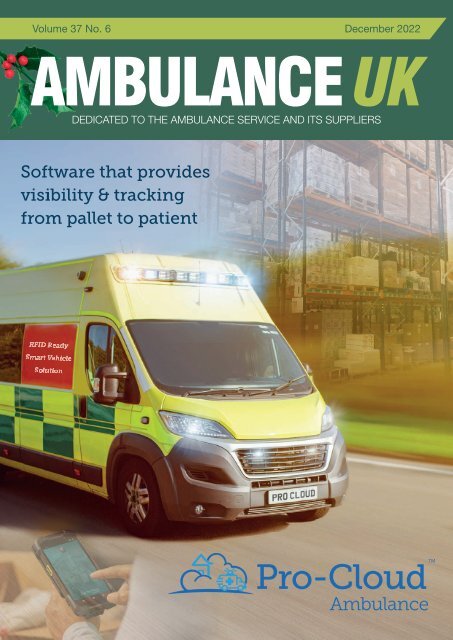
Pro-Cloud <strong>Ambulance</strong><br />
Supporting the overwhelming pressures of a modern-day <strong>Ambulance</strong><br />
Service<br />
Pro-Cloud <strong>Ambulance</strong> is a highly configurable paperless software platform that automates<br />
critical areas of an ambulance operation supply chain, it complies with MHRA Managing<br />
Medical Devices 2021 and fully supports CQC’s Regulation 15.<br />
The solution provides stock and equipment control, Radio Frequency Technology (RFID)<br />
capabilities, automated ordering from vehicle preparation hubs to their warehouse facility<br />
and enables automatic stock transfer requests based on minimum and maximum levels.<br />
RFID is at the centre of the software offering, which can be used across all ambulance<br />
settings. As one of the first providers to offer both fixed and hand-held Radio Frequency<br />
Technology (RFID) in a combined solution this advanced technology together with the<br />
Pro-Cloud Ready to Go app provides instant visualisation of a fleet and onboard assets.<br />
It is used by response teams to complete inventory checks before leaving the scene of an<br />
incident and reads multiple RFID tags simultaneously within moments, allowing real-time<br />
reporting of equipment located or missing from a vehicle. By using the Ready to Go app,<br />
the crew can also report faulty equipment, which alerts make ready teams back at base to<br />
ensure they have replacements ready for the vehicle’s arrival.<br />
Approximately 3000 ambulance hours are lost each year due to clinical equipment not<br />
being available at the start of a shift.<br />
Start using the Pro-Cloud <strong>Ambulance</strong> solution and significantly increase equipment and<br />
service availability.<br />
More information can be found about Pro-Cloud <strong>Ambulance</strong> and RFID technology by<br />
visiting: https://pro-cloud.org/ready-to-go-rfid-app/<br />
Tel: 0800 652 0488<br />
Email: enquiries@csseurope.co.uk<br />
Website: www.pro-cloud.org<br />
PUBLISHED BI-MONTHLY:<br />
February, April, June, August,<br />
October, <strong>December</strong><br />
COPYRIGHT:<br />
Media Publishing Company<br />
Greenoaks<br />
Lockhill<br />
Upper Sapey, Worcester, WR6 6XR<br />
PUBLISHERS STATEMENT:<br />
The views and opinions expressed in<br />
this issue are not necessarily those of<br />
the Publisher, the Editors or Media<br />
Publishing Company.<br />
Next Issue February 2023<br />
Subscription Information – <strong>December</strong> <strong>2022</strong><br />
<strong>Ambulance</strong> <strong>UK</strong> is available through<br />
a personal, company or institutional<br />
subscription in both the <strong>UK</strong> and overseas.<br />
<strong>UK</strong>:<br />
Individuals - £24.00 (inc postage)<br />
Companies - £60.00 (inc postage)<br />
Rest of the World:<br />
£60.00 (inc. surface postage)<br />
£84.00 (airmail)<br />
We are also able to process your<br />
subscriptions via most major credit<br />
cards. Please ask for details.<br />
Cheques should be made<br />
payable to MEDIA PUBLISHING.<br />
Designed in the <strong>UK</strong> by me&you creative<br />
AMBULANCE <strong>UK</strong> - DECEMBER<br />
Do you have anything you would like to add or include? Please contact us and let us know.<br />
179
EDITOR’S COMMENT<br />
EDITOR’S COMMENT<br />
A good friend of mine, who is a doctor, recently attended a long course with the<br />
military. The course was clinical but designed to push the candidates by reducing<br />
their sleep and increasing their physical activity. It is known to be very testing.<br />
I met up with him once he had successfully completed the course. His refl ections were thought-provoking.<br />
He said that while it was good to have passed this notoriously diffi cult course, his take-away was that it isn’t<br />
your destination that is important. Nor is it the journey. The important thing is the people you are with on the<br />
journey.<br />
AMBULANCE <strong>UK</strong> - DECEMBER<br />
“However<br />
hard things<br />
get, we can<br />
get through<br />
it, provided<br />
we look<br />
after each<br />
other and<br />
remember<br />
that no one<br />
is alone:<br />
there is a<br />
whole tribe<br />
of us on<br />
the same<br />
journey.”<br />
This struck a chord with me. Pre-hospital workers, and particularly ambulance clinicians are a tribe. I am<br />
lucky enough to meet with and talk to ambulance people from across the country, and occasionally from<br />
across the world. We all have the same issues, worries and problems to deal with, but there is defi nitely a<br />
sense of belonging among road staff. They ‘get’ each other. It’s something about that shared experience;<br />
that understanding that everyone is experiencing similar issues.<br />
Unfortunately, various CQC reports, and staff surveys recently have shown that this sense of understanding<br />
and connection may not extend to senior leadership within organisations. I guess this is understandable: I<br />
suffer from too much time in meetings and on emails, which is the curse of anyone who moves away from<br />
the shop fl oor. As leaders and managers in any organisation, the ability to maintain that connection with the<br />
bulk of the workforce has its challenges. That also results to a greater or lesser extent to a loss of that sense<br />
of tribe. One almost feels as if you are looking in on the tribe, rather than being part of it.<br />
However, it doesn’t take much; whether that’s a clinical incident, a face-to-face, or a course, to realise that<br />
that the tribe is still there, and that sense of belonging can be rekindled.<br />
We all know that things are not as good as they should be out there. I don’t need to list the reasons! It is<br />
hard for a lot of us in very different ways. However hard things get, we can get through it, provided we look<br />
after each other and remember that no one is alone: there is a whole tribe of us on the same journey.<br />
Dr Matt House, Co-Editor <strong>Ambulance</strong> <strong>UK</strong><br />
180<br />
For more news visit: www.ambulanceukonline.com
Improve workflow with the<br />
defibrillator/monitor.<br />
A complete modular system that can be split into three parts;<br />
Monitor<br />
Patient Box<br />
Defibrillator<br />
The corpuls 3 adapts optimally to your needs.<br />
Discover the clinical flexibility in your hands and optimise patient workflow with the unique user<br />
interface of modular or compact mode during patient monitoring and therapy.<br />
• Enhanced patient safety with extensive data storage and data transmission capability throughout<br />
the patient journey with corpuls.mission and corpuls.manager<br />
• Modular design allows for versatility and better ergonomics throughout the patient care pathway.<br />
• Intuitive touch screen monitor with navigation dial option.<br />
www.corpuls.co.uk<br />
www.theortusgroup.com<br />
Official <strong>UK</strong> supplier of corpuls and Weinmann<br />
medical devices and software.
FEATURE<br />
PROTECTING YOUR AED –<br />
SHOCKINGLY OBVIOUS!<br />
By Steve Jelfs, Defibrillation & Resuscitation Consultant<br />
With the ever-increasing number of automated external<br />
defibrillators (AEDs) appearing in public places across the <strong>UK</strong>,<br />
Europe and globally, ensuring your AEDs are ready for rescue and<br />
are permanently tracked has never been more important.<br />
The two operational elements of an AED, the battery and defi brillation<br />
pads, must be present and in full working order. This can, of course,<br />
be done by the person responsible for the AED(s) carrying out a visual<br />
inspection to ensure the device’s indicator shows that both battery and<br />
pads are useable. However, this is labour-intensive, especially if the<br />
person responsible has multiple AEDs to check.<br />
A matter of choice<br />
There are several AEDs available in the market for the<br />
end-user to buy; similarly, there are a wide range of<br />
cabinets in which to store the device — many of which<br />
monitor the readiness of both pads and battery. Once<br />
the device is removed from the cabinet this type of<br />
monitoring is no longer an option, neither is any form<br />
of tracking possible.<br />
identifi ed that 70,000 additional AEDs are unknown to The Circuit.<br />
The fact that so many AEDs are still unregistered underlines that relying<br />
on the end-user to register their device(s) is a haphazard approach.<br />
Automate the process<br />
The use of an automatic system would solve this at a stroke.<br />
A further advantage of an automatic platform is to provide cloud-based<br />
post-rescue clinical data that an increasing number of emergency<br />
physicians and ambulance service clinicians are requiring as a<br />
minimum data set. The data can also be made accessible for multiple<br />
stakeholders in line with the chain of survival.<br />
The international CardiLink team has developed a<br />
multi-stakeholder platform https://www.cardi-link.<br />
com/ which is useable across all AED platforms,<br />
regardless of manufacturer, and will provide a<br />
comprehensive solution to all the issues discussed<br />
above. The platform uses cellular technology and will,<br />
as well as monitoring the AED, track any movement<br />
the device makes from its normal location in real-time.<br />
AMBULANCE <strong>UK</strong> - DECEMBER<br />
By implementing an automatic system within the<br />
AED itself, manufacturers can provide the end-user<br />
with a reassuring system for device monitoring, geofencing<br />
and geo-location to track the device. This<br />
latter functionality ensures that no matter the reason<br />
the device is removed from its normal location, it can<br />
be tracked in real-time and successfully retrieved. Recently in the <strong>UK</strong><br />
several AEDs have been stolen from cabinets and have proved diffi cult<br />
to locate due to the absence of a tracking system. Many of the devices<br />
in public places have been provided through charity fund-raising, making<br />
such thefts not only callous in the extreme but also posing a serious<br />
risk to the life of a member of the community suffering a sudden cardiac<br />
arrest (SCA).<br />
Information is king<br />
In addition to the advantages stated above, an automatic system will<br />
remove the problem of end-users informing their local ambulance<br />
service about the placement of their AED(s). This is vital when an SCA<br />
occurs so the ambulance service dispatcher can immediately inform the<br />
caller where the nearest AED is located.<br />
The British Heart Foundation (BHF) has created The Circuit which is<br />
designed for end-users to report the location of their AED(s) so the<br />
local ambulance service can identify it and signpost the caller to the<br />
nearest AED in the event of an SCA. So far, 13 out of 14 <strong>UK</strong> ambulance<br />
services are signed up to The Circuit. At the time of writing, the BHF has<br />
The end-user, ambulance dispatch centre and other<br />
interested parties can monitor each device in real-time<br />
as well as track movement and a host of other related<br />
device information through a user-friendly app available<br />
on both iOS and Android platforms.<br />
If we are to save more lives from SCA and ensure AEDs are always<br />
ready and available, it makes sense for all AED manufacturers to<br />
incorporate this platform into their devices.<br />
Steve Jelfs – Bio<br />
Steve Jelfs is currently working as a Defi brillation & Resuscitation<br />
consultant and has worked in the industry for over twenty years in sales,<br />
international marketing and as a clinical specialist. He has worked for<br />
the British Red Cross and had a twenty-three-year career in various <strong>UK</strong><br />
ambulance services from paramedic to chief offi cer starting his service in<br />
his native Devon in 1973.<br />
He is passionate about saving lives from sudden cardiac arrest and has<br />
introduced several initiatives around automated external defi brillators<br />
(AEDs) across the <strong>UK</strong> and Europe.<br />
He is a member of the European Resuscitation Council and the <strong>UK</strong><br />
Resuscitation Council and a past president of the <strong>Ambulance</strong> Service<br />
Institute He currently lives in central Scotland.<br />
182<br />
For further recruitment vacancies visit: www.ambulanceukonline.com
FEATURE<br />
Intranasal mucosal atomisation device<br />
Medication can be quickly and painlessly<br />
delivered with the DART Intranasal<br />
mucosal atomisation device.<br />
Medication can be quickly and painlessly delivered with<br />
the DART intranasal mucosal atomisation device,<br />
helping the patient remain calm in a high stress situation.<br />
Scan the QR code to<br />
find out more:<br />
lnteract with us<br />
AMBULANCE <strong>UK</strong> - DECEMBER<br />
Quality, innovation and choice<br />
www.intersurgical.co.uk<br />
Do you have anything you would like to add or include in Features? Please contact us and let us know.<br />
183
FEATURE<br />
PRAYING FOR THE SURVIVAL OF<br />
THE NHS WILL NOT BE ENOUGH<br />
TO SAVE IT<br />
By Ivor Campbell<br />
AMBULANCE <strong>UK</strong> - DECEMBER<br />
It’s often said that the National Health<br />
Service is the closest thing Britain has to a<br />
unifying religion. If that is the case, then the<br />
faith of the population is being tested like<br />
never before.<br />
With budgets already stretched before the<br />
Covid pandemic, additional cost pressures since<br />
heaped on health boards across the country by double-digit inflation has<br />
brought the NHS closer to breaking point than at any time in its history.<br />
Every passing day seems to bring bleaker news for the beleaguered<br />
service, with a seemingly endless rollcall of damning statistics and<br />
publication of official reports charting yet higher levels of institutional<br />
failure.<br />
If anything, the relentless flow of anecdotes of patient betrayal,<br />
breathlessly reported in the pages of local press, is more shocking.<br />
In the past few weeks we learned that four patients had waited more<br />
than 20 hours in the back of ambulances outside Royal Shrewsbury<br />
Hospital in England; that GPs in Peterborough are now responsible for<br />
the care of more than 2,000 patients each; and that Stockport NHS<br />
Foundation Trust is offering food bank vouchers to hospital workers<br />
struggling to get by on poverty wages.<br />
In the same week a British Medical Association (BMA) survey found<br />
that 44% of senior doctors are planning to leave their roles “in some<br />
capacity” over the next 12 months, while the Care Quality Commission<br />
(CQC) reported 132,000 NHS and 165,000 social care vacancies,<br />
meaning a workforce the size of the population of Newcastle-Upon-Tyne<br />
is needed to fix the logjam.<br />
Meanwhile, the average wait for category two, 999 calls for an<br />
ambulance — including for chest pains and strokes — in England and<br />
Wales is now 60 minutes, compared with a target of 18 minutes. And in<br />
Scotland, throughout August, one in ten operations was cancelled due<br />
to lack of resources.<br />
Traditionally, the response of politicians to complaints of a ‘crisis’ in<br />
the NHS has been to throw more money at it, and right now there’s no<br />
money to spare.<br />
While both Conservative and Labour governments have previously toyed<br />
with reform, none has dared challenge the universally free, taxpayerfunded<br />
model upon which the health service was founded – until now.<br />
This week it was reported that NHS chief executives in Scotland<br />
– one of four autonomous health service areas in the <strong>UK</strong> – have<br />
discussed abandoning its founding principles by having wealthier<br />
patients pay for treatment.<br />
The prospect of the first ‘two-tier’ health service in the <strong>UK</strong> since<br />
its founding in 1948 is raised in draft minutes of a meeting of NHS<br />
Scotland health board leaders in September. They also discussed<br />
the possibility of curtailing some free prescriptions.<br />
While Humza Yousaf, Scotland’s Health Secretary, sought to play<br />
down the reports – insisting NHS Scotland would stay publicly<br />
owned and operated and free at the point of delivery – the reports<br />
represent something of a watershed.<br />
Yousaf’s comments were only to be expected. If there is a single,<br />
immutable reality of British political life it is that the NHS is an<br />
untouchable shibboleth, and any party that says otherwise risks<br />
courting electoral oblivion.<br />
Even if there was a prime minister mad, or drunk, enough to<br />
suggest privatising the service, they would surpass the ends of the<br />
earth several times over before finding a private operator madder,<br />
or drunker, enough to take-on the job.<br />
Yet, there is a dynamic to the latest spot in which the NHS finds<br />
itself, which appears materially different to anything in the past.<br />
Again, you need only scroll through some of the local press articles<br />
to discover that waits are longer, levels of basic care poorer and<br />
patient experiences grimmer than ever before.<br />
Figures published by NHS Wales last week revealed more than<br />
60,000 patients are waiting more than two years for treatment. Ian<br />
Hembrow, 53, from Maesteg, in Bridgend was told the waiting list<br />
for his urgent hip operation was four-and-a -half-years.<br />
In Bonhill, West Dunbartonshire, 69-year-old grandmother Mary<br />
Travis has already lived in crippling pain for more than two years,<br />
waiting for a back operation to straighten her twisted spine. Earlier<br />
this month she was told that, despite being at the top of a waiting<br />
list, she could face a further, two-year wait.<br />
The NHS has endured because there is an almost spiritual belief<br />
in its universality. People of all classes and backgrounds accept<br />
the same level of treatment as a right and consequence of being<br />
British.<br />
184<br />
For more news visit: www.ambulanceukonline.com
FEATURE<br />
Those principals have survived because NHS care, as well as being<br />
universal, was also universally excellent. That can no longer be said<br />
to be the case. The withholding of treatment for years is worse than<br />
receiving poor treatment and those who can afford to pay privately<br />
for a better service will inevitably opt to do so.<br />
The most compelling argument against privatising the NHS has<br />
always been that the provision of healthcare should not be left to<br />
the vagaries of market forces. The irony of the current crisis is that<br />
those very market forces may now compel its demise.<br />
No matter how strongly Britons support the NHS, few will be<br />
prepared to wait months or years to have an ingrowing toenail<br />
treated or a cyst removed if they can have it done privately the<br />
following week for a few hundred pounds.<br />
And while we may be happy and willing to pay European levels of<br />
taxes in return for a European-style health service, we’re unlikely to<br />
do the same for a US-style system.<br />
With the growing development of robotics and telemedicine, as well<br />
as an expansion of over-the-counter diagnostics, more people are<br />
now seeking remedies, for a greater range of treatments, from their<br />
local chemist or from a private therapist or practitioner.<br />
More is being done online than was the case a few years ago.<br />
Much of it remains minor, but the direction of travel is such that,<br />
before long, more serious illnesses will be diagnosed remotely and<br />
by high street providers.<br />
If patients can be diagnosed with prostate or breast cancer sooner,<br />
and treated more effectively, then the way in which the health<br />
service is configured and funded will no longer be as important.<br />
We may end up with something approaching the German health<br />
service model where a private service handles minor and routine<br />
complaints, while accidents and serious illnesses are treated by<br />
a publicly funded service, similar to the NHS, which is free at the<br />
point of delivery.<br />
It’s unlikely the NHS will ever be wholly privatised, but we could see<br />
– slowly and over time – some of its more routine functions being<br />
taken over by private companies.<br />
Even the most traditional religions are forced to adapt and evolve to<br />
remain relevant and the NHS is no different. How it responds to the<br />
current crisis will determine its role in treating the next generations<br />
of patients and whether they will hold it with the same reverence for<br />
another 70 years.<br />
By spending a small amount each month, they can have more-orless<br />
unlimited telephone or video access to a private GP.<br />
Ivor Campbell is Managing Director of Stirlingshire-based Snedden<br />
Campbell, a search company for the medical technology industry.<br />
WHY NOT WRITE FOR US?<br />
<strong>Ambulance</strong> <strong>UK</strong> welcomes the submission of<br />
clinical papers and case reports or news that<br />
you feel will be of interest to your colleagues.<br />
Material submitted will be seen by those working within the public and private<br />
sector of the <strong>Ambulance</strong> Service, Air <strong>Ambulance</strong> Operators, BASICS Doctors etc.<br />
All submissions should be forwarded to info@mediapublishingcompany.com<br />
If you have any queries please contact the publisher Terry Gardner via:<br />
info@mediapublishingcompany.com<br />
AMBULANCE <strong>UK</strong> - DECEMBER<br />
Do you have anything you would like to add or include in Features? Please contact us and let us know.<br />
185
NEWSLINE<br />
EEAST<br />
Plans for new stateof-the-art<br />
base<br />
unveiled<br />
The East of England <strong>Ambulance</strong><br />
Service NHS Trust (EEAST)<br />
has drawn up plans to create<br />
a state-of-the-art hub on the<br />
outskirts of Bury St Edmunds to<br />
further improve the response it<br />
can provide to patients.<br />
The revamped station – which will<br />
be known as a central reporting<br />
hub – will be developed at Suffolk<br />
Park on the Moreton Hall estate,<br />
which neighbours the A14 if<br />
planning permission for the project<br />
is granted later this year.<br />
The modern building will provide<br />
significantly improved facilities for<br />
staff, including an outside gym,<br />
quiet spaces, a wellbeing garden<br />
and fishpond, kitchen and dining<br />
area and training rooms.<br />
It will also include a “make ready”<br />
zone, where a dedicated team<br />
will work around the clock to<br />
clean and restock all vehicles to<br />
a consistently high standard. This<br />
will mean there is always a fullystocked,<br />
cleaned and checked<br />
vehicle ready for crews to use so<br />
that they can deliver life-saving<br />
care to patients faster.<br />
The hub has been carefully<br />
designed to minimise its<br />
environmental impact, in line<br />
with the NHS’s commitment to<br />
reducing its carbon footprint. It<br />
will be powered by photovoltaic<br />
cells on its roof and constructed<br />
using “greener” materials and<br />
construction methods wherever<br />
possible.<br />
Jackie Nugent, infrastructure<br />
and estates transformation<br />
programme lead at EEAST, said:<br />
“We are investing significantly<br />
in our estates so that we can<br />
provide modern, fit-for-purpose<br />
facilities for our staff while<br />
improving the response we are<br />
able to provide to the public.<br />
“The hub in Bury will be first of<br />
a number of new stations we<br />
develop across the region. It<br />
will include an on-site vehicle<br />
workshop, which will allow us to<br />
bring maintenance in-house and<br />
keep more ambulances on the<br />
road. The hub will also have 24/7<br />
make ready facilities so that we<br />
can make sure our vehicles are<br />
prepared to a consistently high<br />
standard. This will free up frontline<br />
clinicians from doing this prep<br />
work so that they can focus on<br />
what they do best – caring for<br />
patients.<br />
“Importantly, the hub will also<br />
provide a vastly improved working<br />
environment for our staff and<br />
new facilities, such as gym and<br />
dedicated welfare spaces where<br />
crews can relax between calls, in<br />
turn boosting their wellbeing.<br />
“This flagship development will<br />
form a blueprint which we will<br />
then roll out across the rest of our<br />
patch to ensure our committed<br />
teams are working from the<br />
right buildings and with the right<br />
vehicles and equipment to provide<br />
the highest quality care to our<br />
patients.”<br />
EEAST has appointed Assura as<br />
a development partner for the<br />
project. If planning permission<br />
is granted later this year,<br />
construction will begin in early<br />
2023 with the building operational<br />
by summer 2024.<br />
A computer-generated walkthrough<br />
showing the basic<br />
lay out of the building is<br />
available here: https://vimeo.<br />
com/736172875/6068d97c2f<br />
SECAMB<br />
Birchington woman<br />
thanks life-saving<br />
ambulance crew<br />
A woman from Birchington has<br />
thanked the ambulance team<br />
who came to her aid when she<br />
collapsed while on a cliff top<br />
walk.<br />
Patricia Seager, 68, collapsed<br />
when walking her dog with a<br />
AMBULANCE <strong>UK</strong> - DECEMBER<br />
Photo credit: Corstorphine & Wright<br />
186<br />
For more news visit: www.ambulanceukonline.com
NEWSLINE<br />
friend, Marguerite Whitling, in<br />
Minnis Bay on the morning of<br />
17 September after suddenly<br />
feeling unwell. The pair met<br />
with the ambulance team at<br />
Thanet Make Ready Centre in<br />
Ramsgate last week.<br />
South East Coast <strong>Ambulance</strong><br />
collapsed. Apart from the odd<br />
snippet, I don’t remember much<br />
about what happened but I<br />
have subsequently been told by<br />
Marguerite of the heroic efforts<br />
the team made to save my life.”<br />
Shannon and Claire were<br />
backed up by fellow clinicians<br />
her and Marguerite in better<br />
circumstances.”<br />
Patricia added: “I survived<br />
due to the expert and<br />
compassionate care of the<br />
whole team. Without them I<br />
simply wouldn’t be here and I<br />
also wouldn’t have been around<br />
to see my daughter finish her<br />
chemotherapy treatment and<br />
hopefully beat cancer. There<br />
are no words I can really say to<br />
express my thanks to them all.<br />
It has been lovely to meet them<br />
to thank them face-to-face and<br />
offer them my most heartfelt<br />
gratitude and appreciation.”<br />
paramedic, Shannon Reed and<br />
John Ward and Jess Bushell.<br />
crew mate, Claire Hardy were<br />
The team worked to stabilise<br />
quickly on scene and sprang<br />
Patricia before liaising with the<br />
into action when Patricia went<br />
Trust’s Critical Care Desk and<br />
into cardiac arrest soon after<br />
arranging to take her initially<br />
their arrival. The pair delivered<br />
to QEQM Hospital in Margate.<br />
a shock with their defibrillator<br />
Patricia was then transferred<br />
which thankfully restored<br />
to William Harvey Hospital<br />
Patricia’s heart to a more normal<br />
in Ashford where she spent<br />
rhythm.<br />
five days in the Critical Care<br />
Unit before being fitted with a<br />
Patricia, who has now returned<br />
pacemaker and defibrillator.<br />
to her work in social care,<br />
underwent a triple heart bypass<br />
Shannon said: “It was a pleasure<br />
in 2015 but has since striven<br />
to meet Patricia and see her<br />
to look after her heart health by<br />
doing so well. From the moment<br />
walking and by making healthy<br />
we arrived, Claire was my rock<br />
lifestyle changes.<br />
and we worked together to<br />
ensure Patricia received the<br />
She said: “As we walked along,<br />
treatment she needed, with<br />
I suddenly felt dizzy but before<br />
John and Jess providing vital<br />
I could reach a nearby bench I<br />
back up. It was amazing to see<br />
WHY NOT WRITE FOR US?<br />
<strong>Ambulance</strong> <strong>UK</strong> welcomes the submission of<br />
clinical papers and case reports or news that<br />
you feel will be of interest to your colleagues.<br />
Material submitted will be seen by those working within the public and private<br />
sector of the <strong>Ambulance</strong> Service, Air <strong>Ambulance</strong> Operators, BASICS Doctors etc.<br />
All submissions should be forwarded to info@mediapublishingcompany.com<br />
If you have any queries please contact the publisher Terry Gardner via:<br />
info@mediapublishingcompany.com<br />
AMBULANCE <strong>UK</strong> - DECEMBER<br />
Do you have anything you would like to add or include in Newsline? Please contact us and let us know.<br />
187
NEWSLINE<br />
AMBULANCE <strong>UK</strong> - DECEMBER<br />
Christmas slays<br />
– holidays should<br />
come with a health<br />
warning, says expert<br />
The holiday season is one of<br />
the deadliest times of the year,<br />
with Christmas Day worst of all.<br />
A leading testing expert reveals<br />
why, and how we can protect<br />
ourselves.<br />
It’s that time of the year. Every<br />
TV advert and supermarket visit<br />
reminds us that we should already<br />
be planning for Christmas. As<br />
we set about organising food,<br />
presents and parties, we should<br />
also be planning how to survive<br />
the season, says a leading health<br />
testing expert.<br />
Dr Quinton Fivelman PhD, Chief<br />
Scientific Officer at London<br />
Medical Laboratory, says:<br />
‘Christmas is widely considered<br />
to be a joyful and relaxing time,<br />
but for many it’s anything but. The<br />
Office for National Statistics (ONS)<br />
says <strong>December</strong> and January are<br />
the most common months of<br />
death in the <strong>UK</strong>.<br />
‘Surprisingly, the highest<br />
concentration of cardiac-related<br />
deaths is during Christmas time.<br />
Some distinctly unfestive research<br />
published in the US journal<br />
“Circulation” shows that 4% more<br />
people die of heart problems<br />
during the Christmas holiday<br />
compared to even the midwinter<br />
average. Most fatal of all is<br />
Christmas Day. It has the highest<br />
number of cardiac deaths that<br />
occur rapidly after presentation of<br />
a medical problem. In second and<br />
third place are 26 <strong>December</strong> and<br />
New Year’s Day.<br />
‘It used to be thought that the<br />
primary reason for the higher<br />
number of <strong>UK</strong> Christmas deaths<br />
was the cold weather. However,<br />
Los Angeles, a Californian city<br />
with very mild winters, also has a<br />
third more deaths at Christmas.<br />
Furthermore, although Australia<br />
and New Zealand both celebrate<br />
Christmas in their mid-summers,<br />
there’s a marked rise in deaths at<br />
this time of year.<br />
‘So, if it’s not just the cold weather<br />
that’s responsible, what are the<br />
main reasons why Christmas and<br />
New Year prove fatal, and what<br />
can we do about it?<br />
‘The <strong>UK</strong>’s winter peak in deaths<br />
from cardiovascular disease<br />
is likely to be linked to high<br />
cholesterol and high blood<br />
pressure; both are known to climb<br />
around the holiday season for<br />
many people.<br />
‘Strong evidence suggests that<br />
rich foods, alcohol and restricted<br />
access to hospitals results in a<br />
higher frequency of heart attacks<br />
during the festive season.<br />
‘Additionally, many of us travel to<br />
see friends and family and that<br />
may present problems. While<br />
people are holidaying away from<br />
their main medical facilities, they<br />
may try to put off presenting to<br />
a doctor until they return home.<br />
That delay can prove fatal.<br />
‘There are a number of other<br />
medical reasons why <strong>UK</strong> deaths<br />
climb during Christmas and New<br />
Year. Many of us have lower<br />
vitamin D levels now than at other<br />
times of the year. From around late<br />
March to the end of September,<br />
our body creates enough vitamin D<br />
through exposure to direct sunlight<br />
absorbed on our skin. However,<br />
from October to early March we<br />
do not make enough naturally.<br />
Vitamin D deficiency is associated<br />
with increased incidence and risk<br />
of heart attacks. For this reason,<br />
many people take vitamin D<br />
supplements. If in doubt, it’s a<br />
good idea to have a vitamin profile<br />
blood test.<br />
‘It’s not just rich foods, excess<br />
alcohol and grey winters that can<br />
trigger heart attacks, however.<br />
The stress of meeting relatives<br />
we’ve been avoiding for the<br />
previous eleven months may also<br />
be causing us harm. Another<br />
worry is the cost of the presents,<br />
parties, food and booze. That will<br />
be a particular issue this year, as<br />
household costs soar. A groundbreaking<br />
2017 study published in<br />
“The Lancet” revealed that there’s<br />
probably a direct link between<br />
stress and heart problems. It<br />
tested activity in the amygdala, a<br />
region of the brain associated with<br />
stress, and discovered that those<br />
people with the most activity in<br />
the amygdala had the highest risk<br />
of developing heart disease over a<br />
follow-up lasting nearly four years.<br />
‘Finally, it’s perhaps not generally<br />
known that a bad case of flu can<br />
also have an impact on our heart.<br />
There is a known link between<br />
the flu virus and cardiovascular<br />
disease. The flu virus affects<br />
inflammatory and blood-clotting<br />
pathways. This can cause fatty<br />
deposits on the artery walls<br />
(plaques) to break loose, leading<br />
to coronary artery blockage – the<br />
main cause of heart attacks. We<br />
are far more likely to catch flu<br />
during the winter, together with<br />
Covid-19 and respiratory syncytial<br />
virus (RSV). RSV is a virus that<br />
infects the upper and lower<br />
respiratory tract, causing about<br />
14,000 hospital admissions and<br />
8,000 deaths in the <strong>UK</strong> annually.<br />
‘Knowing all these issues, what<br />
preventative actions can we take<br />
to get us through Christmas?<br />
Obviously, going easy on fatty<br />
foods and alcohol is the single<br />
most significant step. Additionally,<br />
if people know they are not in the<br />
best of heart health, they may<br />
want to consider access to GPs<br />
and hospitals before deciding<br />
to travel. A heart health blood<br />
test might also be a sensible<br />
precaution. London Medical<br />
Laboratory’s Heart Health Profile<br />
test can be done either at home<br />
or at one of over 85 selected<br />
pharmacies, drop-in clinics and<br />
health stores that offer these tests<br />
across London and nationwide.<br />
‘In terms of reducing stress,<br />
the encouraging takeaway from<br />
the Lancet study is that stress<br />
reduction techniques, such as<br />
exercise and deep breathing, might<br />
calm the mechanism that converts<br />
stress to heart attacks and strokes.<br />
‘Finally, knowing that the flu can<br />
trigger heart-related events,<br />
the introduction of London<br />
Medical Laboratory’s new rapid<br />
PCR test, that detects whether<br />
your symptoms are caused by<br />
Covid, flu and/or RSV, is timely.<br />
The revolutionary new “Covid,<br />
Cold or Flu A & B, 4-in-1 PCR<br />
Test” can be taken at one of<br />
over 85 selected pharmacies,<br />
drop-in clinics and health stores<br />
nationwide or, for convenience,<br />
at home through the post. For<br />
full details, see https://www.<br />
londonmedicallaboratory.com/<br />
product/4-in-1-flu<br />
WAS<br />
Welsh <strong>Ambulance</strong><br />
Service’s patient<br />
records go digital<br />
The Welsh <strong>Ambulance</strong> Service<br />
has introduced new technology<br />
which has enabled all of its<br />
patient records to go digital.<br />
The Trust generates an average<br />
400,000 patient records a year,<br />
which traditionally have been<br />
captured as handwritten notes.<br />
Electronic Patient Clinical Record<br />
(ePCR) technology enables crews<br />
to capture information on an iPad,<br />
reducing paper, improving the<br />
accuracy of notes and enabling realtime<br />
information to be shared quickly<br />
and easily with healthcare partners.<br />
Rather than wait to be handed a<br />
paper-based record, doctors can<br />
now determine the best course<br />
of treatment prior to a patient’s<br />
188<br />
For further recruitment vacancies visit: www.ambulanceukonline.com
NEWSLINE<br />
arrival at hospital, speeding up<br />
handovers.<br />
which takes us closer to our<br />
decarbonisation goals.<br />
Senior clinicians providing remote<br />
advice to paramedics face-to-face<br />
with a patient can also access the<br />
ePCR in real-time and record their<br />
advice as part of the record.<br />
Dr Brendan Lloyd, Executive<br />
Medical Director at the Welsh<br />
<strong>Ambulance</strong> Service, said: “The<br />
move from paper-based patient<br />
data collection to ePCR is<br />
transformational for the Trust and<br />
patient care.<br />
“Not only does it streamline the<br />
way information is captured, but<br />
the live data we’re entering into<br />
the Welsh Clinical Portal means<br />
other clinicians can access it,<br />
which strengthens collaboration<br />
and ultimately, means a better<br />
service for the patient.<br />
“The move to digital has also<br />
eliminated the use of paper,<br />
“We believe passionately about<br />
harnessing technology to equip our<br />
clinicians with information to provide<br />
individual care to improve patient<br />
outcomes and the experiences of<br />
patients, carers and their families<br />
when they need us the most.”<br />
The new ePCR solution was<br />
funded via Welsh Government’s<br />
Digital Priorities Investment Fund,<br />
and rollout at the height of the<br />
Covid-19 pandemic took around<br />
12 months.<br />
Welsh Government Minister for<br />
Health and Social Services Eluned<br />
Morgan said: “I congratulate<br />
the team on the successful and<br />
timely rollout of its new electronic<br />
records system.<br />
“The digitisation of patient care<br />
records means that information<br />
can be shared in a more effi cient<br />
manner to improve patient care<br />
and save vital minutes upon arrival<br />
in the hospital.<br />
“I will continue to support<br />
additional development of the<br />
ePCR system to further improve<br />
patient care in Wales.”<br />
The Trust’s ePCR Programme<br />
is now exploring further<br />
developments to interface with<br />
other NHS Wales systems and<br />
provide additional information to<br />
ambulance crews, like a patient’s<br />
allergies and regular medications.<br />
Work to enable the Trust’s<br />
Community First Responders to<br />
use the system is also underway<br />
with a view to capturing information<br />
across the service – be it by staff<br />
or volunteers – as a single digital<br />
Patient Clinical Record.<br />
RAPTOR ® RESCUE<br />
Available online from: www.leatherman.co.uk<br />
Developed with the input of special<br />
operations medics, EMTs and fire<br />
professionals familiar with standard<br />
medical shears, the Raptor Rescue<br />
was crafted with just the right balance<br />
of multi-purpose features for medicalspecific<br />
ops without an overkill of<br />
tools to complicate sometimes<br />
life-threatening situations.<br />
AMBULANCE <strong>UK</strong> - DECEMBER<br />
For the latest <strong>Ambulance</strong> Service News visit: www.ambulancenewsdesk.com<br />
189
NEWSLINE<br />
St John <strong>Ambulance</strong><br />
rated ‘Good’ across<br />
the board<br />
All St John <strong>Ambulance</strong> services<br />
regulated by the Care Quality<br />
Commission (CQC) have all<br />
been inspected and rated<br />
as ‘Good’, including some<br />
outstanding practice.<br />
The charity, which started a fouryear<br />
contract with NHS England<br />
to provide the nation’s ambulance<br />
auxiliary in August, scored highly<br />
across all four of its regions, plus its<br />
Sussex-based homeless service.<br />
St John <strong>Ambulance</strong>’s Director<br />
of Health and Volunteering<br />
Operations, Craig Harman says:<br />
“During a year when many<br />
ambulance services have been<br />
struggling, we should recognise<br />
what a massive achievement it<br />
is for our crews to get such a<br />
rousing affirmation from the Care<br />
Quality Commission.<br />
“It’s particularly moving to see<br />
how our people were noted for<br />
– as the CQC put it – showing<br />
extensive ‘compassion and<br />
kindness’ to patients – because<br />
those are our values and that’s<br />
what St John is all about.”<br />
Outstanding practice was noted<br />
in three of the four reports<br />
into ambulance services, with<br />
St John’s commitments to<br />
investing in fleet and improving<br />
organisational culture, plus the<br />
contribution of skilled volunteers in<br />
caring for patients highlighted.<br />
<strong>Ambulance</strong> hubs inspected<br />
included St John premises<br />
in London, West Bromwich,<br />
Stockport and Brighton.<br />
And St John’s Homeless Service,<br />
which operates in Brighton and<br />
Hastings, was also rated as good,<br />
with outstanding features.<br />
The charity’s Director of Quality<br />
and Safety, Niloufar Hajilou adds:<br />
“To be rated this highly across all<br />
five of our regulated services is<br />
a powerful endorsement of the<br />
incredible effort all St John people<br />
put in to ensure the care we<br />
deliver to patients is professional<br />
and compassionate.<br />
“I could not be more proud of<br />
our people for their continuous<br />
dedication and commitment to the<br />
provision of high quality care.<br />
“The last couple of years have<br />
been tough for everyone working<br />
in frontline healthcare, and there<br />
is always room for improvement,<br />
but St John is working hard and<br />
investing in our infrastructure,<br />
staff and volunteers to ensure we<br />
maintain these standards and get<br />
even better in the years to come.”<br />
All five CQC reports can be found<br />
on St John <strong>Ambulance</strong>’s website:<br />
https://www.sja.org.uk/what-wedo/governance-and-leadership/<br />
care-quality-commission/<br />
WAS<br />
Life-saving cardiac<br />
responder app is<br />
back<br />
The Welsh <strong>Ambulance</strong> Service<br />
has partnered with a life-saving<br />
app that lets first aiders know<br />
when there is a cardiac arrest in<br />
their area.<br />
The GoodSAM app uses GPS<br />
technology to alert trained first<br />
responders registered on the app<br />
to a nearby cardiac arrest.<br />
If the responder is available, they<br />
can accept the alert via the app<br />
and make their way to the patient<br />
to begin CPR prior to the arrival of<br />
an ambulance.<br />
Responders include NHS workers<br />
like doctors, nurses, paramedics<br />
and therapists, as well as police<br />
and fire staff, first aiders and<br />
others who are trained in CPR.<br />
Several thousand responders in<br />
Wales are already signed up to<br />
the app, 800 Welsh <strong>Ambulance</strong><br />
Service staff and volunteers – but<br />
now the Trust is inviting more.<br />
Carl Powell, Clinical Support Lead<br />
at the Welsh <strong>Ambulance</strong> Service,<br />
said: “When someone goes into<br />
cardiac arrest, every second<br />
counts, so the sooner that effective<br />
CPR is started, the better.<br />
“In a cardiac arrest situation, we<br />
will send an ambulance as quickly<br />
as possible on lights and sirens,<br />
but if there’s someone closer who<br />
can begin the chain of survival,<br />
it could mean the difference<br />
between life and death.<br />
“Often it’s the first few minutes that<br />
determine a patient’s outcome,<br />
which is why the GoodSAM app is<br />
a brilliant resource.<br />
“Early CPR is crucial, which is why<br />
we would encourage everyone is<br />
who CPR-trained across Wales to<br />
consider registering on the app.”<br />
The Welsh <strong>Ambulance</strong> responds<br />
to over 6,000 out-of-hospital<br />
cardiac arrests in Wales every<br />
year, but for every minute without<br />
CPR, a person’s chances of<br />
survival drop by 10%.<br />
AMBULANCE <strong>UK</strong> - DECEMBER<br />
The Welsh <strong>Ambulance</strong> Service first<br />
began using the GoodSAM app<br />
in 2018, and within two days, it<br />
has saved the life of Phil Nunnerley<br />
who went into cardiac arrest at<br />
a Wales vs Scotland game at<br />
Cardiff’s Principality Stadium.<br />
Use of the app was paused during<br />
the Covid-19 pandemic, but the<br />
partnership with GoodSAM has<br />
since been relaunched to allow<br />
more responders to come forward.<br />
Mark Wilson OBE, Co-Founder<br />
and Director of GoodSAM, said:<br />
“If your job requires CPR training<br />
190<br />
For more news visit: www.ambulanceukonline.com
NEWSLINE<br />
or you are a fi rst aider, then we<br />
encourage you to sign up.<br />
services and creating research<br />
that benefi ts patients and the<br />
<strong>Ambulance</strong> Service NHS Trust,<br />
said: “This is an excellent<br />
Professor Steve Goodacre,<br />
Professor of Emergency Medicine<br />
“If we can get as many people<br />
involved, there could be a<br />
GoodSAM responder on every<br />
street.”<br />
wider public.<br />
Staff from YAS and ScHARR will<br />
have the opportunity to codevelop<br />
and produce high quality<br />
opportunity for both Yorkshire<br />
<strong>Ambulance</strong> Service and the<br />
University of Sheffi eld to develop<br />
research that is impactful to<br />
our local communities. This<br />
at the University of Sheffi eld,<br />
said: “This is an important<br />
initiative that strengthens our<br />
existing relationship between<br />
Yorkshire <strong>Ambulance</strong> Service<br />
Deputy Chief Medical Offi cer for<br />
Wales, Professor Chris Jones,<br />
added: “The GoodSAM initiative is<br />
a huge step forward for Wales to<br />
ensure that anyone in the vicinity<br />
with the skills to save a life will be<br />
notifi ed and can help.<br />
research studies and will also<br />
benefi t from joint training sessions.<br />
Dr Steven Dykes, Executive<br />
Medical Director at Yorkshire<br />
agreement solidifi es the good<br />
working relationships we already<br />
have in place and ensures that<br />
we continue to work together in<br />
meaningful way.”<br />
and the University of Sheffi eld.<br />
I look forward to building our<br />
relationship and enhancing<br />
our ability to deliver impactful<br />
research.”<br />
“We are doing lots of work to<br />
increase people’s confi dence<br />
to intervene in a cardiac arrest<br />
emergency which includes<br />
highlighting ‘Help is closer than you<br />
think’, the importance of calling<br />
999 immediately, support provided<br />
by the call handler to do CPR and<br />
how to locate a defi brillator until an<br />
ambulance arrives.<br />
The Welsh <strong>Ambulance</strong> Service<br />
continues to work in partnership<br />
with Welsh Government and third<br />
sector partners to strive to deliver<br />
the Out of Hospital Cardiac Arrest<br />
Plan in Wales.<br />
Primarily established to work in<br />
the world of international<br />
medical repatriation, the<br />
business has evolved to provide<br />
expert clinical solutions across<br />
a variety of specialist sectors<br />
and services.<br />
IPRS Aeromed are now recruiting Paramedics & Nurses<br />
YAS<br />
Joint research<br />
agreement between<br />
Yorkshire <strong>Ambulance</strong><br />
Service and<br />
University of Sheffield<br />
School of Health and<br />
Related Research<br />
Yorkshire <strong>Ambulance</strong><br />
Service NHS Trust (YAS) and<br />
the University of Sheffield<br />
School of Health and Related<br />
Research (ScHARR) have<br />
joined forces to develop and<br />
deliver ambulance-focused<br />
research to help improve<br />
patient care.<br />
Both organisations have signed a<br />
Memorandum of Understanding<br />
and are committed to improving<br />
What sets us apart is the<br />
experience and skills of our<br />
valued clinicians who are<br />
well-versed in managing<br />
patients from around the<br />
world in a wide variety of<br />
settings.<br />
Join a team that's really going places!<br />
https://iprsaeromed.com/jobs/ or email IPRS Aeromed<br />
Recruitment aeromed.recruitment@iprsgroup.com<br />
AMBULANCE <strong>UK</strong> - DECEMBER<br />
Do you have anything you would like to add or include in Newsline? Please contact us and let us know.<br />
191
NEWSLINE<br />
SCAS<br />
South Central<br />
<strong>Ambulance</strong> Service<br />
wins prestigious<br />
award for CPR<br />
and defibrillator<br />
campaign<br />
South Central <strong>Ambulance</strong><br />
Service (SCAS) has won a<br />
Chartered Institute of Public<br />
Relations (CIPR) award for its<br />
campaign to increase public<br />
awareness of cardiopulmonary<br />
resuscitation (CPR) and<br />
defibrillators.<br />
Entitled Saving lives - the<br />
three Cs (cardiac arrest, CPR,<br />
communication), it was named<br />
best healthcare campaign last<br />
night (Tuesday) at the CIPR<br />
PRide Awards <strong>2022</strong> in the Anglia,<br />
Thames and Chiltern region.<br />
Alongside raising public<br />
awareness and interest in<br />
CPR and automated external<br />
defibrillators (AED), the<br />
campaign set out to improve<br />
take-up rates of CPR and<br />
AED usage and raise funds<br />
for South Central <strong>Ambulance</strong><br />
Charity to aid development of<br />
volunteers and the purchasing<br />
of equipment.<br />
It was developed by the<br />
communications department<br />
in collaboration with the<br />
community engagement and<br />
training team and South Central<br />
<strong>Ambulance</strong> Charity.<br />
The aim was to ensure regular<br />
communication throughout the<br />
year to secure national media<br />
coverage, significant social<br />
media engagement, charity<br />
donations and, most crucially, to<br />
aid an increase in out of hospital<br />
cardiac arrest survival rates.<br />
The project covered four main<br />
subject areas including SCAS<br />
becoming the first in the country<br />
to roll out LUCAS 3, a state-ofthe-art<br />
device which can perform<br />
CPR on a patient automatically to<br />
free up paramedics to carry out<br />
other vital interventions.<br />
The second focused on Danish<br />
footballer Christian Eriksen’s<br />
cardiac arrest at Euro 2020 and<br />
the link with the ‘Save a Life’ CPR<br />
app developed by SCAS, with<br />
the third on Facebook Live CPR<br />
sessions hosted as part of the<br />
2021 World Restart a Heart Week.<br />
The final communications initiative<br />
was the story of volunteer<br />
Graham Langley who saved the<br />
life of his friend and then became<br />
a volunteer community first<br />
responder.<br />
Among the returns were<br />
widespread national and<br />
international media coverage of<br />
the LUCAS 3 device, national<br />
media coverage and a spike in<br />
downloads of the ‘Save a Life’<br />
app, live CPR events which<br />
involved more than 50,000<br />
people and regional media<br />
coverage of Graham’s story and<br />
subsequent use as an advert to<br />
recruit volunteers.<br />
There were 2,294 occasions<br />
during the year where CPR<br />
was in progress prior to the<br />
arrival of an ambulance across<br />
Buckinghamshire, Berkshire,<br />
Oxfordshire and Hampshire<br />
which supports SCAS’s<br />
improving out of hospital<br />
cardiac arrest survival rate of<br />
13.9% - one of the highest in<br />
the country.<br />
“The dedication and the<br />
commitment from our<br />
communications department,<br />
charity and community training<br />
A WORLD OF COMFORT<br />
CLIMATE CONTROLLED HEALTHCARE<br />
Customised vehicle heating and cooling solutions from Eberspacher.<br />
Simple to use, effective in performance and reliable in operation.<br />
On the move comfort for patient and healthcare professionals.<br />
| WWW.EBERSPACHER.COM
NEWSLINE<br />
and engagement team in<br />
working together to raise the<br />
profile of CPR and defibrillators,<br />
funding advances in equipment<br />
and care and training members<br />
of the public has been vital in<br />
helping to improve out of hospital<br />
cardiac arrest survival rates in<br />
the SCAS region,” said Nicola<br />
Dunbar, head of community<br />
engagement and training at<br />
SCAS.<br />
“The variety of activities over<br />
the course of this year have<br />
demonstrated the benefits of<br />
this relationship, achieving media<br />
and social media impact, raising<br />
funds and training thousands of<br />
members of the public in vital lifesaving<br />
skills.”<br />
Gillian Hodgetts, director of<br />
communications, marketing and<br />
engagement at SCAS, said:<br />
‘We are all thrilled to win this<br />
prestigious award and more<br />
importantly for an aspect of our<br />
work that we are passionate<br />
about and that has the potential<br />
to help save many lives’.<br />
GWAAC<br />
GWAAC<br />
On Friday 16 September <strong>2022</strong>,<br />
Bristol’s Aerospace Museum<br />
opened its doors to the Great<br />
Western Air <strong>Ambulance</strong> Charity<br />
(GWAAC) and its guests for the<br />
return of the much-anticipated<br />
Pre-Hospital Emergency<br />
Medical (PHEM) Symposium<br />
– an informative and friendly<br />
conference for healthcare<br />
professionals wanting to learn<br />
more about all things PHEMrelated.<br />
The first Symposium was held<br />
in 2016 but the last two events<br />
in 2020 and 2021 did not run<br />
due to COVID-19. It was great<br />
to get colleagues and medical<br />
professionals back together<br />
in a collaborative learning<br />
environment, with CPD certificates<br />
waiting at the end.<br />
Introductions<br />
After half an hour of meeting and<br />
greeting in the Concorde hangar<br />
(next to GWAAC’s old home at<br />
Filton Airfield), the attendees<br />
moved upstairs to take their seats<br />
to listen to a warm welcome by<br />
GWAAC’s CEO, Anna Perry, and<br />
Medical Director, Ed Valentine.<br />
Ms Perry and Dr Valentine briefed<br />
the audience on what they could<br />
expect from the day and played<br />
a fast-paced and gripping video<br />
that gave a glimpse into life as<br />
a GWAAC crew member. The<br />
video showed the crew getting<br />
ready for a mission, followed by a<br />
simulation of their response to a<br />
Road Traffic Accident (RTC).<br />
PHEM topics<br />
An array of expert speakers from<br />
varied backgrounds delivered<br />
valuable presentations over four<br />
sessions. Topics covered:<br />
• Critical care transfers: what is it<br />
all about?<br />
• ECMO: Is it useful in the prehospital<br />
setting?<br />
• Pushing Boundaries in<br />
paramedicine<br />
• Claims, inquests and the<br />
regulator from a pre-hospital<br />
perspective<br />
• Gardening V carpentry:<br />
designing a wellbeing strategy<br />
• Bumps and bruises: managing<br />
pregnant women in a prehospital<br />
environment<br />
• Interactive case scenario<br />
discussions<br />
• Great Western Air <strong>Ambulance</strong><br />
Charity – demonstration by<br />
crew<br />
• Keynote — pre-hospital critical<br />
care; where have we come<br />
from and where are we going?<br />
• Manchester Arena Public<br />
Inquiry and reflections on the<br />
duty of care<br />
• Hot, wet and high: trauma and<br />
extremes<br />
During the breaks, attendees were<br />
treated to excellent refreshments,<br />
an opportunity to look around<br />
trade stands and a peek inside<br />
Concorde itself.<br />
Attendees said…<br />
“Every single speaker has brought<br />
a lot to the table for me. The<br />
‘Pushing Boundaries’ talk was<br />
very eye-opening, and I’ve also<br />
learned that the procedures we’re<br />
using now might change in the<br />
next ten years.”<br />
Natalie Cunningham – Emergency<br />
Care Assistant<br />
“Seeing the Critical Care Team in<br />
action was truly a sight to behold.<br />
They ran the case like a well-oiled<br />
machine. It was very inspirational<br />
to see!”<br />
Dr Zain Mitha – Junior Doctor,<br />
Intensive Care Unit<br />
“There are different speakers every<br />
year. It’s a good opportunity to<br />
hear what the latest developments<br />
are in pre-hospital care. And it’s<br />
good to develop my knowledge<br />
even though I don’t work in prehospital<br />
care.”<br />
Dr Matthew Williams – Registrar,<br />
Emergency Department<br />
A note from the organiser<br />
“I couldn’t be happier with this<br />
year’s Symposium. The attendees<br />
were really engaged and a lot<br />
of them said they’d be back<br />
for the next one! I just want to<br />
say a huge thank you to all our<br />
guest speakers for sharing their<br />
expertise. The whole event was<br />
a great collaboration and we all<br />
learned from each other.”<br />
Vicki Brown, APCC, GWAAC, and<br />
organiser of the <strong>2022</strong> Symposium<br />
If you’re a healthcare professional<br />
interested in attending the<br />
next GWAAC Symposium, join<br />
GWAAC’s dedicated mailing list<br />
and be the first to receive details.<br />
AMBULANCE <strong>UK</strong> - DECEMBER<br />
For the latest <strong>Ambulance</strong> Service News visit: www.ambulancenewsdesk.com<br />
193
NEWSLINE<br />
EEAST<br />
New approach to<br />
get patients the<br />
care they need more<br />
quickly<br />
The East of England<br />
<strong>Ambulance</strong> Service Trust<br />
(EEAST) is piloting a new<br />
approach that will see patients<br />
getting the help they need<br />
more quickly.<br />
New ways of integrated working<br />
and new digital systems have<br />
been put in place to allow<br />
ambulance referrals to be sent<br />
directly to urgent care response<br />
services, such as ‘Hospital at<br />
Home’ – a service already in<br />
place in Hertfordshire and West<br />
Essex.<br />
This means that, where<br />
appropriate, people will be seen<br />
sooner by the right healthcare<br />
practitioner rather than going to<br />
hospital – saving hours of delays<br />
and in many cases providing a<br />
more tailored approach to their<br />
care.<br />
“We are rolling out this approach<br />
across our region to improve<br />
care for patients.”<br />
The new approach includes<br />
access for partners to EEAST’s<br />
cases so health care partners,<br />
and ‘clinical conversations’<br />
- where EEAST paramedics<br />
identify appropriate patients and<br />
discuss with local health teams if<br />
their care can be transferred to a<br />
community partner – potentially<br />
eliminating the need for patients<br />
to go to emergency departments<br />
for diagnosis and further<br />
treatment.<br />
Before launching the pilot,<br />
EEAST trialled the ‘clinical<br />
conversation’ with the East &<br />
North Herts’ existing Hospital<br />
at Home service - operated<br />
by Hertfordshire Community<br />
NHS Trust (HCT). The service<br />
means patients can receive<br />
nursing care, therapy and<br />
remote monitoring services in<br />
the comfort of their own home<br />
or care home with a team of<br />
GPs, nurses, therapists and<br />
pharmacists overseeing care.<br />
AMBULANCE <strong>UK</strong> - DECEMBER<br />
The new approach has been<br />
launched in partnership with<br />
Hertfordshire & West Essex<br />
Integrated Care Board and will<br />
shortly be rolled out with other<br />
partners to help build on the work<br />
done so far in this area across<br />
the region.<br />
EEAST chief executive Tom Abell<br />
said:<br />
“We believe this will deliver real<br />
benefits for patients in getting<br />
them the help they need.<br />
“This will help free up our<br />
dedicated people to see patients<br />
who most need our care and help<br />
reduce pressure on hospitals,<br />
reducing handover delays<br />
at emergency departments.<br />
Emergency patients with time<br />
critical care will always be taken<br />
straight to hospital for treatment.<br />
The week-long trial meant for the<br />
first time EEAST could directly<br />
refer into the service. A total of<br />
108 patients were identified as<br />
suitable for Hospital at Home<br />
and of these 73 were not<br />
conveyed to hospital.<br />
HCT Chief Executive, Elliot<br />
Howard-Jones, said:<br />
“Working as one healthcare<br />
system to extend access to<br />
EEAST’s cases is a momentous<br />
occasion as it not only means<br />
patients get the care they need<br />
when they need it – but that we<br />
are working together to reduce<br />
pressure on other services<br />
while still providing quality local<br />
healthcare.”<br />
The other community providers<br />
working with EEAST on<br />
this new approach include<br />
194<br />
For more news visit: www.ambulanceukonline.com
NEWSLINE<br />
Central London Community<br />
Healthcare NHS Trust and<br />
Essex Partnership University<br />
NHS Trust, who provides rapid<br />
response services that can help<br />
people at home, provide services<br />
that ensure they have greater<br />
independence in their own home<br />
and enable onward referral/<br />
follow up within community<br />
services to be made.<br />
LAS<br />
Mayor of London<br />
becomes latest<br />
London Lifesaver<br />
The Mayor of London, Sadiq<br />
Khan, has become the latest<br />
Londoner to learn essential<br />
life-saving skills as he signed<br />
up to London <strong>Ambulance</strong><br />
Service’s (LAS) mission to train<br />
100,000 London Lifesavers on<br />
Tuesday 4 October.<br />
Community Resuscitation Trainer<br />
Victoria Geary, Community<br />
Defibrillation Manager<br />
Samantha Wilcox, and Head<br />
of First Responders Samantha<br />
Palfreyman-Jones visited City<br />
Hall yesterday and provided a<br />
two-and-a-half hour training<br />
session on Emergency Life<br />
Support for the Mayor and his<br />
colleagues. During the training,<br />
Mr Khan was taught how to<br />
recognise symptoms of cardiac<br />
arrest, put an unconscious<br />
patient in the recovery position,<br />
perform Basic Life Support<br />
(BLS), and use a defibrillator.<br />
knowledge could literally save<br />
lives – including that of a friend<br />
or a loved one. I encourage<br />
Londoners to sign up to be<br />
a Lifesaver so that you have<br />
the confidence and training to<br />
be able to help when it truly<br />
matters.”<br />
The mayoral training session is<br />
part of a much wider London<br />
Lifesavers initiative, which was<br />
launched by London <strong>Ambulance</strong><br />
Service in September 2021.<br />
The campaign aims to improve<br />
people’s chances of surviving<br />
an out-of-hospital cardiac arrest<br />
by equipping at least 100,000<br />
Londoners with the knowledge<br />
and confidence to act in an<br />
emergency situation until<br />
ambulance crews arrive at the<br />
scene.<br />
Over the past six months, the<br />
London Lifesavers initiative has<br />
trained and registered almost<br />
2,000 new lifesavers, who<br />
are now equipped with basic<br />
resuscitation skills. LAS plans to<br />
scale up the London Lifesavers<br />
campaign further in the coming<br />
months.<br />
The initiative also aims to<br />
achieve a target of 10,000 public<br />
access defibrillators (PADs)<br />
available to save lives across the<br />
capital. Over the past year, LAS<br />
has supported the installation of<br />
1,000 new PADs across London,<br />
bringing the current total to<br />
7,500.<br />
The latest achievements in the<br />
London Lifesavers campaign<br />
come as LAS responded to<br />
9,500 cardiac arrests since the<br />
start of this calendar year (<strong>2022</strong>).<br />
LAS estimates that by reaching<br />
its target of 100,000 London<br />
Lifesavers and more than 10,000<br />
defibrillators across the city it<br />
could help save more than 100<br />
additional lives every year.<br />
LAS Community Defibrillation<br />
Manager Samantha Wilcox said:<br />
“I’d like to thank the Mayor of<br />
London for taking part in this<br />
training today, and encourage<br />
the citizens of London to follow<br />
his footsteps and learn these<br />
life-saving skills.<br />
“We know from experience that<br />
in the few minutes it takes for<br />
an ambulance crew to reach<br />
a person in cardiac arrest, the<br />
actions of passers-by can make<br />
the difference between life and<br />
death for that person. For every<br />
minute that goes by without<br />
life-saving intervention like CPR<br />
and defibrillation, the chances of<br />
a person surviving cardiac arrest<br />
decrease by 10%.<br />
“There are several ways that<br />
organisations, workplaces,<br />
communities and individuals<br />
can get involved. We advise<br />
contacting our London<br />
Lifesavers team for information<br />
on how to join our campaign.”<br />
The London Lifesavers initiative<br />
is funded by the London<br />
<strong>Ambulance</strong> Charity thanks to a<br />
grant received by NHS Charities<br />
Together and the support of our<br />
donors.<br />
The Mayor of London, Sadiq<br />
Khan, said: “London <strong>Ambulance</strong><br />
Service work around the clock<br />
to save lives and are there for<br />
Londoners when they need it<br />
most - but we know that when<br />
anyone has a serious health<br />
issue every second counts.<br />
“Doing simple lifesaver training,<br />
like I have done, gives you<br />
the confidence to do CPR<br />
and use a defibrillator and this<br />
Sadiq Khan encourages all Londoners to learn CPR and defibrillation skills<br />
AMBULANCE <strong>UK</strong> - DECEMBER<br />
Do you have anything you would like to add or include in Newsline? Please contact us and let us know.<br />
195
NEWSLINE<br />
AMBULANCE <strong>UK</strong> - DECEMBER<br />
SECAMB<br />
Trust committed<br />
to further<br />
improvements<br />
following publication<br />
of CQC report<br />
South East Coast <strong>Ambulance</strong><br />
Service NHS Foundation Trust<br />
(SECAmb) has reaffirmed<br />
its commitment to making<br />
improvements following the<br />
publication on Wednesday<br />
26 October of a Care Quality<br />
Commission (CQC) report.<br />
The inspection, which took<br />
place in August, and looked at<br />
SECAmb’s urgent and emergency<br />
care, as well as its resilience<br />
teams, sees the Trust’s overall<br />
rating move from ‘Good’ to<br />
‘Requires Improvement’. The<br />
individual rating for Caring remains<br />
rated as ‘Good’.<br />
The inspection also checked on<br />
the Trust’s progress in meeting<br />
the requirements from a well-led<br />
inspection which took place in<br />
February. The February inspection<br />
resulted in an ‘Inadequate’<br />
well-led rating, rated the Trust<br />
NHS 111 service as ‘Good’ but<br />
suspended other ratings until<br />
the latest inspection had been<br />
completed.<br />
SECAmb is pleased the care<br />
provided by its staff was<br />
recognised with a ‘Good’ rating<br />
and that inspectors found and<br />
were encouraged that Trust<br />
leaders were showing a sense<br />
of urgency in prioritising the<br />
issues which had previously been<br />
identified.<br />
SECAmb Interim Chief Executive,<br />
Siobhan Melia, was appointed<br />
in July this year. She said: “I am<br />
really pleased that the excellent<br />
care provided by our staff has<br />
once again been recognised and<br />
rated as ‘Good’ by the CQC,<br />
despite the huge pressures they<br />
face every day. I am very proud<br />
of the high-quality care and<br />
compassion provided by our staff.<br />
“We have already taken concerns<br />
around our culture and leadership<br />
extremely seriously and we are<br />
committed to making further<br />
improvements to ensure we<br />
improve our response to patients<br />
and the working lives of our staff.<br />
I know that there is much to do<br />
to get the Trust to where it needs<br />
to be and we are working closely<br />
with staff as well as partners both<br />
regionally and nationally to make<br />
the necessary improvements<br />
highlighted in the report”.<br />
The report found that there was<br />
additional pressure on SECAmb’s<br />
services which included increased<br />
staff sickness and increased<br />
delays in hospital handover. It<br />
also found, as flagged in a wider<br />
national CQC report published<br />
last week, State of Care, that<br />
the South East, along with other<br />
areas, has a health and social<br />
care system that is ‘gridlocked’.<br />
Inspectors recognised that<br />
SECAmb is unable to solve all of<br />
its issues alone and encouraged<br />
the Trust to work with the wider<br />
health system to find resolutions.<br />
SECAmb has outlined an<br />
improvement plan focusing<br />
on four main areas; Quality<br />
Improvement, Responsive Care,<br />
Sustainability, and People and<br />
Culture. Work includes improving<br />
learning from incidents as well as<br />
further recruitment and greater<br />
retention of staff. It also involves<br />
growing the Trust’s voice within<br />
the wider NHS system to support<br />
improved patient pathways,<br />
reduce hospital handover delays<br />
and develop new partnerships.<br />
WAS<br />
Shoctober campaign<br />
The Welsh <strong>Ambulance</strong><br />
Service has been back in<br />
schools celebrating its annual<br />
Shoctober campaign.<br />
The month-long campaign,<br />
which runs every October, sees<br />
the Welsh <strong>Ambulance</strong> Service<br />
educating primary school pupils<br />
about the correct use of 999,<br />
how to perform cardiopulmonary<br />
resuscitation (CPR) and how to<br />
use a defibrillator.<br />
As a result of the pandemic,<br />
the Trust’s Patient Experience<br />
and Community Involvement<br />
(PECI) Team had to approach<br />
the campaign virtually for two<br />
years, providing an educational<br />
animated film, suitable for<br />
children.<br />
This year, the team is back<br />
to visiting schools across the<br />
country in-person, building<br />
the confidence of more than<br />
1,800 pupils, by teaching what<br />
they can do in an emergency<br />
situation while help is on its way,<br />
including hands-only CPR.<br />
Fiona Maclean, PECI team<br />
manager, said: “We are really<br />
pleased to be back face-to-face,<br />
educating and teaching children.<br />
“We’ve managed to visit 32<br />
schools across Wales, with<br />
volunteers from the Welsh<br />
<strong>Ambulance</strong> Service, Local<br />
Health Board colleagues and<br />
medical students helping us in<br />
our demonstrations.<br />
“The interactive sessions include<br />
THE appropriateness of 999,<br />
the five emergency services<br />
available and life-saving skills;<br />
recovery position, hands-only<br />
CPR and using a defibrillator.<br />
“Teaching children from a young<br />
age means that they are more<br />
likely to stay calm if a crisis<br />
presents itself.<br />
“I want to say a massive thank<br />
you to all the schools involved<br />
and especially to the volunteers<br />
who gave up their time to<br />
support this very important<br />
campaign.”<br />
LAA<br />
LAA’s Physician<br />
Response Unit (PRU)<br />
welcomes launch of<br />
third car<br />
London’s Air <strong>Ambulance</strong><br />
Charity has announced that<br />
the Physician Response Unit<br />
(PRU) wing of the service has<br />
been bolstered by the addition<br />
of a third team. As a result,<br />
the geographical footprint<br />
of the PRU will expand to<br />
cover Barking, Havering and<br />
Redbridge, alongside the<br />
existing operations in Tower<br />
Hamlets, Newham and Waltham<br />
Forest.<br />
The PRU is a pioneering<br />
Community Emergency Medicine<br />
service which aims to deliver safe,<br />
effective and patient-centred<br />
emergency care via car in North<br />
East London. It is delivered in<br />
partnership with Barts Health NHS<br />
Trust, London’s Air <strong>Ambulance</strong><br />
Charity and the London<br />
<strong>Ambulance</strong> Service.<br />
The service sees patients of all<br />
ages with all types of emergency<br />
presentations ranging from<br />
critically unwell patients to<br />
those with minor injuries or<br />
acute illnesses that benefit from<br />
the ED being taken out to the<br />
patient. At present the operating<br />
model of the PRU involves a<br />
rapid response vehicle, senior<br />
emergency medicine doctor and<br />
ambulance clinician which attend<br />
emergency calls in the prehospital<br />
environment. The vehicle<br />
carries an extensive kit consisting<br />
of diagnostic equipment and in<br />
effect brings the hospital to the<br />
patient – rather than the other way<br />
around.<br />
In addition to expanding the<br />
geographic footprint of the<br />
service, the addition of the third<br />
car will help reach a wider range<br />
of patients and ensure that the<br />
service continues to bring out-of-<br />
196<br />
For further recruitment vacancies visit: www.ambulanceukonline.com
NEWSLINE<br />
hospital care to people in need<br />
across Northeast London.<br />
Tony Joy, PRU Clinical Lead, said:<br />
“The addition of a new car to our<br />
weekday operations is an exciting<br />
step forward for the PRU service.<br />
At the forefront of everything we<br />
do are the patients we serve<br />
and the new car will help reach<br />
more patients, as well as improve<br />
patient outcomes. We are pleased<br />
to ensure that patients get the<br />
right care in the right place first<br />
time, especially given the extreme<br />
pressures faced by the ambulance<br />
and emergency care systems at<br />
present.<br />
I’d like to thank everyone at Barts,<br />
LAA, and LAS for helping get the<br />
new car rolled out and supporting<br />
patients across Northeast<br />
London.”<br />
EEAST<br />
Family’s thanks to<br />
EEAST and Magpas<br />
Air <strong>Ambulance</strong><br />
crews who brought<br />
13-year-old “back to<br />
life”<br />
The crews then handed over care<br />
to colleagues from Magpas Air<br />
<strong>Ambulance</strong>: Dr James Price and<br />
Critical Care Paramedics Steve<br />
Chambers and Thomas Giddings.<br />
The team performed a rapid<br />
general anaesthetic at the incident<br />
scene – a procedure usually only<br />
available in a hospital – to protect<br />
Daisy’s vital functions before<br />
she was transferred by land to<br />
Addenbrooke’s Hospital for further<br />
care. She has since made a full<br />
recovery.<br />
The EEAST team and colleagues<br />
from Magpas Air <strong>Ambulance</strong> have<br />
been named as finalists in 999<br />
hero of The Sun’s ‘Who Cares<br />
Wins’ awards in recognition of<br />
their life-saving efforts.<br />
The awards ceremony will<br />
be broadcast on Channel 4<br />
at 6.30pm on Sunday 27th<br />
November.<br />
“We are incredibly proud of the<br />
fantastic teamwork showed<br />
by our crews and Magpas Air<br />
<strong>Ambulance</strong> partners during what<br />
was an incredibly challenging<br />
call,” said Lesley Hall, Leading<br />
Operations Manager with EEAST<br />
who was also on scene during the<br />
incident.<br />
“Attending a cardiac arrest is<br />
never easy, but when the patient<br />
is so young it makes it even<br />
harder. This was not a normal job<br />
by any stretch of the imagination.<br />
Thankfully this was a very rare<br />
event, and because of how the<br />
crews reacted under enormous<br />
pressure, Daisy now has her<br />
whole life ahead of her.”<br />
Dr James Price of Magpas<br />
Air <strong>Ambulance</strong> said: “Survival<br />
from cardiac arrest is very<br />
rare, especially in children. But<br />
everything went in Daisy’s favour<br />
that day. From the bystander<br />
calling 999 to the CPR given early<br />
and the early shock to her heart<br />
from the ambulance crew.<br />
“To see Daisy and her family now<br />
is incredible. It is very rewarding<br />
and makes the years of training in<br />
Pre-Hospital Emergency Medicine<br />
seem all the more worthwhile.”<br />
Daisy, together with parents<br />
John and Lisa, have since visited<br />
Huntingdon <strong>Ambulance</strong> Station to<br />
meet the team and thank them in<br />
person.<br />
John, who is a retired police<br />
officer who now works in patient<br />
transport for the NHS said: “We<br />
would like to thank everybody<br />
who helped Daisy. They were all a<br />
credit to the NHS.”<br />
Lisa, who is an assistant client<br />
accountant, added: “Words<br />
cannot express how grateful I am<br />
to everyone who helped Daisy<br />
that day. Everyone was in the right<br />
place.”<br />
Daisy added: “Words can’t really<br />
describe how I feel – just gratitude<br />
and thanks to everybody who<br />
gave me the chance to live.”<br />
Crews from the East of England<br />
<strong>Ambulance</strong> Service NHS<br />
Trust (EEAST) and Magpas<br />
Air <strong>Ambulance</strong> have been<br />
shortlisted for a national award<br />
after bringing a 13-year-old in<br />
cardiac arrest back to life.<br />
Daisy Webb was walking to<br />
school in Huntingdon during April<br />
when she suddenly fell to her<br />
knees, lost consciousness and<br />
stopped breathing.<br />
EEAST crew members Grace<br />
Lemin, Harrison Galgut and<br />
Charlie Harris arrived within<br />
minutes to discover she’d had a<br />
cardiac arrest, and began CPR<br />
and shocked Daisy’s heart until<br />
her pulse returned.<br />
Daisy Webb, fifth from the left in between her mum, Lisa, and dad, John, meets the team<br />
who saved her life in April – Photo credit The Sun Newspaper<br />
AMBULANCE <strong>UK</strong> - DECEMBER<br />
For the latest <strong>Ambulance</strong> Service News visit: www.ambulancenewsdesk.com<br />
197
NEWSLINE<br />
LAS<br />
Heart-warming<br />
reunion with<br />
ambulance crews for<br />
man who survived<br />
second cardiac<br />
arrest<br />
A man who beat the odds to<br />
survive his second cardiac<br />
arrest has been reunited with<br />
the London <strong>Ambulance</strong> Service<br />
teams who helped to save his<br />
life.<br />
Val Dyadyuk, 75, was visiting<br />
his son in north London when<br />
he stopped breathing early one<br />
morning in May.<br />
Val’s wife Nina screamed out for<br />
her son when she could not rouse<br />
her husband.<br />
Son Oleg Khomenko immediately<br />
dialled 999. Call handler Nyota<br />
Ndeke dispatched an ambulance<br />
to the home and began instructing<br />
Oleg on how to give life-saving<br />
chest compressions.<br />
Oleg said: “I remember so clearly<br />
the help on the phone, I had<br />
incredible instructions from the<br />
call handler, clear and calming and<br />
reassuring.<br />
“She guided me on the strength<br />
of the chest compressions and<br />
counting with me when I was<br />
getting tired.”<br />
An ambulance crew and two<br />
paramedics in fast response cars<br />
were sent to the home. The crews<br />
managed to resuscitate Val before<br />
taking him to a hospital with a<br />
specialist heart unit. He spent five<br />
weeks in hospital.<br />
Now fully recovered, Val has met<br />
the ambulance crews who treated<br />
him that morning back in May, so<br />
he could thank them in person.<br />
Val and Nina are originally from<br />
Ukraine but now live in Australia,<br />
where they have since returned.<br />
Oleg added: “We could not have<br />
had my dad back without the<br />
wonderful ambulance people that<br />
came to save him for us.<br />
“They were incredibly professional,<br />
helpful, understanding and most<br />
of all human in a time that was so<br />
difficult for myself and my family.<br />
We are forever grateful.”<br />
Val suffered a cardiac arrest<br />
seven years ago. The chances<br />
of someone surviving a cardiac<br />
arrest at home are pretty low –<br />
around one in 10. To survive two<br />
cardiac arrests is rare.<br />
The ambulance crews credit Oleg<br />
with helping his dad beat the<br />
odds.<br />
Paramedic Kate Gaustad said:<br />
“The fact that he woke up to his<br />
mum screaming and leapt into<br />
action with such effective chest<br />
compressions meant he saved his<br />
dad’s life.<br />
“We couldn’t have done our job<br />
without Oleg’s actions. Meeting<br />
Val made me proud, to know his<br />
family have him back, to see him<br />
walking, talking, living life – he<br />
represents what the ambulance<br />
service is there for.”<br />
Paramedic Pilar Gilardi said: “Val<br />
looked so well and so happy, it<br />
meant so much to meet him and<br />
his family.<br />
“Not many people survive a<br />
cardiac arrest and it can only<br />
happen if someone starts chest<br />
compressions while waiting for an<br />
ambulance.”<br />
Andy Snowball, emergency<br />
medical technician, said: “We<br />
rarely get to meet a patient after<br />
they have arrived at hospital so it<br />
is very rewarding to meet Val and<br />
his family after him making such a<br />
great recovery.<br />
“We are trained to save lives but<br />
to actually know find out more<br />
about the person whose life we’ve<br />
saved makes all the difference.”<br />
Paramedic Ben Holyroyd said:<br />
“It was a privilege and honour to<br />
meet Val. It’s just so amazing to<br />
be part of the joy and happiness<br />
that the family have.<br />
“I am proud of what we did but<br />
on that day Oleg was part of our<br />
team – hopefully their story will<br />
inspire others to learn life-saving<br />
skills.”<br />
EHAAT<br />
CQC rates Essex &<br />
Herts Air <strong>Ambulance</strong><br />
as ‘outstanding’<br />
“People’s lives continue to be<br />
saved because of the trust’s<br />
excellent standards, and other<br />
services can look to it as an<br />
example of how to deliver<br />
outstanding care.”<br />
Zoe Robinson, CQC Head of<br />
Hospital Inspection<br />
The Care Quality Commission<br />
(CQC) has rated Essex & Herts<br />
Air <strong>Ambulance</strong> Trust (EHAAT) as<br />
outstanding overall following<br />
inspections carried out in August<br />
and September.<br />
AMBULANCE <strong>UK</strong> - DECEMBER<br />
The service, which provides<br />
emergency care to critically<br />
ill and injured patients in<br />
Essex, Hertfordshire and<br />
the surrounding areas, was<br />
inspected as part of CQC’s<br />
ongoing checks to assess the<br />
quality of care being provided.<br />
It found that the trust delivered<br />
an outstanding service that was<br />
saving lives across the region.<br />
And, as well as being rated<br />
198<br />
For more news visit: www.ambulanceukonline.com
NEWSLINE<br />
outstanding overall, it was also<br />
rated outstanding for being safe,<br />
effective, caring, responsive to<br />
people’s needs, and well-led.<br />
Ben Myer, Head of Clinical<br />
Delivery (CQC Registered<br />
Manager) at EHAAT, is extremely<br />
proud of the CQC rating, which<br />
recognises everyone who plays<br />
a part in the charity’s life-saving<br />
work. He said: “This is an<br />
amazing and truly outstanding<br />
result for the whole charity;<br />
everyone worked so hard to<br />
make the desired result a reality”.<br />
Zoe Robinson, CQC Head of<br />
Hospital Inspection, said, “We<br />
were very impressed to find such<br />
outstanding levels of care being<br />
provided by Essex & Herts Air<br />
<strong>Ambulance</strong>.<br />
“The level of teamwork at the<br />
service was exemplary and staff<br />
and managers worked together<br />
and supported one another<br />
to deliver the best possible<br />
outcomes for people. Patients<br />
were valued and respected<br />
and their individual needs<br />
and preferences were always<br />
considered. Feedback from<br />
those using the service and their<br />
loved ones was overwhelmingly<br />
positive and people told us<br />
that staff went the extra mile<br />
for them and exceeded their<br />
expectations.<br />
EHAAT CEO (CQC Nominated<br />
Individual) Jane Gurney said, ‘I<br />
am so delighted with this result<br />
especially as the inspections<br />
found numerous examples of<br />
outstanding practice throughout<br />
the organisation. I would like<br />
to personally thank each team<br />
member across the entire<br />
charity, whatever their role, all of<br />
whom work so hard every day<br />
to uphold these high standards.<br />
I would like to also take this<br />
opportunity to thank our<br />
communities for supporting their<br />
local life-saving service, making<br />
it possible for us to remain<br />
operational and to keep saving<br />
lives in Essex, Hertfordshire and<br />
surrounding areas”<br />
Following on from the good<br />
news, the charity will continue<br />
to enhance the quality of<br />
the services it provides, as<br />
Ben Myer said, “As ever, the<br />
hard work doesn’t stop here.<br />
We will continue to strive for<br />
excellence for the patients<br />
and communities we care for,<br />
building on this result and<br />
maintaining our service, as an<br />
outstanding organisation with<br />
a national and international<br />
reputation for excellence.”<br />
WAS<br />
Dementia Matters<br />
to the Welsh<br />
<strong>Ambulance</strong> Service<br />
The Welsh <strong>Ambulance</strong> Service<br />
has been meeting people with<br />
dementia in Powys.<br />
Events in Ystradgynlais,<br />
Welshpool, Newtown,<br />
Llandrindod Wells and Brecon,<br />
held jointly with Dementia<br />
Matters in Powys, enabled<br />
the Trust to deliver interactive<br />
experiences and other activities<br />
to people living with dementia,<br />
their carers and families.<br />
Dementia Matters in Powys is a<br />
charity that supports the health<br />
and wellbeing of people living<br />
with dementia and those who<br />
care for them.<br />
Alison Johnstone, the<br />
Welsh <strong>Ambulance</strong> Service’s<br />
Programme Manager for<br />
Dementia, said: “This<br />
engagement work is vital for us<br />
to listen and learn from people<br />
affected by dementia.<br />
“For example, feedback tells<br />
us that ambulance vehicle<br />
environments can be distressing<br />
and difficult for people living<br />
with dementia.<br />
“These sessions not only<br />
allow us to educate people<br />
about what to expect when<br />
accessing our services, but<br />
where possible, vehicles are<br />
showcased to allow potential<br />
users to become familiar with<br />
their surroundings.<br />
“These opportunities to engage<br />
and educate are a key part of<br />
our Dementia Plan.”<br />
The number of people living<br />
with dementia is expected to<br />
triple from 50 million to 152<br />
million by 2050, according to<br />
the World Health Organization.<br />
Wendy Moss, Dementia<br />
Community Development Officer<br />
for Dementia Matters, said:<br />
“The Welsh <strong>Ambulance</strong> Service<br />
provides such a valuable service<br />
to our local communities.<br />
“It was nice to be able to<br />
engage with the Trust without<br />
having to go through the trauma<br />
of an emergency.<br />
“Thank you – we look forward to<br />
having you visit us again in the<br />
future.”<br />
The Welsh <strong>Ambulance</strong> Service<br />
is recognised as a Dementia<br />
Friendly Organisation by the<br />
Alzheimer’s Society.<br />
If you want to learn more about<br />
the Welsh <strong>Ambulance</strong> Service’s<br />
dementia work, please contact<br />
the Dementia Team on amb_<br />
mentalhealth@wales.nhs.uk<br />
YAS<br />
International<br />
accreditation for<br />
Yorkshire <strong>Ambulance</strong><br />
Service’s 999 call<br />
handling<br />
Colleagues at Yorkshire<br />
<strong>Ambulance</strong> Service are<br />
celebrating once again having<br />
been awarded international<br />
accreditation for their 999 call<br />
handling.<br />
Both Emergency Operations<br />
Centres (EOCs) in Wakefield and<br />
York have received Accredited<br />
Centre of Excellence (ACE)<br />
status from the International<br />
Academies of Emergency<br />
Dispatch® (IAED) and multi-site<br />
Centre of Excellence status for<br />
the fourth time in succession.<br />
The accreditation is awarded<br />
to emergency services across<br />
the world that can demonstrate<br />
superior performance in<br />
training, quality assurance and<br />
improvement process and/or<br />
management, and very high<br />
compliance to protocol within<br />
their communication centre<br />
environments. Currently there<br />
are only 296 out of 3,600<br />
agencies worldwide with<br />
accreditation and Yorkshire<br />
<strong>Ambulance</strong> Service was<br />
commended at the recent <strong>UK</strong><br />
and Ireland Navigator <strong>2022</strong><br />
Conference.<br />
To celebrate the achievement,<br />
the Trust’s Chief Executive Rod<br />
Barnes and Executive Director<br />
of Operations Nick Smith visited<br />
EOCs at York and Wakefield<br />
to formally present the<br />
accreditation certificates and<br />
thank staff for their excellent<br />
work in handling emergency<br />
calls and ensuring patients<br />
receive the care they need.<br />
Claire Lindsay, Head of EOC<br />
at Yorkshire <strong>Ambulance</strong><br />
Service, is very proud of the<br />
achievement and said: “To be<br />
accredited during this period<br />
of prolonged operational<br />
pressure is particularly special<br />
and a testament to colleagues’<br />
dedication and excellence. We<br />
receive thousands of 999 calls<br />
every day and how we handle<br />
those calls is so important so<br />
that patients receive the care<br />
they need.”<br />
AMBULANCE <strong>UK</strong> - DECEMBER<br />
Do you have anything you would like to add or include in Newsline? Please contact us and let us know.<br />
199
NEWSLINE<br />
LAS<br />
London <strong>Ambulance</strong><br />
Service wins Mayor’s<br />
top apprenticeship<br />
employer award<br />
London <strong>Ambulance</strong> Service<br />
has been named as the<br />
Apprenticeship Employer of the<br />
Year in a new awards scheme<br />
for the capital.<br />
Apprenticeship manager Darren<br />
Avery picked up the honour at the<br />
Mayor of London Adult Learning<br />
Awards, held at City Hall.<br />
The Service has more than 650<br />
apprentices, with more than half<br />
of those on paramedic degree<br />
apprenticeships.<br />
LAS also has a further 237 people<br />
working as Assistant <strong>Ambulance</strong><br />
Practitioners, a role which also<br />
provides on-the-job training for<br />
people with no clinical experience.<br />
Apprentice Karen Thompson said:<br />
“It’s been such a great experience.<br />
I didn’t know what to expect<br />
but I have thoroughly enjoyed it.<br />
The teaching has been amazing,<br />
second to none.”<br />
Awards and a Recruitment<br />
Excellence Award at the National<br />
Apprenticeship Awards.<br />
Patrick Brown, Assistant Director<br />
of Development and Talent at LAS,<br />
said: “We want as many people as<br />
possible from across London to<br />
join our apprenticeship programme,<br />
which supports people from all<br />
walks of life to kick-start a new<br />
career, do training on the job, and<br />
being paid while you do so.<br />
“London <strong>Ambulance</strong> Service is<br />
a place where people can learn,<br />
develop and thrive. We welcome<br />
everybody.”<br />
valuable time for critically ill patients<br />
needing lifesaving treatment.<br />
Air ambulance patients currently<br />
must land in a nearby sports<br />
field and are then transported to<br />
the Emergency Department by<br />
road ambulance. It is anticipated<br />
that having an on-site helipad at<br />
Salford Royal Hospital could save<br />
20 vital minutes for a patient.<br />
The helipad is due to become<br />
operational when the Major<br />
Trauma Hospital opens in June<br />
2023, with an anticipated 360<br />
landings on the helipad every year.<br />
The helipad has been made<br />
He said: “Being named as<br />
Apprenticeship Employer of the<br />
Year is an extremely prestigious<br />
achievement and I feel proud<br />
for everybody working here at<br />
London <strong>Ambulance</strong> Service and<br />
more importantly the apprentices<br />
themselves.<br />
Apprentice Jacob Finney said:<br />
“I’ve been in the programme for<br />
about 10 weeks. I wanted to join<br />
the ambulance service because<br />
it’s the perfect blend of being<br />
out on my feet, helping people<br />
and really gaining that sense of<br />
fulfilment through science.”<br />
Salford Royal<br />
reaches huge<br />
milestone with<br />
rooftop helipad now<br />
complete<br />
purely from aluminium, including<br />
the support structure, and has<br />
been constructed with almost<br />
1,000 bolts, so it is able to hold<br />
a colossal 8600kg, the estimated<br />
weight of a Tyrannosaurus Rex.<br />
Built on top of the Greater<br />
Manchester Major Trauma Hospital<br />
“Our apprenticeship scheme is<br />
all about creating a pipeline of<br />
paramedics for the future.<br />
“We’ve got a great career pathway<br />
so we can take someone from not<br />
having any clinical experience to<br />
becoming a paramedic.”<br />
The award recognised that LAS<br />
has gone above and beyond to<br />
help Londoners get into highquality<br />
apprenticeships, paid at<br />
least the London Living Wage, and<br />
gave good support to apprentices.<br />
This latest award for the<br />
apprenticeship scheme comes hot<br />
on the heels of other prestigious<br />
awards . Earlier this year, LAS was<br />
ranked as the top NHS employer<br />
for apprenticeships in the country<br />
by the Department for Education –<br />
ahead of big name companies like<br />
Tesco and Amazon.<br />
In the last few weeks the Service<br />
has also won the award for<br />
Outstanding Initiative in Education<br />
or Employment in the East<br />
London Community Heroes<br />
Thanks to a £2million donation<br />
from the HELP Appeal, the only<br />
charity in the country dedicated<br />
to funding NHS hospital helipads,<br />
the construction of a state-ofthe-art<br />
helipad on top of the<br />
first standalone Major Trauma<br />
Hospital in the <strong>UK</strong>, at Salford<br />
Royal Hospital, is now complete.<br />
The donation, made from the<br />
HELP Appeal to Salford Royal<br />
Hospital, has funded the entire<br />
development of one of the first<br />
rooftop helipads in the country,<br />
with direct access to a lift down to<br />
on the Salford Royal Hospital<br />
site, the square helipad deck is<br />
approximately 26.4 metres squared.<br />
Robert Bertram, Chief Executive<br />
of the HELP Appeal said,<br />
“Hospitals and helicopters help<br />
to save lives. But a helipad also<br />
plays a key role by linking the two<br />
together so seriously ill patients<br />
can be transferred quickly and<br />
seamlessly to the Emergency<br />
Department after landing in an air<br />
ambulance. This is why we had no<br />
hesitation in making the £2million<br />
donation, which was only made<br />
the Emergency Department, saving<br />
possible by our supporters.”<br />
AMBULANCE <strong>UK</strong> - DECEMBER<br />
200<br />
For more news visit: www.ambulanceukonline.com
IN PERSON<br />
WAS News<br />
Coveted award for Welsh<br />
<strong>Ambulance</strong> Service<br />
The Welsh <strong>Ambulance</strong> Service won not<br />
one, but two prestigious awards.<br />
The Trust’s Emergency Communication Nurse<br />
System (ECNS) project team were named the<br />
winner of the Digital and Technology Innovation<br />
Award at last week’s Advancing Healthcare<br />
Awards Wales ceremony, while Advanced<br />
Paramedic Practitioner Ed Harry was highly<br />
commended in the Allied Health Professional of<br />
the Year category.<br />
ECNS is a new telephone consultation tool to<br />
help control room clinicians arrange the most<br />
appropriate care for 999 callers.<br />
Ellen Edwards, Senior Practice Educator and<br />
project team member, said: “It was an absolute<br />
honour to win the Advancing Healthcare Award<br />
for Digital and Technology Innovation.<br />
“The implementation of ECNS onto the Clinical<br />
Support Desk has been a challenge, with<br />
winter pressures, mass recruitment and a<br />
condensed timeline.<br />
“But despite all of this, the team have worked<br />
extremely hard, and this is a testament to that.”<br />
On the award, which was sponsored by<br />
the Welsh Government, the judging panel<br />
felt the ECNS project showed “workforce<br />
sustainability, an extremely high impact to<br />
patients and would be of worldwide interest.”<br />
Penny Durrant, Service Manager for the Clinical<br />
Support Desk said: “I am incredibly proud of<br />
all the staff that have made a contribution to us<br />
winning this award.<br />
“There have been significant changes to the<br />
CSD in the last 12 months with the expansion<br />
in clinician numbers, the introduction of the<br />
Mental Health Practitioners and a new way of<br />
working with the implementation of LowCode,<br />
which operates ECNS.<br />
“This award is evidence of the dedication<br />
and hard work of CSD and its continued<br />
commitment to service improvement and<br />
ultimately patient care.”<br />
Advanced Paramedic Practitioner Ed Harry<br />
was also awarded ‘Highly Commended’ in the<br />
Allied Health Professional of the Year category.<br />
He said: “The only other individual who has<br />
been previously shortlisted from WAST for this<br />
award was Andy Swinburn, our Director of<br />
Paramedicine, so I’m just so grateful to even<br />
be nominated, let alone a runner-up.”<br />
Ed started his career as a paramedic in 2009<br />
and is now an APP who supports various<br />
projects and teams including the clinical<br />
support desk, APP training and ECNS, all while<br />
undertaking a PHD.<br />
Kerry Robertshaw, Professional Development<br />
Lead for Advanced Practice, said: “I nominated<br />
Ed, as his enthusiasm is infectious, and he is<br />
one of those people who just goes above and<br />
beyond.<br />
“He does so much incredible work in his own<br />
time – down to transformational projects<br />
that he is working on with the college of<br />
paramedics, to his PHD that is looking at<br />
the impact of Covid-19 on the health and<br />
wellbeing of our ambulance staff.<br />
“He’s really keen that our voice is remembered<br />
during this difficult time.”<br />
The Advancing Health Care Awards are held<br />
every year and is an opportunity to recognise<br />
and celebrate the important and innovative<br />
work of healthcare scientists and allied health<br />
professionals across Wales.<br />
News<br />
St John <strong>Ambulance</strong> CEO<br />
awarded honorary doctorate<br />
The University of Gloucestershire has<br />
conferred an Honorary Doctorate of<br />
Science on St John <strong>Ambulance</strong>’s Chief<br />
Executive, Martin Houghton-Brown.<br />
It’s more than 30 years since Martin started<br />
training to become a teacher at St Paul’s and St<br />
Mary’s College, and he later returned to complete<br />
a postgraduate certificate in biblical studies.<br />
Since then, he has enjoyed a series of<br />
influential roles and the university’s accolade<br />
recognises his significant career in public<br />
service – in particular, in the field of public<br />
health – together with Martin’s consistent<br />
commitment to helping others.<br />
Having joined St John at the beginning of<br />
2018, Martin has seen the charity through its<br />
biggest challenge in generations – supporting<br />
communities and the NHS through the<br />
Covid-19 pandemic. From March 2020 to this<br />
year, St John people have given more than 1.6<br />
million hours of their time, including a million<br />
hours from the almost 30,000 new volunteers<br />
recruited and trained to administer lifesaving<br />
vaccinations.<br />
“I am deeply humbled by this great honour,<br />
which means so much to me but is – like<br />
all honours – not really mine,” said Martin,<br />
AMBULANCE <strong>UK</strong> - DECEMBER<br />
Do you have anything you would like to add or include? Please contact us and let us know.<br />
201
IN PERSON<br />
whose acceptance speech focused on the<br />
importance of storytelling in leadership and<br />
enabling people to do more, achieve more,<br />
gain more and give more.<br />
“This honorary doctorate belongs to my father,<br />
who taught me to tell stories and is still telling<br />
stories at the age of 82.<br />
“It belongs to every volunteer who has told<br />
themselves ‘I will give myself the free time to<br />
make myself able to save a life, inspire a young<br />
person, or provide care for someone in need’.<br />
St John people tell themselves that story and,<br />
in doing so, they change the world and make it<br />
a better place.<br />
“This is for everyone who has ever told<br />
themselves a simple story, as I did many years<br />
ago; maybe if I just take a chance and try that<br />
new adventure, that new opportunity, that<br />
bigger challenge, I can do even more with my<br />
life than I had hoped.<br />
“At every stage in our lives it is important to<br />
tell stories and – more importantly – listen to<br />
them and I hope everyone graduating or being<br />
awarded other honours today gets to keep on<br />
doing that until they are at least 82”<br />
Martin received his award from the University<br />
of Gloucestershire’s Chancellor, Lord Michael<br />
Bichard, and he was joined at today’s<br />
ceremony in Cheltenham by his husband,<br />
daughters and his dad, Jeremy Houghton-<br />
Brown.<br />
“Martin always wanted to follow in his<br />
grandfather’s footsteps to become a doctor,<br />
so it is a matter of immense pride for us all that<br />
he is being awarded this honorary doctorate,<br />
in part for all he has done for healthcare,” said<br />
Jeremy.<br />
“None of us wanted to face the trials of the<br />
pandemic but we all know that Martin was<br />
exactly where he would have wanted to be,<br />
where he could make the biggest difference;<br />
with his leadership of St John <strong>Ambulance</strong>’s<br />
enormous contribution to the vaccination<br />
effort, he was again achieving remarkable<br />
things.<br />
“But from the point of view of his children –<br />
my grandchildren – as well as being a caring<br />
father, he has always sought to achieve<br />
his vision of progress and sustainability in<br />
whichever charitable organisation he worked<br />
for.<br />
“So, his honorary doctorate is a fitting<br />
marker by his university for his remarkable<br />
achievements in leading service to others.”<br />
WAS News<br />
Volunteer awarded for<br />
supporting others<br />
A Welsh <strong>Ambulance</strong> Service volunteer has<br />
won a Cardiff Volunteer Award.<br />
Roger Marshall, a Community First Responder<br />
(CFR), has been presented with the Volunteer<br />
Coordinator of the Year Award for <strong>2022</strong> by<br />
Cardiff Third Sector Council.<br />
The 76-year-old, who worked as a<br />
pharmacologist for almost 40 years, joined the<br />
Welsh <strong>Ambulance</strong> Service seven years ago.<br />
Alongside volunteering as a CFR, Roger<br />
has recently visited schools as part of the<br />
Trust’s Shoctober campaign designed to<br />
educate children about the importance of<br />
cardiopulmonary resuscitation (CPR) when<br />
someone is in cardiac arrest.<br />
He also still lectures a couple of times a<br />
year for the University of Cardiff’s College of<br />
Medicine on the accident and emergency<br />
course and to the dental students.<br />
Roger said: “I’m very grateful for this award, as<br />
being a CFR is so rewarding.<br />
“I’m not only helping people, but the role keeps<br />
me on my toes, and I consider myself very<br />
lucky that I have something like this to do.<br />
“I’m excited for the Cardiff-based CFR team,<br />
as we have some new team members who are<br />
fantastic.<br />
“I will keep volunteering as a CFR until my<br />
body says otherwise.”<br />
The Volunteer Coordinator of the Year Award<br />
is presented to an individual who goes above<br />
and beyond, supporting others to volunteer.<br />
Jennifer Wilson, National Volunteer Manager<br />
for the Welsh <strong>Ambulance</strong> Service, said: “We<br />
are delighted Roger has received this reward<br />
in recognition of the dedication and care he<br />
provides to the people of Cardiff on behalf of<br />
the ambulance service.<br />
AMBULANCE <strong>UK</strong> - DECEMBER<br />
202<br />
For further recruitment vacancies visit: www.ambulanceukonline.com
IN PERSON<br />
“Roger is admired and respected by patients,<br />
volunteers and staff across the Trust, and this<br />
is a well-deserved award – congratulations<br />
Roger!”<br />
The ceremony was held last Thursday (17<br />
November) at Butetown Community Centre,<br />
where volunteers, community groups and<br />
organisations were recognised for their hard<br />
work and for going above and beyond to<br />
support everyone across Cardiff.<br />
News<br />
<strong>2022</strong> Awards of Excellence<br />
winners announced<br />
Air <strong>Ambulance</strong>s <strong>UK</strong> is pleased to announce<br />
the <strong>2022</strong> Awards of Excellence winners<br />
sponsored by Airbus. The annual awards<br />
celebrate and recognise the specialist<br />
lifesaving skills and commitment of those<br />
working tirelessly within and in support<br />
of the air ambulance community. Our<br />
Independent judging panel deliberated long<br />
and hard over some very difficult decisions<br />
due to the excellent quality of nominations.<br />
Simmy Akhtar, Air <strong>Ambulance</strong>s <strong>UK</strong> CEO<br />
said “Congratulations to our <strong>2022</strong> Awards of<br />
Excellence winners. It has been wonderful to<br />
read and hear about all of the nominees and<br />
their fantastic contributions. Our independent<br />
judging panel had some tough decisions to<br />
make when selecting the winners and we<br />
would like to thank everyone who submitted<br />
their nominations. The air ambulance<br />
community across the <strong>UK</strong> has remained<br />
determined to provide the highest level of<br />
specialist patient care at scene despite global<br />
and national challenges. All the nominees in all<br />
categories, those shortlisted, and the winners<br />
are all part of one community which works<br />
together to be there for their local communities<br />
at their time of need. A huge thank you to<br />
all staff, volunteers and supporters in our<br />
innovative lifesaving community.”<br />
worked tirelessly to both promote and practice<br />
quality critical care. Her latest achievement<br />
came earlier this year when she became the<br />
first person in the country to get on the Faculty<br />
of Pre-Hospital Care (FPHC) Register of<br />
Consultant (Level 8) Practitioners by qualifying<br />
from a purely paramedic background.<br />
Since the first registration in 2015 to Vicki’s<br />
registration, there were only 70 on the list.<br />
Vicki’s achievement was covered by local and<br />
national press at the time.<br />
Every day Vicki works to achieve something<br />
for the good of others, whether that’s forging<br />
pathways for future paramedics or sharing<br />
her knowledge with peers and trainees. Her<br />
qualifications and actions always speak of<br />
equality, diversity and inclusion, with the aim<br />
of developing and providing the best possible<br />
care for critically ill patients, be it short term on<br />
scene, or long term by upskilling paramedics<br />
or leading on research projects.<br />
The Devon Air <strong>Ambulance</strong> ‘Help with all your<br />
Heart’ campaign was launched in Q2 of <strong>2022</strong><br />
to achieve the following objectives:<br />
• To raise awareness of the number of cardiac<br />
incidents assisted by DAA.<br />
• Through a county-wide survey, understand<br />
the key blockers for public intervention<br />
during a cardiac arrest.<br />
• Educate the public of Devon about cardiac<br />
arrest, the chain of survival and the<br />
importance of early bystander intervention.<br />
• Build confidence and provide reassurance<br />
to the public by providing free, informative<br />
CPR/AED training sessions across Devon<br />
during Q2 and Q3 by DAA crew through the<br />
use of hard-hitting factual and informative<br />
presentations and interactive training.<br />
• Install accessible defibrillators for public use<br />
at the majority of our retail shop locations<br />
during Q2/Q3<br />
• Ultimately supporting their mission to deliver<br />
exemplary time-critical care<br />
In no particular order our award winners are:<br />
Breaking Barriers Award <strong>2022</strong><br />
Sponsored by Airbus<br />
WINNER: Great Western Air <strong>Ambulance</strong><br />
Charity, Vicki Brown<br />
Since the day Vicki joined GWAAC in 2012 as<br />
a Specialist Paramedic in Critical Care, she has<br />
Campaign of the Year <strong>2022</strong><br />
Sponsored by Lottery Fundraising Services<br />
WINNER: Devon Air <strong>Ambulance</strong><br />
AMBULANCE <strong>UK</strong> - DECEMBER<br />
Do you have anything you would like to add or include? Please contact us and let us know.<br />
203
IN PERSON<br />
The ‘Help with all your heart campaign’ was<br />
a success both within Devon Air <strong>Ambulance</strong><br />
and the external, public environment. Most<br />
importantly in the event of a cardiac arrest,<br />
Devon Air <strong>Ambulance</strong> have provided the knowhow,<br />
reassurance and confidence to more<br />
people across Devon to support the ‘chain<br />
of survival’, ultimately the potential to save<br />
someone’s life.<br />
Charity Staff Member of the Year <strong>2022</strong><br />
WINNER: Sarita Taneja, Air <strong>Ambulance</strong> Kent<br />
Surrey Sussex<br />
Highly Commended: Joe Hughes, Great<br />
Western Air <strong>Ambulance</strong> Charity<br />
Sarita has worked within the KSS Community<br />
Fundraising Team since she joined the charity<br />
six years ago. During that time she has<br />
supported thousands of fundraisers, organised<br />
store collections, managed KSS’s attendance<br />
at fundraising events and offered fantastic<br />
stewardship to individuals and groups alike.<br />
She is an extremely strong communicator,<br />
proactive, enthusiastic, empathetic and very<br />
thoughtful, which makes her highly regarded<br />
by colleagues and fundraisers.<br />
Many patients and their families find it helps<br />
significantly with their recovery journey if they<br />
have the opportunity to engage with our crews<br />
who were involved in their care, so around<br />
three years ago, Sarita’s remit was extended to<br />
oversee KSS’s patient visits. She was the ideal<br />
candidate for this role, not only because many<br />
former patients and families were choosing<br />
to fundraise for KSS but largely because she<br />
is extremely personable with an exceptionally<br />
caring nature. She has arranged over 100<br />
patient visits to KSS and has helped many<br />
more link up to the charity.<br />
Charity Team of the Year <strong>2022</strong><br />
Sponsored by Sloane Helicopters<br />
WINNER: Devon Air <strong>Ambulance</strong><br />
Devon Air <strong>Ambulance</strong>’s Community Landing<br />
Sites (CLS) Team, all of whom are nonclinicians,<br />
have saved many lives! The<br />
Community Landing Site team were keen to<br />
minimise the risks to our staff and developed<br />
an innovative solution that is unique within<br />
the <strong>UK</strong> HEMS sector. As although many<br />
Air <strong>Ambulance</strong> services will presurvey such<br />
spaces to help them reach towns and villages<br />
so they can land in the dark, the unique feature<br />
conceived, designed and delivered by our<br />
team is a network of Community Landing Sites<br />
that have remote controlled flood lighting, that<br />
can be activated either by the HEMS Dispatch<br />
Team within the ambulance control room, or<br />
the aircrew themselves, enabling the landing<br />
areas for the helicopter to be fully illuminated.<br />
The team’s unfaltering desire and enthusiasm,<br />
coordination, and collaboration with a range<br />
of community groups, parish councils and<br />
planning authorities has resulted to date in<br />
over 200 communities within Devon to have<br />
their very own floodlit Community Landing Site<br />
installed.<br />
the service launched in Northern Ireland. He<br />
signed up as a Club AANI member, giving a<br />
monthly direct debit to the service as soon as<br />
the scheme opened. When Air <strong>Ambulance</strong><br />
Nothern Ireland first surveyed their members<br />
in 2020, Colin expressed an interest in<br />
volunteering and since then the relationship<br />
and his support has literally taken off!<br />
Highlights are that Colin<br />
• has become the designated event<br />
photographer–in the past year took photos<br />
at the HEMS cycle event, Belfast City<br />
Marathon, AANI Club Member Day, and<br />
AANI Supercar Sunday event to name a few.<br />
• has become their go-to mascot<br />
volunteer‘Helimed Ted’<br />
• is key in assisting at many AANI fundraising<br />
events<br />
• was crucial in 2021 in AANI securing a 3<br />
year partnership with Translink, Northern<br />
Ireland’s only public transport provider of all<br />
trains and buses across Northern Ireland<br />
with a marketing and fundraising value of<br />
approximately £300k.<br />
Part of the AANI Family<br />
Colin has developed up a great relationship with<br />
the small but mighty team of 7 staff, he knows<br />
and is very helpful to them all. Colin regularly<br />
ensures he is able to be at AANI key activities,<br />
sometimes booking annual leave for this. He<br />
also is a life saver on many occasions in regard<br />
to practical help and support including picking<br />
up and dropping off fundraising materials for<br />
events, helping with event set up, providing<br />
quotes to encourage others support and also<br />
representing the charity at events, whether as<br />
himself or the mascot!<br />
Charity Volunteer of the Year <strong>2022</strong><br />
Sponsored by Tower Lotteries<br />
AMBULANCE <strong>UK</strong> - DECEMBER<br />
WINNER: Colin King, Air <strong>Ambulance</strong> Northern<br />
Ireland<br />
Highly Commended: Pino Gianniti, Great<br />
Western Air <strong>Ambulance</strong> Charity<br />
Colin King could genuinely be THE MOST<br />
passionate and committed Air <strong>Ambulance</strong> NI<br />
volunteer! His interest in the air ambulance<br />
service and charity started 5 years ago when<br />
204<br />
For more news visit: www.ambulanceukonline.com
IN PERSON<br />
Critical Care Practitioner of the Year <strong>2022</strong><br />
Sponsored by Zoll<br />
WINNER: Lee Hilton, Devon Air <strong>Ambulance</strong><br />
Highly Commended: Pete Appleby, Dorset &<br />
Somerset Air <strong>Ambulance</strong><br />
Lee Hilton is an Advanced Paramedic in<br />
Critical Care with Devon Air <strong>Ambulance</strong>. The<br />
past year Lee has undertaken personal and<br />
organisational development, supported the<br />
leadership team and been instrumental is<br />
setting up a volunteer responder scheme with<br />
Devon Air <strong>Ambulance</strong>, each of which is having<br />
a significant impact on the quality of patient<br />
care.<br />
Inspired by Lee’s lead, several of Devon’s<br />
neighbouring Air <strong>Ambulance</strong> services have<br />
indicated they are keen to establish similar<br />
responder schemes in their own organisations<br />
and Lee has committed to sharing with them<br />
all his experiences and data to help these other<br />
services consider and develop the options for<br />
even more patients to be helped.<br />
Doctor of the Year <strong>2022</strong><br />
Sponsored by Leonardo Helicopters<br />
Ian has developed a fully functional critical<br />
care capability for the DocBike within the<br />
NHS governance of SWASFT. As a critical<br />
care asset, Ian is tasked on the DocBike by<br />
the regional critical care tasking desk. Within<br />
Dorset and Somerset, Ian volunteers his time<br />
to staff the DocBike, providing very frequent<br />
additional clinical critical care cover for the<br />
region and at the same time meeting with<br />
bikers at local events to spread the message<br />
of injury prevention. This model of resilience<br />
clinical provision mixed with primary prevention<br />
activity is highly innovative.<br />
Innovation of the Year <strong>2022</strong><br />
Sponsored by Aeroptimo<br />
WINNER: Essex & Herts Air <strong>Ambulance</strong><br />
Essex & Herts Air <strong>Ambulance</strong> is committed<br />
to continuously improving patient care. Their<br />
critical care doctors and paramedics are highly<br />
skilled at adapting to unpredictable, timecritical<br />
situations, but they’re always looking<br />
at ways to raise the bar and improve existing<br />
skills to maximise each patient’s chances of<br />
survival and help them recover faster.<br />
The CCC Passport has since been<br />
incorporated into the electronic RADAR<br />
governance system, allowing EHAAT’s critical<br />
care doctors and paramedics to manage their<br />
portfolio of cases and procedures and track<br />
their progress via their smartphones.<br />
The CCC Passport has already positively<br />
impacted the wider air ambulance sector,<br />
with Air <strong>Ambulance</strong> Kent Surrey Sussex (KSS)<br />
adopting a similar system based on the CCC<br />
Passport concept, and Dr Tony Joy said he<br />
“would not be surprised” if the innovation is<br />
rolled out wider.<br />
Operations Support Staff of the Year <strong>2022</strong><br />
WINNER: Wayne Busby, Dorset and Somerset<br />
Air <strong>Ambulance</strong><br />
Highly Commended: Christine Henry, London’s<br />
Air <strong>Ambulance</strong><br />
Wayne Busby’s total dedication to the<br />
maintenance of our air ambulance helicopter is<br />
unquestionable. Often working unsociable and<br />
extended hours and making himself available<br />
for consultation whenever off-shift, Wayne<br />
has enabled DSAA to maintain a high level of<br />
service availability across the region. Due to<br />
his efforts, this has enabled the aircraft and<br />
our critical care team to attend many more lifesaving<br />
missions.<br />
Wayne’s exceptional contributions to DSAA<br />
through his unstinting drive and determination<br />
to keep their helicopter available for life saving<br />
missions, for as many of the shift hours as<br />
possible, certainly deserves recognition. The<br />
admirably high levels of availability achieved<br />
with a complicated new helicopter type, are<br />
due in no small part to the exemplary way he<br />
has dedicated his time and skill set to the task.<br />
WINNER: Ian Mew, Dorset and Somerset Air<br />
<strong>Ambulance</strong><br />
Dr. Ian Mew has worked for Dorset and<br />
Somerset Air <strong>Ambulance</strong> (DSAA) for the past<br />
nine years. During this time he has been<br />
instrumental in transforming care provided<br />
to the very most injured in the South West<br />
region and he has hugely contributed to the<br />
development of injury prevention campaigns in<br />
the South West and on a national basis.<br />
AMBULANCE <strong>UK</strong> - DECEMBER<br />
For the latest <strong>Ambulance</strong> Service News visit: www.ambulancenewsdesk.com<br />
205
IN PERSON<br />
Pilot of the Year <strong>2022</strong><br />
Sponsored by Safran<br />
WINNER: Matthew Wood, Midlands Air<br />
<strong>Ambulance</strong><br />
Captain Matthew Wood has worked with<br />
Midlands Air <strong>Ambulance</strong> Charity (MAAC) for 18<br />
years, for the last decade at the organisation’s<br />
Tatenhill airbase in Staffordshire. He has<br />
always demonstrated exemplary airmanship<br />
and should be recognised for his unfaltering<br />
support of the charity, the crews he works<br />
with and ultimately, his role in giving patients<br />
the very best chance of survival and good<br />
recovery.<br />
During his time with MAAC, Captain Wood has<br />
undertaken more than 2,300 vitally important<br />
air ambulance missions, helping the crews<br />
rapidly reach and start treatment on those<br />
critically ill and injured across the Midlands.<br />
He treats every single mission with the same<br />
dedication and passion. This has not only<br />
meant lives were saved, but hundreds of<br />
families have been kept together thanks to<br />
his diligence and commitment to helicopter<br />
emergency medical service (HEMS).<br />
serious risk of being swept into the sea. With<br />
the mother unwilling to leave her daughter, the<br />
crew were worried they could soon have two<br />
casualties.<br />
Lisa recalled: “We were sheltering behind rocks<br />
with waves crashing over us all. We were using<br />
all our strength to hold them in place, if we<br />
didn’t they would have been washed into the<br />
sea. The conditions were getting worse, no<br />
one would have got into that water and come<br />
out alive. The power of the waves would have<br />
thrown us against the rocks. Pete and I looked<br />
at each other, we work together a lot, and we<br />
both knew what the other was thinking. We<br />
couldn’t leave them.”<br />
Following the incident, Lisa and Pete had a<br />
debrief with the team from the Coastguard<br />
Search and Rescue who told them their<br />
actions that day “undoubtedly saved two<br />
lives”.<br />
Lisa said: “After the incident we did reflect on<br />
the situation we were in, and it does make you<br />
think what could have happened. But when<br />
you are with a good crew mate, you trust and<br />
support each other and remain calm- that’s<br />
what got us through.”<br />
lost her father in a road traffic collision in<br />
February 2019 when she was just 8. The air<br />
ambulance Northern Ireland team were tasked<br />
to Ellie’s Daddy, but sadly he could not be<br />
saved due to the extent of his injuries. Ellie<br />
has one older brother, Harry, and along with<br />
their mum, Caroline, the family have become<br />
passionate supporters of Air <strong>Ambulance</strong> NI.<br />
The family have attended Air <strong>Ambulance</strong> NI<br />
fundraising events, they have become official<br />
volunteers, and organised their own events.<br />
In the earlier years these events were led by<br />
Harry as the oldest of the children, however<br />
Ellie decided that she wanted to lead her own<br />
event and take more responsibility in her final<br />
year of primary school September 2021-June<br />
<strong>2022</strong>). She came up with an event that she<br />
wanted to take the lead on organising and<br />
decided to host a party in honour of what<br />
would have been her Dad Peter’s 50th year.<br />
This was because ‘he loved a party’; and so<br />
‘Ellie’s Ball’ was born.<br />
The final total equated to £16,000 being raised<br />
for Air Ambualnce NI, a figure that funded<br />
almost 3 days of the service, and likely to<br />
help 6 future patients – what an impact! The<br />
auction raised almost £9,000 of this figure from<br />
18 lots– a remarkable achievement for an 11<br />
year old!<br />
Special Incident of the Year <strong>2022</strong><br />
Sponsored by Ageas<br />
Young Person of the Year <strong>2022</strong><br />
WINNER: Cornwall Air <strong>Ambulance</strong><br />
AMBULANCE <strong>UK</strong> - DECEMBER<br />
On 21st October 2021, Helimed01 was on<br />
route to an incident when details came through<br />
the ACANS system that a 22-year-old had<br />
fallen from a cliff after suffering a seizure. Upon<br />
reaching the patient they found she was lying<br />
face down in the water; she was unconscious<br />
and had a serious open head injury. Mum was<br />
very distressed, but indicated she was a GP<br />
and was able to give a clear handover.<br />
In less than 20 minutes, the waves were<br />
crashing over the ledge. The patient was at<br />
WINNER: Ellie Smyth, Air <strong>Ambulance</strong> Northern<br />
Ireland<br />
Highly Commended:<br />
Jack Jinkerson, East Anglian Air <strong>Ambulance</strong><br />
Alfie Lowther, Essex & Herts Air <strong>Ambulance</strong><br />
Bradley Staples, Lincs and Notts Air<br />
<strong>Ambulance</strong><br />
Cory Pygott, Wales Air <strong>Ambulance</strong><br />
Ellie Smyth is 11 years of age and from the<br />
North Coast of Northern Ireland. Sadly, Ellie<br />
Lifetime Achievement Award <strong>2022</strong><br />
Sponsored by Specialist Aviation Services<br />
WINNER: Nigel Hare, Devon Air <strong>Ambulance</strong><br />
<strong>2022</strong> represents Nigel Hare’s 25th year<br />
involved within the Air <strong>Ambulance</strong> Helicopter<br />
Emergency Medical Services (HEMS)<br />
community. Joining Devon Air <strong>Ambulance</strong> as<br />
a HEMS paramedic in 1997, Nigel is one of<br />
the longest serving paramedics within the <strong>UK</strong>,<br />
if not the longest serving. During his 25 year<br />
career Nigel has undertaken a variety of roles,<br />
206<br />
For further recruitment vacancies visit: www.ambulanceukonline.com
IN PERSON<br />
operationally, in a training and development<br />
capacity and over the last 15 years in a senior<br />
leadership role.<br />
In his 25 years involved in air ambulances<br />
Nigel has developed innovative processes and<br />
solutions to problems not just locally but for<br />
the benefit of <strong>UK</strong> HEMS community.<br />
Chair’s Award <strong>2022</strong><br />
Patrick Peal has worked in the air ambulance<br />
sector for over 20 years and until last year was<br />
Chief Executive of East Anglian Air <strong>Ambulance</strong>.<br />
He drove a transformation that has undergone<br />
huge change and growth and achieved his<br />
ultimate ambition to introduce a 24/7 service,<br />
with the first overnight HEMS shift starting<br />
on his final day in post. The key to Patrick<br />
receiving this award surrounds his drive to<br />
bring together a spirit of collaboration and<br />
having a long-lasting positive impact in the air<br />
ambulance sector.<br />
We would like to congratulate all nominees and<br />
to thank the judges for their hard work when<br />
facing some very difficult decisions on deciding<br />
the shortlist and selecting the winners.<br />
COMPANY NEWS<br />
Butterfly Network<br />
partners with East<br />
Anglian Air <strong>Ambulance</strong><br />
to bring the power<br />
of ultrasound to<br />
emergency assessment<br />
Butterfly Network has signed an<br />
innovative partnership with one<br />
of the <strong>UK</strong>’s crucial providers of<br />
emergency medical care.<br />
East Anglian Air <strong>Ambulance</strong><br />
(EAAA) are working along Butterfly<br />
Network on the successful<br />
deployment of a unique<br />
ultrasound governance and<br />
education programme.<br />
This innovative approach will<br />
allow the emergency clinicians to<br />
assess cardiac arrest, to guide<br />
IV placements and provide full<br />
trauma ultrasound scans before<br />
the patients reach A&E.<br />
Butterfly iQ+ is a durable<br />
and simple-to-use handheld<br />
ultrasound probe which interfaces<br />
seamlessly with the iOS devices<br />
already in use by <strong>UK</strong> medics<br />
through an award-winning app to<br />
create a powerful imaging system.<br />
The Butterfly iQ+ allows users<br />
to perform quick, precise<br />
patient assessment in the field.<br />
Butterfly’s software solution,<br />
Compass TM , will not only help<br />
streamline documentation and<br />
quality assurance (QA), but will<br />
also empower this high-level unit<br />
to provide attestation and QA<br />
support for the group of critical<br />
care doctors and paramedics.<br />
The efforts of EAAA to modernise<br />
emergency care don’t stop<br />
here. The team is collaborating<br />
with peers from other Trusts to<br />
ensure the smooth and optimal<br />
deployment of their newlyacquired<br />
Butterfly iQ+ devices in a<br />
way that benefits both the clinical<br />
staff and the patients.<br />
In addition, by leveraging the<br />
custom Butterfly Cloud solution<br />
to track what scans have been<br />
collected where and when, these<br />
organisations will optimise their<br />
preparedness for emergency care<br />
situations over time.<br />
To find out more about how<br />
Butterfly iQ+ fits into your<br />
emergency medical practice, visit<br />
www.butterflynetwork.com/int/<br />
en-uk<br />
Butterfly iQ+ is a Class IIa<br />
portable ultrasound system<br />
designed for ultrasound imaging by<br />
trained healthcare professionals.<br />
Carefully read and understand all<br />
cautions, warnings and operational<br />
instructions prior to use.<br />
The cutting-edge<br />
Make Ready<br />
software solution is<br />
available now!<br />
CSS Europe Limited - creators<br />
of the automated Pro-Cloud<br />
<strong>Ambulance</strong> platform that provides<br />
everything needed to manage assets,<br />
warehouse operations, and fleets<br />
of vehicles - have been further<br />
developing their solutions through<br />
the modernisation of a Make Ready<br />
system and mobile app.<br />
By working closely with industry<br />
experts, the system has<br />
successfully captured everything<br />
required to ensure make ready<br />
teams can fully digitise the way<br />
they work and improve efficiencies<br />
throughout their department and<br />
ambulance service.<br />
The tried and tested Make Ready<br />
system elevates patient care<br />
by ensuring make ready tasks<br />
are completed effectively and<br />
vehicles are ready for emergency<br />
call-outs as quickly as possible.<br />
Every component of the make<br />
ready process from cleaning,<br />
vehicle checks, and restocking<br />
is recorded through the app and<br />
updated in real-time.<br />
All outcomes are readily available<br />
on the vehicle status dashboard,<br />
with a full suite of management<br />
tools to provide a high-level<br />
overview of equipment shortfalls<br />
along with a real-time platform to<br />
monitor and track all vehicles as<br />
they make it through the Make<br />
Ready process.<br />
Radio Frequency Identification<br />
(RFID) technology is a key<br />
component of the process and<br />
ensures vehicle and inventory<br />
checks are completed as quickly<br />
and accurately as possible.<br />
We are proud to be RFID<br />
specialist Zebra business<br />
partners, meaning we can offer<br />
state-ofthe-art RFID equipment<br />
together with our Pro-Cloud<br />
software for an inclusive package<br />
that won’t only save significant<br />
time in the completion of the<br />
make ready process but will also<br />
save money by ensuring critical<br />
equipment and consumables are<br />
always accounted for.<br />
Make Ready can be used as<br />
a standalone system or in<br />
conjunction with the Pro-Cloud<br />
asset management solution,<br />
eliminating the need for various<br />
disjoined systems, revolutionising<br />
the way services manage and<br />
record everyday operational data.<br />
More information can be found<br />
about the make ready solution by<br />
visiting: https://procloud.org/<br />
make-ready/<br />
AMBULANCE <strong>UK</strong> - DECEMBER<br />
For the latest <strong>Ambulance</strong> Service News visit: www.ambulancenewsdesk.com<br />
207


 Change language